
To view this on the COS website, click here the-lamp-of-experience-constitutional-amendments-work-2
To download the pdf file from the COS website, click here Article2-LampofExperience_COSA102022.pdf
The Lamp of Experience: Constitutional Amendments Work
The Lamp of Experience: Constitutional Amendments Work By Robert Natelson
Attachment: 3970/Article2-LampofExperienceCOSA102022.pdf
|

THE LAMP OF EXPERIENCE:
CONSTITUTIONAL AMENDMENTS WORK
Robert Natelson, Independence Institute’s Senior Fellow in Constitutional Jurisprudence
and Head of the Institute’s Article V Information Center
Updated November 2022
Opponents of a Convention of States long
argued there was an unacceptable risk
that a convention might do too much. It
now appears they were mistaken. So they
increasingly argue that amendments can-
not do enough.
The gist of this argument is that amend-
ments would accomplish nothing because
federal officials would violate amend-
ments as readily as they violate the orig-
inal Constitution.
Opponents will soon find their new po-
sition even less defensible than the old.
This is because the contention that
amendments are useless flatly contradicts
over two centuries of American experi-
ence that demonstrates that amendments
work. In fact, amendments have had a
major impact on American political life,
mostly for good.
The Framers inserted an amendment
process into the Constitution to render
the underlying system less fragile and
more durable. They saw the amendment
mechanism as a way to:
•
Correct drafting errors.
•
Resolve constitutional disputes, such as by
reversing bad Supreme Court decisions.
•
Respond to changed conditions; and
•
Correct and forestall governmental abuse.
The Framers turned out to be correct,
because in the intervening years we have
adopted amendments for all four of those
reasons. Today, nearly all of these amend-
ments are accepted by the overwhelm-
ing majority of Americans, and all but
very few remain in full effect. Possibly
because ratification of a constitutional
amendment is a powerful expression of
popular political will, amendments have
proved more durable than some parts of
the original Constitution.
Following are some examples:
Correcting Drafting Errors
Although the Framers were very great
people, they still were human, and they
occasionally erred. Thus, they inserted
into the Constitution qualifications for
Senators, Representatives, and the Pres-
ident, but omitted any for Vice Presi-
dent. They also adopted a presidential/
vice presidential election procedure that,
while initially plausible, proved unaccept-
able in practice.
The founding generation proposed and
ratified the Twelfth Amendment to cor-
rect those mistakes. The Twenty-Fifth
Amendment addressed some other de-
ficiencies in Article II, which deals with
the presidency. Both amendments are in
full effect today.
Resolving Constitutional Disputes and
Overruling the Supreme Court
The Framers wrote most of the Consti-
tution in clear language, but they knew
that, as with any legal document, there
would be differences of interpretation.
The amendment process was a way of re-
solving interpretive disputes.
The founding generation employed it
for this purpose just seven years after
the Constitution came into effect. In
Chisholm v. Georgia, the Supreme Court
Amendments work.
In fact, amendments have
had a major impact on
American political life,
mostly for good.
Continued on back page
misinterpreted the wording of Article III
defining the jurisdiction of the federal
courts. The Eleventh Amendment
reversed that decision.
In 1857, the Court issued Dred Scott
v. Sandford, in which it erroneously
interpreted the Constitution to deny
citizenship to African Americans. The
Citizenship Clause of the Fourteenth
Amendment reversed that case.
In 1970, the Court decided Oregon v.
Mitchell, whose misinterpretation of the
Constitution created a national election
law mess. A year later, Americans cleaned
up the mess by ratifying the Twenty-
Sixth Amendment.
All these amendments are in full effect
today, and fully respected by the courts.
Responding to Changed Conditions
The Twentieth Amendment is the most
obvious example of a response to changed
conditions. Reflecting improvements
in transportation since the Founding,
it moved the inauguration of Congress
and President from March to the January
following election.
Similarly, the Nineteenth Amendment,
which assured women the vote in states
not already granting it, was passed for
reasons beyond simple fairness. During
the 1800s, medical and technological
advances made possible by a vigorous
market economy improved the position
of women immeasurably and rendered
their political participation far more
feasible. Without these changes, I doubt
the Nineteenth Amendment would have
been adopted.
Needless to say, the Nineteenth and
Twentieth Amendments are in full effect
many years after they were ratified.
Correcting and Forestalling
Government Abuse
Avoiding and correcting government
abuse was a principal reason the
Constitutional Convention unanimously
inserted the state driven convention
procedure into Article V. Our failure
to use that procedure helps explain
why the earlier constitutional barriers
against federal overreaching seem a little
ragged. Before looking at the problems,
however, let’s look at some successes:
• We adopted the Thirteenth, Fourteenth,
Fifteenth, and Twenty-Fourth Amendments to
correct state abuses of power. All of these are
in substantially full effect.
• In 1992, we ratified the Twenty-Seventh
Amendment, 203 years after James Madison
first proposed it. It limits congressional pay
raises, although some would say not enough.
• In 1951, we adopted the Twenty-Second
Amendment, limiting the President to two
terms. Eleven Presidents later, it remains in
full force, and few would contend it has not
made a difference.
Now the problems:
Because we have
not used the convention process,
the first 10 amendments (the Bill
of Rights) remain almost the only
amendments significantly limiting
congressional overreaching. I suppose
that if the Founders had listened to the
“amendments won’t make any difference”
crowd, they would not have adopted the
Bill of Rights either. But I don’t know
anyone today who seriously claims the
Bill of Rights has made no difference.
“I have but one lamp by which my feet are
guided; and that is the lamp of experience,”
Patrick Henry said. “I know of no way
of judging of the future but by the past.”
In this case, the lamp of experience sheds
light unmistakably bright and clear:
Constitutional amendments work.
(540) 441-7227 | CONVENTIONOFSTATES.COM | Facebook.com/ConventionOf States | Twitter.com/COSproject
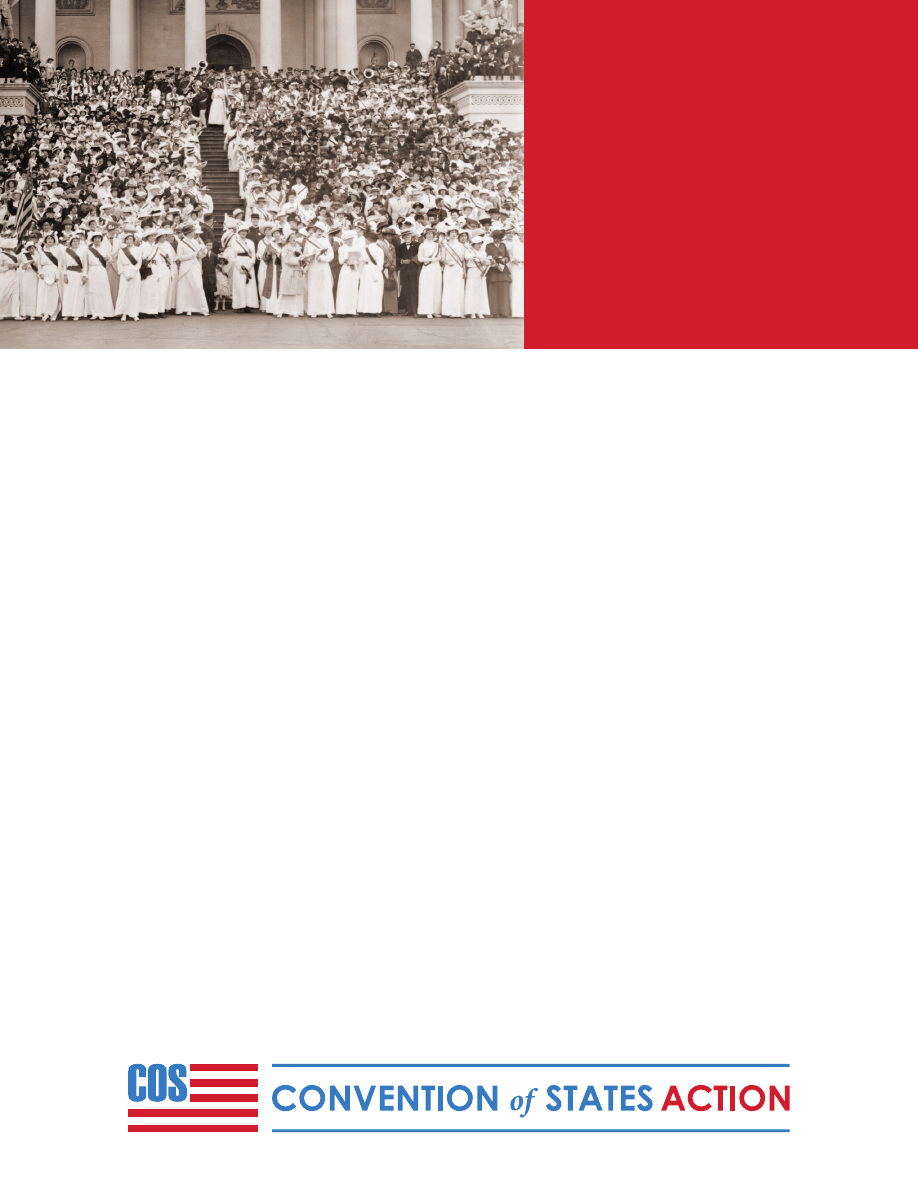
Women’s Suffrage envoys on
and about the East Steps of
the Capitol, May 9, 1914. The
Nineteenth Amendment was
ratified August 18, 1920.|
—-
| Page Metadata ||
|Login Required to view? |No |
|Created: |2024-02-08 18:15 GMT|
|Updated: |2025-02-09 00:00 GMT|
|Published: |2024-02-08 08:00 GMT|
|Converted: |2025-11-11 12:29 GMT|
|Change Author: |Convention of States|
|Credit Author: | |