
public:cb_mirror:svcd_role_manual_pdf_files_24758
To view this on the COS website, click here svcd-role-manual
To download the pdf file from the COS website, click here SVCD-manual-2024.pdf
SVCD Role Manual
SVCD 3/20/24
Attachment: 4162/SVCD-manual-2024.pdf
 State Veteran’s Affairs Coalition Director Table of Contents **Welcome to the Team.....................................................................................................................3\\ ****Responsibilities...............................................................................................................................4\\ ****Becoming Part of Your State Team.............................................................................................. 5\\ ****Growing the Coalition................................................................................................................... 6** Here are some proven ideas that will help you lead your veterans:.....................................6\\ Here are a few things that are helpful to know about holding meetings:............................ 7\\ Work with your SD or Events Coordinator (EC) to determine who to invite:.....................7\\ Work with your State Communications Coordinator (SCC) to:.......................................... 8\\ More Meeting Hints:............................................................................................................8\\ Meeting Follow-up...............................................................................................................8 **Getting to know your legislator.................................................................................................... 9\\ ****Legal Limits On Your Volunteer Activity..................................................................................10** Organizational Information......................................................................................................10\\ How Does This Affect You?.................................................................................................... 11\\ One More Limit: No Campaigning under COSF!................................................................... 11\\ Who Do I Contact If I Have Questions?..................................................................................12 **Continuing Education..................................................................................................................12\\ Personal Development................................................................................................................. 12\\ ****Commonly Used Acronyms.........................................................................................................13** Positions...................................................................................................................................13\\ Tools.........................................................................................................................................13\\ General.....................................................................................................................................13 **State Leadership Flow Chart:.....................................................................................................14\\ ****Your Signature............................................................................................................................. 15\\ Additional Help............................................................................................................................ 15** Page 1 Revised 3/20/24  Welcome to the Team Congratulations! Being selected as the State Veterans Coalition Director (SVCD) for Convention of States (COS) says a great deal about you. Your willingness to step into this vital role and become part of your state leadership team is commended. You have defended the Constitution honorably, and the mission continues! Thank you for your lifetime service to our nation, first through your military service and now your fight to regain freedom and liberty as our founders intended. You are appreciated. The mission of COS is to “Build an engaged army of self-governing grassroots activists”. We aim to grow a grassroots army large enough to call the first convention of states and drive the political and cultural narrative across all 50 states. We want to see self-governance and liberty flourish in our nation, and we believe the only way this will happen is if good people like you get involved in the political and cultural battle. We want to train you how to do this as effectively as possible. If we fail to pass the resolution one year, we keep growing the grassroots team, and training more activists until we have enough influence to effect change and pass the resolution. If you are in a state that has passed the resolution, the mission is the same: the resolution must be defended against rescission, and you must influence change in the name of liberty in your state. Every additional person we educate, train, and get involved with is one person closer to victory! We often say, “There is no political problem that more grassroots can’t fix.” All of this is not done by one person. It is a team effort. You will be working closely with your state team, and good communication with your team will be the key to your success. Here, you will find a wealth of information to equip you to handle most situations. This manual is not intended to be all that you need. Rather, it should give you basic guidelines and principles for you to use as your template. There are three aspects to your training: 1. Personal mentoring. 2. Written training consists of this manual and other files, videos, and documents. Page 2 Revised 3/20/24  3. Upcoming training which will be provided through our COSUniversity on topics such as technology, legal and operational. Responsibilities As a SVCD, your primary role is to help identify, develop, and lead your state’s Veterans Coalition Director Team (VCD Team). You will work closely with the State Director (SD), Grassroots Coordinator (GC), and other members of your state team, and you are the link between these positions and the veterans in your state. Every year, each state team develops a state strategy for the coming year. The list of responsibilities below can help you and your veteran leaders develop a plan to incorporate into the comprehensive state strategy. Basic responsibilities: ● Strive to build a VCD Team by recruiting a VCD for each state region and a VCD Team member for each state House District. ● Learn the CitizenBuilder (CB) tools necessary for communication with the veterans in your state. Train your VCD Team on how to use the tools effectively. ● You are a leader in your state, serving to assist your VCD Team on how to reach, teach, and activate the veterans in your state who have signed the petition and those who expressed an interest in volunteering for our cause. ● Collaborate with your VCD Team on strategies and plans for recruiting more veterans to COS. ● Create a list of local Veteran Service Organization (VSO) chapters and posts in your state. Develop a plan or strategy for you, your VCD Team leaders, and the veterans in your state to build relationships with VSO members and leaders and win their support for COS. ● Report weekly progress to your SD. ● Participate in State Leadership calls. ● Participate in national Veterans Coalition calls. ● Become part of your state Slack workspace and the national VETS4COS Slack workspace. In your state workspace, you will interact with other leaders to brainstorm, encourage each other, and participate in conversations related to your state and its progress with COS. On the national VETS4COS workspace, you can network with Page 3 Revised 3/20/24  SVCDs and VCD Team members from across the nation to learn plans, strategies, experiences, and ideas from each other. ● In coordination with other state leaders, lead and guide the veterans in your state to develop relationships with legislators, influence their support for COS to pass the COS resolution in pending states, and continue COS support in passed states. ● Expect to spend approximately 20 hours per month in this position. Becoming Part of Your State Team You are now a part of a unique and growing team in your state. Here is a directory of all of the leaders in your state. It is important that you communicate frequently with your state team and respond to communications as appropriate. You should also check for communications from SVCDs from other states and the National Veterans Coalition Coordinator. Our primary method of communication is the state Slack workspace and VETS4COS Slack workspace. Your SD will reach out to welcome you into your state COS family and schedule your training. If they don’t reach out to you, please contact them. You will be trained on how to use the following tools: ● CitizenBuilder (CB) ● District Dashboard (DD) ● Slack Get to know your SD and GC. They are there to assist you with training, and to support you in your role. Participate in your state’s regularly scheduled conference calls. The SD will notify you about these calls. They are there to guide, empower, and help you with what you need. The state team will value your input on those calls. As your team grows, plan your own ‘Veterans 4 COS’ conference calls to communicate with and train your team members. You will highlight your veterans on these calls and let them tell their stories. Page 4 Revised 3/20/24  Another form of communication provided for you is a tool called Slack. This is an instant messaging system with your state team and other SVCDs nationwide. You will receive an email invitation to join two Slack workspaces, also known as Slack teams. One is your state team Slack, and the other is the VETS4COS Slack. Please sign up right away. Growing the Coalition The most important lesson about growing this statewide coalition is that you cannot do this alone; you will need to develop a team of veterans to do it. To complete our mission, start working to reach, teach, and activate veterans who have signed the COS petition or indicated a volunteer interest. Bringing new volunteers in through your Veterans Coalition allows for a whole new dynamic—veteran to veteran. Personal contact (face-to-face or on the phone) is essential to building a relationship with your members. The goal is to turn veteran petition signers and volunteers into knowledgeable, engaged veterans who are activists and who will do their part to contribute to the mission. You will find that some new supporters will only want to sign the petition. Some will have a schedule that allows them to only be a ‘Face for COS’—that’s fine—begin there. Some will be willing to become active if they are personally contacted and encouraged. All are important, but these are the kind of citizen-leaders that you need to identify, serve, and mentor. These will be your leaders. Remember that you are a team-builder. For your team to grow, you must recruit volunteers to help make phone calls, facilitate contact with the legislators, help with meetings and events, give presentations, etc. Here are some proven ideas that will help you lead your veterans: Schedule a “meet and greet” type of meeting to answer other veterans' questions about COS. Start by helping them meet with a few veterans in a home, library, coffee shop, or any location that offers a free meeting room. In some instances, they will want to start having meetings every month. When you start, the numbers are not important, so do not worry about trying to get a crowd to come. Involve nearby district captains or other state team members as much as possible—especially during these first few meetings. Page 5 Revised 3/20/24  When hosting a group meeting, you want it to last about 45 minutes (no longer than one hour). We invite you to use our “Introduction to Convention of States” presentation. If you choose to make a personal presentation, here is a sample agenda: ● Welcome and Introductions. 2 minutes ● Background and history of COS and the Mission. 5 minutes ● Points on Article V as the founders handed it to us. 10 minutes ● COS Resolution and how it relates to veterans’ concerns. 5 minutes ● How does the legislative process work? 5 minutes ● Update on the status of your state. 5 minutes ● A call to action to become part of your team. 5 minutes ● Questions and Answers. 10 minutes When you are communicating with the general public, avoid using acronyms such as COS for Convention of States, SD for State Director etc. Here are a few things that are helpful to know about holding meetings: ● Schedule a meeting time and place before you start inviting guests. ● Promotion of your meeting is important. Send an email blast with the meeting details, but do not rely on email alone. Sending a text blast a day before or the day of the meeting is very helpful. Personal phone calls are the most successful way to invite supporters. Consider using the TelePatriot feature on the COSaction app to call supporters. Your state team can help create the call mission. Work with your SD or Events Coordinator (EC) to determine who to invite: ● Veterans. ● Leaders of VSOs. Page 6 Revised 3/20/24  ● Family and friends who you know are interested. ● District Captains (DC) and other COS leaders in the area. Work with your State Communications Coordinator (SCC) to : ● Post an announcement on the COS blog for your state. ● Post an announcement on the state COS Facebook page. ● Spread the word on your own social media accounts. ● Ask people who come to bring a friend next time (many will). ● Challenge everyone attending with a positive call to action. It is helpful to schedule monthly meetings at the same time each month so people can get used to the routine. “Same time, same place!“ Always provide the date of the next meeting at the close of your current meeting. More Meeting Hints: ● As people arrive, have them fill out a sheet with their contact information so you can let them know about the next meeting. This list will also provide you with information to make a personal follow-up contact. ● Allow them to share their stories. Ask questions that can’t be answered with yes or no. Listen to what they share, then turn the conversation to the solution offered by the Convention of States. Use this opportunity to invite them to volunteer. ● Everyone should be encouraged to sign the Convention of States Petition if they have not already done so. While it is great to be able to get a lot of people coming to meetings, remember that some of the most productive events can be small meetings with only a few people present. Meeting Follow-up ● After the meeting, contact them by phone (if a number is provided) or by personal email within 2 days. Thank them for attending, offer to answer any questions, and invite them to your next meeting. ● After you have reached out to the supporters who have already signed the petition, the focus should be to spread awareness in the entire ‘veterans community’. There are many ways this can be done, but some proven methods include setting up a table or booth at any kind of ‘veterans’ events as well as gun shows and festivals. Some veterans groups are beginning to open their meetings for special COS presentations. ● You should log a note in the CB profile for each person who attended your meeting. Page 7 Revised 3/20/24  Getting to know your legislator Meeting or calling your legislator is probably much easier than you think. Letting your legislator know that you support COS is vitally important. One person can make the difference in how a legislator votes, so do not undervalue the impact that you have. Phone calls to your legislator are helpful and necessary, but face-to-face visits are priceless. Hand-written cards are also a very effective way to communicate and are highly valued by your legislator. When contacting a legislator, always identify yourself as a veteran . When calling or visiting, your first point of contact will likely be a staff member. Do not underestimate the role that person can play in whether you are able to speak with the legislator and the success of your meeting. Staff play a large role in shaping a legislator’s agenda and position on issues. Cultivating a positive relationship with the staff will have a tremendous impact on the success of your contacts with the legislator. We always want to be polite and respectful to the legislator and staff, even if they disagree with you. Always schedule an appointment ahead of time rather than walking in. Arrive on time and dress appropriately (casual business). Prepare what you will say in advance. Do your best, but do not worry about saying every word perfectly. You are simply asking them to support Convention of States. Give them several personal reasons in your own words why you support COS and feel it is important. For example, a parent or grandparent may be concerned about the debt, a farmer might mention the negative impact that the EPA has on his farm, a business owner may be concerned about the overreaching federal regulations imposed on businesses. If the legislator or staff has questions, answer them if you are able. If you don’t know an answer, tell them that you will be happy to find out and get back with them (be sure to take a business card to know who to email or call). A member of your state team will be happy to help you provide the answers you need. When you get home (before you have time to forget), write a brief thank you note and mail it to the office. As stated above, a handwritten note will be very impactful and will be noticed much more than an email. Thank your legislator for taking the time to meet with you regarding Convention of States. If a staff member was especially helpful, you might compliment them by name. They will hear about it, and you will likely win a friend in the office! Page 8 Revised 3/20/24  After any phone call or meeting, be sure to keep personal notes and enter a report into the Legislative Management System (LMS) or COSAction app detailing how your meeting went. Pay particular attention to describe any comments that the legislator made to indicate concerns or support and be sure to pass this information along to the appropriate members of your team (e.g. your Legislative Liaison (LL). If your legislator does not support Convention of States, do not give up! Keep going back, and invite others to join you. Many legislators will eventually support when they hear from enough supporters in their district. If your legislator does support, you still need to remain in frequent contact to let him/her know that you would appreciate the support and to encourage the legislator to be an advocate with other legislators. Always speak to them as you would want to be spoken to. Legal Limits On Your Volunteer Activity Convention of States represents a significant threat to the established powers in Washington, D.C. They would love nothing better than to shut us down and silence our voices. We need to keep our activities clean under the law to ensure they can't do that. As part of this, COS requires all state leaders to complete the Legal Training Course at COS University. Organizational Information Who Are Citizens for Self-Governance, Convention of States Foundation, and Convention of States Action, and How Are They Related to Convention of States? Mark Meckler, a co-founder of the Tea Party Patriots, founded Citizens for Self-Governance (CSG) to promote the ideals of the Tea Party beyond the partisan divide. CSG encourages the principle of self-governance by educating citizens about their constitutional rights and defending individuals and groups unjustly targeted by the government. In August 2013, CSG founded the Convention of States Project to educate citizens about a little-known but very potent power in Article V of the Constitution. Convention of States Action (COSA) was created a little over a year later in late 2014 when it became clear that Convention of States would require a massive legislative effort to get applications passed in 34 states. In 2018, CSG filed to operate under the name Convention of States Foundation (COSF) to establish more consistent messaging and make it clear how CSG was connected to the Convention of States movement. CSG and COSF are just two names for the same organization. CSG/COSF continues to be involved with COS by promoting the idea of a convention and educating citizens about their constitutional power in Article V. Most of the COSis now under COSA, which works to get the COS application passed in 34 states. Page 9 Revised 3/20/24  Why Have Two Different Organizations? We have two different organizations because of how the IRS regulates nonprofit organizations. The IRS allows different types of nonprofits to engage in different kinds of activity. According to the IRS, COSF is a 501©(3) nonprofit organization, which means that it can educate people about their constitutional rights but can’t promote legislation to protect those rights or get involved in supporting or opposing candidates. COSA is a 501©(4) nonprofit organization which can promote legislation and support or oppose some candidates as long as it does so in accord with state and federal laws . There are all kinds of technical differences between 501©(3) organizations like COSF and 501©(4) organizations like COSA. However, the main one you need to understand is that COSF can’t promote legislation and absolutely can’t promote or oppose candidates, but COSA can. COSA can talk to legislators about the COS application, collect petitions, host legislative strategy sessions, and engage in other activities to promote the COS application. COSF cannot. How Does This Affect You? Most of your volunteer activity will be for COSA, so you won’t have to worry about the limit on promoting legislation most of the time. But every so often, you may be asked to support or assist with an event or activity sponsored by COSF. When working on a COSF event or activity, you’ll need to remember that you can’t collect petitions, discuss legislative strategy, display COSA materials or banners, or otherwise try to persuade people to support COSA’s specific application. When working for COSF, you can educate people about their constitutional rights, including those in Article V, and respond to frequent objections like claims that a convention would “run away.” One More Limit: No Campaigning under COSF! Promoting or opposing political candidates is strictly prohibited for COSF and is only allowed for COSA if specifically approved by the COSA National Legal Team. COSF cannot do any campaigning ever. COSA can only campaign if it complies with many state and federal laws and regulations governing campaign activity. As a COS volunteer, you can only tell people how they should vote in the next election if you receive explicit permission from the national legal team. You can’t send out an email to our volunteers in your district asking them to support a candidate, oppose a candidate, volunteer for a candidate’s campaign, or join a political party. You should not do anything even close to the line–don’t do anything that could be construed as supporting a particular candidate or political party without checking with COSA’s Legal Team. The prohibition against expressing a political view is an absolute rule that we strictly enforce because any violation will jeopardize the organization’s nonprofit status. Page 10 Revised 3/20/24  If you want to do a limited campaigning effort in your state through COSA, please contact your RD. The COSA Legal Team will check the laws in your state and determine if you can proceed. If the Legal Team approves campaigning in your state, they will issue detailed instructions about how to comply with the law. Make sure you carefully review these instructions before engaging in any election-related activity This restriction only applies when you actively volunteer for COS or use COS resources (including the CitizenBuilder database). You are entirely free to support any candidates or political parties you wish with your own time and resources. Who Do I Contact If I Have Questions? If you would like to get in touch with our legal team about specific questions, please reach out to your State Director or Regional Director, who will be able to direct your inquiry to the right place. Continuing Education We have many resources available. Here are a few to get you started: ● Our Resource Page is the best source to learn more, and we encourage you to visit often. ● Here are a series of short articles on various topics. ● We have hundreds of educational and inspirational videos available on our YouTube Channel. ● COSUniversity offers online training courses. ● Hundreds of research articles and historical documents can be found on our Wiki site . ● COS Briefing Book. ● The Law of Article V by Robert G. Natelson Personal Development “If you want to grow and become the best person you can be, you’ve got to be intentional about it. Many unsuccessful people who try to lead others have the mistaken belief that people will follow them because their cause is good. But that’s not the way leadership works. People will follow you when they believe in you.” - John Maxwell Suggested reading/resources: ● We highly recommend you join an online small group study of the book “Servant Leadership ” by David Kuhnert which is the cornerstone of our leadership training. ○ To receive more information and learn about the classes being offered, please email Ginny Rapini: grapini@cosation.com ● “ Mentoring 101” by John Maxwell ● More Information about Servant Leadership used by our organization. Page 11 Revised 3/20/24 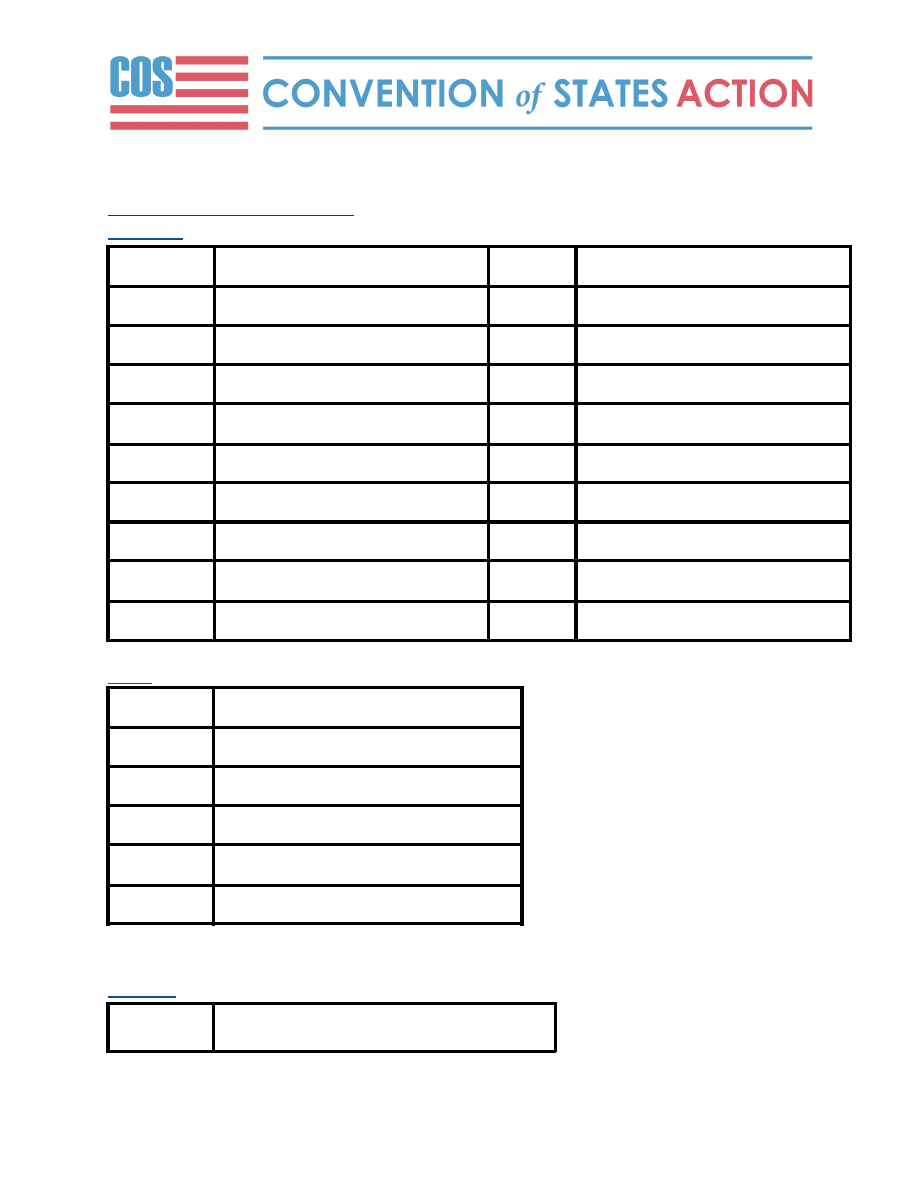 Commonly Used Acronyms Positions SD State Director RC Regional Captain GC Grassroots Coordinator FUT Follow Up Team LL Legislative Liaison DC District Captain ML Media Liaison VCD Veterans Coalition Director SIA State Information Analyst RD Regional Director SCC State Communications Coordinator SMW Social Media Warrior VCD Veterans Coalition Director FBEditor Facebook Editor EC Events Coordinator DD District Dashboard CD Coalitions Director CB Citizen Builder SV State Videographer Tools CB Citizen Builder FUT Follow-up Tool DD District Dashboard LMT Leadership Management Tool LMS Legislative Management System COSU Convention of States University General CTA Call to Action Page 12 Revised 3/20/24 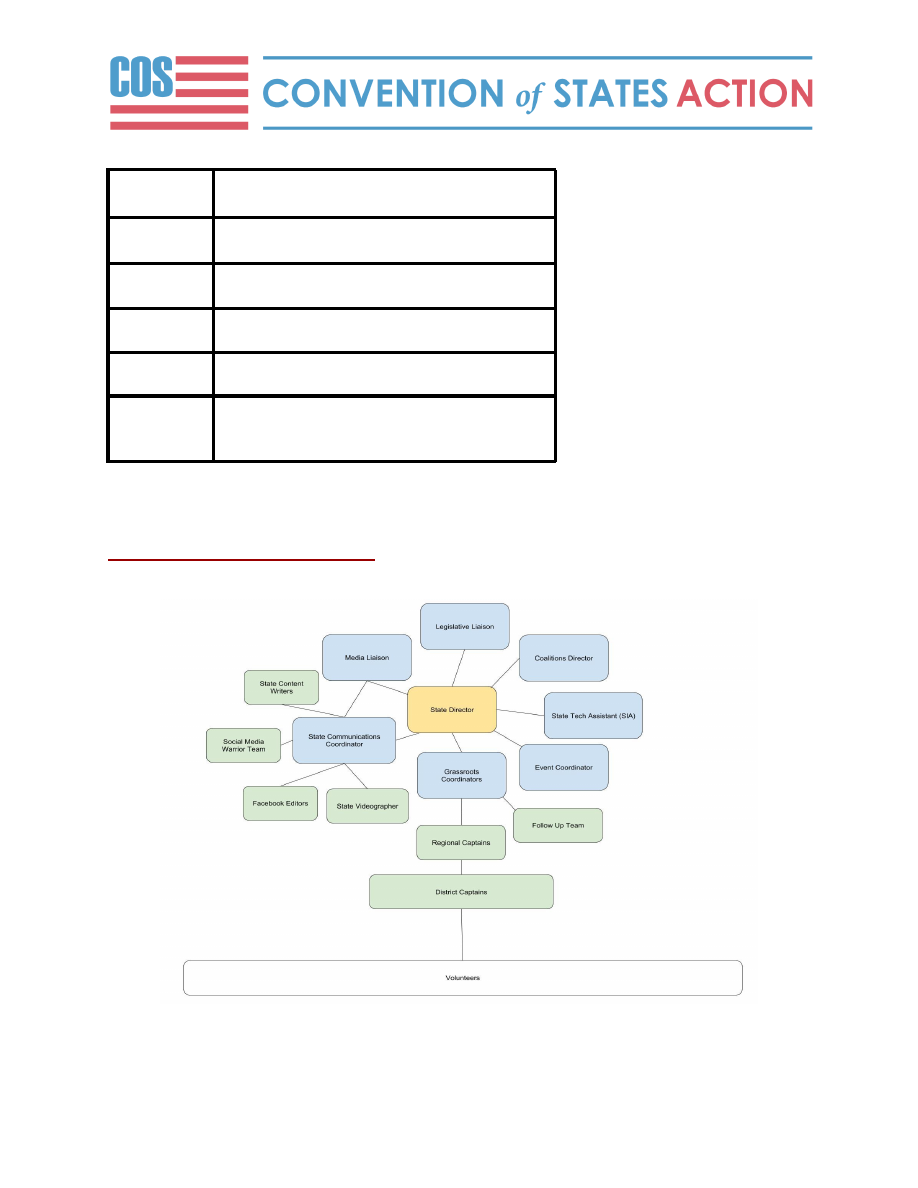 COSA Convention of States Action COSF Convention of States Foundation JBS John Birch Society (opposition group) EF Eagle Forum (opposition group) BBA Balanced Budget Amendment NAGR National Association for Gun Rights (opposition group) State Leadership Flow Chart: Page 13 Revised 3/20/24  Your Signature You should receive an email link to this manual from your state team. Be sure to sign it electronically. Additional Help If you have a question or need assistance with something that is not covered in this manual, please reach out to your State Communications Coordinator or State Director. If they are unable to help, contact the help desk . Page 14 Revised 3/20/24 |
| Page Metadata | |
| Login Required to view? | No |
| Created: | 2024-05-08 05:48 GMT |
| Updated: | 2025-05-08 03:00 GMT |
| Published: | 2024-05-08 05:00 GMT |
| Converted: | 2025-11-11 12:32 GMT |
| Change Author: | Michael Cassidy |
| Credit Author: | |
public/cb_mirror/svcd_role_manual_pdf_files_24758.txt · Last modified: 2025/11/11 12:32 by 127.0.0.1