
To view this on the COS website, click here legislator-reference-manual-example-only
To download the pdf file from the COS website, click here Example_Notebook1.pdf
Legislator Reference Manual (Example Only)
Legislator Reference Manual (Example Only)
Attachment: 356/ExampleNotebook1.pdf
|

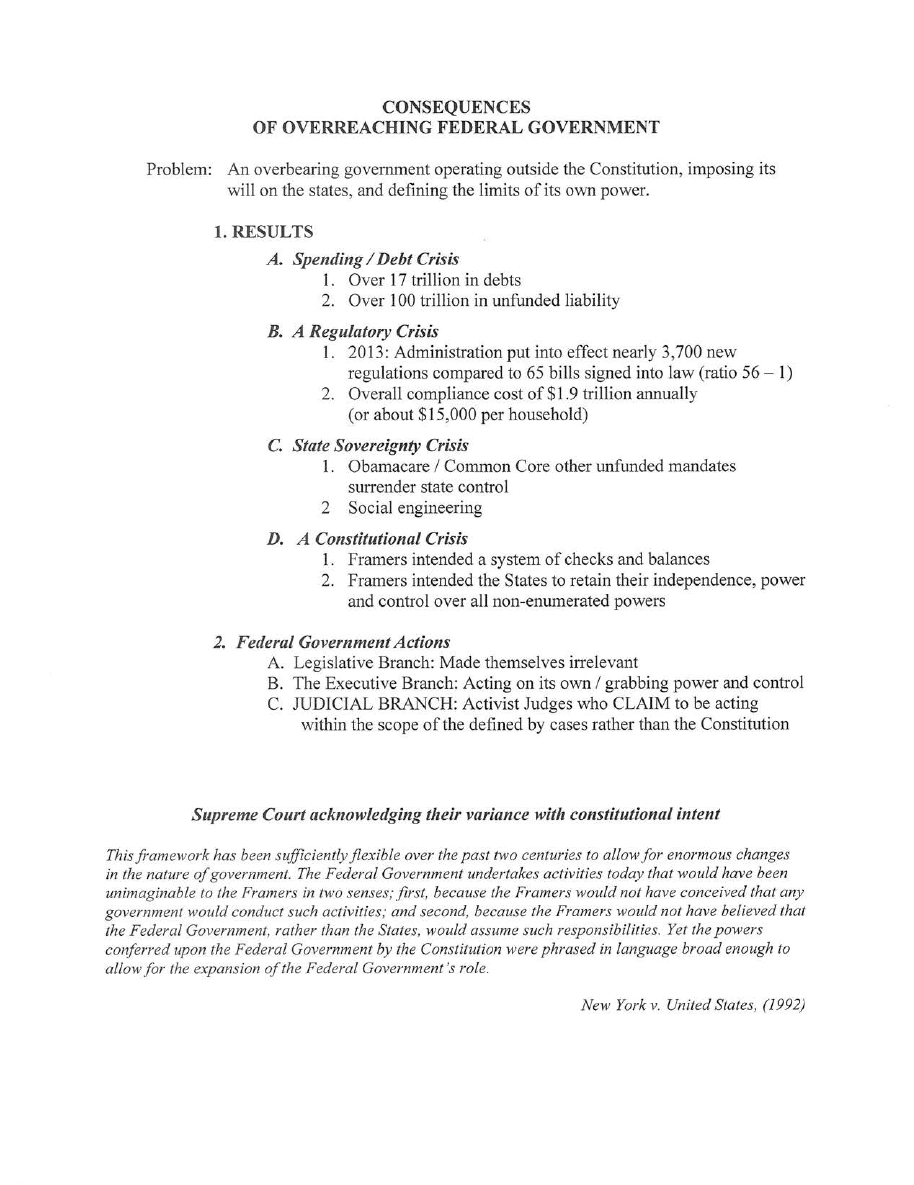

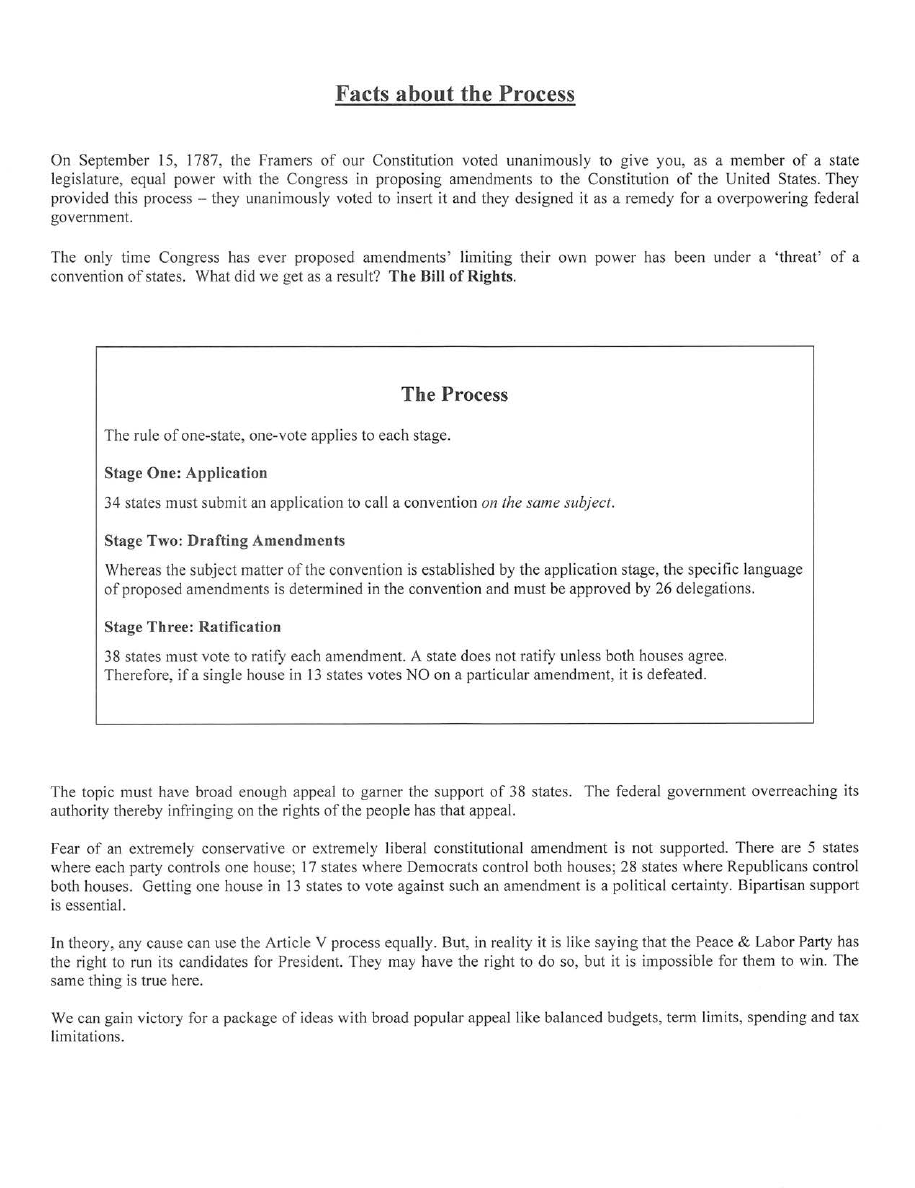
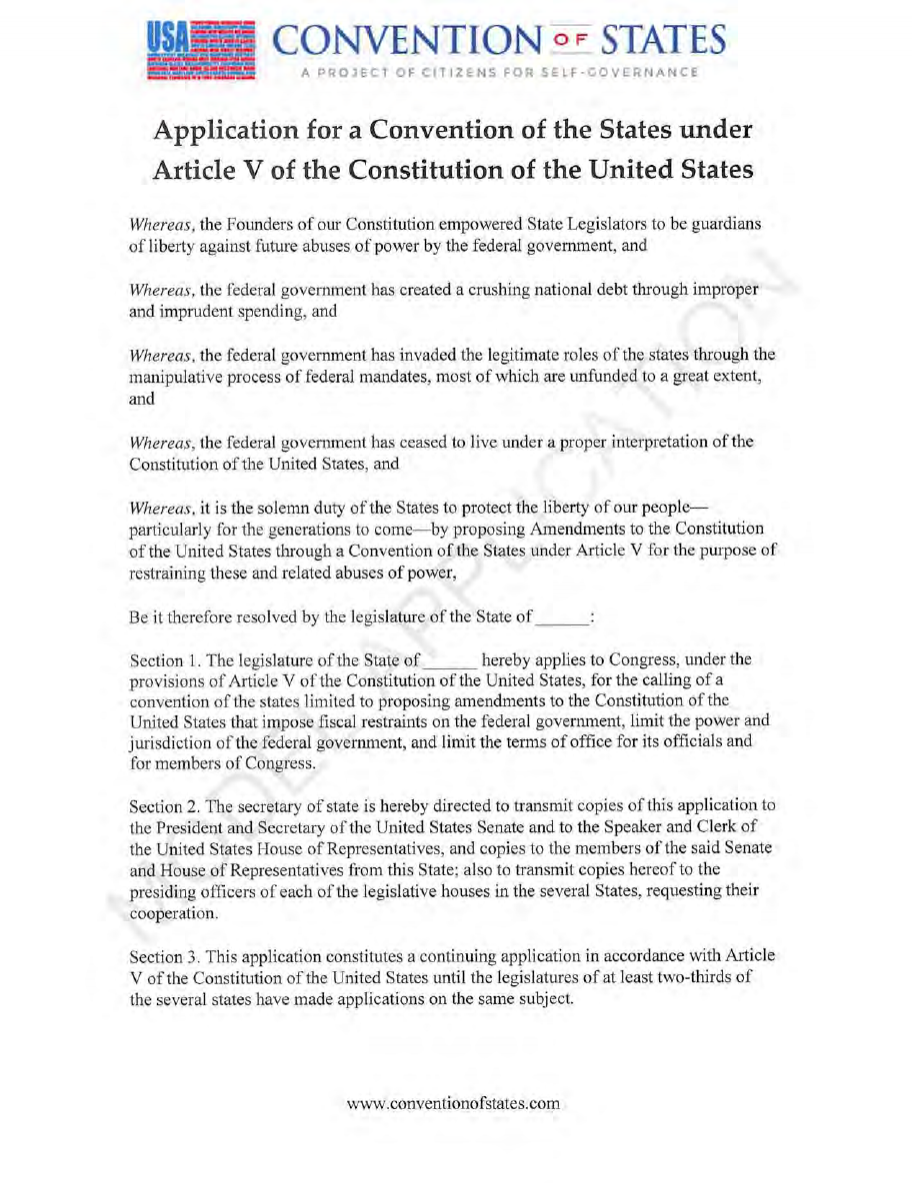
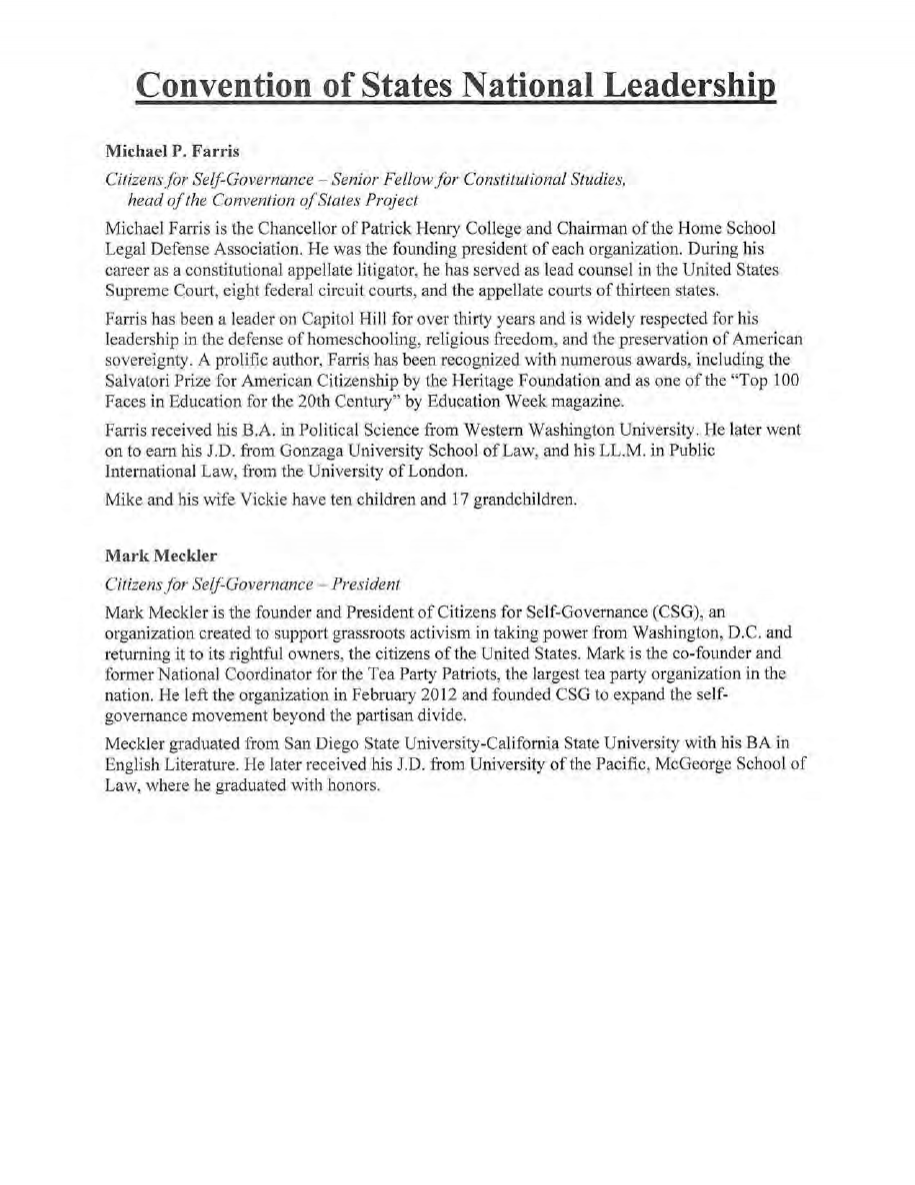
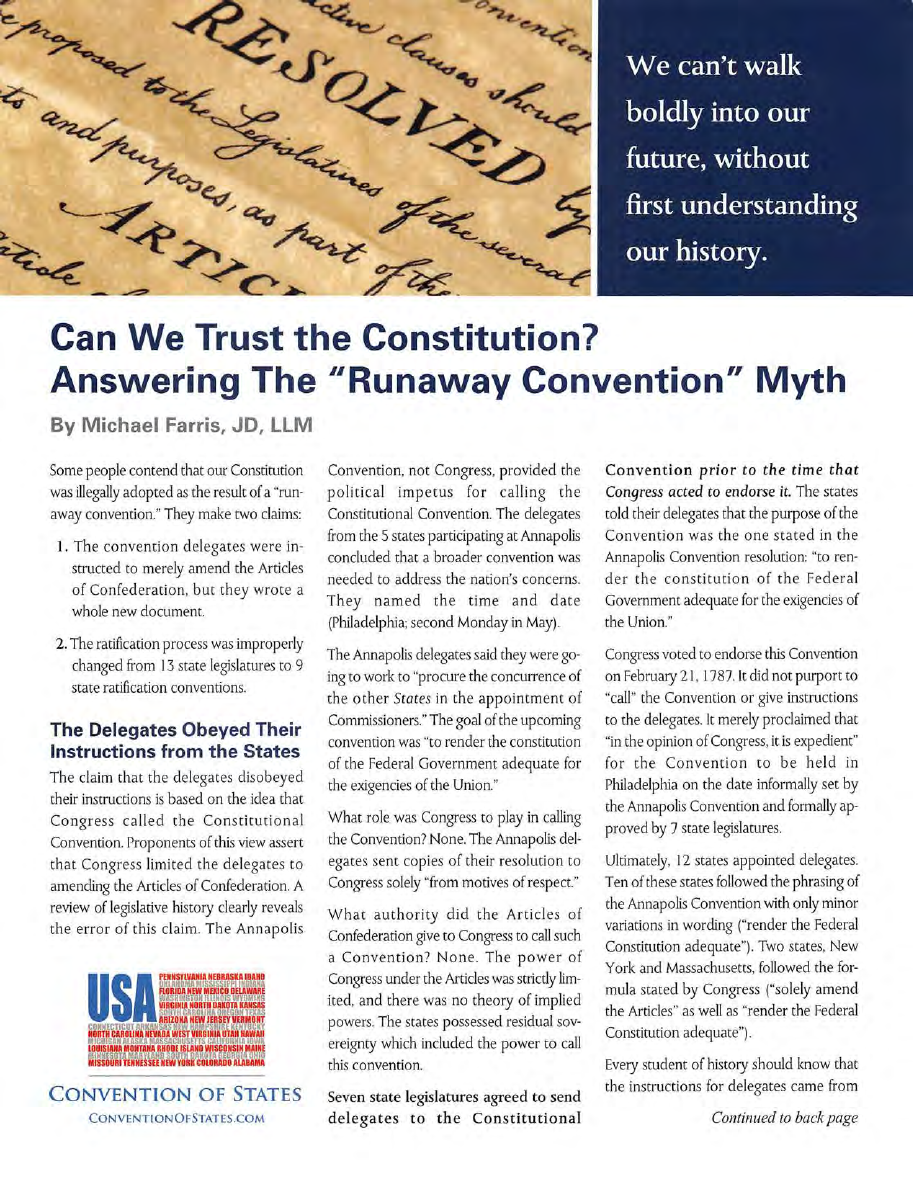












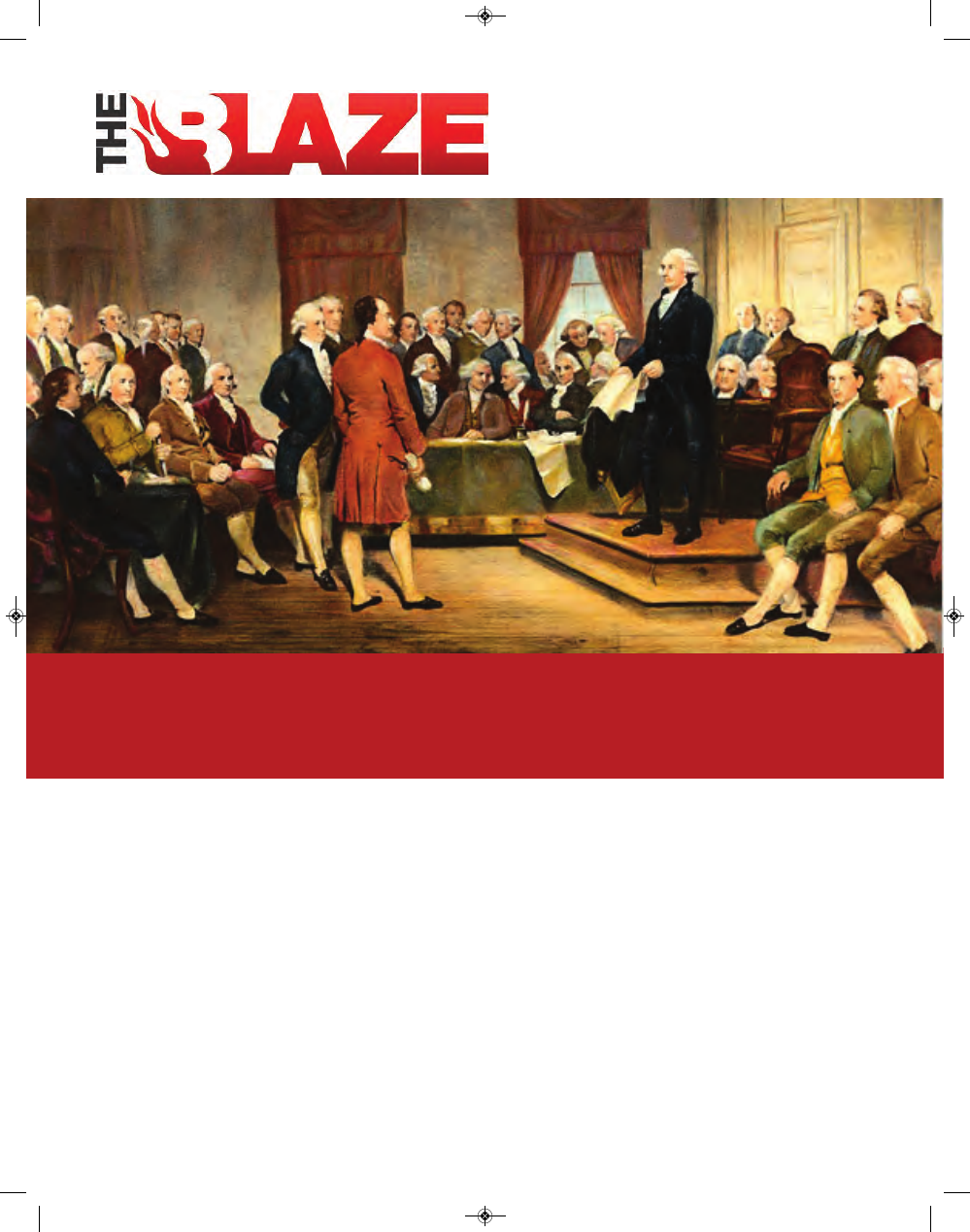
Photo source: Americans for Prosperity
Continued on page 2
Restore Our Republic
Exploring the Purpose and Power of a Convention of States
The Article V Solution Series
Published March 9–13, 2015
By Rita Martin Dunaway |
| theblaze.com
Washington is broken. Our states have been stripped of their rightful decision-making
authority. Debt is out of control, regulations crush free enterprise, and our freedoms
have been stolen.
But we have a solution as big as the problem.
Article V of the Constitution allows the states to call a Convention of States to
propose constitutional amendments to limit federal spending, debt, and regulations.
A Convention of States is the tool given to us by our Founding Fathers to protect and
restore our Constitution, and thereby protect and restore our Republic.
NOW is the time. Discover exactly what a Convention of States is, how it works, what it
can and cannot do. Then decide:
do you have the courage to join us?
COS-Blaze Dunaway July15Layout 1 7/14/15 1:02 PM Page 1

2
We know that the Founders’ whole purpose for
including the convention mechanism was to provide a
way for the states to bypass Congress in achieving
needed constitutional amendments.
P
erhaps the most unifying conservative
trait is the conviction that our Founding
Fathers designed an ingenious federal sys-
tem that we ought to conserve. But as fed-
eralism lies dying and our society spirals
toward socialism, there is dissension
among conservatives about using the pro-
cedure the Founders left to the states to
conserve it.
Because Article V’s amendment-proposing
convention process has never been used,
some have branded it a mystical and dan-
gerous power — a thing shrouded in mys-
tery, riddled with unanswerable questions,
and therefore best left alone. Some have lit-
erally labeled it a “Pandora’s Box,” the
opening of which would unleash all manner
of evil upon our beleaguered nation.
Article V opponents accuse proponents of
being reckless with the Constitution. They
say we have no idea how a convention
would work, who would choose the dele-
gates, how votes would be apportioned, or
whether the topic of amendments could be
limited.
My task today is to remove the shroud
of mysticism by revealing what we do
know about an Article V convention from
its text, context, historical precedent, and
simple logic.
For starters, we know that the Founders’
whole purpose for including the convention
mechanism was to provide a way for the
states to bypass Congress in achieving
needed constitutional amendments.
An early draft of Article V vested Congress
with the sole power to propose constitu-
tional amendments. Under that version,
two-thirds of the states could petition
Congress to propose amendments, but it
was still Congress that did the proposing.
On Sept. 15, 1787, George Mason strenu-
ously objected to this, pointing out that such
a system provided no recourse for the states
if the national government should become
tyrannical, as he predicted it would do.
The result was the unanimous adoption of
Article V in its current form, providing two
ways for constitutional amendments to be
proposed: Congress can propose them, or
the states can propose amendments at a con-
vention called by Congress upon application
from two-thirds, or 34, of the states.
Regardless of which body proposes the
amendments, proposals must be ratified by
three-fourths, or 38, of the states in order to
become effective.
We also know from history that voting at an
Article V convention would be done on a
one-state, one-vote basis. This is the univer-
sal precedent set by the 32 interstate con-
ventions that occurred prior to the
Constitution’s drafting. It explains why it
was unnecessary for Article V to specify the
number of delegates to be sent by each state;
the states can send as many delegates as
they like, but each state only gets one vote.
We know that state legislatures choose and
instruct their convention delegates who act
as agents of the state legislatures. Again, this
is a matter of universal historical precedent
for interstate conventions.
On Nov. 14, 1788, the Virginia General As-
sembly filed the very first application for an
Article V Convention to propose a bill of
rights and aptly branded the convention a
“convention of the States” to be composed
of “deputies from the several States.”
Because Congress ultimately used its own
Article V power to propose a bill of rights,
that meeting was rendered unnecessary. But
the application demonstrates the contempo-
raneous understanding that the convention
process was state-led. The Supreme Court
has likewise referred to the process as a
“convention of states.”
The Article V Solution — Demystifying a Dusty Tool
by Rita Martin Dunaway
|
March 9, 2015
1
Continued to page 3
COS-Blaze Dunaway July15Layout 1 7/14/15 1:02 PM Page 2

3
F
ar and away, fear is the most common
rationale among opponents of Article
V’s convention process for proposing con-
stitutional amendments. Fear of the uncer-
tain result, fear of a Congressional
take-over, fear of George Soros and what
his money might buy.
But even as naysayers sit in their meeting
rooms and chat rooms opining about hy-
pothetical rogue delegates to a hypotheti-
cal convention, Congress continues to
spend money that our great-grandchildren
will one day owe.
Our president continues to use creative
legal arguments to erase the lines that once
separated constitutional powers, thrusting
himself into the business of lawmaking.
Unelected bureaucrats continue to churn
out mountains of regulations that are unau-
thorized by Congress—and in some cases
put hardworking Americans out of work.
And the Supreme Court is one vote away
from a revocation-through-interpretation
of our right to bear arms.
Rather than checking and balancing one
another as they were designed and em-
powered to do, the three branches of the
federal government are acting in concert
to further concentrate their power at the
expense of state prerogatives and individ-
ual liberty.
All three branches are, effectively, making
laws. Congress, the intended lawmaking
branch, has extended its lawmaking into
matters reserved to the states. And our un-
accountable Supreme Court finds inven-
tive ways to interpret the Constitution so
as to justify this—not because it can’t de-
termine the Constitution’s original mean-
ing, but because the original meaning
doesn’t matter if our Constitution is, as we
are told, a “living, breathing document.”
Meanwhile, administrative agencies—the
bold and unmanageable fourth branch of
government—have broken the will of the
American people by the sheer volume of
their regulations, rules, and reports. The
Environmental Protection Agency’s 376-
page “Regulatory Impact Analysis” for its
War on Coal begins with a five-page list
of acronyms to be learned by the aspiring
reader—a virtual electric fence to all but
the most intrepid citizen.
How can we be a self-governing people
when we are completely removed from the
invisible hands that actually regulate us,
with no means of holding them account-
The Article V Solution — The Absurdity of Inaction
by Rita Martin Dunaway
|
March 10, 2015
Ph
ot
o
so
ur
ce
: A
P
Ph
ot
o/
C
ha
rle
s
D
ha
ra
pa
k
Continued on page 4
All three branches are, effectively, making laws.
2
Finally, we know that the topic(s) specified
in the convention applications does matter.
Over 400 applications for an Article V con-
vention have been filed since the drafting of
the Constitution. The reason we have never
had one is because there have never been 34
applications seeking a convention for the
same purpose(s). The state applications con-
tain the agenda for an Article V convention,
and until 34 states agree upon a convention
agenda, there will be no convention.
Because the authority for an Article V con-
vention is derived from the 34 state appli-
cations that trigger it, the topic(s) for
amendments specified in those applications
is a binding limitation on the scope of the
convention.
The “unanswerable” questions about Arti-
cle V do have answers. The unshrouded Ar-
ticle V convention isn’t a Pandora’s Box at
all, because there is no such thing as magic
in a box for us to fear—there is only history,
law, and reason to guide faithful Americans
in tending their government. And precisely
because there is no such thing as magic,
we’re going to need an effective tool to do
the hard work of restoring our Republic.
It’s time to dust off the tool the Founders
gave us in Article V and get started.
n
Continued from page 2
COS-Blaze Dunaway July15Layout 1 7/14/15 1:02 PM Page 3
4
able, and no hope of knowing or under-
standing the laws they are making?
Many who oppose using Article V’s con-
vention process would agree that well-de-
signed constitutional amendments could
close court-created structural loopholes
that have damaged our federal structure
and concentrated power in Washington,
D.C. For instance, we could require con-
gressional approval for all administrative
regulations. We could clarify where Con-
gress’ authority ends and the states’ author-
ity begins so that Congress could actually
have time to do its constitutional job.
Yet some insist that an amendment-
proposing convention amounts to open-
heart surgery for our Constitution, and that
nothing could ever justify such an action.
Newsflash: our beloved Constitution has
been on the operating table, under the knife
of an activist Supreme Court, for decades.
An admittedly imperfect but well-prepared
team of doctors is standing by, eager to
stop the bleeding and close up the wound.
But a fearful crowd of skeptics is blocking
the way. They love this patient and are not
entirely convinced that the doctors’ train-
ing is sufficient. Do they have the proper
supplies? What if armed gunmen enter the
surgical ward and interrupt the lifesaving
process?
“No,” the skeptics conclude. “We can’t be
assured of a good outcome, so we had bet-
ter just stand by.”
And the patient’s life ebbs away.
We could learn a lot from Dietrich Bonho-
effer, the German pastor who resolved to
actively resist Adolf Hitler, at any cost.
Bonhoeffer had a painful understanding
that it is our actions—not our sentiments—
that reveal our truest convictions, and that
our desire for safety can be an obstacle to
the action that our professed morality re-
quires. In 1934, he explained:
“There is no way to peace along the
way of safety. For peace must be
dared. It is itself the great venture and
can never be safe. Peace is the oppo-
site of security.”
It was also Bonhoeffer who said, “Not to
act is to act.”
The Founding Fathers gave us a tool in
Article V to restrain federal power
through state-proposed constitutional
amendments. I do not doubt that the
conservatives trying to block the use of
this tool have sincere reverence for our
founding document. But mere sentiments
cannot rescue our Constitution from con-
tinued disfiguration under the federal
scalpel, nor close the wounds that are
standing open even as we continue this
debate.
n
Continued from page 3
The Supreme Court is one vote away from a revocation-through-
interpretation of our right to bear arms.
COS-Blaze Dunaway July15Layout 1 7/14/15 1:02 PM Page 4
5
The Article V Solution —
The Way to Implement the 10
th
Amendment
by Rita Martin Dunaway
|
March 11, 2015
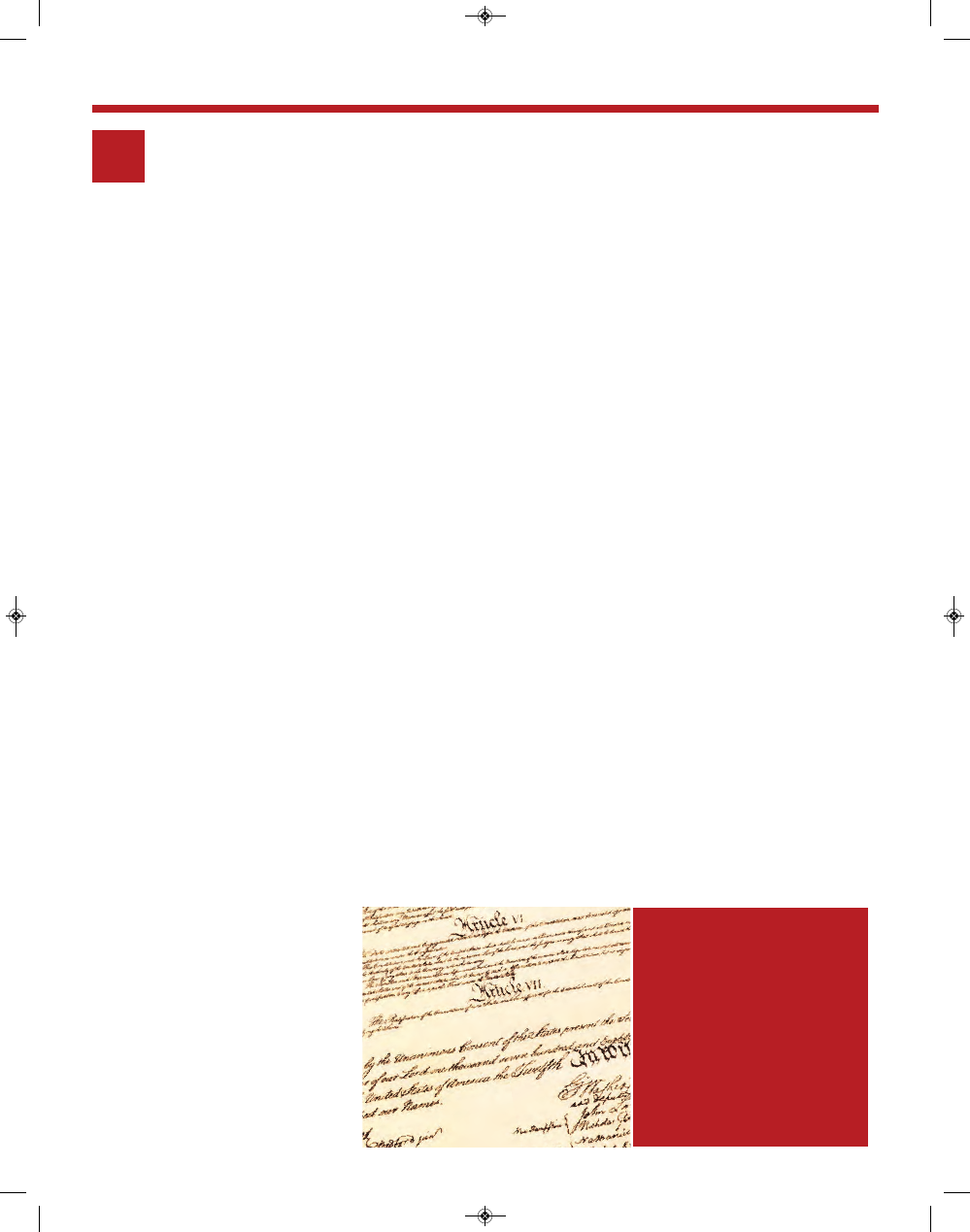
The powers not
delegated to the United
States by the Constitution,
nor prohibited by it to the
states, are reserved to
the states respectively,
or to the people.
I
t’s the elephant in the room. The 10
th
Amendment boldly declares:
“The powers not delegated to the
United States by the Constitution, nor
prohibited by it to the states, are re-
served to the states respectively, or to
the people.”
But if the daily news is any indication,
there is no subject exempt from federal
power. Through its power of the purse,
which is virtually unlimited under the mod-
ern interpretation, Congress can impact, in-
fluence, or coerce behavior in nearly every
aspect of life.
The question, then, that holds the key to
unlocking our constitutional quandary is
this: how do states protect their reserved
powers under the 10
th
Amendment?
On a piecemeal basis, states can certainly
challenge federal actions through lawsuits,
arguing that the federal government lacks
constitutional authority to act in a particu-
lar area. But what if the court, as it is wont
to do, “interprets” the Constitution as pro-
viding the disputed authority? What then?
In their frustration and disbelief over the
growing extent of federal abuses of power
(and the refusal of our Supreme Court to cor-
rect them), some conservatives argue that
states should engage in “nullification,”
whereby the states simply refuse to comply
with federal laws they deem unconstitutional.
While there are some, less dramatic forms
of nullification that are perfectly appropri-
ate and constitutional—such as states re-
fusing to accept federal funds that come
attached to federal requirements—this
state-by-state, ad hoc review of federal law
is fraught with legal and practical pitfalls.
First of all, which state officer, institution,
or individual decides whether a federal ac-
tion is authorized under the Constitution?
Is it the state supreme court, the legislature,
the attorney general—or can any individual
make the determination? After all, the 10
th
Amendment reserves powers to individuals
as well as to states.
Secondly, how can a state enforce its nul-
lification of a federal law? For instance, if
a state decides that the Affordable Care
Act’s individual mandate is unconstitu-
tional, how can it protect its citizens
against the “tax” that will be levied against
them if they fail to comply? It’s difficult to
envision an effective nullification enforce-
ment method that doesn’t end, at some
point, with armed conflict.
But for true conservatives whose goal is to
conserve the original design of our federal
system, the far more fundamental problem
with this type of in-your-face nullification
is the fact that it was not the Founders’ plan.
Article VI tells us that the Constitution and
federal laws passed pursuant to it are the
“supreme law of the land.” Under Article
III, the United States Supreme Court is
considered to be the final interpreter of the
Constitution. While some claim that this
was not the Founders’ intention, historical
records such as Alexander Hamilton’s Fed-
eralist 78 demonstrate it was, in fact, the
judiciary that they intended to assess the
constitutionality of legislative acts.
And then we have the 10
th
Amendment it-
self. It establishes a principle, but it does
not establish a remedy or process for pro-
tecting the reserved powers from federal
intrusion.
That missing process is found in Article V.
Faced with a federal government acting be-
yond the scope of its legitimate powers—
and a Supreme Court that adopts erroneous
interpretations of the Constitution to justify
the federal overreach—the states’ constitu-
tional remedy is to amend the Constitution
to clarify the meaning of the clauses that
have been perverted. In this way, the states
can assert their authority to close the loop-
holes the Supreme Court has opened.
You don’t have to take my word for it.
In an 1830 letter to Edward Everett, James
Madison said:
“Should the provisions of the Constitu-
tion as here reviewed be found not to se-
cure the Government and rights of the
States against usurpations and abuses on
the part of the United States, the final re-
sort within the purview of the Constitu-
tion lies in an amendment of the
Constitution according to a process ap-
plicable by the States.”
In other words, Article V is the ultimate nul-
lification procedure. For states that have the
will to stand up and assert their 10
th
Amend-
ment rights, they can do so by applying for
an Article V convention to propose amend-
ments that restrain federal power.
n
3
COS-Blaze Dunaway July15Layout 1 7/14/15 1:02 PM Page 5
The Article V Solution —
The Founders Would Want Us To Use It
by Rita Martin Dunaway
|
March 12, 2015
4
6
A
s I have explained in previous articles
in this series, most conservative oppo-
nents to Article V’s convention process are
people who revere our Founding Fathers
and the Constitution they created.
While the brave and brilliant men who de-
vised our ingenious federal system are
certainly deserving of our profound re-
spect, admiration, and gratitude, the idea
that they were perfect, infallible states-
men—and that the Constitution is un-
touchable Holy Writ—is antithetical to
their own worldview. And it is this world-
view that inspired our government’s
unique design.
Federalist 51 says it best:
“It may be a reflection on human na-
ture, that such devices should be nec-
essary to control the abuses of
government. But what is government
itself, but the greatest of all reflections
on human nature? If men were angels,
no government would be necessary. If
angels were to govern men, neither ex-
ternal nor internal controls on govern-
ment would be necessary. In framing a
government which is to be adminis-
tered by men over men, the great diffi-
culty lies in this: you must first enable
the government to control the gov-
erned; and in the next place oblige it to
control itself.”
Thus, the Constitution establishes a gov-
ernment replete with checks and balances
designed to make “ambition to counteract
ambition.”
At least, that was the plan. As I explained
in a previous article, the three branches of
our federal government are now acting in
concert to further concentrate federal
power at the expense of state power and
individual liberty.
The Founders predicted this and planned
for it. They provided the states with a
means of imposing additional checks on
all three branches of the federal govern-
ment. They designed Article V’s conven-
tion process specifically to correct any
improper aggregation of power.
Good government is simply not a once-
and-for-all proposition. At a minimum, it
requires our continual exertion to elect
“good” public officials. But because we
don’t do that perfectly, and because even
“good” public officials aren’t perfect, good
government requires various adjustments,
at various times, to realign its operating
structure with the blueprint.
The bold declaration that “all men are
created equal, that they are endowed by
their Creator with certain unalienable
rights” was entirely inconsistent with the
ongoing practice of slavery at our found-
ing. It was perfect in principle, yet de-
manded the blood, sweat and tears of
“In framing a
government which
is to be administered
by men over men,
the great difficulty
lies in this: you must
first enable the
government to control
the governed; and in
the next place oblige
it to control itself.”
Continued on page 7
COS-Blaze Dunaway July15Layout 1 7/14/15 1:02 PM Page 6

7
future generations — and a constitutional
amendment — to effectuate.
Most modern inconsistencies between
constitutional principle and practice result
from interpretations of the language that
conflict with its original meaning. Because
the natural ambition of man has led con-
gresses, presidents, and courts to seize
power at every point of textual vagueness
or ambiguity, modern Americans now con-
front the task of solidifying the original
structure and fortifying limitations on fed-
eral power.
We must use the tools at our disposal to
conform our government’s operating
structure to the blueprint.
I once assembled a desk using pre-fabri-
cated components, a few tools, and an in-
struction booklet. When the project was
finished, I discovered that I had inadver-
tently fastened the drawer to the desktop
in such a way that the drawer cannot be
opened.
Now I can shout, “Open!” at the drawer,
or I can complain about my faulty inter-
pretation of the instructions, but the only
way I will ever achieve a functioning
drawer is to remove the improperly con-
structed pieces and replace them, paying
careful attention to the instructions.
Our Constitution is the operating manual
for our government. At times, those
charged with interpreting the manual have
erred, and erred badly. The result is a dys-
functional federal system.
Those who have read the instructions and
understood them can shout “Obey the
Constitution!” to federal officials. We can
be angry at those who have either purpose-
fully or incompetently interpreted the
manual to produce the mutated system we
have today. But none of this will set things
right.
The only way we will ever return to a
properly functioning federal system is by
repairing the damage that has been done to
it through specific, unambiguous constitu-
tional amendments that reject and replace
the offending workmanship.
It isn’t disloyal to the Founders to propose
constitutional amendments. In fact, the
surest way to honor their legacy is to em-
ulate them. They knew themselves to be
imperfect, and yet they summoned their
courage and acted in pursuit of the high
ideal of self-governance. We must do like-
wise.
n
Continued from page 6
Continued on page 8
The Article V Solution —
Courage Is the Price of Liberty
by Rita Martin Dunaway
|
March 13, 2015
T
hroughout this series, I have argued
t h a t a n A r t i c l e V a m e n d m e n t -
proposing convention offers a viable and
well-designed process for the states to rein
in a runaway federal government and
restore our Republic. In fact, I believe this
process may well be the only way to
close the court-created loopholes to our
Constitution’s original limitations on
federal power.
The process is as safe as any political
process can be, entailing numerous, redun-
dant protections.
First, the scope of authority for the con-
vention is set by the topic(s) specified in
the 34 applications that trigger the conven-
tion. So if 34 states apply for a convention
to propose amendments that limit federal
power, any proposals beyond that scope
would be out of order.
Second, state legislatures can recall any
delegates who exceed their authority or
instructions. As a matter of basic agency
law, actions taken outside the scope of a
delegate’s authority would be void.
Third, even if a majority of convention
delegates went rogue and were left
unchecked by the state legislatures they
represent, and even if Congress neverthe-
Courage was the ink
that marked the words
of the Declaration of
Independence onto the
opening chapter of
America. It was the boat
that carried Gen. George
Washington across the
Delaware River.
5
COS-Blaze Dunaway July15Layout 1 7/14/15 1:02 PM Page 7

8
Continued from page 7
less sent the illicit amendment proposals
to the states for ratification, the courts
could intervene to declare the proposals
void. While the courts don’t have a won-
derful track record in interpreting broad
constitutional language, they do have an
excellent track record of enforcing clear,
technical matters of procedure and
agency law.
But the most important protection on the
Article V process is the explicit constitu-
tional requirement that three-fourths,
or 38, of the states must ratify any pro-
posed amendments in order for them to
become effective. This means that any
bad amendment can be blocked by only
13 states.
In light of the multiple layers of protection
on the state-led Article V convention
process, it is difficult to understand why
some are so afraid of it–or why they don’t
seem to fear Congress’ parallel Article V
power to propose amendments on any sub-
ject, any day it sits in session.
Certainly, no future outcome of any kind
can ever be absolutely guaranteed. Day
has dawned since the beginning of time,
but who can definitively prove that the sun
will rise tomorrow?
What critics must acknowledge, however,
is that the proper risk analysis is a compar-
ative one. It would be difficult for anyone
to maintain, with a straight face, that the
risk of a state-led amendment-proposing
convention is greater than the risk of stay-
ing our current course.
The “risk” (which, again, exists only in the
sense that nothing is entirely risk-free) is
negligible. But to those who can’t see
around it, I posit this: Courage is the price
of liberty. It always has been, and it always
will be.
Courage was the ink that marked the
words of the Declaration of Independence
onto the opening chapter of America. It
was the boat that carried Gen. George
Washington across the Delaware River.
Courage was the tattered uniform of young
men who gave their lives to rid a fledgling
America of the scourge of slavery. It
was the tank that carried weary soldiers
over the battlefields of a Hitler-stained
Europe. And courage was the voice of
Martin Luther King, Jr., challenging
America to end her hypocrisy and make
good on her commitment to the legal
equality of mankind.
America exists because our forefathers
pledged their lives, their fortunes, and their
sacred honor to secure for us the blessings
of liberty and the right of self-governance.
They left us Article V’s convention
process to ensure that we would have a
final defense against federal tyranny. If our
generation is so frozen in fear that we lack
the modicum of courage required to hold
a meeting, then we are simply unworthy of
our heritage.
Courage is the price of liberty.
To learn how you can get involved in this
historic effort to restore our Republic, visit
www.conventionofstates.com.
n
Rita Martin Dunaway serves as
Staff Counsel for The Convention
of States Project and is
passionate about restoring
constitutional governance in the
U.S. Follow her on Facebook
(Rita Martin Dunaway) and e-mail
her at [email protected]
Connect with
Convention of States
Website: ConventionofStates.com
Email: [email protected]
Phone: (540) 441-7227
Facebook:
www.Facebook.com/ConventionOfStates
Twitter: @COSProject
The Convention of States
is a project of
Connect with
Citizens for
Self-Governance
Website: SelfGovern.com
Email: [email protected]
Phone: (512) 943-2014
Facebook:
www.Facebook.com/Citizens4sg
Twitter: @SelfGovernance
COS-Blaze Dunaway July15Layout 1 7/14/15 1:02 PM Page 8
We can’t walk
boldly into our
future, without
first understanding
our history.
Some people contend that our Constitution
was illegally adopted as the result of a “run-
away convention.” They make two claims:
1.
The convention delegates were instructed
to merely amend the Ar ticles of
Confederation, but they wrote a whole
new document.
2.
The ratification process was improperly
changed from
13
state legislatures to
9
state ratification conventions.
The Delegates Obeyed Their
Instructions from the States
The claim that the delegates disobeyed
their instructions is based on the idea that
Congress called the Constitutional
Convention. Proponents of this view
assert that Congress limited the delegates
to amending the Articles of Confederation.
A review of legislative history clearly reveals
the error of this claim. The Annapolis
Convention, not Congress, provided the po-
litical impetus for calling the Constitutional
Convention. The delegates from the
5
states
participating at Annapolis concluded that a
broader convention was needed to address
the nation’s concerns. They named the time
and date (Philadelphia; second Monday
in May).
The Annapolis delegates said they were going
to work to “procure the concurrence of the
other
States
in the appointment of
Commissioners.” The goal of the upcoming
convention was “to render the constitution of
the Federal Government adequate for the ex-
igencies of the Union.”
What role was Congress to play in calling the
Convention? None. The Annapolis delegates
sent copies of their resolution to Congress
solely “from motives of respect.”
What authority did the Ar ticles of
Confederation give to Congress to call such
a Convention? None. The power of Congress
under the Articles was strictly limited, and
there was no theory of implied powers. The
states possessed residual sovereignty which
included the power to call this convention.
Seven state legislatures agreed to
send delegates to the Constitutional
Convention
prior to the time that
Congress acted to endorse it
.
The states
told their delegates that the purpose of the
Convention was the one stated in the
Annapolis Convention resolution: “to render
the constitution of the Federal Government
adequate for the exigencies of the Union.”
Congress voted to endorse this Convention
on February
21, 1787
. It did not purport to
“call” the Convention or give instructions to
the delegates. It merely proclaimed that “in
the opinion of Congress, it is expedient” for
the Convention to be held in Philadelphia on
the date informally set by the Annapolis
Convention and formally approved by
7
state legislatures.
Ultimately,
12
states appointed delegates. Ten
of these states followed the phrasing of the
Annapolis Convention with only minor vari-
ations in wording (“render the Federal
Constitution adequate”). Two states, New
York and Massachusetts, followed the for-
mula stated by Congress (“solely amend the
Articles” as well as “render the Federal
Constitution adequate”).
Every student of history should know that
Can We Trust the Constitution?
Answering The “Runaway Convention” Myth
Michael P. Farris, JD, LLM, Convention of States Action — Senior Fellow for Constitutional Studies
Continued to back page
Continued from front page
History tells the story.
The Constitution was legally adopted.
Now, let’s move on to getting our
nation back to the greatness the
Founders originally envisioned.
the instructions for delegates came from
the states. In
Federalist 40
, James Madison
answered the question of “who gave the
binding instructions to the delegates.” He
said: “The powers of the convention ought,
in strictness, to be determined by an inspec-
tion of the commissions given to the mem-
bers by their respective constituents [i.e. the
states].” He then spends the balance of
Federalist 40
proving that the delegates
from all 12 states properly followed the di-
rections they were given by each of their
states. According to Madison, the February
21
st
resolution from Congress was merely
“a recommendatory act.”
The States, not Congress, called the
Constitutional Convention. They told
their delegates to render the Federal
Constitution adequate for the exigencies of
the Union. And that is exactly what
they did.
The Ratification Process Was
Properly Changed
The Articles of Confederation required any
amendments to be approved by Congress
and ratified by all
13
state legislatures.
Moreover, the Annapolis Convention and
a clear majority of the states insisted that
any amendments coming from the
Constitutional Convention would have to
be approved in this same manner—by
Congress and all
13
state legislatures.
The reason for this rule can be found in the
principles of international law. At the time,
the states were sovereigns. The Articles of
Confederation were, in essence, a treaty be-
tween
13
sovereign nations. Normally, the
only way changes in a treaty can be ratified
is by the approval of all parties to the treaty.
However, a treaty can provide for some-
thing less than unanimous approval if all the
parties agree to a new approval process be-
fore it goes into effect. This is exactly what
the Founders did.
When the Convention sent its draft of the
Constitution to Congress, it also recom-
mended a new ratification process.
Congress approved both the Constitution
itself and the new process.
Along with changing the number of re-
quired states from
13
to
9
, the new ratifica-
tion process required that state
conventions ratify the Constitution rather
than state legislatures. This was done in ac-
cord with the preamble of the
Constitution—the Supreme Law of the
Land would be ratified in the name of “We
the People” rather than “We the States.”
But before this change in ratification
could be valid,
all 13 state legislatures
would also have to consent to the new
method.
All 13 state legislatures did
just this by calling conventions of the
people to vote on the merits of
the Constitution.
Twelve states held popular elections to vote
for delegates. Rhode Island made every
voter a delegate and held a series of town
meetings to vote on the Constitution. Thus,
every state legislature consented to the new
ratification process thereby validating the
Constitution’s requirements for ratification.
Those who claim to be constitutionalists
while contending that the Constitution
was illegally adopted are undermining
themselves. It is like saying George
Washington was a great American hero,
but he was also a British spy. I stand with
the integrity of our Founders who
properly drafted and properly ratified
the Constitution.
Website: ConventionOfStates.com
E-mail: [email protected]
Phone: (540) 441-7227
www.Facebook.com/ConventionOfStates
Twitter: @COSProject

The First-Ever Article V
Convention of States Simulation
~ A Historic Endeavor ~
of
Executive Summary
50 State Delegations Unite to
Pursue Federal Restraints
C
ONVENTION
O
F
S
TATES
.
COM

Mark Meckler
President & Co-Founder
106 E 6
th
Street
Suite 900
Austin, TX 78701
Office: 530-274-9900
[email protected]

1
Table of Contents
Page
INTRODUCTION
The First Ever Convention of States Simulation
3
OPENING SUMMARY
Convention Opening Plenary Session
5
COMMITTEE SUMMARIES
Fiscal Restraints Committee
7
Federal Legislative & Executive Jurisdiction Committee
8
Term Limits & Federal Judicial Jurisdiction Committee
10
CLOSING SUMMARY
Convention Closing Plenary Session
11
LASTING IMPRESSIONS OF CONVENTION SIMULATION
Concluding Letter to Commissioners from Simulation President, Rep. Ken Ivory (UT)
17
Commissioners & Legal Advisors Lasting Impressions
18
COMMITTEE ON FISCAL RESTRAINTS
Fiscal Restraints Committee Official Report
21
Citizen Proposed Amendments: Fiscal Restraints
22
COMMITTEE ON FEDERAL LEGISLATIVE & EXECUTIVE JURISDICTION
Federal Legislative & Executive Jurisdiction Committee Official Report
25
Citizen Proposed Amendments: Federal Legislative & Executive Jurisdiction
27
COMMITTEE ON TERM LIMITS & FEDERAL JUDICIAL JURISDICTION
Term Limits & Federal Judicial Jurisdiction Committee Official Report
31
Citizen Proposed Amendments: Term Limits & Federal Judicial Jurisdiction
32
FINAL CONVENTION REPORT & STATEMENT TO THE AMERICAN PEOPLE
Official Proposed Amendments, Passed out of the Convention of States Simulation
35
APPENDIX
Leadership of the Convention of States Project
37
Roster of State Delegations
39
Convention of States Application
42
Proposed Convention Rules
43
TA
BLE
OF
C
ON
TE
N
TS

2

3
INTRODUCTION
The First Ever Convention of States Simulation - A Historic Endeavor
On September 22nd, a historic event began in Colonial Williamsburg.
Every
state in the Union was present for
the first-ever Simulated Article V Convention to propose amendments to the United States Constitution.
A total of 137 Commissioners, including 115 sitting state legislators and 22 non-legislator citizens took part in
testing this long-neglected constitutional process with the set of draft rules developed by constitutional experts
Professor Robert Natelson and Michael Farris, and reviewed by the COS Caucus, to guide the process.
These 137 Commissioners came to the Simulation representing a broad and diverse range of state and regional
concerns. They came from greatly varying political experiences. Their constituencies ranged from poor inner-
city Americans to the wealthy, affluent movers and shakers of society. But they all came with this common
political bond: the recognition that Washington, D.C. has overstepped its bounds and operated unchecked for
far too long.
The goal of the Simulation was threefold:
1.
Educate Legislators. The Article V Convention of
States process has never been used. It was important to bring
legislators together from all over the country, to use the
process, run a convention according to the rules, and thereby
create “experts” who would then have a deep, personal
knowledge of how the process actually works.
2.
Build a Network of State Legislators. We know the
power of having a network of educated grassroots in all fifty
states, and based on that model, we believed that it was
imperative to build a similar network of state legislators
committed to the Article V cause. The synergistic effect of
The Simulation proved that the
Article V Convention process is
safe and effective.
IN
TR
O
D
U
C
TI
ON

4
working in a group with a common goal was part of the end game of the Simulation.
3.
Prove that a Convention Works. An Article V convention has never been held before, so it was
important to show proof of concept. We can talk about an Article V Convention of States all we want,
but until we demonstrated one, it was all theory.
The Simulation unfolded seamlessly. The Commissioners built relationships that are continuing. The rules
worked flawlessly. The limited call was obeyed and there was not even a hint of a “run away.” But most
important of all, the Simulation engaged ordinary Americans in a meaningful exercise of self-governance and
proved that state legislators are responsive to the people.
Several weeks prior to the Simulation, Convention of States Senior Fellow for Constitutional Studies, Michael
Farris, hosted a live Facebook event for the purpose of training citizens in the art of crafting constitutional
amendment proposals. COS provided a platform for those citizens to submit their own amendment proposals
for consideration by Commissioners at the Simulation.
Of course, COS’s team of lawyers and experts had its own slate of favored proposals. But the mission of Citizens
for Self-Governance is not to push our own ideas for reforming our nation—it’s to educate and engage the
people
to advocate for the reforms
they
believe are needed to restore our constitutional republic.
So yes, the Simulation proved that the Article V Convention process is safe and effective. But even more
importantly, the thousands of citizen-drafted proposals that formed the basis of the Simulation’s deliberations
proved that Americans are ready to be an engaged, self-governing people again and that State Legislators are
ready to listen.
This handbook will give you an inside view of the Simulation’s proceedings from the perspective of the people
who were there. Enclosed you will find:
An account from the Convention Secretary, Robert Kelly, as to what transpired at each of the
Convention’s Plenary Sessions;
An account from each of the Committee Secretaries as to how each Committee meeting
unfolded;
A letter sent by Convention President Rep. Ken Ivory (UT) to the Convention upon its
conclusion;
Closing comments from Commissioners and Legal Advisors;
The Final Report of each Committee meeting, which was delivered to the Convention;
A sampling of proposals from the grassroots, which were submitted to the Commissioners in
advance of the Simulation for their consideration; and
The Final Report of the Convention, including its statement to the American people and the
amendment proposals that were adopted
IN
TR
O
D
U
C
TI
ON

5
CONVENTION OPENING PLENARY SESSION
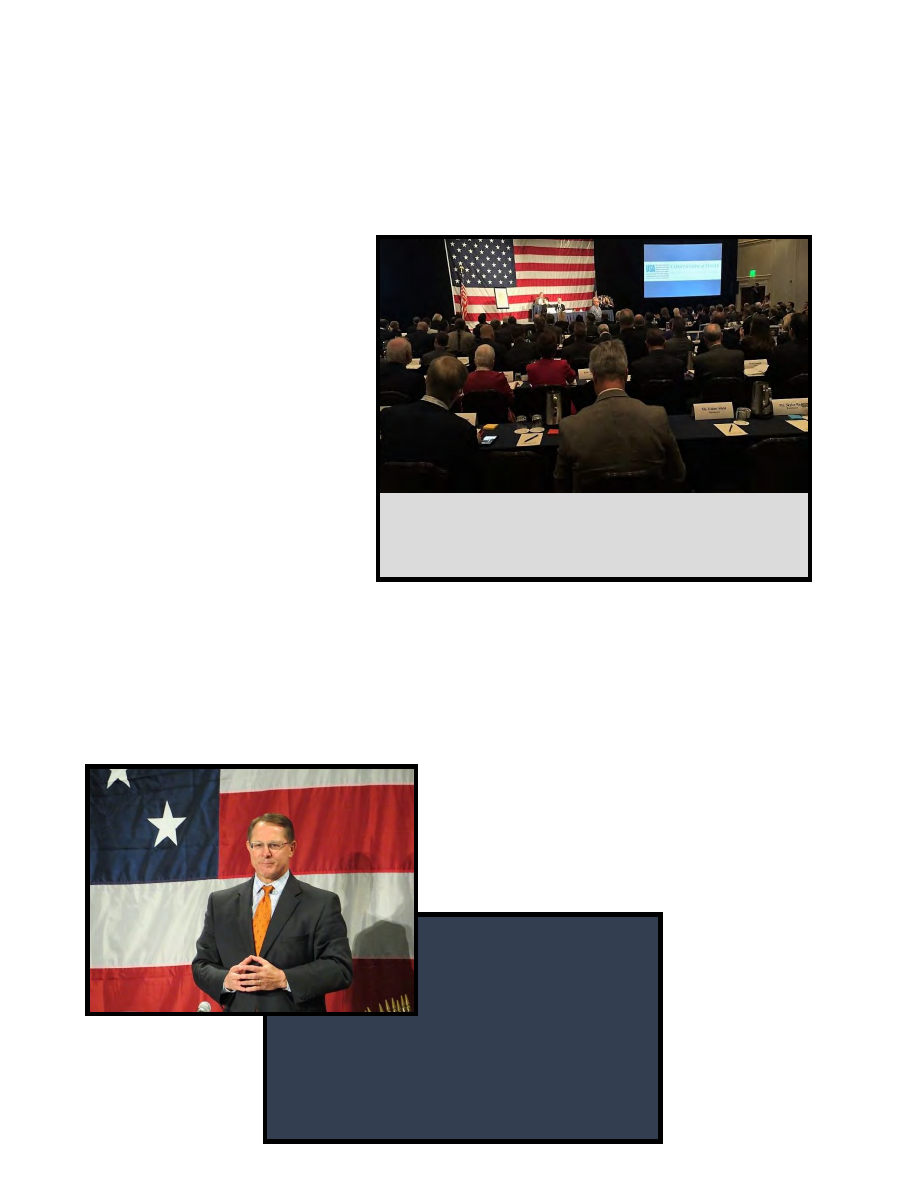
At precisely 9:00 on the morning of Thursday, September 22, 2016, the temporary Convention
President, Rep. Buzz Brockway (GA), gaveled the Simulated Convention of States to order. There
was the brief scramble of everyone taking their seats, followed by a moment of silence as everyone
took a deep breath and absorbed the moment.
Rep. Buzz Brockway (GA) ordered the Secretary to
call the roll, and commenced with the business of the
Convention. As the roll was called and each state
indicated its presence the air was thick with a sense of
history in the making. Forty-nine of the fifty states
reported present, with Arkansas shortly to show up.
Rep. Buzz Brockway (GA) noted the existence of a
quorum and invited retired US Sen. Tom Coburn to
offer an invocation for the body. US Sen. Coburn led
the Convention in a solemn prayer to God that He
might assist the Convention in its business and use the
Commissioners as His instruments to turn the direction
of the country back to Him and to its founding
principles.
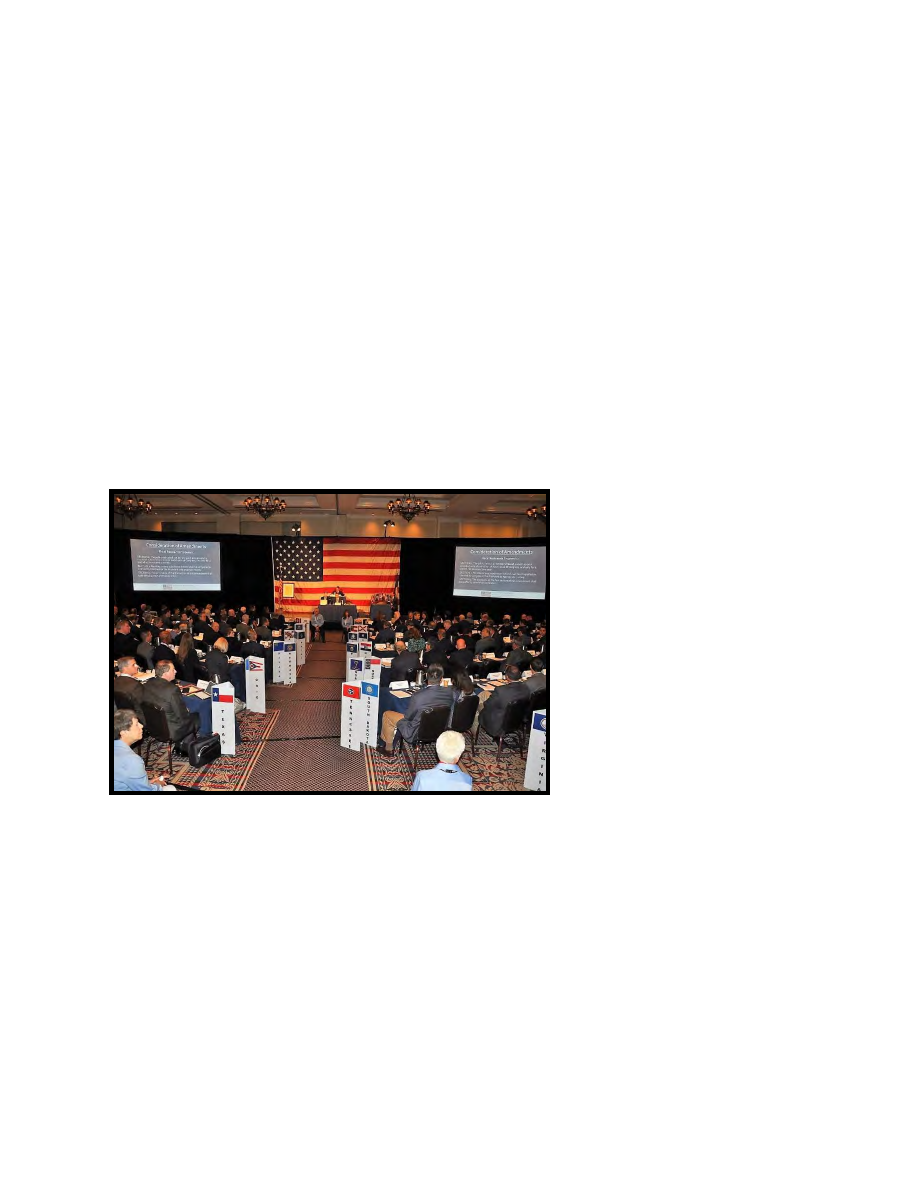
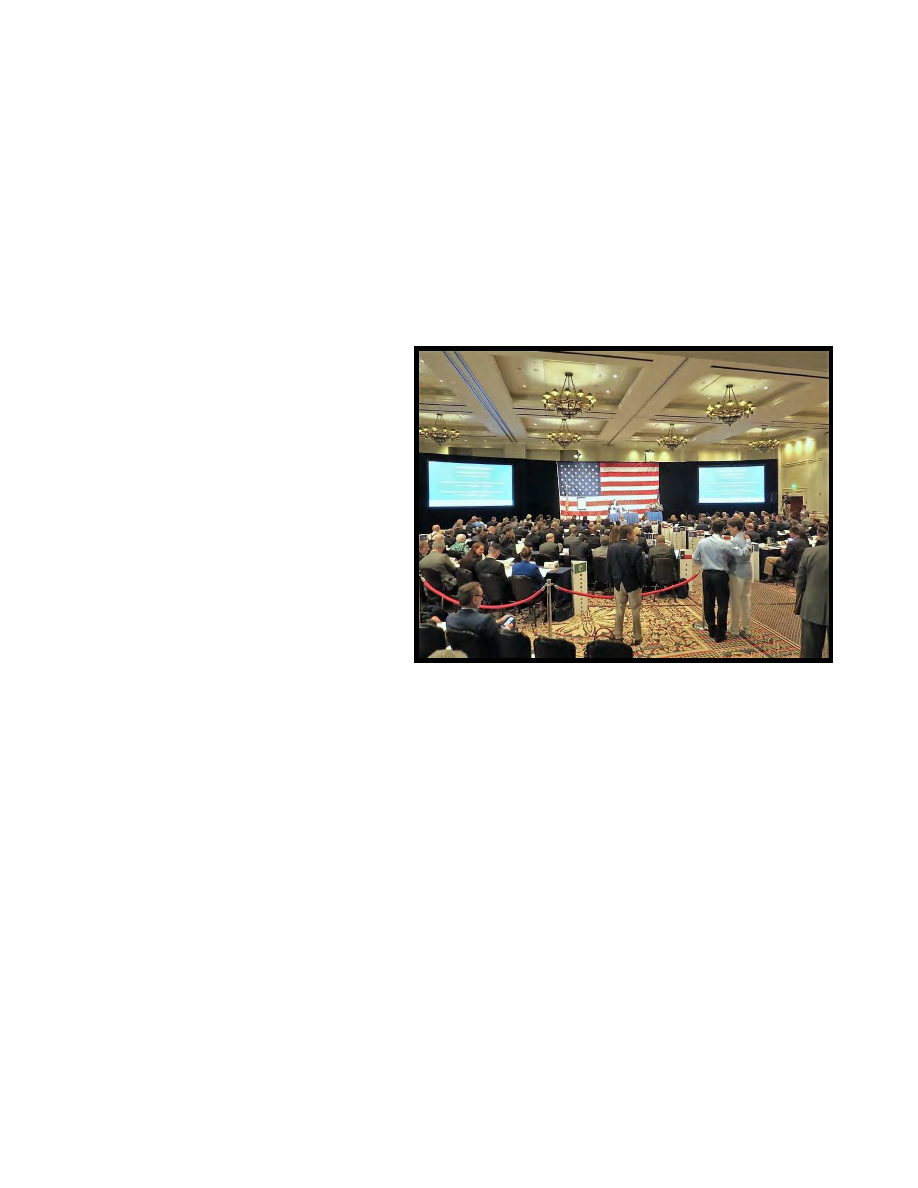
With a huge American Flag behind the main stage, Rep. Buzz Brockway (GA) led the Convention in
the Pledge of Allegiance. It is hard to imagine a more patriotic and solemn moment than the convening
of Commissioners from all fifty states, standing together to pledge their fidelity to our great nation,
before beginning the difficult work of debating how to reform and preserve it for our posterity.
As the Commissioners were seated, Rep. Buzz Brockway (GA) addressed the body. He challenged
the Commissioners to rise to the occasion and to take their task seriously. He encouraged them to
serve as an example to the American people so that the people might realize they need not look to
Washington to solve the nation’s problems.
Rep. Buzz Brockway (GA), then introduced the candidates for Convention President and Vice
President, and asked that they stand as they were named:
The Temporary Convention President allowed the Commissioners a brief moment to consider the
candidates and then asked the Secretary to call the roll. The states were divided between the candidates
and no candidate received a majority of votes. With 12 votes, Rep. Ken Ivory, from Utah was the
leading candidate, followed closely by Dr. John Eastman from California and Rep. Kelly Townsend
from Arizona with 10 votes each.
Rep. Matt Caldwell (FL)
Sen. Gary Daniels (NH)
Dr. John Eastman (CA)
Sen. Alan Hays (FL)
Rep. Ken Ivory (UT)
First-Ever Simulated Convention
of States called to order
September 22, 2016
Sen. Kevin Lundberg (CO)
Mr. Kurt O’Keefe (MI)
Rep. Kelly Townsend (AZ)
Hon. Vance Wilkins (VA)
C
O
N
V
EN
TI
O
N
OP
EN
IN
G
PLEN
A
R
Y
SESSIO
N
6
“Today is the day, the winds
of change are about to blow.”
- Rep. Ken Ivory (UT)
In acts of inspiring statesmanship, several of the nominees voluntarily withdrew their candidacy, and
Rep. Buzz Brockway (GA) encouraged the states to consolidate their votes behind the remaining
nominees. He then ordered the roll a second time. On the second vote, the states were again divided
with Rep. Ken Ivory (UT) receiving a plurality of 17 votes, Dr. Eastman receiving 13, and Rep. Kelly
Townsend (AZ) receiving 11. A murmur ran through the assembly as the Delegations conferred
among themselves and each other.
Rep. Buzz Brockway (GA) again
encouraged the states to consolidate
their votes and again ordered the
roll. On the third vote, Rep. Ken Ivory
(UT) received a majority vote of 28
states and was elected as the
Convention President. Dr. Eastman,
with 12 votes, was elected as the
Convention Vice President.
As Rep. Ken Ivory (UT) took the
podium, he spoke to the body. He
acknowledged the honor that it was to
serve as President before such a group
in such a historic location. He
challenged the body to recognize that
the struggles the nation is facing are not
a product of personnel, but of structure.
The federal government has become a bloated bureaucracy and the states have become almost
powerless. Article V, he urged, is the tool to repair and maintain our federal system of
government. He pled with the Commissioners to act as guardians of the people’s liberty and to work
diligently to that end. Rep. Ken Ivory’s (UT) speech sounded as if it had been lovingly crafted over
a long period of time. Yet it was off the cuff, and from the heart. The man clearly matched the
moment, and the feeling that something special was happening was magnified by his presence at the
podium.
With his exhortation still hanging in the air, Rep. Ken
Ivory (UT) dismissed the Convention to their
Committees and declared the full assembly meeting
adjourned for the day.
State Delegations vote Rep. Ken Ivory
(UT) Convention President
C
O
N
V
EN
TI
O
N
OP
EN
IN
G
PLEN
A
R
Y
SESSIO
N

7
FISCAL RESTRAINTS COMMITTEE
SECRETARY’S SUMMARY
The Fiscal Restraints Committee began with Rep. Bruce Williamson (GA), as temporary Chair pursuant to the
Rules, leading a vote to elect Sen. Kevin Lundberg (CO) as Chair and Rep. Tammie Wilson (AK) as Co-Chair
of the Committee. Commissioners from forty-nine states comprised the Committee, which was tasked with
considering a full docket of amendment proposals involving limitations on taxation and spending and balancing
the federal budget. Professor Robert Natelson was present as a legal advisor and constitutional drafting
consultant.
The first amendment considered under the
subject of balancing the budget was a Debt
Limitation Amendment, which passed by a
wide margin. Under this proposal, the
public debt cannot be increased except
upon a recorded vote of two-thirds of
Congress.
The Committee then moved to the subject
of limiting taxation and spending. The
second proposal adopted by the Committee
was the Fair Tax Amendment, effectively
repealing the 16
th
Amendment and
imposing a national sales tax (the national
sales tax was later stricken by the main
body, as they felt a method of taxation
should not be part of the Constitution but
should instead be enacted legislatively).
This was followed by the narrow passage of a Line Item Veto Amendment proposal (The Line Item Veto
Amendment proposal was later voted down by the main body.
By far, the most time was spent on devising a Balanced Budget Amendment. Commissioners came prepared
for this task with many proposals on how to tackle this complex subject. As possibilities were discussed,
Commissioners such as Sen. Brandt Hershman (IN), who brought extensive fiscal policy experience from their
respective states, weighed in on unintended consequences of wording. Commissioners who are business owners,
such as Bobby Massarini (NY), pointed out that the amendment must be straightforward so that it can be widely
understood by the public. The Chair suggested that a Subcommittee work with Sen. Josh Brecheen (OK), to
hammer out details.
As the Subcommittee returned, the discussion and objections continued. A feeling of disappointment pervaded
the Committee as it realized it would not be able to devise a Balanced Budget Amendment in the short time
allotted to it. Rep. Bill Patmon (OH), a fiscally conservative Democrat, stated that he was committed to staying
late into the night, so determined was he to take something acceptable to his constituents. Statesmanship was
on full display in the Committee room, as Commissioners demonstrated their disdain for disappointing the
constituents they serve.
Vice-Chair Tammie Wilson (AK) put things in perspective for the Committee. She pointed out that although
they could not finish this important amendment in the course of this single day and that they had disagreed on
minor issues, they
had
accomplished a great deal in a very short time. These Commissioners
had
come from all
different states with the common goal of stopping Washington DC from its overreach. She expressed confidence
that with more time in the real Convention, an amendment could certainly be devised that they could agree
upon. She concluded: “Washington should be scared!”
Fiscal Restraints Committee
FI
SC
A
L
R
EST
R
A
IN
TS
C
O
M
M
IT
TEE

8
FEDERAL LEGISLATIVE AND EXECUTIVE
JURISDICTION COMMITTEE
SECRETARY’S SUMMARY:
The Federal Legislative and Executive Jurisdiction Committee convened promptly upon adjournment of the
Convention’s Thursday plenary session. The Temporary Committee Chair, Rep. Buzz Brockway (GA),
gaveled the Convention to order and promptly commenced with the Committee’s agenda and ordered the
Secretary to call the roll. The Committee was comprised of Commissioners representing 46 states, 44 of which
were present and ready to proceed with the Committee’s business. Constitutional Scholar Professor Randy
Barnett was also present to act as the Committee’s legal and drafting advisor.
Rep. Buzz Brockway (GA), next proceeded to the election of his replacement, a permanent chair and vice-chair
for the Committee. On the first vote, the Committee was divided with 14 states supporting Sen. Rob Standridge
(OK), 13 supporting Rep. Matt Caldwell (FL), and 16 supporting one of several other candidates. On the second
vote, Sen. Rob Standridge (OK), received a majority and was elected as a Committee Chair with 25 votes. Rep.
Matt Caldwell (FL), as the second highest vote recipient, was elected Committee Vice-Chair with 10 votes.
Notably, throughout the election, Sen. Rob Standridge (OK) abstained from voting and did not cast a ballot in
his own favor, an action which garnered some comments of approval from the other Commissioners.
After a brief address impressing upon the Committee the importance of its task, the Chair opened the floor to
discussion of how the Committee should organize and consider the numerous proposals before it. Initially, there
was no consensus, and the Committee was forced to briefly recess while the Chair and Vice-Chair conferred
over how best to organize the amendment proposals for the Committee’s consideration. Vice-Chair Caldwell
ultimately moved that each of the amendment proposals be grouped into topics and that the Committee should
select the three topics it considered most important. The Committee would then consolidate and consider all of
the amendment proposals under those topics together. On a voice vote, the Committee agreed to this
process. Vice-Chair Caldwell grouped the proposals into 13 separate topics. Through a series of votes, the
Committee narrowed its consideration to three topics: limits on federal rulemaking, limits on Congress’s
Commerce Clause power, and granting the states authority to countermand federal laws. The Committee then
broke into Subcommittees for each topic. Each Subcommittee was charged with consolidating the several
proposals under its topic into a single proposal to be brought back to the body.
The Subcommittee on Rulemaking, as chaired by Sen. Travis Holdman (IN), was tasked with consolidating
seven separate proposals, each of which sought to restrain the growing federal bureaucracy in one way or
another. The Committee ultimately decided on a procedural
check on administrative agencies: Congress could continue
to delegate rulemaking authority to these agencies, but if a
quarter of either House of Congress objected to the rule, a
majority of both Houses would need to vote to affirm the
rule. The Subcommittee noted that Congress frequently
gridlocks on controversial proposals, and so they drafted the
amendment to make it clear that in the event that Congress
does not take any action on a challenged administrative rule,
it is effectively repealed. As one of the Commissioners
noted, Congress shouldn’t be able to pass laws by gridlock,
doing nothing and allowing unelected bureaucrats to do it
for them.
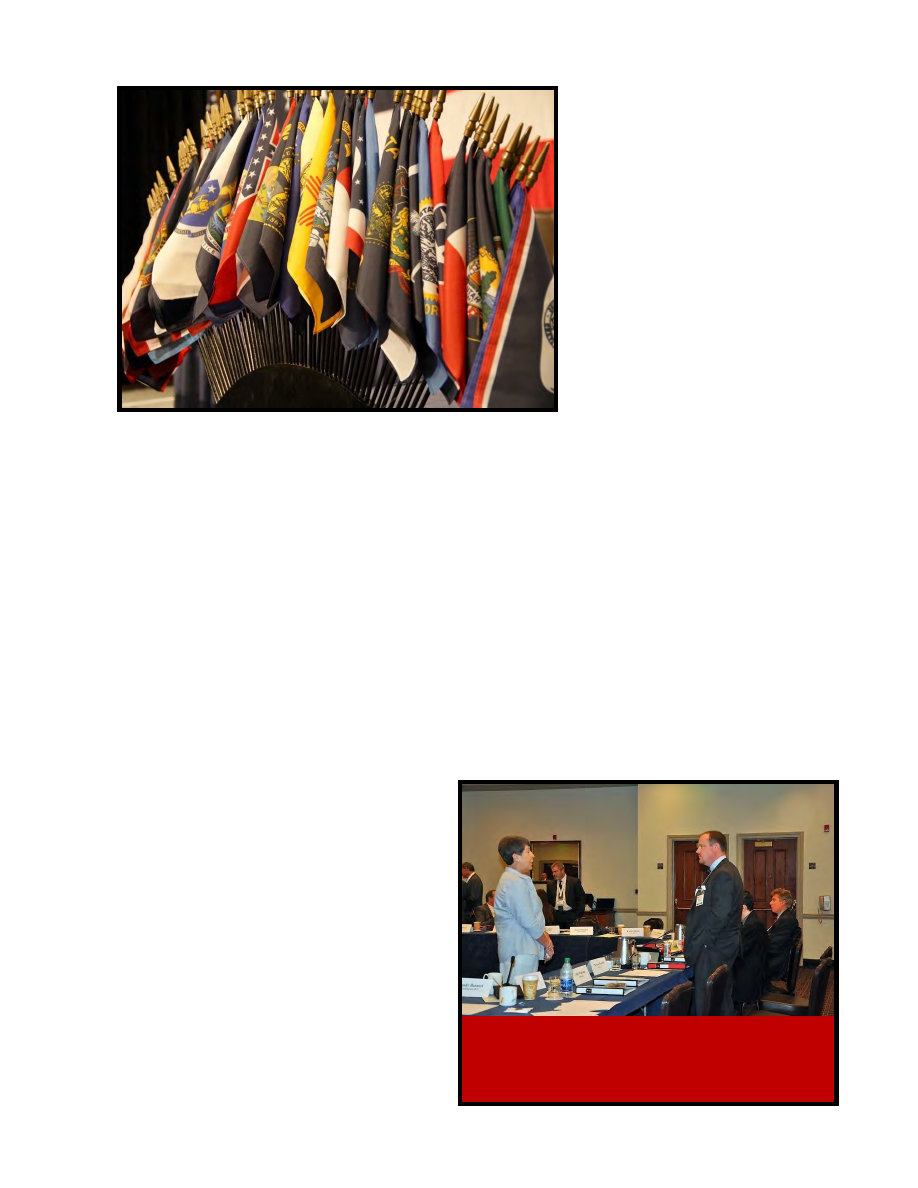
Federal Legislative and Executive
Jurisdiction Subcommittee
FEDE
RAL
LE
GI
SLA
TIVE
& EXE
CUT
IVE
JURI
SDIC
TI
ON CO
M
M
ITT
EE
9
The Subcommittee on the Commerce
Clause was led by Vice-Chair
Caldwell. Despite their disparate
backgrounds, the Commissioners
quickly agreed that Congress’s
Commerce Clause power needed to be
curtailed. This amendment was also
popular among the citizens. Numerous
people had proposed amendments
limiting the Commerce Clause power.
This popular support formed the
backdrop of the Subcommittee’s
deliberations. Of particular concern to
the Subcommittee was ensuring that the
Supreme Court could not simply
reinterpret Congress’s Commerce
Clause as it had in the past. On the
advice of Professor Barnett, the
Subcommittee adopted a two-prong approach. In the first section of the amendment, it affirmatively set forth
what the Commerce Power was intended to be. In the second section, it stated all of the things the Commerce
Power was not, and included language from many of the Supreme Court decisions that had expanded the
Commerce Clause, leaving no room for the Supreme Court to misinterpret or misunderstand the purpose of the
Amendment.
The Subcommittee on Countermand met for the longest time, even as the other Subcommittees were
reconvening into the main body. Under the leadership of Rep. Jim Kasper (ND), the Subcommittee knew it
needed to strike a balance. On one hand, the states needed a constitutional mechanism to push back against
federal abuses of power; on the other, the rule of law needed to be preserved–it would be inappropriate for
states representing a small minority of the population to abrogate federal laws that are supported by the vast
majority of the American people. The Subcommittee debated whether a simple majority of the states should
be able to abrogate federal laws or whether a supermajority should be required. Ultimately, the Subcommittee
opted for a compromise: three-fifths of the states would need to agree in order to abrogate a federal law. This
would ensure that a small minority of the population couldn’t thwart the will of a majority, but would still allow
the states to serve as an instrument of the people when Congress or the Supreme Court implement unpopular
policy.
The Subcommittees went about their work diligently, knowing they had little time to craft these important
amendments. They were so absorbed in their
work that they barely broke for lunch. Instead,
as lunch was carted by, the Commissioners
dashed out into the hallway to make their
selections, and then quickly returned to resume
their discussion. Numerous drafts and revisions
were printed, struck-out, revised, and reprinted. As
an expert in Constitutional Law, Professor
Barnett’s advice was frequently sought, and
many times he found himself needing to be in
three places at once.
In the end, each of the proposals drafted by the
Subcommittees was brought before the entire
Committee for review and approval. Each proposal
met with overwhelming support and was set for
formal introduction to the Convention on the next
day.
Federal Legislative & Executive
Jurisdiction Subcommittee Recess
FEDE
RAL
LE
GI
SLA
TIVE
& EXE
CUT
IVE
JURI
SDIC
TI
ON CO
M
M
ITT
EE

10
TERM LIMITS & FEDERAL JUDICIAL
JURISDICTION COMMITTEE
SECRETARY’S SUMMARY:
The meeting began with the election of the Honorable Vance Wilkins, former Speaker of the House of Virginia,
as Committee Chair. Sen. Alan Hays from Florida was elected as Vice-Chair.
Chairman Wilkins (VA), chose to take up the topic of term limits first. He insisted upon informal debate as
much as possible and suggested the combination of the best possible language from each of the proposals before
the Committee. He moved to have term limits on Congress and term limits on the judiciary separated, and the
body agreed to handle them separately. The Chair then asked the body to review the proposals before them and
prioritize.
The Committee began debate on term limits on Congress. They immediately recognized that term limits were
very popular with the American people, a fact which was reflected the number of terms limits proposals put
forward by the citizens. The debate on term limits lasted for nearly three hours with the Commissioners raising
numerous issues, including the proper number of terms, and whether term limits would only serve to empower
the federal bureaucracies. Several alterations were made to the original proposal through the debate process,
which led to a compromise from all. The final product reflected a wide range of views on the topic, including
the views of some on the Committee who did not support term limits at all.
The Committee turned next to the consideration of limits on the Supreme Court’s jurisdiction. The Committee
decided that it could best represent the people’s wishes by providing a method for vacating Supreme Court
decisions rather than directly reducing the Court’s jurisdiction. There was a general consensus that the people
might find limits on the Supreme Court too controversial. The Committee quickly broke in the middle of its
discussion to grab lunch. A short five minutes later, the Committee was back to their deliberations.
The Chair made the decision to handle the afternoon session in a different manner. He broke up the Committee
into two Subcommittees. One would consider term limits on the Supreme Court, and the other would consider
methods of vacating the Court’s decisions. The Subcommittees split for about one hour to work amongst
themselves and each recommend one proposal back to the entire Committee.
The Subcommittee on Supreme Court Term Limits diverged from any of the initial proposals the Committee
had received. The Subcommittee’s unique proposal left many on the Committee uneasy that a single President
might have the ability to name most of the Court. The Committee itself was sharply divided between those
who favored term limits on the Court and those who favored lifetime appointment. Concerns over giving the
President too much power over the Court ultimately
outweighed concerns about lifetime appointment, and the
Committee rejected the Subcommittee’s proposal.
The Subcommittee on Vacating Supreme Court Decisions
felt there was a deep need to reinvigorate the states’ power
under the Tenth Amendment, which has been effectively
gutted by the Court. The Subcommittee considered a
variety of drafts and ultimately came forward with a
compound proposal that adopted many of the best features
of each. The whole Committee overwhelmingly supported
the proposal and quickly adopted it for a proposal to the
entire Convention.
With its deliberations ended, the Committee adjourned.
Rep. Scott Clem (WY) in Term
Limits & Federal Jurisdiction
Committee
TE
RM
LI
M
IT
S
& F
EDE
RA
L
JU
DICIAL
JURIS
DICT
IO
N
CO
M
M
ITT
EE
11
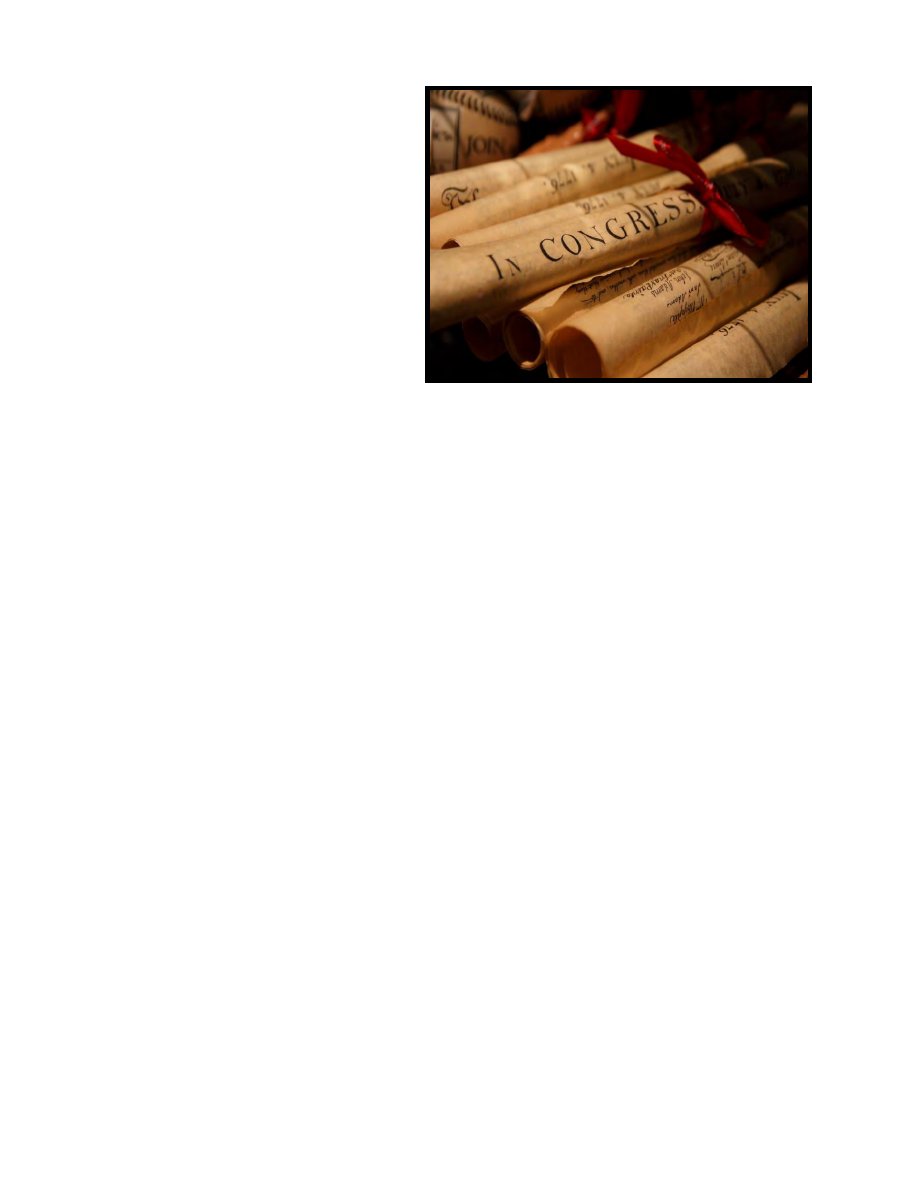
CONVENTION CLOSING PLENARY SESSION
Prior to the final Plenary Session, the Commissioners attended a breakfast at which they were treated to a speech
by a historian portraying Founding Father, Patrick Henry. Patrick Henry delivered his famous “Give Me
Liberty, or Give Me Death” speech, exhorting the Commissioners to act boldly and bravely as they debated in
the session to come. He set the stage and the mood for what was to be an extraordinary day ahead.
At 9:08 on the morning of September 23rd, as the commissioners trickled in from breakfast, Convention
President Rep. Ken Ivory (UT), gaveled the second plenary session of the Simulated Convention of States to
order. Rep. Ken Ivory (UT) ordered the roll to be called and forty-nine states reported as present, with Kentucky
absent.
The Secretary reported a quorum, and Rep. Ken Ivory (UT) invited Michael Farris to offer the
invocation. Michael Farris prayed for God’s blessings on the proceedings of the day and asked that He preserve
the nation’s heritage of self-governance and liberty.
Upon conclusion of the invocation, Rep. Ken Ivory (UT) led the Convention in the Pledge of Allegiance. Once
again, the air was thick with a feeling of history being made, and an almost indescribable sense of seriousness
reigned. While all knew that this was a simulation, none were treating it as such. They were dealing with our
most precious founding document, and each Commissioner took their role seriously.
Rep. Ken Ivory (UT) asked for a motion
to approve the minutes of the previous
day. The motion was made and seconded
and was adopted by unanimous voice
vote.
Each of the Committee Chairs, Sen.
Kevin Lundberg (CO), Sen. Rob
Standridge (OK), and The Hon.
Vance Wilkins (VA), introduced the
proposals put forward by their
respective Committees (Committee
Reports included on pages 21 through
32) and moved that they be
considered by the body at the
appropriate time. Each of the
Committee Reports was adopted by a
unanimous voice vote of the Convention.
Rep. Ken Ivory (UT) acknowledged the limited time available for consideration of the proposals and urged the
Commissioners to keep their remarks on each proposal brief. With that note in mind, Sen. Kevin Lundberg
(CO) introduced the first proposal of the Fiscal Restraints Committee:
SECTION 1.
The public debt shall not be increased except upon a recorded vote of two-thirds of
each house of Congress, and only for a period not to exceed one year.
SECTION 2
. No state or any subdivision thereof shall be compelled or coerced by Congress or the
President to appropriate money.
SECTION 3.
The provisions of the first section of this amendment shall take effect three years
after ratification.
CONVENT
ION
CL
O
SING P
LE
NARY
SES
SION
12
Debate ensued, with the Commissioners
proceeding to dissect the language of the proposed
amendment. Commissioners questioned whether
“compelled or coerced” was the appropriate
language and suggested “required” might be more
straightforward and to the point. One
Commissioner suggested that perhaps Section 2
should apply to Congress, the President, and the
Federal Judiciary, not just Congress and the
President. But this raised concerns that it might
make it impossible to enforce contracts with the
state governments. Ultimately, the Convention
simply decided to adopt the language as
proposed. On a roll call vote, the debt limitation
amendment passed overwhelmingly: 45 to 3.
Next, Rep. Matt Caldwell (FL) introduced the first proposal of the Federal Legislative and Executive
Jurisdiction Committee:
SECTION 1
. The power of Congress to regulate commerce among the several states shall be
limited to the regulation of the sale, shipment, transportation, or any movement of goods, articles
or persons. Congress may not regulate activity solely because it affects commerce among the
several states.
SECTION 2
. The power of Congress to make all laws that are necessary and proper to regulate
commerce among the several states, or with foreign nations, shall not be construed to include the
power to regulate or prohibit any activity that is confined within a single state regardless of its
effects outside the state, whether it employs instrumentalities therefrom, or whether its regulation
or prohibition is part of a comprehensive regulatory scheme; but Congress shall have the power to
define and provide for punishment of offenses constituting acts of war or violent insurrection
against the United States.
SECTION 3
. State legislatures shall have the standing to file any claim alleging a violation of this
article. Nothing in this article shall be construed to limit standing that may otherwise exist for a
person.
SECTION 4
. This article shall be effective not more than five years from the date of its ratification.
In debate, concerns were raised that Section 4 could be read to mean that the amendment would only be in
effect for five years, rather than going into effect after five years, which was the clear intent of the
Committee. The Convention addressed the issue by changing Section 4 to read “This article shall become
effective five years from the date of its ratification.” With this minor change, the Commerce Clause Limitation
Amendment also passed overwhelmingly: 44 to 6.
Sen. Alan Hays (FL), introduced the first proposal of the Term Limits and Federal Judicial Jurisdiction
Committee:
No person shall be elected to more than six full terms in the House of Representatives. No person
shall be elected to more than two full terms in the Senate. These limits shall include the time served
prior to the enactment of this Article.
This Term Limits Amendment was hotly contested in debate. A number of Commissioners raised concerns
that imposing term limits would only empower the federal bureaucracy since they are permanently in office and
can simply outlast adverse Congresses by waiting for them to term out. Objections were also raised that term
CONVENT
ION
CL
O
SING P
LE
NARY
SES
SION
13
limits effectively limit people’s choice in elections–if people don’t want their Congressmen serving lengthy
terms they can just vote them out. Proponents of the proposed amendment countered that term limits are
necessary to overcome the advantage that incumbents have in virtually every election and that term limits
empower the people by getting fresh faces into office. An effort was briefly made to compromise by extending
the term limits in the proposal from six to nine in the House and two to three in the Senate, but that change was
ultimately rejected. When the Term Limits Amendment was finally put to a vote it passed 35 to 12.
Rep. Mark Lepak (OK) introduced the second proposal from the Term Limits and Federal Judicial Jurisdiction
Committee:
SECTION 1
. Any decision of the Supreme Court may be vacated by a resolution passed by the
legislatures of three-fifths of the several states or by two-thirds of both houses of Congress. No
state legislative resolution older than five years shall be counted to aggregate the necessary number.
SECTION 2
. A decision that is
vacated within six months of the date
of the entry of the judgment shall
result in a vacation of the judgment
itself. Otherwise, a decision vacated as
provided herein shall not disturb the
judgment as between the named
parties.
SECTION 3
. The congressional
override is not subject to a presidential
veto and shall not be the subject of
litigation or review in any Federal or
State court.
SECTION 4
. The states’ override
shall not be the subject of litigation or
review in any Federal or State court, or oversight or interference by Congress or the President.
Substantial debate immediately arose over the text of the Judicial Override Amendment, largely over whether
Congress should be given the power to override Supreme Court decisions. An effort to amend the text raised
several other issues, and it became clear that more work was needed to clean up the text of the proposal. The
Convention decided to postpone discussion on the Judicial Override Amendment until after lunch so as to allow
the Committee to refine the language and bring forward a clean proposal.
With discussion of the previous amendment postponed, Rep. Jim Kasper (ND) introduced the second proposal
from the Federal Legislative and Executive Jurisdiction Committee:
SECTION 1:
The States shall have authority to abrogate any provision of federal law issued by
the Congress, President, or Administrative Agencies of the United States, whether in the form of a
statute, decree, order, regulation, rule, opinion, decision, or any other form.
SECTION 2:
Such abrogation shall be effective when the legislatures of three-fifths of the States
approve a resolution declaring the same provision or provisions of federal law to be abrogated. This
abrogation authority may be applied to provisions of federal law existing at the time this
amendment is ratified.
SECTION 3:
No government entity or official, whether federal, state, or local, may take any action
to enforce a provision of federal law after it is abrogated according to this Amendment. Any action
to enforce a provision of abrogated federal law may be enjoined by a federal or state court of general
CONVENT
ION
CL
O
SING P
LE
NARY
SES
SION

14
jurisdiction in the state where the enforcement action occurs, and costs and attorney fees of such
injunction shall be awarded against the entity or official attempting to enforce the abrogated
provision.
SECTION 4
. No provision of federal law abrogated pursuant to this Amendment may be reenacted
or reissued for six years from the date of the abrogation.
The debate focused almost entirely on making minor tweaks to the language. With several small changes
having been made, the Abrogation Amendment passed 43 to 5.
Thanking the Commissioners for their hard work, Rep. Ken Ivory (UT) dismissed the body for a short lunch
recess. Over lunch, the Federal Term Limits and Judicial Jurisdiction Committee continued to meet to refine
the language of their Judicial Override Amendment.
When the Convention returned from lunch, Rep. Mark Lepak (OK) reintroduced the Judicial Override
Amendment with the changes made by the Committee over lunch:
SECTION 1:
Any decision of the Supreme
Court invalidating a state law may be
vacated, and the law reinstated, by a
resolution passed by the legislatures of three-
fifths of the several states or by two-thirds of
both houses of Congress. No state legislative
resolution older than five years shall be
counted to aggregate the necessary number.
SECTION 2:
A decision vacated as provided
herein shall not disturb the judgment as
between the named parties.
SECTION 3:
The Congressional override is
not subject to a Presidential veto and shall not
be the subject of litigation or review in any
Federal or State court.
SECTION 4:
The States’ override shall not
be the subject of litigation or review in any
Federal or State court, or oversight or
interference by Congress or the President.
The debate continued where it had left off, with several Commissioners raising questions about the text of the
proposal. Other Commissioners were concerned that providing the states the ability to override the Federal
Judiciary went too far and gave the states too much power. The general consensus among the body seemed to
be that while the concept of a judicial override was solid in theory, more time was needed to refine the text of
the proposal. The Convention voted to table the proposal 35 to 15, effectively killing it for the Simulation.
Sen. Alan Hays (FL) raised a point of personal privilege and addressed the body to make it clear that the
Convention was not voting against the concept of a Judicial Override Amendment, but rather against proposing
a specific text that needed further development. He suggested that the Convention adopt a statement
encouraging support for an amendment that would impose restraints on the Federal Judiciary.
With the judicial override amendment removed from the Convention’s consideration, Sen. Kevin Lundberg
(CO) introduced the second proposal from the Fiscal Restraints Committee:
The State Delegation of Maine
Sen. Garrett Mason, Rep. Randall
Greenwood, and Rep. Matt Harrington
CONVENT
ION
CL
O
SING
PLE
NARY
SES
SION
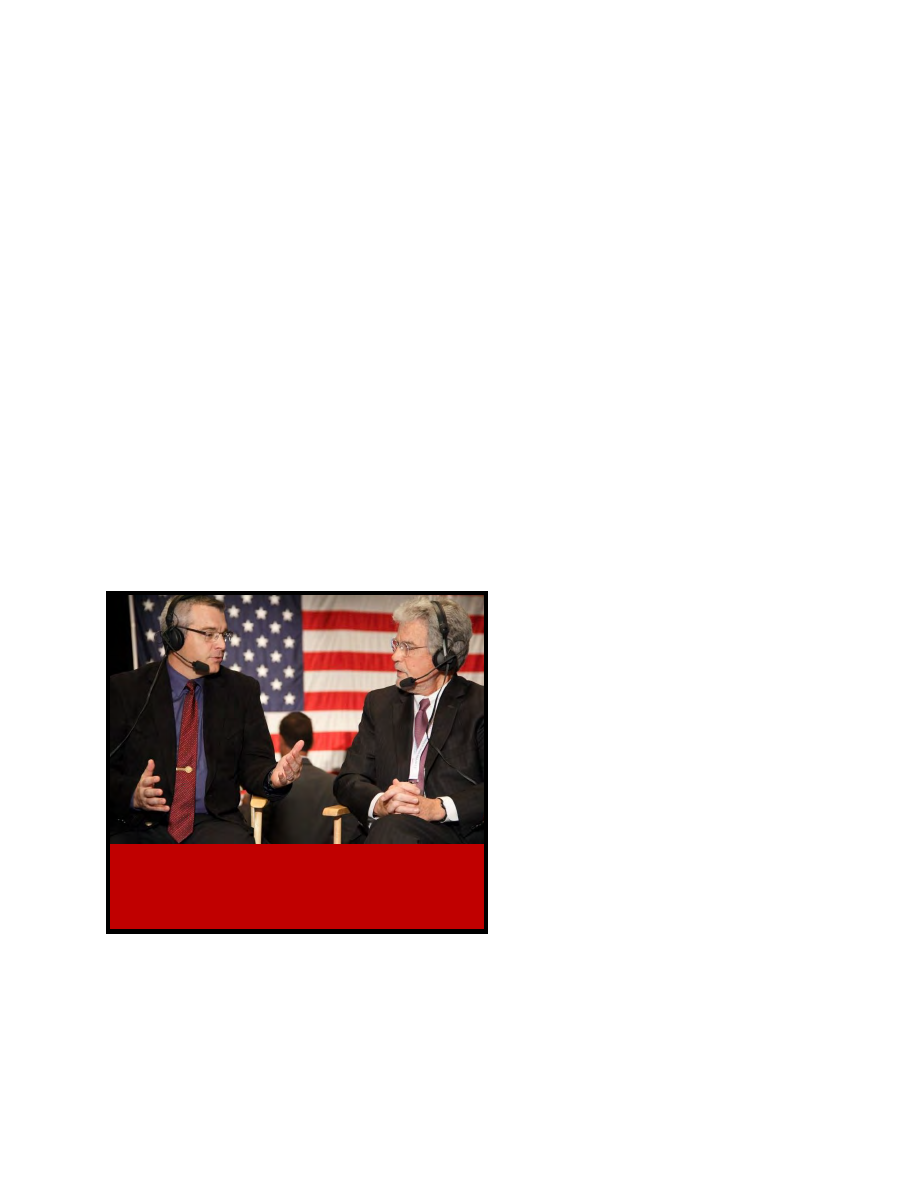
15
SECTION 1:
Congress shall not impose taxes or other exactions upon incomes, gifts, or estates,
or upon aggregate consumption or expenditures; but Congress shall have the power to levy a
uniform tax on the sale of goods.
SECTION 2:
Any imposition of or increase in a tax, duty, impost or excise shall require the
approval of three-fifths of the House of Representatives and three-fifths of the Senate, and shall
separately be presented to the President of the United States.
SECTION 3:
This article shall be effective five years from the date of its ratification, at which
time the 16th Article of Amendment is repealed.
During the debate, concerns were raised that this amendment might bind Congress’s hands too much and make
it too difficult for Congress to raise funds in the event of a national emergency. Several Commissioners also
expressed objection to giving Congress the power to impose a value-added tax at the end of Section 1. After
substantial debate, the Convention decided to strike out the text at the end of section 1 giving Congress the
ability to levy a sales tax, and simply end that section with the word “estates.” With that change and a couple
of minor stylistic edits, the Income Tax Repeal Amendment was adopted by the Convention 33 to 14.
Sen. Kevin Lundberg (CO) then introduced the third proposal from the Fiscal Restraints Committee:
The President may disapprove any item of appropriation in any bill. If any bill is approved by the
President, any item of appropriation contained therein which is not disapproved shall become
law. The President shall return with his objections any item of appropriation disapproved to the
House in which the bill containing such item originated. The Congress may, in the manner
prescribed under Section 7 of Article I for bills disapproved by the President, reconsider any item
disapproved under this article.
Proponents of the Line-Item Veto Amendment
argued that it would allow the President to curtail
pork-barrel spending. Opponents raised concerns
that the Amendment would break down the
separation of powers and actually increase federal
power by allowing the President to coerce Congress
to further his/her agenda through the threat of a
veto. Ultimately the Convention rejected the Line
Item Veto Amendment with a vote of 16 in favor
and 32 opposed.
Following the defeat of the Line-Item Veto
Amendment, Sen. Angela Hill (MS), introduced the
third proposal from the Federal Legislative and
Executive Jurisdiction Committee:
Whenever one-quarter of the members of the
United States House of Representatives or the
Conservative TV & Radio Host
Rick Green & US Sen. Tom Coburn (OK)
CONVENT
ION
CL
O
SING P
LE
NARY
SES
SION
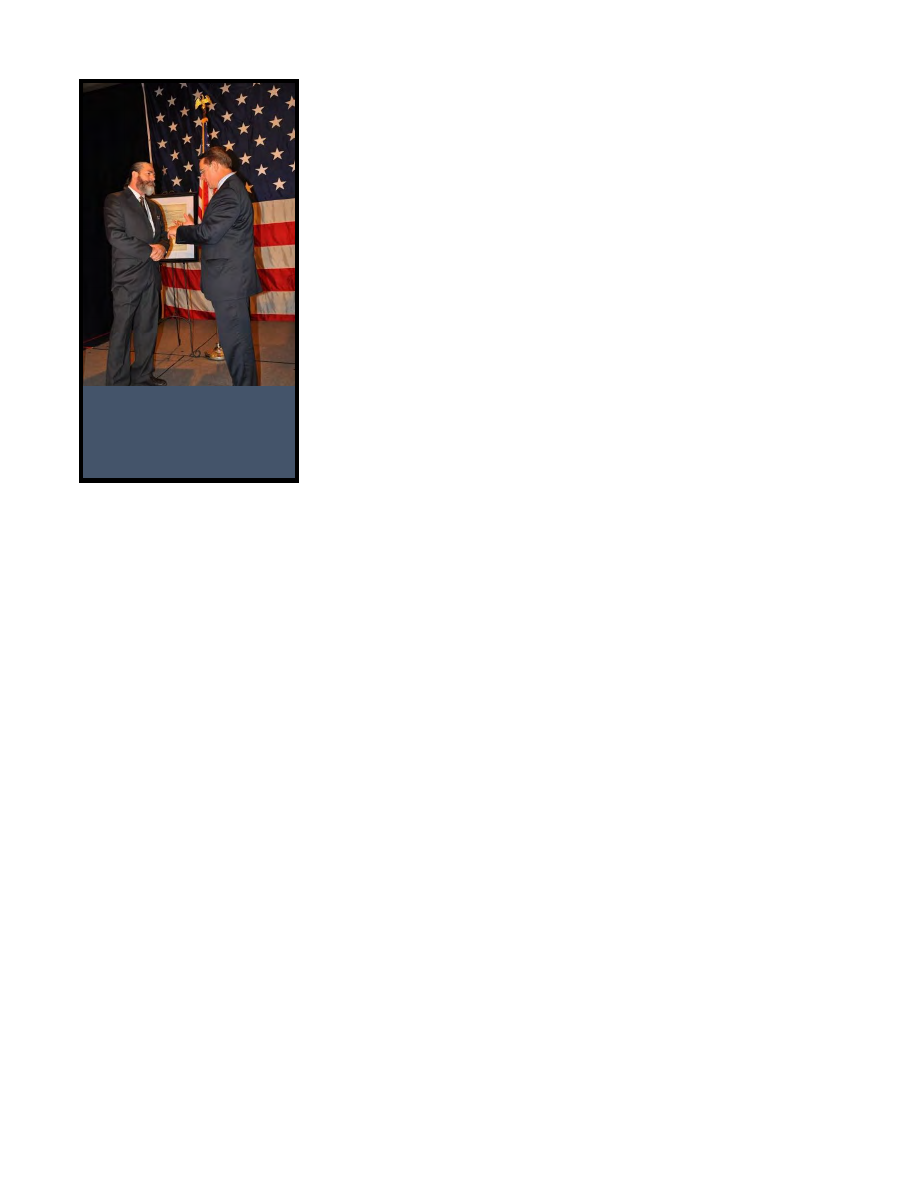
16
United States Senate transmits to the President their written declaration of
opposition to any proposed or existing federal administrative regulation, in
whole or in part, it shall require a majority vote of the House of
Representatives and Senate to adopt or affirm that regulation. Upon the
transmittal of opposition, if Congress shall fail to vote within 180 days, such
regulation shall be vacated. No proposed regulation challenged under the
terms of this Article shall go into effect without the approval of
Congress. Congressional approval or rejection of a rule or regulation is not
subject to a President veto under Article I, Section 7 of the U.S. Constitution.
In debate, several Commissioners’ concern was that allowing a quarter of
Congress to force a vote on the regulation could allow the minority party in
Congress to raise a barrage of obstructions to the majority’s conduct of
business. There was also significant debate over what should happen if
Congress failed to affirm the regulation once an objection had been raised.
Several Commissioners suggested that the regulation should not
automatically be rejected if Congress fails to vote. Ultimately, the
Convention decided to reject that change and adopted the original language
of the proposal 42 to 5.
With all of the amendment proposals having been voted upon, Sen. Alan
Hays (FL) introduced a formal statement for the adoption of the body:
The Convention respectfully submits these proposals to the American people with the conviction
that they are a sound beginning to a critically-needed national discussion about restoring the
balance of power between the federal government and the states. Further, it is the conviction of this
body that the states must deliberate and adopt appropriate proposals for a balanced budget
amendment and an amendment to provide the states a means to serve as a check on judicial
overreach by the federal judiciary of the United States.
The statement was adopted without debate by a voice vote of the Convention.
At the conclusion of the proceedings, Convention President, Rep. Ken Ivory (UT) addressed the
Convention. He praised the Convention for its conscientiousness in considering each of the proposals that was
brought forward and expressed his gratitude for being able to serve the Convention as President. He encouraged
the Commissioners to stay the course and use the constitutional process to change the course of the
country. The Convention gave Rep. Ken Ivory (UT) a standing ovation in recognition of his service as
Convention President. George Washington is said to have coined the phrase that, “The office should seek the
man, not the man the office.” In the case of Rep. Ken Ivory (UT), he proved to be the living embodiment of
why this sentiment is so valuable. He had to be encouraged to put his name into consideration as Convention
President, yet in hindsight, it is hard to imagine anyone else having done a better job.
Before the Convention closed, Rep. Ken Ivory (UT) entertained a motion of Personal Privilege from the Kansas
Delegation, and they requested that Mark Mecker, President of Citizens for Self-Governance be allowed to
address the assembled Commissioners. Granting the motion, Convention President Rep. Ken Ivory (UT)
introduced President and Founder, Citizens for Self-Governance Mr. Mark Meckler and requested that he give
some closing remarks. Mr. Mark Meckler extended recognition and thanks to the Citizens for Self-Governance
staff and noted their contributions to the Simulation. He thanked the Commissioners for the seriousness of their
deliberation and the passion of their debate and encouraged them to think of themselves as the front line in the
fight for the defense of liberty.
The Convention voted to adjourn sine die, and was gaveled to an end by Convention President, Rep. Ken Ivory
(UT). History had been made, the process had been proven to work, and the Convention of States movement
was set to move forward from simulation to the first-ever Article V Convention of States.
Rep. Eric Eastman (NH)
& Convention President
Rep. Ken Ivory (UT)
CONVENT
ION
CL
O
SING P
LE
NARY
SES
SION

17
Commissioners,
Thank you for your heart and hard work during the Convention of States Simulation last week.
Your circumspection in using the constitutional tool the Founders provided for us in Article V
of the Constitution to rein in federal overreach was apparent in your conscientious
deliberations and debate.
The nation can be proud of the work you have done to signal the path forward in restoring
vitality to our ingenious governing system — a system that requires a constitutional balance
between the states and the national government. As Thomas Jefferson counseled this “must be
done by the states themselves, erecting such barriers at the constitutional line as cannot be
surmounted…”
I encourage you to spread the word of your great work in this first ever Convention of States
Simulation to your communities and with your colleagues. You have demonstrated clearly that
representatives closest to the people can exercise their constitutional power in a manner that
will more fully secure the blessings of liberty not only for us but for generations to come.
If I can ever be of assistance to you in your efforts to move this crucial work forward, please
do not hesitate contact me directly.
In Liberty,
Convention President, Rep. Ken Ivory (UT)
CONCLU
DING L
ET
TE
R
TO
CO
M
M
IS
SI
ONER
S

18
COMMISSIONERS’
AND LEGAL ADVISORS’
LASTING IMPRESSIONS
C
OMMITTEE
C
HAIR
P
ERCEPTIONS AND
I
NSIGHTS
:
“The restraint of the Delegates in sticking to the essential issues which we must address first was remarkable
in view of the fact that there were many other desirable issues that almost all of us agreed upon.” –
Hon. Vance
Wilkins (VA), Term Limits and Federal Judicial Jurisdiction Committee Chair
“Even though this event did not possess the force of law for an actual Article V Convention, I was impressed
by the gravity and care everyone gave to the proposed amendments. It was a history making moment and those
in attendance understood its significance. I have had the honor of being a part of several significant milestones
for the Article V movement and I can say without reserve that this was a very important step toward
reestablishing the correct balance of power between the States and the Federal government.” -
Sen. Kevin
Lundberg (CO), Fiscal Restraints Committee Chair
S
TATE
L
EGISLATOR
/C
OMMISSIONERS
’
P
ERCEPTIONS AND
I
NSIGHTS
:
“It was truly an honor and privilege to participate in the
simulated Convention in Williamsburg this past week. I believe
a powerful message was sent not only to the participants, but
to many disheartened citizens who are wondering if there is any
hope against a growing tyrannical federal government. Please
pass along my gratitude to any donors or contributors that
made my participation possible… I look forward to continuing
to work with fine professionals like Regional Director David
Schneider, Mark Meckler and Yourself as we continue to push
towards this goal of a Convention.”
- Rep. Lynne DiSanto (SD)
“
We accomplished in two days what Congress couldn't do in
decades”
– Rep. Eric Eastman (NH)
“Those of us that wish to bring power back to the people in a nation overrun by
politicians and special interest, owe a great debt of gratitude to founders such as
George Mason and James Madison that included a states’ provision in Article V of
our constitution and to Michael Farris, Mark Meckler, Tom Coburn and the other
leaders of the Convention of States project for giving us a grassroots movement big
enough to enact such a provision. I believe in the coming years, thanks to those
mentioned above and the sad state we find our nation in today, the most important
words in our constitution will become,
The Congress…. on the application of the
legislatures of two thirds of the several states, shall call a convention for
proposing amendments
. I am very proud to be a part of this amazing movement
and look forward to the first ever successful call of an Article V Convention in a
just few short years; please join us.” -
Sen. Rob Standridge (OK), Federal
Legislative & Executive Jurisdiction Committee Chair
CO
M
M
IS
SI
ONER
S’
& LE
GA
L
AD
VIS
OR
S’
LA
STING
IM
PRES
SION
S

19
“The constitution has been amended by the Supreme Court with decades of
jurisprudence that have inappropriately expanded the power of each federal
branch. The constitution adhered to by the federal government today is now
over 4,000 pages long, and although it has been effectively – and unlawfully
– changed, the framers gave the states a tool to undo what the SCOTUS has
done, and what Congress continues to fail to do—unilaterally adopt
amendments that limit the federal government’s power.” –
Rep. Matt Rinaldi
(TX)
“It was an honor and privilege to participate in the simulated Convention of the States. This historic event
verified the founders' vision of a process that will work when the states assume their Constitutional
responsibility.”
- Rep. Bert Jones (NC)
“The gravity of our mission was clear to everyone. We were given the opportunity to demonstrate - to those
hopeful and those skeptical - that the states have not only the power but the ability - to strengthen the
constitutional moorings of a nation adrift.”
- Rep. Jack Williams (AL)
“I wasn’t amazed by all of us recognizing the same problems in the federal government. Probably half the US
population could identify most of them. The surprise I got was the large amount, and a variety of, solutions to
these problems. I think about these issues a lot, and there were things presented that I'd never even
considered. Likewise, there were objections to my solutions that came from different perspectives. Again, some
I'd never considered. Normally, I believe that stupidity has an additive property. Meaning that intelligence
goes down as the crowd size increases. This Convention proved to be an exception. We were truly working as
a group, our intelligence and experience being cumulative. In such a scenario, it becomes easier to comprehend
the brilliant results our Founders achieved in drafting our Constitution and Bill of Rights. That brilliance isn't
extinct in America; it just isn't often seen, because rarely does a group of people get together with an identical
goal.”
- Rep. Bill Sutton (KS)
“It was with great satisfaction that I was able to participate in this historic simulated Convention of States. The
vision of George Mason was realized as Legislators came from around the country to find solutions to correct
an out-of-control, overreaching federal government. I left with a renewed hope for my country.”
- Rep. Kelly
Townsend
(AZ)
“I was so honored to serve as a Delegate from Vermont. The Convention has opened our eyes that this take
back of states powers can be achieved. The work we accomplished was amazing and so much fun! It just goes
to show what great things can be accomplished when we work together for the good of our constituents and our
country.”
- Rep. Lynn Batchelor (VT)
“The Williamsburg meeting was a demonstration of how an Article V Convention could be held safely, wisely,
and successfully
.” - Delegate Jim LeMunyon (VA)
“I cannot express to you have much fun I had and the knowledge I gain from [attending] this Convention. I will
forever remember how I felt being part of this, it was an honor.”
- Rep. James Holtzclaw (ID)
“Our two days at the Simulation gave me hope. As with the 1787 Convention, there
were statesmen (and women) in abundance–some showing quiet leadership; others
quite vocal in their views. As with the 1787 Convention, we didn't all agree on the
direction that we should take, but we were bound together by a common
commitment and desire to recapture liberty for our children and grandchildren. It
was an honor and a privilege to take part, and I am anxious to get back to work on
passing our application in Nebraska.”
- Sen. Laura Ebke (NE)
CO
M
M
IS
SI
ONER
S’
&
L
EGAL
ADVI
SO
RS
’LA
STIN
G I
M
PRE
SS
ION
S
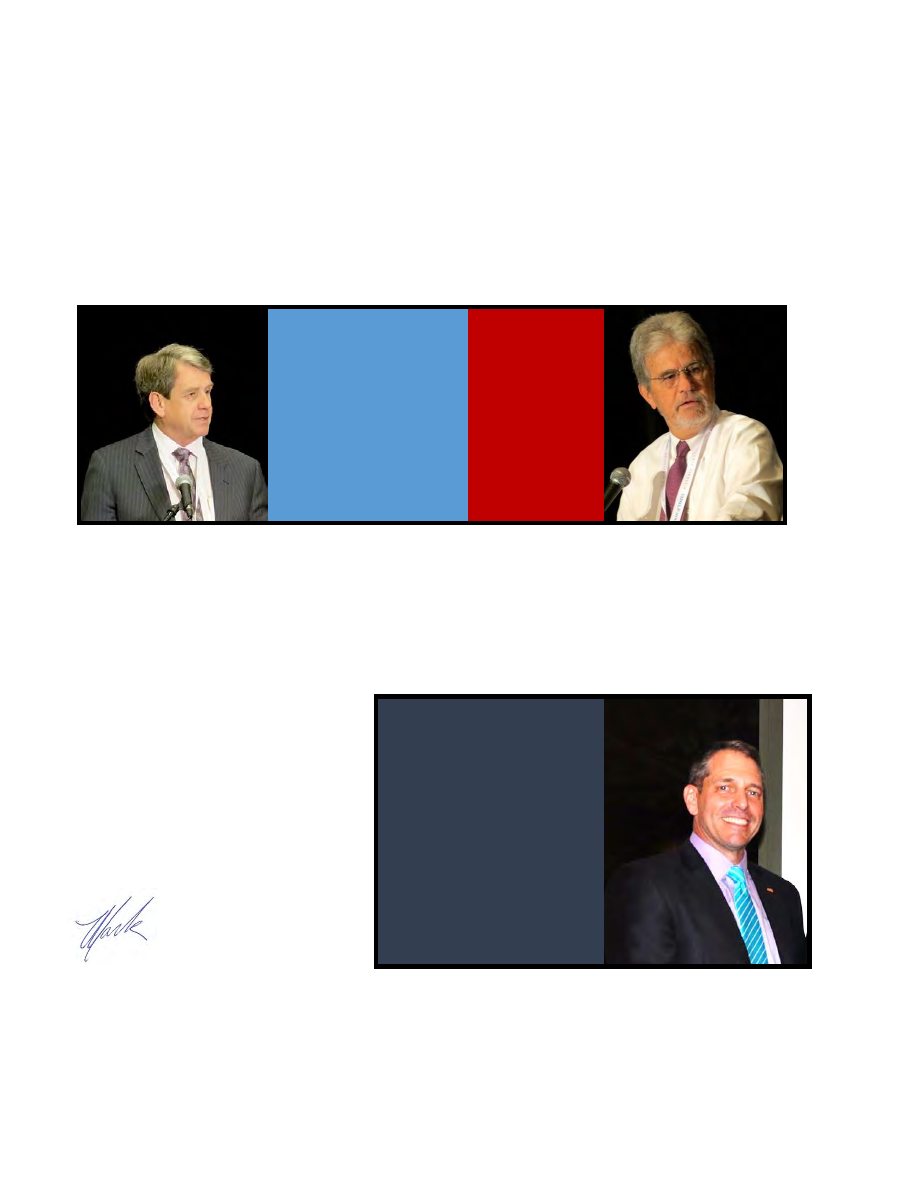
20
“Please pass on my profuse and heartfelt gratitude to the generous sponsors and patriots who chose to make
this event possible for myself and the other Commissioners from South Dakota. I truly believe this historic event
will have a great impact, energizing and educating legislators and the American people about the only practical
and peaceful way to restore self-governance. I am very honored and thankful to have been a part of it!”
- Rep.
Isaac Latterell (SD)
L
EGAL
A
DVISORS
’
L
ASTING
I
MPRESSIONS
:
“George Mason, who gave us the Article V Convention of States, would be proud; it was his spirit that pervaded
the hall.”
- Professor Randy Barnett, Professor of Legal Theory at Georgetown University Law Center
“Something which permeated the approach, explicitly in the messages from Michael Farris, Dr. Tom Coburn,
and especially Mark Meckler, is that these legislators are the new founders, the people responsible for standing
on the shoulders of the great patriots of the past to save the Republic in a time of great peril.”
- Eric O’Keefe,
Citizens for Self-Governance Board Member
“The verdict is in, the process works.” -
Professor Robert Natelson,
Independence Institute Senior Fellow
of Constitutional Jurisprudence
And my own takeaway…
In closing, the most important thing I can
say is “thank you.” This movement is
impossible without great patriots like you.
And most certainly, special events like the
Simulated Convention cannot be executed
without the resources which you so
generously chose to provide. It is an honor
and a privilege to serve my fellow citizens.
In Liberty,
Mark
“We are on our
way to repair
what ails our
country.” -
US
Sen. Tom
Coburn (OK) &
Senior Advisor
to Convention of
States
“The events at
Williamsburg will be
remembered as a turning
point in history. The spirit
of liberty and self-
government has been
reignited.” -
Michael
Farris, COS Senior Fellow
for Constitutional Studies
“The Convention operated
smoothly and according to
the rules. It was an
emotional experience to
witness the seriousness of
the Commissioners as they
debated. Now it's on to the
real Convention…the
sooner the better.”
- Mark
Meckler, President and
Founder, Citizens for Self-
Governance
CO
M
M
IS
SI
ONER
S’
&
L
EGAL
ADVI
SO
RS
’LA
STIN
G I
M
PRE
SS
ION
S

21
FISCAL RESTRAINTS COMMITTEE
OFFICIAL REPORT
Meeting of September 22, 2016
The Committee adopted the following proposed amendments for consideration of the Convention:
PROPOSAL 1 - DEBT LIMITATION AMENDMENT
SECTION 1:
The public debt shall not be increased, except upon a recorded vote of two-thirds of
each house of Congress, and only for a period not to exceed one year.
SECTION 2:
No state or any subdivision thereof shall be compelled or coerced by Congress or the
President to appropriate money.
SECTION 3:
The provisions of the first section of this amendment shall take effect 3 years after
ratification
PROPOSAL 2 - FAIR TAX AMENDMENT
SECTION 1:
Congress shall not impose taxes or other exactions upon incomes, gifts, or estates, or
upon aggregate consumption or expenditures; but Congress shall have the power to levy a uniform tax
on the sale of goods.
SECTION 2:
Any imposition of or increase in a tax, duty, impost or excise shall require the approval
of three-fifths of the House of Representatives and three-fifths of the Senate, and shall separately be
presented to the President of the United States.
SECTION 3:
This article shall be effective five years from the date of its ratification, at which time
the 16th Article of the amendment is repealed.
PROPOSAL 3 - LINE ITEM VETO AMENDMENT
The President may disapprove any item of appropriation in any bill. If any bill is approved by the
President, any item of appropriation contained therein which is not disapproved shall become law.
The President shall return with his objections any item of appropriation disapproved to the House in
which the bill containing such item originated. The Congress may, in the manner prescribed under
section 7 of the article I for bills disapproved by the President, reconsider any item disapproved
under this article.
FIS
CAL
RE
STRA
INT
S
CO
M
M
ITT
EE
REP
ORT

22
TOPIC: BALANCED BUDGET
Constitutional Expert, Michael Farris, proposed:
SECTION 1:
No money may be expended by the
United States except as authorized by a balanced
budget approved as specified herein.
SECTION 2
: For the purposes of this article, money
shall be deemed to be expended either by a cash outlay
or by incurring an obligation, even if that obligation is
contingent in nature.
SECTION 3:
The maximum amount which may be
budgeted for expenditure shall be the amount actually
collected by the United States for these purposes on a
basis of an average of the last three fiscal years.
SECTION 4
: Congress may enact a temporary
exception to this requirement under the following
conditions: if the United States is engaged in a war
which has been declared by Congress as specified in
Article I, then by a majority of the full membership of
both houses of Congress; otherwise, upon a national
emergency as declared by a seventy-five percent
majority vote of the full membership of both houses
of Congress. Provided however, that if Congress votes
to declare an emergency for three consecutive budgets
then all members of Congress shall be permanently
ineligible to seek re-election to either house of
Congress at the end of their individual current term of
service.
Constitutional Expert, Professor Robert Natelson,
proposed:
SECTION 1:
Every measure that shall increase the
total authorized unconditional or contingent public
debt of the United States shall, after complying with
the requirements of the seventh section of the first
article of this Constitution, be presented to the
legislatures of the several states; and before the same
shall take effect, it shall be approved by a majority of
legislatures in states containing a majority of the
population of the United States as determined by the
most recently completed decennial enumeration
pursuant to the third clause of the second section of
the first article. Each state legislature shall have the
power to determine its own rules for consideration of
such measures.
SECTION 2
: Any measure to authorize an increase
in a total contingent debt shall be presented to the state
legislatures separately from any measure to authorize
an increase in total unconditional debt.
SECTION 3
: Any purported increase in the public
debt of the United States after the effective date of this
article that shall not comply with the requirements
herein shall not be deemed money borrowed on the
credit of the United States pursuant to the second
clause of the eighth section of the first article nor valid
public debt of the United States under the fourth
section of the fourteenth article of amendment.
16% of polling respondents
chose this as one of their top 3
amendment proposals.
Several weeks prior to the Simulation, Convention of States
Senior Fellow for Constitutional Studies, Michael Farris,
hosted a live Facebook event to train citizens in the art of
crafting constitutional amendments for proposal. Then,
Convention of States conducted a poll to determine the level of
popular support for various proposals drafted by Michael
Farris, and invited citizens to submit their own amendment
proposals to be considered by the Commissioners of the
Simulation. Below are the results of the polling, along with a
small sampling of the thousands of brilliantly crafted and
proposed
amendments submitted by citizens.
CITIZEN PROPOSED AMENDMENTS: FISCAL RESTRAINTS
CITIZ
EN
PROPO
SE
D
AM
END
M
ENT
S:
FIS
CAL
RE
ST
RAINT
S
COM
M
ITT
EE

23
SECTION 4:
This article shall be inoperative unless
it shall have been ratified as an amendment to the
Constitution within seven years from the date of its
submission to the state legislatures or Conventions in
accordance with the fifth article of this Constitution.
This article shall become effective six months’ after
ratification as an amendment to the Constitution.
Citizen, John S., proposed:
The government of the United States of America can
spend in any one fiscal year a combined total of no
more money than the combined total of all money
collected in the preceding fiscal year from all sources.
The combined expenses include all expenses for the
Executive Branch, the Legislative Branch (House of
Representatives and Senate), and the Judicial Branch,
including interest payments on the government debt,
retirement payments, welfare payments, medical and
Medicare payments, and any money paid to any
receiver during the fiscal year. Money collected
includes all money obtained from income tax
payments (both individual, company, and corporate)
fewer reimbursements, tariffs, interest and penalties
received fewer reimbursements, fees, processing
costs, and any other monies received from any source
during the preceding fiscal year, except borrowed
money and the selling of bonds. This includes any
other taxation system that may be created in the future
that will be paid directly or indirectly by residents
and/or citizens of this country. It also includes money
received from residents or governments of other
countries. The only exception is during war. Part or all
of the cost of a war can be paid from loans or bond
sales but expenses that are not part of the war effort
cannot be paid by money received from loans or
bonds.
Citizen, Oren L., proposed:
SECTION 1
: Congress shall make and the President
shall sign a Balanced Federal Budget every year and
before the beginning of the ensuing fiscal year. In the
event Congress and the President fail to make said
Balanced Federal Budget before the beginning of the
ensuing fiscal year, the last, constitutionally passed
and signed Federal Budget shall go into effect and
shall be the Federal Budget for the entirety of the
ensuing fiscal year.
SECTION 2
: Expenditures in the Federal Budget
shall be limited to only those expenditures expressly
granted and enumerated in the Constitution of the
United States. Only taxes specifically allowed in the
Constitution of the United States shall be levied.
SECTION 3:
Balanced shall be defined as
expenditures not to exceed revenues except in time of
war as Formally Declared by Congress in which case
expenditures exceeding said Balanced Federal Budget
shall be used exclusively for the prosecution of said
Formally Declared War and shall cease immediately
upon the termination of hostilities.
SECTION 4:
Revenues shall be defined as monies
received; not monies predicted, anticipated, or
forecasted beyond the immediate fiscal year.
SECTION 5:
Unfunded liabilities, obligations,
and/or mandates shall be included in the calculation of
the Balanced Federal Budget.
TOPIC: ABOLISH THE FEDERAL
RESERVE
Citizen, Chris W., proposed:
Federal Reserve Board Abolition Amendment
SECTION 1:
Federal Reserve Board Abolished
(a) In General – Effective at the end of the 1-year
period beginning on the date of the enactment of this
ACT, the Board of Governors of the Federal Reserve
System and each Federal reserve bank are hereby
abolished.
(b) Repeal of Federal Reserve Act – Effective at the
end of the 1-year period beginning on the date of the
enactment of this Act, the Federal Reserve Act is
hereby repealed.
© Disposition of Affairs –
(1) MANAGEMENT DURING DISSOLUTION PERIOD
–
During the 1-year period referred to in subsection.
(a) The Chairman of the Board of Governors of the
Federal Reserve System –
(A) shall, for the sole purpose of winding up the
affairs of the Board of Governors of the Federal
Reserve System and the Federal reserve banks – (i)
manage the employees of the Board and each such
bank and provide for the payment of compensation
and benefits of any such employee which accrue
before the position of such employee is abolished; and
(ii) manage the assets and liabilities of the Board and
each such bank until such assets and liabilities are
liquidated or assumed by the Secretary of the Treasury
in accordance with this subsection, and
(B) may take such other action as may be necessary,
subject to the approval of the Secretary of the
Treasury, to wind up the affairs of the Board and the
Federal reserve banks.
(2) LIQUIDATION OF ASSETS- (A) IN GENERAL-
The Director of the Office of Management and Budget
shall liquidate all assets of the Board and the Federal
reserve banks in an orderly manner so as to achieve as
expeditious a liquidation as may be practical while
CITIZ
EN
P
ROPO
SE
D
AM
END
M
ENT
S:
FIS
CAL
RE
STR
AINT
S
CO
M
M
ITT
EE

24
maximizing the return to the Treasury. (B) TRANSFER
TO TREASURY- After satisfying all claims against the
Board and any Federal reserve bank which are
accepted by the Director of the Office of Management
and Budget and redeeming the stock of such banks,
the net proceeds of the liquidation under subparagraph
(A) shall be transferred to the Secretary of the
Treasury and deposited in the General Fund of the
Treasury.
(3) ASSUMPTION OF LIABILITIES- All outstanding
liabilities of the Board of Governors of the Federal
Reserve System and the Federal reserve banks at the
time such entities are abolished, including any
liability for retirement and other benefits for former
officers and employees of the Board or any such bank
in accordance with employee retirement and benefit
programs of the Board and any such bank, shall
become the liability of the Secretary of the Treasury
and shall be paid from amounts deposited in the
general fund pursuant to paragraph (2) which are
hereby appropriated for such purpose until all such
liabilities are satisfied.
(d) Report- At the end of the 18-month period
beginning on the date of the enactment of this Act, the
Secretary of the Treasury and the Director of the
Office of Management and Budget shall submit a joint
report to the Congress containing a detailed
description of the actions taken to implement this Act
and any actions or issues relating to such
implementation that remain uncompleted or
unresolved as of the date of the report.
TOPIC: ABOLISH THE INCOME TAX
Numerous Citizens proposed:
The Sixteenth Amendment is repealed.
Numerous Citizens proposed:
The federal income tax is repealed and replaced by
the Fair Tax.
Citizen, David G., proposed:
There shall be no federal income tax. Federal taxation
shall be only upon goods and services and take the
form of a sales tax never to exceed 17%.
Citizen, Lisa C., proposed:
The current income tax and tax code shall be
abolished and replaced with a consumption tax, as
laid out in current House bill H.R. 25
Topic: Line Item Veto
Citizen, John S., proposed:
The President of the United States of America has
the authority to approve any bill passed by the House
and the Senate, veto that bill, or veto any separate
line item, or items of that bill. Any bill or line item
that has not been vetoed becomes law when the
President signs that bill.
A line item of a bill is defined as any part of a bill
that could be approved and implemented, if
otherwise funded, without any other part of that bill
being approved.
Any bill that is not separated into proper line item
organization may be submitted to the Supreme Court
by the House of Representatives, the Senate, or the
President. The Chief Justice of the Supreme Court
will appoint a Panel of three Justices to review that
bill to see if that bill has been properly organized
into line items.
Any further action or time constants on that bill are
frozen until the Panel of Justices make their decision
and release that bill to continue the bill processing
procedure. The Panel of Justices must complete their
review within two weeks.
If the Panel of Justices find the bill has been properly
organized into line items, the bill will be returned to
the organization (the House of Representatives, the
Senate, or the President) that sent it to the Supreme
Court for the bill to continue processing from that
point.
If the Panel of Justices finds the bill is not properly
organized into line items, all approval signatures on
that bill become null and void and the bill, along
with the Panel of Justices recommendations, is
forwarded to the House of Representatives or the
Senate where that bill was first introduced, to begin
processing again.
When the bill is sent to the Supreme Court, the
House of Representatives, the Senate, or the
President may also ask for an opinion on the
constitutionality of that bill. The Panel of Justices
may decide to provide an opinion on the
constitutionality of that bill without being asked.
Any constitutional opinion the Panel of Justices may
make will not be binding upon the whole Supreme
Court if that bill, after becoming a law, becomes part
of a case before the Supreme Court.
Numerous Citizens proposed:
Line item veto.
CITIZ
EN
PROPO
SE
D
AM
END
M
ENT
S:
FIS
CAL
RE
ST
RAINT
S
COM
M
ITT
EE

25
FEDERAL LEGISLATIVE & EXECUTIVE
JURISDICTION
COMMITTEE OFFICIAL REPORT
Meeting of September 22, 2016
The Committee adopted the following proposed amendments for consideration of the Convention:
PROPOSAL 1
SECTION 1:
The power of Congress to regulate commerce among the several states shall be limited to the
regulation of the sale, shipment, transportation, or other movement of goods, articles or persons. Congress may
not regulate activity solely because it affects commerce among the several states.
SECTION 2:
The power of Congress to make all laws that are necessary and proper to regulate commerce
among the several states, or with foreign nations, shall not be construed to include the power to regulate or
prohibit any activity that is confined within a single state regardless of its effects outside the state, whether it
employs instrumentalities therefrom, or whether its regulation or prohibition is part of a comprehensive
regulatory scheme; but Congress shall have the power to define and provide for punishment of offenses
constituting acts of war or violent insurrection against the United States.
SECTION 3:
State legislatures shall have the standing to file any claim alleging a violation of this article.
Nothing in this article shall be construed to limit standing that may otherwise exist for a person.
SECTION 4:
This article shall be effective not more than five years from the date of its ratification.
PROPOSAL 2
SECTION 1:
The States shall have authority to abrogate any provision of federal law issued by the Congress,
President, or Administrative Agencies of the United States, whether in the form of a statute, decree, order,
regulation, rule, opinion, decision, or other form.
FED
ERA
L
LEG
IS
LA
TIV
E
&
EX
EC
UT
IV
E
JU
RISD
IC
TI
ON
C
OM
MI
TTE
E
OFF
IC
IA
L
REP
OR
T

26
SECTION 2:
Such abrogation shall be effective when the legislatures of three-fifths of the States approve a
resolution declaring the same provision or provisions of federal law to be abrogated. This abrogation authority
may be applied to provisions of federal law existing at the time this amendment is ratified.
SECTION 3:
No government entity or official, whether federal, state, or local, may take any action to enforce
a provision of federal law after it is abrogated according to this Amendment. Any action to enforce a provision
of abrogated federal law may be enjoined by a federal or state court of general jurisdiction in the state where
the enforcement action occurs, and costs and attorney fees of such injunction shall be awarded against the entity
or official attempting to enforce the abrogated provision.
SECTION 4:
No provision of federal law abrogated pursuant to this amendment may be reenacted or reissued
for six years from the date of the abrogation.
PROPOSAL 3
Whenever one-quarter of the members of the United States House of Representatives or the
United States Senate transmits to the President their written declaration of opposition to any
proposed or existing federal administrative regulation, in whole or in part, it shall require a
majority vote of the House of Representatives and Senate to adopt or affirm that regulation. Upon
the transmittal of opposition, if Congress shall fail to vote within 180 days, such regulation shall
be vacated. No proposed regulation challenged under the terms of this Article shall go into effect
without the approval of Congress. Congressional approval or rejection of a rule or regulation is
not subject to Presidential veto under Article 1, Section 7 of the U.S. Constitution.
FED
ERA
L
LEG
IS
LA
TIV
E
&
EX
EC
UT
IV
E
JU
RISD
IC
TI
ON
C
OM
MI
TTE
E
OFF
IC
AL
REP
OR
T

27
TOPIC: ADMINISTRATIVE AGENCIES
Constitutional Expert, Michael Farris, proposed:
SECTION 1
: Neither the president nor any executive
agency of any description whatsoever shall have the
authority to make a rule, regulation, or order that is
binding on any private person or entity. This shall not
be construed to apply to any rule, regulation, or order
that, in its essence, concerns the internal operations of
government even if incidentally applicable to a
private person or entity.
SECTION 2:
Members of state legislatures shall
have standing to file any claim alleging violation of
this amendment.
Citizen, Steven S., proposed:
The federal government shall at no time pass any
regulations, laws, rulings, or any other device that is
binding on the states or citizens that is not also
binding upon the federal government and its
members.
Citizen, William L., proposed:
Congress shall not delegate legislative authority to
any agency. No regulation proposed by any agency of
the government of the United States shall be valid or
enforceable except it first be approved by a majority
vote of both houses of Congress.
TOPIC: ATTORNEYS GENERAL
Citizen, Wayne B., proposed:
The Attorney General of the Federal Government of the
United States shall be appointed by, and serve at the
pleasure of the Congress. The Attorney General shall be
responsible for the enforcement of all Federal Laws and
shall serve for a term of four (4) years.
TOPIC: COMMERCE POWER
Constitutional Expert, Michael Farris, proposed:
14% of polling respondents chose
this as one of their top 3 amendment
proposals.
5% of polling respondents chose this
as one of their top 3 amendment
proposals.
CITIZEN
PROPOSED
AMENDMENTS:
FEDERAL
LEGISLATIVE
&
EXECUTIVE
JURISDICTION
Several weeks prior to the Simulation, Convention of States
Senior Fellow for Constitutional Studies, Michael Farris,
hosted a live Facebook event to train citizens in the art of
crafting constitutional amendments for proposal. Then,
Convention of States conducted a poll to determine the level of
popular support for various proposals drafted by Michael
Farris, and invited citizens to submit their own amendment
proposals to be considered by the Commissioners of the
Simulation. Below are the results of the polling, along with a
small sampling of the thousands of brilliantly crafted and
proposed
amendments submitted by citizens.
CITIZ
EN
PROPO
SE
D
AM
END
M
ENT
S:
FED
ERA
L
LEG
IS
LA
TI
VE
&
EX
ECU
TIVE
JU
RIS
DIC
TIO
N

28
SECTION 1:
The power of Congress to regulate
commerce among the several states shall be limited
to the regulation of the shipment, transportation, or
other movement of goods, articles or persons.
Congress may not regulate activity solely because it
affects commerce among the several states.
SECTION 2:
Members of state legislatures shall
have the standing to file any claim alleging a violation
of this amendment.
Citizen, William L., proposed:
Congress shall not have the authority to ban or
prohibit the manufacture or possession of any item or
substance. Congress may enact laws which define
requirements for the transport of items across state
borders. These laws must be uniform throughout the
United States. They may deal with the nature of the
item and the transport thereof only at the moment it is
transported across the border and may not in any way
address that item before or after.
Citizen, James C. proposed:
The power of Congress to regulate interstate
commerce shall not extend to non-commercial
activities, nor to commercial intrastate activities
which are not involved in the interstate movement of
goods and persons.
TOPIC: COUNTERMAND AMENDMENT
Citizen, Keith K. proposed:
SECTION 1:
Any rule, interpretation, or guidance
adopted by the executive branch may be vacated by a
resolution passed by the legislatures of three-fifths of
the several states or by three-fifths of both houses of
Congress. No state legislative resolution older than
five years shall be counted to aggregate the necessary
number.
SECTION 2:
Any item so vacated shall result in the
full restoration of any monetary penalties assessed any
private party, and any criminal penalty due to the
vacated item shall be expunged, with full rights
restored to the individual.
TOPIC: EXECUTIVE ORDERS
Citizen, J. Bruce G., proposed:
The President may not issue or implement any
executive order which goes against the spirit and
intent of the laws which have been passed by the
House and Senate and signed by a President. Any
violation of this amendment would be the unfaithful
execution of the laws and would be a high crime and
misdemeanor making the president subject to
impeachment.
TOPIC: FEDERAL LANDS
Citizen, David S., proposed:
SECTION 1:
The United States Government shall
not own, control, or oversee a total of more than six
and a half percent of the land and territories of the
United States. This shall not include lands which are
used for military bases, or are used in any other way
for the national defense; which lands shall not exceed
more than one and a half percent of the land and
territories of the United States, except when the
United States is engaged in a war which has been
declared by Congress as specified in Article 1.
SECTION 2:
Upon the ratification of this
amendment, the control or oversight of the United
States Government of private property shall be
immediately abolished. Within five years of the
ratification of this amendment, all lands owned by the
United States Government, except for that which is
specified in Section 1 of this amendment, shall be sold
to the people or states, or to some other non-foreign
entity.
Citizen, Jennifer C., proposed:
The Federal Government shall impose no rules or
regulations that cause, or aid in, the permanent
destruction or fundamental degradation of, natural or
cultural resources common to, or held in trust for, the
whole of the people. Such common resources include
wildlife and wild lands, National parks and
monuments, critical ecosystems, water, soil,
germplasm and the atmosphere. Nor shall such
resources set aside in the common trust be sold by the
Federal Government to any private entity, or managed
by the Federal Government, on behalf of any entity
whatsoever, except for the whole of the American
people.
CITIZ
EN
PROPO
SE
D
AM
END
M
ENT
S:
FED
ERA
L
LEG
IS
LA
TI
VE
&
EX
ECU
TIVE
JU
RIS
DIC
TIO
N

29
TOPIC: IMPEACHMENT
Citizen, Douglas R., proposed:
SECTION 1:
The State Legislatures, whenever two-
thirds shall deem it necessary, may draft and adopt
Articles of Impeachment for the President of the
United States.
SECTION 2:
Each State Legislature adopting said
Articles of Impeachment must adopt Articles
identical in subject and wording to the other State
Legislatures.
SECTION 3:
A two-year time limit is placed on the
adoption of Articles of Impeachment, starting from
the date said Articles are adopted by the first State
Legislature. Each State Legislature adopting said
Articles shall provide an exact copy of the adopted
Articles, along with an affidavit signed and dated by
the Speaker of the State Legislature, to the Archivist
of the United States within fifteen calendar days of its
adoption.
SECTION 4:
Upon adoption of Articles of Impeachment,
a State Legislature may not rescind Articles or modify
them during the two-year period in which the Articles of
Impeachment are under consideration by the several
States’ Legislatures.
SECTION 5:
Upon adoption of Articles of Impeachment
by two-thirds of the several State Legislatures, the
President shall be impeached and removed from office.
SECTION 6:
Motivation for Impeachment must be
appropriate pursuant to the High Crimes and
Misdemeanors clause in Article II of the Constitution.
SECTION 7:
The States’ impeachment action or
impeachment authority shall not be the subject of
litigation or review in any Federal or State court, or
oversight or interference by Congress or the President.
TOPIC: EQUAL APPLICATION OF THE
LAW
Citizen, Daniel C., proposed:
Congress shall impose no laws or regulations to
which they themselves are not subject.
Citizen, Vickie D., proposed:
There shall be no federal law or regulation which
exempts any persons or parties from a neutral law of
general applicability, consistent with the provisions
of the Constitution of the United States of America.
Citizen, Jim K., proposed:
The President shall not have the power to pardon
former Presidents, nor any member of their cabinet.
Further, no person having received a Presidential
Pardon will be allowed to hold the office for a period
of ten years after receiving the pardon. Pardons for
former Presidents and cabinet members shall be
granted only by a two-thirds majority of both houses
of Congress and then approved by simple majority of
the Supreme Court of the United States.
TOPIC: EDUCATION
Citizen, Teresa B., proposed:
The Federal government shall no longer oversee
educational issues, nor make any education policy,
regulation or advisement. The Federal Department of
Education shall be dissolved. All educational
responsibilities, policies, and governance shall be
transferred back to the States.
TOPIC: NECESSARY AND PROPER CLAUSE
Citizen, Thomas G., proposed:
SECTION 1:
The ”Necessary and Proper” clause
(Article 1, Section 8, Clause 18) of this Constitution
is from this date forward repealed on the grounds of
systematic abuse being demonstrated by the Federal
Courts and Government.
SECTION 2:
All laws previously deemed
Constitutional by “Necessary” and/or “Proper”
clause that are not also clearly backed by a specific
enumerated power listed within this Constitution;
are void from this day forward. All proposed laws
from this day forward shall include the enumerated
power of this Constitution that clearly grants the
government the power to enforce any proposed law.
SECTION 3:
Any State government may resolve, by
simple majority vote, to question the conferred
enumerated power granted by this Constitution to
enforce proposed law and upon the passing of such
State resolution; Congress must either demonstrate in
court the power granted to them for proposed law or
ratify this Constitution's enumerated powers list as
already outlined in this Constitution.
CITIZ
EN
PROPO
SE
D
AM
END
M
ENT
S:
FED
ERA
L
LEG
IS
LA
TI
VE
&
EX
ECU
TIVE
JU
RIS
DIC
TIO
N

30
TOPIC: WAR POWER
Citizen, John G., proposed:
No troops can be deployed to foreign lands for more
than 90 days without a declaration of war. There can
be no continuing resolution to bypass the 90-day
requirement and no troops may go back to that area in
the next two years without a declaration of war.
TOPIC: PRIVATE PROPERTY
Citizen, Bobby T., proposed:
Congress shall make no law that allows confiscation of
any personal property whatsoever unless the individual
is convicted by a jury of his/her peers of a crime of
violence, or trafficking in contraband, or human slavery.
Should say individual be found innocent at a later date,
any property confiscated shall be immediate without
delay be returned in the same condition it was when it
was seized, there shall be no exceptions or exclusions to
this.
TOPIC: SINGLE SUBJECT LIMIT ON BILLS
Citizen, David M., proposed:
All bills brought for consideration of the House and
Senate shall consist of not more than one topic,
precisely described in the title, and shall contain no
other items unrelated to the topic and title.
TOPIC: SPENDING CLAUSE
Citizen, Mark S., proposed:
No grant of funds by the federal government to the
individual states shall be conditioned on a recipient
state enacting a state law on a subject matter that is
not within the specifically delegated jurisdiction of
the federal government.
Citizen, Willis E. S., proposed:
SECTION 1:
The Government of the United States
shall not engage in any business, professional,
commercial, financial or industrial enterprise except
as specified in the Constitution.
SECTION 2:
The constitution or laws of any State,
or the laws of the United States shall not be subject to
the terms of any foreign or domestic agreement which
would abrogate this amendment.
SECTION 3:
The activities of the United States
Government which violate the intent and purpose of
this amendment shall, within a period of three years
from the date of the ratification of this amendment,
be liquidated and the properties and facilities
affected shall be sold.
SECTION 4:
Three years after the ratification of
this amendment the sixteenth article of amendment
to the Constitution of the United States shall stand
repealed and thereafter Congress shall not levy taxes
on personal incomes, estates, and/or gifts.
TOPIC: TREATIES
Constitutional Expert, Michael Farris, proposed:
SECTION 1:
A treaty is an international agreement
executed by the United States in written form and
governed by international law, whether embodied in
a single instrument or in two or more related
instruments and whatever its particular designation.
SECTION 2:
No treaty may be adopted by the United
States except by the ratification of two-thirds of the
full membership of the United States Senate or, when
applicable, the process specified in Section 3 of this
Article.
SECTION 3:
Any treaty which primarily obligates
the United States respecting its relationship to its own
citizens and residents shall be ratified in a two-step
process requiring a two-thirds vote of both houses of
Congress followed by approving resolutions by the
legislatures of three-fourths of the several states. All
such approvals shall be completed not later than five
years after the date upon which the United States
executed the relevant treaty.
10% of polling respondents chose this
as one of their top 3 amendment
proposals.
CITIZ
EN
PROPO
SE
D
AM
EN
DM
ENT
S:
FED
ERA
L
LEG
IS
LA
TI
VE
&
EX
ECU
TIVE
JU
RIS
DIC
TIO
N

31
TERM LIMITS AND FEDERAL JUDICIAL
JURISDICTION COMMITTEE OFFICIAL REPORT
Meeting of September 22, 2016
The Committee adopted the following proposed amendments for consideration of the Convention:
PROPOSAL 1
No person shall be elected to more than six full terms in the House of Representatives. No person shall be
elected to more than two full terms in the Senate. These limits shall include the time served prior to the
enactment of this Article.
PROPOSAL 2
SECTION 1:
Any decision of the Supreme Court may be vacated by a resolution passed by the legislatures of
three-fifths of the several states or by two-thirds of both houses of Congress. No state legislative resolution
older than five years shall be counted to aggregate the necessary number.
SECTION 2:
A decision that is vacated within six months of the date of the entry of the judgment shall result
in a vacation of the judgment itself. Otherwise, a decision vacated as provided herein shall not disturb the
judgment as between the named parties.
SECTION 3:
The Congressional override is not subject to a Presidential veto and shall not be the subject of
litigation or review in any Federal or State court.
SECTION 4:
The States' override shall not be the subject of litigation or review in any Federal or State court,
or oversight or interference by Congress or the President.
TE
RM
L
IMI
TS
& F
ED
ERA
L J
UD
IC
IA
L
JU
RISD
IC
TI
ON
C
OM
MI
TT
EE
OFF
IC
IA
L
REP
OR
T

32
TOPIC: IMPEACHMENT OF FEDERAL
JUDGES
Citizen, Bob K. proposed:
A simple majority of state legislatures may impeach
a federal judge for cause.
TOPIC: JUDICIAL QUALIFICATIONS &
POWER
Citizen, Oren L., proposed:
SECTION 1:
No person shall be nominated for or
appointed to the federal bench who is not a Natural
Born Citizen of the United States, who has not
attained the age of thirty-five years, who is not a
member of the Bar in good standing, who has not
been a member of the Bar in good standing for a
minimum of ten years, who is not law-abiding and
without criminal conviction, who is not confirmed
by a two-thirds vote of the Senate of the United
States, and who has not demonstrated a clear and
consistent adherence to Constitutional Principles as
envisioned by the Founders.
SECTION 2:
The power and authority of the
Federal Judiciary shall be strictly limited to that
power and authority expressly enumerated in
Article III of the Constitution of the United States.
Federal Judicial rulings and orders shall be strictly
limited to those parameters expressly enumerated
in Article III of the Constitution of the United
States. No Federal Judicial Ruling shall insert
Legislative, Executive, or Judicial power,
authority, or interpretation, direct or indirect, into
the Constitution of the United States that is not
expressly enumerated therein.
SECTION 3:
Justices of the Supreme Court of the
The United States and judges of subordinate
Federal Courts shall stand for reconfirmation or de-
confirmation by the Senate of the United States
every six years. Justices of the Supreme Court and
judges of subordinate Federal Courts, ensconced on
the Bench before the ratification of this
amendment, shall also stand for reconfirmation or
de- confirmation, every six years, upon the
ratification of this amendment.
SECTION 4:
Congress shall have, by a two-thirds
vote of both the House of Representatives and the
Senate, the power to override individual rulings of
the Supreme Court of the United States and/or
subordinate Federal Courts. The President shall not
have veto authority over Congressional overrides
of Federal
CITIZEN PROPOSED AMENDMENTS: TERM LIMITS &
FEDERAL JUDICIAL JURISDICTION
Several weeks prior to the Simulation, Convention of States
Senior Fellow for Constitutional Studies, Michael Farris,
hosted a live Facebook event to train citizens in the art of
crafting constitutional amendments for proposal. Then,
Convention of States conducted a poll to determine the level of
popular support for various proposals drafted by Michael
Farris, and invited citizens to submit their own amendment
proposals to be considered by the Commissioners of the
Simulation. Below are the results of the polling, along with a
small sampling of the thousands of brilliantly crafted and
proposed
amendments submitted by citizens.
CITIZ
EN
PROPO
SE
D
AM
END
M
ENT
S:
TER
M
LI
MI
TS &
F
ED
ERA
L
JU
DIC
IA
L
JU
RISD
IC
TI
ON

33
TOPIC: SUPREME COURT JURISDICTION
Citizen, Jack S., proposed:
The authority of the supreme court shall be limited
to ruling on the constitutionality of enacted
legislation at any level of government; federal,
state, or municipal. No Supreme Court ruling or
decision shall have any force of law other than as
pertains to the singular question of the
constitutionality of legislation and or processes,
procedures, or practices enacted by legislation.
Citizen, Robert B., proposed:
Respecting the right of the people to be governed
by their elected representatives, judges shall
construe this Constitution and other legal texts with
paramount consideration for their public meaning
as understood by an ordinary reasonable person at
the time that they were written. Breach of this duty
shall be cause for removal of any judge from office
by vote of 2/3 of the states.
TOPIC: SUPREME COURT TERM LIMITS
& COMPOSITION
Constitutional Expert, Michael Farris, proposed:
SECTION 1:
The Supreme Court of the United
States shall be composed of thirteen justices
appointed in the manner specified in this article.
SECTION 2:
The first class of justices appointed
herein shall consist of seven justices appointed for
a six-year term and six justices appointed for a four-
year term. At the expiration of these initial terms,
either six or seven justices shall be appointed every
two years for a four-year term to maintain a
composition of thirteen justices. No justice shall be
reappointed to fill a second term. A state may fill a
vacancy occurring if its appointed justice is unable
or unwilling to serve or is removed by
impeachment.
SECTION 3:
Justices shall be appointed by the
several states by a method determined by state law.
Each state shall appoint one justice for one term in
rotational order. The order of appointment shall be
determined by the order of ratification of this
amendment by the several states. After three-
fourths of the several states have ratified this
amendment, the remaining states shall then follow
in alphabetical order.
SECTION 4:
This article shall take effect on the
July 1 after the date of ratification, provided that the
ratification takes place at least six months before
July 1. Otherwise, the effective date shall be on the
following July 1. All justices serving on the
effective date shall be retired from active service
and shall have all the rights and privileges of a
senior federal judge as established by law.
Citizen, David R., proposed:
The Supreme Court shall consist of thirteen Judges;
the longest serving member Citizen proposal by of
the Supreme Court shall be its Chief Justice. No
person shall serve on the Supreme Court for more
than eighteen years. The appointment of Judges,
both to the Supreme Court and inferior courts, shall
be reconsidered by the Senate every six years. If the
Senate approves of the appointment, the Judge shall
continue in office. If the Senate disapproves of the
appointment, the Judge shall immediately vacate
her or his office. If the Senate fails to reconsider the
appointment, the Judge shall vacate his or her office
at the end of the Senate’s current session. Judges
of the Supreme Court and inferior courts who are
in office at the time of the adoption of this
amendment shall next be reconsidered when a
number of years they have been in office is a
number divisible by six. Judges of the Supreme
Court who have served more than eighteen years at
the time of the adoption of this amendment shall
vacate their office when the number of years they
have served on the Supreme Court is a number
divisible by six.
12% of polling respondents chose
this as one of their top 3 amendment
proposals.
CITIZ
EN
PROPO
SE
D
AM
END
M
ENT
S:
TER
M
LI
MI
TS &
F
ED
ERA
L
JU
DIC
IA
L
JU
RISD
IC
TI
ON

34
TOPIC: TERM LIMITS
Constitutional Expert, Michael Farris, proposed:
No person shall serve in either or both houses of
Congress for more than twelve years. No federal
judge shall serve at any level of federal judicial
service for more than fifteen years, nor at any one
level of service for more than ten years.
Citizen, Dennis M., proposed:
No member of the House of Representatives or the
Senate may hold that office for more than 6 years.
This amendment will take effect one year after its
ratification.
Citizen, David D., proposed:
No person shall serve as President of the United
States for more than one elected term. If the Vice-
President or someone in the line of succession
becomes president, due to the death, resignation,
impeachment, or inability of the president to serve,
that person may run for one elected term, in the next
election, or a future election.
Citizen, Scott J., proposed:
No person shall serve longer than 20 years
combined in both houses. No person shall serve in
the U.S. House for more than 12 years (6 terms).
No person shall serve in the U.S. Senate for more
than 12 years (2 terms). A person may fulfill a
partial term appointed by the state and then be
elected for two terms as Senator, but those years
still count toward the mandatory 20-year overall
limit. No Federal Judge shall serve more than
fifteen years in any judicial office.
Citizen, Lou A., proposed:
SECTION 1:
The term of office for members of
the House of Representatives shall be four (4)
years.
SECTION 2
: No person shall serve in the House
of Representatives for more than three (3) terms.
SECTION 3:
No person shall serve in the Senate
for more than (2) two terms.
SECTION 4:
Justices of the Supreme Court shall
be appointed for a single term of ten (10) years.
SECTION 5
: Judges of the District and Circuit
Courts shall be appointed for a term of six (6) years,
and may be reappointed for one (1) additional term.
Topic: Vacating Supreme Court Decisions
Constitutional Expert, Michael Farris, proposed
:
SECTION 1:
Any decision of the Supreme Court
may be vacated by a resolution passed by the
legislatures of three-fifths of the several states or by
three-fifths of both houses of Congress. No state
legislative resolution older than five years shall be
counted to aggregate the necessary number.
SECTION 2:
A decision that is vacated within six
months of the date of the entry of the judgment
shall result in a vacation of the judgment itself.
Otherwise, a decision vacated as provided herein
shall not disturb the judgment as between the
named parties.
Citizen, Jim D. proposed:
Within 6 months of issuance, Supreme Court
rulings may be overturned/nullified by a 3/5th vote
of the State Attorneys General. Justices may be
removed by 3/5 of the State Attorneys General.
20% of polling respondents chose
this as one of their top 3
amendment proposals.
8% of polling respondents chose this
as one of their top 3 amendment
proposals
CITIZ
EN
PROPO
SE
D
AM
END
M
ENT
S:
TER
M
LI
MI
TS &
F
ED
ERA
L
JU
DIC
IA
L
JU
RISD
IC
TI
ON

35
OFFICIAL PROPOSED AMENDEMENTS FROM
THE SIMULATED CONVENTION OF STATES
Adopted September 23, 2016, in Williamsburg, VA
STATEMENT TO THE AMERICAN PEOPLE:
“The Convention respectfully submits these proposals to the American people with the conviction that they
are a sound beginning to a critically-needed national discussion about restoring the balance of power between
the federal government and the states. Further, it is the conviction of this body that the states must deliberate
and adopt appropriate proposals for a balanced budget amendment and an amendment to provide the states a
means to serve as a check on judicial overreach by the federal judiciary of the United States.”
PROPSED AMENDMENTS, PASSED OUT OF THE CONVENTION OF
STATES SIMULATION:
FISCAL RESTRAINTS PROPOSAL 1:
SECTION 1:
The public debt shall not be increased except upon a recorded vote of two-thirds of each house
of Congress, and only for a period not to exceed one year.
SECTION 2:
No state or any subdivision thereof shall be compelled or coerced by Congress or the President
to appropriate money.
SECTION 3:
The provisions of the first section of this amendment shall take effect 3 years after ratification.
FISCAL RESTRAINTS PROPOSAL 2:
SECTION 1:
Congress shall not impose taxes or other exactions upon incomes, gifts, or estates.
SECTION 2:
Congress shall not impose or increase any tax, duty, impost or excise without the approval of
three-fifths of the House of Representatives and three-fifths of the Senate, and shall separately present such
to the President.
SECTION 3:
This Article shall be effective five years from the date of its ratification, at which time the
Sixteenth Article of the amendment is repealed.
FEDERAL LEGISLATIVE & EXECUTIVE JURISDICTION PROPOSAL 1:
SECTION 1:
The power of Congress to regulate commerce among the several states shall be limited to the
regulation of the sale, shipment, transportation, or other movement of goods, articles or persons. Congress
OFF
ICIAL
PROP
SE
D
AM
END
M
ENT
S
FRO
M
THE
S
IM
ULAT
ED
CONVENT
ION O
F
STAT
ES

36
may not regulate activity solely because it affects commerce among the several states.
SECTION 2:
The power of Congress to make all laws that are necessary and proper to regulate commerce
among the several states, or with foreign nations, shall not be construed to include the power to regulate or
prohibit any activity that is confined within a single state regardless of its effects outside the state, whether
it employs instrumentalities therefrom, or whether its regulation or prohibition is part of a comprehensive
regulatory scheme; but Congress shall have the power to define and provide for punishment of offenses
constituting acts of war or violent insurrection against the United States.
SECTION 3:
The Legislatures of the States shall have the standing to file any claim alleging a violation of
this article. Nothing in this article shall be construed to limit standing that may otherwise exist for a person.
SECTION 4:
This article shall become effective five years from the date of its ratification.
FEDERAL LEGISLATIVE & EXECUTIVE JURISDICTION PROPOSAL 2:
SECTION 1:
The Legislatures of the States shall have authority to abrogate any provision of federal law
issued by the Congress, President, or Administrative Agencies of the United States, whether in the form of
a statute, decree, order, regulation, rule, opinion, decision or other form.
SECTION 2:
Such abrogation shall be effective when the Legislatures of three-fifths of the States approve
a resolution declaring the same provision or provisions of federal law to be abrogated. This abrogation
authority may also be applied to provisions of federal law existing at the time this amendment is ratified.
SECTION 3:
No government entity or official may take any action to enforce a provision of federal law after
it is abrogated according to this Amendment. Any action to enforce a provision of abrogated federal law may
be enjoined by a federal or state court of general jurisdiction in the state where the enforcement action occurs,
and costs and attorney fees of such injunction shall be awarded against the entity or official attempting to
enforce the abrogated provision.
SECTION 4:
No provision of federal law abrogated pursuant to this amendment may be reenacted or
reissued for six years from the date of the abrogation.
FEDERAL LEGISLATIVE & EXECUTIVE JURISDICTION PROPOSAL 3:
Whenever one-quarter of the members of the United States House of Representatives or the United States Senate
transmits to the President their written declaration of opposition to any proposed or existing federal
administrative regulation, in whole or in part, it shall require a majority vote of the House of Representatives
and Senate to adopt or affirm that regulation. Upon the transmittal of opposition, if Congress shall fail to vote
within 180 days, such regulation shall be vacated. No proposed regulation challenged under the terms of this
Article shall go into effect without the approval of Congress. Congressional approval or rejection of a rule or
regulation is not subject to Presidential veto under Article 1, Section 7 of the U.S. Constitution.
FEDERAL TERM LIMITS & JUDICIAL JURISDICTION PROPOSAL 1:
No person shall be elected to more than six full terms in the House of Representatives. No person shall be
elected to more than two full terms in the Senate. These limits shall include the time served prior to the
enactment of this Article.
OFF
ICIAL
PROP
SE
D
AM
END
M
ENT
S
FRO
M
THE
S
IM
ULAT
ED
CONVENT
ION O
F
STAT
ES
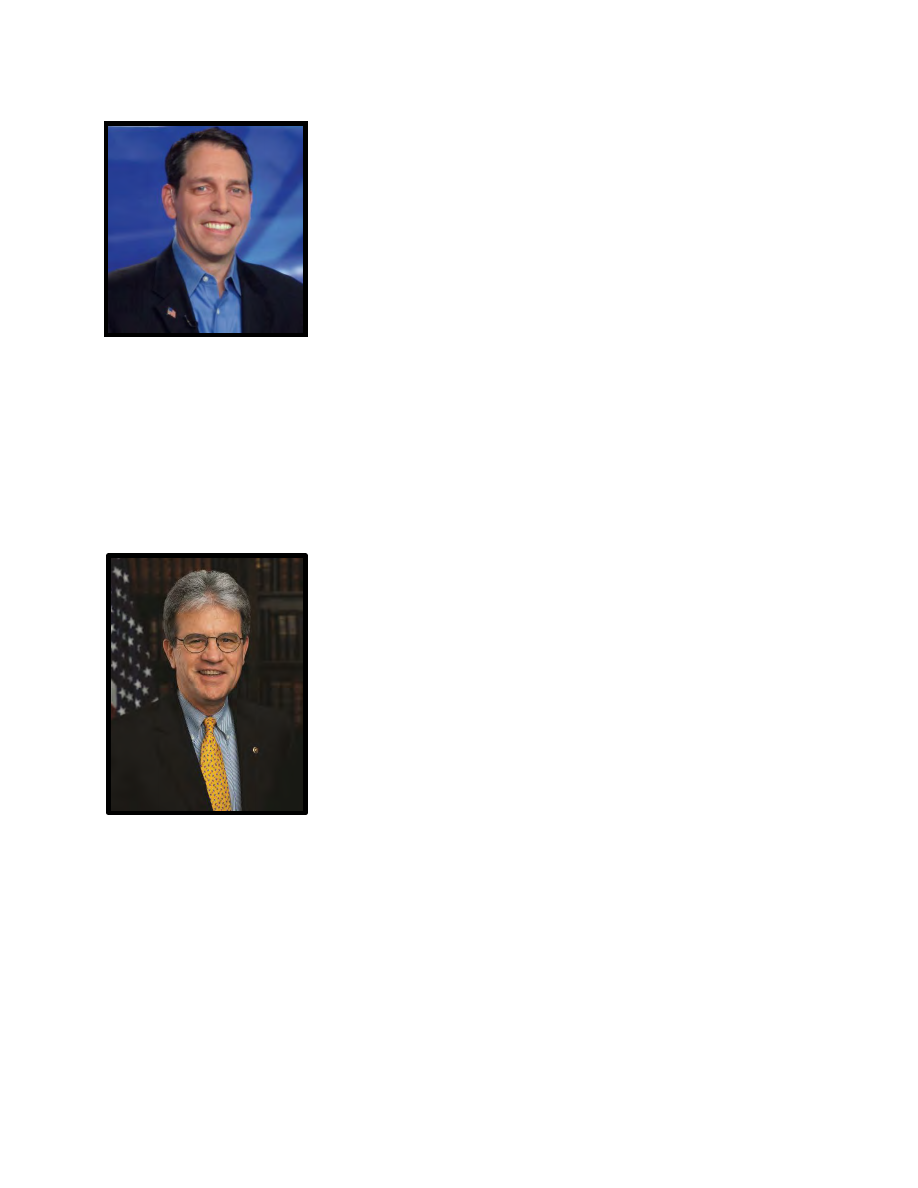
37
Mark Meckler
Citizens for Self-Governance, President
B.A. in English Literature, San Diego State University
J.D., with honors, University of the Pacific McGeorge School of Law
Mark Meckler is the Founder and President of Citizens for Self-Governance, an
organization created to educate and support grassroots activism in taking power
from Washington, D.C., and returning it to its rightful owners, the citizens of the
states. Meckler is widely regarded as one of the most effective and well-networked
grassroots organizers in the nation and is regularly called on for political
commentary in all forms of media.
Meckler is the co-founder and former National Coordinator for the Tea Party Patriots, the largest Tea Party
organization in the nation. He left the organization in February 2012 and founded CSG to work more broadly on
expanding the self-governance movement beyond the partisan divide.
As the President of CSG, Meckler makes sure that all projects, including Convention of States, are fully and
appropriately funded, staffed and managed, with a focus on strict stewardship of donor dollars for maximum leverage
and effect. Meckler is also personally involved in all media and public relations efforts.
Meckler and his wife Patty live in Northern California, where they share a love of outdoor recreation and equestrian
activities.
Tom Coburn
Senior Advisor, Convention of States Project
Retired US Sen. Tom A. Coburn, M.D. graduated Oklahoma State University with
a degree in accounting. He joined his family business Coburn Optical Industries
and helped build it to a juggernaut in the Ophthalmic Industry beginning with 13
employees and growing to over 350. Under his leadership, Coburn Optical
captured 35% of the US market before it was sold. Sen. Tom Coburn, M.D. then
attended medical school, and as a physician has delivered over 4,000 babies.
In 1995, Coburn was elected to the Oklahoma House. Coburn kept his promise to
serve no more than 6 years in the House returning to Muskogee to his medical
practice in 2000.
Upon leaving the House, Coburns’ desire to serve maintained plenty of fire. In
2004 Tom Coburn was elected to represent Oklahoma in the United States
Senate. During his campaign, he committed to serve no more than two terms. During his tenure, Coburn put forth
more legislation than any other Senator to stop out of control spending and to protect the liberties recognized by our
Founders. His efforts have helped to expose wasteful government projects by divulging the infamous “Bridge to
Nowhere” and countless other special projects that were intended to enrich lobbyists and preserve the jobs of career
politicians in both political parties.
His work on behalf of taxpayers has saved billions of dollars. Crowned by the press as a “budget hawk”, Coburn
made balancing the budget a top priority. Senate Democrats referred to him as “Dr. No” because of his unwillingness
to spend taxpayer money on anything but the most important budget items.
After retiring two months early from his second term in the Senate, Coburn returned again to his medical practice but
his desire for public service had not waned. Coburn returned to the public eye once again, placing his time,
contributing his reputation and sacred honor to promote the Convention of States Project. Coburn now travels the
nation educating legislators and concerned Americans about the only constitutional solution as big as our nation’s
problems, Convention of States. Coburn lives with his wife Carolyn, (former Ms. Oklahoma) and loves spending time
with her, his 3 children and 4 grandchildren.
Leadership of the Convention of States Project
AP
PENDE
X
– C.
O.
S.
LE
ADERS
HIP

38
Eric O’Keefe
Citizens for Self-Governance, Board of Directors
Eric O’Keefe has a 25-year history as an active strategist, board member, and donor
with organizations working to advance individual liberty, promote citizen
engagement and restore constitutional governance. O’Keefe helped found U.S. Term
Limits in 1991, and in recent years, co-founded the Campaign for Primary.
Accountability, the Health Care Compact Alliance, and Citizens for Self-
Governance.
O’Keefe is also a founding board member of the Center for Competitive Politics and
Citizens in Charge Foundation.
O’Keefe’s book on the corruption of Congress, “Who Rules America,” won praise from the late freedom
advocate Milton Friedman.
O’Keefe also serves on the board of directors of the Wisconsin Club for Growth, which has been active
defending Gov. Walker’s agenda during legislative campaigns, recall campaigns, and legislative races.
When he is not engaged in civic activities, O’Keefe is a private investor based in rural Wisconsin, where he and
his wife raised three children.
Michael Farris
Citizens for Self-Governance, Senior Fellow for Constitutional Studies, Head of
Convention of States Project
B.A. in Political Science,
magna cum laude
, Western Washington University
J.D., with honors, Gonzaga University School of Law
LL.M., with merit, in Public International Law, University of London
Michael Farris is the Chancellor of Patrick Henry College and Chairman of the
Home School Legal Defense Association. He was the founding president of
each organization.
Farris is a constitutional appellate litigator who has served as lead counsel in
the United States Supreme Court, 8 federal circuit courts, and the appellate
courts of 13 states.
He has been a leader on Capitol Hill for over 30 years
and is widely known for his leadership on homeschooling, religious freedom, and the preservation of American
sovereignty.
A prolific author, Farris has been recognized with a number of awards including the Salvatori Prize for
American Citizenship by the Heritage Foundation and as one of the “Top 100 Faces in Education for the 20th
Century” by
Education Week
magazine.
Farris and his wife Vickie have 10 children and 17 grandchildren.
AP
PENDE
X
– C.
O.
S.
LE
ADERS
HIP

39
ROSTER OF STATE DELEGATIONS
STATE
NAME
COMMITTEE
Alabama
Senator Greg Albritton
Term Limits and Federal Judicial Jurisdiction
Senator Clay Scofield
Federal Legislative and Executive Jurisdiction
Representative Jack “J.D.” Williams
Fiscal Restraints
Alaska
Representative Lynn Gattis
Term Limits and Federal Judicial Jurisdiction
Representative Shelley Hughes
Federal Legislative and Executive Jurisdiction
Representative Tammie Wilson
Fiscal Restraints
Arizona
Senator Debbie Lesko
Federal Legislative and Executive Jurisdiction
Representative Kelly Townsend
Term Limits and Federal Judicial Jurisdiction
Representative Sonny Borrelli
Fiscal Restraints
Arkansas
Representative Bob Ballinger
Term Limits and Federal Judicial Jurisdiction
Senator Robin Lundstrum
Fiscal Restraints
Senator Gary Stubblefield
Federal Legislative and Executive Jurisdiction
California
Assemblyman Brian Jones
Federal Legislative and Executive Jurisdiction
Dr. John Eastman
Term Limits and Federal Judicial Jurisdiction
Mr. Dennis C. Revell
Fiscal Restraints
Colorado
Senator Kevin Lundberg
Fiscal Restraints
Senator Vicki Marble
Federal Legislative and Executive Jurisdiction
Ms. Laurie Bratten
Term Limits and Federal Judicial Jurisdiction
Connecticut
Senator Joe Markley
Fiscal Restraints
Representative Rob Sampson
Federal Legislative and Executive Jurisdiction
Delaware
Senator David Lawson
Federal Legislative and Executive Jurisdiction
Mr. Sam Waltz
Fiscal Restraints
Florida
Representative Matt Caldwell
Federal Legislative and Executive Jurisdiction
Senator Alan Hays
Term Limits and Federal Judicial Jurisdiction
Representative Larry Metz
Fiscal Restraints
Georgia
Representative Timothy Barr
Term Limits and Federal Judicial Jurisdiction
Representative Buzz Brockway
Federal Legislative and Executive Jurisdiction
Representative Bruce Williamson
Fiscal Restraints
Hawaii
Representative Bob McDermott
Term Limits and Federal Judicial Jurisdiction
The Honorable G. Lynn Finnegan
Federal Executive and Legislative Jurisdiction
Idaho
Representative James Holtzclaw
Term Limits and Federal Judicial Jurisdiction
Representative Thomas Loertscher
Federal Executive and Legislative Jurisdiction
Representative Eric Redman
Fiscal Restraints
Illinois
Representative Thomas Morrison
Fiscal Restraints
Mr. Nick Sauer
Term Limits and Federal Judicial Jurisdiction
Indiana
Senator Brandt Hershman
Fiscal Restraints
Senator Travis Holdman
Federal Legislative and Executive Jurisdiction
Representative Ben Smaltz
Term Limits and Federal Judicial Jurisdiction
Iowa
Representative Jake Highfill
Term Limits and Federal Judicial Jurisdiction
Senator Charles Schneider
Fiscal Restraints
Senator Jack Whitver
Federal Legislative and Executive Jurisdiction
Kansas
Representative Pete DeGraaf
Fiscal Restraints
Representative Brett Hildabrand
Federal Legislative and Executive Jurisdiction
Representative Bill Sutton
Term Limits and Federal Judicial Jurisdiction
Kentucky
Senator Tom Buford
Fiscal Restraints
Representative Tim Couch
Federal Legislative and Executive Jurisdiction
Senator Wil Schroder
Term Limits and Federal Judicial Jurisdiction
Louisiana
Senator Dan Claitor
Term Limits and Federal Judicial Jurisdiction
Senator Page Cortez
Federal Legislative and Executive Jurisdiction
Representative Ray Garofalo
Fiscal Restraints
AP
PENDE
X
– RO
ST
ER
OF
S
TAT
E
DEL
EGATION
S

40
STATE
NAME
COMMITTEE
Maine
Representative Randall Greenwood
Fiscal Restraints
Senator Garrett Mason
Federal Legislative and Executive Jurisdiction
Representative Matt Harrington
Term Limits and Federal Judicial Jurisdiction
Maryland
Senator Joan Carter Conway
Fiscal Restraints
Delegate Tony McConkey
Term Limits and Federal Judicial Jurisdiction
Delegate Michael McKay
Federal Legislative and Executive Jurisdiction
Massachusetts
Mr. Andrew Beckwith
Term Limits and Federal Judicial Jurisdiction
Michigan
Representative Lee Chatfield
Federal Legislative and Executive Jurisdiction
Mr. Kurt O'Keefe
Term Limits and Federal Judicial Jurisdiction
The Honorable Ken Bradstreet
Fiscal Restraints
Minnesota
Representative Cindy Pugh
Fiscal Restraints
Representative Duane Quam
Federal Legislative and Executive Jurisdiction
Senator Roger Chamberlain
Term Limits and Federal Judicial Jurisdiction
Mississippi
Representative Chris Brown
Fiscal Restraints
Representative Dan Eubanks
Term Limits and Federal Judicial Jurisdiction
Senator Angela Hill
Federal Legislative and Executive Jurisdiction
Missouri
Senator Bob Dixon
Term Limits and Federal Judicial Jurisdiction
Representative Keith Frederick
Fiscal Restraints
Representative John Wiemann
Federal Legislative and Executive Jurisdiction
Montana
Senator Doug Kary
Fiscal Restraints
Representative Theresa Manzella
Federal Legislative and Executive Jurisdiction
Senator Scott Sales
Term Limits and Federal Judicial Jurisdiction
Nebraska
Senator Laura Ebke
Term Limits and Federal Judicial Jurisdiction
Senator Curt Friesen
Federal Legislative and Executive Jurisdiction
Senator Brett Lindstrom
Fiscal Restraints
Nevada
The Honorable Sharron Angle
Term Limits and Federal Judicial Jurisdiction
Assemblyman Brent Jones
Federal Legislative and Executive Jurisdiction
Mr. Steven Miller
Fiscal Restraints
New Hampshire
Senator Gary Daniels
Fiscal Restraints
Representative Eric Eastman
Federal Legislative and Executive Jurisdiction
Representative Kris Roberts
Term Limits and Federal Judicial Jurisdiction
New Jersey
Assemblyman Robert Auth
Fiscal Restraints
New Mexico
Representative Yvette Herrell
Federal Legislative and Executive Jurisdiction
Ms. Carla Sonntag
Fiscal Restraints
New York
Mr. Bobby Massarini
Fiscal Restraints
North Carolina
Representative Bert Jones
Term Limits and Federal Judicial Jurisdiction
Representative Dennis Riddell
Federal Legislative and Executive Jurisdiction
Senator Norman Sanderson
Fiscal Restraints
North Dakota
Representative Rick Becker
Term Limits and Federal Judicial Jurisdiction
Representative Jim Kasper
Federal Legislative and Executive Jurisdiction
Representative Scott Louser
Fiscal Restraints
Ohio
Representative Christina Hagan
Federal Legislative and Executive Jurisdiction
Representative Bill Patmon
Fiscal Restraints
Representative Margy Conditt
Term Limits and Federal Judicial Jurisdiction
Oklahoma
Senator Josh Brecheen
Fiscal Restraints
Representative Mark Lepak
Term Limits and Federal Judicial Jurisdiction
Senator Rob Standridge
Federal Legislative and Executive Jurisdiction
Oregon
The Honorable Bruce Starr
Fiscal Restraints
Mr. Kevin Moss
Federal Legislative and Executive Jurisdiction
The Honorable Derrick Kitts
Term Limits and Federal Judicial Jurisdiction
Pennsylvania
Senator John Eichelberger
Federal Legislative and Executive Jurisdiction
The Honorable Eugene Geesey
Fiscal Restraints
AP
PENDE
X
– RO
ST
ER
O
F
STAT
E
DEL
EGATION
S

41
STATE
NAME
COMMITTEE
Rhode Island
Mr. William Perry
Fiscal Restraints
Mr. Matt Fabisch
Federal Legislative and Executive Jurisdiction
South Carolina
Senator Larry Grooms
Fiscal Restraints
Representative Ralph Kennedy
Term Limits and Federal Judicial Jurisdiction
Representative Bill Taylor
Federal Legislative and Executive Jurisdiction
South Dakota
Representative Lynne DiSanto
Term Limits and Federal Judicial Jurisdiction
Senator Brock Greenfield
Fiscal Restraints
Representative Isaac Latterell
Federal Legislative and Executive Jurisdiction
Tennessee
Senator Mike Bell
Fiscal Restraints
Representative Sheila Butt
Term Limits and Federal Judicial Jurisdiction
Representative Jay Reedy
Federal Legislative and Executive Jurisdiction
Texas
Senator Brian Birdwell
Federal Legislative and Executive Jurisdiction
Representative Phil King
Federal Legislative and Executive Jurisdiction
Representative Rick Miller
Fiscal Restraints
Representative Matt Rinaldi
Term Limits and Federal Judicial Jurisdiction
Utah
Representative Ken Ivory
Term Limits and Federal Judicial Jurisdiction
Representative Merrill Nelson
Federal Legislative and Executive Jurisdiction
Representative Kim Coleman
Fiscal Restraints
Vermont
Representative Robert Helm
Term Limits and Federal Judicial Jurisdiction
Representative Vicki Strong
Fiscal Restraints
Representative Lynn Batchelor
Federal Legislative and Executive Jurisdiction
Virginia
Senator Amanda Chase
Federal Legislative and Executive Jurisdiction
Delegate Jim LeMunyon
Fiscal Restraints
Delegate Scott Lingamfelter
Fiscal Restraints
The Honorable Vance Wilkins (Former
Speaker of Virginia House of Delegates) Term Limits and Federal Judicial Jurisdiction
Washington
Senator Ann Rivers
Fiscal Restraints
Mr. Skyler Rude
Federal Legislative and Executive Jurisdiction
Ms. Fallon Stidd
Term Limits and Federal Judicial Jurisdiction
West Virginia
Senator Robert Karnes
Federal Legislative and Executive Jurisdiction
Delegate John Overington
Fiscal Restraints
Wisconsin
Mr. Eric O'Keefe
Federal Legislative and Executive Jurisdiction
The Honorable Dave Zien
Term Limits and Federal Judicial Jurisdiction
Wyoming
Representative Jim Allen
Federal Legislative and Executive Jurisdiction
Representative Scott Clem
Term Limits and Federal Judicial Jurisdiction
Representative Dan Laursen
Fiscal Restraints
Delegation Chairperson in Bold
AP
PENDE
X
– R
OS
TER
OF
S
TAT
E
DEL
EGATION
S

42
Application for a Convention of the States under
Article V of the Constitution of the United States
Whereas,
the Founders of our Constitution empowered State Legislators to be guardians of liberty against future
abuses of power by the federal government, and
Whereas,
the federal government has created a crushing national debt through improper and imprudent
spending, and
Whereas
,
the federal government has invaded the legitimate roles of the states through the manipulative process
of federal mandates, most of which are unfunded to a great extent, and
Whereas
,
the federal government has ceased to live under a proper interpretation of the Constitution of the
United States, and
Whereas,
it is the solemn duty of the States to protect the liberty of our people — particularly for the generations
to come — by proposing Amendments to the Constitution of the United States through a Convention of the
States under Article V for the purpose of restraining these and related abuses of power.
Be it therefore resolved by the legislature of the State of %%%%%%%%%%%%%%%%%%%%%%%%%%%%%%%%%%%%%%%%%%%%:
Section 1
. The legislature of the State of %%%%%%%%%%%% hereby applies to Congress, under the provisions of
Article V of the Constitution of the United States, for the calling of a Convention of the States limited to
proposing amendments to the Constitution of the United States that impose fiscal restraints on the federal
government, limit the power and jurisdiction of the federal government, and limit the terms of office for its
officials and for members of Congress.
Section 2
. The secretary of state is hereby directed to transmit copies of this application to the President and
Secretary of the United States Senate and to the Speaker and Clerk of the United States House of
Representatives, and copies to the members of the said Senate and House of Representatives from this State;
also to transmit copies hereof to the presiding officers of each of the legislative houses in the several States,
requesting their cooperation.
Section 3
. This application constitutes a continuing application in accordance with Article V of the Constitution
of the United States until the legislatures of at least two-thirds of the several states have made applications on
the same subject.
AP
PEND
EX
–
C.
O.S.
M
OD
EL
AP
PLIC
AT
ION

43
PROPOSED CONVENTION RULES
In July 2015, Professor
Robert Natelson, one of
the nation’s leading
Article V experts, crafted
an initial draft of rules for
a Convention of the States
along with Convention of
States
Project
Co-
Founder, Michael Farris.
Since then, members of
the Convention of States
Caucus – a group of
200+ state legislators
from 40 states, all united
in their support of an Article V Convention of States – have been invited to review Professor Natelson’s rules
and provide input. The following is the latest iteration of those rules as of September 2015. When a Convention
of States is called, these rules will be available for official debate and adoption.
CONVENTION FOR PROPOSING AMENDMENTS - PROPOSED RULES
(1)
Rule 1.
Questions not governed by these rules shall be governed by the latest
published edition of
Mason’s
Manual of Legislative Procedure
, except where the rule in that manual can be applied only to a state legislature
rather than a convention; in which case the matter shall be determined by parliamentary common law. (2)
Rule 2.
Officers
(a) The officers of the Convention shall consist of a president and vice president, who shall be elected from
among the Commissioners; and the following, who shall be elected from among persons, not Commissioners:
secretary, sergeant-at-arms, parliamentarian, and assistant parliamentarian.
(b) All officers shall be on oath to carry out their duties faithfully and in accordance with lawful authority.
© The temporary Convention President shall be appointed from among the Commissioners from the state that
was the first to enact the application that led to the calling of this Convention. The temporary president shall be
selected by a majority vote of that state’s Delegation. The temporary president’s sole duty shall be to preside
over the election of the Convention President and he or she shall be ineligible to be the permanent president.
Rule 3.
The sergeant-at-arms is empowered, under the direction of the president,
to secure the good order of
the house. Orders issued by the president to the sergeant-of-arms shall be appealable, as in the case of other
rulings of the chair. (4)
Rule 4.
The members of this Convention are the Committees (Delegations)
appointed by their respective states.
(5) All votes shall be taken by states, with each state having one vote. (6) In roll call votes, states shall declare
their votes in alphabetical order. (7)
Rule 5.
Irrespective of how many Commissioners a state includes within its
Delegation, no more than five
Commissioners from any one state shall be on the floor at the same time. (8) On every vote, the state's vote
shall be announced by the chair of the state Delegation or his or her designee. Every Delegation shall canvass
each Commissioner on each vote in a manner to be prescribed by the commissioning state or, in default of a
prescribed manner, by the Delegation. Each state Delegation's vote shall be determined in accordance with the
rule prescribed by the commissioning state.
Rule 6.
A quorum to do business shall consist of the Commissioners
empowered to cast the votes of not less
AP
PEND
EX
–
PR
OP
OSED
C
ONV
EN
TIO
N
RU
LES

44
than 26 member states, and all questions shall be decided by the greater number of those which be fully
represented, but a lower number than 26 may adjourn from day to day. (9)
Rule 7.
The order of business shall be as follows: (10)
(1)
call to order,
(2)
roll call,
(3)
invocation,
(4)
pledge of allegiance,
(5)
reading and approval by the clerk of the minutes of the previous day,
(6)
reports of standing Committees,
(7)
reports of special or select Committees,
(8)
special orders,
(9)
unfinished business,
(10)
introduction and first reading of proposals,
(11)
consideration of daily calendar,
(12)
announcement of Committee meetings, and
(13)
recess for the day (adjournment). (11)
Rule 8.
Every Commissioner, rising to speak, shall address the President; and
while he or she shall be speaking
no one shall pass between them or read any written matter not immediately germane to the question under
consideration. (12)
Rule 9.
Of two Commissioners rising to speak at the same time, the President
shall name the one who shall
first be heard. (13)
Rule 10.
A Commissioner shall not speak more often than twice, without
special leave upon the same question;
and not a second time before every other who had been silent but shall choose to speak on the subject shall have
been heard. [The Commissioners from any one State Committee shall not speak more often than ten times
without special leave upon the same question; and not more than five times before every other who had been
silent but shall choose to speak on the subject shall have been heard.] (14)
Rule 11.
No Commissioner shall, without leave of the Convention, speak
more than 10 minutes at any one
time. (15)
Rule 12.
A motion made and seconded, shall be repeated; and if written, as it
shall be when any member shall
so require, shall be read aloud by the Secretary or transmitted to each Commissioner’s pre-designated electronic
device before it shall be debated. (16) No motion, other than a procedural motion, shall be in order unless
germane to both the subject matter specified in the state applications on which Congress called the Convention
and to the subject matter specified in the Convention call. (17)
Rule 13.
A motion may be withdrawn at any time before the vote upon it
shall have been declared. (18)
Rule 14.
When a debate shall arise upon a question, no motion, other than to
amend the question, to commit
it, or to postpone the debate, shall be received. (19)
Rule 15.
A question that consists of one or more propositions shall, at the
request of any Commissioner, be
divided and put separately as to each proposition. (20)
Rule 16.
No substantive question or Committee recommendation shall be
decided the day on which it is
introduced or first debated if any five states request that the decision is postponed to another day. (21)
Rule 17.
A motion to reconsider a matter that has been determined by a
majority may be made, with leave
unanimously given, on the same day on which the vote passed; but otherwise not without one day’s previous
notice; in which last case, if the Convention agree to the reconsideration, the Convention or, by the Convention’s
leave, the President shall assign a future day for the purpose. (22)
Rule 18.
A Commissioner may be called to order by another Commissioner,
as well as by the President, and
AP
PEND
EX
–
PR
OP
OSED
C
ONV
EN
TIO
N R
UL
ES

45
may be allowed to explain his or her conduct or any expressions supposed to be reprehensible. (23)
Rule 19.
All questions of order shall be decided by the President, subject to
appeal to the Convention, but
without debate. (24)
Rule 20.
Upon a question to recess for the day, (25) which may be made at
any time, if it is seconded, the
question shall be put without debate. (26)
[
Rule 21.
When the Convention shall recess, every Commissioner shall stand in his or her place until the
president pass.] (27)
Rule 22.
No Commissioner shall be absent from the Convention, so as to
interrupt the representation of his or
her state, without leave. (28)
Rule 23.
Committees—generally applicable provisions
(1)
The standing Committees shall include Rules, Credentials, Administration, Fiscal Restraints, Federal
Jurisdiction, and Term Limits. (29) The Convention may create ad hoc Committees.
(2)
The membership of the Rules, Credentials, and Administration Committees shall be elected by a plurality
vote of the states, voting by secret ballot. The membership of ad hoc Committees shall be appointed by the
President unless the Convention shall prescribe another method. (30) The membership of the Fiscal Restraints,
Federal Jurisdiction, and Term Limits Committees shall be selected by the method designated in Rule 24.
(3)
Each Committee may by majority vote create Subcommittees for issues germane to the Committee’s
assigned task.
(4)
Committees and Subcommittees shall not sit while the Convention shall be or ought to be sitting, without
leave of the Convention. (31)
Rule 24.
Fiscal Restraints, Federal Jurisdiction, and Term Limits Committees.
(32)
(1)
The Fiscal Restraints Committee, Federal Jurisdiction Committee, and Term Limits Committee each has
[exclusive] (33) responsibility for developing proposals within the corresponding subject matter of the state
applications for the Convention.
(2)
Each of these three Committees shall consist of one member from each state Delegation, selected as
determined by such Delegation; provided, however, that no person shall serve on more than one of those three
Committees.
(3) Any proposal approved by a Subcommittee of any of these three Committees shall be referred to its
Committee Chairman, who shall schedule it for hearing within five days of its referral from the Subcommittee.
The Committee shall vote on any proposal endorsed by at least five Committee members within 24 hours after
the hearing (weekends and holidays excluded). Approval shall be by a simple majority of Committee members
present and voting.
(4) Every proposal reported from the Fiscal Restraints, Federal Jurisdiction, or Term Limits Committee shall
be scheduled for debate and a vote on the floor of the Convention; the Presiding Officer of the Convention shall
have no authority to refuse to schedule debate or a vote on any such proposal, and no formal rule shall be
required to schedule any such proposal for debate or a vote. No motion to adjourn sine die shall be in order so
long as any such proposal remains without a Convention vote to pass, reject, or table.
Endnotes
(1)
The general reasons beyond these rules are found in §3.14 of
** ROBERT G. NATELSON, STATE **
**INITIATION OF CONSTITUTIONAL AMENDMENTS: A GUIDE FOR LAWYERS AND **
AP
PEND
EX
–
PR
OP
OSED
C
ONV
EN
TIO
N R
UL
ES

46
**LEGISLATIVE DRAFTER**
S
(2014)
(popularly called the “Article V Compendium”—and
hereinafter
“COMPENDIUM”).
The specific rules derive from a variety of sources (including many prior Conventions of States), but particularly
from the rules adopted by the 1861 Washington Conference Convention, a general gathering of states that
proposed a constitutional amendment. Those rules were, in turn, based on previous Convention experience.
However, with one exception (election of certain committee members) the secrecy rules applying in earlier
Conventions have been dropped. Modern expectations are of openness.
(2)
For an explanation of the selection of Mason’s Manual, see COMPENDIUM, §3.14.4. The 1850 Nashville
Convention designated Jefferson’s rules for the U.S. Senate as a default source, but that seems more dated and
less familiar to most state lawmakers than Mason’s.
(3) This is derived from the practice of previous interstate Conventions. The recommendation of the
parliamentarian is an innovation based on a recommendation by an experienced legislator. COMPENDIUM
§3.14.3. Some Conventions have appointed assistant secretaries, but it would seem better to allow the secretary
to appoint assistants without their being Convention officers.
(4)
This rule follows the parliamentary common law, see COMPENDIUM §3.14.1, but is placed here to
answer questions frequently raised of how the Convention is to control internal demonstrations or disorder.
(5)
This is a clarification of precedent and of sometimes-confusing earlier Convention rules.
(6)
This follows the unvarying former practice.
(7)
The traditional order was for states to vote in a northeast-to-southwest order, but the current configuration
of the country makes that difficult, and the alphabetical system is more familiar to modern Americans.
(8)
This rule addresses the unfair and potentially unruly situation arising at the 1850 Nashville Convention,
where Tennessee, although having only one vote, sent 100 Commissioners, more than all other states combined.
The Compendium recommends a maximum of five, which is justified by fact that this Convention will include
many more states than earlier Conventions. The rules take account of the fact that some states may wish to
appoint alternate Commissioners.
(9)
This is based, with the numbers adjusted for the larger number of states, on the rules of the 1861
Washington Convention. See COMPENDIUM §3.14.3.
(10)
This is the order in Mason’s Manual, as modified for the fact that this is a Convention, not a legislative
body. COMPENDIUM §3.14.5. The pledge of allegiance has been added in this version.
(11)
The word “recess” to describe an adjournment from day-to-day is used in Mason’s Manual.
(12)
This is based on the rules prevailing both at the 1787 Philadelphia Convention and the 1861 Washington
Convention, although modified to take account of modern technology. COMPENDIUM § 3.14.5.
(13)
COMPENDIUM §3.14.5.
(14)
Id. The matter in brackets has been inserted for discussion.
(15)
Added to reflect modern conditions. COMPENDIUM §3.14.5.
(16)
Based on the Washington Convention rules, COMPENDIUM §3.14.5, but updated for modern
conditions.
(17)
This rule provides that a substantive motion is out of order unless germane to the subjects in the
applications and call, whichever is narrower. Normally the subject matter of the applications and the call would
be the same. In some cases, however, some of the 34 applications that trigger a Convention on a particular
subject might mention extraneous subjects. This language makes clear that the Convention is to consider only
subjects on which at least 34 applications agree, and which are therefore stated in the call.
AP
PEND
EX
–
PR
OP
OSED
C
ONV
EN
TIO
N R
UL
ES

47
(18)
Based on the Washington Convention rules. Id.
(19)
Based on the Washington Convention rules. Id.
(20)
Based on a rule of the Washington Convention. Id. The language has been updated.
(21)
This is loosely based on the 1774 New York City Convention usually known as the First Continental
Congress but represents a compromise between the need for speed and a rule that mandated delay at the request
of any Delegation. Id.
(22)
Based on a rule of the 1787 Philadelphia Convention, with language updated.
(23)
COMPENDIUM §3.14.5.
(24)
A proposed rule of the Washington Convention would have dispensed with the right of appeal, but the
Delegates rejected that provision. Compendium §3.14.5.
(25)
The word “recess” to describe an adjournment from day-to-day is used in Mason’s Manual.
(26)
Based on a rule of the Washington Convention. See COMPENDIUM §3.14.5.
(27)
This optional rule is based on rules of the Washington and 1787 Philadelphia Conventions. Id. The rule
reflects the high prestige of the presiding officers of those Conventions, General George Washington, and
former President John Tyler. Other Conventions have not adopted this rule, and whether any particular
Convention adopts it may depend on the identity of its own presiding officer.
(28)
Based on a rule of the Washington Convention, with updated language. COMPENDIUM §3.14.5.
(29)
The requirement for standing committees on fiscal restraints, federal jurisdiction, and term limits is based
on the three-subject model application of Citizens for Self-Governance’s “Convention of States” movement.
(30)
Both plurality elections of committees and presidential appointment were used in prior Conventions.
Here, elections are reserved for the three most important committees. The Convention is free to prescribe
election at any time for other committees.
Earlier Convention rules refer to “ballot.” The word “secret” is added because modern Americans may not be
aware that the term “ballot” traditionally implies secrecy. Although most of the secrecy rules applied in older
Conventions have been dropped here, secrecy may be necessary in this case to ensure an impartial choice and
to minimize hard feelings among Commissioners.
(31) Based on a rule of the Washington Convention and modern legislative practice. COMPENDIUM §3.14.5.
(32)
This Rule was developed for a Convention convened pursuant to the three-subject “Convention of States”
application. It sets forth a procedure for proposals within those three subjects and prevents presiding officers
from refusing to permit debate or votes on credible proposals within those three areas.
(33)
The inclusion of the term exclusive would prevent the Convention from creating committees to “wire
around” the three standing committees mentioned in this section. There are obvious advantages and
disadvantages to both including and omitting the term “exclusive.”
AP
PEND
EX
–
PR
OP
OSED
C
ONV
EN
TIO
N R
UL
ES

On September 11, 2014, some of our nation’s finest legal minds convened to consider arguments for and against the use of
Article V to restrain federal power. These experts specifically rejected the argument that a Convention of States is likely to be
misused or improperly controlled by Congress, concluding instead that the mechanism provided by the Founders is safe.
Moreover, they shared the conviction that Article V provides the only constitutionally effective means to restore our federal
system. The conclusions of these prestigious experts are memorialized in The Jefferson Statement, which is reproduced here.
The names and biographical information of the endorsers, who have formed a “Legal Board of Reference” for the Convention
of States Project, are listed below the Statement.
The Constitution’s Framers foresaw a day when the federal government would exceed and abuse its enumerated powers, thus placing
our liberty at risk. George Mason was instrumental in fashioning a mechanism by which “we the people” could defend our freedom—
the ultimate check on federal power contained in Article V of the Constitution.
Article V provides the states with the opportunity to propose constitutional amendments through a process called a Convention of States.
This process is controlled by the states from beginning to end on all substantive matters.
A Convention of States is convened when 34 state legislatures pass resolutions (applications) on an agreed topic or set of topics. The
Convention is limited to considering amendments on these specified topics.
While some have expressed fears that a Convention of States might be misused or improperly controlled by Congress, it is our considered
judgment that the checks and balances in the Constitution are more than sufficient to ensure the integrity of the process.
The Convention of States mechanism is safe, and it is the only constitutionally effective means available to do what is so essential for
our nation—restoring robust federalism with genuine checks on the power of the federal government.
We share the Founders’ conviction that proper decision-making structures are essential to preserve liberty. We believe that the problems
facing our nation require several structural limitations on the exercise of federal power. While fiscal restraints are essential, we believe
the most effective course is to pursue reasonable limitations, fully in line with the vision of our Founders, on the federal government.
Accordingly, I endorse the Convention of States Project, which calls for an Article V Convention for “the sole purpose of proposing
amendments that impose fiscal restraints on the federal government, limit the power and jurisdiction of the federal government, and
limit the terms of office for its officials and for members of Congress.” I hereby agree to serve on the Legal Board of Reference for the
Convention of States Project.
Signed,
Randy E. Barnett
Charles J. Cooper
John C. Eastman
Michael P. Farris
Robert P. George
C. Boyden Gray
Mark Levin
Nelson Lund
Andrew McCarthy
Mark Meckler
Mat Staver
Continued to back page
Original signers of The Jefferson Statement
THE JEFFERSON STATEMENT
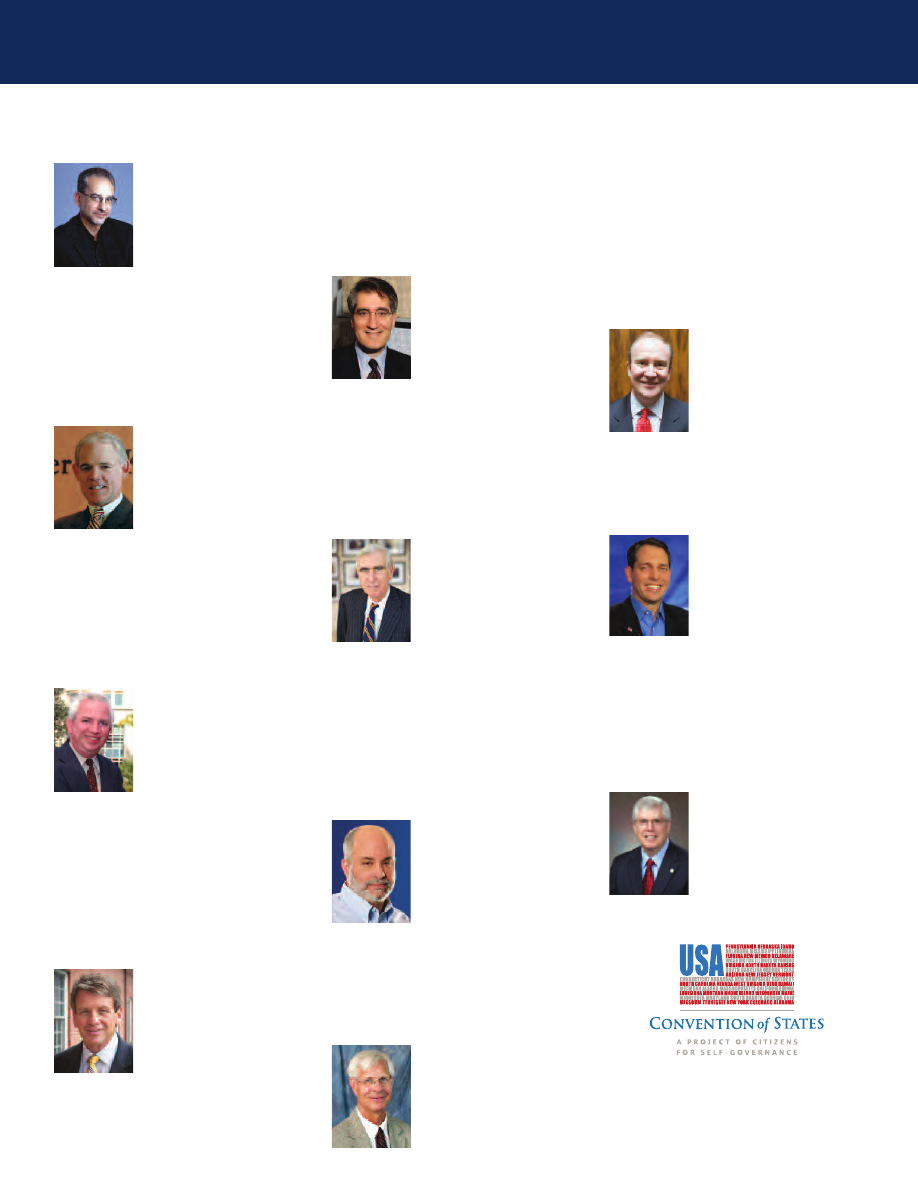
Randy E. Barnett
is the
Carmack Waterhouse Professor
of Legal Theory at the
Georgetown University Law
Center, where he directs the
Georgetown Center for the
Constitution. A graduate of Harvard Law School,
he represented the National Federation of
Independent Business in its constitutional chal-
lenge to the Affordable Care Act. Professor Barnett
has been a visiting professor at Harvard Law
School, the University of Pennsylvania,
and Northwestern.
Charles J. Cooper
is a founding
member and chairman of Cooper
& Kirk, PLLC. He has over 35
years of legal experience in gov-
ernment and private practice,
with several appearances before
the United States Supreme Court. Shortly after
serving as law clerk to Justice William H.
Rehnquist, Mr. Cooper joined the Civil Rights
Division of the U.S. Department of Justice in 1981.
In 1985 President Reagan appointed Mr. Cooper to
the position of Assistant Attorney General for the
Office of Legal Counsel.
John C. Eastman
is the Henry
Salvatori Professor of Law &
Community Service at Chapman
University Fowler School of
Law. He is the Founding Director
of the Center for Constitutional
Jurisprudence, a public interest law firm affiliated
with the Claremont Institute. Prior to joining the
Fowler School of Law faculty in August 1999, he
served as a law clerk with Justice Clarence Thomas
at the Supreme Court of the United States. Mr.
Eastman served as the Director of Congressional
& Public Affairs at the United States Commission
on Civil Rights during the Reagan administration.
Michael P. Farris
, head of the
Convention of States Project, is
the Chancellor of Patrick Henry
College and Chairman of the
Home School Legal Defense
Association. He was the found-
ing president of both organizations. During his ca-
reer as a constitutional appellate litigator, he has
served as lead counsel in the United States
Supreme Court, eight federal circuit courts, and the
appellate courts of thirteen states. Mr. Farris has
been a leader on Capitol Hill for over thirty years
and is widely respected for his leadership in the de-
fense of homeschooling, religious freedom, and the
preservation of American sovereignty.
R o b e r t P. G e o r g e
h o l d s
Princeton’s celebrated McCor-
mick Chair in Jurisprudence and
is the founding director of the
James Madison Program in
American Ideals and Institutions.
He is chairman of the United States Commission
on International Religious Freedom (USCIRF) and
has served as a presidential appointee to the United
States Commission on Civil Rights. Professor
George is a former Judicial Fellow at the Supreme
Court of the United States, where he received the
Justice Tom C. Clark Award.
C. Boyden Gray
is the founding
partner of Boyden Gray &
Associates, in Washington, D.C.
Prior to founding his law firm,
Ambassador Gray served as
Legal Counsel to Vice President
Bush (1981–1989) and as White House Counsel in
the administration of President George H.W. Bush
(1989–1993). Mr. Gray also served as counsel to
the Presidential Task Force on Regulatory Relief
during the Reagan Administration. Following his
service in the White House, he was appointed U.S.
Ambassador to the European Union and U.S.
Special Envoy for Eurasian Energy.
Mark Levin
is one of America’s
preeminent constitutional lawyers
and the author of several
New
York Times
bestselling books in-
cluding
Men in Black
(2007),
Liberty and Tyranny
(2010),
Ameritopia
(2012) and
The Liberty Amendments
(2013). Mr. Levin has served as a top advisor to sev-
eral members of President Ronald Reagan’s
Cabinet—including as Chief of Staff to the Attorney
General of the United States, Edwin Meese.
Nelson Lund
is University
Professor at George Mason
University School of Law. He
holds a doctorate in political sci-
ence from Harvard and a law de-
gree from the University of
Chicago. After clerking for Justice Sandra Day
O’Connor, he served in the White House as
Associate Counsel to President George H.W. Bush.
He also served on Virginia Governor George Allen’s
Advisory Council on Self-Determination and
Federalism, and on the Commission on Federal
Election Reform chaired by President Jimmy Carter
and Secretary James A. Baker III.
Andrew McCarthy
is a best-
selling author, a Senior Fellow at
National Review Institute, and a
contributing editor at National
Review. Mr. McCarthy is a for-
mer Chief Assistant U.S. Attorney
in New York, best known for leading the prosecu-
tion against the various terrorists in New York City.
He has also served as an advisor to the Deputy
Secretary of Defense.
Mark Meckler
is President of
Citizens for Self-Governance, the
parent organization of the
Convention of States Project. Mr.
Meckler is one of the nation’s
most effective grassroots activists.
After he co-founded and served as the National
Coordinator of the Tea Party Patriots, he founded
Citizens for Self-Governance in 2012 to bring the
concept of “self-governance” back to American
government. This grassroots initiative expands and
supports the ever-growing, bipartisan self-gover-
nance movement.
Mat Staver
is the Founder and
Chairman of Liberty Counsel and
also serves as Vice President of
Liberty University, Professor of
Law at Liberty University School
of Law, and Chairman of Liberty
Counsel Action.
LEGAL BOARD OF REFERENCE
Each of the following individuals has signed onto The Jefferson Statement, endorsing the Convention of States Project,
and serves as a legal advisor to the Project:
Website: ConventionOfStates.com
E-mail: [email protected]
Phone: (540) 441-7227
www.Facebook.com/ConventionOfStates
Twitter: @COSProject
Our constitutional rights, especially our Sec-
ond Amendment right to keep and bear
arms, are in peril. With every tragic violent
crime, liberals renew their demands for
Congress and state legislatures to enact so-
called “commonsense gun control” meas-
ures designed to chip away at our individual
constitutional right to armed self defense.
Indeed, were it not for the determination
and sheer political muscle of the National
Rifle Association, Senator Feinstein’s 2013
bill to outlaw so-called “assault weapons”
and other firearms might well have passed.
But the most potent threat facing the Second
Amendment comes not from Congress, but
from the Supreme Court. Four justices of
the Supreme Court do not believe that the
Second Amendment guarantees an individ-
ual right to keep and bear arms. They be-
lieve that Congress and state legislatures
are free not only to restrict firearms owner-
ship by law-abiding Americans, but to ban
firearms altogether. If the Liberals get one
more vote on the Supreme Court, the Sec-
ond Amendment will be no more.
Constitutional law has been the dominant
focus of my practice for most of my career
as a lawyer, first in the Justice Department
as President Reagan’s chief constitutional
lawyer and the chairman of the President’s
Working Group on Federalism, and since
then as a constitutional litigator in private
practice. For almost three decades, I have
represented dozens of states and many other
clients in constitutional cases, including
many Second Amendment cases. In 2001,
for example, I argued the first federal ap-
pellate case to hold that the Second Amend-
ment guarantees every law-abiding respon-
sible adult citizen an individual right to keep
and bear arms. And in 2013 I testified before
the Senate in opposition to Senator Fein-
stein’s anti-gun bill, arguing that it would
violate the Second Amendment. So I am not
accustomed to being accused of supporting
a scheme that would “put our Second
Amendment rights on the chopping block.”
This charge is being hurled by a small gun-
rights group against me and many other con-
stitutional conservatives because we have
urged the states to use their sovereign power
under Article V of the Constitution to call
for a convention for proposing constitutional
amendments designed to rein in the federal
government’s power.
The real threat to our constitutional rights
today is posed not by an Article V conven-
tion of the states, but by an out-of-control
federal government, exercising powers that
it does not have and abusing powers that it
does. The federal government’s unrelenting
encroachment upon the sovereign rights of
Continued on back page
An Open Letter Concerning
The Second Amendment
and The Convention of
States Project
From Charles J. Cooper
Long Time Constitutional Law Litigator for the NRA
Our constitutional
rights, especially
our Second
Amendment
right to keep
and bear arms,
are in peril.

Website: ConventionOfStates.com
E-mail: [email protected]
Phone: (540) 441-7227
www.Facebook.com/ConventionOfStates
Twitter: @COSProject
the states and the individual rights of citi-
zens, and the Supreme Court’s failure to
prevent it, have led me to join the Legal
Board of Reference for the Convention of
States Project. The Project’s mission is to
call for an Article V convention limited to
proposing constitutional amendments that
“impose fiscal restraints on the federal gov-
ernment, limit its power and jurisdiction,
and impose term limits on its officials and
members of Congress.” I am joined in this
effort by many well-known constitutional
conservatives, including Mark Levin, Pro-
fessor Randy Barnett, Professor Robert
George, Michael Farris, Mark Meckler, Pro-
fessor Robert Natelson, Andrew McCarthy,
Professor John Eastman, Ambassador Boy-
den Gray, and Professor Nelson Lund. All
of us have carefully studied the original
meaning of Article V, and not one of us
would support an Article V convention if
we believed it would pose a significant
threat to our Second Amendment rights or
any of our constitutional freedoms. To the
contrary, our mission is to reclaim our dem-
ocratic and individual freedoms from an
overreaching federal government.
The Framers of our Constitution carefully
limited the federal government’s powers by
specifically enumerating those powers in
Article I, and the states promptly ensured
that the Constitution would expressly protect
the “right of the people to keep and bear
arms” by adopting the Second Amendment.
But the Framers understood human nature,
and they could foresee a day when the fed-
eral government would yield to the “en-
croaching spirit of power,” as James Madi-
son put in the Federalist Papers, and would
invade the sovereign domain of the states
and infringe the rights of the citizens. The
Framers also knew that the states would be
powerless to remedy the federal govern-
ment’s encroachments if the process of
amending the Constitution could be initiated
only by Congress; as Alexander Hamilton
noted in the Federalist Papers, “the national
government will always be disinclined to
yield up any portion of the authority” it
claims. So the Framers wisely equipped the
states with the means of reclaiming their
sovereign powers and protecting the rights
of their citizens, even in the face of con-
gressional opposition. Article V vests the
states with unilateral power to convene for
the purpose of proposing constitutional
amendments and to control the amending
process from beginning to end on all sub-
stantive matters.
The day foreseen by the Framers – the day
when the federal government far exceeded
the limits of its enumerated powers – arrived
many years ago. The Framers took care in
Article V to equip the people, acting through
their state legislatures, with the power to put
a stop to it. It is high time they used it.
Charles J. Cooper is a founding member
and chairman of Cooper & Kirk, PLLC.
Named by The National Law Journal as
one of the 10 best civil litigators in Wash-
ington, he has over 35 years of legal ex-
perience in government and private prac-
tice, with several appearances before the
United States Supreme Court and scores
of other successful cases on both the trial
and appellate levels.
Continued from front page
The real threat to our
constitutional rights today
is posed not by an Article V
convention of the states,
but by an out-of-control
federal government,
exercising powers that it
does not have and abusing
powers that it does.
For ten years, Senator Tom Coburn served
in the United States Senate as a voice for
limited government and the values of
Oklahomans. He has been described as
one of the most sought after members on
legislative strategy and thought. And now,
he’s bringing those talents to the Conven-
tion of States Project.
Since joining Convention of States as
Senior Advisor, Coburn has been traveling
across the nation, sharing his vision with
state legislators about why using Article V
calling for a convention of the states is cru-
cial for our nation at this time.
In his recent testimony to the Texas House
Federalism Committee, Coburn said, “[As
a doctor], I know you don’t solve problems
by treating the symptoms; you treat the
disease. Our country has a disease.” Article
V, he said, allows us to get past the symp-
toms and treat the structural problems that
threaten our future.
Coburn brings his political savvy and gravitas
alongside the hundreds of thousands of
volunteers working in all fifty states, and
Convention of States citizen activists in 97%
of all state legislative districts, not to
mention the endorsements of notable public
figures like Mark Levin, Sean Hannity,
Glenn Beck, Governor Mike Huckabee,
Governor Bobby Jindal, Colonel Allen
West, Sarah Palin and many others.
It’s not just his general political knowledge
that makes him an asset to this project.
“The federal government now reaches
into every aspect of our lives in ways the
Founders never imagined nor
intended…[Americans] don’t need
politicians, and unaccountable federal
bureaucrats and administrators telling
them how to live their lives.”
Continued on back page
Convention of States
Senior Advisor:
Senator Tom Coburn
(Ret.)
“After many years in Washington, one of the reasons
I left was because I no longer believe that Washington is
capable of reining itself in … the only avenue to change
it is the one given to us by our Founders in the
Constitution — an Article V Convention of States,
where the people, not the politicians, are in charge.”
COS-Coburn FlyerLayout 1 9/1/15 2:45 PM Page 1
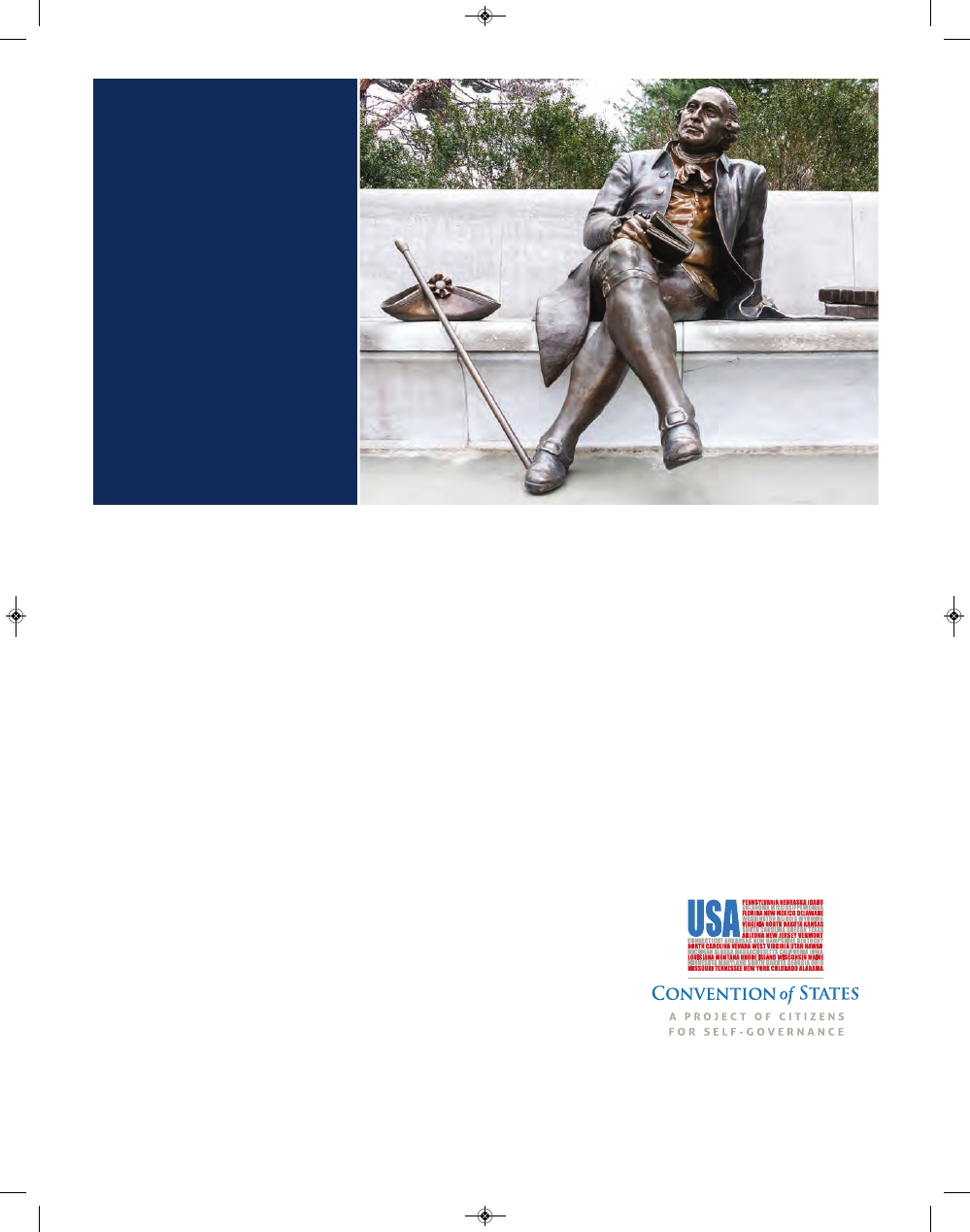
Website: ConventionOfStates.com
E-mail: [email protected]
Phone: (540) 441-7227
www.Facebook.com/ConventionOfStates
Twitter: @COSProject
His experience as Chairman of the Federal
Financial Management Subcommittee
means that he knows exactly where our
specific problems lie.
“What most people don’t realize is that
every single piece of government waste
has a constituency,” says Coburn, “And
most politicians don’t want to do anything
to jeopardize their future elections. So they
remain unresolved election cycle after
election cycle, and the American people
are stuck with the consequences. A Con-
vention of States, on the other hand, can
impose those restraints from the outside
and secure our financial future.”
Knowing that staying in power for many
election cycles is a detriment to effective
statesmanship, Senator Coburn has in-
sisted on term-limiting himself in every
office he has held. He says, “Our Founders
never intended that there be a ruling class
of career politicians. When members of
Congress stay in Washington election after
election, they become less concerned
about working for their constituents and
more concerned about keeping their
power.”
Imposing fiscal restraints and term
limits are two of the three topics
proposed by a Convention of States.
The third—and most important—
is the call to limit the power and ju-
risdiction of the federal government.
Coburn says, “The federal government
now reaches into every aspect of our lives
in ways the Founders never imagined nor
intended. The people of this country are
fully capable of governing themselves.
They don’t need politicians, and unac-
countable federal bureaucrats and admin-
istrators telling them how to live their lives
and run their businesses.”
He continues, “This is the reason that the
Convention of States was included in the
Constitution in the first place. At the Con-
stitutional Convention, George Mason,
knowing that no amendments of the proper
kind would ever be proposed from a tyran-
nical federal government, suggested that
the states have a method by which they
could propose those necessary amend-
ments. His suggestion—the Convention of
States—was met with no debate and unan-
imously agreed upon. Our Framers—in-
cluding George Washington, James Madi-
son, and Alexander Hamilton—all agreed
that the American people should be able
to take control of their country and govern
themselves.”
Without a doubt, Coburn believes the time
for a Convention of States is now.
“This is a movement whose time has come.
Although I am a proud conservative, this
is not a partisan issue. Politicians and
bureaucracies in Washington, D.C. will
never voluntarily relinquish meaningful
power — no matter who is elected. Only
through a Convention of States may the
clear, unfettered voice of the people be
heard and overreaching government be
reined in. It’s time to return government to
the people and realize again our Founders’
vision for self-governance.”
Continued from front page
George Mason Memorial, National Mall, DC
“George Mason,
knowing that no
amendments of the
proper kind would ever
be proposed from a
tyrannical federal
government, suggested
that the states have a
method by which they
could propose those
necessary amendments.”
COS-Coburn FlyerLayout 1 9/1/15 2:45 PM Page 2

For nearly two decades, Jim DeMint
made a name for himself in Washington
fighting for freedom, limited govern-
ment, and fiscal responsibility. Like for-
mer Senator Tom Coburn, DeMint was
known throughout our nation’s capital
for his refusal to become just another
Washington insider. He spoke up for
the will of the people and the good of
the nation, no matter how much oppo-
sition he faced from the statist “elite”
who call the shots in D.C.
DeMint’s extensive experience in
Washington has given him firsthand
knowledge of the near-impossibility
of making any significant changes from
within the federal government.
“I’ve tried to rein in Washington from
inside the Senate,” DeMint said. “I’ve
tried to elect good conservatives with
the Senate Conservatives Fund. And as
the President of the Heritage Foundation,
I’ve worked to create and promote good
conservative policy.
“While all these things are important,
the nation cannot be saved from within
Washington, D.C. Only the people in the
states can save the country, through a
Convention of States that proposes
constitutional amendments to fortify
restrictions on federal power.”
DeMint served in the U.S. House of
Representatives for South Carolina’s
Fourth Congressional District from
1999–2005. He was elected to the U.S.
Senate in 2004 and served as one of
South Carolina’s senators until he re-
signed in 2012 to become President of
the Heritage Foundation. With 18 years
of political experience working both in-
side and outside Congress, DeMint of-
fers a wealth of wisdom and insight to
Continued on back page
Convention of
States Project
Senior Advisor:
Senator Jim DeMint
“Americans are sick and tired of the
doubletalk coming out of Washington.
So am I. After serving in the House,
the Senate, and as President of the
Heritage Foundation, I’ve finally
realized the most important truth
of our time: Washington, D.C., will
never fix itself. Convention of States
is the only solution.”
— Jim DeMint

C
ONVENTION
O
F
S
TATES
.
COM
E-mail: [email protected]
(540) 441-
7
22
7
Facebook.com/ConventionOfStates
Twitter.com/COSProject
the volunteer grassroots armies that are
reaching every state legislature in the
country with the Convention of States
Project’s message: We CAN take our
power back.
“Once I realized that Washington in-
siders will never truly return decision-
making power to the people and the
states, I began to search for another way
to rein in the federal government,”
DeMint said. “When I learned about
Article V and the Convention of States
Project, I knew I had to get involved.”
DeMint brings with him more than just
legislative experience; he knows how
to fight through opposition and make
the tough calls for the benefit of
the country.
In 2009, DeMint was one of only two
Senators who voted against Hillary
Clinton’s appointment to Secretary of
State. In 2010, he introduced an Oba-
macare repeal as well as a bill that
would have required congressional ap-
proval of any major regulatory change
made by a federal agency. While his col-
leagues in Congress were working to
get reelected, DeMint faithfully fought
to uphold his pledge to defend the Con-
stitution and the will of the people.
“I’ve spent my career fighting against
the same radical statist coalition that has
aligned itself against the Convention of
States Project,” DeMint said. “I’m ex-
cited to get outside the beltway and work
with the grassroots to continue that fight.
Through Article V, the people and the
states have more power than I ever did
in D.C. I can’t wait to come alongside
the COS state teams, offer my support,
and watch what these citizen activists
can accomplish.”
To those few sincere Americans who
still fear the Article V process, DeMint
had this to say:
“I understand there are those who be-
lieve electing more ‘good’ leaders to
D.C. will solve our nation’s problems.
Take it from me – it won’t. The few
who fight for the people will always be
overwhelmed by the deep state bureau-
crats, the statist congressmen, and the
activist judges.
“Only a Convention of States can truly
limit the power and jurisdiction of
the federal government, and I’m
thrilled to be a small part of this his-
toric movement.”
Continued from front page
To those few sincere Americans
who still fear the Article V process,
DeMint had this to say:
“I understand there are those who
believe electing more ‘good’ leaders to
D.C. will solve our nation’s problems.
Take it from me – it won’t. The few
who fight for the people will always
be overwhelmed by the deep state
bureaucrats, the statist congressmen,
and the activist judges.”

“I
want legislation authorizing
Texas to join other states in call-
ing for a Convention of States to
fix the cracks in our broken Constitution,”
Abbott said, bringing a room of Texas
policymakers to their feet in support of
the Convention of States resolution.
Governor Abbott has demonstrated tremen-
dous courage and leadership in placing
his support firmly behind Convention of
States, which gives state lawmakers a
powerful tool to fight back against an
overbearing federal government.
Under the Convention of States resolu-
tion, commissioners to the convention
can discuss proposals for constitutional
reforms on three topics: fiscal restraints
on the federal government, term limits
on federal officials, and limits on the
power and jurisdiction of the federal
government.
Abbott's Texas Plan fits nicely within this
framework. Nearly 100 pages long with
more than 350 footnotes, the Texas Plan is
a comprehensive look at the need for an
Article V Convention of States.
“The President changes laws with a pen.
Congress sees no need to root their laws
in constitutional principles. The judiciary
rewrites laws and freely amends the Con-
stitution,” said Abbott, emphasizing that
Article V is the constitutional mechanism
the states can utilize to fix the cracks in
the system.
Moreover, Governor Abbott’s support is
unique in that he had made Convention
of States the primary agenda item of
his administration. In fact, the Texas Plan
was specifically designed to fit within—
and only within—the Convention of
States resolution!
“The Texas Plan does what so desperately
needs to be done—it puts teeth into the
Tenth Amendment,” Abbott said. “That is
the best way to restore the states and the
people as guardians of our Constitution.”
The Texas Plan harkens back to James
Madison’s Virginia Plan, which largely
defined the agenda of the Philadelphia
Convention in 1787.
Likewise, Abbott’s plan puts forward nine
bold solutions for the Convention of States
commissioners to consider—solutions that
would systematically restore power to the
people and to the states.
“The Founders gave us the tool to chart
our own destiny,” said Abbott. “That
tool is Article V of the United States
Constitution. The Framers included it, be-
cause they knew that citizens are the ulti-
mate defense against an overreaching fed-
eral government.”
“I want legislation
authorizing Texas to join
other states in calling for
a Convention of States
to fix the cracks in our
broken Constitution,”
Abbott said, bringing a
room of Texas
policymakers to their
feet in support of the
Convention of States
resolution.
Continued on back page
Texas Governor Abbott Supports
Convention of States
In one bold declaration, Texas Governor Greg Abbott both shocked the political world and
energized a growing movement to restore the rule of law in America.
Governor Greg Abbott

By taking this historic step, Governor
Abbott has demonstrated that he is
committed to helping the states call an
Article V Convention of States to propose
meaningful constitutional reforms that
would dramatically expand liberty and
prosperity for all Americans.
The Texas Plan includes proposals
that would:
• Permit two-thirds of the states to
collectively overturn a federal law,
regulation, or Supreme Court ruling
• Restore the Commerce Clause to
its original intent
• Require Congress to balance the
federal budget
• Require a supermajority of the
Supreme Court to override any
democratically enacted law
• Permit state officials to sue in
federal court when federal officials
overstep their bounds
• Prohibit administrative agencies
from preempting state and
federal law.
In his speech, Governor Abbott recalled
the time when Franklin was asked what
kind of government the Framers had
proposed at the Philadelphia Convention.
“A republic, if you can keep it,” Franklin
famously declared.
“Let us heed the advice of our Founders,”
Abbott said. “If we are going to keep the
republic that Franklin said we got — if
we are going to fight for, protect, and
hand onto the next generation the freedom
that Reagan spoke of—then we the people
have to the take the lead to restore the rule
of law in the United States.”
Convention of States is developing the
largest grassroots army in the nation. We
recently surpassed 1.3 million supporters,
with volunteer leadership in all 50 states.
Convention of States allows citizens to
engage in the only constitutional solution
to restore the balance of power and return
America to its founding principles.
“Franklin knew that if the three branches
of government strayed, there was a fourth
group to rein them in,” Abbott said. “They
identified that fourth group in the first
three words of the United States Consti-
tution—We the People.”
With Governor Abbott’s steadfast support,
we are confident that Convention of States
will be a success.
“Every generation of Americans must face
Franklin’s challenge,” Abbott said. “Do
we have the will to keep our republic?”
Before he became the 48
th
Governor
of Texas, Greg Abbott distinguished
himself as the longest-serving Attorney
General in Texas history and was also
a Justice on the Texas Supreme Court.
His sharp legal mind and experience
in litigating states’ rights makes his
support for Convention of States all the
more powerful.
Continued from front page
Governor Abbott has
demonstrated that
he is committed to
helping the states call an
Article V Convention
of States to propose
meaningful constitutional
reforms that would
dramatically expand
liberty and prosperity
for all Americans.
Website: ConventionOfStates.com
E-mail: [email protected]
Phone: (540) 441-7227
www.Facebook.com/ConventionOfStates
Twitter: @COSProject
PLEASE ACT NOW
Visit ConventionOfStates.com to
learn more and sign the petition calling
for a Convention of States!

“Using the Constitution to
Save the Constitution.”
The Problem
Our nation is in peril. The public widely believes that America is headed in
the wrong direction. They believe the future prospects are troubling, not
only for this generation but for generations to come. The monstrous fed-
eral debt, the power grabs of the federal courts, and the escalating power
of an irresponsible centralized government could ultimately result in the
financial ruin of generations of Americans.
The Solution
Our current situation is precisely what the Founders feared. They knew the
federal government might one day become drunk with power, so they gave
us a solution in Article V of the U.S. Constitution.
Article V says that upon successful ‘application’ by 34 states, the states can
convene a Convention of States to propose constitutional amendments.
Under the Convention of States Project resolution, these amendments
would be limited to imposing fiscal restraints on the federal government,
limiting the power of the federal government, and mandating term limits.
This would allow proposed amendments that limit executive orders, federal
spending and taxation, and terms of office for Congress and the Supreme
Court. What kind of amendments would you propose?
These amendments only become part of the Constitution after they are
ratified by 38 states, rendering the “runaway convention” objection virtually
unthinkable. When 38 states agree on something, it’s not a runaway — it’s
a mandate!
The Strategy
Two goals separate our plan from all other Article V organizations:
1.
We want to call a convention for a particular subject rather than a
particular amendment. Calling a convention for a balanced budget
amendment (though we are entirely supportive of such an amendment),
addresses only one of a number of issues. The Convention of States
application allows for multiple amendments to be considered for the purpose
of limiting the power and jurisdiction of the federal government. This
will allow for the states to provide a solution as big as the problem in D.C.
2.
We believe the grassroots is the key to calling a successful convention.
The goal is to build a grassroots organization in a minimum of 40 states,
getting 100 people to volunteer in at least 75% of the state’s legislative
districts. We believe this is very doable. But only through the support of the
American people will this project have a chance to succeed.
Join Us
The movement is spreading. Millions of Americans along with thought
leaders and members of the media are joining the Convention of States
Project as endorsers, supporters, and volunteers.
PLEASE ACT NOW!
Visit COSAction.com to learn more and sign the petition calling for a
Convention of States!
“States rise up
against Washington”
“Convention of States Trying to
Unleash Power of Citizenry”
“I have whole-
heartedly endorsed
the Convention of
States Project.”
“State-led push to force
convention to amend Constitution
gains steam, with high-profile
Republican support”
“Coburn: A Convention of States
can restore our Constitution”
“U. S. Term Limits Endorses
the Convention of States Project”
“I’m a big supporter of [a
Convention of States]. I like
what you’re doing. I hope you
get it accomplished.”
Sean Hannity
(540) 441-
7
22
7
|
ConventionOfStates.com
|
Facebook.com/
ConventionOfStates
|
Twitter.com/
COSProject
“Thank goodness the founders had
the wisdom to provide us with
Article V of the Constitution. I support
the efforts to gather a constitutional
Convention of States consistent with Article V and
honoring the 10
th
Amendment.”
Colonel Allen West
“There is not enough politic
al will in
Washington to fix the real p
roblems
facing the country. It’s time
for the
people to take back their co
untry. The
plan put forth by Conventio
n of States is a great way to
do
just that by using the proce
ss the Founders gave us for
reining in the federal gover
nment.”
Senator Tom Coburn
Endorsements
“We need ter
m limits and a
balanced bud
get amendme
nt, and
Congress is n
ever going to
give it to
us. That's wh
y I support an
Article V
Convention o
f States.”
Senator Marc
o Rubio
“We can, and we must scale back the
monstrosity that our federal government
has become. For this reason, I support
the Convention of States project efforts
to call an Article V convention to propose
amendments to restrain the size of the federal government.”
Governor Bobby Jindal
“[Our nation’s] prob
lems are not going
to be solved in Was
hington D.C.…
We’ve got to take th
e power back. I
can’t think of a bett
er way of doing it
[than Convention of
States], because
Washington is not g
oing to give up pow
er.”
Senator Ron Johns
on
“I have reviewed their plan and it is
both innovative and realistic. I urge
you to join me in supporting the
Convention of States Project .”
Mike Huckabee
“I want legislation authorizing Texas
to join other states in calling for a
Convention of States to fix the cracks
in our broken Constitution.”
Governor Greg Abbott
Mark Levin
When asked if he endorsed
Convention of States, Ben Car
son
commented, “Very much so…
our founders knew that there
would probably come a time w
hen
you might have to make some
adjustments to the Constitutio
n.”
“I have whole-heartedly endorsed
the Convention of States Project.
I serve on its Legal Board of
Reference because they propose a
solution as big as the problem.”
Ben Carson
A Handbook for
Legislators and Citizens
Fourth Edition
COSAction.com

INSIDE FRONT COVER
Blank

Introduction . . . . . . . . . . . . . . . . . . . . . . . . . . . . . . . . . . . . . . . . . . . . . . . . . . . . . . . . . . 3
Washington, D.C., Is Out of Control and Will Not Relinquish Power. . . . . . . . . . . . . . 4
The Founders Gave Us a Solution: A Convention of States. . . . . . . . . . . . . . . . . . . . . . 6
How Our Proposal Differs from Other Article V Plans . . . . . . . . . . . . . . . . . . . . . . . . . 8
Our Political Plan to Call a Convention of States . . . . . . . . . . . . . . . . . . . . . . . . . . . . . 9
Why a Convention of States Is the Safest Alternative to Preserve Our Liberty. . . . . . 10
We Know How a Convention of States Would Operate . . . . . . . . . . . . . . . . . . . . . . . . 11
Action Steps for Legislators . . . . . . . . . . . . . . . . . . . . . . . . . . . . . . . . . . . . . . . . . . . . . 12
Action Steps for Citizens . . . . . . . . . . . . . . . . . . . . . . . . . . . . . . . . . . . . . . . . . . . . . . . 13
Leadership . . . . . . . . . . . . . . . . . . . . . . . . . . . . . . . . . . . . . . . . . . . . . . . . . . . . . . . . . . 14
Appendix . . . . . . . . . . . . . . . . . . . . . . . . . . . . . . . . . . . . . . . . . . . . . . . . . . . . . . . . . . . 15
Model Application . . . . . . . . . . . . . . . . . . . . . . . . . . . . . . . . . . . . . . . . . . . . . . . . . 16
“Can We Trust the Constitution? Answering the
‘Runaway Convention’ Myth” by Michael Farris . . . . . . . . . . . . . . . . . . . . . . . . . 17
Excerpts from “Founding-Era Conventions and the Meaning of the
Constitution’s ‘Convention for Proposing Amendments’ ”
by Professor Robert G. Natelson . . . . . . . . . . . . . . . . . . . . . . . . . . . . . . . . . . . . . . 19
Pledge Form . . . . . . . . . . . . . . . . . . . . . . . . . . . . . . . . . . . . . . . . . . . . . . . . . . . . . . 24
1
C
o
n
v
en
t
i
o
n
o
f
S
t
a
t
e
s
A
c
t
i
o
n
Hand
boo
k
Table of Contents
The Case for a Convention of States
A Solution As BIG As The Problem!

PAGE 2
Blank

The public widely believes our nation is headed in the wrong direction. They believe that future
prospects are troubling, not only for this generation but for generations to come.
The public is correct.
What is not widely known is that the Constitution itself provides a real, effective solution. Mark
Levin’s bestselling book,
The Liberty Amendments
, has opened the eyes of millions of Americans
to the possibility of stopping the federal abuses of power through a Convention of States. Although
we began the COS Project independently, our plan is a near-perfect match with Levin’s ideas.
The plan we propose does not commit us to any particular amendments. That will be up to the
states when they convene. But it does commit us to a particular subject—proposed amendments
must be designed to limit the power of the federal government.
Introduction
3
C
o
n
v
en
t
i
o
n
o
f
S
t
a
t
e
s
A
c
t
i
o
n
Hand
boo
k

Washington, D.C., Is Out of Control
and Will Not Relinquish Power
We see
four major abuses
perpetrated
by the federal government:
• The Spending and Debt Crisis
• The Regulatory Crisis
• Congressional Attacks on State
Sovereignty
• Federal Takeover of Decision
Making
These abuses are not mere instances of
bad policy. They are driving us towards
an age of “soft tyranny” in which the
government “softens, bends, and
guides” men’s wills. If we do nothing to
halt these abuses, we run the risk of
becoming, as Alexis de Tocqueville
warned in 1840, nothing more than
“a flock of timid and industrious ani-
mals, of which the government is the
shepherd.”
1. The Spending
and Debt Crisis
The $20 trillion national debt is stag-
gering, but it only tells a part of the
story. If we apply the normal rules
of business accounting, the federal
government owes at least $100 trillion
more in vested Social Security bene-
fits and other programs. This is why
the government cannot tax its way out
of debt. Even if it confiscated every-
thing owned by private citizens and
companies, there would still not be
enough to cover the debt.
2. The Regulatory Crisis
The federal bureaucracy has created
a complex, contradictory regulatory
scheme that is crushing businesses.
Little accountability exists when
unelected bureaucrats—rather than
Congress—enact the real substance of
the law. Research from the American
Enterprise Institute, shows that since
1949 federal regulations have lowered
the real GDP growth by 2% and made
America 72% poorer.
3. Congressional Attacks
on State Sovereignty
For years, Congress has been using
federal grants to keep the states under
its control. By attaching mandates to
federal grants, Congress has turned state
legislatures into their regional agencies
rather than treating them as truly inde-
pendent republican governments.
A radical social agenda and an erosion
of the rights of the people accompany
all of this. While substantial efforts
have been made to combat federal
expansion and protect peoples’ rights,
we have missed one of the most impor-
tant principles of the American found-
ing. State legislatures need to be free to
implement the will of the voters in their
own states, not the will of Congress.
4
C
o
n
v
en
t
i
o
n
o
f
S
t
a
t
e
s
A
c
t
i
o
n
Hand
boo
k
“If we do nothing to halt
these abuses, we run the
risk of becoming, as
Alexis de Tocqueville
warned, nothing more
than ‘a flock of timid and
industrious animals, of
which the government is
the shepherd.’ ”

4. Federal Takeover of the
Decision Making Process
The Founders believed the structures of
a limited government would provide the
greatest protection of liberty. There
were to be checks and balances at the
federal level. And everything not specif-
ically granted to Congress for legisla-
tive control was to be left to the states
and the people.
Collusion among decision makers in
Washington, D.C., has overrun these
checks and balances. The federal judi-
ciary supports Congress and the White
House in their ever-escalating attack
upon the jurisdiction of the fifty states.
This is more than an attack on the inde-
pendence of the states. This robs the
people of their most fundamental lib-
erty—the right of self-governance.
We need to realize that the structure of
decision making matters. Who decides
what the law will be is even more
important than what is decided. The
protection of liberty requires a strict
adherence to the principle that power is
limited and delegated.
Washington, D.C., does not believe
this principle, as evidenced by an
unbroken practice of expanding the
boundaries of federal power. In a
remarkably frank admission, the
Supreme Court rebuffed a constitutional
challenge to the federal spending power
by acknowledging its approval of pro-
grams that violate the original meaning
of the Constitution:
This framework has been sufficiently
flexible over the past two centuries to
allow for enormous changes in the
nature of government. The Federal
Government undertakes activities
today that would have been unimag-
inable to the Framers in two senses;
first, because the Framers would not
have conceived that any government
would conduct such activities; and
second, because the Framers would
not have believed that the Federal
Government, rather than the States,
would assume such responsibilities.
Yet the powers conferred upon the
Federal Government by the Constitu-
tion were phrased in language broad
enough to allow for the expansion of
the Federal Government’s role.
New York v. United States
, 505 U.S.
144, 157 (1992).
This is not a partisan issue. Washington,
D.C., will never voluntarily relinquish
power—no matter who is elected. The
only rational conclusion is this: unless
some political force outside of Wash-
ington, D.C., intervenes, the federal
government will continue to bankrupt
this nation, embezzle the legitimate
authority of the states, and destroy the
liberty of the people. Rather than secur-
ing the blessings of liberty for future
generations, Washington, D.C., is on a
path that will enslave our children and
grandchildren to the debts of
the past.
5
C
o
n
v
en
t
i
o
n
o
f
S
t
a
t
e
s
A
c
t
i
o
n
Hand
boo
k
“We need to realize
that the structure of
decision-making
matters. Who decides
what the law will be is
even more important
than what is decided.”
“This is not a partisan
issue. Washington, D.C.,
will never voluntarily
relinquish power — no
matter who is elected.”
Most people don’t know that there are
two methods to propose amendments to
the Constitution.
1.
Two-thirds of each house of Con-
gress agrees to propose a particular
amendment; or
2.
Two-thirds of the state legislatures
pass applications for an amend-
ments convention.
The Founders knew the federal govern-
ment might one day become drunk with
power. The most important check to this
power is Article V. Article V gives states
the authority to hold a convention
for
the purpose of proposing amendments
to the Constitution.
By calling a Convention of States, we
can stop the federal spending and
debt spree, the power grabs of the fed-
eral courts, and other misuses of
federal power. The current situation is
precisely what the Founders feared, and
they gave us a solution we have a duty
to use.
After the states propose, debate, and
vote upon the proposed amendments,
they will be sent to the 50 state legisla-
tures for ratification. Congress
must
choose one of two “modes of ratifica-
tion.” They can either submit the
amendments to state conventions
elected for that purpose or to the state
legislatures. Either way, three-quarters
of the states must agree for any of the
proposed amendments to be ratified.
Congress has no authority to stop
such a process. The Founders made sure
of that.
We are approaching a crossroads. One
path leads to the escalating power of an
irresponsible centralized government,
ultimately resulting in the financial ruin
of generations of Americans. The other
path leads to the restoration of liberty
and an American renaissance.
Which will you choose?
The Founders Gave Us a Solution:
A Convention of States
6
C
o
n
v
en
t
i
o
n
o
f
S
t
a
t
e
s
A
c
t
i
o
n
Hand
boo
k
“By calling a Convention of States, we can stop the federal
spending and debt spree, the power grabs of the federal courts,
and other misuses of federal power.”

7
C
o
n
v
en
t
i
o
n
o
f
S
t
a
t
e
s
A
c
t
i
o
n
Hand
boo
k
The Congress, whenever two thirds of both Houses
shall deem it necessary, shall propose Amendments
to this Constitution, or, on the Application of the
Legislatures of two thirds of the several States,
shall call a Convention for proposing Amend-
ments, which, in either case, shall be valid to all
Intents and Purposes, as part of this Constitution,
when ratified by the Legislatures of three fourths
of the several States, or by Conventions in three
fourths thereof, as the one or the other Mode of
Ratification may be proposed by the Congress;
Provided that no Amendment which may be made
prior to the Year One thousand eight hundred and
eight shall in any Manner affect the first and fourth
Clauses in the Ninth Section of the first Article;
and that no State, without its Consent, shall be
deprived of its equal Suffrage in the Senate.
Article V, U.S. Constitution
A story from the Convention of 1787:
“On September 15, as the Convention
was reviewing the revisions made by the
Committee of Style, George Mason
expressed opposition to the provisions
limiting the power to propose amendments
to Congress. According to the Convention
records, Mason thought that
‘no amend-
ments of the proper kind would ever be
obtained by the people, if the Government
should become oppressive, as he verily
believed would be the case.’
In response,
Gouverneur Morris and Elbridge Gerry
made a motion to amend the article to
reintroduce language requiring that a
convention be called when two
-
thirds of
the States applied for an amendment.”
30 Harvard Journal of Law and
Public Policy 1005, 1007 (2007).

We believe our strategy gives us an
excellent chance of success.
Two goals separate our plan from all
other Article V efforts:
1.
We want to call a convention for a
particular
subject
rather than a par-
ticular
amendment
. Instead of calling
a convention for a balanced budget
amendment (though we are entirely
supportive of such an amendment),
we want to call a convention for the
purpose of limiting the power and
jurisdiction of the federal govern-
ment.
2.
We believe the grassroots is the key
to calling a successful convention.
The goal is to build a grassroots
network in a minimum of 40 states,
getting 100 people to volunteer in at
least 75% of the state legislative
district (that’s 3,000 districts). We
believe this is very realistic. Through
the support of the American people
this project will succeed.
We Have a Solution
As Big As the Problem
Rather than calling a convention for a
specific amendment, Convention of
States Action urges state legislatures to
properly use Article V to call a conven-
tion for a particular subject—reducing
the power of Washington, D.C. It is
important to note that a convention for
an individual amendment (e.g. a bal-
anced budget amendment) would be
limited to that single idea. Requiring a
balanced budget is a great idea that
COSA fully supports. Congress, how-
ever, could comply with a balanced
budget amendment by simply raising
taxes. We need spending restraints as
well. We need restraints on taxation. We
need prohibitions against improper fed-
eral regulation. We need to stop
unfunded mandates.
No current Article V proposal has been
able to reach the 34 state applications
needed to call a Convention of States.
There is not enough momentum
behind any one amendment. The
Convention of States Project allows
all these Article V efforts to combine,
giving them the collective force necessary
to call a convention.
Once called, the delegates will be able
to debate and propose a complete pack-
age of restraints on all branches of the
federal government. This is what our
plan will do. It would allow ALL
amendments germane to “limiting the
power and jurisdiction of the federal
government” to be considered.
What Sort of Amendments
Could Be Passed?
The following are examples of amend-
ment topics that could be proposed at a
Convention of States:
• A balanced budget amendment
• Reducing federal spending power
(fixing the General Welfare Clause)
• Reducing federal regulatory power
(fixing the Commerce Clause)
• A prohibition of using international
treaties and law to govern the domestic
law of the United States
• A limitation on using Executive Orders
and federal regulations to enact laws
(since the Congress is supposed to be
the exclusive agency to enact laws)
• Imposing real checks and balances
on the Supreme Court (such as
term limits)
• Placing a limit on federal taxation
Of course, these are merely examples of
what could be up for discussion. So long
as a proposed amendment relates to lim-
iting the power of the federal govern-
ment, the Convention of States itself
would determine which ideas deserve
serious consideration, and it will take a
majority of votes from the states to for-
mally propose any amendments.
American citizens have become so frus-
trated with runaway federal power that
they have begun discussing ideas like
nullification and even secession. Such
ideas are not only impractical; they
could ultimately lead to a violent con-
flict. We need not turn to such dangerous
alternatives. The Founders gave us a
legitimate path to save our liberty by
using our state governments to impose
binding restraints on the federal govern-
ment. We must use the power granted to
the states in the Constitution.
How Our Proposal Differs from
Other Article V Plans
8
C
o
n
v
en
t
i
o
n
o
f
S
t
a
t
e
s
A
c
t
i
o
n
Hand
boo
k
“The Founders gave us a legitimate path
to save our liberty by using our state
governments to impose binding restraints
on the federal government.”

The Grassroots
The leadership of the COS Project
believes the success of a Convention of
States depends directly on American
citizens. Our plan is not only simple, it
is
realistic
:
• We will build a strong grassroots net-
work that is active in all 50 states.
• There are approximately 5,000 state
house districts across all 50 states.
Our goal is to have active volunteers
in at least 3,000 of these districts.
• We will have 3,000 district captains
who will organize at least 100 people
in each district to contact their state
legislators to support a convention of
states, and turn out at least 25 people
per district at legislative hearings.
Legislators must know that our grass-
roots team will have their backs if they
support a Convention of States. A wide-
spread grassroots organization has been
missing from the Article movements of
the past. COSA’s President, Mark
Meckler, was the co-founder of the Tea
Party Patriots — the largest tea party
group in the country. Michael Farris is
the founder of the Home School Legal
Defense Association. As such, he brings
with him over 30 years of grassroots
leadership and activism in all 50 states.
Eric O’Keefe was the lead organizer for
the term limits movement that resulted
in 23 states passing ballot initiatives to
that effect. We not only have experi-
enced staff for this project, but we are
also networking with like-minded coali-
tion members across America.
The strategic advantage of a fresh start
on the application process is that we will
be building current grassroots opera-
tions in all of the states needed to ratify
any proposed amendments, and have
them all addressed at one convention. If
one of the existing proposals (such as
the balanced budget applications)
achieved 34 valid applications, CSG
certainly would support it as well.
Unfortunately, the balanced budget plan
relies on applications that were enacted
ten, twenty, and thirty years ago.
The grassroots organizations that
achieved those victories are long gone.
Starting fresh insures that we have
current grassroots operations in all
the states necessary to actually ratify
any proposed amendments.
Starting fresh also allows us to avoid
any legal difficulties that may arise dur-
ing the “aggregation” process. Applica-
tions must deal with the same issue in
order for them to be counted towards the
necessary 34 states (or, in order for them
to be “aggregated”). Many of the bal-
anced budget applications, for example,
are sufficiently different that they may
be subject to legal challenge when the
time comes to determine which states
are included in the count. It is unlikely
all balanced budget applications cur-
rently pending will be successfully
aggregated. Our model application lays
out a unified text that can be adopted in
every state, eliminating legal concerns
about aggregation.
Thus, there is both a legal advantage
(clear aggregation) and a political
advantage (current grassroots network-
ing) to a fresh start on the application
process. Moreover, we will have a
greater ability to protect our liberty by
addressing the full scope of the prob-
lems in Washington, D.C., through a
Convention of States.
This unique strategy combined with
strong grassroots support will provide a
clear path to victory.
Only one question remains. Will you
help?
Our Political Plan to Call
a Convention of States
9
C
o
n
v
en
t
i
o
n
o
f
S
t
a
t
e
s
A
c
t
i
o
n
Hand
boo
k
The success of
a Convention
of States
depends
directly on
the American
citizens.

The most common objection to an Arti-
cle V convention envisions a doomsday
scenario where delegates disregard the
purpose of the convention, rewrite the
Constitution, and change the entire
American system of government. This
has been called the “runaway conven-
tion” scenario, and it is based on fear
and misinformation.
Here are the facts:
1. There is a clear, strong single-sub-
ject precedent that would almost
certainly be declared binding in
the event of a court challenge.
There have been over 400 applica-
tions from state legislatures for an
Article V convention in the history
of the Republic. No such convention
has ever been called because there
has never been an application from
two-thirds of the states on the same
subject. In addition to this, there is a
huge amount of historical precedent
that limits interstate conventions to
a particular subject. (See Professor
Robert G. Natelson’s essay on
page 19).
2. Ratification of any proposed
amendment requires the approval
of 38 states.
It only takes 13 states
to vote “no” to defeat any proposed
amendment. The chances of 38 state
legislatures approving a rogue
amendment are effectively zero.
3. Improper changes to the process
can be legally challenged by state
legislators.
Efforts to change the
Article V process midstream have
been held unconstitutional by federal
courts. (See Idaho v. Freeman, 529
F. Supp. 1107 [D. Idaho 1981].) The
head of the Convention of States
Project, Michael Farris, was lead
counsel for several Washington state
legislators in that litigation.
4. There is absolutely no historical
precedent for a runaway conven-
tion.
Many opponents of a Conven-
tion of States make the historically
false allegation that our Constitution
was adopted as the result of an ille-
gal runaway convention. This argu-
ment was invented by the enemies of
the Constitution and is unsupported
by historical fact. The truth is that the
new process for adopting the Consti-
tution was unanimously approved
by both the Congress and all 13
states as required by the Articles of
Confederation. (See “Can We Trust
the Constitution?” by Michael Farris
on page 17.)
Thus, there are multiple lines of
defense against any amendment that
departs from the original subject:
(1) A majority of states at the Conven-
tion would almost certainly vote such a
proposal to be out of order; (2) Any
changes in the Article V process, like
the proposal of a rogue amendment,
would be challenged in court and struck
down; (3) It only takes 13 states to
defeat any such proposal at the ratifica-
tion stage; (4) There is absolutely no
historical precedent for a runaway con-
vention.
American citizens must evaluate the rel-
ative safety of two choices. Should we
allow our runaway federal government
to continue to abuse the Constitution
and the rights of the people, with the
vague hope that someday Washington,
D.C., will see the light and relinquish
power? Or should we call a Convention
of States, trusting that one of the many
lines of defense will stop any misuse of
the convention process?
At the end of the day, we must trust
either Congress or the states. Recent
history makes that an easy choice.
Washington, D.C., is clearly the greatest
danger to our liberty.
We believe the choice is clear. A Con-
vention of States is the safest path to
preserve self-government and liberty.
Why a Convention of States Is the Safest
Alternative to Preserve Our Liberty
10
C
o
n
v
en
t
i
o
n
o
f
S
t
a
t
e
s
A
c
t
i
o
n
Hand
boo
k
“At the end of the day,
we must trust either
Congress or the States.
Recent history makes
that an easy choice.
Washington, D.C., is
clearly the greatest
danger to our liberty.”
Convention opponents claim we know
nothing about how a Convention of
States would function. They say that no
precedent exists for such a convention,
and it should be avoided due to all the
unknowns. The historical record shows
us that these assertions are plainly false.
History tells us how a Convention of
States would operate. Interstate conven-
tions were common during the Found-
ing Era, and the rules and procedures
for such conventions were widely
accepted. (For more on this historical
precedent see Professor Natelson’s arti-
cle on page 19.) According to Professor
Robert Natelson, leading expert on the
Article V process, we know that:
• The “convention for proposing
amendments” was consciously mod-
eled on multi-state conventions held
during the century leading up to the
Constitutional Convention, when
states or colonies met together every
few years. There are well-established
rules from these conventions that
would govern any convention today.
• There have been at least 36 multi-state
conventions in American history. Not
a single one exceeded its prescribed
mandate—not even the Constitutional
Convention, despite anti-historical
claims to the contrary.
• A Convention of States is a meeting of
sovereign state governments, and
each state has one vote. Each state
commissioner is empowered and
instructed by his or her state legislature.
• Congress’s call for the convention
cannot determine how many dele-
gates each state sends or how they
are chosen. That is a matter for each
state legislature to decide.
• The state legislatures’ applications fix
the subject matter for a convention for
proposing amendments. When two-
thirds of the states apply on a given
subject, Congress must call the con-
vention. Congress’ power is limited to
setting the initial time and place of
meeting.
Article V does not lay out the proce-
dural rules for a convention because the
Founders knew them so well. They
knew how an Article V convention
would operate because they held con-
ventions themselves on a regular basis.
These well-established rules are still in
place and still binding on a convention
held today.
We Know How a Convention of States
Would Operate
11
C
o
n
v
en
t
i
o
n
o
f
S
t
a
t
e
s
A
c
t
i
o
n
Hand
boo
k
“The convention for
proposing amendments is
called to propose solutions
to discrete, pre-assigned
problems.” “When two-
thirds of the states apply on
a given subject, Congress
must call the convention.”

To call a Convention of States, 34 state
legislatures must pass applications on
the same subject matter. Governors play
no official role in this process. A simple
majority vote is enough to pass the
application unless the state legislature
has adopted prior rules requiring a dif-
ferent number.
“Aggregation” is the most important
issue for legislators to consider. Will
one state’s application be counted
toward the required 34-state majority,
or will it be considered distinct from
those of other states? The great variety
of applications for a proposed balanced
budget amendment demonstrates the
problem. Most legal scholars believe
that a handful of the existing applica-
tions will be considered sufficiently dis-
tinct to deny aggregation status in a
final count. The best plan is for state
legislatures to adopt applications with
operative language that is identical or as
close to identical as possible. The COS
model application is contained in the
Appendix on page 16. This model
application was drafted in consultation
with a wide range of constitutional
scholars, legislators, and citizen
activists.
Action Steps for Legislators
12
C
o
n
v
en
t
i
o
n
o
f
S
t
a
t
e
s
A
c
t
i
o
n
Hand
boo
k
“The best plan is for
state legislatures to
adopt applications
with operative
language that is
identical or as
close to identical
as possible.”

Ultimately, the success of a Convention
of States depends on the citizens of the
United States. The grassroots will be the
engine that drives this project. If Amer-
icans are willing to sacrifice their time
and energy, there is still a chance to halt
the tyrannical abuses of the federal
government.
In each state, we will appoint three
state-wide volunteer leaders: the State
Director, Legislative Liaison, and
Coalitions Director. These individuals
will organize the movement across
the state, coordinating volunteers, con-
necting with state legislators, and build-
ing the grassroots network. In each state
legislative district, a District Captain
will be appointed to coordinate and
mobilize volunteers in their district.
There are a number of ways volunteers
will be able to be involved in helping
move the project forward:
• Recruiting friends, family, neighbors
and co-workers to join the effort.
• Writing letters, making calls, and
visiting state legislator’s offices to
encourage them to support a Conven-
tion of States.
• Attending legislative hearings to
show support for a Convention of
States.
• Organizing and speaking at events
in your area as a representative
for COS.
For more information about leadership
job descriptions and volunteer opportu-
nities visit visit www.cosaction.com.
The Founders gave us the tools to curb
the federal abuse of power. It’s time
we stand up and use them to preserve
liberty—not only for ourselves but for
posterity.
Action Steps for Citizens
13
C
o
n
v
en
t
i
o
n
o
f
S
t
a
t
e
s
A
c
t
i
o
n
Hand
boo
k
“The grassroots
will be the engine
that drives this
project.”

Mark Meckler
Convention of States Action,
President
B.A. in English Literature, San Diego
State University
J.D., with honors, University of the
Pacific McGeorge School of Law
Mark Meckler is the founder and President of Convention of
States Action, an organization created specifically to call a
Convention of States and ratify amendments to limit the power
and jurisdiction of Washington, D.C. Meckler is widely
regarded as one of the most effective and well-networked
grassroots organizers in the nation and is regularly called on
for political commentary in all forms of media.
Meckler is the co-founder and former National Coordinator
for the Tea Party Patriots, the largest tea party organization in
the nation. He left the organization in February 2012 to work
more broadly on expanding the self-governance movement
beyond the partisan divide.
As the President of COSA, Meckler makes sure that the
Convention of States Project is fully and appropriately funded,
staffed and managed, with a focus on strict stewardship of
donor dollars for maximum leverage and effect. Meckler is
also personally involved in all media and public relations
efforts.
Meckler and his wife Patty live in Northern California with
their teenage children, where they share a love of outdoor
recreation and equestrian activities.
Eric O’Keefe
Convention of States Action,
Chairman, Board of Directors
Eric O’Keefe has a 25-year history as
an active strategist, board member,
and donor with organizations working
to advance individual liberty, promote
citizen engagement and restore con-
stitutional governance. O’Keefe helped found U.S. Term Lim-
its in 1991, and in recent years, co-founded the Campaign for
Primary Accountability, the Health Care Compact Alliance,
and Citizens for Self-Governance. O’Keefe is also a founding
board member of the Center for Competitive Politics and Cit-
izens in Charge Foundation.
O’Keefe’s book on the corruption of Congress, “Who Rules
America,” won praise from the late freedom advocate
Milton Friedman.
O’Keefe also serves on the board of directors of the Wisconsin
Club for Growth, which has been active defending
Gov. Walker’s agenda during legislative campaigns, recall
campaigns, and legislative races.
When he is not engaged in political activities, O’Keefe is a
private investor based in rural Wisconsin, where he and his
wife raised three children.
Senator Tom Coburn, M.D.
Convention of States Action,
Senior Advisor
Dr. Tom Coburn served in the United
States Senate from 2005-2015 and
in the United States House of
Representatives from 1995-2001.
During his time in the Senate,
Coburn served as Chairman and Ranking Member of several
committees. He was a reliable champion of smaller govern-
ment and worked tirelessly to eliminate waste, fraud
and abuse in Congress. He is perhaps best known for his
advocacy of fiscal responsibility at all levels of government.
Having observed that Congress was never going to fix itself,
Coburn left the U.S. Senate early in December 2014 to
become a grassroots activist. In January 2015, Coburn joined
Convention of States Action as Senior Advisor.
Coburn is a family physician, having earned his M.D. with
honors from the University of Oklahoma Medical School.
During his three-decade medical career in Muskogee,
Oklahoma, he treated over 15,000 patients and delivered
more than 4,000 babies. He also holds a B.S. in Accounting,
with honors, from Oklahoma State University.
Coburn and his wife, Carolyn, have been married since 1968
and have 3 children and 5 grandchildren.
Leadership of the Convention of States Project
14
C
o
n
v
en
t
i
o
n
o
f
S
t
a
t
e
s
A
c
t
i
o
n
Hand
boo
k

15
C
o
n
v
en
t
i
o
n
o
f
S
t
a
t
e
s
A
c
t
i
o
n
Hand
boo
k
Model Application . . . . . . . . . . . . . . . . . . . . . . . . . . . . . . . . . . . . . . . . . . . . . . . . . 16
“Can We Trust the Constitution? Answering the
‘Runaway Convention’ Myth” by Michael Farris . . . . . . . . . . . . . . . . . . . . . . . . . 17
Excerpts from “Founding-Era Conventions and the Meaning of the
Constitution’s ‘Convention for Proposing Amendments’ ”
by Professor Robert G. Natelson . . . . . . . . . . . . . . . . . . . . . . . . . . . . . . . . . . . . . . 19
Pledge Form . . . . . . . . . . . . . . . . . . . . . . . . . . . . . . . . . . . . . . . . . . . . . . . . . . . . . . 24
Appendix
We want you to have all
of the information you
need to get involved.
Please see the materials
we’ve gathered for
you to be the most
informed person in
your community.
It’ll take hard work,
but it’s time to spread
the word!

Whereas
, the Founders of our Constitution empowered State Legislators to be guardians of liberty against future
abuses of power by the federal government, and
Whereas
, the federal government has created a crushing national debt through improper and imprudent spending,
and
Whereas
, the federal government has invaded the legitimate roles of the states through the manipulative process
of federal mandates, most of which are unfunded to a great extent, and
Whereas
, the federal government has ceased to live under a proper interpretation of the Constitution of the
United States, and
Whereas
, it is the solemn duty of the States to protect the liberty of our people—particularly for the generations
to come—to propose Amendments to the Constitution of the United States through a Convention of the States
under Article V to place clear restraints on these and related abuses of power,
Be it therefore resolved by the legislature of the State of %%%%%%%%%%%%%%%%%%%%%%%%%%%%:
Section 1. The legislature of the State of %%%%%%%% hereby applies to Congress, under the provisions of Article
V of the Constitution of the United States, for the calling of a convention of the states limited to proposing
amendments to the Constitution of the United States that impose fiscal restraints on the federal government,
limit the power and jurisdiction of the federal government, and limit the terms of office for its officials and for
members of Congress.
Section 2. The secretary of state is hereby directed to transmit copies of this application to the President and
Secretary of the United States Senate and to the Speaker and Clerk of the United States House of Representatives,
and copies to the members of the said Senate and House of Representatives from this State; also to transmit
copies hereof to the presiding officers of each of the legislative houses in the several States, requesting their
cooperation.
Section 3. This application constitutes a continuing application in accordance with Article V of the Constitution
of the United States until the legislatures of at least two-thirds of the several states have made applications on
the same subject.
Application for a Convention of the States
Under Article V of the U.S. Constitution
16
C
o
n
v
en
t
i
o
n
o
f
S
t
a
t
e
s
A
c
t
i
o
n
Hand
boo
k
Some people contend that our Consti-
tution was illegally adopted as the
result of a “runaway convention.”
They make two claims:
1.
The convention delegates were
instructed to merely amend the
Articles of Confederation, but they
wrote a whole new document.
2.
The ratification process was
improperly changed from 13 state
legislatures to 9 state ratification
conventions.
The Delegates Obeyed
Their Instructions from
the States
The claim that the delegates disobeyed
their instructions is based on the idea
that Congress called the Constitutional
Convention. Proponents of this view
assert that Congress limited the dele-
gates to amending the Articles of Con-
federation. A review of legislative
history clearly reveals the error of this
claim. The Annapolis Convention, not
Congress, provided the political impetus
for calling the Constitutional Conven-
tion. The delegates from the 5 states par-
ticipating at Annapolis concluded that a
broader convention was needed to
address the nation’s concerns. They
named the date and place (Philadelphia;
second Monday in May).
The Annapolis delegates said they were
going to work to “procure the concur-
rence of the other
States
in the appoint-
ment of Commissioners.” The goal of
the upcoming convention was “to render
the constitution of the Federal Govern-
ment adequate for the exigencies of the
Union.”
What role was Congress to play in call-
ing the Convention? None. The
Annapolis delegates sent copies of their
resolution to Congress solely “from
motives of respect.”
What authority did the Articles of Con-
federation give to Congress to call such
a Convention? None. The power of
Congress under the Articles was strictly
limited, and there was no theory of
implied powers. The states possessed
residual sovereignty which included the
power to call this convention.
Seven state legislatures agreed to send
delegates to the Constitutional Conven-
tion
prior to the time that Congress
acted to endorse it
. The states told their
delegates that the purpose of the Con-
vention was the one stated in the
Annapolis Convention resolution: “to
render the constitution of the Federal
Government adequate for the exigencies
of the Union.”
Congress voted to endorse this Conven-
tion on February 21, 1787. It did not pur-
port to “call” the Convention or give
instructions to the delegates. It merely
proclaimed that “in the opinion of
Congress, it is expedient” for the Con-
vention to be held in Philadelphia on the
date informally set by the Annapolis
Convention and formally approved by 7
state legislatures.
Ultimately, 12 states appointed dele-
gates. Ten of these states followed the
phrasing of the Annapolis Convention
with only minor variations in wording
(“render the Federal Constitution
adequate”). Two states, New York and
Massachusetts, followed the formula
stated by Congress (“solely amend the
Articles” as well as “render the Federal
Constitution adequate”).
Can We Trust the Constitution?
Answering The “Runaway Convention” Myth
Michael Farris, JD, LLM
Chancellor, Patrick Henry College
Senior Fellow for Constitutional Studies, Citizens for Self-Governance
17
C
o
n
v
en
t
i
o
n
o
f
S
t
a
t
e
s
A
c
t
i
o
n
Hand
boo
k
Continued to page 18
We can’t walk
boldly into our
future, without first
understanding
our history.

Can We Trust The Constitution? Answering The “Runaway Convention” Myth
Continued from page 17
18
C
o
n
v
en
t
i
o
n
o
f
S
t
a
t
e
s
A
c
t
i
o
n
Hand
boo
k
History tells the story.
The Constitution was legally
adopted.
Now, let’s move on to getting
our nation back to the
greatness the Founders
originally envisioned.
Every student of history should know
that the instructions for delegates came
from the states. In
Federalist 40
, James
Madison answered the question of “who
gave the binding instructions to the del-
egates.” He said: “The powers of the
convention ought, in strictness, to be
determined by an inspection of the com-
missions given to the members by their
respective constituents [i.e. the states].”
He then spends the balance of
Federalist
40
proving that the delegates from all 12
states properly followed the directions
they were given by each of their states.
According to Madison, the February
21st resolution from Congress was
merely “a recommendatory act.”
The States, not Congress, called the
Constitutional Convention. They told
their delegates to render the Federal
Constitution adequate for the exigencies
of the Union. And that is exactly what
they did.
The Ratification Process
Was Properly Changed
The Articles of Confederation required
any amendments to be approved by
Congress and ratified by all 13 state leg-
islatures. Moreover, the Annapolis Con-
vention and a clear majority of the states
insisted that any amendments coming
from the Constitutional Convention
would have to be approved in this same
manner—by Congress and all 13 state
legislatures.
The reason for this rule can be found in
principles of international law. At the
time, the states were sovereigns. The
Articles of Confederation were, in
essence, a treaty between 13 sovereign
nations. Normally, the only way changes
in a treaty can be ratified is by the
approval of all parties to the treaty.
However, a treaty can provide for some-
thing less than unanimous approval if all
the parties agree to a new approval
process before it goes into effect. This is
exactly what the Founders did.
When the Convention sent its draft of
the Constitution to Congress, it also rec-
ommended a new ratification process.
Congress approved both the Constitu-
tion itself and the new process.
Along with changing the number of
required states from 13 to 9, the new rat-
ification process required that state con-
ventions ratify the Constitution rather
than state legislatures. This was done in
accord with the preamble of the Consti-
tution—the Supreme Law of the Land
would be ratified in the name of “We the
People” rather than “We the States.”
But before this change in ratification
could be valid, all 13 state legislatures
would also have to consent to the new
method. All 13 state legislatures did just
this by calling conventions of the people
to vote on the merits of the Constitution.
Twelve states held popular elections to
vote for delegates. Rhode Island made
every voter a delegate and held a series
of town meetings to vote on the Consti-
tution. Thus, every state legislature con-
sented to the new ratification process
thereby validating the Constitution’s
requirements for ratification.
Those who claim to be constitutionalists
while contending that the Constitution
was illegally adopted are undermining
themselves. It is like saying George
Washington was a great American hero,
but he was also a British spy. I stand
with the integrity of our Founders who
properly drafted and properly ratified
the Constitution.

Overview Of Prior
American Experience
With Conventions […]
A. Conventions Before
the Constitution
The Founders understood a political
“convention” to be an assembly, other
than a legislature, designed to undertake
prescribed governmental functions. The
convention was a familiar and approved
device: several generations of English-
men and Americans had resorted to
them. In 1660 a “convention Parlia-
ment” had recalled the Stuart line, in the
person of Charles II, to the throne of
England. A 1689 convention Parliament
had adopted the English Bill of Rights,
declared the throne vacant, and invited
William and Mary to fill it. Also in
1689, Americans resorted to at least
four conventions in three different
colonies as mechanisms to replace
unpopular colonial governments, and in
1719 they held yet another.
During the run-up to Independence,
conventions within particular colonies
issued protests, operated as legislatures
when the de jure legislature had been
dissolved, and removed British officials
and governed in their absence. After
Independence, conventions wrote sev-
eral state constitutions.
Those state constitutions also resorted
to conventions as elements of their
amendment procedures. The Pennsyl-
vania Constitution of 1776 and the
Founding-Era Conventions and
the Meaning of the Constitution’s
“Convention For Proposing Amendments”
Professor Robert G. Natelson
The Independence Institute; Montana Policy Institute
April 22, 2012
65 Fla. L. Rev. 615 (2013)
[The following is an excerpt from Professor Robert G. Natelson’s
Florida Law Review
article titled below. For brevity all
citations have been removed. It can be downloaded in full at http:%%papers.ssrn.com/sol3/papers.cfm?abstract_id=2044296. \\ \\ These excerpts are reprinted here with the permission of the Florida Law Review and Professor Robert G. Natelson.]\\ \\ 19\\ \\ **C**\\ \\ **o**\\ \\ **n**\\ \\ **v**\\ \\ **en**\\ \\ **t**\\ \\ **i**\\ \\ **o**\\ \\ **n**\\ \\ **o**\\ \\ **f**\\ \\ **S**\\ \\ **t**\\ \\ **a**\\ \\ **t**\\ \\ **e**\\ \\ **s**\\ \\ ** A**\\ \\ **c**\\ \\ **t**\\ \\ **i**\\ \\ **o**\\ \\ **n**\\ \\ ** Hand**\\ \\ **boo**\\ \\ **k**\\ \\ //Continued to page 20//\\ \\ “The convention was a\\ \\ familiar and approved\\ \\ device: several generations\\ \\ of Englishmen and \\ \\ Americans had resorted\\ \\ to them.”\\ \\ The Founders knew how a\\ \\ convention would operate\\ \\ and we do too.\\ \\ \\ \\ {{:public:cb_mirror:files_6339_pdfto133.png?nolink&918x1188|}}\\ \\ 20\\ \\ **C**\\ \\ **o**\\ \\ **n**\\ \\ **v**\\ \\ **en**\\ \\ **t**\\ \\ **i**\\ \\ **o**\\ \\ **n**\\ \\ **o**\\ \\ **f**\\ \\ **S**\\ \\ **t**\\ \\ **a**\\ \\ **t**\\ \\ **e**\\ \\ **s**\\ \\ ** A**\\ \\ **c**\\ \\ **t**\\ \\ **i**\\ \\ **o**\\ \\ **n**\\ \\ ** Hand**\\ \\ **boo**\\ \\ **k**\\ \\ Vermont Constitution of 1786 both\\ authorized amendments conventions\\ limited as to subjects by a “council of\\ censors.” The Massachusetts Constitu-\\ tion of 1780 provided for amendment\\ by convention. The Georgia Constitu-\\ tion of 1777 required the legislature to\\ call a convention to draft constitutional\\ amendments whose gist had been pre-\\ scribed by a majority of counties.\\ \\ Conventions within individual colonies\\ or states represented the people, towns,\\ or counties. Another sort of “conven-\\ tion” was a gathering of three or more\\ American governments under protocols\\ modeled on international diplomatic\\ practice. These multi-government \\ conventions were comprised of delega-\\ tions from each participating govern-\\ ment, including, on some occasions,\\ Indian tribes. Before Independence,\\ such gatherings often were called “con-\\ gresses,” because “congress” was an\\ established term for a gathering of sov-\\ ereignties. After Independence, they\\ were more often called “conventions,”\\ presumably to avoid confusion with the\\ Continental and Confederation Con-\\ gresses. But both before and after Inde-\\ pendence the terms could be employed\\ interchangeably. \\ \\ Multi-government congresses or con-\\ ventions were particularly common in\\ the Northeast, perhaps because govern-\\ ments in that region had a history of\\ working together. In 1643 the four\\ colonies of Massachusetts, Plymouth\\ Colony, Connecticut, and New Haven\\ formed the United Colonies of New\\ England. Essentially a joint standing\\ committee of colonial legislatures, this\\ association was not always active, but\\ endured at least formally until 1684. In\\ 1695, the Crown created the Dominion\\ of New England, a unified government\\ imposed on New England, New York,\\ \\ and New Jersey. The Dominion proved\\ unpopular, and in 1689 colonial con-\\ ventions swept it away; nevertheless,\\ northeastern governments continued to\\ confer together. Many of these meetings\\ were conclaves of colonial governors,\\ usually conferring on issues of defense\\ against French Canada and her \\ allied Indian tribes, rather than conven-\\ tions of diplomatic delegations. An\\ example from outside the Northeast\\ was the meeting of five governors \\ held at Alexandria, Virginia in 1755.\\ Many others, however, were full-dress\\ conventions among commissioners\\ appointed from three or more colonies.\\ These meetings were usually, but \\ not always, held under the sanction of\\ royal authorities.\\ \\ To be specific: Three colonies met at\\ Boston in 1689 to discuss defense\\ issues. The following year, the acting\\ New York lieutenant governor called,\\ without royal sanction, a defense con-\\ vention of most of the continental\\ colonies to meet in New York City. The\\ meeting was held on May 1, 1690, with\\ New York, Massachusetts Bay, Con-\\ necticut, and Plymouth colonies in\\ attendance. A similar gathering\\ occurred in 1693 in New York, this time\\ under Crown auspices. Other defense\\ conventions were held in New York\\ City in 1704, Boston in 1711, Albany in\\ 1744 and 1745, and New York City in\\ 1747. The New England colonies held\\ yet another in 1757.\\ \\ In addition to defense conventions,\\ there were conventions serving as\\ diplomatic meetings among colonies\\ and sovereign Indian tribes, particularly\\ the Iroquois. There were at least ten\\ such conclaves between 1677 and 1768\\ involving three or more colonies. Those\\ ten included gatherings in 1677, 1689,\\ 1694, and 1722 at Albany, New York;\\ \\ in 1744 at Lancaster, Pennsylvania; in\\ 1745, 1746, 1751, and 1754 at Albany;\\ and in 1768 at Fort Stanwix (Rome), \\ New York.\\ \\ The assembly at Lancaster became one\\ of the more noted. Participants included\\ Pennsylvania, Maryland, Virginia, and\\ several Indian tribes. The proceedings\\ lasted from June 22 to July 4, 1744, and\\ produced the Treaty of Lancaster. Even\\ more important, however, was the\\ seven-colony Albany Congress of 1754,\\ whose proceedings are discussed in \\ Part IV.A. \\ \\ The most famous inter-colonial conven-\\ tions were the Stamp Act Congress of\\ 1765 and the First Continental Con-\\ gress of 1774, discussed in Parts IV.B\\ and IV.C. As for the Second Continental\\ Congress (1775-81), participants might\\ initially have thought of it as a conven-\\ tion, but it is not so classified here\\ because it really served as a continuing\\ legislature. \\ \\ After the colonies had declared them-\\ selves independent states, they contin-\\ ued to gather in conventions. All of\\ these meetings were called to address\\ specific issues of common concern.\\ Northeastern states convened twice in\\ Providence, Rhode Island—in Decem-\\ ber, 1776 and January, 1777, and again\\ in 1781. Other conventions of north-\\ eastern states met in Springfield, Mas-\\ sachusetts (1777); New Haven,\\ Connecticut (1778); Hartford, Con-\\ necticut (1779 and 1780); and Boston,\\ Massachusetts (1780). Conventions that\\ included states outside the Northeast\\ included those at York Town, Pennsyl-\\ vania (1777), Philadelphia, Pennsylva-\\ nia (1780 and, of course, 1787), \\ and Annapolis, Maryland (1786). There\\ also were abortive calls for multi-\\ state conventions in Fredericksburg, \\ \\ **Founding-Era Conventions and the Meaning of the Constitution’s \\ “Convention For Proposing Amendments” **\\ \\ //Continued from page 19//\\ \\ \\ \\ {{:public:cb_mirror:files_6339_pdfto134.png?nolink&918x1188|}}\\ \\ Virginia, Charleston, South Carolina,\\ and elsewhere. \\ \\ Thus, the Constitutional Convention\\ of 1787—far from being the unique\\ event it is often assumed to be—\\ was but one in a long line of \\ similar gatherings.\\ \\ **Conclusion: What \\ Prior Conventions \\ Tell Us About The \\ Convention For \\ Proposing Amendments **\\ \\ As noted above, Founding-Era customs\\ assist us in understanding the attributes\\ and procedures inherent in a “conven-\\ tion for proposing amendments,” and\\ the powers and prerogatives of the\\ actors in the process. This Conclusion\\ draws on the historical material col-\\ lected above, together with the brief\\ constitutional text, to outline those\\ attributes and procedures. \\ \\ The previous record of American con-\\ ventions made it clear that a convention\\ for proposing amendments was to be,\\ like its immediate predecessors, an\\ inter-governmental diplomatic gather-\\ ing—a “convention of the states” or\\ \\ “convention of committees.” It was to\\ be a forum in which state delegations\\ could meet on the basis of sovereign\\ equality. Its purpose is to put the “states\\ in convention assembled” on equal\\ footing with Congress in proposing\\ amendments. \\ \\ Founding-Era practice informs us that\\ Article V applications and calls may ask\\ for either a plenipotentiary convention\\ or one limited to pre-defined subjects.\\ Most American multi-government gath-\\ erings had been limited to one or more\\ subjects, and the ratification-era record\\ shows affirmatively that the Founders\\ expected that most conventions for pro-\\ posing amendments would be similarly\\ limited. Founding-Era practice informs\\ us also that commissioners at an\\ amendments convention were to oper-\\ ate under agency law and remain within\\ the limits of their commissions. Neither\\ the record of Founding Era conventions\\ nor the ratification debates offer signif-\\ icant support for the modern claim that\\ a convention cannot be limited. \\ \\ The only Founding Era efforts to insert\\ in a convention call prescriptions other\\ than time, place, and subject-matter\\ were abortive. When Massachusetts\\ \\ presumed to set the voting rules while\\ calling a third Hartford convention, two\\ of the four states invited refused to par-\\ ticipate. In the few instances in which\\ convention calls suggested how sover-\\ eign governments should select their\\ commissioners, some of those govern-\\ ments disregarded the suggestions, but\\ their commissioners were seated any-\\ way. This record therefore suggests that\\ a convention call, as the Constitution\\ uses the term, may not include legally-\\ binding terms other than time, place,\\ and subject. However, the occasional\\ Founding-Era practice of making calls\\ and applications conditional and of\\ r e s c i n d i n g t h e m s u g g e s t s t h a t \\ Article V applications and calls also\\ may be made conditional or rescinded.\\ In accordance with Founding-Era prac-\\ tice, states are free to honor or reject\\ calls, as they choose. \\ \\ Universal pre-constitutional practice\\ tells us that states may select, commis-\\ sion, instruct, and pay their delegates as\\ they wish, and may alter their instruc-\\ tions and recall them. Although the\\ states may define the subject and\\ instruct their commissioners to vote in\\ a certain way, the convention as a whole\\ \\ 21\\ \\ **C**\\ \\ **o**\\ \\ **n**\\ \\ **v**\\ \\ **en**\\ \\ **t**\\ \\ **i**\\ \\ **o**\\ \\ **n**\\ \\ **o**\\ \\ **f**\\ \\ **S**\\ \\ **t**\\ \\ **a**\\ \\ **t**\\ \\ **e**\\ \\ **s**\\ \\ ** A**\\ \\ **c**\\ \\ **t**\\ \\ **i**\\ \\ **o**\\ \\ **n**\\ \\ ** Hand**\\ \\ **boo**\\ \\ **k**\\ \\ “History and the \\ \\ constitutional text \\ \\ inform us that a \\ \\ convention for proposing\\ \\ amendments is, like \\ \\ its direct predecessors, \\ \\ a multi-government \\ \\ proposing convention.”\\ \\ //Continued to page 22//\\ \\ \\ \\ {{:public:cb_mirror:files_6339_pdfto135.png?nolink&918x1188|}}\\ \\ 22\\ \\ **C**\\ \\ **o**\\ \\ **n**\\ \\ **v**\\ \\ **en**\\ \\ **t**\\ \\ **i**\\ \\ **o**\\ \\ **n**\\ \\ **o**\\ \\ **f**\\ \\ **S**\\ \\ **t**\\ \\ **a**\\ \\ **t**\\ \\ **e**\\ \\ **s**\\ \\ ** A**\\ \\ **c**\\ \\ **t**\\ \\ **i**\\ \\ **o**\\ \\ **n**\\ \\ ** Hand**\\ \\ **boo**\\ \\ **k**\\ \\ makes its own rules, elects its own \\ officers, establishes and staffs its own\\ committees, and sets its own time \\ of adjournment. \\ \\ All Founding-Era conventions were\\ deliberative bodies. This was true to a\\ certain extent even of conventions\\ whose formal power was limited to an\\ up-or-down vote. When Rhode Island\\ lawmakers submitted the Constitution\\ to a statewide referendum in town\\ meetings rather than to a ratifying con-\\ vention, a principal criticism was that\\ the referendum lacked the deliberative\\ qualities of the convention. Critics con-\\ tended that a ratifying convention,\\ unlike a referendum, provided a central\\ forum for a full hearing and debate and\\ exchange of information among people\\ from different locales. They further\\ contended that the convention offered a\\ way to supplement the affirmative or\\ negative vote with non-binding recom-\\ mendations for amendments. \\ \\ Before and during the Founding Era,\\ American multi-government conven-\\ tions enjoyed even more deliberative\\ freedom than ratifying conventions—\\ as, indeed, befits the dignity of a diplo-\\ matic gathering of sovereignties. No\\ multi-government convention was lim-\\ ited to an up-or-down vote. Each was\\ assigned discrete problems to work on,\\ but within that sphere each enjoyed\\ freedom to deliberate, advise, consult,\\ confer, recommend, and propose.\\ Multi-government conventions also\\ could refuse to propose. Essentially,\\ they served as task forces where dele-\\ gates from different states could share\\ information, debate, compare notes, and\\ try to hammer out creative solutions to\\ the problems posed to them. \\ \\ History and the constitutional text\\ inform us that a convention for propos-\\ \\ ing amendments is, like its direct pred-\\ ecessors, a multi-government proposing\\ convention. This suggests that an\\ amendments convention is deliberative\\ in much the same way its predecessors\\ were. This suggests further that when a\\ legislature attempts in its application to\\ compel the convention to merely vote\\ up-or-down on prescribed language, it\\ is not utilizing the application power in\\ a valid way. \\ \\ Prevailing convention practice during\\ the Founding Era permitted a few pro-\\ cedural variations, and it is precisely in\\ these areas that the text of Article V pre-\\ scribes procedure. Specifically: \\ \\ • During the Founding Era, multi-state\\ \\ conventions could be authorized\\ merely to \\ \\ //propose//\\ \\ solutions for state\\ \\ approval, or, less commonly, to\\ \\ //resolve//\\ \\ issues; in the latter case each\\ \\ state “pledged its faith” to comply\\ with the outcome. Article V clarifies\\ that an amendments convention only\\ may propose. At the Constitutional\\ Convention, the Framers rejected\\ proffered language to create an\\ amendments convention that could\\ resolve.\\ \\ • During the Founding Era, a proposing\\ \\ convention could be plenipotentiary\\ or limited. Article V clarifies that nei-\\ ther the states nor Congress may call\\ plenipotentiary conventions under\\ Article V, because that Article author-\\ izes only amendments to “this Consti-\\ tution,” and, further, it proscribes\\ certain amendments. \\ \\ • During the Founding Era, an “appli-\\ \\ cation” for a multi-government con-\\ vention could refer either to (1) a\\ request from a state to Congress to\\ call, or (2) the call itself. Article V\\ clarifies that an application has only\\ the former meaning. \\ \\ • During the Founding Era a call \\ \\ could come from one or more states,\\ from Congress, or from another con-\\ vention. Article V prescribes that \\ the call for an amendments conven-\\ tion comes only from Congress, \\ but is mandatory when two thirds of\\ the states have submitted similar\\ applications.\\ \\ • During the Founding Era, one propos-\\ \\ ing convention (that of 1787) had\\ attempted to specify how the states\\ were to review its recommendations.\\ Article V clarifies that an amend-\\ ments convention does not have this\\ power.\\ \\ Thus do text and history fit together to\\ guide us in the use of Article V.\\ \\ **Founding-Era Conventions and the Meaning of the Constitution’s \\ “Convention For Proposing Amendments” **\\ \\ //Continued from page 21//\\ \\ \\ \\ {{:public:cb_mirror:files_6339_pdfto136.png?nolink&918x1188|}}\\ \\ 23\\ \\ **Notes**\\ \\ \\ \\ {{:public:cb_mirror:files_6339_pdfto137.png?nolink&918x1188|}}\\ \\ **100 Congress Ave, Suite 2000 **\\ \\ l\\ \\ ** **\\ \\ **Aus n, TX 78701 **\\ \\ l\\ \\ ** **\\ \\ **COSAc on.com **\\ \\ l\\ \\ ** **\\ \\ **530-274-9900**\\ \\ ** **\\ \\ ** **\\ \\ **Please accept my generous **\\ \\ //**501 c4**//\\ \\ ** dona on to call a Conven on of States:**\\ \\ ** **\\ \\ m\\ \\ $50 \\ \\ m\\ \\ $100 \\ \\ m\\ \\ $250 \\ \\ m\\ \\ $500 \\ \\ m\\ \\ $1,000 \\ \\ m\\ \\ $2,500 Other\\ \\ m\\ \\ $%%
Phone:
Office:
Mobile:
Email:
PAYMENT OPTIONS:
Check Informa on
Payable to: COS Ac!on
Mail to:
100 Congress Ave, Suite 2000
Aus!n, TX 78701
For wiring Informa on contact: Pa!y Meckler at
pmeckler@cosac on.com
or 530-274-9900
Credit Card
m
American Express
m
Discover
m
MasterCard
m
Visa
One-!me contribu!on of
$
Or
Monthly contribu!on of
$
Name on Card:
Exp.:
/
Card #:
Sec Code:
Billing address if different from above
Signature:
COS Ac on is a non-profit sec on
501©(4) organiza on
. Contribu ons to COS Ac on are not tax deduc ble as charitable
contribu ons. COS Ac on respects the wishes of its donors to keep their iden es confiden al.
COSA HB
24
HFLC

Inside Back Cover
Blank
Connect with Convention of States Action
Website: COSAction.com
Phone: (540) 441-7227

Having been dormant for centuries, a potent
section in the U.S. Constitution is now in the
minds and on the lips of a new generation of
reformers who are determined to keep the
nation out of an abyss. As America stares
hard at the darkness ahead, the new reform-
ers — supporters of The Convention of States
Project — have begun to popularize this for-
gotten constitutional provision that might
well become Official Washington’s undoing.
The problem, which hardly needs stating, is
that the federal government has become the
very monster the Founders anticipated. Quite
likely, the beast we face is far beyond anything
that could have been imagined by the found-
ing generation. Even today it is hard to ade-
quately comprehend the omnipresent
and, thanks to the NSA, omniscient federal
menace that hangs over every aspect of life in
21
st
-century America.
The Founders’ concern that power would be
consolidated at the federal level is dealt with
in
Article V
of the U.S. Constitution.
Author Mark Levin, in his blockbuster best-
seller,
//The Liberty Amendments: Restoring the//
//American Republic//
, based his ideas for reform
on this less well-known means by which
amendments may be proposed — a process
that entirely outflanks Washington’s fixed for-
tifications. Levin cogently argues that attempts
at reform from within Washington are futile.
Obviously, what is needed is a way to trump
the Beltway ruling class from without.
Enter Article V, which prescribes the amend-
ment process. Article V establishes the
amendment process as a two-phase affair:
proposal, followed by ratification of three-
fourths of the states. The states have no way
to ratify that which has not first been pro-
posed. From the beginning, the states have re-
lied on congressional super-majorities to do
the proposing.
But the Founders knew that Congress would
be loath to propose anything that would limit
federal power, so they included a way for the
states to propose amendments in an ad hoc
assembly that Article V styles as “A Conven-
tion for Proposing Amendments.”
The idea of using the amendments conven-
tion assembly has surfaced from time to time
in U.S. history — most recently in the
1980
s,
with the movement to propose a Balanced
Budget Amendment (BBA). The effort peaked
with
33
states passing resolutions — just one
shy of the required two-thirds of state legisla-
tures, which would have compelled Congress
to issue a call for the amendments convention.
That’s when the effor t took a bizarre
detour — into oblivion.
The BBA advocates of the 1980s, including
then-President Reagan, were decidedly of the
political right. The last thing anyone in the
movement expected was for “friendlies” from
elsewhere on the right to object to the idea in
near hysterics as a plot to render the Constitu-
tion null and void. The unlikely opponents,
while not necessarily opposed to a BBA, con-
demned in no uncertain terms the use of the
amendments convention to propose it. It
quickly became evident, from the critics’ rhet-
oric, that they had confused the Convention
for Proposing Amendments assembly with a
so-called plenary (full authority) Constitu-
tional Convention.
BBA advocates attempted to clarify the differ-
ence between the types of conventions by
pointing out that, as sovereigns, the states
have never needed permission from the Con-
stitution to call an actual Constitutional Con-
vention. Indeed, the only reason to invoke Ar-
ticle V would be to self-limit the convention’s
authority to “proposing amendments,” as the
assembly’s name indicates.
The critics would have none of it.
In appeals to the public, the critics insidiously
The Final Constitutional Option
Bob Berry, Regional Director for Convention of States Project
Continued to back page
The problem, which hardly
needs stating, is that the
federal government has
become the very monster
the Founders anticipated.

(540)
441-
7
22
7
|
C
ONVENTION
O
F
S
TATES
.
COM
|
Facebook.com/
ConventionOfStates
|
Twitter.com/COSproject
Continued from front page
left out any mention of the ratification process
by three-fourths of the states — the implica-
tion being that once the proceedings began,
there would be nothing that could be done to
hold it back when, inevitably, extreme ele-
ments moved to dissolve the Constitution.
When challenged on this, the foes weaved the
assertion into their conspiracy theory that the
out-of-control assembly would simply declare
its own sovereignty and dispense with the rati-
fication process altogether!
As preposterous as this notion was, the ac-
companying slogan was more effective: “We
don’t need a new Constitution!” Gobsmacked,
the BBA proponents could only look on as
state legislators made for the tall grass. One by
one, states began rescinding BBA resolutions.
As a postscript to this sad chapter, it should be
noted that by the late
1980
s, the national
debt had just topped
$
2
trillion. An effective
BBA at that time could have stopped the
bleeding that, by any objective measure, has
become an existential threat.
The Professor
In
2009
, an academic from the University of
Montana was surveying opportunities for re-
search. Of particular interest to
Professor
Robert G. Natelson
were areas of constitu-
tional scholarship characterized by a scarcity
of research, poor research, or, optimally, both.
Intrigued by the vestigial Convention for Pro-
posing Amendments mentioned in Article V,
Natelson was struck by the paucity of mod-
ern-day scholarship on the topic, despite an
abundance of original source material.
Quietly, he set to work.
Before long, Natelson had acquired nearly all
of the journals of founding-era conventions.
This was added to his existing collection of
material from each state’s ratification conven-
tion as each considered whether or not to ap-
prove the proposed
1787
Constitution. A pic-
ture of early American convention tradition
began to emerge.
Casting a wider net, he pulled in over
40
gen-
erally neglected Article V court decisions,
some of which had been argued before the
Supreme Court. In a series of publications,
Natelson churned out his findings (available
at
www.articlevinfocenter.com
), which sur-
prised many — including himself.
The research quickly became the gold stan-
dard of scholarship about the process,
known formally as the “State-Application-
and-Convention” method of amending
the Constitution.
Natelson held that, far from being a self-de-
struct mechanism, the Founders meant for the
process to be used in parallel to the congres-
sional method as yet another “check and bal-
ance” within the framework of the newly con-
stituted federal government.
Most importantly, Natelson drew a strong dis-
tinction between the assembly mentioned in
Article V and the oft-mentioned Constitu-
tional Convention. For this reason, he is quick
to correct anyone mistakenly referring to the
Convention for Proposing Amendments as a
“Constitutional Convention.”
Natelson’s research trove smashed the con-
spiracy theories of the
1980
s and has become
the intellectual base of the resurgent Article V
movement that has been joined by Levin and
other prominent reformers. When the history
is written, it will record that this was the mo-
ment the Article V movement achieved criti-
cal mass.
The new reformers would do well to press on
with the case for state-initiated amendments
and ignore the tired conspiracy theories of the
past. Having been marginalized to an almost
comic degree, the foes of yesterday have been
effectively dispatched.
When a battle is won, it is wise to move to the
next battle, for the waiting opponent is formi-
dable and lives on Capitol Hill.
The new reformers would do
well to press on with the case
for state-initiated amendments
and ignore the tired conspiracy
theories of the past.

The Environmental
Protection Agency’s
Battle Over Coal is
part of a larger
War on Federalism.
The Environmental Protection Agency’s
“War on Coal” is a war that the states liter-
ally cannot afford to lose.
With coal providing
almost 40 percent of
U.S. electricity
and around a
half-million
American jobs
, we all stand to suffer from
proposed federal regulations that would
force plants to close
,
drive our electricity
bills up
, and
hinder the competitiveness of
U.S. manufacturers
in the global market.
But this recent bureaucratic power grab is
more appropriately described as a “battle”
than a “war.” It is just one fight—albeit an
important one—in the larger War on
Federalism being waged day after day
by a formidable national government in
Washington, D.C.
The power play being made by the EPA in
this instance is handily representative of
the processes that have steadily expanded
federal power over the years. Just like
President Obama’s
executive fiat on immi-
gration policy
, it involves actions that do
not quite
ignore
constitutional boundaries,
but simply lawyer around them.
Here, the EPA wants to order the states to
apply the same crippling carbon dioxide
emission standards to existing energy
plants—already regulated under a sepa-
rate section of the
Clean Air Act
—as the
federal standards designed for
new
plants.
For decades, the EPA has been administer-
ing the federal law according to a
common-sense reading of the language,
whereby existing sources of air pollution
are regulated under
one section
and
new
or otherwise unregulated sources are
gov-erned by
another
.
Then came a failed attempt by the Obama
administration to shepherd new climate
change legislation through Congress. Now,
however, citing a dubious ambiguity in the
wording of one provision of the decades-
old Clean Air Act, the EPA claims that
Congress actually authorized it to apply
the more stringent standards to existing
plants anyway.
The EPA’s attempt to steamroll what
most
see as a clear, congressionally-constructed
boundary
on its regulatory authority is
made possible by a landmark Supreme
Court precedent from 1984,
Chevron
U.S.A. v. National Resources Defense
Council
. That case gave us the “Chevron
Test” for evaluating the extent of agency
authority by reviewing Congress’ statutory
instructions to the agency.
Essentially, if Congress’ direction to the
agency is clear, it simply must be followed.
If, however, there is silence or ambiguity in
the language, then courts will uphold the
agency’s action as long as it is based on a
permissible
interpretation of the law.
In other words, an interpretive “tie” goes to
the bureaucrats.
The Battle Over Coal and
the War on States’ Rights
Rita Dunaway, Esq., National Legislative Strategist for the Convention of States Project
Continued to back page

Continued from front page
(540) 441-
7
22
7
|
C
ONVENTION
O
F
S
TATES
.
COM
|
Facebook.com/ConventionOfStates
|
Twitter.com/COSproject
This policy puts power tools in the hands
of bureaucrats who are already predis-
posed to chip away at the limitations of
their authority. It
invites
every administra-
tive agency to expand its power at every
turn by inventing creative statutory inter-
pretations that can pass the low bar of
a“permissible” designation by some fed-
eral judge.
As it turns out, federal bureaucrats are cre-
ative geniuses when it comes to
“interpreting” their statutory authority.
Their creativity mirrors that of the execu-
tive, legislative, and judicial branches in
interpreting the Constitution itself.
Invariably, all this interpretive creativity
comes at the expense of states’ rights. In
fact, this very Battle over Coal is an exam-
ple of how much the states have already
lost, for this battle is a tug-of-war between
federal
agencies and the
federal
legislature
over an area of policy that rightfully
belongs to the states.
Strategies for winning this Battle over Coal
in the short-term—including the usual
expensive lawsuits—must not be mistaken
for the needed long-term solution to the
epidemic erosion of our constitutional fed-
eral system.
We cannot allow our national government
to continue distracting us with countless
and repeated skirmishes over the practical
and procedural terms of their abuses of
power. Instead, we must engage in the
larger war over fundamental constitutional
principles
that the feds are actually waging.
The states are well-equipped to win this
War on Federalism decisively, but victory
requires them to use the one effectual con-
stitutional tool at their disposal that, until
now, they have entirely neglected.
By invoking Article V’s state-controlled
process to propose constitutional amend-
ments, the states can foreclose the feds’
opportunity to lawyer around limitations
on their authority. The states can defini-
tively end not only the EPA’s attempt to
hijack legislative prerogatives, but also hun-
dreds of other instances of overreaching by
bureaucrats, the president, Congress, and
even the Supreme Court.
A constitutional amendment could over-
rule the Chevron case’s “tie goes to the
agency” framework and replace it with a
rule that, where Congress’ intent is unclear,
the agency may not act.
But more importantly, a constitutional
amendment could limit the power of
Con-
gress
to interfere with policies that the
Constitution reserved to the states. For
example, an amendment could overturn
the current, overbroad interpretation of
the Commerce Clause, which was
origi-
nally intended
to merely allow Congress to
regulate interstate shipping.
What is ultimately at stake here is our self-
governance. Will the vast majority of our
laws be created in the state and local gov-
ernments that are most responsive to the
people, as intended by the Constitution?
Or will we instead allow ourselves to be
ruled by an elite ruling class in a distant
capitol, which hands down high-minded
orders and cracks the whip on the backs of
the states to carry them out?
Federalism is a defining characteristic of
our exceptional Constitution, and it is
under siege. But the War on Federalism is
one that the states can win if they use the
appropriate constitutional defense.
//Originally published on //
//TheBlaze.com//
This Battle over Coal is an example of
how much the states have already lost,
for this battle is a tug-of-war between
federal
agencies and the
federal
legislature over an area of policy
that rightfully belongs to the states.

Newsflash: Our beloved
Constitution has been
on the operating table,
under the knife of an
activist Supreme Court,
for decades.
Far and away, fear is the most common
rationale among opponents of
Article V
’s
convention process for proposing consti-
tutional amendments. Fear of the uncertain
result, fear of a Congressional take-over,
fear of George Soros and what his money
might buy.
But even as naysayers sit in their meeting
rooms and chatrooms opining about
hypothetical rogue delegates to a hypo-
thetical convention, Congress continues to
spend
money
that
our
great-
grandchildren
will one day
owe
.
Our president continues to use
creative
legal arguments
to erase the lines that
once
separated constitutional powers, thrusting
himself into the business of lawmaking.
Unelected bureaucrats continue to churn
out mountains of regulations that are
unauthorized by Congress—and in
some
cases
put hardworking Americans
out of work.
And the Supreme Court is
one vote away
from a revocation-through-interpretation
of our right to bear arms.
Rather than checking and balancing one
another as they were designed and
empowered to do, the three branches of
the federal government are acting in con-
cert to further concentrate their power at
the expense of state prerogatives and indi-
vidual liberty.
All three branches are, effectively, making
laws. Congress, the intended lawmaking
branch, has extended its lawmaking into
matters reserved to the states. And our
unaccountable Supreme Court finds
inventive ways to interpret the Constitu-
tion so as to justify this—not because it
can’t determine the Constitution’s original
meaning, but because the original meaning
doesn’t matter if our Constitution is, as we
are told, a “living, breathing document.”
Meanwhile, administrative agencies—the
bold and unmanageable fourth branch of
government—have broken the will of the
American people by the sheer volume of
their regulations, rules and reports. The
Environmental Protection Agency’s 376-
page
“Regulatory Impact Analysis”
for its
War on Coal begins with a five-page list of
acronyms to be learned by the aspiring
reader—a virtual electric fence to all but
the most intrepid citizen.
How can we be a self-governing people
when we are completely removed from
the invisible hands that actually regulate us,
with no means of holding them account-
a
b
l e
, a
n
d n
o h
o
p e o
f k
n
o w
i
n
g o
r
understanding the laws they are making?
Many who oppose using Article V’s
convention process would agree that well-
designed constitutional amendments
The Article V Solution and
the Absurdity of Inaction
Rita Dunaway, Esq., National Legislative Strategist for the Convention of States Project
Continued to back page

Continued from front page
(540)
441-
7
22
7
|
C
ONVENTION
O
F
S
TATES
.
COM
|
Facebook.com/ConventionOfStates
|
Twitter.com/COSproject
could close court-created structural loop-
holes that have damaged our federal
structure and concentrated power in
Washington, D.C. For instance, we could
require congressional approval for all
administrative regulations. We could
clarify where Congress’ authority ends
and the states’ authority begins so that
Congress could actually have time to do its
constitutional job.
Yet some insist that an amendment-
proposing convention amounts to
open-heart surgery for our Constitution,
and that nothing could ever justify such
an action.
Newsflash: Our beloved Constitution has
been on the operating table, under
the knife of an activist Supreme Court,
for decades.
An admittedly imperfect but well-prepared
team of doctors is standing by, eager to
stop the bleeding and close up the wound.
But a fearful crowd of skeptics is blocking
the way. They love this patient and are
not entirely convinced that the doctors’
training is sufficient. Do they have the
proper supplies? What if armed gunmen
enter the surgical ward and interrupt the
lifesaving process?
“No,” the skeptics conclude. “We can’t be
assured of a good outcome, so we had bet-
ter just stand by.”
And the patient’s life ebbs away.
We could learn a lot from
Dietrich Bonho-
effer
, the German pastor who resolved to
actively resist Adolf Hitler, at any cost. Bon-
hoeffer had a painful understanding that it
is our actions—not our sentiments—that
reveal our truest convictions, and that our
desire for safety can be an obstacle to the
action that our professed morality
requires.
In 1934, he
explained
: “There is no way to
peace along the way of safety. For peace
must be dared, it is itself the great venture
and can never be safe. Peace is the oppo-
site of security.”
It was also Bonhoeffer who said, “Not to
act is to act.”
The Founding Fathers gave us a tool in
Article V to restrain federal power
through state-proposed constitutional
amendments. I do not doubt that the
conservatives trying to block the use of \\ this
tool
have sincere reverence for our
found-ing document. But mere sentiments
cannot
rescue our Constitution from
continued
disfiguration under the federal
scalpel, nor
close the wounds that are
standing open
even as we continue this
debate.
Originally published on TheBlaze.com
It is our actions —
not our
sentiments —
that reveal our
truest convictions.

Article V’s convention process
is part of the beautiful
constitutional machinery built
to protect the states and the
people from an overreaching
federal government.
The constitutional boundaries separating
the three federal branches and setting
outer limits on their power are barely
visible anymore. Many Americans are turn-
ing toward
Article V
of the Constitution to
restore those boundaries. Constitutional
amendment is strong medicine, to be sure,
but it is
the
medicine that our Founders
prescribed for the disease of federal
overreach that is otherwise terminal to
our Republic.
Here are five myths about the Article V
antidote and its side effects.
1. An Article V convention is a “Consti-
tutional Convention” or “Con-Con.”
This point can get confusing, because
Article V is a provision of the Constitution,
so a convention held pursuant to its terms
could be described as “constitutional” in
that sense. But what most people mean
when they describe an Article V conven-
tion as a “Con-Con” is that it is the same
type of gathering as the one in
1787
that
produced our Constitution. And that impli-
cation is clearly wrong.
The distinction between the
Philadelphia
Convention of 1787
and a convention
held pursuant to Article V lies in the source
of authority for each. The states gathered
in
1787
pursuant to their residual powers
as individual sovereigns—
not
pursuant to
any provision of the
Articles of Confedera-
tion
for proposing amendments.
An Article V convention, on the other
hand, derives its authority from the terms
of Article V itself and is therefore limited to
proposing amendments to the Constitu-
tion we already have, pursuant to the
prescribed procedures.
2. We have no idea how an Article V
convention would operate.
Article V itself is silent as to the procedural
details of a convention, leading some to
speculate that we are left clueless as to how
the meeting would function. But while
it’s true that there has never been an
Article V convention,
per se
, the states
have met in conventions at least
33 times.
There is a clear precedent for how these
meetings work.
In fact, many of the Framers had attended
one or more conventions, and the
basic
procedures
were
always
the same. For
instance, voting at an interstate convention
is always done as states, with each state
getting one vote, regardless of population
or the number of delegates in attendance
(that’s why it’s a convention of states—not
a convention of delegates).
The more detailed, parliamentary rules of
the convention are decided by the dele-
gates at the convention itself.
3. The topic of an Article V convention
cannot be limited, so convention
delegates could re-write the entire
Constitution once they assemble.
If states weren’t free to define the scope
of an Article V convention, then America
would have already witnessed many of
them. Over the course of our nation’s
Five Myths About An
Article V Convention
Rita Dunaway, Esq., National Legislative Strategist for the Convention of States Project
Continued to back page

Continued from front page
(540)
441-
7
22
7
|
C
ONVENTION
O
F
S
TATES
.
COM
|
Facebook.com/ConventionOfStates
|
Twitter.com/COSproject
history, states have filed
over 400 applica-
tions
for Article V conventions. The reason
we haven’t had one yet is because there
have never been
34
applications request-
ing a convention on the same topic.
Moreover, this proposition makes no sense
from a historical, practical or legal perspec-
tive. In every interstate convention ever
held, there was
always
a specified topic or
agenda for the meeting. Practically speak-
ing, some limitation on the topic is
necessary in order for the state legislatures
to provide instructions to the delegates
they send as their agents (states always
instruct their delegates).
4. Congress would control an Article V
convention.
Anyone who has read
James Madison’s
record
of the Philadelphia Convention pro-
ceedings knows that the very reason the
drafters added the convention method of
proposing amendments to Article V was to
give the states a way to bypass Congress—
which has its own, express power to
unilaterally propose amendments. They
would never have given Congress control
over both methods.
Congress only has two powers related to
the convention: to issue the formal call,
setting the date and location of the con-
vention once
34
similar applications are
received, and to choose between two
methods of state ratification for any pro-
posals offered by the convention. That’s it.
In fact, at least one federal court has defin-
itively
ruled
that Congress cannot use any
of its Article I powers—including its power
under the Necessary and Proper Clause—
to affect Article V procedures.
5. The Article V convention process
has no safeguards to protect our
Constitution from rogue delegates or
big-money special interest groups.
To the contrary, the process is so well-safe-
guarded that it has proven incredibly
difficult to invoke! There are numerous,
redundant safeguards on the process.
First, the topic specified in the
34
applica-
tions that trigger the convention act as an
initial limitation on it. These applications
are the very source of authority for the
convention, so any proposals beyond their
scope would be out of order.
Second, state legislatures can recall any
delegates who exceed their authority or
instructions. Convention delegates are the
agents of their state legislature and are
subject to its instructions. As a matter of
basic agency law
, any actions taken outside
the scope of a delegate’s authority would
be void.
But the final and most effective protection
of the process is the simple fact that it
takes
38
states to ratify any amendment
proposed by the convention. This means
that it would only take
13
states to block
any ill-conceived or illegitimately advo-
cated proposal.
Article V’s convention process is part of
the beautiful constitutional machinery built
to protect the states and the people from
an overreaching federal government. It is
time for us to use it.
Originally published on TheBlaze.com
The process is so
well-safeguarded
that it has proven
incredibly difficult
to invoke.
“There can, therefore, be no
comparison between the
facility of affecting an
amendment, and that of
establishing in the first instance
a complete Constitution.”
— Alexander Hamilton
A common misconception about an Article V
convention is that it is identical to a
Constitutional Convention. Unfortunately, today
some people believe this, due to false informa-
tion propagated by groups opposed to the states
exercising their constitutional authority. A cur-
sory review of the writings of the Framers during
the creation and ratification of the Constitution
clearly demonstrates, however, that an Article V
convention is
not
the same as a Constitutional
Convention (or a “Con-Con,” as opponents like
to call it). Here is what history tells us.
The Framers Rejected a Proposal to Give
Article V Conventions More Power
On September 15, 1787, the delegates at the
Constitutional Convention unanimously ap-
proved adding the convention mode to Article
V in order to give the states authority to propose
constitutional amendments without the consent
of Congress. Immediately after that vote, a mo-
tion was made by Roger Sherman to remove the
three-fourths requirement for ratification of
amendments. This would have given future con-
ventions even more authority by allowing them
to determine how many states would be re-
quired to ratify their proposals.
James Madison described the motion:
“Mr.
Sherman moved to strike out of art. V. after “legis-
latures” the words “of three fourths” and so after
the word “Conventions” leaving future Conventions
to act in this matter, like the present Conventions
according to circumstances.”
This motion was re-
jected by the Framers, clearly indicating their in-
tent to limit the power of future Article V
conventions within carefully delineated constitu-
tional boundaries.
James Madison himself makes it clear that a
Constitutional Convention and an Article V con-
vention are separate and distinct entities.
According to Madison:
“A Convention cannot be called without the
unanimous consent of the parties who are to be
bound by it, if first principles are to be recurred to;
or without the previous application of
2
⁄
3
of the
State legislatures, if the forms of the Constitution
are to be pursued.”
Notice how he described that a Constitutional
Convention (first principles) requires unanimous
consent to be called by the parties that are to be
bound to it, whereas an Article V convention
(forms of the Constitution) only requires appli-
cation by
2
⁄
3
of the states.
This high bar of unanimous consent “of the par-
ties who are to be bound to it” is required for a
convention to propose a new Constitution, but
not for an amendment-proposing convention,
which only requires
2
⁄
3
of the states to call. Also,
a state is only bound by a new Constitution if it
ratifies it; this is not the case for an individual
amendment. Once three-fourths (38) of the
states ratify an amendment, all 50 states are
bound by it.
A New Constitution Must Be Ratified As a
Whole Document, Whereas Amendments
Are Ratified Individually
Another major difference between a Constitu-
tional Convention and an Article V convention
for proposing amendments is the passage and
ratification process. A new Constitution must
be passed and ratified as a complete document,
whereas amendments are passed and ratified
individually. Alexander Hamilton explains in
Federalist 85:
“Every Constitution for the United States must
An Article V Convention Is
Not a Constitutional Convention
By Ken Quinn, Regional Director Convention of States Action
Continued to back page
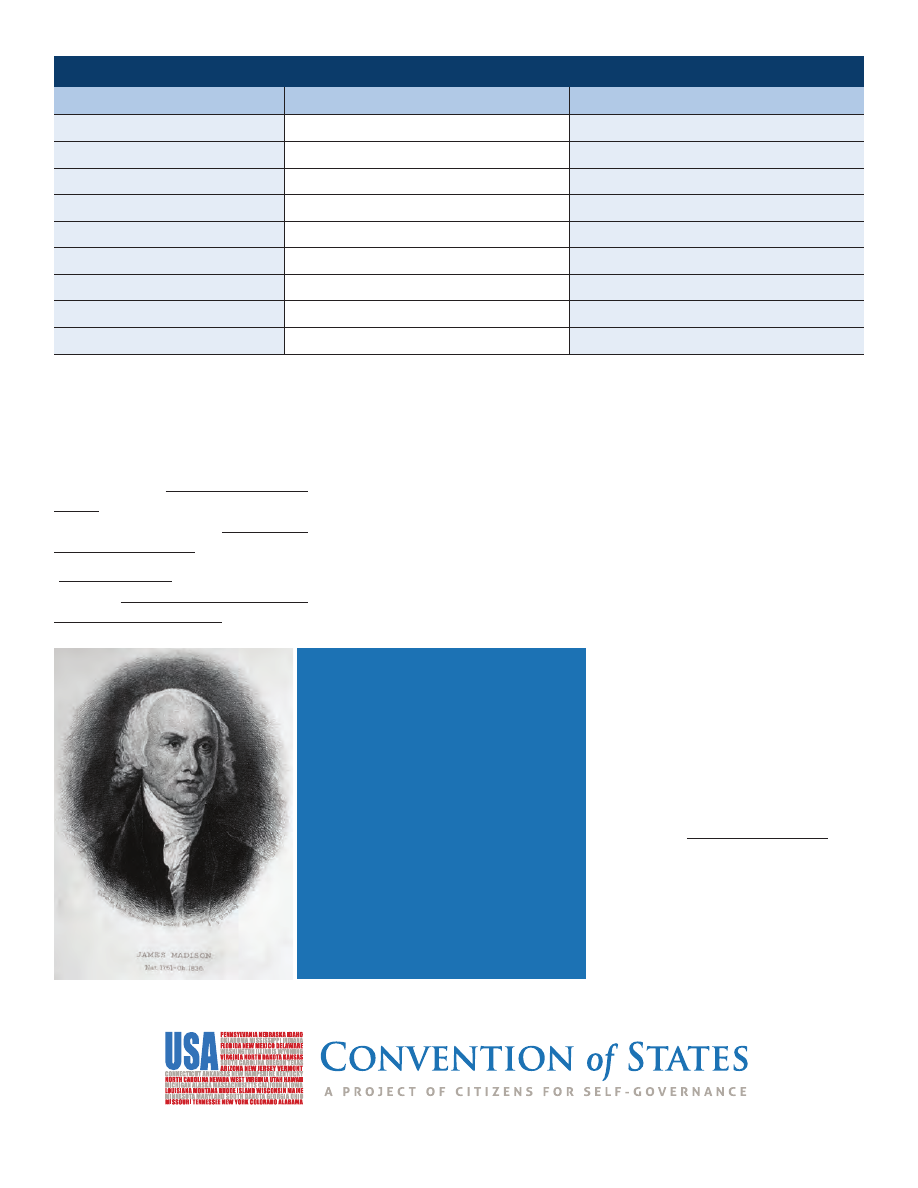
Continued from front page
(540) 441-
7
22
7
|
C
ONVENTION
O
F
S
TATES
.
COM
|
Facebook.com/ConventionOfStates
|
Twitter.com/COSproject
ACTION
CONSTITUTIONAL CONVENTION
ARTICLE V CONVENTION
Propose
Propose New Constitution
Propose Amendments to Current Constitution
Power
Full Powers, Unlimited
Limited to Subject of State Applications
Authority
Outside of the Constitution
Under Article V of the Constitution
Requirement to Call
Unanimous Consent of States to be Bound
Application by Two-thirds of the States
Called By
The States
Congress
Scope of Passage at Convention
Entire Constitution as a Whole Document
Individual Amendments, Singly
Votes for Passage at Convention
Unanimous Consent Required
Simple Majority
Scope of Ratification by the States
Entire Constitution as a Whole Document
Individual Amendments, Singly
Votes for Ratification by the States
Only Binds States That Ratify It
Ratified by Three-fourths and Binds All States
DIFFERENCES BETWEEN A CONSTITUTIONAL CONVENTION AND AN ARTICLE V CONVENTION
inevitably consist of a great variety of particulars….
Hence the necessity of moulding and arranging all
the particulars which are to compose the whole, in
such a manner as to satisfy all the parties to the
compact; and hence, also, an immense multiplica-
tion of difficulties and casualties in obtaining the col-
lective assent to a final act….
“But every amendment to the Constitution, if once
established, would be a single proposition, and
might be brought forward singly…. The will of the
requisite number would at once bring the matter
to a decisive issue. And consequently, whenever
nine (
2
⁄
3
), or rather ten States (
3
⁄
4
), were united in
the desire of a particular amendment, that amend-
ment must infallibly prevail. There can, therefore,
be no comparison between the facility of affecting
an amendment, and that of establishing in the first
instance a complete Constitution.”
Text of Article V Unequivocally States
“Convention for Proposing Amendments”
Article V could not be any clearer in regards to
the powers a convention is given. Here is the rel-
evant portion of text:
“The Congress, whenever
two thirds of both Houses shall deem it necessary,
shall propose Amendments to this Constitution, or,
on the Application of the Legislatures of two thirds
of the several States, shall call a Convention for pro-
posing Amendments….”
It is absolutely disingen-
uous to claim that an Article V convention can
propose an entirely new Constitution. The
words
“for proposing amendments”
could not be
any clearer. Article V gives a convention the
exact same authority as Congress: the power
to propose amendments — nothing more,
nothing less.
Text of Article V Does Not Allow
For a New Constitution to Be Drafted
Last but not least is the fact that Article V does
not allow for a new Constitution to be drafted,
because the text states:
“Congress … shall call a
Convention for proposing Amendments, which,
in either Case, shall be valid to all Intents
and Purposes, as Part of this Constitution, when
ratified by the Legislatures of three fourths of
the several States, or by Conventions in three
fourths thereof….”
When ratified, the amend-
ments proposed by a convention become part
of our current Constitution. A convention can-
not, under the plain text of Article V, set up a
new constitution.
“Should the provisions of the
Constitution as here reviewed be
found not to secure the Govt. &
rights of the States agst.
usurpations & abuses on the part
of the U. S. the final resort within
the purview of the Constn. lies in
an amendment of the Constn.
according to a process applicable
by the States.”
— James Madison,
Letter to Edward Everett, August 28, 1830
When our government’s
“interpretations” of the
Constitution don’t seem to
square with what we read in
black and white, it is usually
because they
don’t
square
with the Constitution.
There is only one way to deal with
squatters.
As a law school student, I remember
being outraged when I learned that if a
landowner does not begin the legal evic-
tion process within a prescribed period of
time, a brazen trespasser can actually
acquire title to real estate.
It’s called “
adverse possession
,” and it’s
happening today in a context that is less
tangible but far more alarming. Today
in Washington, D.C., we have a Congress,
President, Supreme Court, and a slew of
administrative agencies acting as constitu-
tional squatters.
They are brazen trespassers, having taken
up residence in jurisdictions that belong to
the states—openly claiming power to
mandate state recognition of marriages
that defy the states’ constitutions, to regu-
late businesses out of existence, to dictate
farming and conservation practices, and to
bully state and local education depart-
ments into accepting federal programs.
They have even injected themselves
into our personal business, mandating that
we buy certain health insurance policies,
for instance.
The American people have grown so
accustomed to seeing the feds occupy this
territory that many no longer bother to
consult their pocket Constitutions in an
effort to identify any source of authority
for these actions. The Supreme Court
deci-
sions
upholding them are so lengthy and
contrived that most Americans have given
up on understanding them, concluding
It’s Time to Evict the
Constitutional Squatters
Rita Dunaway, Esq., National Legislative Strategist for the Convention of States Project
that the Constitution must be too complex
for ordinary people to comprehend.
While a simple reading of
Articles I
and
II
appears to indicate that neither Congress
nor the President has any legitimate power
over education, health insurance, or
the environment, we are “jargoned” and
“precedented” into submission by dense,
complex judicial pronouncements inter-
preting federal laws like the
Affordable
Care Act
, which rival the works of Tolstoy
in length and might as well have been writ-
ten in his native tongue.
Regular, hard-working people raising fami-
lies probably have no clue how the
Anti-Injunction Act
figures into their health
insurance situation, but they know the
upshot is that they must buy the insurance
the feds want them to have, or be pun-
ished. “Theirs not to reason why, theirs but
to do and die…”
As a young lawyer fresh out of school, I
often failed to question the judgments of
Continued to back page

Continued from front page
(540) 441-
7
22
7
|
C
ONVENTION
O
F
S
TATES
.
COM
|
Facebook.com/Convent
ion
OfStates
|
Twitter.com/COSproject
more seasoned attorneys, always assuming
they knew something I didn’t. I’m sure that
was true enough, plenty of the time. But as
time went on, I came to understand that
often what seemed like a bad judgment
call to me really was a bad judgment call.
And it was my
duty
to point it out in the
proper tone and forum.
Here’s what I’m getting at: The average
American isn’t so ignorant, nor the aver-
age judge, congressman, president, or
bureaucrat so brilliant, as we might think.
The Constitution is for us, and it is not so
complex that we should despair of under-
standing it.
When our government’s “interpretations”
of the Constitution don’t seem to square
with what we read in black and white, it is
usually because they
don’t
square with the
Constitution, and our President, Congress,
courts, and countless busy bureaucrats
are really acting without proper constitu-
tional authority.
The feds have rudely pitched their tent on
the front lawn of our liberty, and it’s time
we served them their eviction notice.
Just as landowners have the right and duty
to invoke a legal process (eviction) to deal
with squatters in property cases, the Amer-
ican people have the right and duty to
invoke a particular constitutional process
to restore the balance of power among the
national government, the states, and the
people. It’s found in
Article V
of the Con-
stitution, and it’s called a Convention of
States for proposing amendments.
But here’s the rub: Just as legal property
owners lose their title if they fail to act, so
we will lose the protection of original con-
stitutional boundaries if we fail to enforce
them through Article V.
You don’t have to take my word for it. In
a
law review article
published last year,
Boston College Law School Assistant Pro-
fessor Richard Albert explained:
“There are several other more flexible
modes of constitutional change that do
not rely on the mechanistic procedures of
Article V in order to keep the constitu-
tional regime current and reflective of the
new social and political equilibria. They
result in unwritten changes to the Consti-
tution that may be as constraining as a
formal amendment. That the United States
Constitution is both written and unwritten
is therefore now uncontroversial.”
What Albert describes as the “unwritten”
Constitution, achieved by “more flexible
modes of constitutional change,” is just like
the “unwritten” legal title that squatters
achieve when the rightful owner fails to
defend his property. Ultimately, it comes
to have the same force and effect as a writ-
ten deed to the family farm.
Every student of American history knows
that legitimate government depends upon
the consent of the governed. The legal title
to government is vested in us, and with it
the right and duty to defend our title
against trespassers.
I urge you to join with the
Convention of
States Project
to evict the constitutional
squatters.
Originally published on TheBlaze.com
We will lose the
protection of original
constitutional boundaries
if we fail to enforce them
through Article V.

It’s the elephant in the room. The Tenth
Amendment boldly declares:
“The powers not delegated to the United
States by the Constitution, nor prohibited
by it to the states, are reserved to the states
respectively, or to the people.”
But if the daily news is any indication,
there is no subject exempt from federal
power. Through its power of the purse,
which is virtually unlimited under the
modern interpretation, Congress can
impact, influence, or coerce behavior in
nearly every aspect of life.
The question, then, that holds the key to
unlocking our constitutional quandary, is
this: How do states protect their reserved
powers under the Tenth Amendment?
On a piecemeal basis, states can cer-
tainly challenge federal actions through
lawsuits, arguing that the federal govern-
ment lacks constitutional authority to
act in a particular area. But what if the
court, as it is wont to do, “interprets” the
Constitution as providing the disputed
authority? What then?
In their frustration and disbelief over
the growing extent of federal abuses of
power (and the refusal of our Supreme
Court to correct them), some conserva-
tives argue that states should engage in
“nullification,” whereby the states simply
refuse to comply with federal laws they
deem unconstitutional.
While there are some, less dramatic
forms of nullification that are perfectly
appropriate and constitutional—such as
states refusing to accept federal funds
that come attached to federal require-
ments—this state-by-state, ad hoc review
of federal law is fraught with legal and
practical pitfalls.
First of all, which state officer, institution,
or individual decides whether a federal
action is authorized under the Constitu-
tion? Is it the state supreme court, the
legislature, the attorney general—or can
any individual make the determination?
After all, the Tenth Amendment reserves
powers to individuals as well as to states.
Secondly, how can a state enforce its
nullification of a federal law? For
instance, if a state decides that the
Affordable Care Act’s individual man-
date is unconstitutional, how can it
protect its citizens against the “tax” that
will be levied against them if they fail to
comply? It’s difficult to envision an effec-
tive nullification enforcement method
The Article V Solution — The Way
to Implement the Tenth Amendment
Rita Dunaway, Esq., National Legislative Strategist for the Convention of States Project
Continued to back page
Article V
is the ultimate
nullification
procedure.

Continued from front page
(540)
441-
7
22
7
|
C
ONVENTION
O
F
S
TATES
.
COM
|
Facebook.com/ConventionOfStates
|
Twitter.com/COSproject
that doesn’t end, at some point, with
armed conflict.
But for true conservatives whose goal is
to conserve the original design of our
federal system, the far more fundamental
problem with this type of in-your-face
nullification is the fact that it was not the
Founders’ plan.
Article VI tells us that the Constitution,
and federal laws passed pursuant to it, is
the “supreme law of the land.” Under
Article III, the United States Supreme
Court is considered to be the final inter-
preter of the Constitution. While some
claim that this was not the Founders’
intention, historical records such as
Alexander Hamilton’s Federalist 78
demonstrate it was, in fact, the judiciary
that they intended to assess the constitu-
tionality of legislative acts.
And then we have the Tenth Amend-
ment itself. It establishes a principle, but
it does not establish a remedy or process
for protecting the reserved powers from
federal intrusion.
That missing process is found in Article V.
Faced with a federal government acting
beyond the scope of its legitimate
powers—and a Supreme Court that
adopts erroneous interpretations of the
Constitution to justify the federal over-
reach—the states’ constitutional remedy
is to amend the Constitution to clarify the
meaning of the clauses that have been
perverted. In this way, the states can assert
their authority to close the loopholes the
Supreme Court has opened.
You don’t have to take my word for it.
In an 1830 letter to Edward Everett,
James Madison wrote:
“Should the provisions of the Constitution
as here reviewed be found not to secure
the Govt. & rights of the States agst.
usurpations & abuses on the part of the
U.S. the final resort within the purview of
the Constn. lies in an amendment of the
Constn. according to a process applicable
by the States.”
In other words, Article V is the ultimate
nullification procedure. For states that
have the will to stand up and assert their
Tenth Amendment rights, they can do so
by applying for an Article V convention
to propose amendments that restrain
federal power.
Originally published on TheBlaze.com
The powers not
delegated to the
United States by
the Constitution,
nor prohibited by
it to the states, are
reserved to the states
respectively, or to
the people.
Is your state a “donor state?” Donor
states are those in which taxpayers con-
sistently pay significantly more to the
federal government in tax payments
than their state receives in federal spend-
ing. California, Colorado, Delaware,
Illinois, Kansas, Massachusetts, Min-
nesota, Nebraska, New Jersey, New
York, and Ohio are consistently among
the biggest losers when it comes to the
federal budgeting process. All of these
states each lost over
$
10
billion (some of
them several times that) to other states
in
2014
alone. Even tiny Delaware sent
$
13
billion to other states, courtesy of the
federal government.
Here in my home state of Illinois, our
budget situation is so precarious that
our comptroller made national news by
suspending payments to lottery winners.
If we could keep even half of the
$
78
bil-
lion we lost in
2014
here in Illinois, we
could immediately close our budget gap
and begin catching up on our under-
funded pension obligations…without
having to raise anyone’s taxes.
How is this money collected, and where
does it go? The money that goes to
Washington gets there through a variety
of taxes, some obvious and some less so.
Personal income tax is one of the pri-
mary vehicles for the transfer of money
from the states to Washington. Estate
and inheritance taxes, gift taxes, and
taxes paid by employers, such as the
FICA match, are also part of the formula.
Money returns to the states through a
wide array of federal programs and
expenditures such as highway funding,
social safety net programs, military
spending … and pork.
Here are just a few of the more egre-
gious examples of federal waste,
fraud, and abuse:
•
$
150,000
to study the hookah smoking
habits of Jordanian students
•
$
121
million on lavish conferences for
Department of Justice employees
•
$
1
billion on energy credits for people
who don’t own any real estate
•
$
2 4
million on routers powerful
enough to serve thousands of users
How Can the Convention of States
Project Help Address My State’s
Budget Challenges?
Vickie Deppe, Illinois Legislative Liaison, Convention of States Project
Continued to back page
Expenditures are
easily hidden in the
federal budget
because it is so large
and complicated.
Continued from front page
(540)
441-
7
22
7
|
C
ONVENTION
O
F
S
TATES
.
COM
|
Facebook.com/ConventionOfStates
|
Twitter.com/COSproject
for buildings in rural West Virginia
with fewer than
10
computers
•
$
104
million on a “Harbor to Nowhere”
and “Airport to Nowhere” to go with
Alaska’s “Bridge to Nowhere”
•
$
2
million to fund a single intern for the
Department of Agriculture
•
$
862,000
a year to warehouse unused
furniture for the IRS
•
$
16
million a year on food stamps for
dead people
These expenditures are easily hidden in
the federal budget because it is so large
and complicated. Together with the
annotations, the federal budget is the
size of a telephone directory for a large
city. Unless they sit on an appropriations
committee, members of Congress can
only cast an up or down vote on a
budget or spending bill in its entirety.
Most of them can’t possibly read it all,
and even if they did, they have no power
to strike a single line item. And they cer-
tainly aren’t going to bring the entire
federal government to a halt over a little
pork…especially if their state benefits. But
as Sen. Everett Dirksen famously said, “A
billion here, a billion there, and pretty
soon you’re talking about real money!”
Do you think you could manage this
money better? So do the staff, volun-
teers, and supporters of the Convention
of States Project. We believe that the
best decisions are made as close to
home as possible, with local input and
oversight. The challenges facing cities
like Chicago and New York are far
different from those in Antelope, South
Dakota. The needs of an individual com-
munity, big or small, shouldn’t be
drowned out in a one-size-fits-all “solu-
tion” crafted largely by people who have
never even set foot in that neighbor-
hood…or one in which waste, fraud, and
abuse is an inherent part of the system.
At an Article V Convention to limit the
power and jurisdiction of the federal
government and establish spending con-
trols and term limits upon its officials, the
states have the power to propose a con-
stitutional amendment that prohibits the
federal government from spending
money on projects and expenditures
that the Constitution originally reserved
for state and local control. They can also
eliminate unfunded federal mandates.
And if you’re a legislator in a donor
state, that’s very good news.
The needs of an individual
community, big or small,
shouldn’t be drowned out
in a one-size-fits-all
“solution.”

It’s time to dust
off the tool the
Founders gave us
in Article V.
Perhaps the most unifying conservative
trait is the conviction that our Founding
Fathers designed an ingenious federal sys-
tem that we ought to conserve. But as
federalism lies dying and our society spi-
rals toward socialism, there is dissension
among conservatives about using the pro-
cedure the Founders left to the states to
conserve it.
Because
Article V
’s amendment-propos-
ing convention process has never been
used, some have branded it a mystical
a
n
d d
a
n
g
e
r
o
u
s p
o w
e
r — a t
h
i
n
g
shrouded in mystery, riddled with unan-
swerable questions, and therefore best
left alone. Some have literally labeled it a
“
Pandora’s Box
,” the opening of which
would unleash all manner of evil upon
our beleaguered nation.
Article V opponents accuse proponents of
being reckless with the Constitution. They
say we have no idea how a convention
would work, who would choose the dele-
gates, how votes would be apportioned,
or whether the topic of amendments
could be limited.
My task today is to remove the shroud of
mysticism by revealing what we do know
about an Article V convention from its
text, context, historical precedent, and
simple logic.
For starters, we know that the Founders’
whole purpose for including the conven-
tion mechanism was to provide a way for
the states to bypass Congress in achieving
needed constitutional amendments.
An early draft of Article V vested Congress
with the sole power to propose constitu-
tional amendments. Under that version,
two-thirds of the states could petition
Congress to propose amendments, but it
was still Congress that did the proposing.
On Sept.
15, 1787
, George Mason
strenu-
ously objected
to this, pointing out that
such a system provided no recourse for
the states if the national government
should become tyrannical, as he predicted
it would do.
The result was the
unanimous
adoption of
Article V in its current form, providing two
ways for constitutional amendments to be
proposed: Congress can propose them, or
the states can propose amendments at a
convention called by Congress upon
application from two-thirds, or
34
, of the
states. Regardless of which body proposes
the amendments, proposals must be rati-
The Article V Solution —
Demystifying a Dusty Tool
Rita Dunaway, Esq., National Legislative Strategist for the Convention of States Project
Continued to back page

(540)
441-
7
22
7
|
C
ONVENTION
O
F
S
TATES
.
COM
|
Facebook.com/
ConventionOfStates
|
Twitter.com/COSproject
Continued from front page
fied by three-fourths, or
38
, of the states in
order to become effective.
We also know from history that voting at
an Article V convention would be done
on a one-state, one-vote basis. This is the
universal precedent set by the
32
inter-
state conventions
that occurred prior to
the Constitution’s drafting. It explains why
it was unnecessary for Article V to specify
the number of delegates to be sent by
each state; the states can send as many
delegates as they like, but each state only
gets one vote.
We know that state legislatures choose
and instruct their convention delegates,
who act as agents of the state legislatures.
Again, this is a matter of universal histori-
cal precedent for interstate conventions.
On Nov.
14, 1788
, the Virginia General
Assembly filed the very
first application
for
an Article V Convention to propose a Bill
of Rights, aptly branding the convention “a
convention of the States” to be composed
of “deputies from the several States.”
Because Congress ultimately used its own
Article V power to propose a Bill of Rights,
that meeting was rendered unnecessary.
But the application demonstrates the con-
temporaneous understanding that the
convention process was state-led. The
Supreme Court
has likewise referred to
the process as a “convention of states.”
Finally, we know that the topic specified in
the convention applications does matter.
Over
400
applications for an Article V
convention have been filed since the draft-
ing of the Constitution. The reason we
have never had one is because there have
never been
34
applications seeking a con-
vention for the same purpose. The state
applications contain the agenda for an
Article V convention, and until
34
states
agree upon a convention agenda, there
will be no convention.
Because the authority for an Article V con-
vention is derived from the
34
state
applications that trigger it, the topic for
amendments specified in those applica-
tions is a binding limitation on the scope
of the convention.
The “unanswerable” questions about Arti-
cle V do have answers. The unshrouded
Article V convention isn’t a Pandora’s Box
at all, because there is no such thing as
magic in a box for us to fear—there is only
history, law, and reason to guide faithful
Americans in tending their government.
And precisely because there is no such
thing as magic, we’re going to need an
effective tool to do the hard work of
restoring our Republic.
It’s time to dust off the tool the Founders
gave us in Article V and get started.
Originally published on TheBlaze.com
The “unanswerable”
questions about
Article V do have
answers.

American taxpayers have
lost multiple billions of
dollars on companies owned
by big political donors who
received federal funding and
then went bankrupt.
Most Americans are legitimately suspi-
cious of lobbyists and big-money politi-
cal donors…so much so, that the
Supreme Court’s
Citizens United
decision
sparked its own Article V movement.
But an Article V Convention to limit the
power and jurisdiction of the federal
government and establish spending con-
trols and term limits upon its officials
gives the states the power to propose
amendments that can address this prob-
lem in a variety of ways.
Big-money donors are not usually ideo-
logically motivated, but they do expect
favorable treatment for themselves or
their business interests once their candi-
date is sworn in as a legislator. We believe
taking away the favors politicians have to
dispense will dry up this money and
restore the level playing field Americans
hold dear, far more effectively than con-
tinued attempts at a regulatory solu-
tion…for which someone always finds a
workaround, anyway.
One of the most common means for
politicians to reward their supporters is
through regulatory exemptions. An
amendment that prohibits members of
Congress from exempting themselves
and their friends from the laws they
make for the rest of us not only enjoys
the unanimous support of voters we’ve
surveyed, but also removes a powerful
incentive for business owners to
attempt to “buy” candidates. A com-
panion amendment removing de facto
lawmaking authority from unelected
bureaucrats will help prevent members
of Congress from hiding these activities
from voters. Such amendments will
also help locally-owned businesses
compete more effectively with large
corporations who can afford lobbyists
and attorneys to keep them in compli-
ance with ever-more burdensome and
complex federal regulations. Ameri-
cans agree that a business should suc-
ceed because it offers a superior prod-
uct or service to its customers…not
because it has friends in Washington.
Another vehicle for cronyism rests in the
power of politicians to use taxpayer
money to invest in and award grants,
loans, and loan guarantees to for-profit
businesses. Why should the politically-
How Can the Convention of States
Project Help Curb the Corrupting
Influence of Money in Politics?
Vickie Deppe, Illinois Legislative Liaison, Convention of States Project
Continued to back page

Continued from front page
(540)
441-
7
22
7
|
C
ONVENTION
O
F
S
TATES
.
COM
|
Facebook.com/
ConventionOfStates
|
Twitter.com/COSproject
connected get to shake down the Ameri-
can taxpayer when they couldn’t con-
vince local banks and investors to fund
their projects? American taxpayers have
lost multiple billions of dollars on compa-
nies owned by big political donors who
received federal funding and then went
bankrupt. Moreover, when the federal
government invests in businesses, even as
it regulates them and the financial mar-
kets in which they function, it acts as both
referee and player. This creates an addi-
tional dimension of conflict-of-interest
that everyday Americans find unaccept-
able. The only way this practice will be
stopped is for the states to propose and
ratify an amendment prohibiting it; there
is too much power and money involved
to expect Congress to reform itself.
Finally, term limits can serve to disrupt
the ability of lobbyists and big donors to
groom and maintain politicians. Term
limits are wildly popular among voters,
but many legislators have serious and
legitimate reservations. There are two
reasons that legislators opposed to term
limits can feel good about supporting
our initiative:
The state legislatures, not the Conven-
tion of States Project or voters directly,
are in the driver’s seat at the conven-
tion. Our application provides the op-
portunity for term limits to be dis-
cussed, but in no way guarantees that
they will be included on the agenda,
much less adopted or ratified. Those
who oppose term limits will have the
opportunity to argue forcefully against
them, and states may instruct their del-
egation to vote “no” if such a measure
comes to a floor vote.
Momentum for term limits is largely
driven by dissatisfaction with legislators
over the issues and abuses discussed
above. When common sense reforms
are adopted to curb these abuses, the
pressure for term limits will likely sub-
side. It may seem counterintuitive, but
our application offers the best avenue to
avoid term limits because it has the
potential to remedy the root causes
behind the push for them. Absent such
measures, term limits will continue to
gain popular support. U.S. Term Limits, a
group dedicated to enacting term limits
on legislators, makes gains every election
cycle, and has recently announced a
new Article V effort to complement its
legislator pledge initiative.
Otto von Bismarck once compared laws
to sausage. He said it’s probably best if
people don’t watch them being made.
Here at the Convention of States Project,
we’re working to put the kitchen in plain
view of the diners.
Americans agree that
a business should
succeed because it offers
a superior product or
service to its customers…
not because it has
friends in Washington.

The protection of liberty
requires a strict
adherence to the
principle that power is
limited and delegated.
We See Four Major Abuses Perpetrated
by the Federal Government.
These abuses are not mere instances of bad
policy. They are driving us towards an age of
“soft tyranny” in which the government does
not shatter men’s wills but “softens, bends,
and guides” them. If we do nothing to halt
these abuses, we run the risk of becoming
nothing more than “a flock of timid and in-
dustrious animals, of which the government
is the shepherd.” (Alexis de Tocqueville,
Democracy in America
,
1840
)
1. The Spending and Debt Crisis
The
$
17
trillion national debt is staggering,
but it only tells part of the story. Under stan-
dard accounting practices, the federal gov-
ernment owes around
$
100
trillion more in
vested Social Security benefits and other pro-
grams. This is why the government cannot
tax its way out of debt. Even if it confiscated
everything, it would not cover the debt.
2. The Regulatory Crisis
The federal bureaucracy has placed a regula-
tory burden upon businesses that is com-
plex, conflicted, and crushing. Little account-
ability exists when agencies—rather than
Congress—enact the real substance of the
law. Research from the American Enterprise
Institute shows that, since
1949
, federal regu-
lations have lowered the real GDP growth by
2
% and made America
72
% poorer.
3. Congressional Attacks
on State Sovereignty
For years, Congress has been using federal
grants to keep the states under its control.
Combining these grants with federal
mandates (which are rarely fully funded),
Congress has turned state legislatures
into their regional agencies rather than re-
specting them as truly independent repub-
lican governments.
A radical social agenda and an invasion
of the rights of the people accompany
all of this. While significant efforts have
been made to combat this social erosion,
these trends defy some of the most impor-
tant principles.
4. Federal Takeover of the
Decision-Making Process
The Founders believed that the structures of
a limited government would provide the
greatest protection of liberty. Not only were
there to be checks and balances between the
branches of the federal government, but
power was to be shared between the states
and federal government, with the latter only
exercising those powers specifically granted
in the Constitution.
Collusion among decision-makers in Wash-
ington, D.C., has replaced these checks and
balances. The federal judiciary supports Con-
gress and the White House in their ever-
escalating attack upon the jurisdiction of the
fifty states.
We need to realize that the structure of deci-
sion-making matters. Who decides what the
law shall be is as important as what is de-
cided. The protection of liberty requires a
strict adherence to the principle that power
is limited and delegated.
Washington, D.C., does not believe in this
principle, as evidenced by an unbroken prac-
tice of expanding the boundaries of federal
power. In a remarkably frank admission, the
Supreme Court rebuffed a challenge to fed-
eral spending power, despite acknowledging
that power had grown far beyond the
bounds envisioned by the Founders.
What Does this Mean?
This is not a partisan issue. Washington,
D.C., will never voluntarily relinquish mean-
A Solution As Big As The Problem
Michael P. Farris, JD, LLM, Convention of States Action — Senior Fellow for Constitutional Studies
Continued to back page

Continued from front page
(540)
441-
7
22
7
|
COSA
CTION
.
COM
|
Fa
ce
book.
co
m/COSA
ct
ion
|
Twitter.com/COSAction
ingful power—no matter who is elected. The
only rational conclusion is this: Unless some
political force outside of Washington, D.C.,
intervenes, the federal government will con-
tinue to bankrupt this nation, embezzle the
legitimate authority of the states, and de-
stroy the liberty of the people. Rather than
securing the blessings of liberty for future
generations, Washington, D.C., is on a path
that will enslave our children and grandchil-
dren to the debts of the past. The problem is
big, but we have a solution. Article V gives
us a tool to fix the mess in D.C.
Our Solution Is Big Enough to Solve
the Problem
Rather than calling a convention for a spe-
cific amendment, Convention of States
Action (COSA) urges state legislatures to
properly use Article V to call a convention
for a particular subject—reducing the power
of Washington, D.C. It is important to note
that a convention for an individual amend-
ment (e.g., a Balanced Budget Amendment)
would be limited to that single idea. Requir-
ing a balanced budget is a great idea that
COSA fully supports. Congress, however,
could comply with a Balanced Budget
Amendment by simply raising taxes. We
need spending restraints as well. We need
restraints on taxation. We need prohibitions
against improper federal regulation. We
need to stop unfunded mandates.
A Convention of States needs to be called to
ensure that we are able to debate and
impose a complete package of restraints on
the misuse of power by all branches of the
federal government.
What Sorts of Amendments Could Be
Passed?
The following are examples of amendment
topics that could be discussed at a conven-
tion of states:
• A Balanced Budget Amendment
• A redefinition of the General Welfare
Clause (the original view was that the
federal government could not spend
money on any topic within the jurisdiction
of the states)
• A redefinition of the Commerce Clause (the
original view was that Congress was
granted a narrow and exclusive power to
regulate shipments across state lines–not
all the economic activity of the nation)
• A prohibition on using international treaties
and law to govern the domestic law of the
United States
• A limitation on using executive orders and
federal regulations to enact laws (since
Congress is supposed to be the exclusive
agency to enact laws)
• Imposing term limits on Congress and the
Supreme Court
• Placing an upper limit on federal taxation
• Requiring the sunset of all existing federal
taxes and a super-majority vote to replace
them with new, fairer taxes
Of course, these are merely examples of
what would be up for discussion. The
Convention of States itself would deter-
mine which ideas deserve serious considera-
tion, and it would take a majority of
votes from the states to formally pro-
pose any amendments.
The Founders gave us a legitimate path to
save our liberty by using our state govern-
ments to impose binding restraints on the
federal government. We must use the power
granted to the states in the Constitution.
The Founders gave us a
legitimate path to save our
liberty. We must use the
power granted to the states in
the Constitution.

A few days ago I heard a presentation by a
spokesman for a group that claims to defend the
Constitution and revere the Founders. Yet the
spokesman trashed the Constitution’s Framers
for allegedly exceeding their authority and
claimed they added a provision that largely ren-
dered another provision useless. In other words,
the spokesman charged the Framers with being
both (
1
) dishonorable and (
2
) incompetent.
The Framers inserted the
“Convention for propos-
ing Amendments”
in the Constitution to provide
the states with a way of obtaining constitutional
amendments without federal interference.
Tench
Coxe
, a leading advocate for the Constitution
during the ratification debates, pointed out that
the convention device allows the states to obtain
whatever amendments they choose, “
although
the President, Senate and Federal House of Rep-
resentatives should be unanimously opposed to
each and all of them.
”
The spokesman, however, asserted that the
Constitution allowed Congress, through the
Necessary and Proper Clause, to dictate, either
in the convention call or by previous legislation,
how an amendments convention is structured
and how commissioners (delegates) are selected
and apportioned.
The claim that Congress can use the Necessary
and Proper Clause to structure the convention
was first advanced in the
1960
s, and has been
repeated numerous times since then. A Congres-
sional Research Service report published earlier
this year noted that some in Congress have
taken the same line, although the report did not
actually endorse it.
But pause to consider: Why would the Framers
place in the Constitution a method by which
Congress could largely control a convention
created to bypass Congress? Were the Framers
that stupid?
Of course not. Most of them were highly experi-
enced and extremely deft legal drafters.
Behind the belief that the Necessary and Proper
Clause empowers Congress to structure the
convention are three distinct assumptions—all
erroneous. They are (
1
) that the scope of Con-
gress’s authority under the Necessary and
Proper Clause is broader than it is, (
2
) that the
Clause covers the amendment process, and (
3
)
that ordinary legislation may govern the amend-
ment process.
The Necessary and Proper Clause is the last item
in the Article I, Section 8 list of congressional
powers. It reads:
“The Congress shall have Power . . . To make all
Laws which shall be necessary and proper for car-
rying into Execution the foregoing Powers, and all
other Powers vested by this Constitution in the
Government of the United States, or in any Depart-
ment or Officer thereof.”
It happens that the most extensive treatment of
the Necessary and Proper Clause is an
academic
book I co-authored with Professors Gary Lawson,
Guy Seidman, and Geoff Miller:
//The Origins of//
// //
//the Necessary and Proper Clause//
// //
(Cambridge
University Press,
2010
) (cited by Justice Thomas
in a
Supreme Court case
in
2014
and apparently
relied on by Chief Justice Roberts in
2012
). This
book reveals the Necessary and Proper Clause to
be a masterpiece of legal draftsmanship.
The Clause was based on usage common in 18
th
-
The Necessary and Proper Clause Does
NOT Empower Congress to Control an
Amendments Convention
Robert Natelson, Independence Institute’s Senior Fellow in Constitutional Jurisprudence
and Head of the Institute’s Article V Information Center
Continued to back page
The Framers inserted the
“Convention for proposing
Amendments” in the Constitution to
provide the states with a way of
obtaining constitutional amendments
without federal interference.
Continued from front page
(540)
441-
7
22
7
|
C
ONVENTION
O
F
S
TATES
.
COM
|
Facebook.com/Conven
tionOfState
s
|
Twitter.com/COSproject
century legal documents. It is not a grant of au-
thority, but a rule of interpretation. It tells us to
construe certain enumerated powers as the rati-
fiers understood them, rather than in an overly-
narrow way. In legal terms, the Necessary and
Proper Clause informs us that those enumerated
powers include “incidental” authority.
Even if the Clause did apply to the amendment
process, the authority “incidental” to Congress’s
call would be quite narrow. An entity that calls
an interstate convention always has been limited
to specifying the time, place, and subject matter.
It is the state legislatures that control selection of
their own commissioners.
But, in fact, the Necessary and Proper Clause
does not extend to the amendment process.
To explain:
The Constitution includes numerous grants of
power. These grants are made to Congress, to
the President, to the courts, to the Electoral Col-
lege, and to state legislatures, state governors,
and various conventions. An entity exercising a
power under one of those grants is said to exer-
cise a “federal function.”
The Necessary and Proper Clause is crafted to
apply to most federal functions, but it also ex-
cludes a number of them. Specifically, it covers
only the grants listed in Article
I
, Section
8
, and
those vested in the “Government of the United
States” and in “Departments” and “Officers” of
that government.
In other words, the Clause omits constitutional
grants made to entities that are not part of the
“Government of the United States,” even when
those entities exercise “federal functions.” See,
for example,
//Ray v. Blair//
,
343
U.S.
214
(
1952
)
(holding that presidential electors, who ulti-
mately derive their power from the Constitution,
exercise a federal function but are not federal of-
ficers or agents). The convention for proposing
amendments is one of a handful of entities that
falls into this category.
Even if we did assume, for sake of argument, that
Congress is a “Department” of the federal gov-
ernment for
other
purposes, the rules for Article
V are different.
The difference is that (according to the courts)
when Congress and state legislatures act in the
amendment process, they do not act as the leg-
islative branches of their respective govern-
ments. Instead, they act as
ad hoc
assemblies for
registering the popular will. They can exercise
only the power granted by Article V, and not
powers granted by other parts of the U.S. Consti-
tution or by state constitutions. Thus, in
Idaho v.
Freeman
(
1981
), a federal court ruled that:
“Congress, outside the authority granted by Article
V, has no power to act with regard to an amend-
ment, i.e., it does not retain any of its traditional au-
thority vested in it by Article I” [which includes the
Necessary and Proper Clause].
(This case was later vacated as moot, but there
were no problems with the merits of the ruling.)
Or, as the Supreme Court of Missouri pointed
out when addressing the state legislature’s Arti-
cle V functions,
“[The legislature] was not, strictly
speaking, performing the functions of a legislative
body for the state, but was acting as a representa-
tive of the people, pursuant to authority delegated
to it by the federal Constitution. . . ” State ex rel.
Tate v. Sevier (
1933
).
(The U.S. Supreme Court denied certiorari in
that case, meaning it refused to consider revers-
ing this decision.)
Again, when legislatures act under Article V they
do so as separate assemblies, not as the legisla-
tive branches of their governments. This is a very
old principle, dating back to
1798
,
when the
Supreme Court held that congressional amend-
ment proposals do not need presidential signa-
ture
. See also
//United States v. Sprague //
(
1931
).
Well, if Congress cannot insert language in the
“call” structuring the convention, can it pass laws
for the same purpose? Again, the answer is “no.”
A long list of
20
th
century cases from courts at all
levels holds that the amendment process is gov-
erned by the express and implied provisions of
Article V, not by other sources of law, such as
statutes, state constitutions, or ordinary legisla-
tive rules. See, for example,
//Leser v. Garnett//
// //
(
1922
) and
//Dyer v. Blair//
// //
(
1975
).
Why would the Framers place in the
Constitution a method by which
Congress could largely control a
convention created to bypass
Congress? Were the Framers that
stupid? Of course not.
The time has arrived for our
state legislatures to stop falling
victim to the fear-mongering
tactics and conspiracy theories
of extremist groups.
For decades The John Birch Society (JBS) has
been using fear tactics to manipulate state legis-
lators into believing that an Article V convention
for proposing amendments is a Constitutional
Convention. To further their agenda they make
the false claim that the
1787
Constitutional Con-
vention was called by Congress to solely revise
the Articles of Confederation and that the con-
vention “ran away” because the delegates wrote
an entirely new Constitution instead.
These claims are false and have been refuted by
historical facts and even the writings of the
Framers themselves (see “
Can We Trust The
Constitution
,” by Michael Farris
, and
Federalist
40
, written by James Madison
).
This marketing campaign of fear titled “Stop a
Con-Con” has silenced the voice of the people
and has paralyzed some state legislatures from
fulfilling their duty as the barrier against
encroachments by the national government (see
Federalist 85
).
Instead of supporting the states in their efforts to
fight back against an overreaching federal gov-
ernment, JBS has actually helped the federal
government to go unchecked by preventing the
states from using the very tool the Framers pro-
vided to stop such usurpation of power.
The John Birch Society claims to be for “less gov-
ernment and more responsibility,” yet when
state legislatures try to pass resolutions to actu-
ally propose such amendments, JBS actively
opposes them and even works to rescind resolu-
tions that have passed!
According to JBS President John McManus, it
does not matter what amendment is being advo-
cated by the states; they will oppose it regardless
of the topic. JBS works to rescind resolutions
even for amendments that they claim they
would like to see proposed by Congress, such as
repeal of the Seventeenth Amendment (direct
election of senators) and the Sixteenth Amend-
ment (federal income tax).
McManus states that only Congress should be
allowed to propose amendments to the Consti-
tution. Stop and consider that for a minute. He is
actually trying to convince his membership and
you as state legislators that those who are daily
usurping the Constitution are the only ones who
can be trusted to propose amendments to it!
Does anyone truly believe that Congress will
propose amendments to limit their own power?
Of course not!
You see, JBS does not trust you as a state
legislator or the people to govern themselves.
Does that sound like an organization that sup-
ports “less government and more responsibility”
to you? JBS will give lip service to the Constitu-
tion, but when it comes to the states actually
trying to use the Constitution to defend them-
selves as intended by the Framers, JBS is
anti-Constitutional.
However, former JBS leaders were strong sup-
porters of the states calling for an Article V
convention for proposing amendments. As you
are about to see, they not only understood
Article V but they fully advocated for the states
to hold a convention to propose an amendment
that would fulfill their goal of “less government
and more responsibility.” That amendment was
known as the
Liberty Amendment
.
In
1944
, Willis E. Stone, a descendant of
Thomas Stone, a signer of the Declaration of
Independence, drafted the Liberty Amendment,
which sought to vastly restrict federal authority,
cut government cost, protect private enter-
prises, and repeal the Sixteenth Amendment.
Stone ultimately organized the Liberty Amend-
ment Committee in all
50
states and worked for
decades to have his amendment proposed
either by Congress or by the states in an
Article V convention.
Shortly after JBS was founded in
1958
by Robert
The John Birch Society Denies
Its History and Betrays Its Mission
Ken Quinn, Regional Director for Convention of States Project
Continued to back page
19
Continued from front page
(540) 441-
7
22
7
|
C
ONVENTION
O
F
S
TATES
.
COM
|
Facebook.com/ConventionOfStates
|
Twitter.com/COSproject
Welch, JBS members began supporting state leg-
islatures in their efforts to pass resolutions for the
Liberty Amendment.
As one newspaper reported, “
Members of the
four Birch societies in Bismarck
, the state capi-
tal [of North Dakota], were pushing in the
legislature a proposal for a constitutional con-
vention to act on an amendment…[the Liberty
Amendment].”
1
In August of
1963
,
Welch sent an urgent request
asking all JBS chapter leaders and members to
send telegrams and letters urging the Alabama
Senate to pass the resolution calling for the Lib-
erty Amendment
.
2
Welch also produced a
15
-minute radio pro-
gram for JBS called “Are You Listening Uncle
Sam,” and, in
1967
, he dedicated two programs
to the Liberty Amendment. On the program
Stone explained that his organization was using
both methods (Congress and an Article V con-
vention) to propose the Liberty Amendment.
In
1967
California State Senator John Schmitz,
who was also a National Director for the John
Birch Society
, introduced the Liberty Amend-
ment and called for a “national convention.”
3
In
1968
Welch joined Senator Schmitz as special
guests at the National Convention of the Liberty
Amendment Committee
.
4
Obviously, Welch supported Stone’s efforts to
have either Congress or the states propose the
Liberty Amendment, and he used his time,
resources, and relationships to make it happen.
On October
9, 1975
, Representative Larry
McDonald from Georgia, who served at the time
on the John Birch Society’s National Council,
introduced the Liberty Amendment in Congress
and gave extensive testimony — including
advocating for the states to propose it in an
Article V convention
.
5
In his book titled “
We Hold These Truths
,” Repre-
sentative Larry McDonald accurately explains
that Congress and the states are authorized to
propose amendments:
“Congress is authorized to propose constitu-
tional amendments if it pleases. It is obligated to
call a special convention to propose constitu-
tional amendments if two-thirds of all state
legislatures demand that it do so.”
Nowhere in the writings of Welch or McDonald
do you find them concerned about a “runaway
convention” or that the entire Constitution could
be thrown out in an Article V convention. In
fact, they were one hundred percent behind
the states in their efforts to use Article V to pro-
pose amendments.
It is only under the current leadership of JBS that
this organization has turned its back on the Con-
stitution and the process the Framers gave us to
defend our security and liberties. In so doing,
The John Birch Society has denied its history and
betrayed its mission.
In fact, in his article, “Falsehoods Mark the
Campaign for a Constitutional Convention,”
McManus denies all of the evidence to the con-
trary. Though a “constitutional convention” is
not the same thing as an Article V convention for
proposing amendments, McManus and other
current JBS leaders insist upon referring to an
Article V convention of states as a “constitutional
convention.” If the President of JBS is this mislead-
ing about the history of his own organization,
why would anyone in his right mind trust him in
regards to the history of our Constitution?
The time has arrived for our state legislatures to
stop falling victim to the fear-mongering tactics
and conspiracy theories of extremist groups. As
representatives of the people and guardians of
the Republic, you are the last resort in
defending us against this overreaching federal
government by proposing amendments to
restore the balance of power back to the states.
Time is running out. Will you be led by fear or
will you be a fearless leader?
1. The Warren County Observer, March 27, 1961, page 5
2. The John Birch Society, August 30, 1963, Interim Bulletin
3. Daily Independent Journal February 24, 1967, page 2
4. Colorado Springs Gazette-Telegraph, June 13, 1968, page 36
5. Congressional Record – House, October 9, 1975, 32634-32641)
“This country consists of a union of sovereign
States which hold the only power to ratify
amendments… State legislatures hold
concurrent power under the Constitution to
initiate such amendments as they, the States
and the people within them, require.”
— Representative Larry McDonald, John Birch Society National Council & Chairman

The Process of an Article V Convention
For Proposing Amendments
34 STATE LEGISLATURES APPLY FOR A CONVENTION
TO PROPOSE AMENDMENTS ON A SPECIFIED TOPIC
• The topics specified in the applications must be the same, in order for them to aggregate.
• The topics in the aggregated applications set the agenda for the Article V Convention.
CONGRESS “CALLS” THE ARTICLE V CONVENTION, BY SETTING THE TIME AND PLACE
• The entity that “calls” the meeting does not exercise any authority other than setting the time and place.
• Issuing the call is a ministerial duty.
THE STATES SELECT, INSTRUCT, AND SEND DELEGATES
TO THE AMENDMENT-PROPOSING CONVENTION
• All states can participate, even those that did not apply.
• States select the delegates who will act as their agents at the convention, and instruct them
on the scope of their authority.
CONVENTION OCCURS.
PROPOSED AMENDMENTS SUPPORTED BY THE MAJORITY OF
STATE DELEGATIONS ARE SENT TO THE STATES FOR RATIFICATION.
• States may send as many delegates as they choose, but each state only gets one vote when
the convention begins.
CONGRESS SELECTS THE METHOD OF STATE RATIFICATION
• By the specific terms of Article V, Congress must choose between two options:
ratification by state legislatures or by state ratifying conventions.
PROPOSED AMENDMENTS ONLY BECOME EFFECTIVE IF RATIFIED BY 38 STATES
• It only takes 13 states to stop a bad amendment.
THE CONSTITUTION IS AMENDED
• By asserting your constitutional power under Article V, you can act as a final check on
rampant federal overreach, and restore the proper balance of power.
Continued to back page

Continued from front page
The restrictions, limitations, and controls on the Article V process include all of the following,
acting in conjunction:
• The convention’s agenda is set by the
34
state applications (for the Convention of States Project,
amendment proposals must “impose fiscal restraints on the federal government, limit the power
and
jurisdiction of the federal government, and limit the terms of office for its officials and for
members of
Congress”);
• Once
34
states apply for a convention on the same topic and the convention is called, state
legislatures select and instruct their delegates;
• At the convention, any single delegate can object to off-topic proposals as “out of order,” for which
the objection must be sustained;
• At the convention, a majority of the states must vote in favor of any proposal in order for it to
advance to the ratification stage;
• Any delegate who proposes or votes in favor of an amendment beyond the scope of the agreed
agenda OR beyond the scope of his/her state legislature’s instructions can be recalled by the state
legislature and subjected to penalties according to state law;
• Because delegates act as the agents of their state legislatures, a delegate’s vote that exceeds his/her
instructions or authority is void;
• The courts could be called upon, if needed, to protect the process at any point (there are
abundant
precedents
demonstrating that, in fact, the courts DO acknowledge and protect the historical
Article
V procedures);
• Thirty-eight states must ratify any proposed amendments for them to become effective. This means
that it only takes
13
states to block a bad proposal.
(540)
441-
7
22
7
|
C
ONVENTION
O
F
S
TATES
.
COM
|
Facebook.com/ConventionOfStates
|
Twitter.com/COSproject
The Founding Fathers knew what they were doing when they created this process.
And they intended for you to use it to muzzle a power-hungry national government.
THE TIME IS NOW.
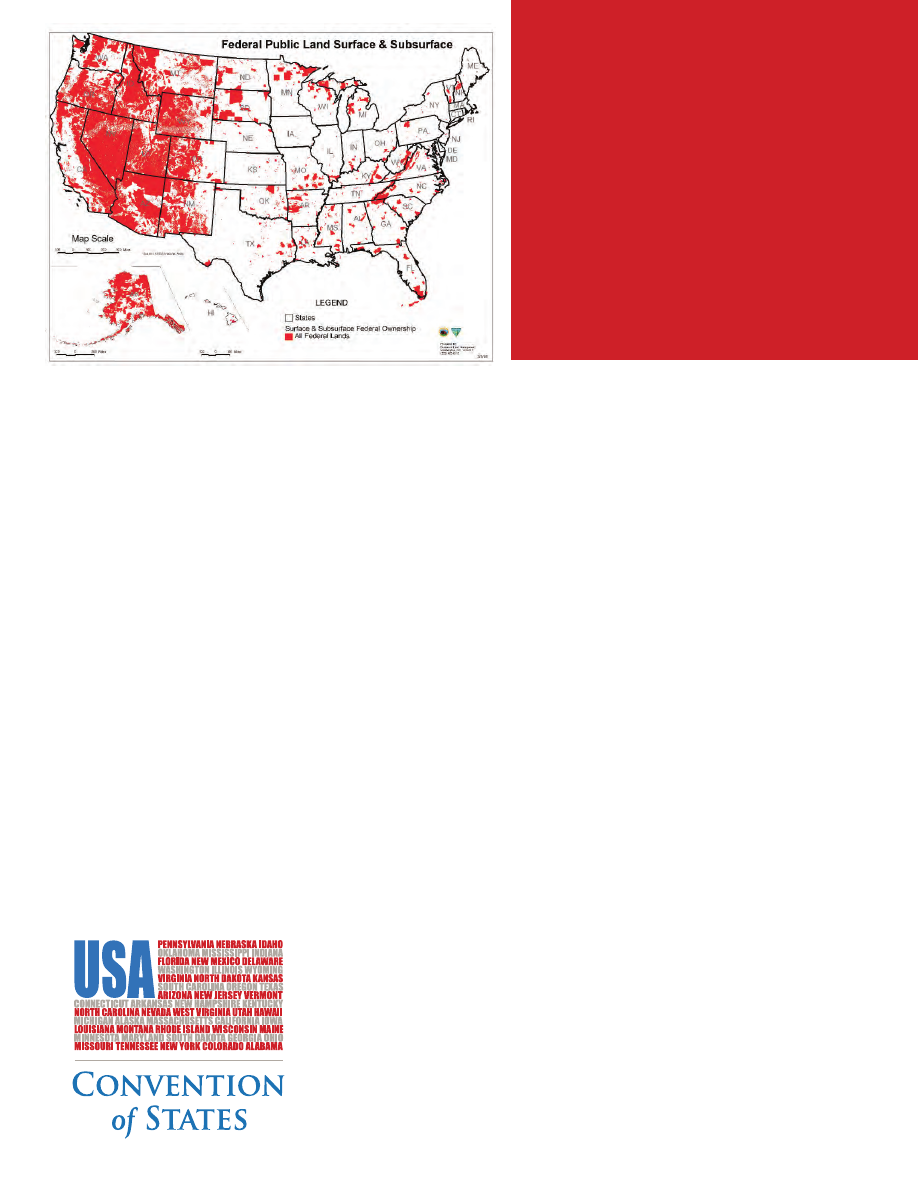
As they moved westward, their strongest men
inexplicably dropped dead along the trail. In
a company of pioneers trudging forward
through harsh, early winter conditions, the
sudden deaths caused great concern. The
company leader ordered an investigation.
The ones still alive were all half-frozen. As
their supplies dwindled, their daily ration of
food was one small, eight-ounce pouch of
flour. These strong men were scooping
much of their flour into their children’s
pouches so that they might make it safely to
their land of promise.
The hardships these pioneers endured
paled in comparison to their vision to
secure their own piece of land and the right
to govern themselves, and to pass on to
their children the opportunity to prosper.
The movie “Monumental” depicts how the
pilgrims suffered intensely during their first
winter. Nevertheless, the sickly settlers
refused to give up and sail back to England,
having a “generational vision that they
could lay their lives down in this wilderness
and literally put their faces down in the mud
and have their children walk on their backs
to a better day.”
Aren’t we all pioneers and pilgrims? Don’t
we all share the same “generational
vision” of healthier air, water and wildlife;
safe and vibrant communities; and abun-
dant recreation?
We’ve been told for decades now that, to
achieve this promise, we have to trust distant
federal bureaucrats with the management of
our unique lands. However, federal bureau-
crats, more concerned with policies than
promises, lock up our lands like they are in
a museum — Hands Off, Don’t Touch!
This “museum management” results in
overgrown forests and record-setting cata-
strophic wildfires that pollute our air,
destroy water supplies and habitat, and kill
wildlife in the millions, leaving communities
depressed and unsafe, and recreation areas
burned up or blocked off. It’s Not Working!
It’s not working for the Oregon woman
who was raped and brutalized in her own
home because federal policies shut down
the timber industry that funded the sher-
iff’s department. When she called 911, all
the operator could do was to tell her to
“call back tomorrow” because, with only
two deputies, the sheriff’s office could
not respond.
It’s not working for the little bear cub in
eastern Washington state who crawled des-
perately on her little paws, burned up to her
elbows, to find anywhere that was not an
inferno. State wildlife agents found her and
she was nursed to health, only to be
released into another overgrown forest.
Every year, millions of her forest mates are
not so lucky.
Public Lands: A “Generational Vision”
Ken Ivory is a Utah State Representative and Director of the
Free the Lands Project with Federalism in Action.
Continued to back page
The federal government
loses
27
cents for every
dollar it spends on land
management, a loss to
taxpayers of approximately
$
2
billion per year.

Continued from front page
(540)
441-
7
22
7
|
C
ONVENTION
O
F
S
TATES
.
COM
|
Facebook.com/ConventionOfStates
|
Twitter.com/COSproject
It’s not working for the lands and people of
Montana. Firefighters in the state put out
wildfires, on average, at less than
10
acres.
Their helicopters are equipped to carry
more water and drop it faster. When wild-
fires broke out on federal lands, five
Montana crews were in the air. However,
the U.S. Forest Service grounded them
because the Montana helicopters were “not
on their approved list.” The Montana crews
sat there on the ground watching thou-
sands upon thousands of acres burn, their
air polluted for weeks, and their water sup-
plies decimated.
It’s not working for Garfield County, Utah,
where they recently declared an economic
state of emergency. Inflicted by a host of
federal lands policies, from a two million-
acre national monument that shut down
the world’s largest reserve of the cleanest
coal, to federal policies that decimated their
timber and livestock industries, the number
one export from Garfield County is now
their children.
It’s not working for national security or
energy independence. China controls nearly
90
% of the world market for rare earth ele-
ments that are vital to the technology that
keeps our planes in the air, ships on the
water, and troops on the field. We have
rare earth elements in abundance locked
up from New Mexico to Alaska in federally
controlled lands. We are dependent on
foreign powers that manipulate the price
and supply of our energy. According to the
U.S. GAO, there is more recoverable oil in
Utah, Colorado, and Wyoming than in the
rest of the world combined, locked up in
federally controlled lands.
It’s not working for the nation. The federal
government extracts billions of dollars each
year from taxpayers east of the Rockies, to
subsidize western communities that are
thwarted in their ability to raise sufficient
revenues for public services because the
federal government controls up to 90% of
their lands. Worse yet, Congress regularly
holds these funds to western communities
hostage in a sort of “two-bit protection
racket,” as Sen. Mike Lee calls it, to garner
western votes for hundreds of billions to be
doled out from the “dysfunctional favor
bank” that epitomizes D.C. politics. This
undermines our system of strong, self-reliant
states meant to check federal overreach.
So, what’s the answer? Have you ever had a
garden? If so, you know that a healthy
garden is a productive garden, and a pro-
ductive garden is a healthy garden. Who
better to tend the garden than those who
know the unique soil, climate, pests, and
local conditions best, and who are on hand
to address the unforeseen circumstances
that always arise?
It’s time to Free the Lands for more effective
local care and management. Who better to
care for the unique lands and interests of
Nevada (
85
% federally controlled) than
Nevadans? Or, for the unique lands of
Alaska (more than
225
million acres feder-
ally controlled) than Alaskans?
With the same “generational vision” that
built this nation, we can secure the oppor-
tunity for our children to prosper.
A Convention of States has the power
to propose amendments that will rein in
an out-of-control federal land baron,
transition to more effective local care of
our unique lands, and unleash a national
economic renaissance.
What’s in your flour pouch?
With improved management …
vast ecosystems will have the opportunity
to recover, blue ribbon fisheries will be
restored, the threat of massive wildfires
will be reduced, and big game will be
able to flourish again.

Amendments work.
In fact, amendments have
had a major impact on
American political life,
mostly for good.
Opponents of a Convention of States long
argued there was an unacceptable risk that a
convention might do too much.
It now
appears they were mistaken.
So they
increasingly argue
that amendments cannot
do enough.
The gist of this argument is that amendments
would accomplish nothing because federal
officials would violate amendments as read-
ily as they violate the original Constitution.
Opponents will soon find their new position
even less defensible than the old. This is be-
cause the contention that amendments are
useless flatly contradicts over two centuries
of American experience — experience that
demonstrates that
amendments work
. In fact,
amendments have had a major impact on
American political life, mostly for good.
The Framers inserted an amendment
process into the Constitution to render the
underlying system less fragile and more
durable. They saw the amendment mecha-
nism as a way to:
• correct drafting errors;
• resolve constitutional disputes, such as by
reversing bad Supreme Court decisions;
• respond to changed conditions; and
• correct and forestall governmental abuse.
The Framers turned out to be correct, be-
cause in the intervening years we have
adopted amendments for all four of those
reasons. Today, nearly all of these amend-
ments are accepted by the overwhelming
majority of Americans, and all but very few
remain in full effect. Possibly because ratifica-
tion of a constitutional amendment is a pow-
erful expression of popular political will,
amendments have proved more durable
than some parts of the original Constitution.
Following are some examples:
Correcting Drafting Errors
Although the Framers were very great peo-
ple, they still were human, and they occa-
sionally erred. Thus, they inserted into the
Constitution qualifications for Senators,
Representatives, and the President, but omit-
ted any for Vice President. They also
adopted a presidential/vice presidential elec-
tion procedure that, while initially plausible,
proved unacceptable in practice.
The founding generation proposed and rati-
fied the
Twelfth Amendment
to correct
those mistakes. The
Twenty-Fifth Amend-
ment
addressed some other deficiencies in
Article II, which deals with the presidency.
Both amendments are in full effect today.
Resolving Constitutional Disputes
and Overruling the Supreme Court
The Framers wrote most of the Constitution
in clear language, but they knew that, as
with any legal document, there would be
differences of interpretation. The amend-
ment process was a way of resolving inter-
pretive disputes.
The founding generation employed it for this
purpose just seven years after the Constitu-
tion came into effect. In
//Chisholm v. Georgia//
,
the Supreme Court misinterpreted the word-
ing of Article III defining the jurisdiction of
the federal courts. The
Eleventh Amendment
reversed that decision.
The Lamp of Experience:
Constitutional Amendments Work
Robert Natelson, Independence Institute’s Senior Fellow in Constitutional Jurisprudence
and Head of the Institute’s Article V Information Center
Continued to back page
8
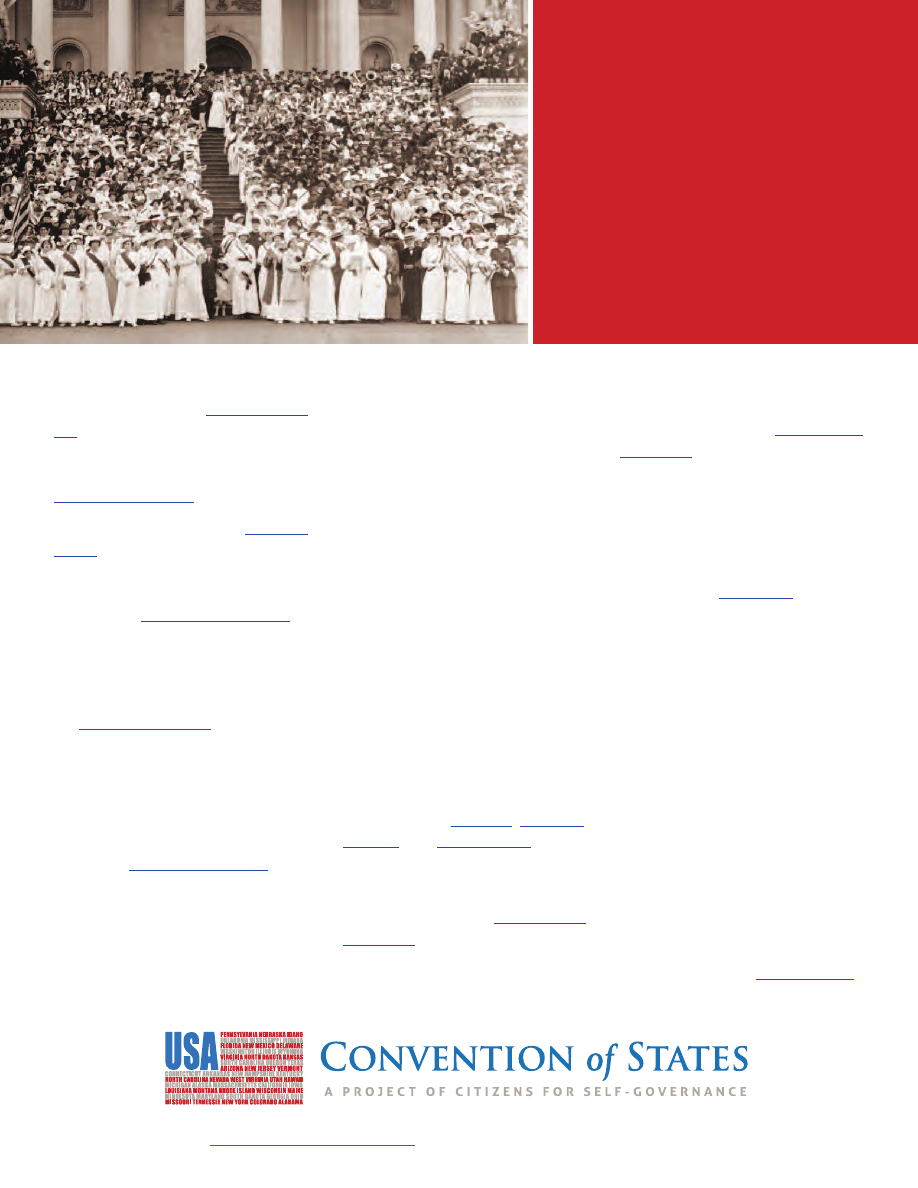
Continued from front page
(540)
441-
7
22
7
|
C
ONVENTION
O
F
S
TATES
.
COM
|
Face
book
.com/ConventionOfStates
|
Twitter.com/COSproject
In
1857
, the Court issued
//Dred Scott v. Sand-//
//ford//
, in which it erroneously interpreted the
Constitution to deny citizenship to African
Americans. The Citizenship Clause of the
Fourteenth Amendment
reversed that case.
In
1970
, the Court decided
//Oregon v.//
//Mitchell//
, whose misinterpretation of the Con-
stitution created a national election law mess.
A year later, Americans cleaned up the mess
by ratifying the
Twenty-Sixth Amendment
.
All these amendments are in full effect today,
and fully respected by the courts.
Responding to Changed Conditions
The
Twentieth Amendment
is the most obvi-
ous example of a response to changed con-
ditions. Reflecting improvements in trans-
portation since the Founding, it moved the
inauguration of Congress and President from
March to the January following election.
Similarly, the
Nineteenth Amendment
, which
assured women the vote in states not al-
ready granting it, was passed for reasons be-
yond simple fairness. During the
1800
s,
medical and technological advances made
possible by a vigorous market economy im-
proved the position of women immeasur-
ably and rendered their political participa-
tion far more feasible. Without these
changes, I doubt the Nineteenth Amend-
ment would have been adopted.
Needless to say, the Nineteenth and Twenti-
eth Amendments are in full effect many
years after they were ratified.
Correcting and Forestalling
Government Abuse
Avoiding and correcting government abuse
was a principal reason the Constitutional
Convention unanimously inserted the state-
driven convention procedure into Article V.
Our failure to use that procedure helps ex-
plain why the earlier constitutional barriers
against federal overreaching seem a little
ragged. Before looking at the problems, how-
ever, let’s look at some successes:
• We adopted the
Thirteenth
,
Fourteenth
,
Fifteenth
, and
Twenty-Fourth
Amend-
ments to correct state abuses of power.
All of these are in substantially full effect.
• In
1992
, we ratified the
Twenty-Seventh
Amendment
,
203
years after James Madi-
son first proposed it. It limits congressional
pay raises, although some would say
not enough.
• In
1951
, we adopted the
Twenty-Second
Amendment
, limiting the President to two
terms. Eleven Presidents later, it remains in
full force, and few would contend it has not
made a difference.
Now the problems: Because we have not
used the convention process, the first
10
amendments (the
Bill of Rights
) remain al-
most the only amendments significantly lim-
iting congressional overreaching. I suppose
that if the Founders had listened to the
“amendments won’t make any difference”
crowd, they would not have adopted the Bill
of Rights either. But I don’t know anyone to-
day who seriously claims the Bill of Rights
has made no difference.
“I have but one lamp by which my feet are
guided; and that is the lamp of experience,”
Patrick Henry said. “I know of no way of judg-
ing of the future but by the past.”
In this case, the lamp of experience sheds
light unmistakably bright and clear: Constitu-
tional amendments work.
//Originally appeared in the //
//American Thinker//
//.//
Women’s Suffrage envoys on
and about the East Steps of
the Capitol, May 9, 1914. The
Nineteenth Amendment was
ratified August 18, 1920.

We can’t walk
boldly into our
future, without
first understanding
our history.
Some people contend that our Constitution
was illegally adopted as the result of a “run-
away convention.” They make two claims:
1.
The convention delegates were instructed
to merely amend the Ar ticles of
Confederation, but they wrote a whole
new document.
2.
The ratification process was improperly
changed from
13
state legislatures to
9
state ratification conventions.
The Delegates Obeyed Their
Instructions from the States
The claim that the delegates disobeyed
their instructions is based on the idea that
Congress called the Constitutional
Convention. Proponents of this view
assert that Congress limited the delegates
to amending the Articles of Confederation.
A review of legislative history clearly reveals
the error of this claim. The Annapolis
Convention, not Congress, provided the po-
litical impetus for calling the Constitutional
Convention. The delegates from the
5
states
participating at Annapolis concluded that a
broader convention was needed to address
the nation’s concerns. They named the time
and date (Philadelphia; second Monday
in May).
The Annapolis delegates said they were going
to work to “procure the concurrence of the
other
States
in the appointment of
Commissioners.” The goal of the upcoming
convention was “to render the constitution of
the Federal Government adequate for the ex-
igencies of the Union.”
What role was Congress to play in calling the
Convention? None. The Annapolis delegates
sent copies of their resolution to Congress
solely “from motives of respect.”
What authority did the Ar ticles of
Confederation give to Congress to call such
a Convention? None. The power of Congress
under the Articles was strictly limited, and
there was no theory of implied powers. The
states possessed residual sovereignty which
included the power to call this convention.
Seven state legislatures agreed to
send delegates to the Constitutional
Convention
prior to the time that
Congress acted to endorse it
.
The states
told their delegates that the purpose of the
Convention was the one stated in the
Annapolis Convention resolution: “to render
the constitution of the Federal Government
adequate for the exigencies of the Union.”
Congress voted to endorse this Convention
on February
21, 1787
. It did not purport to
“call” the Convention or give instructions to
the delegates. It merely proclaimed that “in
the opinion of Congress, it is expedient” for
the Convention to be held in Philadelphia on
the date informally set by the Annapolis
Convention and formally approved by
7
state legislatures.
Ultimately,
12
states appointed delegates. Ten
of these states followed the phrasing of the
Annapolis Convention with only minor vari-
ations in wording (“render the Federal
Constitution adequate”). Two states, New
York and Massachusetts, followed the for-
mula stated by Congress (“solely amend the
Articles” as well as “render the Federal
Constitution adequate”).
Every student of history should know that
Can We Trust the Constitution?
Answering The “Runaway Convention” Myth
Michael P. Farris, JD, LLM, Convention of States Action — Senior Fellow for Constitutional Studies
Continued to back page
Continued from front page
History tells the story.
The Constitution was legally adopted.
Now, let’s move on to getting our
nation back to the greatness the
Founders originally envisioned.
the instructions for delegates came from
the states. In
Federalist 40
, James Madison
answered the question of “who gave the
binding instructions to the delegates.” He
said: “The powers of the convention ought,
in strictness, to be determined by an inspec-
tion of the commissions given to the mem-
bers by their respective constituents [i.e. the
states].” He then spends the balance of
Federalist 40
proving that the delegates
from all 12 states properly followed the di-
rections they were given by each of their
states. According to Madison, the February
21
st
resolution from Congress was merely
“a recommendatory act.”
The States, not Congress, called the
Constitutional Convention. They told
their delegates to render the Federal
Constitution adequate for the exigencies of
the Union. And that is exactly what
they did.
The Ratification Process Was
Properly Changed
The Articles of Confederation required any
amendments to be approved by Congress
and ratified by all
13
state legislatures.
Moreover, the Annapolis Convention and
a clear majority of the states insisted that
any amendments coming from the
Constitutional Convention would have to
be approved in this same manner—by
Congress and all
13
state legislatures.
The reason for this rule can be found in the
principles of international law. At the time,
the states were sovereigns. The Articles of
Confederation were, in essence, a treaty be-
tween
13
sovereign nations. Normally, the
only way changes in a treaty can be ratified
is by the approval of all parties to the treaty.
However, a treaty can provide for some-
thing less than unanimous approval if all the
parties agree to a new approval process be-
fore it goes into effect. This is exactly what
the Founders did.
When the Convention sent its draft of the
Constitution to Congress, it also recom-
mended a new ratification process.
Congress approved both the Constitution
itself and the new process.
Along with changing the number of re-
quired states from
13
to
9
, the new ratifica-
tion process required that state
conventions ratify the Constitution rather
than state legislatures. This was done in ac-
cord with the preamble of the
Constitution—the Supreme Law of the
Land would be ratified in the name of “We
the People” rather than “We the States.”
But before this change in ratification
could be valid,
all 13 state legislatures
would also have to consent to the new
method.
All 13 state legislatures did
just this by calling conventions of the
people to vote on the merits of
the Constitution.
Twelve states held popular elections to vote
for delegates. Rhode Island made every
voter a delegate and held a series of town
meetings to vote on the Constitution. Thus,
every state legislature consented to the new
ratification process thereby validating the
Constitution’s requirements for ratification.
Those who claim to be constitutionalists
while contending that the Constitution
was illegally adopted are undermining
themselves. It is like saying George
Washington was a great American hero,
but he was also a British spy. I stand with
the integrity of our Founders who
properly drafted and properly ratified
the Constitution.
(540)
441-
7
22
7
|
C
ONVENTION
O
F
S
TATES
.
COM
|
Facebook.com/ConventionOfStates
|
Twitter.com/COSproject
Our constitutional rights, especially our Sec-
ond Amendment right to keep and bear
arms, are in peril. With every tragic violent
crime, liberals renew their demands for
Congress and state legislatures to enact so-
called “commonsense gun control” meas-
ures designed to chip away at our individual
constitutional right to armed self defense.
Indeed, were it not for the determination
and sheer political muscle of the National
Rifle Association, Senator Feinstein’s 2013
bill to outlaw so-called “assault weapons”
and other firearms might well have passed.
But the most potent threat facing the Second
Amendment comes not from Congress, but
from the Supreme Court. Four justices of
the Supreme Court do not believe that the
Second Amendment guarantees an individ-
ual right to keep and bear arms. They be-
lieve that Congress and state legislatures
are free not only to restrict firearms owner-
ship by law-abiding Americans, but to ban
firearms altogether. If the Liberals get one
more vote on the Supreme Court, the Sec-
ond Amendment will be no more.
Constitutional law has been the dominant
focus of my practice for most of my career
as a lawyer, first in the Justice Department
as President Reagan’s chief constitutional
lawyer and the chairman of the President’s
Working Group on Federalism, and since
then as a constitutional litigator in private
practice. For almost three decades, I have
represented dozens of states and many other
clients in constitutional cases, including
many Second Amendment cases. In 2001,
for example, I argued the first federal ap-
pellate case to hold that the Second Amend-
ment guarantees every law-abiding respon-
sible adult citizen an individual right to keep
and bear arms. And in 2013 I testified before
the Senate in opposition to Senator Fein-
stein’s anti-gun bill, arguing that it would
violate the Second Amendment. So I am not
accustomed to being accused of supporting
a scheme that would “put our Second
Amendment rights on the chopping block.”
This charge is being hurled by a small gun-
rights group against me and many other con-
stitutional conservatives because we have
urged the states to use their sovereign power
under Article V of the Constitution to call
for a convention for proposing constitutional
amendments designed to rein in the federal
government’s power.
The real threat to our constitutional rights
today is posed not by an Article V conven-
tion of the states, but by an out-of-control
federal government, exercising powers that
it does not have and abusing powers that it
does. The federal government’s unrelenting
encroachment upon the sovereign rights of
Continued on back page
An Open Letter Concerning
The Second Amendment
and The Convention of
States Project
From Charles J. Cooper
Appellate Attorney and Litigator
Our constitutional
rights, especially
our Second
Amendment
right to keep
and bear arms,
are in peril.
Website:
ConventionOfStates.com
E-mail: [email protected]
Phone: (540) 441-7227
www.Facebook.com/ConventionOfStates
Twitter: @COSProject
the states and the individual rights of citi-
zens, and the Supreme Court’s failure to
prevent it, have led me to join the Legal
Board of Reference for the Convention of
States Project. The Project’s mission is to
urge 34 state legislatures to call for an
Article V convention limited to proposing
constitutional amendments that “impose fis-
cal restraints on the federal government,
limit its power and jurisdiction, and impose
term limits on its officials and members of
Congress.” I am joined in this effort by
many well-known constitutional conserva-
tives, including Mark Levin, Professor
Randy Barnett, Professor Robert George,
Michael Farris, Mark Meckler, Professor
Robert Natelson, Andrew McCarthy, Pro-
fessor John Eastman, Ambassador Boyden
Gray, and Professor Nelson Lund. All of us
have carefully studied the original meaning
of Article V, and not one of us would sup-
port an Article V convention if we believed
it would pose a significant threat to our
Second Amendment rights or any of our
constitutional freedoms. To the contrary,
our mission is to reclaim our democratic
and individual freedoms from an overreach-
ing federal government.
The Framers of our Constitution carefully
limited the federal government’s powers by
specifically enumerating those powers in
Article I, and the states promptly ensured
that the Constitution would expressly protect
the “right of the people to keep and bear
arms” by adopting the Second Amendment.
But the Framers understood human nature,
and they could foresee a day when the fed-
eral government would yield to the “en-
croaching spirit of power,” as James Madi-
son put in the Federalist Papers, and would
invade the sovereign domain of the states
and infringe the rights of the citizens. The
Framers also knew that the states would be
powerless to remedy the federal govern-
ment’s encroachments if the process of
amending the Constitution could be initiated
only by Congress; as Alexander Hamilton
noted in the Federalist Papers, “the national
government will always be disinclined to
yield up any portion of the authority” it
claims. So the Framers wisely equipped the
states with the means of reclaiming their
sovereign powers and protecting the rights
of their citizens, even in the face of con-
gressional opposition. Article V vests the
states with unilateral power to convene for
the purpose of proposing constitutional
amendments and to control the amending
process from beginning to end on all sub-
stantive matters.
The day foreseen by the Framers – the day
when the federal government far exceeded
the limits of its enumerated powers – arrived
many years ago. The Framers took care in
Article V to equip the people, acting through
their state legislatures, with the power to put
a stop to it. It is high time they used it.
Charles J. Cooper is a founding member
and chairman of Cooper & Kirk, PLLC.
Named by The National Law Journal as
one of the 10 best civil litigators in Wash-
ington, he has over 35 years of legal ex-
perience in government and private prac-
tice, with several appearances before the
United States Supreme Court and scores
of other successful cases on both the trial
and appellate levels.
Continued from front page
The real threat to our
constitutional rights today
is posed not by an Article V
convention of the states,
but by an out-of-control
federal government,
exercising powers that it
does not have and abusing
powers that it does.

The mistakes these authors
made can be attributed
partly to the agenda-driven
nature of their writings, and
their failure to examine
many historical sources.
This past week, conservative icon Phyllis
Schlafly contributed a
short piece to
Townhall.com
, in which she attacked the
movement for an Article V convention.
As
I wrote in my response
, she was relying on
claims about the convention that had been
superseded by modern research.
You can classify modern Article V writing
in three broad waves. (There are many
exceptions, but the generalization is valid,
I think.) The first wave consisted of
publications from the
1960
s and
1970
s,
mostly
—
but not exclusively—by liberal
academics who opposed conservative
efforts to trigger a convention. Examples
include articles by Yale’s Charles Black,
William and Mary’s William Swindler,
Duke’s Walter Dellinger, and Harvard’s
Lawrence Tribe.
Typically, these authors concluded that an
Article V “constitutional convention” (as
they called it) could not be limited to a
single subject. That, as we now know, was
a mistake. A related error was their
assumption that, when the Founders
referred to a “general” convention, they
meant a convention with unlimited subject
matter. Actually, a “general convention”
meant one in which all the states, or at
least states from all regions, participated. It
was the opposite of a “partial” or regional
convention, and it had nothing to do with
the scope of the subject matter.
The mistakes these authors made can be
attributed partly to the agenda-driven
nature of their writings, and their failure to
examine many historical sources. They
seldom ventured beyond The Federalist
Papers and a few pages from the transcript
of the
1787
Constitutional Convention.
Also in the First Wave was a
1973
study
sponsored by the American Bar Associa-
tion. The ABA document did conclude
that a “constitutional convention” could
be limited, but it was not a very solid piece
of research, perhaps because (if my infor-
mation is accurate) the principal writers
were not professional scholars, but a pair
of law students.
The Second Wave began in
1979
with a
publication issued by President Carter’s
U.S. Office of Legal Counsel and written
by attorney John Harmon. For its time, it
was a particularly thorough job. Among
the other authors in this wave were
Grover Rees III and the University of
Minnesota’s Michael Stokes Paulsen.
The most elaborate publication of this era
was by Russell Caplan, whose book,
//Constitutional Brinksmanship//
, was released
by Oxford University Press in 1988.
S e c o nd W a ve a u t ho r s a c c e s s e d f a r
more material than their predecessors.
They paid more attention to the
1787–90
How We Have Learned More and More
About the Constitution’s “Convention
for Proposing Amendments”
Robert Natelson, Independence Institute’s Senior Fellow in Constitutional Jurisprudence
and Head of the Institute’s Article V Information Center
Continued to back page
Continued from front page
(540)
441-
7
22
7
|
C
ONVENTION
O
F
S
TATES
.
COM
|
Facebook.com/ConventionOfStates
|
Twitter.com/COSproject
ratification debates. Caplan even made
some reference to earlier interstate con-
ventions. Most of them (Paulsen was an
exception) correctly concluded that an
Article V gathering could be limited.
But Second Wave writers did make some
mistakes. They continued to refer to an
Article V conclave as a “constitutional con-
vention.” Some of them assumed, as some
First Wave writers had, that Congress had
broad authority under the Necessary and
Proper Clause to regulate the convention
and the selection and apportionment of
delegates. None investigated the records
of other interstate conventions in detail, or
fully grasped their significance.
T h e T h i r d W a v e b e g a n i n t h e 2 1
s t
century. Its contributing authors include
the University of San Diego’s Michael
Rappaport, former House of Representa-
tives Senior Counsel Mike Stern, the
Goldwater Institute’s Nick Dranias, and
myself. We have been able to place the
Article V convention into its larger legal
and historical context.
Like most of the Second Wave writers, we
understand that an Article V convention
can be limited. But we also have learned a
lot of other things: The gathering is not a
constitutional convention, it was modeled
after a long tradition of limited-purpose
gatherings, and it is governed by a rich his-
tory of practice and case law.
We also know that the Necessary and
Proper Clause does not apply to conven-
tions. That clause gives Congress power to
make laws to carry into execution certain
enumerated powers and “all other Powers
vested by this Constitution in the Govern-
ment of the United States, or in any
Department or Officer thereof.” But a con-
vention for proposing amendments is not
part of the “Government of the United
States,” nor is it a “Department or Officer
thereof.” Supreme Court precedent, as well
as the wording of the Constitution, make
this clear. For this and other reasons, con-
gressional powers over the process are
quite limited.
A few days ago, a friend sent me a
1987
report issued by the U.S. Justice Depart-
ment
. The title is “Limited Constitutional
Conventions Under Article V of the United
States Constitution.” As the date would
suggest, this is a typical Second Wave
publication. In addition to labeling an
Article V Convention as a “constitutional
convention,” it also assumes that a “gen-
eral” convention is one that is unlimited as
to subject matter. It shows no familiarity
with any previous interstate conventions
other than the
1787
gathering. It makes
the erroneous assumption that the latter
meeting was called by Congress under the
Articles of Confederation. It fails to under-
stand the nature of the convention as a
meeting of commissioners from state
legislatures. It asserts erroneously that all
19
th
century state applications were for an
unlimited convention. (In fact, several were
limited.) And it makes the inaccurate
assumption that Congress has power
under the Necessary and Proper Clause
to prescribe procedures for an amend-
ments convention.
Such documents are of historical interest,
but they should no longer be taken
as authoritative.
We have been
able to place
the Article V
convention into its
larger legal and
historical context.
One source of security
we have… is the courts’
long history of protecting
the integrity of the
[amendment] procedure.
One source of security we have in using
the Constitution’s amendment process is
the courts’ (including the U.S. Supreme
Court) long history of protecting the
integrity of the procedure.
Many of those who pontificate on the
subject are largely unaware of this
jurisprudence. As a result, they often
debate questions that the courts have
long resolved or promote scenarios (such
as the “runaway” scenario) that the law
has long foreclosed.
Here are some of the key issues the
courts have addressed, either in binding
judgments or in what lawyers call “per-
suasive authority.” This listing of cases is
only partial.
• Article V grants enumerated powers to
named assemblies—that is, to Congress,
state legislatures, conventions for propos-
ing amendments, and state conventions.
When an assembly acts under Article V,
that assembly executes a “federal func-
tion” different from whatever other
responsibilities it may have.
Hawke v.
Smith,
253
U.S.
221 (1920)
;
Leser v. Gar-
nett,
258 U.S. 130 (1922)
;
State ex rel.
Donnelly v. Myers,
127
Ohio St.
104, 186
N.E.
918 (1933
);
Dyer v. Blair,
390
F. Supp.
1291
(N.D. Ill.
1975
) (Justice Stevens).
• Article V gives authority to named
assemblies, without participation by the
executive.
Hollingsworth v. Virginia
,
3
U.S.
(
3
Dall.)
378 (1798)
.
• Where the language of Article V is clear,
it must be enforced as written.
United
States v. Sprague,
282
U.S.
716 (1931
).
• That does not mean, as some have
claimed, that judges may never go
beyond reading the words and guessing
what they signify. Rather, a court may con-
sider the history underlying Article V.
Dyer v. Blair,
390
F. Supp.
1291
(N.D. Ill.
1975
) (Justice Stevens). It may also con-
sider what is implied as well as what is
expressed.
Dillon v. Gloss,
256
U.S.
368
(
1921
). In other words, courts apply the
same rules of interpretation to Article V
as elsewhere.
• Just as other enumerated powers in the
Constitution bring with them certain inci-
dental authority, so also do the powers
enumerated in Article V.
State ex rel.
Donnelly v. Myers,
127
Ohio St.
104, 186
N.E. 918 (1933).
This point and the one
previous are important in determining the
scope of such Article V words as “call,”
“convention,” and “application.”
• The two-thirds vote required in
Congress for proposing amendments
is two thirds of a quorum present and
voting, not of the entire membership.
How the Courts have Clarified the
Constitution’s Amendment Process
Robert Natelson, Independence Institute’s Senior Fellow in Constitutional Jurisprudence
and Head of the Institute’s Article V Information Center
Continued to back page
Continued from front page
(540)
441-
7
22
7
|
C
ONVENTION
O
F
S
TATES
.
COM
|
Facebook.com/ConventionOfStates
|
Twitter.com/COSproject
State of Rhode Island v. Palmer
,
253
U.S. 320 (1920).
• A convention for proposing amend-
ments is, like all of its predecessors, a
“convention of the states.”
Smith v. Union
Bank,
30 U.S. 518, 528 (1831).
The
national government is not concerned
with how Article V conventions or state
legislatures are constituted.
United States v.
Thibault
,
47 F.2
d
169
(2d Cir.
1931
).
• No legislature or convention has power
to alter the ratification procedure. That is
fixed by Article V.
Hawke v. Smith,
253
U.S. 221 (1920)
;
United States v. Sprague
,
282 U.S. 716 (1931)
. Some “runaway”
alarmists have suggested that a convention
for proposing amendments could decree
ratification by national referendum, but the
Supreme Court has ruled this out.
Dodge
v. Woolsey
,
59 U.S. 331 (1855)
. Neither
can a state mutate its own ratifying proce-
dure into a referendum.
State of Rhode
Island v. Palmer,
253 U.S. 320 (1920).
• Congress may not try to manipulate the
ratification procedure, other than by
choosing one of two specified “modes
of ratification.”
Idaho v. Freeman,
529
F.
Supp.
1107
(D. Idaho
1981
), a judgment
vacated as moot by Carmen v. Idaho,
459
U.S. 809 (1982)
; compare
United States
v. Sprague,
282 U.S. 716 (1931).
• A convention meeting under Article V
may be limited to its purpose.
I n R e
Opinion of the Justices,
204 N.C. 306, 172
S.E. 474 (1933).
• But an outside body may not dictate an
Article V assembly’s rules and procedures.
Leser v. Garnett,
258 U.S. 130 (1922)
;
Dyer v. Blair,
390
F. Supp.
1291
(N.D. Ill.
1975
) (Justice Stevens).
• Nor may the assembly be compelled
to resolve the issue presented to it in a
particular way.
State ex rel. Harper v.
Waltermire
,
691
P.2d
826
(
1984
);
AFL-
CIO v. Eu,
686
P.2d
609
(Cal.
1984
);
Miller
v. Moore,
169
F.3d
1119
(8th Cir.
1999
);
Gralike v. Cook,
191
F.3d
911
, 924-25 (8
th
Cir.
1999)
, affirmed on other grounds sub
nom.
Cook v. Gralike,
531
U.S.
510 (2001)
;
Barker v. Hazeltine,
3
F. Supp. 2d
1088,
1094
(D.S.D.
1998
);
League of Women
Voters of Maine v. Gwadosky
,
966
F. Supp.
52
(D. Me.
1997
);
Donovan v. Priest,
931
S.W.2d
119
(Ark. 1996).
• Article V functions are complete when
a convention or legislature has acted.
There is no need for other officials to pro-
claim the action.
United States ex rel.
Widenmann v. Colby,
265 F.
398
(D.C. Cir.
1920
), affirmed
257
U.S.
619 (1921
).
As these cases illustrate, the courts are
very much in the business of protecting
Article V procedures, and they have done
so for more than two centuries.
The courts are very
much in the business
of protecting
Article V procedures,
and they have done
so for more than
two centuries.

The Founders created
the convention for
precisely the kind of
situation we face now.
The Founders bequeathed to Americans a
method to bypass the federal government
and amend the Constitution, empowering
two-thirds of the states to call an amendments
convention. In the wake of Mark Levin’s
bestselling book,
//The Liberty Amendments//
,
proposing just such a convention, some
have raised entirely unnecessary alarms. Sur-
prisingly, a few of the leading lights of
conservatism have been among the alarmists.
But their concerns are based on an incom-
plete reading of history and judicial case law.
Phyllis Schlafly is a great American and a great
leader, but her
speculations
about the nature of
the Constitution’s “convention for proposing
amendments” are nearly as quaint as Dante’s
speculations about the solar system. Those
speculations simply overlook the last three
decades of research into the background and
subsequent history of the Constitution’s
amendment process. They also ignore how
that process actually works, and how the
courts elucidate it.
Article V of the Constitution provides for a
“convention for proposing amendments.” The
Founders inserted this provision to enable the
people, acting through their state legislatures,
to rein in an abusive or runaway federal gov-
ernment. In other words, the Founders created
the convention for precisely the kind of situa-
tion we face now.
Mrs. Schlafly doesn’t think we know much else
about the process. She writes, “Everything else
about how an Article V Convention would func-
tion, including its agenda, is anybody’s guess.”
But she’s wrong. There is no need to guess.
There is a great deal we know about the subject.
The “convention for proposing amendments”
was consciously modeled on
federal conven-
tions held
during the century leading up to the
Constitutional Convention. During this period
the states — and before Independence, the
colonies — met together on average about
every
40
months. These were meetings of sep-
arate governments, and their protocols were
based on international practice. Those proto-
cols were well-established and are inherent in
Article V.
Each federal convention has been called to
address one or more discrete, prescribed prob-
lems. A convention “call” cannot determine
how many delegates (“commissioners”) each
state sends or how they are chosen. That is a
matter for each state legislature to decide.
A convention for proposing amendments is a
meeting of sovereignties or semi-sovereignties,
and each state has one vote. Each state com-
missioner is empowered and instructed by his
or her state legislature or its designee.
As was true of earlier interstate gatherings, the
convention for proposing amendments is
called to propose solutions to discrete, pre-
assigned problems. There is no record of any
federal convention significantly exceeding its
pre-assigned mandate — not even the Consti-
tutional Convention, despite
erroneous claims
to the contrary.
The state legislatures’ applications fix the sub-
ject-matter for a convention for proposing
The Myth of a Runaway
Amendments Convention
Robert Natelson, Independence Institute’s Senior Fellow in Constitutional Jurisprudence
and Head of the Institute’s Article V Information Center
Continued to back page
(540)
441-
7
22
7
|
C
ONVENTION
O
F
S
TATES
.
COM
|
Facebook.com/ConventionOfStates
|
Twitter.com/COSproject
Continued from front page
amendments. When two-thirds of the states
apply on a given subject, Congress must call
the convention. However, the congressional
call is limited to the time and place of meeting,
and to reciting the state-determined subject.
In the unlikely event that the convention strays
from its prescribed agenda (and the commis-
sioners escape recall), any “proposal” they
issue is
ultra vires
(“beyond powers”) and void.
Congress may not choose a “mode of ratifica-
tion” for that proposal, and the necessary
three-quarters of the states would not ratify it
in any event.
Contrary to Mrs. Schlafly’s claim that “Article V
doesn’t give any power to the courts to correct
what does or does not happen,” the courts can
and do adjudicate Article V cases. There has
been a
long line of those cases
from
1798
into
the
21
st
century.
“But,” you might ask, “Will the prescribed con-
vention procedures actually work?“
They already have. In
1861
, in an effort to
prevent the Civil War, the Virginia legislature
called for an interstate gathering formally enti-
tled the
Washington Conference Convention
and, informally, the
Washington Peace Confer
-
ence
. The idea was that the convention would
draft and propose one or more constitutional
amendments that, if ratified, would weaken
extremists in both the North and the South,
and thereby save the Union. This gathering
differed from an Article V convention prima-
rily in that it made its proposal to Congress
rather than to the states. In virtually every
other respect, however, it was a blueprint for
an Article V convention.
When the convention met in Washington,
D.C., on February
4, 1861
, seven states
already had seceded. Of the
26
then remain-
i n g i n t h e U n i o n ,
2 1
s e n t c o m m i t t e e s
(delegations). The conference lasted until
February
27
, when it proposed a
7
-section
constitutional amendment.
The assembly followed to the letter the
convention rules established during the
18
th
century—the same rules relied on by
the Constitution’s Framers when they
provided for a Convention for Proposing
Amendments. Specifically:
• The convention call fixed the place, time, and
topic, but did not try to dictate other mat-
ters, such as selection of commissioners
(delegates) or convention rules.
• At the convention, voting was by state. One
vote was, apparently inadvertently, taken
per capita, but that was quickly corrected.
• The committee from each state was
selected in the manner that state’s leg-
islature directed.
• The conclave adopted its own rules and
selected its own officers. Former President
John Tyler served as president.
• The commissioners stayed on topic. One
commissioner made a motion that was
arguably off topic (changing the President’s
term of office), but that was voted down
without debate.
Congress subsequently deadlocked over the
amendment, but the convention itself did
everything right: It
followed all the protocols
listed
above, and it produced a compromise
amendment. Although the convention met in
a time of enormous stress, this “dry run” came
off well, with none of Mrs. Schlafly’s specula-
tive “horribles.”
In any political procedure, there are always
uncertainties, but in this case they are far fewer
than predicted by anti-convention alarmists.
And they must be balanced against a certainty:
Unless we use the procedure the Founders
gave us to rein in a runaway Congress, then
Congress will surely continue to run away.
In any political procedure,
there are always uncertainties,
but in this case they are far
fewer than predicted by
anti-convention alarmists.
Article V provides two methods to pro-
pose constitutional amendments—one
controlled by Congress and one con-
trolled by the state legislatures. In the
last two years, there has been a signifi-
cant renewal of interest in employing
the state-based method for proposing
amendments to the Constitution. This
newfound interest in Article V arises
largely from the belief that the Con-
gress will never propose amendments
that impose meaningful restrictions on
federal power.
There are only two “Article V” move-
ments that have made significant
progress: the Balanced Budget Amend-
ment and the Convention of States
Project. The first (BBA) seeks one sin-
gle amendment requiring the federal
government to adopt a balanced
budget. The second (COS) seeks broad
limitations on federal power—specifi-
cally, “imposing fiscal restraints on the
federal government, limiting the power
and jurisdiction of the federal govern-
ment, and imposing term limits on fed-
eral officials.”
The COS Project was launched in the
fall of 2013, and in its first year secured
passage of a formal application from
the legislatures of Georgia, Florida,
and Alaska.
The BBA project has been underway
for over forty years and has secured a
variety of applications in a great num-
ber of states. However, determining the
current number of states that have a
valid, pending BBA application pres-
ents a challenge. Two issues make
counting difficult. First, there is signifi-
cant variance among the language of
the various BBA applications, which
raises potential problems with aggrega-
tion. Second, many states have
rescinded their prior BBA applications.
We will discuss these legal issues
below in Section 4.
The COS Project is working to pass
applications with identical operative
language in 34 states. This ensures that
no issues of aggregation can arise.
Moreover, no states have rescinded a
COS application.
There are at least five significant reasons
why a state legislature should adopt a
COS application even if it has already
adopted a valid BBA application.
1.There is no rule against a state
passing two or more applications.
Every Article V application from a state
legislature must identify its purpose.
There have been over 400 applications
in the history of the Republic, and yet
there has never been an Article V Con-
vention because two-thirds of the states
have never agreed on the subject mat-
ter. There have been countless occa-
sions when a state has passed a second
or third application for a Convention on
a different topic, even while a prior
application was still pending.
This historical practice reflects com-
mon sense. There may be multiple
issues that states want to see addressed
through a constitutional amendment.
And the process of building a coalition
of 34 states is sufficiently daunting that
the states see the wisdom in supporting
multiple efforts that use varying
approaches to accomplish their goals.
Why a State Should Adopt an Article V
Application for A Convention of States
if It Has Already Adopted a Balanced Budget
Amendment Application
Michael P. Farris, JD, LLM, Convention of States Action — Senior Fellow for Constitutional Studies
Continued to page 2
1

appropriations made by the Congress
for any fiscal year may not exceed the
total of the estimated Federal revenues
for that fiscal year, excluding any rev-
enues derived from borrowing; and this
prohibition extends to all Federal
appropriations and all estimated Fed-
eral revenues, excluding any revenues
derived from borrowing.” It goes on to
specify circumstances under which the
requirement could be suspended.
Mississippi’s application also calls for
the proposal of a specifically-worded
amendment, but its language is differ-
ent from Maryland’s proposal. Missis-
sippi’s language would prohibit con-
gressional appropriations that would
exceed revenues in a given fiscal year,
but also requires that the national debt
be repaid within a specified timeline at
a specified rate, etc.
Still other states’ resolutions for a BBA
demonstrate additional variations on
the theme.
This raises a very serious concern about
aggregation. While Congress has a very
limited role in the state-initiated
process of proposing amendments, leg-
islative practice and the text of Article
V suggest that Congress determines
when 34 states have applied for a con-
vention on the same subject.
The reality is that if the state applica-
tions are not uniform or essentially uni-
form (as to their operative language),
Congress will be entitled to make a
political judgment about whether the
applications should be aggregated. If
there is a simple majority in both
houses of Congress that favor an Arti-
cle V Convention to consider a BBA,
then Congress will likely grant a great
deal of latitude on the issue of aggrega-
tion. However, if a majority of either
house of Congress is opposed to either
the idea of a Balanced Budget Amend-
ment or the convening of an Article V
Convention in general, Congress would
“interpret” the applications very nar-
rowly and conclude that 34 states have
not applied for a convention on the
same subject.
Regardless of which way the vote goes,
litigation will certainly follow to test the
question of aggregation. And while good
substantive arguments can be made to
bolster the notion that aggregation
should be broadly accepted rather than
narrowly confined, the courts would
likely avoid deciding this question.
In fact, it is very likely that the Supreme
Court will take the position that the
question of aggregation is a political
question whenever the state applica-
tions are not identical or essentially
identical as to their operative language.
Litigation on this point would add two
to four years to the process of calling
a BBA convention, because the legal
issues will be viewed as important
and sufficiently close to merit full
consideration.
In short, litigation will prolong the
process, and whatever Congress
decides on the BBA aggregation issue
is likely to be affirmed in the courts.
The Convention of States Project
avoids this problem altogether. Our
strategy is for 34 states to commit to
adopting our model language for the
operative portion of their applications,
thus precluding any legitimate question
about aggregation. Congress will have
no cause to make a political judgment,
and the courts will enforce the direct
language of Article V forcefully upon
such facts.
5. Our nation doesn’t have time
to wait and see what will happen
with a BBA before it tackles the
issues raised by the COS.
The problems our nation faces are com-
plex and urgent. If we are going to pre-
serve liberty, restore self-governance
and prevent an economic collapse, we
must act promptly.
Under the best case scenario for the
BBA, sufficient applications will be
amassed in 2016. If we add just two
years for litigation, we will be at 2018
before a convention could be held.
Then there will be the ratification fight
that will surely last until 2020.
The critical issues that we can address
through COS cannot safely be delayed
until 2020.
Since there is no barrier to prevent a
state from passing both a BBA and
COS, there is every reason to proceed
with both applications as quickly as
possible in as many states as possible.
3
There is no barrier to prevent a state from
passing both a BBA and COS. We must proceed
with both applications as quickly as possible in
as many states as possible.
Continued from page 1
2
2. Only the COS application seeks
to restore federalism.
The BBA seeks to prohibit the federal
government from taking the nation
even deeper into debt. This is, of
course, a worthy goal, and one that
COS supports. However, we also seek
to address the root cause of the prob-
lem. The root cause of debt is excessive
federal spending. And the cause of
excessive spending is, at least in signif-
icant part, entitlement and other domes-
tic programs that are within the exclu-
sive jurisdiction of the states under the
original meaning of the Constitution.
By 2020, 89% of the federal budget will
need to be devoted to just four items:
interest on the national debt, Medicare,
Medicaid, and Social Security. This is
untenable and leaves our nation’s infra-
structure and defense at great risk. A
BBA alone will not cure this problem.
We must restrict Congress’ virtually
unlimited power to spend.
In the Obamacare decision, Chief Jus-
tice Roberts’ majority ruling held that
there is no constitutional limitation on
the power of Congress to tax and spend.
This is the core problem. And, we must
fix it. This means a return to the states
of exclusive jurisdiction for several
areas of government expenditure.
Not only has Congress invaded the
province of the states with regard to
domestic spending, it has increasingly
taken charge of state governments by
means of conditional federal grants.
Congress coerces the states to do its
bidding by taking money from taxpay-
ers (current or future), and then offering
federal funding for mandated programs.
This leaves the state legislatures in the
structural position of being unable to
achieve their central mission—repre-
senting the voters of their own states.
Rather, state legislators are effectively
required to do the will of Congress. This
is a clear violation of the principles of a
Republican form of government.
Regaining true federalism is not just a
matter of insisting on adherence to the
original meaning of the Constitution. If
freedom is to survive, we must return to
the structural designs of a robust feder-
alism, with a truly limited federal gov-
ernment. Only the COS seeks to address
this core issue.
3. There are other structural issues
with the federal government that
require immediate attention.
Article I, Section 1 of the Constitution
commands that all federal laws must be
made by Congress. But the Executive
Branch, through both executive orders
and bureaucratic regulations, makes an
ever-escalating percentage of the fed-
eral laws that are crippling our econ-
omy. This problem is persistent regard-
less of which political party controls
the White House.
The Supreme Court has, on approxi-
mately thirty occasions, acknowledged
that the only limitation on its power is
the Court’s own sense of self-restraint.
We must apply appropriate checks and
balances to the Supreme Court.
We see the State Department and many
in the United States Senate increasingly
enamored with the idea that interna-
tional law should govern the domestic
policy of the United States. Under the
Supremacy Clause, all state laws and
state constitutions must yield to any rat-
ified international treaty. We need to
limit the treaty power to the interna-
tional sphere and not allow it to invade
the domestic authority of the states.
The chief reasons for the growth of the
federal government involve misuse of
the General Welfare Clause and the
Commerce Clause. Both of these need
to be returned to their original meaning.
We need to have a serious discussion
on the issue of term limits for members
of Congress and the federal judiciary.
(For example, federal judges could be
limited to one eight-year term without
reappointment. A single term would
continue to guarantee judicial inde-
pendence without creating a sense of
permanent judicial supremacy.)
All of these issues can be effectively
addressed under the language of the
model COS application. None of these
issues can be addressed under the
BBA application.
4. The COS Project avoids legal
issues presented by the BBA which
will likely result in lengthy delays.
At one time or another, 34 state legisla-
tures have applied for a BBA conven-
tion. However, 10 of these applications
have since been rescinded. Moreover,
there is considerable variation in the
language of BBA applications. Con-
sider some examples:
The 2014 application from Ohio calls
for a convention limited to “proposing
an amendment to the United States
Constitution requiring that in the
absence of a national emergency the
total of all federal appropriations made
by the Congress for any fiscal year may
not exceed the total of all estimated fed-
eral revenues for that fiscal year,
together with any related and appropri-
ate fiscal restraints.”
On the other hand, the current Mary-
land application calls for a convention
to propose a specific amendment, pro-
viding that “The total of all Federal

Alabama
Alaska
Arizona
Arkansas
Colorado
Delaware
Florida
Georgia
Idaho
Indiana
6-1-11
2-24-82
3-5-79
4-5-78
2-25-76
4-21-14
2-20-14
3-12-57
“for the specific and exclusive purpose of proposing an amendment to that Constitution
requiring that, in the absence of a national emergency . . . the total of all federal appropriations
made by Congress for any fiscal year not exceed the total revenue for that fiscal year.”
“for the sole and exclusive purpose of proposing an amendment to the Constitution of the
United States which would require that, In the absence of a national emergency, the total of all
appropriations made by Congress for a fiscal year shall not exceed the total of all estimated
federal revenues for that fiscal year.”
Rescinded
“for the specific and exclusive purpose of proposing an amendment to the Federal Constitution
requiring in the absence of a national emergency that the total of all Federal appropriations
made by the Congress for any fiscal year may not exceed the total of all estimated Federal
revenues for that ficsal[sic] year.”
“for the specific and exclusive purpose of proposing an amendment to the federal constitution
prohibiting deficit spending except under conditions specified in such amendment.”
“for the purpose of proposing of the following amendment to the Constitution of the United
States: 'ARTICLE The costs of operating the Federal Government shall not exceed its income
during any fiscal year, except in the event of declared war.'”
“limited to proposing an amendment to the Constitution requiring that, in the absence of a
national emergency, the total of all federal appropriations made by the Congress for any fiscal
year may not exceed the total of all estimated federal revenues for that fiscal year, together
with any related and appropriate fiscal restraints.”
“limited to consideration and proposal of an amendment requiring that in the absence of a
national emergency the total of all federal appropriations made by the Congress for any fiscal
year may not exceed the total of all estimated federal revenues for that fiscal year.”
Rescinded
“for proposing the following article as an amendment to the Constitution of the United States:
'ARTICLE ”'SECTION 1. On or before the 15th day after the beginning of each regular session of
the Congress, the President shall transmit to the Congress a budget which shall set forth his
estimates of the receipts of the Government, other than trust funds, during the ensuing fiscal
year under the laws then existing and his recommendations with respect to expenditures to be
made from funds other than trust funds during such ensuing fiscal year, which shall not exceed
such estimate of receipts. If the Congress shall authorize expenditures to be made during such
ensuing fiscal year in excess of such estimated receipts, it shall not adjourn for more than 3
days at a time until action has been taken necessary to balance the budget for such ensuing
fiscal year. In case of war or other grave national emergency, if the President shall so
recommend, the Congress by a vote of three-fourths of all the Members of each House may
suspend the foregoing provisions for balancing the budget for periods, either successive or
otherwise, not exceeding 1 year each.”
4
5
Yes
Yes
No
Yes
Yes
Yes
Yes
Yes
No
Yes
STATE
DATE
PASSED
OPERATIVE LANGUAGE
STILL
PENDING
State Applications for Article V Convention to Propose a Balanced Budget Amendment
Continued on page 6
Indiana
Iowa
Kansas
Louisiana
Maryland
Michigan
3-22-79
7-1-80
2-8-79
5-14-14
1-28-77
3-26-14
“for the specific and exclusive purpose of proposing an amendment to the Constitution
to the effect that, in the absence of a national emergency, the total of all Federal
appropriations made by the Congress for any fiscal year may not exceed the total of
all estimated Federal revenues for that fiscal year.”
“for the specific and exclusive purpose of proposing an amendment to the Constitution of the
United States to require a balanced federal budget and to make certain exceptions with
respect thereto.”
“for the sole and exclusive purpose of proposing an amendment to the Constitution of the
United States which would require that, in the absence of a national emergency, the total of all
appropriations made by the Congress for a fiscal year shall not exceed the total of all
estimated federal revenues for such fiscal year.”
“for the specific and exclusive purpose of proposing an amendment to the Constitution of the
United States, for submission to the states for ratification, to require that in the absence of a
national emergency the total of all federal outlays made by congress for any fiscal year may
not exceed the total of all estimated federal revenues for that fiscal year, together with any
related and appropriate fiscal restraints.”
“for the specific and exclusive purpose of proposing [Article XXVII] . . . PROPOSED ARTICLE
XXVII: “The total of all Federal appropriations made by the Congress for any fiscal year may not
exceed the total of the estimated Federal revenues for that fiscal year, excluding any revenues
derived from borrowing; and this prohibition extends to all Federal appropriations and all
estimated Federal revenues, excluding any revenues derived from borrowing. The President in
submitting budgetary requests and the Congress in enacting appropriation bills shall comply
with this Article. If the President proclaims a national emergency, suspending the requirement
that the total.of all Federal appropriations not exceed the total estimated Federal revenues for
a fiscal year, excluding any revenues derived from borrowing, and two-thirds of all Members
elected to each House of' the Congress so determined by Joint Resolution, the total of all
Federal appropriations may exceed the total estimated Federal revenues for that fiscal year.”
“limited to proposing an amendment to the constitution of the United States requiring that in
the absence of a national emergency, including, but not limited to, an attack by a foreign nation
or terrorist organization within the United States of America, the total of all federal
appropriations made by the congress for any fiscal year may not exceed the total of all
estimated federal revenues for that fiscal year, together with any related and appropriate fiscal
restraints.”
Yes
Yes
Yes
Yes
Yes
Yes
STATE
DATE
PASSED
OPERATIVE LANGUAGE
STILL
PENDING

6
7
Continued from page 5
Mississippi
Missouri
Nebraska
Nevada
New
Hampshire
New
Mexico
4-29-75
7-21-83
2-8-79
2-8-79
5-16-12
2-8-79
“for the proposing of the following amendment to the Constitution of the United States:
'Article “'Section 1. Except as provided in Section 3, the Congress shall make no appropriation
for any fiscal year if the resulting total of appropriations for such fiscal year would exceed the
total revenues of the United States for such fiscal year. ”'Section 2. There shall be no increase
in the national debt and such debt, as it exists on the date on which this article is ratified, shall
be repaid during the one-hundred-year period beginning with the first fiscal year which begins
after the date on, which this article is ratified. The rate of repayment shall be such that one-
tenth (1/10) of such debt shall be repaid during each ten-year interval of such one-hundred-
year period. “'Section 3. In time of war or national emergency, as declared by the Congress,
the application of Section 1 or Section 2 of this article, or both such sections, may be
suspended by a concurrent resolution which has passed the Senate and the House of
Representatives by an affirmative vote of three-fourths (3/4) of the authorized membership of
each such house. Such suspension shall not be effective past the two-year term of the
Congress which passes such resolution, and if war or an emergency continues to exist such
suspension, must be reenacted in the same manner as provided herein. ”'Section 4. This article
shall apply only with respect to fiscal years which begin more than, six (6) months after the
date on which this article is ratified.'”
“for the specific and exclusive purpose of proposing an amendment to the Constitution of the
United States to require a balanced federal budget and to make certain exceptions with
respect thereto;”
“for the specific and exclusive purpose of proposing an amendment to the Constitution of the
United States requiring in the absence of a national emergency that the total of all federal
appropriations made by the Congress for any fiscal year may not exceed the total of all
estimated federal revenue for that fiscal year.”
“for the purpose of proposing an amendment to the United States Constitution which would
require that, in the absence of a national emergency, the total of the appropriation made by the
Congress for each fiscal year may not exceed the total of the estimated federal revenues for
that year;”
“for the specific and exclusive purpose of proposing an amendment to the Constitution of the
United States, for submission to the states for ratification, requiring, with certain exceptions,
that for each fiscal year the president of the United States submit and the Congress of the
United States adopt a balanced federal budget;”
“for the specific and exclusive purpose of proposing an amendment to the constitution
requiring in the absence of a national emergency that the total of all federal appropriations
made by the congress for any fiscal year may not exceed the total of all estimated federal
revenues for that fiscal year;”
Yes
Yes
Yes
Yes
Yes
Yes
STATE
DATE
PASSED
OPERATIVE LANGUAGE
STILL
PENDING
North
Carolina
North Dakota
Ohio
Oklahoma
Oregon
Pennsylvania
South
Carolina
South Dakota
Tennessee
Texas
Utah
Virginia
Wyoming
1-29-79
2014
2-8-79
3-10-14
3-15-79
“for the exclusive purpose of proposing an amendment to the Constitution of the United States
to require a balanced federal budget in the absence of a national emergency.”
Rescinded
“limited to proposing an amendment to the United States Constitution requiring that in the
absence of a national emergency the total of all federal appropriations made by the Congress
for any fiscal year may not exceed the total of all estimated federal revenues for that fiscal
year, together with any related and appropriate fiscal restraints;”
Rescinded
Rescinded
“for the specific and exclusive purpose of proposing an amendment to the Federal Constitution
requiring in the absence of a national emergency that the total of all Federal appropriations
made by the Congress for any fiscal year may not exceed the total of all estimated Federal
revenues for that fiscal year;”
Rescinded
Rescinded
“limited to proposing an amendment to the Constitution of the United States requiring that in
the absence of a national emergency the total of all Federal appropriations made by the
Congress for any fiscal year may not exceed the total of all estimated Federal revenues for that
fiscal year, together with any related and appropriate fiscal restraints.”
“for the specific and exclusive purpose of proposing an amendment to the federal constitution
requiring in the absence of a national emergency that the total of all federal appropriations
made by the congress for any fiscal year may not exceed the total of all estimated federal
revenues for that fiscal year;”
Rescinded
Rescinded
Rescinded
Yes
No
Yes
No
No
Yes
No
No
Yes
Yes
No
No
No
STATE
DATE
PASSED
OPERATIVE LANGUAGE
STILL
PENDING

(540)
441-
7
22
7
|
C
ONVENTION
O
F
S
TATES
.
COM
|
Facebook.com/ConventionOfStates
|
Twitter.com/COSproject

This educational conflict
over Common Core, an
outrage to parents
across the nation, reveals
that we’ve drifted far
off course.
We are often reminded that Common
Core is a “voluntary” program, and that
states still retain complete control over
their public educational curriculum. But
the truth is, until the states wrest control
over education from the clutches of the
federal government, there will be grave
consequences for states that refuse to ac-
quiesce.
In 2014, for instance, the U.S. Department
of Education denied Oklahoma’s request
for a waiver from No Child Left Behind—a
thinly veiled, politically motivated punish-
ment for the state’s rejection of the “volun-
tary” Common Core program.
State legislators who believe that the best
decisions about public education are the
ones made closest to home should plan
and implement a meaningful, strategic re-
sponse to this kind of federal bullying.
But what does that look like?
A lawsuit against the feds would be an up-
hill battle. At most, it could win on a nar-
row, procedural basis. Alternatively, the
states could use this moment to take a his-
toric step toward dismantling the basis for
illicit federal power grabs.
The Constitution’s Framers believed that
having the right structure for decision-
making was essential for the preservation
of liberty. They had learned this lesson in
the crucible of a very real conflict.
Our Founders had refused to pay the
taxes imposed by Parliament, insisting
upon their rights under British law to be
subject only to taxes imposed by their
own elected representatives. They stood
up for the principle of self-government —
and the victory they won stands as the
crowning achievement of that generation.
Today, this educational conflict over
Common Core, an outrage to parents
across the nation, reveals that we’ve
drifted far off course.
The principle of “enumerated powers”
means that the federal government has
no authority to dictate the educational
policy of
any
state, directly or indirectly,
because it wasn’t given this power under
the Constitution. Yet states like Okla-
homa are engaged in this battle because
of the
de facto
collusion between the
Supreme Court and Congress to gradu-
ally increase federal power.
While the Supreme Court has recognized
that the federal government can’t directly
regulate education, the court also has
ruled that Congress’ power to tax and
spend under the General Welfare Clause
is, for most practical purposes, unlimited.
Congress is therefore free to take money
from a state’s taxpayers, then offer it
Let’s Provide Our Children
Common Sense, Not Common Core
Michael P. Farris, JD, LLM, Convention of States Action — Senior Fellow for Constitutional Studies
Continued to back page

Continued from front page
(540)
441-
7
22
7
|
C
ONVENTION
O
F
S
TATES
.
COM
|
Facebook.com/Conven
tionOfStates
|
Twitter.com/COSproject
back—on the condition that the state
gives Congress control of its schools.
The Common Core battle also raises the
fundamental issue of who makes federal
law. The Founders thought they’d settled
the question, declaring in Article I, Sec-
tion 1 that all federal laws must be made
by Congress. Yet states like Oklahoma
are punished for challenging mere
administrative decisions of the Obama
administration.
What can
you
do?
Article V of the Constitution gives state
legislatures the means to unilaterally pro-
pose amendments to the Constitution
that can remedy these modern perver-
sions of our federal system.
The legislatures of Georgia, Florida,
Alaska, and Alabama have already passed
resolutions calling for a Convention of
States under Article V, for the express pur-
pose of proposing amendments to rein in
a runaway federal government. This kind
of specific, systemic correction is needed
to repair the damaged structures of the
Constitution and restore limitations on
federal power.
You can help these other states in leading
the way to real reform. When 34 states
call for an amendments convention to re-
strain the federal government, we will
have our only realistic opportunity to re-
ject not only Common Core, but all forms
of illicit federal mandates.
Ultimately, this fight isn’t merely about ed-
ucation policy. It’s about the principle of
self-government that is the real common
core of America.
This fight isn’t merely about education policy. It’s about the principle
of self-government that is the real common core of America.

On September 11, 2014, some of our nation’s finest legal minds convened to consider arguments for and against the use of
Article V to restrain federal power. These experts specifically rejected the argument that a Convention of States is likely to be
misused or improperly controlled by Congress, concluding instead that the mechanism provided by the Founders is safe.
Moreover, they shared the conviction that Article V provides the only constitutionally effective means to restore our federal
system. The conclusions of these prestigious experts are memorialized in The Jefferson Statement, which is reproduced here.
The names and biographical information of the endorsers, who have formed a “Legal Board of Reference” for the Convention
of States Project, are listed below the Statement.
The Constitution’s Framers foresaw a day when the federal government would exceed and abuse its enumerated powers, thus placing
our liberty at risk. George Mason was instrumental in fashioning a mechanism by which “we the people” could defend our freedom—
the ultimate check on federal power contained in Article V of the Constitution.
Article V provides the states with the opportunity to propose constitutional amendments through a process called a Convention of States.
This process is controlled by the states from beginning to end on all substantive matters.
A Convention of States is convened when 34 state legislatures pass resolutions (applications) on an agreed topic or set of topics. The
Convention is limited to considering amendments on these specified topics.
While some have expressed fears that a Convention of States might be misused or improperly controlled by Congress, it is our considered
judgment that the checks and balances in the Constitution are more than sufficient to ensure the integrity of the process.
The Convention of States mechanism is safe, and it is the only constitutionally effective means available to do what is so essential for
our nation—restoring robust federalism with genuine checks on the power of the federal government.
We share the Founders’ conviction that proper decision-making structures are essential to preserve liberty. We believe that the problems
facing our nation require several structural limitations on the exercise of federal power. While fiscal restraints are essential, we believe
the most effective course is to pursue reasonable limitations, fully in line with the vision of our Founders, on the federal government.
Accordingly, I endorse the Convention of States Project, which calls for an Article V Convention for “the sole purpose of proposing
amendments that impose fiscal restraints on the federal government, limit the power and jurisdiction of the federal government, and
limit the terms of office for its officials and for members of Congress.” I hereby agree to serve on the Legal Board of Reference for the
Convention of States Project.
Signed,
Randy E. Barnett
Charles J. Cooper
John C. Eastman
Michael P. Farris
Robert P. George
C. Boyden Gray
Mark Levin
Nelson Lund
Andrew McCarthy
Mark Meckler
Mat Staver
Continued to back page
Original signers of The Jefferson Statement
THE JEFFERSON STATEMENT

(540) 441-7227
COSA
ction.com
Randy E. Barnett
is the
Carmack Waterhouse Professor
of Legal Theory at the
Georgetown University Law
Center, where he directs the
Georgetown Center for the
Constitution. A graduate of Harvard Law School,
he represented the National Federation of
Independent Business in its constitutional chal-
lenge to the Affordable Care Act. Professor Barnett
has been a visiting professor at Harvard Law
School, the University of Pennsylvania,
and Northwestern.
Charles J. Cooper
is a founding
member and chairman of Cooper
& Kirk, PLLC. He has over 35
years of legal experience in gov-
ernment and private practice,
with several appearances before
the United States Supreme Court. Shortly after
serving as law clerk to Justice William H.
Rehnquist, Mr. Cooper joined the Civil Rights
Division of the U.S. Department of Justice in 1981.
In 1985 President Reagan appointed Mr. Cooper to
the position of Assistant Attorney General for the
Office of Legal Counsel.
John C. Eastman
is the Henry
Salvatori Professor of Law &
Community Service at Chapman
University Fowler School of
Law. He is the Founding Director
of the Center for Constitutional
Jurisprudence, a public interest law firm affiliated
with the Claremont Institute. Prior to joining the
Fowler School of Law faculty in August 1999, he
served as a law clerk with Justice Clarence Thomas
at the Supreme Court of the United States. Mr.
Eastman served as the Director of Congressional
& Public Affairs at the United States Commission
on Civil Rights during the Reagan administration.
Michael P. Farris
, head of the
Convention of States Project, is
the Chancellor of Patrick Henry
College and Chairman of the
Home School Legal Defense
Association. He was the found-
ing president of both organizations. During his ca-
reer as a constitutional appellate litigator, he has
served as lead counsel in the United States
Supreme Court, eight federal circuit courts, and the
appellate courts of thirteen states. Mr. Farris has
been a leader on Capitol Hill for over thirty years
and is widely respected for his leadership in the de-
fense of homeschooling, religious freedom, and the
preservation of American sovereignty.
Robert P. George
h o l d s
Princeton’s celebrated McCor-
mick Chair in Jurisprudence and
is the founding director of the
James Madison Program in
American Ideals and Institutions.
He is chairman of the United States Commission
on International Religious Freedom (USCIRF) and
has served as a presidential appointee to the United
States Commission on Civil Rights. Professor
George is a former Judicial Fellow at the Supreme
Court of the United States, where he received the
Justice Tom C. Clark Award.
C. Boyden Gray
is the founding
partner of Boyden Gray &
Associates, in Washington, D.C.
Prior to founding his law firm,
Ambassador Gray served as
Legal Counsel to Vice President
Bush (1981–1989) and as White House Counsel in
the administration of President George H.W. Bush
(1989–1993). Mr. Gray also served as counsel to
the Presidential Task Force on Regulatory Relief
during the Reagan Administration. Following his
service in the White House, he was appointed U.S.
Ambassador to the European Union and U.S.
Special Envoy for Eurasian Energy.
Mark Levin
is one of America’s
preeminent constitutional lawyers
and the author of several
New
York Times
bestselling books in-
cluding
Men in Black
(2007),
Liberty and Tyranny
(2010),
Ameritopia
(2012) and
The Liberty Amendments
(2013). Mr. Levin has served as a top advisor to sev-
eral members of President Ronald Reagan’s
Cabinet—including as Chief of Staff to the Attorney
General of the United States, Edwin Meese.
Nelson Lund
is University
Professor at George Mason
University School of Law. He
holds a doctorate in political sci-
ence from Harvard and a law de-
gree from the University of
Chicago. After clerking for Justice Sandra Day
O’Connor, he served in the White House as
Associate Counsel to President George H.W. Bush.
He also served on Virginia Governor George Allen’s
Advisory Council on Self-Determination and
Federalism, and on the Commission on Federal
Election Reform chaired by President Jimmy Carter
and Secretary James A. Baker III.
Andrew McCarthy
is a best-
selling author, a Senior Fellow at
National Review Institute, and a
contributing editor at National
Review. Mr. McCarthy is a for-
mer Chief Assistant U.S. Attorney
in New York, best known for leading the prosecu-
tion against the various terrorists in New York City.
He has also served as an advisor to the Deputy
Secretary of Defense.
Mark Meckler
is President of
Citizens for Self-Governance, the
parent organization of the
Convention of States Project. Mr.
Meckler is one of the nation’s
most effective grassroots activists.
After he co-founded and served as the National
Coordinator of the Tea Party Patriots, he founded
Citizens for Self-Governance in 2012 to bring the
concept of “self-governance” back to American
government. This grassroots initiative expands and
supports the ever-growing, bipartisan self-gover-
nance movement.
Mat Staver
is the Founder and
Chairman of Liberty Counsel and
also serves as Vice President of
Liberty University, Professor of
Law at Liberty University School
of Law, and Chairman of Liberty
Counsel Action.
LEGAL BOARD OF REFERENCE
Each of the following individuals has signed onto The Jefferson Statement, endorsing the Convention of States Project,
and serves as a legal advisor to the Project:
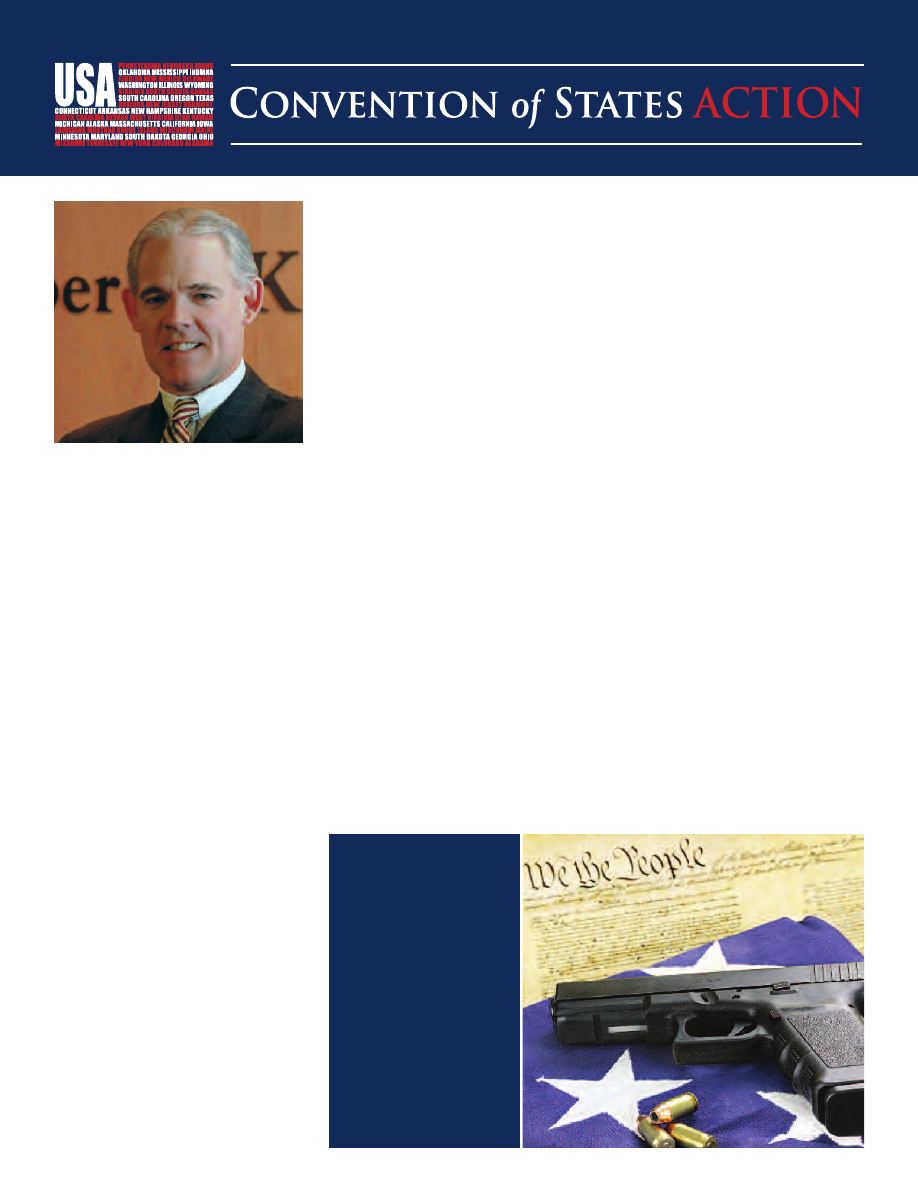
Our constitutional rights, especially our Sec-
ond Amendment right to keep and bear
arms, are in peril. With every tragic violent
crime, liberals renew their demands for
Congress and state legislatures to enact so-
called “commonsense gun control” meas-
ures designed to chip away at our individual
constitutional right to armed self defense.
Indeed, were it not for the determination
and sheer political muscle of the National
Rifle Association, Senator Feinstein’s 2013
bill to outlaw so-called “assault weapons”
and other firearms might well have passed.
But the most potent threat facing the Second
Amendment comes not from Congress, but
from the Supreme Court. Four justices of
the Supreme Court do not believe that the
Second Amendment guarantees an individ-
ual right to keep and bear arms. They be-
lieve that Congress and state legislatures
are free not only to restrict firearms owner-
ship by law-abiding Americans, but to ban
firearms altogether. If the Liberals get one
more vote on the Supreme Court, the Sec-
ond Amendment will be no more.
Constitutional law has been the dominant
focus of my practice for most of my career
as a lawyer, first in the Justice Department
as President Reagan’s chief constitutional
lawyer and the chairman of the President’s
Working Group on Federalism, and since
then as a constitutional litigator in private
practice. For almost three decades, I have
represented dozens of states and many other
clients in constitutional cases, including
many Second Amendment cases. In 2001,
for example, I argued the first federal ap-
pellate case to hold that the Second Amend-
ment guarantees every law-abiding respon-
sible adult citizen an individual right to keep
and bear arms. And in 2013 I testified before
the Senate in opposition to Senator Fein-
stein’s anti-gun bill, arguing that it would
violate the Second Amendment. So I am not
accustomed to being accused of supporting
a scheme that would “put our Second
Amendment rights on the chopping block.”
This charge is being hurled by a small gun-
rights group against me and many other con-
stitutional conservatives because we have
urged the states to use their sovereign power
under Article V of the Constitution to call
for a convention for proposing constitutional
amendments designed to rein in the federal
government’s power.
The real threat to our constitutional rights
today is posed not by an Article V conven-
tion of the states, but by an out-of-control
federal government, exercising powers that
it does not have and abusing powers that it
does. The federal government’s unrelenting
encroachment upon the sovereign rights of
Continued on back page
An Open Letter Concerning
The Second Amendment
and The Convention of
States Project
From Charles J. Cooper
Long Time Constitutional Law Litigator for the NRA
Our constitutional
rights, especially
our Second
Amendment
right to keep
and bear arms,
are in peril.
22

the states and the individual rights of citi-
zens, and the Supreme Court’s failure to
prevent it, have led me to join the Legal
Board of Reference for the Convention of
States Project. The Project’s mission is to
urge 34 state legislatures to call for an
Article V convention limited to proposing
constitutional amendments that “impose fis-
cal restraints on the federal government,
limit its power and jurisdiction, and impose
term limits on its officials and members of
Congress.” I am joined in this effort by
many well-known constitutional conserva-
tives, including Mark Levin, Professor
Randy Barnett, Professor Robert George,
Michael Farris, Mark Meckler, Professor
Robert Natelson, Andrew McCarthy, Pro-
fessor John Eastman, Ambassador Boyden
Gray, and Professor Nelson Lund. All of us
have carefully studied the original meaning
of Article V, and not one of us would sup-
port an Article V convention if we believed
it would pose a significant threat to our
Second Amendment rights or any of our
constitutional freedoms. To the contrary,
our mission is to reclaim our democratic
and individual freedoms from an overreach-
ing federal government.
The Framers of our Constitution carefully
limited the federal government’s powers by
specifically enumerating those powers in
Article I, and the states promptly ensured
that the Constitution would expressly protect
the “right of the people to keep and bear
arms” by adopting the Second Amendment.
But the Framers understood human nature,
and they could foresee a day when the
federal government would yield to the
“encroaching spirit of power,” as James
Madison put in the Federalist Papers, and
would invade the sovereign domain of the
states and infringe the rights of the citizens.
The Framers also knew that the states would
be powerless to remedy the federal govern-
ment’s encroachments if the process of
amending the Constitution could be initiated
only by Congress; as Alexander Hamilton
noted in the Federalist Papers, “the national
government will always be disinclined to
yield up any portion of the authority” it
claims. So the Framers wisely equipped the
states with the means of reclaiming their
sovereign powers and protecting the rights
of their citizens, even in the face of con-
gressional opposition. Article V vests the
states with unilateral power to convene for
the purpose of proposing constitutional
amendments and to control the amending
process from beginning to end on all sub-
stantive matters.
The day foreseen by the Framers – the day
when the federal government far exceeded
the limits of its enumerated powers – arrived
many years ago. The Framers took care in
Article V to equip the people, acting through
their state legislatures, with the power to put
a stop to it. It is high time they used it.
Charles J. Cooper is a founding member
and chairman of Cooper & Kirk, PLLC.
Named by The National Law Journal
as one of the 10 best civil litigators in
Washington, he has over 35 years of legal
experience in government and private
practice, with several appearances before
the United States Supreme Court and
scores of other successful cases on both
the trial and appellate levels.
Continued from front page
The real threat to our
constitutional rights today
is posed not by an Article V
convention of the states,
but by an out-of-control
federal government,
exercising powers that it
does not have and abusing
powers that it does.
Website: COSAction.com
E-mail: [email protected]
Phone: (540) 441-7227
Facebook.com/COSAction
Twitter: @COSAction
PLEASE ACT NOW
Visit COSAction.com to learn more and sign the
petition calling for a Convention Of States!
For ten years, Senator Tom Coburn served
in the United States Senate as a voice for
limited government and the values of
Oklahomans. He has been described as
one of the most sought after members on
legislative strategy and thought. And now,
he’s bringing those talents to the Conven-
tion of States Project.
Since joining Convention of States as
Senior Advisor, Coburn has been traveling
across the nation, sharing his vision with
state legislators about why using Article V
calling for a convention of the states is cru-
cial for our nation at this time.
In his recent testimony to the Texas House
Federalism Committee, Coburn said, “[As
a doctor], I know you don’t solve problems
by treating the symptoms; you treat the
disease. Our country has a disease.” Article
V, he said, allows us to get past the symp-
toms and treat the structural problems that
threaten our future.
Coburn brings his political savvy and gravitas
alongside the hundreds of thousands of
volunteers working in all fifty states, and
Convention of States citizen activists in 97%
of all state legislative districts, not to
mention the endorsements of notable public
figures like Mark Levin, Sean Hannity,
Glenn Beck, Governor Mike Huckabee,
Governor Bobby Jindal, Colonel Allen
West, Sarah Palin and many others.
It’s not just his general political knowledge
that makes him an asset to this project.
“The federal government now reaches
into every aspect of our lives in ways the
Founders never imagined nor
intended…[Americans] don’t need
politicians, and unaccountable federal
bureaucrats and administrators telling
them how to live their lives.”
Continued on back page
Convention of States
Senior Advisor:
Senator Tom Coburn
(Ret.)
“After many years in Washington, one of the reasons
I left was because I no longer believe that Washington is
capable of reining itself in … the only avenue to change
it is the one given to us by our Founders in the
Constitution — an Article V Convention of States,
where the people, not the politicians, are in charge.”

Website: ConventionOfStates.com
E-mail: [email protected]
Phone: (540) 441-7227
www.Facebook.com/ConventionOfStates
Twitter: @COSProject
His experience as Chairman of the Federal
Financial Management Subcommittee
means that he knows exactly where our
specific problems lie.
“What most people don’t realize is that
every single piece of government waste
has a constituency,” says Coburn, “And
most politicians don’t want to do anything
to jeopardize their future elections. So they
remain unresolved election cycle after
election cycle, and the American people
are stuck with the consequences. A Con-
vention of States, on the other hand, can
impose those restraints from the outside
and secure our financial future.”
Knowing that staying in power for many
election cycles is a detriment to effective
statesmanship, Senator Coburn has in-
sisted on term-limiting himself in every
office he has held. He says, “Our Founders
never intended that there be a ruling class
of career politicians. When members of
Congress stay in Washington election after
election, they become less concerned
about working for their constituents and
more concerned about keeping their
power.”
Imposing fiscal restraints and term
limits are two of the three topics
proposed by a Convention of States.
The third—and most important—
is the call to limit the power and ju-
risdiction of the federal government.
Coburn says, “The federal government
now reaches into every aspect of our lives
in ways the Founders never imagined nor
intended. The people of this country are
fully capable of governing themselves.
They don’t need politicians, and unac-
countable federal bureaucrats and admin-
istrators telling them how to live their lives
and run their businesses.”
He continues, “This is the reason that the
Convention of States was included in the
Constitution in the first place. At the Con-
stitutional Convention, George Mason,
knowing that no amendments of the proper
kind would ever be proposed from a tyran-
nical federal government, suggested that
the states have a method by which they
could propose those necessary amend-
ments. His suggestion—the Convention of
States—was met with no debate and unan-
imously agreed upon. Our Framers—in-
cluding George Washington, James Madi-
son, and Alexander Hamilton—all agreed
that the American people should be able
to take control of their country and govern
themselves.”
Without a doubt, Coburn believes the time
for a Convention of States is now.
“This is a movement whose time has come.
Although I am a proud conservative, this
is not a partisan issue. Politicians and
bureaucracies in Washington, D.C. will
never voluntarily relinquish meaningful
power — no matter who is elected. Only
through a Convention of States may the
clear, unfettered voice of the people be
heard and overreaching government be
reined in. It’s time to return government to
the people and realize again our Founders’
vision for self-governance.”
Continued from front page
George Mason Memorial, National Mall, DC
“George Mason,
knowing that no
amendments of the
proper kind would ever
be proposed from a
tyrannical federal
government, suggested
that the states have a
method by which they
could propose those
necessary amendments.”
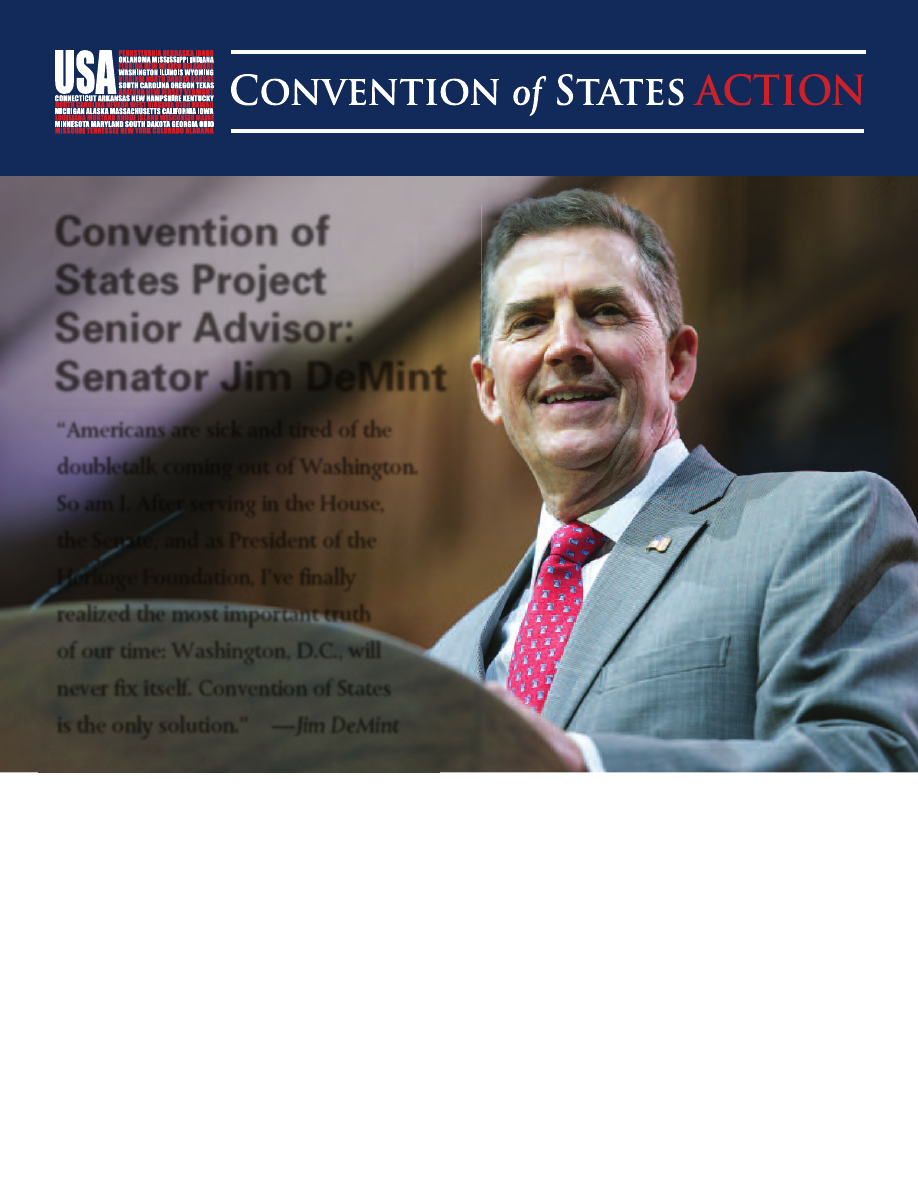
For nearly two decades, Jim DeMint
made a name for himself in Washington
fighting for freedom, limited govern-
ment, and fiscal responsibility. Like for-
mer Senator Tom Coburn, DeMint was
known throughout our nation’s capital
for his refusal to become just another
Washington insider. He spoke up for
the will of the people and the good of
the nation, no matter how much oppo-
sition he faced from the statist “elite”
who call the shots in D.C.
DeMint’s extensive experience in
Washington has given him firsthand
knowledge of the near-impossibility
of making any significant changes from
within the federal government.
“I’ve tried to rein in Washington from
inside the Senate,” DeMint said. “I’ve
tried to elect good conservatives with
the Senate Conservatives Fund. And as
the President of the Heritage Foundation,
I’ve worked to create and promote good
conservative policy.
“While all these things are important,
the nation cannot be saved from within
Washington, D.C. Only the people in the
states can save the country, through a
Convention of States that proposes
constitutional amendments to fortify
restrictions on federal power.”
DeMint served in the U.S. House of
Representatives for South Carolina’s
Fourth Congressional District from
1999–2005. He was elected to the U.S.
Senate in 2004 and served as one of
South Carolina’s senators until he re-
signed in 2012 to become President of
the Heritage Foundation. With 18 years
of political experience working both in-
side and outside Congress, DeMint of-
fers a wealth of wisdom and insight to
Continued on back page
Convention of
States Project
Senior Advisor:
Senator Jim DeMint
“Americans are sick and tired of the
doubletalk coming out of Washington.
So am I. After serving in the House,
the Senate, and as President of the
Heritage Foundation, I’ve finally
realized the most important truth
of our time: Washington, D.C., will
never fix itself. Convention of States
is the only solution.”
— Jim DeMint

COSA
CTION
.
COM
E-mail: [email protected]
(540) 441-
7
22
7
Facebook.com/COSAction
Twitter.com/COSProject
the volunteer grassroots armies that are
reaching every state legislature in the
country with the Convention of States
Project’s message: We CAN take our
power back.
“Once I realized that Washington in-
siders will never truly return decision-
making power to the people and the
states, I began to search for another way
to rein in the federal government,”
DeMint said. “When I learned about
Article V and the Convention of States
Project, I knew I had to get involved.”
DeMint brings with him more than just
legislative experience; he knows how
to fight through opposition and make
the tough calls for the benefit of
the country.
In 2009, DeMint was one of only two
Senators who voted against Hillary
Clinton’s appointment to Secretary of
State. In 2010, he introduced an Oba-
macare repeal as well as a bill that
would have required congressional ap-
proval of any major regulatory change
made by a federal agency. While his col-
leagues in Congress were working to
get reelected, DeMint faithfully fought
to uphold his pledge to defend the Con-
stitution and the will of the people.
“I’ve spent my career fighting against
the same radical statist coalition that has
aligned itself against the Convention of
States Project,” DeMint said. “I’m ex-
cited to get outside the beltway and work
with the grassroots to continue that fight.
Through Article V, the people and the
states have more power than I ever did
in D.C. I can’t wait to come alongside
the COS state teams, offer my support,
and watch what these citizen activists
can accomplish.”
To those few sincere Americans who
still fear the Article V process, DeMint
had this to say:
“I understand there are those who be-
lieve electing more ‘good’ leaders to
D.C. will solve our nation’s problems.
Take it from me – it won’t. The few
who fight for the people will always be
overwhelmed by the deep state bureau-
crats, the statist congressmen, and the
activist judges.
“Only a Convention of States can truly
limit the power and jurisdiction of
the federal government, and I’m
thrilled to be a small part of this his-
toric movement.”
Continued from front page
To those few sincere Americans
who still fear the Article V process,
DeMint had this to say:
“I understand there are those who
believe electing more ‘good’ leaders to
D.C. will solve our nation’s problems.
Take it from me – it won’t. The few
who fight for the people will always
be overwhelmed by the deep state
bureaucrats, the statist congressmen,
and the activist judges.”
“I
want legislation authorizing
Texas to join other states in call-
ing for a Convention of States to
fix the cracks in our broken Constitution,”
Abbott said, bringing a room of Texas
policymakers to their feet in support of
the Convention of States resolution.
Governor Abbott has demonstrated tremen-
dous courage and leadership in placing
his support firmly behind Convention of
States, which gives state lawmakers a
powerful tool to fight back against an
overbearing federal government.
Under the Convention of States resolu-
tion, commissioners to the convention
can discuss proposals for constitutional
reforms on three topics: fiscal restraints
on the federal government, term limits
on federal officials, and limits on the
power and jurisdiction of the federal
government.
Abbott's Texas Plan fits nicely within this
framework. Nearly 100 pages long with
more than 350 footnotes, the Texas Plan is
a comprehensive look at the need for an
Article V Convention of States.
“The President changes laws with a pen.
Congress sees no need to root their laws
in constitutional principles. The judiciary
rewrites laws and freely amends the Con-
stitution,” said Abbott, emphasizing that
Article V is the constitutional mechanism
the states can utilize to fix the cracks in
the system.
Moreover, Governor Abbott’s support is
unique in that he had made Convention
of States the primary agenda item of
his administration. In fact, the Texas Plan
was specifically designed to fit within—
and only within—the Convention of
States resolution!
“The Texas Plan does what so desperately
needs to be done—it puts teeth into the
Tenth Amendment,” Abbott said. “That is
the best way to restore the states and the
people as guardians of our Constitution.”
The Texas Plan harkens back to James
Madison’s Virginia Plan, which largely
defined the agenda of the Philadelphia
Convention in 1787.
Likewise, Abbott’s plan puts forward nine
bold solutions for the Convention of States
commissioners to consider—solutions that
would systematically restore power to the
people and to the states.
“The Founders gave us the tool to chart
our own destiny,” said Abbott. “That
tool is Article V of the United States
Constitution. The Framers included it, be-
cause they knew that citizens are the ulti-
mate defense against an overreaching fed-
eral government.”
Continued on back page
Governor Greg Abbott
Texas Governor Abbott Supports
Convention of States
In one bold declaration, Texas Governor Greg Abbott both shocked the political world and
energized a growing movement to restore the rule of law in America.
“I want legislation
authorizing Texas to join
other states in calling for
a Convention of States
to fix the cracks in our
broken Constitution,”
Abbott said, bringing a
room of Texas
policymakers to their
feet in support of the
Convention of States
resolution.
By taking this historic step, Governor
Abbott has demonstrated that he is
committed to helping the states call an
Article V Convention of States to propose
meaningful constitutional reforms that
would dramatically expand liberty and
prosperity for all Americans.
The Texas Plan includes proposals
that would:
• Permit two-thirds of the states to
collectively overturn a federal law,
regulation, or Supreme Court ruling
• Restore the Commerce Clause to
its original intent
• Require Congress to balance the
federal budget
• Require a supermajority of the
Supreme Court to override any
democratically enacted law
• Permit state officials to sue in
federal court when federal officials
overstep their bounds
• Prohibit administrative agencies
from preempting state and
federal law.
In his speech, Governor Abbott recalled
the time when Franklin was asked what
kind of government the Framers had
proposed at the Philadelphia Convention.
“A republic, if you can keep it,” Franklin
famously declared.
“Let us heed the advice of our Founders,”
Abbott said. “If we are going to keep the
republic that Franklin said we got — if
we are going to fight for, protect, and
hand onto the next generation the freedom
that Reagan spoke of—then we the people
have to the take the lead to restore the rule
of law in the United States.”
Convention of States is developing the
largest grassroots army in the nation. We
recently surpassed 1.3 million supporters,
with volunteer leadership in all 50 states.
Convention of States allows citizens to
engage in the only constitutional solution
to restore the balance of power and return
America to its founding principles.
“Franklin knew that if the three branches
of government strayed, there was a fourth
group to rein them in,” Abbott said. “They
identified that fourth group in the first
three words of the United States Consti-
tution—We the People.”
With Governor Abbott’s steadfast support,
we are confident that Convention of States
will be a success.
“Every generation of Americans must face
Franklin’s challenge,” Abbott said. “Do
we have the will to keep our republic?”
Before he became the 48
th
Governor
of Texas, Greg Abbott distinguished
himself as the longest-serving Attorney
General in Texas history and was also
a Justice on the Texas Supreme Court.
His sharp legal mind and experience
in litigating states’ rights makes his
support for Convention of States all the
more powerful.
Continued from front page
Governor Abbott has
demonstrated that
he is committed to
helping the states call an
Article V Convention
of States to propose
meaningful constitutional
reforms that would
dramatically expand
liberty and prosperity
for all Americans.
Website: COSAction.com
E-mail: [email protected]
Phone: (540) 441-7227
Facebook.com/COSAction
Twitter: @COSAction
PLEASE ACT NOW
Visit COSAction.com to learn more
and sign the petition calling for a
Convention of States!

“Using the Constitution to
Save the Constitution.”
The Problem
Our nation is in peril. The public widely believes that America is headed in
the wrong direction. They believe the future prospects are troubling, not
only for this generation but for generations to come. The monstrous fed-
eral debt, the power grabs of the federal courts, and the escalating power
of an irresponsible centralized government could ultimately result in the
financial ruin of generations of Americans.
The Solution
Our current situation is precisely what the Founders feared. They knew the
federal government might one day become drunk with power, so they gave
us a solution in Article V of the U.S. Constitution.
Article V says that upon successful ‘application’ by 34 states, the states can
convene a Convention of States to propose constitutional amendments.
Under the Convention of States Project resolution, these amendments
would be limited to imposing fiscal restraints on the federal government,
limiting the power of the federal government, and mandating term limits.
This would allow proposed amendments that limit executive orders, federal
spending and taxation, and terms of office for Congress and the Supreme
Court. What kind of amendments would you propose?
These amendments only become part of the Constitution after they are
ratified by 38 states, rendering the “runaway convention” objection virtually
unthinkable. When 38 states agree on something, it’s not a runaway — it’s
a mandate!
The Strategy
Two goals separate our plan from all other Article V organizations:
1.
We want to call a convention for a particular subject rather than a
particular amendment. Calling a convention for a balanced budget
amendment (though we are entirely supportive of such an amendment),
addresses only one of a number of issues. The Convention of States
application allows for multiple amendments to be considered for the purpose
of limiting the power and jurisdiction of the federal government. This
will allow for the states to provide a solution as big as the problem in D.C.
2.
We believe the grassroots is the key to calling a successful convention.
The goal is to build a grassroots organization in a minimum of 40 states,
getting 100 people to volunteer in at least 75% of the state’s legislative
districts. We believe this is very doable. But only through the support of the
American people will this project have a chance to succeed.
Join Us
The movement is spreading. Millions of Americans along with thought
leaders and members of the media are joining the Convention of States
Project as endorsers, supporters, and volunteers.
PLEASE ACT NOW!
Visit COSAction.com to learn more and sign the petition calling for a
Convention of States!
“States rise up
against Washington”
“Convention of States Trying to
Unleash Power of Citizenry”
“I have whole-
heartedly endorsed
the Convention of
States Project.”
“State-led push to force
convention to amend Constitution
gains steam, with high-profile
Republican support”
“Coburn: A Convention of States
can restore our Constitution”
“U. S. Term Limits Endorses
the Convention of States Project”
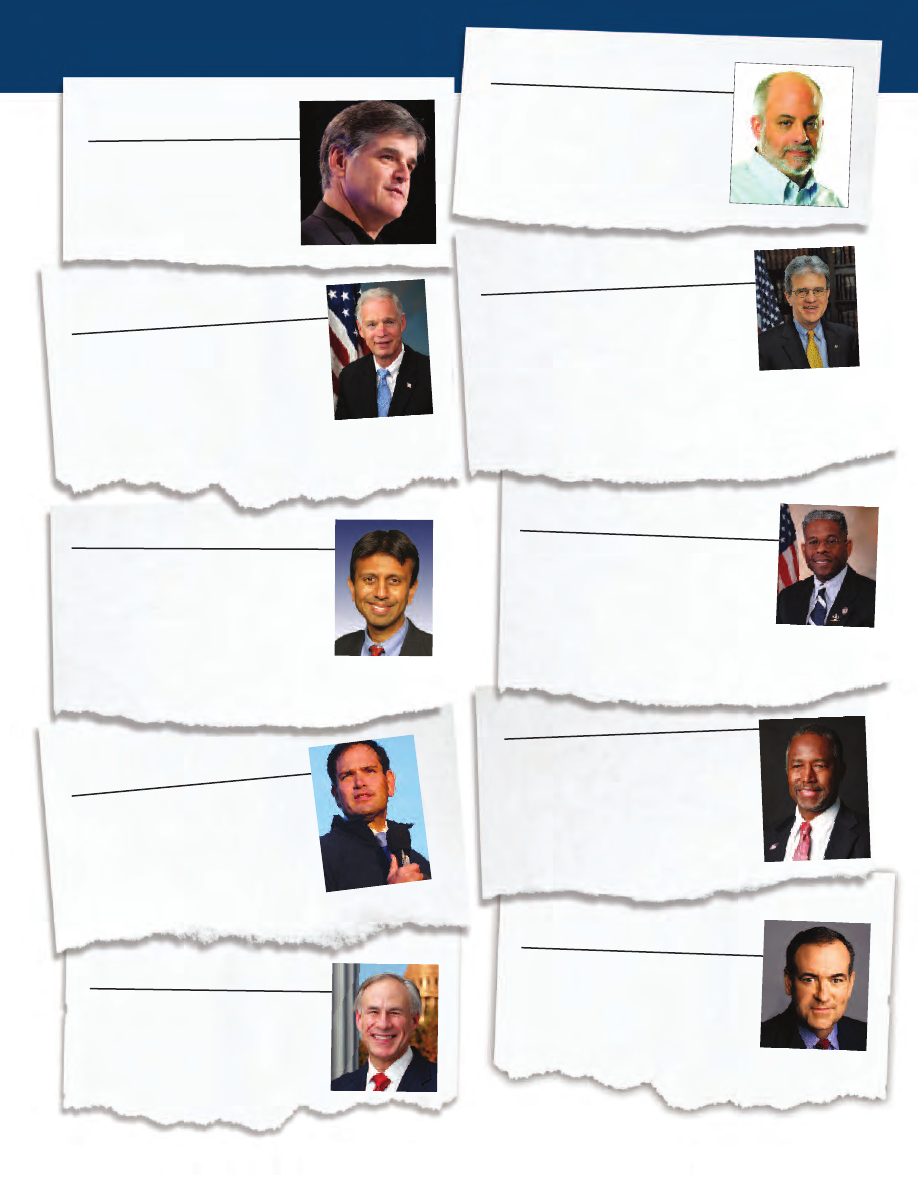
“I’m a big supporter of [a
Convention of States]. I like
what you’re doing. I hope you
get it accomplished.”
Sean Hannity
(540) 441-
7
22
7
|
COSAction.com
|
Facebook.com/COSAction
“Thank goodness the founders had
the wisdom to provide us with
Article V of the Constitution. I support
the efforts to gather a constitutional
Convention of States consistent with Article V and
honoring the 10
th
Amendment.”
Colonel Allen West
“There is not enough politic
al will in
Washington to fix the real p
roblems
facing the country. It’s time
for the
people to take back their co
untry. The
plan put forth by Conventio
n of States is a great way to
do
just that by using the proce
ss the Founders gave us for
reining in the federal gover
nment.”
Senator Tom Coburn
Endorsements
“We need ter
m limits and a
balanced bud
get amendme
nt, and
Congress is n
ever going to
give it to
us. That's wh
y I support an
Article V
Convention o
f States.”
Senator Marc
o Rubio
“We can, and we must scale back the
monstrosity that our federal government
has become. For this reason, I support
the Convention of States project efforts
to call an Article V convention to propose
amendments to restrain the size of the federal government.”
Governor Bobby Jindal
“[Our nation’s] prob
lems are not going
to be solved in Was
hington D.C.…
We’ve got to take th
e power back. I
can’t think of a bett
er way of doing it
[than Convention of
States], because
Washington is not g
oing to give up pow
er.”
Senator Ron Johns
on
“I have reviewed their plan and it is
both innovative and realistic. I urge
you to join me in supporting the
Convention of States Project .”
Mike Huckabee
“I want legislation authorizing Texas
to join other states in calling for a
Convention of States to fix the cracks
in our broken Constitution.”
Governor Greg Abbott
Mark Levin
When asked if he endorsed
Convention of States, Ben Car
son
commented, “Very much so…
our founders knew that there
would probably come a time w
hen
you might have to make some
adjustments to the Constitutio
n.”
“I have whole-heartedly endorsed
the Convention of States Project.
I serve on its Legal Board of
Reference because they propose a
solution as big as the problem.”
Ben Carson
Levin’s book on Article V,
The Liberty
Amendments
, has been a #1
New York
Times
bestseller and is credited with
kicking off the movement to call a
Convention of States for proposing amend-
ments to the Constitution.
Yet when it comes to his specific
endorsement of an Article V project, Levin
has thrown his support fully behind the
Convention of States Project and
our three-pronged call for fiscal restraints,
limitations on the power and scope
of Washington, and term limits on fed-
eral officials.
Levin’s endorsement came during his
impassioned speech to the American
Legislative Exchange Council’s 2014 State
& Nation Policy Summit. In that speech,
he explained why a convention surrounding
a single amendment simply is too small of
a solution, saying, “When they met in
Philadelphia they didn’t just sit there and
say, ‘Hey, let’s talk about a balanced
budget.’ They said, ‘Let’s talk about liberty.
What kind of government do we want to
live under?’ And that’s what this Conven-
tion of the States is all about.”
Although many organizations are calling
for term limits or a balanced budget, Con-
vention of States is the only Article V res-
olution calling for both term limits
and
fiscal restraints. More importantly, we are
targeting the deeper issue — the continual
growth of Washington’s overreach — by
imposing limits on the power and juris-
diction of the federal government.
Levin said, “Why are we solely focused
on a balanced budget amendment when the
Supreme Court is a runaway court? Why
are we solely focused on a balanced budget
amendment when we have other issues
that are problematic like the entrenched
ruling class in the bureaucracy? If you’re
going to go through the process, don’t be
myopic…don’t get caught up in one matter.
This is a structural, systemic issue…
“We’re trying to restore the republic and
save what’s left of the Constitution. I say
we can coalesce a group around saving the
Republic.”
“When [the Framers] met in Philadelphia … they
said, ‘Let’s talk about liberty. What kind of
government do we want to live under?’ And that’s
what this Convention of the States is all about.”
Continued on back page
TAKE YOUR
POWER BACK!
“I have whole-heartedly endorsed the
Convention of States Project,” says
constitutional scholar Mark Levin. “I serve
on its Legal Board of Reference because they
propose a solution as big as the problem.”
MARK LEVIN

Website: ConventionOfStates.com
E-mail: [email protected]
Phone: (540) 441-7227
www.Facebook.com/ConventionOfStates
Twitter: @COSProject
And for those in favor of limited govern-
ment, the Republic does, indeed, need to
be saved. Recent Supreme Court rulings
have advanced an agenda of judicial ac-
tivism. However, Levin noted that the
problem of federal expansion is deeper
than that.
He asked: “Today the federal government
is the nation’s largest creditor, debtor,
lender, employer, consumer, grantor, prop-
erty owner, tenant, insurer, healthcare
provider, and pension guarantor. Does that
sound like limited government to you?”
Many state legislators fear that a Conven-
tion of States will not be able to be con-
trolled and will “runaway,” to which ar-
gument Levin gave a sharp response: “Do
you realize there can never be a runaway
convention, never, ever? It’s impossible!
Since three-fourths of the states must ratify
whatever is proposed by the delegates sent
by two-thirds of the states…All you do is
you propose specific amendments, and the
states consider them or reject them.
Congress does this, it’s done it before. Now
you do it, it’s your turn, that’s why it’s in
there.”
Not only has Levin fought against the
notion of a runaway convention, he has
spoken out on the air against legislators
who have held up the Convention of
States application from going to the floor
for a vote:
“If we get a full vote in these states, we
win. We win. But you see, these Senate
presidents, and some of these Speakers,
are part of the problem, wherever they are.
They like big government…They pretend
they’re originalists. They’re not.”
Levin was specifically addressing Senator
Craig Estes (R) of TX, Senator Andy
Biggs (R) of AZ, and Senator John Alario,
Jr. (R) of LA.
The Convention of States movement is
filled with constitutional originalists who
believe that this is the only way to curtail
Washington’s intrusion into our lives.
Colonel Allen West, Governor Sarah Palin,
Governor Bobby Jindal, Governor Mike
Huckabee, Glenn Beck, Sean Hannity, and
others have joined Levin as full-fledged
endorsers of this project.
“We’re not some cult over here,” Levin
said, “We’re the majority. We’re not some
extreme, hard-right group over here, we’re
constitutionalists. We’re not some wackos
over here…we embrace the American
Heritage. We are the ones trying to lead an
effort to save what's left of this country.”
Levin reminded legislators not only of
their ability, but also their duty, to call
a Convention of States. “I want you to
understand that you as individuals…
have a capacity as state representatives
and state senators — you alone, not
your governors, not congressmen, not
senators, not the president, not the
court — but you have it within your-
selves, and it ought to be your number
one priority when you leave here, to
help restore this republic and give us
our constitution back.”
Continued from front page
“Today the federal government is the nation’s
largest creditor, debtor, lender, employer, consumer,
grantor, property owner, tenant, insurer, healthcare
provider, and pension guarantor. Does that sound
like limited government to you?”

Levin’s book on Article V,
The Liberty
Amendments
, has been a #1
New York
Times
bestseller and is credited with
kicking off the movement to call a
Convention of States for proposing amend-
ments to the Constitution.
Yet when it comes to his specific
endorsement of an Article V project, Levin
has thrown his support fully behind the
Convention of States Project and
our three-pronged call for fiscal restraints,
limitations on the power and scope
of Washington, and term limits on fed-
eral officials.
Levin’s endorsement came during his
impassioned speech to the American
Legislative Exchange Council’s 2014 State
& Nation Policy Summit. In that speech,
he explained why a convention surrounding
a single amendment simply is too small of
a solution, saying, “When they met in
Philadelphia they didn’t just sit there and
say, ‘Hey, let’s talk about a balanced
budget.’ They said, ‘Let’s talk about liberty.
What kind of government do we want to
live under?’ And that’s what this Conven-
tion of the States is all about.”
Although many organizations are calling
for term limits or a balanced budget, Con-
vention of States is the only Article V res-
olution calling for both term limits
and
fiscal restraints. More importantly, we are
targeting the deeper issue — the continual
growth of Washington’s overreach — by
imposing limits on the power and juris-
diction of the federal government.
Levin said, “Why are we solely focused
on a balanced budget amendment when the
Supreme Court is a runaway court? Why
are we solely focused on a balanced budget
amendment when we have other issues
that are problematic like the entrenched
ruling class in the bureaucracy? If you’re
going to go through the process, don’t be
myopic…don’t get caught up in one matter.
This is a structural, systemic issue…
“We’re trying to restore the republic and
save what’s left of the Constitution. I say
we can coalesce a group around saving the
Republic.”
“When [the Framers] met in Philadelphia … they
said, ‘Let’s talk about liberty. What kind of
government do we want to live under?’ And that’s
what this Convention of the States is all about.”
Continued on back page
TAKE YOUR
POWER BACK!
“I have whole-heartedly endorsed the
Convention of States Project,” says
constitutional scholar Mark Levin. “I serve
on its Legal Board of Reference because they
propose a solution as big as the problem.”
MARK LEVIN
Website: ConventionOfStates.com
E-mail: [email protected]
Phone: (540) 441-7227
www.Facebook.com/ConventionOfStates
Twitter: @COSProject
And for those in favor of limited govern-
ment, the Republic does, indeed, need to
be saved. Recent Supreme Court rulings
have advanced an agenda of judicial ac-
tivism. However, Levin noted that the
problem of federal expansion is deeper
than that.
He asked: “Today the federal government
is the nation’s largest creditor, debtor,
lender, employer, consumer, grantor, prop-
erty owner, tenant, insurer, healthcare
provider, and pension guarantor. Does that
sound like limited government to you?”
Many state legislators fear that a Conven-
tion of States will not be able to be con-
trolled and will “runaway,” to which ar-
gument Levin gave a sharp response: “Do
you realize there can never be a runaway
convention, never, ever? It’s impossible!
Since three-fourths of the states must ratify
whatever is proposed by the delegates sent
by two-thirds of the states…All you do is
you propose specific amendments, and the
states consider them or reject them.
Congress does this, it’s done it before. Now
you do it, it’s your turn, that’s why it’s in
there.”
Not only has Levin fought against the
notion of a runaway convention, he has
spoken out on the air against legislators
who have held up the Convention of
States application from going to the floor
for a vote:
“If we get a full vote in these states, we
win. We win. But you see, these Senate
presidents, and some of these Speakers,
are part of the problem, wherever they are.
They like big government…They pretend
they’re originalists. They’re not.”
Levin was specifically addressing Senator
Craig Estes (R) of TX, Senator Andy
Biggs (R) of AZ, and Senator John Alario,
Jr. (R) of LA.
The Convention of States movement is
filled with constitutional originalists who
believe that this is the only way to curtail
Washington’s intrusion into our lives.
Colonel Allen West, Governor Sarah Palin,
Governor Bobby Jindal, Governor Mike
Huckabee, Glenn Beck, Sean Hannity, and
others have joined Levin as full-fledged
endorsers of this project.
“We’re not some cult over here,” Levin
said, “We’re the majority. We’re not some
extreme, hard-right group over here, we’re
constitutionalists. We’re not some wackos
over here…we embrace the American
Heritage. We are the ones trying to lead an
effort to save what's left of this country.”
Levin reminded legislators not only of
their ability, but also their duty, to call
a Convention of States. “I want you to
understand that you as individuals…
have a capacity as state representatives
and state senators — you alone, not
your governors, not congressmen, not
senators, not the president, not the
court — but you have it within your-
selves, and it ought to be your number
one priority when you leave here, to
help restore this republic and give us
our constitution back.”
Continued from front page
“Today the federal government is the nation’s
largest creditor, debtor, lender, employer, consumer,
grantor, property owner, tenant, insurer, healthcare
provider, and pension guarantor. Does that sound
like limited government to you?”
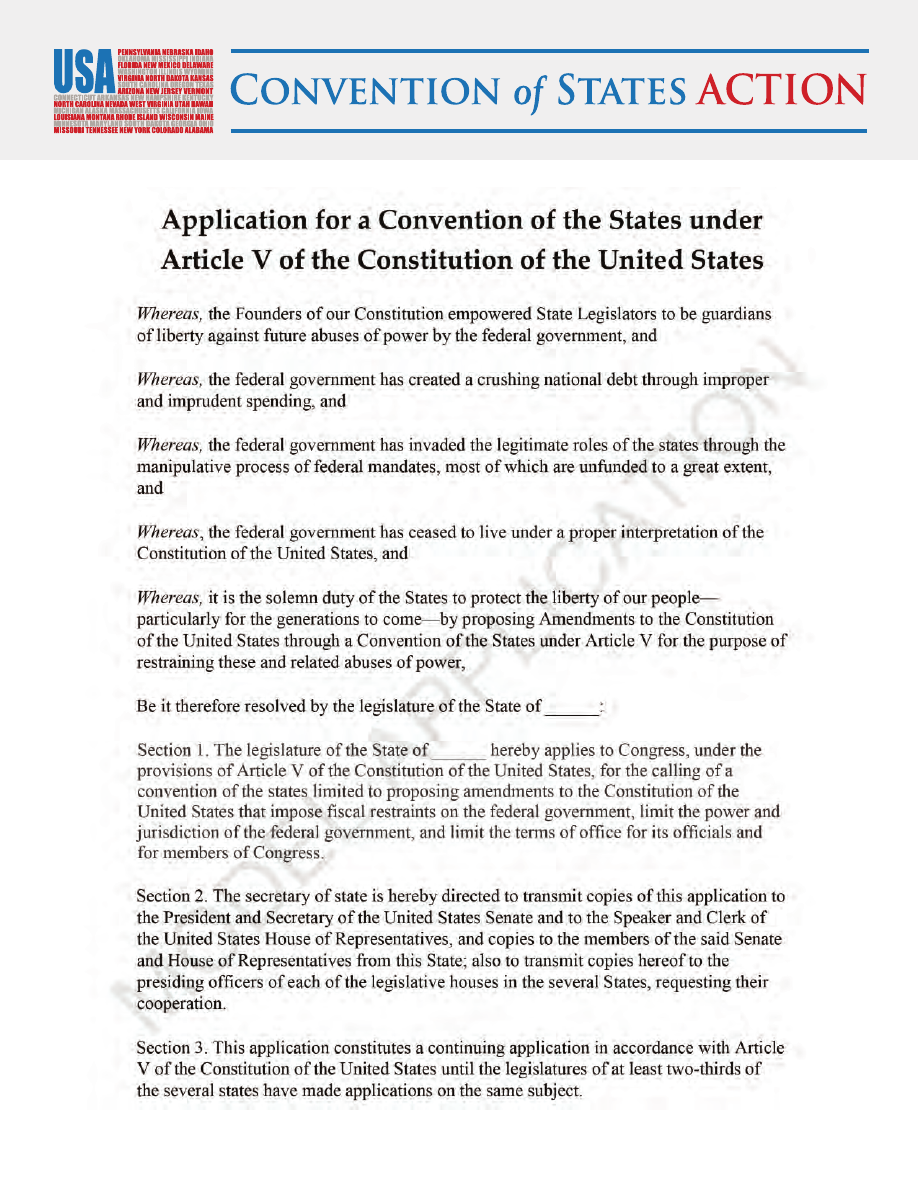
COSACTON.COM

NOW IT’S TIME TO
DRAIN THE SWAMP
OURSELVES
“What’s the right fight when it seems like
there are just so many fights? I want you
to focus on one thing…If you are serious
about saving the nation, this is the best
way to do it.”
For more than twenty years,
Sean Hannity has filled the radio
airwaves and Fox News channel
with conservative news and
commentary. Now, as a prominent
and influential figure, he has
endorsed Convention of States.
Hannity supported President
Trump’s pledge to “drain the
swamp” in Washington, D.C.
when the President said, “today,
we are not merely transferring
power from one administration
to another, or from one party to
another – but we are transferring
power from Washington, D.C.
and giving it back to you, the
American People.”
However, Hannity points out that
the swamp is frankly too deep
for the President to drain alone.
“We know about the DC Swamp
and the Deep State. We know it
is too deep to be drained from the
inside…it’s not going to happen.
President Trump is doing his
best, but the DC monsters and
the swamp are fighting against
everything he does everyday.
They want to destroy him. What
can we do to help? What’s the
right fight when it seems like
there are just so many fights?”
Hannity has been in the fight a
long time, seeing promises broken
time and time again by corrupt
politicians that only want to keep
themselves in office while lining
their pockets. He has come to see
that Washington is fundamentally
broken. “The massive, budget-
busting spending bill that passed
proves that DC will NEVER
reform itself. If Republicans in
Congress and the Presidency can’t
“The solution is in our Constitution.
We can call a Convention of States
to restrain the size, scope, power and
jurisdiction of the federal government.”
Sean Hannity and Convention of
States President Mark Meckler
Photo: National Archives

conventionofstates.com
[email protected]
(540) 441-7227
facebook.com/conventionofstates
twitter.com/COSProject
control our deficit spending…then
who can? We the People actually
can!”
When Sean discovered the
Convention of States movement,
he knew he found the right
solution for the corruption and
irresponsibility in Washington.
Through a little known clause
in Article V of the Constitution,
states can pass resolutions to call
a convention limited to proposing
amendments that impose
fiscal restraints on the federal
government, limit the power
and jurisdiction of the federal
government, and limit the terms
of office for its officials and for
members of Congress.
“The solution is in our
Constitution. We can call a
Convention of States to restrain the
size, scope, power and jurisdiction
of the federal government. That
includes stopping the madness
of borrowing and spending…
and mortgaging our kids’ and
grandkids’ future. We don’t
need the approval of anyone
in Washington or the federal
government to approve it. Congress
and the courts can’t stop us.”
“The reality is that we can and
we must take power back. We
the People have constitutional
authority - we just have to use
it. We have the power of the
Convention of States.”
While electing good people
to office is important, Hannity
emphasizes that this fight requires
a more proactive approach if
we want to fix the problems in
Washington D.C. permanently.
“We have some good people
trying to fight with us, but don’t
sit around and complain.”
“President Trump can’t do it
alone. And Congress won’t
do it. We can drain the swamp
together.”
“If you’re serious about making
a huge impact on the country
in a positive way, it’s through a
Convention of States.”
“How much clearer does it have
to get that the losers in D.C.
will never, ever fix anything?
They are bankrupting the
country, and they just don’t
care. So it’s up to us.”
Gage Skidmore
CC-BY-SA-3.0
“We don’t need the approval of anyone in Washington
or the federal government to approve a Convention of
States. Congress and the courts can’t stop us.”
—-
====== Document Outline ======
* Examples_Grassroots Notebook
* Articles
* C3_Only_COS_Blaze Dunaway
* C3_Only_COS_CanWeTrustConstitution-Farris
* C3_Only_COS_Sim_Executive Summaryable
* C3-1_COS_JeffersonStatement
* C3-2_COS_Cooper-Flyer
* C3-3_COS_CoburnFlyer
* C3-4_COS_JimDeMint
* C3-5_COS_Abbott Flyer
* C3-6_COS_Endorsement Flyer
* C3-7_COS_ModelApp
* C4_Only_COS_Action_Handbook
* 10-Surge_COS-FinalConstitutionalOption
* 11-Surge_COS-BattleOverCoal-Article
* 12-Surge_COS-ArticleVSolution-AbsurdityofInaction
* 13-Surge_COS-FiveMyths-Article
* 14-Surge_COS-ArticleVConvention
* 15-Surge_COS-TimetoEvictSquatters
* 16-Surve_COS-ImplementTenthAmendment
* 17-Surge_COS-StateBudgetChallenges
* 18-Surge_COS-DemystifyingDustyTool
* 19-Surge_COS-CorruptingMoneyInPolitics
* 1-Surge_COS-SolutionAsBigAsProblem
* 20-Surge_COS-NecessaryProperClause
* 21-Surge_COS-JohnBirchSociety
* 22-Surge_COS-ArticleVProcess
* 23-Surge_COS-FederalControlLands
* 2-Surge_COS-TheLampofExperience
* 3-Surge-COS-CanWeTrustTheConstitution
* 4-Surge_COS-An_Open_Letter_Converning_TheSecondAmendment
* 5-Surge_COS-LearnedMoreAndMore-Article
* 6-Surge_COS-HowTheCourtsHaveClarified
* 7-Surge_COS-MythRunawayConvention
* 8-Surge_COS-WhyAStateShouldAdobtIfAlreadyAdoptedBalancedBudgetAmendment
* 9-Surge_COS-CommonSenseCommonCore
* C4-1_COSA_JeffersonStatement
* C4-2_COSA_Cooper-Flyer
* C4-3_COSA_Coburn
* C4-4_COSA_DeMint Flyer
* C4-5_COSA_Abbott Flyer
* C4-6_COSA_Endorsement Flyer
* C4-7_COS_Levin Flyer
* C4-7_COSA_Levin
* C4-8_COSA_ModelApplication
* C4-9_COSA_Hannity Endorsement|
—-
| Page Metadata ||
|Login Required to view? |No |
|Created: |2018-04-20 18:54 GMT|
|Updated: |2021-02-24 10:25 GMT|
|Published: |2018-04-20 00:00 GMT|
|Converted: |2025-11-11 12:10 GMT|
|Change Author: |Michael Tranchina |
|Credit Author: | |


