
To view this on the COS website, click here conventional-disinformation-2
To download the pdf file from the COS website, click here Conventional_Disinformation.pdf
Conventional Disinformation
Attachment: 3672/ConventionalDisinformation.pdf
|

1
Conventional Disinformation
Opponents of an Article V Convention of the States for Proposing Amendments to the U.S. Constitution
are stoking fear with objections based upon disinformation.
A common objection to an Article V Convention for Proposing Amendments is the belief that the
convention will “runaway” by ignoring the limitations placed on it. The Constitutional Convention of
1787 is often cited as an example of a runaway convention.
Limitations on a convention arise from two sources: the call and the commissions. The call is the first
resolution calling for a convention, and it places limitations on the convention as a whole. A commission
is a set of instructions a state legislature gives to its representatives (commissioners) and can be more
restrictive than the call.
The claim that the 1787 convention exceeded its call starts with incorrect identification of the call.
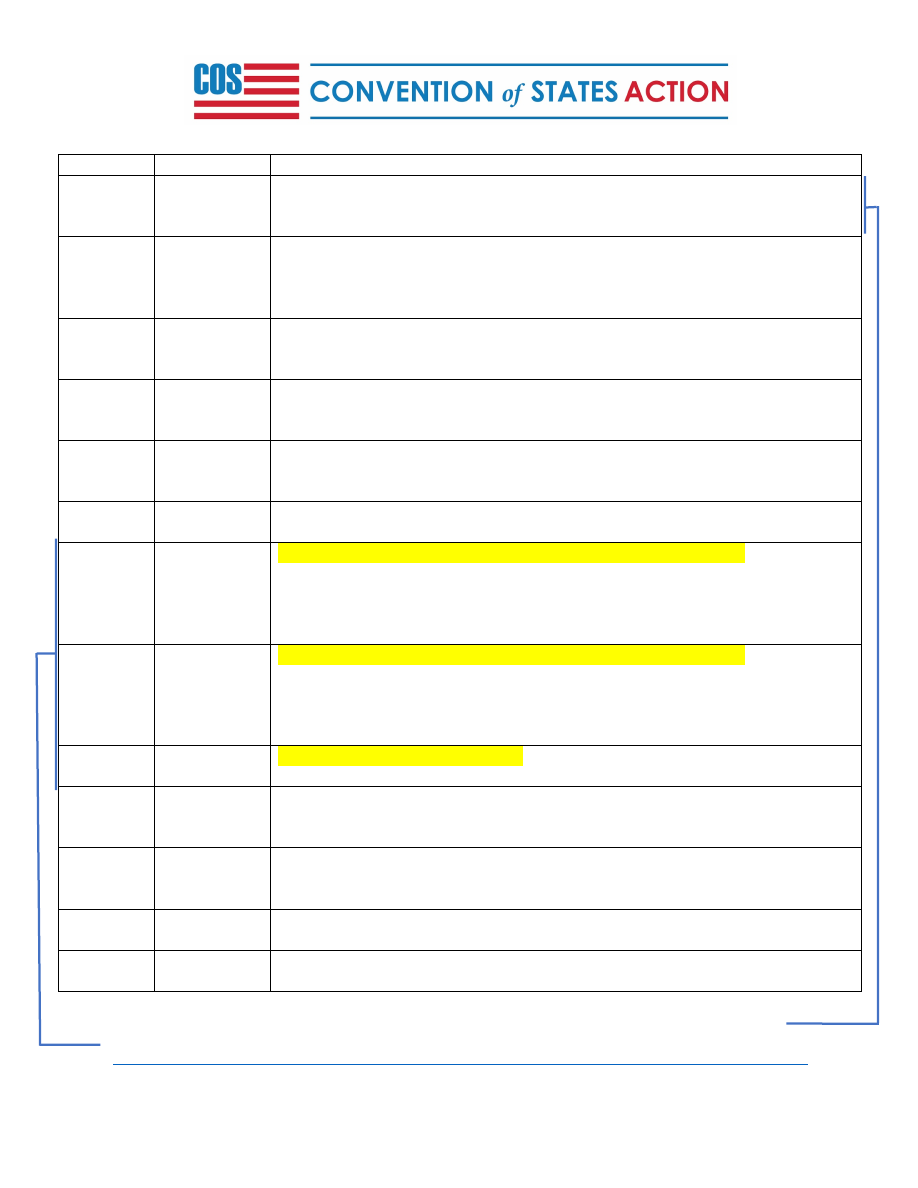
Consider the table on page 2, listing each of the resolutions leading up to the 1787 convention. The
claim is made that the Continental Congress made the call on February 21, 1787 and restricted the
convention to revising the Articles of Confederation. How could this be the call if six states had already
selected and instructed their commissioners prior to February 21, 1787? How would those states know
the subject matter, date, and location of the convention? In fact, the Articles of Confederation did not
grant the Confederation Congress the power to call a Convention of the States.
It was Virginia that issued the call on November 23, 1786, without restricting the convention to revising
the Articles of Confederation. New York and Massachusetts did issue commissions that restricted their
commissioners to revising the Articles of Confederation, but the convention as a whole was not so
restricted.
There have been at least forty-two Conventions of States in our history (see the table on page 3), and
not one has deviated from the scope of its call (runaway). It is also worth noting in that same table that
all forty-two previous Conventions of States operated on the principle of one state, one vote.
Another common objection claims that we do not know how a Convention of States would operate. The
list of forty-two previous Conventions of States would demonstrate that we have a great deal of
experience with operating Conventions of States. In addition, the operation of Conventions of States is
well established in a significant number of court cases on the subject. A sampling of these rulings can be
found in the table on page 4.
Finally, it is self-evident that the framers knew exactly what they meant by a Convention of the States
when they drafted that mechanism into Article V because they were participating in a Convention of
States at the time! In essence, the founders were saying, “if the states desire to propose amendments to
the Constitution, use the same method we are using right now.”
The data in the following three tables is clear evidence that an Article V Convention of the States for
Proposing Amendments is the safe, reliable, and time-tested method the framers intended for such a
time as this.
2
The 1787 Constitutional Convention Call and Commissions
Date
State
Commission
11/23/1786
Virginia
devising and discussing all such alterations and further provisions, as may be
necessary to render the Federal Constitution adequate to the exigencies of the
Union. [meet Second Monday in May 1787 in Philadelphia]
11/24/1786
New Jersey
for the purpose of taking into consideration the state of the Union as to trade and
other important objects, and of devising such further provisions as shall appear
necessary to render the Constitution of the federal government adequate to the
exigencies thereof
12/3/1786
Pennsylvania devising, deliberating on, and discussing all such alterations and further provisions as
may be necessary to render the foederal constitution fully adequate to the exigencies
of the Union
1/6/1787
North Carolina To discuss and decide upon the most effectual means to remove the defects of our
foederal union, and to procure the enlarged purposes which it was intended to
effect.
2/3/1787
Delaware
devising, deliberating on, and discussing, such Alterations and further Provisions, as
may be necessary to render the Foederal Constitution adequate to the Exigencies of
the Union [each State shall have one vote]
2/10/1787
Georgia
Devising and discussing all such alterations and farther provisions, as may be
necessary to render the federal constitution adequate to the exigencies of the union.
2/21/1787 Confederation
Congress
the sole and express purpose of revising the Articles of Confederation and reporting
to Congress and the several legislatures such alterations and provisions therein as
shall when agreed to in Congress and confirmed by the states render the federal
constitution adequate to the exigencies of government and the preservation of the
Union.
3/6/1787
New York
the sole and express purpose of revising the Articles of Confederation and reporting
to Congress and the several legislatures such alterations and provisions therein as
shall when agreed to in Congress and confirmed by the states render the federal
constitution adequate to the exigencies of government and the preservation of the
Union.
3/7/1787
Massachusetts amend the Articles of Confederation to render the federal constitution adequate to
the exigencies of government and the preservation of the union.
3/8/1787
South Carolina in devising and discussing all such alterations, clauses, articles and provisions as may
be thought necessary to render the foederal constitution entirely adequate to the
actual situation and future good government of the confederated states
5/17/1787
Connecticut
Such Alterations and Provisions, agreeable to the general Principles of Republican
Government, as they shall think proper, to render the foederal Constitution adequate
to the Exigencies of Government, and the Preservation of the Union.
5/26/1787
Maryland
considering such alterations, and further provisions, as may be necessary to render
the federal constitution adequate for the exigencies of the union.
6/27/1787
New
Hampshire
to discuss and decide upon the most effectual means to remedy the defects of our
federal union.
Because it is first, the Virginia resolution is the call, placing limitations on the convention as a whole.
These cannot be the call, because six states had already selected and instructed their commissioners.
https:%%conventionofstates.com/files/defying-conventional-wisdom-the-constitution-was-not-the-product-of-a-runaway-convention-by-michael-farris-1\\ \\ \\ \\ \\ \\ {{:public:cb_mirror:files_20812_pdfto003.png?nolink&918x1188|}}\\ \\ \\ \\ 3 \\ \\ \\ \\ ** **\\ \\ **42 Historical Conventions of States**\\ \\ \\ \\ Year \\ \\ Location \\ \\ Purpose \\ \\ Voting \\ \\ Runaway \\ \\ 1677 \\ \\ Albany \\ \\ Indian negotiations \\ \\ 1 State 1 Vote \\ \\ No \\ \\ 1684 \\ \\ Albany \\ \\ Indian negotiations \\ \\ 1 State 1 Vote \\ \\ No \\ \\ 1689 \\ \\ Boston \\ \\ Defense issues \\ \\ 1 State 1 Vote \\ \\ No \\ \\ 1689 \\ \\ Albany \\ \\ Indian negotiations \\ \\ 1 State 1 Vote \\ \\ No \\ \\ 1690 \\ \\ New York City \\ \\ Defense \\ \\ 1 State 1 Vote \\ \\ No \\ \\ 1693 \\ \\ New York City \\ \\ Defense \\ \\ 1 State 1 Vote \\ \\ No \\ \\ 1694 \\ \\ Albany \\ \\ Indian negotiations \\ \\ 1 State 1 Vote \\ \\ No \\ \\ 1704 \\ \\ New York City \\ \\ Defense \\ \\ 1 State 1 Vote \\ \\ No \\ \\ 1711 \\ \\ Boston \\ \\ Defense \\ \\ 1 State 1 Vote \\ \\ No \\ \\ 1722 \\ \\ Albany \\ \\ Indian negotiations \\ \\ 1 State 1 Vote \\ \\ No \\ \\ 1744 \\ \\ Albany \\ \\ Defense \\ \\ 1 State 1 Vote \\ \\ No \\ \\ 1744 \\ \\ Lancaster \\ \\ Indian negotiations \\ \\ 1 State 1 Vote \\ \\ No \\ \\ 1745 \\ \\ Albany \\ \\ Defense \\ \\ 1 State 1 Vote \\ \\ No \\ \\ 1745 \\ \\ Albany \\ \\ Indian negotiations \\ \\ 1 State 1 Vote \\ \\ No \\ \\ 1747 \\ \\ New York City \\ \\ Defense \\ \\ 1 State 1 Vote \\ \\ No \\ \\ 1751 \\ \\ Albany \\ \\ Indian negotiations \\ \\ 1 State 1 Vote \\ \\ No \\ \\ 1754 \\ \\ Albany \\ \\ Indian negotiations and plan of union \\ \\ 1 State 1 Vote \\ \\ No \\ \\ 1765 \\ \\ New York City \\ \\ Response to Stamp Act \\ \\ 1 State 1 Vote \\ \\ No \\ \\ 1768 \\ \\ Fort Stanwyx \\ \\ Indian negotiations \\ \\ 1 State 1 Vote \\ \\ No \\ \\ 1774 \\ \\ New York City \\ \\ Response to British actions \\ \\ 1 State 1 Vote \\ \\ No \\ \\ 1776-77 Providence, RI \\ \\ Paper currency and public credit \\ \\ 1 State 1 Vote \\ \\ No \\ \\ 1777 \\ \\ Yorktown, PA \\ \\ Price control \\ \\ 1 State 1 Vote \\ \\ No \\ \\ 1777 \\ \\ Springfield, MA \\ \\ Economic issues \\ \\ 1 State 1 Vote \\ \\ No \\ \\ 1778 \\ \\ New Haven, CT \\ \\ Price controls and other responses to inflation \\ \\ 1 State 1 Vote \\ \\ No \\ \\ 1779 \\ \\ Hartford, CT \\ \\ Economic issues \\ \\ 1 State 1 Vote \\ \\ No \\ \\ 1780 \\ \\ Philadelphia, PA \\ \\ Price controls \\ \\ 1 State 1 Vote \\ \\ No \\ \\ 1780 \\ \\ Boston, MA \\ \\ Conduct of Revolutionary War \\ \\ 1 State 1 Vote \\ \\ No \\ \\ 1780 \\ \\ Hartford, CT \\ \\ Conduct of Revolutionary War \\ \\ 1 State 1 Vote \\ \\ No \\ \\ 1781 \\ \\ Providence, RI \\ \\ War supply \\ \\ 1 State 1 Vote \\ \\ No \\ \\ 1786 \\ \\ Annapolis, MD \\ \\ Trade \\ \\ 1 State 1 Vote \\ \\ No \\ \\ 1787 \\ \\ Philadelphia, PA \\ \\ Propose changes to political system \\ \\ 1 State 1 Vote \\ \\ No \\ \\ 1814 \\ \\ Hartford, CT \\ \\ New England states response to the war of 1812 1 State 1 Vote \\ \\ No \\ \\ 1850 \\ \\ Nashville, TN \\ \\ Southern response to the North \\ \\ 1 State 1 Vote \\ \\ No \\ \\ 1861 \\ \\ Washington, DC \\ \\ Propose a constitutional amendment \\ \\ 1 State 1 Vote \\ \\ No \\ \\ 1861 \\ \\ Montgomery, AL \\ \\ Write the Confederate Constitution \\ \\ 1 State 1 Vote \\ \\ No \\ \\ 1889 \\ \\ St. Louis, MO \\ \\ Propose anti-trust measures \\ \\ 1 State 1 Vote \\ \\ No \\ \\ 1922 \\ \\ Santa Fe, NM \\ \\ Negotiate the Colorado River Compact \\ \\ 1 State 1 Vote \\ \\ No \\ \\ 1928-29 Santa Fe, NM \\ \\ Negotiate temporary Rio Grande Compact \\ \\ 1 State 1 Vote \\ \\ No \\ \\ 1928-38 Colorado Springs, CO \\ \\ Santa Fe, NM \\ \\ Negotiate the Rio Grande Compact \\ \\ 1 State 1 Vote \\ \\ No \\ \\ 1937 \\ \\ Santa Fe, NM \\ \\ Negotiate the Rio Grande Compact \\ \\ 1 State 1 Vote \\ \\ No \\ \\ 1946-49 Denver, CO \\ \\ Negotiate the Upper Colorado River Basin \\ Compact \\ \\ 1 State 1 Vote \\ \\ No \\ \\ 2017 \\ \\ Phoenix, AZ \\ \\ Propose rules for an Article V convention to \\ propose a balanced budget \\ \\ 1 State 1 Vote \\ \\ No \\ \\ \\ \\ https:%%articlevinfocenter.com/list-conventions-states-colonies-american-history/
https:%%articlevinfocenter.com/no-a-convention-of-states-could-not-change-the-one-state-one-vote-\\ \\ rule/\\ \\ \\ \\ \\ \\ \\ \\ {{:public:cb_mirror:files_20812_pdfto004.png?nolink&918x1188|}}\\ \\ \\ \\ 4 \\ \\ \\ \\ \\ \\ **Selected Court Cases Related to Article V **\\ \\ **Case **\\ \\ **Holding **\\ \\ //Barker v. Hazeltine//\\ \\ , 3 F. Supp. 2d 1088 (D.S.D. 1998) \\ \\ \\ \\ Article V is the only constitutional method of \\ \\ amending the US Constitution. \\ \\ //Dodge v. Woolsey//\\ \\ , 59 U.S. 331 (1855) \\ \\ Amendatory conventions may be single issue.\\ \\ ** **\\ \\ **T**\\ \\ he States and/or the people cannot \\ \\ dictate the amendments. A state \\ \\ application is valid solely because it was \\ \\ made by the state.\\ \\ \\ \\ //Gralike v. Cooke//\\ \\ , 191 F. 3d 911 (8\\ \\ th \\ \\ Cir. 1999) \\ \\ Article V Conventions cannot be prohibited \\ \\ from deliberation and consideration of a \\ \\ proposed amendment and thereby limited to \\ \\ pre-written wording. \\ \\ //Hollingsworth v. Virginia, //\\ \\ 3 U.S. (3 Dall.) 378 (1798) \\ \\ No signature of the President is required for a \\ \\ constitutional amendment to be valid and \\ \\ complete. \\ \\ //In Re Opinion of the Justices, //\\ \\ 204 N.C. 306, 172 S.E. \\ \\ 474 (1933) \\ \\ An Article V Convention may be limited in \\ \\ purpose to a single issue or to a fixed set of \\ \\ issues. \\ \\ //Leser v. Garnett, //\\ \\ 258 U.S. 130 (1922) \\ \\ The state legislature’s discretion could not be \\ \\ supplanted by the rules imposed by a third \\ \\ party. \\ \\ //Opinion of the Justices to the Senate//\\ \\ , 373 Mass. 877, \\ \\ 366 N.E. 2d 1226 (1977) \\ \\ The governor plays no role in the approval \\ \\ process of an Article V Convention application. \\ \\ //Prigg v. Commonwealth of Pennsylvania//\\ \\ , 41 U.S. 539 \\ \\ (1842) \\ \\ No one is authorized to question the validity \\ \\ of a state’s application for an Article V \\ \\ Convention. \\ \\ //Smith v. Union Bank of Georgetown, //\\ \\ 30 U.S. 518 \\ \\ (1831) \\ \\ An Article V Convention is a “convention of \\ \\ the States” and is therefore endowed with the \\ \\ powers of an interstate convention. \\ \\ //State of Rhode Island v. Palmer, //\\ \\ 253 U.S. 320 (1920) An Article V Convention will require only two-\\ \\ thirds of the quorum present to conduct \\ \\ business. \\ \\ //Ullmann v. United States//\\ \\ , 350 U.S. 422 (1956) \\ \\ The amendment and ratification processes \\ \\ cannot be changed to circumvent the Article V \\ \\ Convention. \\ \\ //United States v. Thibault, //\\ \\ 47 F.2d 169 (2d Cir. 1931) \\ \\ The federal or national government is not \\ \\ concerned with how an Article V Convention \\ \\ of a state legislature is constituted. Therefore, \\ \\ the Article V Convention is empowered to \\ \\ organize and conduct its business as the \\ \\ delegates or commissioners see fit. \\ \\ \\ \\ https:%%rickbulow.com/Library/Books/Non-Fiction/ArticleV/FindingsOfCourtCasesRelatedToArticleVOfTheUnitedStatesConstitution.pdf
|
|
—-
| Page Metadata ||
|Login Required to view? |No |
|Created: |2023-06-30 17:38 GMT|
|Updated: |2024-07-01 03:00 GMT|
|Published: |2023-06-30 07:00 GMT|
|Converted: |2025-11-11 12:27 GMT|
|Change Author: |Jakob Fay |
|Credit Author: | |