
public:cb_mirror:co_document_library_case_for_series_part_2_pdf_files_28754
To view this on the COS website, click here co-document-library-case-for-series-part-2
To download the pdf file from the COS website, click here 2._Case_for_Amending_U.S._Constitution_(Term_Limits_for_Congress%%__%%August_10%%__%%2024).pdf
CO Document Library-Case for Series Part 2
Attachment: 4670/2.CaseforAmendingU.S.Constitution(TermLimitsforCongress%%%%August10__2024).pdf
 1 Case for Amending U.S. Constitution: Term Limits for Members of Congress Written by Mr. Michael D. Forbis August 10, 2024 Overview. This short paper attempts to provide a simple and objective explanation for the basis of adding an amendment to the U.S. Constitution that addresses the need to establish Term Limits for Members of Congress. It serves as a starting and reference point to inform further discussion and development of the final amendment structure. Disclaimer. The views expressed in this work are those of the author and do no necessarily represent the views of Convention of States Action (COS), its staff, or affiliates.  2 Members of the United States Congress must have term limits, and there are several reasons for this action. The potential amendment can simply be written in the following manner. • Section 1: No person may serve more than eighteen years as a Member of Congress, whether such service is exclusively in the House or the Senate or combined in both chambers. • Section 2: Upon ratification of this article, any incumbent Member of Congress whose term exceeds the eighteenth year limit shall complete the current term, but thereafter shall be ineligible for further service as a Member of Congress. • Section 3: This amendment shall take effect in the third year after its ratification. When George Washington served as the 1st President of the United States, he served two consecutive terms for a total of eight years (1789-1797). He set a precedent for future Presidents to follow, and this informal expectation existed for the next 136 years (1797-1933) until Franklin Delano Roosevelt (FDR). As the 32 nd President, FDR was successfully elected four consecutive times, and he would have served 16 total years if he did not die within three months (i.e., April 1945) into his fourth term. Within six years of his death on February 27, 1951, the 22 nd Amendment became part of the U.S. Constitution placing term limits on the Presidency. 1 Essentially, the President can serve no more than two elected terms, and it is a reflection of the original precedent established by George Washington. One of the core functions of the U.S. Constitution is to limit power, and there are critical circumstances in U.S. History when amendments are necessary to specify limits on power such as the 22 nd Amendment. The length of time in an elected position is equivalent to power, and the more time a person serves in an elected position means more power. There is now a critical circumstance where an amendment is necessary to specify limits on power for Members of the United States Congress. Like the Presidency, this critical circumstance evolved over the course of time and history. Originally, the Founding Fathers believed in term limits for delegates elected to the Continental Congress. Under the Articles of Confederation, it states “no person shall be capable of being a delegate for more than three years in any term of six years.” 2 The core idea is that elected officials served in Congress for a short time as part of their duty as citizens, and they were not expected to be career politicians. Essentially, this same attitude did exist even during the Constitutional Convention in 1787, but the language in Article I of the U.S. Constitution did not specify term limits for the Legislative Branch like Article II did not originally specify term 1 Note: FDR is ranked #3 of 44 Presidents by historians (see https://www.c-span.org/presidentsurvey2021/ ). In general, the need to set a Presidential term limit originated even in the case of a very favorable ranking as FDR. 2 See 2 nd Paragraph of Article V in the Articles of Confederation adopted on July 9, 1778: “No State shall be represented in Congress by less than two, nor by more than seven, members; and no person shall be capable of being a delegate for more than three years in any term of six years ; nor shall any person, being a delegate, be capable of holding any office under the United States, for which he, or another for his benefit, receives any salary, fees, or emolument of any kind.” Note: the Founding Fathers also did not believe in paying delegates of the Continental Congress.  3 limits for the Executive Branch. The following three charts depict the service time by Members of Congress as it evolved over the course of history. In general, it appears Members of Congress served for periods of time that reflected the Founding Fathers’ original intent until the mid-20 th century. Since the 1950s, the trend appears to be “more career politicians.” 3 3 Congressional Careers: Service Tenure and Patterns of Member Service, 1789-2023 . Updated January 17, 2023. Congressional Research Service (CRS) report at https://crsreports.congress.gov/R41545 , pages 3,10-11 (Figures 1, 4-5 respectively). Note: the CRS is a nonpartisan shared staff that serves committees and members of Congress. Any CRS report may be reproduced, distributed, or used in its entirety without permission of the CRS. It is an unbiased report available to the public. More Career Politicians More Career Politicians 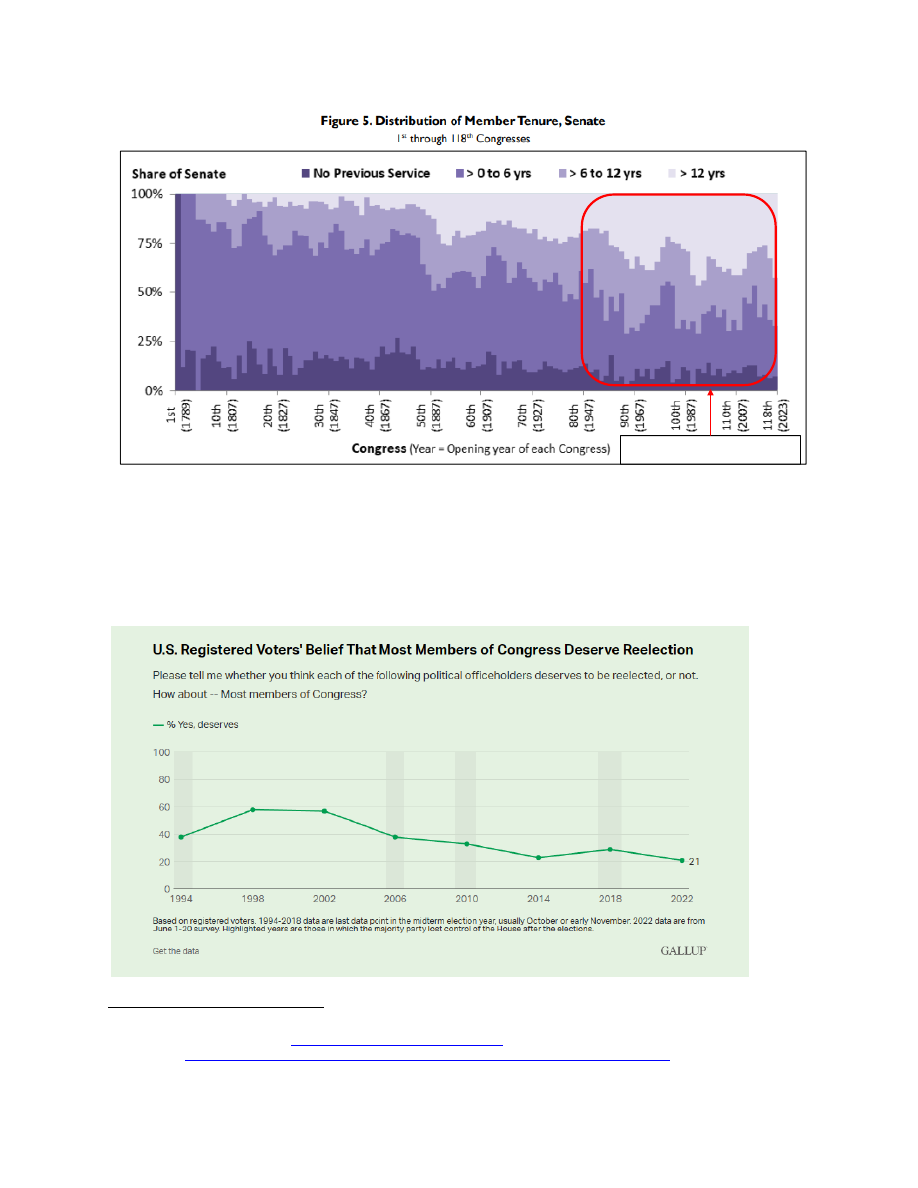 4 In the House of Representatives, the percentage of members who sought re-election ranged 85-93% during the 1950s to present day, and the success rate ranged 88-97% during the 1950s to present day. 4 These two factors and their high rates are also significant indicators of the pattern of career politicians that currently exist. However, the vast majority of the American population does not think they deserve re-election, and this has been the trend for the last 15 years. 5 4 Congressional Careers: Service Tenure and Patterns of Member Service, 1789-2023 . Updated January 17, 2023. Congressional Research Service (CRS) report at https://crsreports.congress.gov/R41545 , pages 5-6. 5 Gallup Poll: https://news.gallup.com/poll/394685/voters-eagerness-reelect-incumbents-near-lows.aspx . More Career Politicians 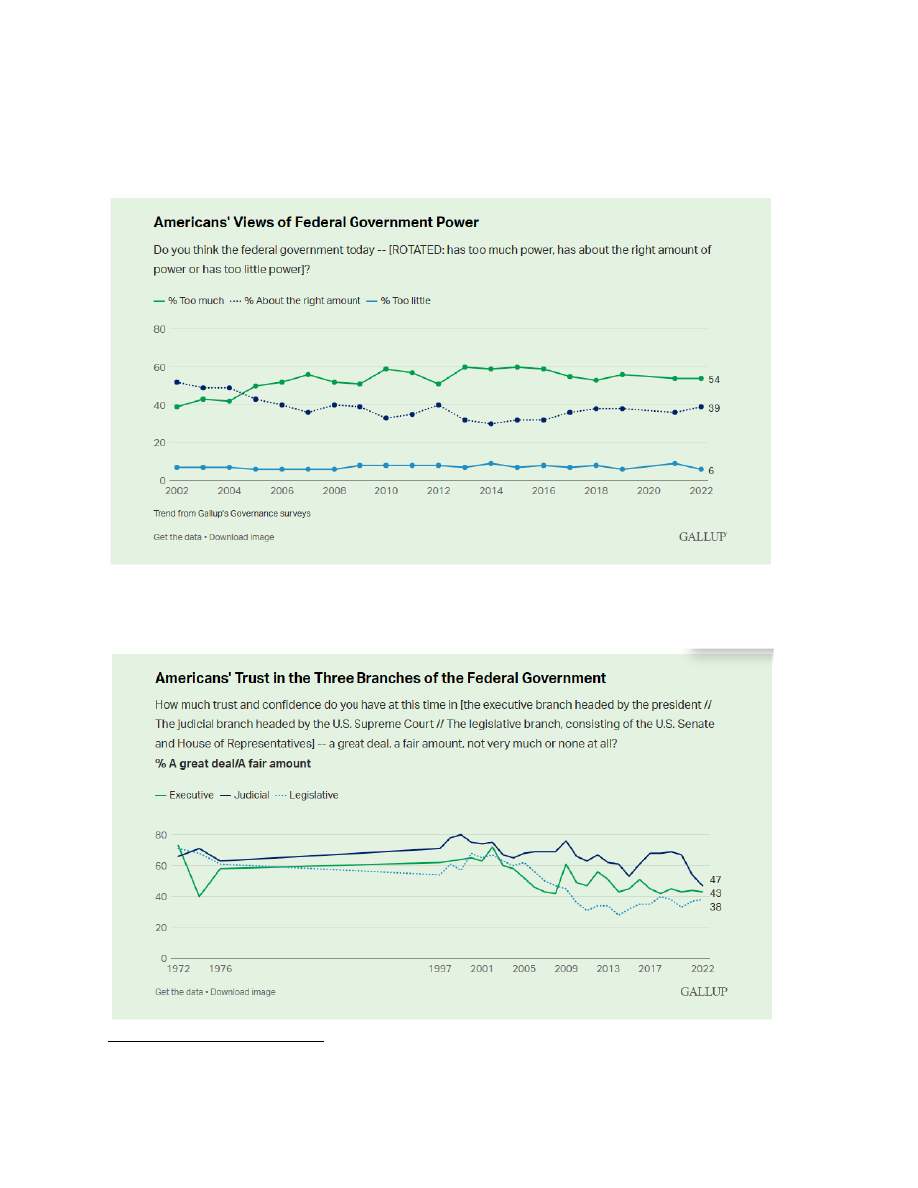 5 In general, the American population thinks the federal government has too much power, and there is a lack of balance of power (“right amount”). This has been the trend for approximately 20 years. 6 Ideally, a good view on a balance of power is 60% or better (not a simple majority). In addition, there is a lack of trust by a vast majority of Americans in the legislative branch of the federal government, and it has been the worst branch for approximately the last 15 years. 7 6 Gallup Poll: https://news.gallup.com/poll/403124/majority-continues-say-government-powerful.aspx 7 Gallup Poll: https://news.gallup.com/poll/402737/trust-federal-government-branches-continues-falter.aspx  6 There is an obvious need to set term limits, and the critical question to answer is the actual term limit service time. In the service time determination, it is necessary to incorporate the historical rate of those members who seek re-election (85-93%) and their success rate for re- election (88-97%). These two critical rates from the past 70+ years are very high across both the lower and upper bounds, and they are both critical factors to account within the determination of establishing a reasonable term limit service time. Through a basic mathematical model, it is possible to calculate a reasonable estimation for a term limit service time. Within the venn diagram, “A” represents the historical rate of members who seek re-election, and “B” represents their success rate for re-election. Both are necessary conditions to occur. The basic math definition of independence calculates the probability for two events to happen. In other words, the probability of both “A” and “B” happening is represented by the following equation: Pr(A and B) = Pr(A)Pr(B). It is like flipping a coin. The basic equation can be applied to both the lower bounds and upper bounds as depicted below. • Lower Bound: (0.85)(0.88) = 0.748 • Upper Bound: (0.93)(0.97) = 0.9021 • These lower and upper bound probabilities can be applied to a potential term limit service time, and an expected value results for each. The table below depicts the expected range of actual service times for Members of Congress across different term limit options. • For purposes of the amendment, a term limit of 18 years is a reasonable estimation. Thus, a Member of Congress can reasonably expect to serve between 13.5-16.2 years. Term Limit Option Expected Value: Lower Bound Expected Value: Upper Bound 24 Years 24(0.748) = 17.9 years 24(0.9021) = 21.7 years 18 Years 18(0.748) = 13.5 years 18(0.9021) = 16.2 years 12 Years 12(0.748) = 8.9 years 12*(0.9021) = 10.8 years Overall, the Members of Congress evolved into a body of career politicians over the last 70+ years, and this indicates a strong pattern of increasing power for this branch of the federal government. The vast majority of the American population has a poor view of the legislative branch because Members of Congress do not deserve re-election, have too much power, and are not trustworthy. Term limits for Members of Congress will help address these issues. A service time of no more than 18 years is the right length of time to enable continuity of government for elected Members of Congress, and it is the right length of time to limit power. In other words, 18 years of service time is the right balance, and an end result will be more faith in Congress by the American population. A B |
| Page Metadata | |
| Login Required to view? | No |
| Created: | 2025-03-14 23:45 GMT |
| Updated: | 2025-03-14 23:45 GMT |
| Published: | 2025-03-14 23:45 GMT |
| Converted: | 2025-11-11 12:35 GMT |
| Change Author: | Vivian Garcia |
| Credit Author: | Mike Forbis |
public/cb_mirror/co_document_library_case_for_series_part_2_pdf_files_28754.txt · Last modified: 2025/11/11 12:35 by 127.0.0.1