
To view this on the COS website, click here article-v-legislative-compendium-old
To download the pdf file from the COS website, click here Digital-BriefingBook_COSA102025.pdf
Briefing Book
The Article V Briefing Book for Lawyers and Legislative Drafters
Attachment: 4821/Digital-BriefingBookCOSA102025.pdf
|

CONVENTION OF STATES ACTION
BRIEFING BOOK

2
Convention
of
States Action
Briefing Book
Version: V2-082023
COS Legislative Dept.
Some of the images and graphics have been removed from its original form for printing.

3
**Executive Summary**
For providing background and general information about COSA; includes process
description, endorsers, legislative progress, list of possible amendments, etc.
**Questions/Objections & Responses**
For providing brief responses to the most common objections.
**Convention Disinformation**
For responding to the “runaway” myth and claim that we don’t know how a
convention would work; includes excerpts from the call and commissions for the 1787
Constitutional Conventions, a list of past interstate conventions, and a selection of key
court cases on Article V.
**Problems in the Testimony of Robert Brown**
For responding to erroneous testimony of JBS spokesperson Robert Brown.
**The Liberal Establishment’s Disinformation Campaign \\ Against Article V**
For demonstrating that the anti-Article V talking points originated from the Political
Left.
**Michael Farris article in Harvard Journal of Law & **
**Public Policy,**
“Defying Conventional Wisdom.”
Detailed explanation of the 1787 Constitutional Convention, demonstrating that it was
not a “runaway convention.”
**250 Leftist organizations opposed to Convention of \\ States Action efforts**
.
Demonstrates that the radical Left is opposed to our efforts.
**The Jefferson Statement**
Demonstrates that well-respected, conservative scholars and legal experts
support our efforts.
PAGE 5
PAGE 9
PAGE 13
PAGE 17
PAGE 41
PAGE 63
PAGE 151
PAGE 153

4
America is spiraling out of control. Washington, D.C., today, enjoys almost unchecked power.
This is a systemic problem that requires a systemic solution. This is about more than elections. Elections cannot and
will not solve the problems of a broken system. The only solution big enough to fi x our nation’s problems is an Article V
convention for proposing constitutional amendments to rein in federal tyranny. This is the people’s fi nal “check” on D.C.,
exercised through their state legislators–the ingenious plan of the Founders to make state legislators’ ambitions (for state
power) counteract federal offi cials’ ambitions (for federal power)–for the good of the people.
While there is nothing “wrong” with the Constitution as drafted and ratifi ed, the problems we now face are undeniably
the result of improper constitutional interpretations by the federal courts (i.e. the General Welfare Clause, the
Necessary and Proper Clause, and the Commerce Clause). Conservatives like to say that federal offi cials “ignore” the
Constitution, but what they actually do is creatively “lawyer” around its limitations via Supreme Court rulings expanding
federal power.
We can and must restore the federal government to its proper, limited place by pushing back on the expansion and
eff ectively overturning bad Supreme Court precedents that have eviscerated the Founders’ intended limitations on our
federal system.
The Convention of States Resolution seeks to do this by using the tool given to the states in Article V of the
Constitution. It calls for an Article V convention limited to proposing amendments that
impose fi scal restraints on the
federal government, limit the power and jurisdiction of the federal government, and limit the terms of offi ce for its
offi cials and for members of Congress.
EXECUTIVE SUMMARY
Convention
of
States
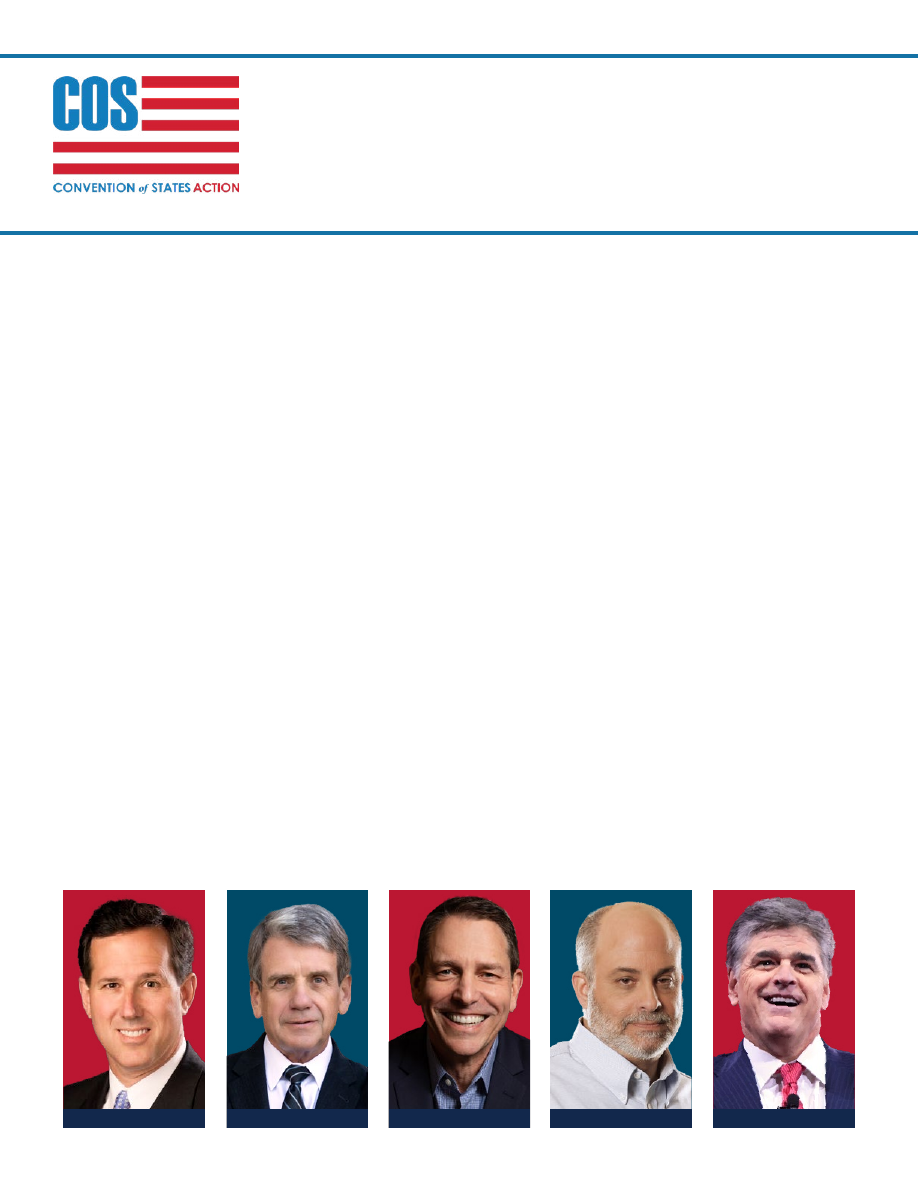
OFFICIAL ENDORSERS
Hon. Rick Santorum,
COS Advisor
Mike Farris,
COS Advisor/ Co-Founder
Mark Meckler,
CEO COS Action
Mark Levin,
The Mark Levin Show
Sean Hannity,
Hannity & Colmes
This page is intentionally left blank
5
America is spiraling out of control. Washington, D.C., today, enjoys almost unchecked power.
This is a systemic problem that requires a systemic solution. This is about more than elections. Elections cannot and
will not solve the problems of a broken system. The only solution big enough to fi x our nation’s problems is an Article V
convention for proposing constitutional amendments to rein in federal tyranny. This is the people’s fi nal “check” on D.C.,
exercised through their state legislators–the ingenious plan of the Founders to make state legislators’ ambitions (for state
power) counteract federal offi cials’ ambitions (for federal power)–for the good of the people.
While there is nothing “wrong” with the Constitution as drafted and ratifi ed, the problems we now face are undeniably
the result of improper constitutional interpretations by the federal courts (i.e. the General Welfare Clause, the
Necessary and Proper Clause, and the Commerce Clause). Conservatives like to say that federal offi cials “ignore” the
Constitution, but what they actually do is creatively “lawyer” around its limitations via Supreme Court rulings expanding
federal power.
We can and must restore the federal government to its proper, limited place by pushing back on the expansion and
eff ectively overturning bad Supreme Court precedents that have eviscerated the Founders’ intended limitations on our
federal system.
The Convention of States Resolution seeks to do this by using the tool given to the states in Article V of the
Constitution. It calls for an Article V convention limited to proposing amendments that
impose fi scal restraints on the
federal government, limit the power and jurisdiction of the federal government, and limit the terms of offi ce for its
offi cials and for members of Congress.
EXECUTIVE SUMMARY
Convention
of
States
OFFICIAL ENDORSERS
Hon. Rick Santorum,
COS Advisor
Mike Farris,
COS Advisor/ Co-Founder
Mark Meckler,
CEO COS Action
Mark Levin,
The Mark Levin Show
Sean Hannity,
Hannity & Colmes

6
COS Resolution Language
The COS Resolution’s operative language defi nes the limits of the types of amendments that can be proposed.
The operative language is as follows:
Section 1. The legislature of the State of
hereby applies to Congress, under the provisions of
Article V of the Constitution of the United States, for the calling of a convention of the states limited to
proposing amendments to the Constitution of the United States that impose fi scal restraints on the federal
government, limit the power and jurisdiction of the federal government, and limit the terms of offi ce for its
offi cials and for members of Congress.
How The Process Works
Article V of the Constitution provides two ways in which amendments may be proposed: Congress may propose
them, or the states can call a “convention for proposing amendments” upon application of 2/3 of the state legislatures
(34 state legislatures). Regardless of which way amendments are proposed, they must always be ratifi ed by 3/4 of the
states (38 states).
The amendments that can be proposed must be germane to the resolution, limited by the language of the resolution
itself, passed by the state legislatures as the subject matter of the convention. Only the proposed amendments that
pass by a simple majority (26 states) shall be put forth for ratifi cation. They are mere suggestions until ratifi ed.
Types of Amendments That Could Be Proposed
• Limiting Supreme Court Justices to nine members of the court
• Preventing the federal government from adding states without the affi rmative consent of three quarters of the
existing states
• A limitation on using Executive Orders and federal regulations to enact laws
• A balanced budget amendment, including limitations on taxes and spending
• Imposition of Generally Accepted Accounting Principles (GAAP)
• Single Subject Amendment – One subject per bill in Congress
• A redefi nition of the General Welfare Clause back to original intent (the original view was the federal government
could not spend money on any topic within the jurisdiction of the states)
• A redefi nition of the Commerce Clause back to original intent (the original view was that Congress was granted a
narrow and exclusive power to regulate shipments across state lines–not all the economic activity of the nation)
• A prohibition of using international treaties and law to govern the domestic law of the United States
• Placing an upper limit on federal taxation
• Requiring the sunset of all existing federal taxes and a super-majority vote to replace them with new, fairer taxes
• Religious freedom amendment, prohibiting the government from further interference with our religious freedoms
• Regulatory curtailment by forcing Congress to vote on regulations instead of deferring law making to regulators.
Former
U.S. Senator Rick Santorum now serves as Senior Advisor to Convention of States. Major endorsers include
(but are not limited to):
Mark Levin, Sean Hannity, Ben Shapiro, Gov. Ron DeSantis, Rep. Mark Meadows, Charlie
Kirk, Pete Hegseth, Lt. Col. Allen West, Dave Rubin, Rep. Chip Roy, David Barton, James O’Keefe, Steve Deace,
David Horowitz, Eric Metaxas, Dr. James Dobson, Rep. Louis Gohmert, Sen. Rand Paul, Sen. Marco Rubio, Sen. Jim
DeMint, Gov. Greg Abbott, The Honorable Jeb Bush, The Honorable Ben Carson,The Honorable Mike Huckabee,
Gov. Sarah Palin, Gov. Bobby Jindal, Sen. Ron Johnson, Kenneth Cuccinelli, Rep. Jeff Duncan, Rep. Ralph Norman,
Sen. Jim Talent, and many more. The late U.S. Senator
Tom Coburn was one of the leading proponents of COS
and also served as a Senior Advisor.
Conservative legal heavyweights serving on the
Convention of States Legal Board
of Reference include:
• Mark Levin
• Prof. Robert P. George
• Prof. Randy Barnett
• Ambassador C. Boyden Gray
• Mat Staver
• Andrew McCarthy
• Dr. John Eastman
• Charles Cooper
• Professor Nelson Lund
• Michael Farris
• Mark Meckler
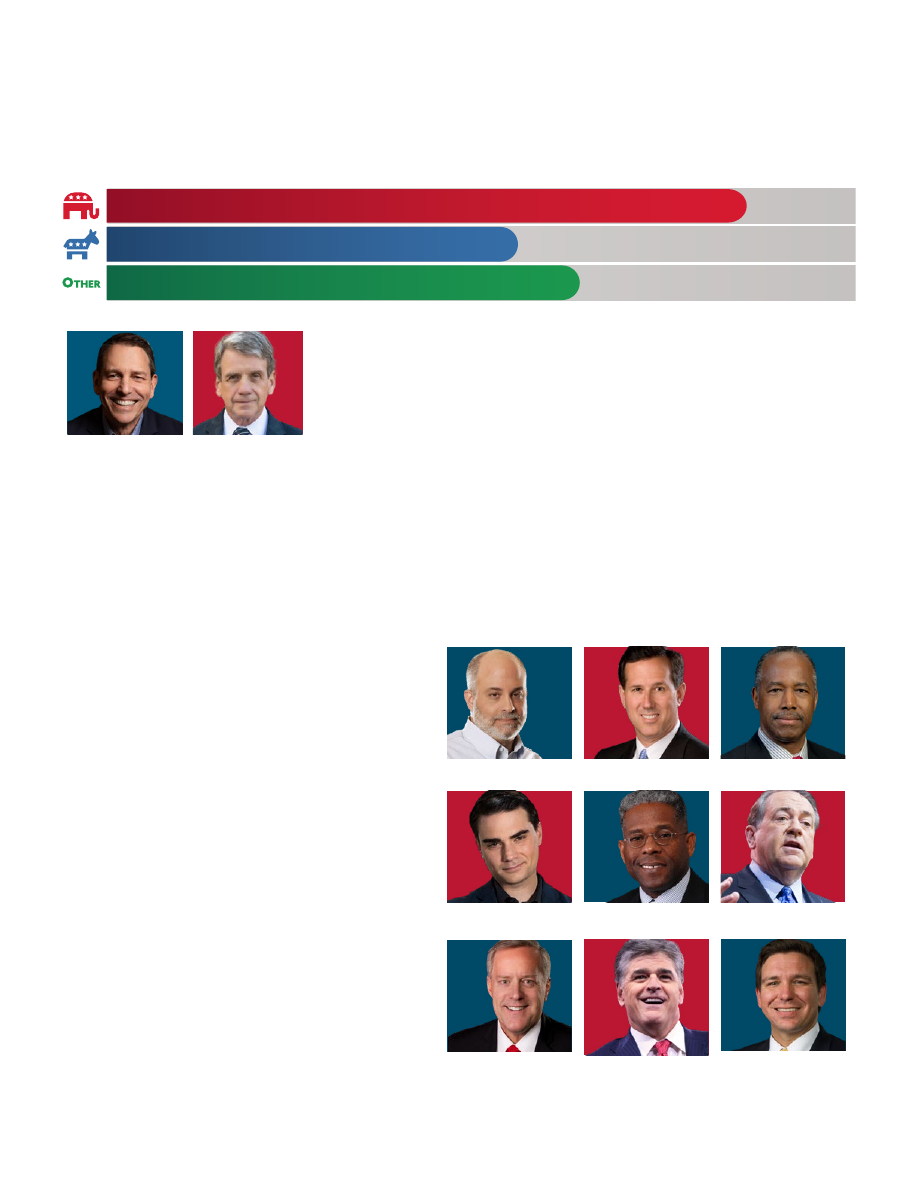
81.3%
50.2%
63.3%
Public Opinion Polling
Polling conducted across the nation indicates that, on average, 65.7% of voters across party lines support the
Convention of States Resolution. That includes 81.3% of Republicans, 50.2% of Democrats, and 63.3% of
“others.” Polling was conducted by Robert Cahaly of The Trafalgar Group, America’s most trusted and accurate
pollster in the 2016, 2018 and 2020 elections.
View our full list of endorsers at conventionofstates.com
Charlie Kirk
Mark Levin
Sean Hannity
Gov. Ron
DeSantis
Rep. Mark
Meadows
Ben Shapiro
Rick Santorum
Lt. Col. Allen West
Hon. Ben Carson
Hon. Mike Huckabee
COS Founders
Convention of States was founded by
Mark Meckler, Co-Founder of Tea
Party Patriots and President of Citizens for Self-Governance, and
Michael
Farris, Founder of Home School Legal Defense Association, Patrick Henry
College, and the former CEO of Alliance Defending Freedom.
Mark Meckler
Michael Farris
COS Endorsers
7
COS Resolution Language
The COS Resolution’s operative language defi nes the limits of the types of amendments that can be proposed.
The operative language is as follows:
Section 1. The legislature of the State of
hereby applies to Congress, under the provisions of
Article V of the Constitution of the United States, for the calling of a convention of the states limited to
proposing amendments to the Constitution of the United States that impose fi scal restraints on the federal
government, limit the power and jurisdiction of the federal government, and limit the terms of offi ce for its
offi cials and for members of Congress.
How The Process Works
Article V of the Constitution provides two ways in which amendments may be proposed: Congress may propose
them, or the states can call a “convention for proposing amendments” upon application of 2/3 of the state legislatures
(34 state legislatures). Regardless of which way amendments are proposed, they must always be ratifi ed by 3/4 of the
states (38 states).
The amendments that can be proposed must be germane to the resolution, limited by the language of the resolution
itself, passed by the state legislatures as the subject matter of the convention. Only the proposed amendments that
pass by a simple majority (26 states) shall be put forth for ratifi cation. They are mere suggestions until ratifi ed.
Types of Amendments That Could Be Proposed
• Limiting Supreme Court Justices to nine members of the court
• Preventing the federal government from adding states without the affi rmative consent of three quarters of the
existing states
• A limitation on using Executive Orders and federal regulations to enact laws
• A balanced budget amendment, including limitations on taxes and spending
• Imposition of Generally Accepted Accounting Principles (GAAP)
• Single Subject Amendment – One subject per bill in Congress
• A redefi nition of the General Welfare Clause back to original intent (the original view was the federal government
could not spend money on any topic within the jurisdiction of the states)
• A redefi nition of the Commerce Clause back to original intent (the original view was that Congress was granted a
narrow and exclusive power to regulate shipments across state lines–not all the economic activity of the nation)
• A prohibition of using international treaties and law to govern the domestic law of the United States
• Placing an upper limit on federal taxation
• Requiring the sunset of all existing federal taxes and a super-majority vote to replace them with new, fairer taxes
• Religious freedom amendment, prohibiting the government from further interference with our religious freedoms
• Regulatory curtailment by forcing Congress to vote on regulations instead of deferring law making to regulators.
Former
U.S. Senator Rick Santorum now serves as Senior Advisor to Convention of States. Major endorsers include
(but are not limited to):
Mark Levin, Sean Hannity, Ben Shapiro, Gov. Ron DeSantis, Rep. Mark Meadows, Charlie
Kirk, Pete Hegseth, Lt. Col. Allen West, Dave Rubin, Rep. Chip Roy, David Barton, James O’Keefe, Steve Deace,
David Horowitz, Eric Metaxas, Dr. James Dobson, Rep. Louis Gohmert, Sen. Rand Paul, Sen. Marco Rubio, Sen. Jim
DeMint, Gov. Greg Abbott, The Honorable Jeb Bush, The Honorable Ben Carson,The Honorable Mike Huckabee,
Gov. Sarah Palin, Gov. Bobby Jindal, Sen. Ron Johnson, Kenneth Cuccinelli, Rep. Jeff Duncan, Rep. Ralph Norman,
Sen. Jim Talent, and many more. The late U.S. Senator
Tom Coburn was one of the leading proponents of COS
and also served as a Senior Advisor.
Conservative legal heavyweights serving on the
Convention of States Legal Board
of Reference include:
• Mark Levin
• Prof. Robert P. George
• Prof. Randy Barnett
• Ambassador C. Boyden Gray
• Mat Staver
• Andrew McCarthy
• Dr. John Eastman
• Charles Cooper
• Professor Nelson Lund
• Michael Farris
• Mark Meckler
81.3%
50.2%
63.3%
Public Opinion Polling
Polling conducted across the nation indicates that, on average, 65.7% of voters across party lines support the
Convention of States Resolution. That includes 81.3% of Republicans, 50.2% of Democrats, and 63.3% of
“others.” Polling was conducted by Robert Cahaly of The Trafalgar Group, America’s most trusted and accurate
pollster in the 2016, 2018 and 2020 elections.
View our full list of endorsers at conventionofstates.com
Charlie Kirk
Mark Levin
Sean Hannity
Gov. Ron
DeSantis
Rep. Mark
Meadows
Ben Shapiro
Rick Santorum
Lt. Col. Allen West
Hon. Ben Carson
Hon. Mike Huckabee
COS Founders
Convention of States was founded by
Mark Meckler, Co-Founder of Tea
Party Patriots and President of Citizens for Self-Governance, and
Michael
Farris, Founder of Home School Legal Defense Association, Patrick Henry
College, and the former CEO of Alliance Defending Freedom.
Mark Meckler
Michael Farris
COS Endorsers
8
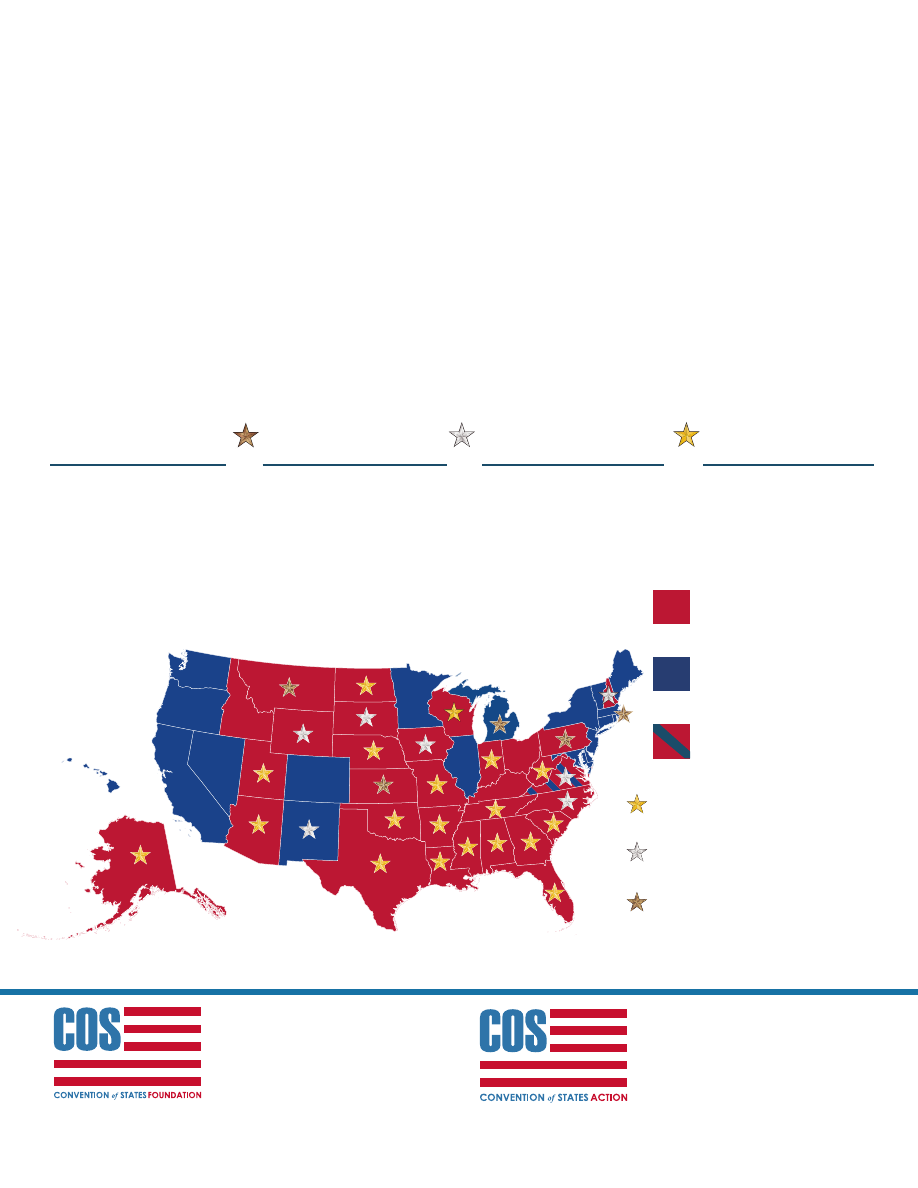
PASSED COS
RESOLUTION (
19
STATES)
PASSED LEGISLATIVE
CHAMBER (
26
STATES)
PASSED COMMITTEE
HEARING (
31
STATES)
Updated 2/07/2023
Legislative makeup and Convention of States Legislative Victories
Passed COS
Resolution
(
19
States)
Passed Legislative
Chamber (
26
States)
Passed Committee
Hearing (
31
States)
Filed COS Resolution
(
49
States)
AK, AL, AR, AZ, FL, GA,
IN, LA, MO, MS, ND,
NE, OK, TN, TX, UT,
WI, WV, SC
AL, AK, AR, AZ, FL, GA,
IA, LA, MS, NE, NH, NC,
ND, NM, TN, VA, SD, IN,
UT, OK, MO, TX, SC, WI,
WV, WY
AL, AK, AZ, AR, FL, GA, IN,
IA, KS, LA, MA, MI, MS, MO
MT, NE, NH, NM, NC, ND,
OK, PA, SC, SD, TN, TX,
UT, VA, WV, WI, WY
AK, AL, AR, AZ, CA, CO ,
DE, FL, GA, HI, ID, IL, IN,
IA, KS, KY, LA, MA, MD,
ME, MI, MN, MS, MO,
MT, NE, NV, NH, NJ,
NM, NY, NC, ND, OH,
OK, OR, PA, RI, SC, SD,
TN, TX, UT, VA, VT, WA,
WI, WV, WY
REPUBLICAN
CONTROLLED LEGISLATURE
DEMOCRAT CONTROLLED
LEGISLATURE
DIVIDED CHAMBER
LEGISLATURE
Convention of States Foundation
5850 San Felipe, Suite 575
Houston, TX 77057
512-487-5525
ConventionofStates.org
Convention of States Action
5850 San Felipe, Suite 580
Houston, TX 77057
512-487-5525
ConventionofStates.com
Tax deductible 501©3
Please feel free to reach out to me personally…
[email protected]
Strategy for Passage of the COS Resolution
The strategy for passage of the Resolution is state-specifi c and is carried out by the 5 Million+ citizen activists
recruited from within 100% of the state legislative districts. Citizen activists put the appropriate pressure on their
state representatives to sponsor or vote in support of the Resolution. To date this strategy has accomplished:
•
49 states fi ling the COS Resolution in their state legislatures.
•
31 states have passed the COS Resolution through at least one committee hearing.
•
26 states have passed the COS Resolution through one entire fl oor chamber.
•
19 states have passed the COS Resolution in its entirety.
The nineteen states that have already passed the Convention of States Resolution are: Florida, Georgia, Alaska,
Alabama, Tennessee, Indiana, Oklahoma, Louisiana, Arizona, North Dakota, Texas, Missouri, Arkansas, Utah,
Mississippi, West Virginia, Wisconsin, Nebraska and South Carolina.
Responses to Common Objections
Objection 1: The Constitutional Convention in Philadelphia defied its authority in
proposing a new Constitution, so we can expect an Article V convention to do the
same.
Response:
The 1787 convention did not run away. The runaway claim is based on the assumption
that the Confederation Congress called the convention and defined its scope, but that is incorrect.
The Constitutional Convention was called by Virginia in December, 1786, and its language gave
the states power (under their reserved powers) to re-write the Articles of Confederation. The
congressional resolution, issued months after Virginia had issued the call, was, by its own wording,
merely an expression of “opinion” and a recommendation.
Michael Farris, former President and CEO of Alliance Defending Freedom, has published an
article refuting the claim. It is published in Volume 40 of the Harvard Journal of Law and Public
Policy, and you can
find it here
.
Objection 2: Nothing in Article V limits the convention to a single topic, and in fact, states
cannot limit the scope of an amendment-proposing convention. Once convened, state
delegations will be free to rewrite the Constitution.
Response
: The states whose applications trigger the convention retain the right to limit the
scope of the convention however they choose. This is inherent in their power of application. In
fact, this is the only reason there has never yet been an Article V convention; while over 400
state applications for a convention have been filed, there have not yet been 34 applications for a
convention on the same subject matter. Every scholar who has published articles or books on the
subject in the 21st century agrees that a convention can be limited.
As the
agents
of the state legislatures who appoint and commission them, the commissioners
only enjoy the scope of authority vested in them by their
principals
(the state legislatures). Any
actions outside the scope of that authority are void as a matter of common law agency
principles, as well as any state laws adopted to specifically address the issue.
The inherent power of state legislatures to control the selection and instruction of their
commissioners, including the requirement that said commissioners restrict their deliberations to
the specified subject matter, is reinforced by the unbroken, universal historical precedent set by
the interstate conventions held at least 42 times in American history. Those who make a
contrary claim cannot cite a single historical or legal precedent to support it.
Finally, keep in mind that under the explicit terms of Article V, the convention’s only power is
to “propose” amendments to “this Constitution” (the one we already have). Only upon
ratification by 38 states does any single amendment become part of the Constitution.
Objection 3: Adding amendments to the Constitution won’t help anything, because
federal officials simply ignore the Constitution anyway.
Response:
It is true that if our Constitution were being interpreted today—and obeyed—
according to its original meaning, we would not be facing most of the problems we face today
in our federal government. But the problem is today is more complex than that officials are
“ignoring” or “disobeying” the Constitution. The real issue is that certain provisions of our
Constitution have been wrenched from their original meaning, perverted, and interpreted to
mean something very different. Federal officials today follow the Constitution as
interpreted
by
the Supreme Court over the years.
As just one example, consider the individual mandate provision of the Affordable Care Act. Of
course, nowhere in the Article I of the Constitution do we read that Congress has the power to
force individuals to purchase health insurance. However, our modern Supreme Court
“interprets” the General Welfare Clause of Article I broadly as a grant of power for Congress to
tax and spend for virtually any purpose that it believes will benefit the people. Now we know
from history that this is not what was intended. But it is the prevailing modern interpretation,
providing a veneer of legitimacy to Congress’ actions—as well as legal grounds for upholding
them.
The federal government doesn’t “ignore” the Constitution—it takes advantage of loopholes
created through practice and precedent. The only way to close these loopholes definitively
and permanently is through an Article V convention that reinstates limitations on federal power
and jurisdiction in clear, modern language.
Objection 4: We have no idea how an Article V convention would operate, because
it is not spelled out in Article V.
Response:
The Constitution does not spell out the details of processes that were well-
known to the Framers (“grand jury” and “habeas corpus” are other examples), and
interstate conventions were common practice for them. We know the process from the
historical records of past conventions. There have been at least 42 in American history.
States always choose and instruct their commissioners, voting is always on a one-state,
one-vote basis, and no interstate convention has ever become a “runaway.”
Objection 5: Congress will use its powers under the Necessary and Proper Clause
to control an Article V convention.
Response:
This argument is based on ignorance of existing precedent, holding that
Congress may not use any of its Article I powers in the context of Article V.
See Idaho
v. Freeman
, 529 F.Supp. 1107, 1151 (D. Idaho 1981) (“Thus Congress, outside of the
authority granted by article V, has no power to act with regard to an amendment, i.e., it
does not retain any of its traditional authority vested in it by article I.”) This case was
later vacated as moot for procedural reasons, but the central holding remains
unchanged. Congress may not use its power under the Necessary and Proper Clause
with respect to the operation of an Article V convention.

9
PASSED COS
RESOLUTION (
19
STATES)
PASSED LEGISLATIVE
CHAMBER (
26
STATES)
PASSED COMMITTEE
HEARING (
31
STATES)
Updated 2/07/2023
Legislative makeup and Convention of States Legislative Victories
Passed COS
Resolution
(
19
States)
Passed Legislative
Chamber (
26
States)
Passed Committee
Hearing (
31
States)
Filed COS Resolution
(
49
States)
AK, AL, AR, AZ, FL, GA,
IN, LA, MO, MS, ND,
NE, OK, TN, TX, UT,
WI, WV, SC
AL, AK, AR, AZ, FL, GA,
IA, LA, MS, NE, NH, NC,
ND, NM, TN, VA, SD, IN,
UT, OK, MO, TX, SC, WI,
WV, WY
AL, AK, AZ, AR, FL, GA, IN,
IA, KS, LA, MA, MI, MS, MO
MT, NE, NH, NM, NC, ND,
OK, PA, SC, SD, TN, TX,
UT, VA, WV, WI, WY
AK, AL, AR, AZ, CA, CO ,
DE, FL, GA, HI, ID, IL, IN,
IA, KS, KY, LA, MA, MD,
ME, MI, MN, MS, MO,
MT, NE, NV, NH, NJ,
NM, NY, NC, ND, OH,
OK, OR, PA, RI, SC, SD,
TN, TX, UT, VA, VT, WA,
WI, WV, WY
REPUBLICAN
CONTROLLED LEGISLATURE
DEMOCRAT CONTROLLED
LEGISLATURE
DIVIDED CHAMBER
LEGISLATURE
Convention of States Foundation
5850 San Felipe, Suite 575
Houston, TX 77057
512-487-5525
ConventionofStates.org
Convention of States Action
5850 San Felipe, Suite 580
Houston, TX 77057
512-487-5525
ConventionofStates.com
Tax deductible 501©3
Please feel free to reach out to me personally…
[email protected]
Strategy for Passage of the COS Resolution
The strategy for passage of the Resolution is state-specifi c and is carried out by the 5 Million+ citizen activists
recruited from within 100% of the state legislative districts. Citizen activists put the appropriate pressure on their
state representatives to sponsor or vote in support of the Resolution. To date this strategy has accomplished:
•
49 states fi ling the COS Resolution in their state legislatures.
•
31 states have passed the COS Resolution through at least one committee hearing.
•
26 states have passed the COS Resolution through one entire fl oor chamber.
•
19 states have passed the COS Resolution in its entirety.
The nineteen states that have already passed the Convention of States Resolution are: Florida, Georgia, Alaska,
Alabama, Tennessee, Indiana, Oklahoma, Louisiana, Arizona, North Dakota, Texas, Missouri, Arkansas, Utah,
Mississippi, West Virginia, Wisconsin, Nebraska and South Carolina.
Responses to Common Objections
Objection 1: The Constitutional Convention in Philadelphia defied its authority in
proposing a new Constitution, so we can expect an Article V convention to do the
same.
Response:
The 1787 convention did not run away. The runaway claim is based on the assumption
that the Confederation Congress called the convention and defined its scope, but that is incorrect.
The Constitutional Convention was called by Virginia in December, 1786, and its language gave
the states power (under their reserved powers) to re-write the Articles of Confederation. The
congressional resolution, issued months after Virginia had issued the call, was, by its own wording,
merely an expression of “opinion” and a recommendation.
Michael Farris, former President and CEO of Alliance Defending Freedom, has published an
article refuting the claim. It is published in Volume 40 of the Harvard Journal of Law and Public
Policy, and you can
find it here
.
Objection 2: Nothing in Article V limits the convention to a single topic, and in fact, states
cannot limit the scope of an amendment-proposing convention. Once convened, state
delegations will be free to rewrite the Constitution.
Response
: The states whose applications trigger the convention retain the right to limit the
scope of the convention however they choose. This is inherent in their power of application. In
fact, this is the only reason there has never yet been an Article V convention; while over 400
state applications for a convention have been filed, there have not yet been 34 applications for a
convention on the same subject matter. Every scholar who has published articles or books on the
subject in the 21st century agrees that a convention can be limited.
As the
agents
of the state legislatures who appoint and commission them, the commissioners
only enjoy the scope of authority vested in them by their
principals
(the state legislatures). Any
actions outside the scope of that authority are void as a matter of common law agency
principles, as well as any state laws adopted to specifically address the issue.
The inherent power of state legislatures to control the selection and instruction of their
commissioners, including the requirement that said commissioners restrict their deliberations to
the specified subject matter, is reinforced by the unbroken, universal historical precedent set by
the interstate conventions held at least 42 times in American history. Those who make a
contrary claim cannot cite a single historical or legal precedent to support it.
Finally, keep in mind that under the explicit terms of Article V, the convention’s only power is
to “propose” amendments to “this Constitution” (the one we already have). Only upon
ratification by 38 states does any single amendment become part of the Constitution.
Objection 3: Adding amendments to the Constitution won’t help anything, because
federal officials simply ignore the Constitution anyway.
Response:
It is true that if our Constitution were being interpreted today—and obeyed—
according to its original meaning, we would not be facing most of the problems we face today
in our federal government. But the problem is today is more complex than that officials are
“ignoring” or “disobeying” the Constitution. The real issue is that certain provisions of our
Constitution have been wrenched from their original meaning, perverted, and interpreted to
mean something very different. Federal officials today follow the Constitution as
interpreted
by
the Supreme Court over the years.
As just one example, consider the individual mandate provision of the Affordable Care Act. Of
course, nowhere in the Article I of the Constitution do we read that Congress has the power to
force individuals to purchase health insurance. However, our modern Supreme Court
“interprets” the General Welfare Clause of Article I broadly as a grant of power for Congress to
tax and spend for virtually any purpose that it believes will benefit the people. Now we know
from history that this is not what was intended. But it is the prevailing modern interpretation,
providing a veneer of legitimacy to Congress’ actions—as well as legal grounds for upholding
them.
The federal government doesn’t “ignore” the Constitution—it takes advantage of loopholes
created through practice and precedent. The only way to close these loopholes definitively
and permanently is through an Article V convention that reinstates limitations on federal power
and jurisdiction in clear, modern language.
Objection 4: We have no idea how an Article V convention would operate, because
it is not spelled out in Article V.
Response:
The Constitution does not spell out the details of processes that were well-
known to the Framers (“grand jury” and “habeas corpus” are other examples), and
interstate conventions were common practice for them. We know the process from the
historical records of past conventions. There have been at least 42 in American history.
States always choose and instruct their commissioners, voting is always on a one-state,
one-vote basis, and no interstate convention has ever become a “runaway.”
Objection 5: Congress will use its powers under the Necessary and Proper Clause
to control an Article V convention.
Response:
This argument is based on ignorance of existing precedent, holding that
Congress may not use any of its Article I powers in the context of Article V.
See Idaho
v. Freeman
, 529 F.Supp. 1107, 1151 (D. Idaho 1981) (“Thus Congress, outside of the
authority granted by article V, has no power to act with regard to an amendment, i.e., it
does not retain any of its traditional authority vested in it by article I.”) This case was
later vacated as moot for procedural reasons, but the central holding remains
unchanged. Congress may not use its power under the Necessary and Proper Clause
with respect to the operation of an Article V convention.

10
Responses to Common Objections
Objection 1: The Constitutional Convention in Philadelphia defied its authority in
proposing a new Constitution, so we can expect an Article V convention to do the
same.
Response:
The 1787 convention did not run away. The runaway claim is based on the assumption
that the Confederation Congress called the convention and defined its scope, but that is incorrect.
The Constitutional Convention was called by Virginia in December, 1786, and its language gave
the states power (under their reserved powers) to re-write the Articles of Confederation. The
congressional resolution, issued months after Virginia had issued the call, was, by its own wording,
merely an expression of “opinion” and a recommendation.
Michael Farris, former President and CEO of Alliance Defending Freedom, has published an
article refuting the claim. It is published in Volume 40 of the Harvard Journal of Law and Public
Policy, and you can
find it here
.
Objection 2: Nothing in Article V limits the convention to a single topic, and in fact, states
cannot limit the scope of an amendment-proposing convention. Once convened, state
delegations will be free to rewrite the Constitution.
Response
: The states whose applications trigger the convention retain the right to limit the
scope of the convention however they choose. This is inherent in their power of application. In
fact, this is the only reason there has never yet been an Article V convention; while over 400
state applications for a convention have been filed, there have not yet been 34 applications for a
convention on the same subject matter. Every scholar who has published articles or books on the
subject in the 21st century agrees that a convention can be limited.
As the
agents
of the state legislatures who appoint and commission them, the commissioners
only enjoy the scope of authority vested in them by their
principals
(the state legislatures). Any
actions outside the scope of that authority are void as a matter of common law agency
principles, as well as any state laws adopted to specifically address the issue.
The inherent power of state legislatures to control the selection and instruction of their
commissioners, including the requirement that said commissioners restrict their deliberations to
the specified subject matter, is reinforced by the unbroken, universal historical precedent set by
the interstate conventions held at least 42 times in American history. Those who make a
contrary claim cannot cite a single historical or legal precedent to support it.
Finally, keep in mind that under the explicit terms of Article V, the convention’s only power is
to “propose” amendments to “this Constitution” (the one we already have). Only upon
ratification by 38 states does any single amendment become part of the Constitution.
Objection 3: Adding amendments to the Constitution won’t help anything, because
federal officials simply ignore the Constitution anyway.
Response:
It is true that if our Constitution were being interpreted today—and obeyed—
according to its original meaning, we would not be facing most of the problems we face today
in our federal government. But the problem is today is more complex than that officials are
“ignoring” or “disobeying” the Constitution. The real issue is that certain provisions of our
Constitution have been wrenched from their original meaning, perverted, and interpreted to
mean something very different. Federal officials today follow the Constitution as
interpreted
by
the Supreme Court over the years.
As just one example, consider the individual mandate provision of the Affordable Care Act. Of
course, nowhere in the Article I of the Constitution do we read that Congress has the power to
force individuals to purchase health insurance. However, our modern Supreme Court
“interprets” the General Welfare Clause of Article I broadly as a grant of power for Congress to
tax and spend for virtually any purpose that it believes will benefit the people. Now we know
from history that this is not what was intended. But it is the prevailing modern interpretation,
providing a veneer of legitimacy to Congress’ actions—as well as legal grounds for upholding
them.
The federal government doesn’t “ignore” the Constitution—it takes advantage of loopholes
created through practice and precedent. The only way to close these loopholes definitively
and permanently is through an Article V convention that reinstates limitations on federal power
and jurisdiction in clear, modern language.
Objection 4: We have no idea how an Article V convention would operate, because
it is not spelled out in Article V.
Response:
The Constitution does not spell out the details of processes that were well-
known to the Framers (“grand jury” and “habeas corpus” are other examples), and
interstate conventions were common practice for them. We know the process from the
historical records of past conventions. There have been at least 42 in American history.
States always choose and instruct their commissioners, voting is always on a one-state,
one-vote basis, and no interstate convention has ever become a “runaway.”
Objection 5: Congress will use its powers under the Necessary and Proper Clause
to control an Article V convention.
Response:
This argument is based on ignorance of existing precedent, holding that
Congress may not use any of its Article I powers in the context of Article V.
See Idaho
v. Freeman
, 529 F.Supp. 1107, 1151 (D. Idaho 1981) (“Thus Congress, outside of the
authority granted by article V, has no power to act with regard to an amendment, i.e., it
does not retain any of its traditional authority vested in it by article I.”) This case was
later vacated as moot for procedural reasons, but the central holding remains
unchanged. Congress may not use its power under the Necessary and Proper Clause
with respect to the operation of an Article V convention.
Objection 6: A convention could change the ratification process just like the
Constitutional Convention did.
Response:
(excerpted from an article by Professor Rob Natelson):
● This misinterprets the power of the 1787 convention, which met under the
states’ reserved powers and not under the Articles of Confederation;
● This contradicts the specific words of Article V, which lays out how
amendments to “this Constitution” must be ratified;
● This contradicts 200+ years of Article V court decisions, which rule that every
actor in the amendment process must follow the rules laid out in Article V; and
● This defies reality: The convention has no military force nor even any existence
after adjournment. How will it enforce its decree? Call out the army?
Objection 7: The Article V process was intended only to correct drafting errors;
not to correct abuses of power.
Response:
At the Constitutional Convention in 1787, Col. George Mason promoted the
convention procedure specifically as a remedy for abuses of power by the national
government. A number of other historical documents confirm that this was the
Founders’ intention. (
https:%%articlevinfocenter.com/the-founders-pointed-to-article-v-as-a-\\ \\
cure-for-federal-abuse\\ \\
) \\ \\
Moreover, amendments have been used for this purpose before and have been \\ \\
extremely effective. The Eleventh Amendment was proposed by Congress and ratified \\ \\
by the states specifically to reverse a wrong Supreme Court decision, \\ \\
//Chisholm v. //\\ \\
//Georgia//\\ \\
, that had given the federal courts more jurisdiction than they should have had. \\ \\
The problem was corrected through the Article V amendment process. \\ \\
**Objection 8: An Article V convention would open up our beloved Constitution to **\\ \\
**massive changes, and the convention could even replace our entire Constitution **\\ \\
**with a new one. **\\ \\
\\ \\
**Response: **\\ \\
An Article V convention to propose amendments is not the same as a \\ \\
“Constitutional Convention.” At a constitutional convention such as the one in 1787, the \\ \\
states gather pursuant to their reserved sovereignty and the basic right of the people to \\ \\
“alter or abolish” their government as recognized in the Declaration of Independence. \\ \\
At an Article V convention, on the other hand, the states gather pursuant to their power \\ \\
under Article V, and are limited by its provisions. \\ \\
The only power an Article V convention will have is the same power that Congress also \\ \\
has under Article V every day it is in session–the power to \\ \\
//propose amendments //\\ \\
that \\ \\
would be \\ \\
//added//\\ \\
to the Constitution (if ratified by 38 states) just like the 27 amendments \\ \\
we already have. \\ \\
\\ \\
{{:public:cb_mirror:files_4014_pdfto011.png?nolink&918x1188|}}\\ \\
**11**\\ \\
**Responses to Common Objections **\\ \\
**Objection 1: The Constitutional Convention in Philadelphia defied its authority in **\\ \\
**proposing a new Constitution, so we can expect an Article V convention to do the **\\ \\
**same. **\\ \\
**Response: **\\ \\
The 1787 convention did not run away. The runaway claim is based on the assumption \\ \\
that the Confederation Congress called the convention and defined its scope, but that is incorrect. \\ \\
The Constitutional Convention was called by Virginia in December, 1786, and its language gave \\ \\
the states power (under their reserved powers) to re-write the Articles of Confederation. The \\ \\
congressional resolution, issued months after Virginia had issued the call, was, by its own wording, \\ \\
merely an expression of “opinion” and a recommendation. \\ \\
Michael Farris, former President and CEO of Alliance Defending Freedom, has published an \\ \\
article refuting the claim. It is published in Volume 40 of the Harvard Journal of Law and Public \\ \\
Policy, and you can \\ \\
find it here\\ \\
. \\ \\
**Objection 2: Nothing in Article V limits the convention to a single topic, and in fact, states **\\ \\
**cannot limit the scope of an amendment-proposing convention. Once convened, state **\\ \\
**delegations will be free to rewrite the Constitution. **\\ \\
**Response**\\ \\
: The states whose applications trigger the convention retain the right to limit the \\ \\
scope of the convention however they choose. This is inherent in their power of application. In \\ \\
fact, this is the only reason there has never yet been an Article V convention; while over 400 \\ \\
state applications for a convention have been filed, there have not yet been 34 applications for a \\ \\
convention on the same subject matter. Every scholar who has published articles or books on the \\ \\
subject in the 21st century agrees that a convention can be limited. \\ \\
As the \\ \\
//agents//\\ \\
of the state legislatures who appoint and commission them, the commissioners \\ \\
only enjoy the scope of authority vested in them by their \\ \\
//principals//\\ \\
(the state legislatures). Any \\ \\
actions outside the scope of that authority are void as a matter of common law agency \\ \\
principles, as well as any state laws adopted to specifically address the issue. \\ \\
The inherent power of state legislatures to control the selection and instruction of their \\ \\
commissioners, including the requirement that said commissioners restrict their deliberations to \\ \\
the specified subject matter, is reinforced by the unbroken, universal historical precedent set by \\ \\
the interstate conventions held at least 42 times in American history. Those who make a \\ \\
contrary claim cannot cite a single historical or legal precedent to support it. \\ \\
Finally, keep in mind that under the explicit terms of Article V, the convention’s only power is \\ \\
to “propose” amendments to “this Constitution” (the one we already have). Only upon \\ \\
ratification by 38 states does any single amendment become part of the Constitution. \\ \\
**Objection 3: Adding amendments to the Constitution won’t help anything, because **\\ \\
**federal officials simply ignore the Constitution anyway. **\\ \\
**Response:**\\ \\
It is true that if our Constitution were being interpreted today—and obeyed—\\ \\
according to its original meaning, we would not be facing most of the problems we face today \\ \\
in our federal government. But the problem is today is more complex than that officials are\\ \\
“ignoring” or “disobeying” the Constitution. The real issue is that certain provisions of our \\ \\
Constitution have been wrenched from their original meaning, perverted, and interpreted to \\ \\
mean something very different. Federal officials today follow the Constitution as \\ \\
//interpreted//\\ \\
by\\ \\
the Supreme Court over the years. \\ \\
As just one example, consider the individual mandate provision of the Affordable Care Act. Of \\ \\
course, nowhere in the Article I of the Constitution do we read that Congress has the power to \\ \\
force individuals to purchase health insurance. However, our modern Supreme Court\\ \\
“interprets” the General Welfare Clause of Article I broadly as a grant of power for Congress to\\ \\
tax and spend for virtually any purpose that it believes will benefit the people. Now we know\\ \\
from history that this is not what was intended. But it is the prevailing modern interpretation, \\ \\
providing a veneer of legitimacy to Congress’ actions—as well as legal grounds for upholding \\ \\
them. \\ \\
The federal government doesn’t “ignore” the Constitution—it takes advantage of loopholes \\ \\
created through practice and precedent. The only way to close these loopholes definitively\\ \\
and permanently is through an Article V convention that reinstates limitations on federal power \\ \\
and jurisdiction in clear, modern language. \\ \\
**Objection 4: We have no idea how an Article V convention would operate, because **\\ \\
**it is not spelled out in Article V.**\\ \\
**Response: **\\ \\
The Constitution does not spell out the details of processes that were well-\\ \\
known to the Framers (“grand jury” and “habeas corpus” are other examples), and \\ \\
interstate conventions were common practice for them. We know the process from the\\ \\
historical records of past conventions. There have been at least 42 in American history. \\ \\
States always choose and instruct their commissioners, voting is always on a one-state, \\ \\
one-vote basis, and no interstate convention has ever become a “runaway.”\\ \\
**Objection 5: Congress will use its powers under the Necessary and Proper Clause**\\ \\
**to control an Article V convention.**\\ \\
**Response:**\\ \\
This argument is based on ignorance of existing precedent, holding that \\ \\
Congress may not use any of its Article I powers in the context of Article V.\\ \\
//See Idaho//\\ \\
//v. Freeman//\\ \\
, 529 F.Supp. 1107, 1151 (D. Idaho 1981) (“Thus Congress, outside of the \\ \\
authority granted by article V, has no power to act with regard to an amendment, i.e., it\\ \\
does not retain any of its traditional authority vested in it by article I.”) This case was\\ \\
later vacated as moot for procedural reasons, but the central holding remains\\ \\
unchanged. Congress may not use its power under the Necessary and Proper Clause\\ \\
with respect to the operation of an Article V convention.\\ \\
**Objection 6: A convention could change the ratification process just like the **\\ \\
**Constitutional Convention did. **\\ \\
**Response: **\\ \\
(excerpted from an article by Professor Rob Natelson): \\ \\
● This misinterprets the power of the 1787 convention, which met under the\\ \\
states’ reserved powers and not under the Articles of Confederation;\\ \\
● This contradicts the specific words of Article V, which lays out how\\ \\
amendments to “this Constitution” must be ratified;\\ \\
● This contradicts 200+ years of Article V court decisions, which rule that every\\ \\
actor in the amendment process must follow the rules laid out in Article V; and\\ \\
● This defies reality: The convention has no military force nor even any existence\\ \\
after adjournment. How will it enforce its decree? Call out the army?\\ \\
**Objection 7: The Article V process was intended only to correct drafting errors; **\\ \\
**not to correct abuses of power. **\\ \\
**Response: **\\ \\
At the Constitutional Convention in 1787, Col. George Mason promoted the \\ \\
convention procedure specifically as a remedy for abuses of power by the national \\ \\
government. A number of other historical documents confirm that this was the \\ \\
Founders’ intention. (\\ \\
https:%%articlevinfocenter.com/the-founders-pointed-to-article-v-as-a-
cure-for-federal-abuse
)
Moreover, amendments have been used for this purpose before and have been
extremely effective. The Eleventh Amendment was proposed by Congress and ratified
by the states specifically to reverse a wrong Supreme Court decision,
Chisholm v.
Georgia
, that had given the federal courts more jurisdiction than they should have had.
The problem was corrected through the Article V amendment process.
Objection 8: An Article V convention would open up our beloved Constitution to
massive changes, and the convention could even replace our entire Constitution
with a new one.
Response:
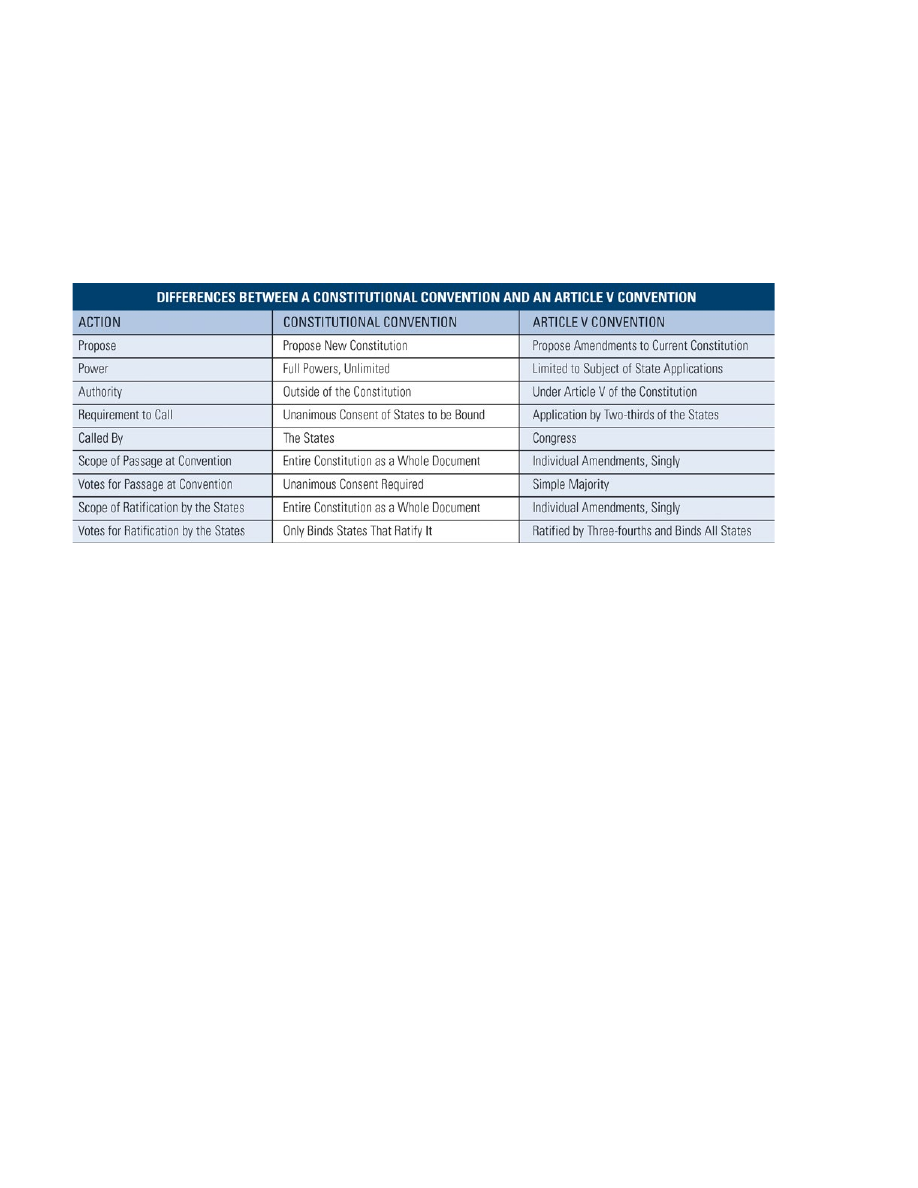
An Article V convention to propose amendments is not the same as a
“Constitutional Convention.” At a constitutional convention such as the one in 1787, the
states gather pursuant to their reserved sovereignty and the basic right of the people to
“alter or abolish” their government as recognized in the Declaration of Independence.
At an Article V convention, on the other hand, the states gather pursuant to their power
under Article V, and are limited by its provisions.
The only power an Article V convention will have is the same power that Congress also
has under Article V every day it is in session–the power to
propose amendments
that
would be
added
to the Constitution (if ratified by 38 states) just like the 27 amendments
we already have.
12
1
Conventional Disinformation
Opponents of an Article V
c
onvention for
pr
oposing
a
mendments to the U.S. Constitution are stoking
fear with objections based upon disinformation.
A common objection to an Article V
c
onvention for
p
roposing
a
mendments is the belief that the
convention will “runaway” by ignoring the limitations placed on it. The Constitutional Convention of
1787 is often cited as an example of a runaway convention.
Limitations on a convention arise from two sources: the call and the commissions. The call is the first
resolution calling for a convention, and it places limitations on the convention as a whole. A commission
is a set of instructions a state legislature gives to its representatives (commissioners) and can be more
restrictive than the call.
The claim that the 1787 convention exceeded its call starts with incorrect identification of the call.
Consider the table on page
14
, listing each of the resolutions leading up to the 1787 convention. The
claim is made that the Continental Congress made the call on February 21, 1787 and restricted the
convention to revising the Articles of Confederation. How could this be the call if six states had already
selected and instructed their commissioners prior to February 21, 1787? How would those states know
the subject matter, date, and location of the convention? In fact, the Articles of Confederation did not
grant the Confederation Congress the power to call a Convention of the States.
It was Virginia that issued the call on November 23, 1786, without restricting the convention to revising
the Articles of Confederation. New York and Massachusetts did issue commissions that restricted their
commissioners to revising the Articles of Confederation, but the convention as a whole was not so
restricted.
There have been at least forty-two
state conventions
in our history (see the table on page
15)
, and not
one has deviated from the scope of its call (runaway). It is also worth noting in that same table that all
forty-two previous
state conventions
operated on the principle of one state, one vote.
Another common objection claims that we do not know how a
n Article V c
onvention would operate.
The list of forty-two previous
state conventions
would demonstrate that we have a great deal of
experience with operating
an Article V convention
. In addition, the operation of
an Article V convention
is
well established in a significant number of court cases on the subject. A sampling of these rulings can be
found in the table on page
16
.
Finally, it is self-evident that the framers knew exactly what they meant by a Convention of the States
when they drafted that mechanism into Article V because they were participating in a Convention of
the
States at the time! In essence, the founders were saying, “if the states desire to propose amendments
to the Constitution, use the same method we are using right now.”
The data in the following three tables is clear evidence that an Article V
c
onvention for
p
roposing
a
mendments is the safe, reliable, and time-tested method the framers intended for such a time as this.
Objection 6: A convention could change the ratification process just like the
Constitutional Convention did.
Response:
(excerpted from an article by Professor Rob Natelson):
● This misinterprets the power of the 1787 convention, which met under the
states’ reserved powers and not under the Articles of Confederation;
● This contradicts the specific words of Article V, which lays out how
amendments to “this Constitution” must be ratified;
● This contradicts 200+ years of Article V court decisions, which rule that every
actor in the amendment process must follow the rules laid out in Article V; and
● This defies reality: The convention has no military force nor even any existence
after adjournment. How will it enforce its decree? Call out the army?
Objection 7: The Article V process was intended only to correct drafting errors;
not to correct abuses of power.
Response:
At the Constitutional Convention in 1787, Col. George Mason promoted the
convention procedure specifically as a remedy for abuses of power by the national
government. A number of other historical documents confirm that this was the
Founders’ intention. (
https:%%articlevinfocenter.com/the-founders-pointed-to-article-v-as-a-\\ \\
cure-for-federal-abuse\\ \\
) \\ \\
Moreover, amendments have been used for this purpose before and have been \\ \\
extremely effective. The Eleventh Amendment was proposed by Congress and ratified \\ \\
by the states specifically to reverse a wrong Supreme Court decision, \\ \\
//Chisholm v. //\\ \\
//Georgia//\\ \\
, that had given the federal courts more jurisdiction than they should have had. \\ \\
The problem was corrected through the Article V amendment process. \\ \\
**Objection 8: An Article V convention would open up our beloved Constitution to **\\ \\
**massive changes, and the convention could even replace our entire Constitution **\\ \\
**with a new one. **\\ \\
\\ \\
**Response: **\\ \\
An Article V convention to propose amendments is not the same as a \\ \\
“Constitutional Convention.” At a constitutional convention such as the one in 1787, the \\ \\
states gather pursuant to their reserved sovereignty and the basic right of the people to \\ \\
“alter or abolish” their government as recognized in the Declaration of Independence. \\ \\
At an Article V convention, on the other hand, the states gather pursuant to their power \\ \\
under Article V, and are limited by its provisions. \\ \\
The only power an Article V convention will have is the same power that Congress also \\ \\
has under Article V every day it is in session–the power to \\ \\
//propose amendments //\\ \\
that \\ \\
would be \\ \\
//added//\\ \\
to the Constitution (if ratified by 38 states) just like the 27 amendments \\ \\
we already have. \\ \\
As was the case with the Bill of Rights, each amendment proposed by an Article V \\ \\
convention of the states would have to be ratified individually by 38 states. This is \\ \\
simply not a “re-writing” or “replacing” process. If the states wanted to do that, they \\ \\
would not need to use the Article V process. They would simply gather, as they did in \\ \\
1787, pursuant to their residual sovereignty. \\ \\
This chart highlights the distinctions between these two types of interstate conventions: \\ \\
\\ \\
\\ \\
\\ \\
\\ \\
{{:public:cb_mirror:files_4014_pdfto013.png?nolink&918x1188|}}\\ \\
**13**\\ \\
1 \\ \\
**Conventional Disinformation **\\ \\
Opponents of an Article V \\ \\
c\\ \\
onvention for \\ \\
pr\\ \\
oposing \\ \\
a\\ \\
mendments to the U.S. Constitution are stoking \\ \\
fear with objections based upon disinformation. \\ \\
A common objection to an Article V \\ \\
c\\ \\
onvention for \\ \\
p\\ \\
roposing \\ \\
a\\ \\
mendments is the belief that the \\ \\
convention will “runaway” by ignoring the limitations placed on it. The Constitutional Convention of \\ \\
1787 is often cited as an example of a runaway convention. \\ \\
Limitations on a convention arise from two sources: the call and the commissions. The call is the first \\ \\
resolution calling for a convention, and it places limitations on the convention as a whole. A commission \\ \\
is a set of instructions a state legislature gives to its representatives (commissioners) and can be more \\ \\
restrictive than the call. \\ \\
The claim that the 1787 convention exceeded its call starts with incorrect identification of the call. \\ \\
Consider the table on page \\ \\
14\\ \\
, listing each of the resolutions leading up to the 1787 convention. The \\ \\
claim is made that the Continental Congress made the call on February 21, 1787 and restricted the \\ \\
convention to revising the Articles of Confederation. How could this be the call if six states had already \\ \\
selected and instructed their commissioners prior to February 21, 1787? How would those states know \\ \\
the subject matter, date, and location of the convention? In fact, the Articles of Confederation did not \\ \\
grant the Confederation Congress the power to call a Convention of the States. \\ \\
It was Virginia that issued the call on November 23, 1786, without restricting the convention to revising \\ \\
the Articles of Confederation. New York and Massachusetts did issue commissions that restricted their \\ \\
commissioners to revising the Articles of Confederation, but the convention as a whole was not so \\ \\
restricted. \\ \\
There have been at least forty-two \\ \\
state conventions\\ \\
in our history (see the table on page \\ \\
15)\\ \\
, and not \\ \\
one has deviated from the scope of its call (runaway). It is also worth noting in that same table that all \\ \\
forty-two previous \\ \\
state conventions\\ \\
operated on the principle of one state, one vote. \\ \\
Another common objection claims that we do not know how a\\ \\
n Article V c\\ \\
onvention would operate. \\ \\
The list of forty-two previous \\ \\
state conventions\\ \\
would demonstrate that we have a great deal of \\ \\
experience with operating \\ \\
an Article V convention\\ \\
. In addition, the operation of \\ \\
an Article V convention\\ \\
is \\ \\
well established in a significant number of court cases on the subject. A sampling of these rulings can be \\ \\
found in the table on page \\ \\
16\\ \\
. \\ \\
Finally, it is self-evident that the framers knew exactly what they meant by a Convention of the States \\ \\
when they drafted that mechanism into Article V because they were participating in a Convention of \\ \\
the \\ \\
States at the time! In essence, the founders were saying, “if the states desire to propose amendments \\ \\
to the Constitution, use the same method we are using right now.” \\ \\
The data in the following three tables is clear evidence that an Article V \\ \\
c\\ \\
onvention for \\ \\
p\\ \\
roposing \\ \\
a\\ \\
mendments is the safe, reliable, and time-tested method the framers intended for such a time as this. \\ \\
**Objection 6: A convention could change the ratification process just like the **\\ \\
**Constitutional Convention did. **\\ \\
**Response: **\\ \\
(excerpted from an article by Professor Rob Natelson): \\ \\
● This misinterprets the power of the 1787 convention, which met under the\\ \\
states’ reserved powers and not under the Articles of Confederation;\\ \\
● This contradicts the specific words of Article V, which lays out how\\ \\
amendments to “this Constitution” must be ratified;\\ \\
● This contradicts 200+ years of Article V court decisions, which rule that every\\ \\
actor in the amendment process must follow the rules laid out in Article V; and\\ \\
● This defies reality: The convention has no military force nor even any existence\\ \\
after adjournment. How will it enforce its decree? Call out the army?\\ \\
**Objection 7: The Article V process was intended only to correct drafting errors; **\\ \\
**not to correct abuses of power. **\\ \\
**Response: **\\ \\
At the Constitutional Convention in 1787, Col. George Mason promoted the \\ \\
convention procedure specifically as a remedy for abuses of power by the national \\ \\
government. A number of other historical documents confirm that this was the \\ \\
Founders’ intention. (\\ \\
https:%%articlevinfocenter.com/the-founders-pointed-to-article-v-as-a-
cure-for-federal-abuse
)
Moreover, amendments have been used for this purpose before and have been
extremely effective. The Eleventh Amendment was proposed by Congress and ratified
by the states specifically to reverse a wrong Supreme Court decision,
Chisholm v.
Georgia
, that had given the federal courts more jurisdiction than they should have had.
The problem was corrected through the Article V amendment process.
Objection 8: An Article V convention would open up our beloved Constitution to
massive changes, and the convention could even replace our entire Constitution
with a new one.
Response:
An Article V convention to propose amendments is not the same as a
“Constitutional Convention.” At a constitutional convention such as the one in 1787, the
states gather pursuant to their reserved sovereignty and the basic right of the people to
“alter or abolish” their government as recognized in the Declaration of Independence.
At an Article V convention, on the other hand, the states gather pursuant to their power
under Article V, and are limited by its provisions.
The only power an Article V convention will have is the same power that Congress also
has under Article V every day it is in session–the power to
propose amendments
that
would be
added
to the Constitution (if ratified by 38 states) just like the 27 amendments
we already have.
As was the case with the Bill of Rights, each amendment proposed by an Article V
convention of the states would have to be ratified individually by 38 states. This is
simply not a “re-writing” or “replacing” process. If the states wanted to do that, they
would not need to use the Article V process. They would simply gather, as they did in
1787, pursuant to their residual sovereignty.
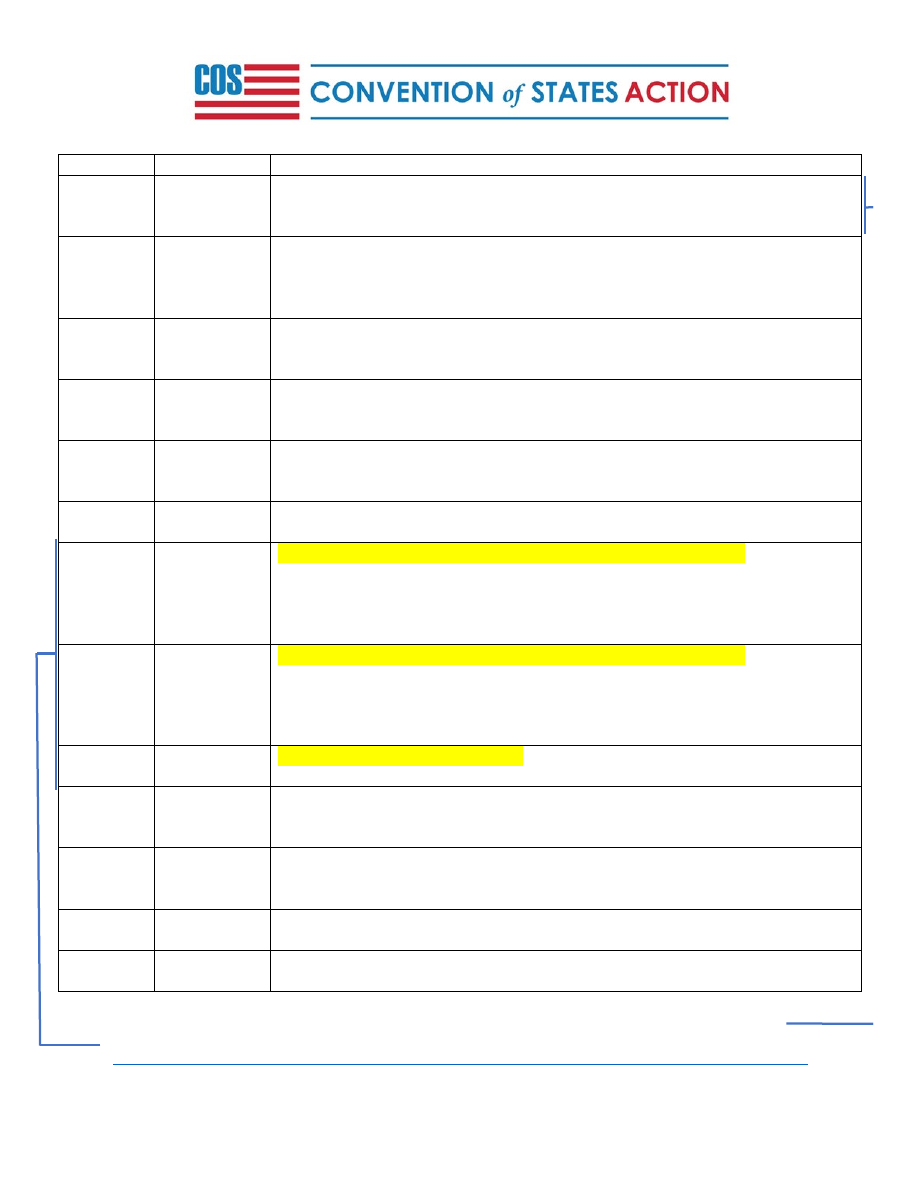
This chart highlights the distinctions between these two types of interstate conventions:
14
3
42 Historical
State Conventions
YYeeaarr
LLooccaattiioonn
PPuurrppoossee
VVoottiinngg
RRuunnaawwaayy
1677
Albany
Indian negotiations
1 State 1 Vote
No
1684
Albany
Indian negotiations
1 State 1 Vote
No
1689
Boston
Defense issues
1 State 1 Vote
No
1689
Albany
Indian negotiations
1 State 1 Vote
No
1690
New York City
Defense
1 State 1 Vote
No
1693
New York City
Defense
1 State 1 Vote
No
1694
Albany
Indian negotiations
1 State 1 Vote
No
1704
New York City
Defense
1 State 1 Vote
No
1711
Boston
Defense
1 State 1 Vote
No
1722
Albany
Indian negotiations
1 State 1 Vote
No
1744
Albany
Defense
1 State 1 Vote
No
1744
Lancaster
Indian negotiations
1 State 1 Vote
No
1745
Albany
Defense
1 State 1 Vote
No
1745
Albany
Indian negotiations
1 State 1 Vote
No
1747
New York City
Defense
1 State 1 Vote
No
1751
Albany
Indian negotiations
1 State 1 Vote
No
1754
Albany
Indian negotiations and plan of union
1 State 1 Vote
No
1765
New York City
Response to Stamp Act
1 State 1 Vote
No
1768
Fort Stanwyx
Indian negotiations
1 State 1 Vote
No
1774
New York City
Response to British actions
1 State 1 Vote
No
1776-77 Providence, RI
Paper currency and public credit
1 State 1 Vote
No
1777
Yorktown, PA
Price control
1 State 1 Vote
No
1777
Springfield, MA
Economic issues
1 State 1 Vote
No
1778
New Haven, CT
Price controls and other responses to inflation
1 State 1 Vote
No
1779
Hartford, CT
Economic issues
1 State 1 Vote
No
1780
Philadelphia, PA
Price controls
1 State 1 Vote
No
1780
Boston, MA
Conduct of Revolutionary War
1 State 1 Vote
No
1780
Hartford, CT
Conduct of Revolutionary War
1 State 1 Vote
No
1781
Providence, RI
War supply
1 State 1 Vote
No
1786
Annapolis, MD
Trade
1 State 1 Vote
No
1787
Philadelphia, PA
Propose changes to political system
1 State 1 Vote
No
1814
Hartford, CT
New England states response to the war of 1812 1 State 1 Vote
No
1850
Nashville, TN
Southern response to the North
1 State 1 Vote
No
1861
Washington, DC
Propose a constitutional amendment
1 State 1 Vote
No
1861
Montgomery, AL
Write the Confederate Constitution
1 State 1 Vote
No
1889
St. Louis, MO
Propose anti-trust measures
1 State 1 Vote
No
1922
Santa Fe, NM
Negotiate the Colorado River Compact
1 State 1 Vote
No
1928-29 Santa Fe, NM
Negotiate temporary Rio Grande Compact
1 State 1 Vote
No
1928-38 Colorado Springs, CO
Santa Fe, NM
Negotiate the Rio Grande Compact
1 State 1 Vote
No
1937
Santa Fe, NM
Negotiate the Rio Grande Compact
1 State 1 Vote
No
1946-49 Denver, CO
Negotiate the Upper Colorado River Basin
Compact
1 State 1 Vote
No
2017
Phoenix, AZ
Propose rules for an Article V convention to
propose a balanced budget
1 State 1 Vote
No
https:%%articlevinfocenter.com/list-conventions-states-colonies-american-history/\\ \\
\\ \\
https:%%articlevinfocenter.com/no-a-convention-of-states-could-not-change-the-one-state-one-vote-
rule/
2
The 1787 Constitutional Convention Call and Commissions
Date
State
Commission
11/23/1786
Virginia
devising and discussing all such alterations and further provisions, as may be
necessary to render the Federal Constitution adequate to the exigencies of the
Union. [meet Second Monday in May 1787 in Philadelphia]
11/24/1786
New Jersey
for the purpose of taking into consideration the state of the Union as to trade and
other important objects, and of devising such further provisions as shall appear
necessary to render the Constitution of the federal government adequate to the
exigencies thereof
12/3/1786
Pennsylvania devising, deliberating on, and discussing all such alterations and further provisions as
may be necessary to render the foederal constitution fully adequate to the exigencies
of the Union
1/6/1787 North Carolina To discuss and decide upon the most effectual means to remove the defects of our
foederal union, and to procure the enlarged purposes which it was intended to
effect.
2/3/1787
Delaware
devising, deliberating on, and discussing, such Alterations and further Provisions, as
may be necessary to render the Foederal Constitution adequate to the Exigencies of
the Union [each State shall have one vote]
2/10/1787
Georgia
Devising and discussing all such alterations and farther provisions, as may be
necessary to render the federal constitution adequate to the exigencies of the union.
2/21/1787 Confederation
Congress
the sole and express purpose of revising the Articles of Confederation and reporting
to Congress and the several legislatures such alterations and provisions therein as
shall when agreed to in Congress and confirmed by the states render the federal
constitution adequate to the exigencies of government and the preservation of the
Union.
3/6/1787
New York
the sole and express purpose of revising the Articles of Confederation and reporting
to Congress and the several legislatures such alterations and provisions therein as
shall when agreed to in Congress and confirmed by the states render the federal
constitution adequate to the exigencies of government and the preservation of the
Union.
3/7/1787 Massachusetts amend the Articles of Confederation to render the federal constitution adequate to
the exigencies of government and the preservation of the union.
3/8/1787 South Carolina in devising and discussing all such alterations, clauses, articles and provisions as may
be thought necessary to render the foederal constitution entirely adequate to the
actual situation and future good government of the confederated states
5/17/1787
Connecticut Such Alterations and Provisions, agreeable to the general Principles of Republican
Government, as they shall think proper, to render the foederal Constitution adequate
to the Exigencies of Government, and the Preservation of the Union.
5/26/1787
Maryland
considering such alterations, and further provisions, as may be necessary to render
the federal constitution adequate for the exigencies of the union.
6/27/1787
New
Hampshire
in devising and discussing all such alterations and further provisions as to render the
federal constitution adequate to the exigencies of the Union.
Because it is first, the Virginia resolution is the call, placing limitations on the convention as a whole.
These cannot be the call, because six states had already selected and instructed their commissioners.
https:%%conventionofstates.com/files/defying-conventional-wisdom-the-constitution-was-not-the-product-of-a-runaway-convention-by-michael-farris-1\\ \\
\\ \\
3 \\ \\
**42 Historical **\\ \\
**State Conventions**\\ \\
\\ \\
YYeeaarr \\ \\
LLooccaattiioonn \\ \\
PPuurrppoossee \\ \\
VVoottiinngg \\ \\
RRuunnaawwaayy \\ \\
1677 \\ \\
Albany \\ \\
Indian negotiations \\ \\
1 State 1 Vote \\ \\
No \\ \\
1684\\ \\
Albany\\ \\
Indian negotiations\\ \\
1 State 1 Vote\\ \\
No\\ \\
1689 \\ \\
Boston \\ \\
Defense issues \\ \\
1 State 1 Vote \\ \\
No \\ \\
1689 \\ \\
Albany \\ \\
Indian negotiations \\ \\
1 State 1 Vote \\ \\
No \\ \\
1690 \\ \\
New York City \\ \\
Defense \\ \\
1 State 1 Vote \\ \\
No \\ \\
1693 \\ \\
New York City \\ \\
Defense \\ \\
1 State 1 Vote \\ \\
No \\ \\
1694 \\ \\
Albany \\ \\
Indian negotiations \\ \\
1 State 1 Vote \\ \\
No \\ \\
1704 \\ \\
New York City \\ \\
Defense \\ \\
1 State 1 Vote \\ \\
No \\ \\
1711 \\ \\
Boston \\ \\
Defense \\ \\
1 State 1 Vote \\ \\
No \\ \\
1722 \\ \\
Albany \\ \\
Indian negotiations \\ \\
1 State 1 Vote \\ \\
No \\ \\
1744 \\ \\
Albany \\ \\
Defense \\ \\
1 State 1 Vote \\ \\
No \\ \\
1744 \\ \\
Lancaster \\ \\
Indian negotiations \\ \\
1 State 1 Vote \\ \\
No \\ \\
1745 \\ \\
Albany \\ \\
Defense \\ \\
1 State 1 Vote \\ \\
No \\ \\
1745\\ \\
Albany\\ \\
Indian negotiations\\ \\
1 State 1 Vote\\ \\
No\\ \\
1747 \\ \\
New York City \\ \\
Defense \\ \\
1 State 1 Vote \\ \\
No \\ \\
1751 \\ \\
Albany \\ \\
Indian negotiations \\ \\
1 State 1 Vote \\ \\
No \\ \\
1754 \\ \\
Albany \\ \\
Indian negotiations and plan of union \\ \\
1 State 1 Vote \\ \\
No \\ \\
1765 \\ \\
New York City \\ \\
Response to Stamp Act \\ \\
1 State 1 Vote \\ \\
No \\ \\
1768 \\ \\
Fort Stanwyx \\ \\
Indian negotiations \\ \\
1 State 1 Vote \\ \\
No \\ \\
1774 \\ \\
New York City \\ \\
Response to British actions \\ \\
1 State 1 Vote \\ \\
No \\ \\
1776-77 Providence, RI \\ \\
Paper currency and public credit \\ \\
1 State 1 Vote \\ \\
No \\ \\
1777 \\ \\
Yorktown, PA \\ \\
Price control \\ \\
1 State 1 Vote \\ \\
No \\ \\
1777 \\ \\
Springfield, MA \\ \\
Economic issues \\ \\
1 State 1 Vote \\ \\
No \\ \\
1778 \\ \\
New Haven, CT \\ \\
Price controls and other responses to inflation \\ \\
1 State 1 Vote \\ \\
No \\ \\
1779 \\ \\
Hartford, CT \\ \\
Economic issues \\ \\
1 State 1 Vote \\ \\
No \\ \\
1780\\ \\
Philadelphia, PA\\ \\
Price controls\\ \\
1 State 1 Vote\\ \\
No\\ \\
1780 \\ \\
Boston, MA \\ \\
Conduct of Revolutionary War \\ \\
1 State 1 Vote \\ \\
No \\ \\
1780 \\ \\
Hartford, CT \\ \\
Conduct of Revolutionary War \\ \\
1 State 1 Vote \\ \\
No \\ \\
1781 \\ \\
Providence, RI \\ \\
War supply \\ \\
1 State 1 Vote \\ \\
No \\ \\
1786 \\ \\
Annapolis, MD \\ \\
Trade \\ \\
1 State 1 Vote \\ \\
No \\ \\
1787 \\ \\
Philadelphia, PA \\ \\
Propose changes to political system \\ \\
1 State 1 Vote \\ \\
No \\ \\
1814 \\ \\
Hartford, CT \\ \\
New England states response to the war of 1812 1 State 1 Vote \\ \\
No \\ \\
1850 \\ \\
Nashville, TN \\ \\
Southern response to the North \\ \\
1 State 1 Vote \\ \\
No \\ \\
1861 \\ \\
Washington, DC \\ \\
Propose a constitutional amendment \\ \\
1 State 1 Vote \\ \\
No \\ \\
1861 \\ \\
Montgomery, AL \\ \\
Write the Confederate Constitution \\ \\
1 State 1 Vote \\ \\
No \\ \\
1889 \\ \\
St. Louis, MO \\ \\
Propose anti-trust measures \\ \\
1 State 1 Vote \\ \\
No \\ \\
1922 \\ \\
Santa Fe, NM \\ \\
Negotiate the Colorado River Compact \\ \\
1 State 1 Vote \\ \\
No \\ \\
1928-29 Santa Fe, NM\\ \\
Negotiate temporary Rio Grande Compact\\ \\
1 State 1 Vote\\ \\
No\\ \\
1928-38 Colorado Springs, CO \\ \\
Santa Fe, NM \\ \\
Negotiate the Rio Grande Compact \\ \\
1 State 1 Vote \\ \\
No \\ \\
1937 \\ \\
Santa Fe, NM \\ \\
Negotiate the Rio Grande Compact \\ \\
1 State 1 Vote \\ \\
No \\ \\
1946-49 Denver, CO \\ \\
Negotiate the Upper Colorado River Basin \\ \\
Compact \\ \\
1 State 1 Vote \\ \\
No \\ \\
2017 \\ \\
Phoenix, AZ \\ \\
Propose rules for an Article V convention to \\ \\
propose a balanced budget \\ \\
1 State 1 Vote \\ \\
No \\ \\
https:%%articlevinfocenter.com/list-conventions-states-colonies-american-history/
https:%%articlevinfocenter.com/no-a-convention-of-states-could-not-change-the-one-state-one-vote-\\ \\
rule/\\ \\
\\ \\
\\ \\
2 \\ \\
\\ \\
**The 1787 Constitutional Convention Call and Commissions **\\ \\
**Date **\\ \\
**State **\\ \\
**Commission **\\ \\
11/23/1786 \\ \\
Virginia \\ \\
devising and discussing all such alterations and further provisions, as may be \\ \\
necessary to render the Federal Constitution adequate to the exigencies of the \\ \\
Union. [meet Second Monday in May 1787 in Philadelphia] \\ \\
11/24/1786 \\ \\
New Jersey \\ \\
for the purpose of taking into consideration the state of the Union as to trade and \\ \\
other important objects, and of devising such further provisions as shall appear \\ \\
necessary to render the Constitution of the federal government adequate to the \\ \\
exigencies thereof \\ \\
12/3/1786 \\ \\
Pennsylvania devising, deliberating on, and discussing all such alterations and further provisions as \\ \\
may be necessary to render the foederal constitution fully adequate to the exigencies \\ \\
of the Union \\ \\
1/6/1787 North Carolina To discuss and decide upon the most effectual means to remove the defects of our \\ \\
foederal union, and to procure the enlarged purposes which it was intended to \\ \\
effect. \\ \\
2/3/1787 \\ \\
Delaware \\ \\
devising, deliberating on, and discussing, such Alterations and further Provisions, as \\ \\
may be necessary to render the Foederal Constitution adequate to the Exigencies of \\ \\
the Union [each State shall have one vote] \\ \\
2/10/1787 \\ \\
Georgia \\ \\
Devising and discussing all such alterations and farther provisions, as may be \\ \\
necessary to render the federal constitution adequate to the exigencies of the union. \\ \\
2/21/1787 Confederation \\ \\
Congress \\ \\
the sole and express purpose of revising the Articles of Confederation and reporting \\ \\
to Congress and the several legislatures such alterations and provisions therein as \\ \\
shall when agreed to in Congress and confirmed by the states render the federal \\ \\
constitution adequate to the exigencies of government and the preservation of the \\ \\
Union. \\ \\
3/6/1787 \\ \\
New York \\ \\
the sole and express purpose of revising the Articles of Confederation and reporting \\ \\
to Congress and the several legislatures such alterations and provisions therein as \\ \\
shall when agreed to in Congress and confirmed by the states render the federal \\ \\
constitution adequate to the exigencies of government and the preservation of the \\ \\
Union. \\ \\
3/7/1787 Massachusetts amend the Articles of Confederation to render the federal constitution adequate to \\ \\
the exigencies of government and the preservation of the union. \\ \\
3/8/1787 South Carolina in devising and discussing all such alterations, clauses, articles and provisions as may \\ \\
be thought necessary to render the foederal constitution entirely adequate to the \\ \\
actual situation and future good government of the confederated states \\ \\
5/17/1787 \\ \\
Connecticut Such Alterations and Provisions, agreeable to the general Principles of Republican \\ \\
Government, as they shall think proper, to render the foederal Constitution adequate \\ \\
to the Exigencies of Government, and the Preservation of the Union. \\ \\
5/26/1787 \\ \\
Maryland \\ \\
considering such alterations, and further provisions, as may be necessary to render \\ \\
the federal constitution adequate for the exigencies of the union. \\ \\
6/27/1787 \\ \\
New \\ \\
Hampshire \\ \\
in devising and discussing all such alterations and further provisions as to render the \\ \\
federal constitution adequate to the exigencies of the Union. \\ \\
\\ \\
Because it is first, the Virginia resolution is the call, placing limitations on the convention as a whole.\\ \\
\\ \\
These cannot be the call, because six states had already selected and instructed their commissioners. \\ \\
https:%%conventionofstates.com/files/defying-conventional-wisdom-the-constitution-was-not-the-product-of-a-runaway-convention-by-michael-farris-1
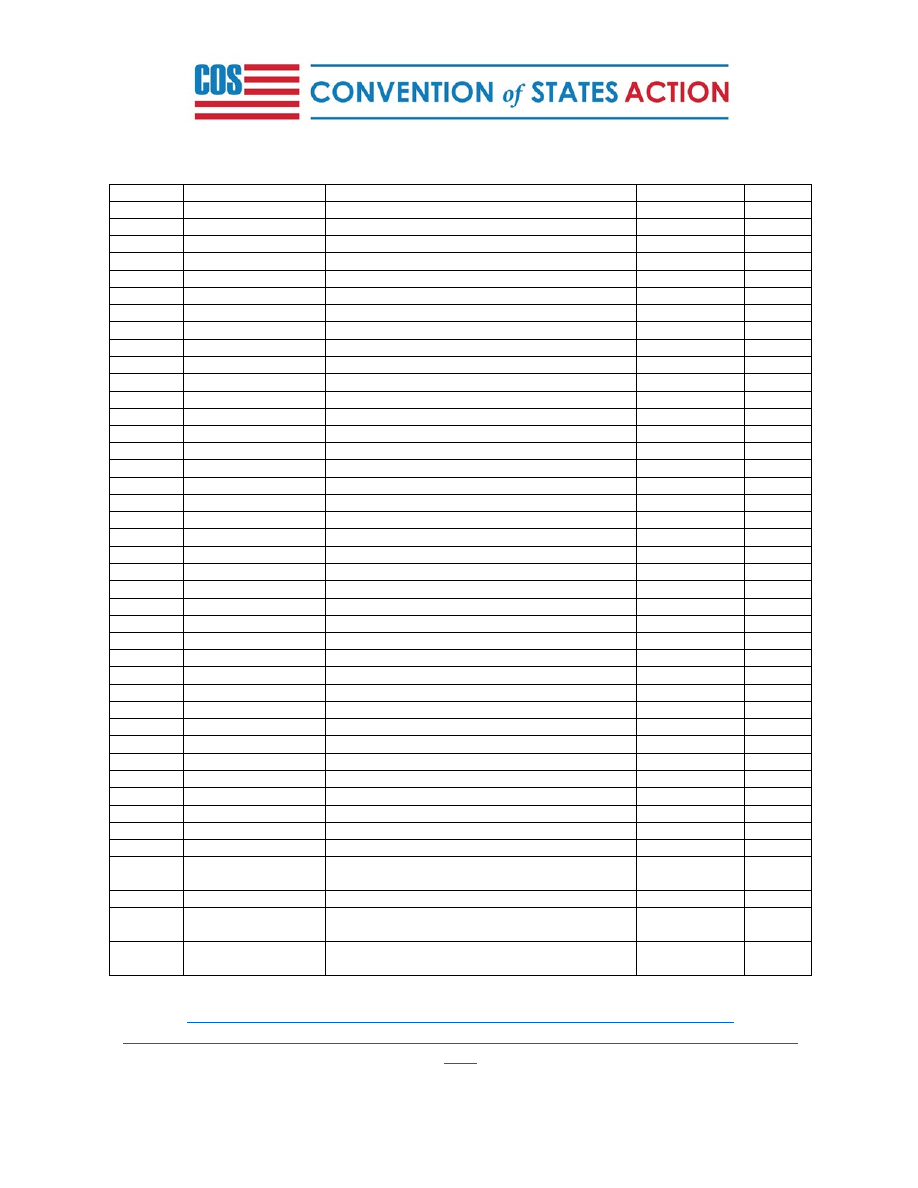
15
3
42 Historical
State Conventions
YYeeaarr
LLooccaattiioonn
PPuurrppoossee
VVoottiinngg
RRuunnaawwaayy
1677
Albany
Indian negotiations
1 State 1 Vote
No
1684
Albany
Indian negotiations
1 State 1 Vote
No
1689
Boston
Defense issues
1 State 1 Vote
No
1689
Albany
Indian negotiations
1 State 1 Vote
No
1690
New York City
Defense
1 State 1 Vote
No
1693
New York City
Defense
1 State 1 Vote
No
1694
Albany
Indian negotiations
1 State 1 Vote
No
1704
New York City
Defense
1 State 1 Vote
No
1711
Boston
Defense
1 State 1 Vote
No
1722
Albany
Indian negotiations
1 State 1 Vote
No
1744
Albany
Defense
1 State 1 Vote
No
1744
Lancaster
Indian negotiations
1 State 1 Vote
No
1745
Albany
Defense
1 State 1 Vote
No
1745
Albany
Indian negotiations
1 State 1 Vote
No
1747
New York City
Defense
1 State 1 Vote
No
1751
Albany
Indian negotiations
1 State 1 Vote
No
1754
Albany
Indian negotiations and plan of union
1 State 1 Vote
No
1765
New York City
Response to Stamp Act
1 State 1 Vote
No
1768
Fort Stanwyx
Indian negotiations
1 State 1 Vote
No
1774
New York City
Response to British actions
1 State 1 Vote
No
1776-77 Providence, RI
Paper currency and public credit
1 State 1 Vote
No
1777
Yorktown, PA
Price control
1 State 1 Vote
No
1777
Springfield, MA
Economic issues
1 State 1 Vote
No
1778
New Haven, CT
Price controls and other responses to inflation
1 State 1 Vote
No
1779
Hartford, CT
Economic issues
1 State 1 Vote
No
1780
Philadelphia, PA
Price controls
1 State 1 Vote
No
1780
Boston, MA
Conduct of Revolutionary War
1 State 1 Vote
No
1780
Hartford, CT
Conduct of Revolutionary War
1 State 1 Vote
No
1781
Providence, RI
War supply
1 State 1 Vote
No
1786
Annapolis, MD
Trade
1 State 1 Vote
No
1787
Philadelphia, PA
Propose changes to political system
1 State 1 Vote
No
1814
Hartford, CT
New England states response to the war of 1812 1 State 1 Vote
No
1850
Nashville, TN
Southern response to the North
1 State 1 Vote
No
1861
Washington, DC
Propose a constitutional amendment
1 State 1 Vote
No
1861
Montgomery, AL
Write the Confederate Constitution
1 State 1 Vote
No
1889
St. Louis, MO
Propose anti-trust measures
1 State 1 Vote
No
1922
Santa Fe, NM
Negotiate the Colorado River Compact
1 State 1 Vote
No
1928-29 Santa Fe, NM
Negotiate temporary Rio Grande Compact
1 State 1 Vote
No
1928-38 Colorado Springs, CO
Santa Fe, NM
Negotiate the Rio Grande Compact
1 State 1 Vote
No
1937
Santa Fe, NM
Negotiate the Rio Grande Compact
1 State 1 Vote
No
1946-49 Denver, CO
Negotiate the Upper Colorado River Basin
Compact
1 State 1 Vote
No
2017
Phoenix, AZ
Propose rules for an Article V convention to
propose a balanced budget
1 State 1 Vote
No
https:%%articlevinfocenter.com/list-conventions-states-colonies-american-history/\\ \\
\\ \\
https:%%articlevinfocenter.com/no-a-convention-of-states-could-not-change-the-one-state-one-vote-
rule/
2
The 1787 Constitutional Convention Call and Commissions
Date
State
Commission
11/23/1786
Virginia
devising and discussing all such alterations and further provisions, as may be
necessary to render the Federal Constitution adequate to the exigencies of the
Union. [meet Second Monday in May 1787 in Philadelphia]
11/24/1786
New Jersey
for the purpose of taking into consideration the state of the Union as to trade and
other important objects, and of devising such further provisions as shall appear
necessary to render the Constitution of the federal government adequate to the
exigencies thereof
12/3/1786
Pennsylvania devising, deliberating on, and discussing all such alterations and further provisions as
may be necessary to render the foederal constitution fully adequate to the exigencies
of the Union
1/6/1787 North Carolina To discuss and decide upon the most effectual means to remove the defects of our
foederal union, and to procure the enlarged purposes which it was intended to
effect.
2/3/1787
Delaware
devising, deliberating on, and discussing, such Alterations and further Provisions, as
may be necessary to render the Foederal Constitution adequate to the Exigencies of
the Union [each State shall have one vote]
2/10/1787
Georgia
Devising and discussing all such alterations and farther provisions, as may be
necessary to render the federal constitution adequate to the exigencies of the union.
2/21/1787 Confederation
Congress
the sole and express purpose of revising the Articles of Confederation and reporting
to Congress and the several legislatures such alterations and provisions therein as
shall when agreed to in Congress and confirmed by the states render the federal
constitution adequate to the exigencies of government and the preservation of the
Union.
3/6/1787
New York
the sole and express purpose of revising the Articles of Confederation and reporting
to Congress and the several legislatures such alterations and provisions therein as
shall when agreed to in Congress and confirmed by the states render the federal
constitution adequate to the exigencies of government and the preservation of the
Union.
3/7/1787 Massachusetts amend the Articles of Confederation to render the federal constitution adequate to
the exigencies of government and the preservation of the union.
3/8/1787 South Carolina in devising and discussing all such alterations, clauses, articles and provisions as may
be thought necessary to render the foederal constitution entirely adequate to the
actual situation and future good government of the confederated states
5/17/1787
Connecticut Such Alterations and Provisions, agreeable to the general Principles of Republican
Government, as they shall think proper, to render the foederal Constitution adequate
to the Exigencies of Government, and the Preservation of the Union.
5/26/1787
Maryland
considering such alterations, and further provisions, as may be necessary to render
the federal constitution adequate for the exigencies of the union.
6/27/1787
New
Hampshire
in devising and discussing all such alterations and further provisions as to render the
federal constitution adequate to the exigencies of the Union.
Because it is first, the Virginia resolution is the call, placing limitations on the convention as a whole.
These cannot be the call, because six states had already selected and instructed their commissioners.
https:%%conventionofstates.com/files/defying-conventional-wisdom-the-constitution-was-not-the-product-of-a-runaway-convention-by-michael-farris-1\\ \\
\\ \\
3 \\ \\
**42 Historical **\\ \\
**State Conventions**\\ \\
\\ \\
YYeeaarr \\ \\
LLooccaattiioonn \\ \\
PPuurrppoossee \\ \\
VVoottiinngg \\ \\
RRuunnaawwaayy \\ \\
1677 \\ \\
Albany \\ \\
Indian negotiations \\ \\
1 State 1 Vote \\ \\
No \\ \\
1684\\ \\
Albany\\ \\
Indian negotiations\\ \\
1 State 1 Vote\\ \\
No\\ \\
1689 \\ \\
Boston \\ \\
Defense issues \\ \\
1 State 1 Vote \\ \\
No \\ \\
1689 \\ \\
Albany \\ \\
Indian negotiations \\ \\
1 State 1 Vote \\ \\
No \\ \\
1690 \\ \\
New York City \\ \\
Defense \\ \\
1 State 1 Vote \\ \\
No \\ \\
1693 \\ \\
New York City \\ \\
Defense \\ \\
1 State 1 Vote \\ \\
No \\ \\
1694 \\ \\
Albany \\ \\
Indian negotiations \\ \\
1 State 1 Vote \\ \\
No \\ \\
1704 \\ \\
New York City \\ \\
Defense \\ \\
1 State 1 Vote \\ \\
No \\ \\
1711 \\ \\
Boston \\ \\
Defense \\ \\
1 State 1 Vote \\ \\
No \\ \\
1722 \\ \\
Albany \\ \\
Indian negotiations \\ \\
1 State 1 Vote \\ \\
No \\ \\
1744 \\ \\
Albany \\ \\
Defense \\ \\
1 State 1 Vote \\ \\
No \\ \\
1744 \\ \\
Lancaster \\ \\
Indian negotiations \\ \\
1 State 1 Vote \\ \\
No \\ \\
1745 \\ \\
Albany \\ \\
Defense \\ \\
1 State 1 Vote \\ \\
No \\ \\
1745\\ \\
Albany\\ \\
Indian negotiations\\ \\
1 State 1 Vote\\ \\
No\\ \\
1747 \\ \\
New York City \\ \\
Defense \\ \\
1 State 1 Vote \\ \\
No \\ \\
1751 \\ \\
Albany \\ \\
Indian negotiations \\ \\
1 State 1 Vote \\ \\
No \\ \\
1754 \\ \\
Albany \\ \\
Indian negotiations and plan of union \\ \\
1 State 1 Vote \\ \\
No \\ \\
1765 \\ \\
New York City \\ \\
Response to Stamp Act \\ \\
1 State 1 Vote \\ \\
No \\ \\
1768 \\ \\
Fort Stanwyx \\ \\
Indian negotiations \\ \\
1 State 1 Vote \\ \\
No \\ \\
1774 \\ \\
New York City \\ \\
Response to British actions \\ \\
1 State 1 Vote \\ \\
No \\ \\
1776-77 Providence, RI \\ \\
Paper currency and public credit \\ \\
1 State 1 Vote \\ \\
No \\ \\
1777 \\ \\
Yorktown, PA \\ \\
Price control \\ \\
1 State 1 Vote \\ \\
No \\ \\
1777 \\ \\
Springfield, MA \\ \\
Economic issues \\ \\
1 State 1 Vote \\ \\
No \\ \\
1778 \\ \\
New Haven, CT \\ \\
Price controls and other responses to inflation \\ \\
1 State 1 Vote \\ \\
No \\ \\
1779 \\ \\
Hartford, CT \\ \\
Economic issues \\ \\
1 State 1 Vote \\ \\
No \\ \\
1780\\ \\
Philadelphia, PA\\ \\
Price controls\\ \\
1 State 1 Vote\\ \\
No\\ \\
1780 \\ \\
Boston, MA \\ \\
Conduct of Revolutionary War \\ \\
1 State 1 Vote \\ \\
No \\ \\
1780 \\ \\
Hartford, CT \\ \\
Conduct of Revolutionary War \\ \\
1 State 1 Vote \\ \\
No \\ \\
1781 \\ \\
Providence, RI \\ \\
War supply \\ \\
1 State 1 Vote \\ \\
No \\ \\
1786 \\ \\
Annapolis, MD \\ \\
Trade \\ \\
1 State 1 Vote \\ \\
No \\ \\
1787 \\ \\
Philadelphia, PA \\ \\
Propose changes to political system \\ \\
1 State 1 Vote \\ \\
No \\ \\
1814 \\ \\
Hartford, CT \\ \\
New England states response to the war of 1812 1 State 1 Vote \\ \\
No \\ \\
1850 \\ \\
Nashville, TN \\ \\
Southern response to the North \\ \\
1 State 1 Vote \\ \\
No \\ \\
1861 \\ \\
Washington, DC \\ \\
Propose a constitutional amendment \\ \\
1 State 1 Vote \\ \\
No \\ \\
1861 \\ \\
Montgomery, AL \\ \\
Write the Confederate Constitution \\ \\
1 State 1 Vote \\ \\
No \\ \\
1889 \\ \\
St. Louis, MO \\ \\
Propose anti-trust measures \\ \\
1 State 1 Vote \\ \\
No \\ \\
1922 \\ \\
Santa Fe, NM \\ \\
Negotiate the Colorado River Compact \\ \\
1 State 1 Vote \\ \\
No \\ \\
1928-29 Santa Fe, NM\\ \\
Negotiate temporary Rio Grande Compact\\ \\
1 State 1 Vote\\ \\
No\\ \\
1928-38 Colorado Springs, CO \\ \\
Santa Fe, NM \\ \\
Negotiate the Rio Grande Compact \\ \\
1 State 1 Vote \\ \\
No \\ \\
1937 \\ \\
Santa Fe, NM \\ \\
Negotiate the Rio Grande Compact \\ \\
1 State 1 Vote \\ \\
No \\ \\
1946-49 Denver, CO \\ \\
Negotiate the Upper Colorado River Basin \\ \\
Compact \\ \\
1 State 1 Vote \\ \\
No \\ \\
2017 \\ \\
Phoenix, AZ \\ \\
Propose rules for an Article V convention to \\ \\
propose a balanced budget \\ \\
1 State 1 Vote \\ \\
No \\ \\
https:%%articlevinfocenter.com/list-conventions-states-colonies-american-history/
https:%%articlevinfocenter.com/no-a-convention-of-states-could-not-change-the-one-state-one-vote-\\ \\
rule/\\ \\
\\ \\
\\ \\
2 \\ \\
\\ \\
**The 1787 Constitutional Convention Call and Commissions **\\ \\
**Date **\\ \\
**State **\\ \\
**Commission **\\ \\
11/23/1786 \\ \\
Virginia \\ \\
devising and discussing all such alterations and further provisions, as may be \\ \\
necessary to render the Federal Constitution adequate to the exigencies of the \\ \\
Union. [meet Second Monday in May 1787 in Philadelphia] \\ \\
11/24/1786 \\ \\
New Jersey \\ \\
for the purpose of taking into consideration the state of the Union as to trade and \\ \\
other important objects, and of devising such further provisions as shall appear \\ \\
necessary to render the Constitution of the federal government adequate to the \\ \\
exigencies thereof \\ \\
12/3/1786 \\ \\
Pennsylvania devising, deliberating on, and discussing all such alterations and further provisions as \\ \\
may be necessary to render the foederal constitution fully adequate to the exigencies \\ \\
of the Union \\ \\
1/6/1787 North Carolina To discuss and decide upon the most effectual means to remove the defects of our \\ \\
foederal union, and to procure the enlarged purposes which it was intended to \\ \\
effect. \\ \\
2/3/1787 \\ \\
Delaware \\ \\
devising, deliberating on, and discussing, such Alterations and further Provisions, as \\ \\
may be necessary to render the Foederal Constitution adequate to the Exigencies of \\ \\
the Union [each State shall have one vote] \\ \\
2/10/1787 \\ \\
Georgia \\ \\
Devising and discussing all such alterations and farther provisions, as may be \\ \\
necessary to render the federal constitution adequate to the exigencies of the union. \\ \\
2/21/1787 Confederation \\ \\
Congress \\ \\
the sole and express purpose of revising the Articles of Confederation and reporting \\ \\
to Congress and the several legislatures such alterations and provisions therein as \\ \\
shall when agreed to in Congress and confirmed by the states render the federal \\ \\
constitution adequate to the exigencies of government and the preservation of the \\ \\
Union. \\ \\
3/6/1787 \\ \\
New York \\ \\
the sole and express purpose of revising the Articles of Confederation and reporting \\ \\
to Congress and the several legislatures such alterations and provisions therein as \\ \\
shall when agreed to in Congress and confirmed by the states render the federal \\ \\
constitution adequate to the exigencies of government and the preservation of the \\ \\
Union. \\ \\
3/7/1787 Massachusetts amend the Articles of Confederation to render the federal constitution adequate to \\ \\
the exigencies of government and the preservation of the union. \\ \\
3/8/1787 South Carolina in devising and discussing all such alterations, clauses, articles and provisions as may \\ \\
be thought necessary to render the foederal constitution entirely adequate to the \\ \\
actual situation and future good government of the confederated states \\ \\
5/17/1787 \\ \\
Connecticut Such Alterations and Provisions, agreeable to the general Principles of Republican \\ \\
Government, as they shall think proper, to render the foederal Constitution adequate \\ \\
to the Exigencies of Government, and the Preservation of the Union. \\ \\
5/26/1787 \\ \\
Maryland \\ \\
considering such alterations, and further provisions, as may be necessary to render \\ \\
the federal constitution adequate for the exigencies of the union. \\ \\
6/27/1787 \\ \\
New \\ \\
Hampshire \\ \\
in devising and discussing all such alterations and further provisions as to render the \\ \\
federal constitution adequate to the exigencies of the Union. \\ \\
\\ \\
Because it is first, the Virginia resolution is the call, placing limitations on the convention as a whole.\\ \\
\\ \\
These cannot be the call, because six states had already selected and instructed their commissioners. \\ \\
https:%%conventionofstates.com/files/defying-conventional-wisdom-the-constitution-was-not-the-product-of-a-runaway-convention-by-michael-farris-1
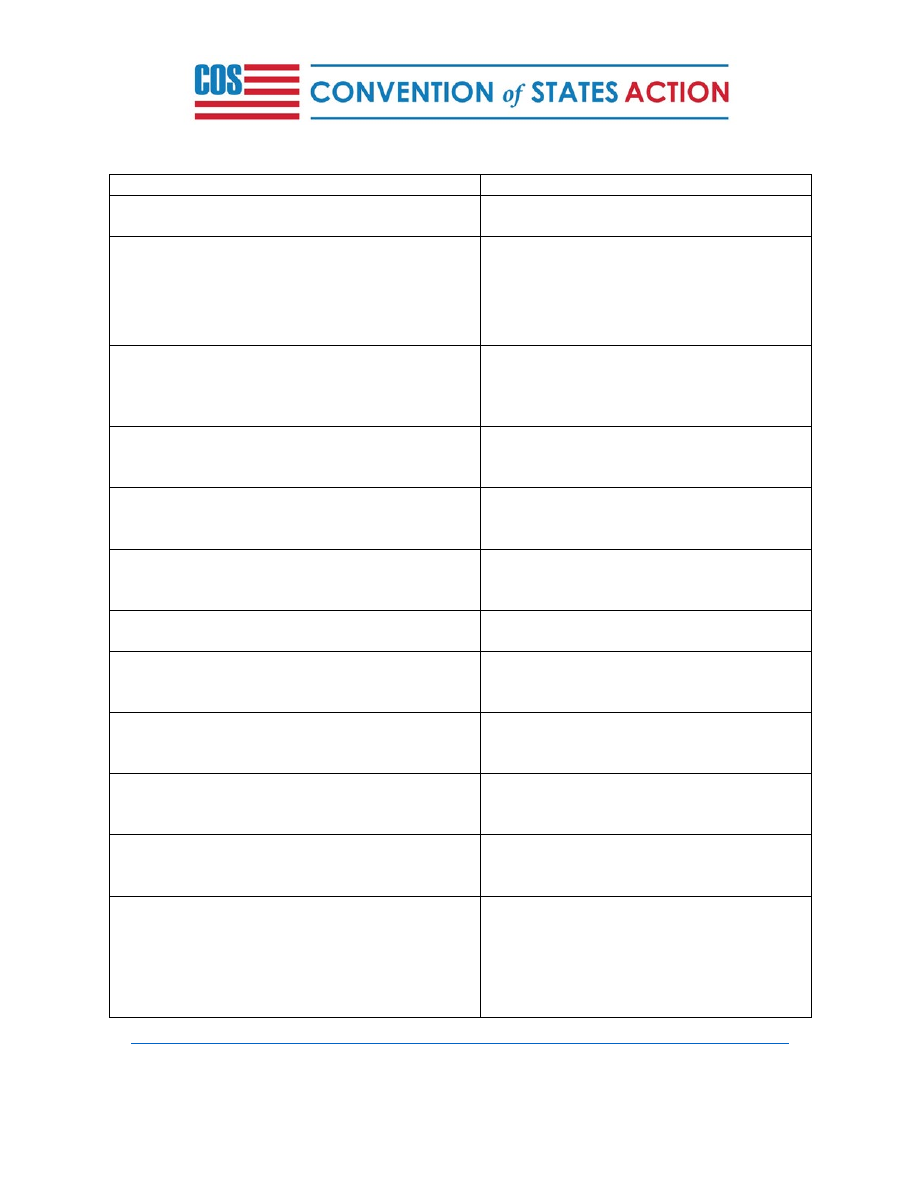
16
4
Selected Court Cases Related to Article V
Case
Holding
Barker v. Hazeltine, 3 F. Supp. 2d 1088 (D.S.D. 1998)
Article V is the only constitutional method of
amending the US Constitution.
Dodge v. Woolsey, 59 U.S. 331 (1855)
Amendatory conventions may be single issue.
T
he States and/or the people cannot
dictate the amendments. A state
application is valid solely because it was
made by the state.
Gralike v. Cooke, 191 F. 3d 911 (8
th
Cir. 1999)
Article V Conventions cannot be prohibited
from deliberation and consideration of a
proposed amendment and thereby limited to
pre-written wording.
Hollingsworth v. Virginia, 3 U.S. (3 Dall.) 378 (1798) No signature of the President is required for a
constitutional amendment to be valid and
complete.
In Re Opinion of the Justices, 204 N.C. 306, 172 S.E.
474 (1933)
An Article V Convention may be limited in
purpose to a single issue or to a fixed set of
issues.
Leser v. Garnett, 258 U.S. 130 (1922)
The state legislature’s discretion could not be
supplanted by the rules imposed by a third
party.
Opinion of the Justices to the Senate, 373 Mass. 877,
366 N.E. 2d 1226 (1977)
The governor plays no role in the approval
process of an Article V Convention application.
Prigg v. Commonwealth of Pennsylvania, 41 U.S. 539
(1842)
No one is authorized to question the validity
of a state’s application for an Article V
Convention.
Smith v. Union Bank of Georgetown, 30 U.S. 518
(1831)
An Article V Convention is a “convention of
the States” and is therefore endowed with the
powers of an interstate convention.
State of Rhode Island v. Palmer, 253 U.S. 320 (1920) An Article V Convention will require only two-
thirds of the quorum present to conduct
business.
Ullmann v. United States, 350 U.S. 422 (1956)
The amendment and ratification processes
cannot be changed to circumvent the Article V
Convention.
United States v. Thibault, 47 F.2d 169 (2d Cir. 1931)
The federal or national government is not
concerned with how an Article V Convention
of a state legislature is constituted. Therefore,
the Article V Convention is empowered to
organize and conduct its business as the
delegates or commissioners see fit.
https:%%rickbulow.com/Library/Books/Non-Fiction/ArticleV/FindingsOfCourtCasesRelatedToArticleVOfTheUnitedStatesConstitution.pdf\\ \\
\\ \\
\\ \\
PROBLEMS\\ \\
IN THE TESTIMONY OF\\ \\
ROBERT BROWN\\ \\
//**By Professor Rob Natelson**//\\ \\
\\ \\
{{:public:cb_mirror:files_4014_pdfto017.png?nolink&918x1188|}}\\ \\
**17**\\ \\
\\ \\
4 \\ \\
\\ \\
\\ \\
**Selected Court Cases Related to Article V **\\ \\
**Case **\\ \\
**Holding **\\ \\
//Barker v. Hazeltine//, 3 F. Supp. 2d 1088 (D.S.D. 1998) \\ \\
\\ \\
Article V is the only constitutional method of \\ \\
amending the US Constitution. \\ \\
//Dodge v. Woolsey//, 59 U.S. 331 (1855) \\ \\
Amendatory conventions may be single issue.\\ \\
** **\\ \\
**T**\\ \\
he States and/or the people cannot \\ \\
dictate the amendments. A state \\ \\
application is valid solely because it was \\ \\
made by the state.\\ \\
\\ \\
//Gralike v. Cooke//, 191 F. 3d 911 (8\\ \\
th \\ \\
Cir. 1999) \\ \\
Article V Conventions cannot be prohibited \\ \\
from deliberation and consideration of a \\ \\
proposed amendment and thereby limited to \\ \\
pre-written wording. \\ \\
//Hollingsworth v. Virginia, //3 U.S. (3 Dall.) 378 (1798) No signature of the President is required for a \\ \\
constitutional amendment to be valid and \\ \\
complete. \\ \\
//In Re Opinion of the Justices, //204 N.C. 306, 172 S.E. \\ \\
474 (1933) \\ \\
An Article V Convention may be limited in \\ \\
purpose to a single issue or to a fixed set of \\ \\
issues. \\ \\
//Leser v. Garnett, //258 U.S. 130 (1922) \\ \\
The state legislature’s discretion could not be \\ \\
supplanted by the rules imposed by a third \\ \\
party. \\ \\
//Opinion of the Justices to the Senate//, 373 Mass. 877, \\ \\
366 N.E. 2d 1226 (1977) \\ \\
The governor plays no role in the approval \\ \\
process of an Article V Convention application. \\ \\
//Prigg v. Commonwealth of Pennsylvania//, 41 U.S. 539 \\ \\
(1842) \\ \\
No one is authorized to question the validity \\ \\
of a state’s application for an Article V \\ \\
Convention. \\ \\
//Smith v. Union Bank of Georgetown, //30 U.S. 518 \\ \\
(1831) \\ \\
An Article V Convention is a “convention of \\ \\
the States” and is therefore endowed with the \\ \\
powers of an interstate convention. \\ \\
//State of Rhode Island v. Palmer, //253 U.S. 320 (1920) An Article V Convention will require only two-\\ \\
thirds of the quorum present to conduct \\ \\
business. \\ \\
//Ullmann v. United States//, 350 U.S. 422 (1956) \\ \\
The amendment and ratification processes \\ \\
cannot be changed to circumvent the Article V \\ \\
Convention. \\ \\
//United States v. Thibault, //47 F.2d 169 (2d Cir. 1931) \\ \\
The federal or national government is not \\ \\
concerned with how an Article V Convention \\ \\
of a state legislature is constituted. Therefore, \\ \\
the Article V Convention is empowered to \\ \\
organize and conduct its business as the \\ \\
delegates or commissioners see fit. \\ \\
\\ \\
https:%%rickbulow.com/Library/Books/Non-Fiction/ArticleV/FindingsOfCourtCasesRelatedToArticleVOfTheUnitedStatesConstitution.pdf
PROBLEMS
IN THE TESTIMONY OF
ROBERT BROWN
By Professor Rob Natelson

18
Problems in the Testimony of Robert Brown
By Robert G. Natelson
1
1
About the Author: Professor Natelson is the director of the Article V Information Center at the Independence Institute in
Denver and has published widely on many parts of the U.S. Constitution for the scholarly and popular markets. He is the most-
published active scholar on the Constitution’s amendment process, and the author of T
HE
L
AW
O
F
A
RTICLE
V, a legal treatise.
His research studies have been relied on by the highest courts of 16 states, by federal appeals courts in fi ve cases, and by U.S.
Supreme Court Justices in seven cases.
Professor Natelson has a degrees in history and law, the latter from Cornell University (J.D. 1973), where he was elected to
both the Cornell Law Review and the University Senate. (He chose the latter.) After practicing law (1974-85), he served as a
tenure-track and tenured professor of law (1985-2010).
Professor Natelson has split his professional experience between the public and private sectors. He also has extensive political
experience: In Montana, he led several successful statewide ballot campaigns to restrain taxes and spending, and he placed
second in a fi ve-candidate fi eld in the open party primaries for governor (2000). A more complete biography is at https://i2i.
org/about/our-people/rob-natelson/.
“It is much easier to alarm people than to inform them.”
—William Davie
Constitutional Convention Delegate
i

19
Problems in the Testimony of Robert Brown
By Robert G. Natelson
1
1
About the Author: Professor Natelson is the director of the Article V Information Center at the Independence Institute in
Denver and has published widely on many parts of the U.S. Constitution for the scholarly and popular markets. He is the most-
published active scholar on the Constitution’s amendment process, and the author of T
HE
L
AW
O
F
A
RTICLE
V, a legal treatise.
His research studies have been relied on by the highest courts of 16 states, by federal appeals courts in fi ve cases, and by U.S.
Supreme Court Justices in seven cases.
Professor Natelson has a degrees in history and law, the latter from Cornell University (J.D. 1973), where he was elected to
both the Cornell Law Review and the University Senate. (He chose the latter.) After practicing law (1974-85), he served as a
tenure-track and tenured professor of law (1985-2010).
Professor Natelson has split his professional experience between the public and private sectors. He also has extensive political
experience: In Montana, he led several successful statewide ballot campaigns to restrain taxes and spending, and he placed
second in a fi ve-candidate fi eld in the open party primaries for governor (2000). A more complete biography is at https://i2i.
org/about/our-people/rob-natelson/.
“It is much easier to alarm people than to inform them.”
—William Davie
Constitutional Convention Delegate
i

20
1
P
ROBLEMS
IN
THE
T
ESTIMONY
OF
R
OBERT
B
ROWN
I was enjoying success placing research articles in
academic journals on common legal topics. Then
I researched and composed an article on the
more exotic subject of classical Roman law, and I
submitted it to a peer-reviewed legal history journal.
A “peer reviewed” journal is called that because
other scholars anonymously examine and report
on your article before the journal agrees to
publish it. This ensures the contribution is well-
grounded and adds to human knowledge.
Based on peer review of my submission, the
journal’s editor rejected it and provided me with
a copy of the review to explain why.
The reviewer’s assessment was devastating. He
said it was obvious that I was writing without prior
education in Roman law—that I knew little about
scholarship in the fi eld, and, frankly, I was clueless
as to how much I didn’t know.
I was emotionally crushed, but I also recognized
that the reviewer was correct. And although the
reviewer could have remained anonymous, he
kindly disclosed his identity to me. He helped me
work through my disappointment. He outlined
what I needed to do before I could contribute
to the very specialized realm of Roman law. I
don’t remember all his recommendations, but I
do recall that one of them was to acquire some
formal education on the subject.2
The experience taught me that I had fallen into
the common error of undervaluing other people’s
specialties. (Think of all the disasters wrought by
overconfi dent husbands who imagine they can do
their own plumbing!) The experience also taught
me that when researching a subject, you should
gather as much information about it as possible:
Never limit your universe of sources.
The experience had some implications for the
reviewer as well. He told me he had a hard time
writing his assessment, precisely because my
paper lacked the foundation of basic knowledge
of the fi eld. If he were responding to a scholar who
had some foundational knowledge, the review
could have simply pointed out the mistakes, and
perhaps suggest ways to correct them. But to
respond eff ectively to a beginner, he also had to
outline and explain many of the fundamentals.
Later I learned how time consuming this is. For
example, when a lawyer has to thoroughly explain
a legal conclusion to a non-lawyer, the lawyer
fi rst must outline basic concepts taught in law
school before proceeding to the issue at hand.
The diffi culty increases exponentially when the
non-lawyer thinks he’s already an “expert” in the
subject, and has reached a diff erent conclusion.
Such people never want to believe the truth, so
the lawyer has to pile up sources to support the
most elementary propositions.
This is one reason lawyers tell each other, “Never
argue law with a non-lawyer.” Much the same is said
in other specialties as well, and often less politely.
E
arly in my 25-year career as a legal academic I had an
experience both humiliating and invaluable.
2
After additional research over several years, I was able to publish a related article that did not require as much specialized
knowledge: Robert G. Natelson, The Government as Fiduciary: Lessons from the Reign of the Emperor Trajan, 35
R
ICHMOND
L. R
EV
. 191 (2001).
2
C
ONVENTION
OF
S
TATES
This is such a case: Robert Brown is a novice who
promotes himself as an expert. So to explain why
his conclusions are incorrect you often have to
review the basics understood by all true experts.
That is why this paper is so long.
Background
Robert Brown is an employee of the John Birch
Society (JBS). Videos of his performances
before legislative committees show that he
holds himself out as a “nationally known
constitutional scholar.”3 He or JBS apparently
used like representations of expertise to obtain
an interview with Joshua Philipp of the Epoch
Times, an international newspaper.
However, Brown’s biography shows none of the
background or hard work necessary to make one
a constitutional scholar, much less a “nationally
known” one.4 There is no evidence of formal, or
even informal, training in law, history, or language.
A search of an academic database revealed no
evidence that he has published any scholarship
on the Constitution or on anything else.5
Brown’s biography shows none of the background or hard work necessary to make one a
constitutional scholar, much less a “nationally known” one. There is no evidence of formal, or
even informal, training in law, history, or language. A search of an academic database revealed
no evidence that he has published any scholarship on the Constitution or on anything else.
3
https://www.youtube.com/watch?app=desktop&v=aeaAfCdQk18. The video shows Mr. Brown representing himself as a
“nationally known constitutional scholar” at legislative hearings in North Dakota, South Dakota, and South Carolina.
4
Mr. Brown’s offi cial JBS biography is sketchy. It tells us only that “he and some buddies started a bicycle design company for a
few years,” that he has worked for JBS since 2009 and that he raises chickens and goats on two acres of land.

21
1
P
ROBLEMS
IN
THE
T
ESTIMONY
OF
R
OBERT
B
ROWN
I was enjoying success placing research articles in
academic journals on common legal topics. Then
I researched and composed an article on the
more exotic subject of classical Roman law, and I
submitted it to a peer-reviewed legal history journal.
A “peer reviewed” journal is called that because
other scholars anonymously examine and report
on your article before the journal agrees to
publish it. This ensures the contribution is well-
grounded and adds to human knowledge.
Based on peer review of my submission, the
journal’s editor rejected it and provided me with
a copy of the review to explain why.
The reviewer’s assessment was devastating. He
said it was obvious that I was writing without prior
education in Roman law—that I knew little about
scholarship in the fi eld, and, frankly, I was clueless
as to how much I didn’t know.
I was emotionally crushed, but I also recognized
that the reviewer was correct. And although the
reviewer could have remained anonymous, he
kindly disclosed his identity to me. He helped me
work through my disappointment. He outlined
what I needed to do before I could contribute
to the very specialized realm of Roman law. I
don’t remember all his recommendations, but I
do recall that one of them was to acquire some
formal education on the subject.2
The experience taught me that I had fallen into
the common error of undervaluing other people’s
specialties. (Think of all the disasters wrought by
overconfi dent husbands who imagine they can do
their own plumbing!) The experience also taught
me that when researching a subject, you should
gather as much information about it as possible:
Never limit your universe of sources.
The experience had some implications for the
reviewer as well. He told me he had a hard time
writing his assessment, precisely because my
paper lacked the foundation of basic knowledge
of the fi eld. If he were responding to a scholar who
had some foundational knowledge, the review
could have simply pointed out the mistakes, and
perhaps suggest ways to correct them. But to
respond eff ectively to a beginner, he also had to
outline and explain many of the fundamentals.
Later I learned how time consuming this is. For
example, when a lawyer has to thoroughly explain
a legal conclusion to a non-lawyer, the lawyer
fi rst must outline basic concepts taught in law
school before proceeding to the issue at hand.
The diffi culty increases exponentially when the
non-lawyer thinks he’s already an “expert” in the
subject, and has reached a diff erent conclusion.
Such people never want to believe the truth, so
the lawyer has to pile up sources to support the
most elementary propositions.
This is one reason lawyers tell each other, “Never
argue law with a non-lawyer.” Much the same is said
in other specialties as well, and often less politely.
E
arly in my 25-year career as a legal academic I had an
experience both humiliating and invaluable.
2
After additional research over several years, I was able to publish a related article that did not require as much specialized
knowledge: Robert G. Natelson, The Government as Fiduciary: Lessons from the Reign of the Emperor Trajan, 35
R
ICHMOND
L. R
EV
. 191 (2001).
2
C
ONVENTION
OF
S
TATES
This is such a case: Robert Brown is a novice who
promotes himself as an expert. So to explain why
his conclusions are incorrect you often have to
review the basics understood by all true experts.
That is why this paper is so long.
Background
Robert Brown is an employee of the John Birch
Society (JBS). Videos of his performances
before legislative committees show that he
holds himself out as a “nationally known
constitutional scholar.”3 He or JBS apparently
used like representations of expertise to obtain
an interview with Joshua Philipp of the Epoch
Times, an international newspaper.
However, Brown’s biography shows none of the
background or hard work necessary to make one
a constitutional scholar, much less a “nationally
known” one.4 There is no evidence of formal, or
even informal, training in law, history, or language.
A search of an academic database revealed no
evidence that he has published any scholarship
on the Constitution or on anything else.5
Brown’s biography shows none of the background or hard work necessary to make one a
constitutional scholar, much less a “nationally known” one. There is no evidence of formal, or
even informal, training in law, history, or language. A search of an academic database revealed
no evidence that he has published any scholarship on the Constitution or on anything else.
3
https://www.youtube.com/watch?app=desktop&v=aeaAfCdQk18. The video shows Mr. Brown representing himself as a
“nationally known constitutional scholar” at legislative hearings in North Dakota, South Dakota, and South Carolina.
4
Mr. Brown’s offi cial JBS biography is sketchy. It tells us only that “he and some buddies started a bicycle design company for a
few years,” that he has worked for JBS since 2009 and that he raises chickens and goats on two acres of land.

22
3
P
ROBLEMS
IN
THE
T
ESTIMONY
OF
R
OBERT
B
ROWN
I recognize, of course, that everyone has a First
Amendment right to express his or her opinion,
expert or not. But no one has the right to mislead
legislators on important matters of law and policy
under the cover of false credentials.
To use an analogy: Suppose John Q. Quacker
regularly infl uenced government health policy by
holding himself out as a “nationally known cardiac
surgeon”—but had never gone to medical school,
never served a residency, and never performed
an operation. We would be justifi ably concerned.
We should be equally concerned when a person
off ers constitutional and other legal advice, and
aff ects legislative policy, without any reasonable
basis for doing so.
Yet Brown has repeatedly purveyed constitutional
and legal advice, frequently on the very important
issue of whether state lawmakers should apply for
a convention for proposing amendments to the
United States Constitution. Brown’s statements
are based on citations, sometimes out of
context, from only a narrow sliver of the sources
constitutional scholars employ in their work.6
The Interview
To illustrate the problems in Brown’s approach
I have chosen his Epoch Times interview with
Joshua Philipp. The interview is 30 minutes long.
This paper quotes relevant excerpts, and then
responds to each. The footnote below provides a
link to the entire interview.7
* * *
Suppose John Q. Quacker regularly influenced government health
policy by holding himself out as a “nationally known cardiac
surgeon”—but had never gone to medical school . . . We should be
equally concerned when a person offers constitutional and other
legal advice, and affects legislative policy, without any reasonable
basis for doing so.
5
Publishing in scholarly journals subjects one’s work to review and critique from others knowledgeable in the subject.
6
Constitutional scholars work with 18th century law books, cases and statutes; the 18th century educational canon (including
the Greco-Roman classics); British parliamentary records; political and philosophical works infl uential with the Founders, such
as those by Aristotle, Cicero, Locke, Montesquieu and DeLolme; colonial charters and instructions to colonial governors; pre-
4
C
ONVENTION
OF
S
TATES
It would have been correct to say that there
are only two ways of proposing amendments.
However, Brown and other convention critics
often fudge the diff erence between proposal and
ratifi cation to suggest, falsely, that a convention
alone, without state ratifi cation, could impose
constitutional change. The Constitution and
many other sources (see Notes) make it absolutely
clear this is not so.
Brown confl ates proposal and ratifi cation elsewhere
in the interview as well, as explained below.
* *
Brown:
“So, the second method has never been
used before. We’ve been well over 200 years under
the current constitution and it has been brought up
a number of times throughout our nation’s history.”
Correction:
This is a half-truth, because it
understates the role the Constitution’s application-
and-convention process has played in American
history. Although the process has not been used
to completion, states have adopted hundreds of
“applications” for a convention, and on several
occasions America has been quite close to one.
On several occasions as well, application campaigns
have forced Congress to propose amendments or
take other action. Without the convention process,
it is very likely neither the Bill of Rights nor the 17th
nor 22nd amendments would have been adopted.
Joshua Philipp:
“Hey, welcome back everyone. . . .
Robert Brown. He’s a constitutional expert with the
John Birch Society. And Robert, it’s a real pleasure
to have you on Crossroads. . . . Now, I’m curious
from your standpoint, what is the Convention of
States? How would you describe it?”
Robert Brown:
“Convention of States is an
organization pushing to use the second method in
Article V for obtaining changes or amendments to
the Constitution. . . . . Yeah, in Article V it talks
about two diff erent ways of amending or changing
the Constitution.”
Correction:
Mr. Brown’s response is in-
accurate in two respects. First, he fails
to distinguish between a “convention of
states” as a constitutional mechanism and
the movement of Convention of States
Action, which is one of several organizations
trying to bring about such a convention.
Second, he erroneously states that there are two
ways of amending the Constitution. In fact, there
are four: (1) proposal by Congress, ratifi cation
by state legislatures, (2) proposal by interstate
convention, ratifi cation by state legislatures,
(3) proposal by Congress, ratifi cation by state
conventions, and (4) proposal by interstate
convention, ratifi cation by state conventions.
1787 state constitutions; debates in the state legislatures and state ratifying conventions; newspaper articles and speeches; and
the records of the Continental, Confederation, and First Federal Congresses. These materials sprawl over hundreds of volumes.
Practicing constitutional lawyers increasingly use the full range of this material as well.
Fully competent constitutional scholarship also requires some background in the Latin language. See F
ORREST
M
C
D
ONALD
,
N
OVUS
O
RDO
S
ECLORUM
xi (1985) (Professor McDonald was arguably our greatest 20th century constitutional historian).
7
https:%%m.theepochtimes.com/video-arguments-against-the-convention-of-states-interview-with-robert-brown_3754686.//\\ \\
//html.//\\ \\
\\ \\
{{:public:cb_mirror:files_4014_pdfto023.png?nolink&918x1188|}}\\ \\
**23**\\ \\
//3//\\ \\
P\\ \\
ROBLEMS\\ \\
\\ \\
IN\\ \\
\\ \\
THE\\ \\
T\\ \\
ESTIMONY\\ \\
\\ \\
OF\\ \\
R\\ \\
OBERT\\ \\
B\\ \\
ROWN\\ \\
I recognize, of course, that everyone has a First \\ \\
Amendment right to express his or her opinion, \\ \\
expert or not. But no one has the right to mislead \\ \\
legislators on important matters of law and policy \\ \\
under the cover of false credentials.\\ \\
To use an analogy: Suppose John Q. Quacker \\ \\
regularly infl uenced government health policy by \\ \\
holding himself out as a “nationally known cardiac \\ \\
surgeon”—but had never gone to medical school, \\ \\
never served a residency, and never performed \\ \\
an operation. We would be justifi ably concerned. \\ \\
We should be equally concerned when a person \\ \\
off ers constitutional and other legal advice, and \\ \\
aff ects legislative policy, without any reasonable \\ \\
basis for doing so.\\ \\
Yet Brown has repeatedly purveyed constitutional \\ \\
and legal advice, frequently on the very important \\ \\
issue of whether state lawmakers should apply for \\ \\
a convention for proposing amendments to the \\ \\
United States Constitution. Brown’s statements \\ \\
are based on citations, sometimes out of \\ \\
context, from only a narrow sliver of the sources \\ \\
constitutional scholars employ in their work.6\\ \\
//The Interview//\\ \\
To illustrate the problems in Brown’s approach \\ \\
I have chosen his //Epoch Times// interview with \\ \\
Joshua Philipp. The interview is 30 minutes long. \\ \\
This paper quotes relevant excerpts, and then \\ \\
responds to each. The footnote below provides a \\ \\
link to the entire interview.7 \\ \\
//* * * *//\\ \\
**Suppose John Q. Quacker regularly influenced government health \\ policy by holding himself out as a “nationally known cardiac \\ surgeon”—but had never gone to medical school . . . We should be \\ equally concerned when a person offers constitutional and other \\ legal advice, and affects legislative policy, without any reasonable **\\ \\
**basis for doing so.**\\ \\
//5//\\ \\
// Publishing in scholarly journals subjects one’s work to review and critique from others knowledgeable in the subject.//\\ \\
// //\\ \\
//6//\\ \\
// Constitutional scholars work with 18th century law books, cases and statutes; the 18th century educational canon (including //\\ \\
//the Greco-Roman classics); British parliamentary records; political and philosophical works infl uential with the Founders, such //\\ \\
//as those by Aristotle, Cicero, Locke, Montesquieu and DeLolme; colonial charters and instructions to colonial governors; pre-//\\ \\
//4//\\ \\
C\\ \\
ONVENTION\\ \\
\\ \\
OF\\ \\
S\\ \\
TATES\\ \\
It would have been correct to say that there \\ \\
are only two ways of //proposing// amendments. \\ \\
However, Brown and other convention critics \\ \\
often fudge the diff erence between proposal and \\ \\
ratifi cation to suggest, falsely, that a convention \\ \\
alone, without state ratifi cation, could impose \\ \\
constitutional change. The Constitution and \\ \\
many other sources (see //Notes//) make it absolutely \\ \\
clear this is not so.\\ \\
Brown confl ates proposal and ratifi cation elsewhere \\ \\
in the interview as well, as explained below.\\ \\
//* * * *//\\ \\
Brown:\\ \\
//“So, the second method has never been //\\ \\
//used before. We’ve been well over 200 years under //\\ \\
//the current constitution and it has been brought up //\\ \\
//a number of times throughout our nation’s history.”//\\ \\
Correction:\\ \\
This is a half-truth, because it \\ \\
understates the role the Constitution’s application-\\ \\
and-convention process has played in American \\ \\
history. Although the process has not been used \\ \\
to //completion//, states have adopted hundreds of \\ \\
“applications” for a convention, and on several \\ \\
occasions America has been quite close to one. \\ \\
On several occasions as well, application campaigns \\ \\
have forced Congress to propose amendments or \\ \\
take other action. Without the convention process, \\ \\
it is very likely neither the Bill of Rights nor the 17th \\ \\
nor 22nd amendments would have been adopted.\\ \\
Joshua Philipp:\\ \\
//“Hey, welcome back everyone. . . . //\\ \\
//Robert Brown. He’s a constitutional expert with the //\\ \\
//John Birch Society. And Robert, it’s a real pleasure //\\ \\
//to have you on Crossroads. . . . Now, I’m curious //\\ \\
//from your standpoint, what is the Convention of //\\ \\
//States? How would you describe it?”//\\ \\
Robert Brown:\\ \\
//“Convention of States is an //\\ \\
//organization pushing to use the second method in //\\ \\
//Article V for obtaining changes or amendments to //\\ \\
//the Constitution. . . . . Yeah, in Article V it talks //\\ \\
//about two diff erent ways of amending or changing //\\ \\
//the Constitution.”//\\ \\
Correction:\\ \\
Mr. Brown’s response is in-\\ \\
accurate in two respects. First, he fails \\ \\
to distinguish between a “convention of \\ \\
states” as a constitutional mechanism and \\ \\
the movement of Convention of States \\ \\
Action, which is one of several organizations \\ \\
trying to bring about such a convention.\\ \\
Second, he erroneously states that there are two \\ \\
ways of amending the Constitution. In fact, there \\ \\
are four: (1) proposal by Congress, ratifi cation \\ \\
by state legislatures, (2) proposal by interstate \\ \\
convention, ratifi cation by state legislatures, \\ \\
(3) proposal by Congress, ratifi cation by state \\ \\
conventions, and (4) proposal by interstate \\ \\
convention, ratifi cation by state conventions.\\ \\
//1787 state constitutions; debates in the state legislatures and state ratifying conventions; newspaper articles and speeches; and //\\ \\
//the records of the Continental, Confederation, and First Federal Congresses. These materials sprawl over hundreds of volumes. //\\ \\
//Practicing constitutional lawyers increasingly use the full range of this material as well.//\\ \\
// //\\ \\
//Fully competent constitutional scholarship also requires some background in the Latin language. See //F\\ \\
ORREST\\ \\
M\\ \\
C\\ \\
D\\ \\
ONALD\\ \\
, \\ \\
N\\ \\
OVUS\\ \\
O\\ \\
RDO\\ \\
S\\ \\
ECLORUM\\ \\
xi// (1985) (Professor McDonald was arguably our greatest 20th century constitutional historian).//\\ \\
// //\\ \\
//7//\\ \\
// https:%%m.theepochtimes.com/video-arguments-against-the-convention-of-states-interview-with-robert-brown3754686.
html.

24
5
P
ROBLEMS
IN
THE
T
ESTIMONY
OF
R
OBERT
B
ROWN
* * *
Brown:
“James Madison in particular. . . . strongly
pushed against achieving the Bill of Rights through an
Article V Convention, saying it was a more dangerous
mode than Congress. He uh- in fact, a letter to
George Turberville, November 2, 1788, he says he
would tremble at the results of a convention. . . . .”
Correction:
JBS borrows many of its arguments
from liberal sources opposed to a convention,
and this is one example.
The myth that Madison—the principal author of
Article V—opposed its provision for conventions
apparently was invented by liberal lawyer Arthur J.
Goldberg in 1983.8 Madison’s full correspondence
on this subject includes at least twelve other
letters, and it tells quite a diff erent story.
Madison’s full correspondence tells us that he did
not oppose Article V conventions in general; he
opposed only a specifi c proposal for a convention
to re-write the entire Constitution. In that
correspondence, moreover, Madison also wrote
he would be fully agreeable to holding a convention
in a year or two, after some experience under the
new government. In a letter written later in life,
Madison endorsed an amendments convention
over the favorite JBS “solution” of nullifi cation.9
* *
Philipp:
“Now, on the Convention of States, you
mentioned that you—you kind of see the same
problems but you—you don’t think that—that the
model of using it to amend the Constitution is a good
model. Why not? What is the argument against it?
What would you say?”
Brown:
“. . . Given today’s political environment, if we
were to pull up the anchor of the U.S. Constitution and
drift to the center of political thought today, do you
feel that would move us closer to the views of Marx
or Madison? And obviously, our nation has moved far
more towards the socialist mentality than we were in
1787 when the Constitution was originally written . . . .”
Correction:
Convention advocates explicitly
rule out “pull[ing] up the anchor of the
U.S. Constitution.” They seek only (in the
Constitution’s words) “a convention for proposing
amendments” “to this Constitution.”
JBS claims it is a bad time for a convention, and
it has been making that claim for decades, no
matter what the political conditions. It is clear
that JBS does not consider any time to be good.
Practically speaking, right now probably is a good
time for a convention to propose conservative-
leaning amendments: Thirty-one state
legislatures are Republican. Congress is deeply
unpopular, and its narrow Democratic majority
is widely viewed as overreaching. The present
justices on the Supreme Court and other federal
courts are the most favorable in years.
* *
8
Arthur J. Goldberg, Commentary: The Proposed Constitutional Convention, 11 H
ASTINGS
C
ONST
. L.Q. 1 (1983).
9
I have collected Madison’s correspondence on the subject at the Article V Information Center webpage at https:%%//\\ \\
//articlevinfocenter.com/what-madison-really-said-in-1788-and-1789-about-holding-a-second-convention/. On a Montana //\\ \\
//radio show several years ago, I informed Mr. Brown of this correspondence, what it said, and where to fi nd it.//\\ \\
//6//\\ \\
C\\ \\
ONVENTION\\ \\
\\ \\
OF\\ \\
S\\ \\
TATES\\ \\
**Madison’s full correspondence tells us that he did **\\ \\
**not oppose Article V conventions in general; he **\\ \\
**opposed only a specific proposal for a convention **\\ \\
**to re-write the entire Constitution. In that **\\ \\
**correspondence, moreover, Madison also wrote he **\\ \\
**would be fully agreeable to holding a convention **\\ \\
**in a year or two, after some experience under the **\\ \\
**new government.**\\ \\
\\ \\
{{:public:cb_mirror:files_4014_pdfto025.png?nolink&918x1188|}}\\ \\
**25**\\ \\
//5//\\ \\
P\\ \\
ROBLEMS\\ \\
\\ \\
IN\\ \\
\\ \\
THE\\ \\
T\\ \\
ESTIMONY\\ \\
\\ \\
OF\\ \\
R\\ \\
OBERT\\ \\
B\\ \\
ROWN\\ \\
//* * * *//\\ \\
Brown:\\ \\
//“James Madison in particular. . . . strongly //\\ \\
//pushed against achieving the Bill of Rights through an //\\ \\
//Article V Convention, saying it was a more dangerous //\\ \\
//mode than Congress. He uh- in fact, a letter to //\\ \\
//George Turberville, November 2, 1788, he says he //\\ \\
//would //tremble// at the results of a convention. . . . .”//\\ \\
Correction:\\ \\
JBS borrows many of its arguments \\ \\
from liberal sources opposed to a convention, \\ \\
and this is one example. \\ \\
The myth that Madison—the principal author of \\ \\
Article V—opposed its provision for conventions \\ \\
apparently was invented by liberal lawyer Arthur J. \\ \\
Goldberg in 1983.8 Madison’s full correspondence \\ \\
on this subject includes at least twelve other \\ \\
letters, and it tells quite a diff erent story.\\ \\
\\ \\
Madison’s full correspondence tells us that he did \\ \\
not oppose Article V conventions in general; he \\ \\
opposed only a specifi c proposal for a convention \\ \\
to re-write the entire Constitution. In that \\ \\
correspondence, moreover, Madison also wrote \\ \\
he would be fully agreeable to holding a convention \\ \\
in a year or two, after some experience under the \\ \\
new government. In a letter written later in life, \\ \\
Madison endorsed an amendments convention \\ \\
over the favorite JBS “solution” of nullifi cation.9\\ \\
//* * * *//\\ \\
Philipp:\\ \\
//“Now, on the Convention of States, you //\\ \\
//mentioned that you—you kind of see the same //\\ \\
//problems but you—you don’t think that—that the //\\ \\
//model of using it to amend the Constitution is a good //\\ \\
//model. Why not? What is the argument against it? //\\ \\
//What would you say?” //\\ \\
Brown:\\ \\
//“. . . Given today’s political environment, if we //\\ \\
//were to pull up the anchor of the U.S. Constitution and //\\ \\
//drift to the //center// of political thought today, do you //\\ \\
//feel that would move us closer to the views of Marx //\\ \\
//or Madison? And obviously, our nation has moved far //\\ \\
//more towards the socialist mentality than we were in //\\ \\
//1787 when the Constitution was originally written . . . .”//\\ \\
Correction:\\ \\
Convention advocates explicitly \\ \\
rule out “pull[ing] up the anchor of the \\ \\
U.S. Constitution.” They seek only (in the \\ \\
Constitution’s words) //“a convention for proposing //\\ \\
//amendments” “to this Constitution.”//\\ \\
JBS claims it is a bad time for a convention, and \\ \\
it has been making that claim for decades, no \\ \\
matter what the political conditions. It is clear \\ \\
that JBS does not consider any time to be good.\\ \\
Practically speaking, right now probably //is// a good \\ \\
time for a convention to propose conservative-\\ \\
leaning amendments: Thirty-one state \\ \\
legislatures are Republican. Congress is deeply \\ \\
unpopular, and its narrow Democratic majority \\ \\
is widely viewed as overreaching. The present \\ \\
justices on the Supreme Court and other federal \\ \\
courts are the most favorable in years.\\ \\
//* * * *//\\ \\
//8 //\\ \\
//Arthur J. Goldberg, //Commentary: The Proposed Constitutional Convention//, 11 H//\\ \\
//ASTINGS//\\ \\
// C//\\ \\
//ONST//\\ \\
//. L.Q. 1 (1983).//\\ \\
//9 //\\ \\
//I have collected Madison’s correspondence on the subject at the Article V Information Center webpage at https:%%
articlevinfocenter.com/what-madison-really-said-in-1788-and-1789-about-holding-a-second-convention/. On a Montana
radio show several years ago, I informed Mr. Brown of this correspondence, what it said, and where to fi nd it.
6
C
ONVENTION
OF
S
TATES
Madison’s full correspondence tells us that he did
not oppose Article V conventions in general; he
opposed only a specific proposal for a convention
to re-write the entire Constitution. In that
correspondence, moreover, Madison also wrote he
would be fully agreeable to holding a convention
in a year or two, after some experience under the
new government.

26
7
P
ROBLEMS
IN
THE
T
ESTIMONY
OF
R
OBERT
B
ROWN
Philipp:
“Now, I know proponents of it, they
argue that—y’know, they can preven- they can
propose amendments, but they’re saying that you
can’t undo current rights within the Constitution.
Is this accurate? What do you—what do you think
on this?”
Brown:
“It’s really not [accurate] . . . . The problem
is, historical precedent does say otherwise. And
this is probably the number one most important
argument between the two sides, is what does the
historical precedent say?”
Correction:
There is no “important argument
between the two sides” about historical precedent,
because opponents really don’t cite any.
Historical precedents include (1) about forty
conventions of states and colonies since 1677, (2)
hundreds of convention applications, and (3) a line
of reported Article V court decisions dating back
to 1798. (The case law is discussed in my treatise,
The Law of Article V.) Out of all this material, Mr.
Brown selects only one incident occurring more
than 200 years ago—and as we shall see, even his
understanding of that incident is wrong.
* *
Brown:
“The 1787 Convention, where our
constitution was written, is really the only national
constitution amending convention we’ve ever had.”
Correction:
That’s not true. A national
amending convention was held in Washington,
D.C. in 1861. More states participated in that
convention than at any before or since.
10
In
addition, the Albany Congress of 1754 and
the First Continental Congress of 1774 were
national conventions that proposed what were
then basic constitutional changes.
Even if Brown’s comment were technically
true, it would be deceptive. This is because
regional and national conventions of states
operate under much the same protocols,
including (1) limited and defined powers and (2)
equal voting power for each state. The Article
V Information Center provides a complete list
of these conventions.
11
* *
Brown:
“And in that case we have the existing
constitution as the Articles of Confederation.”
Correction:
The Articles of Confederation were
not a constitution as we think of one, and the
Confederation Congress was not a government.
The Articles were a multilateral treaty something
like NATO. The Confederation Congress was a
limited coordinating body much like NATO’s
North Atlantic Council.
In thinking of the Articles as a “constitution” in
the modern sense, Mr. Brown commits a common
error in historical method called anachronism.
* *
Brown:
“States sent delegates to the 1787
Convention and gave them specifi c delegate
commissions, or authority.”
10
For a summary, see It’s Been Done Before: A Convention of the States to Propose Constitutional Amendments,
https:%%articlevinfocenter.com/its-been-done-before-a-convention-of-the-states-to-propose-constitutional-amendments/.//\\ \\
//11// \\ \\
List of Conventions of States and Colonies in American History//, https:%%articlevinfocenter.com/list-conventions-states-
colonies-american-history/.
8
C
ONVENTION
OF
S
TATES
Correction:
As noted above, the 1787 convention
is the sole precedent opponents cite. Their
fundamental argument is that the 1787 conclave
exceeded its authority (“ran away”). From
that, we are supposed to fear a more limited
convention held under very diff erent conditions
over 230 years later.
Even if it were true that the 1787 convention
had exceeded its authority (and, as explained
below, it is not true) that is not very good
evidence of what would happen in an Article V
convention today.
First: There have been about forty conventions
of states, many after 1787.
12
They were governed
by procedures that have become standardized,
including rules limiting their authority. Everyone
concedes that the other conventions remained
within their authority. Certainly thirty-nine off er
much more precedential weight than just one.
Second: The 1787 convention was not called
under the Articles of Confederation. It
operated outside of any legal restraint other
than the delegates’ commissions. By contrast, a
convention for proposing amendments is called
under the Constitution and is subject to the rules
of the Constitution. Over a century of decided
case law affi rms that.
Third: On the modern convention fl oor, any
commissioner raising issues outside the prescribed
agenda can be reined in with a simple point of order.
Fourth: Modern technology enables the state
legislatures commissioning delegates to use
video oversight to track them 24/7. If a straying
delegate somehow were not brought back to
order, a supervising state legislative committee
would see the incident in real time and could
immediately re-instruct or recall.
* *
Brown:
“States sent delegates to the 1787
Convention and gave them specifi c delegate
commissions, or authority. You’re authorized to
make these types of changes, you’re not authorized
to change these things . . . Mark Meckler,
Convention of States, organizations like that, will
repeatedly claim those convention delegates were
given full authority to make any changes they felt
were necessary to the Articles of Confederation.
Now, if that were true, do you think that delegates
would have known that? And the reason I say that
is because, as you look through Madison’s notes
from the federal convention, you see this issue came
up repeatedly throughout the Convention: do we
actually have the authority to be creating a new
constitution, instead of just amending the Articles
of Confederation? . . . .
“First side said things like, ‘We really don’t have the
authority and we should not proceed with changing
the Constitution this drastically without fi rst going
back to the States and getting further authority.’
That was the argument of William Patterson, uh
Charles Pinckney, Elbridge Gerry
13
, John Lansing.
“The other side of the argument was not what
Mr. Meckler says, ‘They have full authority.’ The
12
See the previous footnote.
13
In this interview Brown makes an error no genuine constitutional scholar would make: He pronounced Elbridge Gerry’s last
name with a soft “g” (like “Jerry”) rather than how Gerry actually pronounced it (with a hard “g”). It seems like a small mistake,
but such mistakes are clues to whether the speaker knows what he or she is talking about.

27
7
P
ROBLEMS
IN
THE
T
ESTIMONY
OF
R
OBERT
B
ROWN
Philipp:
“Now, I know proponents of it, they
argue that—y’know, they can preven- they can
propose amendments, but they’re saying that you
can’t undo current rights within the Constitution.
Is this accurate? What do you—what do you think
on this?”
Brown:
“It’s really not [accurate] . . . . The problem
is, historical precedent does say otherwise. And
this is probably the number one most important
argument between the two sides, is what does the
historical precedent say?”
Correction:
There is no “important argument
between the two sides” about historical precedent,
because opponents really don’t cite any.
Historical precedents include (1) about forty
conventions of states and colonies since 1677, (2)
hundreds of convention applications, and (3) a line
of reported Article V court decisions dating back
to 1798. (The case law is discussed in my treatise,
The Law of Article V.) Out of all this material, Mr.
Brown selects only one incident occurring more
than 200 years ago—and as we shall see, even his
understanding of that incident is wrong.
* *
Brown:
“The 1787 Convention, where our
constitution was written, is really the only national
constitution amending convention we’ve ever had.”
Correction:
That’s not true. A national
amending convention was held in Washington,
D.C. in 1861. More states participated in that
convention than at any before or since.
10
In
addition, the Albany Congress of 1754 and
the First Continental Congress of 1774 were
national conventions that proposed what were
then basic constitutional changes.
Even if Brown’s comment were technically
true, it would be deceptive. This is because
regional and national conventions of states
operate under much the same protocols,
including (1) limited and defined powers and (2)
equal voting power for each state. The Article
V Information Center provides a complete list
of these conventions.
11
* *
Brown:
“And in that case we have the existing
constitution as the Articles of Confederation.”
Correction:
The Articles of Confederation were
not a constitution as we think of one, and the
Confederation Congress was not a government.
The Articles were a multilateral treaty something
like NATO. The Confederation Congress was a
limited coordinating body much like NATO’s
North Atlantic Council.
In thinking of the Articles as a “constitution” in
the modern sense, Mr. Brown commits a common
error in historical method called anachronism.
* *
Brown:
“States sent delegates to the 1787
Convention and gave them specifi c delegate
commissions, or authority.”
10
For a summary, see It’s Been Done Before: A Convention of the States to Propose Constitutional Amendments,
https:%%articlevinfocenter.com/its-been-done-before-a-convention-of-the-states-to-propose-constitutional-amendments/.//\\ \\
//11// \\ \\
List of Conventions of States and Colonies in American History//, https:%%articlevinfocenter.com/list-conventions-states-
colonies-american-history/.
8
C
ONVENTION
OF
S
TATES
Correction:
As noted above, the 1787 convention
is the sole precedent opponents cite. Their
fundamental argument is that the 1787 conclave
exceeded its authority (“ran away”). From
that, we are supposed to fear a more limited
convention held under very diff erent conditions
over 230 years later.
Even if it were true that the 1787 convention
had exceeded its authority (and, as explained
below, it is not true) that is not very good
evidence of what would happen in an Article V
convention today.
First: There have been about forty conventions
of states, many after 1787.
12
They were governed
by procedures that have become standardized,
including rules limiting their authority. Everyone
concedes that the other conventions remained
within their authority. Certainly thirty-nine off er
much more precedential weight than just one.
Second: The 1787 convention was not called
under the Articles of Confederation. It
operated outside of any legal restraint other
than the delegates’ commissions. By contrast, a
convention for proposing amendments is called
under the Constitution and is subject to the rules
of the Constitution. Over a century of decided
case law affi rms that.
Third: On the modern convention fl oor, any
commissioner raising issues outside the prescribed
agenda can be reined in with a simple point of order.
Fourth: Modern technology enables the state
legislatures commissioning delegates to use
video oversight to track them 24/7. If a straying
delegate somehow were not brought back to
order, a supervising state legislative committee
would see the incident in real time and could
immediately re-instruct or recall.
* *
Brown:
“States sent delegates to the 1787
Convention and gave them specifi c delegate
commissions, or authority. You’re authorized to
make these types of changes, you’re not authorized
to change these things . . . Mark Meckler,
Convention of States, organizations like that, will
repeatedly claim those convention delegates were
given full authority to make any changes they felt
were necessary to the Articles of Confederation.
Now, if that were true, do you think that delegates
would have known that? And the reason I say that
is because, as you look through Madison’s notes
from the federal convention, you see this issue came
up repeatedly throughout the Convention: do we
actually have the authority to be creating a new
constitution, instead of just amending the Articles
of Confederation? . . . .
“First side said things like, ‘We really don’t have the
authority and we should not proceed with changing
the Constitution this drastically without fi rst going
back to the States and getting further authority.’
That was the argument of William Patterson, uh
Charles Pinckney, Elbridge Gerry
13
, John Lansing.
“The other side of the argument was not what
Mr. Meckler says, ‘They have full authority.’ The
12
See the previous footnote.
13
In this interview Brown makes an error no genuine constitutional scholar would make: He pronounced Elbridge Gerry’s last
name with a soft “g” (like “Jerry”) rather than how Gerry actually pronounced it (with a hard “g”). It seems like a small mistake,
but such mistakes are clues to whether the speaker knows what he or she is talking about.
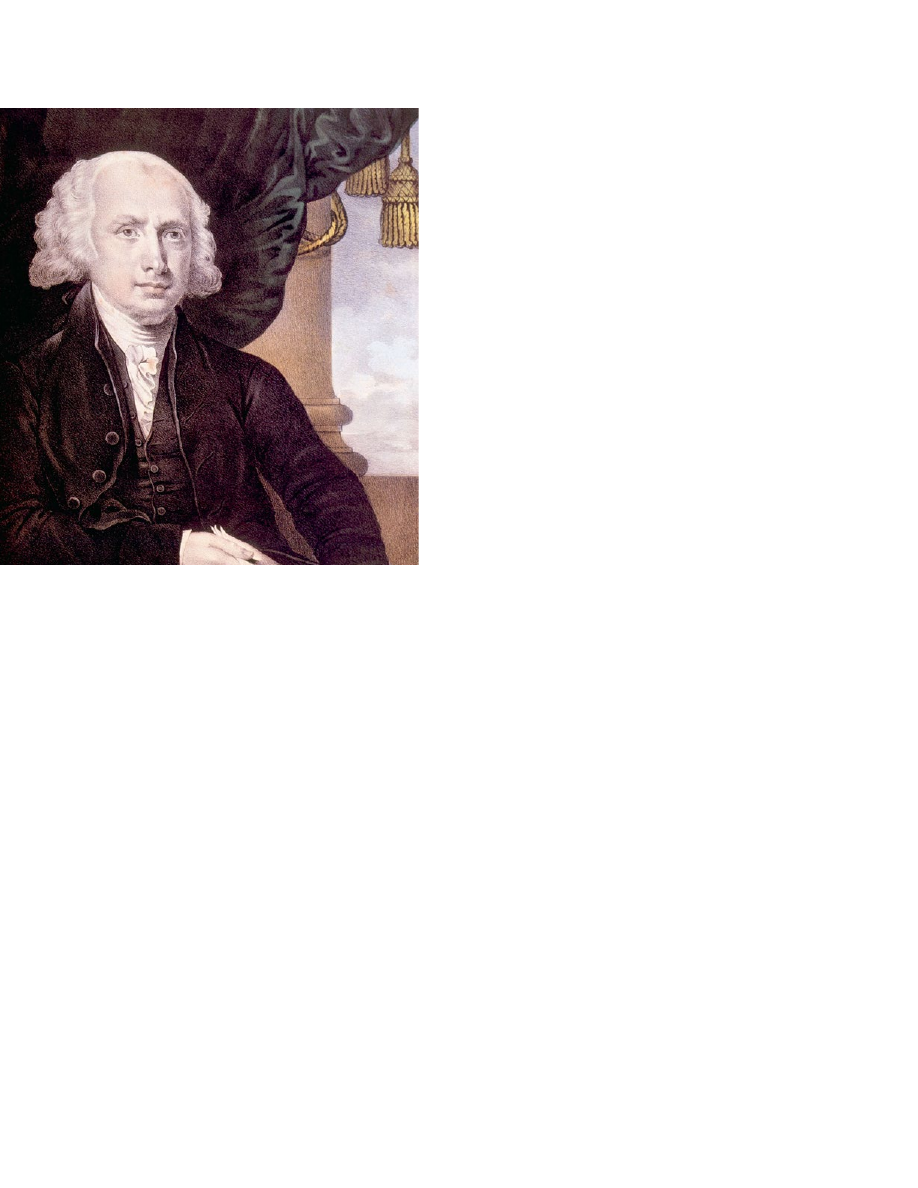
28
9
P
ROBLEMS
IN
THE
T
ESTIMONY
OF
R
OBERT
B
ROWN
other side of the argument represented by people
like Edmund Randolph, Alexander Hamilton, even
James Madison, was, ‘You’re right, we really don’t
have the authorization to be doing this, but we
need to do it anyways. This is an urgent need of our
nation. . . . We must proceed.’
“Nobody stood up in the 1787 Convention and claimed,
‘Look at our commissions, we’re fully authorized to
make any changes we feel are necessary.’”
Correction:
These comments depart from the
traditional JBS line, which is that Congress called
the 1787 convention and limited it to proposing
only amendments to the Articles. However,
modern research has made that position untenable,
so I am glad to see Mr. Brown abandon it.
Madison points out in Federalist No. 40 that
the state-issued commissions (or “credentials”)
defi ned the scope of the convention’s authority.
Founding-era law books confi rm this rule. Now,
among the 12 states participating in the 1787
convention, all but two (Massachusetts and
New York) issued commissions conveying full
power to propose a new form of government.
The general public overwhelmingly shared the
expectation that the convention would propose
a new form of government—some imagined it
might be a monarchy!
Brown points to statements by commissioners
questioning the extent of their authority. But
what determines whether the 1787 convention “ran
away” is what the commissioners’ credentials said,
not what anyone said they said!
There were several reasons why commissioners
might rhetorically question their authority.
Some represented one of the two states granting
narrower powers, such as New York’s John Lansing
and Massachusetts’ Elbridge Gerry. Virginia’s
Madison points out
in Federalist No.
40 that the state-
issued commissions
(or “credentials”)
defined the scope
of the convention’s
authority. Founding-
era law books confirm
this rule.
10
C
ONVENTION
OF
S
TATES
Edmund Randolph clearly did not buy the “no-
authority” argument, but like the good advocate
he was, he conceded it arguendo (for sake of
argument) and built his case on practical rather
than technical legal grounds. William Paterson of
New Jersey denigrated his authority for strategic
reasons—to strengthen his case for equal state
representation in the Senate. Once Paterson
achieved his goal, he dropped the argument and
urged creation of a strong government.
Brown’s restriction to a narrow range of sources
prevented him from learning that during
the ratifi cation debates the Constitution’s
advocates addressed the issue. They vigorously
defended the delegates’ actions as authorized
by their commissions.
14
* *
Brown:
“In fact, one of the challenges I repeatedly
put out to the other side, they never want to answer
this: show me the delegate. Show me the delegate
who made that claim, ‘We have full authority.’”
Correction:
Mr. Brown has never put the
challenge to me. I would have responded by
naming James Wilson, who told the Convention,
“Relative to the powers of this convention—We
have powers to conclude nothing; we have power
to propose anything.”
* *
Brown:
“Instead, what they did was, and this comes
directly from James Madison, I’m going to read it to
ou directly. They said that people were in fact, the
fountain of all power, and by resorting to them, all
diffi culties were got over.”
Correction:
This is another example of
opponents conflating proposal with ratification.
As Madison (in Federalist No. 40) and other
Founders made clear, the power to propose
came from the states via their commissions to
“We have powers to
conclude nothing;
we have power to
propose anything.”
- James Wilson
14
See, e.g., Carlisle Gazette, Mar. 12, 1788, in 34 D
OCUMENTARY
H
ISTORY
OF
THE
R
ATIFICATION
OF
THE
C
ONSTITUTION
1014, 1016.
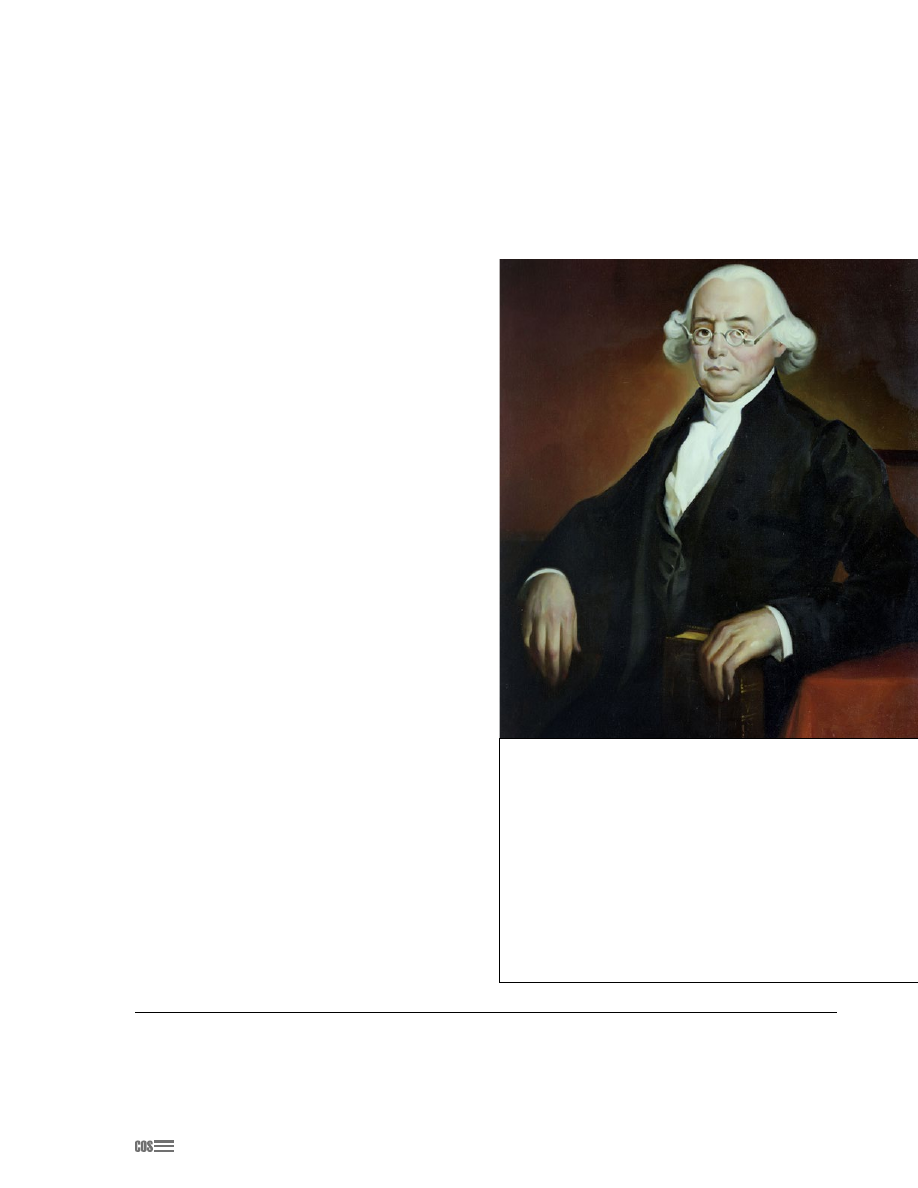
29
9
P
ROBLEMS
IN
THE
T
ESTIMONY
OF
R
OBERT
B
ROWN
other side of the argument represented by people
like Edmund Randolph, Alexander Hamilton, even
James Madison, was, ‘You’re right, we really don’t
have the authorization to be doing this, but we
need to do it anyways. This is an urgent need of our
nation. . . . We must proceed.’
“Nobody stood up in the 1787 Convention and claimed,
‘Look at our commissions, we’re fully authorized to
make any changes we feel are necessary.’”
Correction:
These comments depart from the
traditional JBS line, which is that Congress called
the 1787 convention and limited it to proposing
only amendments to the Articles. However,
modern research has made that position untenable,
so I am glad to see Mr. Brown abandon it.
Madison points out in Federalist No. 40 that
the state-issued commissions (or “credentials”)
defi ned the scope of the convention’s authority.
Founding-era law books confi rm this rule. Now,
among the 12 states participating in the 1787
convention, all but two (Massachusetts and
New York) issued commissions conveying full
power to propose a new form of government.
The general public overwhelmingly shared the
expectation that the convention would propose
a new form of government—some imagined it
might be a monarchy!
Brown points to statements by commissioners
questioning the extent of their authority. But
what determines whether the 1787 convention “ran
away” is what the commissioners’ credentials said,
not what anyone said they said!
There were several reasons why commissioners
might rhetorically question their authority.
Some represented one of the two states granting
narrower powers, such as New York’s John Lansing
and Massachusetts’ Elbridge Gerry. Virginia’s
Madison points out
in Federalist No.
40 that the state-
issued commissions
(or “credentials”)
defined the scope
of the convention’s
authority. Founding-
era law books confirm
this rule.
10
C
ONVENTION
OF
S
TATES
Edmund Randolph clearly did not buy the “no-
authority” argument, but like the good advocate
he was, he conceded it arguendo (for sake of
argument) and built his case on practical rather
than technical legal grounds. William Paterson of
New Jersey denigrated his authority for strategic
reasons—to strengthen his case for equal state
representation in the Senate. Once Paterson
achieved his goal, he dropped the argument and
urged creation of a strong government.
Brown’s restriction to a narrow range of sources
prevented him from learning that during
the ratifi cation debates the Constitution’s
advocates addressed the issue. They vigorously
defended the delegates’ actions as authorized
by their commissions.
14
* *
Brown:
“In fact, one of the challenges I repeatedly
put out to the other side, they never want to answer
this: show me the delegate. Show me the delegate
who made that claim, ‘We have full authority.’”
Correction:
Mr. Brown has never put the
challenge to me. I would have responded by
naming James Wilson, who told the Convention,
“Relative to the powers of this convention—We
have powers to conclude nothing; we have power
to propose anything.”
* *
Brown:
“Instead, what they did was, and this comes
directly from James Madison, I’m going to read it to
ou directly. They said that people were in fact, the
fountain of all power, and by resorting to them, all
diffi culties were got over.”
Correction:
This is another example of
opponents conflating proposal with ratification.
As Madison (in Federalist No. 40) and other
Founders made clear, the power to propose
came from the states via their commissions to
“We have powers to
conclude nothing;
we have power to
propose anything.”
- James Wilson
14
See, e.g., Carlisle Gazette, Mar. 12, 1788, in 34 D
OCUMENTARY
H
ISTORY
OF
THE
R
ATIFICATION
OF
THE
C
ONSTITUTION
1014, 1016.

30
11
P
ROBLEMS
IN
THE
T
ESTIMONY
OF
R
OBERT
B
ROWN
the delegates. The power to ratify came from
the people, who elected delegates to their
state ratifying conventions.
* *
Brown:
“They were also given a constitutionally
defi ned ratifi cation process, they threw it out,
retroactively created a much lower bar . . . .”
Correction:
Mr. Brown’s claim is that (1)
the Constitutional Convention provided for
ratifi cation by nine states rather than the
thirteen required by the Articles, so therefore
(2) a modern amendments convention might
alter the ratifi cation process as well.
Constitutional scholars consider this as one of
the “runaway” alarmists’ loonier ideas. It is based
on utter ignorance of governing law, both in 1787
and now. Specifi cally:
• As noted before, the 1787 convention was
not held under the Articles of Confederation.
It was held under reserved state powers
retained by signatories of treaties and
recognized explicitly by the Articles. The
convention could, therefore, propose any
method of ratifi cation it chose. Incidentally,
the Confederation Congress approved the
convention’s actions when it forwarded the
Constitution to the states and urged them to
hold ratifying conventions.
15
• A convention for proposing amendments,
by contrast, receives its power from the
Constitution and is subject to its rules,
including ratifi cation rules. One of the
clearest principles from 223 years of Article
V court decisions is that no participant in
the amendment process may change the
Constitution’s amendment rules. But Mr.
Brown never mentions case law. From
listening to him you’d think the courts never
issued an Article V ruling and all we have to
go on is what allegedly happened in 1787. Yet
there are hundreds of cases defi ning general
constitutional principles and dozens more
interpreting Article V.
• Nor do alarmists tell us how, if a convention
purported to change the ratifi cation rules, it
could enforce its decision. Call out the army?
* *
Brown:
“[T]he precedent they set was, these
types of conventions represent, not the States,
not the legislatures, but they represent the people
themselves . . . .”
Correction:
It is unclear what Mr. Brown means
by “these types of conventions.” If he is referring
to conventions that deal with constitutional
issues, then his statement is only a half-truth.
Conventions elected directly by the people within
a particular state—sometimes called constituent
conventions—represent the people. Constituent
conventions were used to ratify the U.S.
Constitution and the 21st amendment. They also are
employed to propose and ratify state constitutions.
Interstate conventions whose commissioners
are selected as directed by state legislatures
are called conventions of states or conventions
of the states. They answer to the states or state
legislatures directly, so they represent the people
15
Did Congress Approve the Constitution? A Member’s Letter Says “Yes”, https:%%articlevinfocenter.com/did-congress-approve-//\\ \\
//the-constitution-a-members-letter-says-yes/.//\\ \\
//12//\\ \\
C\\ \\
ONVENTION\\ \\
\\ \\
OF\\ \\
S\\ \\
TATES\\ \\
only in a remote sense. When called under states’ \\ \\
reserved powers, conventions of states meet to \\ \\
propose solutions to common problems—such \\ \\
as coordinating state laws or negotiating water \\ \\
compacts. When called under Article V of the \\ \\
Constitution, they may propose amendments \\ \\
to the states for ratifi cation. My treatise, //The //\\ \\
//Law of Article V//, discusses the legal diff erences \\ \\
among conventions.\\ \\
//* * * *//\\ \\
Brown:\\ \\
//“. . . and as such their power cannot be //\\ \\
//limited. Now, we’ve seen that same precedent //\\ \\
//upheld //repeatedly// in state conventions ever since. I //\\ \\
//mentioned the Montana one, for example.”//\\ \\
Correction:\\ \\
This is legal nonsense. Conventions—\\ \\
even those that represent the people directly—\\ \\
usually //are// limited. Brown cites the 1972 Montana \\ \\
constitutional convention as an unlimited body. \\ \\
But the Montana Supreme Court specifi cally held \\ \\
that its powers were limited. //State of Montana ex rel. //\\ \\
//Kvaalen v. Graybill//, 496 P.2d 1127 (Mont. 1972).\\ \\
Unless a convention is acting in absence of an \\ \\
established government (as in some states at the \\ \\
opening of the American Revolution), it is always \\ \\
limited to some extent. For example, a state \\ \\
convention called under an existing constitution \\ \\
may not be subject to the legislature, but it is \\ \\
limited by the terms of the existing constitution. \\ \\
When state conventions were being considered to \\ \\
ratify the 21st amendment, some people argued \\ \\
they would be unlimited—but court adjudication \\ \\
determined otherwise. As noted earlier, the \\ \\
courts have ruled repeatedly that all assemblies \\ \\
operating under Article V are bound by the rules \\ \\
laid out in the Constitution.\\ \\
//* * * *//\\ \\
Brown:\\ \\
//“In fact, if you look to the—the law journal //\\ \\
//that’s called //Corpus Juris Secundum//, that’s a //\\ \\
//collection of various Supreme Court rulings from //\\ \\
//12//\\ \\
**If a convention purported to change the ratification rules, \\ how could it enforce its decision? Call out the army?**\\ \\
\\ \\
{{:public:cb_mirror:files_4014_pdfto031.png?nolink&918x1188|}}\\ \\
**31**\\ \\
//11//\\ \\
P\\ \\
ROBLEMS\\ \\
\\ \\
IN\\ \\
\\ \\
THE\\ \\
T\\ \\
ESTIMONY\\ \\
\\ \\
OF\\ \\
R\\ \\
OBERT\\ \\
B\\ \\
ROWN\\ \\
the delegates. The power to //ratify// came from \\ \\
the people, who elected delegates to their \\ \\
state ratifying conventions.\\ \\
//* * * *//\\ \\
Brown:\\ \\
//“They were also given a constitutionally //\\ \\
//defi ned ratifi cation process, they threw it out, //\\ \\
//retroactively created a much lower bar . . . .”//\\ \\
Correction:\\ \\
Mr. Brown’s claim is that (1) \\ \\
the Constitutional Convention provided for \\ \\
ratifi cation by nine states rather than the \\ \\
thirteen required by the Articles, so therefore \\ \\
(2) a modern amendments convention might \\ \\
alter the ratifi cation process as well.\\ \\
Constitutional scholars consider this as one of \\ \\
the “runaway” alarmists’ loonier ideas. It is based \\ \\
on utter ignorance of governing law, both in 1787 \\ \\
and now. Specifi cally:\\ \\
• As noted before, the 1787 convention was \\ \\
not held under the Articles of Confederation. \\ \\
It was held under reserved state powers \\ \\
retained by signatories of treaties and \\ \\
recognized explicitly by the Articles. The \\ \\
convention could, therefore, propose any \\ \\
method of ratifi cation it chose. Incidentally, \\ \\
the Confederation Congress approved the \\ \\
convention’s actions when it forwarded the \\ \\
Constitution to the states and urged them to \\ \\
hold ratifying conventions.\\ \\
//15 //\\ \\
• A convention for proposing amendments, \\ \\
by contrast, receives its power from the \\ \\
Constitution and is subject to its rules, \\ \\
including ratifi cation rules. One of the \\ \\
clearest principles from 223 years of Article \\ \\
V court decisions is that no participant in \\ \\
the amendment process may change the \\ \\
Constitution’s amendment rules. But Mr. \\ \\
Brown never mentions case law. From \\ \\
listening to him you’d think the courts never \\ \\
issued an Article V ruling and all we have to \\ \\
go on is what allegedly happened in 1787. Yet \\ \\
there are hundreds of cases defi ning general \\ \\
constitutional principles and dozens more \\ \\
interpreting Article V. \\ \\
• Nor do alarmists tell us how, if a convention \\ \\
purported to change the ratifi cation rules, it \\ \\
could enforce its decision. Call out the army?\\ \\
//* * * *//\\ \\
Brown:\\ \\
//“[T]he precedent they set was, these //\\ \\
//types of conventions represent, not the States, //\\ \\
//not the legislatures, but they represent the people //\\ \\
themselves// . . . .”//\\ \\
Correction:\\ \\
It is unclear what Mr. Brown means \\ \\
by “these types of conventions.” If he is referring \\ \\
to conventions that deal with constitutional \\ \\
issues, then his statement is only a half-truth. \\ \\
Conventions elected directly by the people within \\ \\
a particular state—sometimes called constituent \\ \\
conventions—represent the people. Constituent \\ \\
conventions were used to ratify the U.S. \\ \\
Constitution and the 21st amendment. They also are \\ \\
employed to propose and ratify state constitutions. \\ \\
Interstate conventions whose commissioners \\ \\
are selected as directed by state legislatures \\ \\
are called //conventions of states// or //conventions //\\ \\
//of the states//. They answer to the states or state \\ \\
legislatures directly, so they represent the people \\ \\
//15//\\ \\
// Did Congress Approve the Constitution? A Member’s Letter Says “Yes”, https:%%articlevinfocenter.com/did-congress-approve-
the-constitution-a-members-letter-says-yes/.
12
C
ONVENTION
OF
S
TATES
only in a remote sense. When called under states’
reserved powers, conventions of states meet to
propose solutions to common problems—such
as coordinating state laws or negotiating water
compacts. When called under Article V of the
Constitution, they may propose amendments
to the states for ratifi cation. My treatise, The
Law of Article V, discusses the legal diff erences
among conventions.
* *
Brown:
“. . . and as such their power cannot be
limited. Now, we’ve seen that same precedent
upheld repeatedly in state conventions ever since. I
mentioned the Montana one, for example.”
Correction:
This is legal nonsense. Conventions—
even those that represent the people directly—
usually are limited. Brown cites the 1972 Montana
constitutional convention as an unlimited body.
But the Montana Supreme Court specifi cally held
that its powers were limited. State of Montana ex rel.
Kvaalen v. Graybill, 496 P.2d 1127 (Mont. 1972).
Unless a convention is acting in absence of an
established government (as in some states at the
opening of the American Revolution), it is always
limited to some extent. For example, a state
convention called under an existing constitution
may not be subject to the legislature, but it is
limited by the terms of the existing constitution.
When state conventions were being considered to
ratify the 21st amendment, some people argued
they would be unlimited—but court adjudication
determined otherwise. As noted earlier, the
courts have ruled repeatedly that all assemblies
operating under Article V are bound by the rules
laid out in the Constitution.
* *
Brown:
“In fact, if you look to the—the law journal
that’s called Corpus Juris Secundum, that’s a
collection of various Supreme Court rulings from
12
If a convention purported to change the ratification rules,
how could it enforce its decision? Call out the army?

32
13
P
ROBLEMS
IN
THE
T
ESTIMONY
OF
R
OBERT
B
ROWN
the States all across the country and we’ve seen
consistently the same thing.”
Correction:
Where do we begin with this one?
There is so much error from which to choose!
First: Contrary to Mr. Brown’s description,
Corpus Juris Secundum (CJS) is not a “law
journal.” It is a legal encyclopedia that attempts
to summarize law on all topics.
Second: CJS is not a “collection of various
Supreme Court rulings.” It is principally a legal
text with supporting citations from federal and
states appellate courts at all levels.
Third: Every fi rst-year law student learns that
CJS’s text is not fully trustworthy and should
never be cited as authority. It is used principally
as a case fi nder. You have to read the cases it
cites to fi nd out what the law is, then expand your
research to fi nd other cases on the same topic.
Fourth: Mr. Brown apparently didn’t read
the cases referenced in the part of CJS he
mentions. If he did, he’d know they have
nothing to do with Article V conventions.
He would also learn that those cases are
all very old. They were decided long
before most Article V court rulings
were issued. Thus:
• In Cox v. Robison, 105 Tex. 426,
150 S.W. 1149 (1912), the facts
were that in 1866, the former
Confederate state of Texas was
under federal military occupation. As
commander-in-chief of the U.S. armed
forces, President Andrew Johnson called
for a Texas state constitutional convention.
The court held that the state constitution did
not have to be ratifi ed by the people because
the president had not required it. (Presumably
he could have limited the convention by
requiring it.)
• Frantz v. Autry, 18 Okla. 561, 91 P. 13 (1907)
dealt with a local constitutional convention
Congress had authorized in what was then the
Territory of Oklahoma. The case held that the
convention had all the power Congress gave
it, and that Congress had imposed only a few
limits. The cases said the convention needed
to respect only the limits Congress imposed.
• Koehler & Lange v. Hill, 60 Iowa 543, 14 N.W.
738 (1883) held that when any constitution
prescribes an amendment procedure, that
procedure must be followed. It added “The
powers of a convention are, of course, unlimited.
The members thereof are the representatives
of the people, called together for that purpose.”
But the court was speaking of state constitutional
conventions, not federal conventions, and this
case is contradicted by later authority, such
Every
fi rst-year law
student learns that
Corpus Juris Secundum’s
text is not fully trustworthy
and should never be cited
as authority. It is used
principally as a case
fi nder.
14
C
ONVENTION
OF
S
TATES
as State of Montana ex rel. Kvaalen v. Graybill,
496 P.2d 1127 (Mont. 1972), mentioned above.
• Loomis v. Jackson, 6 W.Va. 613 (1873) says
that “A [state] constitutional convention,
lawfully convened, does not derive its powers
from the legislature; but from the people.
The powers of such a convention are in the
nature of sovereign powers.” But in this
country, we frequently limit sovereignty, and
a convention’s authority can be limited by an
existing constitution.
16
• Sproule v. Fredericks, 69 Miss. 898, 11 So.
472 (1892) examined the power of a state
constitutional convention called by the
legislature. It ruled that the convention’s
power was very broad, but also acknowledged
that its power could have been limited.
Again, nothing in these fi ve decisions had
anything to do with Article V.
So much for Mr. Brown’s cases. I’ve taken some
time to examine his misuse of CJS because it
illustrates the conceptual chaos that ensues
when someone ignorant of law starts interpreting
legal texts and spouting legal advice.
* *
Brown:
“Congress is essentially—they often
refer to it as a sitting constitutional convention
themselves. Madison diff erentiated between them.
Again, as I mentioned as he was putting out his
opposition to an Article V Convention, he said
that in his view, the Convention would feel much
greater latitude in making sweeping changes to
the Constitution than Congress would, which is
why he said Congress is the safer mode.”
An amendments convention
may do only what Congress
may do at any time: propose
amendments. But unlike a
convention, Congress has
unlimited, unrestricted
power to do so.
16
Incidentally, another line in the Loomis case contradicts the common JBS claim that Congress could control an amendments
convention: “That the legislature can neither limit or restrict [conventions] in the exercise of these powers . . . .”
33
13
P
ROBLEMS
IN
THE
T
ESTIMONY
OF
R
OBERT
B
ROWN
the States all across the country and we’ve seen
consistently the same thing.”
Correction:
Where do we begin with this one?
There is so much error from which to choose!
First: Contrary to Mr. Brown’s description,
Corpus Juris Secundum (CJS) is not a “law
journal.” It is a legal encyclopedia that attempts
to summarize law on all topics.
Second: CJS is not a “collection of various
Supreme Court rulings.” It is principally a legal
text with supporting citations from federal and
states appellate courts at all levels.
Third: Every fi rst-year law student learns that
CJS’s text is not fully trustworthy and should
never be cited as authority. It is used principally
as a case fi nder. You have to read the cases it
cites to fi nd out what the law is, then expand your
research to fi nd other cases on the same topic.
Fourth: Mr. Brown apparently didn’t read
the cases referenced in the part of CJS he
mentions. If he did, he’d know they have
nothing to do with Article V conventions.
He would also learn that those cases are
all very old. They were decided long
before most Article V court rulings
were issued. Thus:
• In Cox v. Robison, 105 Tex. 426,
150 S.W. 1149 (1912), the facts
were that in 1866, the former
Confederate state of Texas was
under federal military occupation. As
commander-in-chief of the U.S. armed
forces, President Andrew Johnson called
for a Texas state constitutional convention.
The court held that the state constitution did
not have to be ratifi ed by the people because
the president had not required it. (Presumably
he could have limited the convention by
requiring it.)
• Frantz v. Autry, 18 Okla. 561, 91 P. 13 (1907)
dealt with a local constitutional convention
Congress had authorized in what was then the
Territory of Oklahoma. The case held that the
convention had all the power Congress gave
it, and that Congress had imposed only a few
limits. The cases said the convention needed
to respect only the limits Congress imposed.
• Koehler & Lange v. Hill, 60 Iowa 543, 14 N.W.
738 (1883) held that when any constitution
prescribes an amendment procedure, that
procedure must be followed. It added “The
powers of a convention are, of course, unlimited.
The members thereof are the representatives
of the people, called together for that purpose.”
But the court was speaking of state constitutional
conventions, not federal conventions, and this
case is contradicted by later authority, such
Every
fi rst-year law
student learns that
Corpus Juris Secundum’s
text is not fully trustworthy
and should never be cited
as authority. It is used
principally as a case
fi nder.
14
C
ONVENTION
OF
S
TATES
as State of Montana ex rel. Kvaalen v. Graybill,
496 P.2d 1127 (Mont. 1972), mentioned above.
• Loomis v. Jackson, 6 W.Va. 613 (1873) says
that “A [state] constitutional convention,
lawfully convened, does not derive its powers
from the legislature; but from the people.
The powers of such a convention are in the
nature of sovereign powers.” But in this
country, we frequently limit sovereignty, and
a convention’s authority can be limited by an
existing constitution.
16
• Sproule v. Fredericks, 69 Miss. 898, 11 So.
472 (1892) examined the power of a state
constitutional convention called by the
legislature. It ruled that the convention’s
power was very broad, but also acknowledged
that its power could have been limited.
Again, nothing in these fi ve decisions had
anything to do with Article V.
So much for Mr. Brown’s cases. I’ve taken some
time to examine his misuse of CJS because it
illustrates the conceptual chaos that ensues
when someone ignorant of law starts interpreting
legal texts and spouting legal advice.
* *
Brown:
“Congress is essentially—they often
refer to it as a sitting constitutional convention
themselves. Madison diff erentiated between them.
Again, as I mentioned as he was putting out his
opposition to an Article V Convention, he said
that in his view, the Convention would feel much
greater latitude in making sweeping changes to
the Constitution than Congress would, which is
why he said Congress is the safer mode.”
An amendments convention
may do only what Congress
may do at any time: propose
amendments. But unlike a
convention, Congress has
unlimited, unrestricted
power to do so.
16
Incidentally, another line in the Loomis case contradicts the common JBS claim that Congress could control an amendments
convention: “That the legislature can neither limit or restrict [conventions] in the exercise of these powers . . . .”

34
15
P
ROBLEMS
IN
THE
T
ESTIMONY
OF
R
OBERT
B
ROWN
Correction:
As already discussed, Madison was
not opposed to amendments conventions. The
reason he opposed New York’s 1788 proposal
was because its scope was too wide and it came
too early. But very few convention applications
have been as broad as that. The applications
being passed today are all quite focused.
In this passage Mr. Brown does inadvertently
allude to an inconvenient fact: An amendments
convention may do only what Congress may
do at any time: propose amendments. But
unlike a convention, Congress has unlimited,
unrestricted power to do so.
MR. BROWN CLAIMS
HE ORGANIZED
A GROUP TO
PRESSURE REP.
DENNY REHBERG…
BUT AFTER
BROWN STARTED
HARASSING HIM,
REHBERG’S RATING
DROPPED TO 80%
IN 2011 AND 76% IN
2012—HIS LOWEST
SCORES EVER.
16
C
ONVENTION
OF
S
TATES
* *
Brown:
“Congress already pretty much does whatever
they want to with regards to what the Constitution
says, for the most part. And the only reason they get
away with that, is we the people don’t hold them to it .
. . .
“When I fi rst moved to Montana about a decade
ago, I organized a couple hundred people and we
started holding our congressman accountable to
his voting as it squared with the Constitution. At
the time, his “constitutional rating,” so to say, was
somewhere around 40-60%. He was always right
in the middle. About half the time he’d follow the
Constitution, half the time he wouldn’t. Within four
months, he was at 80% and thereafter he was stated
at 90%, because we started pushing on him on . . . .”
Correction:
This prescription for curing the
federal government is terminally naïve. The
majority of members of Congress, particularly
the leadership, are long-time holders of “safe”
seats and immune to popular, pro-Constitution
lobbying. Indeed, they hold their seats largely by
violating the Constitution.
The Congressman referred to is Rep. Denny
Rehberg (R.-Mont.), who was in offi ce from
2001 to early January, 2013. Mr. Brown claims
he organized a group to lobby Rehberg “about
decade ago” — i.e., sometime between 2009
and 2011. Now, if anyone was amenable to
“constitutionalist” lobbying, Congressman
Rehberg should have been. He served a swing
district and I know from personal acquaintance
that he has conservative values.
But did Brown’s lobbying really have any eff ect?
The American Conservative Union ranks
members of Congress by their commitment to
smaller, constitutional government. The ranking
is on a scale of zero to 100.
Rehberg was rated for the years 2001 through
2012. His ACU voting record for each year was
as follows:
2001 - 84%
2002 - 100%
2003 - 84%
2004 - 96%
2005 - 92%
2006 - 83%
2007 - 88%
2008 - 84%
2009 - 92%
2010 - 96%
2011 - 80%
2012 - 76%
If there is any pattern in their fi gures at all—and I’m
not sure there is—it suggests Brown’s eff orts may
have been counterproductive. In the years including
and up to 2010, Rep. Rehberg’s ACU score had
ranged from 84% to 100%. But after Brown started
harassing him, Rehberg’s rating dropped to 80% in
2011 and 76% in 2012—his lowest scores ever.
In theory millions of Americans could pressure
members of Congress to change. But as a matter
of historical record, this does not happen: The
organizational costs for conservative Americans
are too high. Professional lobbyists concentrated
in Washington, D.C. are paid big money to lobby,
and they do it continuously. They off er concrete
benefi ts beyond what the conservative grassroots
can off er, such as connections to many large
political donors. They enjoy the support of the
national media, which has strong incentives to
concentrate power at the federal level.
There are good people in Congress. But as they
acknowledge, they need fi rm rules to restrain
their behavior and enable them to justify voting
against certain programs. Only constitutional
amendments can provide those rules.

35
15
P
ROBLEMS
IN
THE
T
ESTIMONY
OF
R
OBERT
B
ROWN
Correction:
As already discussed, Madison was
not opposed to amendments conventions. The
reason he opposed New York’s 1788 proposal
was because its scope was too wide and it came
too early. But very few convention applications
have been as broad as that. The applications
being passed today are all quite focused.
In this passage Mr. Brown does inadvertently
allude to an inconvenient fact: An amendments
convention may do only what Congress may
do at any time: propose amendments. But
unlike a convention, Congress has unlimited,
unrestricted power to do so.
MR. BROWN CLAIMS
HE ORGANIZED
A GROUP TO
PRESSURE REP.
DENNY REHBERG…
BUT AFTER
BROWN STARTED
HARASSING HIM,
REHBERG’S RATING
DROPPED TO 80%
IN 2011 AND 76% IN
2012—HIS LOWEST
SCORES EVER.
16
C
ONVENTION
OF
S
TATES
* *
Brown:
“Congress already pretty much does whatever
they want to with regards to what the Constitution
says, for the most part. And the only reason they get
away with that, is we the people don’t hold them to it .
. . .
“When I fi rst moved to Montana about a decade
ago, I organized a couple hundred people and we
started holding our congressman accountable to
his voting as it squared with the Constitution. At
the time, his “constitutional rating,” so to say, was
somewhere around 40-60%. He was always right
in the middle. About half the time he’d follow the
Constitution, half the time he wouldn’t. Within four
months, he was at 80% and thereafter he was stated
at 90%, because we started pushing on him on . . . .”
Correction:
This prescription for curing the
federal government is terminally naïve. The
majority of members of Congress, particularly
the leadership, are long-time holders of “safe”
seats and immune to popular, pro-Constitution
lobbying. Indeed, they hold their seats largely by
violating the Constitution.
The Congressman referred to is Rep. Denny
Rehberg (R.-Mont.), who was in offi ce from
2001 to early January, 2013. Mr. Brown claims
he organized a group to lobby Rehberg “about
decade ago” — i.e., sometime between 2009
and 2011. Now, if anyone was amenable to
“constitutionalist” lobbying, Congressman
Rehberg should have been. He served a swing
district and I know from personal acquaintance
that he has conservative values.
But did Brown’s lobbying really have any eff ect?
The American Conservative Union ranks
members of Congress by their commitment to
smaller, constitutional government. The ranking
is on a scale of zero to 100.
Rehberg was rated for the years 2001 through
2012. His ACU voting record for each year was
as follows:
2001 - 84%
2002 - 100%
2003 - 84%
2004 - 96%
2005 - 92%
2006 - 83%
2007 - 88%
2008 - 84%
2009 - 92%
2010 - 96%
2011 - 80%
2012 - 76%
If there is any pattern in their fi gures at all—and I’m
not sure there is—it suggests Brown’s eff orts may
have been counterproductive. In the years including
and up to 2010, Rep. Rehberg’s ACU score had
ranged from 84% to 100%. But after Brown started
harassing him, Rehberg’s rating dropped to 80% in
2011 and 76% in 2012—his lowest scores ever.
In theory millions of Americans could pressure
members of Congress to change. But as a matter
of historical record, this does not happen: The
organizational costs for conservative Americans
are too high. Professional lobbyists concentrated
in Washington, D.C. are paid big money to lobby,
and they do it continuously. They off er concrete
benefi ts beyond what the conservative grassroots
can off er, such as connections to many large
political donors. They enjoy the support of the
national media, which has strong incentives to
concentrate power at the federal level.
There are good people in Congress. But as they
acknowledge, they need fi rm rules to restrain
their behavior and enable them to justify voting
against certain programs. Only constitutional
amendments can provide those rules.

36
17
P
ROBLEMS
IN
THE
T
ESTIMONY
OF
R
OBERT
B
ROWN
* *
Brown:
“We look at Federalist 16, 26, and 33:
Alexander Hamilto-Hamilton talking about the
power that we the people and we the States have
to push back against federal tyranny. Madison
picks it up in Federalist 44 and 46, 46 especially.
And what’s interesting is, in all of those documents
where they’re talking about what to do to push back
against federal tyranny, they never mention Article
V. In fact, when you go onto Federalist 48 and 49,
Madison directly addresses that.”
Correction:
Notice how Mr. Brown’s sources
for the ratifi cation debates consist solely of
The Federalist—a minuscule fraction of the
ratifi cation record. He never mentions the
other founding-era commentators who spoke
to the amendments convention process.
17
Even
his use of The Federalist is clumsy. For example,
at this point he overlooks references to the
Article V convention process in Federalist No.
43 and No. 85.
* *
Brown:
“In 49, [Madison] asks, ‘Is it appropriate
to use a Convention to address breaches in the
Constitution when the federal government ignores
it?’ And his answer is absolutely not . . . .”
Correction:
This is another example of Brown’s
inept use of The Federalist. Trying to convert
one of its essays into an argument against the
Constitution’s amendment process makes no
sense at all. The Federalist was written to support
the Constitution, not trash it.
Here’s the real scoop on Federalist No. 49: When
Madison was writing, Pennsylvania and Vermont
had constitutions that provided for a “council of
censors” to meet every seven years. The censors
could decide whether their state constitution was
working well. The censors could call a constitutional
convention to address any problems.
In 1783, Thomas Jeff erson outlined his own ideas
for a new Virginia constitution. In partial imitation
of the Pennsylvania-Vermont approach, his draft
would have permitted some state offi cials to call
a convention for “altering this Constitution or
correcting breaches of it.” Strikingly, this new
convention was to have all the powers enjoyed by a
plenary constitutional convention—including power
to write an entirely new document and impose all
its changes without a ratifi cation procedure.
Madison had four objections: (1) A rogue state
legislature could block the process in various ways;
(2) “frequent appeals” for constitutional revision
could reduce public respect for government;
(3) frequent referrals to the citizenry might
cause constitutional turbulence; and (4) the
legislature—the branch most likely responsible
for the problems—might highjack the process.
Notice that none of these objections is
relevant to calling a convention under Article
V. The states, not federal offi cials, initiate
and staff the convention, thereby preventing
congressional obstruction or control. Article
V is very diffi cult to trigger, eliminating the
danger of “frequent appeals.” A convention
for proposing amendments has power only to
propose specifi ed amendments, not re-write
17
For collections of this material, see, for example, my following two articles: Is the Constitution’s Convention for
Proposing Amendments a ‘Mystery’? Overlooked Evidence in the Narrative of Uncertainty, 104 M
ARQUETTE
L.
R
EV
. 1 (2020) and Founding-Era Conventions and the Meaning of the Constitution’s “Convention for Proposing
Amendments,” 65 F
LA
. L. R
EV
. 615 (2013). See also A Founder Gives Us a Lesson on the Constitution’s Amendment
Process, https://articlevinfocenter.com/founder-gives-us-lesson-constitutions-amendment-process/.
18
C
ONVENTION
OF
S
TATES
the Constitution. And unlike Jeff erson’s idea for
periodic plenary constitutional conventions, any
proposal from an Article V convention is subject
to a diffi cult ratifi cation process.
In a portion of Federalist No. 49 Brown fails
to quote, Madison assures us that, although he
objects to Jeff erson’s plan, still “a constitutional
road to the decision of the people ought to be
marked out and kept open, for certain great and
extraordinary occasions.”
Unlike the proposals Madison was criticizing,
the convention procedure of Article V seems to
meet his goal very well.
* *
Brown:
“Now, in Federalist uh, I think it was 43,
yeah, in Federalist 43, Madison does address the
Article V Convention. And in that case, he refers to
it as “the remedy for errors” in the Constitution.”
Correction:
Mr. Brown is repeating—perhaps
is the author of—a common JBS claim that the
only role for an amendments convention was to
correct drafting errors in the Constitution.
This is still more nonsense. The fact that Madison
stated one purpose of the convention procedure
does not mean he excluded other purposes.
Other Founders itemized additional purposes.
One was the need to correct federal abuses
and overreach. That was the reason George
Mason gave at the Constitutional Convention.
During the ratifi cation debates, prominent
advocates cited the convention procedure again
and again as a key safeguard against abuse.
18
* *
Trying to convert one
of The Federalist essays
into an argument against
the Constitution’s
amendment process
makes no sense at all.
The Federalist was
written to support the
Constitution, not trash it.
18
See, e.g., The Founders Pointed to Article V as a Cure for Federal Abuse, https:%%articlevinfocenter.com/the-founders-//\\ \\
//pointed-to-article-v-as-a-cure-for-federal-abuse/ (collecting examples).//\\ \\
\\ \\
{{:public:cb_mirror:files_4014_pdfto037.png?nolink&918x1188|}}\\ \\
**37**\\ \\
//17//\\ \\
P\\ \\
ROBLEMS\\ \\
\\ \\
IN\\ \\
\\ \\
THE\\ \\
T\\ \\
ESTIMONY\\ \\
\\ \\
OF\\ \\
R\\ \\
OBERT\\ \\
B\\ \\
ROWN\\ \\
//* * * *//\\ \\
Brown:\\ \\
//“We look at Federalist 16, 26, and 33: //\\ \\
//Alexander Hamilto-Hamilton talking about the //\\ \\
//power that we the people and we the States have //\\ \\
//to push back against federal tyranny. Madison //\\ \\
//picks it up in Federalist 44 and 46, 46 especially. //\\ \\
//And what’s interesting is, in all of those documents //\\ \\
//where they’re talking about what to do to push back //\\ \\
//against federal tyranny, they never mention Article //\\ \\
//V. In fact, when you go onto Federalist 48 and 49, //\\ \\
//Madison directly addresses that.”//\\ \\
Correction:\\ \\
Notice how Mr. Brown’s sources \\ \\
for the ratifi cation debates consist solely of \\ \\
//The Federalist//—a minuscule fraction of the \\ \\
ratifi cation record. He never mentions the \\ \\
other founding-era commentators who spoke \\ \\
to the amendments convention process.\\ \\
//17//\\ \\
Even \\ \\
his use of //The Federalist// is clumsy. For example, \\ \\
at this point he overlooks references to the \\ \\
Article V convention process in Federalist No. \\ \\
43 and No. 85.\\ \\
//* * * *//\\ \\
Brown:\\ \\
//“In 49, [Madison] asks, ‘Is it appropriate //\\ \\
//to use a Convention to address breaches in the //\\ \\
//Constitution when the federal government ignores //\\ \\
//it?’ And his answer is absolutely not . . . .”//\\ \\
\\ \\
Correction:\\ \\
This is another example of Brown’s \\ \\
inept use of //The Federalist//. Trying to convert \\ \\
one of its essays into an argument against the \\ \\
Constitution’s amendment process makes no \\ \\
sense at all. //The Federalist// was written to support \\ \\
the Constitution, not trash it.\\ \\
Here’s the real scoop on Federalist No. 49: When \\ \\
Madison was writing, Pennsylvania and Vermont \\ \\
had constitutions that provided for a “council of \\ \\
censors” to meet every seven years. The censors \\ \\
could decide whether their state constitution was \\ \\
working well. The censors could call a constitutional \\ \\
convention to address any problems.\\ \\
In 1783, Thomas Jeff erson outlined his own ideas \\ \\
for a new Virginia constitution. In partial imitation \\ \\
of the Pennsylvania-Vermont approach, his draft \\ \\
would have permitted some state offi cials to call \\ \\
a convention for “altering this Constitution or \\ \\
correcting breaches of it.” Strikingly, this new \\ \\
convention was to have all the powers enjoyed by a \\ \\
plenary constitutional convention—including power \\ \\
to write an entirely new document and impose all \\ \\
its changes without a ratifi cation procedure.\\ \\
Madison had four objections: (1) A rogue state \\ \\
legislature could block the process in various ways; \\ \\
(2) “frequent appeals” for constitutional revision \\ \\
could reduce public respect for government; \\ \\
(3) frequent referrals to the citizenry might \\ \\
cause constitutional turbulence; and (4) the \\ \\
legislature—the branch most likely responsible \\ \\
for the problems—might highjack the process.\\ \\
Notice that //none// of these objections is \\ \\
relevant to calling a convention under Article \\ \\
V. The states, not federal offi cials, initiate \\ \\
and staff the convention, thereby preventing \\ \\
congressional obstruction or control. Article \\ \\
V is very diffi cult to trigger, eliminating the \\ \\
danger of “frequent appeals.” A convention \\ \\
for proposing amendments has power only to \\ \\
propose specifi ed amendments, not re-write \\ \\
17 \\ \\
For collections of this material, see, for example, my following two articles: Is the Constitution’s Convention for \\ \\
Proposing Amendments a ‘Mystery’? Overlooked Evidence in the Narrative of Uncertainty, 104 M\\ \\
ARQUETTE\\ \\
L. \\ \\
R\\ \\
EV\\ \\
. 1 (2020) and Founding-Era Conventions and the Meaning of the Constitution’s “Convention for Proposing \\ \\
Amendments,” 65 F\\ \\
LA\\ \\
. L. R\\ \\
EV\\ \\
. 615 (2013). See also A Founder Gives Us a Lesson on the Constitution’s Amendment \\ \\
Process, https:%%articlevinfocenter.com/founder-gives-us-lesson-constitutions-amendment-process/.
18
C
ONVENTION
OF
S
TATES
the Constitution. And unlike Jeff erson’s idea for
periodic plenary constitutional conventions, any
proposal from an Article V convention is subject
to a diffi cult ratifi cation process.
In a portion of Federalist No. 49 Brown fails
to quote, Madison assures us that, although he
objects to Jeff erson’s plan, still “a constitutional
road to the decision of the people ought to be
marked out and kept open, for certain great and
extraordinary occasions.”
Unlike the proposals Madison was criticizing,
the convention procedure of Article V seems to
meet his goal very well.
* * *
Brown:
“Now, in Federalist uh, I think it was 43,
yeah, in Federalist 43, Madison does address the
Article V Convention. And in that case, he refers to
it as “the remedy for errors” in the Constitution.”
Correction:
Mr. Brown is repeating—perhaps
is the author of—a common JBS claim that the
only role for an amendments convention was to
correct drafting errors in the Constitution.
This is still more nonsense. The fact that Madison
stated one purpose of the convention procedure
does not mean he excluded other purposes.
Other Founders itemized additional purposes.
One was the need to correct federal abuses
and overreach. That was the reason George
Mason gave at the Constitutional Convention.
During the ratifi cation debates, prominent
advocates cited the convention procedure again
and again as a key safeguard against abuse.
18
* *
Trying to convert one
of The Federalist essays
into an argument against
the Constitution’s
amendment process
makes no sense at all.
The Federalist was
written to support the
Constitution, not trash it.
18
See, e.g., The Founders Pointed to Article V as a Cure for Federal Abuse, https:%%articlevinfocenter.com/the-founders-//\\ \\
//pointed-to-article-v-as-a-cure-for-federal-abuse/ (collecting examples).//\\ \\
\\ \\
{{:public:cb_mirror:files_4014_pdfto038.png?nolink&918x1188|}}\\ \\
**38**\\ \\
//19//\\ \\
P\\ \\
ROBLEMS\\ \\
\\ \\
IN\\ \\
\\ \\
THE\\ \\
T\\ \\
ESTIMONY\\ \\
\\ \\
OF\\ \\
R\\ \\
OBERT\\ \\
B\\ \\
ROWN\\ \\
Brown:\\ \\
//“Article V has never been used //\\ \\
//technically, as far as the convention mode. It has //\\ \\
//no track record of any success other than, well, //\\ \\
//it did pressure Congress into passing the 17th //\\ \\
//amendment, which I wouldn’t really consider a good //\\ \\
//thing but, on the other hand, nullifi cation is just //\\ \\
one// of many tools in our quiver.”//\\ \\
Correction:\\ \\
Mr. Brown incorrectly uses the term \\ \\
“nullifi cation” to refer to all methods of what \\ \\
Madison called “interposition.” In constitutional \\ \\
scholarship, “nullifi cation” usually refers to \\ \\
formally adopting a state law or state convention \\ \\
resolution declaring that a federal law is void \\ \\
within state boundaries. The Constitution has \\ \\
no provision for nullifi cation and, contrary \\ \\
to JBS claims, Madison fi rmly opposed it—\\ \\
recommending an Article V convention instead.\\ \\
//19//\\ \\
//* * * *//\\ \\
Brown:\\ \\
//“Well, y’know, in that light, it really gives a //\\ \\
//feeling of there’s a sense of urgency here: we’ve gotta //\\ \\
//get something done, we’ve gotta do it soon. And if //\\ \\
//we look at the timetable, Convention of States is the //\\ \\
//example again, they’ve been around for seven years, //\\ \\
//they’ve gotten less than halfway to the thirty-four //\\ \\
//states mark. //If// they don’t lose momentum . . . we’re //\\ \\
//looking at another 10 years before they get to 34 states. //\\ \\
//“They also admit that there will be numerous legal //\\ \\
//challenges stalling the process along the way. When //\\ \\
//we eventually get to a convention, Congress calls //\\ \\
//the convention, they fi nally conclude their—their //\\ \\
//whatever amendment proposals they come up with, //\\ \\
//and then it goes out to the States for ratifi cation. //\\ \\
//. . . You’re looking at a //minimum// of 20 years for //\\ \\
anything// to actually go into eff ect from a convention. //\\ \\
//I don’t think we have 20 years to turn this around.”//\\ \\
Correction:\\ \\
It ill behooves someone who had been \\ \\
slowing down a process to gripe about it being slow. \\ \\
On several occasions in recent American history, \\ \\
we have been at the cusp of a convention only to \\ \\
see JBS and other alarmists frighten people away.\\ \\
**It also ill-behooves an organization to complain about length of time **\\ \\
**when it has had over 50 years for its own “solutions” to work.**\\ \\
//19//\\ \\
// James Madison to Edward Everett, Aug. 28, 1830, https:%%articlevinfocenter.com/wp-content/uploads/2021/02/1830-0828-
JM-to-E-Everett.pdf.
20
C
ONVENTION
OF
S
TATES
It also ill-behooves an organization to complain
about length of time when it has had over 50
years for its own “solutions” to work. Of course,
they haven’t worked, and by any measure, the
political system is more dysfunctional than ever.
History shows that once a popular amendment
is proposed, it can be ratifi ed in fairly short
order—depending on the proposal, 15 months is
a reasonable estimate. The 26th amendment was
ratifi ed in slightly more than three months.
As for litigation: Mr. Brown probably is wrong on
this one as well. The Convention of States Project
application is designed in a way to minimize the
chances of lengthy litigation. (That is not true of
the non-uniform applications promoted by some
other Article V organizations.)
* *
Brown:
“… The moment… the balanced budget
becomes a higher priority than all these other
programs, then Congress will make it their highest
priority as well and will pass a balanced budget.
“So, the problem really isn’t Congress, it really isn’t
the federal government, it really comes down to
what we the people tolerate.”
Correction:
This refl ects Mr. Brown’s ignorance of
how the federal government works. As the Public
Choice school of economics has documented,
politicians respond to incentives. Over the long
term, these incentives are more important than
the character of the politicians themselves. When
the incentives are bad, the results usually are
bad. When the incentives are good, the results
usually are good. However, concentrated special
interests, with media support, almost always can
off er stronger incentives than the diff used public.
There are various ways to change incentives, but one
of the most direct is to alter the system in which
political actors work—by constitutional amendment.
When given the opportunity for constitutional
change, people act diff erently than they do
from day to day. Take the balanced budget
amendment as an example: Right now, Congress
has strong incentives to defi cit-spend and very
weak incentives to balance the budget. Special
interests fi ght for as much federal booty as
they can, knowing that if they don’t do so, the
spending will happen anyway—but it will go to
someone else. Fiscal conservatives have never
been able to match that clout, even though they
probably comprise most of the U.S. population.
But when people are given a chance to adopt a rule
that they know (1) is for the good of all and (2) will
bind others as much as themselves, they act very
diff erently. A carefully-worded Balanced Budget
Amendment will never be proposed by Congress—
the incentives to defi cit spending are too strong.
But if a convention of the states proposed it, it
probably would be ratifi ed fairly quickly.
Conclusion
Mr. Brown has little knowledge of constitutional
history, constitutional law, law in general, or
government operations. But his claims to
expertise have certainly helped to disable a
key constitutional check-and-balance. Brown
proposes other remedies, but he and his
predecessors have argued for those remedies for
decades, while federal dysfunction grows ever
worse.
Our ability to extricate ourselves from our current
political problems depends heavily on whether
we use the most powerful tool the Founders gave
us for correcting federal dysfunction and abuse.
The time for using it is here—in fact, it has been
here for a very long time.

39
19
P
ROBLEMS
IN
THE
T
ESTIMONY
OF
R
OBERT
B
ROWN
Brown:
“Article V has never been used
technically, as far as the convention mode. It has
no track record of any success other than, well,
it did pressure Congress into passing the 17th
amendment, which I wouldn’t really consider a good
thing but, on the other hand, nullifi cation is just
one of many tools in our quiver.”
Correction:
Mr. Brown incorrectly uses the term
“nullifi cation” to refer to all methods of what
Madison called “interposition.” In constitutional
scholarship, “nullifi cation” usually refers to
formally adopting a state law or state convention
resolution declaring that a federal law is void
within state boundaries. The Constitution has
no provision for nullifi cation and, contrary
to JBS claims, Madison fi rmly opposed it—
recommending an Article V convention instead.
19
* *
Brown:
“Well, y’know, in that light, it really gives a
feeling of there’s a sense of urgency here: we’ve gotta
get something done, we’ve gotta do it soon. And if
we look at the timetable, Convention of States is the
example again, they’ve been around for seven years,
they’ve gotten less than halfway to the thirty-four
states mark. If they don’t lose momentum . . . we’re
looking at another 10 years before they get to 34 states.
“They also admit that there will be numerous legal
challenges stalling the process along the way. When
we eventually get to a convention, Congress calls
the convention, they fi nally conclude their—their
whatever amendment proposals they come up with,
and then it goes out to the States for ratifi cation.
. . . You’re looking at a minimum of 20 years for
anything to actually go into eff ect from a convention.
I don’t think we have 20 years to turn this around.”
Correction:
It ill behooves someone who had been
slowing down a process to gripe about it being slow.
On several occasions in recent American history,
we have been at the cusp of a convention only to
see JBS and other alarmists frighten people away.
It also ill-behooves an organization to complain about length of time
when it has had over 50 years for its own “solutions” to work.
19
James Madison to Edward Everett, Aug. 28, 1830, https:%%articlevinfocenter.com/wp-content/uploads/2021/02/1830-0828-//\\ \\
//JM-to-E-Everett.pdf.//\\ \\
//20//\\ \\
C\\ \\
ONVENTION\\ \\
\\ \\
OF\\ \\
S\\ \\
TATES\\ \\
It also ill-behooves an organization to complain \\ \\
about length of time when it has had over 50 \\ \\
years for its own “solutions” to work. Of course, \\ \\
they haven’t worked, and by any measure, the \\ \\
political system is more dysfunctional than ever.\\ \\
History shows that once a popular amendment \\ \\
is proposed, it can be ratifi ed in fairly short \\ \\
order—depending on the proposal, 15 months is \\ \\
a reasonable estimate. The 26th amendment was \\ \\
ratifi ed in slightly more than three months. \\ \\
As for litigation: Mr. Brown probably is wrong on \\ \\
this one as well. The Convention of States Project \\ \\
application is designed in a way to minimize the \\ \\
chances of lengthy litigation. (That is not true of \\ \\
the non-uniform applications promoted by some \\ \\
other Article V organizations.)\\ \\
//* * * *//\\ \\
Brown:\\ \\
//“... The moment... the balanced budget //\\ \\
//becomes a higher priority than all these other //\\ \\
//programs, then Congress will make it their highest //\\ \\
//priority as well and will pass a balanced budget. //\\ \\
//“So, the problem really isn’t Congress, it really isn’t //\\ \\
//the federal government, it really comes down to //\\ \\
//what we the people tolerate.”//\\ \\
Correction:\\ \\
This refl ects Mr. Brown’s ignorance of \\ \\
how the federal government works. As the Public \\ \\
Choice school of economics has documented, \\ \\
politicians respond to incentives. Over the long \\ \\
term, these incentives are more important than \\ \\
the character of the politicians themselves. When \\ \\
the incentives are bad, the results usually are \\ \\
bad. When the incentives are good, the results \\ \\
usually are good. However, concentrated special \\ \\
interests, with media support, almost always can \\ \\
off er stronger incentives than the diff used public.\\ \\
There are various ways to change incentives, but one \\ \\
of the most direct is to alter the system in which \\ \\
political actors work—by constitutional amendment.\\ \\
When given the opportunity for constitutional \\ \\
change, people act diff erently than they do \\ \\
from day to day. Take the balanced budget \\ \\
amendment as an example: Right now, Congress \\ \\
has strong incentives to defi cit-spend and very \\ \\
weak incentives to balance the budget. Special \\ \\
interests fi ght for as much federal booty as \\ \\
they can, knowing that if they don’t do so, the \\ \\
spending will happen anyway—but it will go to \\ \\
someone else. Fiscal conservatives have never \\ \\
been able to match that clout, even though they \\ \\
probably comprise most of the U.S. population.\\ \\
But when people are given a chance to adopt a rule \\ \\
that they know (1) is for the good of all and (2) will \\ \\
bind others as much as themselves, they act very \\ \\
diff erently. A carefully-worded Balanced Budget \\ \\
Amendment will //never// be proposed by Congress—\\ \\
the incentives to defi cit spending are too strong. \\ \\
But if a convention of the states proposed it, it \\ \\
probably would be ratifi ed fairly quickly.\\ \\
//Conclusion//\\ \\
Mr. Brown has little knowledge of constitutional \\ \\
history, constitutional law, law in general, or \\ \\
government operations. But his claims to \\ \\
expertise have certainly helped to disable a \\ \\
key constitutional check-and-balance. Brown \\ \\
proposes other remedies, but he and his \\ \\
predecessors have argued for those remedies for \\ \\
decades, while federal dysfunction grows ever \\ \\
worse.\\ \\
Our ability to extricate ourselves from our current \\ \\
political problems depends heavily on whether \\ \\
we use the most powerful tool the Founders gave \\ \\
us for correcting federal dysfunction and abuse. \\ \\
The time for using it is here—in fact, it has been \\ \\
here for a very long time.\\ \\
\\ \\
{{:public:cb_mirror:files_4014_pdfto040.png?nolink&918x1188|}}\\ \\
**40**\\ \\
This page is intentionally left blank\\ \\
**Misled**\\ \\
//**Liberal Establishment’s**//\\ \\
//**By Professor Rob Natelson**//\\ \\
**DISINFORMATION CAMPAIGN**\\ \\
**AGAINST**\\ \\
**ARTICLE V**\\ \\
**CONSERVATIVES**\\ \\
//**the**//\\ \\
//**and how it**//\\ \\
\\ \\
{{:public:cb_mirror:files_4014_pdfto041.png?nolink&918x1188|}}\\ \\
**41**\\ \\
**Misled**\\ \\
//**Liberal Establishment’s**//\\ \\
//**By Professor Rob Natelson**//\\ \\
**DISINFORMATION CAMPAIGN**\\ \\
**AGAINST**\\ \\
**ARTICLE V**\\ \\
**CONSERVATIVES**\\ \\
//**the**//\\ \\
//**and how it**//\\ \\
\\ \\
{{:public:cb_mirror:files_4014_pdfto042.png?nolink&918x1188|}}\\ \\
**42**\\ \\
//**The Liberal Establishment’s Disinformation Campaign **//\\ \\
//**Against Article V—and How It Misled Conservatives**//\\ \\
By Robert G. Natelson\\ \\
1\\ \\
//Executive Summary //\\ \\
Some conservative organizations regularly lobby against using \\ \\
the Constitution’s procedure for a “convention for proposing \\ \\
amendments.” Those organizations may think they are defending the \\ \\
Constitution, but in fact they are unwittingly repeating misinformation \\ \\
deliberately injected into public discourse by their political opponents. \\ \\
This paper shows how liberal establishment fi gures fabricated and spread \\ \\
this misinformation. This paper also reveals the reasons they did so: to \\ \\
disable a vital constitutional check on the power of the federal government. \\ \\
//i//\\ \\
\\ \\
{{:public:cb_mirror:files_4014_pdfto043.png?nolink&918x1188|}}\\ \\
**43**\\ \\
//**The Liberal Establishment’s Disinformation Campaign **//\\ \\
//**Against Article V—and How It Misled Conservatives**//\\ \\
By Robert G. Natelson\\ \\
1\\ \\
//Executive Summary //\\ \\
Some conservative organizations regularly lobby against using \\ \\
the Constitution’s procedure for a “convention for proposing \\ \\
amendments.” Those organizations may think they are defending the \\ \\
Constitution, but in fact they are unwittingly repeating misinformation \\ \\
deliberately injected into public discourse by their political opponents. \\ \\
This paper shows how liberal establishment fi gures fabricated and spread \\ \\
this misinformation. This paper also reveals the reasons they did so: to \\ \\
disable a vital constitutional check on the power of the federal government. \\ \\
//i//\\ \\
\\ \\
{{:public:cb_mirror:files_4014_pdfto044.png?nolink&918x1188|}}\\ \\
**44**\\ \\
//1//\\ \\
T\\ \\
HE\\ \\
L\\ \\
IBERAL\\ \\
E\\ \\
STABLISHMENT\\ \\
’\\ \\
S\\ \\
D\\ \\
ISINFORMATION\\ \\
C\\ \\
AMPAIGN\\ \\
A\\ \\
GAINST\\ \\
A\\ \\
RTICLE\\ \\
V—\\ \\
AND\\ \\
H\\ \\
OW\\ \\
I\\ \\
T\\ \\
M\\ \\
ISLED\\ \\
C\\ \\
ONSERVATIVES\\ \\
The Framers adopted the convention procedure \\ \\
to ensure that Congress did not have a monopoly \\ \\
on the amendment process. The Framers saw the \\ \\
procedure as a way the people, acting through \\ \\
their state legislatures, could respond if the federal \\ \\
government became dysfunctional or abusive.\\ \\
There is widespread public support for \\ \\
amendments to cure some of the real problems \\ \\
now plaguing the country. However, since repeal \\ \\
of Prohibition, Congress repeatedly has refused \\ \\
to propose any constitutional amendments \\ \\
limiting its own power and prerogatives. When \\ \\
reformers sought to check lavish congressional \\ \\
pay raises, for example, they could get nothing \\ \\
through Congress. Instead, they had to secure \\ \\
ratifi cation of an amendment (the 27th) that had \\ \\
been formally proposed in 1789!\\ \\
Such unresponsiveness would seem to be exactly \\ \\
the occasion for which the Founders authorized \\ \\
the convention for proposing amendments. Yet \\ \\
a handful of conservative groups—including but \\ \\
not limited to, the John Birch Society and Eagle \\ \\
Forum—have uncompromisingly opposed any use \\ \\
of the convention procedure to bypass Congress. \\ \\
They assiduously lobby state legislatures to \\ \\
reject any and all proposals for a convention, no \\ \\
matter how worthwhile or necessary they may \\ \\
be. This uncompromising opposition has become \\ \\
a mainstay of those groups’ political identity and, \\ \\
perhaps, a useful fundraising device.\\ \\
Although these groups bill themselves as \\ \\
conservative, their refl exive opposition to the \\ \\
convention process regularly allies them with the \\ \\
liberal establishment and with special interest \\ \\
lobbyists who seek only to protect the status \\ \\
quo. Since the 1980s, this strange coalition \\ \\
has blocked all constitutional eff orts to address \\ \\
federal dysfunction. As a result that dysfunction \\ \\
has become steadily worse. For example, their \\ \\
long-held opposition to a balanced budget \\ \\
convention is a principal reason America now \\ \\
labors under a $26 trillion national debt.\\ \\
U\\ \\
nder Article V of the U.S. Constitution, any \\ \\
constitutional amendment must be ratifi ed by three \\ \\
fourths of the states (now 38 of 50) to be eff ective. \\ \\
Before an amendment can be ratifi ed, however, it must be \\ \\
proposed either (1) by Congress or (2) by an interstate task \\ \\
force the Constitution calls a “convention for proposing \\ \\
amendments.” This gathering is convened when the people \\ \\
convince two thirds of the state legislatures (34 of 50) to pass \\ \\
resolutions demanding it. The convention itself is a meeting \\ \\
of the representatives of state legislatures—an assembly of \\ \\
the kind traditionally called a “convention of states.”\\ \\
//2//\\ \\
C\\ \\
ONVENTION\\ \\
\\ \\
OF\\ \\
S\\ \\
TATES\\ \\
//THE ARGUMENTS AGAINST//\\ \\
//A CONVENTION//\\ \\
//AND THEIR SOURCE//\\ \\
Opponents present an array of stock arguments \\ \\
against using the Constitution’s convention \\ \\
procedure. One such argument—the claim \\ \\
that “amendments won’t work”—has been so \\ \\
resoundingly contradicted by history that it has \\ \\
little credibility.\\ \\
//2//\\ \\
The others can be distilled into \\ \\
the following propositions:\\ \\
• Little is known about how the process is \\ \\
supposed to operate;\\ \\
• a convention for proposing amendments would \\ \\
be an uncontrollable “constitutional convention;”\\ \\
• a convention for proposing amendments could \\ \\
be controlled or manipulated by Congress \\ \\
under the Constitution’s Necessary and Proper \\ \\
Clause;\\ \\
//3//\\ \\
and\\ \\
• a convention for proposing amendments could \\ \\
unilaterally impose radical constitutional changes \\ \\
on America. \\ \\
These arguments are largely inconsistent with \\ \\
established constitutional law and with historical \\ \\
precedent,\\ \\
//4//\\ \\
and (as the reader can see) some are \\ \\
inconsistent with each other. \\ \\
**Since repeal of Prohibition, Congress repeatedly has refused to propose \\ any constitutional amendments limiting its own power and prerogatives. **\\ \\
\\ \\
{{:public:cb_mirror:files_4014_pdfto045.png?nolink&918x1188|}}\\ \\
**45**\\ \\
//1//\\ \\
T\\ \\
HE\\ \\
L\\ \\
IBERAL\\ \\
E\\ \\
STABLISHMENT\\ \\
’\\ \\
S\\ \\
D\\ \\
ISINFORMATION\\ \\
C\\ \\
AMPAIGN\\ \\
A\\ \\
GAINST\\ \\
A\\ \\
RTICLE\\ \\
V—\\ \\
AND\\ \\
H\\ \\
OW\\ \\
I\\ \\
T\\ \\
M\\ \\
ISLED\\ \\
C\\ \\
ONSERVATIVES\\ \\
The Framers adopted the convention procedure \\ \\
to ensure that Congress did not have a monopoly \\ \\
on the amendment process. The Framers saw the \\ \\
procedure as a way the people, acting through \\ \\
their state legislatures, could respond if the federal \\ \\
government became dysfunctional or abusive.\\ \\
There is widespread public support for \\ \\
amendments to cure some of the real problems \\ \\
now plaguing the country. However, since repeal \\ \\
of Prohibition, Congress repeatedly has refused \\ \\
to propose any constitutional amendments \\ \\
limiting its own power and prerogatives. When \\ \\
reformers sought to check lavish congressional \\ \\
pay raises, for example, they could get nothing \\ \\
through Congress. Instead, they had to secure \\ \\
ratifi cation of an amendment (the 27th) that had \\ \\
been formally proposed in 1789!\\ \\
Such unresponsiveness would seem to be exactly \\ \\
the occasion for which the Founders authorized \\ \\
the convention for proposing amendments. Yet \\ \\
a handful of conservative groups—including but \\ \\
not limited to, the John Birch Society and Eagle \\ \\
Forum—have uncompromisingly opposed any use \\ \\
of the convention procedure to bypass Congress. \\ \\
They assiduously lobby state legislatures to \\ \\
reject any and all proposals for a convention, no \\ \\
matter how worthwhile or necessary they may \\ \\
be. This uncompromising opposition has become \\ \\
a mainstay of those groups’ political identity and, \\ \\
perhaps, a useful fundraising device.\\ \\
Although these groups bill themselves as \\ \\
conservative, their refl exive opposition to the \\ \\
convention process regularly allies them with the \\ \\
liberal establishment and with special interest \\ \\
lobbyists who seek only to protect the status \\ \\
quo. Since the 1980s, this strange coalition \\ \\
has blocked all constitutional eff orts to address \\ \\
federal dysfunction. As a result that dysfunction \\ \\
has become steadily worse. For example, their \\ \\
long-held opposition to a balanced budget \\ \\
convention is a principal reason America now \\ \\
labors under a $26 trillion national debt.\\ \\
U\\ \\
nder Article V of the U.S. Constitution, any \\ \\
constitutional amendment must be ratifi ed by three \\ \\
fourths of the states (now 38 of 50) to be eff ective. \\ \\
Before an amendment can be ratifi ed, however, it must be \\ \\
proposed either (1) by Congress or (2) by an interstate task \\ \\
force the Constitution calls a “convention for proposing \\ \\
amendments.” This gathering is convened when the people \\ \\
convince two thirds of the state legislatures (34 of 50) to pass \\ \\
resolutions demanding it. The convention itself is a meeting \\ \\
of the representatives of state legislatures—an assembly of \\ \\
the kind traditionally called a “convention of states.”\\ \\
//2//\\ \\
C\\ \\
ONVENTION\\ \\
\\ \\
OF\\ \\
S\\ \\
TATES\\ \\
//THE ARGUMENTS AGAINST//\\ \\
//A CONVENTION//\\ \\
//AND THEIR SOURCE//\\ \\
Opponents present an array of stock arguments \\ \\
against using the Constitution’s convention \\ \\
procedure. One such argument—the claim \\ \\
that “amendments won’t work”—has been so \\ \\
resoundingly contradicted by history that it has \\ \\
little credibility.\\ \\
//2//\\ \\
The others can be distilled into \\ \\
the following propositions:\\ \\
• Little is known about how the process is \\ \\
supposed to operate;\\ \\
• a convention for proposing amendments would \\ \\
be an uncontrollable “constitutional convention;”\\ \\
• a convention for proposing amendments could \\ \\
be controlled or manipulated by Congress \\ \\
under the Constitution’s Necessary and Proper \\ \\
Clause;\\ \\
//3//\\ \\
and\\ \\
• a convention for proposing amendments could \\ \\
unilaterally impose radical constitutional changes \\ \\
on America. \\ \\
These arguments are largely inconsistent with \\ \\
established constitutional law and with historical \\ \\
precedent,\\ \\
//4//\\ \\
and (as the reader can see) some are \\ \\
inconsistent with each other. \\ \\
**Since repeal of Prohibition, Congress repeatedly has refused to propose \\ any constitutional amendments limiting its own power and prerogatives. **\\ \\
\\ \\
{{:public:cb_mirror:files_4014_pdfto046.png?nolink&918x1188|}}\\ \\
**46**\\ \\
//3//\\ \\
T\\ \\
HE\\ \\
L\\ \\
IBERAL\\ \\
E\\ \\
STABLISHMENT\\ \\
’\\ \\
S\\ \\
D\\ \\
ISINFORMATION\\ \\
C\\ \\
AMPAIGN\\ \\
A\\ \\
GAINST\\ \\
A\\ \\
RTICLE\\ \\
V—\\ \\
AND\\ \\
H\\ \\
OW\\ \\
I\\ \\
T\\ \\
M\\ \\
ISLED\\ \\
C\\ \\
ONSERVATIVES\\ \\
This paper shows that these arguments did not \\ \\
originate with the conservative groups that rely \\ \\
on them. Rather, they were produced as part of a \\ \\
disinformation campaign run by America’s liberal \\ \\
establishment. Members of that establishment \\ \\
injected these arguments into public discourse to \\ \\
cripple an important constitutional check on the \\ \\
federal government.\\ \\
This disinformation campaign dates from the mid-\\ \\
20th century. Its participants included members \\ \\
of Congress who feared that a convention might \\ \\
propose amendments to limit their power, \\ \\
activist Supreme Court justices seeking to \\ \\
protect themselves from constitutional reversal, \\ \\
and left-of-center academic and popular writers \\ \\
who opposed restraints on federal authority.\\ \\
The campaign succeeded because its publicists \\ \\
enjoyed privileged access to both the academic \\ \\
and the popular media. The fact that many \\ \\
conservatives swallowed the propaganda enabled \\ \\
liberal activists to recede into the background \\ \\
and rely on conservatives to obstruct reform.\\ \\
//SOME ADDITIONAL //\\ \\
//CONSTITUTIONAL //\\ \\
//BACKGROUND//\\ \\
The American Founders envisioned citizens and \\ \\
states using constitutional amendments to prevent \\ \\
federal overreach and abuse. They ratifi ed the \\ \\
Bill of Rights in 1791 precisely for this reason. By \\ \\
the same token, in 1795 they ratifi ed the 11th \\ \\
amendment to reverse an overreaching Supreme \\ \\
Court decision.\\ \\
The Founders also recognized that federal offi cials \\ \\
might resist amendments to curb their own power. \\ \\
The convention procedure was designed as a way \\ \\
to bypass those offi cials. Tench Coxe, a leading \\ \\
advocate for the Constitution, explained the eff ect:\\ \\
//It is provided, in the clearest words, //\\ \\
//that Congress shall be obliged to call a //\\ \\
//convention on the application of two thirds //\\ \\
//of the legislatures; and all amendments //\\ \\
//proposed by such convention, are to be //\\ \\
//valid when approved by the conventions or //\\ \\
//legislatures of three fourths of the states. It //\\ \\
//must therefore be evident to every candid //\\ \\
//man, that two thirds of the states can always //\\ \\
//procure a general convention for the purpose //\\ \\
//of amending the constitution, and that //\\ \\
//three fourths of them can introduce those //\\ \\
//amendments into the constitution, although //\\ \\
//the President, Senate and Federal House //\\ \\
//of Representatives, should be unanimously //\\ \\
//opposed to each and all of them.//\\ \\
//5//\\ \\
In adopting the convention mechanism, the \\ \\
Founders well understood what they were doing. \\ \\
Conventions among the states (and before \\ \\
independence, among the colonies) had been \\ \\
a fi xture of American life for a century.\\ \\
//6//\\ \\
The \\ \\
Founding-Era record renders it quite clear that \\ \\
a “convention for proposing amendments” was to \\ \\
be a meeting of representatives from the state \\ \\
legislatures, and that the procedure and protocols \\ \\
would be the same as in prior gatherings.\\ \\
//7//\\ \\
\\ \\
In the two centuries after the Founding, the \\ \\
judiciary, including the U.S. Supreme Court, \\ \\
decided over three dozen cases interpreting \\ \\
Article V, and in doing so generally followed \\ \\
historical practice. Thus, by the middle years of \\ \\
the 20th century, the composition and protocols \\ \\
of a convention for proposing amendments \\ \\
should have been clear to anyone who seriously \\ \\
examined the historical and legal record.\\ \\
The trouble was that some people were not really \\ \\
interested in the facts. \\ \\
//4//\\ \\
C\\ \\
ONVENTION\\ \\
\\ \\
OF\\ \\
S\\ \\
TATES\\ \\
**It must therefore be **\\ \\
**evident to every candid **\\ \\
**man, that two thirds of **\\ \\
**the states can always **\\ \\
**procure a general **\\ \\
**convention for the **\\ \\
**purpose of amending the **\\ \\
**constitution, and that **\\ \\
**three fourths of them **\\ \\
**can introduce those **\\ \\
**amendments into the **\\ \\
**constitution, although **\\ \\
**the President, Senate **\\ \\
**and Federal House of **\\ \\
**Representatives, should **\\ \\
**be unanimously opposed **\\ \\
**to each and all of them.**\\ \\
**”**\\ \\
**“**\\ \\
\\ \\
{{:public:cb_mirror:files_4014_pdfto047.png?nolink&918x1188|}}\\ \\
**47**\\ \\
//3//\\ \\
T\\ \\
HE\\ \\
L\\ \\
IBERAL\\ \\
E\\ \\
STABLISHMENT\\ \\
’\\ \\
S\\ \\
D\\ \\
ISINFORMATION\\ \\
C\\ \\
AMPAIGN\\ \\
A\\ \\
GAINST\\ \\
A\\ \\
RTICLE\\ \\
V—\\ \\
AND\\ \\
H\\ \\
OW\\ \\
I\\ \\
T\\ \\
M\\ \\
ISLED\\ \\
C\\ \\
ONSERVATIVES\\ \\
This paper shows that these arguments did not \\ \\
originate with the conservative groups that rely \\ \\
on them. Rather, they were produced as part of a \\ \\
disinformation campaign run by America’s liberal \\ \\
establishment. Members of that establishment \\ \\
injected these arguments into public discourse to \\ \\
cripple an important constitutional check on the \\ \\
federal government.\\ \\
This disinformation campaign dates from the mid-\\ \\
20th century. Its participants included members \\ \\
of Congress who feared that a convention might \\ \\
propose amendments to limit their power, \\ \\
activist Supreme Court justices seeking to \\ \\
protect themselves from constitutional reversal, \\ \\
and left-of-center academic and popular writers \\ \\
who opposed restraints on federal authority.\\ \\
The campaign succeeded because its publicists \\ \\
enjoyed privileged access to both the academic \\ \\
and the popular media. The fact that many \\ \\
conservatives swallowed the propaganda enabled \\ \\
liberal activists to recede into the background \\ \\
and rely on conservatives to obstruct reform.\\ \\
//SOME ADDITIONAL //\\ \\
//CONSTITUTIONAL //\\ \\
//BACKGROUND//\\ \\
The American Founders envisioned citizens and \\ \\
states using constitutional amendments to prevent \\ \\
federal overreach and abuse. They ratifi ed the \\ \\
Bill of Rights in 1791 precisely for this reason. By \\ \\
the same token, in 1795 they ratifi ed the 11th \\ \\
amendment to reverse an overreaching Supreme \\ \\
Court decision.\\ \\
The Founders also recognized that federal offi cials \\ \\
might resist amendments to curb their own power. \\ \\
The convention procedure was designed as a way \\ \\
to bypass those offi cials. Tench Coxe, a leading \\ \\
advocate for the Constitution, explained the eff ect:\\ \\
//It is provided, in the clearest words, //\\ \\
//that Congress shall be obliged to call a //\\ \\
//convention on the application of two thirds //\\ \\
//of the legislatures; and all amendments //\\ \\
//proposed by such convention, are to be //\\ \\
//valid when approved by the conventions or //\\ \\
//legislatures of three fourths of the states. It //\\ \\
//must therefore be evident to every candid //\\ \\
//man, that two thirds of the states can always //\\ \\
//procure a general convention for the purpose //\\ \\
//of amending the constitution, and that //\\ \\
//three fourths of them can introduce those //\\ \\
//amendments into the constitution, although //\\ \\
//the President, Senate and Federal House //\\ \\
//of Representatives, should be unanimously //\\ \\
//opposed to each and all of them.//\\ \\
//5//\\ \\
In adopting the convention mechanism, the \\ \\
Founders well understood what they were doing. \\ \\
Conventions among the states (and before \\ \\
independence, among the colonies) had been \\ \\
a fi xture of American life for a century.\\ \\
//6//\\ \\
The \\ \\
Founding-Era record renders it quite clear that \\ \\
a “convention for proposing amendments” was to \\ \\
be a meeting of representatives from the state \\ \\
legislatures, and that the procedure and protocols \\ \\
would be the same as in prior gatherings.\\ \\
//7//\\ \\
\\ \\
In the two centuries after the Founding, the \\ \\
judiciary, including the U.S. Supreme Court, \\ \\
decided over three dozen cases interpreting \\ \\
Article V, and in doing so generally followed \\ \\
historical practice. Thus, by the middle years of \\ \\
the 20th century, the composition and protocols \\ \\
of a convention for proposing amendments \\ \\
should have been clear to anyone who seriously \\ \\
examined the historical and legal record.\\ \\
The trouble was that some people were not really \\ \\
interested in the facts. \\ \\
//4//\\ \\
C\\ \\
ONVENTION\\ \\
\\ \\
OF\\ \\
S\\ \\
TATES\\ \\
**It must therefore be **\\ \\
**evident to every candid **\\ \\
**man, that two thirds of **\\ \\
**the states can always **\\ \\
**procure a general **\\ \\
**convention for the **\\ \\
**purpose of amending the **\\ \\
**constitution, and that **\\ \\
**three fourths of them **\\ \\
**can introduce those **\\ \\
**amendments into the **\\ \\
**constitution, although **\\ \\
**the President, Senate **\\ \\
**and Federal House of **\\ \\
**Representatives, should **\\ \\
**be unanimously opposed **\\ \\
**to each and all of them.**\\ \\
**”**\\ \\
**“**\\ \\
\\ \\
{{:public:cb_mirror:files_4014_pdfto048.png?nolink&918x1188|}}\\ \\
**48**\\ \\
//5//\\ \\
T\\ \\
HE\\ \\
L\\ \\
IBERAL\\ \\
E\\ \\
STABLISHMENT\\ \\
’\\ \\
S\\ \\
D\\ \\
ISINFORMATION\\ \\
C\\ \\
AMPAIGN\\ \\
A\\ \\
GAINST\\ \\
A\\ \\
RTICLE\\ \\
V—\\ \\
AND\\ \\
H\\ \\
OW\\ \\
I\\ \\
T\\ \\
M\\ \\
ISLED\\ \\
C\\ \\
ONSERVATIVES\\ \\
//TWENTIETH CENTURY //\\ \\
//EFFORTS TO ADDRESS //\\ \\
//FEDERAL OVERREACH//\\ \\
As the size, power, and dysfunction of the federal \\ \\
government grew, many Americans turned to \\ \\
the Founders’ solution: the convention process.\\ \\
//8//\\ \\
The fi rst 20th century eff ort for a convention to \\ \\
address federal overreach began in 1939, with a \\ \\
drive to repeal the 16th Amendment.\\ \\
//9//\\ \\
By 1950, \\ \\
that drive had garnered the approval of 18 states. \\ \\
Another drive induced Congress to propose the \\ \\
22nd Amendment, mandating a two-term limit \\ \\
for the President.\\ \\
Early in the 1960s, the Council of \\ \\
State Governments suggested three \\ \\
amendments: one to streamline Article \\ \\
V, one to reverse Supreme Court \\ \\
decisions forcing state legislatures to reapportion, \\ \\
and one to check the Supreme Court by adding \\ \\
a state-based tribunal to review that Court’s \\ \\
decisions. In the late 1960s, there was another, \\ \\
nearly-successful, push for a convention to \\ \\
address the Court’s reapportionment cases. \\ \\
In 1979, the fi rst eff ort for a balanced \\ \\
budget amendment began. Throughout \\ \\
the next two decades there were \\ \\
drives to overrule the Supreme \\ \\
Court’s abortion ruling in Roe v. \\ \\
Wade, to impose term limits \\ \\
on members of \\ \\
Congress, and to enact \\ \\
other reforms. Some of these \\ \\
movements enjoyed wide popular \\ \\
support. The convention procedure was \\ \\
endorsed by President Eisenhower, by President \\ \\
Reagan, and (before he became a Supreme \\ \\
Court Justice) by Antonin Scalia.\\ \\
//10//\\ \\
//**Co**//\\ \\
//**ng**//\\ \\
//**re**//\\ \\
//**s**//\\ \\
//**s [**//\\ \\
//**s**//\\ \\
//**h**//\\ \\
//**oul**//\\ \\
//**d**//\\ \\
//**] r**//\\ \\
//**e**//\\ \\
//**t**//\\ \\
//**a**//\\ \\
//**in**//\\ \\
//** **//\\ \\
//**c**//\\ \\
//**o**//\\ \\
//**ntrol**//\\ \\
//** **//\\ \\
//**o**//\\ \\
//**ver **//\\ \\
//**th**//\\ \\
//**e**//\\ \\
//** **//\\ \\
//**c**//\\ \\
//**on**//\\ \\
//**ve**//\\ \\
//**nt**//\\ \\
//**io**//\\ \\
//**n**//\\ \\
//** **//\\ \\
//**p**//\\ \\
//**r**//\\ \\
//**o**//\\ \\
//**c**//\\ \\
//**e**//\\ \\
//**s**//\\ \\
//**s.**//\\ \\
//** **//\\ \\
//** **//\\ \\
//** **//\\ \\
//** **//\\ \\
//** **//\\ \\
//** **//\\ \\
//** **//\\ \\
//** I**//\\ \\
//**t w**//\\ \\
//**ill **//\\ \\
//**p**//\\ \\
//**r**//\\ \\
//**ob**//\\ \\
//**a**//\\ \\
//**b**//\\ \\
//**l**//\\ \\
//**y**//\\ \\
//** b**//\\ \\
//**e **//\\ \\
//**a**//\\ \\
//**r**//\\ \\
//**gue**//\\ \\
//**d**//\\ \\
//** th**//\\ \\
//**a**//\\ \\
//**t the**//\\ \\
//** voti**//\\ \\
//**ng in**//\\ \\
//** a**//\\ \\
//**n**//\\ \\
//**y**//\\ \\
//** con**//\\ \\
//**ven**//\\ \\
//**t**//\\ \\
//**ion**//\\ \\
//** **//\\ \\
//**m**//\\ \\
//**us**//\\ \\
//**t**//\\ \\
//** **//\\ \\
//**be**//\\ \\
//** **//\\ \\
//**by**//\\ \\
//** **//\\ \\
//**st**//\\ \\
//**at**//\\ \\
//**e**//\\ \\
//**s**//\\ \\
//**, s**//\\ \\
//**i**//\\ \\
//**n**//\\ \\
//**c**//\\ \\
//**e**//\\ \\
//** **//\\ \\
//**t**//\\ \\
//**h**//\\ \\
//**e **//\\ \\
//**vo**//\\ \\
//**t**//\\ \\
//**in**//\\ \\
//**g **//\\ \\
//**i**//\\ \\
//**n **//\\ \\
//**the**//\\ \\
//** o**//\\ \\
//**r**//\\ \\
//**i**//\\ \\
//**g**//\\ \\
//**i**//\\ \\
//**nal**//\\ \\
//** **//\\ \\
//**Cons**//\\ \\
//**ti**//\\ \\
//**tuti**//\\ \\
//**o**//\\ \\
//**na**//\\ \\
//**l**//\\ \\
//** **//\\ \\
//**Co**//\\ \\
//**nv**//\\ \\
//**e**//\\ \\
//**nti**//\\ \\
//**on**//\\ \\
//** **//\\ \\
//**w**//\\ \\
//**as**//\\ \\
//** b**//\\ \\
//**y**//\\ \\
//** **//\\ \\
//**s**//\\ \\
//**t**//\\ \\
//**ate**//\\ \\
//**s**//\\ \\
//**.**//\\ \\
//**St**//\\ \\
//**at**//\\ \\
//**e l**//\\ \\
//**e**//\\ \\
//**gis**//\\ \\
//**l**//\\ \\
//**atur**//\\ \\
//**es**//\\ \\
//** **//\\ \\
//**do no**//\\ \\
//**t**//\\ \\
//** ac**//\\ \\
//**cu**//\\ \\
//**rat**//\\ \\
//**el**//\\ \\
//**y r**//\\ \\
//**e**//\\ \\
//**pr**//\\ \\
//**es**//\\ \\
//**en**//\\ \\
//**t t**//\\ \\
//**h**//\\ \\
//**e **//\\ \\
//**p**//\\ \\
//**e**//\\ \\
//**o**//\\ \\
//**p**//\\ \\
//**l**//\\ \\
//**e**//\\ \\
//** **//\\ \\
//**o**//\\ \\
//**f**//\\ \\
//** **//\\ \\
//**t**//\\ \\
//**h**//\\ \\
//**eir **//\\ \\
//**stat**//\\ \\
//**es—**//\\ \\
//**th**//\\ \\
//**at**//\\ \\
//** a **//\\ \\
//**ma**//\\ \\
//**j**//\\ \\
//**or**//\\ \\
//**ity**//\\ \\
//** i**//\\ \\
//**n**//\\ \\
//** **//\\ \\
//** **//\\ \\
//** **//\\ \\
//** **//\\ \\
//** **//\\ \\
//** **//\\ \\
//** **//\\ \\
//** **//\\ \\
//** **//\\ \\
//** **//\\ \\
//** **//\\ \\
//** **//\\ \\
//** **//\\ \\
//** **//\\ \\
//** **//\\ \\
//** In**//\\ \\
//**si**//\\ \\
//**st**//\\ \\
//**en**//\\ \\
//**c**//\\ \\
//**e **//\\ \\
//**wo**//\\ \\
//**u**//\\ \\
//**ld **//\\ \\
//**b**//\\ \\
//**e t**//\\ \\
//**h**//\\ \\
//**o**//\\ \\
//**ro**//\\ \\
//**ughl**//\\ \\
//**y j**//\\ \\
//**ust**//\\ \\
//**i**//\\ \\
//**fied**//\\ \\
//** o**//\\ \\
//**n**//\\ \\
//** a**//\\ \\
//**n a**//\\ \\
//**ll**//\\ \\
//**o**//\\ \\
//**c**//\\ \\
//**a**//\\ \\
//**t**//\\ \\
//**io**//\\ \\
//**n**//\\ \\
//** of **//\\ \\
//**v**//\\ \\
//**oti**//\\ \\
//**ng**//\\ \\
//** **//\\ \\
//**p**//\\ \\
//**ow**//\\ \\
//**e**//\\ \\
//**r**//\\ \\
//** **//\\ \\
//** **//\\ \\
//** **//\\ \\
//** **//\\ \\
//** **//\\ \\
//** **//\\ \\
//** **//\\ \\
//** **//\\ \\
//**by **//\\ \\
//**p**//\\ \\
//**o**//\\ \\
//**p**//\\ \\
//**u**//\\ \\
//**l**//\\ \\
//**a**//\\ \\
//**tion **//\\ \\
//**r**//\\ \\
//**at**//\\ \\
//**h**//\\ \\
//**e**//\\ \\
//**r **//\\ \\
//**t**//\\ \\
//**ha**//\\ \\
//**n by **//\\ \\
//**s**//\\ \\
//**tat**//\\ \\
//**es.**//\\ \\
//**..t**//\\ \\
//**o**//\\ \\
//** pr**//\\ \\
//**even**//\\ \\
//**t **//\\ \\
//**raci**//\\ \\
//**a**//\\ \\
//**l a**//\\ \\
//**nd**//\\ \\
//** oth**//\\ \\
//**er di**//\\ \\
//**s**//\\ \\
//**cr**//\\ \\
//**i**//\\ \\
//**m**//\\ \\
//**i**//\\ \\
//**n**//\\ \\
//**ati**//\\ \\
//**on**//\\ \\
//**.**//\\ \\
//** **//\\ \\
//**N**//\\ \\
//**o S**//\\ \\
//**ena**//\\ \\
//**to**//\\ \\
//**r**//\\ \\
//** o**//\\ \\
//**r **//\\ \\
//**R**//\\ \\
//**e**//\\ \\
//**p**//\\ \\
//**r**//\\ \\
//**e**//\\ \\
//**sen**//\\ \\
//**tative**//\\ \\
//** i**//\\ \\
//**s**//\\ \\
//** bo**//\\ \\
//**un**//\\ \\
//**d t**//\\ \\
//**o**//\\ \\
//** vo**//\\ \\
//**te **//\\ \\
//**f**//\\ \\
//**o**//\\ \\
//**r **//\\ \\
//**a**//\\ \\
//** **//\\ \\
//**conve**//\\ \\
//**ntion c**//\\ \\
//**a**//\\ \\
//**l**//\\ \\
//**l w**//\\ \\
//**hi**//\\ \\
//**c**//\\ \\
//**h i**//\\ \\
//**n **//\\ \\
//**i**//\\ \\
//**ts**//\\ \\
//** fo**//\\ \\
//**r**//\\ \\
//**m**//\\ \\
//** **//\\ \\
//**fa**//\\ \\
//**i**//\\ \\
//**ls**//\\ \\
//** to**//\\ \\
//** **//\\ \\
//**sa**//\\ \\
//**feg**//\\ \\
//**uar**//\\ \\
//**d**//\\ \\
//** **//\\ \\
//**w**//\\ \\
//**ha**//\\ \\
//**t**//\\ \\
//** he **//\\ \\
//**b**//\\ \\
//**e**//\\ \\
//**lie**//\\ \\
//**ves**//\\ \\
//** to**//\\ \\
//** b**//\\ \\
//**e vita**//\\ \\
//**l**//\\ \\
//** **//\\ \\
//**n**//\\ \\
//**at**//\\ \\
//**i**//\\ \\
//**o**//\\ \\
//**na**//\\ \\
//**l**//\\ \\
//** in**//\\ \\
//**ter**//\\ \\
//**est**//\\ \\
//**s**//\\ \\
//**.**//\\ \\
//** **//\\ \\
//** **//\\ \\
//** **//\\ \\
//** **//\\ \\
//** **//\\ \\
//** **//\\ \\
//** **//\\ \\
//** **//\\ \\
//** **//\\ \\
//** **//\\ \\
//** **//\\ \\
//** **//\\ \\
//** **//\\ \\
//** **//\\ \\
//** **//\\ \\
//** **//\\ \\
//** **//\\ \\
//** **//\\ \\
//** **//\\ \\
//** **//\\ \\
//** **//\\ \\
//** **//\\ \\
//** **//\\ \\
//** **//\\ \\
//** **//\\ \\
//** **//\\ \\
//**If**//\\ \\
//** th**//\\ \\
//**e**//\\ \\
//** P**//\\ \\
//**r**//\\ \\
//**es**//\\ \\
//**i**//\\ \\
//**den**//\\ \\
//**t **//\\ \\
//**b**//\\ \\
//**e**//\\ \\
//**l**//\\ \\
//**ie**//\\ \\
//**ve**//\\ \\
//**d**//\\ \\
//** **//\\ \\
//**t**//\\ \\
//**he**//\\ \\
//** **//\\ \\
//**str**//\\ \\
//**u**//\\ \\
//**c**//\\ \\
//**t**//\\ \\
//**u**//\\ \\
//**r**//\\ \\
//**e**//\\ \\
//** an**//\\ \\
//**d **//\\ \\
//**ma**//\\ \\
//**n**//\\ \\
//**d**//\\ \\
//**a**//\\ \\
//**te **//\\ \\
//**of**//\\ \\
//** **//\\ \\
//**t**//\\ \\
//**h**//\\ \\
//**e **//\\ \\
//**“c**//\\ \\
//**on**//\\ \\
//**v**//\\ \\
//**ent**//\\ \\
//**io**//\\ \\
//**n**//\\ \\
//**”**//\\ \\
//** sig**//\\ \\
//**ni**//\\ \\
//**fi**//\\ \\
//**c**//\\ \\
//**a**//\\ \\
//**nt**//\\ \\
//**ly **//\\ \\
//**w**//\\ \\
//**r**//\\ \\
//**on**//\\ \\
//**g**//\\ \\
//**,**//\\ \\
//** **//\\ \\
//** **//\\ \\
//** **//\\ \\
//** **//\\ \\
//** **//\\ \\
//** **//\\ \\
//** **//\\ \\
//** **//\\ \\
//** **//\\ \\
//** **//\\ \\
//** **//\\ \\
//** **//\\ \\
//** **//\\ \\
//** **//\\ \\
//** **//\\ \\
//** **//\\ \\
//** **//\\ \\
//** **//\\ \\
//** **//\\ \\
//** **//\\ \\
//** **//\\ \\
//** **//\\ \\
//** **//\\ \\
//** **//\\ \\
//** **//\\ \\
//** **//\\ \\
//** **//\\ \\
//** **//\\ \\
//** **//\\ \\
//** **//\\ \\
//** **//\\ \\
//** **//\\ \\
//** **//\\ \\
//** **//\\ \\
//** **//\\ \\
//** **//\\ \\
//** **//\\ \\
//** **//\\ \\
//** **//\\ \\
//**and**//\\ \\
//** **//\\ \\
//**d**//\\ \\
//**an**//\\ \\
//**g**//\\ \\
//**e**//\\ \\
//**r**//\\ \\
//**o**//\\ \\
//**u**//\\ \\
//**s**//\\ \\
//** **//\\ \\
//**to**//\\ \\
//** **//\\ \\
//**th**//\\ \\
//**e**//\\ \\
//** **//\\ \\
//**n**//\\ \\
//**a**//\\ \\
//**ti**//\\ \\
//**o**//\\ \\
//**n**//\\ \\
//**al**//\\ \\
//** we**//\\ \\
//**ll-**//\\ \\
//**be**//\\ \\
//**i**//\\ \\
//**n**//\\ \\
//**g**//\\ \\
//**, **//\\ \\
//**t**//\\ \\
//**h**//\\ \\
//**e**//\\ \\
//**n**//\\ \\
//** h**//\\ \\
//**e **//\\ \\
//**wou**//\\ \\
//**l**//\\ \\
//**d**//\\ \\
//** **//\\ \\
//** **//\\ \\
//** **//\\ \\
//** **//\\ \\
//** **//\\ \\
//** **//\\ \\
//** **//\\ \\
//** **//\\ \\
//** **//\\ \\
//** **//\\ \\
//** **//\\ \\
//** **//\\ \\
//** **//\\ \\
//** **//\\ \\
//** **//\\ \\
//** **//\\ \\
//** **//\\ \\
//** **//\\ \\
//** **//\\ \\
//** **//\\ \\
//** **//\\ \\
//** **//\\ \\
//** **//\\ \\
//** **//\\ \\
//** **//\\ \\
//** **//\\ \\
//** **//\\ \\
//** **//\\ \\
//** **//\\ \\
//** **//\\ \\
//** **//\\ \\
//** **//\\ \\
//** **//\\ \\
//** **//\\ \\
//** **//\\ \\
//** **//\\ \\
//** **//\\ \\
//** **//\\ \\
//** **//\\ \\
//** **//\\ \\
//** **//\\ \\
//** **//\\ \\
//** **//\\ \\
//** **//\\ \\
//** **//\\ \\
//** **//\\ \\
//** s**//\\ \\
//**ur**//\\ \\
//**el**//\\ \\
//**y**//\\ \\
//** **//\\ \\
//**b**//\\ \\
//**e**//\\ \\
//** **//\\ \\
//**j**//\\ \\
//**us**//\\ \\
//**tifi**//\\ \\
//**e**//\\ \\
//**d**//\\ \\
//** **//\\ \\
//**in**//\\ \\
//** veto**//\\ \\
//**ing **//\\ \\
//**t**//\\ \\
//**he**//\\ \\
//** Re**//\\ \\
//**so**//\\ \\
//**lu**//\\ \\
//**ti**//\\ \\
//**o**//\\ \\
//**n**//\\ \\
//**.**//\\ \\
**Charles Black,**\\ \\
** **\\ \\
**Yale law professor **\\ \\
**and zealous defender of liberal \\ causes, penned a polemical article \\ in 1963 on the Article V process that \\ was lacking in history and case law. **\\ \\
**If **\\ \\
**a**\\ \\
**ll**\\ \\
** **\\ \\
**th**\\ \\
**i**\\ \\
**s **\\ \\
**te**\\ \\
**r**\\ \\
**rai**\\ \\
**n **\\ \\
**is f**\\ \\
**oug**\\ \\
**h**\\ \\
**t**\\ \\
** o**\\ \\
**ve**\\ \\
**r,**\\ \\
** t**\\ \\
**hen t**\\ \\
**he**\\ \\
** **\\ \\
**A**\\ \\
**m**\\ \\
**e**\\ \\
**ri**\\ \\
**c**\\ \\
**a**\\ \\
**n**\\ \\
** p**\\ \\
**e**\\ \\
**o**\\ \\
**p**\\ \\
**l**\\ \\
**e**\\ \\
** w**\\ \\
**il**\\ \\
**l **\\ \\
**s**\\ \\
**ur**\\ \\
**re**\\ \\
**n**\\ \\
**d**\\ \\
**e**\\ \\
**r **\\ \\
**th**\\ \\
**is **\\ \\
**ul**\\ \\
**ti**\\ \\
**ma**\\ \\
**t**\\ \\
**e p**\\ \\
**o**\\ \\
**w**\\ \\
**er**\\ \\
** in**\\ \\
**t**\\ \\
**o**\\ \\
** t**\\ \\
**he**\\ \\
** **\\ \\
**h**\\ \\
**an**\\ \\
**d**\\ \\
**s**\\ \\
** **\\ \\
**o**\\ \\
**f**\\ \\
**a**\\ \\
** m**\\ \\
**ino**\\ \\
**r**\\ \\
**it**\\ \\
**y**\\ \\
** **\\ \\
**o**\\ \\
**nly i**\\ \\
**f**\\ \\
** t**\\ \\
**h**\\ \\
**ey **\\ \\
**want to, a**\\ \\
**n**\\ \\
**d if the**\\ \\
**y w**\\ \\
**ant**\\ \\
** to**\\ \\
** **\\ \\
**no**\\ \\
**bo**\\ \\
**d**\\ \\
**y**\\ \\
** **\\ \\
**c**\\ \\
**an**\\ \\
** **\\ \\
**s**\\ \\
**to**\\ \\
**p**\\ \\
** **\\ \\
**th**\\ \\
**em**\\ \\
**.**\\ \\
//5//\\ \\
//6//\\ \\
C\\ \\
ONVENTION\\ \\
\\ \\
OF\\ \\
S\\ \\
TATES\\ \\
//THE RESPONSE FROM //\\ \\
//THE ESTABLISHMENT: //\\ \\
//COORDINATED //\\ \\
//DISINFORMATION //\\ \\
During the 1950s, ’60s and ’70s, establishment \\ \\
liberals were pleased with the growth of the \\ \\
federal government and the activist Supreme \\ \\
Court. They wanted no corrective amendments. \\ \\
Rather, they felt threatened by conservative and \\ \\
moderate eff orts to use the convention process. \\ \\
Liberals developed, therefore, a campaign to \\ \\
eff ectively disable it. \\ \\
Their project was highly successful. It not \\ \\
only gained traction among liberals, but it \\ \\
pitted conservatives against conservatives by \\ \\
persuading many of them to abandon one of the \\ \\
Constitution’s most important checks on federal \\ \\
overreaching. The campaign resulted in the \\ \\
defeat of every eff ort to propose amendments \\ \\
to reform or restrain the federal government. \\ \\
Its psychological and political force continued \\ \\
unabated for decades.\\ \\
//11//\\ \\
The story begins in 1951. Faced with a conservative \\ \\
drive to repeal the 16th Amendment, liberal U.S. \\ \\
Rep. Wright Patman (D.-Tex.) attacked it \\ \\
as “fascist” and “reactionary.” He added the \\ \\
unsupported assertion that a convention for \\ \\
proposing amendments could not be limited—\\ \\
that it could “rewrite the whole Constitution.”\\ \\
//12//\\ \\
\\ \\
The obvious goal behind that statement was to \\ \\
scare people into thinking that the convention, \\ \\
instead of focusing on a single amendment, might \\ \\
eff ectively stage a coup d’état.\\ \\
A more coordinated campaign against Article \\ \\
V began in 1963, with an article in the Yale Law \\ \\
Journal. It was authored by a law professor named \\ \\
Charles Black, also of Yale, a zealous defender of \\ \\
liberal causes and of the activism of the Supreme \\ \\
Court, then led by Chief Justice Earl Warren. The \\ \\
occasion for Black’s article was the amendment \\ \\
proposal of the Council of State Governments.\\ \\
Despite Black’s position as a professor at one of \\ \\
the nation’s premier law schools—and despite the \\ \\
nature of the journal that published it—Black’s \\ \\
article was polemical rather than scholarly. You \\ \\
can deduce its tenor from the title: The Proposed \\ \\
Amendment of Article V: A Threatened Disaster.\\ \\
//13//\\ \\
On its face, Black’s article was responding to \\ \\
the Council of State Government’s proposals. \\ \\
In fact, his propositions extended much further. \\ \\
Black objected to the whole idea of the states \\ \\
being allowed to overrule Congress or the \\ \\
Supreme Court. So he off ered a wide-ranging \\ \\
plan of constitutional obstruction. In a nutshell, \\ \\
his position was as follows: \\ \\
• The process enabled a tiny minority of the \\ \\
American people to amend the Constitution \\ \\
against the wishes of the majority, and \\ \\
• if allowed to do so, the state legislatures might \\ \\
radically rewrite the Constitution. They “could \\ \\
change the presidency to a committee of three, \\ \\
hobble the treaty power, make the federal \\ \\
judiciary elective, repeal the fourth amendment, \\ \\
//**Co**//\\ \\
//**ng**//\\ \\
//**re**//\\ \\
//**s**//\\ \\
//**s [**//\\ \\
//**s**//\\ \\
//**h**//\\ \\
//**oul**//\\ \\
//**d**//\\ \\
//**] r**//\\ \\
//**e**//\\ \\
//**t**//\\ \\
//**a**//\\ \\
//**in**//\\ \\
//** **//\\ \\
//**c**//\\ \\
//**o**//\\ \\
//**ntrol**//\\ \\
//** **//\\ \\
//**o**//\\ \\
//**ver **//\\ \\
//**th**//\\ \\
//**e**//\\ \\
//** **//\\ \\
//**c**//\\ \\
//**on**//\\ \\
//**ve**//\\ \\
//**nt**//\\ \\
//**io**//\\ \\
//**n**//\\ \\
//** **//\\ \\
//**p**//\\ \\
//**r**//\\ \\
//**o**//\\ \\
//**c**//\\ \\
//**e**//\\ \\
//**s**//\\ \\
//**s.**//\\ \\
//** **//\\ \\
//** **//\\ \\
//** **//\\ \\
//** **//\\ \\
//** **//\\ \\
//** **//\\ \\
//** **//\\ \\
//** I**//\\ \\
//**t w**//\\ \\
//**ill **//\\ \\
//**p**//\\ \\
//**r**//\\ \\
//**ob**//\\ \\
//**a**//\\ \\
//**b**//\\ \\
//**l**//\\ \\
//**y**//\\ \\
//** b**//\\ \\
//**e **//\\ \\
//**a**//\\ \\
//**r**//\\ \\
//**gue**//\\ \\
//**d**//\\ \\
//** th**//\\ \\
//**a**//\\ \\
//**t the**//\\ \\
//** voti**//\\ \\
//**ng in**//\\ \\
//** a**//\\ \\
//**n**//\\ \\
//**y**//\\ \\
//** con**//\\ \\
//**ven**//\\ \\
//**t**//\\ \\
//**ion**//\\ \\
//** **//\\ \\
//**m**//\\ \\
//**us**//\\ \\
//**t**//\\ \\
//** **//\\ \\
//**be**//\\ \\
//** **//\\ \\
//**by**//\\ \\
//** **//\\ \\
//**st**//\\ \\
//**at**//\\ \\
//**e**//\\ \\
//**s**//\\ \\
//**, s**//\\ \\
//**i**//\\ \\
//**n**//\\ \\
//**c**//\\ \\
//**e**//\\ \\
//** **//\\ \\
//**t**//\\ \\
//**h**//\\ \\
//**e **//\\ \\
//**vo**//\\ \\
//**t**//\\ \\
//**in**//\\ \\
//**g **//\\ \\
//**i**//\\ \\
//**n **//\\ \\
//**the**//\\ \\
//** o**//\\ \\
//**r**//\\ \\
//**i**//\\ \\
//**g**//\\ \\
//**i**//\\ \\
//**nal**//\\ \\
//** **//\\ \\
//**Cons**//\\ \\
//**ti**//\\ \\
//**tuti**//\\ \\
//**o**//\\ \\
//**na**//\\ \\
//**l**//\\ \\
//** **//\\ \\
//**Co**//\\ \\
//**nv**//\\ \\
//**e**//\\ \\
//**nti**//\\ \\
//**on**//\\ \\
//** **//\\ \\
//**w**//\\ \\
//**as**//\\ \\
//** b**//\\ \\
//**y**//\\ \\
//** **//\\ \\
//**s**//\\ \\
//**t**//\\ \\
//**ate**//\\ \\
//**s**//\\ \\
//**.**//\\ \\
//**St**//\\ \\
//**at**//\\ \\
//**e l**//\\ \\
//**e**//\\ \\
//**gis**//\\ \\
//**l**//\\ \\
//**atur**//\\ \\
//**es**//\\ \\
//** **//\\ \\
//**do no**//\\ \\
//**t**//\\ \\
//** ac**//\\ \\
//**cu**//\\ \\
//**rat**//\\ \\
//**el**//\\ \\
//**y r**//\\ \\
//**e**//\\ \\
//**pr**//\\ \\
//**es**//\\ \\
//**en**//\\ \\
//**t t**//\\ \\
//**h**//\\ \\
//**e **//\\ \\
//**p**//\\ \\
//**e**//\\ \\
//**o**//\\ \\
//**p**//\\ \\
//**l**//\\ \\
//**e**//\\ \\
//** **//\\ \\
//**o**//\\ \\
//**f**//\\ \\
//** **//\\ \\
//**t**//\\ \\
//**h**//\\ \\
//**eir **//\\ \\
//**stat**//\\ \\
//**es—**//\\ \\
//**th**//\\ \\
//**at**//\\ \\
//** a **//\\ \\
//**ma**//\\ \\
//**j**//\\ \\
//**or**//\\ \\
//**ity**//\\ \\
//** i**//\\ \\
//**n**//\\ \\
//** **//\\ \\
//** **//\\ \\
//** **//\\ \\
//** **//\\ \\
//** **//\\ \\
//** **//\\ \\
//** **//\\ \\
//** **//\\ \\
//** **//\\ \\
//** **//\\ \\
//** **//\\ \\
//** **//\\ \\
//** **//\\ \\
//** **//\\ \\
//** **//\\ \\
//** In**//\\ \\
//**si**//\\ \\
//**st**//\\ \\
//**en**//\\ \\
//**c**//\\ \\
//**e **//\\ \\
//**wo**//\\ \\
//**u**//\\ \\
//**ld **//\\ \\
//**b**//\\ \\
//**e t**//\\ \\
//**h**//\\ \\
//**o**//\\ \\
//**ro**//\\ \\
//**ughl**//\\ \\
//**y j**//\\ \\
//**ust**//\\ \\
//**i**//\\ \\
//**fied**//\\ \\
//** o**//\\ \\
//**n**//\\ \\
//** a**//\\ \\
//**n a**//\\ \\
//**ll**//\\ \\
//**o**//\\ \\
//**c**//\\ \\
//**a**//\\ \\
//**t**//\\ \\
//**io**//\\ \\
//**n**//\\ \\
//** of **//\\ \\
//**v**//\\ \\
//**oti**//\\ \\
//**ng**//\\ \\
//** **//\\ \\
//**p**//\\ \\
//**ow**//\\ \\
//**e**//\\ \\
//**r**//\\ \\
//** **//\\ \\
//** **//\\ \\
//** **//\\ \\
//** **//\\ \\
//** **//\\ \\
//** **//\\ \\
//** **//\\ \\
//** **//\\ \\
//**by **//\\ \\
//**p**//\\ \\
//**o**//\\ \\
//**p**//\\ \\
//**u**//\\ \\
//**l**//\\ \\
//**a**//\\ \\
//**tion **//\\ \\
//**r**//\\ \\
//**at**//\\ \\
//**h**//\\ \\
//**e**//\\ \\
//**r **//\\ \\
//**t**//\\ \\
//**ha**//\\ \\
//**n by **//\\ \\
//**s**//\\ \\
//**tat**//\\ \\
//**es.**//\\ \\
//**..t**//\\ \\
//**o**//\\ \\
//** pr**//\\ \\
//**even**//\\ \\
//**t **//\\ \\
//**raci**//\\ \\
//**a**//\\ \\
//**l a**//\\ \\
//**nd**//\\ \\
//** oth**//\\ \\
//**er di**//\\ \\
//**s**//\\ \\
//**cr**//\\ \\
//**i**//\\ \\
//**m**//\\ \\
//**i**//\\ \\
//**n**//\\ \\
//**ati**//\\ \\
//**on**//\\ \\
//**.**//\\ \\
//** **//\\ \\
//**N**//\\ \\
//**o S**//\\ \\
//**ena**//\\ \\
//**to**//\\ \\
//**r**//\\ \\
//** o**//\\ \\
//**r **//\\ \\
//**R**//\\ \\
//**e**//\\ \\
//**p**//\\ \\
//**r**//\\ \\
//**e**//\\ \\
//**sen**//\\ \\
//**tative**//\\ \\
//** i**//\\ \\
//**s**//\\ \\
//** bo**//\\ \\
//**un**//\\ \\
//**d t**//\\ \\
//**o**//\\ \\
//** vo**//\\ \\
//**te **//\\ \\
//**f**//\\ \\
//**o**//\\ \\
//**r **//\\ \\
//**a**//\\ \\
//** **//\\ \\
//**conve**//\\ \\
//**ntion c**//\\ \\
//**a**//\\ \\
//**l**//\\ \\
//**l w**//\\ \\
//**hi**//\\ \\
//**c**//\\ \\
//**h i**//\\ \\
//**n **//\\ \\
//**i**//\\ \\
//**ts**//\\ \\
//** fo**//\\ \\
//**r**//\\ \\
//**m**//\\ \\
//** **//\\ \\
//**fa**//\\ \\
//**i**//\\ \\
//**ls**//\\ \\
//** to**//\\ \\
//** **//\\ \\
//**sa**//\\ \\
//**feg**//\\ \\
//**uar**//\\ \\
//**d**//\\ \\
//** **//\\ \\
//**w**//\\ \\
//**ha**//\\ \\
//**t**//\\ \\
//** he **//\\ \\
//**b**//\\ \\
//**e**//\\ \\
//**lie**//\\ \\
//**ves**//\\ \\
//** to**//\\ \\
//** b**//\\ \\
//**e vita**//\\ \\
//**l**//\\ \\
//** **//\\ \\
//**n**//\\ \\
//**at**//\\ \\
//**i**//\\ \\
//**o**//\\ \\
//**na**//\\ \\
//**l**//\\ \\
//** in**//\\ \\
//**ter**//\\ \\
//**est**//\\ \\
//**s**//\\ \\
//**.**//\\ \\
//** **//\\ \\
//** **//\\ \\
//** **//\\ \\
//** **//\\ \\
//** **//\\ \\
//** **//\\ \\
//** **//\\ \\
//** **//\\ \\
//** **//\\ \\
//** **//\\ \\
//** **//\\ \\
//** **//\\ \\
//** **//\\ \\
//** **//\\ \\
//** **//\\ \\
//** **//\\ \\
//** **//\\ \\
//** **//\\ \\
//** **//\\ \\
//** **//\\ \\
//** **//\\ \\
//** **//\\ \\
//** **//\\ \\
//** **//\\ \\
//** **//\\ \\
//** **//\\ \\
//**If**//\\ \\
//** th**//\\ \\
//**e**//\\ \\
//** P**//\\ \\
//**r**//\\ \\
//**es**//\\ \\
//**i**//\\ \\
//**den**//\\ \\
//**t **//\\ \\
//**b**//\\ \\
//**e**//\\ \\
//**l**//\\ \\
//**ie**//\\ \\
//**ve**//\\ \\
//**d**//\\ \\
//** **//\\ \\
//**t**//\\ \\
//**he**//\\ \\
//** **//\\ \\
//**str**//\\ \\
//**u**//\\ \\
//**c**//\\ \\
//**t**//\\ \\
//**u**//\\ \\
//**r**//\\ \\
//**e**//\\ \\
//** an**//\\ \\
//**d **//\\ \\
//**ma**//\\ \\
//**n**//\\ \\
//**d**//\\ \\
//**a**//\\ \\
//**te **//\\ \\
//**of**//\\ \\
//** **//\\ \\
//**t**//\\ \\
//**h**//\\ \\
//**e **//\\ \\
//**“c**//\\ \\
//**on**//\\ \\
//**v**//\\ \\
//**ent**//\\ \\
//**io**//\\ \\
//**n**//\\ \\
//**”**//\\ \\
//** sig**//\\ \\
//**ni**//\\ \\
//**fi**//\\ \\
//**c**//\\ \\
//**a**//\\ \\
//**nt**//\\ \\
//**ly **//\\ \\
//**w**//\\ \\
//**r**//\\ \\
//**on**//\\ \\
//**g**//\\ \\
//**,**//\\ \\
//** **//\\ \\
//** **//\\ \\
//** **//\\ \\
//** **//\\ \\
//** **//\\ \\
//** **//\\ \\
//** **//\\ \\
//** **//\\ \\
//** **//\\ \\
//** **//\\ \\
//** **//\\ \\
//** **//\\ \\
//** **//\\ \\
//** **//\\ \\
//** **//\\ \\
//** **//\\ \\
//** **//\\ \\
//** **//\\ \\
//** **//\\ \\
//** **//\\ \\
//** **//\\ \\
//** **//\\ \\
//** **//\\ \\
//** **//\\ \\
//** **//\\ \\
//** **//\\ \\
//** **//\\ \\
//** **//\\ \\
//** **//\\ \\
//** **//\\ \\
//** **//\\ \\
//** **//\\ \\
//** **//\\ \\
//** **//\\ \\
//** **//\\ \\
//** **//\\ \\
//** **//\\ \\
//** **//\\ \\
//** **//\\ \\
//**and**//\\ \\
//** **//\\ \\
//**d**//\\ \\
//**an**//\\ \\
//**g**//\\ \\
//**e**//\\ \\
//**r**//\\ \\
//**o**//\\ \\
//**u**//\\ \\
//**s**//\\ \\
//** **//\\ \\
//**to**//\\ \\
//** **//\\ \\
//**th**//\\ \\
//**e**//\\ \\
//** **//\\ \\
//**n**//\\ \\
//**a**//\\ \\
//**ti**//\\ \\
//**o**//\\ \\
//**n**//\\ \\
//**al**//\\ \\
//** we**//\\ \\
//**ll-**//\\ \\
//**be**//\\ \\
//**i**//\\ \\
//**n**//\\ \\
//**g**//\\ \\
//**, **//\\ \\
//**t**//\\ \\
//**h**//\\ \\
//**e**//\\ \\
//**n**//\\ \\
//** h**//\\ \\
//**e **//\\ \\
//**wou**//\\ \\
//**l**//\\ \\
//**d**//\\ \\
//** **//\\ \\
//** **//\\ \\
//** **//\\ \\
//** **//\\ \\
//** **//\\ \\
//** **//\\ \\
//** **//\\ \\
//** **//\\ \\
//** **//\\ \\
//** **//\\ \\
//** **//\\ \\
//** **//\\ \\
//** **//\\ \\
//** **//\\ \\
//** **//\\ \\
//** **//\\ \\
//** **//\\ \\
//** **//\\ \\
//** **//\\ \\
//** **//\\ \\
//** **//\\ \\
//** **//\\ \\
//** **//\\ \\
//** **//\\ \\
//** **//\\ \\
//** **//\\ \\
//** **//\\ \\
//** **//\\ \\
//** **//\\ \\
//** **//\\ \\
//** **//\\ \\
//** **//\\ \\
//** **//\\ \\
//** **//\\ \\
//** **//\\ \\
//** **//\\ \\
//** **//\\ \\
//** **//\\ \\
//** **//\\ \\
//** **//\\ \\
//** **//\\ \\
//** **//\\ \\
//** **//\\ \\
//** **//\\ \\
//** **//\\ \\
//** **//\\ \\
//** s**//\\ \\
//**ur**//\\ \\
//**el**//\\ \\
//**y**//\\ \\
//** **//\\ \\
//**b**//\\ \\
//**e**//\\ \\
//** **//\\ \\
//**j**//\\ \\
//**us**//\\ \\
//**tifi**//\\ \\
//**e**//\\ \\
//**d**//\\ \\
//** **//\\ \\
//**in**//\\ \\
//** veto**//\\ \\
//**ing **//\\ \\
//**t**//\\ \\
//**he**//\\ \\
//** Re**//\\ \\
//**so**//\\ \\
//**lu**//\\ \\
//**ti**//\\ \\
//**o**//\\ \\
//**n**//\\ \\
//**.**//\\ \\
**If **\\ \\
**a**\\ \\
**ll**\\ \\
** **\\ \\
**th**\\ \\
**i**\\ \\
**s **\\ \\
**te**\\ \\
**r**\\ \\
**rai**\\ \\
**n **\\ \\
**is f**\\ \\
**oug**\\ \\
**h**\\ \\
**t**\\ \\
** o**\\ \\
**ve**\\ \\
**r,**\\ \\
** t**\\ \\
**hen t**\\ \\
**he**\\ \\
** **\\ \\
**A**\\ \\
**m**\\ \\
**e**\\ \\
**ri**\\ \\
**c**\\ \\
**a**\\ \\
**n**\\ \\
** p**\\ \\
**e**\\ \\
**o**\\ \\
**p**\\ \\
**l**\\ \\
**e**\\ \\
** w**\\ \\
**il**\\ \\
**l **\\ \\
**s**\\ \\
**ur**\\ \\
**re**\\ \\
**n**\\ \\
**d**\\ \\
**e**\\ \\
**r **\\ \\
**th**\\ \\
**is **\\ \\
**ul**\\ \\
**ti**\\ \\
**ma**\\ \\
**t**\\ \\
**e p**\\ \\
**o**\\ \\
**w**\\ \\
**er**\\ \\
** in**\\ \\
**t**\\ \\
**o**\\ \\
** t**\\ \\
**he**\\ \\
** **\\ \\
**h**\\ \\
**an**\\ \\
**d**\\ \\
**s**\\ \\
** **\\ \\
**o**\\ \\
**f**\\ \\
**a**\\ \\
** m**\\ \\
**ino**\\ \\
**r**\\ \\
**it**\\ \\
**y**\\ \\
** **\\ \\
**o**\\ \\
**nly i**\\ \\
**f**\\ \\
** t**\\ \\
**h**\\ \\
**ey **\\ \\
**want to, a**\\ \\
**n**\\ \\
**d if the**\\ \\
**y w**\\ \\
**ant**\\ \\
** to**\\ \\
** **\\ \\
**no**\\ \\
**bo**\\ \\
**d**\\ \\
**y**\\ \\
** **\\ \\
**c**\\ \\
**an**\\ \\
** **\\ \\
**s**\\ \\
**to**\\ \\
**p**\\ \\
** **\\ \\
**th**\\ \\
**em**\\ \\
**.**\\ \\
\\ \\
{{:public:cb_mirror:files_4014_pdfto049.png?nolink&918x1188|}}\\ \\
**49**\\ \\
//5//\\ \\
T\\ \\
HE\\ \\
L\\ \\
IBERAL\\ \\
E\\ \\
STABLISHMENT\\ \\
’\\ \\
S\\ \\
D\\ \\
ISINFORMATION\\ \\
C\\ \\
AMPAIGN\\ \\
A\\ \\
GAINST\\ \\
A\\ \\
RTICLE\\ \\
V—\\ \\
AND\\ \\
H\\ \\
OW\\ \\
I\\ \\
T\\ \\
M\\ \\
ISLED\\ \\
C\\ \\
ONSERVATIVES\\ \\
//TWENTIETH CENTURY //\\ \\
//EFFORTS TO ADDRESS //\\ \\
//FEDERAL OVERREACH//\\ \\
As the size, power, and dysfunction of the federal \\ \\
government grew, many Americans turned to \\ \\
the Founders’ solution: the convention process.\\ \\
//8//\\ \\
The fi rst 20th century eff ort for a convention to \\ \\
address federal overreach began in 1939, with a \\ \\
drive to repeal the 16th Amendment.\\ \\
//9//\\ \\
By 1950, \\ \\
that drive had garnered the approval of 18 states. \\ \\
Another drive induced Congress to propose the \\ \\
22nd Amendment, mandating a two-term limit \\ \\
for the President.\\ \\
Early in the 1960s, the Council of \\ \\
State Governments suggested three \\ \\
amendments: one to streamline Article \\ \\
V, one to reverse Supreme Court \\ \\
decisions forcing state legislatures to reapportion, \\ \\
and one to check the Supreme Court by adding \\ \\
a state-based tribunal to review that Court’s \\ \\
decisions. In the late 1960s, there was another, \\ \\
nearly-successful, push for a convention to \\ \\
address the Court’s reapportionment cases. \\ \\
In 1979, the fi rst eff ort for a balanced \\ \\
budget amendment began. Throughout \\ \\
the next two decades there were \\ \\
drives to overrule the Supreme \\ \\
Court’s abortion ruling in Roe v. \\ \\
Wade, to impose term limits \\ \\
on members of \\ \\
Congress, and to enact \\ \\
other reforms. Some of these \\ \\
movements enjoyed wide popular \\ \\
support. The convention procedure was \\ \\
endorsed by President Eisenhower, by President \\ \\
Reagan, and (before he became a Supreme \\ \\
Court Justice) by Antonin Scalia.\\ \\
//10//\\ \\
//**Co**//\\ \\
//**ng**//\\ \\
//**re**//\\ \\
//**s**//\\ \\
//**s [**//\\ \\
//**s**//\\ \\
//**h**//\\ \\
//**oul**//\\ \\
//**d**//\\ \\
//**] r**//\\ \\
//**e**//\\ \\
//**t**//\\ \\
//**a**//\\ \\
//**in**//\\ \\
//** **//\\ \\
//**c**//\\ \\
//**o**//\\ \\
//**ntrol**//\\ \\
//** **//\\ \\
//**o**//\\ \\
//**ver **//\\ \\
//**th**//\\ \\
//**e**//\\ \\
//** **//\\ \\
//**c**//\\ \\
//**on**//\\ \\
//**ve**//\\ \\
//**nt**//\\ \\
//**io**//\\ \\
//**n**//\\ \\
//** **//\\ \\
//**p**//\\ \\
//**r**//\\ \\
//**o**//\\ \\
//**c**//\\ \\
//**e**//\\ \\
//**s**//\\ \\
//**s.**//\\ \\
//** **//\\ \\
//** **//\\ \\
//** **//\\ \\
//** **//\\ \\
//** **//\\ \\
//** **//\\ \\
//** **//\\ \\
//** I**//\\ \\
//**t w**//\\ \\
//**ill **//\\ \\
//**p**//\\ \\
//**r**//\\ \\
//**ob**//\\ \\
//**a**//\\ \\
//**b**//\\ \\
//**l**//\\ \\
//**y**//\\ \\
//** b**//\\ \\
//**e **//\\ \\
//**a**//\\ \\
//**r**//\\ \\
//**gue**//\\ \\
//**d**//\\ \\
//** th**//\\ \\
//**a**//\\ \\
//**t the**//\\ \\
//** voti**//\\ \\
//**ng in**//\\ \\
//** a**//\\ \\
//**n**//\\ \\
//**y**//\\ \\
//** con**//\\ \\
//**ven**//\\ \\
//**t**//\\ \\
//**ion**//\\ \\
//** **//\\ \\
//**m**//\\ \\
//**us**//\\ \\
//**t**//\\ \\
//** **//\\ \\
//**be**//\\ \\
//** **//\\ \\
//**by**//\\ \\
//** **//\\ \\
//**st**//\\ \\
//**at**//\\ \\
//**e**//\\ \\
//**s**//\\ \\
//**, s**//\\ \\
//**i**//\\ \\
//**n**//\\ \\
//**c**//\\ \\
//**e**//\\ \\
//** **//\\ \\
//**t**//\\ \\
//**h**//\\ \\
//**e **//\\ \\
//**vo**//\\ \\
//**t**//\\ \\
//**in**//\\ \\
//**g **//\\ \\
//**i**//\\ \\
//**n **//\\ \\
//**the**//\\ \\
//** o**//\\ \\
//**r**//\\ \\
//**i**//\\ \\
//**g**//\\ \\
//**i**//\\ \\
//**nal**//\\ \\
//** **//\\ \\
//**Cons**//\\ \\
//**ti**//\\ \\
//**tuti**//\\ \\
//**o**//\\ \\
//**na**//\\ \\
//**l**//\\ \\
//** **//\\ \\
//**Co**//\\ \\
//**nv**//\\ \\
//**e**//\\ \\
//**nti**//\\ \\
//**on**//\\ \\
//** **//\\ \\
//**w**//\\ \\
//**as**//\\ \\
//** b**//\\ \\
//**y**//\\ \\
//** **//\\ \\
//**s**//\\ \\
//**t**//\\ \\
//**ate**//\\ \\
//**s**//\\ \\
//**.**//\\ \\
//**St**//\\ \\
//**at**//\\ \\
//**e l**//\\ \\
//**e**//\\ \\
//**gis**//\\ \\
//**l**//\\ \\
//**atur**//\\ \\
//**es**//\\ \\
//** **//\\ \\
//**do no**//\\ \\
//**t**//\\ \\
//** ac**//\\ \\
//**cu**//\\ \\
//**rat**//\\ \\
//**el**//\\ \\
//**y r**//\\ \\
//**e**//\\ \\
//**pr**//\\ \\
//**es**//\\ \\
//**en**//\\ \\
//**t t**//\\ \\
//**h**//\\ \\
//**e **//\\ \\
//**p**//\\ \\
//**e**//\\ \\
//**o**//\\ \\
//**p**//\\ \\
//**l**//\\ \\
//**e**//\\ \\
//** **//\\ \\
//**o**//\\ \\
//**f**//\\ \\
//** **//\\ \\
//**t**//\\ \\
//**h**//\\ \\
//**eir **//\\ \\
//**stat**//\\ \\
//**es—**//\\ \\
//**th**//\\ \\
//**at**//\\ \\
//** a **//\\ \\
//**ma**//\\ \\
//**j**//\\ \\
//**or**//\\ \\
//**ity**//\\ \\
//** i**//\\ \\
//**n**//\\ \\
//** **//\\ \\
//** **//\\ \\
//** **//\\ \\
//** **//\\ \\
//** **//\\ \\
//** **//\\ \\
//** **//\\ \\
//** **//\\ \\
//** **//\\ \\
//** **//\\ \\
//** **//\\ \\
//** **//\\ \\
//** **//\\ \\
//** **//\\ \\
//** **//\\ \\
//** In**//\\ \\
//**si**//\\ \\
//**st**//\\ \\
//**en**//\\ \\
//**c**//\\ \\
//**e **//\\ \\
//**wo**//\\ \\
//**u**//\\ \\
//**ld **//\\ \\
//**b**//\\ \\
//**e t**//\\ \\
//**h**//\\ \\
//**o**//\\ \\
//**ro**//\\ \\
//**ughl**//\\ \\
//**y j**//\\ \\
//**ust**//\\ \\
//**i**//\\ \\
//**fied**//\\ \\
//** o**//\\ \\
//**n**//\\ \\
//** a**//\\ \\
//**n a**//\\ \\
//**ll**//\\ \\
//**o**//\\ \\
//**c**//\\ \\
//**a**//\\ \\
//**t**//\\ \\
//**io**//\\ \\
//**n**//\\ \\
//** of **//\\ \\
//**v**//\\ \\
//**oti**//\\ \\
//**ng**//\\ \\
//** **//\\ \\
//**p**//\\ \\
//**ow**//\\ \\
//**e**//\\ \\
//**r**//\\ \\
//** **//\\ \\
//** **//\\ \\
//** **//\\ \\
//** **//\\ \\
//** **//\\ \\
//** **//\\ \\
//** **//\\ \\
//** **//\\ \\
//**by **//\\ \\
//**p**//\\ \\
//**o**//\\ \\
//**p**//\\ \\
//**u**//\\ \\
//**l**//\\ \\
//**a**//\\ \\
//**tion **//\\ \\
//**r**//\\ \\
//**at**//\\ \\
//**h**//\\ \\
//**e**//\\ \\
//**r **//\\ \\
//**t**//\\ \\
//**ha**//\\ \\
//**n by **//\\ \\
//**s**//\\ \\
//**tat**//\\ \\
//**es.**//\\ \\
//**..t**//\\ \\
//**o**//\\ \\
//** pr**//\\ \\
//**even**//\\ \\
//**t **//\\ \\
//**raci**//\\ \\
//**a**//\\ \\
//**l a**//\\ \\
//**nd**//\\ \\
//** oth**//\\ \\
//**er di**//\\ \\
//**s**//\\ \\
//**cr**//\\ \\
//**i**//\\ \\
//**m**//\\ \\
//**i**//\\ \\
//**n**//\\ \\
//**ati**//\\ \\
//**on**//\\ \\
//**.**//\\ \\
//** **//\\ \\
//**N**//\\ \\
//**o S**//\\ \\
//**ena**//\\ \\
//**to**//\\ \\
//**r**//\\ \\
//** o**//\\ \\
//**r **//\\ \\
//**R**//\\ \\
//**e**//\\ \\
//**p**//\\ \\
//**r**//\\ \\
//**e**//\\ \\
//**sen**//\\ \\
//**tative**//\\ \\
//** i**//\\ \\
//**s**//\\ \\
//** bo**//\\ \\
//**un**//\\ \\
//**d t**//\\ \\
//**o**//\\ \\
//** vo**//\\ \\
//**te **//\\ \\
//**f**//\\ \\
//**o**//\\ \\
//**r **//\\ \\
//**a**//\\ \\
//** **//\\ \\
//**conve**//\\ \\
//**ntion c**//\\ \\
//**a**//\\ \\
//**l**//\\ \\
//**l w**//\\ \\
//**hi**//\\ \\
//**c**//\\ \\
//**h i**//\\ \\
//**n **//\\ \\
//**i**//\\ \\
//**ts**//\\ \\
//** fo**//\\ \\
//**r**//\\ \\
//**m**//\\ \\
//** **//\\ \\
//**fa**//\\ \\
//**i**//\\ \\
//**ls**//\\ \\
//** to**//\\ \\
//** **//\\ \\
//**sa**//\\ \\
//**feg**//\\ \\
//**uar**//\\ \\
//**d**//\\ \\
//** **//\\ \\
//**w**//\\ \\
//**ha**//\\ \\
//**t**//\\ \\
//** he **//\\ \\
//**b**//\\ \\
//**e**//\\ \\
//**lie**//\\ \\
//**ves**//\\ \\
//** to**//\\ \\
//** b**//\\ \\
//**e vita**//\\ \\
//**l**//\\ \\
//** **//\\ \\
//**n**//\\ \\
//**at**//\\ \\
//**i**//\\ \\
//**o**//\\ \\
//**na**//\\ \\
//**l**//\\ \\
//** in**//\\ \\
//**ter**//\\ \\
//**est**//\\ \\
//**s**//\\ \\
//**.**//\\ \\
//** **//\\ \\
//** **//\\ \\
//** **//\\ \\
//** **//\\ \\
//** **//\\ \\
//** **//\\ \\
//** **//\\ \\
//** **//\\ \\
//** **//\\ \\
//** **//\\ \\
//** **//\\ \\
//** **//\\ \\
//** **//\\ \\
//** **//\\ \\
//** **//\\ \\
//** **//\\ \\
//** **//\\ \\
//** **//\\ \\
//** **//\\ \\
//** **//\\ \\
//** **//\\ \\
//** **//\\ \\
//** **//\\ \\
//** **//\\ \\
//** **//\\ \\
//** **//\\ \\
//**If**//\\ \\
//** th**//\\ \\
//**e**//\\ \\
//** P**//\\ \\
//**r**//\\ \\
//**es**//\\ \\
//**i**//\\ \\
//**den**//\\ \\
//**t **//\\ \\
//**b**//\\ \\
//**e**//\\ \\
//**l**//\\ \\
//**ie**//\\ \\
//**ve**//\\ \\
//**d**//\\ \\
//** **//\\ \\
//**t**//\\ \\
//**he**//\\ \\
//** **//\\ \\
//**str**//\\ \\
//**u**//\\ \\
//**c**//\\ \\
//**t**//\\ \\
//**u**//\\ \\
//**r**//\\ \\
//**e**//\\ \\
//** an**//\\ \\
//**d **//\\ \\
//**ma**//\\ \\
//**n**//\\ \\
//**d**//\\ \\
//**a**//\\ \\
//**te **//\\ \\
//**of**//\\ \\
//** **//\\ \\
//**t**//\\ \\
//**h**//\\ \\
//**e **//\\ \\
//**“c**//\\ \\
//**on**//\\ \\
//**v**//\\ \\
//**ent**//\\ \\
//**io**//\\ \\
//**n**//\\ \\
//**”**//\\ \\
//** sig**//\\ \\
//**ni**//\\ \\
//**fi**//\\ \\
//**c**//\\ \\
//**a**//\\ \\
//**nt**//\\ \\
//**ly **//\\ \\
//**w**//\\ \\
//**r**//\\ \\
//**on**//\\ \\
//**g**//\\ \\
//**,**//\\ \\
//** **//\\ \\
//** **//\\ \\
//** **//\\ \\
//** **//\\ \\
//** **//\\ \\
//** **//\\ \\
//** **//\\ \\
//** **//\\ \\
//** **//\\ \\
//** **//\\ \\
//** **//\\ \\
//** **//\\ \\
//** **//\\ \\
//** **//\\ \\
//** **//\\ \\
//** **//\\ \\
//** **//\\ \\
//** **//\\ \\
//** **//\\ \\
//** **//\\ \\
//** **//\\ \\
//** **//\\ \\
//** **//\\ \\
//** **//\\ \\
//** **//\\ \\
//** **//\\ \\
//** **//\\ \\
//** **//\\ \\
//** **//\\ \\
//** **//\\ \\
//** **//\\ \\
//** **//\\ \\
//** **//\\ \\
//** **//\\ \\
//** **//\\ \\
//** **//\\ \\
//** **//\\ \\
//** **//\\ \\
//** **//\\ \\
//**and**//\\ \\
//** **//\\ \\
//**d**//\\ \\
//**an**//\\ \\
//**g**//\\ \\
//**e**//\\ \\
//**r**//\\ \\
//**o**//\\ \\
//**u**//\\ \\
//**s**//\\ \\
//** **//\\ \\
//**to**//\\ \\
//** **//\\ \\
//**th**//\\ \\
//**e**//\\ \\
//** **//\\ \\
//**n**//\\ \\
//**a**//\\ \\
//**ti**//\\ \\
//**o**//\\ \\
//**n**//\\ \\
//**al**//\\ \\
//** we**//\\ \\
//**ll-**//\\ \\
//**be**//\\ \\
//**i**//\\ \\
//**n**//\\ \\
//**g**//\\ \\
//**, **//\\ \\
//**t**//\\ \\
//**h**//\\ \\
//**e**//\\ \\
//**n**//\\ \\
//** h**//\\ \\
//**e **//\\ \\
//**wou**//\\ \\
//**l**//\\ \\
//**d**//\\ \\
//** **//\\ \\
//** **//\\ \\
//** **//\\ \\
//** **//\\ \\
//** **//\\ \\
//** **//\\ \\
//** **//\\ \\
//** **//\\ \\
//** **//\\ \\
//** **//\\ \\
//** **//\\ \\
//** **//\\ \\
//** **//\\ \\
//** **//\\ \\
//** **//\\ \\
//** **//\\ \\
//** **//\\ \\
//** **//\\ \\
//** **//\\ \\
//** **//\\ \\
//** **//\\ \\
//** **//\\ \\
//** **//\\ \\
//** **//\\ \\
//** **//\\ \\
//** **//\\ \\
//** **//\\ \\
//** **//\\ \\
//** **//\\ \\
//** **//\\ \\
//** **//\\ \\
//** **//\\ \\
//** **//\\ \\
//** **//\\ \\
//** **//\\ \\
//** **//\\ \\
//** **//\\ \\
//** **//\\ \\
//** **//\\ \\
//** **//\\ \\
//** **//\\ \\
//** **//\\ \\
//** **//\\ \\
//** **//\\ \\
//** **//\\ \\
//** **//\\ \\
//** s**//\\ \\
//**ur**//\\ \\
//**el**//\\ \\
//**y**//\\ \\
//** **//\\ \\
//**b**//\\ \\
//**e**//\\ \\
//** **//\\ \\
//**j**//\\ \\
//**us**//\\ \\
//**tifi**//\\ \\
//**e**//\\ \\
//**d**//\\ \\
//** **//\\ \\
//**in**//\\ \\
//** veto**//\\ \\
//**ing **//\\ \\
//**t**//\\ \\
//**he**//\\ \\
//** Re**//\\ \\
//**so**//\\ \\
//**lu**//\\ \\
//**ti**//\\ \\
//**o**//\\ \\
//**n**//\\ \\
//**.**//\\ \\
**Charles Black,**\\ \\
** **\\ \\
**Yale law professor **\\ \\
**and zealous defender of liberal \\ causes, penned a polemical article \\ in 1963 on the Article V process that \\ was lacking in history and case law. **\\ \\
**If **\\ \\
**a**\\ \\
**ll**\\ \\
** **\\ \\
**th**\\ \\
**i**\\ \\
**s **\\ \\
**te**\\ \\
**r**\\ \\
**rai**\\ \\
**n **\\ \\
**is f**\\ \\
**oug**\\ \\
**h**\\ \\
**t**\\ \\
** o**\\ \\
**ve**\\ \\
**r,**\\ \\
** t**\\ \\
**hen t**\\ \\
**he**\\ \\
** **\\ \\
**A**\\ \\
**m**\\ \\
**e**\\ \\
**ri**\\ \\
**c**\\ \\
**a**\\ \\
**n**\\ \\
** p**\\ \\
**e**\\ \\
**o**\\ \\
**p**\\ \\
**l**\\ \\
**e**\\ \\
** w**\\ \\
**il**\\ \\
**l **\\ \\
**s**\\ \\
**ur**\\ \\
**re**\\ \\
**n**\\ \\
**d**\\ \\
**e**\\ \\
**r **\\ \\
**th**\\ \\
**is **\\ \\
**ul**\\ \\
**ti**\\ \\
**ma**\\ \\
**t**\\ \\
**e p**\\ \\
**o**\\ \\
**w**\\ \\
**er**\\ \\
** in**\\ \\
**t**\\ \\
**o**\\ \\
** t**\\ \\
**he**\\ \\
** **\\ \\
**h**\\ \\
**an**\\ \\
**d**\\ \\
**s**\\ \\
** **\\ \\
**o**\\ \\
**f**\\ \\
**a**\\ \\
** m**\\ \\
**ino**\\ \\
**r**\\ \\
**it**\\ \\
**y**\\ \\
** **\\ \\
**o**\\ \\
**nly i**\\ \\
**f**\\ \\
** t**\\ \\
**h**\\ \\
**ey **\\ \\
**want to, a**\\ \\
**n**\\ \\
**d if the**\\ \\
**y w**\\ \\
**ant**\\ \\
** to**\\ \\
** **\\ \\
**no**\\ \\
**bo**\\ \\
**d**\\ \\
**y**\\ \\
** **\\ \\
**c**\\ \\
**an**\\ \\
** **\\ \\
**s**\\ \\
**to**\\ \\
**p**\\ \\
** **\\ \\
**th**\\ \\
**em**\\ \\
**.**\\ \\
//5//\\ \\
//6//\\ \\
C\\ \\
ONVENTION\\ \\
\\ \\
OF\\ \\
S\\ \\
TATES\\ \\
//THE RESPONSE FROM //\\ \\
//THE ESTABLISHMENT: //\\ \\
//COORDINATED //\\ \\
//DISINFORMATION //\\ \\
During the 1950s, ’60s and ’70s, establishment \\ \\
liberals were pleased with the growth of the \\ \\
federal government and the activist Supreme \\ \\
Court. They wanted no corrective amendments. \\ \\
Rather, they felt threatened by conservative and \\ \\
moderate eff orts to use the convention process. \\ \\
Liberals developed, therefore, a campaign to \\ \\
eff ectively disable it. \\ \\
Their project was highly successful. It not \\ \\
only gained traction among liberals, but it \\ \\
pitted conservatives against conservatives by \\ \\
persuading many of them to abandon one of the \\ \\
Constitution’s most important checks on federal \\ \\
overreaching. The campaign resulted in the \\ \\
defeat of every eff ort to propose amendments \\ \\
to reform or restrain the federal government. \\ \\
Its psychological and political force continued \\ \\
unabated for decades.\\ \\
//11//\\ \\
The story begins in 1951. Faced with a conservative \\ \\
drive to repeal the 16th Amendment, liberal U.S. \\ \\
Rep. Wright Patman (D.-Tex.) attacked it \\ \\
as “fascist” and “reactionary.” He added the \\ \\
unsupported assertion that a convention for \\ \\
proposing amendments could not be limited—\\ \\
that it could “rewrite the whole Constitution.”\\ \\
//12//\\ \\
\\ \\
The obvious goal behind that statement was to \\ \\
scare people into thinking that the convention, \\ \\
instead of focusing on a single amendment, might \\ \\
eff ectively stage a coup d’état.\\ \\
A more coordinated campaign against Article \\ \\
V began in 1963, with an article in the Yale Law \\ \\
Journal. It was authored by a law professor named \\ \\
Charles Black, also of Yale, a zealous defender of \\ \\
liberal causes and of the activism of the Supreme \\ \\
Court, then led by Chief Justice Earl Warren. The \\ \\
occasion for Black’s article was the amendment \\ \\
proposal of the Council of State Governments.\\ \\
Despite Black’s position as a professor at one of \\ \\
the nation’s premier law schools—and despite the \\ \\
nature of the journal that published it—Black’s \\ \\
article was polemical rather than scholarly. You \\ \\
can deduce its tenor from the title: The Proposed \\ \\
Amendment of Article V: A Threatened Disaster.\\ \\
//13//\\ \\
On its face, Black’s article was responding to \\ \\
the Council of State Government’s proposals. \\ \\
In fact, his propositions extended much further. \\ \\
Black objected to the whole idea of the states \\ \\
being allowed to overrule Congress or the \\ \\
Supreme Court. So he off ered a wide-ranging \\ \\
plan of constitutional obstruction. In a nutshell, \\ \\
his position was as follows: \\ \\
• The process enabled a tiny minority of the \\ \\
American people to amend the Constitution \\ \\
against the wishes of the majority, and \\ \\
• if allowed to do so, the state legislatures might \\ \\
radically rewrite the Constitution. They “could \\ \\
change the presidency to a committee of three, \\ \\
hobble the treaty power, make the federal \\ \\
judiciary elective, repeal the fourth amendment, \\ \\
//**Co**//\\ \\
//**ng**//\\ \\
//**re**//\\ \\
//**s**//\\ \\
//**s [**//\\ \\
//**s**//\\ \\
//**h**//\\ \\
//**oul**//\\ \\
//**d**//\\ \\
//**] r**//\\ \\
//**e**//\\ \\
//**t**//\\ \\
//**a**//\\ \\
//**in**//\\ \\
//** **//\\ \\
//**c**//\\ \\
//**o**//\\ \\
//**ntrol**//\\ \\
//** **//\\ \\
//**o**//\\ \\
//**ver **//\\ \\
//**th**//\\ \\
//**e**//\\ \\
//** **//\\ \\
//**c**//\\ \\
//**on**//\\ \\
//**ve**//\\ \\
//**nt**//\\ \\
//**io**//\\ \\
//**n**//\\ \\
//** **//\\ \\
//**p**//\\ \\
//**r**//\\ \\
//**o**//\\ \\
//**c**//\\ \\
//**e**//\\ \\
//**s**//\\ \\
//**s.**//\\ \\
//** **//\\ \\
//** **//\\ \\
//** **//\\ \\
//** **//\\ \\
//** **//\\ \\
//** **//\\ \\
//** **//\\ \\
//** I**//\\ \\
//**t w**//\\ \\
//**ill **//\\ \\
//**p**//\\ \\
//**r**//\\ \\
//**ob**//\\ \\
//**a**//\\ \\
//**b**//\\ \\
//**l**//\\ \\
//**y**//\\ \\
//** b**//\\ \\
//**e **//\\ \\
//**a**//\\ \\
//**r**//\\ \\
//**gue**//\\ \\
//**d**//\\ \\
//** th**//\\ \\
//**a**//\\ \\
//**t the**//\\ \\
//** voti**//\\ \\
//**ng in**//\\ \\
//** a**//\\ \\
//**n**//\\ \\
//**y**//\\ \\
//** con**//\\ \\
//**ven**//\\ \\
//**t**//\\ \\
//**ion**//\\ \\
//** **//\\ \\
//**m**//\\ \\
//**us**//\\ \\
//**t**//\\ \\
//** **//\\ \\
//**be**//\\ \\
//** **//\\ \\
//**by**//\\ \\
//** **//\\ \\
//**st**//\\ \\
//**at**//\\ \\
//**e**//\\ \\
//**s**//\\ \\
//**, s**//\\ \\
//**i**//\\ \\
//**n**//\\ \\
//**c**//\\ \\
//**e**//\\ \\
//** **//\\ \\
//**t**//\\ \\
//**h**//\\ \\
//**e **//\\ \\
//**vo**//\\ \\
//**t**//\\ \\
//**in**//\\ \\
//**g **//\\ \\
//**i**//\\ \\
//**n **//\\ \\
//**the**//\\ \\
//** o**//\\ \\
//**r**//\\ \\
//**i**//\\ \\
//**g**//\\ \\
//**i**//\\ \\
//**nal**//\\ \\
//** **//\\ \\
//**Cons**//\\ \\
//**ti**//\\ \\
//**tuti**//\\ \\
//**o**//\\ \\
//**na**//\\ \\
//**l**//\\ \\
//** **//\\ \\
//**Co**//\\ \\
//**nv**//\\ \\
//**e**//\\ \\
//**nti**//\\ \\
//**on**//\\ \\
//** **//\\ \\
//**w**//\\ \\
//**as**//\\ \\
//** b**//\\ \\
//**y**//\\ \\
//** **//\\ \\
//**s**//\\ \\
//**t**//\\ \\
//**ate**//\\ \\
//**s**//\\ \\
//**.**//\\ \\
//**St**//\\ \\
//**at**//\\ \\
//**e l**//\\ \\
//**e**//\\ \\
//**gis**//\\ \\
//**l**//\\ \\
//**atur**//\\ \\
//**es**//\\ \\
//** **//\\ \\
//**do no**//\\ \\
//**t**//\\ \\
//** ac**//\\ \\
//**cu**//\\ \\
//**rat**//\\ \\
//**el**//\\ \\
//**y r**//\\ \\
//**e**//\\ \\
//**pr**//\\ \\
//**es**//\\ \\
//**en**//\\ \\
//**t t**//\\ \\
//**h**//\\ \\
//**e **//\\ \\
//**p**//\\ \\
//**e**//\\ \\
//**o**//\\ \\
//**p**//\\ \\
//**l**//\\ \\
//**e**//\\ \\
//** **//\\ \\
//**o**//\\ \\
//**f**//\\ \\
//** **//\\ \\
//**t**//\\ \\
//**h**//\\ \\
//**eir **//\\ \\
//**stat**//\\ \\
//**es—**//\\ \\
//**th**//\\ \\
//**at**//\\ \\
//** a **//\\ \\
//**ma**//\\ \\
//**j**//\\ \\
//**or**//\\ \\
//**ity**//\\ \\
//** i**//\\ \\
//**n**//\\ \\
//** **//\\ \\
//** **//\\ \\
//** **//\\ \\
//** **//\\ \\
//** **//\\ \\
//** **//\\ \\
//** **//\\ \\
//** **//\\ \\
//** **//\\ \\
//** **//\\ \\
//** **//\\ \\
//** **//\\ \\
//** **//\\ \\
//** **//\\ \\
//** **//\\ \\
//** In**//\\ \\
//**si**//\\ \\
//**st**//\\ \\
//**en**//\\ \\
//**c**//\\ \\
//**e **//\\ \\
//**wo**//\\ \\
//**u**//\\ \\
//**ld **//\\ \\
//**b**//\\ \\
//**e t**//\\ \\
//**h**//\\ \\
//**o**//\\ \\
//**ro**//\\ \\
//**ughl**//\\ \\
//**y j**//\\ \\
//**ust**//\\ \\
//**i**//\\ \\
//**fied**//\\ \\
//** o**//\\ \\
//**n**//\\ \\
//** a**//\\ \\
//**n a**//\\ \\
//**ll**//\\ \\
//**o**//\\ \\
//**c**//\\ \\
//**a**//\\ \\
//**t**//\\ \\
//**io**//\\ \\
//**n**//\\ \\
//** of **//\\ \\
//**v**//\\ \\
//**oti**//\\ \\
//**ng**//\\ \\
//** **//\\ \\
//**p**//\\ \\
//**ow**//\\ \\
//**e**//\\ \\
//**r**//\\ \\
//** **//\\ \\
//** **//\\ \\
//** **//\\ \\
//** **//\\ \\
//** **//\\ \\
//** **//\\ \\
//** **//\\ \\
//** **//\\ \\
//**by **//\\ \\
//**p**//\\ \\
//**o**//\\ \\
//**p**//\\ \\
//**u**//\\ \\
//**l**//\\ \\
//**a**//\\ \\
//**tion **//\\ \\
//**r**//\\ \\
//**at**//\\ \\
//**h**//\\ \\
//**e**//\\ \\
//**r **//\\ \\
//**t**//\\ \\
//**ha**//\\ \\
//**n by **//\\ \\
//**s**//\\ \\
//**tat**//\\ \\
//**es.**//\\ \\
//**..t**//\\ \\
//**o**//\\ \\
//** pr**//\\ \\
//**even**//\\ \\
//**t **//\\ \\
//**raci**//\\ \\
//**a**//\\ \\
//**l a**//\\ \\
//**nd**//\\ \\
//** oth**//\\ \\
//**er di**//\\ \\
//**s**//\\ \\
//**cr**//\\ \\
//**i**//\\ \\
//**m**//\\ \\
//**i**//\\ \\
//**n**//\\ \\
//**ati**//\\ \\
//**on**//\\ \\
//**.**//\\ \\
//** **//\\ \\
//**N**//\\ \\
//**o S**//\\ \\
//**ena**//\\ \\
//**to**//\\ \\
//**r**//\\ \\
//** o**//\\ \\
//**r **//\\ \\
//**R**//\\ \\
//**e**//\\ \\
//**p**//\\ \\
//**r**//\\ \\
//**e**//\\ \\
//**sen**//\\ \\
//**tative**//\\ \\
//** i**//\\ \\
//**s**//\\ \\
//** bo**//\\ \\
//**un**//\\ \\
//**d t**//\\ \\
//**o**//\\ \\
//** vo**//\\ \\
//**te **//\\ \\
//**f**//\\ \\
//**o**//\\ \\
//**r **//\\ \\
//**a**//\\ \\
//** **//\\ \\
//**conve**//\\ \\
//**ntion c**//\\ \\
//**a**//\\ \\
//**l**//\\ \\
//**l w**//\\ \\
//**hi**//\\ \\
//**c**//\\ \\
//**h i**//\\ \\
//**n **//\\ \\
//**i**//\\ \\
//**ts**//\\ \\
//** fo**//\\ \\
//**r**//\\ \\
//**m**//\\ \\
//** **//\\ \\
//**fa**//\\ \\
//**i**//\\ \\
//**ls**//\\ \\
//** to**//\\ \\
//** **//\\ \\
//**sa**//\\ \\
//**feg**//\\ \\
//**uar**//\\ \\
//**d**//\\ \\
//** **//\\ \\
//**w**//\\ \\
//**ha**//\\ \\
//**t**//\\ \\
//** he **//\\ \\
//**b**//\\ \\
//**e**//\\ \\
//**lie**//\\ \\
//**ves**//\\ \\
//** to**//\\ \\
//** b**//\\ \\
//**e vita**//\\ \\
//**l**//\\ \\
//** **//\\ \\
//**n**//\\ \\
//**at**//\\ \\
//**i**//\\ \\
//**o**//\\ \\
//**na**//\\ \\
//**l**//\\ \\
//** in**//\\ \\
//**ter**//\\ \\
//**est**//\\ \\
//**s**//\\ \\
//**.**//\\ \\
//** **//\\ \\
//** **//\\ \\
//** **//\\ \\
//** **//\\ \\
//** **//\\ \\
//** **//\\ \\
//** **//\\ \\
//** **//\\ \\
//** **//\\ \\
//** **//\\ \\
//** **//\\ \\
//** **//\\ \\
//** **//\\ \\
//** **//\\ \\
//** **//\\ \\
//** **//\\ \\
//** **//\\ \\
//** **//\\ \\
//** **//\\ \\
//** **//\\ \\
//** **//\\ \\
//** **//\\ \\
//** **//\\ \\
//** **//\\ \\
//** **//\\ \\
//** **//\\ \\
//**If**//\\ \\
//** th**//\\ \\
//**e**//\\ \\
//** P**//\\ \\
//**r**//\\ \\
//**es**//\\ \\
//**i**//\\ \\
//**den**//\\ \\
//**t **//\\ \\
//**b**//\\ \\
//**e**//\\ \\
//**l**//\\ \\
//**ie**//\\ \\
//**ve**//\\ \\
//**d**//\\ \\
//** **//\\ \\
//**t**//\\ \\
//**he**//\\ \\
//** **//\\ \\
//**str**//\\ \\
//**u**//\\ \\
//**c**//\\ \\
//**t**//\\ \\
//**u**//\\ \\
//**r**//\\ \\
//**e**//\\ \\
//** an**//\\ \\
//**d **//\\ \\
//**ma**//\\ \\
//**n**//\\ \\
//**d**//\\ \\
//**a**//\\ \\
//**te **//\\ \\
//**of**//\\ \\
//** **//\\ \\
//**t**//\\ \\
//**h**//\\ \\
//**e **//\\ \\
//**“c**//\\ \\
//**on**//\\ \\
//**v**//\\ \\
//**ent**//\\ \\
//**io**//\\ \\
//**n**//\\ \\
//**”**//\\ \\
//** sig**//\\ \\
//**ni**//\\ \\
//**fi**//\\ \\
//**c**//\\ \\
//**a**//\\ \\
//**nt**//\\ \\
//**ly **//\\ \\
//**w**//\\ \\
//**r**//\\ \\
//**on**//\\ \\
//**g**//\\ \\
//**,**//\\ \\
//** **//\\ \\
//** **//\\ \\
//** **//\\ \\
//** **//\\ \\
//** **//\\ \\
//** **//\\ \\
//** **//\\ \\
//** **//\\ \\
//** **//\\ \\
//** **//\\ \\
//** **//\\ \\
//** **//\\ \\
//** **//\\ \\
//** **//\\ \\
//** **//\\ \\
//** **//\\ \\
//** **//\\ \\
//** **//\\ \\
//** **//\\ \\
//** **//\\ \\
//** **//\\ \\
//** **//\\ \\
//** **//\\ \\
//** **//\\ \\
//** **//\\ \\
//** **//\\ \\
//** **//\\ \\
//** **//\\ \\
//** **//\\ \\
//** **//\\ \\
//** **//\\ \\
//** **//\\ \\
//** **//\\ \\
//** **//\\ \\
//** **//\\ \\
//** **//\\ \\
//** **//\\ \\
//** **//\\ \\
//** **//\\ \\
//**and**//\\ \\
//** **//\\ \\
//**d**//\\ \\
//**an**//\\ \\
//**g**//\\ \\
//**e**//\\ \\
//**r**//\\ \\
//**o**//\\ \\
//**u**//\\ \\
//**s**//\\ \\
//** **//\\ \\
//**to**//\\ \\
//** **//\\ \\
//**th**//\\ \\
//**e**//\\ \\
//** **//\\ \\
//**n**//\\ \\
//**a**//\\ \\
//**ti**//\\ \\
//**o**//\\ \\
//**n**//\\ \\
//**al**//\\ \\
//** we**//\\ \\
//**ll-**//\\ \\
//**be**//\\ \\
//**i**//\\ \\
//**n**//\\ \\
//**g**//\\ \\
//**, **//\\ \\
//**t**//\\ \\
//**h**//\\ \\
//**e**//\\ \\
//**n**//\\ \\
//** h**//\\ \\
//**e **//\\ \\
//**wou**//\\ \\
//**l**//\\ \\
//**d**//\\ \\
//** **//\\ \\
//** **//\\ \\
//** **//\\ \\
//** **//\\ \\
//** **//\\ \\
//** **//\\ \\
//** **//\\ \\
//** **//\\ \\
//** **//\\ \\
//** **//\\ \\
//** **//\\ \\
//** **//\\ \\
//** **//\\ \\
//** **//\\ \\
//** **//\\ \\
//** **//\\ \\
//** **//\\ \\
//** **//\\ \\
//** **//\\ \\
//** **//\\ \\
//** **//\\ \\
//** **//\\ \\
//** **//\\ \\
//** **//\\ \\
//** **//\\ \\
//** **//\\ \\
//** **//\\ \\
//** **//\\ \\
//** **//\\ \\
//** **//\\ \\
//** **//\\ \\
//** **//\\ \\
//** **//\\ \\
//** **//\\ \\
//** **//\\ \\
//** **//\\ \\
//** **//\\ \\
//** **//\\ \\
//** **//\\ \\
//** **//\\ \\
//** **//\\ \\
//** **//\\ \\
//** **//\\ \\
//** **//\\ \\
//** **//\\ \\
//** **//\\ \\
//** s**//\\ \\
//**ur**//\\ \\
//**el**//\\ \\
//**y**//\\ \\
//** **//\\ \\
//**b**//\\ \\
//**e**//\\ \\
//** **//\\ \\
//**j**//\\ \\
//**us**//\\ \\
//**tifi**//\\ \\
//**e**//\\ \\
//**d**//\\ \\
//** **//\\ \\
//**in**//\\ \\
//** veto**//\\ \\
//**ing **//\\ \\
//**t**//\\ \\
//**he**//\\ \\
//** Re**//\\ \\
//**so**//\\ \\
//**lu**//\\ \\
//**ti**//\\ \\
//**o**//\\ \\
//**n**//\\ \\
//**.**//\\ \\
**If **\\ \\
**a**\\ \\
**ll**\\ \\
** **\\ \\
**th**\\ \\
**i**\\ \\
**s **\\ \\
**te**\\ \\
**r**\\ \\
**rai**\\ \\
**n **\\ \\
**is f**\\ \\
**oug**\\ \\
**h**\\ \\
**t**\\ \\
** o**\\ \\
**ve**\\ \\
**r,**\\ \\
** t**\\ \\
**hen t**\\ \\
**he**\\ \\
** **\\ \\
**A**\\ \\
**m**\\ \\
**e**\\ \\
**ri**\\ \\
**c**\\ \\
**a**\\ \\
**n**\\ \\
** p**\\ \\
**e**\\ \\
**o**\\ \\
**p**\\ \\
**l**\\ \\
**e**\\ \\
** w**\\ \\
**il**\\ \\
**l **\\ \\
**s**\\ \\
**ur**\\ \\
**re**\\ \\
**n**\\ \\
**d**\\ \\
**e**\\ \\
**r **\\ \\
**th**\\ \\
**is **\\ \\
**ul**\\ \\
**ti**\\ \\
**ma**\\ \\
**t**\\ \\
**e p**\\ \\
**o**\\ \\
**w**\\ \\
**er**\\ \\
** in**\\ \\
**t**\\ \\
**o**\\ \\
** t**\\ \\
**he**\\ \\
** **\\ \\
**h**\\ \\
**an**\\ \\
**d**\\ \\
**s**\\ \\
** **\\ \\
**o**\\ \\
**f**\\ \\
**a**\\ \\
** m**\\ \\
**ino**\\ \\
**r**\\ \\
**it**\\ \\
**y**\\ \\
** **\\ \\
**o**\\ \\
**nly i**\\ \\
**f**\\ \\
** t**\\ \\
**h**\\ \\
**ey **\\ \\
**want to, a**\\ \\
**n**\\ \\
**d if the**\\ \\
**y w**\\ \\
**ant**\\ \\
** to**\\ \\
** **\\ \\
**no**\\ \\
**bo**\\ \\
**d**\\ \\
**y**\\ \\
** **\\ \\
**c**\\ \\
**an**\\ \\
** **\\ \\
**s**\\ \\
**to**\\ \\
**p**\\ \\
** **\\ \\
**th**\\ \\
**em**\\ \\
**.**\\ \\
\\ \\
{{:public:cb_mirror:files_4014_pdfto050.png?nolink&918x1188|}}\\ \\
**50**\\ \\
//7//\\ \\
T\\ \\
HE\\ \\
L\\ \\
IBERAL\\ \\
E\\ \\
STABLISHMENT\\ \\
’\\ \\
S\\ \\
D\\ \\
ISINFORMATION\\ \\
C\\ \\
AMPAIGN\\ \\
A\\ \\
GAINST\\ \\
A\\ \\
RTICLE\\ \\
V—\\ \\
AND\\ \\
H\\ \\
OW\\ \\
I\\ \\
T\\ \\
M\\ \\
ISLED\\ \\
C\\ \\
ONSERVATIVES\\ \\
make Catholics ineligible for public offi ce, and \\ \\
move the national capital to Topeka.”\\ \\
To prevent such horrifi c developments, Black argued:\\ \\
• that Congress should refuse to count state \\ \\
legislative resolutions that did not comply with \\ \\
standards he laid down;\\ \\
• that “Congress [should] retain control over the \\ \\
convention process,” and dictate allocation of \\ \\
delegates and determine how they were selected; and\\ \\
• that the President should veto any congressional \\ \\
resolution calling a convention if the measure did \\ \\
not meet Black’s standards.\\ \\
It is clear to anyone familiar with the law and \\ \\
history of Article V that Black did virtually no \\ \\
research on the subject before putting pen to \\ \\
paper. Not only did he make no reference to \\ \\
the extensive American history of interstate \\ \\
conventions, but he recited little of the case \\ \\
law interpreting Article V. He also failed to \\ \\
read carefully the Necessary and Proper \\ \\
Clause, which actually grants Congress \\ \\
no power over Article V conventions.\\ \\
//14//\\ \\
Later the same year, William F. \\ \\
Swindler, a law professor at the College \\ \\
of William and Mary, published \\ \\
an article in the Georgetown Law \\ \\
Journal.\\ \\
//15//\\ \\
Like Black’s contribution, \\ \\
it was largely polemical and short on \\ \\
history and case law. \\ \\
Swindler claimed that the Council \\ \\
of State Government’s proposed \\ \\
amendments were “alarmingly regressive” \\ \\
and would destroy the Constitution as we \\ \\
know it: “For it is clear,” he wrote, “that the \\ \\
eff ect of one or all of the proposals. . . would \\ \\
be to extinguish the very essence of federalism \\ \\
which distinguishes the Constitution from the \\ \\
Articles of Confederation.” Like Black, Swindler \\ \\
argued that Congress could and should control \\ \\
the convention and impose obstacles to the \\ \\
convention serving its constitutional purpose. \\ \\
Indeed, Swindler went even further, maintaining \\ \\
that because “only a federal agency (Congress, \\ \\
as provided by the Constitution) is competent to \\ \\
propose” amendments, the convention procedure \\ \\
should be disregarded as “no longer of any eff ect.” \\ \\
The placement of the Black and Swindler diatribes in \\ \\
two of the nation’s top law journals can be explained \\ \\
only by the authors’ institutional affi liations\\ \\
//16//\\ \\
and/\\ \\
or by the agenda harbored by the journals’ editors. \\ \\
That placement enabled them to reach a wide \\ \\
audience among the legal establishment.\\ \\
Somewhat later, Chief Justice Warren, whose \\ \\
judicial activism was one of the targets of the \\ \\
Council of State Governments, mimicked Black \\ \\
and Swindler with the absurd declaration that \\ \\
//“The //\\ \\
//placement of //\\ \\
//the Black and Swindler //\\ \\
//diatribes in two of the nation’s //\\ \\
//top law journals can be explained //\\ \\
//only by the authors’ institutional \\ affi liations and/or by the agenda \\ harbored by the journals’ editors. //\\ \\
//That placement enabled them to //\\ \\
//reach a wide audience among //\\ \\
//the legal establishment.”//\\ \\
//8//\\ \\
C\\ \\
ONVENTION\\ \\
\\ \\
OF\\ \\
S\\ \\
TATES\\ \\
its amendment drive “could soon destroy the \\ \\
foundations of the Constitution.”\\ \\
//17//\\ \\
When Senator Everett Dirksen (R.- Ill.) joined \\ \\
the fi ght for an amendment partially reversing \\ \\
the Warren Court’s reapportionment cases, his \\ \\
liberal colleagues pushed back hard. Senators \\ \\
Joseph Tydings (D.-Md) and Robert Kennedy \\ \\
(D.-NY) followed Black’s lead and advanced \\ \\
various “reasons” why Congress should \\ \\
disregard state legislative resolutions it did not \\ \\
care for.\\ \\
//18//\\ \\
Senator William Proxmire (D.-Wis.) \\ \\
and the liberal New York Republican, Senator \\ \\
Jacob Javits pressed the claim that a convention \\ \\
would be uncontrollable.\\ \\
//19//\\ \\
Kennedy’s resistance was supplemented by other \\ \\
opinion leaders associated with the Kennedy \\ \\
clan. In 1967, Kennedy speech writer Theodore \\ \\
Sorensen wrote a Saturday Review article in which \\ \\
he repeated Black’s “minority will control the \\ \\
process” argument. In congressional testimony \\ \\
the same year, Sorensen speculated that an \\ \\
Article V convention might “amend the Bill of \\ \\
Rights . . . limit free speech . . . reopen the wars \\ \\
between church and state . . . limit the Supreme \\ \\
Court’s jurisdiction or the President’s veto power \\ \\
or the congressional war-making authority.”\\ \\
//20//\\ \\
In 1968, University of Michigan law professor \\ \\
Paul G. Kauper contributed a piece to Michigan \\ \\
Law Review that likewise displayed almost \\ \\
complete disregard of Article V law and history.\\ \\
//21//\\ \\
\\ \\
Kauper admitted that Congress could not refuse \\ \\
to call a convention if 34 states applied for one. \\ \\
But he asserted that “Congress has broad power \\ \\
to fashion the ground rules for the calling of the \\ \\
convention and to prescribe basic procedures \\ \\
to be followed.” Kauper also stated that “The \\ \\
national legislature is obviously the most \\ \\
appropriate body for exercising a supervisory \\ \\
authority. . .”—a conclusion in direct confl ict with \\ \\
**Chief Justice Earl Warren (center), later parroted Black and \\ Swindler with the absurd declaration that a convention “could \\ soon destroy the foundations of the Constitution.”**\\ \\
\\ \\
{{:public:cb_mirror:files_4014_pdfto051.png?nolink&918x1188|}}\\ \\
**51**\\ \\
//7//\\ \\
T\\ \\
HE\\ \\
L\\ \\
IBERAL\\ \\
E\\ \\
STABLISHMENT\\ \\
’\\ \\
S\\ \\
D\\ \\
ISINFORMATION\\ \\
C\\ \\
AMPAIGN\\ \\
A\\ \\
GAINST\\ \\
A\\ \\
RTICLE\\ \\
V—\\ \\
AND\\ \\
H\\ \\
OW\\ \\
I\\ \\
T\\ \\
M\\ \\
ISLED\\ \\
C\\ \\
ONSERVATIVES\\ \\
make Catholics ineligible for public offi ce, and \\ \\
move the national capital to Topeka.”\\ \\
To prevent such horrifi c developments, Black argued:\\ \\
• that Congress should refuse to count state \\ \\
legislative resolutions that did not comply with \\ \\
standards he laid down;\\ \\
• that “Congress [should] retain control over the \\ \\
convention process,” and dictate allocation of \\ \\
delegates and determine how they were selected; and\\ \\
• that the President should veto any congressional \\ \\
resolution calling a convention if the measure did \\ \\
not meet Black’s standards.\\ \\
It is clear to anyone familiar with the law and \\ \\
history of Article V that Black did virtually no \\ \\
research on the subject before putting pen to \\ \\
paper. Not only did he make no reference to \\ \\
the extensive American history of interstate \\ \\
conventions, but he recited little of the case \\ \\
law interpreting Article V. He also failed to \\ \\
read carefully the Necessary and Proper \\ \\
Clause, which actually grants Congress \\ \\
no power over Article V conventions.\\ \\
//14//\\ \\
Later the same year, William F. \\ \\
Swindler, a law professor at the College \\ \\
of William and Mary, published \\ \\
an article in the Georgetown Law \\ \\
Journal.\\ \\
//15//\\ \\
Like Black’s contribution, \\ \\
it was largely polemical and short on \\ \\
history and case law. \\ \\
Swindler claimed that the Council \\ \\
of State Government’s proposed \\ \\
amendments were “alarmingly regressive” \\ \\
and would destroy the Constitution as we \\ \\
know it: “For it is clear,” he wrote, “that the \\ \\
eff ect of one or all of the proposals. . . would \\ \\
be to extinguish the very essence of federalism \\ \\
which distinguishes the Constitution from the \\ \\
Articles of Confederation.” Like Black, Swindler \\ \\
argued that Congress could and should control \\ \\
the convention and impose obstacles to the \\ \\
convention serving its constitutional purpose. \\ \\
Indeed, Swindler went even further, maintaining \\ \\
that because “only a federal agency (Congress, \\ \\
as provided by the Constitution) is competent to \\ \\
propose” amendments, the convention procedure \\ \\
should be disregarded as “no longer of any eff ect.” \\ \\
The placement of the Black and Swindler diatribes in \\ \\
two of the nation’s top law journals can be explained \\ \\
only by the authors’ institutional affi liations\\ \\
//16//\\ \\
and/\\ \\
or by the agenda harbored by the journals’ editors. \\ \\
That placement enabled them to reach a wide \\ \\
audience among the legal establishment.\\ \\
Somewhat later, Chief Justice Warren, whose \\ \\
judicial activism was one of the targets of the \\ \\
Council of State Governments, mimicked Black \\ \\
and Swindler with the absurd declaration that \\ \\
//“The //\\ \\
//placement of //\\ \\
//the Black and Swindler //\\ \\
//diatribes in two of the nation’s //\\ \\
//top law journals can be explained //\\ \\
//only by the authors’ institutional \\ affi liations and/or by the agenda \\ harbored by the journals’ editors. //\\ \\
//That placement enabled them to //\\ \\
//reach a wide audience among //\\ \\
//the legal establishment.”//\\ \\
//8//\\ \\
C\\ \\
ONVENTION\\ \\
\\ \\
OF\\ \\
S\\ \\
TATES\\ \\
its amendment drive “could soon destroy the \\ \\
foundations of the Constitution.”\\ \\
//17//\\ \\
When Senator Everett Dirksen (R.- Ill.) joined \\ \\
the fi ght for an amendment partially reversing \\ \\
the Warren Court’s reapportionment cases, his \\ \\
liberal colleagues pushed back hard. Senators \\ \\
Joseph Tydings (D.-Md) and Robert Kennedy \\ \\
(D.-NY) followed Black’s lead and advanced \\ \\
various “reasons” why Congress should \\ \\
disregard state legislative resolutions it did not \\ \\
care for.\\ \\
//18//\\ \\
Senator William Proxmire (D.-Wis.) \\ \\
and the liberal New York Republican, Senator \\ \\
Jacob Javits pressed the claim that a convention \\ \\
would be uncontrollable.\\ \\
//19//\\ \\
Kennedy’s resistance was supplemented by other \\ \\
opinion leaders associated with the Kennedy \\ \\
clan. In 1967, Kennedy speech writer Theodore \\ \\
Sorensen wrote a Saturday Review article in which \\ \\
he repeated Black’s “minority will control the \\ \\
process” argument. In congressional testimony \\ \\
the same year, Sorensen speculated that an \\ \\
Article V convention might “amend the Bill of \\ \\
Rights . . . limit free speech . . . reopen the wars \\ \\
between church and state . . . limit the Supreme \\ \\
Court’s jurisdiction or the President’s veto power \\ \\
or the congressional war-making authority.”\\ \\
//20//\\ \\
In 1968, University of Michigan law professor \\ \\
Paul G. Kauper contributed a piece to Michigan \\ \\
Law Review that likewise displayed almost \\ \\
complete disregard of Article V law and history.\\ \\
//21//\\ \\
\\ \\
Kauper admitted that Congress could not refuse \\ \\
to call a convention if 34 states applied for one. \\ \\
But he asserted that “Congress has broad power \\ \\
to fashion the ground rules for the calling of the \\ \\
convention and to prescribe basic procedures \\ \\
to be followed.” Kauper also stated that “The \\ \\
national legislature is obviously the most \\ \\
appropriate body for exercising a supervisory \\ \\
authority. . .”—a conclusion in direct confl ict with \\ \\
**Chief Justice Earl Warren (center), later parroted Black and \\ Swindler with the absurd declaration that a convention “could \\ soon destroy the foundations of the Constitution.”**\\ \\
\\ \\
{{:public:cb_mirror:files_4014_pdfto052.png?nolink&918x1188|}}\\ \\
**52**\\ \\
//9//\\ \\
T\\ \\
HE\\ \\
L\\ \\
IBERAL\\ \\
E\\ \\
STABLISHMENT\\ \\
’\\ \\
S\\ \\
D\\ \\
ISINFORMATION\\ \\
C\\ \\
AMPAIGN\\ \\
A\\ \\
GAINST\\ \\
A\\ \\
RTICLE\\ \\
V—\\ \\
AND\\ \\
H\\ \\
OW\\ \\
I\\ \\
T\\ \\
M\\ \\
ISLED\\ \\
C\\ \\
ONSERVATIVES\\ \\
the convention’s fundamental purpose as a device \\ \\
to bypass Congress. Kauper added that Congress \\ \\
could mandate that delegates be elected one \\ \\
from each congressional district, revealing his \\ \\
disregard of the Supreme Court opinion and \\ \\
other sources\\ \\
//22//\\ \\
that specifi cally identifi ed the \\ \\
gathering as a “convention of the states” rather \\ \\
than a popular assembly.\\ \\
In 1972, Black returned to the Yale Law Journal \\ \\
to oppose what he termed the “national \\ \\
calamity” threatened by a bill introduced in \\ \\
Congress by Senator Sam Ervin (D.-N.C.).\\ \\
//23//\\ \\
\\ \\
Ervin’s bill, while well intentioned, was almost \\ \\
certainly unconstitutional because it was based \\ \\
on an overly-expansive reading of the Necessary \\ \\
and Proper Clause. But that was not Black’s \\ \\
objection. Black’s objection was that the “bill \\ \\
would make amendment far too easy.” Black \\ \\
contended that the process permitted a minority \\ \\
to force amendments on the majority, that state \\ \\
legislatures should have no control over the \\ \\
procedure, and that the President could veto the \\ \\
congressional call.\\ \\
Black’s 1972 article was characterized by the \\ \\
same haste and lack of scholarly curiosity that \\ \\
had characterized his 1963 piece. For example, in \\ \\
defi ance of precedent he claimed that governors \\ \\
should be permitted to veto state Article V \\ \\
resolutions. He also misinterpreted the founding-\\ \\
era phrase “general convention,” assuming it \\ \\
meant a gathering unlimited by subject. A minimal \\ \\
amount of research would have informed him that \\ \\
a “general convention” was one that was national \\ \\
rather than limited to states in a particular region. \\ \\
Finally, in arguing that the convention could not be \\ \\
limited, Black stated that all legislative resolutions \\ \\
for a convention adopted during the Constitution’s \\ \\
fi rst century were unlimited as to subject. This was \\ \\
fl atly untrue, and could have been disproved be \\ \\
simply examining the resolutions themselves.\\ \\
//24 //\\ \\
//10//\\ \\
C\\ \\
ONVENTION\\ \\
\\ \\
OF\\ \\
S\\ \\
TATES\\ \\
It is apparent that the goal of such writings was not to \\ \\
disseminate truth but to protect Congress and the \\ \\
Supreme Court from constitutional accountability \\ \\
for their actions. The campaign was successful in \\ \\
that it helped ensure the defeat of the eff orts to \\ \\
propose a reapportionment amendment.\\ \\
//25//\\ \\
\\ \\
In January, 1979, however, a new “national \\ \\
calamity” threatened. The National Tax \\ \\
Limitation Committee kicked off its drive for a \\ \\
balanced budget amendment to limit somewhat \\ \\
Congress’s bottomless line of credit. In response, \\ \\
establishment spokesmen again resorted to the \\ \\
same misinformation propagated in the 1960s. \\ \\
Kennedy admirer and eulogist Richard Rovere \\ \\
terrifi ed the readers of the New Yorker magazine \\ \\
with the specter of a convention that might \\ \\
//reinstate segregation, and even slavery; //\\ \\
//throw out all or much of the Bill of Rights //\\ \\
//. . . eliminate the Fourteenth Amendment’s //\\ \\
//due process clause and reverse any Supreme //\\ \\
//Court decision the members didn’t like, //\\ \\
//including the one-man-one-vote rule; and //\\ \\
//perhaps for good measure, eliminate the //\\ \\
//Supreme Court itself.//\\ \\
//26//\\ \\
(Rovere failed to explain how 38 states could be \\ \\
induced to ratify such proposals.) \\ \\
Opponents amplifi ed the histrionics by branding \\ \\
the amendments convention with a diff erent, \\ \\
and more frightening, name. Rather than refer \\ \\
to it by the name given by the Constitution—\\ \\
“Convention for proposing Amendments”—\\ \\
opponents began to call it a “constitutional \\ \\
convention.” This re-labeling reinforced the \\ \\
mental image of a junta that would not merely \\ \\
propose an amendment or two, but re-write our \\ \\
entire Constitution. \\ \\
**Throughout American history, \\ conventions of states (and \\ before them, of colonies) \\ have been convened for \\ many different purposes. But \\ only two are referred to as \\ “constitutional conventions” \\ because only those two \\ proposed a complete remodeling \\ of the political system. The \\ federal convention of 1787, which \\ drafted the federal Constitution, \\ was one of those conventions.**\\ \\
\\ \\
{{:public:cb_mirror:files_4014_pdfto053.png?nolink&918x1188|}}\\ \\
**53**\\ \\
//9//\\ \\
T\\ \\
HE\\ \\
L\\ \\
IBERAL\\ \\
E\\ \\
STABLISHMENT\\ \\
’\\ \\
S\\ \\
D\\ \\
ISINFORMATION\\ \\
C\\ \\
AMPAIGN\\ \\
A\\ \\
GAINST\\ \\
A\\ \\
RTICLE\\ \\
V—\\ \\
AND\\ \\
H\\ \\
OW\\ \\
I\\ \\
T\\ \\
M\\ \\
ISLED\\ \\
C\\ \\
ONSERVATIVES\\ \\
the convention’s fundamental purpose as a device \\ \\
to bypass Congress. Kauper added that Congress \\ \\
could mandate that delegates be elected one \\ \\
from each congressional district, revealing his \\ \\
disregard of the Supreme Court opinion and \\ \\
other sources\\ \\
//22//\\ \\
that specifi cally identifi ed the \\ \\
gathering as a “convention of the states” rather \\ \\
than a popular assembly.\\ \\
In 1972, Black returned to the Yale Law Journal \\ \\
to oppose what he termed the “national \\ \\
calamity” threatened by a bill introduced in \\ \\
Congress by Senator Sam Ervin (D.-N.C.).\\ \\
//23//\\ \\
\\ \\
Ervin’s bill, while well intentioned, was almost \\ \\
certainly unconstitutional because it was based \\ \\
on an overly-expansive reading of the Necessary \\ \\
and Proper Clause. But that was not Black’s \\ \\
objection. Black’s objection was that the “bill \\ \\
would make amendment far too easy.” Black \\ \\
contended that the process permitted a minority \\ \\
to force amendments on the majority, that state \\ \\
legislatures should have no control over the \\ \\
procedure, and that the President could veto the \\ \\
congressional call.\\ \\
Black’s 1972 article was characterized by the \\ \\
same haste and lack of scholarly curiosity that \\ \\
had characterized his 1963 piece. For example, in \\ \\
defi ance of precedent he claimed that governors \\ \\
should be permitted to veto state Article V \\ \\
resolutions. He also misinterpreted the founding-\\ \\
era phrase “general convention,” assuming it \\ \\
meant a gathering unlimited by subject. A minimal \\ \\
amount of research would have informed him that \\ \\
a “general convention” was one that was national \\ \\
rather than limited to states in a particular region. \\ \\
Finally, in arguing that the convention could not be \\ \\
limited, Black stated that all legislative resolutions \\ \\
for a convention adopted during the Constitution’s \\ \\
fi rst century were unlimited as to subject. This was \\ \\
fl atly untrue, and could have been disproved be \\ \\
simply examining the resolutions themselves.\\ \\
//24 //\\ \\
//10//\\ \\
C\\ \\
ONVENTION\\ \\
\\ \\
OF\\ \\
S\\ \\
TATES\\ \\
It is apparent that the goal of such writings was not to \\ \\
disseminate truth but to protect Congress and the \\ \\
Supreme Court from constitutional accountability \\ \\
for their actions. The campaign was successful in \\ \\
that it helped ensure the defeat of the eff orts to \\ \\
propose a reapportionment amendment.\\ \\
//25//\\ \\
\\ \\
In January, 1979, however, a new “national \\ \\
calamity” threatened. The National Tax \\ \\
Limitation Committee kicked off its drive for a \\ \\
balanced budget amendment to limit somewhat \\ \\
Congress’s bottomless line of credit. In response, \\ \\
establishment spokesmen again resorted to the \\ \\
same misinformation propagated in the 1960s. \\ \\
Kennedy admirer and eulogist Richard Rovere \\ \\
terrifi ed the readers of the New Yorker magazine \\ \\
with the specter of a convention that might \\ \\
//reinstate segregation, and even slavery; //\\ \\
//throw out all or much of the Bill of Rights //\\ \\
//. . . eliminate the Fourteenth Amendment’s //\\ \\
//due process clause and reverse any Supreme //\\ \\
//Court decision the members didn’t like, //\\ \\
//including the one-man-one-vote rule; and //\\ \\
//perhaps for good measure, eliminate the //\\ \\
//Supreme Court itself.//\\ \\
//26//\\ \\
(Rovere failed to explain how 38 states could be \\ \\
induced to ratify such proposals.) \\ \\
Opponents amplifi ed the histrionics by branding \\ \\
the amendments convention with a diff erent, \\ \\
and more frightening, name. Rather than refer \\ \\
to it by the name given by the Constitution—\\ \\
“Convention for proposing Amendments”—\\ \\
opponents began to call it a “constitutional \\ \\
convention.” This re-labeling reinforced the \\ \\
mental image of a junta that would not merely \\ \\
propose an amendment or two, but re-write our \\ \\
entire Constitution. \\ \\
**Throughout American history, \\ conventions of states (and \\ before them, of colonies) \\ have been convened for \\ many different purposes. But \\ only two are referred to as \\ “constitutional conventions” \\ because only those two \\ proposed a complete remodeling \\ of the political system. The \\ federal convention of 1787, which \\ drafted the federal Constitution, \\ was one of those conventions.**\\ \\
\\ \\
{{:public:cb_mirror:files_4014_pdfto054.png?nolink&918x1188|}}\\ \\
**54**\\ \\
//11//\\ \\
T\\ \\
HE\\ \\
L\\ \\
IBERAL\\ \\
E\\ \\
STABLISHMENT\\ \\
’\\ \\
S\\ \\
D\\ \\
ISINFORMATION\\ \\
C\\ \\
AMPAIGN\\ \\
A\\ \\
GAINST\\ \\
A\\ \\
RTICLE\\ \\
V—\\ \\
AND\\ \\
H\\ \\
OW\\ \\
I\\ \\
T\\ \\
M\\ \\
ISLED\\ \\
C\\ \\
ONSERVATIVES\\ \\
Some background may help explain the audacity \\ \\
of this re-branding. Throughout American \\ \\
history, conventions of states (and before them, \\ \\
of colonies) have been convened for many \\ \\
diff erent purposes. But only two are referred \\ \\
to as “constitutional conventions” because only \\ \\
those two proposed a complete remodeling of the \\ \\
political system. They were the federal convention \\ \\
of 1787, which drafted the federal Constitution, \\ \\
and the 1861 Montgomery, Alabama gathering \\ \\
that drafted the Confederate Constitution. \\ \\
The other 30-plus interstate conventions were \\ \\
summoned for more modest purposes. Among \\ \\
these were four that gathered to propose \\ \\
amendments or that did propose amendments: \\ \\
(1) the Hartford Convention of 1780, which \\ \\
recommended alteration of the Articles of \\ \\
Confederation, (2) the Annapolis Convention \\ \\
of 1786, called for the same purpose, (3) the \\ \\
Hartford Convention of 1814, which promoted \\ \\
several constitutional amendments, and (4) the \\ \\
Washington Convention of 1861, which proposed \\ \\
an amendment to stave off the Civil War. Although \\ \\
not convened to Article V, these assemblies were \\ \\
amendments conventions in every other respect. \\ \\
Yet to my knowledge, none had ever been \\ \\
referred to as a “constitutional convention.” They \\ \\
were empowered only to suggest amendments, \\ \\
not to write new constitutions. Through the re-\\ \\
branding, however, Americans were encouraged \\ \\
to believe that a mere amendments convention \\ \\
was a constitutional convention. \\ \\
Confusion between a “convention for proposing \\ \\
amendments” and a constitutional convention \\ \\
appears to be wholly a product of the 20th \\ \\
century. I have found no 18th or 19th century \\ \\
state resolutions, nor any reported 18th or \\ \\
19th century state or federal court decision,\\ \\
//27//\\ \\
\\ \\
referring to an amendments convention as a \\ \\
“constitutional convention.” On the contrary, \\ \\
the usual practice was to refer to a convention \\ \\
for proposing amendments by its proper name or \\ \\
as a “convention of the states” or by a variation \\ \\
of the latter phrase. In other words, affi xing the \\ \\
“con-con” label on an amendments convention \\ \\
was an eff ort to alter English usage. \\ \\
Where did the “dis-informants” get the idea of \\ \\
changing the convention’s name? Perhaps they \\ \\
were inspired by a misunderstanding arising \\ \\
during the movement for direct election of U.S. \\ \\
Senators, and the manner in which opponents of \\ \\
direct election seized on that misunderstanding. \\ \\
In 1901 a congressional compiler gave the \\ \\
erroneous title “constitutional convention” to a \\ \\
state legislative resolution, and after 1903, a few \\ \\
resolutions actually used that term. The most \\ \\
famous example of how opponents capitalized \\ \\
on the confusion was a 1911 speech of Senator \\ \\
Weldon B. Heyburn (R.-Idaho). Senator \\ \\
Heyburn passionately opposed direct election, so \\ \\
to dissuade states from demanding a convention, \\ \\
he argued that: \\ \\
//When the constitutional convention meets //\\ \\
//it is the people, and it is the same people //\\ \\
//who made the original constitution, and no //\\ \\
//limit on the original constitution controls //\\ \\
//the people when they meet again to consider //\\ \\
//the Constitution.//\\ \\
//28//\\ \\
// //\\ \\
The Heyburn view was not legally sound and \\ \\
seems not to have been persuasive at the time. \\ \\
By the following year the applying states were \\ \\
only one shy of the then-necessary 32 (of \\ \\
48). The demand for a convention abated only \\ \\
because the U.S. Senate yielded, and Congress \\ \\
itself proposed a direct election amendment. \\ \\
But the mid-20th century disinformation \\ \\
campaign did change public perceptions: Many \\ \\
people came think that a convention for proposing \\ \\
amendments was a “con-con.” Professor Black bore \\ \\
some of the responsibility for this development as \\ \\
well. In his 1972 polemic he repeatedly referred \\ \\
to an amendments convention as a “constitutional \\ \\
//12//\\ \\
C\\ \\
ONVENTION\\ \\
\\ \\
OF\\ \\
S\\ \\
TATES\\ \\
convention.” He had not used the term in that \\ \\
way in his 1963 article. \\ \\
There were many additional contributions to \\ \\
the mislabeling campaign, particularly after the \\ \\
balanced budget drive began in 1979. An essay \\ \\
that year by Lawrence Tribe, a liberal Harvard \\ \\
law professor and Kennedy ally, referred to an \\ \\
amendments convention as a “constitutional \\ \\
convention.”\\ \\
//29//\\ \\
Tribe also asserted that such a \\ \\
gathering would be an “uncharted course,” and \\ \\
he issued a long list of questions about Article V \\ \\
Jared Soares/Redux\\ \\
**PROF. LAWRENCE **\\ \\
**TRIBE ISSUED A LONG **\\ \\
**LIST OF QUESTIONS **\\ \\
**ABOUT ARTICLE V **\\ \\
**TO WHICH, HE SAID, **\\ \\
**“GENUINE ANSWERS **\\ \\
**SIMPLY DO NOT EXIST.” **\\ \\
**ALTHOUGH NEARLY **\\ \\
**ALL THOSE QUESTIONS **\\ \\
**HAVE SINCE BEEN **\\ \\
**ANSWERED, CONVENTION **\\ \\
**OPPONENTS STILL **\\ \\
**COMMONLY PRESENT **\\ \\
**STATE LAWMAKERS **\\ \\
**WITH VARIATIONS ON **\\ \\
**PROFESSOR TRIBE’S LIST.**\\ \\
//12//\\ \\
\\ \\
{{:public:cb_mirror:files_4014_pdfto055.png?nolink&918x1188|}}\\ \\
**55**\\ \\
//11//\\ \\
T\\ \\
HE\\ \\
L\\ \\
IBERAL\\ \\
E\\ \\
STABLISHMENT\\ \\
’\\ \\
S\\ \\
D\\ \\
ISINFORMATION\\ \\
C\\ \\
AMPAIGN\\ \\
A\\ \\
GAINST\\ \\
A\\ \\
RTICLE\\ \\
V—\\ \\
AND\\ \\
H\\ \\
OW\\ \\
I\\ \\
T\\ \\
M\\ \\
ISLED\\ \\
C\\ \\
ONSERVATIVES\\ \\
Some background may help explain the audacity \\ \\
of this re-branding. Throughout American \\ \\
history, conventions of states (and before them, \\ \\
of colonies) have been convened for many \\ \\
diff erent purposes. But only two are referred \\ \\
to as “constitutional conventions” because only \\ \\
those two proposed a complete remodeling of the \\ \\
political system. They were the federal convention \\ \\
of 1787, which drafted the federal Constitution, \\ \\
and the 1861 Montgomery, Alabama gathering \\ \\
that drafted the Confederate Constitution. \\ \\
The other 30-plus interstate conventions were \\ \\
summoned for more modest purposes. Among \\ \\
these were four that gathered to propose \\ \\
amendments or that did propose amendments: \\ \\
(1) the Hartford Convention of 1780, which \\ \\
recommended alteration of the Articles of \\ \\
Confederation, (2) the Annapolis Convention \\ \\
of 1786, called for the same purpose, (3) the \\ \\
Hartford Convention of 1814, which promoted \\ \\
several constitutional amendments, and (4) the \\ \\
Washington Convention of 1861, which proposed \\ \\
an amendment to stave off the Civil War. Although \\ \\
not convened to Article V, these assemblies were \\ \\
amendments conventions in every other respect. \\ \\
Yet to my knowledge, none had ever been \\ \\
referred to as a “constitutional convention.” They \\ \\
were empowered only to suggest amendments, \\ \\
not to write new constitutions. Through the re-\\ \\
branding, however, Americans were encouraged \\ \\
to believe that a mere amendments convention \\ \\
was a constitutional convention. \\ \\
Confusion between a “convention for proposing \\ \\
amendments” and a constitutional convention \\ \\
appears to be wholly a product of the 20th \\ \\
century. I have found no 18th or 19th century \\ \\
state resolutions, nor any reported 18th or \\ \\
19th century state or federal court decision,\\ \\
//27//\\ \\
\\ \\
referring to an amendments convention as a \\ \\
“constitutional convention.” On the contrary, \\ \\
the usual practice was to refer to a convention \\ \\
for proposing amendments by its proper name or \\ \\
as a “convention of the states” or by a variation \\ \\
of the latter phrase. In other words, affi xing the \\ \\
“con-con” label on an amendments convention \\ \\
was an eff ort to alter English usage. \\ \\
Where did the “dis-informants” get the idea of \\ \\
changing the convention’s name? Perhaps they \\ \\
were inspired by a misunderstanding arising \\ \\
during the movement for direct election of U.S. \\ \\
Senators, and the manner in which opponents of \\ \\
direct election seized on that misunderstanding. \\ \\
In 1901 a congressional compiler gave the \\ \\
erroneous title “constitutional convention” to a \\ \\
state legislative resolution, and after 1903, a few \\ \\
resolutions actually used that term. The most \\ \\
famous example of how opponents capitalized \\ \\
on the confusion was a 1911 speech of Senator \\ \\
Weldon B. Heyburn (R.-Idaho). Senator \\ \\
Heyburn passionately opposed direct election, so \\ \\
to dissuade states from demanding a convention, \\ \\
he argued that: \\ \\
//When the constitutional convention meets //\\ \\
//it is the people, and it is the same people //\\ \\
//who made the original constitution, and no //\\ \\
//limit on the original constitution controls //\\ \\
//the people when they meet again to consider //\\ \\
//the Constitution.//\\ \\
//28//\\ \\
// //\\ \\
The Heyburn view was not legally sound and \\ \\
seems not to have been persuasive at the time. \\ \\
By the following year the applying states were \\ \\
only one shy of the then-necessary 32 (of \\ \\
48). The demand for a convention abated only \\ \\
because the U.S. Senate yielded, and Congress \\ \\
itself proposed a direct election amendment. \\ \\
But the mid-20th century disinformation \\ \\
campaign did change public perceptions: Many \\ \\
people came think that a convention for proposing \\ \\
amendments was a “con-con.” Professor Black bore \\ \\
some of the responsibility for this development as \\ \\
well. In his 1972 polemic he repeatedly referred \\ \\
to an amendments convention as a “constitutional \\ \\
//12//\\ \\
C\\ \\
ONVENTION\\ \\
\\ \\
OF\\ \\
S\\ \\
TATES\\ \\
convention.” He had not used the term in that \\ \\
way in his 1963 article. \\ \\
There were many additional contributions to \\ \\
the mislabeling campaign, particularly after the \\ \\
balanced budget drive began in 1979. An essay \\ \\
that year by Lawrence Tribe, a liberal Harvard \\ \\
law professor and Kennedy ally, referred to an \\ \\
amendments convention as a “constitutional \\ \\
convention.”\\ \\
//29//\\ \\
Tribe also asserted that such a \\ \\
gathering would be an “uncharted course,” and \\ \\
he issued a long list of questions about Article V \\ \\
Jared Soares/Redux\\ \\
**PROF. LAWRENCE **\\ \\
**TRIBE ISSUED A LONG **\\ \\
**LIST OF QUESTIONS **\\ \\
**ABOUT ARTICLE V **\\ \\
**TO WHICH, HE SAID, **\\ \\
**“GENUINE ANSWERS **\\ \\
**SIMPLY DO NOT EXIST.” **\\ \\
**ALTHOUGH NEARLY **\\ \\
**ALL THOSE QUESTIONS **\\ \\
**HAVE SINCE BEEN **\\ \\
**ANSWERED, CONVENTION **\\ \\
**OPPONENTS STILL **\\ \\
**COMMONLY PRESENT **\\ \\
**STATE LAWMAKERS **\\ \\
**WITH VARIATIONS ON **\\ \\
**PROFESSOR TRIBE’S LIST.**\\ \\
//12//\\ \\
\\ \\
{{:public:cb_mirror:files_4014_pdfto056.png?nolink&918x1188|}}\\ \\
**56**\\ \\
//13//\\ \\
T\\ \\
HE\\ \\
L\\ \\
IBERAL\\ \\
E\\ \\
STABLISHMENT\\ \\
’\\ \\
S\\ \\
D\\ \\
ISINFORMATION\\ \\
C\\ \\
AMPAIGN\\ \\
A\\ \\
GAINST\\ \\
A\\ \\
RTICLE\\ \\
V—\\ \\
AND\\ \\
H\\ \\
OW\\ \\
I\\ \\
T\\ \\
M\\ \\
ISLED\\ \\
C\\ \\
ONSERVATIVES\\ \\
to which, he said, “genuine answers simply do not \\ \\
exist.” Although nearly all those questions have \\ \\
since been answered,\\ \\
//30//\\ \\
convention opponents \\ \\
still commonly present state lawmakers with \\ \\
variations on Professor Tribe’s list.\\ \\
//31 //\\ \\
Gerald Gunther of Stanford University, yet \\ \\
another liberal law professor, had clerked for Chief \\ \\
Justice Earl Warren. Warren’s decisions had been, \\ \\
of course, targets of some of the conservative \\ \\
amendment drives. In 1979 Gunther published his \\ \\
own tract branding an amendments convention \\ \\
a “constitutional convention.”\\ \\
//32//\\ \\
He further \\ \\
asserted that the crusade for a balanced \\ \\
budget amendment was “an exercise \\ \\
in constitutional irresponsibility,” \\ \\
and that the “convention \\ \\
route promises uncertainty, \\ \\
controversy, and divisiveness \\ \\
at every turn.” Apparently \\ \\
unaware of the Supreme Court’s \\ \\
prior characterization of an \\ \\
amendments convention as a \\ \\
“convention of states,” \\ \\
Gunther said the \\ \\
assembly would be \\ \\
popularly elected. While \\ \\
claiming that “relevant \\ \\
historical materials” \\ \\
supported his arguments, \\ \\
he off ered relatively little \\ \\
history to support them. \\ \\
Yet another assault on \\ \\
Article V published in \\ \\
1979 came from the \\ \\
pen of Duke University \\ \\
law professor Walter \\ \\
E. Dellinger. Dellinger \\ \\
had clerked for Justice \\ \\
Hugo Black (not to be \\ \\
confused with Professor \\ \\
Charles Black), one \\ \\
of the stalwarts of the \\ \\
activist Earl Warren/Warren Burger Supreme \\ \\
Court. Dellinger later served as acting solicitor \\ \\
general in the Clinton administration. He also \\ \\
labeled a convention for proposing amendments \\ \\
a “constitutional convention.”\\ \\
//33//\\ \\
\\ \\
Like other writers in this fi eld, Dellinger did little \\ \\
original research but, like Charles Black, managed \\ \\
to get his essay published in the Yale Law Journal. \\ \\
Apparently the Journal was willing to compromise \\ \\
its supposedly rigorous standards of scholarship \\ \\
to accommodate such material. Like Charles \\ \\
Black as well, Dellinger inaccurately \\ \\
declared that all legislative resolutions \\ \\
submitted during the Constitution’s \\ \\
fi rst century were unlimited as to \\ \\
subject and asserted that any \\ \\
resolution imposing subject-\\ \\
matter limits was invalid.\\ \\
//34//\\ \\
The establishment’s war against \\ \\
Article V continued throughout \\ \\
the 1980s as its spokesmen resisted \\ \\
popular pressure for a balanced \\ \\
budget amendment and for \\ \\
amendments overruling \\ \\
the activist Supreme Court. \\ \\
Arthur Goldberg was \\ \\
another member of the \\ \\
Kennedy circle: President \\ \\
Kennedy had appointed \\ \\
him successively as \\ \\
Secretary of Labor and \\ \\
Supreme Court Justice. \\ \\
In a 1983 article he \\ \\
labeled an amendments \\ \\
convention a “constitutional \\ \\
convention” and declared \\ \\
that its agenda would be \\ \\
uncontrollable.\\ \\
//35//\\ \\
He also \\ \\
quoted out of context \\ \\
part of a 1788 letter \\ \\
written by James Madison \\ \\
**Supreme Court Justice Arthur \\ Goldberg quoted out of context \\ a 1788 letter written by James \\ Madison, attempting to show that \\ Madison opposed the Article V \\ convention process. Madison actually \\ supported the use of Article V for a \\ convention of the states. This was a \\ clear misuse of historical material, \\ but some anti-Article V activists \\ still follow Goldberg’s lead today. **\\ \\
//14//\\ \\
C\\ \\
ONVENTION\\ \\
\\ \\
OF\\ \\
S\\ \\
TATES\\ \\
in which Madison opposed a contemporaneous \\ \\
eff ort by two states to call a convention to \\ \\
completely rewrite the new Constitution. The \\ \\
quotation was out of context because Madison’s \\ \\
letter criticized only that specifi c eff ort, not the \\ \\
process generally— a process Madison actually \\ \\
supported. This was a clear misuse of historical \\ \\
material by Goldberg, but some anti-Article V \\ \\
activists still follow Goldberg’s lead today. \\ \\
In 1986, New Jersey Governor Thomas Kean, a \\ \\
liberal Republican, wrote an article characterized \\ \\
by the usual hysteria: A Constitutional \\ \\
Convention Would Threaten the Rights We \\ \\
have Cherished for 200 Years.\\ \\
//36//\\ \\
As the title \\ \\
indicates, Kean applied the phrase “constitutional \\ \\
convention” to an amendments convention. \\ \\
Relying on the same out-of-context letter cited \\ \\
by Goldberg, Kean stoked the fear that such a \\ \\
convention might “run away.” \\ \\
The same year, Senator Paul Simon (D.-Ill.), one \\ \\
of the most liberal members of Congress, called \\ \\
the convention process “a very dangerous path.”\\ \\
//37//\\ \\
\\ \\
Twice in 1986 and again in 1988, Chief Justice \\ \\
Warren Burger—a participant in Roe v. Wade \\ \\
and other cases that belied his prior reputation \\ \\
as a “conservative”—wrote letters opposing \\ \\
what he called a “constitutional convention.” \\ \\
Burger claimed the gathering might disregard its \\ \\
agenda. He based the latter speculation on the \\ \\
frequent, although inaccurate, assertion that the \\ \\
1787 gathering did the same. Burger off ered no \\ \\
other support for his claims, and I have found \\ \\
no evidence he ever researched the subject. He \\ \\
certainly never published anything on it. \\ \\
I believe Burger absorbed his anti-Article V views \\ \\
from William F. Swindler. As mentioned earlier, \\ \\
Swindler was the author of possibly the most \\ \\
outrageous academic attack on the convention \\ \\
process. Burger was a self-described personal \\ \\
**As the drive for a balanced budget amendment \\ started to grow in earnest in 1979, the liberal \\ establishment renewed efforts to push the \\ false “con-con” narrative about the \\ Article V amending process.**\\ \\
\\ \\
{{:public:cb_mirror:files_4014_pdfto057.png?nolink&918x1188|}}\\ \\
**57**\\ \\
//13//\\ \\
T\\ \\
HE\\ \\
L\\ \\
IBERAL\\ \\
E\\ \\
STABLISHMENT\\ \\
’\\ \\
S\\ \\
D\\ \\
ISINFORMATION\\ \\
C\\ \\
AMPAIGN\\ \\
A\\ \\
GAINST\\ \\
A\\ \\
RTICLE\\ \\
V—\\ \\
AND\\ \\
H\\ \\
OW\\ \\
I\\ \\
T\\ \\
M\\ \\
ISLED\\ \\
C\\ \\
ONSERVATIVES\\ \\
to which, he said, “genuine answers simply do not \\ \\
exist.” Although nearly all those questions have \\ \\
since been answered,\\ \\
//30//\\ \\
convention opponents \\ \\
still commonly present state lawmakers with \\ \\
variations on Professor Tribe’s list.\\ \\
//31 //\\ \\
Gerald Gunther of Stanford University, yet \\ \\
another liberal law professor, had clerked for Chief \\ \\
Justice Earl Warren. Warren’s decisions had been, \\ \\
of course, targets of some of the conservative \\ \\
amendment drives. In 1979 Gunther published his \\ \\
own tract branding an amendments convention \\ \\
a “constitutional convention.”\\ \\
//32//\\ \\
He further \\ \\
asserted that the crusade for a balanced \\ \\
budget amendment was “an exercise \\ \\
in constitutional irresponsibility,” \\ \\
and that the “convention \\ \\
route promises uncertainty, \\ \\
controversy, and divisiveness \\ \\
at every turn.” Apparently \\ \\
unaware of the Supreme Court’s \\ \\
prior characterization of an \\ \\
amendments convention as a \\ \\
“convention of states,” \\ \\
Gunther said the \\ \\
assembly would be \\ \\
popularly elected. While \\ \\
claiming that “relevant \\ \\
historical materials” \\ \\
supported his arguments, \\ \\
he off ered relatively little \\ \\
history to support them. \\ \\
Yet another assault on \\ \\
Article V published in \\ \\
1979 came from the \\ \\
pen of Duke University \\ \\
law professor Walter \\ \\
E. Dellinger. Dellinger \\ \\
had clerked for Justice \\ \\
Hugo Black (not to be \\ \\
confused with Professor \\ \\
Charles Black), one \\ \\
of the stalwarts of the \\ \\
activist Earl Warren/Warren Burger Supreme \\ \\
Court. Dellinger later served as acting solicitor \\ \\
general in the Clinton administration. He also \\ \\
labeled a convention for proposing amendments \\ \\
a “constitutional convention.”\\ \\
//33//\\ \\
\\ \\
Like other writers in this fi eld, Dellinger did little \\ \\
original research but, like Charles Black, managed \\ \\
to get his essay published in the Yale Law Journal. \\ \\
Apparently the Journal was willing to compromise \\ \\
its supposedly rigorous standards of scholarship \\ \\
to accommodate such material. Like Charles \\ \\
Black as well, Dellinger inaccurately \\ \\
declared that all legislative resolutions \\ \\
submitted during the Constitution’s \\ \\
fi rst century were unlimited as to \\ \\
subject and asserted that any \\ \\
resolution imposing subject-\\ \\
matter limits was invalid.\\ \\
//34//\\ \\
The establishment’s war against \\ \\
Article V continued throughout \\ \\
the 1980s as its spokesmen resisted \\ \\
popular pressure for a balanced \\ \\
budget amendment and for \\ \\
amendments overruling \\ \\
the activist Supreme Court. \\ \\
Arthur Goldberg was \\ \\
another member of the \\ \\
Kennedy circle: President \\ \\
Kennedy had appointed \\ \\
him successively as \\ \\
Secretary of Labor and \\ \\
Supreme Court Justice. \\ \\
In a 1983 article he \\ \\
labeled an amendments \\ \\
convention a “constitutional \\ \\
convention” and declared \\ \\
that its agenda would be \\ \\
uncontrollable.\\ \\
//35//\\ \\
He also \\ \\
quoted out of context \\ \\
part of a 1788 letter \\ \\
written by James Madison \\ \\
**Supreme Court Justice Arthur \\ Goldberg quoted out of context \\ a 1788 letter written by James \\ Madison, attempting to show that \\ Madison opposed the Article V \\ convention process. Madison actually \\ supported the use of Article V for a \\ convention of the states. This was a \\ clear misuse of historical material, \\ but some anti-Article V activists \\ still follow Goldberg’s lead today. **\\ \\
//14//\\ \\
C\\ \\
ONVENTION\\ \\
\\ \\
OF\\ \\
S\\ \\
TATES\\ \\
in which Madison opposed a contemporaneous \\ \\
eff ort by two states to call a convention to \\ \\
completely rewrite the new Constitution. The \\ \\
quotation was out of context because Madison’s \\ \\
letter criticized only that specifi c eff ort, not the \\ \\
process generally— a process Madison actually \\ \\
supported. This was a clear misuse of historical \\ \\
material by Goldberg, but some anti-Article V \\ \\
activists still follow Goldberg’s lead today. \\ \\
In 1986, New Jersey Governor Thomas Kean, a \\ \\
liberal Republican, wrote an article characterized \\ \\
by the usual hysteria: A Constitutional \\ \\
Convention Would Threaten the Rights We \\ \\
have Cherished for 200 Years.\\ \\
//36//\\ \\
As the title \\ \\
indicates, Kean applied the phrase “constitutional \\ \\
convention” to an amendments convention. \\ \\
Relying on the same out-of-context letter cited \\ \\
by Goldberg, Kean stoked the fear that such a \\ \\
convention might “run away.” \\ \\
The same year, Senator Paul Simon (D.-Ill.), one \\ \\
of the most liberal members of Congress, called \\ \\
the convention process “a very dangerous path.”\\ \\
//37//\\ \\
\\ \\
Twice in 1986 and again in 1988, Chief Justice \\ \\
Warren Burger—a participant in Roe v. Wade \\ \\
and other cases that belied his prior reputation \\ \\
as a “conservative”—wrote letters opposing \\ \\
what he called a “constitutional convention.” \\ \\
Burger claimed the gathering might disregard its \\ \\
agenda. He based the latter speculation on the \\ \\
frequent, although inaccurate, assertion that the \\ \\
1787 gathering did the same. Burger off ered no \\ \\
other support for his claims, and I have found \\ \\
no evidence he ever researched the subject. He \\ \\
certainly never published anything on it. \\ \\
I believe Burger absorbed his anti-Article V views \\ \\
from William F. Swindler. As mentioned earlier, \\ \\
Swindler was the author of possibly the most \\ \\
outrageous academic attack on the convention \\ \\
process. Burger was a self-described personal \\ \\
**As the drive for a balanced budget amendment \\ started to grow in earnest in 1979, the liberal \\ establishment renewed efforts to push the \\ false “con-con” narrative about the \\ Article V amending process.**\\ \\
\\ \\
{{:public:cb_mirror:files_4014_pdfto058.png?nolink&918x1188|}}\\ \\
**58**\\ \\
//15//\\ \\
T\\ \\
HE\\ \\
L\\ \\
IBERAL\\ \\
E\\ \\
STABLISHMENT\\ \\
’\\ \\
S\\ \\
D\\ \\
ISINFORMATION\\ \\
C\\ \\
AMPAIGN\\ \\
A\\ \\
GAINST\\ \\
A\\ \\
RTICLE\\ \\
V—\\ \\
AND\\ \\
H\\ \\
OW\\ \\
I\\ \\
T\\ \\
M\\ \\
ISLED\\ \\
C\\ \\
ONSERVATIVES\\ \\
friend of Swindler and appointed him to two of \\ \\
the Supreme Court’s advisory and administrative \\ \\
committees.\\ \\
//38//\\ \\
Burger apparently enjoyed \\ \\
Swindler’s company, and upon Swindler’s death \\ \\
Burger publicly eulogized him as “an analyst of \\ \\
history and a historian of the fi rst rank.”\\ \\
//39//\\ \\
//THE TURNING POINT //\\ \\
In the years since 2010, research by this author \\ \\
and other constitutional scholars has recaptured \\ \\
the history and law governing the amendments \\ \\
convention process. Arguments against that \\ \\
process have lost credibility among many \\ \\
conservatives\\ \\
//40//\\ \\
and moderates and among some \\ \\
honest progressives as well. This is refl ected in \\ \\
a spate of formal state legislative demands for a \\ \\
convention.\\ \\
//41//\\ \\
As a result, establishment publicists \\ \\
who previously could aff ord to remain quiet have \\ \\
been forced to rally their own forces against the \\ \\
movement for a convention. \\ \\
Illustrative is a December 4, 2013 posting in \\ \\
the Daily Kos, a left-wing website, which warns \\ \\
of the “threat” of a convention and repeats the \\ \\
Charles Black argument that it would represent \\ \\
only a minority of the population.\\ \\
//42//\\ \\
Illustrative \\ \\
also is an op-ed column in the Washington \\ \\
Post dated October 21, 2014. The column was \\ \\
entitled, “A constitutional convention could be \\ \\
the single most dangerous way to ‘fi x’ American \\ \\
**Progressives and right-wing groups such as the John Birch Society use the \\ same stock anti-convention of states arguments to spread disinformation **\\ \\
**about the important constitutional check on the federal government.**\\ \\
//16//\\ \\
C\\ \\
ONVENTION\\ \\
\\ \\
OF\\ \\
S\\ \\
TATES\\ \\
government.”\\ \\
//43//\\ \\
As the title suggests, the author \\ \\
opposed a convention using rhetoric almost \\ \\
precisely identical to that employed by groups \\ \\
such as the John Birch Society. \\ \\
The author was no Bircher, however, but \\ \\
Robert Greenstein, a former member of the \\ \\
Clinton administration and an Obama ally, who \\ \\
heads an infl uential left-wing policy center in \\ \\
Washington, D.C. reportedly funded by socialist \\ \\
fi nancier George Soros.\\ \\
//44//\\ \\
For reasons explained \\ \\
in this paper, the similarity between Greenstein’s \\ \\
argument and those of misguided conservative \\ \\
groups is not accidental. \\ \\
The identity of interest among left-wing and right-\\ \\
wing opponents emerged in sharp relief during a \\ \\
recent Montana legislative session. On February \\ \\
2, 2015, a spokeswoman for the Montana \\ \\
Budget and Policy Center, a “progressive” state \\ \\
policy group with ties to Greenstein’s think tank, \\ \\
sent an e-mail to Democratic lawmakers advising \\ \\
them on how to defeat a proposed balanced \\ \\
budget resolution. The spokeswoman’s “Topline \\ \\
Message” (suggested talking points) closely \\ \\
mirrored those of conservative opponents and \\ \\
of Greenstein, including the use of the “con-\\ \\
con” label. She further told Democratic state \\ \\
lawmakers, “We strongly urge committee \\ \\
members to AVOID talking about a balanced \\ \\
budget amendment, instead focusing on the \\ \\
lack of certainty in calling a convention.” She \\ \\
suggested that liberal lawmakers direct questions \\ \\
to John Birch Society lobbyists who would make \\ \\
the liberals’ arguments for them.\\ \\
//45//\\ \\
\\ \\
//CONCLUSION //\\ \\
W\\ \\
hen conservatives and moderates use \\ \\
the stock anti-convention arguments, \\ \\
they merely repeat disinformation \\ \\
injected into American political life by their political \\ \\
opponents. The purpose of this disinformation was \\ \\
to weaken or disable an important constitutional \\ \\
check on the federal government. \\ \\
In recent years, the inaccuracies spread in that \\ \\
campaign have been corrected. Accordingly, many \\ \\
conservative and moderate convention opponents \\ \\
have become supporters. Groups that persist in \\ \\
spreading misinformation have lost credibility. \\ \\
To shore up the anti-convention position, therefore, \\ \\
spokespeople for the liberal establishment are \\ \\
now reemerging to rally their own allies with the \\ \\
same stock arguments. Conservatives, moderates, \\ \\
and responsible progressives should hold them \\ \\
accountable for doing so.\\ \\
\\ \\
//Notes//\\ \\
//1//\\ \\
//Robert G. Natelson, the Senior Fellow in Constitutional //\\ \\
//Jurisprudence at the Independence Institute in Denver, was //\\ \\
//a law professor for 25 years at three diff erent universities. //\\ \\
//He has written extensively on the Constitution for both the //\\ \\
//scholarly and popular markets, and since 2013 has been cited //\\ \\
//increasingly at the U.S. Supreme Court, both by parties and //\\ \\
//by justices. He is the nation’s most published active scholar //\\ \\
//on the amendment process, and heads the Institute’s Article //\\ \\
//V Information Center. For a biography and bibliography, see //\\ \\
//http:%%constitution.i2i.org/about.
2
The Lamp of Experience: Constitutional Amendments
Work, http:%%constitution.i2i.org/2014/03/09/thelamp-of-//\\ \\
//experience-constitutionalamendments-work///\\ \\
//3//\\ \\
//U.S. Const., art. I, § 8, cl. 18.//\\ \\
//4//\\ \\
//For a survey of the law of Article V, see Robert G. Natelson, //\\ \\
//A Treatise on the Law of Amendment Conventions: State //\\ \\
//Initiation of Constitutional Amendments: A Guide for //\\ \\
//Lawyers and Legislative Drafters (2014).//\\ \\
\\ \\
{{:public:cb_mirror:files_4014_pdfto059.png?nolink&918x1188|}}\\ \\
**59**\\ \\
//15//\\ \\
T\\ \\
HE\\ \\
L\\ \\
IBERAL\\ \\
E\\ \\
STABLISHMENT\\ \\
’\\ \\
S\\ \\
D\\ \\
ISINFORMATION\\ \\
C\\ \\
AMPAIGN\\ \\
A\\ \\
GAINST\\ \\
A\\ \\
RTICLE\\ \\
V—\\ \\
AND\\ \\
H\\ \\
OW\\ \\
I\\ \\
T\\ \\
M\\ \\
ISLED\\ \\
C\\ \\
ONSERVATIVES\\ \\
friend of Swindler and appointed him to two of \\ \\
the Supreme Court’s advisory and administrative \\ \\
committees.\\ \\
//38//\\ \\
Burger apparently enjoyed \\ \\
Swindler’s company, and upon Swindler’s death \\ \\
Burger publicly eulogized him as “an analyst of \\ \\
history and a historian of the fi rst rank.”\\ \\
//39//\\ \\
//THE TURNING POINT //\\ \\
In the years since 2010, research by this author \\ \\
and other constitutional scholars has recaptured \\ \\
the history and law governing the amendments \\ \\
convention process. Arguments against that \\ \\
process have lost credibility among many \\ \\
conservatives\\ \\
//40//\\ \\
and moderates and among some \\ \\
honest progressives as well. This is refl ected in \\ \\
a spate of formal state legislative demands for a \\ \\
convention.\\ \\
//41//\\ \\
As a result, establishment publicists \\ \\
who previously could aff ord to remain quiet have \\ \\
been forced to rally their own forces against the \\ \\
movement for a convention. \\ \\
Illustrative is a December 4, 2013 posting in \\ \\
the Daily Kos, a left-wing website, which warns \\ \\
of the “threat” of a convention and repeats the \\ \\
Charles Black argument that it would represent \\ \\
only a minority of the population.\\ \\
//42//\\ \\
Illustrative \\ \\
also is an op-ed column in the Washington \\ \\
Post dated October 21, 2014. The column was \\ \\
entitled, “A constitutional convention could be \\ \\
the single most dangerous way to ‘fi x’ American \\ \\
**Progressives and right-wing groups such as the John Birch Society use the \\ same stock anti-convention of states arguments to spread disinformation **\\ \\
**about the important constitutional check on the federal government.**\\ \\
//16//\\ \\
C\\ \\
ONVENTION\\ \\
\\ \\
OF\\ \\
S\\ \\
TATES\\ \\
government.”\\ \\
//43//\\ \\
As the title suggests, the author \\ \\
opposed a convention using rhetoric almost \\ \\
precisely identical to that employed by groups \\ \\
such as the John Birch Society. \\ \\
The author was no Bircher, however, but \\ \\
Robert Greenstein, a former member of the \\ \\
Clinton administration and an Obama ally, who \\ \\
heads an infl uential left-wing policy center in \\ \\
Washington, D.C. reportedly funded by socialist \\ \\
fi nancier George Soros.\\ \\
//44//\\ \\
For reasons explained \\ \\
in this paper, the similarity between Greenstein’s \\ \\
argument and those of misguided conservative \\ \\
groups is not accidental. \\ \\
The identity of interest among left-wing and right-\\ \\
wing opponents emerged in sharp relief during a \\ \\
recent Montana legislative session. On February \\ \\
2, 2015, a spokeswoman for the Montana \\ \\
Budget and Policy Center, a “progressive” state \\ \\
policy group with ties to Greenstein’s think tank, \\ \\
sent an e-mail to Democratic lawmakers advising \\ \\
them on how to defeat a proposed balanced \\ \\
budget resolution. The spokeswoman’s “Topline \\ \\
Message” (suggested talking points) closely \\ \\
mirrored those of conservative opponents and \\ \\
of Greenstein, including the use of the “con-\\ \\
con” label. She further told Democratic state \\ \\
lawmakers, “We strongly urge committee \\ \\
members to AVOID talking about a balanced \\ \\
budget amendment, instead focusing on the \\ \\
lack of certainty in calling a convention.” She \\ \\
suggested that liberal lawmakers direct questions \\ \\
to John Birch Society lobbyists who would make \\ \\
the liberals’ arguments for them.\\ \\
//45//\\ \\
\\ \\
//CONCLUSION //\\ \\
W\\ \\
hen conservatives and moderates use \\ \\
the stock anti-convention arguments, \\ \\
they merely repeat disinformation \\ \\
injected into American political life by their political \\ \\
opponents. The purpose of this disinformation was \\ \\
to weaken or disable an important constitutional \\ \\
check on the federal government. \\ \\
In recent years, the inaccuracies spread in that \\ \\
campaign have been corrected. Accordingly, many \\ \\
conservative and moderate convention opponents \\ \\
have become supporters. Groups that persist in \\ \\
spreading misinformation have lost credibility. \\ \\
To shore up the anti-convention position, therefore, \\ \\
spokespeople for the liberal establishment are \\ \\
now reemerging to rally their own allies with the \\ \\
same stock arguments. Conservatives, moderates, \\ \\
and responsible progressives should hold them \\ \\
accountable for doing so.\\ \\
\\ \\
//Notes//\\ \\
//1//\\ \\
//Robert G. Natelson, the Senior Fellow in Constitutional //\\ \\
//Jurisprudence at the Independence Institute in Denver, was //\\ \\
//a law professor for 25 years at three diff erent universities. //\\ \\
//He has written extensively on the Constitution for both the //\\ \\
//scholarly and popular markets, and since 2013 has been cited //\\ \\
//increasingly at the U.S. Supreme Court, both by parties and //\\ \\
//by justices. He is the nation’s most published active scholar //\\ \\
//on the amendment process, and heads the Institute’s Article //\\ \\
//V Information Center. For a biography and bibliography, see //\\ \\
//http:%%constitution.i2i.org/about.
2
The Lamp of Experience: Constitutional Amendments
Work, http:%%constitution.i2i.org/2014/03/09/thelamp-of-//\\ \\
//experience-constitutionalamendments-work///\\ \\
//3//\\ \\
//U.S. Const., art. I, § 8, cl. 18.//\\ \\
//4//\\ \\
//For a survey of the law of Article V, see Robert G. Natelson, //\\ \\
//A Treatise on the Law of Amendment Conventions: State //\\ \\
//Initiation of Constitutional Amendments: A Guide for //\\ \\
//Lawyers and Legislative Drafters (2014).//\\ \\
\\ \\
{{:public:cb_mirror:files_4014_pdfto060.png?nolink&918x1188|}}\\ \\
**60**\\ \\
//17//\\ \\
T\\ \\
HE\\ \\
L\\ \\
IBERAL\\ \\
E\\ \\
STABLISHMENT\\ \\
’\\ \\
S\\ \\
D\\ \\
ISINFORMATION\\ \\
C\\ \\
AMPAIGN\\ \\
A\\ \\
GAINST\\ \\
A\\ \\
RTICLE\\ \\
V—\\ \\
AND\\ \\
H\\ \\
OW\\ \\
I\\ \\
T\\ \\
M\\ \\
ISLED\\ \\
C\\ \\
ONSERVATIVES\\ \\
//5//\\ \\
//“A Friend of Society and Liberty,” Pa. Gazette, Jul. //\\ \\
//23, 1788, reprinted in 18 Documentary History of the //\\ \\
//Ratifi cation of the Constitution of the United States, 277, //\\ \\
//283. Coxe’s writings were at least as infl uential with the //\\ \\
//general public as The Federalist Papers. He was a member //\\ \\
//of Congress and Pennsylvania’s delegate to the Annapolis //\\ \\
//convention, and the fi rst Assistant Secretary of the Treasury. //\\ \\
//By a “general convention,” Coxe meant a national rather //\\ \\
//than a regional gathering.//\\ \\
//6//\\ \\
//Robert G. Natelson, Founding-Era Conventions and the //\\ \\
//Meaning of the Constitution’s “Convention for Proposing //\\ \\
//Amendments,” 65 Fla. L. Rev. 615 (2013).//\\ \\
//7//\\ \\
//Id.//\\ \\
//8//\\ \\
//Liberals occasionally crusaded for amendments as well, but //\\ \\
//by and large their clout in Congress, the bureaucracy, and the //\\ \\
//courts was suffi cient for their purposes.//\\ \\
//9//\\ \\
//Philip L. Martin, The Application Clause of Article Five, 85 //\\ \\
//Pol. Sci. Q. 615, 623 (1970).//\\ \\
//The Sixteenth Amendment did not, as some say, authorize the //\\ \\
//federal income tax; it merely dropped the requirement that //\\ \\
//federal income tax revenues be apportioned among the states //\\ \\
//by population. //\\ \\
//10//\\ \\
//Russell L. Caplan, Constitutional Brinksmanship (Oxford //\\ \\
//Univ. Press 1988) [hereinafter “Caplan”], 74 (Eisenhower), //\\ \\
//85 (Reagan), 71 (Scalia). There are reports that Scalia //\\ \\
//changed his position after ascending to the Court. //\\ \\
//11//\\ \\
//The disinformation has lost credibility in the last few //\\ \\
//years, as explained below. In 1992, reformers did success //\\ \\
//in obtaining ratifi cation of the 27th amendment, limiting //\\ \\
//congressional pay raises, but that amendment had been //\\ \\
//proposed in 1789 as part of the Bill of Rights.//\\ \\
//12//\\ \\
//Caplan, p.69.//\\ \\
//13//\\ \\
//Charles L. Black, Jr., The Proposed Amendment of Article //\\ \\
//V: A Threatened Disaster, 72 Yale L.J. 957 (1963). Black //\\ \\
//engaged in similar histrionics in the title of another article: //\\ \\
//Proposed Constitutional Amendments: They Would Return //\\ \\
//Us to a Confederacy, 49 A.B.A J. 637 (1963).//\\ \\
//14//\\ \\
//By its terms, the Necessary and Proper Clause applies //\\ \\
//to the 17 preceding powers in Article I, Section 8 and to //\\ \\
//powers granted to the government of the United States and //\\ \\
//to “Offi cers” and “Departments.” A convention fi ts none of //\\ \\
//those categories. See The Constitution’s Grants to Persons //\\ \\
//and Entities Outside the Federal Government, http:%%
constitution.i2i.org/2014/12/18/theconstitutions-grants-
to-persons-andentities-outside-the-u-s-government/ and
No, the Necessary and Proper Clause Does NOT Empower
Congress to Control an Amendments Convention, http:%%//\\ \\
//constitution.i2i.org/2014/08/23/n o-the-necessary-and-//\\ \\
//proper-clause-doesnot-empower-congress-to-control-//\\ \\
//anamendments-convention/.//\\ \\
//15//\\ \\
//William F. Swindler, The Current Challenge to Federalism: //\\ \\
//The Confederating Proposals, 52 Geo. L. J. 1 (1963) //\\ \\
//16//\\ \\
//The overwhelming majority of law reviews are student-//\\ \\
//edited. Because students are often unable to judge the quality //\\ \\
//of articles submitted to them, the relative prestige of the //\\ \\
//author’s academic institution is infl uential in the decision of //\\ \\
//whether to accept a submission. This is an open secret among //\\ \\
//law professors and supported by empirical research. Jonathan //\\ \\
//Gingerich, A Call for Blind Review: Student Edited Law //\\ \\
//Reviews and Bias, 59 J. Legal Educ. 269 (2009).//\\ \\
//17//\\ \\
//Caplan, p. 74.//\\ \\
//18//\\ \\
//Caplan, pp. 75-76//\\ \\
//19//\\ \\
//Caplan, p. 76. Javits was liberal not just for a Republican, //\\ \\
//but (like some of his GOP colleagues at the time) liberal in //\\ \\
//an absolute sense. His voting record was regularly marked as //\\ \\
//above 80% by the left-of-center Americans for Democratic //\\ \\
//Action.//\\ \\
//20//\\ \\
//Caplan, p. 147. See below for other comments by associates //\\ \\
//and allies of the Kennedy clan.//\\ \\
//21//\\ \\
//Paul G. Kauper, The Alternate Amendment Process: Some //\\ \\
//Observations, 66 Mich. L. Rev. 903 (1968).//\\ \\
//22//\\ \\
//Smith v. Union Bank, 30 U.S. 518, 528 (1831). For //\\ \\
//other sources, see http:%%constitution.i2i.org/2014/03/28/
howdo-we-know-an-article-v-amendmentsconvention-is-
a-%E2%80%9Cconventionof-the-states%E2%80%9D-
because-boththe-founders-and-the-supreme-court-saidso/
23
Charles L. Black, Jr., Amending the Constitution: A Letter
to a Congressman, 82 Yale L.J. 189 (1972)
24
The 1832 resolution of Georgia and the 1833 resolution
of Alabama were both limited as to subject. The 1788
Virginia resolution and the 1864 Oregon resolution were
18
C
ONVENTION
OF
S
TATES
both arguably limited. Robert G. Natelson, Amending
the Constitution by Convention: Lessons for Today from
the Constitution’s First Century, 3, 5 & 7 (Independence
Institute, 2011), available at http:%%liberty.i2i.org///\\ \\
//fi les/2012/03/IP_5_20 11_c.pdf//\\ \\
//25//\\ \\
//Martin, p. 628.//\\ \\
//26//\\ \\
//Caplan, p. Viii.//\\ \\
//27//\\ \\
//According to the Westlaw database.//\\ \\
//28//\\ \\
//Caplan, p. 64.//\\ \\
//29//\\ \\
//Lawrence H. Tribe, Issues Raised by Requesting Congress //\\ \\
//to Call a Constitutional Convention to Propose a Balanced //\\ \\
//Budget Amendment, 10 Pac.L.J. 627 (1979).//\\ \\
//30//\\ \\
//Robert G. Natelson, The Article V Handbook 33-35 (2d //\\ \\
//ed., 2013).//\\ \\
//31//\\ \\
//See, e.g., http:%%www.eagleforum.org/alert/2011/pdf/
20Questions.pdf.
32
Gerald Gunther, The Convention Method of Amending the
United States Constitution, 14 Ga. L. Rev. 1 (1979).
33
Walter E. Dellinger, The Recurring Question of the
“Limited” Constitutional Convention, 88 Yale L.J. 1623
(1979).
34
To give due credit: Four years later Dellinger also published
an article correctly pointing out that Article V issues were
justiciable in court. Walter E. Dellinger, The Legitimacy of
Constitutional Change: Rethinking the Amendment Process,
97 Harv. L. Rev 386 (1983)
35
Arthur J. Goldberg, The Proposed Constitutional
Convention, 11 Hastings Const. L. Q. 1 (1983).
36
Thomas H. Kean, A Constitutional Convention Would
Threaten the Rights We have Cherished for 200 Years, 1986
Det. C.L. Rev. 1087 (1986)
37
Caplan, p. 85.
38
Warren Burger, William F. Swindler: A Tribute from the
Chief Justice of the United States, 20 Wm. & Mary L.J. 595
(1979).
39
William F. Swindler, 70, Dies; Scholar of U.S. Constitution,
New York Times, May 7, 1984, available at http:%%www.//\\ \\
//nytimes.com/1984/05/08/obitu aries/william-f-swindler-70-//\\ \\
//dies-scholarof-us-constitution.html.//\\ \\
//40//\\ \\
//One example of support for a convention by conservative //\\ \\
//and libertarian legal scholars and opinion leaders, including //\\ \\
//some former skeptics, is the “Jeff erson Statement,” http:%%
www.conventionofstates.com/the_jef fersonstatement.
41
For a scorecard of recent developments, see https:%%www.//\\ \\
//facebook.com/pages/FixWashington-By-Calling-an-Article-//\\ \\
//VAmendmentsConvention/598865556818994.//\\ \\
//42//\\ \\
//http:%%www.dailykos.com/story/2013/12/0
4/1260066/-Alert-Art-V-ConventionThreat-Grows-Dec-7-
2013-Assembly.
43
http:%%www.washingtonpost.com/posteverything///\\ \\
//wp/2014/10/21/a-constitutionalconvention-could-be-the-//\\ \\
//single-mostdangerous-way-to-fi x-americangovernment/.//\\ \\
//44//\\ \\
//http:%%sorosfi les.com/soros/2011/10/center -on-budget-
and-policy-priorities.html.
45
The email can be read at http:%%constitution.i2i.org///\\ \\
//fi les/2015/03/OL oughlin-email.pdf. The language quoted //\\ \\
//here was underscored for emphasis.//\\ \\
\\ \\
{{:public:cb_mirror:files_4014_pdfto061.png?nolink&918x1188|}}\\ \\
**61**\\ \\
//17//\\ \\
T\\ \\
HE\\ \\
L\\ \\
IBERAL\\ \\
E\\ \\
STABLISHMENT\\ \\
’\\ \\
S\\ \\
D\\ \\
ISINFORMATION\\ \\
C\\ \\
AMPAIGN\\ \\
A\\ \\
GAINST\\ \\
A\\ \\
RTICLE\\ \\
V—\\ \\
AND\\ \\
H\\ \\
OW\\ \\
I\\ \\
T\\ \\
M\\ \\
ISLED\\ \\
C\\ \\
ONSERVATIVES\\ \\
//5//\\ \\
//“A Friend of Society and Liberty,” Pa. Gazette, Jul. //\\ \\
//23, 1788, reprinted in 18 Documentary History of the //\\ \\
//Ratifi cation of the Constitution of the United States, 277, //\\ \\
//283. Coxe’s writings were at least as infl uential with the //\\ \\
//general public as The Federalist Papers. He was a member //\\ \\
//of Congress and Pennsylvania’s delegate to the Annapolis //\\ \\
//convention, and the fi rst Assistant Secretary of the Treasury. //\\ \\
//By a “general convention,” Coxe meant a national rather //\\ \\
//than a regional gathering.//\\ \\
//6//\\ \\
//Robert G. Natelson, Founding-Era Conventions and the //\\ \\
//Meaning of the Constitution’s “Convention for Proposing //\\ \\
//Amendments,” 65 Fla. L. Rev. 615 (2013).//\\ \\
//7//\\ \\
//Id.//\\ \\
//8//\\ \\
//Liberals occasionally crusaded for amendments as well, but //\\ \\
//by and large their clout in Congress, the bureaucracy, and the //\\ \\
//courts was suffi cient for their purposes.//\\ \\
//9//\\ \\
//Philip L. Martin, The Application Clause of Article Five, 85 //\\ \\
//Pol. Sci. Q. 615, 623 (1970).//\\ \\
//The Sixteenth Amendment did not, as some say, authorize the //\\ \\
//federal income tax; it merely dropped the requirement that //\\ \\
//federal income tax revenues be apportioned among the states //\\ \\
//by population. //\\ \\
//10//\\ \\
//Russell L. Caplan, Constitutional Brinksmanship (Oxford //\\ \\
//Univ. Press 1988) [hereinafter “Caplan”], 74 (Eisenhower), //\\ \\
//85 (Reagan), 71 (Scalia). There are reports that Scalia //\\ \\
//changed his position after ascending to the Court. //\\ \\
//11//\\ \\
//The disinformation has lost credibility in the last few //\\ \\
//years, as explained below. In 1992, reformers did success //\\ \\
//in obtaining ratifi cation of the 27th amendment, limiting //\\ \\
//congressional pay raises, but that amendment had been //\\ \\
//proposed in 1789 as part of the Bill of Rights.//\\ \\
//12//\\ \\
//Caplan, p.69.//\\ \\
//13//\\ \\
//Charles L. Black, Jr., The Proposed Amendment of Article //\\ \\
//V: A Threatened Disaster, 72 Yale L.J. 957 (1963). Black //\\ \\
//engaged in similar histrionics in the title of another article: //\\ \\
//Proposed Constitutional Amendments: They Would Return //\\ \\
//Us to a Confederacy, 49 A.B.A J. 637 (1963).//\\ \\
//14//\\ \\
//By its terms, the Necessary and Proper Clause applies //\\ \\
//to the 17 preceding powers in Article I, Section 8 and to //\\ \\
//powers granted to the government of the United States and //\\ \\
//to “Offi cers” and “Departments.” A convention fi ts none of //\\ \\
//those categories. See The Constitution’s Grants to Persons //\\ \\
//and Entities Outside the Federal Government, http:%%
constitution.i2i.org/2014/12/18/theconstitutions-grants-
to-persons-andentities-outside-the-u-s-government/ and
No, the Necessary and Proper Clause Does NOT Empower
Congress to Control an Amendments Convention, http:%%//\\ \\
//constitution.i2i.org/2014/08/23/n o-the-necessary-and-//\\ \\
//proper-clause-doesnot-empower-congress-to-control-//\\ \\
//anamendments-convention/.//\\ \\
//15//\\ \\
//William F. Swindler, The Current Challenge to Federalism: //\\ \\
//The Confederating Proposals, 52 Geo. L. J. 1 (1963) //\\ \\
//16//\\ \\
//The overwhelming majority of law reviews are student-//\\ \\
//edited. Because students are often unable to judge the quality //\\ \\
//of articles submitted to them, the relative prestige of the //\\ \\
//author’s academic institution is infl uential in the decision of //\\ \\
//whether to accept a submission. This is an open secret among //\\ \\
//law professors and supported by empirical research. Jonathan //\\ \\
//Gingerich, A Call for Blind Review: Student Edited Law //\\ \\
//Reviews and Bias, 59 J. Legal Educ. 269 (2009).//\\ \\
//17//\\ \\
//Caplan, p. 74.//\\ \\
//18//\\ \\
//Caplan, pp. 75-76//\\ \\
//19//\\ \\
//Caplan, p. 76. Javits was liberal not just for a Republican, //\\ \\
//but (like some of his GOP colleagues at the time) liberal in //\\ \\
//an absolute sense. His voting record was regularly marked as //\\ \\
//above 80% by the left-of-center Americans for Democratic //\\ \\
//Action.//\\ \\
//20//\\ \\
//Caplan, p. 147. See below for other comments by associates //\\ \\
//and allies of the Kennedy clan.//\\ \\
//21//\\ \\
//Paul G. Kauper, The Alternate Amendment Process: Some //\\ \\
//Observations, 66 Mich. L. Rev. 903 (1968).//\\ \\
//22//\\ \\
//Smith v. Union Bank, 30 U.S. 518, 528 (1831). For //\\ \\
//other sources, see http:%%constitution.i2i.org/2014/03/28/
howdo-we-know-an-article-v-amendmentsconvention-is-
a-%E2%80%9Cconventionof-the-states%E2%80%9D-
because-boththe-founders-and-the-supreme-court-saidso/
23
Charles L. Black, Jr., Amending the Constitution: A Letter
to a Congressman, 82 Yale L.J. 189 (1972)
24
The 1832 resolution of Georgia and the 1833 resolution
of Alabama were both limited as to subject. The 1788
Virginia resolution and the 1864 Oregon resolution were
18
C
ONVENTION
OF
S
TATES
both arguably limited. Robert G. Natelson, Amending
the Constitution by Convention: Lessons for Today from
the Constitution’s First Century, 3, 5 & 7 (Independence
Institute, 2011), available at http:%%liberty.i2i.org///\\ \\
//fi les/2012/03/IP_5_20 11_c.pdf//\\ \\
//25//\\ \\
//Martin, p. 628.//\\ \\
//26//\\ \\
//Caplan, p. Viii.//\\ \\
//27//\\ \\
//According to the Westlaw database.//\\ \\
//28//\\ \\
//Caplan, p. 64.//\\ \\
//29//\\ \\
//Lawrence H. Tribe, Issues Raised by Requesting Congress //\\ \\
//to Call a Constitutional Convention to Propose a Balanced //\\ \\
//Budget Amendment, 10 Pac.L.J. 627 (1979).//\\ \\
//30//\\ \\
//Robert G. Natelson, The Article V Handbook 33-35 (2d //\\ \\
//ed., 2013).//\\ \\
//31//\\ \\
//See, e.g., http:%%www.eagleforum.org/alert/2011/pdf/
20Questions.pdf.
32
Gerald Gunther, The Convention Method of Amending the
United States Constitution, 14 Ga. L. Rev. 1 (1979).
33
Walter E. Dellinger, The Recurring Question of the
“Limited” Constitutional Convention, 88 Yale L.J. 1623
(1979).
34
To give due credit: Four years later Dellinger also published
an article correctly pointing out that Article V issues were
justiciable in court. Walter E. Dellinger, The Legitimacy of
Constitutional Change: Rethinking the Amendment Process,
97 Harv. L. Rev 386 (1983)
35
Arthur J. Goldberg, The Proposed Constitutional
Convention, 11 Hastings Const. L. Q. 1 (1983).
36
Thomas H. Kean, A Constitutional Convention Would
Threaten the Rights We have Cherished for 200 Years, 1986
Det. C.L. Rev. 1087 (1986)
37
Caplan, p. 85.
38
Warren Burger, William F. Swindler: A Tribute from the
Chief Justice of the United States, 20 Wm. & Mary L.J. 595
(1979).
39
William F. Swindler, 70, Dies; Scholar of U.S. Constitution,
New York Times, May 7, 1984, available at http:%%www.//\\ \\
//nytimes.com/1984/05/08/obitu aries/william-f-swindler-70-//\\ \\
//dies-scholarof-us-constitution.html.//\\ \\
//40//\\ \\
//One example of support for a convention by conservative //\\ \\
//and libertarian legal scholars and opinion leaders, including //\\ \\
//some former skeptics, is the “Jeff erson Statement,” http:%%
www.conventionofstates.com/the_jef fersonstatement.
41
For a scorecard of recent developments, see https:%%www.//\\ \\
//facebook.com/pages/FixWashington-By-Calling-an-Article-//\\ \\
//VAmendmentsConvention/598865556818994.//\\ \\
//42//\\ \\
//http:%%www.dailykos.com/story/2013/12/0
4/1260066/-Alert-Art-V-ConventionThreat-Grows-Dec-7-
2013-Assembly.
43
http:%%www.washingtonpost.com/posteverything///\\ \\
//wp/2014/10/21/a-constitutionalconvention-could-be-the-//\\ \\
//single-mostdangerous-way-to-fi x-americangovernment/.//\\ \\
//44//\\ \\
//http:%%sorosfi les.com/soros/2011/10/center -on-budget-
and-policy-priorities.html.
45
The email can be read at http:%%constitution.i2i.org///\\ \\
//fi les/2015/03/OL oughlin-email.pdf. The language quoted //\\ \\
//here was underscored for emphasis.//\\ \\
\\ \\
{{:public:cb_mirror:files_4014_pdfto062.png?nolink&918x1188|}}\\ \\
**62**\\ \\
This page is intentionally left blank\\ \\
HARVARD JOURNAL\\ \\
//of //\\ \\
LAW & PUBLIC POLICY\\ \\
**VOLUME 40, NUMBER 1**\\ \\
**APRIL 2017**\\ \\
**POVERTY, INEQUALITY, AND THE LAW**\\ \\
THE 35TH ANNUAL FEDERALIST SOCIETY\\ \\
NATIONAL STUDENT SYNOPSIS HIM ON LAW AND PUBLIC POLICY—2016\\ \\
**ARTICLES**\\ \\
D\\ \\
EFYING\\ \\
C\\ \\
ONVENTIONAL\\ \\
W\\ \\
ISDOM\\ \\
:\\ \\
T\\ \\
HE\\ \\
\\ \\
CONSTITUTION\\ \\
\\ \\
WAS\\ \\
\\ \\
NOT\\ \\
\\ \\
THE\\ \\
\\ \\
PRODUCT\\ \\
\\ \\
OF\\ \\
\\ \\
A\\ \\
\\ \\
RUNAWAY\\ \\
\\ \\
CONVENTION\\ \\
Michael Farris\\ \\
D\\ \\
ELEGATION\\ \\
\\ \\
RECONSIDERED\\ \\
:\\ \\
A \\ \\
DELEGATION\\ \\
\\ \\
DOCTRINE\\ \\
\\ \\
FOR\\ \\
\\ \\
THE\\ \\
\\ \\
MODERN\\ \\
\\ \\
ADMINISTRATIVE\\ \\
\\ \\
STATE\\ \\
Ronald A. Cass\\ \\
“C\\ \\
AN\\ \\
\\ \\
ARTIFICIAL\\ \\
\\ \\
BEING\\ \\
”:\\ \\
J\\ \\
OHN\\ \\
M\\ \\
ARSHALL\\ \\
\\ \\
AND\\ \\
C\\ \\
ORPORATE\\ \\
P\\ \\
ERSONHOOD\\ \\
Christopher J. Wolfe\\ \\
**ESSAY**\\ \\
A \\ \\
PROPOSAL\\ \\
\\ \\
TO\\ \\
\\ \\
RECONSTRUCT\\ \\
\\ \\
THE\\ \\
\\ \\
CLEMENCY\\ \\
\\ \\
PROCESS\\ \\
—\\ \\
T\\ \\
HE\\ \\
\\ \\
VICE\\ \\
\\ \\
PRESIDENT\\ \\
\\ \\
AS\\ \\
\\ \\
HEAD\\ \\
\\ \\
OF\\ \\
\\ \\
A\\ \\
\\ \\
WHITE\\ \\
\\ \\
HOUSE\\ \\
, \\ \\
CLEMENCY\\ \\
\\ \\
OFFICE\\ \\
Paul J. Larkin, Jr. \\ \\
Ilya Somin\\ \\
Clint C. Bolick\\ \\
Julia D. Mohoney\\ \\
John C. Eastman\\ \\
Yaron Brook\\ \\
Jason Scott Johnston\\ \\
Robert Woodson\\ \\
\\ \\
{{:public:cb_mirror:files_4014_pdfto063.png?nolink&918x1188|}}\\ \\
**63**\\ \\
HARVARD JOURNAL\\ \\
//of //\\ \\
LAW & PUBLIC POLICY\\ \\
**VOLUME 40, NUMBER 1**\\ \\
**APRIL 2017**\\ \\
**POVERTY, INEQUALITY, AND THE LAW**\\ \\
THE 35TH ANNUAL FEDERALIST SOCIETY\\ \\
NATIONAL STUDENT SYNOPSIS HIM ON LAW AND PUBLIC POLICY—2016\\ \\
**ARTICLES**\\ \\
D\\ \\
EFYING\\ \\
C\\ \\
ONVENTIONAL\\ \\
W\\ \\
ISDOM\\ \\
:\\ \\
T\\ \\
HE\\ \\
\\ \\
CONSTITUTION\\ \\
\\ \\
WAS\\ \\
\\ \\
NOT\\ \\
\\ \\
THE\\ \\
\\ \\
PRODUCT\\ \\
\\ \\
OF\\ \\
\\ \\
A\\ \\
\\ \\
RUNAWAY\\ \\
\\ \\
CONVENTION\\ \\
Michael Farris\\ \\
D\\ \\
ELEGATION\\ \\
\\ \\
RECONSIDERED\\ \\
:\\ \\
A \\ \\
DELEGATION\\ \\
\\ \\
DOCTRINE\\ \\
\\ \\
FOR\\ \\
\\ \\
THE\\ \\
\\ \\
MODERN\\ \\
\\ \\
ADMINISTRATIVE\\ \\
\\ \\
STATE\\ \\
Ronald A. Cass\\ \\
“C\\ \\
AN\\ \\
\\ \\
ARTIFICIAL\\ \\
\\ \\
BEING\\ \\
”:\\ \\
J\\ \\
OHN\\ \\
M\\ \\
ARSHALL\\ \\
\\ \\
AND\\ \\
C\\ \\
ORPORATE\\ \\
P\\ \\
ERSONHOOD\\ \\
Christopher J. Wolfe\\ \\
**ESSAY**\\ \\
A \\ \\
PROPOSAL\\ \\
\\ \\
TO\\ \\
\\ \\
RECONSTRUCT\\ \\
\\ \\
THE\\ \\
\\ \\
CLEMENCY\\ \\
\\ \\
PROCESS\\ \\
—\\ \\
T\\ \\
HE\\ \\
\\ \\
VICE\\ \\
\\ \\
PRESIDENT\\ \\
\\ \\
AS\\ \\
\\ \\
HEAD\\ \\
\\ \\
OF\\ \\
\\ \\
A\\ \\
\\ \\
WHITE\\ \\
\\ \\
HOUSE\\ \\
, \\ \\
CLEMENCY\\ \\
\\ \\
OFFICE\\ \\
Paul J. Larkin, Jr. \\ \\
Ilya Somin\\ \\
Clint C. Bolick\\ \\
Julia D. Mohoney\\ \\
John C. Eastman\\ \\
Yaron Brook\\ \\
Jason Scott Johnston\\ \\
Robert Woodson\\ \\
\\ \\
{{:public:cb_mirror:files_4014_pdfto064.png?nolink&918x1188|}}\\ \\
**64**\\ \\
\\ \\
\\ \\
**D**\\ \\
**EFYING **\\ \\
**C**\\ \\
**ONVENTIONAL **\\ \\
**W**\\ \\
**ISDOM**\\ \\
**:**\\ \\
** **\\ \\
**T**\\ \\
**HE **\\ \\
**C**\\ \\
**ONSTITUTION **\\ \\
**W**\\ \\
**AS **\\ \\
**N**\\ \\
**OT THE **\\ \\
**P**\\ \\
**RODUCT OF A **\\ \\
**R**\\ \\
**UNAWAY **\\ \\
**C**\\ \\
**ONVENTION**\\ \\
** **\\ \\
M\\ \\
ICHAEL \\ \\
F\\ \\
ARRIS\\ \\
* \\ \\
I\\ \\
NTRODUCTION\\ \\
.............................................................. 63\\ \\
\\ \\
I.\\ \\
\\ \\
D\\ \\
ID THE \\ \\
C\\ \\
ONVENTION \\ \\
D\\ \\
ELEGATES \\ \\
E\\ \\
XCEED \\ \\
\\ \\
T\\ \\
HEIR \\ \\
A\\ \\
UTHORITY\\ \\
? ................................................. 67\\ \\
\\ \\
A.\\ \\
\\ \\
The Call of the Convention ............................ 67\\ \\
\\ \\
1.\\ \\
\\ \\
The States Begin the Official Process ..... 70\\ \\
\\ \\
2.\\ \\
\\ \\
Machinations in New York ...................... 73\\ \\
\\ \\
3.\\ \\
\\ \\
Congress Responds to the Annapolis \\ \\
Convention Report ................................... 74\\ \\
\\ \\
4.\\ \\
\\ \\
The Six Remaining States Appoint \\ \\
Delegates .................................................... 77\\ \\
\\ \\
B.\\ \\
\\ \\
Arguments about Delegates’ Authority at \\ \\
\\ \\
the Constitutional Convention ...................... 80\\ \\
\\ \\
C.\\ \\
\\ \\
Debates in the Confederation Congress ....... 86\\ \\
\\ \\
D.\\ \\
\\ \\
Debates in the State Ratification \\ \\
\\ \\
Convention Process ......................................... 88\\ \\
\\ \\
1.\\ \\
\\ \\
There was a General Consensus that \\ \\
\\ \\
the States, Not Congress Called the \\ \\
Convention ................................................ 88\\ \\
\\ \\
2.\\ \\
\\ \\
Who gave the delegates their \\ \\
instructions? ............................................... 90\\ \\
\\ \\
a.\\ \\
\\ \\
Anti-Federalist Views ........................ 91\\ \\
\\ \\
b.\\ \\
\\ \\
Federalist Views ................................. 94\\ \\
\\ \\
3.\\ \\
\\ \\
Was the Convention unlawful from \\ \\
\\ \\
the beginning? ........................................... 97\\ \\
\\ \\
4.\\ \\
\\ \\
The “Runaway Convention” theory \\ \\
\\ \\
\\ \\
* J.D. 1976, Gonzaga University, LL.M. 2011, University of London, (Public In-\\ \\
ternational Law). Farris is the President, CEO, and General Counsel of Alliance \\ \\
Defending Freedom and Chancellor //Emeritus// at Patrick Henry College. \\ \\
This page is intentionally left blank\\ \\
\\ \\
\\ \\
**D**\\ \\
**EFYING **\\ \\
**C**\\ \\
**ONVENTIONAL **\\ \\
**W**\\ \\
**ISDOM**\\ \\
**:**\\ \\
** **\\ \\
**T**\\ \\
**HE **\\ \\
**C**\\ \\
**ONSTITUTION **\\ \\
**W**\\ \\
**AS **\\ \\
**N**\\ \\
**OT THE **\\ \\
**P**\\ \\
**RODUCT OF A **\\ \\
**R**\\ \\
**UNAWAY **\\ \\
**C**\\ \\
**ONVENTION**\\ \\
** **\\ \\
M\\ \\
ICHAEL \\ \\
F\\ \\
ARRIS\\ \\
* \\ \\
I\\ \\
NTRODUCTION\\ \\
.............................................................. 63\\ \\
\\ \\
I.\\ \\
\\ \\
D\\ \\
ID THE \\ \\
C\\ \\
ONVENTION \\ \\
D\\ \\
ELEGATES \\ \\
E\\ \\
XCEED \\ \\
\\ \\
T\\ \\
HEIR \\ \\
A\\ \\
UTHORITY\\ \\
? ................................................. 67\\ \\
\\ \\
A.\\ \\
\\ \\
The Call of the Convention ............................ 67\\ \\
\\ \\
1.\\ \\
\\ \\
The States Begin the Official Process ..... 70\\ \\
\\ \\
2.\\ \\
\\ \\
Machinations in New York ...................... 73\\ \\
\\ \\
3.\\ \\
\\ \\
Congress Responds to the Annapolis \\ \\
Convention Report ................................... 74\\ \\
\\ \\
4.\\ \\
\\ \\
The Six Remaining States Appoint \\ \\
Delegates .................................................... 77\\ \\
\\ \\
B.\\ \\
\\ \\
Arguments about Delegates’ Authority at \\ \\
\\ \\
the Constitutional Convention ...................... 80\\ \\
\\ \\
C.\\ \\
\\ \\
Debates in the Confederation Congress ....... 86\\ \\
\\ \\
D.\\ \\
\\ \\
Debates in the State Ratification \\ \\
\\ \\
Convention Process ......................................... 88\\ \\
\\ \\
1.\\ \\
\\ \\
There was a General Consensus that \\ \\
\\ \\
the States, Not Congress Called the \\ \\
Convention ................................................ 88\\ \\
\\ \\
2.\\ \\
\\ \\
Who gave the delegates their \\ \\
instructions? ............................................... 90\\ \\
\\ \\
a.\\ \\
\\ \\
Anti-Federalist Views ........................ 91\\ \\
\\ \\
b.\\ \\
\\ \\
Federalist Views ................................. 94\\ \\
\\ \\
3.\\ \\
\\ \\
Was the Convention unlawful from \\ \\
\\ \\
the beginning? ........................................... 97\\ \\
\\ \\
4.\\ \\
\\ \\
The “Runaway Convention” theory \\ \\
\\ \\
\\ \\
* J.D. 1976, Gonzaga University, LL.M. 2011, University of London, (Public In-\\ \\
ternational Law). Farris is the President, CEO, and General Counsel of Alliance \\ \\
Defending Freedom and Chancellor //Emeritus// at Patrick Henry College. \\ \\
\\ \\
{{:public:cb_mirror:files_4014_pdfto065.png?nolink&918x1188|}}\\ \\
**65**\\ \\
\\ \\
\\ \\
**D**\\ \\
**EFYING **\\ \\
**C**\\ \\
**ONVENTIONAL **\\ \\
**W**\\ \\
**ISDOM**\\ \\
**:**\\ \\
** **\\ \\
**T**\\ \\
**HE **\\ \\
**C**\\ \\
**ONSTITUTION **\\ \\
**W**\\ \\
**AS **\\ \\
**N**\\ \\
**OT THE **\\ \\
**P**\\ \\
**RODUCT OF A **\\ \\
**R**\\ \\
**UNAWAY **\\ \\
**C**\\ \\
**ONVENTION**\\ \\
** **\\ \\
M\\ \\
ICHAEL \\ \\
F\\ \\
ARRIS\\ \\
* \\ \\
I\\ \\
NTRODUCTION\\ \\
.............................................................. 63\\ \\
\\ \\
I.\\ \\
\\ \\
D\\ \\
ID THE \\ \\
C\\ \\
ONVENTION \\ \\
D\\ \\
ELEGATES \\ \\
E\\ \\
XCEED \\ \\
\\ \\
T\\ \\
HEIR \\ \\
A\\ \\
UTHORITY\\ \\
? ................................................. 67\\ \\
\\ \\
A.\\ \\
\\ \\
The Call of the Convention ............................ 67\\ \\
\\ \\
1.\\ \\
\\ \\
The States Begin the Official Process ..... 70\\ \\
\\ \\
2.\\ \\
\\ \\
Machinations in New York ...................... 73\\ \\
\\ \\
3.\\ \\
\\ \\
Congress Responds to the Annapolis \\ \\
Convention Report ................................... 74\\ \\
\\ \\
4.\\ \\
\\ \\
The Six Remaining States Appoint \\ \\
Delegates .................................................... 77\\ \\
\\ \\
B.\\ \\
\\ \\
Arguments about Delegates’ Authority at \\ \\
\\ \\
the Constitutional Convention ...................... 80\\ \\
\\ \\
C.\\ \\
\\ \\
Debates in the Confederation Congress ....... 86\\ \\
\\ \\
D.\\ \\
\\ \\
Debates in the State Ratification \\ \\
\\ \\
Convention Process ......................................... 88\\ \\
\\ \\
1.\\ \\
\\ \\
There was a General Consensus that \\ \\
\\ \\
the States, Not Congress Called the \\ \\
Convention ................................................ 88\\ \\
\\ \\
2.\\ \\
\\ \\
Who gave the delegates their \\ \\
instructions? ............................................... 90\\ \\
\\ \\
a.\\ \\
\\ \\
Anti-Federalist Views ........................ 91\\ \\
\\ \\
b.\\ \\
\\ \\
Federalist Views ................................. 94\\ \\
\\ \\
3.\\ \\
\\ \\
Was the Convention unlawful from \\ \\
\\ \\
the beginning? ........................................... 97\\ \\
\\ \\
4.\\ \\
\\ \\
The “Runaway Convention” theory \\ \\
\\ \\
\\ \\
* J.D. 1976, Gonzaga University, LL.M. 2011, University of London, (Public In-\\ \\
ternational Law). Farris is the President, CEO, and General Counsel of Alliance \\ \\
Defending Freedom and Chancellor //Emeritus// at Patrick Henry College. \\ \\
\\ \\
\\ \\
**D**\\ \\
**EFYING **\\ \\
**C**\\ \\
**ONVENTIONAL **\\ \\
**W**\\ \\
**ISDOM**\\ \\
**:**\\ \\
** **\\ \\
**T**\\ \\
**HE **\\ \\
**C**\\ \\
**ONSTITUTION **\\ \\
**W**\\ \\
**AS **\\ \\
**N**\\ \\
**OT THE **\\ \\
**P**\\ \\
**RODUCT OF A **\\ \\
**R**\\ \\
**UNAWAY **\\ \\
**C**\\ \\
**ONVENTION**\\ \\
** **\\ \\
M\\ \\
ICHAEL \\ \\
F\\ \\
ARRIS\\ \\
* \\ \\
I\\ \\
NTRODUCTION\\ \\
.............................................................. 63\\ \\
\\ \\
I.\\ \\
\\ \\
D\\ \\
ID THE \\ \\
C\\ \\
ONVENTION \\ \\
D\\ \\
ELEGATES \\ \\
E\\ \\
XCEED \\ \\
\\ \\
T\\ \\
HEIR \\ \\
A\\ \\
UTHORITY\\ \\
? ................................................. 67\\ \\
\\ \\
A.\\ \\
\\ \\
The Call of the Convention ............................ 67\\ \\
\\ \\
1.\\ \\
\\ \\
The States Begin the Official Process ..... 70\\ \\
\\ \\
2.\\ \\
\\ \\
Machinations in New York ...................... 73\\ \\
\\ \\
3.\\ \\
\\ \\
Congress Responds to the Annapolis \\ \\
Convention Report ................................... 74\\ \\
\\ \\
4.\\ \\
\\ \\
The Six Remaining States Appoint \\ \\
Delegates .................................................... 77\\ \\
\\ \\
B.\\ \\
\\ \\
Arguments about Delegates’ Authority at \\ \\
\\ \\
the Constitutional Convention ...................... 80\\ \\
\\ \\
C.\\ \\
\\ \\
Debates in the Confederation Congress ....... 86\\ \\
\\ \\
D.\\ \\
\\ \\
Debates in the State Ratification \\ \\
\\ \\
Convention Process ......................................... 88\\ \\
\\ \\
1.\\ \\
\\ \\
There was a General Consensus that \\ \\
\\ \\
the States, Not Congress Called the \\ \\
Convention ................................................ 88\\ \\
\\ \\
2.\\ \\
\\ \\
Who gave the delegates their \\ \\
instructions? ............................................... 90\\ \\
\\ \\
a.\\ \\
\\ \\
Anti-Federalist Views ........................ 91\\ \\
\\ \\
b.\\ \\
\\ \\
Federalist Views ................................. 94\\ \\
\\ \\
3.\\ \\
\\ \\
Was the Convention unlawful from \\ \\
\\ \\
the beginning? ........................................... 97\\ \\
\\ \\
4.\\ \\
\\ \\
The “Runaway Convention” theory \\ \\
\\ \\
\\ \\
* J.D. 1976, Gonzaga University, LL.M. 2011, University of London, (Public In-\\ \\
ternational Law). Farris is the President, CEO, and General Counsel of Alliance \\ \\
Defending Freedom and Chancellor //Emeritus// at Patrick Henry College. \\ \\
\\ \\
{{:public:cb_mirror:files_4014_pdfto066.png?nolink&918x1188|}}\\ \\
**66**\\ \\
No. 1] \\ \\
//Defying Conventional Wisdom// 63 \\ \\
\\ \\
I\\ \\
NTRODUCTION\\ \\
\\ \\
The Constitution stands at the pinnacle of our legal and po-\\ \\
litical system as the “supreme Law of the Land,”\\ \\
1\\ \\
but it is far \\ \\
more important than just a set of rules. We do not take oaths to \\ \\
defend our nation, our government, or our leaders. Our ulti-\\ \\
mate oath of loyalty affirms that we “will to the best of [our] \\ \\
Ability, preserve, protect and defend the Constitution of the \\ \\
United States.”\\ \\
2\\ \\
Each president, every member of the Supreme \\ \\
Court, legislators in both houses of Congress, all members of \\ \\
the military, countless state and federal officials, all new citi-\\ \\
zens, and all members of the legal profession pledge our honor \\ \\
and duty to defend this document. \\ \\
Despite this formal and symbolic profession of devotion, many \\ \\
leaders, lawyers, and citizens repeat the apparently inconsistent \\ \\
claim that the Constitution was illegally adopted by a runaway \\ \\
convention. In the words of former Chief Justice Warren Burger, \\ \\
the Constitution’s Framers “didn’t pay much attention to any lim-\\ \\
itations on their mandate.”\\ \\
3\\ \\
The oft-repeated claim is that the \\ \\
Constitutional Convention was called by the Confederation Con-\\ \\
gress “for the sole and express purpose of revising the Articles of \\ \\
Confederation.”\\ \\
4\\ \\
However, “the Convention departed from the \\ \\
mission that Congress had given it. The Convention did not simp-\\ \\
ly draft ‘alterations’ for the Articles of Confederation as amend-\\ \\
ments. Instead, it proposed an entirely new Constitution to re-\\ \\
place the Articles of Confederation.”\\ \\
5\\ \\
\\ \\
Critics also assert that the Founders’ illegal behavior extend-\\ \\
ed into the ratification process. “The Convention did not ask \\ \\
Congress or the state legislatures to approve the proposed \\ \\
Constitution. Instead, perhaps fearing delay and possible de-\\ \\
\\ \\
1. U.S.\\ \\
\\ \\
C\\ \\
ONST\\ \\
. art. VI, cl. 2. \\ \\
// //2//. Id.// art. II, § 1, cl. 8; //see also// //id.// art. VI, cl. 3. \\ \\
3. Warren Burger, Remarks at the Fifth Annual Judicial Conference of the Unit-\\ \\
ed States Court of Appeals for the Fifth Circuit (May 8, 1987), //in// 119 F.R.D. 45, 79. \\ \\
4. Resolution of Confederation Congress (February 21, 1787)//,// //reprinted in// 1 T\\ \\
HE \\ \\
D\\ \\
OCUMENTARY \\ \\
H\\ \\
ISTORY OF THE \\ \\
R\\ \\
ATIFICATION OF THE \\ \\
C\\ \\
ONSTITUTION\\ \\
185, 187 \\ \\
(John P. Kaminski et al. eds., 2009) [hereinafter DHRC]. \\ \\
5. Gregory E. Maggs, //A Concise Guide to the Records of the Federal Constitutional //\\ \\
//Convention of 1787 As A Source of the Original Meaning of the U.S. Constitution//, 80 \\ \\
G\\ \\
EO\\ \\
.\\ \\
\\ \\
W\\ \\
ASH\\ \\
.\\ \\
\\ \\
L.\\ \\
\\ \\
R\\ \\
EV\\ \\
. 1707, 1711 (2012). \\ \\
62 \\ \\
//Harvard Journal of Law & Public Policy// \\ \\
[Vol. 40 \\ \\
\\ \\
\\ \\
was tested and rejected ............................ 99\\ \\
\\ \\
II.\\ \\
\\ \\
W\\ \\
AS THE \\ \\
C\\ \\
ONSTITUTION \\ \\
P\\ \\
ROPERLY \\ \\
R\\ \\
ATIFIED\\ \\
? . 101\\ \\
\\ \\
A.\\ \\
\\ \\
The Source of Law for Ratification \\ \\
\\ \\
\\ \\
Authority ........................................................ 102\\ \\
\\ \\
B.\\ \\
\\ \\
The Constitutional Convention’s \\ \\
Development of the Plan for Ratification... 103\\ \\
\\ \\
C.\\ \\
\\ \\
Debates in the Confederation Congress ..... 112\\ \\
\\ \\
D.\\ \\
\\ \\
Thirteen Legislatures Approve the New \\ \\
Process............................................................. 114\\ \\
\\ \\
III.\\ \\
\\ \\
M\\ \\
OST \\ \\
M\\ \\
ODERN \\ \\
S\\ \\
CHOLARSHIP \\ \\
F\\ \\
AILS TO \\ \\
\\ \\
C\\ \\
ONSIDER THE \\ \\
A\\ \\
CTUAL \\ \\
P\\ \\
ROCESS \\ \\
E\\ \\
MPLOYED IN \\ \\
A\\ \\
DOPTING THE \\ \\
C\\ \\
ONSTITUTION\\ \\
............................ 119\\ \\
\\ \\
A.\\ \\
\\ \\
Most Scholarly References to the Legality \\ \\
\\ \\
of the Adoption of the Constitution are \\ \\
Superficial and Conclusory .......................... 119\\ \\
\\ \\
B.\\ \\
\\ \\
Answering Ackerman and Katyal .............. 125\\ \\
\\ \\
1.\\ \\
\\ \\
The Contention that the Whole \\ \\
\\ \\
Process Was Illegal under the Articles \\ \\
\\ \\
of Confederation May Be Summarily \\ \\
Dismissed ................................................. 129\\ \\
\\ \\
2.\\ \\
\\ \\
Conspiracy Theories and Character \\ \\
Attacks: Exploring the Legality of the \\ \\
Delegates’ Conduct ................................. 134\\ \\
\\ \\
a.\\ \\
\\ \\
The Call .............................................. 134\\ \\
\\ \\
b.\\ \\
\\ \\
The Delegates’ Authority ................ 136\\ \\
\\ \\
c.\\ \\
\\ \\
The Delaware Claim ........................ 139\\ \\
\\ \\
3.\\ \\
\\ \\
The Legality of the Ratification \\ \\
\\ \\
Process ...................................................... 140\\ \\
\\ \\
a.\\ \\
\\ \\
Article XIII ......................................... 140\\ \\
\\ \\
b.\\ \\
\\ \\
State Constitutions ........................... 142\\ \\
\\ \\
4.\\ \\
\\ \\
The Professors’ Real Agenda ................. 144\\ \\
\\ \\
IV.\\ \\
\\ \\
C\\ \\
ONCLUSION\\ \\
......................................................... 146\\ \\
\\ \\
\\ \\
\\ \\
\\ \\
No. 1] \\ \\
//Defying Conventional Wisdom// 63 \\ \\
\\ \\
I\\ \\
NTRODUCTION\\ \\
\\ \\
The Constitution stands at the pinnacle of our legal and po-\\ \\
litical system as the “supreme Law of the Land,”\\ \\
1\\ \\
but it is far \\ \\
more important than just a set of rules. We do not take oaths to \\ \\
defend our nation, our government, or our leaders. Our ulti-\\ \\
mate oath of loyalty affirms that we “will to the best of [our] \\ \\
Ability, preserve, protect and defend the Constitution of the \\ \\
United States.”\\ \\
2\\ \\
Each president, every member of the Supreme \\ \\
Court, legislators in both houses of Congress, all members of \\ \\
the military, countless state and federal officials, all new citi-\\ \\
zens, and all members of the legal profession pledge our honor \\ \\
and duty to defend this document. \\ \\
Despite this formal and symbolic profession of devotion, many \\ \\
leaders, lawyers, and citizens repeat the apparently inconsistent \\ \\
claim that the Constitution was illegally adopted by a runaway \\ \\
convention. In the words of former Chief Justice Warren Burger, \\ \\
the Constitution’s Framers “didn’t pay much attention to any lim-\\ \\
itations on their mandate.”\\ \\
3\\ \\
The oft-repeated claim is that the \\ \\
Constitutional Convention was called by the Confederation Con-\\ \\
gress “for the sole and express purpose of revising the Articles of \\ \\
Confederation.”\\ \\
4\\ \\
However, “the Convention departed from the \\ \\
mission that Congress had given it. The Convention did not simp-\\ \\
ly draft ‘alterations’ for the Articles of Confederation as amend-\\ \\
ments. Instead, it proposed an entirely new Constitution to re-\\ \\
place the Articles of Confederation.”\\ \\
5\\ \\
\\ \\
Critics also assert that the Founders’ illegal behavior extend-\\ \\
ed into the ratification process. “The Convention did not ask \\ \\
Congress or the state legislatures to approve the proposed \\ \\
Constitution. Instead, perhaps fearing delay and possible de-\\ \\
\\ \\
1. U.S.\\ \\
\\ \\
C\\ \\
ONST\\ \\
. art. VI, cl. 2. \\ \\
// //2//. Id.// art. II, § 1, cl. 8; //see also// //id.// art. VI, cl. 3. \\ \\
3. Warren Burger, Remarks at the Fifth Annual Judicial Conference of the Unit-\\ \\
ed States Court of Appeals for the Fifth Circuit (May 8, 1987), //in// 119 F.R.D. 45, 79. \\ \\
4. Resolution of Confederation Congress (February 21, 1787)//,// //reprinted in// 1 T\\ \\
HE \\ \\
D\\ \\
OCUMENTARY \\ \\
H\\ \\
ISTORY OF THE \\ \\
R\\ \\
ATIFICATION OF THE \\ \\
C\\ \\
ONSTITUTION\\ \\
185, 187 \\ \\
(John P. Kaminski et al. eds., 2009) [hereinafter DHRC]. \\ \\
5. Gregory E. Maggs, //A Concise Guide to the Records of the Federal Constitutional //\\ \\
//Convention of 1787 As A Source of the Original Meaning of the U.S. Constitution//, 80 \\ \\
G\\ \\
EO\\ \\
.\\ \\
\\ \\
W\\ \\
ASH\\ \\
.\\ \\
\\ \\
L.\\ \\
\\ \\
R\\ \\
EV\\ \\
. 1707, 1711 (2012). \\ \\
62 \\ \\
//Harvard Journal of Law & Public Policy// \\ \\
[Vol. 40 \\ \\
\\ \\
\\ \\
was tested and rejected ............................ 99\\ \\
\\ \\
II.\\ \\
\\ \\
W\\ \\
AS THE \\ \\
C\\ \\
ONSTITUTION \\ \\
P\\ \\
ROPERLY \\ \\
R\\ \\
ATIFIED\\ \\
? . 101\\ \\
\\ \\
A.\\ \\
\\ \\
The Source of Law for Ratification \\ \\
\\ \\
\\ \\
Authority ........................................................ 102\\ \\
\\ \\
B.\\ \\
\\ \\
The Constitutional Convention’s \\ \\
Development of the Plan for Ratification... 103\\ \\
\\ \\
C.\\ \\
\\ \\
Debates in the Confederation Congress ..... 112\\ \\
\\ \\
D.\\ \\
\\ \\
Thirteen Legislatures Approve the New \\ \\
Process............................................................. 114\\ \\
\\ \\
III.\\ \\
\\ \\
M\\ \\
OST \\ \\
M\\ \\
ODERN \\ \\
S\\ \\
CHOLARSHIP \\ \\
F\\ \\
AILS TO \\ \\
\\ \\
C\\ \\
ONSIDER THE \\ \\
A\\ \\
CTUAL \\ \\
P\\ \\
ROCESS \\ \\
E\\ \\
MPLOYED IN \\ \\
A\\ \\
DOPTING THE \\ \\
C\\ \\
ONSTITUTION\\ \\
............................ 119\\ \\
\\ \\
A.\\ \\
\\ \\
Most Scholarly References to the Legality \\ \\
\\ \\
of the Adoption of the Constitution are \\ \\
Superficial and Conclusory .......................... 119\\ \\
\\ \\
B.\\ \\
\\ \\
Answering Ackerman and Katyal .............. 125\\ \\
\\ \\
1.\\ \\
\\ \\
The Contention that the Whole \\ \\
\\ \\
Process Was Illegal under the Articles \\ \\
\\ \\
of Confederation May Be Summarily \\ \\
Dismissed ................................................. 129\\ \\
\\ \\
2.\\ \\
\\ \\
Conspiracy Theories and Character \\ \\
Attacks: Exploring the Legality of the \\ \\
Delegates’ Conduct ................................. 134\\ \\
\\ \\
a.\\ \\
\\ \\
The Call .............................................. 134\\ \\
\\ \\
b.\\ \\
\\ \\
The Delegates’ Authority ................ 136\\ \\
\\ \\
c.\\ \\
\\ \\
The Delaware Claim ........................ 139\\ \\
\\ \\
3.\\ \\
\\ \\
The Legality of the Ratification \\ \\
\\ \\
Process ...................................................... 140\\ \\
\\ \\
a.\\ \\
\\ \\
Article XIII ......................................... 140\\ \\
\\ \\
b.\\ \\
\\ \\
State Constitutions ........................... 142\\ \\
\\ \\
4.\\ \\
\\ \\
The Professors’ Real Agenda ................. 144\\ \\
\\ \\
IV.\\ \\
\\ \\
C\\ \\
ONCLUSION\\ \\
......................................................... 146\\ \\
\\ \\
\\ \\
\\ \\
\\ \\
\\ \\
{{:public:cb_mirror:files_4014_pdfto067.png?nolink&918x1188|}}\\ \\
**67**\\ \\
No. 1] \\ \\
//Defying Conventional Wisdom// 63 \\ \\
\\ \\
I\\ \\
NTRODUCTION\\ \\
\\ \\
The Constitution stands at the pinnacle of our legal and po-\\ \\
litical system as the “supreme Law of the Land,”\\ \\
1\\ \\
but it is far \\ \\
more important than just a set of rules. We do not take oaths to \\ \\
defend our nation, our government, or our leaders. Our ulti-\\ \\
mate oath of loyalty affirms that we “will to the best of [our] \\ \\
Ability, preserve, protect and defend the Constitution of the \\ \\
United States.”\\ \\
2\\ \\
Each president, every member of the Supreme \\ \\
Court, legislators in both houses of Congress, all members of \\ \\
the military, countless state and federal officials, all new citi-\\ \\
zens, and all members of the legal profession pledge our honor \\ \\
and duty to defend this document. \\ \\
Despite this formal and symbolic profession of devotion, many \\ \\
leaders, lawyers, and citizens repeat the apparently inconsistent \\ \\
claim that the Constitution was illegally adopted by a runaway \\ \\
convention. In the words of former Chief Justice Warren Burger, \\ \\
the Constitution’s Framers “didn’t pay much attention to any lim-\\ \\
itations on their mandate.”\\ \\
3\\ \\
The oft-repeated claim is that the \\ \\
Constitutional Convention was called by the Confederation Con-\\ \\
gress “for the sole and express purpose of revising the Articles of \\ \\
Confederation.”\\ \\
4\\ \\
However, “the Convention departed from the \\ \\
mission that Congress had given it. The Convention did not simp-\\ \\
ly draft ‘alterations’ for the Articles of Confederation as amend-\\ \\
ments. Instead, it proposed an entirely new Constitution to re-\\ \\
place the Articles of Confederation.”\\ \\
5\\ \\
\\ \\
Critics also assert that the Founders’ illegal behavior extend-\\ \\
ed into the ratification process. “The Convention did not ask \\ \\
Congress or the state legislatures to approve the proposed \\ \\
Constitution. Instead, perhaps fearing delay and possible de-\\ \\
\\ \\
1. U.S.\\ \\
\\ \\
C\\ \\
ONST\\ \\
. art. VI, cl. 2. \\ \\
// //2//. Id.// art. II, § 1, cl. 8; //see also// //id.// art. VI, cl. 3. \\ \\
3. Warren Burger, Remarks at the Fifth Annual Judicial Conference of the Unit-\\ \\
ed States Court of Appeals for the Fifth Circuit (May 8, 1987), //in// 119 F.R.D. 45, 79. \\ \\
4. Resolution of Confederation Congress (February 21, 1787)//,// //reprinted in// 1 T\\ \\
HE \\ \\
D\\ \\
OCUMENTARY \\ \\
H\\ \\
ISTORY OF THE \\ \\
R\\ \\
ATIFICATION OF THE \\ \\
C\\ \\
ONSTITUTION\\ \\
185, 187 \\ \\
(John P. Kaminski et al. eds., 2009) [hereinafter DHRC]. \\ \\
5. Gregory E. Maggs, //A Concise Guide to the Records of the Federal Constitutional //\\ \\
//Convention of 1787 As A Source of the Original Meaning of the U.S. Constitution//, 80 \\ \\
G\\ \\
EO\\ \\
.\\ \\
\\ \\
W\\ \\
ASH\\ \\
.\\ \\
\\ \\
L.\\ \\
\\ \\
R\\ \\
EV\\ \\
. 1707, 1711 (2012). \\ \\
62 \\ \\
//Harvard Journal of Law & Public Policy// \\ \\
[Vol. 40 \\ \\
\\ \\
\\ \\
was tested and rejected ............................ 99\\ \\
\\ \\
II.\\ \\
\\ \\
W\\ \\
AS THE \\ \\
C\\ \\
ONSTITUTION \\ \\
P\\ \\
ROPERLY \\ \\
R\\ \\
ATIFIED\\ \\
? . 101\\ \\
\\ \\
A.\\ \\
\\ \\
The Source of Law for Ratification \\ \\
\\ \\
\\ \\
Authority ........................................................ 102\\ \\
\\ \\
B.\\ \\
\\ \\
The Constitutional Convention’s \\ \\
Development of the Plan for Ratification... 103\\ \\
\\ \\
C.\\ \\
\\ \\
Debates in the Confederation Congress ..... 112\\ \\
\\ \\
D.\\ \\
\\ \\
Thirteen Legislatures Approve the New \\ \\
Process............................................................. 114\\ \\
\\ \\
III.\\ \\
\\ \\
M\\ \\
OST \\ \\
M\\ \\
ODERN \\ \\
S\\ \\
CHOLARSHIP \\ \\
F\\ \\
AILS TO \\ \\
\\ \\
C\\ \\
ONSIDER THE \\ \\
A\\ \\
CTUAL \\ \\
P\\ \\
ROCESS \\ \\
E\\ \\
MPLOYED IN \\ \\
A\\ \\
DOPTING THE \\ \\
C\\ \\
ONSTITUTION\\ \\
............................ 119\\ \\
\\ \\
A.\\ \\
\\ \\
Most Scholarly References to the Legality \\ \\
\\ \\
of the Adoption of the Constitution are \\ \\
Superficial and Conclusory .......................... 119\\ \\
\\ \\
B.\\ \\
\\ \\
Answering Ackerman and Katyal .............. 125\\ \\
\\ \\
1.\\ \\
\\ \\
The Contention that the Whole \\ \\
\\ \\
Process Was Illegal under the Articles \\ \\
\\ \\
of Confederation May Be Summarily \\ \\
Dismissed ................................................. 129\\ \\
\\ \\
2.\\ \\
\\ \\
Conspiracy Theories and Character \\ \\
Attacks: Exploring the Legality of the \\ \\
Delegates’ Conduct ................................. 134\\ \\
\\ \\
a.\\ \\
\\ \\
The Call .............................................. 134\\ \\
\\ \\
b.\\ \\
\\ \\
The Delegates’ Authority ................ 136\\ \\
\\ \\
c.\\ \\
\\ \\
The Delaware Claim ........................ 139\\ \\
\\ \\
3.\\ \\
\\ \\
The Legality of the Ratification \\ \\
\\ \\
Process ...................................................... 140\\ \\
\\ \\
a.\\ \\
\\ \\
Article XIII ......................................... 140\\ \\
\\ \\
b.\\ \\
\\ \\
State Constitutions ........................... 142\\ \\
\\ \\
4.\\ \\
\\ \\
The Professors’ Real Agenda ................. 144\\ \\
\\ \\
IV.\\ \\
\\ \\
C\\ \\
ONCLUSION\\ \\
......................................................... 146\\ \\
\\ \\
\\ \\
\\ \\
\\ \\
No. 1] \\ \\
//Defying Conventional Wisdom// 63 \\ \\
\\ \\
I\\ \\
NTRODUCTION\\ \\
\\ \\
The Constitution stands at the pinnacle of our legal and po-\\ \\
litical system as the “supreme Law of the Land,”\\ \\
1\\ \\
but it is far \\ \\
more important than just a set of rules. We do not take oaths to \\ \\
defend our nation, our government, or our leaders. Our ulti-\\ \\
mate oath of loyalty affirms that we “will to the best of [our] \\ \\
Ability, preserve, protect and defend the Constitution of the \\ \\
United States.”\\ \\
2\\ \\
Each president, every member of the Supreme \\ \\
Court, legislators in both houses of Congress, all members of \\ \\
the military, countless state and federal officials, all new citi-\\ \\
zens, and all members of the legal profession pledge our honor \\ \\
and duty to defend this document. \\ \\
Despite this formal and symbolic profession of devotion, many \\ \\
leaders, lawyers, and citizens repeat the apparently inconsistent \\ \\
claim that the Constitution was illegally adopted by a runaway \\ \\
convention. In the words of former Chief Justice Warren Burger, \\ \\
the Constitution’s Framers “didn’t pay much attention to any lim-\\ \\
itations on their mandate.”\\ \\
3\\ \\
The oft-repeated claim is that the \\ \\
Constitutional Convention was called by the Confederation Con-\\ \\
gress “for the sole and express purpose of revising the Articles of \\ \\
Confederation.”\\ \\
4\\ \\
However, “the Convention departed from the \\ \\
mission that Congress had given it. The Convention did not simp-\\ \\
ly draft ‘alterations’ for the Articles of Confederation as amend-\\ \\
ments. Instead, it proposed an entirely new Constitution to re-\\ \\
place the Articles of Confederation.”\\ \\
5\\ \\
\\ \\
Critics also assert that the Founders’ illegal behavior extend-\\ \\
ed into the ratification process. “The Convention did not ask \\ \\
Congress or the state legislatures to approve the proposed \\ \\
Constitution. Instead, perhaps fearing delay and possible de-\\ \\
\\ \\
1. U.S.\\ \\
\\ \\
C\\ \\
ONST\\ \\
. art. VI, cl. 2. \\ \\
// //2//. Id.// art. II, § 1, cl. 8; //see also// //id.// art. VI, cl. 3. \\ \\
3. Warren Burger, Remarks at the Fifth Annual Judicial Conference of the Unit-\\ \\
ed States Court of Appeals for the Fifth Circuit (May 8, 1987), //in// 119 F.R.D. 45, 79. \\ \\
4. Resolution of Confederation Congress (February 21, 1787)//,// //reprinted in// 1 T\\ \\
HE \\ \\
D\\ \\
OCUMENTARY \\ \\
H\\ \\
ISTORY OF THE \\ \\
R\\ \\
ATIFICATION OF THE \\ \\
C\\ \\
ONSTITUTION\\ \\
185, 187 \\ \\
(John P. Kaminski et al. eds., 2009) [hereinafter DHRC]. \\ \\
5. Gregory E. Maggs, //A Concise Guide to the Records of the Federal Constitutional //\\ \\
//Convention of 1787 As A Source of the Original Meaning of the U.S. Constitution//, 80 \\ \\
G\\ \\
EO\\ \\
.\\ \\
\\ \\
W\\ \\
ASH\\ \\
.\\ \\
\\ \\
L.\\ \\
\\ \\
R\\ \\
EV\\ \\
. 1707, 1711 (2012). \\ \\
62 \\ \\
//Harvard Journal of Law & Public Policy// \\ \\
[Vol. 40 \\ \\
\\ \\
\\ \\
was tested and rejected ............................ 99\\ \\
\\ \\
II.\\ \\
\\ \\
W\\ \\
AS THE \\ \\
C\\ \\
ONSTITUTION \\ \\
P\\ \\
ROPERLY \\ \\
R\\ \\
ATIFIED\\ \\
? . 101\\ \\
\\ \\
A.\\ \\
\\ \\
The Source of Law for Ratification \\ \\
\\ \\
\\ \\
Authority ........................................................ 102\\ \\
\\ \\
B.\\ \\
\\ \\
The Constitutional Convention’s \\ \\
Development of the Plan for Ratification... 103\\ \\
\\ \\
C.\\ \\
\\ \\
Debates in the Confederation Congress ..... 112\\ \\
\\ \\
D.\\ \\
\\ \\
Thirteen Legislatures Approve the New \\ \\
Process............................................................. 114\\ \\
\\ \\
III.\\ \\
\\ \\
M\\ \\
OST \\ \\
M\\ \\
ODERN \\ \\
S\\ \\
CHOLARSHIP \\ \\
F\\ \\
AILS TO \\ \\
\\ \\
C\\ \\
ONSIDER THE \\ \\
A\\ \\
CTUAL \\ \\
P\\ \\
ROCESS \\ \\
E\\ \\
MPLOYED IN \\ \\
A\\ \\
DOPTING THE \\ \\
C\\ \\
ONSTITUTION\\ \\
............................ 119\\ \\
\\ \\
A.\\ \\
\\ \\
Most Scholarly References to the Legality \\ \\
\\ \\
of the Adoption of the Constitution are \\ \\
Superficial and Conclusory .......................... 119\\ \\
\\ \\
B.\\ \\
\\ \\
Answering Ackerman and Katyal .............. 125\\ \\
\\ \\
1.\\ \\
\\ \\
The Contention that the Whole \\ \\
\\ \\
Process Was Illegal under the Articles \\ \\
\\ \\
of Confederation May Be Summarily \\ \\
Dismissed ................................................. 129\\ \\
\\ \\
2.\\ \\
\\ \\
Conspiracy Theories and Character \\ \\
Attacks: Exploring the Legality of the \\ \\
Delegates’ Conduct ................................. 134\\ \\
\\ \\
a.\\ \\
\\ \\
The Call .............................................. 134\\ \\
\\ \\
b.\\ \\
\\ \\
The Delegates’ Authority ................ 136\\ \\
\\ \\
c.\\ \\
\\ \\
The Delaware Claim ........................ 139\\ \\
\\ \\
3.\\ \\
\\ \\
The Legality of the Ratification \\ \\
\\ \\
Process ...................................................... 140\\ \\
\\ \\
a.\\ \\
\\ \\
Article XIII ......................................... 140\\ \\
\\ \\
b.\\ \\
\\ \\
State Constitutions ........................... 142\\ \\
\\ \\
4.\\ \\
\\ \\
The Professors’ Real Agenda ................. 144\\ \\
\\ \\
IV.\\ \\
\\ \\
C\\ \\
ONCLUSION\\ \\
......................................................... 146\\ \\
\\ \\
\\ \\
\\ \\
\\ \\
\\ \\
{{:public:cb_mirror:files_4014_pdfto068.png?nolink&918x1188|}}\\ \\
**68**\\ \\
No. 1] \\ \\
//Defying Conventional Wisdom// 65 \\ \\
\\ \\
ample of Orwellian “double-think.” Our belief that the Constitu-\\ \\
tion is Supreme Law deserving respect and oaths of allegiance is \\ \\
utterly inconsistent with the notion that it was crafted by an illegal \\ \\
convention and ratified by an unsanctioned process that bordered \\ \\
on treason. \\ \\
As we will see, the scholarship on this issue is inadequate. \\ \\
Only two articles have been dedicated to developing the ar-\\ \\
gument that the Constitution was illegally adopted by revo-\\ \\
lutionary action.\\ \\
14\\ \\
Nearly all other scholarly references to the \\ \\
illegality of the adoption of the Constitution consist of either \\ \\
brief discussions or naked assertions.\\ \\
15\\ \\
Professors Bruce \\ \\
Ackerman and Neal Katyal argue that the illegality of the \\ \\
Consitution justifies the constitutional “revolutions” of Re-\\ \\
construction and twentieth-century judicial activism.\\ \\
16\\ \\
\\ \\
Despite the widespread belief that the Constitutional Con-\\ \\
vention delegates viewed their instructions as mere sugges-\\ \\
tions which could be ignored with impunity, the historical rec-\\ \\
ord paints a different picture. In //Federalist No. 78, //Alexander \\ \\
Hamilton underlined the importance of acting within one’s au-\\ \\
thority: “There is no position which depends on clearer princi-\\ \\
ples, than that every act of a delegated authority, contrary to \\ \\
the tenor of the commission under which it is exercised, is \\ \\
void.”\\ \\
17\\ \\
And in //Federalist No. 40//, James Madison had already \\ \\
answered the charge that the Convention delegates had ex-\\ \\
ceeded their commissions.\\ \\
18\\ \\
\\ \\
Understanding the lawfulness of the adoption of the Consti-\\ \\
tution is not merely of historical interest. State appellate courts \\ \\
have cited the allegedly unauthorized acts of the delegates as \\ \\
\\ \\
14. Bruce Ackerman & Neal Katyal, //Our Unconventional Founding//, 62. U.\\ \\
\\ \\
C\\ \\
HI\\ \\
.\\ \\
\\ \\
L.\\ \\
\\ \\
R\\ \\
EV\\ \\
. 475 (1995); Richard S. Kay, //The Illegality of the Constitution, //4 C\\ \\
ONST\\ \\
.\\ \\
\\ \\
C\\ \\
OM-\\ \\
MENT\\ \\
. 57 (1987). \\ \\
// //15//. See, e.g.//, John C. Godbold, //“Lawyer”—A Title of Honor//, 29 C\\ \\
UMB\\ \\
.\\ \\
\\ \\
L.\\ \\
\\ \\
R\\ \\
EV\\ \\
. 301, \\ \\
314 (1999); Kurt T. Lash, //The Constitutional Convention of 1937: The Original Mean-//\\ \\
//ing of the New Jurisprudential Deal//, 70 F\\ \\
ORDHAM \\ \\
L.\\ \\
\\ \\
R\\ \\
EV\\ \\
. 459, 523 (2001); L. Scott \\ \\
Smith, //From Promised Land to Tower of Babel: Religious Pluralism and the Future of the //\\ \\
//Liberal Experiment in America//, 45 B\\ \\
RANDEIS \\ \\
L.J. 527, 539–40 (2007); Lindsay K. \\ \\
Jonker, Note, //Learning from the Past: How the Events That Shaped the Constitutions of //\\ \\
//the United States and Germany Play Out in the Abortion Controversy//, 23 R\\ \\
EGENT \\ \\
U.\\ \\
\\ \\
L.\\ \\
\\ \\
R\\ \\
EV\\ \\
. 447, 453–54 (2011). \\ \\
16. Ackerman & Katyal, //supra// note 14, at 476. \\ \\
17. T\\ \\
HE \\ \\
F\\ \\
EDERALIST \\ \\
N\\ \\
O\\ \\
. 78, at 467 (Alexander Hamilton) (Clinton Rossiter ed., \\ \\
1961). \\ \\
18. T\\ \\
HE \\ \\
F\\ \\
EDERALIST \\ \\
N\\ \\
O\\ \\
. 40 (James Madison). \\ \\
64 \\ \\
//Harvard Journal of Law & Public Policy// \\ \\
[Vol. 40 \\ \\
\\ \\
feat, the Convention called for separate ratifying conventions \\ \\
to be held in each state.”\\ \\
6\\ \\
\\ \\
These criticisms are not new. Many of the Anti-Federalist op-\\ \\
ponents of the Constitution unleashed a string of vile invectives \\ \\
aimed at the architects of this “outrageous violation.”\\ \\
7\\ \\
The Fram-\\ \\
ers employed “all the arts of insinuation, and influence, to betray \\ \\
the people of the United States.”\\ \\
8\\ \\
“[T]hat vile conspirator, //the au-//\\ \\
//thor of Publius:// I think he might be impeached for high treason.”\\ \\
9\\ \\
\\ \\
The Constitution itself was treated to similar opprobrium: \\ \\
Upon the whole I look upon the new system as a most ri-\\ \\
diculous piece of business—something (//entre nouz//) like \\ \\
the legs of Nebuchadnezar’s image: It seems to have been \\ \\
formed by jumbling or compressing a number of ideas to-\\ \\
gether, something like the manner in which poems were \\ \\
made in Swift’s flying Island.\\ \\
10\\ \\
\\ \\
Modern legal writers level critiques that are equally harsh, albe-\\ \\
it with less colorful language. One author contends that James \\ \\
Madison led the delegates “[i]n what might be termed a bloodless \\ \\
coup.”\\ \\
11\\ \\
Another suggests that the intentional violation of their \\ \\
limited mandate “could likely have led to the participants being \\ \\
found guilty of treason in the event that their proceedings were \\ \\
publicized or unsuccessful.”\\ \\
12\\ \\
Ironically, Chief Justice Burger’s \\ \\
critique of the legality of the Constitution was delivered in his ca-\\ \\
pacity as Chairman of the National Commission on the Bicenten-\\ \\
nial of the Constitution of the United States.\\ \\
13\\ \\
This is a classic ex-\\ \\
\\ \\
// //6//. Id. //\\ \\
7. \\ \\
//Sydney,// N.Y.J., June 13–14, 1788, //reprinted in //20// //DHRC, //supra// note 4, at 1153, \\ \\
1157. \\ \\
// //8//. //A\\ \\
\\ \\
C\\ \\
OLUMBIAN \\ \\
P\\ \\
ATRIOT\\ \\
:\\ \\
\\ \\
O\\ \\
BSERVATIONS ON THE \\ \\
C\\ \\
ONSTITUTION \\ \\
(1788), //reprint-//\\ \\
//ed in //16 DHRC, //supra// note 4, at 272, 277. \\ \\
// //9//. Curtiopolis//, N.Y.\\ \\
\\ \\
D\\ \\
AILY \\ \\
A\\ \\
DVERTISER\\ \\
, Jan. 18, 1788, //reprinted in// 15 DHRC, //supra// \\ \\
note 4, at 399, 402. \\ \\
10. Letter from William Grayson to William Short (Nov. 10, 1787), //reprinted in// 1 \\ \\
DHRC, //supra// note 4, at 150, 151. \\ \\
11. Paul Finkelman, //The First American Constitutions: State and Federal//, 59 T\\ \\
EXAS \\ \\
L.\\ \\
\\ \\
R\\ \\
EV\\ \\
.\\ \\
\\ \\
1141, 1162 n.43 (1981) (reviewing W\\ \\
ILLI \\ \\
P\\ \\
AUL \\ \\
A\\ \\
DAMS\\ \\
,\\ \\
\\ \\
T\\ \\
HE \\ \\
F\\ \\
IRST \\ \\
A\\ \\
MERI-\\ \\
CAN \\ \\
C\\ \\
ONSTITUTIONS\\ \\
:\\ \\
\\ \\
R\\ \\
EPUBLICAN \\ \\
I\\ \\
DEOLOGY AND THE \\ \\
M\\ \\
AKING OF THE \\ \\
S\\ \\
TATE \\ \\
C\\ \\
ONSTITUTIONS IN THE \\ \\
R\\ \\
EVOLUTIONARY \\ \\
E\\ \\
RA\\ \\
(1980) and W\\ \\
ILLIAM \\ \\
W\\ \\
INSLOW \\ \\
C\\ \\
ROSSKEY \\ \\
&\\ \\
\\ \\
W\\ \\
ILLIAM \\ \\
J\\ \\
EFFREY\\ \\
,\\ \\
\\ \\
P\\ \\
OLITICS AND THE \\ \\
C\\ \\
ONSTITUTION IN THE \\ \\
H\\ \\
ISTORY \\ \\
OF THE \\ \\
U\\ \\
NITED \\ \\
S\\ \\
TATES \\ \\
(1980)). \\ \\
12. Brian Kane, //Idaho’s Open Meetings Act: Government’s Guarantee of Openness or //\\ \\
//the Toothless Promise?//, 44 I\\ \\
DAHO \\ \\
L.\\ \\
\\ \\
R\\ \\
EV\\ \\
. 135, 137 (2007). \\ \\
13. Burger, Remarks, //supra// note 3, at 77. \\ \\
No. 1] \\ \\
//Defying Conventional Wisdom// 65 \\ \\
\\ \\
ample of Orwellian “double-think.” Our belief that the Constitu-\\ \\
tion is Supreme Law deserving respect and oaths of allegiance is \\ \\
utterly inconsistent with the notion that it was crafted by an illegal \\ \\
convention and ratified by an unsanctioned process that bordered \\ \\
on treason. \\ \\
As we will see, the scholarship on this issue is inadequate. \\ \\
Only two articles have been dedicated to developing the ar-\\ \\
gument that the Constitution was illegally adopted by revo-\\ \\
lutionary action.\\ \\
14\\ \\
Nearly all other scholarly references to the \\ \\
illegality of the adoption of the Constitution consist of either \\ \\
brief discussions or naked assertions.\\ \\
15\\ \\
Professors Bruce \\ \\
Ackerman and Neal Katyal argue that the illegality of the \\ \\
Consitution justifies the constitutional “revolutions” of Re-\\ \\
construction and twentieth-century judicial activism.\\ \\
16\\ \\
\\ \\
Despite the widespread belief that the Constitutional Con-\\ \\
vention delegates viewed their instructions as mere sugges-\\ \\
tions which could be ignored with impunity, the historical rec-\\ \\
ord paints a different picture. In //Federalist No. 78, //Alexander \\ \\
Hamilton underlined the importance of acting within one’s au-\\ \\
thority: “There is no position which depends on clearer princi-\\ \\
ples, than that every act of a delegated authority, contrary to \\ \\
the tenor of the commission under which it is exercised, is \\ \\
void.”\\ \\
17\\ \\
And in //Federalist No. 40//, James Madison had already \\ \\
answered the charge that the Convention delegates had ex-\\ \\
ceeded their commissions.\\ \\
18\\ \\
\\ \\
Understanding the lawfulness of the adoption of the Consti-\\ \\
tution is not merely of historical interest. State appellate courts \\ \\
have cited the allegedly unauthorized acts of the delegates as \\ \\
\\ \\
14. Bruce Ackerman & Neal Katyal, //Our Unconventional Founding//, 62. U.\\ \\
\\ \\
C\\ \\
HI\\ \\
.\\ \\
\\ \\
L.\\ \\
\\ \\
R\\ \\
EV\\ \\
. 475 (1995); Richard S. Kay, //The Illegality of the Constitution, //4 C\\ \\
ONST\\ \\
.\\ \\
\\ \\
C\\ \\
OM-\\ \\
MENT\\ \\
. 57 (1987). \\ \\
// //15//. See, e.g.//, John C. Godbold, //“Lawyer”—A Title of Honor//, 29 C\\ \\
UMB\\ \\
.\\ \\
\\ \\
L.\\ \\
\\ \\
R\\ \\
EV\\ \\
. 301, \\ \\
314 (1999); Kurt T. Lash, //The Constitutional Convention of 1937: The Original Mean-//\\ \\
//ing of the New Jurisprudential Deal//, 70 F\\ \\
ORDHAM \\ \\
L.\\ \\
\\ \\
R\\ \\
EV\\ \\
. 459, 523 (2001); L. Scott \\ \\
Smith, //From Promised Land to Tower of Babel: Religious Pluralism and the Future of the //\\ \\
//Liberal Experiment in America//, 45 B\\ \\
RANDEIS \\ \\
L.J. 527, 539–40 (2007); Lindsay K. \\ \\
Jonker, Note, //Learning from the Past: How the Events That Shaped the Constitutions of //\\ \\
//the United States and Germany Play Out in the Abortion Controversy//, 23 R\\ \\
EGENT \\ \\
U.\\ \\
\\ \\
L.\\ \\
\\ \\
R\\ \\
EV\\ \\
. 447, 453–54 (2011). \\ \\
16. Ackerman & Katyal, //supra// note 14, at 476. \\ \\
17. T\\ \\
HE \\ \\
F\\ \\
EDERALIST \\ \\
N\\ \\
O\\ \\
. 78, at 467 (Alexander Hamilton) (Clinton Rossiter ed., \\ \\
1961). \\ \\
18. T\\ \\
HE \\ \\
F\\ \\
EDERALIST \\ \\
N\\ \\
O\\ \\
. 40 (James Madison). \\ \\
64 \\ \\
//Harvard Journal of Law & Public Policy// \\ \\
[Vol. 40 \\ \\
\\ \\
feat, the Convention called for separate ratifying conventions \\ \\
to be held in each state.”\\ \\
6\\ \\
\\ \\
These criticisms are not new. Many of the Anti-Federalist op-\\ \\
ponents of the Constitution unleashed a string of vile invectives \\ \\
aimed at the architects of this “outrageous violation.”\\ \\
7\\ \\
The Fram-\\ \\
ers employed “all the arts of insinuation, and influence, to betray \\ \\
the people of the United States.”\\ \\
8\\ \\
“[T]hat vile conspirator, //the au-//\\ \\
//thor of Publius:// I think he might be impeached for high treason.”\\ \\
9\\ \\
\\ \\
The Constitution itself was treated to similar opprobrium: \\ \\
Upon the whole I look upon the new system as a most ri-\\ \\
diculous piece of business—something (//entre nouz//) like \\ \\
the legs of Nebuchadnezar’s image: It seems to have been \\ \\
formed by jumbling or compressing a number of ideas to-\\ \\
gether, something like the manner in which poems were \\ \\
made in Swift’s flying Island.\\ \\
10\\ \\
\\ \\
Modern legal writers level critiques that are equally harsh, albe-\\ \\
it with less colorful language. One author contends that James \\ \\
Madison led the delegates “[i]n what might be termed a bloodless \\ \\
coup.”\\ \\
11\\ \\
Another suggests that the intentional violation of their \\ \\
limited mandate “could likely have led to the participants being \\ \\
found guilty of treason in the event that their proceedings were \\ \\
publicized or unsuccessful.”\\ \\
12\\ \\
Ironically, Chief Justice Burger’s \\ \\
critique of the legality of the Constitution was delivered in his ca-\\ \\
pacity as Chairman of the National Commission on the Bicenten-\\ \\
nial of the Constitution of the United States.\\ \\
13\\ \\
This is a classic ex-\\ \\
\\ \\
// //6//. Id. //\\ \\
7. \\ \\
//Sydney,// N.Y.J., June 13–14, 1788, //reprinted in //20// //DHRC, //supra// note 4, at 1153, \\ \\
1157. \\ \\
// //8//. //A\\ \\
\\ \\
C\\ \\
OLUMBIAN \\ \\
P\\ \\
ATRIOT\\ \\
:\\ \\
\\ \\
O\\ \\
BSERVATIONS ON THE \\ \\
C\\ \\
ONSTITUTION \\ \\
(1788), //reprint-//\\ \\
//ed in //16 DHRC, //supra// note 4, at 272, 277. \\ \\
// //9//. Curtiopolis//, N.Y.\\ \\
\\ \\
D\\ \\
AILY \\ \\
A\\ \\
DVERTISER\\ \\
, Jan. 18, 1788, //reprinted in// 15 DHRC, //supra// \\ \\
note 4, at 399, 402. \\ \\
10. Letter from William Grayson to William Short (Nov. 10, 1787), //reprinted in// 1 \\ \\
DHRC, //supra// note 4, at 150, 151. \\ \\
11. Paul Finkelman, //The First American Constitutions: State and Federal//, 59 T\\ \\
EXAS \\ \\
L.\\ \\
\\ \\
R\\ \\
EV\\ \\
.\\ \\
\\ \\
1141, 1162 n.43 (1981) (reviewing W\\ \\
ILLI \\ \\
P\\ \\
AUL \\ \\
A\\ \\
DAMS\\ \\
,\\ \\
\\ \\
T\\ \\
HE \\ \\
F\\ \\
IRST \\ \\
A\\ \\
MERI-\\ \\
CAN \\ \\
C\\ \\
ONSTITUTIONS\\ \\
:\\ \\
\\ \\
R\\ \\
EPUBLICAN \\ \\
I\\ \\
DEOLOGY AND THE \\ \\
M\\ \\
AKING OF THE \\ \\
S\\ \\
TATE \\ \\
C\\ \\
ONSTITUTIONS IN THE \\ \\
R\\ \\
EVOLUTIONARY \\ \\
E\\ \\
RA\\ \\
(1980) and W\\ \\
ILLIAM \\ \\
W\\ \\
INSLOW \\ \\
C\\ \\
ROSSKEY \\ \\
&\\ \\
\\ \\
W\\ \\
ILLIAM \\ \\
J\\ \\
EFFREY\\ \\
,\\ \\
\\ \\
P\\ \\
OLITICS AND THE \\ \\
C\\ \\
ONSTITUTION IN THE \\ \\
H\\ \\
ISTORY \\ \\
OF THE \\ \\
U\\ \\
NITED \\ \\
S\\ \\
TATES \\ \\
(1980)). \\ \\
12. Brian Kane, //Idaho’s Open Meetings Act: Government’s Guarantee of Openness or //\\ \\
//the Toothless Promise?//, 44 I\\ \\
DAHO \\ \\
L.\\ \\
\\ \\
R\\ \\
EV\\ \\
. 135, 137 (2007). \\ \\
13. Burger, Remarks, //supra// note 3, at 77. \\ \\
\\ \\
{{:public:cb_mirror:files_4014_pdfto069.png?nolink&918x1188|}}\\ \\
**69**\\ \\
No. 1] \\ \\
//Defying Conventional Wisdom// 65 \\ \\
\\ \\
ample of Orwellian “double-think.” Our belief that the Constitu-\\ \\
tion is Supreme Law deserving respect and oaths of allegiance is \\ \\
utterly inconsistent with the notion that it was crafted by an illegal \\ \\
convention and ratified by an unsanctioned process that bordered \\ \\
on treason. \\ \\
As we will see, the scholarship on this issue is inadequate. \\ \\
Only two articles have been dedicated to developing the ar-\\ \\
gument that the Constitution was illegally adopted by revo-\\ \\
lutionary action.\\ \\
14\\ \\
Nearly all other scholarly references to the \\ \\
illegality of the adoption of the Constitution consist of either \\ \\
brief discussions or naked assertions.\\ \\
15\\ \\
Professors Bruce \\ \\
Ackerman and Neal Katyal argue that the illegality of the \\ \\
Consitution justifies the constitutional “revolutions” of Re-\\ \\
construction and twentieth-century judicial activism.\\ \\
16\\ \\
\\ \\
Despite the widespread belief that the Constitutional Con-\\ \\
vention delegates viewed their instructions as mere sugges-\\ \\
tions which could be ignored with impunity, the historical rec-\\ \\
ord paints a different picture. In //Federalist No. 78, //Alexander \\ \\
Hamilton underlined the importance of acting within one’s au-\\ \\
thority: “There is no position which depends on clearer princi-\\ \\
ples, than that every act of a delegated authority, contrary to \\ \\
the tenor of the commission under which it is exercised, is \\ \\
void.”\\ \\
17\\ \\
And in //Federalist No. 40//, James Madison had already \\ \\
answered the charge that the Convention delegates had ex-\\ \\
ceeded their commissions.\\ \\
18\\ \\
\\ \\
Understanding the lawfulness of the adoption of the Consti-\\ \\
tution is not merely of historical interest. State appellate courts \\ \\
have cited the allegedly unauthorized acts of the delegates as \\ \\
\\ \\
14. Bruce Ackerman & Neal Katyal, //Our Unconventional Founding//, 62. U.\\ \\
\\ \\
C\\ \\
HI\\ \\
.\\ \\
\\ \\
L.\\ \\
\\ \\
R\\ \\
EV\\ \\
. 475 (1995); Richard S. Kay, //The Illegality of the Constitution, //4 C\\ \\
ONST\\ \\
.\\ \\
\\ \\
C\\ \\
OM-\\ \\
MENT\\ \\
. 57 (1987). \\ \\
// //15//. See, e.g.//, John C. Godbold, //“Lawyer”—A Title of Honor//, 29 C\\ \\
UMB\\ \\
.\\ \\
\\ \\
L.\\ \\
\\ \\
R\\ \\
EV\\ \\
. 301, \\ \\
314 (1999); Kurt T. Lash, //The Constitutional Convention of 1937: The Original Mean-//\\ \\
//ing of the New Jurisprudential Deal//, 70 F\\ \\
ORDHAM \\ \\
L.\\ \\
\\ \\
R\\ \\
EV\\ \\
. 459, 523 (2001); L. Scott \\ \\
Smith, //From Promised Land to Tower of Babel: Religious Pluralism and the Future of the //\\ \\
//Liberal Experiment in America//, 45 B\\ \\
RANDEIS \\ \\
L.J. 527, 539–40 (2007); Lindsay K. \\ \\
Jonker, Note, //Learning from the Past: How the Events That Shaped the Constitutions of //\\ \\
//the United States and Germany Play Out in the Abortion Controversy//, 23 R\\ \\
EGENT \\ \\
U.\\ \\
\\ \\
L.\\ \\
\\ \\
R\\ \\
EV\\ \\
. 447, 453–54 (2011). \\ \\
16. Ackerman & Katyal, //supra// note 14, at 476. \\ \\
17. T\\ \\
HE \\ \\
F\\ \\
EDERALIST \\ \\
N\\ \\
O\\ \\
. 78, at 467 (Alexander Hamilton) (Clinton Rossiter ed., \\ \\
1961). \\ \\
18. T\\ \\
HE \\ \\
F\\ \\
EDERALIST \\ \\
N\\ \\
O\\ \\
. 40 (James Madison). \\ \\
64 \\ \\
//Harvard Journal of Law & Public Policy// \\ \\
[Vol. 40 \\ \\
\\ \\
feat, the Convention called for separate ratifying conventions \\ \\
to be held in each state.”\\ \\
6\\ \\
\\ \\
These criticisms are not new. Many of the Anti-Federalist op-\\ \\
ponents of the Constitution unleashed a string of vile invectives \\ \\
aimed at the architects of this “outrageous violation.”\\ \\
7\\ \\
The Fram-\\ \\
ers employed “all the arts of insinuation, and influence, to betray \\ \\
the people of the United States.”\\ \\
8\\ \\
“[T]hat vile conspirator, //the au-//\\ \\
//thor of Publius:// I think he might be impeached for high treason.”\\ \\
9\\ \\
\\ \\
The Constitution itself was treated to similar opprobrium: \\ \\
Upon the whole I look upon the new system as a most ri-\\ \\
diculous piece of business—something (//entre nouz//) like \\ \\
the legs of Nebuchadnezar’s image: It seems to have been \\ \\
formed by jumbling or compressing a number of ideas to-\\ \\
gether, something like the manner in which poems were \\ \\
made in Swift’s flying Island.\\ \\
10\\ \\
\\ \\
Modern legal writers level critiques that are equally harsh, albe-\\ \\
it with less colorful language. One author contends that James \\ \\
Madison led the delegates “[i]n what might be termed a bloodless \\ \\
coup.”\\ \\
11\\ \\
Another suggests that the intentional violation of their \\ \\
limited mandate “could likely have led to the participants being \\ \\
found guilty of treason in the event that their proceedings were \\ \\
publicized or unsuccessful.”\\ \\
12\\ \\
Ironically, Chief Justice Burger’s \\ \\
critique of the legality of the Constitution was delivered in his ca-\\ \\
pacity as Chairman of the National Commission on the Bicenten-\\ \\
nial of the Constitution of the United States.\\ \\
13\\ \\
This is a classic ex-\\ \\
\\ \\
// //6//. Id. //\\ \\
7. \\ \\
//Sydney,// N.Y.J., June 13–14, 1788, //reprinted in //20// //DHRC, //supra// note 4, at 1153, \\ \\
1157. \\ \\
// //8//. //A\\ \\
\\ \\
C\\ \\
OLUMBIAN \\ \\
P\\ \\
ATRIOT\\ \\
:\\ \\
\\ \\
O\\ \\
BSERVATIONS ON THE \\ \\
C\\ \\
ONSTITUTION \\ \\
(1788), //reprint-//\\ \\
//ed in //16 DHRC, //supra// note 4, at 272, 277. \\ \\
// //9//. Curtiopolis//, N.Y.\\ \\
\\ \\
D\\ \\
AILY \\ \\
A\\ \\
DVERTISER\\ \\
, Jan. 18, 1788, //reprinted in// 15 DHRC, //supra// \\ \\
note 4, at 399, 402. \\ \\
10. Letter from William Grayson to William Short (Nov. 10, 1787), //reprinted in// 1 \\ \\
DHRC, //supra// note 4, at 150, 151. \\ \\
11. Paul Finkelman, //The First American Constitutions: State and Federal//, 59 T\\ \\
EXAS \\ \\
L.\\ \\
\\ \\
R\\ \\
EV\\ \\
.\\ \\
\\ \\
1141, 1162 n.43 (1981) (reviewing W\\ \\
ILLI \\ \\
P\\ \\
AUL \\ \\
A\\ \\
DAMS\\ \\
,\\ \\
\\ \\
T\\ \\
HE \\ \\
F\\ \\
IRST \\ \\
A\\ \\
MERI-\\ \\
CAN \\ \\
C\\ \\
ONSTITUTIONS\\ \\
:\\ \\
\\ \\
R\\ \\
EPUBLICAN \\ \\
I\\ \\
DEOLOGY AND THE \\ \\
M\\ \\
AKING OF THE \\ \\
S\\ \\
TATE \\ \\
C\\ \\
ONSTITUTIONS IN THE \\ \\
R\\ \\
EVOLUTIONARY \\ \\
E\\ \\
RA\\ \\
(1980) and W\\ \\
ILLIAM \\ \\
W\\ \\
INSLOW \\ \\
C\\ \\
ROSSKEY \\ \\
&\\ \\
\\ \\
W\\ \\
ILLIAM \\ \\
J\\ \\
EFFREY\\ \\
,\\ \\
\\ \\
P\\ \\
OLITICS AND THE \\ \\
C\\ \\
ONSTITUTION IN THE \\ \\
H\\ \\
ISTORY \\ \\
OF THE \\ \\
U\\ \\
NITED \\ \\
S\\ \\
TATES \\ \\
(1980)). \\ \\
12. Brian Kane, //Idaho’s Open Meetings Act: Government’s Guarantee of Openness or //\\ \\
//the Toothless Promise?//, 44 I\\ \\
DAHO \\ \\
L.\\ \\
\\ \\
R\\ \\
EV\\ \\
. 135, 137 (2007). \\ \\
13. Burger, Remarks, //supra// note 3, at 77. \\ \\
No. 1] \\ \\
//Defying Conventional Wisdom// 65 \\ \\
\\ \\
ample of Orwellian “double-think.” Our belief that the Constitu-\\ \\
tion is Supreme Law deserving respect and oaths of allegiance is \\ \\
utterly inconsistent with the notion that it was crafted by an illegal \\ \\
convention and ratified by an unsanctioned process that bordered \\ \\
on treason. \\ \\
As we will see, the scholarship on this issue is inadequate. \\ \\
Only two articles have been dedicated to developing the ar-\\ \\
gument that the Constitution was illegally adopted by revo-\\ \\
lutionary action.\\ \\
14\\ \\
Nearly all other scholarly references to the \\ \\
illegality of the adoption of the Constitution consist of either \\ \\
brief discussions or naked assertions.\\ \\
15\\ \\
Professors Bruce \\ \\
Ackerman and Neal Katyal argue that the illegality of the \\ \\
Consitution justifies the constitutional “revolutions” of Re-\\ \\
construction and twentieth-century judicial activism.\\ \\
16\\ \\
\\ \\
Despite the widespread belief that the Constitutional Con-\\ \\
vention delegates viewed their instructions as mere sugges-\\ \\
tions which could be ignored with impunity, the historical rec-\\ \\
ord paints a different picture. In //Federalist No. 78, //Alexander \\ \\
Hamilton underlined the importance of acting within one’s au-\\ \\
thority: “There is no position which depends on clearer princi-\\ \\
ples, than that every act of a delegated authority, contrary to \\ \\
the tenor of the commission under which it is exercised, is \\ \\
void.”\\ \\
17\\ \\
And in //Federalist No. 40//, James Madison had already \\ \\
answered the charge that the Convention delegates had ex-\\ \\
ceeded their commissions.\\ \\
18\\ \\
\\ \\
Understanding the lawfulness of the adoption of the Consti-\\ \\
tution is not merely of historical interest. State appellate courts \\ \\
have cited the allegedly unauthorized acts of the delegates as \\ \\
\\ \\
14. Bruce Ackerman & Neal Katyal, //Our Unconventional Founding//, 62. U.\\ \\
\\ \\
C\\ \\
HI\\ \\
.\\ \\
\\ \\
L.\\ \\
\\ \\
R\\ \\
EV\\ \\
. 475 (1995); Richard S. Kay, //The Illegality of the Constitution, //4 C\\ \\
ONST\\ \\
.\\ \\
\\ \\
C\\ \\
OM-\\ \\
MENT\\ \\
. 57 (1987). \\ \\
// //15//. See, e.g.//, John C. Godbold, //“Lawyer”—A Title of Honor//, 29 C\\ \\
UMB\\ \\
.\\ \\
\\ \\
L.\\ \\
\\ \\
R\\ \\
EV\\ \\
. 301, \\ \\
314 (1999); Kurt T. Lash, //The Constitutional Convention of 1937: The Original Mean-//\\ \\
//ing of the New Jurisprudential Deal//, 70 F\\ \\
ORDHAM \\ \\
L.\\ \\
\\ \\
R\\ \\
EV\\ \\
. 459, 523 (2001); L. Scott \\ \\
Smith, //From Promised Land to Tower of Babel: Religious Pluralism and the Future of the //\\ \\
//Liberal Experiment in America//, 45 B\\ \\
RANDEIS \\ \\
L.J. 527, 539–40 (2007); Lindsay K. \\ \\
Jonker, Note, //Learning from the Past: How the Events That Shaped the Constitutions of //\\ \\
//the United States and Germany Play Out in the Abortion Controversy//, 23 R\\ \\
EGENT \\ \\
U.\\ \\
\\ \\
L.\\ \\
\\ \\
R\\ \\
EV\\ \\
. 447, 453–54 (2011). \\ \\
16. Ackerman & Katyal, //supra// note 14, at 476. \\ \\
17. T\\ \\
HE \\ \\
F\\ \\
EDERALIST \\ \\
N\\ \\
O\\ \\
. 78, at 467 (Alexander Hamilton) (Clinton Rossiter ed., \\ \\
1961). \\ \\
18. T\\ \\
HE \\ \\
F\\ \\
EDERALIST \\ \\
N\\ \\
O\\ \\
. 40 (James Madison). \\ \\
64 \\ \\
//Harvard Journal of Law & Public Policy// \\ \\
[Vol. 40 \\ \\
\\ \\
feat, the Convention called for separate ratifying conventions \\ \\
to be held in each state.”\\ \\
6\\ \\
\\ \\
These criticisms are not new. Many of the Anti-Federalist op-\\ \\
ponents of the Constitution unleashed a string of vile invectives \\ \\
aimed at the architects of this “outrageous violation.”\\ \\
7\\ \\
The Fram-\\ \\
ers employed “all the arts of insinuation, and influence, to betray \\ \\
the people of the United States.”\\ \\
8\\ \\
“[T]hat vile conspirator, //the au-//\\ \\
//thor of Publius:// I think he might be impeached for high treason.”\\ \\
9\\ \\
\\ \\
The Constitution itself was treated to similar opprobrium: \\ \\
Upon the whole I look upon the new system as a most ri-\\ \\
diculous piece of business—something (//entre nouz//) like \\ \\
the legs of Nebuchadnezar’s image: It seems to have been \\ \\
formed by jumbling or compressing a number of ideas to-\\ \\
gether, something like the manner in which poems were \\ \\
made in Swift’s flying Island.\\ \\
10\\ \\
\\ \\
Modern legal writers level critiques that are equally harsh, albe-\\ \\
it with less colorful language. One author contends that James \\ \\
Madison led the delegates “[i]n what might be termed a bloodless \\ \\
coup.”\\ \\
11\\ \\
Another suggests that the intentional violation of their \\ \\
limited mandate “could likely have led to the participants being \\ \\
found guilty of treason in the event that their proceedings were \\ \\
publicized or unsuccessful.”\\ \\
12\\ \\
Ironically, Chief Justice Burger’s \\ \\
critique of the legality of the Constitution was delivered in his ca-\\ \\
pacity as Chairman of the National Commission on the Bicenten-\\ \\
nial of the Constitution of the United States.\\ \\
13\\ \\
This is a classic ex-\\ \\
\\ \\
// //6//. Id. //\\ \\
7. \\ \\
//Sydney,// N.Y.J., June 13–14, 1788, //reprinted in //20// //DHRC, //supra// note 4, at 1153, \\ \\
1157. \\ \\
// //8//. //A\\ \\
\\ \\
C\\ \\
OLUMBIAN \\ \\
P\\ \\
ATRIOT\\ \\
:\\ \\
\\ \\
O\\ \\
BSERVATIONS ON THE \\ \\
C\\ \\
ONSTITUTION \\ \\
(1788), //reprint-//\\ \\
//ed in //16 DHRC, //supra// note 4, at 272, 277. \\ \\
// //9//. Curtiopolis//, N.Y.\\ \\
\\ \\
D\\ \\
AILY \\ \\
A\\ \\
DVERTISER\\ \\
, Jan. 18, 1788, //reprinted in// 15 DHRC, //supra// \\ \\
note 4, at 399, 402. \\ \\
10. Letter from William Grayson to William Short (Nov. 10, 1787), //reprinted in// 1 \\ \\
DHRC, //supra// note 4, at 150, 151. \\ \\
11. Paul Finkelman, //The First American Constitutions: State and Federal//, 59 T\\ \\
EXAS \\ \\
L.\\ \\
\\ \\
R\\ \\
EV\\ \\
.\\ \\
\\ \\
1141, 1162 n.43 (1981) (reviewing W\\ \\
ILLI \\ \\
P\\ \\
AUL \\ \\
A\\ \\
DAMS\\ \\
,\\ \\
\\ \\
T\\ \\
HE \\ \\
F\\ \\
IRST \\ \\
A\\ \\
MERI-\\ \\
CAN \\ \\
C\\ \\
ONSTITUTIONS\\ \\
:\\ \\
\\ \\
R\\ \\
EPUBLICAN \\ \\
I\\ \\
DEOLOGY AND THE \\ \\
M\\ \\
AKING OF THE \\ \\
S\\ \\
TATE \\ \\
C\\ \\
ONSTITUTIONS IN THE \\ \\
R\\ \\
EVOLUTIONARY \\ \\
E\\ \\
RA\\ \\
(1980) and W\\ \\
ILLIAM \\ \\
W\\ \\
INSLOW \\ \\
C\\ \\
ROSSKEY \\ \\
&\\ \\
\\ \\
W\\ \\
ILLIAM \\ \\
J\\ \\
EFFREY\\ \\
,\\ \\
\\ \\
P\\ \\
OLITICS AND THE \\ \\
C\\ \\
ONSTITUTION IN THE \\ \\
H\\ \\
ISTORY \\ \\
OF THE \\ \\
U\\ \\
NITED \\ \\
S\\ \\
TATES \\ \\
(1980)). \\ \\
12. Brian Kane, //Idaho’s Open Meetings Act: Government’s Guarantee of Openness or //\\ \\
//the Toothless Promise?//, 44 I\\ \\
DAHO \\ \\
L.\\ \\
\\ \\
R\\ \\
EV\\ \\
. 135, 137 (2007). \\ \\
13. Burger, Remarks, //supra// note 3, at 77. \\ \\
\\ \\
{{:public:cb_mirror:files_4014_pdfto070.png?nolink&918x1188|}}\\ \\
**70**\\ \\
No. 1] \\ \\
//Defying Conventional Wisdom// 67 \\ \\
\\ \\
Finally, after developing the legal issues surrounding the \\ \\
Framers’ allegedly illegal acts, this article examines modern \\ \\
scholarly literature to assess whether the critics have correctly \\ \\
analyzed each of these two related but distinct legal issues. \\ \\
I.\\ \\
\\ \\
D\\ \\
ID THE \\ \\
C\\ \\
ONVENTION \\ \\
D\\ \\
ELEGATES \\ \\
E\\ \\
XCEED \\ \\
T\\ \\
HEIR \\ \\
A\\ \\
UTHORITY\\ \\
? \\ \\
//A.//\\ \\
// //\\ \\
//The Call of the Convention //\\ \\
The idea of “calling” the convention actually raises several \\ \\
distinct questions: (1) Who had the authority to convene the \\ \\
meeting? (2) When and where was it to be held? (3) Who ac-\\ \\
tually invited the states to appoint delegates and attend the \\ \\
meeting? (4) Who chose the delegates? (5) Who gave the del-\\ \\
egates their authority and instructions? (6) What were those \\ \\
instructions? (7) Who had the authority to determine the \\ \\
rules for the Convention? \\ \\
It might be thought that the place to begin our analysis of \\ \\
these questions would be Article XIII of the Articles of Con-\\ \\
federation, which laid out the process for amending that \\ \\
document.\\ \\
22\\ \\
However, this Article contains no provision \\ \\
whatsoever for holding a convention. Accordingly, the Con-\\ \\
vention had to originate from other sources that are easily \\ \\
discovered by a sequential examination of the relevant \\ \\
events. We start with the Annapolis Convention. \\ \\
On November 30, 1785, the Virginia House of Delegates ap-\\ \\
proved James Madison’s motion requesting Virginia’s congres-\\ \\
sional delegates to seek an expansion of congressional authori-\\ \\
ty to regulate commerce. However, on the following day the \\ \\
House reconsidered because “it does not, from a mistake, con-\\ \\
tain the sense of the majority of this house that voted for the \\ \\
said resolutions.”\\ \\
23\\ \\
On January 21, 1786, a similar effort was \\ \\
initiated. Rather than a solution in Congress, the Virginia \\ \\
\\ \\
22. A\\ \\
RTICLES OF \\ \\
C\\ \\
ONFEDERATION OF \\ \\
1781, art. XIII. (“[N]or shall any alteration \\ \\
at any time hereafter be made in any of them; unless such alteration be agreed to \\ \\
in a Congress of the United States, and be afterwards confirmed by the legisla-\\ \\
tures of every State.”). \\ \\
23. 1 T\\ \\
HE \\ \\
D\\ \\
EBATES IN THE \\ \\
S\\ \\
EVERAL \\ \\
S\\ \\
TATE \\ \\
C\\ \\
ONVENTIONS ON THE \\ \\
A\\ \\
DOPTION OF \\ \\
THE \\ \\
F\\ \\
EDERAL \\ \\
C\\ \\
ONSTITUTION\\ \\
,\\ \\
AS \\ \\
R\\ \\
ECOMMENDED BY THE \\ \\
G\\ \\
ENERAL \\ \\
C\\ \\
ONVENTION AT \\ \\
P\\ \\
HILADELPHIA IN \\ \\
1787, at 115 (Jonathan Elliot ed., 2nd ed. 1891) [hereinafter E\\ \\
L-\\ \\
LIOT\\ \\
’\\ \\
S \\ \\
D\\ \\
EBATES\\ \\
]. \\ \\
66 \\ \\
//Harvard Journal of Law & Public Policy// \\ \\
[Vol. 40 \\ \\
\\ \\
legal precedent in lawsuits challenging the legitimacy of the \\ \\
process for the adoption of state constitutions.\\ \\
19\\ \\
When critics \\ \\
claim that the Supreme Court’s judicial activism is tantamount \\ \\
to an improper revision of the Constitution’s text, some schol-\\ \\
ars defend the Court by comparison to the “unauthorized acts” \\ \\
of the delegates to the Constitutional Convention.\\ \\
20\\ \\
And as not-\\ \\
ed by Professor Robert Natelson, the specter of the “runaway \\ \\
convention” of 1787 is a common argument employed by polit-\\ \\
ical opponents of modern calls for an Article V Convention of \\ \\
States.\\ \\
21\\ \\
If the Philadelphia Convention violated its mandate, a \\ \\
new convention will do so today, critics assert. Even without \\ \\
such pragmatic implications, this article respectfully suggests \\ \\
that in a nation that treats allegiance to the Constitution as the \\ \\
ultimate standard of national fidelity, it is a self-evident truth \\ \\
that we ought to be satisfied, if at all possible, that the Consti-\\ \\
tution was lawfully and properly adopted. Yet, while this is \\ \\
obviously the preferred outcome, we must test this premise \\ \\
with fair-minded and thorough scholarship. \\ \\
To this end, this Article separately examines the two \\ \\
claims of illegal action by the Founders. First, it reviews the \\ \\
question of whether the delegates violated their commis-\\ \\
sions by proposing “a whole new” Constitution rather than \\ \\
merely amending the Articles of Confederation. Second, it \\ \\
explores the legality of the ratification process that permitted \\ \\
the Constitution to become operational upon approval of \\ \\
nine state conventions rather than awaiting the unanimous \\ \\
approval of the thirteen state legislatures. \\ \\
Each issue will be developed in the following sequence: \\ \\
\\ \\
\\ \\
Review of the timing and text of the official docu-\\ \\
ments that are claimed to control the process. \\ \\
\\ \\
\\ \\
Review of the discussion of the issue at the Constitu-\\ \\
tional Convention. \\ \\
\\ \\
\\ \\
Review of the debates on the issue during the ratifica-\\ \\
tion process. \\ \\
\\ \\
// //19//. See //Smith v. Cenarrusa, 475 P.2d 11, 14 (Idaho 1970); Wheeler v. Bd. of Trs. of \\ \\
Fargo Consol. Sch. Dist., 37 S.E.2d 322, 328–29 (Ga. 1946). \\ \\
// //20//. See, e.g.//, Lash, //supra// note 15, at 523. \\ \\
21. Robert G. Natelson, //Proposing Constitutional Amendments by Convention: Rules //\\ \\
//Governing the Process//, 78 T\\ \\
ENN\\ \\
.\\ \\
\\ \\
L.\\ \\
\\ \\
R\\ \\
EV\\ \\
. 693, 719–23 (2011). \\ \\
\\ \\
No. 1] \\ \\
//Defying Conventional Wisdom// 67 \\ \\
\\ \\
Finally, after developing the legal issues surrounding the \\ \\
Framers’ allegedly illegal acts, this article examines modern \\ \\
scholarly literature to assess whether the critics have correctly \\ \\
analyzed each of these two related but distinct legal issues. \\ \\
I.\\ \\
\\ \\
D\\ \\
ID THE \\ \\
C\\ \\
ONVENTION \\ \\
D\\ \\
ELEGATES \\ \\
E\\ \\
XCEED \\ \\
T\\ \\
HEIR \\ \\
A\\ \\
UTHORITY\\ \\
? \\ \\
//A.//\\ \\
// //\\ \\
//The Call of the Convention //\\ \\
The idea of “calling” the convention actually raises several \\ \\
distinct questions: (1) Who had the authority to convene the \\ \\
meeting? (2) When and where was it to be held? (3) Who ac-\\ \\
tually invited the states to appoint delegates and attend the \\ \\
meeting? (4) Who chose the delegates? (5) Who gave the del-\\ \\
egates their authority and instructions? (6) What were those \\ \\
instructions? (7) Who had the authority to determine the \\ \\
rules for the Convention? \\ \\
It might be thought that the place to begin our analysis of \\ \\
these questions would be Article XIII of the Articles of Con-\\ \\
federation, which laid out the process for amending that \\ \\
document.\\ \\
22\\ \\
However, this Article contains no provision \\ \\
whatsoever for holding a convention. Accordingly, the Con-\\ \\
vention had to originate from other sources that are easily \\ \\
discovered by a sequential examination of the relevant \\ \\
events. We start with the Annapolis Convention. \\ \\
On November 30, 1785, the Virginia House of Delegates ap-\\ \\
proved James Madison’s motion requesting Virginia’s congres-\\ \\
sional delegates to seek an expansion of congressional authori-\\ \\
ty to regulate commerce. However, on the following day the \\ \\
House reconsidered because “it does not, from a mistake, con-\\ \\
tain the sense of the majority of this house that voted for the \\ \\
said resolutions.”\\ \\
23\\ \\
On January 21, 1786, a similar effort was \\ \\
initiated. Rather than a solution in Congress, the Virginia \\ \\
\\ \\
22. A\\ \\
RTICLES OF \\ \\
C\\ \\
ONFEDERATION OF \\ \\
1781, art. XIII. (“[N]or shall any alteration \\ \\
at any time hereafter be made in any of them; unless such alteration be agreed to \\ \\
in a Congress of the United States, and be afterwards confirmed by the legisla-\\ \\
tures of every State.”). \\ \\
23. 1 T\\ \\
HE \\ \\
D\\ \\
EBATES IN THE \\ \\
S\\ \\
EVERAL \\ \\
S\\ \\
TATE \\ \\
C\\ \\
ONVENTIONS ON THE \\ \\
A\\ \\
DOPTION OF \\ \\
THE \\ \\
F\\ \\
EDERAL \\ \\
C\\ \\
ONSTITUTION\\ \\
,\\ \\
AS \\ \\
R\\ \\
ECOMMENDED BY THE \\ \\
G\\ \\
ENERAL \\ \\
C\\ \\
ONVENTION AT \\ \\
P\\ \\
HILADELPHIA IN \\ \\
1787, at 115 (Jonathan Elliot ed., 2nd ed. 1891) [hereinafter E\\ \\
L-\\ \\
LIOT\\ \\
’\\ \\
S \\ \\
D\\ \\
EBATES\\ \\
]. \\ \\
66 \\ \\
//Harvard Journal of Law & Public Policy// \\ \\
[Vol. 40 \\ \\
\\ \\
legal precedent in lawsuits challenging the legitimacy of the \\ \\
process for the adoption of state constitutions.\\ \\
19\\ \\
When critics \\ \\
claim that the Supreme Court’s judicial activism is tantamount \\ \\
to an improper revision of the Constitution’s text, some schol-\\ \\
ars defend the Court by comparison to the “unauthorized acts” \\ \\
of the delegates to the Constitutional Convention.\\ \\
20\\ \\
And as not-\\ \\
ed by Professor Robert Natelson, the specter of the “runaway \\ \\
convention” of 1787 is a common argument employed by polit-\\ \\
ical opponents of modern calls for an Article V Convention of \\ \\
States.\\ \\
21\\ \\
If the Philadelphia Convention violated its mandate, a \\ \\
new convention will do so today, critics assert. Even without \\ \\
such pragmatic implications, this article respectfully suggests \\ \\
that in a nation that treats allegiance to the Constitution as the \\ \\
ultimate standard of national fidelity, it is a self-evident truth \\ \\
that we ought to be satisfied, if at all possible, that the Consti-\\ \\
tution was lawfully and properly adopted. Yet, while this is \\ \\
obviously the preferred outcome, we must test this premise \\ \\
with fair-minded and thorough scholarship. \\ \\
To this end, this Article separately examines the two \\ \\
claims of illegal action by the Founders. First, it reviews the \\ \\
question of whether the delegates violated their commis-\\ \\
sions by proposing “a whole new” Constitution rather than \\ \\
merely amending the Articles of Confederation. Second, it \\ \\
explores the legality of the ratification process that permitted \\ \\
the Constitution to become operational upon approval of \\ \\
nine state conventions rather than awaiting the unanimous \\ \\
approval of the thirteen state legislatures. \\ \\
Each issue will be developed in the following sequence: \\ \\
\\ \\
\\ \\
Review of the timing and text of the official docu-\\ \\
ments that are claimed to control the process. \\ \\
\\ \\
\\ \\
Review of the discussion of the issue at the Constitu-\\ \\
tional Convention. \\ \\
\\ \\
\\ \\
Review of the debates on the issue during the ratifica-\\ \\
tion process. \\ \\
\\ \\
// //19//. See //Smith v. Cenarrusa, 475 P.2d 11, 14 (Idaho 1970); Wheeler v. Bd. of Trs. of \\ \\
Fargo Consol. Sch. Dist., 37 S.E.2d 322, 328–29 (Ga. 1946). \\ \\
// //20//. See, e.g.//, Lash, //supra// note 15, at 523. \\ \\
21. Robert G. Natelson, //Proposing Constitutional Amendments by Convention: Rules //\\ \\
//Governing the Process//, 78 T\\ \\
ENN\\ \\
.\\ \\
\\ \\
L.\\ \\
\\ \\
R\\ \\
EV\\ \\
. 693, 719–23 (2011). \\ \\
\\ \\
\\ \\
{{:public:cb_mirror:files_4014_pdfto071.png?nolink&918x1188|}}\\ \\
**71**\\ \\
No. 1] \\ \\
//Defying Conventional Wisdom// 67 \\ \\
\\ \\
Finally, after developing the legal issues surrounding the \\ \\
Framers’ allegedly illegal acts, this article examines modern \\ \\
scholarly literature to assess whether the critics have correctly \\ \\
analyzed each of these two related but distinct legal issues. \\ \\
I.\\ \\
\\ \\
D\\ \\
ID THE \\ \\
C\\ \\
ONVENTION \\ \\
D\\ \\
ELEGATES \\ \\
E\\ \\
XCEED \\ \\
T\\ \\
HEIR \\ \\
A\\ \\
UTHORITY\\ \\
? \\ \\
//A.//\\ \\
// //\\ \\
//The Call of the Convention //\\ \\
The idea of “calling” the convention actually raises several \\ \\
distinct questions: (1) Who had the authority to convene the \\ \\
meeting? (2) When and where was it to be held? (3) Who ac-\\ \\
tually invited the states to appoint delegates and attend the \\ \\
meeting? (4) Who chose the delegates? (5) Who gave the del-\\ \\
egates their authority and instructions? (6) What were those \\ \\
instructions? (7) Who had the authority to determine the \\ \\
rules for the Convention? \\ \\
It might be thought that the place to begin our analysis of \\ \\
these questions would be Article XIII of the Articles of Con-\\ \\
federation, which laid out the process for amending that \\ \\
document.\\ \\
22\\ \\
However, this Article contains no provision \\ \\
whatsoever for holding a convention. Accordingly, the Con-\\ \\
vention had to originate from other sources that are easily \\ \\
discovered by a sequential examination of the relevant \\ \\
events. We start with the Annapolis Convention. \\ \\
On November 30, 1785, the Virginia House of Delegates ap-\\ \\
proved James Madison’s motion requesting Virginia’s congres-\\ \\
sional delegates to seek an expansion of congressional authori-\\ \\
ty to regulate commerce. However, on the following day the \\ \\
House reconsidered because “it does not, from a mistake, con-\\ \\
tain the sense of the majority of this house that voted for the \\ \\
said resolutions.”\\ \\
23\\ \\
On January 21, 1786, a similar effort was \\ \\
initiated. Rather than a solution in Congress, the Virginia \\ \\
\\ \\
22. A\\ \\
RTICLES OF \\ \\
C\\ \\
ONFEDERATION OF \\ \\
1781, art. XIII. (“[N]or shall any alteration \\ \\
at any time hereafter be made in any of them; unless such alteration be agreed to \\ \\
in a Congress of the United States, and be afterwards confirmed by the legisla-\\ \\
tures of every State.”). \\ \\
23. 1 T\\ \\
HE \\ \\
D\\ \\
EBATES IN THE \\ \\
S\\ \\
EVERAL \\ \\
S\\ \\
TATE \\ \\
C\\ \\
ONVENTIONS ON THE \\ \\
A\\ \\
DOPTION OF \\ \\
THE \\ \\
F\\ \\
EDERAL \\ \\
C\\ \\
ONSTITUTION\\ \\
,\\ \\
AS \\ \\
R\\ \\
ECOMMENDED BY THE \\ \\
G\\ \\
ENERAL \\ \\
C\\ \\
ONVENTION AT \\ \\
P\\ \\
HILADELPHIA IN \\ \\
1787, at 115 (Jonathan Elliot ed., 2nd ed. 1891) [hereinafter E\\ \\
L-\\ \\
LIOT\\ \\
’\\ \\
S \\ \\
D\\ \\
EBATES\\ \\
]. \\ \\
66 \\ \\
//Harvard Journal of Law & Public Policy// \\ \\
[Vol. 40 \\ \\
\\ \\
legal precedent in lawsuits challenging the legitimacy of the \\ \\
process for the adoption of state constitutions.\\ \\
19\\ \\
When critics \\ \\
claim that the Supreme Court’s judicial activism is tantamount \\ \\
to an improper revision of the Constitution’s text, some schol-\\ \\
ars defend the Court by comparison to the “unauthorized acts” \\ \\
of the delegates to the Constitutional Convention.\\ \\
20\\ \\
And as not-\\ \\
ed by Professor Robert Natelson, the specter of the “runaway \\ \\
convention” of 1787 is a common argument employed by polit-\\ \\
ical opponents of modern calls for an Article V Convention of \\ \\
States.\\ \\
21\\ \\
If the Philadelphia Convention violated its mandate, a \\ \\
new convention will do so today, critics assert. Even without \\ \\
such pragmatic implications, this article respectfully suggests \\ \\
that in a nation that treats allegiance to the Constitution as the \\ \\
ultimate standard of national fidelity, it is a self-evident truth \\ \\
that we ought to be satisfied, if at all possible, that the Consti-\\ \\
tution was lawfully and properly adopted. Yet, while this is \\ \\
obviously the preferred outcome, we must test this premise \\ \\
with fair-minded and thorough scholarship. \\ \\
To this end, this Article separately examines the two \\ \\
claims of illegal action by the Founders. First, it reviews the \\ \\
question of whether the delegates violated their commis-\\ \\
sions by proposing “a whole new” Constitution rather than \\ \\
merely amending the Articles of Confederation. Second, it \\ \\
explores the legality of the ratification process that permitted \\ \\
the Constitution to become operational upon approval of \\ \\
nine state conventions rather than awaiting the unanimous \\ \\
approval of the thirteen state legislatures. \\ \\
Each issue will be developed in the following sequence: \\ \\
\\ \\
\\ \\
Review of the timing and text of the official docu-\\ \\
ments that are claimed to control the process. \\ \\
\\ \\
\\ \\
Review of the discussion of the issue at the Constitu-\\ \\
tional Convention. \\ \\
\\ \\
\\ \\
Review of the debates on the issue during the ratifica-\\ \\
tion process. \\ \\
\\ \\
// //19//. See //Smith v. Cenarrusa, 475 P.2d 11, 14 (Idaho 1970); Wheeler v. Bd. of Trs. of \\ \\
Fargo Consol. Sch. Dist., 37 S.E.2d 322, 328–29 (Ga. 1946). \\ \\
// //20//. See, e.g.//, Lash, //supra// note 15, at 523. \\ \\
21. Robert G. Natelson, //Proposing Constitutional Amendments by Convention: Rules //\\ \\
//Governing the Process//, 78 T\\ \\
ENN\\ \\
.\\ \\
\\ \\
L.\\ \\
\\ \\
R\\ \\
EV\\ \\
. 693, 719–23 (2011). \\ \\
\\ \\
No. 1] \\ \\
//Defying Conventional Wisdom// 67 \\ \\
\\ \\
Finally, after developing the legal issues surrounding the \\ \\
Framers’ allegedly illegal acts, this article examines modern \\ \\
scholarly literature to assess whether the critics have correctly \\ \\
analyzed each of these two related but distinct legal issues. \\ \\
I.\\ \\
\\ \\
D\\ \\
ID THE \\ \\
C\\ \\
ONVENTION \\ \\
D\\ \\
ELEGATES \\ \\
E\\ \\
XCEED \\ \\
T\\ \\
HEIR \\ \\
A\\ \\
UTHORITY\\ \\
? \\ \\
//A.//\\ \\
// //\\ \\
//The Call of the Convention //\\ \\
The idea of “calling” the convention actually raises several \\ \\
distinct questions: (1) Who had the authority to convene the \\ \\
meeting? (2) When and where was it to be held? (3) Who ac-\\ \\
tually invited the states to appoint delegates and attend the \\ \\
meeting? (4) Who chose the delegates? (5) Who gave the del-\\ \\
egates their authority and instructions? (6) What were those \\ \\
instructions? (7) Who had the authority to determine the \\ \\
rules for the Convention? \\ \\
It might be thought that the place to begin our analysis of \\ \\
these questions would be Article XIII of the Articles of Con-\\ \\
federation, which laid out the process for amending that \\ \\
document.\\ \\
22\\ \\
However, this Article contains no provision \\ \\
whatsoever for holding a convention. Accordingly, the Con-\\ \\
vention had to originate from other sources that are easily \\ \\
discovered by a sequential examination of the relevant \\ \\
events. We start with the Annapolis Convention. \\ \\
On November 30, 1785, the Virginia House of Delegates ap-\\ \\
proved James Madison’s motion requesting Virginia’s congres-\\ \\
sional delegates to seek an expansion of congressional authori-\\ \\
ty to regulate commerce. However, on the following day the \\ \\
House reconsidered because “it does not, from a mistake, con-\\ \\
tain the sense of the majority of this house that voted for the \\ \\
said resolutions.”\\ \\
23\\ \\
On January 21, 1786, a similar effort was \\ \\
initiated. Rather than a solution in Congress, the Virginia \\ \\
\\ \\
22. A\\ \\
RTICLES OF \\ \\
C\\ \\
ONFEDERATION OF \\ \\
1781, art. XIII. (“[N]or shall any alteration \\ \\
at any time hereafter be made in any of them; unless such alteration be agreed to \\ \\
in a Congress of the United States, and be afterwards confirmed by the legisla-\\ \\
tures of every State.”). \\ \\
23. 1 T\\ \\
HE \\ \\
D\\ \\
EBATES IN THE \\ \\
S\\ \\
EVERAL \\ \\
S\\ \\
TATE \\ \\
C\\ \\
ONVENTIONS ON THE \\ \\
A\\ \\
DOPTION OF \\ \\
THE \\ \\
F\\ \\
EDERAL \\ \\
C\\ \\
ONSTITUTION\\ \\
,\\ \\
AS \\ \\
R\\ \\
ECOMMENDED BY THE \\ \\
G\\ \\
ENERAL \\ \\
C\\ \\
ONVENTION AT \\ \\
P\\ \\
HILADELPHIA IN \\ \\
1787, at 115 (Jonathan Elliot ed., 2nd ed. 1891) [hereinafter E\\ \\
L-\\ \\
LIOT\\ \\
’\\ \\
S \\ \\
D\\ \\
EBATES\\ \\
]. \\ \\
66 \\ \\
//Harvard Journal of Law & Public Policy// \\ \\
[Vol. 40 \\ \\
\\ \\
legal precedent in lawsuits challenging the legitimacy of the \\ \\
process for the adoption of state constitutions.\\ \\
19\\ \\
When critics \\ \\
claim that the Supreme Court’s judicial activism is tantamount \\ \\
to an improper revision of the Constitution’s text, some schol-\\ \\
ars defend the Court by comparison to the “unauthorized acts” \\ \\
of the delegates to the Constitutional Convention.\\ \\
20\\ \\
And as not-\\ \\
ed by Professor Robert Natelson, the specter of the “runaway \\ \\
convention” of 1787 is a common argument employed by polit-\\ \\
ical opponents of modern calls for an Article V Convention of \\ \\
States.\\ \\
21\\ \\
If the Philadelphia Convention violated its mandate, a \\ \\
new convention will do so today, critics assert. Even without \\ \\
such pragmatic implications, this article respectfully suggests \\ \\
that in a nation that treats allegiance to the Constitution as the \\ \\
ultimate standard of national fidelity, it is a self-evident truth \\ \\
that we ought to be satisfied, if at all possible, that the Consti-\\ \\
tution was lawfully and properly adopted. Yet, while this is \\ \\
obviously the preferred outcome, we must test this premise \\ \\
with fair-minded and thorough scholarship. \\ \\
To this end, this Article separately examines the two \\ \\
claims of illegal action by the Founders. First, it reviews the \\ \\
question of whether the delegates violated their commis-\\ \\
sions by proposing “a whole new” Constitution rather than \\ \\
merely amending the Articles of Confederation. Second, it \\ \\
explores the legality of the ratification process that permitted \\ \\
the Constitution to become operational upon approval of \\ \\
nine state conventions rather than awaiting the unanimous \\ \\
approval of the thirteen state legislatures. \\ \\
Each issue will be developed in the following sequence: \\ \\
\\ \\
\\ \\
Review of the timing and text of the official docu-\\ \\
ments that are claimed to control the process. \\ \\
\\ \\
\\ \\
Review of the discussion of the issue at the Constitu-\\ \\
tional Convention. \\ \\
\\ \\
\\ \\
Review of the debates on the issue during the ratifica-\\ \\
tion process. \\ \\
\\ \\
// //19//. See //Smith v. Cenarrusa, 475 P.2d 11, 14 (Idaho 1970); Wheeler v. Bd. of Trs. of \\ \\
Fargo Consol. Sch. Dist., 37 S.E.2d 322, 328–29 (Ga. 1946). \\ \\
// //20//. See, e.g.//, Lash, //supra// note 15, at 523. \\ \\
21. Robert G. Natelson, //Proposing Constitutional Amendments by Convention: Rules //\\ \\
//Governing the Process//, 78 T\\ \\
ENN\\ \\
.\\ \\
\\ \\
L.\\ \\
\\ \\
R\\ \\
EV\\ \\
. 693, 719–23 (2011). \\ \\
\\ \\
\\ \\
{{:public:cb_mirror:files_4014_pdfto072.png?nolink&918x1188|}}\\ \\
**72**\\ \\
No. 1] \\ \\
//Defying Conventional Wisdom// 69 \\ \\
\\ \\
a future meeting it might “seem to exceed the strict bounds of \\ \\
their appointment.”\\ \\
31\\ \\
Nonetheless, they passed a recommenda-\\ \\
tion for a new convention “with more enlarged powers” necessi-\\ \\
tated by a situation “so serious” as “to render the situation of the \\ \\
United States delicate and critical, calling for an exertion of the \\ \\
united virtue and wisdom of all the members of the confedera-\\ \\
cy.”\\ \\
32\\ \\
It was apparent to all that the act of these delegates was a \\ \\
mere political recommendation. \\ \\
The Annapolis report suggested the framework for the next \\ \\
convention of states in four specific ways. First, it set the date and \\ \\
place—Philadelphia, on the second Monday of May, 1787.\\ \\
33\\ \\
Sec-\\ \\
ond, it recommended a “convention of deputies from the different \\ \\
states” who would gather “for the special and sole purpose of en-\\ \\
tering into [an] investigation [of the national government’s ills], \\ \\
and digesting a plan for supplying such defects as may be discov-\\ \\
ered to exist . . . .”\\ \\
34\\ \\
Third, it looked to the state legislatures to \\ \\
name the delegates and to give them their authorization. The An-\\ \\
napolis commissioners “beg[ged] leave to suggest” that “the \\ \\
states, by whom [we] have been respectively delegated,” “concur” \\ \\
in this plan and send delegates “with more enlarged powers.”\\ \\
35\\ \\
\\ \\
Moreover, the commissioners recommended that the states “use \\ \\
their endeavors to procure the concurrence of the other states, in \\ \\
the appointment of commissioners.”\\ \\
36\\ \\
The purpose of the next \\ \\
convention would be to “devise such further provisions as shall \\ \\
appear to them necessary to render the constitution of the federal \\ \\
government adequate to the exigencies of the Union . . . .”\\ \\
37\\ \\
The \\ \\
next convention’s proposals would be adopted by a familiar pro-\\ \\
cess. It would “report such an act for that purpose to the United \\ \\
States in Congress assembled, as, when agreed to by them, and \\ \\
afterwards confirmed by the legislatures of every State, will effec-\\ \\
tually provide for the same.”\\ \\
38\\ \\
\\ \\
There was no request to Congress to authorize the Philadel-\\ \\
phia Convention. But the Annapolis commissioners “neverthe-\\ \\
\\ \\
// //31//. Id. //\\ \\
// //32//. Id. //at 118. \\ \\
// //33//. Id.// \\ \\
// //34//. Id.// \\ \\
// //35//. Id.// \\ \\
// //36//. Id.// \\ \\
// //37//. Id.// \\ \\
// //38//. Id.// \\ \\
68 \\ \\
//Harvard Journal of Law & Public Policy// \\ \\
[Vol. 40 \\ \\
\\ \\
House proposed a convention of states—a meeting that would \\ \\
become known as the Annapolis Convention. Its purpose was: \\ \\
[T]o take into consideration the trade of the United States; to \\ \\
examine the relative situation and trade of the said states; to \\ \\
consider how far a uniform system in their commercial regu-\\ \\
lations may be necessary to their common interest and their \\ \\
permanent harmony; and to report to the several states such \\ \\
an act relative to this great object as, when unanimously rati-\\ \\
fied by them, will enable the United States in Congress as-\\ \\
sembled effectually to provide for the same . . . .\\ \\
24\\ \\
\\ \\
It is clear that the Annapolis Convention was intended to \\ \\
propose a change to the Articles of Confederation using the \\ \\
power of the states and without involving Congress. Patrick \\ \\
Henry, who became an Anti-Federalist leader of the first \\ \\
rank, signed the resolution calling this Convention as Gov-\\ \\
ernor of Virginia and it was communicated with the requi-\\ \\
site formalities to the other states.\\ \\
25\\ \\
The minutes of the An-\\ \\
napolis Convention reflect that only five states (New York, \\ \\
New Jersey, Pennsylvania, Delaware, and Virginia) were in \\ \\
attendance.\\ \\
26\\ \\
Four additional states appointed commission-\\ \\
ers, but they did not arrive in a timely fashion and as such \\ \\
were not part of the proceedings.\\ \\
27\\ \\
The credentials of the \\ \\
delegates were read and then the Convention turned to the \\ \\
issue of “what would be proper to be done by the commis-\\ \\
sioners now assembled.”\\ \\
28\\ \\
\\ \\
The final Report of the Commissioners concluded that they \\ \\
“did not conceive it advisable to proceed on the business of their \\ \\
mission under the circumstance of so partial and defective a rep-\\ \\
resentation.”\\ \\
29\\ \\
They then expressed a desire “that speedy \\ \\
measures may be taken to effect a general meeting of the states, \\ \\
in a future convention, for the same and such other purposes as \\ \\
the situation of public affairs may be found to require.”\\ \\
30\\ \\
The \\ \\
commissioners repeatedly mentioned the limits of their authori-\\ \\
ty and even worried that by making a mere recommendation for \\ \\
\\ \\
// //24//. Id. //at 115–16. \\ \\
// //25//. Id. //at 116. \\ \\
// //26//. Id.// \\ \\
27. 1 DHRC, //supra// note 4, at 177. \\ \\
28. 1 E\\ \\
LLIOT\\ \\
’\\ \\
S \\ \\
D\\ \\
EBATES\\ \\
, //supra //note 23,// //at 116. \\ \\
// //29//. Id.// at 117. \\ \\
// //30//. Id.// \\ \\
No. 1] \\ \\
//Defying Conventional Wisdom// 69 \\ \\
\\ \\
a future meeting it might “seem to exceed the strict bounds of \\ \\
their appointment.”\\ \\
31\\ \\
Nonetheless, they passed a recommenda-\\ \\
tion for a new convention “with more enlarged powers” necessi-\\ \\
tated by a situation “so serious” as “to render the situation of the \\ \\
United States delicate and critical, calling for an exertion of the \\ \\
united virtue and wisdom of all the members of the confedera-\\ \\
cy.”\\ \\
32\\ \\
It was apparent to all that the act of these delegates was a \\ \\
mere political recommendation. \\ \\
The Annapolis report suggested the framework for the next \\ \\
convention of states in four specific ways. First, it set the date and \\ \\
place—Philadelphia, on the second Monday of May, 1787.\\ \\
33\\ \\
Sec-\\ \\
ond, it recommended a “convention of deputies from the different \\ \\
states” who would gather “for the special and sole purpose of en-\\ \\
tering into [an] investigation [of the national government’s ills], \\ \\
and digesting a plan for supplying such defects as may be discov-\\ \\
ered to exist . . . .”\\ \\
34\\ \\
Third, it looked to the state legislatures to \\ \\
name the delegates and to give them their authorization. The An-\\ \\
napolis commissioners “beg[ged] leave to suggest” that “the \\ \\
states, by whom [we] have been respectively delegated,” “concur” \\ \\
in this plan and send delegates “with more enlarged powers.”\\ \\
35\\ \\
\\ \\
Moreover, the commissioners recommended that the states “use \\ \\
their endeavors to procure the concurrence of the other states, in \\ \\
the appointment of commissioners.”\\ \\
36\\ \\
The purpose of the next \\ \\
convention would be to “devise such further provisions as shall \\ \\
appear to them necessary to render the constitution of the federal \\ \\
government adequate to the exigencies of the Union . . . .”\\ \\
37\\ \\
The \\ \\
next convention’s proposals would be adopted by a familiar pro-\\ \\
cess. It would “report such an act for that purpose to the United \\ \\
States in Congress assembled, as, when agreed to by them, and \\ \\
afterwards confirmed by the legislatures of every State, will effec-\\ \\
tually provide for the same.”\\ \\
38\\ \\
\\ \\
There was no request to Congress to authorize the Philadel-\\ \\
phia Convention. But the Annapolis commissioners “neverthe-\\ \\
\\ \\
// //31//. Id. //\\ \\
// //32//. Id. //at 118. \\ \\
// //33//. Id.// \\ \\
// //34//. Id.// \\ \\
// //35//. Id.// \\ \\
// //36//. Id.// \\ \\
// //37//. Id.// \\ \\
// //38//. Id.// \\ \\
68 \\ \\
//Harvard Journal of Law & Public Policy// \\ \\
[Vol. 40 \\ \\
\\ \\
House proposed a convention of states—a meeting that would \\ \\
become known as the Annapolis Convention. Its purpose was: \\ \\
[T]o take into consideration the trade of the United States; to \\ \\
examine the relative situation and trade of the said states; to \\ \\
consider how far a uniform system in their commercial regu-\\ \\
lations may be necessary to their common interest and their \\ \\
permanent harmony; and to report to the several states such \\ \\
an act relative to this great object as, when unanimously rati-\\ \\
fied by them, will enable the United States in Congress as-\\ \\
sembled effectually to provide for the same . . . .\\ \\
24\\ \\
\\ \\
It is clear that the Annapolis Convention was intended to \\ \\
propose a change to the Articles of Confederation using the \\ \\
power of the states and without involving Congress. Patrick \\ \\
Henry, who became an Anti-Federalist leader of the first \\ \\
rank, signed the resolution calling this Convention as Gov-\\ \\
ernor of Virginia and it was communicated with the requi-\\ \\
site formalities to the other states.\\ \\
25\\ \\
The minutes of the An-\\ \\
napolis Convention reflect that only five states (New York, \\ \\
New Jersey, Pennsylvania, Delaware, and Virginia) were in \\ \\
attendance.\\ \\
26\\ \\
Four additional states appointed commission-\\ \\
ers, but they did not arrive in a timely fashion and as such \\ \\
were not part of the proceedings.\\ \\
27\\ \\
The credentials of the \\ \\
delegates were read and then the Convention turned to the \\ \\
issue of “what would be proper to be done by the commis-\\ \\
sioners now assembled.”\\ \\
28\\ \\
\\ \\
The final Report of the Commissioners concluded that they \\ \\
“did not conceive it advisable to proceed on the business of their \\ \\
mission under the circumstance of so partial and defective a rep-\\ \\
resentation.”\\ \\
29\\ \\
They then expressed a desire “that speedy \\ \\
measures may be taken to effect a general meeting of the states, \\ \\
in a future convention, for the same and such other purposes as \\ \\
the situation of public affairs may be found to require.”\\ \\
30\\ \\
The \\ \\
commissioners repeatedly mentioned the limits of their authori-\\ \\
ty and even worried that by making a mere recommendation for \\ \\
\\ \\
// //24//. Id. //at 115–16. \\ \\
// //25//. Id. //at 116. \\ \\
// //26//. Id.// \\ \\
27. 1 DHRC, //supra// note 4, at 177. \\ \\
28. 1 E\\ \\
LLIOT\\ \\
’\\ \\
S \\ \\
D\\ \\
EBATES\\ \\
, //supra //note 23,// //at 116. \\ \\
// //29//. Id.// at 117. \\ \\
// //30//. Id.// \\ \\
\\ \\
{{:public:cb_mirror:files_4014_pdfto073.png?nolink&918x1188|}}\\ \\
**73**\\ \\
No. 1] \\ \\
//Defying Conventional Wisdom// 69 \\ \\
\\ \\
a future meeting it might “seem to exceed the strict bounds of \\ \\
their appointment.”\\ \\
31\\ \\
Nonetheless, they passed a recommenda-\\ \\
tion for a new convention “with more enlarged powers” necessi-\\ \\
tated by a situation “so serious” as “to render the situation of the \\ \\
United States delicate and critical, calling for an exertion of the \\ \\
united virtue and wisdom of all the members of the confedera-\\ \\
cy.”\\ \\
32\\ \\
It was apparent to all that the act of these delegates was a \\ \\
mere political recommendation. \\ \\
The Annapolis report suggested the framework for the next \\ \\
convention of states in four specific ways. First, it set the date and \\ \\
place—Philadelphia, on the second Monday of May, 1787.\\ \\
33\\ \\
Sec-\\ \\
ond, it recommended a “convention of deputies from the different \\ \\
states” who would gather “for the special and sole purpose of en-\\ \\
tering into [an] investigation [of the national government’s ills], \\ \\
and digesting a plan for supplying such defects as may be discov-\\ \\
ered to exist . . . .”\\ \\
34\\ \\
Third, it looked to the state legislatures to \\ \\
name the delegates and to give them their authorization. The An-\\ \\
napolis commissioners “beg[ged] leave to suggest” that “the \\ \\
states, by whom [we] have been respectively delegated,” “concur” \\ \\
in this plan and send delegates “with more enlarged powers.”\\ \\
35\\ \\
\\ \\
Moreover, the commissioners recommended that the states “use \\ \\
their endeavors to procure the concurrence of the other states, in \\ \\
the appointment of commissioners.”\\ \\
36\\ \\
The purpose of the next \\ \\
convention would be to “devise such further provisions as shall \\ \\
appear to them necessary to render the constitution of the federal \\ \\
government adequate to the exigencies of the Union . . . .”\\ \\
37\\ \\
The \\ \\
next convention’s proposals would be adopted by a familiar pro-\\ \\
cess. It would “report such an act for that purpose to the United \\ \\
States in Congress assembled, as, when agreed to by them, and \\ \\
afterwards confirmed by the legislatures of every State, will effec-\\ \\
tually provide for the same.”\\ \\
38\\ \\
\\ \\
There was no request to Congress to authorize the Philadel-\\ \\
phia Convention. But the Annapolis commissioners “neverthe-\\ \\
\\ \\
// //31//. Id. //\\ \\
// //32//. Id. //at 118. \\ \\
// //33//. Id.// \\ \\
// //34//. Id.// \\ \\
// //35//. Id.// \\ \\
// //36//. Id.// \\ \\
// //37//. Id.// \\ \\
// //38//. Id.// \\ \\
68 \\ \\
//Harvard Journal of Law & Public Policy// \\ \\
[Vol. 40 \\ \\
\\ \\
House proposed a convention of states—a meeting that would \\ \\
become known as the Annapolis Convention. Its purpose was: \\ \\
[T]o take into consideration the trade of the United States; to \\ \\
examine the relative situation and trade of the said states; to \\ \\
consider how far a uniform system in their commercial regu-\\ \\
lations may be necessary to their common interest and their \\ \\
permanent harmony; and to report to the several states such \\ \\
an act relative to this great object as, when unanimously rati-\\ \\
fied by them, will enable the United States in Congress as-\\ \\
sembled effectually to provide for the same . . . .\\ \\
24\\ \\
\\ \\
It is clear that the Annapolis Convention was intended to \\ \\
propose a change to the Articles of Confederation using the \\ \\
power of the states and without involving Congress. Patrick \\ \\
Henry, who became an Anti-Federalist leader of the first \\ \\
rank, signed the resolution calling this Convention as Gov-\\ \\
ernor of Virginia and it was communicated with the requi-\\ \\
site formalities to the other states.\\ \\
25\\ \\
The minutes of the An-\\ \\
napolis Convention reflect that only five states (New York, \\ \\
New Jersey, Pennsylvania, Delaware, and Virginia) were in \\ \\
attendance.\\ \\
26\\ \\
Four additional states appointed commission-\\ \\
ers, but they did not arrive in a timely fashion and as such \\ \\
were not part of the proceedings.\\ \\
27\\ \\
The credentials of the \\ \\
delegates were read and then the Convention turned to the \\ \\
issue of “what would be proper to be done by the commis-\\ \\
sioners now assembled.”\\ \\
28\\ \\
\\ \\
The final Report of the Commissioners concluded that they \\ \\
“did not conceive it advisable to proceed on the business of their \\ \\
mission under the circumstance of so partial and defective a rep-\\ \\
resentation.”\\ \\
29\\ \\
They then expressed a desire “that speedy \\ \\
measures may be taken to effect a general meeting of the states, \\ \\
in a future convention, for the same and such other purposes as \\ \\
the situation of public affairs may be found to require.”\\ \\
30\\ \\
The \\ \\
commissioners repeatedly mentioned the limits of their authori-\\ \\
ty and even worried that by making a mere recommendation for \\ \\
\\ \\
// //24//. Id. //at 115–16. \\ \\
// //25//. Id. //at 116. \\ \\
// //26//. Id.// \\ \\
27. 1 DHRC, //supra// note 4, at 177. \\ \\
28. 1 E\\ \\
LLIOT\\ \\
’\\ \\
S \\ \\
D\\ \\
EBATES\\ \\
, //supra //note 23,// //at 116. \\ \\
// //29//. Id.// at 117. \\ \\
// //30//. Id.// \\ \\
No. 1] \\ \\
//Defying Conventional Wisdom// 69 \\ \\
\\ \\
a future meeting it might “seem to exceed the strict bounds of \\ \\
their appointment.”\\ \\
31\\ \\
Nonetheless, they passed a recommenda-\\ \\
tion for a new convention “with more enlarged powers” necessi-\\ \\
tated by a situation “so serious” as “to render the situation of the \\ \\
United States delicate and critical, calling for an exertion of the \\ \\
united virtue and wisdom of all the members of the confedera-\\ \\
cy.”\\ \\
32\\ \\
It was apparent to all that the act of these delegates was a \\ \\
mere political recommendation. \\ \\
The Annapolis report suggested the framework for the next \\ \\
convention of states in four specific ways. First, it set the date and \\ \\
place—Philadelphia, on the second Monday of May, 1787.\\ \\
33\\ \\
Sec-\\ \\
ond, it recommended a “convention of deputies from the different \\ \\
states” who would gather “for the special and sole purpose of en-\\ \\
tering into [an] investigation [of the national government’s ills], \\ \\
and digesting a plan for supplying such defects as may be discov-\\ \\
ered to exist . . . .”\\ \\
34\\ \\
Third, it looked to the state legislatures to \\ \\
name the delegates and to give them their authorization. The An-\\ \\
napolis commissioners “beg[ged] leave to suggest” that “the \\ \\
states, by whom [we] have been respectively delegated,” “concur” \\ \\
in this plan and send delegates “with more enlarged powers.”\\ \\
35\\ \\
\\ \\
Moreover, the commissioners recommended that the states “use \\ \\
their endeavors to procure the concurrence of the other states, in \\ \\
the appointment of commissioners.”\\ \\
36\\ \\
The purpose of the next \\ \\
convention would be to “devise such further provisions as shall \\ \\
appear to them necessary to render the constitution of the federal \\ \\
government adequate to the exigencies of the Union . . . .”\\ \\
37\\ \\
The \\ \\
next convention’s proposals would be adopted by a familiar pro-\\ \\
cess. It would “report such an act for that purpose to the United \\ \\
States in Congress assembled, as, when agreed to by them, and \\ \\
afterwards confirmed by the legislatures of every State, will effec-\\ \\
tually provide for the same.”\\ \\
38\\ \\
\\ \\
There was no request to Congress to authorize the Philadel-\\ \\
phia Convention. But the Annapolis commissioners “neverthe-\\ \\
\\ \\
// //31//. Id. //\\ \\
// //32//. Id. //at 118. \\ \\
// //33//. Id.// \\ \\
// //34//. Id.// \\ \\
// //35//. Id.// \\ \\
// //36//. Id.// \\ \\
// //37//. Id.// \\ \\
// //38//. Id.// \\ \\
68 \\ \\
//Harvard Journal of Law & Public Policy// \\ \\
[Vol. 40 \\ \\
\\ \\
House proposed a convention of states—a meeting that would \\ \\
become known as the Annapolis Convention. Its purpose was: \\ \\
[T]o take into consideration the trade of the United States; to \\ \\
examine the relative situation and trade of the said states; to \\ \\
consider how far a uniform system in their commercial regu-\\ \\
lations may be necessary to their common interest and their \\ \\
permanent harmony; and to report to the several states such \\ \\
an act relative to this great object as, when unanimously rati-\\ \\
fied by them, will enable the United States in Congress as-\\ \\
sembled effectually to provide for the same . . . .\\ \\
24\\ \\
\\ \\
It is clear that the Annapolis Convention was intended to \\ \\
propose a change to the Articles of Confederation using the \\ \\
power of the states and without involving Congress. Patrick \\ \\
Henry, who became an Anti-Federalist leader of the first \\ \\
rank, signed the resolution calling this Convention as Gov-\\ \\
ernor of Virginia and it was communicated with the requi-\\ \\
site formalities to the other states.\\ \\
25\\ \\
The minutes of the An-\\ \\
napolis Convention reflect that only five states (New York, \\ \\
New Jersey, Pennsylvania, Delaware, and Virginia) were in \\ \\
attendance.\\ \\
26\\ \\
Four additional states appointed commission-\\ \\
ers, but they did not arrive in a timely fashion and as such \\ \\
were not part of the proceedings.\\ \\
27\\ \\
The credentials of the \\ \\
delegates were read and then the Convention turned to the \\ \\
issue of “what would be proper to be done by the commis-\\ \\
sioners now assembled.”\\ \\
28\\ \\
\\ \\
The final Report of the Commissioners concluded that they \\ \\
“did not conceive it advisable to proceed on the business of their \\ \\
mission under the circumstance of so partial and defective a rep-\\ \\
resentation.”\\ \\
29\\ \\
They then expressed a desire “that speedy \\ \\
measures may be taken to effect a general meeting of the states, \\ \\
in a future convention, for the same and such other purposes as \\ \\
the situation of public affairs may be found to require.”\\ \\
30\\ \\
The \\ \\
commissioners repeatedly mentioned the limits of their authori-\\ \\
ty and even worried that by making a mere recommendation for \\ \\
\\ \\
// //24//. Id. //at 115–16. \\ \\
// //25//. Id. //at 116. \\ \\
// //26//. Id.// \\ \\
27. 1 DHRC, //supra// note 4, at 177. \\ \\
28. 1 E\\ \\
LLIOT\\ \\
’\\ \\
S \\ \\
D\\ \\
EBATES\\ \\
, //supra //note 23,// //at 116. \\ \\
// //29//. Id.// at 117. \\ \\
// //30//. Id.// \\ \\
\\ \\
{{:public:cb_mirror:files_4014_pdfto074.png?nolink&918x1188|}}\\ \\
**74**\\ \\
No. 1] \\ \\
//Defying Conventional Wisdom// 71 \\ \\
\\ \\
ument. On December 4th, Virginia elected seven delegates to \\ \\
the Philadelphia Convention.\\ \\
47\\ \\
The act provided that “the Gov-\\ \\
ernor is requested to transmit forthwith a copy of this Act to \\ \\
the United States in Congress, and to the Executives of each of \\ \\
the States in the Union.”\\ \\
48\\ \\
Edmund Randolph, who became \\ \\
governor just four days earlier, complied with the request.\\ \\
49\\ \\
\\ \\
New Jersey voted on November 24th, 1786 to send author-\\ \\
ized delegates “for the purpose of taking into consideration the \\ \\
state of the Union as to trade and other important objects, and \\ \\
of devising such further provisions as shall appear necessary to \\ \\
render the Constitution of the federal government adequate to \\ \\
the exigencies thereof.”\\ \\
50\\ \\
// //Pennsylvania acted next, voting on \\ \\
December 30th to send delegates to the Philadelphia Conven-\\ \\
tion. The legislature recited that it was “fully convinced of the \\ \\
necessity of revising the Foederal Constitution, for the purpose \\ \\
of making such alterations and amendments as the exigencies \\ \\
of our public affairs require.”\\ \\
51\\ \\
Pennsylvania instructed their \\ \\
delegates “to join with [delegates from other states] in devis-\\ \\
ing, deliberating on, and discussing all such alterations and \\ \\
further provisions as may be necessary to render the foederal \\ \\
constitution fully adequate to the exigencies of the Union.”\\ \\
52\\ \\
\\ \\
North Carolina’s legislature passed a measure on January \\ \\
6th, 1787 bearing the title “for the purpose of revising the foed-\\ \\
eral constitution.”\\ \\
53\\ \\
This state’s delegates were empowered “to \\ \\
discuss and decide upon the most effectual means to remove \\ \\
the defects of our foederal union, and to procure the enlarged \\ \\
purposes which it was intended to effect.”\\ \\
54\\ \\
North Carolina re-\\ \\
fers to the Articles of Confederation in the preamble of its reso-\\ \\
lution but not in the delegates’ instructions.\\ \\
55\\ \\
\\ \\
\\ \\
// //47//. Id. //\\ \\
// //48//. Id.// \\ \\
49. 1 DHRC, //supra //note 4, at 192 (Randolph circulated the Virginia resolution).// //\\ \\
50. Resolution Authorizing and Empowering the Delegates (Nov. 24, 1786), \\ \\
//reprinted in //1 DHRC, //supra //note 4, at 196, 196. \\ \\
51. Act Electing and Empowering Delegates (Dec. 30, 1786), //reprinted in// 1 \\ \\
DHRC, //supra// note 4,// //at 199, 199. \\ \\
// //52//. Id.// \\ \\
53. Act Authorizing the Election of Delegates (Jan. 6, 1787), //reprinted in// 1 DHRC, \\ \\
//supra// note 4,// //at 200, 200. \\ \\
// //54//. Id. //at 201. \\ \\
// //55//. Id.// at 200–201. \\ \\
70 \\ \\
//Harvard Journal of Law & Public Policy// \\ \\
[Vol. 40 \\ \\
\\ \\
less concluded, from motives of respect, to transmit copies of \\ \\
this report to the United States in Congress assembled, and to \\ \\
the executive of the other states.”\\ \\
39\\ \\
Importantly, the term “Arti-\\ \\
cles of Confederation” is totally absent from their report. In-\\ \\
stead, the Annapolis report asked the states to appoint and au-\\ \\
thorize delegates “to render the constitution of the federal \\ \\
government adequate to the exigencies of the Union.”\\ \\
40\\ \\
\\ \\
//1.//\\ \\
// //\\ \\
//The States Begin the Official Process //\\ \\
The plan for the second convention was launched on No-\\ \\
vember 23rd, 1786, once again by the Virginia General Assem-\\ \\
bly.\\ \\
41\\ \\
The measure recited that the Annapolis commissioners \\ \\
“have recommended” the proposed Philadelphia Convention.\\ \\
42\\ \\
\\ \\
Virginia gave its two-fold rationale for not pursuing this matter \\ \\
in Congress: (1) Congress “might be too much interrupted by \\ \\
the ordinary business before them;” (2) discussions in Congress \\ \\
might be “deprived of the valuable counsels of sundry indi-\\ \\
viduals, who are disqualified [from Congress]” because of state \\ \\
laws or the circumstances of the individuals.\\ \\
43 \\ \\
George Wash-\\ \\
ington was undoubtedly the best known example of the latter \\ \\
class of persons.\\ \\
44\\ \\
Having Washington at such a convention \\ \\
would be invaluable to convey a sense of dignity and serious-\\ \\
ness, but he was not willing to serve in Congress.\\ \\
45\\ \\
\\ \\
Seven commissioners were to be appointed “to meet such \\ \\
Deputies as may be appointed and authorised by other States” \\ \\
at the time and place specified “to join with them in devising \\ \\
and discussing all such alterations and further provisions, as \\ \\
may be necessary to render the Federal Constitution adequate \\ \\
to the exigencies of the Union.”\\ \\
46\\ \\
There was no mention of \\ \\
seeking the permission of Congress to hold the convention, nor \\ \\
does the phrase “Articles of Confederation” appear in the doc-\\ \\
\\ \\
// //39//. Id.// \\ \\
// //40//. Id. //\\ \\
41. Virginia’s Appointment of Delegates to the Constitutional Convention (Nov. \\ \\
23, 1786), //reprinted in //8 DHRC, //supra// note 4, at 540, 540. \\ \\
// //42//. Id. //\\ \\
// //43//. Id.// \\ \\
44. \\ \\
//See// Whit Ridgeway, //George Washington and the Constitution//, //in//\\ \\
\\ \\
A\\ \\
\\ \\
C\\ \\
OMPANION \\ \\
TO \\ \\
G\\ \\
EORGE \\ \\
W\\ \\
ASHINGTON \\ \\
413,\\ \\
\\ \\
421–24 (Edward G.Lengel ed., 2012). \\ \\
45. \\ \\
//Id.// \\ \\
46. 8 DHRC, //supra// note 4, at 541.// //\\ \\
No. 1] \\ \\
//Defying Conventional Wisdom// 71 \\ \\
\\ \\
ument. On December 4th, Virginia elected seven delegates to \\ \\
the Philadelphia Convention.\\ \\
47\\ \\
The act provided that “the Gov-\\ \\
ernor is requested to transmit forthwith a copy of this Act to \\ \\
the United States in Congress, and to the Executives of each of \\ \\
the States in the Union.”\\ \\
48\\ \\
Edmund Randolph, who became \\ \\
governor just four days earlier, complied with the request.\\ \\
49\\ \\
\\ \\
New Jersey voted on November 24th, 1786 to send author-\\ \\
ized delegates “for the purpose of taking into consideration the \\ \\
state of the Union as to trade and other important objects, and \\ \\
of devising such further provisions as shall appear necessary to \\ \\
render the Constitution of the federal government adequate to \\ \\
the exigencies thereof.”\\ \\
50\\ \\
// //Pennsylvania acted next, voting on \\ \\
December 30th to send delegates to the Philadelphia Conven-\\ \\
tion. The legislature recited that it was “fully convinced of the \\ \\
necessity of revising the Foederal Constitution, for the purpose \\ \\
of making such alterations and amendments as the exigencies \\ \\
of our public affairs require.”\\ \\
51\\ \\
Pennsylvania instructed their \\ \\
delegates “to join with [delegates from other states] in devis-\\ \\
ing, deliberating on, and discussing all such alterations and \\ \\
further provisions as may be necessary to render the foederal \\ \\
constitution fully adequate to the exigencies of the Union.”\\ \\
52\\ \\
\\ \\
North Carolina’s legislature passed a measure on January \\ \\
6th, 1787 bearing the title “for the purpose of revising the foed-\\ \\
eral constitution.”\\ \\
53\\ \\
This state’s delegates were empowered “to \\ \\
discuss and decide upon the most effectual means to remove \\ \\
the defects of our foederal union, and to procure the enlarged \\ \\
purposes which it was intended to effect.”\\ \\
54\\ \\
North Carolina re-\\ \\
fers to the Articles of Confederation in the preamble of its reso-\\ \\
lution but not in the delegates’ instructions.\\ \\
55\\ \\
\\ \\
\\ \\
// //47//. Id. //\\ \\
// //48//. Id.// \\ \\
49. 1 DHRC, //supra //note 4, at 192 (Randolph circulated the Virginia resolution).// //\\ \\
50. Resolution Authorizing and Empowering the Delegates (Nov. 24, 1786), \\ \\
//reprinted in //1 DHRC, //supra //note 4, at 196, 196. \\ \\
51. Act Electing and Empowering Delegates (Dec. 30, 1786), //reprinted in// 1 \\ \\
DHRC, //supra// note 4,// //at 199, 199. \\ \\
// //52//. Id.// \\ \\
53. Act Authorizing the Election of Delegates (Jan. 6, 1787), //reprinted in// 1 DHRC, \\ \\
//supra// note 4,// //at 200, 200. \\ \\
// //54//. Id. //at 201. \\ \\
// //55//. Id.// at 200–201. \\ \\
70 \\ \\
//Harvard Journal of Law & Public Policy// \\ \\
[Vol. 40 \\ \\
\\ \\
less concluded, from motives of respect, to transmit copies of \\ \\
this report to the United States in Congress assembled, and to \\ \\
the executive of the other states.”\\ \\
39\\ \\
Importantly, the term “Arti-\\ \\
cles of Confederation” is totally absent from their report. In-\\ \\
stead, the Annapolis report asked the states to appoint and au-\\ \\
thorize delegates “to render the constitution of the federal \\ \\
government adequate to the exigencies of the Union.”\\ \\
40\\ \\
\\ \\
//1.//\\ \\
// //\\ \\
//The States Begin the Official Process //\\ \\
The plan for the second convention was launched on No-\\ \\
vember 23rd, 1786, once again by the Virginia General Assem-\\ \\
bly.\\ \\
41\\ \\
The measure recited that the Annapolis commissioners \\ \\
“have recommended” the proposed Philadelphia Convention.\\ \\
42\\ \\
\\ \\
Virginia gave its two-fold rationale for not pursuing this matter \\ \\
in Congress: (1) Congress “might be too much interrupted by \\ \\
the ordinary business before them;” (2) discussions in Congress \\ \\
might be “deprived of the valuable counsels of sundry indi-\\ \\
viduals, who are disqualified [from Congress]” because of state \\ \\
laws or the circumstances of the individuals.\\ \\
43 \\ \\
George Wash-\\ \\
ington was undoubtedly the best known example of the latter \\ \\
class of persons.\\ \\
44\\ \\
Having Washington at such a convention \\ \\
would be invaluable to convey a sense of dignity and serious-\\ \\
ness, but he was not willing to serve in Congress.\\ \\
45\\ \\
\\ \\
Seven commissioners were to be appointed “to meet such \\ \\
Deputies as may be appointed and authorised by other States” \\ \\
at the time and place specified “to join with them in devising \\ \\
and discussing all such alterations and further provisions, as \\ \\
may be necessary to render the Federal Constitution adequate \\ \\
to the exigencies of the Union.”\\ \\
46\\ \\
There was no mention of \\ \\
seeking the permission of Congress to hold the convention, nor \\ \\
does the phrase “Articles of Confederation” appear in the doc-\\ \\
\\ \\
// //39//. Id.// \\ \\
// //40//. Id. //\\ \\
41. Virginia’s Appointment of Delegates to the Constitutional Convention (Nov. \\ \\
23, 1786), //reprinted in //8 DHRC, //supra// note 4, at 540, 540. \\ \\
// //42//. Id. //\\ \\
// //43//. Id.// \\ \\
44. \\ \\
//See// Whit Ridgeway, //George Washington and the Constitution//, //in//\\ \\
\\ \\
A\\ \\
\\ \\
C\\ \\
OMPANION \\ \\
TO \\ \\
G\\ \\
EORGE \\ \\
W\\ \\
ASHINGTON \\ \\
413,\\ \\
\\ \\
421–24 (Edward G.Lengel ed., 2012). \\ \\
45. \\ \\
//Id.// \\ \\
46. 8 DHRC, //supra// note 4, at 541.// //\\ \\
\\ \\
{{:public:cb_mirror:files_4014_pdfto075.png?nolink&918x1188|}}\\ \\
**75**\\ \\
No. 1] \\ \\
//Defying Conventional Wisdom// 71 \\ \\
\\ \\
ument. On December 4th, Virginia elected seven delegates to \\ \\
the Philadelphia Convention.\\ \\
47\\ \\
The act provided that “the Gov-\\ \\
ernor is requested to transmit forthwith a copy of this Act to \\ \\
the United States in Congress, and to the Executives of each of \\ \\
the States in the Union.”\\ \\
48\\ \\
Edmund Randolph, who became \\ \\
governor just four days earlier, complied with the request.\\ \\
49\\ \\
\\ \\
New Jersey voted on November 24th, 1786 to send author-\\ \\
ized delegates “for the purpose of taking into consideration the \\ \\
state of the Union as to trade and other important objects, and \\ \\
of devising such further provisions as shall appear necessary to \\ \\
render the Constitution of the federal government adequate to \\ \\
the exigencies thereof.”\\ \\
50\\ \\
// //Pennsylvania acted next, voting on \\ \\
December 30th to send delegates to the Philadelphia Conven-\\ \\
tion. The legislature recited that it was “fully convinced of the \\ \\
necessity of revising the Foederal Constitution, for the purpose \\ \\
of making such alterations and amendments as the exigencies \\ \\
of our public affairs require.”\\ \\
51\\ \\
Pennsylvania instructed their \\ \\
delegates “to join with [delegates from other states] in devis-\\ \\
ing, deliberating on, and discussing all such alterations and \\ \\
further provisions as may be necessary to render the foederal \\ \\
constitution fully adequate to the exigencies of the Union.”\\ \\
52\\ \\
\\ \\
North Carolina’s legislature passed a measure on January \\ \\
6th, 1787 bearing the title “for the purpose of revising the foed-\\ \\
eral constitution.”\\ \\
53\\ \\
This state’s delegates were empowered “to \\ \\
discuss and decide upon the most effectual means to remove \\ \\
the defects of our foederal union, and to procure the enlarged \\ \\
purposes which it was intended to effect.”\\ \\
54\\ \\
North Carolina re-\\ \\
fers to the Articles of Confederation in the preamble of its reso-\\ \\
lution but not in the delegates’ instructions.\\ \\
55\\ \\
\\ \\
\\ \\
// //47//. Id. //\\ \\
// //48//. Id.// \\ \\
49. 1 DHRC, //supra //note 4, at 192 (Randolph circulated the Virginia resolution).// //\\ \\
50. Resolution Authorizing and Empowering the Delegates (Nov. 24, 1786), \\ \\
//reprinted in //1 DHRC, //supra //note 4, at 196, 196. \\ \\
51. Act Electing and Empowering Delegates (Dec. 30, 1786), //reprinted in// 1 \\ \\
DHRC, //supra// note 4,// //at 199, 199. \\ \\
// //52//. Id.// \\ \\
53. Act Authorizing the Election of Delegates (Jan. 6, 1787), //reprinted in// 1 DHRC, \\ \\
//supra// note 4,// //at 200, 200. \\ \\
// //54//. Id. //at 201. \\ \\
// //55//. Id.// at 200–201. \\ \\
70 \\ \\
//Harvard Journal of Law & Public Policy// \\ \\
[Vol. 40 \\ \\
\\ \\
less concluded, from motives of respect, to transmit copies of \\ \\
this report to the United States in Congress assembled, and to \\ \\
the executive of the other states.”\\ \\
39\\ \\
Importantly, the term “Arti-\\ \\
cles of Confederation” is totally absent from their report. In-\\ \\
stead, the Annapolis report asked the states to appoint and au-\\ \\
thorize delegates “to render the constitution of the federal \\ \\
government adequate to the exigencies of the Union.”\\ \\
40\\ \\
\\ \\
//1.//\\ \\
// //\\ \\
//The States Begin the Official Process //\\ \\
The plan for the second convention was launched on No-\\ \\
vember 23rd, 1786, once again by the Virginia General Assem-\\ \\
bly.\\ \\
41\\ \\
The measure recited that the Annapolis commissioners \\ \\
“have recommended” the proposed Philadelphia Convention.\\ \\
42\\ \\
\\ \\
Virginia gave its two-fold rationale for not pursuing this matter \\ \\
in Congress: (1) Congress “might be too much interrupted by \\ \\
the ordinary business before them;” (2) discussions in Congress \\ \\
might be “deprived of the valuable counsels of sundry indi-\\ \\
viduals, who are disqualified [from Congress]” because of state \\ \\
laws or the circumstances of the individuals.\\ \\
43 \\ \\
George Wash-\\ \\
ington was undoubtedly the best known example of the latter \\ \\
class of persons.\\ \\
44\\ \\
Having Washington at such a convention \\ \\
would be invaluable to convey a sense of dignity and serious-\\ \\
ness, but he was not willing to serve in Congress.\\ \\
45\\ \\
\\ \\
Seven commissioners were to be appointed “to meet such \\ \\
Deputies as may be appointed and authorised by other States” \\ \\
at the time and place specified “to join with them in devising \\ \\
and discussing all such alterations and further provisions, as \\ \\
may be necessary to render the Federal Constitution adequate \\ \\
to the exigencies of the Union.”\\ \\
46\\ \\
There was no mention of \\ \\
seeking the permission of Congress to hold the convention, nor \\ \\
does the phrase “Articles of Confederation” appear in the doc-\\ \\
\\ \\
// //39//. Id.// \\ \\
// //40//. Id. //\\ \\
41. Virginia’s Appointment of Delegates to the Constitutional Convention (Nov. \\ \\
23, 1786), //reprinted in //8 DHRC, //supra// note 4, at 540, 540. \\ \\
// //42//. Id. //\\ \\
// //43//. Id.// \\ \\
44. \\ \\
//See// Whit Ridgeway, //George Washington and the Constitution//, //in//\\ \\
\\ \\
A\\ \\
\\ \\
C\\ \\
OMPANION \\ \\
TO \\ \\
G\\ \\
EORGE \\ \\
W\\ \\
ASHINGTON \\ \\
413,\\ \\
\\ \\
421–24 (Edward G.Lengel ed., 2012). \\ \\
45. \\ \\
//Id.// \\ \\
46. 8 DHRC, //supra// note 4, at 541.// //\\ \\
No. 1] \\ \\
//Defying Conventional Wisdom// 71 \\ \\
\\ \\
ument. On December 4th, Virginia elected seven delegates to \\ \\
the Philadelphia Convention.\\ \\
47\\ \\
The act provided that “the Gov-\\ \\
ernor is requested to transmit forthwith a copy of this Act to \\ \\
the United States in Congress, and to the Executives of each of \\ \\
the States in the Union.”\\ \\
48\\ \\
Edmund Randolph, who became \\ \\
governor just four days earlier, complied with the request.\\ \\
49\\ \\
\\ \\
New Jersey voted on November 24th, 1786 to send author-\\ \\
ized delegates “for the purpose of taking into consideration the \\ \\
state of the Union as to trade and other important objects, and \\ \\
of devising such further provisions as shall appear necessary to \\ \\
render the Constitution of the federal government adequate to \\ \\
the exigencies thereof.”\\ \\
50\\ \\
// //Pennsylvania acted next, voting on \\ \\
December 30th to send delegates to the Philadelphia Conven-\\ \\
tion. The legislature recited that it was “fully convinced of the \\ \\
necessity of revising the Foederal Constitution, for the purpose \\ \\
of making such alterations and amendments as the exigencies \\ \\
of our public affairs require.”\\ \\
51\\ \\
Pennsylvania instructed their \\ \\
delegates “to join with [delegates from other states] in devis-\\ \\
ing, deliberating on, and discussing all such alterations and \\ \\
further provisions as may be necessary to render the foederal \\ \\
constitution fully adequate to the exigencies of the Union.”\\ \\
52\\ \\
\\ \\
North Carolina’s legislature passed a measure on January \\ \\
6th, 1787 bearing the title “for the purpose of revising the foed-\\ \\
eral constitution.”\\ \\
53\\ \\
This state’s delegates were empowered “to \\ \\
discuss and decide upon the most effectual means to remove \\ \\
the defects of our foederal union, and to procure the enlarged \\ \\
purposes which it was intended to effect.”\\ \\
54\\ \\
North Carolina re-\\ \\
fers to the Articles of Confederation in the preamble of its reso-\\ \\
lution but not in the delegates’ instructions.\\ \\
55\\ \\
\\ \\
\\ \\
// //47//. Id. //\\ \\
// //48//. Id.// \\ \\
49. 1 DHRC, //supra //note 4, at 192 (Randolph circulated the Virginia resolution).// //\\ \\
50. Resolution Authorizing and Empowering the Delegates (Nov. 24, 1786), \\ \\
//reprinted in //1 DHRC, //supra //note 4, at 196, 196. \\ \\
51. Act Electing and Empowering Delegates (Dec. 30, 1786), //reprinted in// 1 \\ \\
DHRC, //supra// note 4,// //at 199, 199. \\ \\
// //52//. Id.// \\ \\
53. Act Authorizing the Election of Delegates (Jan. 6, 1787), //reprinted in// 1 DHRC, \\ \\
//supra// note 4,// //at 200, 200. \\ \\
// //54//. Id. //at 201. \\ \\
// //55//. Id.// at 200–201. \\ \\
70 \\ \\
//Harvard Journal of Law & Public Policy// \\ \\
[Vol. 40 \\ \\
\\ \\
less concluded, from motives of respect, to transmit copies of \\ \\
this report to the United States in Congress assembled, and to \\ \\
the executive of the other states.”\\ \\
39\\ \\
Importantly, the term “Arti-\\ \\
cles of Confederation” is totally absent from their report. In-\\ \\
stead, the Annapolis report asked the states to appoint and au-\\ \\
thorize delegates “to render the constitution of the federal \\ \\
government adequate to the exigencies of the Union.”\\ \\
40\\ \\
\\ \\
//1.//\\ \\
// //\\ \\
//The States Begin the Official Process //\\ \\
The plan for the second convention was launched on No-\\ \\
vember 23rd, 1786, once again by the Virginia General Assem-\\ \\
bly.\\ \\
41\\ \\
The measure recited that the Annapolis commissioners \\ \\
“have recommended” the proposed Philadelphia Convention.\\ \\
42\\ \\
\\ \\
Virginia gave its two-fold rationale for not pursuing this matter \\ \\
in Congress: (1) Congress “might be too much interrupted by \\ \\
the ordinary business before them;” (2) discussions in Congress \\ \\
might be “deprived of the valuable counsels of sundry indi-\\ \\
viduals, who are disqualified [from Congress]” because of state \\ \\
laws or the circumstances of the individuals.\\ \\
43 \\ \\
George Wash-\\ \\
ington was undoubtedly the best known example of the latter \\ \\
class of persons.\\ \\
44\\ \\
Having Washington at such a convention \\ \\
would be invaluable to convey a sense of dignity and serious-\\ \\
ness, but he was not willing to serve in Congress.\\ \\
45\\ \\
\\ \\
Seven commissioners were to be appointed “to meet such \\ \\
Deputies as may be appointed and authorised by other States” \\ \\
at the time and place specified “to join with them in devising \\ \\
and discussing all such alterations and further provisions, as \\ \\
may be necessary to render the Federal Constitution adequate \\ \\
to the exigencies of the Union.”\\ \\
46\\ \\
There was no mention of \\ \\
seeking the permission of Congress to hold the convention, nor \\ \\
does the phrase “Articles of Confederation” appear in the doc-\\ \\
\\ \\
// //39//. Id.// \\ \\
// //40//. Id. //\\ \\
41. Virginia’s Appointment of Delegates to the Constitutional Convention (Nov. \\ \\
23, 1786), //reprinted in //8 DHRC, //supra// note 4, at 540, 540. \\ \\
// //42//. Id. //\\ \\
// //43//. Id.// \\ \\
44. \\ \\
//See// Whit Ridgeway, //George Washington and the Constitution//, //in//\\ \\
\\ \\
A\\ \\
\\ \\
C\\ \\
OMPANION \\ \\
TO \\ \\
G\\ \\
EORGE \\ \\
W\\ \\
ASHINGTON \\ \\
413,\\ \\
\\ \\
421–24 (Edward G.Lengel ed., 2012). \\ \\
45. \\ \\
//Id.// \\ \\
46. 8 DHRC, //supra// note 4, at 541.// //\\ \\
\\ \\
{{:public:cb_mirror:files_4014_pdfto076.png?nolink&918x1188|}}\\ \\
**76**\\ \\
No. 1] \\ \\
//Defying Conventional Wisdom// 73 \\ \\
\\ \\
vote.\\ \\
63\\ \\
Pennsylvania required a four-delegate quorum.\\ \\
64\\ \\
Geor-\\ \\
gia set the number at two delegates.\\ \\
65\\ \\
\\ \\
In chronological order, the next event was a February 21st \\ \\
resolution passed by the Confederation Congress that is widely \\ \\
proclaimed as the measure that “called” the Constitutional \\ \\
Convention. But, to understand the origins of this controversial \\ \\
and important measure, we need to turn our attention to the \\ \\
legislature of New York. \\ \\
//2.//\\ \\
// //\\ \\
//Machinations in New York //\\ \\
Congress’s inability to pay the debts from the War for Ameri-\\ \\
can Independence was one of the key reasons that the states were \\ \\
looking to revise the federal system.\\ \\
66\\ \\
Congress proposed a new \\ \\
system in April 1783 containing two important changes to the Ar-\\ \\
ticles of Confederation.\\ \\
67\\ \\
First, apportionment of debt would be \\ \\
based on population rather than the value of land.\\ \\
68\\ \\
Second, the \\ \\
Impost of 1783 requested that the states permit Congress to im-\\ \\
pose a five-percent tariff on imports for twenty-five years with the \\ \\
funds dedicated to paying off war debt.\\ \\
69\\ \\
\\ \\
The Impost of 1783 reveals the formalities the Confederation \\ \\
Congress employed when it requested that the states take offi-\\ \\
cial action. Congress proclaimed that their measure was “rec-\\ \\
ommended to the several states.”\\ \\
70\\ \\
Moreover, “the several \\ \\
states are advised to authorize their respective delegates to \\ \\
subscribe and ratify the same as part of said instrument of un-\\ \\
ion.”\\ \\
71\\ \\
This was followed by a formal printed, six-page “Ad-\\ \\
\\ \\
63. Act Authorizing the Election of Delegates (Nov. 23, 1786), //reprinted in// 1 \\ \\
DHRC, //supra //note 4, at 196, 196; Act Authorizing the Election of Delegates (Jan. 6, \\ \\
1787), //reprinted in// 1 DHRC, //supra// note 4, at 200, 200; Act Electing and Empowering \\ \\
Delegates (Feb. 3, 1787) //reprinted in //1 DHRC, //supra// note 4, at 203, 203. \\ \\
// //64//. //Act Electing and Empowering Delegates (Dec. 30, 1786), //reprinted in// 1 \\ \\
DHRC, //supra// note 4, at 199, 199. \\ \\
// //65//. //Act Electing and Empowering Delegates (Feb. 10, 1787), //reprinted in// 1 DHRC, \\ \\
//supra// note 4, at 204, 204.// // \\ \\
66. \\ \\
//See e.g.//, T\\ \\
HE \\ \\
F\\ \\
EDERALIST \\ \\
N\\ \\
O\\ \\
.\\ \\
\\ \\
15, at 69 (Alexander Hamilton) (Clinton Rossit-\\ \\
er ed., 1961). \\ \\
67. 19 DHRC, //supra// note 4, at xxxvi. \\ \\
// //68//. Id. //\\ \\
// //69//. Id. //\\ \\
70. 24 J\\ \\
OURNALS OF THE \\ \\
C\\ \\
ONTINENTAL \\ \\
C\\ \\
ONGRESS\\ \\
,\\ \\
\\ \\
1774–1789, at 258 (Worthing-\\ \\
ton C. Ford et al. eds., 1904–37) [hereinafter J\\ \\
OURNALS OF \\ \\
C\\ \\
ONGRESS\\ \\
]. \\ \\
// //71//. Id.// at 260. \\ \\
72 \\ \\
//Harvard Journal of Law & Public Policy// \\ \\
[Vol. 40 \\ \\
\\ \\
On February 3rd, Delaware became the fifth state to author-\\ \\
ize the Philadelphia Convention with an act entitled “for the \\ \\
purpose of revising the federal Constitution.”\\ \\
56\\ \\
The preamble \\ \\
recites that the legislature was “fully convinced of the Necessi-\\ \\
ty of revising the Foederal Constitution, and adding thereto \\ \\
such further Provisions as may render the same more adequate \\ \\
to the Exigencies of the Union.”\\ \\
57\\ \\
\\ \\
Delaware employed the familiar language of international \\ \\
diplomacy in granting “powers” to its delegates.\\ \\
58\\ \\
They were \\ \\
“hereby constituted and appointed Deputies from this State, \\ \\
with Powers to meet such Deputies as may be appointed and \\ \\
authorized by the other States . . . and to join with them in de-\\ \\
vising, deliberating on, and discussing, such Alterations and \\ \\
further Provisions, as may be necessary to render the Foederal \\ \\
Constitution adequate to the Exigencies of the Union.”\\ \\
59\\ \\
Dela-\\ \\
ware added one extremely important limitation to their dele-\\ \\
gates’ authority. Their powers did “not extend to that Part of \\ \\
the Fifth Article of the Confederation . . . which declares \\ \\
that . . . each State shall have one Vote.”\\ \\
60\\ \\
\\ \\
On February 10th, Georgia enacted a measure “for the Pur-\\ \\
pose of revising the Federal Constitution.”\\ \\
61\\ \\
Its delegates were \\ \\
empowered “to join with [delegates from other states] in devis-\\ \\
ing and discussing all such alterations and farther [sic] provi-\\ \\
sions, as may be necessary to render the federal constitution \\ \\
adequate to the exigencies of the union.”\\ \\
62\\ \\
\\ \\
In addition to Delaware’s specific instruction on preserving \\ \\
the equality of the states, all six of the initial states issued for-\\ \\
mal instruction to their delegates regarding voting. For exam-\\ \\
ple, each state established its own rule for a minimum number \\ \\
of delegates authorized to cast a vote for the state. Virginia, \\ \\
New Jersey, North Carolina, and Delaware required a mini-\\ \\
mum of three delegates to be present to cast the state’s single \\ \\
\\ \\
56. Act Electing and Empowering Delegates (Feb. 3, 1787), //reprinted in// 1 DHRC, \\ \\
//supra// note 4,// //at 203, 203. \\ \\
// //57//. Id.// \\ \\
// //58//. Id. //\\ \\
// //59//. Id.// \\ \\
// //60//. Id. //\\ \\
61. Act Electing and Empowering Delegates (Feb. 10, 1787), //reprinted in// 1 DHRC, \\ \\
//supra// note 4,// //at 204, 204. \\ \\
// //62//. Id.// \\ \\
No. 1] \\ \\
//Defying Conventional Wisdom// 73 \\ \\
\\ \\
vote.\\ \\
63\\ \\
Pennsylvania required a four-delegate quorum.\\ \\
64\\ \\
Geor-\\ \\
gia set the number at two delegates.\\ \\
65\\ \\
\\ \\
In chronological order, the next event was a February 21st \\ \\
resolution passed by the Confederation Congress that is widely \\ \\
proclaimed as the measure that “called” the Constitutional \\ \\
Convention. But, to understand the origins of this controversial \\ \\
and important measure, we need to turn our attention to the \\ \\
legislature of New York. \\ \\
//2.//\\ \\
// //\\ \\
//Machinations in New York //\\ \\
Congress’s inability to pay the debts from the War for Ameri-\\ \\
can Independence was one of the key reasons that the states were \\ \\
looking to revise the federal system.\\ \\
66\\ \\
Congress proposed a new \\ \\
system in April 1783 containing two important changes to the Ar-\\ \\
ticles of Confederation.\\ \\
67\\ \\
First, apportionment of debt would be \\ \\
based on population rather than the value of land.\\ \\
68\\ \\
Second, the \\ \\
Impost of 1783 requested that the states permit Congress to im-\\ \\
pose a five-percent tariff on imports for twenty-five years with the \\ \\
funds dedicated to paying off war debt.\\ \\
69\\ \\
\\ \\
The Impost of 1783 reveals the formalities the Confederation \\ \\
Congress employed when it requested that the states take offi-\\ \\
cial action. Congress proclaimed that their measure was “rec-\\ \\
ommended to the several states.”\\ \\
70\\ \\
Moreover, “the several \\ \\
states are advised to authorize their respective delegates to \\ \\
subscribe and ratify the same as part of said instrument of un-\\ \\
ion.”\\ \\
71\\ \\
This was followed by a formal printed, six-page “Ad-\\ \\
\\ \\
63. Act Authorizing the Election of Delegates (Nov. 23, 1786), //reprinted in// 1 \\ \\
DHRC, //supra //note 4, at 196, 196; Act Authorizing the Election of Delegates (Jan. 6, \\ \\
1787), //reprinted in// 1 DHRC, //supra// note 4, at 200, 200; Act Electing and Empowering \\ \\
Delegates (Feb. 3, 1787) //reprinted in //1 DHRC, //supra// note 4, at 203, 203. \\ \\
// //64//. //Act Electing and Empowering Delegates (Dec. 30, 1786), //reprinted in// 1 \\ \\
DHRC, //supra// note 4, at 199, 199. \\ \\
// //65//. //Act Electing and Empowering Delegates (Feb. 10, 1787), //reprinted in// 1 DHRC, \\ \\
//supra// note 4, at 204, 204.// // \\ \\
66. \\ \\
//See e.g.//, T\\ \\
HE \\ \\
F\\ \\
EDERALIST \\ \\
N\\ \\
O\\ \\
.\\ \\
\\ \\
15, at 69 (Alexander Hamilton) (Clinton Rossit-\\ \\
er ed., 1961). \\ \\
67. 19 DHRC, //supra// note 4, at xxxvi. \\ \\
// //68//. Id. //\\ \\
// //69//. Id. //\\ \\
70. 24 J\\ \\
OURNALS OF THE \\ \\
C\\ \\
ONTINENTAL \\ \\
C\\ \\
ONGRESS\\ \\
,\\ \\
\\ \\
1774–1789, at 258 (Worthing-\\ \\
ton C. Ford et al. eds., 1904–37) [hereinafter J\\ \\
OURNALS OF \\ \\
C\\ \\
ONGRESS\\ \\
]. \\ \\
// //71//. Id.// at 260. \\ \\
72 \\ \\
//Harvard Journal of Law & Public Policy// \\ \\
[Vol. 40 \\ \\
\\ \\
On February 3rd, Delaware became the fifth state to author-\\ \\
ize the Philadelphia Convention with an act entitled “for the \\ \\
purpose of revising the federal Constitution.”\\ \\
56\\ \\
The preamble \\ \\
recites that the legislature was “fully convinced of the Necessi-\\ \\
ty of revising the Foederal Constitution, and adding thereto \\ \\
such further Provisions as may render the same more adequate \\ \\
to the Exigencies of the Union.”\\ \\
57\\ \\
\\ \\
Delaware employed the familiar language of international \\ \\
diplomacy in granting “powers” to its delegates.\\ \\
58\\ \\
They were \\ \\
“hereby constituted and appointed Deputies from this State, \\ \\
with Powers to meet such Deputies as may be appointed and \\ \\
authorized by the other States . . . and to join with them in de-\\ \\
vising, deliberating on, and discussing, such Alterations and \\ \\
further Provisions, as may be necessary to render the Foederal \\ \\
Constitution adequate to the Exigencies of the Union.”\\ \\
59\\ \\
Dela-\\ \\
ware added one extremely important limitation to their dele-\\ \\
gates’ authority. Their powers did “not extend to that Part of \\ \\
the Fifth Article of the Confederation . . . which declares \\ \\
that . . . each State shall have one Vote.”\\ \\
60\\ \\
\\ \\
On February 10th, Georgia enacted a measure “for the Pur-\\ \\
pose of revising the Federal Constitution.”\\ \\
61\\ \\
Its delegates were \\ \\
empowered “to join with [delegates from other states] in devis-\\ \\
ing and discussing all such alterations and farther [sic] provi-\\ \\
sions, as may be necessary to render the federal constitution \\ \\
adequate to the exigencies of the union.”\\ \\
62\\ \\
\\ \\
In addition to Delaware’s specific instruction on preserving \\ \\
the equality of the states, all six of the initial states issued for-\\ \\
mal instruction to their delegates regarding voting. For exam-\\ \\
ple, each state established its own rule for a minimum number \\ \\
of delegates authorized to cast a vote for the state. Virginia, \\ \\
New Jersey, North Carolina, and Delaware required a mini-\\ \\
mum of three delegates to be present to cast the state’s single \\ \\
\\ \\
56. Act Electing and Empowering Delegates (Feb. 3, 1787), //reprinted in// 1 DHRC, \\ \\
//supra// note 4,// //at 203, 203. \\ \\
// //57//. Id.// \\ \\
// //58//. Id. //\\ \\
// //59//. Id.// \\ \\
// //60//. Id. //\\ \\
61. Act Electing and Empowering Delegates (Feb. 10, 1787), //reprinted in// 1 DHRC, \\ \\
//supra// note 4,// //at 204, 204. \\ \\
// //62//. Id.// \\ \\
\\ \\
{{:public:cb_mirror:files_4014_pdfto077.png?nolink&918x1188|}}\\ \\
**77**\\ \\
No. 1] \\ \\
//Defying Conventional Wisdom// 73 \\ \\
\\ \\
vote.\\ \\
63\\ \\
Pennsylvania required a four-delegate quorum.\\ \\
64\\ \\
Geor-\\ \\
gia set the number at two delegates.\\ \\
65\\ \\
\\ \\
In chronological order, the next event was a February 21st \\ \\
resolution passed by the Confederation Congress that is widely \\ \\
proclaimed as the measure that “called” the Constitutional \\ \\
Convention. But, to understand the origins of this controversial \\ \\
and important measure, we need to turn our attention to the \\ \\
legislature of New York. \\ \\
//2.//\\ \\
// //\\ \\
//Machinations in New York //\\ \\
Congress’s inability to pay the debts from the War for Ameri-\\ \\
can Independence was one of the key reasons that the states were \\ \\
looking to revise the federal system.\\ \\
66\\ \\
Congress proposed a new \\ \\
system in April 1783 containing two important changes to the Ar-\\ \\
ticles of Confederation.\\ \\
67\\ \\
First, apportionment of debt would be \\ \\
based on population rather than the value of land.\\ \\
68\\ \\
Second, the \\ \\
Impost of 1783 requested that the states permit Congress to im-\\ \\
pose a five-percent tariff on imports for twenty-five years with the \\ \\
funds dedicated to paying off war debt.\\ \\
69\\ \\
\\ \\
The Impost of 1783 reveals the formalities the Confederation \\ \\
Congress employed when it requested that the states take offi-\\ \\
cial action. Congress proclaimed that their measure was “rec-\\ \\
ommended to the several states.”\\ \\
70\\ \\
Moreover, “the several \\ \\
states are advised to authorize their respective delegates to \\ \\
subscribe and ratify the same as part of said instrument of un-\\ \\
ion.”\\ \\
71\\ \\
This was followed by a formal printed, six-page “Ad-\\ \\
\\ \\
63. Act Authorizing the Election of Delegates (Nov. 23, 1786), //reprinted in// 1 \\ \\
DHRC, //supra //note 4, at 196, 196; Act Authorizing the Election of Delegates (Jan. 6, \\ \\
1787), //reprinted in// 1 DHRC, //supra// note 4, at 200, 200; Act Electing and Empowering \\ \\
Delegates (Feb. 3, 1787) //reprinted in //1 DHRC, //supra// note 4, at 203, 203. \\ \\
// //64//. //Act Electing and Empowering Delegates (Dec. 30, 1786), //reprinted in// 1 \\ \\
DHRC, //supra// note 4, at 199, 199. \\ \\
// //65//. //Act Electing and Empowering Delegates (Feb. 10, 1787), //reprinted in// 1 DHRC, \\ \\
//supra// note 4, at 204, 204.// // \\ \\
66. \\ \\
//See e.g.//, T\\ \\
HE \\ \\
F\\ \\
EDERALIST \\ \\
N\\ \\
O\\ \\
.\\ \\
\\ \\
15, at 69 (Alexander Hamilton) (Clinton Rossit-\\ \\
er ed., 1961). \\ \\
67. 19 DHRC, //supra// note 4, at xxxvi. \\ \\
// //68//. Id. //\\ \\
// //69//. Id. //\\ \\
70. 24 J\\ \\
OURNALS OF THE \\ \\
C\\ \\
ONTINENTAL \\ \\
C\\ \\
ONGRESS\\ \\
,\\ \\
\\ \\
1774–1789, at 258 (Worthing-\\ \\
ton C. Ford et al. eds., 1904–37) [hereinafter J\\ \\
OURNALS OF \\ \\
C\\ \\
ONGRESS\\ \\
]. \\ \\
// //71//. Id.// at 260. \\ \\
72 \\ \\
//Harvard Journal of Law & Public Policy// \\ \\
[Vol. 40 \\ \\
\\ \\
On February 3rd, Delaware became the fifth state to author-\\ \\
ize the Philadelphia Convention with an act entitled “for the \\ \\
purpose of revising the federal Constitution.”\\ \\
56\\ \\
The preamble \\ \\
recites that the legislature was “fully convinced of the Necessi-\\ \\
ty of revising the Foederal Constitution, and adding thereto \\ \\
such further Provisions as may render the same more adequate \\ \\
to the Exigencies of the Union.”\\ \\
57\\ \\
\\ \\
Delaware employed the familiar language of international \\ \\
diplomacy in granting “powers” to its delegates.\\ \\
58\\ \\
They were \\ \\
“hereby constituted and appointed Deputies from this State, \\ \\
with Powers to meet such Deputies as may be appointed and \\ \\
authorized by the other States . . . and to join with them in de-\\ \\
vising, deliberating on, and discussing, such Alterations and \\ \\
further Provisions, as may be necessary to render the Foederal \\ \\
Constitution adequate to the Exigencies of the Union.”\\ \\
59\\ \\
Dela-\\ \\
ware added one extremely important limitation to their dele-\\ \\
gates’ authority. Their powers did “not extend to that Part of \\ \\
the Fifth Article of the Confederation . . . which declares \\ \\
that . . . each State shall have one Vote.”\\ \\
60\\ \\
\\ \\
On February 10th, Georgia enacted a measure “for the Pur-\\ \\
pose of revising the Federal Constitution.”\\ \\
61\\ \\
Its delegates were \\ \\
empowered “to join with [delegates from other states] in devis-\\ \\
ing and discussing all such alterations and farther [sic] provi-\\ \\
sions, as may be necessary to render the federal constitution \\ \\
adequate to the exigencies of the union.”\\ \\
62\\ \\
\\ \\
In addition to Delaware’s specific instruction on preserving \\ \\
the equality of the states, all six of the initial states issued for-\\ \\
mal instruction to their delegates regarding voting. For exam-\\ \\
ple, each state established its own rule for a minimum number \\ \\
of delegates authorized to cast a vote for the state. Virginia, \\ \\
New Jersey, North Carolina, and Delaware required a mini-\\ \\
mum of three delegates to be present to cast the state’s single \\ \\
\\ \\
56. Act Electing and Empowering Delegates (Feb. 3, 1787), //reprinted in// 1 DHRC, \\ \\
//supra// note 4,// //at 203, 203. \\ \\
// //57//. Id.// \\ \\
// //58//. Id. //\\ \\
// //59//. Id.// \\ \\
// //60//. Id. //\\ \\
61. Act Electing and Empowering Delegates (Feb. 10, 1787), //reprinted in// 1 DHRC, \\ \\
//supra// note 4,// //at 204, 204. \\ \\
// //62//. Id.// \\ \\
No. 1] \\ \\
//Defying Conventional Wisdom// 73 \\ \\
\\ \\
vote.\\ \\
63\\ \\
Pennsylvania required a four-delegate quorum.\\ \\
64\\ \\
Geor-\\ \\
gia set the number at two delegates.\\ \\
65\\ \\
\\ \\
In chronological order, the next event was a February 21st \\ \\
resolution passed by the Confederation Congress that is widely \\ \\
proclaimed as the measure that “called” the Constitutional \\ \\
Convention. But, to understand the origins of this controversial \\ \\
and important measure, we need to turn our attention to the \\ \\
legislature of New York. \\ \\
//2.//\\ \\
// //\\ \\
//Machinations in New York //\\ \\
Congress’s inability to pay the debts from the War for Ameri-\\ \\
can Independence was one of the key reasons that the states were \\ \\
looking to revise the federal system.\\ \\
66\\ \\
Congress proposed a new \\ \\
system in April 1783 containing two important changes to the Ar-\\ \\
ticles of Confederation.\\ \\
67\\ \\
First, apportionment of debt would be \\ \\
based on population rather than the value of land.\\ \\
68\\ \\
Second, the \\ \\
Impost of 1783 requested that the states permit Congress to im-\\ \\
pose a five-percent tariff on imports for twenty-five years with the \\ \\
funds dedicated to paying off war debt.\\ \\
69\\ \\
\\ \\
The Impost of 1783 reveals the formalities the Confederation \\ \\
Congress employed when it requested that the states take offi-\\ \\
cial action. Congress proclaimed that their measure was “rec-\\ \\
ommended to the several states.”\\ \\
70\\ \\
Moreover, “the several \\ \\
states are advised to authorize their respective delegates to \\ \\
subscribe and ratify the same as part of said instrument of un-\\ \\
ion.”\\ \\
71\\ \\
This was followed by a formal printed, six-page “Ad-\\ \\
\\ \\
63. Act Authorizing the Election of Delegates (Nov. 23, 1786), //reprinted in// 1 \\ \\
DHRC, //supra //note 4, at 196, 196; Act Authorizing the Election of Delegates (Jan. 6, \\ \\
1787), //reprinted in// 1 DHRC, //supra// note 4, at 200, 200; Act Electing and Empowering \\ \\
Delegates (Feb. 3, 1787) //reprinted in //1 DHRC, //supra// note 4, at 203, 203. \\ \\
// //64//. //Act Electing and Empowering Delegates (Dec. 30, 1786), //reprinted in// 1 \\ \\
DHRC, //supra// note 4, at 199, 199. \\ \\
// //65//. //Act Electing and Empowering Delegates (Feb. 10, 1787), //reprinted in// 1 DHRC, \\ \\
//supra// note 4, at 204, 204.// // \\ \\
66. \\ \\
//See e.g.//, T\\ \\
HE \\ \\
F\\ \\
EDERALIST \\ \\
N\\ \\
O\\ \\
.\\ \\
\\ \\
15, at 69 (Alexander Hamilton) (Clinton Rossit-\\ \\
er ed., 1961). \\ \\
67. 19 DHRC, //supra// note 4, at xxxvi. \\ \\
// //68//. Id. //\\ \\
// //69//. Id. //\\ \\
70. 24 J\\ \\
OURNALS OF THE \\ \\
C\\ \\
ONTINENTAL \\ \\
C\\ \\
ONGRESS\\ \\
,\\ \\
\\ \\
1774–1789, at 258 (Worthing-\\ \\
ton C. Ford et al. eds., 1904–37) [hereinafter J\\ \\
OURNALS OF \\ \\
C\\ \\
ONGRESS\\ \\
]. \\ \\
// //71//. Id.// at 260. \\ \\
72 \\ \\
//Harvard Journal of Law & Public Policy// \\ \\
[Vol. 40 \\ \\
\\ \\
On February 3rd, Delaware became the fifth state to author-\\ \\
ize the Philadelphia Convention with an act entitled “for the \\ \\
purpose of revising the federal Constitution.”\\ \\
56\\ \\
The preamble \\ \\
recites that the legislature was “fully convinced of the Necessi-\\ \\
ty of revising the Foederal Constitution, and adding thereto \\ \\
such further Provisions as may render the same more adequate \\ \\
to the Exigencies of the Union.”\\ \\
57\\ \\
\\ \\
Delaware employed the familiar language of international \\ \\
diplomacy in granting “powers” to its delegates.\\ \\
58\\ \\
They were \\ \\
“hereby constituted and appointed Deputies from this State, \\ \\
with Powers to meet such Deputies as may be appointed and \\ \\
authorized by the other States . . . and to join with them in de-\\ \\
vising, deliberating on, and discussing, such Alterations and \\ \\
further Provisions, as may be necessary to render the Foederal \\ \\
Constitution adequate to the Exigencies of the Union.”\\ \\
59\\ \\
Dela-\\ \\
ware added one extremely important limitation to their dele-\\ \\
gates’ authority. Their powers did “not extend to that Part of \\ \\
the Fifth Article of the Confederation . . . which declares \\ \\
that . . . each State shall have one Vote.”\\ \\
60\\ \\
\\ \\
On February 10th, Georgia enacted a measure “for the Pur-\\ \\
pose of revising the Federal Constitution.”\\ \\
61\\ \\
Its delegates were \\ \\
empowered “to join with [delegates from other states] in devis-\\ \\
ing and discussing all such alterations and farther [sic] provi-\\ \\
sions, as may be necessary to render the federal constitution \\ \\
adequate to the exigencies of the union.”\\ \\
62\\ \\
\\ \\
In addition to Delaware’s specific instruction on preserving \\ \\
the equality of the states, all six of the initial states issued for-\\ \\
mal instruction to their delegates regarding voting. For exam-\\ \\
ple, each state established its own rule for a minimum number \\ \\
of delegates authorized to cast a vote for the state. Virginia, \\ \\
New Jersey, North Carolina, and Delaware required a mini-\\ \\
mum of three delegates to be present to cast the state’s single \\ \\
\\ \\
56. Act Electing and Empowering Delegates (Feb. 3, 1787), //reprinted in// 1 DHRC, \\ \\
//supra// note 4,// //at 203, 203. \\ \\
// //57//. Id.// \\ \\
// //58//. Id. //\\ \\
// //59//. Id.// \\ \\
// //60//. Id. //\\ \\
61. Act Electing and Empowering Delegates (Feb. 10, 1787), //reprinted in// 1 DHRC, \\ \\
//supra// note 4,// //at 204, 204. \\ \\
// //62//. Id.// \\ \\
\\ \\
{{:public:cb_mirror:files_4014_pdfto078.png?nolink&918x1188|}}\\ \\
**78**\\ \\
No. 1] \\ \\
//Defying Conventional Wisdom// 75 \\ \\
\\ \\
the Annapolis report.\\ \\
80\\ \\
It expressed the view that Congress \\ \\
“entirely coincide[ed]” with the report as “the inefficiency of \\ \\
the federal government and the necessity of devising such \\ \\
farther [sic] provisions as shall render the same adequate to \\ \\
the exigencies of the Union” and “strongly recommend[ed] \\ \\
to the different state legislatures to send forward delegates \\ \\
to meet the proposed convention . . . .”\\ \\
81\\ \\
\\ \\
However, before the resolution could be voted on by Con-\\ \\
gress, New York’s delegates introduced a competing resolution \\ \\
as instructed by their state legislature.\\ \\
82\\ \\
New York’s motion \\ \\
was limited to “revising the Articles of Confederation.”\\ \\
83\\ \\
In \\ \\
light of the underlying acrimony, New York’s alternative \\ \\
measure was doomed. The final vote was five votes no, three \\ \\
votes yes, and two states divided.\\ \\
84\\ \\
Neither Rhode Island nor \\ \\
New Hampshire was present or voting.\\ \\
85\\ \\
\\ \\
Massachusetts’ delegates—one of the three states voting to \\ \\
approve the New York measure—followed immediately with \\ \\
an alternative viewed as a compromise.\\ \\
86\\ \\
Congress approved \\ \\
these fateful words: \\ \\
Resolved that in the opinion of Congress it is expedient that \\ \\
on the second Monday in May next a convention of dele-\\ \\
gates who shall have been appointed by the several states be \\ \\
held at Philadelphia for the sole and express purpose of re-\\ \\
vising the Articles of Confederation and reporting to Con-\\ \\
gress and the several legislatures such alterations and provi-\\ \\
sions therein as shall when agreed to in Congress and \\ \\
confirmed by the states render the federal constitution ade-\\ \\
quate to the exigencies of government and the preservation \\ \\
of the Union.\\ \\
87\\ \\
\\ \\
While the language of this resolution has been oft-quoted, schol-\\ \\
ars have generally failed to look at the resolution and its context to \\ \\
determine whether this was in fact the formal call for the Phila-\\ \\
\\ \\
80. Commentaries on the Constitution, //reprinted in //13 DHRC, //supra// note 4, at 36–\\ \\
37. \\ \\
81. 32 J\\ \\
OURNALS OF \\ \\
C\\ \\
ONGRESS\\ \\
, //supra //note 70//,// at 71–72. \\ \\
// //82//. Id.// at 72. \\ \\
// //83//. Id.// \\ \\
// //84//. Id. //at 73. \\ \\
// //85//. Id.// \\ \\
// //86//. Id. //at 73–74. \\ \\
87. Confederation Congress Calls the Constitutional Convention (Feb. 21, 1787), \\ \\
//reprinted in //1 DHRC, //supra //note 4, at 185, 187. \\ \\
74 \\ \\
//Harvard Journal of Law & Public Policy// \\ \\
[Vol. 40 \\ \\
\\ \\
dress to the States, by the United States in Congress Assembled \\ \\
//to accompany the act of April 18, 1783//.”\\ \\
72\\ \\
\\ \\
The Impost measure was eventually adopted by twelve \\ \\
states.\\ \\
73\\ \\
However, New York’s Senate defeated the Impost by a \\ \\
vote of 11-7 on April 14th, 1785.\\ \\
74\\ \\
With no other solutions on \\ \\
the horizon, on February 15th, 1786, Congress urged the New \\ \\
York legislature to reconsider.\\ \\
75\\ \\
Repeated requests from Con-\\ \\
gress and rebuffs from New York left the dangerously divisive \\ \\
matter unsettled when the state’s legislature convened in Janu-\\ \\
ary 1787.\\ \\
76\\ \\
On February 15th, the legislature rejected an impas-\\ \\
sioned plea by Alexander Hamilton to approve the Impost, vot-\\ \\
ing 38 to 19 to send yet another deliberately unacceptable \\ \\
proposal back to Congress.\\ \\
77\\ \\
\\ \\
Rather than complying with the request of Congress to approve \\ \\
the Impost, the New York House voted on February 17th to in-\\ \\
struct the state’s delegates in Congress to make a motion to call \\ \\
for a convention of states under very specific terms.\\ \\
78\\ \\
After an ac-\\ \\
rimonious attack from Senator Abraham Yates, Jr., the Senate ap-\\ \\
proved the measure by a vote of 10-9 on February 20th.\\ \\
79\\ \\
The con-\\ \\
text strongly suggests that the New York legislature believed that \\ \\
this motion was an effort to not only respond to the ongoing dis-\\ \\
pute about the Impost, but to attempt to control the upcoming \\ \\
convention of states to be held in Philadelphia on terms accepta-\\ \\
ble to this most recalcitrant state. \\ \\
//3.//\\ \\
// //\\ \\
//Congress Responds to the Annapolis Convention Report //\\ \\
While the conflict with New York remained in a hostile \\ \\
stalemate, on February 19th, a committee in Congress voted \\ \\
by a one-vote margin to approve a resolution responding to \\ \\
\\ \\
72. 1 E\\ \\
LLIOT\\ \\
’\\ \\
S \\ \\
D\\ \\
EBATES\\ \\
, //supra// note 23, at 96–100. Scholars of the era understood \\ \\
the importance of this document in the process of adopting the Constitution. The \\ \\
Impost of 1783 is cited in //Elliot’s Debates// in the chapter entitled: “Proceedings \\ \\
which led to the Adoption of the Constitution of the United States.” //Id.// at 92. \\ \\
73. C\\ \\
ALVIN \\ \\
H.\\ \\
\\ \\
J\\ \\
OHNSON\\ \\
,\\ \\
\\ \\
R\\ \\
IGHTEOUS \\ \\
A\\ \\
NGER AT THE \\ \\
W\\ \\
ICKED \\ \\
S\\ \\
TATES\\ \\
:\\ \\
\\ \\
T\\ \\
HE \\ \\
M\\ \\
EAN-\\ \\
ING OF THE \\ \\
F\\ \\
OUNDERS\\ \\
’\\ \\
\\ \\
C\\ \\
ONSTITUTION\\ \\
224 (2005). \\ \\
74. 19 DHRC, //supra //note 4, at xxxvi. \\ \\
// //75//. Id.// \\ \\
// //76//. Id.// at xxxvi–xxxix. \\ \\
// //77//. Id//. at xl. \\ \\
78. 31 J\\ \\
OURNALS OF \\ \\
C\\ \\
ONGRESS\\ \\
, //supra// note 70, at 72. \\ \\
79. 19 DHRC, //supra //note 4, at 507. \\ \\
No. 1] \\ \\
//Defying Conventional Wisdom// 75 \\ \\
\\ \\
the Annapolis report.\\ \\
80\\ \\
It expressed the view that Congress \\ \\
“entirely coincide[ed]” with the report as “the inefficiency of \\ \\
the federal government and the necessity of devising such \\ \\
farther [sic] provisions as shall render the same adequate to \\ \\
the exigencies of the Union” and “strongly recommend[ed] \\ \\
to the different state legislatures to send forward delegates \\ \\
to meet the proposed convention . . . .”\\ \\
81\\ \\
\\ \\
However, before the resolution could be voted on by Con-\\ \\
gress, New York’s delegates introduced a competing resolution \\ \\
as instructed by their state legislature.\\ \\
82\\ \\
New York’s motion \\ \\
was limited to “revising the Articles of Confederation.”\\ \\
83\\ \\
In \\ \\
light of the underlying acrimony, New York’s alternative \\ \\
measure was doomed. The final vote was five votes no, three \\ \\
votes yes, and two states divided.\\ \\
84\\ \\
Neither Rhode Island nor \\ \\
New Hampshire was present or voting.\\ \\
85\\ \\
\\ \\
Massachusetts’ delegates—one of the three states voting to \\ \\
approve the New York measure—followed immediately with \\ \\
an alternative viewed as a compromise.\\ \\
86\\ \\
Congress approved \\ \\
these fateful words: \\ \\
Resolved that in the opinion of Congress it is expedient that \\ \\
on the second Monday in May next a convention of dele-\\ \\
gates who shall have been appointed by the several states be \\ \\
held at Philadelphia for the sole and express purpose of re-\\ \\
vising the Articles of Confederation and reporting to Con-\\ \\
gress and the several legislatures such alterations and provi-\\ \\
sions therein as shall when agreed to in Congress and \\ \\
confirmed by the states render the federal constitution ade-\\ \\
quate to the exigencies of government and the preservation \\ \\
of the Union.\\ \\
87\\ \\
\\ \\
While the language of this resolution has been oft-quoted, schol-\\ \\
ars have generally failed to look at the resolution and its context to \\ \\
determine whether this was in fact the formal call for the Phila-\\ \\
\\ \\
80. Commentaries on the Constitution, //reprinted in //13 DHRC, //supra// note 4, at 36–\\ \\
37. \\ \\
81. 32 J\\ \\
OURNALS OF \\ \\
C\\ \\
ONGRESS\\ \\
, //supra //note 70//,// at 71–72. \\ \\
// //82//. Id.// at 72. \\ \\
// //83//. Id.// \\ \\
// //84//. Id. //at 73. \\ \\
// //85//. Id.// \\ \\
// //86//. Id. //at 73–74. \\ \\
87. Confederation Congress Calls the Constitutional Convention (Feb. 21, 1787), \\ \\
//reprinted in //1 DHRC, //supra //note 4, at 185, 187. \\ \\
74 \\ \\
//Harvard Journal of Law & Public Policy// \\ \\
[Vol. 40 \\ \\
\\ \\
dress to the States, by the United States in Congress Assembled \\ \\
//to accompany the act of April 18, 1783//.”\\ \\
72\\ \\
\\ \\
The Impost measure was eventually adopted by twelve \\ \\
states.\\ \\
73\\ \\
However, New York’s Senate defeated the Impost by a \\ \\
vote of 11-7 on April 14th, 1785.\\ \\
74\\ \\
With no other solutions on \\ \\
the horizon, on February 15th, 1786, Congress urged the New \\ \\
York legislature to reconsider.\\ \\
75\\ \\
Repeated requests from Con-\\ \\
gress and rebuffs from New York left the dangerously divisive \\ \\
matter unsettled when the state’s legislature convened in Janu-\\ \\
ary 1787.\\ \\
76\\ \\
On February 15th, the legislature rejected an impas-\\ \\
sioned plea by Alexander Hamilton to approve the Impost, vot-\\ \\
ing 38 to 19 to send yet another deliberately unacceptable \\ \\
proposal back to Congress.\\ \\
77\\ \\
\\ \\
Rather than complying with the request of Congress to approve \\ \\
the Impost, the New York House voted on February 17th to in-\\ \\
struct the state’s delegates in Congress to make a motion to call \\ \\
for a convention of states under very specific terms.\\ \\
78\\ \\
After an ac-\\ \\
rimonious attack from Senator Abraham Yates, Jr., the Senate ap-\\ \\
proved the measure by a vote of 10-9 on February 20th.\\ \\
79\\ \\
The con-\\ \\
text strongly suggests that the New York legislature believed that \\ \\
this motion was an effort to not only respond to the ongoing dis-\\ \\
pute about the Impost, but to attempt to control the upcoming \\ \\
convention of states to be held in Philadelphia on terms accepta-\\ \\
ble to this most recalcitrant state. \\ \\
//3.//\\ \\
// //\\ \\
//Congress Responds to the Annapolis Convention Report //\\ \\
While the conflict with New York remained in a hostile \\ \\
stalemate, on February 19th, a committee in Congress voted \\ \\
by a one-vote margin to approve a resolution responding to \\ \\
\\ \\
72. 1 E\\ \\
LLIOT\\ \\
’\\ \\
S \\ \\
D\\ \\
EBATES\\ \\
, //supra// note 23, at 96–100. Scholars of the era understood \\ \\
the importance of this document in the process of adopting the Constitution. The \\ \\
Impost of 1783 is cited in //Elliot’s Debates// in the chapter entitled: “Proceedings \\ \\
which led to the Adoption of the Constitution of the United States.” //Id.// at 92. \\ \\
73. C\\ \\
ALVIN \\ \\
H.\\ \\
\\ \\
J\\ \\
OHNSON\\ \\
,\\ \\
\\ \\
R\\ \\
IGHTEOUS \\ \\
A\\ \\
NGER AT THE \\ \\
W\\ \\
ICKED \\ \\
S\\ \\
TATES\\ \\
:\\ \\
\\ \\
T\\ \\
HE \\ \\
M\\ \\
EAN-\\ \\
ING OF THE \\ \\
F\\ \\
OUNDERS\\ \\
’\\ \\
\\ \\
C\\ \\
ONSTITUTION\\ \\
224 (2005). \\ \\
74. 19 DHRC, //supra //note 4, at xxxvi. \\ \\
// //75//. Id.// \\ \\
// //76//. Id.// at xxxvi–xxxix. \\ \\
// //77//. Id//. at xl. \\ \\
78. 31 J\\ \\
OURNALS OF \\ \\
C\\ \\
ONGRESS\\ \\
, //supra// note 70, at 72. \\ \\
79. 19 DHRC, //supra //note 4, at 507. \\ \\
\\ \\
{{:public:cb_mirror:files_4014_pdfto079.png?nolink&918x1188|}}\\ \\
**79**\\ \\
No. 1] \\ \\
//Defying Conventional Wisdom// 75 \\ \\
\\ \\
the Annapolis report.\\ \\
80\\ \\
It expressed the view that Congress \\ \\
“entirely coincide[ed]” with the report as “the inefficiency of \\ \\
the federal government and the necessity of devising such \\ \\
farther [sic] provisions as shall render the same adequate to \\ \\
the exigencies of the Union” and “strongly recommend[ed] \\ \\
to the different state legislatures to send forward delegates \\ \\
to meet the proposed convention . . . .”\\ \\
81\\ \\
\\ \\
However, before the resolution could be voted on by Con-\\ \\
gress, New York’s delegates introduced a competing resolution \\ \\
as instructed by their state legislature.\\ \\
82\\ \\
New York’s motion \\ \\
was limited to “revising the Articles of Confederation.”\\ \\
83\\ \\
In \\ \\
light of the underlying acrimony, New York’s alternative \\ \\
measure was doomed. The final vote was five votes no, three \\ \\
votes yes, and two states divided.\\ \\
84\\ \\
Neither Rhode Island nor \\ \\
New Hampshire was present or voting.\\ \\
85\\ \\
\\ \\
Massachusetts’ delegates—one of the three states voting to \\ \\
approve the New York measure—followed immediately with \\ \\
an alternative viewed as a compromise.\\ \\
86\\ \\
Congress approved \\ \\
these fateful words: \\ \\
Resolved that in the opinion of Congress it is expedient that \\ \\
on the second Monday in May next a convention of dele-\\ \\
gates who shall have been appointed by the several states be \\ \\
held at Philadelphia for the sole and express purpose of re-\\ \\
vising the Articles of Confederation and reporting to Con-\\ \\
gress and the several legislatures such alterations and provi-\\ \\
sions therein as shall when agreed to in Congress and \\ \\
confirmed by the states render the federal constitution ade-\\ \\
quate to the exigencies of government and the preservation \\ \\
of the Union.\\ \\
87\\ \\
\\ \\
While the language of this resolution has been oft-quoted, schol-\\ \\
ars have generally failed to look at the resolution and its context to \\ \\
determine whether this was in fact the formal call for the Phila-\\ \\
\\ \\
80. Commentaries on the Constitution, //reprinted in //13 DHRC, //supra// note 4, at 36–\\ \\
37. \\ \\
81. 32 J\\ \\
OURNALS OF \\ \\
C\\ \\
ONGRESS\\ \\
, //supra //note 70//,// at 71–72. \\ \\
// //82//. Id.// at 72. \\ \\
// //83//. Id.// \\ \\
// //84//. Id. //at 73. \\ \\
// //85//. Id.// \\ \\
// //86//. Id. //at 73–74. \\ \\
87. Confederation Congress Calls the Constitutional Convention (Feb. 21, 1787), \\ \\
//reprinted in //1 DHRC, //supra //note 4, at 185, 187. \\ \\
74 \\ \\
//Harvard Journal of Law & Public Policy// \\ \\
[Vol. 40 \\ \\
\\ \\
dress to the States, by the United States in Congress Assembled \\ \\
//to accompany the act of April 18, 1783//.”\\ \\
72\\ \\
\\ \\
The Impost measure was eventually adopted by twelve \\ \\
states.\\ \\
73\\ \\
However, New York’s Senate defeated the Impost by a \\ \\
vote of 11-7 on April 14th, 1785.\\ \\
74\\ \\
With no other solutions on \\ \\
the horizon, on February 15th, 1786, Congress urged the New \\ \\
York legislature to reconsider.\\ \\
75\\ \\
Repeated requests from Con-\\ \\
gress and rebuffs from New York left the dangerously divisive \\ \\
matter unsettled when the state’s legislature convened in Janu-\\ \\
ary 1787.\\ \\
76\\ \\
On February 15th, the legislature rejected an impas-\\ \\
sioned plea by Alexander Hamilton to approve the Impost, vot-\\ \\
ing 38 to 19 to send yet another deliberately unacceptable \\ \\
proposal back to Congress.\\ \\
77\\ \\
\\ \\
Rather than complying with the request of Congress to approve \\ \\
the Impost, the New York House voted on February 17th to in-\\ \\
struct the state’s delegates in Congress to make a motion to call \\ \\
for a convention of states under very specific terms.\\ \\
78\\ \\
After an ac-\\ \\
rimonious attack from Senator Abraham Yates, Jr., the Senate ap-\\ \\
proved the measure by a vote of 10-9 on February 20th.\\ \\
79\\ \\
The con-\\ \\
text strongly suggests that the New York legislature believed that \\ \\
this motion was an effort to not only respond to the ongoing dis-\\ \\
pute about the Impost, but to attempt to control the upcoming \\ \\
convention of states to be held in Philadelphia on terms accepta-\\ \\
ble to this most recalcitrant state. \\ \\
//3.//\\ \\
// //\\ \\
//Congress Responds to the Annapolis Convention Report //\\ \\
While the conflict with New York remained in a hostile \\ \\
stalemate, on February 19th, a committee in Congress voted \\ \\
by a one-vote margin to approve a resolution responding to \\ \\
\\ \\
72. 1 E\\ \\
LLIOT\\ \\
’\\ \\
S \\ \\
D\\ \\
EBATES\\ \\
, //supra// note 23, at 96–100. Scholars of the era understood \\ \\
the importance of this document in the process of adopting the Constitution. The \\ \\
Impost of 1783 is cited in //Elliot’s Debates// in the chapter entitled: “Proceedings \\ \\
which led to the Adoption of the Constitution of the United States.” //Id.// at 92. \\ \\
73. C\\ \\
ALVIN \\ \\
H.\\ \\
\\ \\
J\\ \\
OHNSON\\ \\
,\\ \\
\\ \\
R\\ \\
IGHTEOUS \\ \\
A\\ \\
NGER AT THE \\ \\
W\\ \\
ICKED \\ \\
S\\ \\
TATES\\ \\
:\\ \\
\\ \\
T\\ \\
HE \\ \\
M\\ \\
EAN-\\ \\
ING OF THE \\ \\
F\\ \\
OUNDERS\\ \\
’\\ \\
\\ \\
C\\ \\
ONSTITUTION\\ \\
224 (2005). \\ \\
74. 19 DHRC, //supra //note 4, at xxxvi. \\ \\
// //75//. Id.// \\ \\
// //76//. Id.// at xxxvi–xxxix. \\ \\
// //77//. Id//. at xl. \\ \\
78. 31 J\\ \\
OURNALS OF \\ \\
C\\ \\
ONGRESS\\ \\
, //supra// note 70, at 72. \\ \\
79. 19 DHRC, //supra //note 4, at 507. \\ \\
No. 1] \\ \\
//Defying Conventional Wisdom// 75 \\ \\
\\ \\
the Annapolis report.\\ \\
80\\ \\
It expressed the view that Congress \\ \\
“entirely coincide[ed]” with the report as “the inefficiency of \\ \\
the federal government and the necessity of devising such \\ \\
farther [sic] provisions as shall render the same adequate to \\ \\
the exigencies of the Union” and “strongly recommend[ed] \\ \\
to the different state legislatures to send forward delegates \\ \\
to meet the proposed convention . . . .”\\ \\
81\\ \\
\\ \\
However, before the resolution could be voted on by Con-\\ \\
gress, New York’s delegates introduced a competing resolution \\ \\
as instructed by their state legislature.\\ \\
82\\ \\
New York’s motion \\ \\
was limited to “revising the Articles of Confederation.”\\ \\
83\\ \\
In \\ \\
light of the underlying acrimony, New York’s alternative \\ \\
measure was doomed. The final vote was five votes no, three \\ \\
votes yes, and two states divided.\\ \\
84\\ \\
Neither Rhode Island nor \\ \\
New Hampshire was present or voting.\\ \\
85\\ \\
\\ \\
Massachusetts’ delegates—one of the three states voting to \\ \\
approve the New York measure—followed immediately with \\ \\
an alternative viewed as a compromise.\\ \\
86\\ \\
Congress approved \\ \\
these fateful words: \\ \\
Resolved that in the opinion of Congress it is expedient that \\ \\
on the second Monday in May next a convention of dele-\\ \\
gates who shall have been appointed by the several states be \\ \\
held at Philadelphia for the sole and express purpose of re-\\ \\
vising the Articles of Confederation and reporting to Con-\\ \\
gress and the several legislatures such alterations and provi-\\ \\
sions therein as shall when agreed to in Congress and \\ \\
confirmed by the states render the federal constitution ade-\\ \\
quate to the exigencies of government and the preservation \\ \\
of the Union.\\ \\
87\\ \\
\\ \\
While the language of this resolution has been oft-quoted, schol-\\ \\
ars have generally failed to look at the resolution and its context to \\ \\
determine whether this was in fact the formal call for the Phila-\\ \\
\\ \\
80. Commentaries on the Constitution, //reprinted in //13 DHRC, //supra// note 4, at 36–\\ \\
37. \\ \\
81. 32 J\\ \\
OURNALS OF \\ \\
C\\ \\
ONGRESS\\ \\
, //supra //note 70//,// at 71–72. \\ \\
// //82//. Id.// at 72. \\ \\
// //83//. Id.// \\ \\
// //84//. Id. //at 73. \\ \\
// //85//. Id.// \\ \\
// //86//. Id. //at 73–74. \\ \\
87. Confederation Congress Calls the Constitutional Convention (Feb. 21, 1787), \\ \\
//reprinted in //1 DHRC, //supra //note 4, at 185, 187. \\ \\
74 \\ \\
//Harvard Journal of Law & Public Policy// \\ \\
[Vol. 40 \\ \\
\\ \\
dress to the States, by the United States in Congress Assembled \\ \\
//to accompany the act of April 18, 1783//.”\\ \\
72\\ \\
\\ \\
The Impost measure was eventually adopted by twelve \\ \\
states.\\ \\
73\\ \\
However, New York’s Senate defeated the Impost by a \\ \\
vote of 11-7 on April 14th, 1785.\\ \\
74\\ \\
With no other solutions on \\ \\
the horizon, on February 15th, 1786, Congress urged the New \\ \\
York legislature to reconsider.\\ \\
75\\ \\
Repeated requests from Con-\\ \\
gress and rebuffs from New York left the dangerously divisive \\ \\
matter unsettled when the state’s legislature convened in Janu-\\ \\
ary 1787.\\ \\
76\\ \\
On February 15th, the legislature rejected an impas-\\ \\
sioned plea by Alexander Hamilton to approve the Impost, vot-\\ \\
ing 38 to 19 to send yet another deliberately unacceptable \\ \\
proposal back to Congress.\\ \\
77\\ \\
\\ \\
Rather than complying with the request of Congress to approve \\ \\
the Impost, the New York House voted on February 17th to in-\\ \\
struct the state’s delegates in Congress to make a motion to call \\ \\
for a convention of states under very specific terms.\\ \\
78\\ \\
After an ac-\\ \\
rimonious attack from Senator Abraham Yates, Jr., the Senate ap-\\ \\
proved the measure by a vote of 10-9 on February 20th.\\ \\
79\\ \\
The con-\\ \\
text strongly suggests that the New York legislature believed that \\ \\
this motion was an effort to not only respond to the ongoing dis-\\ \\
pute about the Impost, but to attempt to control the upcoming \\ \\
convention of states to be held in Philadelphia on terms accepta-\\ \\
ble to this most recalcitrant state. \\ \\
//3.//\\ \\
// //\\ \\
//Congress Responds to the Annapolis Convention Report //\\ \\
While the conflict with New York remained in a hostile \\ \\
stalemate, on February 19th, a committee in Congress voted \\ \\
by a one-vote margin to approve a resolution responding to \\ \\
\\ \\
72. 1 E\\ \\
LLIOT\\ \\
’\\ \\
S \\ \\
D\\ \\
EBATES\\ \\
, //supra// note 23, at 96–100. Scholars of the era understood \\ \\
the importance of this document in the process of adopting the Constitution. The \\ \\
Impost of 1783 is cited in //Elliot’s Debates// in the chapter entitled: “Proceedings \\ \\
which led to the Adoption of the Constitution of the United States.” //Id.// at 92. \\ \\
73. C\\ \\
ALVIN \\ \\
H.\\ \\
\\ \\
J\\ \\
OHNSON\\ \\
,\\ \\
\\ \\
R\\ \\
IGHTEOUS \\ \\
A\\ \\
NGER AT THE \\ \\
W\\ \\
ICKED \\ \\
S\\ \\
TATES\\ \\
:\\ \\
\\ \\
T\\ \\
HE \\ \\
M\\ \\
EAN-\\ \\
ING OF THE \\ \\
F\\ \\
OUNDERS\\ \\
’\\ \\
\\ \\
C\\ \\
ONSTITUTION\\ \\
224 (2005). \\ \\
74. 19 DHRC, //supra //note 4, at xxxvi. \\ \\
// //75//. Id.// \\ \\
// //76//. Id.// at xxxvi–xxxix. \\ \\
// //77//. Id//. at xl. \\ \\
78. 31 J\\ \\
OURNALS OF \\ \\
C\\ \\
ONGRESS\\ \\
, //supra// note 70, at 72. \\ \\
79. 19 DHRC, //supra //note 4, at 507. \\ \\
\\ \\
{{:public:cb_mirror:files_4014_pdfto080.png?nolink&918x1188|}}\\ \\
**80**\\ \\
76 \\ \\
//Harvard Journal of Law & Public Policy// \\ \\
[Vol. 40 \\ \\
\\ \\
delphia Convention. There are two attributes that would be found \\ \\
in a formal call that are completely absent here. First, the language \\ \\
of the resolution would be addressed to the states. Second, Con-\\ \\
gress would follow its normal formal protocol for submitting \\ \\
measures for the consideration of the states. For example, when \\ \\
Congress asked the states to ratify the amendment to the Articles \\ \\
in the Impost of 1783, the language was directed to the states and \\ \\
there was formal communication to the chief executives of each \\ \\
state.\\ \\
88\\ \\
There is no such language of invitation contained in the \\ \\
February 21st resolution of Congress and there is no record of any \\ \\
formal instruments of communication to the states inviting them \\ \\
to send delegates to Philadelphia. When Virginia called the Phila-\\ \\
delphia Convention, it had sent such communications.\\ \\
89\\ \\
Congress \\ \\
never did in this instance. \\ \\
The absence of the formalities is strong evidence that Congress \\ \\
was merely issuing its blessing on the convention planning al-\\ \\
ready in progress at the initiative of Virginia and five other \\ \\
states. Congress expressed its “opinion” that “it is expedient” \\ \\
that a convention of delegates “be held.” On its face, it reads \\ \\
more like an endorsement than a formal request to the states to \\ \\
send delegates. Moreover, the question of the power of Congress \\ \\
to issue such a formal call cannot be overlooked. There is noth-\\ \\
ing in the text of the Articles of Confederation (particularly Arti-\\ \\
cle XIII) that suggests that Congress had any power to actually \\ \\
call a convention of states.\\ \\
90\\ \\
\\ \\
However, the historical record demonstrates that the states \\ \\
clearly believed that they could call conventions of states to dis-\\ \\
cuss common problems. Natelson has catalogued ten such con-\\ \\
ventions after the Declaration of Independence but prior to the \\ \\
Annapolis Convention.\\ \\
91\\ \\
Congress was basically a bystander in \\ \\
this process. Virginia did not seek the approval of Congress when \\ \\
it invited the other states to the conventions held in Annapolis \\ \\
and Philadelphia. It is clear that the states believed, as the text of \\ \\
the Annapolis report makes plain, that notifying Congress arose \\ \\
\\ \\
88. 24 J\\ \\
OURNALS OF \\ \\
C\\ \\
ONGRESS\\ \\
, //supra //note 70//,// at 258. \\ \\
89. Virginia’s Appointment of Delegates to the Constitutional Convention (Nov. \\ \\
23, 1786), //reprinted in //8 DHRC, //supra// note 4, at 540, 540. \\ \\
// //90//. See// //supra// note 22 and accompanying text.\\ \\
\\ \\
\\ \\
91. Robert G. Natelson, //Founding-Era Conventions and the Meaning of the Constitu-//\\ \\
//tion’s “Convention for Proposing Amendments//”, 65 F\\ \\
LA\\ \\
.\\ \\
\\ \\
L.\\ \\
\\ \\
R\\ \\
EV\\ \\
. 615 (2013). \\ \\
No. 1] \\ \\
//Defying Conventional Wisdom// 77 \\ \\
\\ \\
“from motives of respect”\\ \\
92\\ \\
rather than from any sense that it was \\ \\
necessary to seek congressional approval. \\ \\
Calling a convention is a formal invitation to participate in \\ \\
an official gathering. A call to the states to take action at the \\ \\
request of Congress would have said so directly and would \\ \\
have been sent to the states with appropriate formalities. All \\ \\
such indicia of a formal call are missing from the February 21st \\ \\
resolution but are clearly present in the measure enacted the \\ \\
previous fall by the Virginia legislature. \\ \\
//4.//\\ \\
// //\\ \\
//The Six Remaining States Appoint Delegates //\\ \\
A February 22nd resolution by the Massachusetts legislature \\ \\
was enacted without knowledge that Congress had acted the \\ \\
prior day.\\ \\
93\\ \\
It was repealed and replaced with another enact-\\ \\
ment on March 7th.\\ \\
94\\ \\
This resolution adopted the operative \\ \\
paragraph from the congressional resolution.\\ \\
95\\ \\
Thus, Massa-\\ \\
chusetts delegates were instructed to “solely” amend the Arti-\\ \\
cles of Confederation to “render the federal constitution ade-\\ \\
quate to the exigencies of government and the preservation of \\ \\
the union.”\\ \\
96\\ \\
// //Without specifically citing the Congressional reso-\\ \\
lution, on March 6th, New York’s legislature appointed dele-\\ \\
gates with the verbatim language used in the resolution.\\ \\
97\\ \\
Con-\\ \\
sequently, the Empire State’s delegates were under the same \\ \\
instructions as those from Massachusetts. \\ \\
South Carolina’s legislature ignored the language proffered \\ \\
by Congress. It essentially returned to the Virginia model with \\ \\
an enactment entitled “for the purpose of revising the foederal \\ \\
constitution.”\\ \\
98\\ \\
On March 8th, its delegates were given the au-\\ \\
thority “to join” with other delegates “in devising and discuss-\\ \\
ing all such alterations, clauses, articles and provisions as may \\ \\
\\ \\
92. 1 E\\ \\
LLIOT\\ \\
’\\ \\
S \\ \\
D\\ \\
EBATES\\ \\
, //supra //note 23,// //at 118. \\ \\
93. Resolution Authorizing the Appointment of Delegates and Providing In-\\ \\
structions for Them (Feb. 22, 1787), //reprinted in //1 DHRC, //supra //note 4, at 205, 205. \\ \\
94. House Substitute of 7 March for the Resolution of 22 February (Mar. 7, 1787), \\ \\
//reprinted in //1 DHRC, //supra //note 4, at 207, 207. \\ \\
// //95//. Id.// \\ \\
// //96//. Id.// \\ \\
97. Assembly and Senate Authorize Election of Delegates (Feb. 26, 1787), //reprint-//\\ \\
//ed in// 1 DHRC, //supra// note 4, at 209, 209. \\ \\
98. Act Authorizing the Election of Delegates (Mar. 8, 1787), //reprinted// //in //1 \\ \\
DHRC, //supra //note 4, at 213, 214. \\ \\
76 \\ \\
//Harvard Journal of Law & Public Policy// \\ \\
[Vol. 40 \\ \\
\\ \\
delphia Convention. There are two attributes that would be found \\ \\
in a formal call that are completely absent here. First, the language \\ \\
of the resolution would be addressed to the states. Second, Con-\\ \\
gress would follow its normal formal protocol for submitting \\ \\
measures for the consideration of the states. For example, when \\ \\
Congress asked the states to ratify the amendment to the Articles \\ \\
in the Impost of 1783, the language was directed to the states and \\ \\
there was formal communication to the chief executives of each \\ \\
state.\\ \\
88\\ \\
There is no such language of invitation contained in the \\ \\
February 21st resolution of Congress and there is no record of any \\ \\
formal instruments of communication to the states inviting them \\ \\
to send delegates to Philadelphia. When Virginia called the Phila-\\ \\
delphia Convention, it had sent such communications.\\ \\
89\\ \\
Congress \\ \\
never did in this instance. \\ \\
The absence of the formalities is strong evidence that Congress \\ \\
was merely issuing its blessing on the convention planning al-\\ \\
ready in progress at the initiative of Virginia and five other \\ \\
states. Congress expressed its “opinion” that “it is expedient” \\ \\
that a convention of delegates “be held.” On its face, it reads \\ \\
more like an endorsement than a formal request to the states to \\ \\
send delegates. Moreover, the question of the power of Congress \\ \\
to issue such a formal call cannot be overlooked. There is noth-\\ \\
ing in the text of the Articles of Confederation (particularly Arti-\\ \\
cle XIII) that suggests that Congress had any power to actually \\ \\
call a convention of states.\\ \\
90\\ \\
\\ \\
However, the historical record demonstrates that the states \\ \\
clearly believed that they could call conventions of states to dis-\\ \\
cuss common problems. Natelson has catalogued ten such con-\\ \\
ventions after the Declaration of Independence but prior to the \\ \\
Annapolis Convention.\\ \\
91\\ \\
Congress was basically a bystander in \\ \\
this process. Virginia did not seek the approval of Congress when \\ \\
it invited the other states to the conventions held in Annapolis \\ \\
and Philadelphia. It is clear that the states believed, as the text of \\ \\
the Annapolis report makes plain, that notifying Congress arose \\ \\
\\ \\
88. 24 J\\ \\
OURNALS OF \\ \\
C\\ \\
ONGRESS\\ \\
, //supra //note 70//,// at 258. \\ \\
89. Virginia’s Appointment of Delegates to the Constitutional Convention (Nov. \\ \\
23, 1786), //reprinted in //8 DHRC, //supra// note 4, at 540, 540. \\ \\
// //90//. See// //supra// note 22 and accompanying text.\\ \\
\\ \\
\\ \\
91. Robert G. Natelson, //Founding-Era Conventions and the Meaning of the Constitu-//\\ \\
//tion’s “Convention for Proposing Amendments//”, 65 F\\ \\
LA\\ \\
.\\ \\
\\ \\
L.\\ \\
\\ \\
R\\ \\
EV\\ \\
. 615 (2013). \\ \\
No. 1] \\ \\
//Defying Conventional Wisdom// 77 \\ \\
\\ \\
“from motives of respect”\\ \\
92\\ \\
rather than from any sense that it was \\ \\
necessary to seek congressional approval. \\ \\
Calling a convention is a formal invitation to participate in \\ \\
an official gathering. A call to the states to take action at the \\ \\
request of Congress would have said so directly and would \\ \\
have been sent to the states with appropriate formalities. All \\ \\
such indicia of a formal call are missing from the February 21st \\ \\
resolution but are clearly present in the measure enacted the \\ \\
previous fall by the Virginia legislature. \\ \\
//4.//\\ \\
// //\\ \\
//The Six Remaining States Appoint Delegates //\\ \\
A February 22nd resolution by the Massachusetts legislature \\ \\
was enacted without knowledge that Congress had acted the \\ \\
prior day.\\ \\
93\\ \\
It was repealed and replaced with another enact-\\ \\
ment on March 7th.\\ \\
94\\ \\
This resolution adopted the operative \\ \\
paragraph from the congressional resolution.\\ \\
95\\ \\
Thus, Massa-\\ \\
chusetts delegates were instructed to “solely” amend the Arti-\\ \\
cles of Confederation to “render the federal constitution ade-\\ \\
quate to the exigencies of government and the preservation of \\ \\
the union.”\\ \\
96\\ \\
// //Without specifically citing the Congressional reso-\\ \\
lution, on March 6th, New York’s legislature appointed dele-\\ \\
gates with the verbatim language used in the resolution.\\ \\
97\\ \\
Con-\\ \\
sequently, the Empire State’s delegates were under the same \\ \\
instructions as those from Massachusetts. \\ \\
South Carolina’s legislature ignored the language proffered \\ \\
by Congress. It essentially returned to the Virginia model with \\ \\
an enactment entitled “for the purpose of revising the foederal \\ \\
constitution.”\\ \\
98\\ \\
On March 8th, its delegates were given the au-\\ \\
thority “to join” with other delegates “in devising and discuss-\\ \\
ing all such alterations, clauses, articles and provisions as may \\ \\
\\ \\
92. 1 E\\ \\
LLIOT\\ \\
’\\ \\
S \\ \\
D\\ \\
EBATES\\ \\
, //supra //note 23,// //at 118. \\ \\
93. Resolution Authorizing the Appointment of Delegates and Providing In-\\ \\
structions for Them (Feb. 22, 1787), //reprinted in //1 DHRC, //supra //note 4, at 205, 205. \\ \\
94. House Substitute of 7 March for the Resolution of 22 February (Mar. 7, 1787), \\ \\
//reprinted in //1 DHRC, //supra //note 4, at 207, 207. \\ \\
// //95//. Id.// \\ \\
// //96//. Id.// \\ \\
97. Assembly and Senate Authorize Election of Delegates (Feb. 26, 1787), //reprint-//\\ \\
//ed in// 1 DHRC, //supra// note 4, at 209, 209. \\ \\
98. Act Authorizing the Election of Delegates (Mar. 8, 1787), //reprinted// //in //1 \\ \\
DHRC, //supra //note 4, at 213, 214. \\ \\
\\ \\
{{:public:cb_mirror:files_4014_pdfto081.png?nolink&918x1188|}}\\ \\
**81**\\ \\
76 \\ \\
//Harvard Journal of Law & Public Policy// \\ \\
[Vol. 40 \\ \\
\\ \\
delphia Convention. There are two attributes that would be found \\ \\
in a formal call that are completely absent here. First, the language \\ \\
of the resolution would be addressed to the states. Second, Con-\\ \\
gress would follow its normal formal protocol for submitting \\ \\
measures for the consideration of the states. For example, when \\ \\
Congress asked the states to ratify the amendment to the Articles \\ \\
in the Impost of 1783, the language was directed to the states and \\ \\
there was formal communication to the chief executives of each \\ \\
state.\\ \\
88\\ \\
There is no such language of invitation contained in the \\ \\
February 21st resolution of Congress and there is no record of any \\ \\
formal instruments of communication to the states inviting them \\ \\
to send delegates to Philadelphia. When Virginia called the Phila-\\ \\
delphia Convention, it had sent such communications.\\ \\
89\\ \\
Congress \\ \\
never did in this instance. \\ \\
The absence of the formalities is strong evidence that Congress \\ \\
was merely issuing its blessing on the convention planning al-\\ \\
ready in progress at the initiative of Virginia and five other \\ \\
states. Congress expressed its “opinion” that “it is expedient” \\ \\
that a convention of delegates “be held.” On its face, it reads \\ \\
more like an endorsement than a formal request to the states to \\ \\
send delegates. Moreover, the question of the power of Congress \\ \\
to issue such a formal call cannot be overlooked. There is noth-\\ \\
ing in the text of the Articles of Confederation (particularly Arti-\\ \\
cle XIII) that suggests that Congress had any power to actually \\ \\
call a convention of states.\\ \\
90\\ \\
\\ \\
However, the historical record demonstrates that the states \\ \\
clearly believed that they could call conventions of states to dis-\\ \\
cuss common problems. Natelson has catalogued ten such con-\\ \\
ventions after the Declaration of Independence but prior to the \\ \\
Annapolis Convention.\\ \\
91\\ \\
Congress was basically a bystander in \\ \\
this process. Virginia did not seek the approval of Congress when \\ \\
it invited the other states to the conventions held in Annapolis \\ \\
and Philadelphia. It is clear that the states believed, as the text of \\ \\
the Annapolis report makes plain, that notifying Congress arose \\ \\
\\ \\
88. 24 J\\ \\
OURNALS OF \\ \\
C\\ \\
ONGRESS\\ \\
, //supra //note 70//,// at 258. \\ \\
89. Virginia’s Appointment of Delegates to the Constitutional Convention (Nov. \\ \\
23, 1786), //reprinted in //8 DHRC, //supra// note 4, at 540, 540. \\ \\
// //90//. See// //supra// note 22 and accompanying text.\\ \\
\\ \\
\\ \\
91. Robert G. Natelson, //Founding-Era Conventions and the Meaning of the Constitu-//\\ \\
//tion’s “Convention for Proposing Amendments//”, 65 F\\ \\
LA\\ \\
.\\ \\
\\ \\
L.\\ \\
\\ \\
R\\ \\
EV\\ \\
. 615 (2013). \\ \\
No. 1] \\ \\
//Defying Conventional Wisdom// 77 \\ \\
\\ \\
“from motives of respect”\\ \\
92\\ \\
rather than from any sense that it was \\ \\
necessary to seek congressional approval. \\ \\
Calling a convention is a formal invitation to participate in \\ \\
an official gathering. A call to the states to take action at the \\ \\
request of Congress would have said so directly and would \\ \\
have been sent to the states with appropriate formalities. All \\ \\
such indicia of a formal call are missing from the February 21st \\ \\
resolution but are clearly present in the measure enacted the \\ \\
previous fall by the Virginia legislature. \\ \\
//4.//\\ \\
// //\\ \\
//The Six Remaining States Appoint Delegates //\\ \\
A February 22nd resolution by the Massachusetts legislature \\ \\
was enacted without knowledge that Congress had acted the \\ \\
prior day.\\ \\
93\\ \\
It was repealed and replaced with another enact-\\ \\
ment on March 7th.\\ \\
94\\ \\
This resolution adopted the operative \\ \\
paragraph from the congressional resolution.\\ \\
95\\ \\
Thus, Massa-\\ \\
chusetts delegates were instructed to “solely” amend the Arti-\\ \\
cles of Confederation to “render the federal constitution ade-\\ \\
quate to the exigencies of government and the preservation of \\ \\
the union.”\\ \\
96\\ \\
// //Without specifically citing the Congressional reso-\\ \\
lution, on March 6th, New York’s legislature appointed dele-\\ \\
gates with the verbatim language used in the resolution.\\ \\
97\\ \\
Con-\\ \\
sequently, the Empire State’s delegates were under the same \\ \\
instructions as those from Massachusetts. \\ \\
South Carolina’s legislature ignored the language proffered \\ \\
by Congress. It essentially returned to the Virginia model with \\ \\
an enactment entitled “for the purpose of revising the foederal \\ \\
constitution.”\\ \\
98\\ \\
On March 8th, its delegates were given the au-\\ \\
thority “to join” with other delegates “in devising and discuss-\\ \\
ing all such alterations, clauses, articles and provisions as may \\ \\
\\ \\
92. 1 E\\ \\
LLIOT\\ \\
’\\ \\
S \\ \\
D\\ \\
EBATES\\ \\
, //supra //note 23,// //at 118. \\ \\
93. Resolution Authorizing the Appointment of Delegates and Providing In-\\ \\
structions for Them (Feb. 22, 1787), //reprinted in //1 DHRC, //supra //note 4, at 205, 205. \\ \\
94. House Substitute of 7 March for the Resolution of 22 February (Mar. 7, 1787), \\ \\
//reprinted in //1 DHRC, //supra //note 4, at 207, 207. \\ \\
// //95//. Id.// \\ \\
// //96//. Id.// \\ \\
97. Assembly and Senate Authorize Election of Delegates (Feb. 26, 1787), //reprint-//\\ \\
//ed in// 1 DHRC, //supra// note 4, at 209, 209. \\ \\
98. Act Authorizing the Election of Delegates (Mar. 8, 1787), //reprinted// //in //1 \\ \\
DHRC, //supra //note 4, at 213, 214. \\ \\
76 \\ \\
//Harvard Journal of Law & Public Policy// \\ \\
[Vol. 40 \\ \\
\\ \\
delphia Convention. There are two attributes that would be found \\ \\
in a formal call that are completely absent here. First, the language \\ \\
of the resolution would be addressed to the states. Second, Con-\\ \\
gress would follow its normal formal protocol for submitting \\ \\
measures for the consideration of the states. For example, when \\ \\
Congress asked the states to ratify the amendment to the Articles \\ \\
in the Impost of 1783, the language was directed to the states and \\ \\
there was formal communication to the chief executives of each \\ \\
state.\\ \\
88\\ \\
There is no such language of invitation contained in the \\ \\
February 21st resolution of Congress and there is no record of any \\ \\
formal instruments of communication to the states inviting them \\ \\
to send delegates to Philadelphia. When Virginia called the Phila-\\ \\
delphia Convention, it had sent such communications.\\ \\
89\\ \\
Congress \\ \\
never did in this instance. \\ \\
The absence of the formalities is strong evidence that Congress \\ \\
was merely issuing its blessing on the convention planning al-\\ \\
ready in progress at the initiative of Virginia and five other \\ \\
states. Congress expressed its “opinion” that “it is expedient” \\ \\
that a convention of delegates “be held.” On its face, it reads \\ \\
more like an endorsement than a formal request to the states to \\ \\
send delegates. Moreover, the question of the power of Congress \\ \\
to issue such a formal call cannot be overlooked. There is noth-\\ \\
ing in the text of the Articles of Confederation (particularly Arti-\\ \\
cle XIII) that suggests that Congress had any power to actually \\ \\
call a convention of states.\\ \\
90\\ \\
\\ \\
However, the historical record demonstrates that the states \\ \\
clearly believed that they could call conventions of states to dis-\\ \\
cuss common problems. Natelson has catalogued ten such con-\\ \\
ventions after the Declaration of Independence but prior to the \\ \\
Annapolis Convention.\\ \\
91\\ \\
Congress was basically a bystander in \\ \\
this process. Virginia did not seek the approval of Congress when \\ \\
it invited the other states to the conventions held in Annapolis \\ \\
and Philadelphia. It is clear that the states believed, as the text of \\ \\
the Annapolis report makes plain, that notifying Congress arose \\ \\
\\ \\
88. 24 J\\ \\
OURNALS OF \\ \\
C\\ \\
ONGRESS\\ \\
, //supra //note 70//,// at 258. \\ \\
89. Virginia’s Appointment of Delegates to the Constitutional Convention (Nov. \\ \\
23, 1786), //reprinted in //8 DHRC, //supra// note 4, at 540, 540. \\ \\
// //90//. See// //supra// note 22 and accompanying text.\\ \\
\\ \\
\\ \\
91. Robert G. Natelson, //Founding-Era Conventions and the Meaning of the Constitu-//\\ \\
//tion’s “Convention for Proposing Amendments//”, 65 F\\ \\
LA\\ \\
.\\ \\
\\ \\
L.\\ \\
\\ \\
R\\ \\
EV\\ \\
. 615 (2013). \\ \\
No. 1] \\ \\
//Defying Conventional Wisdom// 77 \\ \\
\\ \\
“from motives of respect”\\ \\
92\\ \\
rather than from any sense that it was \\ \\
necessary to seek congressional approval. \\ \\
Calling a convention is a formal invitation to participate in \\ \\
an official gathering. A call to the states to take action at the \\ \\
request of Congress would have said so directly and would \\ \\
have been sent to the states with appropriate formalities. All \\ \\
such indicia of a formal call are missing from the February 21st \\ \\
resolution but are clearly present in the measure enacted the \\ \\
previous fall by the Virginia legislature. \\ \\
//4.//\\ \\
// //\\ \\
//The Six Remaining States Appoint Delegates //\\ \\
A February 22nd resolution by the Massachusetts legislature \\ \\
was enacted without knowledge that Congress had acted the \\ \\
prior day.\\ \\
93\\ \\
It was repealed and replaced with another enact-\\ \\
ment on March 7th.\\ \\
94\\ \\
This resolution adopted the operative \\ \\
paragraph from the congressional resolution.\\ \\
95\\ \\
Thus, Massa-\\ \\
chusetts delegates were instructed to “solely” amend the Arti-\\ \\
cles of Confederation to “render the federal constitution ade-\\ \\
quate to the exigencies of government and the preservation of \\ \\
the union.”\\ \\
96\\ \\
// //Without specifically citing the Congressional reso-\\ \\
lution, on March 6th, New York’s legislature appointed dele-\\ \\
gates with the verbatim language used in the resolution.\\ \\
97\\ \\
Con-\\ \\
sequently, the Empire State’s delegates were under the same \\ \\
instructions as those from Massachusetts. \\ \\
South Carolina’s legislature ignored the language proffered \\ \\
by Congress. It essentially returned to the Virginia model with \\ \\
an enactment entitled “for the purpose of revising the foederal \\ \\
constitution.”\\ \\
98\\ \\
On March 8th, its delegates were given the au-\\ \\
thority “to join” with other delegates “in devising and discuss-\\ \\
ing all such alterations, clauses, articles and provisions as may \\ \\
\\ \\
92. 1 E\\ \\
LLIOT\\ \\
’\\ \\
S \\ \\
D\\ \\
EBATES\\ \\
, //supra //note 23,// //at 118. \\ \\
93. Resolution Authorizing the Appointment of Delegates and Providing In-\\ \\
structions for Them (Feb. 22, 1787), //reprinted in //1 DHRC, //supra //note 4, at 205, 205. \\ \\
94. House Substitute of 7 March for the Resolution of 22 February (Mar. 7, 1787), \\ \\
//reprinted in //1 DHRC, //supra //note 4, at 207, 207. \\ \\
// //95//. Id.// \\ \\
// //96//. Id.// \\ \\
97. Assembly and Senate Authorize Election of Delegates (Feb. 26, 1787), //reprint-//\\ \\
//ed in// 1 DHRC, //supra// note 4, at 209, 209. \\ \\
98. Act Authorizing the Election of Delegates (Mar. 8, 1787), //reprinted// //in //1 \\ \\
DHRC, //supra //note 4, at 213, 214. \\ \\
\\ \\
{{:public:cb_mirror:files_4014_pdfto082.png?nolink&918x1188|}}\\ \\
**82**\\ \\
78 \\ \\
//Harvard Journal of Law & Public Policy// \\ \\
[Vol. 40 \\ \\
\\ \\
be thought necessary to render the foederal constitution entire-\\ \\
ly adequate to the actual situation and future good government \\ \\
of the confederated states.”\\ \\
99\\ \\
\\ \\
Connecticut was the second state to formally acknowledge \\ \\
the Congressional measure in its appointment of delegates. Its \\ \\
enactment recited that the act of Congress was a recommenda-\\ \\
tion.\\ \\
100\\ \\
The measure specified that the delegates were “author-\\ \\
ized and impowered . . . to confer with [other delegates] for the \\ \\
Purposes mentioned in the sd [sic] Act of Congress.”\\ \\
101\\ \\
Howev-\\ \\
er, it granted further authority under a different formula. Its \\ \\
delegates were “duly empowered” to discuss and report “such \\ \\
Alterations and Provisions, agreeable to the general Principles \\ \\
of Republican Government, as they shall think proper, to ren-\\ \\
der the foederal Constitution adequate to the Exigencies of \\ \\
Government, and the Preservation of the Union.”\\ \\
102\\ \\
Thus, the \\ \\
final phrasing is essentially the same as the Virginia formula. \\ \\
Connecticut appears to have been covering both alternatives \\ \\
when it finally acted on May 17th—two days after the sched-\\ \\
uled start of the Convention. \\ \\
After prolonged discord between the House and Senate, on \\ \\
May 26th, Maryland appointed delegates authorized to meet \\ \\
and negotiate “for the purpose of revising the federal sys-\\ \\
tem.”\\ \\
103\\ \\
Working with other states, the delegates were sanc-\\ \\
tioned to join in “considering such alterations, and further pro-\\ \\
visions, as may be necessary to render the federal constitution \\ \\
adequate for the exigencies of the union.”\\ \\
104\\ \\
Following the Vir-\\ \\
ginia model, New Hampshire was the twelfth and final state to \\ \\
authorize delegates on June 27th—a month after the Convention \\ \\
was in full operation.\\ \\
105\\ \\
Its delegates were to join with other states \\ \\
“in devising and discussing all such alterations and further provi-\\ \\
\\ \\
// //99//. Id.// \\ \\
100. Act Electing and Empowering Delegates (May 17, 1787), //reprinted in //1 \\ \\
DHRC, //supra //note 4, at 215, 215. \\ \\
// //101//. Id.// at 216. \\ \\
// //102//. Id.// \\ \\
103. Act Electing and Empowering Delegates (May 26, 1787), //reprinted in //1 \\ \\
DHRC, //supra //note 4, at 222, 222. \\ \\
// //104//. Id.// \\ \\
105. Act Electing and Empowering Delegates (June 27, 1787), //reprinted in //1 \\ \\
DHRC, //supra// note 4, at 223, 223. \\ \\
No. 1] \\ \\
//Defying Conventional Wisdom// 79 \\ \\
\\ \\
sions as to render the federal constitution adequate to the exigen-\\ \\
cies of the Union.”\\ \\
106\\ \\
\\ \\
Like the first six states, each of the final six states imposed an in-\\ \\
ternal quorum rule that was strictly observed by the Convention. \\ \\
Massachusetts and South Carolina required the presence of at \\ \\
least three delegates.\\ \\
107\\ \\
New Hampshire permitted two delegates \\ \\
to represent the state.\\ \\
108\\ \\
Connecticut and Maryland allowed one \\ \\
delegate to suffice.\\ \\
109\\ \\
New York, in its ongoing obstinate ap-\\ \\
proach, appointed three delegates but made no provision for any \\ \\
lesser number to suffice to cast the state’s vote.\\ \\
110\\ \\
Every other state \\ \\
appointed more delegates than the minimum number required by \\ \\
that state’s quorum rule. \\ \\
Only two states, Massachusetts and Connecticut, actually cit-\\ \\
ed the Congressional resolution in their formal appointment of \\ \\
delegates.\\ \\
111\\ \\
Connecticut described the Congressional resolu-\\ \\
tion as a “recommend[ation]” but did not limit its delegates to \\ \\
the merely amending the Articles of Confederation.\\ \\
112\\ \\
New \\ \\
York and Massachusetts appointed delegates employing the \\ \\
verbatim language of the Congressional resolution.\\ \\
113\\ \\
From the \\ \\
context, however, it was clear to all that these delegates were to \\ \\
“solely amend the Articles” as specified by their states—not \\ \\
because of the language from Congress. \\ \\
On the other hand, both Pennsylvania and Delaware spe-\\ \\
cifically cite the Virginia resolution as the impetus for their \\ \\
\\ \\
106. Resolution Electing and Empowering Delegates (Jan. 17, 1787), //reprinted in //\\ \\
1 DHRC, //supra// note 4, at 223, 223. \\ \\
107. 3 R\\ \\
ECORDS OF THE \\ \\
C\\ \\
ONSTITUTIONAL CONVENTION OF \\ \\
1787,\\ \\
\\ \\
584\\ \\
\\ \\
(Max Far-\\ \\
rand ed., 1st ed. 1911) [hereinafter F\\ \\
ARRAND\\ \\
’\\ \\
S \\ \\
R\\ \\
ECORDS\\ \\
]. \\ \\
108. \\ \\
//Id//. at 572–73. \\ \\
\\ \\
109. \\ \\
//Id//. at 585–86. \\ \\
110. \\ \\
//Id//. at 579–81. \\ \\
111. House Substitute of 7 March for the Resolution of 22 February (Mar. 7, \\ \\
1787), //reprinted in //1 DHRC, //supra //note 4, at 207, 207; Act Electing and Empowering \\ \\
Delegates (May 17, 1787), //reprinted in //1 DHRC, //supra //note 4, at 215, 215. \\ \\
112. Act Electing and Empowering Delegates (May 17, 1787), //reprinted in //1 \\ \\
DHRC, //supra //note 4, at 215, 215. \\ \\
113. House Substitute of 7 March for the Resolution of 22 February (Mar. 7, \\ \\
1787), //reprinted in //1 DHRC, //supra //note 4, at 207, 207; Assembly and Senate Author-\\ \\
ize Election of Delegates (Feb. 26, 1787), //reprinted in// 1 DHRC, //supra// note 4, at 209, \\ \\
209. \\ \\
78 \\ \\
//Harvard Journal of Law & Public Policy// \\ \\
[Vol. 40 \\ \\
\\ \\
be thought necessary to render the foederal constitution entire-\\ \\
ly adequate to the actual situation and future good government \\ \\
of the confederated states.”\\ \\
99\\ \\
\\ \\
Connecticut was the second state to formally acknowledge \\ \\
the Congressional measure in its appointment of delegates. Its \\ \\
enactment recited that the act of Congress was a recommenda-\\ \\
tion.\\ \\
100\\ \\
The measure specified that the delegates were “author-\\ \\
ized and impowered . . . to confer with [other delegates] for the \\ \\
Purposes mentioned in the sd [sic] Act of Congress.”\\ \\
101\\ \\
Howev-\\ \\
er, it granted further authority under a different formula. Its \\ \\
delegates were “duly empowered” to discuss and report “such \\ \\
Alterations and Provisions, agreeable to the general Principles \\ \\
of Republican Government, as they shall think proper, to ren-\\ \\
der the foederal Constitution adequate to the Exigencies of \\ \\
Government, and the Preservation of the Union.”\\ \\
102\\ \\
Thus, the \\ \\
final phrasing is essentially the same as the Virginia formula. \\ \\
Connecticut appears to have been covering both alternatives \\ \\
when it finally acted on May 17th—two days after the sched-\\ \\
uled start of the Convention. \\ \\
After prolonged discord between the House and Senate, on \\ \\
May 26th, Maryland appointed delegates authorized to meet \\ \\
and negotiate “for the purpose of revising the federal sys-\\ \\
tem.”\\ \\
103\\ \\
Working with other states, the delegates were sanc-\\ \\
tioned to join in “considering such alterations, and further pro-\\ \\
visions, as may be necessary to render the federal constitution \\ \\
adequate for the exigencies of the union.”\\ \\
104\\ \\
Following the Vir-\\ \\
ginia model, New Hampshire was the twelfth and final state to \\ \\
authorize delegates on June 27th—a month after the Convention \\ \\
was in full operation.\\ \\
105\\ \\
Its delegates were to join with other states \\ \\
“in devising and discussing all such alterations and further provi-\\ \\
\\ \\
// //99//. Id.// \\ \\
100. Act Electing and Empowering Delegates (May 17, 1787), //reprinted in //1 \\ \\
DHRC, //supra //note 4, at 215, 215. \\ \\
// //101//. Id.// at 216. \\ \\
// //102//. Id.// \\ \\
103. Act Electing and Empowering Delegates (May 26, 1787), //reprinted in //1 \\ \\
DHRC, //supra //note 4, at 222, 222. \\ \\
// //104//. Id.// \\ \\
105. Act Electing and Empowering Delegates (June 27, 1787), //reprinted in //1 \\ \\
DHRC, //supra// note 4, at 223, 223. \\ \\
No. 1] \\ \\
//Defying Conventional Wisdom// 79 \\ \\
\\ \\
sions as to render the federal constitution adequate to the exigen-\\ \\
cies of the Union.”\\ \\
106\\ \\
\\ \\
Like the first six states, each of the final six states imposed an in-\\ \\
ternal quorum rule that was strictly observed by the Convention. \\ \\
Massachusetts and South Carolina required the presence of at \\ \\
least three delegates.\\ \\
107\\ \\
New Hampshire permitted two delegates \\ \\
to represent the state.\\ \\
108\\ \\
Connecticut and Maryland allowed one \\ \\
delegate to suffice.\\ \\
109\\ \\
New York, in its ongoing obstinate ap-\\ \\
proach, appointed three delegates but made no provision for any \\ \\
lesser number to suffice to cast the state’s vote.\\ \\
110\\ \\
Every other state \\ \\
appointed more delegates than the minimum number required by \\ \\
that state’s quorum rule. \\ \\
Only two states, Massachusetts and Connecticut, actually cit-\\ \\
ed the Congressional resolution in their formal appointment of \\ \\
delegates.\\ \\
111\\ \\
Connecticut described the Congressional resolu-\\ \\
tion as a “recommend[ation]” but did not limit its delegates to \\ \\
the merely amending the Articles of Confederation.\\ \\
112\\ \\
New \\ \\
York and Massachusetts appointed delegates employing the \\ \\
verbatim language of the Congressional resolution.\\ \\
113\\ \\
From the \\ \\
context, however, it was clear to all that these delegates were to \\ \\
“solely amend the Articles” as specified by their states—not \\ \\
because of the language from Congress. \\ \\
On the other hand, both Pennsylvania and Delaware spe-\\ \\
cifically cite the Virginia resolution as the impetus for their \\ \\
\\ \\
106. Resolution Electing and Empowering Delegates (Jan. 17, 1787), //reprinted in //\\ \\
1 DHRC, //supra// note 4, at 223, 223. \\ \\
107. 3 R\\ \\
ECORDS OF THE \\ \\
C\\ \\
ONSTITUTIONAL CONVENTION OF \\ \\
1787,\\ \\
\\ \\
584\\ \\
\\ \\
(Max Far-\\ \\
rand ed., 1st ed. 1911) [hereinafter F\\ \\
ARRAND\\ \\
’\\ \\
S \\ \\
R\\ \\
ECORDS\\ \\
]. \\ \\
108. \\ \\
//Id//. at 572–73. \\ \\
\\ \\
109. \\ \\
//Id//. at 585–86. \\ \\
110. \\ \\
//Id//. at 579–81. \\ \\
111. House Substitute of 7 March for the Resolution of 22 February (Mar. 7, \\ \\
1787), //reprinted in //1 DHRC, //supra //note 4, at 207, 207; Act Electing and Empowering \\ \\
Delegates (May 17, 1787), //reprinted in //1 DHRC, //supra //note 4, at 215, 215. \\ \\
112. Act Electing and Empowering Delegates (May 17, 1787), //reprinted in //1 \\ \\
DHRC, //supra //note 4, at 215, 215. \\ \\
113. House Substitute of 7 March for the Resolution of 22 February (Mar. 7, \\ \\
1787), //reprinted in //1 DHRC, //supra //note 4, at 207, 207; Assembly and Senate Author-\\ \\
ize Election of Delegates (Feb. 26, 1787), //reprinted in// 1 DHRC, //supra// note 4, at 209, \\ \\
209. \\ \\
\\ \\
{{:public:cb_mirror:files_4014_pdfto083.png?nolink&918x1188|}}\\ \\
**83**\\ \\
78 \\ \\
//Harvard Journal of Law & Public Policy// \\ \\
[Vol. 40 \\ \\
\\ \\
be thought necessary to render the foederal constitution entire-\\ \\
ly adequate to the actual situation and future good government \\ \\
of the confederated states.”\\ \\
99\\ \\
\\ \\
Connecticut was the second state to formally acknowledge \\ \\
the Congressional measure in its appointment of delegates. Its \\ \\
enactment recited that the act of Congress was a recommenda-\\ \\
tion.\\ \\
100\\ \\
The measure specified that the delegates were “author-\\ \\
ized and impowered . . . to confer with [other delegates] for the \\ \\
Purposes mentioned in the sd [sic] Act of Congress.”\\ \\
101\\ \\
Howev-\\ \\
er, it granted further authority under a different formula. Its \\ \\
delegates were “duly empowered” to discuss and report “such \\ \\
Alterations and Provisions, agreeable to the general Principles \\ \\
of Republican Government, as they shall think proper, to ren-\\ \\
der the foederal Constitution adequate to the Exigencies of \\ \\
Government, and the Preservation of the Union.”\\ \\
102\\ \\
Thus, the \\ \\
final phrasing is essentially the same as the Virginia formula. \\ \\
Connecticut appears to have been covering both alternatives \\ \\
when it finally acted on May 17th—two days after the sched-\\ \\
uled start of the Convention. \\ \\
After prolonged discord between the House and Senate, on \\ \\
May 26th, Maryland appointed delegates authorized to meet \\ \\
and negotiate “for the purpose of revising the federal sys-\\ \\
tem.”\\ \\
103\\ \\
Working with other states, the delegates were sanc-\\ \\
tioned to join in “considering such alterations, and further pro-\\ \\
visions, as may be necessary to render the federal constitution \\ \\
adequate for the exigencies of the union.”\\ \\
104\\ \\
Following the Vir-\\ \\
ginia model, New Hampshire was the twelfth and final state to \\ \\
authorize delegates on June 27th—a month after the Convention \\ \\
was in full operation.\\ \\
105\\ \\
Its delegates were to join with other states \\ \\
“in devising and discussing all such alterations and further provi-\\ \\
\\ \\
// //99//. Id.// \\ \\
100. Act Electing and Empowering Delegates (May 17, 1787), //reprinted in //1 \\ \\
DHRC, //supra //note 4, at 215, 215. \\ \\
// //101//. Id.// at 216. \\ \\
// //102//. Id.// \\ \\
103. Act Electing and Empowering Delegates (May 26, 1787), //reprinted in //1 \\ \\
DHRC, //supra //note 4, at 222, 222. \\ \\
// //104//. Id.// \\ \\
105. Act Electing and Empowering Delegates (June 27, 1787), //reprinted in //1 \\ \\
DHRC, //supra// note 4, at 223, 223. \\ \\
No. 1] \\ \\
//Defying Conventional Wisdom// 79 \\ \\
\\ \\
sions as to render the federal constitution adequate to the exigen-\\ \\
cies of the Union.”\\ \\
106\\ \\
\\ \\
Like the first six states, each of the final six states imposed an in-\\ \\
ternal quorum rule that was strictly observed by the Convention. \\ \\
Massachusetts and South Carolina required the presence of at \\ \\
least three delegates.\\ \\
107\\ \\
New Hampshire permitted two delegates \\ \\
to represent the state.\\ \\
108\\ \\
Connecticut and Maryland allowed one \\ \\
delegate to suffice.\\ \\
109\\ \\
New York, in its ongoing obstinate ap-\\ \\
proach, appointed three delegates but made no provision for any \\ \\
lesser number to suffice to cast the state’s vote.\\ \\
110\\ \\
Every other state \\ \\
appointed more delegates than the minimum number required by \\ \\
that state’s quorum rule. \\ \\
Only two states, Massachusetts and Connecticut, actually cit-\\ \\
ed the Congressional resolution in their formal appointment of \\ \\
delegates.\\ \\
111\\ \\
Connecticut described the Congressional resolu-\\ \\
tion as a “recommend[ation]” but did not limit its delegates to \\ \\
the merely amending the Articles of Confederation.\\ \\
112\\ \\
New \\ \\
York and Massachusetts appointed delegates employing the \\ \\
verbatim language of the Congressional resolution.\\ \\
113\\ \\
From the \\ \\
context, however, it was clear to all that these delegates were to \\ \\
“solely amend the Articles” as specified by their states—not \\ \\
because of the language from Congress. \\ \\
On the other hand, both Pennsylvania and Delaware spe-\\ \\
cifically cite the Virginia resolution as the impetus for their \\ \\
\\ \\
106. Resolution Electing and Empowering Delegates (Jan. 17, 1787), //reprinted in //\\ \\
1 DHRC, //supra// note 4, at 223, 223. \\ \\
107. 3 R\\ \\
ECORDS OF THE \\ \\
C\\ \\
ONSTITUTIONAL CONVENTION OF \\ \\
1787,\\ \\
\\ \\
584\\ \\
\\ \\
(Max Far-\\ \\
rand ed., 1st ed. 1911) [hereinafter F\\ \\
ARRAND\\ \\
’\\ \\
S \\ \\
R\\ \\
ECORDS\\ \\
]. \\ \\
108. \\ \\
//Id//. at 572–73. \\ \\
\\ \\
109. \\ \\
//Id//. at 585–86. \\ \\
110. \\ \\
//Id//. at 579–81. \\ \\
111. House Substitute of 7 March for the Resolution of 22 February (Mar. 7, \\ \\
1787), //reprinted in //1 DHRC, //supra //note 4, at 207, 207; Act Electing and Empowering \\ \\
Delegates (May 17, 1787), //reprinted in //1 DHRC, //supra //note 4, at 215, 215. \\ \\
112. Act Electing and Empowering Delegates (May 17, 1787), //reprinted in //1 \\ \\
DHRC, //supra //note 4, at 215, 215. \\ \\
113. House Substitute of 7 March for the Resolution of 22 February (Mar. 7, \\ \\
1787), //reprinted in //1 DHRC, //supra //note 4, at 207, 207; Assembly and Senate Author-\\ \\
ize Election of Delegates (Feb. 26, 1787), //reprinted in// 1 DHRC, //supra// note 4, at 209, \\ \\
209. \\ \\
78 \\ \\
//Harvard Journal of Law & Public Policy// \\ \\
[Vol. 40 \\ \\
\\ \\
be thought necessary to render the foederal constitution entire-\\ \\
ly adequate to the actual situation and future good government \\ \\
of the confederated states.”\\ \\
99\\ \\
\\ \\
Connecticut was the second state to formally acknowledge \\ \\
the Congressional measure in its appointment of delegates. Its \\ \\
enactment recited that the act of Congress was a recommenda-\\ \\
tion.\\ \\
100\\ \\
The measure specified that the delegates were “author-\\ \\
ized and impowered . . . to confer with [other delegates] for the \\ \\
Purposes mentioned in the sd [sic] Act of Congress.”\\ \\
101\\ \\
Howev-\\ \\
er, it granted further authority under a different formula. Its \\ \\
delegates were “duly empowered” to discuss and report “such \\ \\
Alterations and Provisions, agreeable to the general Principles \\ \\
of Republican Government, as they shall think proper, to ren-\\ \\
der the foederal Constitution adequate to the Exigencies of \\ \\
Government, and the Preservation of the Union.”\\ \\
102\\ \\
Thus, the \\ \\
final phrasing is essentially the same as the Virginia formula. \\ \\
Connecticut appears to have been covering both alternatives \\ \\
when it finally acted on May 17th—two days after the sched-\\ \\
uled start of the Convention. \\ \\
After prolonged discord between the House and Senate, on \\ \\
May 26th, Maryland appointed delegates authorized to meet \\ \\
and negotiate “for the purpose of revising the federal sys-\\ \\
tem.”\\ \\
103\\ \\
Working with other states, the delegates were sanc-\\ \\
tioned to join in “considering such alterations, and further pro-\\ \\
visions, as may be necessary to render the federal constitution \\ \\
adequate for the exigencies of the union.”\\ \\
104\\ \\
Following the Vir-\\ \\
ginia model, New Hampshire was the twelfth and final state to \\ \\
authorize delegates on June 27th—a month after the Convention \\ \\
was in full operation.\\ \\
105\\ \\
Its delegates were to join with other states \\ \\
“in devising and discussing all such alterations and further provi-\\ \\
\\ \\
// //99//. Id.// \\ \\
100. Act Electing and Empowering Delegates (May 17, 1787), //reprinted in //1 \\ \\
DHRC, //supra //note 4, at 215, 215. \\ \\
// //101//. Id.// at 216. \\ \\
// //102//. Id.// \\ \\
103. Act Electing and Empowering Delegates (May 26, 1787), //reprinted in //1 \\ \\
DHRC, //supra //note 4, at 222, 222. \\ \\
// //104//. Id.// \\ \\
105. Act Electing and Empowering Delegates (June 27, 1787), //reprinted in //1 \\ \\
DHRC, //supra// note 4, at 223, 223. \\ \\
No. 1] \\ \\
//Defying Conventional Wisdom// 79 \\ \\
\\ \\
sions as to render the federal constitution adequate to the exigen-\\ \\
cies of the Union.”\\ \\
106\\ \\
\\ \\
Like the first six states, each of the final six states imposed an in-\\ \\
ternal quorum rule that was strictly observed by the Convention. \\ \\
Massachusetts and South Carolina required the presence of at \\ \\
least three delegates.\\ \\
107\\ \\
New Hampshire permitted two delegates \\ \\
to represent the state.\\ \\
108\\ \\
Connecticut and Maryland allowed one \\ \\
delegate to suffice.\\ \\
109\\ \\
New York, in its ongoing obstinate ap-\\ \\
proach, appointed three delegates but made no provision for any \\ \\
lesser number to suffice to cast the state’s vote.\\ \\
110\\ \\
Every other state \\ \\
appointed more delegates than the minimum number required by \\ \\
that state’s quorum rule. \\ \\
Only two states, Massachusetts and Connecticut, actually cit-\\ \\
ed the Congressional resolution in their formal appointment of \\ \\
delegates.\\ \\
111\\ \\
Connecticut described the Congressional resolu-\\ \\
tion as a “recommend[ation]” but did not limit its delegates to \\ \\
the merely amending the Articles of Confederation.\\ \\
112\\ \\
New \\ \\
York and Massachusetts appointed delegates employing the \\ \\
verbatim language of the Congressional resolution.\\ \\
113\\ \\
From the \\ \\
context, however, it was clear to all that these delegates were to \\ \\
“solely amend the Articles” as specified by their states—not \\ \\
because of the language from Congress. \\ \\
On the other hand, both Pennsylvania and Delaware spe-\\ \\
cifically cite the Virginia resolution as the impetus for their \\ \\
\\ \\
106. Resolution Electing and Empowering Delegates (Jan. 17, 1787), //reprinted in //\\ \\
1 DHRC, //supra// note 4, at 223, 223. \\ \\
107. 3 R\\ \\
ECORDS OF THE \\ \\
C\\ \\
ONSTITUTIONAL CONVENTION OF \\ \\
1787,\\ \\
\\ \\
584\\ \\
\\ \\
(Max Far-\\ \\
rand ed., 1st ed. 1911) [hereinafter F\\ \\
ARRAND\\ \\
’\\ \\
S \\ \\
R\\ \\
ECORDS\\ \\
]. \\ \\
108. \\ \\
//Id//. at 572–73. \\ \\
\\ \\
109. \\ \\
//Id//. at 585–86. \\ \\
110. \\ \\
//Id//. at 579–81. \\ \\
111. House Substitute of 7 March for the Resolution of 22 February (Mar. 7, \\ \\
1787), //reprinted in //1 DHRC, //supra //note 4, at 207, 207; Act Electing and Empowering \\ \\
Delegates (May 17, 1787), //reprinted in //1 DHRC, //supra //note 4, at 215, 215. \\ \\
112. Act Electing and Empowering Delegates (May 17, 1787), //reprinted in //1 \\ \\
DHRC, //supra //note 4, at 215, 215. \\ \\
113. House Substitute of 7 March for the Resolution of 22 February (Mar. 7, \\ \\
1787), //reprinted in //1 DHRC, //supra //note 4, at 207, 207; Assembly and Senate Author-\\ \\
ize Election of Delegates (Feb. 26, 1787), //reprinted in// 1 DHRC, //supra// note 4, at 209, \\ \\
209. \\ \\
\\ \\
{{:public:cb_mirror:files_4014_pdfto084.png?nolink&918x1188|}}\\ \\
**84**\\ \\
80 \\ \\
//Harvard Journal of Law & Public Policy// \\ \\
[Vol. 40 \\ \\
\\ \\
action.\\ \\
114\\ \\
Moreover, in the official communications between \\ \\
the Maryland House and Senate, the Senate cited the Virgin-\\ \\
ia resolution as the basis for action by the Maryland legisla-\\ \\
ture.\\ \\
115\\ \\
Nine states essentially followed the Virginia language \\ \\
in the grant of authority to their delegates. Connecticut \\ \\
adopted broad language of its own creation. One thing is \\ \\
clear about all twelve states: every legislature acted on the \\ \\
premise that it was the body that would decide what author-\\ \\
ity it would give its own delegates. \\ \\
//B.//\\ \\
// //\\ \\
//Arguments about Delegates’ Authority at the Constitutional //\\ \\
//Convention //\\ \\
On the second Monday in May, in the eleventh year of the \\ \\
independence of the United States of America, “in virtue of ap-\\ \\
pointments from their respective States, sundry Deputies to the \\ \\
foederal-Convention appeared.”\\ \\
116\\ \\
No quorum of states mate-\\ \\
rialized until May 25th.\\ \\
117\\ \\
On that day, the first order of busi-\\ \\
ness was the election of George Washington as President of the \\ \\
Convention followed by the election of a secretary.\\ \\
118\\ \\
The next \\ \\
order of business was for each state to produce its creden-\\ \\
tials.\\ \\
119\\ \\
The credentials of the seven states in attendance were \\ \\
read.\\ \\
120\\ \\
We know this from the following entry: \\ \\
On reading the Credentials of the deputies it was noticed \\ \\
that those from Delaware were prohibited from changing \\ \\
the Article in the Confederation establishing an equality of \\ \\
votes among the states.\\ \\
121\\ \\
\\ \\
Through the remainder of the Convention, upon the arrival \\ \\
of a new state, or a new delegate, the record repeatedly reflects \\ \\
that the credentials were produced and read.\\ \\
122\\ \\
The Delaware \\ \\
\\ \\
114. Act Electing and Empowering Delegates (Dec. 30, 1787), //reprinted in// 1 \\ \\
DHRC, //supra// note 4,// //199, 199; Act Electing and Empowering Delegates (Feb. 3, \\ \\
1787), //reprinted in// 1 DHRC, //supra// note 4,// //at 203, 203. \\ \\
115. Senate Message to House Objecting to Adjournment (Jan. 20, 1787), //reprint-//\\ \\
//ed in// 1 DHRC, //supra// note 4, at 217, 217–18. \\ \\
116. 1 F\\ \\
ARRAND\\ \\
’\\ \\
S \\ \\
R\\ \\
ECORDS\\ \\
,\\ \\
\\ \\
//supra// note 107, at\\ \\
\\ \\
1. \\ \\
// //117//. Id.// \\ \\
// //118//. Id.// at 2. \\ \\
// //119//. Id.// \\ \\
// //120//. Id.// \\ \\
// //121//. Id.// at 4. \\ \\
// //122//. See id.// at 7, 45, 62, 76, 115, 334, 353. \\ \\
No. 1] \\ \\
//Defying Conventional Wisdom// 81 \\ \\
\\ \\
example indicates clearly that the Convention understood that \\ \\
these deputies were agents of their state and subject to the in-\\ \\
structions contained in their credentials. \\ \\
On May 29th, 1789, Edmund Randolph introduced his plan \\ \\
for a truly national government.\\ \\
123\\ \\
It was met with immediate \\ \\
resistance on various grounds. General Charles Cotesworth \\ \\
Pinckney, a delegate from South Carolina, “expressed a doubt \\ \\
whether the act of Congs. recommending the Convention, or \\ \\
the Commissions of the deputies to it, could authorize a dis-\\ \\
cussion of a System founded on different principles from the \\ \\
federal Constitution.”\\ \\
124\\ \\
Elbridge Gerry, from Massachusetts, \\ \\
expressed the same doubt. “The commission from Massachu-\\ \\
setts empowers the deputies to proceed agreeably to the rec-\\ \\
ommendation of Congress. This [sic] the foundation of the \\ \\
convention. If we have a right to pass this resolution we have a \\ \\
right to annihilate the confederation.”\\ \\
125\\ \\
Both objectors—who \\ \\
became leading Anti-Federalists after the Convention—\\ \\
described the act of Congress as a “recommendation.”\\ \\
126\\ \\
Both \\ \\
cited their state commissions as the formal source of their au-\\ \\
thority.\\ \\
127\\ \\
There was no motion made and no vote taken in re-\\ \\
sponse to these arguments. On June 7th, George Mason, who \\ \\
ultimately refused to sign the Constitution and became a lead-\\ \\
ing Anti-Federalist,\\ \\
128\\ \\
described the authority of the convention \\ \\
somewhat more broadly. The delegates were “appointed for \\ \\
the special purpose of revising and amending the federal con-\\ \\
stitution, so as to obtain and preserve the important objects for \\ \\
which it was instituted.”\\ \\
129\\ \\
\\ \\
William Paterson rose on June 9th in opposition to the pro-\\ \\
posal to adopt a system of proportional representation for the \\ \\
legislative chamber. He contended that the Convention “was \\ \\
formed in pursuance of an Act of Congs. that this act was recit-\\ \\
ed in several of the Commissions, particularly that of Massts. \\ \\
\\ \\
// //123//. Id.// at 20. \\ \\
// //124//. Id.// at 34. \\ \\
// //125//. Id.// at 43. \\ \\
// //126//. Id.// at 41, 43. \\ \\
// //127//. Id.// at 34, 43. \\ \\
128. Virginia Convention Debates (June 10, 1788), //reprinted in //9 DHRC, //supra //\\ \\
note 4, at 811–813. \\ \\
129. 1 F\\ \\
ARRAND\\ \\
’\\ \\
S \\ \\
R\\ \\
ECORDS\\ \\
,\\ \\
\\ \\
//supra// note 107, at\\ \\
\\ \\
160–61. \\ \\
80 \\ \\
//Harvard Journal of Law & Public Policy// \\ \\
[Vol. 40 \\ \\
\\ \\
action.\\ \\
114\\ \\
Moreover, in the official communications between \\ \\
the Maryland House and Senate, the Senate cited the Virgin-\\ \\
ia resolution as the basis for action by the Maryland legisla-\\ \\
ture.\\ \\
115\\ \\
Nine states essentially followed the Virginia language \\ \\
in the grant of authority to their delegates. Connecticut \\ \\
adopted broad language of its own creation. One thing is \\ \\
clear about all twelve states: every legislature acted on the \\ \\
premise that it was the body that would decide what author-\\ \\
ity it would give its own delegates. \\ \\
//B.//\\ \\
// //\\ \\
//Arguments about Delegates’ Authority at the Constitutional //\\ \\
//Convention //\\ \\
On the second Monday in May, in the eleventh year of the \\ \\
independence of the United States of America, “in virtue of ap-\\ \\
pointments from their respective States, sundry Deputies to the \\ \\
foederal-Convention appeared.”\\ \\
116\\ \\
No quorum of states mate-\\ \\
rialized until May 25th.\\ \\
117\\ \\
On that day, the first order of busi-\\ \\
ness was the election of George Washington as President of the \\ \\
Convention followed by the election of a secretary.\\ \\
118\\ \\
The next \\ \\
order of business was for each state to produce its creden-\\ \\
tials.\\ \\
119\\ \\
The credentials of the seven states in attendance were \\ \\
read.\\ \\
120\\ \\
We know this from the following entry: \\ \\
On reading the Credentials of the deputies it was noticed \\ \\
that those from Delaware were prohibited from changing \\ \\
the Article in the Confederation establishing an equality of \\ \\
votes among the states.\\ \\
121\\ \\
\\ \\
Through the remainder of the Convention, upon the arrival \\ \\
of a new state, or a new delegate, the record repeatedly reflects \\ \\
that the credentials were produced and read.\\ \\
122\\ \\
The Delaware \\ \\
\\ \\
114. Act Electing and Empowering Delegates (Dec. 30, 1787), //reprinted in// 1 \\ \\
DHRC, //supra// note 4,// //199, 199; Act Electing and Empowering Delegates (Feb. 3, \\ \\
1787), //reprinted in// 1 DHRC, //supra// note 4,// //at 203, 203. \\ \\
115. Senate Message to House Objecting to Adjournment (Jan. 20, 1787), //reprint-//\\ \\
//ed in// 1 DHRC, //supra// note 4, at 217, 217–18. \\ \\
116. 1 F\\ \\
ARRAND\\ \\
’\\ \\
S \\ \\
R\\ \\
ECORDS\\ \\
,\\ \\
\\ \\
//supra// note 107, at\\ \\
\\ \\
1. \\ \\
// //117//. Id.// \\ \\
// //118//. Id.// at 2. \\ \\
// //119//. Id.// \\ \\
// //120//. Id.// \\ \\
// //121//. Id.// at 4. \\ \\
// //122//. See id.// at 7, 45, 62, 76, 115, 334, 353. \\ \\
No. 1] \\ \\
//Defying Conventional Wisdom// 81 \\ \\
\\ \\
example indicates clearly that the Convention understood that \\ \\
these deputies were agents of their state and subject to the in-\\ \\
structions contained in their credentials. \\ \\
On May 29th, 1789, Edmund Randolph introduced his plan \\ \\
for a truly national government.\\ \\
123\\ \\
It was met with immediate \\ \\
resistance on various grounds. General Charles Cotesworth \\ \\
Pinckney, a delegate from South Carolina, “expressed a doubt \\ \\
whether the act of Congs. recommending the Convention, or \\ \\
the Commissions of the deputies to it, could authorize a dis-\\ \\
cussion of a System founded on different principles from the \\ \\
federal Constitution.”\\ \\
124\\ \\
Elbridge Gerry, from Massachusetts, \\ \\
expressed the same doubt. “The commission from Massachu-\\ \\
setts empowers the deputies to proceed agreeably to the rec-\\ \\
ommendation of Congress. This [sic] the foundation of the \\ \\
convention. If we have a right to pass this resolution we have a \\ \\
right to annihilate the confederation.”\\ \\
125\\ \\
Both objectors—who \\ \\
became leading Anti-Federalists after the Convention—\\ \\
described the act of Congress as a “recommendation.”\\ \\
126\\ \\
Both \\ \\
cited their state commissions as the formal source of their au-\\ \\
thority.\\ \\
127\\ \\
There was no motion made and no vote taken in re-\\ \\
sponse to these arguments. On June 7th, George Mason, who \\ \\
ultimately refused to sign the Constitution and became a lead-\\ \\
ing Anti-Federalist,\\ \\
128\\ \\
described the authority of the convention \\ \\
somewhat more broadly. The delegates were “appointed for \\ \\
the special purpose of revising and amending the federal con-\\ \\
stitution, so as to obtain and preserve the important objects for \\ \\
which it was instituted.”\\ \\
129\\ \\
\\ \\
William Paterson rose on June 9th in opposition to the pro-\\ \\
posal to adopt a system of proportional representation for the \\ \\
legislative chamber. He contended that the Convention “was \\ \\
formed in pursuance of an Act of Congs. that this act was recit-\\ \\
ed in several of the Commissions, particularly that of Massts. \\ \\
\\ \\
// //123//. Id.// at 20. \\ \\
// //124//. Id.// at 34. \\ \\
// //125//. Id.// at 43. \\ \\
// //126//. Id.// at 41, 43. \\ \\
// //127//. Id.// at 34, 43. \\ \\
128. Virginia Convention Debates (June 10, 1788), //reprinted in //9 DHRC, //supra //\\ \\
note 4, at 811–813. \\ \\
129. 1 F\\ \\
ARRAND\\ \\
’\\ \\
S \\ \\
R\\ \\
ECORDS\\ \\
,\\ \\
\\ \\
//supra// note 107, at\\ \\
\\ \\
160–61. \\ \\
\\ \\
{{:public:cb_mirror:files_4014_pdfto085.png?nolink&918x1188|}}\\ \\
**85**\\ \\
80 \\ \\
//Harvard Journal of Law & Public Policy// \\ \\
[Vol. 40 \\ \\
\\ \\
action.\\ \\
114\\ \\
Moreover, in the official communications between \\ \\
the Maryland House and Senate, the Senate cited the Virgin-\\ \\
ia resolution as the basis for action by the Maryland legisla-\\ \\
ture.\\ \\
115\\ \\
Nine states essentially followed the Virginia language \\ \\
in the grant of authority to their delegates. Connecticut \\ \\
adopted broad language of its own creation. One thing is \\ \\
clear about all twelve states: every legislature acted on the \\ \\
premise that it was the body that would decide what author-\\ \\
ity it would give its own delegates. \\ \\
//B.//\\ \\
// //\\ \\
//Arguments about Delegates’ Authority at the Constitutional //\\ \\
//Convention //\\ \\
On the second Monday in May, in the eleventh year of the \\ \\
independence of the United States of America, “in virtue of ap-\\ \\
pointments from their respective States, sundry Deputies to the \\ \\
foederal-Convention appeared.”\\ \\
116\\ \\
No quorum of states mate-\\ \\
rialized until May 25th.\\ \\
117\\ \\
On that day, the first order of busi-\\ \\
ness was the election of George Washington as President of the \\ \\
Convention followed by the election of a secretary.\\ \\
118\\ \\
The next \\ \\
order of business was for each state to produce its creden-\\ \\
tials.\\ \\
119\\ \\
The credentials of the seven states in attendance were \\ \\
read.\\ \\
120\\ \\
We know this from the following entry: \\ \\
On reading the Credentials of the deputies it was noticed \\ \\
that those from Delaware were prohibited from changing \\ \\
the Article in the Confederation establishing an equality of \\ \\
votes among the states.\\ \\
121\\ \\
\\ \\
Through the remainder of the Convention, upon the arrival \\ \\
of a new state, or a new delegate, the record repeatedly reflects \\ \\
that the credentials were produced and read.\\ \\
122\\ \\
The Delaware \\ \\
\\ \\
114. Act Electing and Empowering Delegates (Dec. 30, 1787), //reprinted in// 1 \\ \\
DHRC, //supra// note 4,// //199, 199; Act Electing and Empowering Delegates (Feb. 3, \\ \\
1787), //reprinted in// 1 DHRC, //supra// note 4,// //at 203, 203. \\ \\
115. Senate Message to House Objecting to Adjournment (Jan. 20, 1787), //reprint-//\\ \\
//ed in// 1 DHRC, //supra// note 4, at 217, 217–18. \\ \\
116. 1 F\\ \\
ARRAND\\ \\
’\\ \\
S \\ \\
R\\ \\
ECORDS\\ \\
,\\ \\
\\ \\
//supra// note 107, at\\ \\
\\ \\
1. \\ \\
// //117//. Id.// \\ \\
// //118//. Id.// at 2. \\ \\
// //119//. Id.// \\ \\
// //120//. Id.// \\ \\
// //121//. Id.// at 4. \\ \\
// //122//. See id.// at 7, 45, 62, 76, 115, 334, 353. \\ \\
No. 1] \\ \\
//Defying Conventional Wisdom// 81 \\ \\
\\ \\
example indicates clearly that the Convention understood that \\ \\
these deputies were agents of their state and subject to the in-\\ \\
structions contained in their credentials. \\ \\
On May 29th, 1789, Edmund Randolph introduced his plan \\ \\
for a truly national government.\\ \\
123\\ \\
It was met with immediate \\ \\
resistance on various grounds. General Charles Cotesworth \\ \\
Pinckney, a delegate from South Carolina, “expressed a doubt \\ \\
whether the act of Congs. recommending the Convention, or \\ \\
the Commissions of the deputies to it, could authorize a dis-\\ \\
cussion of a System founded on different principles from the \\ \\
federal Constitution.”\\ \\
124\\ \\
Elbridge Gerry, from Massachusetts, \\ \\
expressed the same doubt. “The commission from Massachu-\\ \\
setts empowers the deputies to proceed agreeably to the rec-\\ \\
ommendation of Congress. This [sic] the foundation of the \\ \\
convention. If we have a right to pass this resolution we have a \\ \\
right to annihilate the confederation.”\\ \\
125\\ \\
Both objectors—who \\ \\
became leading Anti-Federalists after the Convention—\\ \\
described the act of Congress as a “recommendation.”\\ \\
126\\ \\
Both \\ \\
cited their state commissions as the formal source of their au-\\ \\
thority.\\ \\
127\\ \\
There was no motion made and no vote taken in re-\\ \\
sponse to these arguments. On June 7th, George Mason, who \\ \\
ultimately refused to sign the Constitution and became a lead-\\ \\
ing Anti-Federalist,\\ \\
128\\ \\
described the authority of the convention \\ \\
somewhat more broadly. The delegates were “appointed for \\ \\
the special purpose of revising and amending the federal con-\\ \\
stitution, so as to obtain and preserve the important objects for \\ \\
which it was instituted.”\\ \\
129\\ \\
\\ \\
William Paterson rose on June 9th in opposition to the pro-\\ \\
posal to adopt a system of proportional representation for the \\ \\
legislative chamber. He contended that the Convention “was \\ \\
formed in pursuance of an Act of Congs. that this act was recit-\\ \\
ed in several of the Commissions, particularly that of Massts. \\ \\
\\ \\
// //123//. Id.// at 20. \\ \\
// //124//. Id.// at 34. \\ \\
// //125//. Id.// at 43. \\ \\
// //126//. Id.// at 41, 43. \\ \\
// //127//. Id.// at 34, 43. \\ \\
128. Virginia Convention Debates (June 10, 1788), //reprinted in //9 DHRC, //supra //\\ \\
note 4, at 811–813. \\ \\
129. 1 F\\ \\
ARRAND\\ \\
’\\ \\
S \\ \\
R\\ \\
ECORDS\\ \\
,\\ \\
\\ \\
//supra// note 107, at\\ \\
\\ \\
160–61. \\ \\
80 \\ \\
//Harvard Journal of Law & Public Policy// \\ \\
[Vol. 40 \\ \\
\\ \\
action.\\ \\
114\\ \\
Moreover, in the official communications between \\ \\
the Maryland House and Senate, the Senate cited the Virgin-\\ \\
ia resolution as the basis for action by the Maryland legisla-\\ \\
ture.\\ \\
115\\ \\
Nine states essentially followed the Virginia language \\ \\
in the grant of authority to their delegates. Connecticut \\ \\
adopted broad language of its own creation. One thing is \\ \\
clear about all twelve states: every legislature acted on the \\ \\
premise that it was the body that would decide what author-\\ \\
ity it would give its own delegates. \\ \\
//B.//\\ \\
// //\\ \\
//Arguments about Delegates’ Authority at the Constitutional //\\ \\
//Convention //\\ \\
On the second Monday in May, in the eleventh year of the \\ \\
independence of the United States of America, “in virtue of ap-\\ \\
pointments from their respective States, sundry Deputies to the \\ \\
foederal-Convention appeared.”\\ \\
116\\ \\
No quorum of states mate-\\ \\
rialized until May 25th.\\ \\
117\\ \\
On that day, the first order of busi-\\ \\
ness was the election of George Washington as President of the \\ \\
Convention followed by the election of a secretary.\\ \\
118\\ \\
The next \\ \\
order of business was for each state to produce its creden-\\ \\
tials.\\ \\
119\\ \\
The credentials of the seven states in attendance were \\ \\
read.\\ \\
120\\ \\
We know this from the following entry: \\ \\
On reading the Credentials of the deputies it was noticed \\ \\
that those from Delaware were prohibited from changing \\ \\
the Article in the Confederation establishing an equality of \\ \\
votes among the states.\\ \\
121\\ \\
\\ \\
Through the remainder of the Convention, upon the arrival \\ \\
of a new state, or a new delegate, the record repeatedly reflects \\ \\
that the credentials were produced and read.\\ \\
122\\ \\
The Delaware \\ \\
\\ \\
114. Act Electing and Empowering Delegates (Dec. 30, 1787), //reprinted in// 1 \\ \\
DHRC, //supra// note 4,// //199, 199; Act Electing and Empowering Delegates (Feb. 3, \\ \\
1787), //reprinted in// 1 DHRC, //supra// note 4,// //at 203, 203. \\ \\
115. Senate Message to House Objecting to Adjournment (Jan. 20, 1787), //reprint-//\\ \\
//ed in// 1 DHRC, //supra// note 4, at 217, 217–18. \\ \\
116. 1 F\\ \\
ARRAND\\ \\
’\\ \\
S \\ \\
R\\ \\
ECORDS\\ \\
,\\ \\
\\ \\
//supra// note 107, at\\ \\
\\ \\
1. \\ \\
// //117//. Id.// \\ \\
// //118//. Id.// at 2. \\ \\
// //119//. Id.// \\ \\
// //120//. Id.// \\ \\
// //121//. Id.// at 4. \\ \\
// //122//. See id.// at 7, 45, 62, 76, 115, 334, 353. \\ \\
No. 1] \\ \\
//Defying Conventional Wisdom// 81 \\ \\
\\ \\
example indicates clearly that the Convention understood that \\ \\
these deputies were agents of their state and subject to the in-\\ \\
structions contained in their credentials. \\ \\
On May 29th, 1789, Edmund Randolph introduced his plan \\ \\
for a truly national government.\\ \\
123\\ \\
It was met with immediate \\ \\
resistance on various grounds. General Charles Cotesworth \\ \\
Pinckney, a delegate from South Carolina, “expressed a doubt \\ \\
whether the act of Congs. recommending the Convention, or \\ \\
the Commissions of the deputies to it, could authorize a dis-\\ \\
cussion of a System founded on different principles from the \\ \\
federal Constitution.”\\ \\
124\\ \\
Elbridge Gerry, from Massachusetts, \\ \\
expressed the same doubt. “The commission from Massachu-\\ \\
setts empowers the deputies to proceed agreeably to the rec-\\ \\
ommendation of Congress. This [sic] the foundation of the \\ \\
convention. If we have a right to pass this resolution we have a \\ \\
right to annihilate the confederation.”\\ \\
125\\ \\
Both objectors—who \\ \\
became leading Anti-Federalists after the Convention—\\ \\
described the act of Congress as a “recommendation.”\\ \\
126\\ \\
Both \\ \\
cited their state commissions as the formal source of their au-\\ \\
thority.\\ \\
127\\ \\
There was no motion made and no vote taken in re-\\ \\
sponse to these arguments. On June 7th, George Mason, who \\ \\
ultimately refused to sign the Constitution and became a lead-\\ \\
ing Anti-Federalist,\\ \\
128\\ \\
described the authority of the convention \\ \\
somewhat more broadly. The delegates were “appointed for \\ \\
the special purpose of revising and amending the federal con-\\ \\
stitution, so as to obtain and preserve the important objects for \\ \\
which it was instituted.”\\ \\
129\\ \\
\\ \\
William Paterson rose on June 9th in opposition to the pro-\\ \\
posal to adopt a system of proportional representation for the \\ \\
legislative chamber. He contended that the Convention “was \\ \\
formed in pursuance of an Act of Congs. that this act was recit-\\ \\
ed in several of the Commissions, particularly that of Massts. \\ \\
\\ \\
// //123//. Id.// at 20. \\ \\
// //124//. Id.// at 34. \\ \\
// //125//. Id.// at 43. \\ \\
// //126//. Id.// at 41, 43. \\ \\
// //127//. Id.// at 34, 43. \\ \\
128. Virginia Convention Debates (June 10, 1788), //reprinted in //9 DHRC, //supra //\\ \\
note 4, at 811–813. \\ \\
129. 1 F\\ \\
ARRAND\\ \\
’\\ \\
S \\ \\
R\\ \\
ECORDS\\ \\
,\\ \\
\\ \\
//supra// note 107, at\\ \\
\\ \\
160–61. \\ \\
\\ \\
{{:public:cb_mirror:files_4014_pdfto086.png?nolink&918x1188|}}\\ \\
**86**\\ \\
82 \\ \\
//Harvard Journal of Law & Public Policy// \\ \\
[Vol. 40 \\ \\
\\ \\
which he required to be read.”\\ \\
130\\ \\
Of course, the formula created \\ \\
by Congress was only followed precisely by New York and \\ \\
Massachusetts. Paterson cleverly avoided asking for a reading \\ \\
of his own New Jersey credentials, which contained a much \\ \\
broader statement of authority.\\ \\
131\\ \\
He was attempting to defeat \\ \\
proportional representation, and he carefully selected the cre-\\ \\
dentials he thought would bolster his political argument. Pat-\\ \\
erson elaborated on his view of the delegates’ authority: \\ \\
Our powers do not extend to the abolition of the State Gov-\\ \\
ernments, and the Erection of a national Govt. —They only au-\\ \\
thorise amendments in the present System, and have for yr. Ba-\\ \\
sis the present Confederation which establishes the principle \\ \\
that each State has an equal vote in Congress . . . .\\ \\
132\\ \\
\\ \\
Six days later, Paterson introduced his well-known New Jer-\\ \\
sey plan which contained nine points: (1) federal powers were \\ \\
to be enlarged; (2) Congress should be given the power to tax; \\ \\
(3) enforcement powers should be given to collect delinquen-\\ \\
cies from the states; (4) Congress would appoint an executive; \\ \\
(5) a federal judiciary would be created; (6) a supremacy clause \\ \\
was included; (7) a process was created for admission of new \\ \\
states; (8) a uniform rule of naturalization should be adopted in \\ \\
each state; and (9) full faith and credit observed between the \\ \\
states with regard to criminal convictions.\\ \\
133\\ \\
\\ \\
The New Jersey Plan was no minor revision of the Articles of \\ \\
Confederation. It contained a radical expansion of power com-\\ \\
pared with the existing system. Paterson did not include any \\ \\
change in the system of voting in Congress. However, Congress \\ \\
would remain one-state, one-vote. And, he did not propose the \\ \\
direct election of any branch of government by the people. If the \\ \\
New Jersey Plan had formed the ultimate framework from the \\ \\
Convention, it would have almost certainly required a compre-\\ \\
hensive rewrite of the Articles of Confederation—a “whole new \\ \\
document”—rather than discrete amendments. Paterson and the \\ \\
other Anti-Federalists did not object to massive changes or a new \\ \\
document; rather they contended that the delegates were unau-\\ \\
\\ \\
// //130//. Id. //at 177. \\ \\
// //131//. See// Resolution Authorizing and Empowering the Delegates (Nov. 24, 1786), \\ \\
//reprinted in //1 DHRC, //supra //note 4, at 196, 196. \\ \\
132. 1 F\\ \\
ARRAND\\ \\
’\\ \\
S \\ \\
R\\ \\
ECORDS\\ \\
,\\ \\
\\ \\
//supra// note 107, at\\ \\
\\ \\
184. \\ \\
// //133//. Id. //at// //242–45. \\ \\
No. 1] \\ \\
//Defying Conventional Wisdom// 83 \\ \\
\\ \\
thorized to adopt a different theory of government. When the ad-\\ \\
vocates of the New Jersey Plan raised arguments about the scope \\ \\
of the delegates’ authority, they were not making technical legal \\ \\
arguments. Their contention was one of political philosophy. Any \\ \\
plan that they deemed insufficiently “federalist” in character was \\ \\
beyond the scope of their view of the delegates’ authority. \\ \\
This is clearly shown by debates on the following day, Sat-\\ \\
urday, June 16th. John Lansing, Jr., an ardent Anti-Federalist \\ \\
from New York, asked for a reading of the first resolutions of \\ \\
both Paterson’s plan and Randolph’s Virginia Plan.\\ \\
134\\ \\
Lansing \\ \\
contended that Paterson’s plan sustained the sovereignty of the \\ \\
states, while Randolph’s destroyed state sovereignty.\\ \\
135\\ \\
He \\ \\
picked up Paterson’s earlier contention that the Convention \\ \\
had the authority to adopt the New Jersey Plan but not the Vir-\\ \\
ginia Plan.\\ \\
136\\ \\
“He was decidedly of opinion that the power of \\ \\
the Convention was restrained to amendments of a federal na-\\ \\
ture, and having for their basis the Confederacy in being.”\\ \\
137\\ \\
\\ \\
Then he asserted, “The Act of Congress[, t]he tenor of the Acts \\ \\
of the States, the commissions produced by the several deputa-\\ \\
tions all proved this.”\\ \\
138\\ \\
\\ \\
While Lansing’s own New York credentials followed the lim-\\ \\
ited formula of Congress, he was playing fast and loose with the \\ \\
facts to assert that this was a fair description of the authority of \\ \\
any other state except Massachusetts. However, one component \\ \\
of his argument was more than disingenuous political spin. He \\ \\
emphasized the concept that the Convention must propose a \\ \\
federal, not national government.\\ \\
139\\ \\
Every state’s credentials had \\ \\
explicit language embracing the view that the revised govern-\\ \\
ment should be federal in character since they were to deliver an \\ \\
adequate “federal constitution.” Like Randolph’s plan, the Anti-\\ \\
Federalists’ plan would have required a substantial rewrite of \\ \\
the Articles of Confederation. Their continued objection was not \\ \\
to the writing of a “whole new document” but to a form of gov-\\ \\
ernment that they personally deemed to be insufficiently “feder-\\ \\
al” in character. James Wilson took the floor immediately follow-\\ \\
\\ \\
// //134//. Id.// at 249. \\ \\
// //135//. Id.// \\ \\
// //136//. Id.// \\ \\
// //137//. Id.// \\ \\
// //138//. Id. //\\ \\
// //139//. Id. //at 246. \\ \\
82 \\ \\
//Harvard Journal of Law & Public Policy// \\ \\
[Vol. 40 \\ \\
\\ \\
which he required to be read.”\\ \\
130\\ \\
Of course, the formula created \\ \\
by Congress was only followed precisely by New York and \\ \\
Massachusetts. Paterson cleverly avoided asking for a reading \\ \\
of his own New Jersey credentials, which contained a much \\ \\
broader statement of authority.\\ \\
131\\ \\
He was attempting to defeat \\ \\
proportional representation, and he carefully selected the cre-\\ \\
dentials he thought would bolster his political argument. Pat-\\ \\
erson elaborated on his view of the delegates’ authority: \\ \\
Our powers do not extend to the abolition of the State Gov-\\ \\
ernments, and the Erection of a national Govt. —They only au-\\ \\
thorise amendments in the present System, and have for yr. Ba-\\ \\
sis the present Confederation which establishes the principle \\ \\
that each State has an equal vote in Congress . . . .\\ \\
132\\ \\
\\ \\
Six days later, Paterson introduced his well-known New Jer-\\ \\
sey plan which contained nine points: (1) federal powers were \\ \\
to be enlarged; (2) Congress should be given the power to tax; \\ \\
(3) enforcement powers should be given to collect delinquen-\\ \\
cies from the states; (4) Congress would appoint an executive; \\ \\
(5) a federal judiciary would be created; (6) a supremacy clause \\ \\
was included; (7) a process was created for admission of new \\ \\
states; (8) a uniform rule of naturalization should be adopted in \\ \\
each state; and (9) full faith and credit observed between the \\ \\
states with regard to criminal convictions.\\ \\
133\\ \\
\\ \\
The New Jersey Plan was no minor revision of the Articles of \\ \\
Confederation. It contained a radical expansion of power com-\\ \\
pared with the existing system. Paterson did not include any \\ \\
change in the system of voting in Congress. However, Congress \\ \\
would remain one-state, one-vote. And, he did not propose the \\ \\
direct election of any branch of government by the people. If the \\ \\
New Jersey Plan had formed the ultimate framework from the \\ \\
Convention, it would have almost certainly required a compre-\\ \\
hensive rewrite of the Articles of Confederation—a “whole new \\ \\
document”—rather than discrete amendments. Paterson and the \\ \\
other Anti-Federalists did not object to massive changes or a new \\ \\
document; rather they contended that the delegates were unau-\\ \\
\\ \\
// //130//. Id. //at 177. \\ \\
// //131//. See// Resolution Authorizing and Empowering the Delegates (Nov. 24, 1786), \\ \\
//reprinted in //1 DHRC, //supra //note 4, at 196, 196. \\ \\
132. 1 F\\ \\
ARRAND\\ \\
’\\ \\
S \\ \\
R\\ \\
ECORDS\\ \\
,\\ \\
\\ \\
//supra// note 107, at\\ \\
\\ \\
184. \\ \\
// //133//. Id. //at// //242–45. \\ \\
No. 1] \\ \\
//Defying Conventional Wisdom// 83 \\ \\
\\ \\
thorized to adopt a different theory of government. When the ad-\\ \\
vocates of the New Jersey Plan raised arguments about the scope \\ \\
of the delegates’ authority, they were not making technical legal \\ \\
arguments. Their contention was one of political philosophy. Any \\ \\
plan that they deemed insufficiently “federalist” in character was \\ \\
beyond the scope of their view of the delegates’ authority. \\ \\
This is clearly shown by debates on the following day, Sat-\\ \\
urday, June 16th. John Lansing, Jr., an ardent Anti-Federalist \\ \\
from New York, asked for a reading of the first resolutions of \\ \\
both Paterson’s plan and Randolph’s Virginia Plan.\\ \\
134\\ \\
Lansing \\ \\
contended that Paterson’s plan sustained the sovereignty of the \\ \\
states, while Randolph’s destroyed state sovereignty.\\ \\
135\\ \\
He \\ \\
picked up Paterson’s earlier contention that the Convention \\ \\
had the authority to adopt the New Jersey Plan but not the Vir-\\ \\
ginia Plan.\\ \\
136\\ \\
“He was decidedly of opinion that the power of \\ \\
the Convention was restrained to amendments of a federal na-\\ \\
ture, and having for their basis the Confederacy in being.”\\ \\
137\\ \\
\\ \\
Then he asserted, “The Act of Congress[, t]he tenor of the Acts \\ \\
of the States, the commissions produced by the several deputa-\\ \\
tions all proved this.”\\ \\
138\\ \\
\\ \\
While Lansing’s own New York credentials followed the lim-\\ \\
ited formula of Congress, he was playing fast and loose with the \\ \\
facts to assert that this was a fair description of the authority of \\ \\
any other state except Massachusetts. However, one component \\ \\
of his argument was more than disingenuous political spin. He \\ \\
emphasized the concept that the Convention must propose a \\ \\
federal, not national government.\\ \\
139\\ \\
Every state’s credentials had \\ \\
explicit language embracing the view that the revised govern-\\ \\
ment should be federal in character since they were to deliver an \\ \\
adequate “federal constitution.” Like Randolph’s plan, the Anti-\\ \\
Federalists’ plan would have required a substantial rewrite of \\ \\
the Articles of Confederation. Their continued objection was not \\ \\
to the writing of a “whole new document” but to a form of gov-\\ \\
ernment that they personally deemed to be insufficiently “feder-\\ \\
al” in character. James Wilson took the floor immediately follow-\\ \\
\\ \\
// //134//. Id.// at 249. \\ \\
// //135//. Id.// \\ \\
// //136//. Id.// \\ \\
// //137//. Id.// \\ \\
// //138//. Id. //\\ \\
// //139//. Id. //at 246. \\ \\
\\ \\
{{:public:cb_mirror:files_4014_pdfto087.png?nolink&918x1188|}}\\ \\
**87**\\ \\
82 \\ \\
//Harvard Journal of Law & Public Policy// \\ \\
[Vol. 40 \\ \\
\\ \\
which he required to be read.”\\ \\
130\\ \\
Of course, the formula created \\ \\
by Congress was only followed precisely by New York and \\ \\
Massachusetts. Paterson cleverly avoided asking for a reading \\ \\
of his own New Jersey credentials, which contained a much \\ \\
broader statement of authority.\\ \\
131\\ \\
He was attempting to defeat \\ \\
proportional representation, and he carefully selected the cre-\\ \\
dentials he thought would bolster his political argument. Pat-\\ \\
erson elaborated on his view of the delegates’ authority: \\ \\
Our powers do not extend to the abolition of the State Gov-\\ \\
ernments, and the Erection of a national Govt. —They only au-\\ \\
thorise amendments in the present System, and have for yr. Ba-\\ \\
sis the present Confederation which establishes the principle \\ \\
that each State has an equal vote in Congress . . . .\\ \\
132\\ \\
\\ \\
Six days later, Paterson introduced his well-known New Jer-\\ \\
sey plan which contained nine points: (1) federal powers were \\ \\
to be enlarged; (2) Congress should be given the power to tax; \\ \\
(3) enforcement powers should be given to collect delinquen-\\ \\
cies from the states; (4) Congress would appoint an executive; \\ \\
(5) a federal judiciary would be created; (6) a supremacy clause \\ \\
was included; (7) a process was created for admission of new \\ \\
states; (8) a uniform rule of naturalization should be adopted in \\ \\
each state; and (9) full faith and credit observed between the \\ \\
states with regard to criminal convictions.\\ \\
133\\ \\
\\ \\
The New Jersey Plan was no minor revision of the Articles of \\ \\
Confederation. It contained a radical expansion of power com-\\ \\
pared with the existing system. Paterson did not include any \\ \\
change in the system of voting in Congress. However, Congress \\ \\
would remain one-state, one-vote. And, he did not propose the \\ \\
direct election of any branch of government by the people. If the \\ \\
New Jersey Plan had formed the ultimate framework from the \\ \\
Convention, it would have almost certainly required a compre-\\ \\
hensive rewrite of the Articles of Confederation—a “whole new \\ \\
document”—rather than discrete amendments. Paterson and the \\ \\
other Anti-Federalists did not object to massive changes or a new \\ \\
document; rather they contended that the delegates were unau-\\ \\
\\ \\
// //130//. Id. //at 177. \\ \\
// //131//. See// Resolution Authorizing and Empowering the Delegates (Nov. 24, 1786), \\ \\
//reprinted in //1 DHRC, //supra //note 4, at 196, 196. \\ \\
132. 1 F\\ \\
ARRAND\\ \\
’\\ \\
S \\ \\
R\\ \\
ECORDS\\ \\
,\\ \\
\\ \\
//supra// note 107, at\\ \\
\\ \\
184. \\ \\
// //133//. Id. //at// //242–45. \\ \\
No. 1] \\ \\
//Defying Conventional Wisdom// 83 \\ \\
\\ \\
thorized to adopt a different theory of government. When the ad-\\ \\
vocates of the New Jersey Plan raised arguments about the scope \\ \\
of the delegates’ authority, they were not making technical legal \\ \\
arguments. Their contention was one of political philosophy. Any \\ \\
plan that they deemed insufficiently “federalist” in character was \\ \\
beyond the scope of their view of the delegates’ authority. \\ \\
This is clearly shown by debates on the following day, Sat-\\ \\
urday, June 16th. John Lansing, Jr., an ardent Anti-Federalist \\ \\
from New York, asked for a reading of the first resolutions of \\ \\
both Paterson’s plan and Randolph’s Virginia Plan.\\ \\
134\\ \\
Lansing \\ \\
contended that Paterson’s plan sustained the sovereignty of the \\ \\
states, while Randolph’s destroyed state sovereignty.\\ \\
135\\ \\
He \\ \\
picked up Paterson’s earlier contention that the Convention \\ \\
had the authority to adopt the New Jersey Plan but not the Vir-\\ \\
ginia Plan.\\ \\
136\\ \\
“He was decidedly of opinion that the power of \\ \\
the Convention was restrained to amendments of a federal na-\\ \\
ture, and having for their basis the Confederacy in being.”\\ \\
137\\ \\
\\ \\
Then he asserted, “The Act of Congress[, t]he tenor of the Acts \\ \\
of the States, the commissions produced by the several deputa-\\ \\
tions all proved this.”\\ \\
138\\ \\
\\ \\
While Lansing’s own New York credentials followed the lim-\\ \\
ited formula of Congress, he was playing fast and loose with the \\ \\
facts to assert that this was a fair description of the authority of \\ \\
any other state except Massachusetts. However, one component \\ \\
of his argument was more than disingenuous political spin. He \\ \\
emphasized the concept that the Convention must propose a \\ \\
federal, not national government.\\ \\
139\\ \\
Every state’s credentials had \\ \\
explicit language embracing the view that the revised govern-\\ \\
ment should be federal in character since they were to deliver an \\ \\
adequate “federal constitution.” Like Randolph’s plan, the Anti-\\ \\
Federalists’ plan would have required a substantial rewrite of \\ \\
the Articles of Confederation. Their continued objection was not \\ \\
to the writing of a “whole new document” but to a form of gov-\\ \\
ernment that they personally deemed to be insufficiently “feder-\\ \\
al” in character. James Wilson took the floor immediately follow-\\ \\
\\ \\
// //134//. Id.// at 249. \\ \\
// //135//. Id.// \\ \\
// //136//. Id.// \\ \\
// //137//. Id.// \\ \\
// //138//. Id. //\\ \\
// //139//. Id. //at 246. \\ \\
82 \\ \\
//Harvard Journal of Law & Public Policy// \\ \\
[Vol. 40 \\ \\
\\ \\
which he required to be read.”\\ \\
130\\ \\
Of course, the formula created \\ \\
by Congress was only followed precisely by New York and \\ \\
Massachusetts. Paterson cleverly avoided asking for a reading \\ \\
of his own New Jersey credentials, which contained a much \\ \\
broader statement of authority.\\ \\
131\\ \\
He was attempting to defeat \\ \\
proportional representation, and he carefully selected the cre-\\ \\
dentials he thought would bolster his political argument. Pat-\\ \\
erson elaborated on his view of the delegates’ authority: \\ \\
Our powers do not extend to the abolition of the State Gov-\\ \\
ernments, and the Erection of a national Govt. —They only au-\\ \\
thorise amendments in the present System, and have for yr. Ba-\\ \\
sis the present Confederation which establishes the principle \\ \\
that each State has an equal vote in Congress . . . .\\ \\
132\\ \\
\\ \\
Six days later, Paterson introduced his well-known New Jer-\\ \\
sey plan which contained nine points: (1) federal powers were \\ \\
to be enlarged; (2) Congress should be given the power to tax; \\ \\
(3) enforcement powers should be given to collect delinquen-\\ \\
cies from the states; (4) Congress would appoint an executive; \\ \\
(5) a federal judiciary would be created; (6) a supremacy clause \\ \\
was included; (7) a process was created for admission of new \\ \\
states; (8) a uniform rule of naturalization should be adopted in \\ \\
each state; and (9) full faith and credit observed between the \\ \\
states with regard to criminal convictions.\\ \\
133\\ \\
\\ \\
The New Jersey Plan was no minor revision of the Articles of \\ \\
Confederation. It contained a radical expansion of power com-\\ \\
pared with the existing system. Paterson did not include any \\ \\
change in the system of voting in Congress. However, Congress \\ \\
would remain one-state, one-vote. And, he did not propose the \\ \\
direct election of any branch of government by the people. If the \\ \\
New Jersey Plan had formed the ultimate framework from the \\ \\
Convention, it would have almost certainly required a compre-\\ \\
hensive rewrite of the Articles of Confederation—a “whole new \\ \\
document”—rather than discrete amendments. Paterson and the \\ \\
other Anti-Federalists did not object to massive changes or a new \\ \\
document; rather they contended that the delegates were unau-\\ \\
\\ \\
// //130//. Id. //at 177. \\ \\
// //131//. See// Resolution Authorizing and Empowering the Delegates (Nov. 24, 1786), \\ \\
//reprinted in //1 DHRC, //supra //note 4, at 196, 196. \\ \\
132. 1 F\\ \\
ARRAND\\ \\
’\\ \\
S \\ \\
R\\ \\
ECORDS\\ \\
,\\ \\
\\ \\
//supra// note 107, at\\ \\
\\ \\
184. \\ \\
// //133//. Id. //at// //242–45. \\ \\
No. 1] \\ \\
//Defying Conventional Wisdom// 83 \\ \\
\\ \\
thorized to adopt a different theory of government. When the ad-\\ \\
vocates of the New Jersey Plan raised arguments about the scope \\ \\
of the delegates’ authority, they were not making technical legal \\ \\
arguments. Their contention was one of political philosophy. Any \\ \\
plan that they deemed insufficiently “federalist” in character was \\ \\
beyond the scope of their view of the delegates’ authority. \\ \\
This is clearly shown by debates on the following day, Sat-\\ \\
urday, June 16th. John Lansing, Jr., an ardent Anti-Federalist \\ \\
from New York, asked for a reading of the first resolutions of \\ \\
both Paterson’s plan and Randolph’s Virginia Plan.\\ \\
134\\ \\
Lansing \\ \\
contended that Paterson’s plan sustained the sovereignty of the \\ \\
states, while Randolph’s destroyed state sovereignty.\\ \\
135\\ \\
He \\ \\
picked up Paterson’s earlier contention that the Convention \\ \\
had the authority to adopt the New Jersey Plan but not the Vir-\\ \\
ginia Plan.\\ \\
136\\ \\
“He was decidedly of opinion that the power of \\ \\
the Convention was restrained to amendments of a federal na-\\ \\
ture, and having for their basis the Confederacy in being.”\\ \\
137\\ \\
\\ \\
Then he asserted, “The Act of Congress[, t]he tenor of the Acts \\ \\
of the States, the commissions produced by the several deputa-\\ \\
tions all proved this.”\\ \\
138\\ \\
\\ \\
While Lansing’s own New York credentials followed the lim-\\ \\
ited formula of Congress, he was playing fast and loose with the \\ \\
facts to assert that this was a fair description of the authority of \\ \\
any other state except Massachusetts. However, one component \\ \\
of his argument was more than disingenuous political spin. He \\ \\
emphasized the concept that the Convention must propose a \\ \\
federal, not national government.\\ \\
139\\ \\
Every state’s credentials had \\ \\
explicit language embracing the view that the revised govern-\\ \\
ment should be federal in character since they were to deliver an \\ \\
adequate “federal constitution.” Like Randolph’s plan, the Anti-\\ \\
Federalists’ plan would have required a substantial rewrite of \\ \\
the Articles of Confederation. Their continued objection was not \\ \\
to the writing of a “whole new document” but to a form of gov-\\ \\
ernment that they personally deemed to be insufficiently “feder-\\ \\
al” in character. James Wilson took the floor immediately follow-\\ \\
\\ \\
// //134//. Id.// at 249. \\ \\
// //135//. Id.// \\ \\
// //136//. Id.// \\ \\
// //137//. Id.// \\ \\
// //138//. Id. //\\ \\
// //139//. Id. //at 246. \\ \\
\\ \\
{{:public:cb_mirror:files_4014_pdfto088.png?nolink&918x1188|}}\\ \\
**88**\\ \\
84 \\ \\
//Harvard Journal of Law & Public Policy// \\ \\
[Vol. 40 \\ \\
\\ \\
ing Lansing and Paterson on this Saturday session. He began \\ \\
with a side-by-side comparison of the two comprehensive plans. \\ \\
He contended that his powers allowed him to “agree to either \\ \\
plan or none.”\\ \\
140\\ \\
\\ \\
On the following Monday, June 18th, Madison picked up the \\ \\
argument. He contended that the New Jersey Plan itself varied \\ \\
from some delegates’ views of a federal system “since it is to \\ \\
operate eventually on individuals.”\\ \\
141\\ \\
Madison contended that \\ \\
the States “sent us here to provide for the exigences [sic] of the \\ \\
Union. To rely on & propose any plan not adequate to these \\ \\
exigences [sic], merely because it was not clearly within our \\ \\
powers, would be to sacrifice the means to the end.”\\ \\
142\\ \\
Here, \\ \\
and in other speeches and writings, Madison embraced the no-\\ \\
tion that the delegates would be justified in exceeding their \\ \\
strict instructions if necessary. But his moral argument was not \\ \\
a concession by him that, in fact, their proposed actions were a \\ \\
legal violation of their credentials. His argument was clearly in \\ \\
the alternative. He bolstered his argument based on the lan-\\ \\
guage adopted by ten states. This recitation makes it clear that \\ \\
he believed that their actions were justified under the language \\ \\
of their credentials. \\ \\
Hamilton followed Madison in defense of the delegates’ \\ \\
authority to consider the Virginia Plan. They had been “ap-\\ \\
pointed for the //sole// and //express// purpose of revising the con-\\ \\
federation, and to //alter// or //amend// it, so as to render it effectual \\ \\
for the purposes of a good government.”\\ \\
143\\ \\
He concluded \\ \\
with a reminder that the Convention could only “propose \\ \\
and recommend.”\\ \\
144\\ \\
The power of ratifying or rejecting lay \\ \\
solely with the states.\\ \\
145\\ \\
\\ \\
On the following day, June 19th, Madison again defended \\ \\
the Virginia Plan against the charge that it was not sufficiently \\ \\
“federal” in character.\\ \\
146\\ \\
Madison focused on the claimed dif-\\ \\
ferences between a federal system and a national system to \\ \\
demonstrate that the Virginia Plan was indeed federal in char-\\ \\
\\ \\
// //140//. Id.// at 261. \\ \\
// //141//. Id.// at 283. \\ \\
// //142//. Id.// \\ \\
// //143//. Id.// at 294. \\ \\
// //144//. Id.// at 295. \\ \\
// //145//. Id//. \\ \\
// //146//. Id. //at 313–22. \\ \\
No. 1] \\ \\
//Defying Conventional Wisdom// 85 \\ \\
\\ \\
acter.\\ \\
147\\ \\
The Anti-Federalists claimed that a federal government \\ \\
could not operate directly on individuals.\\ \\
148\\ \\
Madison demon-\\ \\
strated that in certain instances both the existing Articles and \\ \\
the New Jersey Plan would permit direct governance of indi-\\ \\
viduals.\\ \\
149\\ \\
Second, it was contended that to qualify as a federal \\ \\
plan the delegates to Congress had to be chosen by the state \\ \\
legislatures.\\ \\
150\\ \\
But, as Madison pointed out, Connecticut and \\ \\
Rhode Island currently selected their members in the Confed-\\ \\
eration Congress by a vote of the people rather than by the leg-\\ \\
islature.\\ \\
151\\ \\
Thus, Madison convincingly argued that if the New \\ \\
Jersey Plan was “federal” in character and fell within the dele-\\ \\
gates’ credentials, the Virginia Plan was likewise a federal pro-\\ \\
posal and could be properly considered. \\ \\
About two weeks later, when the contentious issue of the \\ \\
method of voting in the two houses of Congress hit a stalemate, \\ \\
on July 2nd, Robert Yates, an Anti-Federalist from New York, \\ \\
was appointed to the committee to discuss a proposal from Ol-\\ \\
iver Ellsworth that has come to be known as the Connecticut \\ \\
Compromise.\\ \\
152\\ \\
That committee, headed by Elbridge Gerry, \\ \\
reported its recommendations on July 5th. Two days later, Ger-\\ \\
ry explained that the “new Govern[ment] would be partly na-\\ \\
tional, partly federal.”\\ \\
153\\ \\
\\ \\
The Convention approved equal representation for each state in \\ \\
the Senate on July 7th.\\ \\
154\\ \\
And on July 10th, as they were hammer-\\ \\
ing out the details for popular representation in the House of Rep-\\ \\
resentatives, Lansing and Yates left the Convention for good.\\ \\
155\\ \\
\\ \\
This left New York without a vote from that point on in the Con-\\ \\
vention. Hamilton remained and participated in the debates, but \\ \\
New York never cast another vote. \\ \\
During the Convention, every allegation that delegates were \\ \\
exceeding their credentials was directed at the Virginia Plan \\ \\
and not the final product. Thus, it is simply not true to suggest \\ \\
\\ \\
// //147//. Id.// at 314. \\ \\
// //148//. Id.// \\ \\
// //149//. Id.// \\ \\
// //150//. Id. //\\ \\
// //151//. Id.// \\ \\
// //152//. Id.// at 509. \\ \\
// //153//. Id.// at 551 (statement of Gouverneur Morris quoting Gerry). \\ \\
// //154//. Id.// at 548–49. \\ \\
// //155//. Id. //at 536. \\ \\
84 \\ \\
//Harvard Journal of Law & Public Policy// \\ \\
[Vol. 40 \\ \\
\\ \\
ing Lansing and Paterson on this Saturday session. He began \\ \\
with a side-by-side comparison of the two comprehensive plans. \\ \\
He contended that his powers allowed him to “agree to either \\ \\
plan or none.”\\ \\
140\\ \\
\\ \\
On the following Monday, June 18th, Madison picked up the \\ \\
argument. He contended that the New Jersey Plan itself varied \\ \\
from some delegates’ views of a federal system “since it is to \\ \\
operate eventually on individuals.”\\ \\
141\\ \\
Madison contended that \\ \\
the States “sent us here to provide for the exigences [sic] of the \\ \\
Union. To rely on & propose any plan not adequate to these \\ \\
exigences [sic], merely because it was not clearly within our \\ \\
powers, would be to sacrifice the means to the end.”\\ \\
142\\ \\
Here, \\ \\
and in other speeches and writings, Madison embraced the no-\\ \\
tion that the delegates would be justified in exceeding their \\ \\
strict instructions if necessary. But his moral argument was not \\ \\
a concession by him that, in fact, their proposed actions were a \\ \\
legal violation of their credentials. His argument was clearly in \\ \\
the alternative. He bolstered his argument based on the lan-\\ \\
guage adopted by ten states. This recitation makes it clear that \\ \\
he believed that their actions were justified under the language \\ \\
of their credentials. \\ \\
Hamilton followed Madison in defense of the delegates’ \\ \\
authority to consider the Virginia Plan. They had been “ap-\\ \\
pointed for the //sole// and //express// purpose of revising the con-\\ \\
federation, and to //alter// or //amend// it, so as to render it effectual \\ \\
for the purposes of a good government.”\\ \\
143\\ \\
He concluded \\ \\
with a reminder that the Convention could only “propose \\ \\
and recommend.”\\ \\
144\\ \\
The power of ratifying or rejecting lay \\ \\
solely with the states.\\ \\
145\\ \\
\\ \\
On the following day, June 19th, Madison again defended \\ \\
the Virginia Plan against the charge that it was not sufficiently \\ \\
“federal” in character.\\ \\
146\\ \\
Madison focused on the claimed dif-\\ \\
ferences between a federal system and a national system to \\ \\
demonstrate that the Virginia Plan was indeed federal in char-\\ \\
\\ \\
// //140//. Id.// at 261. \\ \\
// //141//. Id.// at 283. \\ \\
// //142//. Id.// \\ \\
// //143//. Id.// at 294. \\ \\
// //144//. Id.// at 295. \\ \\
// //145//. Id//. \\ \\
// //146//. Id. //at 313–22. \\ \\
No. 1] \\ \\
//Defying Conventional Wisdom// 85 \\ \\
\\ \\
acter.\\ \\
147\\ \\
The Anti-Federalists claimed that a federal government \\ \\
could not operate directly on individuals.\\ \\
148\\ \\
Madison demon-\\ \\
strated that in certain instances both the existing Articles and \\ \\
the New Jersey Plan would permit direct governance of indi-\\ \\
viduals.\\ \\
149\\ \\
Second, it was contended that to qualify as a federal \\ \\
plan the delegates to Congress had to be chosen by the state \\ \\
legislatures.\\ \\
150\\ \\
But, as Madison pointed out, Connecticut and \\ \\
Rhode Island currently selected their members in the Confed-\\ \\
eration Congress by a vote of the people rather than by the leg-\\ \\
islature.\\ \\
151\\ \\
Thus, Madison convincingly argued that if the New \\ \\
Jersey Plan was “federal” in character and fell within the dele-\\ \\
gates’ credentials, the Virginia Plan was likewise a federal pro-\\ \\
posal and could be properly considered. \\ \\
About two weeks later, when the contentious issue of the \\ \\
method of voting in the two houses of Congress hit a stalemate, \\ \\
on July 2nd, Robert Yates, an Anti-Federalist from New York, \\ \\
was appointed to the committee to discuss a proposal from Ol-\\ \\
iver Ellsworth that has come to be known as the Connecticut \\ \\
Compromise.\\ \\
152\\ \\
That committee, headed by Elbridge Gerry, \\ \\
reported its recommendations on July 5th. Two days later, Ger-\\ \\
ry explained that the “new Govern[ment] would be partly na-\\ \\
tional, partly federal.”\\ \\
153\\ \\
\\ \\
The Convention approved equal representation for each state in \\ \\
the Senate on July 7th.\\ \\
154\\ \\
And on July 10th, as they were hammer-\\ \\
ing out the details for popular representation in the House of Rep-\\ \\
resentatives, Lansing and Yates left the Convention for good.\\ \\
155\\ \\
\\ \\
This left New York without a vote from that point on in the Con-\\ \\
vention. Hamilton remained and participated in the debates, but \\ \\
New York never cast another vote. \\ \\
During the Convention, every allegation that delegates were \\ \\
exceeding their credentials was directed at the Virginia Plan \\ \\
and not the final product. Thus, it is simply not true to suggest \\ \\
\\ \\
// //147//. Id.// at 314. \\ \\
// //148//. Id.// \\ \\
// //149//. Id.// \\ \\
// //150//. Id. //\\ \\
// //151//. Id.// \\ \\
// //152//. Id.// at 509. \\ \\
// //153//. Id.// at 551 (statement of Gouverneur Morris quoting Gerry). \\ \\
// //154//. Id.// at 548–49. \\ \\
// //155//. Id. //at 536. \\ \\
\\ \\
{{:public:cb_mirror:files_4014_pdfto089.png?nolink&918x1188|}}\\ \\
**89**\\ \\
84 \\ \\
//Harvard Journal of Law & Public Policy// \\ \\
[Vol. 40 \\ \\
\\ \\
ing Lansing and Paterson on this Saturday session. He began \\ \\
with a side-by-side comparison of the two comprehensive plans. \\ \\
He contended that his powers allowed him to “agree to either \\ \\
plan or none.”\\ \\
140\\ \\
\\ \\
On the following Monday, June 18th, Madison picked up the \\ \\
argument. He contended that the New Jersey Plan itself varied \\ \\
from some delegates’ views of a federal system “since it is to \\ \\
operate eventually on individuals.”\\ \\
141\\ \\
Madison contended that \\ \\
the States “sent us here to provide for the exigences [sic] of the \\ \\
Union. To rely on & propose any plan not adequate to these \\ \\
exigences [sic], merely because it was not clearly within our \\ \\
powers, would be to sacrifice the means to the end.”\\ \\
142\\ \\
Here, \\ \\
and in other speeches and writings, Madison embraced the no-\\ \\
tion that the delegates would be justified in exceeding their \\ \\
strict instructions if necessary. But his moral argument was not \\ \\
a concession by him that, in fact, their proposed actions were a \\ \\
legal violation of their credentials. His argument was clearly in \\ \\
the alternative. He bolstered his argument based on the lan-\\ \\
guage adopted by ten states. This recitation makes it clear that \\ \\
he believed that their actions were justified under the language \\ \\
of their credentials. \\ \\
Hamilton followed Madison in defense of the delegates’ \\ \\
authority to consider the Virginia Plan. They had been “ap-\\ \\
pointed for the //sole// and //express// purpose of revising the con-\\ \\
federation, and to //alter// or //amend// it, so as to render it effectual \\ \\
for the purposes of a good government.”\\ \\
143\\ \\
He concluded \\ \\
with a reminder that the Convention could only “propose \\ \\
and recommend.”\\ \\
144\\ \\
The power of ratifying or rejecting lay \\ \\
solely with the states.\\ \\
145\\ \\
\\ \\
On the following day, June 19th, Madison again defended \\ \\
the Virginia Plan against the charge that it was not sufficiently \\ \\
“federal” in character.\\ \\
146\\ \\
Madison focused on the claimed dif-\\ \\
ferences between a federal system and a national system to \\ \\
demonstrate that the Virginia Plan was indeed federal in char-\\ \\
\\ \\
// //140//. Id.// at 261. \\ \\
// //141//. Id.// at 283. \\ \\
// //142//. Id.// \\ \\
// //143//. Id.// at 294. \\ \\
// //144//. Id.// at 295. \\ \\
// //145//. Id//. \\ \\
// //146//. Id. //at 313–22. \\ \\
No. 1] \\ \\
//Defying Conventional Wisdom// 85 \\ \\
\\ \\
acter.\\ \\
147\\ \\
The Anti-Federalists claimed that a federal government \\ \\
could not operate directly on individuals.\\ \\
148\\ \\
Madison demon-\\ \\
strated that in certain instances both the existing Articles and \\ \\
the New Jersey Plan would permit direct governance of indi-\\ \\
viduals.\\ \\
149\\ \\
Second, it was contended that to qualify as a federal \\ \\
plan the delegates to Congress had to be chosen by the state \\ \\
legislatures.\\ \\
150\\ \\
But, as Madison pointed out, Connecticut and \\ \\
Rhode Island currently selected their members in the Confed-\\ \\
eration Congress by a vote of the people rather than by the leg-\\ \\
islature.\\ \\
151\\ \\
Thus, Madison convincingly argued that if the New \\ \\
Jersey Plan was “federal” in character and fell within the dele-\\ \\
gates’ credentials, the Virginia Plan was likewise a federal pro-\\ \\
posal and could be properly considered. \\ \\
About two weeks later, when the contentious issue of the \\ \\
method of voting in the two houses of Congress hit a stalemate, \\ \\
on July 2nd, Robert Yates, an Anti-Federalist from New York, \\ \\
was appointed to the committee to discuss a proposal from Ol-\\ \\
iver Ellsworth that has come to be known as the Connecticut \\ \\
Compromise.\\ \\
152\\ \\
That committee, headed by Elbridge Gerry, \\ \\
reported its recommendations on July 5th. Two days later, Ger-\\ \\
ry explained that the “new Govern[ment] would be partly na-\\ \\
tional, partly federal.”\\ \\
153\\ \\
\\ \\
The Convention approved equal representation for each state in \\ \\
the Senate on July 7th.\\ \\
154\\ \\
And on July 10th, as they were hammer-\\ \\
ing out the details for popular representation in the House of Rep-\\ \\
resentatives, Lansing and Yates left the Convention for good.\\ \\
155\\ \\
\\ \\
This left New York without a vote from that point on in the Con-\\ \\
vention. Hamilton remained and participated in the debates, but \\ \\
New York never cast another vote. \\ \\
During the Convention, every allegation that delegates were \\ \\
exceeding their credentials was directed at the Virginia Plan \\ \\
and not the final product. Thus, it is simply not true to suggest \\ \\
\\ \\
// //147//. Id.// at 314. \\ \\
// //148//. Id.// \\ \\
// //149//. Id.// \\ \\
// //150//. Id. //\\ \\
// //151//. Id.// \\ \\
// //152//. Id.// at 509. \\ \\
// //153//. Id.// at 551 (statement of Gouverneur Morris quoting Gerry). \\ \\
// //154//. Id.// at 548–49. \\ \\
// //155//. Id. //at 536. \\ \\
84 \\ \\
//Harvard Journal of Law & Public Policy// \\ \\
[Vol. 40 \\ \\
\\ \\
ing Lansing and Paterson on this Saturday session. He began \\ \\
with a side-by-side comparison of the two comprehensive plans. \\ \\
He contended that his powers allowed him to “agree to either \\ \\
plan or none.”\\ \\
140\\ \\
\\ \\
On the following Monday, June 18th, Madison picked up the \\ \\
argument. He contended that the New Jersey Plan itself varied \\ \\
from some delegates’ views of a federal system “since it is to \\ \\
operate eventually on individuals.”\\ \\
141\\ \\
Madison contended that \\ \\
the States “sent us here to provide for the exigences [sic] of the \\ \\
Union. To rely on & propose any plan not adequate to these \\ \\
exigences [sic], merely because it was not clearly within our \\ \\
powers, would be to sacrifice the means to the end.”\\ \\
142\\ \\
Here, \\ \\
and in other speeches and writings, Madison embraced the no-\\ \\
tion that the delegates would be justified in exceeding their \\ \\
strict instructions if necessary. But his moral argument was not \\ \\
a concession by him that, in fact, their proposed actions were a \\ \\
legal violation of their credentials. His argument was clearly in \\ \\
the alternative. He bolstered his argument based on the lan-\\ \\
guage adopted by ten states. This recitation makes it clear that \\ \\
he believed that their actions were justified under the language \\ \\
of their credentials. \\ \\
Hamilton followed Madison in defense of the delegates’ \\ \\
authority to consider the Virginia Plan. They had been “ap-\\ \\
pointed for the //sole// and //express// purpose of revising the con-\\ \\
federation, and to //alter// or //amend// it, so as to render it effectual \\ \\
for the purposes of a good government.”\\ \\
143\\ \\
He concluded \\ \\
with a reminder that the Convention could only “propose \\ \\
and recommend.”\\ \\
144\\ \\
The power of ratifying or rejecting lay \\ \\
solely with the states.\\ \\
145\\ \\
\\ \\
On the following day, June 19th, Madison again defended \\ \\
the Virginia Plan against the charge that it was not sufficiently \\ \\
“federal” in character.\\ \\
146\\ \\
Madison focused on the claimed dif-\\ \\
ferences between a federal system and a national system to \\ \\
demonstrate that the Virginia Plan was indeed federal in char-\\ \\
\\ \\
// //140//. Id.// at 261. \\ \\
// //141//. Id.// at 283. \\ \\
// //142//. Id.// \\ \\
// //143//. Id.// at 294. \\ \\
// //144//. Id.// at 295. \\ \\
// //145//. Id//. \\ \\
// //146//. Id. //at 313–22. \\ \\
No. 1] \\ \\
//Defying Conventional Wisdom// 85 \\ \\
\\ \\
acter.\\ \\
147\\ \\
The Anti-Federalists claimed that a federal government \\ \\
could not operate directly on individuals.\\ \\
148\\ \\
Madison demon-\\ \\
strated that in certain instances both the existing Articles and \\ \\
the New Jersey Plan would permit direct governance of indi-\\ \\
viduals.\\ \\
149\\ \\
Second, it was contended that to qualify as a federal \\ \\
plan the delegates to Congress had to be chosen by the state \\ \\
legislatures.\\ \\
150\\ \\
But, as Madison pointed out, Connecticut and \\ \\
Rhode Island currently selected their members in the Confed-\\ \\
eration Congress by a vote of the people rather than by the leg-\\ \\
islature.\\ \\
151\\ \\
Thus, Madison convincingly argued that if the New \\ \\
Jersey Plan was “federal” in character and fell within the dele-\\ \\
gates’ credentials, the Virginia Plan was likewise a federal pro-\\ \\
posal and could be properly considered. \\ \\
About two weeks later, when the contentious issue of the \\ \\
method of voting in the two houses of Congress hit a stalemate, \\ \\
on July 2nd, Robert Yates, an Anti-Federalist from New York, \\ \\
was appointed to the committee to discuss a proposal from Ol-\\ \\
iver Ellsworth that has come to be known as the Connecticut \\ \\
Compromise.\\ \\
152\\ \\
That committee, headed by Elbridge Gerry, \\ \\
reported its recommendations on July 5th. Two days later, Ger-\\ \\
ry explained that the “new Govern[ment] would be partly na-\\ \\
tional, partly federal.”\\ \\
153\\ \\
\\ \\
The Convention approved equal representation for each state in \\ \\
the Senate on July 7th.\\ \\
154\\ \\
And on July 10th, as they were hammer-\\ \\
ing out the details for popular representation in the House of Rep-\\ \\
resentatives, Lansing and Yates left the Convention for good.\\ \\
155\\ \\
\\ \\
This left New York without a vote from that point on in the Con-\\ \\
vention. Hamilton remained and participated in the debates, but \\ \\
New York never cast another vote. \\ \\
During the Convention, every allegation that delegates were \\ \\
exceeding their credentials was directed at the Virginia Plan \\ \\
and not the final product. Thus, it is simply not true to suggest \\ \\
\\ \\
// //147//. Id.// at 314. \\ \\
// //148//. Id.// \\ \\
// //149//. Id.// \\ \\
// //150//. Id. //\\ \\
// //151//. Id.// \\ \\
// //152//. Id.// at 509. \\ \\
// //153//. Id.// at 551 (statement of Gouverneur Morris quoting Gerry). \\ \\
// //154//. Id.// at 548–49. \\ \\
// //155//. Id. //at 536. \\ \\
\\ \\
{{:public:cb_mirror:files_4014_pdfto090.png?nolink&918x1188|}}\\ \\
**90**\\ \\
86 \\ \\
//Harvard Journal of Law & Public Policy// \\ \\
[Vol. 40 \\ \\
\\ \\
that the Convention believed it was intentionally violating its \\ \\
credentials when voting to adopt the Constitution. Even during \\ \\
the earlier stages of the Convention, the Federalists defended \\ \\
the Virginia Plan as being within the scope of their authority. \\ \\
The final product—the actual Constitution—was more bal-\\ \\
anced toward true federalism than the Virginia Plan. Thus, at \\ \\
no stage of the Convention was there a consensus that the del-\\ \\
egates were acting in an //ultra vires //manner. \\ \\
//C.//\\ \\
// //\\ \\
//Debates in the Confederation Congress //\\ \\
The Constitution was carried by William Jackson, secretary \\ \\
of the Convention, to New York where he delivered it to Con-\\ \\
gress on September 19th.\\ \\
156\\ \\
The debates over the Constitution \\ \\
began the following week on September 26th.\\ \\
157\\ \\
\\ \\
On the first day of debate, Nathan Dane made a motion con-\\ \\
tending that it was beyond the power of Congress to recom-\\ \\
mend approval of the new Constitution.\\ \\
158\\ \\
Congress was lim-\\ \\
ited to proposing amendments to the Articles of Confederation \\ \\
rather than recommending a new system of government.\\ \\
159\\ \\
\\ \\
Dane’s motion acknowledges that the delegates’ powers were \\ \\
found in their state credentials.\\ \\
160\\ \\
Dane referred to the February \\ \\
21st action of Congress as having “resolved that it was expedi-\\ \\
ent that a Convention of the States should be held for the Sole \\ \\
and express purpose of revising the articles of Confedera-\\ \\
tion.”\\ \\
161\\ \\
A fair reading of Dane’s motion suggests that he was \\ \\
surprised by the outcome. Nothing he said implied that the \\ \\
delegates had violated their credentials from the states. Dane \\ \\
contended that Congress should simply forward the Constitu-\\ \\
tion to the state legislatures for their consideration.\\ \\
162\\ \\
He ar-\\ \\
gued that this was neutral toward the Constitution, though he \\ \\
clearly opposed the document.\\ \\
163\\ \\
\\ \\
Richard Henry Lee vigorously contended that the Constitu-\\ \\
tion could be amended by the Confederation Congress before it \\ \\
\\ \\
156. 13 DHRC, //supra //note 4, at 229. \\ \\
// //157//. Id.// at 231. \\ \\
// //158//. Id.// \\ \\
// //159//. Id.// \\ \\
// //160//. Id//. \\ \\
// //161//. Id.// \\ \\
// //162//. Id.// at 232. \\ \\
// //163//. Id.// \\ \\
No. 1] \\ \\
//Defying Conventional Wisdom// 87 \\ \\
\\ \\
was sent to the states.\\ \\
164\\ \\
He ultimately proposed a series of \\ \\
amendments outlining many provisions in the nature of a bill \\ \\
of rights and various changes in the structure of government.\\ \\
165\\ \\
\\ \\
He also sought to establish the Senate on the basis of propor-\\ \\
tional representation rather than the equality of the states.\\ \\
166\\ \\
\\ \\
Rufus King of Massachusetts argued that Congress could not \\ \\
“constitutionally make alterations” and that “[t]he idea of [the] \\ \\
Convention originated in the states.”\\ \\
167\\ \\
Madison followed this \\ \\
argument almost immediately contending that “[t]he Conven-\\ \\
tion was not appointed by Congress, but by the people from \\ \\
whom Congress derive their power.”\\ \\
168\\ \\
\\ \\
It must be noted there were substantial conflicts in Congress \\ \\
over the mode of ratification (which will be considered in section \\ \\
II) and it is was fair to conclude that some members of Congress \\ \\
were surprised with the outcome of the Convention. Nonetheless, \\ \\
there was no serious contention that the delegates had violated \\ \\
their instructions from the states. Notably absent from the record \\ \\
is any claim that Congress had called the Convention and given \\ \\
the delegates their instructions and authority. This silence is pow-\\ \\
erful evidence that Congress did not believe that it had called the \\ \\
Convention or had issued binding instructions. \\ \\
Every attempt to propose amendments or to express a sub-\\ \\
stantive opinion on the merits of the Constitution was unsuc-\\ \\
cessful. On September 28th, Congress (voting by states) unan-\\ \\
imously approved the following resolution: \\ \\
Resolved unanimously, That the said report with the resolu-\\ \\
tions and letter accompanying the same be transmitted to \\ \\
the several legislatures in order to be submitted to a conven-\\ \\
tion of delegates chosen in each state by the people thereof \\ \\
in conformity to the resolves of the Convention made and \\ \\
provided in that case.\\ \\
169\\ \\
\\ \\
The only recommendation coming from Congress was that the \\ \\
state legislatures should send the matter to state conventions. This \\ \\
\\ \\
// //164//. Id.// at 237–38. \\ \\
// //165//. Id.// at 238–240. \\ \\
// //166//. Id.// at 240. \\ \\
167. Melancton Smith’s Notes (Sept. 27, 1787), //reprinted// //in// 1 DHRC, //supra// note 4, \\ \\
at 335, 335–36. \\ \\
// //168//. Id.// at 336. \\ \\
169. Journals of Congress (Sept. 28, 1787), //reprinted in// 1 DHRC, //supra// note 4, at \\ \\
340, 340. \\ \\
86 \\ \\
//Harvard Journal of Law & Public Policy// \\ \\
[Vol. 40 \\ \\
\\ \\
that the Convention believed it was intentionally violating its \\ \\
credentials when voting to adopt the Constitution. Even during \\ \\
the earlier stages of the Convention, the Federalists defended \\ \\
the Virginia Plan as being within the scope of their authority. \\ \\
The final product—the actual Constitution—was more bal-\\ \\
anced toward true federalism than the Virginia Plan. Thus, at \\ \\
no stage of the Convention was there a consensus that the del-\\ \\
egates were acting in an //ultra vires //manner. \\ \\
//C.//\\ \\
// //\\ \\
//Debates in the Confederation Congress //\\ \\
The Constitution was carried by William Jackson, secretary \\ \\
of the Convention, to New York where he delivered it to Con-\\ \\
gress on September 19th.\\ \\
156\\ \\
The debates over the Constitution \\ \\
began the following week on September 26th.\\ \\
157\\ \\
\\ \\
On the first day of debate, Nathan Dane made a motion con-\\ \\
tending that it was beyond the power of Congress to recom-\\ \\
mend approval of the new Constitution.\\ \\
158\\ \\
Congress was lim-\\ \\
ited to proposing amendments to the Articles of Confederation \\ \\
rather than recommending a new system of government.\\ \\
159\\ \\
\\ \\
Dane’s motion acknowledges that the delegates’ powers were \\ \\
found in their state credentials.\\ \\
160\\ \\
Dane referred to the February \\ \\
21st action of Congress as having “resolved that it was expedi-\\ \\
ent that a Convention of the States should be held for the Sole \\ \\
and express purpose of revising the articles of Confedera-\\ \\
tion.”\\ \\
161\\ \\
A fair reading of Dane’s motion suggests that he was \\ \\
surprised by the outcome. Nothing he said implied that the \\ \\
delegates had violated their credentials from the states. Dane \\ \\
contended that Congress should simply forward the Constitu-\\ \\
tion to the state legislatures for their consideration.\\ \\
162\\ \\
He ar-\\ \\
gued that this was neutral toward the Constitution, though he \\ \\
clearly opposed the document.\\ \\
163\\ \\
\\ \\
Richard Henry Lee vigorously contended that the Constitu-\\ \\
tion could be amended by the Confederation Congress before it \\ \\
\\ \\
156. 13 DHRC, //supra //note 4, at 229. \\ \\
// //157//. Id.// at 231. \\ \\
// //158//. Id.// \\ \\
// //159//. Id.// \\ \\
// //160//. Id//. \\ \\
// //161//. Id.// \\ \\
// //162//. Id.// at 232. \\ \\
// //163//. Id.// \\ \\
No. 1] \\ \\
//Defying Conventional Wisdom// 87 \\ \\
\\ \\
was sent to the states.\\ \\
164\\ \\
He ultimately proposed a series of \\ \\
amendments outlining many provisions in the nature of a bill \\ \\
of rights and various changes in the structure of government.\\ \\
165\\ \\
\\ \\
He also sought to establish the Senate on the basis of propor-\\ \\
tional representation rather than the equality of the states.\\ \\
166\\ \\
\\ \\
Rufus King of Massachusetts argued that Congress could not \\ \\
“constitutionally make alterations” and that “[t]he idea of [the] \\ \\
Convention originated in the states.”\\ \\
167\\ \\
Madison followed this \\ \\
argument almost immediately contending that “[t]he Conven-\\ \\
tion was not appointed by Congress, but by the people from \\ \\
whom Congress derive their power.”\\ \\
168\\ \\
\\ \\
It must be noted there were substantial conflicts in Congress \\ \\
over the mode of ratification (which will be considered in section \\ \\
II) and it is was fair to conclude that some members of Congress \\ \\
were surprised with the outcome of the Convention. Nonetheless, \\ \\
there was no serious contention that the delegates had violated \\ \\
their instructions from the states. Notably absent from the record \\ \\
is any claim that Congress had called the Convention and given \\ \\
the delegates their instructions and authority. This silence is pow-\\ \\
erful evidence that Congress did not believe that it had called the \\ \\
Convention or had issued binding instructions. \\ \\
Every attempt to propose amendments or to express a sub-\\ \\
stantive opinion on the merits of the Constitution was unsuc-\\ \\
cessful. On September 28th, Congress (voting by states) unan-\\ \\
imously approved the following resolution: \\ \\
Resolved unanimously, That the said report with the resolu-\\ \\
tions and letter accompanying the same be transmitted to \\ \\
the several legislatures in order to be submitted to a conven-\\ \\
tion of delegates chosen in each state by the people thereof \\ \\
in conformity to the resolves of the Convention made and \\ \\
provided in that case.\\ \\
169\\ \\
\\ \\
The only recommendation coming from Congress was that the \\ \\
state legislatures should send the matter to state conventions. This \\ \\
\\ \\
// //164//. Id.// at 237–38. \\ \\
// //165//. Id.// at 238–240. \\ \\
// //166//. Id.// at 240. \\ \\
167. Melancton Smith’s Notes (Sept. 27, 1787), //reprinted// //in// 1 DHRC, //supra// note 4, \\ \\
at 335, 335–36. \\ \\
// //168//. Id.// at 336. \\ \\
169. Journals of Congress (Sept. 28, 1787), //reprinted in// 1 DHRC, //supra// note 4, at \\ \\
340, 340. \\ \\
\\ \\
{{:public:cb_mirror:files_4014_pdfto091.png?nolink&918x1188|}}\\ \\
**91**\\ \\
86 \\ \\
//Harvard Journal of Law & Public Policy// \\ \\
[Vol. 40 \\ \\
\\ \\
that the Convention believed it was intentionally violating its \\ \\
credentials when voting to adopt the Constitution. Even during \\ \\
the earlier stages of the Convention, the Federalists defended \\ \\
the Virginia Plan as being within the scope of their authority. \\ \\
The final product—the actual Constitution—was more bal-\\ \\
anced toward true federalism than the Virginia Plan. Thus, at \\ \\
no stage of the Convention was there a consensus that the del-\\ \\
egates were acting in an //ultra vires //manner. \\ \\
//C.//\\ \\
// //\\ \\
//Debates in the Confederation Congress //\\ \\
The Constitution was carried by William Jackson, secretary \\ \\
of the Convention, to New York where he delivered it to Con-\\ \\
gress on September 19th.\\ \\
156\\ \\
The debates over the Constitution \\ \\
began the following week on September 26th.\\ \\
157\\ \\
\\ \\
On the first day of debate, Nathan Dane made a motion con-\\ \\
tending that it was beyond the power of Congress to recom-\\ \\
mend approval of the new Constitution.\\ \\
158\\ \\
Congress was lim-\\ \\
ited to proposing amendments to the Articles of Confederation \\ \\
rather than recommending a new system of government.\\ \\
159\\ \\
\\ \\
Dane’s motion acknowledges that the delegates’ powers were \\ \\
found in their state credentials.\\ \\
160\\ \\
Dane referred to the February \\ \\
21st action of Congress as having “resolved that it was expedi-\\ \\
ent that a Convention of the States should be held for the Sole \\ \\
and express purpose of revising the articles of Confedera-\\ \\
tion.”\\ \\
161\\ \\
A fair reading of Dane’s motion suggests that he was \\ \\
surprised by the outcome. Nothing he said implied that the \\ \\
delegates had violated their credentials from the states. Dane \\ \\
contended that Congress should simply forward the Constitu-\\ \\
tion to the state legislatures for their consideration.\\ \\
162\\ \\
He ar-\\ \\
gued that this was neutral toward the Constitution, though he \\ \\
clearly opposed the document.\\ \\
163\\ \\
\\ \\
Richard Henry Lee vigorously contended that the Constitu-\\ \\
tion could be amended by the Confederation Congress before it \\ \\
\\ \\
156. 13 DHRC, //supra //note 4, at 229. \\ \\
// //157//. Id.// at 231. \\ \\
// //158//. Id.// \\ \\
// //159//. Id.// \\ \\
// //160//. Id//. \\ \\
// //161//. Id.// \\ \\
// //162//. Id.// at 232. \\ \\
// //163//. Id.// \\ \\
No. 1] \\ \\
//Defying Conventional Wisdom// 87 \\ \\
\\ \\
was sent to the states.\\ \\
164\\ \\
He ultimately proposed a series of \\ \\
amendments outlining many provisions in the nature of a bill \\ \\
of rights and various changes in the structure of government.\\ \\
165\\ \\
\\ \\
He also sought to establish the Senate on the basis of propor-\\ \\
tional representation rather than the equality of the states.\\ \\
166\\ \\
\\ \\
Rufus King of Massachusetts argued that Congress could not \\ \\
“constitutionally make alterations” and that “[t]he idea of [the] \\ \\
Convention originated in the states.”\\ \\
167\\ \\
Madison followed this \\ \\
argument almost immediately contending that “[t]he Conven-\\ \\
tion was not appointed by Congress, but by the people from \\ \\
whom Congress derive their power.”\\ \\
168\\ \\
\\ \\
It must be noted there were substantial conflicts in Congress \\ \\
over the mode of ratification (which will be considered in section \\ \\
II) and it is was fair to conclude that some members of Congress \\ \\
were surprised with the outcome of the Convention. Nonetheless, \\ \\
there was no serious contention that the delegates had violated \\ \\
their instructions from the states. Notably absent from the record \\ \\
is any claim that Congress had called the Convention and given \\ \\
the delegates their instructions and authority. This silence is pow-\\ \\
erful evidence that Congress did not believe that it had called the \\ \\
Convention or had issued binding instructions. \\ \\
Every attempt to propose amendments or to express a sub-\\ \\
stantive opinion on the merits of the Constitution was unsuc-\\ \\
cessful. On September 28th, Congress (voting by states) unan-\\ \\
imously approved the following resolution: \\ \\
Resolved unanimously, That the said report with the resolu-\\ \\
tions and letter accompanying the same be transmitted to \\ \\
the several legislatures in order to be submitted to a conven-\\ \\
tion of delegates chosen in each state by the people thereof \\ \\
in conformity to the resolves of the Convention made and \\ \\
provided in that case.\\ \\
169\\ \\
\\ \\
The only recommendation coming from Congress was that the \\ \\
state legislatures should send the matter to state conventions. This \\ \\
\\ \\
// //164//. Id.// at 237–38. \\ \\
// //165//. Id.// at 238–240. \\ \\
// //166//. Id.// at 240. \\ \\
167. Melancton Smith’s Notes (Sept. 27, 1787), //reprinted// //in// 1 DHRC, //supra// note 4, \\ \\
at 335, 335–36. \\ \\
// //168//. Id.// at 336. \\ \\
169. Journals of Congress (Sept. 28, 1787), //reprinted in// 1 DHRC, //supra// note 4, at \\ \\
340, 340. \\ \\
86 \\ \\
//Harvard Journal of Law & Public Policy// \\ \\
[Vol. 40 \\ \\
\\ \\
that the Convention believed it was intentionally violating its \\ \\
credentials when voting to adopt the Constitution. Even during \\ \\
the earlier stages of the Convention, the Federalists defended \\ \\
the Virginia Plan as being within the scope of their authority. \\ \\
The final product—the actual Constitution—was more bal-\\ \\
anced toward true federalism than the Virginia Plan. Thus, at \\ \\
no stage of the Convention was there a consensus that the del-\\ \\
egates were acting in an //ultra vires //manner. \\ \\
//C.//\\ \\
// //\\ \\
//Debates in the Confederation Congress //\\ \\
The Constitution was carried by William Jackson, secretary \\ \\
of the Convention, to New York where he delivered it to Con-\\ \\
gress on September 19th.\\ \\
156\\ \\
The debates over the Constitution \\ \\
began the following week on September 26th.\\ \\
157\\ \\
\\ \\
On the first day of debate, Nathan Dane made a motion con-\\ \\
tending that it was beyond the power of Congress to recom-\\ \\
mend approval of the new Constitution.\\ \\
158\\ \\
Congress was lim-\\ \\
ited to proposing amendments to the Articles of Confederation \\ \\
rather than recommending a new system of government.\\ \\
159\\ \\
\\ \\
Dane’s motion acknowledges that the delegates’ powers were \\ \\
found in their state credentials.\\ \\
160\\ \\
Dane referred to the February \\ \\
21st action of Congress as having “resolved that it was expedi-\\ \\
ent that a Convention of the States should be held for the Sole \\ \\
and express purpose of revising the articles of Confedera-\\ \\
tion.”\\ \\
161\\ \\
A fair reading of Dane’s motion suggests that he was \\ \\
surprised by the outcome. Nothing he said implied that the \\ \\
delegates had violated their credentials from the states. Dane \\ \\
contended that Congress should simply forward the Constitu-\\ \\
tion to the state legislatures for their consideration.\\ \\
162\\ \\
He ar-\\ \\
gued that this was neutral toward the Constitution, though he \\ \\
clearly opposed the document.\\ \\
163\\ \\
\\ \\
Richard Henry Lee vigorously contended that the Constitu-\\ \\
tion could be amended by the Confederation Congress before it \\ \\
\\ \\
156. 13 DHRC, //supra //note 4, at 229. \\ \\
// //157//. Id.// at 231. \\ \\
// //158//. Id.// \\ \\
// //159//. Id.// \\ \\
// //160//. Id//. \\ \\
// //161//. Id.// \\ \\
// //162//. Id.// at 232. \\ \\
// //163//. Id.// \\ \\
No. 1] \\ \\
//Defying Conventional Wisdom// 87 \\ \\
\\ \\
was sent to the states.\\ \\
164\\ \\
He ultimately proposed a series of \\ \\
amendments outlining many provisions in the nature of a bill \\ \\
of rights and various changes in the structure of government.\\ \\
165\\ \\
\\ \\
He also sought to establish the Senate on the basis of propor-\\ \\
tional representation rather than the equality of the states.\\ \\
166\\ \\
\\ \\
Rufus King of Massachusetts argued that Congress could not \\ \\
“constitutionally make alterations” and that “[t]he idea of [the] \\ \\
Convention originated in the states.”\\ \\
167\\ \\
Madison followed this \\ \\
argument almost immediately contending that “[t]he Conven-\\ \\
tion was not appointed by Congress, but by the people from \\ \\
whom Congress derive their power.”\\ \\
168\\ \\
\\ \\
It must be noted there were substantial conflicts in Congress \\ \\
over the mode of ratification (which will be considered in section \\ \\
II) and it is was fair to conclude that some members of Congress \\ \\
were surprised with the outcome of the Convention. Nonetheless, \\ \\
there was no serious contention that the delegates had violated \\ \\
their instructions from the states. Notably absent from the record \\ \\
is any claim that Congress had called the Convention and given \\ \\
the delegates their instructions and authority. This silence is pow-\\ \\
erful evidence that Congress did not believe that it had called the \\ \\
Convention or had issued binding instructions. \\ \\
Every attempt to propose amendments or to express a sub-\\ \\
stantive opinion on the merits of the Constitution was unsuc-\\ \\
cessful. On September 28th, Congress (voting by states) unan-\\ \\
imously approved the following resolution: \\ \\
Resolved unanimously, That the said report with the resolu-\\ \\
tions and letter accompanying the same be transmitted to \\ \\
the several legislatures in order to be submitted to a conven-\\ \\
tion of delegates chosen in each state by the people thereof \\ \\
in conformity to the resolves of the Convention made and \\ \\
provided in that case.\\ \\
169\\ \\
\\ \\
The only recommendation coming from Congress was that the \\ \\
state legislatures should send the matter to state conventions. This \\ \\
\\ \\
// //164//. Id.// at 237–38. \\ \\
// //165//. Id.// at 238–240. \\ \\
// //166//. Id.// at 240. \\ \\
167. Melancton Smith’s Notes (Sept. 27, 1787), //reprinted// //in// 1 DHRC, //supra// note 4, \\ \\
at 335, 335–36. \\ \\
// //168//. Id.// at 336. \\ \\
169. Journals of Congress (Sept. 28, 1787), //reprinted in// 1 DHRC, //supra// note 4, at \\ \\
340, 340. \\ \\
\\ \\
{{:public:cb_mirror:files_4014_pdfto092.png?nolink&918x1188|}}\\ \\
**92**\\ \\
88 \\ \\
//Harvard Journal of Law & Public Policy// \\ \\
[Vol. 40 \\ \\
\\ \\
was an approval of the new ratification process only, and not an \\ \\
approval of the merits of the Constitution. \\ \\
//D.//\\ \\
// //\\ \\
//Debates in the State Ratification Convention Process //\\ \\
Many people—even some scholars—contend that the Consti-\\ \\
tution was sent straight from the Constitutional Convention in \\ \\
Philadelphia to the ratification conventions in the several \\ \\
states.\\ \\
170\\ \\
Such “history” obviously misses two important steps. \\ \\
First, Congress dealt with the issue as we have just seen. Sec-\\ \\
ond, Congress sent the Constitution together with its recom-\\ \\
mendation for following the new process to the state legisla-\\ \\
tures—not the state ratification conventions. Each legislature \\ \\
had to decide whether it would follow this new process by call-\\ \\
ing a ratification convention within the state. Some of the most \\ \\
important discussions of the propriety of the actions of the \\ \\
Constitutional Convention are found in these state legislative \\ \\
debates. In some states, the issue spilled over into the ratifica-\\ \\
tion conventions and public debates as well. We consider the \\ \\
evidence from all such sources below. \\ \\
//1.//\\ \\
// //\\ \\
//There was a General Consensus that the States, Not Congress //\\ \\
//Called the Convention //\\ \\
While modern scholars generally assert that the Philadelphia \\ \\
Convention was called by Congress on February 21st, 1787, the \\ \\
contemporary view was decidedly different.\\ \\
171\\ \\
As we shall see, \\ \\
the friends and opponents of the Constitution widely agreed that \\ \\
the origins and authority for the Convention came from the States. \\ \\
During the Pennsylvania legislative debates over calling the \\ \\
state ratification convention, an important Federalist, Hugh \\ \\
Breckenridge, explained the origins of the Convention: \\ \\
How did this business first originate? Did Virginia wait the \\ \\
recommendation of Congress? Did Pennsylvania, who fol-\\ \\
lowed her in the appointment of delegates, wait the recom-\\ \\
mendation of Congress? The Assembly of New York, when \\ \\
they found they had not the honor of being foremost in the \\ \\
measure, revived the idea of its being necessary to have it \\ \\
\\ \\
// //170//. See, e.g.//, Brian C. Murchison, //The Concept of Independence in Public Law//, 41 \\ \\
E\\ \\
MORY \\ \\
L.J. 961, 976 (1992) (“Moreover, the Convention did not present the pro-\\ \\
posed Constitution to Congress for approval, or to the legislatures of the states, \\ \\
but called for ratification by ‘specially elected conventions’ in the states.’”). \\ \\
171. \\ \\
//See// //supra //notes 88–92 and accompanying text. \\ \\
No. 1] \\ \\
//Defying Conventional Wisdom// 89 \\ \\
\\ \\
recommended by Congress, as an excuse for their tardiness \\ \\
(being the seat of the federal government), and Congress, to \\ \\
humor them, complied with their suggestions . . . .** **But we \\ \\
never heard, that it was supposed necessary to wait [for \\ \\
Congress’s] recommendations.\\ \\
172\\ \\
\\ \\
George Washington described the origins of the Convention \\ \\
in similar terms in a letter to Marquis de Lafayette on \\ \\
March 25th, 1787: \\ \\
[M]ost of the Legislatures have appointed, & the rest it is \\ \\
said will appoint, delegates to meet at Philadelphia the \\ \\
second monday [sic] in may [sic] next in general Conven-\\ \\
tion of the States to revise, and correct the defects of the \\ \\
federal System. Congress have also recognized, & recom-\\ \\
mended the measure.\\ \\
173\\ \\
\\ \\
Madison echoed this theme in a letter to Washington sent on \\ \\
September 30th,\\ \\
\\ \\
1787. “[E]very circumstance indicated that the \\ \\
introduction of Congress as a party to the reform was intended \\ \\
by the states merely as a matter of form and respect,” he \\ \\
wrote.\\ \\
174\\ \\
Federalists, as may be expected, consistently adhered \\ \\
to the view that the Convention had been called by the states \\ \\
and the action of Congress was a mere endorsement. \\ \\
Even in the midst of their assertions that the Convention \\ \\
had violated its instructions, leading Anti-Federalists repeat-\\ \\
edly admitted that the Convention was called by the states \\ \\
and not by Congress. In the Pennsylvania legislature, an Anti-\\ \\
Federalist leader read the credentials granted to that state’s \\ \\
delegates to the Constitutional Convention, followed by the \\ \\
contention that “no other power was given to the delegates \\ \\
from this state (and I believe the power given by the other \\ \\
states was of the same nature and extent).”\\ \\
175\\ \\
An Anti-\\ \\
Federalist writer—who took the unpopular tack of attacking \\ \\
George Washington—admitted this point as well. “[T]he mo-\\ \\
tion made by Virginia for a General Convention, was so readily \\ \\
\\ \\
172. Assembly Debates, A.M. (Sept. 28, 1787), //reprinted in //2 DHRC, //supra// note 4, \\ \\
at XX, 79–80. \\ \\
173. Letter from George Washington to Marquis de Lafayette (Mar. 25, 1787), \\ \\
//reprinted in //T\\ \\
HE \\ \\
P\\ \\
APERS OF \\ \\
G\\ \\
EORGE \\ \\
W\\ \\
ASHINGTON \\ \\
D\\ \\
IGITAL \\ \\
E\\ \\
DITION\\ \\
106 (Theodore \\ \\
J. Crackel ed., 2008). \\ \\
174. Letter from James Madison to George Washington, New York (Sept. 30, \\ \\
1787), //reprinted// //in //1 DHRC, //supra// note 4, at 343, 343–44. \\ \\
175. Convention Debates (Nov. 28, 1787), //reprinted in// 2 DHRC, //supra// note 4, at \\ \\
382, 394. \\ \\
88 \\ \\
//Harvard Journal of Law & Public Policy// \\ \\
[Vol. 40 \\ \\
\\ \\
was an approval of the new ratification process only, and not an \\ \\
approval of the merits of the Constitution. \\ \\
//D.//\\ \\
// //\\ \\
//Debates in the State Ratification Convention Process //\\ \\
Many people—even some scholars—contend that the Consti-\\ \\
tution was sent straight from the Constitutional Convention in \\ \\
Philadelphia to the ratification conventions in the several \\ \\
states.\\ \\
170\\ \\
Such “history” obviously misses two important steps. \\ \\
First, Congress dealt with the issue as we have just seen. Sec-\\ \\
ond, Congress sent the Constitution together with its recom-\\ \\
mendation for following the new process to the state legisla-\\ \\
tures—not the state ratification conventions. Each legislature \\ \\
had to decide whether it would follow this new process by call-\\ \\
ing a ratification convention within the state. Some of the most \\ \\
important discussions of the propriety of the actions of the \\ \\
Constitutional Convention are found in these state legislative \\ \\
debates. In some states, the issue spilled over into the ratifica-\\ \\
tion conventions and public debates as well. We consider the \\ \\
evidence from all such sources below. \\ \\
//1.//\\ \\
// //\\ \\
//There was a General Consensus that the States, Not Congress //\\ \\
//Called the Convention //\\ \\
While modern scholars generally assert that the Philadelphia \\ \\
Convention was called by Congress on February 21st, 1787, the \\ \\
contemporary view was decidedly different.\\ \\
171\\ \\
As we shall see, \\ \\
the friends and opponents of the Constitution widely agreed that \\ \\
the origins and authority for the Convention came from the States. \\ \\
During the Pennsylvania legislative debates over calling the \\ \\
state ratification convention, an important Federalist, Hugh \\ \\
Breckenridge, explained the origins of the Convention: \\ \\
How did this business first originate? Did Virginia wait the \\ \\
recommendation of Congress? Did Pennsylvania, who fol-\\ \\
lowed her in the appointment of delegates, wait the recom-\\ \\
mendation of Congress? The Assembly of New York, when \\ \\
they found they had not the honor of being foremost in the \\ \\
measure, revived the idea of its being necessary to have it \\ \\
\\ \\
// //170//. See, e.g.//, Brian C. Murchison, //The Concept of Independence in Public Law//, 41 \\ \\
E\\ \\
MORY \\ \\
L.J. 961, 976 (1992) (“Moreover, the Convention did not present the pro-\\ \\
posed Constitution to Congress for approval, or to the legislatures of the states, \\ \\
but called for ratification by ‘specially elected conventions’ in the states.’”). \\ \\
171. \\ \\
//See// //supra //notes 88–92 and accompanying text. \\ \\
No. 1] \\ \\
//Defying Conventional Wisdom// 89 \\ \\
\\ \\
recommended by Congress, as an excuse for their tardiness \\ \\
(being the seat of the federal government), and Congress, to \\ \\
humor them, complied with their suggestions . . . .** **But we \\ \\
never heard, that it was supposed necessary to wait [for \\ \\
Congress’s] recommendations.\\ \\
172\\ \\
\\ \\
George Washington described the origins of the Convention \\ \\
in similar terms in a letter to Marquis de Lafayette on \\ \\
March 25th, 1787: \\ \\
[M]ost of the Legislatures have appointed, & the rest it is \\ \\
said will appoint, delegates to meet at Philadelphia the \\ \\
second monday [sic] in may [sic] next in general Conven-\\ \\
tion of the States to revise, and correct the defects of the \\ \\
federal System. Congress have also recognized, & recom-\\ \\
mended the measure.\\ \\
173\\ \\
\\ \\
Madison echoed this theme in a letter to Washington sent on \\ \\
September 30th,\\ \\
\\ \\
1787. “[E]very circumstance indicated that the \\ \\
introduction of Congress as a party to the reform was intended \\ \\
by the states merely as a matter of form and respect,” he \\ \\
wrote.\\ \\
174\\ \\
Federalists, as may be expected, consistently adhered \\ \\
to the view that the Convention had been called by the states \\ \\
and the action of Congress was a mere endorsement. \\ \\
Even in the midst of their assertions that the Convention \\ \\
had violated its instructions, leading Anti-Federalists repeat-\\ \\
edly admitted that the Convention was called by the states \\ \\
and not by Congress. In the Pennsylvania legislature, an Anti-\\ \\
Federalist leader read the credentials granted to that state’s \\ \\
delegates to the Constitutional Convention, followed by the \\ \\
contention that “no other power was given to the delegates \\ \\
from this state (and I believe the power given by the other \\ \\
states was of the same nature and extent).”\\ \\
175\\ \\
An Anti-\\ \\
Federalist writer—who took the unpopular tack of attacking \\ \\
George Washington—admitted this point as well. “[T]he mo-\\ \\
tion made by Virginia for a General Convention, was so readily \\ \\
\\ \\
172. Assembly Debates, A.M. (Sept. 28, 1787), //reprinted in //2 DHRC, //supra// note 4, \\ \\
at XX, 79–80. \\ \\
173. Letter from George Washington to Marquis de Lafayette (Mar. 25, 1787), \\ \\
//reprinted in //T\\ \\
HE \\ \\
P\\ \\
APERS OF \\ \\
G\\ \\
EORGE \\ \\
W\\ \\
ASHINGTON \\ \\
D\\ \\
IGITAL \\ \\
E\\ \\
DITION\\ \\
106 (Theodore \\ \\
J. Crackel ed., 2008). \\ \\
174. Letter from James Madison to George Washington, New York (Sept. 30, \\ \\
1787), //reprinted// //in //1 DHRC, //supra// note 4, at 343, 343–44. \\ \\
175. Convention Debates (Nov. 28, 1787), //reprinted in// 2 DHRC, //supra// note 4, at \\ \\
382, 394. \\ \\
\\ \\
{{:public:cb_mirror:files_4014_pdfto093.png?nolink&918x1188|}}\\ \\
**93**\\ \\
88 \\ \\
//Harvard Journal of Law & Public Policy// \\ \\
[Vol. 40 \\ \\
\\ \\
was an approval of the new ratification process only, and not an \\ \\
approval of the merits of the Constitution. \\ \\
//D.//\\ \\
// //\\ \\
//Debates in the State Ratification Convention Process //\\ \\
Many people—even some scholars—contend that the Consti-\\ \\
tution was sent straight from the Constitutional Convention in \\ \\
Philadelphia to the ratification conventions in the several \\ \\
states.\\ \\
170\\ \\
Such “history” obviously misses two important steps. \\ \\
First, Congress dealt with the issue as we have just seen. Sec-\\ \\
ond, Congress sent the Constitution together with its recom-\\ \\
mendation for following the new process to the state legisla-\\ \\
tures—not the state ratification conventions. Each legislature \\ \\
had to decide whether it would follow this new process by call-\\ \\
ing a ratification convention within the state. Some of the most \\ \\
important discussions of the propriety of the actions of the \\ \\
Constitutional Convention are found in these state legislative \\ \\
debates. In some states, the issue spilled over into the ratifica-\\ \\
tion conventions and public debates as well. We consider the \\ \\
evidence from all such sources below. \\ \\
//1.//\\ \\
// //\\ \\
//There was a General Consensus that the States, Not Congress //\\ \\
//Called the Convention //\\ \\
While modern scholars generally assert that the Philadelphia \\ \\
Convention was called by Congress on February 21st, 1787, the \\ \\
contemporary view was decidedly different.\\ \\
171\\ \\
As we shall see, \\ \\
the friends and opponents of the Constitution widely agreed that \\ \\
the origins and authority for the Convention came from the States. \\ \\
During the Pennsylvania legislative debates over calling the \\ \\
state ratification convention, an important Federalist, Hugh \\ \\
Breckenridge, explained the origins of the Convention: \\ \\
How did this business first originate? Did Virginia wait the \\ \\
recommendation of Congress? Did Pennsylvania, who fol-\\ \\
lowed her in the appointment of delegates, wait the recom-\\ \\
mendation of Congress? The Assembly of New York, when \\ \\
they found they had not the honor of being foremost in the \\ \\
measure, revived the idea of its being necessary to have it \\ \\
\\ \\
// //170//. See, e.g.//, Brian C. Murchison, //The Concept of Independence in Public Law//, 41 \\ \\
E\\ \\
MORY \\ \\
L.J. 961, 976 (1992) (“Moreover, the Convention did not present the pro-\\ \\
posed Constitution to Congress for approval, or to the legislatures of the states, \\ \\
but called for ratification by ‘specially elected conventions’ in the states.’”). \\ \\
171. \\ \\
//See// //supra //notes 88–92 and accompanying text. \\ \\
No. 1] \\ \\
//Defying Conventional Wisdom// 89 \\ \\
\\ \\
recommended by Congress, as an excuse for their tardiness \\ \\
(being the seat of the federal government), and Congress, to \\ \\
humor them, complied with their suggestions . . . .** **But we \\ \\
never heard, that it was supposed necessary to wait [for \\ \\
Congress’s] recommendations.\\ \\
172\\ \\
\\ \\
George Washington described the origins of the Convention \\ \\
in similar terms in a letter to Marquis de Lafayette on \\ \\
March 25th, 1787: \\ \\
[M]ost of the Legislatures have appointed, & the rest it is \\ \\
said will appoint, delegates to meet at Philadelphia the \\ \\
second monday [sic] in may [sic] next in general Conven-\\ \\
tion of the States to revise, and correct the defects of the \\ \\
federal System. Congress have also recognized, & recom-\\ \\
mended the measure.\\ \\
173\\ \\
\\ \\
Madison echoed this theme in a letter to Washington sent on \\ \\
September 30th,\\ \\
\\ \\
1787. “[E]very circumstance indicated that the \\ \\
introduction of Congress as a party to the reform was intended \\ \\
by the states merely as a matter of form and respect,” he \\ \\
wrote.\\ \\
174\\ \\
Federalists, as may be expected, consistently adhered \\ \\
to the view that the Convention had been called by the states \\ \\
and the action of Congress was a mere endorsement. \\ \\
Even in the midst of their assertions that the Convention \\ \\
had violated its instructions, leading Anti-Federalists repeat-\\ \\
edly admitted that the Convention was called by the states \\ \\
and not by Congress. In the Pennsylvania legislature, an Anti-\\ \\
Federalist leader read the credentials granted to that state’s \\ \\
delegates to the Constitutional Convention, followed by the \\ \\
contention that “no other power was given to the delegates \\ \\
from this state (and I believe the power given by the other \\ \\
states was of the same nature and extent).”\\ \\
175\\ \\
An Anti-\\ \\
Federalist writer—who took the unpopular tack of attacking \\ \\
George Washington—admitted this point as well. “[T]he mo-\\ \\
tion made by Virginia for a General Convention, was so readily \\ \\
\\ \\
172. Assembly Debates, A.M. (Sept. 28, 1787), //reprinted in //2 DHRC, //supra// note 4, \\ \\
at XX, 79–80. \\ \\
173. Letter from George Washington to Marquis de Lafayette (Mar. 25, 1787), \\ \\
//reprinted in //T\\ \\
HE \\ \\
P\\ \\
APERS OF \\ \\
G\\ \\
EORGE \\ \\
W\\ \\
ASHINGTON \\ \\
D\\ \\
IGITAL \\ \\
E\\ \\
DITION\\ \\
106 (Theodore \\ \\
J. Crackel ed., 2008). \\ \\
174. Letter from James Madison to George Washington, New York (Sept. 30, \\ \\
1787), //reprinted// //in //1 DHRC, //supra// note 4, at 343, 343–44. \\ \\
175. Convention Debates (Nov. 28, 1787), //reprinted in// 2 DHRC, //supra// note 4, at \\ \\
382, 394. \\ \\
88 \\ \\
//Harvard Journal of Law & Public Policy// \\ \\
[Vol. 40 \\ \\
\\ \\
was an approval of the new ratification process only, and not an \\ \\
approval of the merits of the Constitution. \\ \\
//D.//\\ \\
// //\\ \\
//Debates in the State Ratification Convention Process //\\ \\
Many people—even some scholars—contend that the Consti-\\ \\
tution was sent straight from the Constitutional Convention in \\ \\
Philadelphia to the ratification conventions in the several \\ \\
states.\\ \\
170\\ \\
Such “history” obviously misses two important steps. \\ \\
First, Congress dealt with the issue as we have just seen. Sec-\\ \\
ond, Congress sent the Constitution together with its recom-\\ \\
mendation for following the new process to the state legisla-\\ \\
tures—not the state ratification conventions. Each legislature \\ \\
had to decide whether it would follow this new process by call-\\ \\
ing a ratification convention within the state. Some of the most \\ \\
important discussions of the propriety of the actions of the \\ \\
Constitutional Convention are found in these state legislative \\ \\
debates. In some states, the issue spilled over into the ratifica-\\ \\
tion conventions and public debates as well. We consider the \\ \\
evidence from all such sources below. \\ \\
//1.//\\ \\
// //\\ \\
//There was a General Consensus that the States, Not Congress //\\ \\
//Called the Convention //\\ \\
While modern scholars generally assert that the Philadelphia \\ \\
Convention was called by Congress on February 21st, 1787, the \\ \\
contemporary view was decidedly different.\\ \\
171\\ \\
As we shall see, \\ \\
the friends and opponents of the Constitution widely agreed that \\ \\
the origins and authority for the Convention came from the States. \\ \\
During the Pennsylvania legislative debates over calling the \\ \\
state ratification convention, an important Federalist, Hugh \\ \\
Breckenridge, explained the origins of the Convention: \\ \\
How did this business first originate? Did Virginia wait the \\ \\
recommendation of Congress? Did Pennsylvania, who fol-\\ \\
lowed her in the appointment of delegates, wait the recom-\\ \\
mendation of Congress? The Assembly of New York, when \\ \\
they found they had not the honor of being foremost in the \\ \\
measure, revived the idea of its being necessary to have it \\ \\
\\ \\
// //170//. See, e.g.//, Brian C. Murchison, //The Concept of Independence in Public Law//, 41 \\ \\
E\\ \\
MORY \\ \\
L.J. 961, 976 (1992) (“Moreover, the Convention did not present the pro-\\ \\
posed Constitution to Congress for approval, or to the legislatures of the states, \\ \\
but called for ratification by ‘specially elected conventions’ in the states.’”). \\ \\
171. \\ \\
//See// //supra //notes 88–92 and accompanying text. \\ \\
No. 1] \\ \\
//Defying Conventional Wisdom// 89 \\ \\
\\ \\
recommended by Congress, as an excuse for their tardiness \\ \\
(being the seat of the federal government), and Congress, to \\ \\
humor them, complied with their suggestions . . . .** **But we \\ \\
never heard, that it was supposed necessary to wait [for \\ \\
Congress’s] recommendations.\\ \\
172\\ \\
\\ \\
George Washington described the origins of the Convention \\ \\
in similar terms in a letter to Marquis de Lafayette on \\ \\
March 25th, 1787: \\ \\
[M]ost of the Legislatures have appointed, & the rest it is \\ \\
said will appoint, delegates to meet at Philadelphia the \\ \\
second monday [sic] in may [sic] next in general Conven-\\ \\
tion of the States to revise, and correct the defects of the \\ \\
federal System. Congress have also recognized, & recom-\\ \\
mended the measure.\\ \\
173\\ \\
\\ \\
Madison echoed this theme in a letter to Washington sent on \\ \\
September 30th,\\ \\
\\ \\
1787. “[E]very circumstance indicated that the \\ \\
introduction of Congress as a party to the reform was intended \\ \\
by the states merely as a matter of form and respect,” he \\ \\
wrote.\\ \\
174\\ \\
Federalists, as may be expected, consistently adhered \\ \\
to the view that the Convention had been called by the states \\ \\
and the action of Congress was a mere endorsement. \\ \\
Even in the midst of their assertions that the Convention \\ \\
had violated its instructions, leading Anti-Federalists repeat-\\ \\
edly admitted that the Convention was called by the states \\ \\
and not by Congress. In the Pennsylvania legislature, an Anti-\\ \\
Federalist leader read the credentials granted to that state’s \\ \\
delegates to the Constitutional Convention, followed by the \\ \\
contention that “no other power was given to the delegates \\ \\
from this state (and I believe the power given by the other \\ \\
states was of the same nature and extent).”\\ \\
175\\ \\
An Anti-\\ \\
Federalist writer—who took the unpopular tack of attacking \\ \\
George Washington—admitted this point as well. “[T]he mo-\\ \\
tion made by Virginia for a General Convention, was so readily \\ \\
\\ \\
172. Assembly Debates, A.M. (Sept. 28, 1787), //reprinted in //2 DHRC, //supra// note 4, \\ \\
at XX, 79–80. \\ \\
173. Letter from George Washington to Marquis de Lafayette (Mar. 25, 1787), \\ \\
//reprinted in //T\\ \\
HE \\ \\
P\\ \\
APERS OF \\ \\
G\\ \\
EORGE \\ \\
W\\ \\
ASHINGTON \\ \\
D\\ \\
IGITAL \\ \\
E\\ \\
DITION\\ \\
106 (Theodore \\ \\
J. Crackel ed., 2008). \\ \\
174. Letter from James Madison to George Washington, New York (Sept. 30, \\ \\
1787), //reprinted// //in //1 DHRC, //supra// note 4, at 343, 343–44. \\ \\
175. Convention Debates (Nov. 28, 1787), //reprinted in// 2 DHRC, //supra// note 4, at \\ \\
382, 394. \\ \\
\\ \\
{{:public:cb_mirror:files_4014_pdfto094.png?nolink&918x1188|}}\\ \\
**94**\\ \\
90 \\ \\
//Harvard Journal of Law & Public Policy// \\ \\
[Vol. 40 \\ \\
\\ \\
agreed to by all the States; and that as the people were so very \\ \\
zealous for a good Federal Government . . . .”\\ \\
176\\ \\
A series of An-\\ \\
ti-Federalist articles appeared in the Massachusetts Centinel \\ \\
from December 29th, 1787 through February 6th, 1788.\\ \\
177\\ \\
In the \\ \\
first installment, this writer admitted that the Constitutional \\ \\
Convention originated in the Virginia legislature: \\ \\
The Federal Convention was first proposed by the legisla-\\ \\
ture of Virginia, to whom America is much indebted for \\ \\
having taken the lead on the most important occasions.—\\ \\
She first sounded the alarm respecting the intended usurpa-\\ \\
tion and tyranny of Great-Britain, and has now proclaimed \\ \\
the necessity of more //power// and //energy// in our federal gov-\\ \\
ernment . . . . \\ In consequence of the measures of Virginia respecting the \\ \\
calling a federal Convention, the legislature of this State on \\ \\
the 21st of February last, //Resolved//, “That five Commissioners \\ \\
be appointed by the General Court, who, or any three of \\ \\
whom, are hereby impowered to meet such commissioners \\ \\
as are or may be appointed by the legislatures of the other \\ \\
States . . . .\\ \\
178\\ \\
\\ \\
Even in a state that formally adopted Congressional language, a \\ \\
major Anti-Federalist advocate admitted that its legislature was \\ \\
prompted to act “in consequence” of the call from Virginia. \\ \\
//2.//\\ \\
// //\\ \\
//Who gave the delegates their instructions? //\\ \\
An article in the New York Daily Advertiser on May 24, \\ \\
1787, may provide us the most objective view on the source of \\ \\
the delegates’ authority since it was published the day before \\ \\
the Convention began its work. No one yet had a reason to \\ \\
claim that the delegates had violated their instructions. \\ \\
[W]e are informed, that the authority granted to their dele-\\ \\
gates, by some states, are very extensive; by others even \\ \\
general, and by all much enlarged. Upon the whole we may \\ \\
\\ \\
176. \\ \\
//An American//, A\\ \\
M\\ \\
.\\ \\
\\ \\
H\\ \\
ERALD\\ \\
, Jan. 28, 1788, //reprinted in //5 DHRC, //supra// note 4, \\ \\
at 792, 792. \\ \\
// //177//. See// 5 DHRC, //supra// note 4, at 549, 589, 661, 698, 833, 843, 869. \\ \\
178. \\ \\
//The Republican Federalist I//, M\\ \\
ASS\\ \\
.\\ \\
\\ \\
C\\ \\
ENTINEL\\ \\
, Dec. 29, 1787, //reprinted in// 5 \\ \\
DHRC, //supra// note 4, at 549, 551–52. \\ \\
No. 1] \\ \\
//Defying Conventional Wisdom// 91 \\ \\
\\ \\
conclude that they will find their authority equal to the im-\\ \\
portant work that will lay before them . . . .\\ \\
179\\ \\
** **\\ \\
This writer—opining before sides were formed—agreed with \\ \\
both the Federalists and the Anti-Federalists after the Conven-\\ \\
tion that the relevant instructions to the delegates were issued \\ \\
by their respective states. \\ \\
//a.//\\ \\
// //\\ \\
//Anti-Federalist Views //\\ \\
Perhaps the most famous Anti-Federalist was Virginia’s Pat-\\ \\
rick Henry. He led a nearly successful effort to defeat the ratifi-\\ \\
cation of the Constitution in that state’s convention.\\ \\
180\\ \\
But, ear-\\ \\
ly in the process, as a superb trial lawyer, Henry sought to lay \\ \\
the documentary record before the Virginia convention to \\ \\
prove that the delegates had violated their instructions. \\ \\
Mr. //Henry// moved, That the Act of Assembly appointing Depu-\\ \\
ties to meet at Annapolis, to consult with those from some oth-\\ \\
er States, on the situation of the commerce of the United \\ \\
States—The Act of Assembly for appointing Deputies to meet \\ \\
at Philadelphia, to revise the Articles of Confederation—and \\ \\
other public papers relative thereto—should be read.\\ \\
181\\ \\
\\ \\
Henry’s maneuver demonstrates that he believed that the con-\\ \\
trolling instructions were to be found, not in a congressional \\ \\
measure, but in the two Virginia acts which appointed dele-\\ \\
gates to Annapolis and Philadelphia. \\ \\
One of the most widely circulated Anti-Federalist attacks \\ \\
against the legitimacy of the Convention was a letter from Robert \\ \\
Yates and John Lansing, Jr. explaining their early exit from the \\ \\
Convention.\\ \\
182\\ \\
The core of their argument was that the Conven-\\ \\
tion had violated its restricted purpose. After reciting the familiar \\ \\
language that the convention had been confined to the “//sole and //\\ \\
//express purpose of revising the articles of Confederation//,”\\ \\
183\\ \\
their letter \\ \\
identifies what they believed to be the controlling source of those \\ \\
\\ \\
179. \\ \\
//To the Political Freethinkers of America//,\\ \\
\\ \\
N.Y.\\ \\
\\ \\
D\\ \\
AILY \\ \\
A\\ \\
DVERTISER\\ \\
, May 24, 1787, \\ \\
//reprinted in //13 DHRC, //supra// note 4, at 113, 114. \\ \\
180. Virginia Convention Debates (June 10, 1788), //reprinted// //in //9 DHRC, //supra// \\ \\
note 4, at 897–900. \\ \\
181. Virginia Convention Debates (June 4, 1788), //reprinted// //in //9 DHRC, //supra// note \\ \\
4, at 915, 917. \\ \\
182. \\ \\
//The Report of New York’s Delegates to the Constitutional Convention//, N.Y.\\ \\
\\ \\
D\\ \\
AI-\\ \\
LY \\ \\
A\\ \\
DVERTISER\\ \\
, Jan. 14, 1788, //reprinted in //15 DHRC, //supra// note 4, at// //366. \\ \\
// //183//. Id.// at 369. \\ \\
90 \\ \\
//Harvard Journal of Law & Public Policy// \\ \\
[Vol. 40 \\ \\
\\ \\
agreed to by all the States; and that as the people were so very \\ \\
zealous for a good Federal Government . . . .”\\ \\
176\\ \\
A series of An-\\ \\
ti-Federalist articles appeared in the Massachusetts Centinel \\ \\
from December 29th, 1787 through February 6th, 1788.\\ \\
177\\ \\
In the \\ \\
first installment, this writer admitted that the Constitutional \\ \\
Convention originated in the Virginia legislature: \\ \\
The Federal Convention was first proposed by the legisla-\\ \\
ture of Virginia, to whom America is much indebted for \\ \\
having taken the lead on the most important occasions.—\\ \\
She first sounded the alarm respecting the intended usurpa-\\ \\
tion and tyranny of Great-Britain, and has now proclaimed \\ \\
the necessity of more //power// and //energy// in our federal gov-\\ \\
ernment . . . . \\ In consequence of the measures of Virginia respecting the \\ \\
calling a federal Convention, the legislature of this State on \\ \\
the 21st of February last, //Resolved//, “That five Commissioners \\ \\
be appointed by the General Court, who, or any three of \\ \\
whom, are hereby impowered to meet such commissioners \\ \\
as are or may be appointed by the legislatures of the other \\ \\
States . . . .\\ \\
178\\ \\
\\ \\
Even in a state that formally adopted Congressional language, a \\ \\
major Anti-Federalist advocate admitted that its legislature was \\ \\
prompted to act “in consequence” of the call from Virginia. \\ \\
//2.//\\ \\
// //\\ \\
//Who gave the delegates their instructions? //\\ \\
An article in the New York Daily Advertiser on May 24, \\ \\
1787, may provide us the most objective view on the source of \\ \\
the delegates’ authority since it was published the day before \\ \\
the Convention began its work. No one yet had a reason to \\ \\
claim that the delegates had violated their instructions. \\ \\
[W]e are informed, that the authority granted to their dele-\\ \\
gates, by some states, are very extensive; by others even \\ \\
general, and by all much enlarged. Upon the whole we may \\ \\
\\ \\
176. \\ \\
//An American//, A\\ \\
M\\ \\
.\\ \\
\\ \\
H\\ \\
ERALD\\ \\
, Jan. 28, 1788, //reprinted in //5 DHRC, //supra// note 4, \\ \\
at 792, 792. \\ \\
// //177//. See// 5 DHRC, //supra// note 4, at 549, 589, 661, 698, 833, 843, 869. \\ \\
178. \\ \\
//The Republican Federalist I//, M\\ \\
ASS\\ \\
.\\ \\
\\ \\
C\\ \\
ENTINEL\\ \\
, Dec. 29, 1787, //reprinted in// 5 \\ \\
DHRC, //supra// note 4, at 549, 551–52. \\ \\
No. 1] \\ \\
//Defying Conventional Wisdom// 91 \\ \\
\\ \\
conclude that they will find their authority equal to the im-\\ \\
portant work that will lay before them . . . .\\ \\
179\\ \\
** **\\ \\
This writer—opining before sides were formed—agreed with \\ \\
both the Federalists and the Anti-Federalists after the Conven-\\ \\
tion that the relevant instructions to the delegates were issued \\ \\
by their respective states. \\ \\
//a.//\\ \\
// //\\ \\
//Anti-Federalist Views //\\ \\
Perhaps the most famous Anti-Federalist was Virginia’s Pat-\\ \\
rick Henry. He led a nearly successful effort to defeat the ratifi-\\ \\
cation of the Constitution in that state’s convention.\\ \\
180\\ \\
But, ear-\\ \\
ly in the process, as a superb trial lawyer, Henry sought to lay \\ \\
the documentary record before the Virginia convention to \\ \\
prove that the delegates had violated their instructions. \\ \\
Mr. //Henry// moved, That the Act of Assembly appointing Depu-\\ \\
ties to meet at Annapolis, to consult with those from some oth-\\ \\
er States, on the situation of the commerce of the United \\ \\
States—The Act of Assembly for appointing Deputies to meet \\ \\
at Philadelphia, to revise the Articles of Confederation—and \\ \\
other public papers relative thereto—should be read.\\ \\
181\\ \\
\\ \\
Henry’s maneuver demonstrates that he believed that the con-\\ \\
trolling instructions were to be found, not in a congressional \\ \\
measure, but in the two Virginia acts which appointed dele-\\ \\
gates to Annapolis and Philadelphia. \\ \\
One of the most widely circulated Anti-Federalist attacks \\ \\
against the legitimacy of the Convention was a letter from Robert \\ \\
Yates and John Lansing, Jr. explaining their early exit from the \\ \\
Convention.\\ \\
182\\ \\
The core of their argument was that the Conven-\\ \\
tion had violated its restricted purpose. After reciting the familiar \\ \\
language that the convention had been confined to the “//sole and //\\ \\
//express purpose of revising the articles of Confederation//,”\\ \\
183\\ \\
their letter \\ \\
identifies what they believed to be the controlling source of those \\ \\
\\ \\
179. \\ \\
//To the Political Freethinkers of America//,\\ \\
\\ \\
N.Y.\\ \\
\\ \\
D\\ \\
AILY \\ \\
A\\ \\
DVERTISER\\ \\
, May 24, 1787, \\ \\
//reprinted in //13 DHRC, //supra// note 4, at 113, 114. \\ \\
180. Virginia Convention Debates (June 10, 1788), //reprinted// //in //9 DHRC, //supra// \\ \\
note 4, at 897–900. \\ \\
181. Virginia Convention Debates (June 4, 1788), //reprinted// //in //9 DHRC, //supra// note \\ \\
4, at 915, 917. \\ \\
182. \\ \\
//The Report of New York’s Delegates to the Constitutional Convention//, N.Y.\\ \\
\\ \\
D\\ \\
AI-\\ \\
LY \\ \\
A\\ \\
DVERTISER\\ \\
, Jan. 14, 1788, //reprinted in //15 DHRC, //supra// note 4, at// //366. \\ \\
// //183//. Id.// at 369. \\ \\
\\ \\
{{:public:cb_mirror:files_4014_pdfto095.png?nolink&918x1188|}}\\ \\
**95**\\ \\
90 \\ \\
//Harvard Journal of Law & Public Policy// \\ \\
[Vol. 40 \\ \\
\\ \\
agreed to by all the States; and that as the people were so very \\ \\
zealous for a good Federal Government . . . .”\\ \\
176\\ \\
A series of An-\\ \\
ti-Federalist articles appeared in the Massachusetts Centinel \\ \\
from December 29th, 1787 through February 6th, 1788.\\ \\
177\\ \\
In the \\ \\
first installment, this writer admitted that the Constitutional \\ \\
Convention originated in the Virginia legislature: \\ \\
The Federal Convention was first proposed by the legisla-\\ \\
ture of Virginia, to whom America is much indebted for \\ \\
having taken the lead on the most important occasions.—\\ \\
She first sounded the alarm respecting the intended usurpa-\\ \\
tion and tyranny of Great-Britain, and has now proclaimed \\ \\
the necessity of more //power// and //energy// in our federal gov-\\ \\
ernment . . . . \\ In consequence of the measures of Virginia respecting the \\ \\
calling a federal Convention, the legislature of this State on \\ \\
the 21st of February last, //Resolved//, “That five Commissioners \\ \\
be appointed by the General Court, who, or any three of \\ \\
whom, are hereby impowered to meet such commissioners \\ \\
as are or may be appointed by the legislatures of the other \\ \\
States . . . .\\ \\
178\\ \\
\\ \\
Even in a state that formally adopted Congressional language, a \\ \\
major Anti-Federalist advocate admitted that its legislature was \\ \\
prompted to act “in consequence” of the call from Virginia. \\ \\
//2.//\\ \\
// //\\ \\
//Who gave the delegates their instructions? //\\ \\
An article in the New York Daily Advertiser on May 24, \\ \\
1787, may provide us the most objective view on the source of \\ \\
the delegates’ authority since it was published the day before \\ \\
the Convention began its work. No one yet had a reason to \\ \\
claim that the delegates had violated their instructions. \\ \\
[W]e are informed, that the authority granted to their dele-\\ \\
gates, by some states, are very extensive; by others even \\ \\
general, and by all much enlarged. Upon the whole we may \\ \\
\\ \\
176. \\ \\
//An American//, A\\ \\
M\\ \\
.\\ \\
\\ \\
H\\ \\
ERALD\\ \\
, Jan. 28, 1788, //reprinted in //5 DHRC, //supra// note 4, \\ \\
at 792, 792. \\ \\
// //177//. See// 5 DHRC, //supra// note 4, at 549, 589, 661, 698, 833, 843, 869. \\ \\
178. \\ \\
//The Republican Federalist I//, M\\ \\
ASS\\ \\
.\\ \\
\\ \\
C\\ \\
ENTINEL\\ \\
, Dec. 29, 1787, //reprinted in// 5 \\ \\
DHRC, //supra// note 4, at 549, 551–52. \\ \\
No. 1] \\ \\
//Defying Conventional Wisdom// 91 \\ \\
\\ \\
conclude that they will find their authority equal to the im-\\ \\
portant work that will lay before them . . . .\\ \\
179\\ \\
** **\\ \\
This writer—opining before sides were formed—agreed with \\ \\
both the Federalists and the Anti-Federalists after the Conven-\\ \\
tion that the relevant instructions to the delegates were issued \\ \\
by their respective states. \\ \\
//a.//\\ \\
// //\\ \\
//Anti-Federalist Views //\\ \\
Perhaps the most famous Anti-Federalist was Virginia’s Pat-\\ \\
rick Henry. He led a nearly successful effort to defeat the ratifi-\\ \\
cation of the Constitution in that state’s convention.\\ \\
180\\ \\
But, ear-\\ \\
ly in the process, as a superb trial lawyer, Henry sought to lay \\ \\
the documentary record before the Virginia convention to \\ \\
prove that the delegates had violated their instructions. \\ \\
Mr. //Henry// moved, That the Act of Assembly appointing Depu-\\ \\
ties to meet at Annapolis, to consult with those from some oth-\\ \\
er States, on the situation of the commerce of the United \\ \\
States—The Act of Assembly for appointing Deputies to meet \\ \\
at Philadelphia, to revise the Articles of Confederation—and \\ \\
other public papers relative thereto—should be read.\\ \\
181\\ \\
\\ \\
Henry’s maneuver demonstrates that he believed that the con-\\ \\
trolling instructions were to be found, not in a congressional \\ \\
measure, but in the two Virginia acts which appointed dele-\\ \\
gates to Annapolis and Philadelphia. \\ \\
One of the most widely circulated Anti-Federalist attacks \\ \\
against the legitimacy of the Convention was a letter from Robert \\ \\
Yates and John Lansing, Jr. explaining their early exit from the \\ \\
Convention.\\ \\
182\\ \\
The core of their argument was that the Conven-\\ \\
tion had violated its restricted purpose. After reciting the familiar \\ \\
language that the convention had been confined to the “//sole and //\\ \\
//express purpose of revising the articles of Confederation//,”\\ \\
183\\ \\
their letter \\ \\
identifies what they believed to be the controlling source of those \\ \\
\\ \\
179. \\ \\
//To the Political Freethinkers of America//,\\ \\
\\ \\
N.Y.\\ \\
\\ \\
D\\ \\
AILY \\ \\
A\\ \\
DVERTISER\\ \\
, May 24, 1787, \\ \\
//reprinted in //13 DHRC, //supra// note 4, at 113, 114. \\ \\
180. Virginia Convention Debates (June 10, 1788), //reprinted// //in //9 DHRC, //supra// \\ \\
note 4, at 897–900. \\ \\
181. Virginia Convention Debates (June 4, 1788), //reprinted// //in //9 DHRC, //supra// note \\ \\
4, at 915, 917. \\ \\
182. \\ \\
//The Report of New York’s Delegates to the Constitutional Convention//, N.Y.\\ \\
\\ \\
D\\ \\
AI-\\ \\
LY \\ \\
A\\ \\
DVERTISER\\ \\
, Jan. 14, 1788, //reprinted in //15 DHRC, //supra// note 4, at// //366. \\ \\
// //183//. Id.// at 369. \\ \\
90 \\ \\
//Harvard Journal of Law & Public Policy// \\ \\
[Vol. 40 \\ \\
\\ \\
agreed to by all the States; and that as the people were so very \\ \\
zealous for a good Federal Government . . . .”\\ \\
176\\ \\
A series of An-\\ \\
ti-Federalist articles appeared in the Massachusetts Centinel \\ \\
from December 29th, 1787 through February 6th, 1788.\\ \\
177\\ \\
In the \\ \\
first installment, this writer admitted that the Constitutional \\ \\
Convention originated in the Virginia legislature: \\ \\
The Federal Convention was first proposed by the legisla-\\ \\
ture of Virginia, to whom America is much indebted for \\ \\
having taken the lead on the most important occasions.—\\ \\
She first sounded the alarm respecting the intended usurpa-\\ \\
tion and tyranny of Great-Britain, and has now proclaimed \\ \\
the necessity of more //power// and //energy// in our federal gov-\\ \\
ernment . . . . \\ In consequence of the measures of Virginia respecting the \\ \\
calling a federal Convention, the legislature of this State on \\ \\
the 21st of February last, //Resolved//, “That five Commissioners \\ \\
be appointed by the General Court, who, or any three of \\ \\
whom, are hereby impowered to meet such commissioners \\ \\
as are or may be appointed by the legislatures of the other \\ \\
States . . . .\\ \\
178\\ \\
\\ \\
Even in a state that formally adopted Congressional language, a \\ \\
major Anti-Federalist advocate admitted that its legislature was \\ \\
prompted to act “in consequence” of the call from Virginia. \\ \\
//2.//\\ \\
// //\\ \\
//Who gave the delegates their instructions? //\\ \\
An article in the New York Daily Advertiser on May 24, \\ \\
1787, may provide us the most objective view on the source of \\ \\
the delegates’ authority since it was published the day before \\ \\
the Convention began its work. No one yet had a reason to \\ \\
claim that the delegates had violated their instructions. \\ \\
[W]e are informed, that the authority granted to their dele-\\ \\
gates, by some states, are very extensive; by others even \\ \\
general, and by all much enlarged. Upon the whole we may \\ \\
\\ \\
176. \\ \\
//An American//, A\\ \\
M\\ \\
.\\ \\
\\ \\
H\\ \\
ERALD\\ \\
, Jan. 28, 1788, //reprinted in //5 DHRC, //supra// note 4, \\ \\
at 792, 792. \\ \\
// //177//. See// 5 DHRC, //supra// note 4, at 549, 589, 661, 698, 833, 843, 869. \\ \\
178. \\ \\
//The Republican Federalist I//, M\\ \\
ASS\\ \\
.\\ \\
\\ \\
C\\ \\
ENTINEL\\ \\
, Dec. 29, 1787, //reprinted in// 5 \\ \\
DHRC, //supra// note 4, at 549, 551–52. \\ \\
No. 1] \\ \\
//Defying Conventional Wisdom// 91 \\ \\
\\ \\
conclude that they will find their authority equal to the im-\\ \\
portant work that will lay before them . . . .\\ \\
179\\ \\
** **\\ \\
This writer—opining before sides were formed—agreed with \\ \\
both the Federalists and the Anti-Federalists after the Conven-\\ \\
tion that the relevant instructions to the delegates were issued \\ \\
by their respective states. \\ \\
//a.//\\ \\
// //\\ \\
//Anti-Federalist Views //\\ \\
Perhaps the most famous Anti-Federalist was Virginia’s Pat-\\ \\
rick Henry. He led a nearly successful effort to defeat the ratifi-\\ \\
cation of the Constitution in that state’s convention.\\ \\
180\\ \\
But, ear-\\ \\
ly in the process, as a superb trial lawyer, Henry sought to lay \\ \\
the documentary record before the Virginia convention to \\ \\
prove that the delegates had violated their instructions. \\ \\
Mr. //Henry// moved, That the Act of Assembly appointing Depu-\\ \\
ties to meet at Annapolis, to consult with those from some oth-\\ \\
er States, on the situation of the commerce of the United \\ \\
States—The Act of Assembly for appointing Deputies to meet \\ \\
at Philadelphia, to revise the Articles of Confederation—and \\ \\
other public papers relative thereto—should be read.\\ \\
181\\ \\
\\ \\
Henry’s maneuver demonstrates that he believed that the con-\\ \\
trolling instructions were to be found, not in a congressional \\ \\
measure, but in the two Virginia acts which appointed dele-\\ \\
gates to Annapolis and Philadelphia. \\ \\
One of the most widely circulated Anti-Federalist attacks \\ \\
against the legitimacy of the Convention was a letter from Robert \\ \\
Yates and John Lansing, Jr. explaining their early exit from the \\ \\
Convention.\\ \\
182\\ \\
The core of their argument was that the Conven-\\ \\
tion had violated its restricted purpose. After reciting the familiar \\ \\
language that the convention had been confined to the “//sole and //\\ \\
//express purpose of revising the articles of Confederation//,”\\ \\
183\\ \\
their letter \\ \\
identifies what they believed to be the controlling source of those \\ \\
\\ \\
179. \\ \\
//To the Political Freethinkers of America//,\\ \\
\\ \\
N.Y.\\ \\
\\ \\
D\\ \\
AILY \\ \\
A\\ \\
DVERTISER\\ \\
, May 24, 1787, \\ \\
//reprinted in //13 DHRC, //supra// note 4, at 113, 114. \\ \\
180. Virginia Convention Debates (June 10, 1788), //reprinted// //in //9 DHRC, //supra// \\ \\
note 4, at 897–900. \\ \\
181. Virginia Convention Debates (June 4, 1788), //reprinted// //in //9 DHRC, //supra// note \\ \\
4, at 915, 917. \\ \\
182. \\ \\
//The Report of New York’s Delegates to the Constitutional Convention//, N.Y.\\ \\
\\ \\
D\\ \\
AI-\\ \\
LY \\ \\
A\\ \\
DVERTISER\\ \\
, Jan. 14, 1788, //reprinted in //15 DHRC, //supra// note 4, at// //366. \\ \\
// //183//. Id.// at 369. \\ \\
\\ \\
{{:public:cb_mirror:files_4014_pdfto096.png?nolink&918x1188|}}\\ \\
**96**\\ \\
92 \\ \\
//Harvard Journal of Law & Public Policy// \\ \\
[Vol. 40 \\ \\
\\ \\
instructions: “From these expressions, we were led to believe that \\ \\
a system of consolidated Government, could not, in the remotest \\ \\
degree, have been in contemplation of the Legislature of this \\ \\
State.”\\ \\
184\\ \\
Their admission should lay to rest any suggestion that \\ \\
the Anti-Federalists believed that Congress gave the Convention \\ \\
its authority and instructions. \\ \\
The New York Journal published a series of Anti-Federalist ar-\\ \\
ticles penned by Hugh Hughes under the pen name of “A Coun-\\ \\
tryman.”\\ \\
185\\ \\
He decries what seemed to be “a Predetermination of \\ \\
a Majority of the Members to reject their Instructions, and all au-\\ \\
thority under which they acted.”\\ \\
186\\ \\
But earlier in the same para-\\ \\
graph he recites “the Resolutions of several of the States, for call-\\ \\
ing a Convention to //amend// the Confederation”\\ \\
187\\ \\
as the source of \\ \\
the delegates’ instructions. His argument strongly suggests that \\ \\
all of the delegates violated their instructions. However, he recites \\ \\
only a paraphrase of the New York instructions in support of his \\ \\
contention. Again, he assumes that the state legislatures, not Con-\\ \\
gress, were the source for the delegates’ instructions. \\ \\
An Anti-Federalist writer from Georgia admitted the correct \\ \\
legal standard even in the midst of an assertion that played fast \\ \\
and loose with the facts: \\ \\
[I]t is to be observed, delegates from all the states, except \\ \\
Rhode Island, were appointed by the legislatures, with this \\ \\
power only, “to meet in Convention, to join in devising and \\ \\
discussing all such ALTERATIONS and farther [sic] provi-\\ \\
sions as may be necessary to render the articles of the con-\\ \\
federation adequate to the exigencies of the Union.”\\ \\
188\\ \\
\\ \\
Not a single state appointed delegates with the exact language set \\ \\
out in this writer’s alleged quotation. His own state’s resolution \\ \\
does not even mention the Articles of Confederation.\\ \\
189\\ \\
He begins \\ \\
\\ \\
// //184//. Id.// \\ \\
// //185//. See// 19 DHRC, //supra// note 4, at 271, 291, 347, 424. \\ \\
186. Hugh Hughes, //A Countryman I//, N.Y.J., Nov. 21, 1787, //reprinted in //19 DHRC, \\ \\
//supra// note 4, at 271, 273. \\ \\
// //187//. Id//. \\ \\
188. \\ \\
//A Georgian//, G\\ \\
AZETTE \\ \\
S\\ \\
T\\ \\
.\\ \\
\\ \\
G\\ \\
A\\ \\
., Nov. 15, 1787, //reprinted in// 3 DHRC, //supra// note \\ \\
4, at 236, 237. \\ \\
189. The operative language from the Georgia legislature instructed the dele-\\ \\
gates: “to join with [other delegates] in devising and discussing all such altera-\\ \\
tions and farther [sic] provisions, as may be necessary to render the federal consti-\\ \\
tution adequate to the exigencies of the union.” Act Electing and Empowering \\ \\
Delegates (Feb. 10, 1787), //reprinted// //in //1 DHRC, //supra// note 4, at 204, 204. \\ \\
No. 1] \\ \\
//Defying Conventional Wisdom// 93 \\ \\
\\ \\
by accurately citing the states as the source of the instructions and \\ \\
then, as was commonly the case, went from fact to fantasy when \\ \\
he purported to quote the delegates’ instructions. \\ \\
Letters from a Federal Farmer, which are widely recognized \\ \\
as the pinnacle of Anti-Federalist writing, contains the same \\ \\
admission—even in the midst of attacking the legitimacy of the \\ \\
convention. The Farmer accuses the Annapolis Convention of \\ \\
launching a plan aimed at “destroying the old constitution, and \\ \\
making a new one.”\\ \\
190\\ \\
The states were duped and fell in line. \\ \\
“The states still unsuspecting, and not aware that, they were \\ \\
passing the Rubicon, appointed members to the new conven-\\ \\
tion, for the sole and express purpose of revising and amend-\\ \\
ing the confederation.”\\ \\
191\\ \\
The Farmer’s political purpose was \\ \\
served by selectively quoting the language used only by two \\ \\
states. But his argument about the states being unaware they \\ \\
were passing the Rubicon applied to all twelve states—\\ \\
including the six that named their delegates and gave them \\ \\
their instructions before this phrase was ever drafted in the \\ \\
Confederation Congress. Again, the Farmer blames the states \\ \\
for being duped when they gave instructions to their delegates. \\ \\
The Anti-Federalist Cato also contended that the process em-\\ \\
ployed was improper. However, in a classic straw man argument, \\ \\
he decried a process that never happened. According to Cato, “a \\ \\
short history of the rise and progress of the Convention” starts \\ \\
with Congress determining that there were problems in the Arti-\\ \\
cles of Confederation that could be fixed in a convention of \\ \\
states.\\ \\
192\\ \\
He contends that Congress was the initiator and that the \\ \\
states were in the role of responders.\\ \\
193\\ \\
All citizens were entitled \\ \\
to their own opinions, but several Anti-Federalists seemed to be-\\ \\
lieve they were also entitled to their own facts. \\ \\
As we can see, while Anti-Federalists had serious doubts about \\ \\
the propriety of the actions of the Convention’s delegates, there \\ \\
was an overriding acknowledgement within their ranks of one \\ \\
key legal issue: the sources of the authority for the delegates were \\ \\
the enactments of each of the several state legislatures. \\ \\
\\ \\
190. Federal Farmer, //Letters to the Republican//, Nov. 8, 1787, //reprinted in //19 DHRC, \\ \\
//supra// note 4, at 203, 211. \\ \\
// //191//. Id.// \\ \\
// //192//. Cato II//, N.Y.J., Oct. 11, 1787, //reprinted in //19 DHRC, //supra// note 4, at 79, 81. \\ \\
// //193//. Id.// at 79–82. \\ \\
92 \\ \\
//Harvard Journal of Law & Public Policy// \\ \\
[Vol. 40 \\ \\
\\ \\
instructions: “From these expressions, we were led to believe that \\ \\
a system of consolidated Government, could not, in the remotest \\ \\
degree, have been in contemplation of the Legislature of this \\ \\
State.”\\ \\
184\\ \\
Their admission should lay to rest any suggestion that \\ \\
the Anti-Federalists believed that Congress gave the Convention \\ \\
its authority and instructions. \\ \\
The New York Journal published a series of Anti-Federalist ar-\\ \\
ticles penned by Hugh Hughes under the pen name of “A Coun-\\ \\
tryman.”\\ \\
185\\ \\
He decries what seemed to be “a Predetermination of \\ \\
a Majority of the Members to reject their Instructions, and all au-\\ \\
thority under which they acted.”\\ \\
186\\ \\
But earlier in the same para-\\ \\
graph he recites “the Resolutions of several of the States, for call-\\ \\
ing a Convention to //amend// the Confederation”\\ \\
187\\ \\
as the source of \\ \\
the delegates’ instructions. His argument strongly suggests that \\ \\
all of the delegates violated their instructions. However, he recites \\ \\
only a paraphrase of the New York instructions in support of his \\ \\
contention. Again, he assumes that the state legislatures, not Con-\\ \\
gress, were the source for the delegates’ instructions. \\ \\
An Anti-Federalist writer from Georgia admitted the correct \\ \\
legal standard even in the midst of an assertion that played fast \\ \\
and loose with the facts: \\ \\
[I]t is to be observed, delegates from all the states, except \\ \\
Rhode Island, were appointed by the legislatures, with this \\ \\
power only, “to meet in Convention, to join in devising and \\ \\
discussing all such ALTERATIONS and farther [sic] provi-\\ \\
sions as may be necessary to render the articles of the con-\\ \\
federation adequate to the exigencies of the Union.”\\ \\
188\\ \\
\\ \\
Not a single state appointed delegates with the exact language set \\ \\
out in this writer’s alleged quotation. His own state’s resolution \\ \\
does not even mention the Articles of Confederation.\\ \\
189\\ \\
He begins \\ \\
\\ \\
// //184//. Id.// \\ \\
// //185//. See// 19 DHRC, //supra// note 4, at 271, 291, 347, 424. \\ \\
186. Hugh Hughes, //A Countryman I//, N.Y.J., Nov. 21, 1787, //reprinted in //19 DHRC, \\ \\
//supra// note 4, at 271, 273. \\ \\
// //187//. Id//. \\ \\
188. \\ \\
//A Georgian//, G\\ \\
AZETTE \\ \\
S\\ \\
T\\ \\
.\\ \\
\\ \\
G\\ \\
A\\ \\
., Nov. 15, 1787, //reprinted in// 3 DHRC, //supra// note \\ \\
4, at 236, 237. \\ \\
189. The operative language from the Georgia legislature instructed the dele-\\ \\
gates: “to join with [other delegates] in devising and discussing all such altera-\\ \\
tions and farther [sic] provisions, as may be necessary to render the federal consti-\\ \\
tution adequate to the exigencies of the union.” Act Electing and Empowering \\ \\
Delegates (Feb. 10, 1787), //reprinted// //in //1 DHRC, //supra// note 4, at 204, 204. \\ \\
No. 1] \\ \\
//Defying Conventional Wisdom// 93 \\ \\
\\ \\
by accurately citing the states as the source of the instructions and \\ \\
then, as was commonly the case, went from fact to fantasy when \\ \\
he purported to quote the delegates’ instructions. \\ \\
Letters from a Federal Farmer, which are widely recognized \\ \\
as the pinnacle of Anti-Federalist writing, contains the same \\ \\
admission—even in the midst of attacking the legitimacy of the \\ \\
convention. The Farmer accuses the Annapolis Convention of \\ \\
launching a plan aimed at “destroying the old constitution, and \\ \\
making a new one.”\\ \\
190\\ \\
The states were duped and fell in line. \\ \\
“The states still unsuspecting, and not aware that, they were \\ \\
passing the Rubicon, appointed members to the new conven-\\ \\
tion, for the sole and express purpose of revising and amend-\\ \\
ing the confederation.”\\ \\
191\\ \\
The Farmer’s political purpose was \\ \\
served by selectively quoting the language used only by two \\ \\
states. But his argument about the states being unaware they \\ \\
were passing the Rubicon applied to all twelve states—\\ \\
including the six that named their delegates and gave them \\ \\
their instructions before this phrase was ever drafted in the \\ \\
Confederation Congress. Again, the Farmer blames the states \\ \\
for being duped when they gave instructions to their delegates. \\ \\
The Anti-Federalist Cato also contended that the process em-\\ \\
ployed was improper. However, in a classic straw man argument, \\ \\
he decried a process that never happened. According to Cato, “a \\ \\
short history of the rise and progress of the Convention” starts \\ \\
with Congress determining that there were problems in the Arti-\\ \\
cles of Confederation that could be fixed in a convention of \\ \\
states.\\ \\
192\\ \\
He contends that Congress was the initiator and that the \\ \\
states were in the role of responders.\\ \\
193\\ \\
All citizens were entitled \\ \\
to their own opinions, but several Anti-Federalists seemed to be-\\ \\
lieve they were also entitled to their own facts. \\ \\
As we can see, while Anti-Federalists had serious doubts about \\ \\
the propriety of the actions of the Convention’s delegates, there \\ \\
was an overriding acknowledgement within their ranks of one \\ \\
key legal issue: the sources of the authority for the delegates were \\ \\
the enactments of each of the several state legislatures. \\ \\
\\ \\
190. Federal Farmer, //Letters to the Republican//, Nov. 8, 1787, //reprinted in //19 DHRC, \\ \\
//supra// note 4, at 203, 211. \\ \\
// //191//. Id.// \\ \\
// //192//. Cato II//, N.Y.J., Oct. 11, 1787, //reprinted in //19 DHRC, //supra// note 4, at 79, 81. \\ \\
// //193//. Id.// at 79–82. \\ \\
\\ \\
{{:public:cb_mirror:files_4014_pdfto097.png?nolink&918x1188|}}\\ \\
**97**\\ \\
92 \\ \\
//Harvard Journal of Law & Public Policy// \\ \\
[Vol. 40 \\ \\
\\ \\
instructions: “From these expressions, we were led to believe that \\ \\
a system of consolidated Government, could not, in the remotest \\ \\
degree, have been in contemplation of the Legislature of this \\ \\
State.”\\ \\
184\\ \\
Their admission should lay to rest any suggestion that \\ \\
the Anti-Federalists believed that Congress gave the Convention \\ \\
its authority and instructions. \\ \\
The New York Journal published a series of Anti-Federalist ar-\\ \\
ticles penned by Hugh Hughes under the pen name of “A Coun-\\ \\
tryman.”\\ \\
185\\ \\
He decries what seemed to be “a Predetermination of \\ \\
a Majority of the Members to reject their Instructions, and all au-\\ \\
thority under which they acted.”\\ \\
186\\ \\
But earlier in the same para-\\ \\
graph he recites “the Resolutions of several of the States, for call-\\ \\
ing a Convention to //amend// the Confederation”\\ \\
187\\ \\
as the source of \\ \\
the delegates’ instructions. His argument strongly suggests that \\ \\
all of the delegates violated their instructions. However, he recites \\ \\
only a paraphrase of the New York instructions in support of his \\ \\
contention. Again, he assumes that the state legislatures, not Con-\\ \\
gress, were the source for the delegates’ instructions. \\ \\
An Anti-Federalist writer from Georgia admitted the correct \\ \\
legal standard even in the midst of an assertion that played fast \\ \\
and loose with the facts: \\ \\
[I]t is to be observed, delegates from all the states, except \\ \\
Rhode Island, were appointed by the legislatures, with this \\ \\
power only, “to meet in Convention, to join in devising and \\ \\
discussing all such ALTERATIONS and farther [sic] provi-\\ \\
sions as may be necessary to render the articles of the con-\\ \\
federation adequate to the exigencies of the Union.”\\ \\
188\\ \\
\\ \\
Not a single state appointed delegates with the exact language set \\ \\
out in this writer’s alleged quotation. His own state’s resolution \\ \\
does not even mention the Articles of Confederation.\\ \\
189\\ \\
He begins \\ \\
\\ \\
// //184//. Id.// \\ \\
// //185//. See// 19 DHRC, //supra// note 4, at 271, 291, 347, 424. \\ \\
186. Hugh Hughes, //A Countryman I//, N.Y.J., Nov. 21, 1787, //reprinted in //19 DHRC, \\ \\
//supra// note 4, at 271, 273. \\ \\
// //187//. Id//. \\ \\
188. \\ \\
//A Georgian//, G\\ \\
AZETTE \\ \\
S\\ \\
T\\ \\
.\\ \\
\\ \\
G\\ \\
A\\ \\
., Nov. 15, 1787, //reprinted in// 3 DHRC, //supra// note \\ \\
4, at 236, 237. \\ \\
189. The operative language from the Georgia legislature instructed the dele-\\ \\
gates: “to join with [other delegates] in devising and discussing all such altera-\\ \\
tions and farther [sic] provisions, as may be necessary to render the federal consti-\\ \\
tution adequate to the exigencies of the union.” Act Electing and Empowering \\ \\
Delegates (Feb. 10, 1787), //reprinted// //in //1 DHRC, //supra// note 4, at 204, 204. \\ \\
No. 1] \\ \\
//Defying Conventional Wisdom// 93 \\ \\
\\ \\
by accurately citing the states as the source of the instructions and \\ \\
then, as was commonly the case, went from fact to fantasy when \\ \\
he purported to quote the delegates’ instructions. \\ \\
Letters from a Federal Farmer, which are widely recognized \\ \\
as the pinnacle of Anti-Federalist writing, contains the same \\ \\
admission—even in the midst of attacking the legitimacy of the \\ \\
convention. The Farmer accuses the Annapolis Convention of \\ \\
launching a plan aimed at “destroying the old constitution, and \\ \\
making a new one.”\\ \\
190\\ \\
The states were duped and fell in line. \\ \\
“The states still unsuspecting, and not aware that, they were \\ \\
passing the Rubicon, appointed members to the new conven-\\ \\
tion, for the sole and express purpose of revising and amend-\\ \\
ing the confederation.”\\ \\
191\\ \\
The Farmer’s political purpose was \\ \\
served by selectively quoting the language used only by two \\ \\
states. But his argument about the states being unaware they \\ \\
were passing the Rubicon applied to all twelve states—\\ \\
including the six that named their delegates and gave them \\ \\
their instructions before this phrase was ever drafted in the \\ \\
Confederation Congress. Again, the Farmer blames the states \\ \\
for being duped when they gave instructions to their delegates. \\ \\
The Anti-Federalist Cato also contended that the process em-\\ \\
ployed was improper. However, in a classic straw man argument, \\ \\
he decried a process that never happened. According to Cato, “a \\ \\
short history of the rise and progress of the Convention” starts \\ \\
with Congress determining that there were problems in the Arti-\\ \\
cles of Confederation that could be fixed in a convention of \\ \\
states.\\ \\
192\\ \\
He contends that Congress was the initiator and that the \\ \\
states were in the role of responders.\\ \\
193\\ \\
All citizens were entitled \\ \\
to their own opinions, but several Anti-Federalists seemed to be-\\ \\
lieve they were also entitled to their own facts. \\ \\
As we can see, while Anti-Federalists had serious doubts about \\ \\
the propriety of the actions of the Convention’s delegates, there \\ \\
was an overriding acknowledgement within their ranks of one \\ \\
key legal issue: the sources of the authority for the delegates were \\ \\
the enactments of each of the several state legislatures. \\ \\
\\ \\
190. Federal Farmer, //Letters to the Republican//, Nov. 8, 1787, //reprinted in //19 DHRC, \\ \\
//supra// note 4, at 203, 211. \\ \\
// //191//. Id.// \\ \\
// //192//. Cato II//, N.Y.J., Oct. 11, 1787, //reprinted in //19 DHRC, //supra// note 4, at 79, 81. \\ \\
// //193//. Id.// at 79–82. \\ \\
92 \\ \\
//Harvard Journal of Law & Public Policy// \\ \\
[Vol. 40 \\ \\
\\ \\
instructions: “From these expressions, we were led to believe that \\ \\
a system of consolidated Government, could not, in the remotest \\ \\
degree, have been in contemplation of the Legislature of this \\ \\
State.”\\ \\
184\\ \\
Their admission should lay to rest any suggestion that \\ \\
the Anti-Federalists believed that Congress gave the Convention \\ \\
its authority and instructions. \\ \\
The New York Journal published a series of Anti-Federalist ar-\\ \\
ticles penned by Hugh Hughes under the pen name of “A Coun-\\ \\
tryman.”\\ \\
185\\ \\
He decries what seemed to be “a Predetermination of \\ \\
a Majority of the Members to reject their Instructions, and all au-\\ \\
thority under which they acted.”\\ \\
186\\ \\
But earlier in the same para-\\ \\
graph he recites “the Resolutions of several of the States, for call-\\ \\
ing a Convention to //amend// the Confederation”\\ \\
187\\ \\
as the source of \\ \\
the delegates’ instructions. His argument strongly suggests that \\ \\
all of the delegates violated their instructions. However, he recites \\ \\
only a paraphrase of the New York instructions in support of his \\ \\
contention. Again, he assumes that the state legislatures, not Con-\\ \\
gress, were the source for the delegates’ instructions. \\ \\
An Anti-Federalist writer from Georgia admitted the correct \\ \\
legal standard even in the midst of an assertion that played fast \\ \\
and loose with the facts: \\ \\
[I]t is to be observed, delegates from all the states, except \\ \\
Rhode Island, were appointed by the legislatures, with this \\ \\
power only, “to meet in Convention, to join in devising and \\ \\
discussing all such ALTERATIONS and farther [sic] provi-\\ \\
sions as may be necessary to render the articles of the con-\\ \\
federation adequate to the exigencies of the Union.”\\ \\
188\\ \\
\\ \\
Not a single state appointed delegates with the exact language set \\ \\
out in this writer’s alleged quotation. His own state’s resolution \\ \\
does not even mention the Articles of Confederation.\\ \\
189\\ \\
He begins \\ \\
\\ \\
// //184//. Id.// \\ \\
// //185//. See// 19 DHRC, //supra// note 4, at 271, 291, 347, 424. \\ \\
186. Hugh Hughes, //A Countryman I//, N.Y.J., Nov. 21, 1787, //reprinted in //19 DHRC, \\ \\
//supra// note 4, at 271, 273. \\ \\
// //187//. Id//. \\ \\
188. \\ \\
//A Georgian//, G\\ \\
AZETTE \\ \\
S\\ \\
T\\ \\
.\\ \\
\\ \\
G\\ \\
A\\ \\
., Nov. 15, 1787, //reprinted in// 3 DHRC, //supra// note \\ \\
4, at 236, 237. \\ \\
189. The operative language from the Georgia legislature instructed the dele-\\ \\
gates: “to join with [other delegates] in devising and discussing all such altera-\\ \\
tions and farther [sic] provisions, as may be necessary to render the federal consti-\\ \\
tution adequate to the exigencies of the union.” Act Electing and Empowering \\ \\
Delegates (Feb. 10, 1787), //reprinted// //in //1 DHRC, //supra// note 4, at 204, 204. \\ \\
No. 1] \\ \\
//Defying Conventional Wisdom// 93 \\ \\
\\ \\
by accurately citing the states as the source of the instructions and \\ \\
then, as was commonly the case, went from fact to fantasy when \\ \\
he purported to quote the delegates’ instructions. \\ \\
Letters from a Federal Farmer, which are widely recognized \\ \\
as the pinnacle of Anti-Federalist writing, contains the same \\ \\
admission—even in the midst of attacking the legitimacy of the \\ \\
convention. The Farmer accuses the Annapolis Convention of \\ \\
launching a plan aimed at “destroying the old constitution, and \\ \\
making a new one.”\\ \\
190\\ \\
The states were duped and fell in line. \\ \\
“The states still unsuspecting, and not aware that, they were \\ \\
passing the Rubicon, appointed members to the new conven-\\ \\
tion, for the sole and express purpose of revising and amend-\\ \\
ing the confederation.”\\ \\
191\\ \\
The Farmer’s political purpose was \\ \\
served by selectively quoting the language used only by two \\ \\
states. But his argument about the states being unaware they \\ \\
were passing the Rubicon applied to all twelve states—\\ \\
including the six that named their delegates and gave them \\ \\
their instructions before this phrase was ever drafted in the \\ \\
Confederation Congress. Again, the Farmer blames the states \\ \\
for being duped when they gave instructions to their delegates. \\ \\
The Anti-Federalist Cato also contended that the process em-\\ \\
ployed was improper. However, in a classic straw man argument, \\ \\
he decried a process that never happened. According to Cato, “a \\ \\
short history of the rise and progress of the Convention” starts \\ \\
with Congress determining that there were problems in the Arti-\\ \\
cles of Confederation that could be fixed in a convention of \\ \\
states.\\ \\
192\\ \\
He contends that Congress was the initiator and that the \\ \\
states were in the role of responders.\\ \\
193\\ \\
All citizens were entitled \\ \\
to their own opinions, but several Anti-Federalists seemed to be-\\ \\
lieve they were also entitled to their own facts. \\ \\
As we can see, while Anti-Federalists had serious doubts about \\ \\
the propriety of the actions of the Convention’s delegates, there \\ \\
was an overriding acknowledgement within their ranks of one \\ \\
key legal issue: the sources of the authority for the delegates were \\ \\
the enactments of each of the several state legislatures. \\ \\
\\ \\
190. Federal Farmer, //Letters to the Republican//, Nov. 8, 1787, //reprinted in //19 DHRC, \\ \\
//supra// note 4, at 203, 211. \\ \\
// //191//. Id.// \\ \\
// //192//. Cato II//, N.Y.J., Oct. 11, 1787, //reprinted in //19 DHRC, //supra// note 4, at 79, 81. \\ \\
// //193//. Id.// at 79–82. \\ \\
\\ \\
{{:public:cb_mirror:files_4014_pdfto098.png?nolink&918x1188|}}\\ \\
**98**\\ \\
94 \\ \\
//Harvard Journal of Law & Public Policy// \\ \\
[Vol. 40 \\ \\
\\ \\
//b.//\\ \\
// //\\ \\
//Federalist Views //\\ \\
In //Federalist No. 40//, Madison posed the question “whether the \\ \\
convention [was] authorized to frame and propose this mixed \\ \\
Constitution[?]”\\ \\
194\\ \\
His response was to the point: “The powers \\ \\
of the convention ought, in strictness, to be determined by an \\ \\
inspection of the commissions given to the members by their \\ \\
respective constituents.”\\ \\
195\\ \\
Even though Madison discusses the \\ \\
language from the Annapolis Report and the Congressional \\ \\
Resolution of February 21st, he establishes that his examination \\ \\
of those two documents is predicated on the idea that all the \\ \\
states essentially followed one formula or the other. Publius \\ \\
was clear: the states gave the delegates their instructions.\\ \\
196\\ \\
\\ \\
During the debate in the Massachusetts legislature over calling \\ \\
a state ratification convention, one Federalist member proclaimed, \\ \\
“Twelve States have appointed Deputies for the sole purpose of \\ \\
forming a system of federal government, adequate to the purpos-\\ \\
es of the union.”\\ \\
197\\ \\
The states gave the instructions, and the lan-\\ \\
guage he cites is the most common element of all state appoint-\\ \\
ments.\\ \\
198\\ \\
John Marshall gave the ultimate answer to Henry’s \\ \\
claim that the delegates had exceeded their powers: \\ \\
The Convention did not in fact assume any power. They \\ \\
have proposed to our consideration a scheme of Govern-\\ \\
ment which they thought advisable. We are not bound to \\ \\
adopt it, if we disapprove of it. Had not every individual in \\ \\
this community a right to tender that scheme which he \\ \\
thought most conducive to the welfare of his country? Have \\ \\
\\ \\
194. T\\ \\
HE \\ \\
F\\ \\
EDERALIST \\ \\
N\\ \\
O\\ \\
.\\ \\
\\ \\
40, at 247\\ \\
\\ \\
(James Madison) (Clinton Rossiter ed., 1961). \\ \\
// //195//. Id.// \\ \\
// //196//. Id.// at 254. \\ \\
197. \\ \\
//House Proceedings and Debates of 24 October//, M\\ \\
ASS\\ \\
.\\ \\
\\ \\
C\\ \\
ENTINEL\\ \\
,\\ \\
\\ \\
Oct. 27, 1787, \\ \\
//reprinted in //4 DHRC, //supra// note 4, at 135, 136. \\ \\
// //198//. See A Friend to Good Government//, P\\ \\
OUGHKEEPSIE \\ \\
C\\ \\
OUNTRY \\ \\
J., Apr. 8, 1788, \\ \\
//reprinted in //20 DHRC, //supra //note 4, at 902, 905 (“[T]he Convention that framed the \\ \\
Constitution, in question; they were appointed by the State Legislatures, and em-\\ \\
powered by the letter of the authority under which they acted . . . .”); Oliver Ells-\\ \\
worth and William Samuel Johnson, Speeches in the Connecticut Convention (Jan. \\ \\
4, 1788), //reprinted in //15 DHRC, //supra// note 4,// //at 243, 249, (“As to the old system, we \\ \\
can go no further with it; experience has shewn [sic] it to be utterly inefficient. The \\ \\
States were sensible of this, to remedy the evil they appointed the convention.”) \\ \\
(statement of William Samuel Johnson). \\ \\
No. 1] \\ \\
//Defying Conventional Wisdom// 95 \\ \\
\\ \\
not several Gentlemen already demonstrated, that the Con-\\ \\
vention did not exceed their powers?\\ \\
199\\ \\
\\ \\
Federalist authors defended the charge that the delegates ex-\\ \\
ceeded their authority in several publications. Curtius II \\ \\
mocked Cato for making the allegation.\\ \\
200\\ \\
“One of the People,” \\ \\
writing in the Pennsylvania Gazette, recited that the delegates \\ \\
had been authorized by their states to make alterations—an \\ \\
inherent right of the people.\\ \\
201\\ \\
“A Friend to Good Govern-\\ \\
ment,” in the Poughkeepsie Country Journal, defended the le-\\ \\
gitimacy of the convention with an accurate review of the \\ \\
events and documents.\\ \\
202\\ \\
\\ \\
The most stinging defenses of the legitimacy of the actions of \\ \\
the Convention were aimed at New York’s Robert Yates and John \\ \\
Lansing, who had left the convention early and had widely at-\\ \\
tacked the Constitution as the result of unauthorized action. “A \\ \\
Dutchess County Farmer” argued that the Convention was: \\ \\
[I]mpowered to make such alterations and provisions there-\\ \\
in, as will render the federal Government (not Confedera-\\ \\
tion) adequate to the exigencies of the Government and the \\ \\
preservation of the Union[.] In the discharge of this im-\\ \\
portant trust, I am bold to say, that the Convention have not \\ \\
\\ \\
199. Virginia Convention Debates (June 10, 1788) //reprinted in //9 DHRC, //supra// \\ \\
note 4, at 1092, 1118. \\ \\
200. \\ \\
//Curtius II//, N.Y.\\ \\
\\ \\
D\\ \\
AILY \\ \\
A\\ \\
DVERTISER\\ \\
, Oct. 18, 1787, //reprinted in// 19 DHRC, \\ \\
//supra// note 4, at 97, 97–102. \\ \\
201. \\ \\
//See One of the People//, P\\ \\
ENN\\ \\
.\\ \\
\\ \\
G\\ \\
AZETTE\\ \\
, Oct. 17, 1787, //reprinted in //2 DHRC, \\ \\
//supra// note 4, at 186, 189–190 (“The deputies from this state were empowered, they \\ \\
had power to make such //alterations// and //further provisions as may be necessary to //\\ \\
//render the federal government fully adequate to the exigencies of the Union//. Had objec-\\ \\
tions such as these prevailed, America never would have had a Congress, nor had \\ \\
America been independent. Alterations in government are always made by the \\ \\
people.”). \\ \\
202. \\ \\
//See A Friend to Good Government//, P\\ \\
OUGHKEEPSIE \\ \\
C\\ \\
OUNTRY \\ \\
J., Apr. 8, 1788, \\ \\
//reprinted in //20 DHRC, //supra// note 4, at 902, 902 (“[T]hey were appointed by the \\ \\
State Legislatures, and empowered by the letter of the authority under which they \\ \\
acted to report such alterations and amendments in the Confederation as would \\ \\
render the federal government adequate to the exigencies of government and //the //\\ \\
//preservation of the Union//—you will here perceive that the latitude given in the in-\\ \\
struction, were amply large enough to justify the measures the Convention have \\ \\
taken. The objects in view were the welfare and preservation of the Union, and \\ \\
their business so far to new model our government as to encompass those ob-\\ \\
jects.”). \\ \\
94 \\ \\
//Harvard Journal of Law & Public Policy// \\ \\
[Vol. 40 \\ \\
\\ \\
//b.//\\ \\
// //\\ \\
//Federalist Views //\\ \\
In //Federalist No. 40//, Madison posed the question “whether the \\ \\
convention [was] authorized to frame and propose this mixed \\ \\
Constitution[?]”\\ \\
194\\ \\
His response was to the point: “The powers \\ \\
of the convention ought, in strictness, to be determined by an \\ \\
inspection of the commissions given to the members by their \\ \\
respective constituents.”\\ \\
195\\ \\
Even though Madison discusses the \\ \\
language from the Annapolis Report and the Congressional \\ \\
Resolution of February 21st, he establishes that his examination \\ \\
of those two documents is predicated on the idea that all the \\ \\
states essentially followed one formula or the other. Publius \\ \\
was clear: the states gave the delegates their instructions.\\ \\
196\\ \\
\\ \\
During the debate in the Massachusetts legislature over calling \\ \\
a state ratification convention, one Federalist member proclaimed, \\ \\
“Twelve States have appointed Deputies for the sole purpose of \\ \\
forming a system of federal government, adequate to the purpos-\\ \\
es of the union.”\\ \\
197\\ \\
The states gave the instructions, and the lan-\\ \\
guage he cites is the most common element of all state appoint-\\ \\
ments.\\ \\
198\\ \\
John Marshall gave the ultimate answer to Henry’s \\ \\
claim that the delegates had exceeded their powers: \\ \\
The Convention did not in fact assume any power. They \\ \\
have proposed to our consideration a scheme of Govern-\\ \\
ment which they thought advisable. We are not bound to \\ \\
adopt it, if we disapprove of it. Had not every individual in \\ \\
this community a right to tender that scheme which he \\ \\
thought most conducive to the welfare of his country? Have \\ \\
\\ \\
194. T\\ \\
HE \\ \\
F\\ \\
EDERALIST \\ \\
N\\ \\
O\\ \\
.\\ \\
\\ \\
40, at 247\\ \\
\\ \\
(James Madison) (Clinton Rossiter ed., 1961). \\ \\
// //195//. Id.// \\ \\
// //196//. Id.// at 254. \\ \\
197. \\ \\
//House Proceedings and Debates of 24 October//, M\\ \\
ASS\\ \\
.\\ \\
\\ \\
C\\ \\
ENTINEL\\ \\
,\\ \\
\\ \\
Oct. 27, 1787, \\ \\
//reprinted in //4 DHRC, //supra// note 4, at 135, 136. \\ \\
// //198//. See A Friend to Good Government//, P\\ \\
OUGHKEEPSIE \\ \\
C\\ \\
OUNTRY \\ \\
J., Apr. 8, 1788, \\ \\
//reprinted in //20 DHRC, //supra //note 4, at 902, 905 (“[T]he Convention that framed the \\ \\
Constitution, in question; they were appointed by the State Legislatures, and em-\\ \\
powered by the letter of the authority under which they acted . . . .”); Oliver Ells-\\ \\
worth and William Samuel Johnson, Speeches in the Connecticut Convention (Jan. \\ \\
4, 1788), //reprinted in //15 DHRC, //supra// note 4,// //at 243, 249, (“As to the old system, we \\ \\
can go no further with it; experience has shewn [sic] it to be utterly inefficient. The \\ \\
States were sensible of this, to remedy the evil they appointed the convention.”) \\ \\
(statement of William Samuel Johnson). \\ \\
No. 1] \\ \\
//Defying Conventional Wisdom// 95 \\ \\
\\ \\
not several Gentlemen already demonstrated, that the Con-\\ \\
vention did not exceed their powers?\\ \\
199\\ \\
\\ \\
Federalist authors defended the charge that the delegates ex-\\ \\
ceeded their authority in several publications. Curtius II \\ \\
mocked Cato for making the allegation.\\ \\
200\\ \\
“One of the People,” \\ \\
writing in the Pennsylvania Gazette, recited that the delegates \\ \\
had been authorized by their states to make alterations—an \\ \\
inherent right of the people.\\ \\
201\\ \\
“A Friend to Good Govern-\\ \\
ment,” in the Poughkeepsie Country Journal, defended the le-\\ \\
gitimacy of the convention with an accurate review of the \\ \\
events and documents.\\ \\
202\\ \\
\\ \\
The most stinging defenses of the legitimacy of the actions of \\ \\
the Convention were aimed at New York’s Robert Yates and John \\ \\
Lansing, who had left the convention early and had widely at-\\ \\
tacked the Constitution as the result of unauthorized action. “A \\ \\
Dutchess County Farmer” argued that the Convention was: \\ \\
[I]mpowered to make such alterations and provisions there-\\ \\
in, as will render the federal Government (not Confedera-\\ \\
tion) adequate to the exigencies of the Government and the \\ \\
preservation of the Union[.] In the discharge of this im-\\ \\
portant trust, I am bold to say, that the Convention have not \\ \\
\\ \\
199. Virginia Convention Debates (June 10, 1788) //reprinted in //9 DHRC, //supra// \\ \\
note 4, at 1092, 1118. \\ \\
200. \\ \\
//Curtius II//, N.Y.\\ \\
\\ \\
D\\ \\
AILY \\ \\
A\\ \\
DVERTISER\\ \\
, Oct. 18, 1787, //reprinted in// 19 DHRC, \\ \\
//supra// note 4, at 97, 97–102. \\ \\
201. \\ \\
//See One of the People//, P\\ \\
ENN\\ \\
.\\ \\
\\ \\
G\\ \\
AZETTE\\ \\
, Oct. 17, 1787, //reprinted in //2 DHRC, \\ \\
//supra// note 4, at 186, 189–190 (“The deputies from this state were empowered, they \\ \\
had power to make such //alterations// and //further provisions as may be necessary to //\\ \\
//render the federal government fully adequate to the exigencies of the Union//. Had objec-\\ \\
tions such as these prevailed, America never would have had a Congress, nor had \\ \\
America been independent. Alterations in government are always made by the \\ \\
people.”). \\ \\
202. \\ \\
//See A Friend to Good Government//, P\\ \\
OUGHKEEPSIE \\ \\
C\\ \\
OUNTRY \\ \\
J., Apr. 8, 1788, \\ \\
//reprinted in //20 DHRC, //supra// note 4, at 902, 902 (“[T]hey were appointed by the \\ \\
State Legislatures, and empowered by the letter of the authority under which they \\ \\
acted to report such alterations and amendments in the Confederation as would \\ \\
render the federal government adequate to the exigencies of government and //the //\\ \\
//preservation of the Union//—you will here perceive that the latitude given in the in-\\ \\
struction, were amply large enough to justify the measures the Convention have \\ \\
taken. The objects in view were the welfare and preservation of the Union, and \\ \\
their business so far to new model our government as to encompass those ob-\\ \\
jects.”). \\ \\
\\ \\
{{:public:cb_mirror:files_4014_pdfto099.png?nolink&918x1188|}}\\ \\
**99**\\ \\
94 \\ \\
//Harvard Journal of Law & Public Policy// \\ \\
[Vol. 40 \\ \\
\\ \\
//b.//\\ \\
// //\\ \\
//Federalist Views //\\ \\
In //Federalist No. 40//, Madison posed the question “whether the \\ \\
convention [was] authorized to frame and propose this mixed \\ \\
Constitution[?]”\\ \\
194\\ \\
His response was to the point: “The powers \\ \\
of the convention ought, in strictness, to be determined by an \\ \\
inspection of the commissions given to the members by their \\ \\
respective constituents.”\\ \\
195\\ \\
Even though Madison discusses the \\ \\
language from the Annapolis Report and the Congressional \\ \\
Resolution of February 21st, he establishes that his examination \\ \\
of those two documents is predicated on the idea that all the \\ \\
states essentially followed one formula or the other. Publius \\ \\
was clear: the states gave the delegates their instructions.\\ \\
196\\ \\
\\ \\
During the debate in the Massachusetts legislature over calling \\ \\
a state ratification convention, one Federalist member proclaimed, \\ \\
“Twelve States have appointed Deputies for the sole purpose of \\ \\
forming a system of federal government, adequate to the purpos-\\ \\
es of the union.”\\ \\
197\\ \\
The states gave the instructions, and the lan-\\ \\
guage he cites is the most common element of all state appoint-\\ \\
ments.\\ \\
198\\ \\
John Marshall gave the ultimate answer to Henry’s \\ \\
claim that the delegates had exceeded their powers: \\ \\
The Convention did not in fact assume any power. They \\ \\
have proposed to our consideration a scheme of Govern-\\ \\
ment which they thought advisable. We are not bound to \\ \\
adopt it, if we disapprove of it. Had not every individual in \\ \\
this community a right to tender that scheme which he \\ \\
thought most conducive to the welfare of his country? Have \\ \\
\\ \\
194. T\\ \\
HE \\ \\
F\\ \\
EDERALIST \\ \\
N\\ \\
O\\ \\
.\\ \\
\\ \\
40, at 247\\ \\
\\ \\
(James Madison) (Clinton Rossiter ed., 1961). \\ \\
// //195//. Id.// \\ \\
// //196//. Id.// at 254. \\ \\
197. \\ \\
//House Proceedings and Debates of 24 October//, M\\ \\
ASS\\ \\
.\\ \\
\\ \\
C\\ \\
ENTINEL\\ \\
,\\ \\
\\ \\
Oct. 27, 1787, \\ \\
//reprinted in //4 DHRC, //supra// note 4, at 135, 136. \\ \\
// //198//. See A Friend to Good Government//, P\\ \\
OUGHKEEPSIE \\ \\
C\\ \\
OUNTRY \\ \\
J., Apr. 8, 1788, \\ \\
//reprinted in //20 DHRC, //supra //note 4, at 902, 905 (“[T]he Convention that framed the \\ \\
Constitution, in question; they were appointed by the State Legislatures, and em-\\ \\
powered by the letter of the authority under which they acted . . . .”); Oliver Ells-\\ \\
worth and William Samuel Johnson, Speeches in the Connecticut Convention (Jan. \\ \\
4, 1788), //reprinted in //15 DHRC, //supra// note 4,// //at 243, 249, (“As to the old system, we \\ \\
can go no further with it; experience has shewn [sic] it to be utterly inefficient. The \\ \\
States were sensible of this, to remedy the evil they appointed the convention.”) \\ \\
(statement of William Samuel Johnson). \\ \\
No. 1] \\ \\
//Defying Conventional Wisdom// 95 \\ \\
\\ \\
not several Gentlemen already demonstrated, that the Con-\\ \\
vention did not exceed their powers?\\ \\
199\\ \\
\\ \\
Federalist authors defended the charge that the delegates ex-\\ \\
ceeded their authority in several publications. Curtius II \\ \\
mocked Cato for making the allegation.\\ \\
200\\ \\
“One of the People,” \\ \\
writing in the Pennsylvania Gazette, recited that the delegates \\ \\
had been authorized by their states to make alterations—an \\ \\
inherent right of the people.\\ \\
201\\ \\
“A Friend to Good Govern-\\ \\
ment,” in the Poughkeepsie Country Journal, defended the le-\\ \\
gitimacy of the convention with an accurate review of the \\ \\
events and documents.\\ \\
202\\ \\
\\ \\
The most stinging defenses of the legitimacy of the actions of \\ \\
the Convention were aimed at New York’s Robert Yates and John \\ \\
Lansing, who had left the convention early and had widely at-\\ \\
tacked the Constitution as the result of unauthorized action. “A \\ \\
Dutchess County Farmer” argued that the Convention was: \\ \\
[I]mpowered to make such alterations and provisions there-\\ \\
in, as will render the federal Government (not Confedera-\\ \\
tion) adequate to the exigencies of the Government and the \\ \\
preservation of the Union[.] In the discharge of this im-\\ \\
portant trust, I am bold to say, that the Convention have not \\ \\
\\ \\
199. Virginia Convention Debates (June 10, 1788) //reprinted in //9 DHRC, //supra// \\ \\
note 4, at 1092, 1118. \\ \\
200. \\ \\
//Curtius II//, N.Y.\\ \\
\\ \\
D\\ \\
AILY \\ \\
A\\ \\
DVERTISER\\ \\
, Oct. 18, 1787, //reprinted in// 19 DHRC, \\ \\
//supra// note 4, at 97, 97–102. \\ \\
201. \\ \\
//See One of the People//, P\\ \\
ENN\\ \\
.\\ \\
\\ \\
G\\ \\
AZETTE\\ \\
, Oct. 17, 1787, //reprinted in //2 DHRC, \\ \\
//supra// note 4, at 186, 189–190 (“The deputies from this state were empowered, they \\ \\
had power to make such //alterations// and //further provisions as may be necessary to //\\ \\
//render the federal government fully adequate to the exigencies of the Union//. Had objec-\\ \\
tions such as these prevailed, America never would have had a Congress, nor had \\ \\
America been independent. Alterations in government are always made by the \\ \\
people.”). \\ \\
202. \\ \\
//See A Friend to Good Government//, P\\ \\
OUGHKEEPSIE \\ \\
C\\ \\
OUNTRY \\ \\
J., Apr. 8, 1788, \\ \\
//reprinted in //20 DHRC, //supra// note 4, at 902, 902 (“[T]hey were appointed by the \\ \\
State Legislatures, and empowered by the letter of the authority under which they \\ \\
acted to report such alterations and amendments in the Confederation as would \\ \\
render the federal government adequate to the exigencies of government and //the //\\ \\
//preservation of the Union//—you will here perceive that the latitude given in the in-\\ \\
struction, were amply large enough to justify the measures the Convention have \\ \\
taken. The objects in view were the welfare and preservation of the Union, and \\ \\
their business so far to new model our government as to encompass those ob-\\ \\
jects.”). \\ \\
94 \\ \\
//Harvard Journal of Law & Public Policy// \\ \\
[Vol. 40 \\ \\
\\ \\
//b.//\\ \\
// //\\ \\
//Federalist Views //\\ \\
In //Federalist No. 40//, Madison posed the question “whether the \\ \\
convention [was] authorized to frame and propose this mixed \\ \\
Constitution[?]”\\ \\
194\\ \\
His response was to the point: “The powers \\ \\
of the convention ought, in strictness, to be determined by an \\ \\
inspection of the commissions given to the members by their \\ \\
respective constituents.”\\ \\
195\\ \\
Even though Madison discusses the \\ \\
language from the Annapolis Report and the Congressional \\ \\
Resolution of February 21st, he establishes that his examination \\ \\
of those two documents is predicated on the idea that all the \\ \\
states essentially followed one formula or the other. Publius \\ \\
was clear: the states gave the delegates their instructions.\\ \\
196\\ \\
\\ \\
During the debate in the Massachusetts legislature over calling \\ \\
a state ratification convention, one Federalist member proclaimed, \\ \\
“Twelve States have appointed Deputies for the sole purpose of \\ \\
forming a system of federal government, adequate to the purpos-\\ \\
es of the union.”\\ \\
197\\ \\
The states gave the instructions, and the lan-\\ \\
guage he cites is the most common element of all state appoint-\\ \\
ments.\\ \\
198\\ \\
John Marshall gave the ultimate answer to Henry’s \\ \\
claim that the delegates had exceeded their powers: \\ \\
The Convention did not in fact assume any power. They \\ \\
have proposed to our consideration a scheme of Govern-\\ \\
ment which they thought advisable. We are not bound to \\ \\
adopt it, if we disapprove of it. Had not every individual in \\ \\
this community a right to tender that scheme which he \\ \\
thought most conducive to the welfare of his country? Have \\ \\
\\ \\
194. T\\ \\
HE \\ \\
F\\ \\
EDERALIST \\ \\
N\\ \\
O\\ \\
.\\ \\
\\ \\
40, at 247\\ \\
\\ \\
(James Madison) (Clinton Rossiter ed., 1961). \\ \\
// //195//. Id.// \\ \\
// //196//. Id.// at 254. \\ \\
197. \\ \\
//House Proceedings and Debates of 24 October//, M\\ \\
ASS\\ \\
.\\ \\
\\ \\
C\\ \\
ENTINEL\\ \\
,\\ \\
\\ \\
Oct. 27, 1787, \\ \\
//reprinted in //4 DHRC, //supra// note 4, at 135, 136. \\ \\
// //198//. See A Friend to Good Government//, P\\ \\
OUGHKEEPSIE \\ \\
C\\ \\
OUNTRY \\ \\
J., Apr. 8, 1788, \\ \\
//reprinted in //20 DHRC, //supra //note 4, at 902, 905 (“[T]he Convention that framed the \\ \\
Constitution, in question; they were appointed by the State Legislatures, and em-\\ \\
powered by the letter of the authority under which they acted . . . .”); Oliver Ells-\\ \\
worth and William Samuel Johnson, Speeches in the Connecticut Convention (Jan. \\ \\
4, 1788), //reprinted in //15 DHRC, //supra// note 4,// //at 243, 249, (“As to the old system, we \\ \\
can go no further with it; experience has shewn [sic] it to be utterly inefficient. The \\ \\
States were sensible of this, to remedy the evil they appointed the convention.”) \\ \\
(statement of William Samuel Johnson). \\ \\
No. 1] \\ \\
//Defying Conventional Wisdom// 95 \\ \\
\\ \\
not several Gentlemen already demonstrated, that the Con-\\ \\
vention did not exceed their powers?\\ \\
199\\ \\
\\ \\
Federalist authors defended the charge that the delegates ex-\\ \\
ceeded their authority in several publications. Curtius II \\ \\
mocked Cato for making the allegation.\\ \\
200\\ \\
“One of the People,” \\ \\
writing in the Pennsylvania Gazette, recited that the delegates \\ \\
had been authorized by their states to make alterations—an \\ \\
inherent right of the people.\\ \\
201\\ \\
“A Friend to Good Govern-\\ \\
ment,” in the Poughkeepsie Country Journal, defended the le-\\ \\
gitimacy of the convention with an accurate review of the \\ \\
events and documents.\\ \\
202\\ \\
\\ \\
The most stinging defenses of the legitimacy of the actions of \\ \\
the Convention were aimed at New York’s Robert Yates and John \\ \\
Lansing, who had left the convention early and had widely at-\\ \\
tacked the Constitution as the result of unauthorized action. “A \\ \\
Dutchess County Farmer” argued that the Convention was: \\ \\
[I]mpowered to make such alterations and provisions there-\\ \\
in, as will render the federal Government (not Confedera-\\ \\
tion) adequate to the exigencies of the Government and the \\ \\
preservation of the Union[.] In the discharge of this im-\\ \\
portant trust, I am bold to say, that the Convention have not \\ \\
\\ \\
199. Virginia Convention Debates (June 10, 1788) //reprinted in //9 DHRC, //supra// \\ \\
note 4, at 1092, 1118. \\ \\
200. \\ \\
//Curtius II//, N.Y.\\ \\
\\ \\
D\\ \\
AILY \\ \\
A\\ \\
DVERTISER\\ \\
, Oct. 18, 1787, //reprinted in// 19 DHRC, \\ \\
//supra// note 4, at 97, 97–102. \\ \\
201. \\ \\
//See One of the People//, P\\ \\
ENN\\ \\
.\\ \\
\\ \\
G\\ \\
AZETTE\\ \\
, Oct. 17, 1787, //reprinted in //2 DHRC, \\ \\
//supra// note 4, at 186, 189–190 (“The deputies from this state were empowered, they \\ \\
had power to make such //alterations// and //further provisions as may be necessary to //\\ \\
//render the federal government fully adequate to the exigencies of the Union//. Had objec-\\ \\
tions such as these prevailed, America never would have had a Congress, nor had \\ \\
America been independent. Alterations in government are always made by the \\ \\
people.”). \\ \\
202. \\ \\
//See A Friend to Good Government//, P\\ \\
OUGHKEEPSIE \\ \\
C\\ \\
OUNTRY \\ \\
J., Apr. 8, 1788, \\ \\
//reprinted in //20 DHRC, //supra// note 4, at 902, 902 (“[T]hey were appointed by the \\ \\
State Legislatures, and empowered by the letter of the authority under which they \\ \\
acted to report such alterations and amendments in the Confederation as would \\ \\
render the federal government adequate to the exigencies of government and //the //\\ \\
//preservation of the Union//—you will here perceive that the latitude given in the in-\\ \\
struction, were amply large enough to justify the measures the Convention have \\ \\
taken. The objects in view were the welfare and preservation of the Union, and \\ \\
their business so far to new model our government as to encompass those ob-\\ \\
jects.”). \\ \\
\\ \\
{{:public:cb_mirror:files_4014_pdfto100.png?nolink&918x1188|}}\\ \\
**100**\\ \\
96 \\ \\
//Harvard Journal of Law & Public Policy// \\ \\
[Vol. 40 \\ \\
\\ \\
gone beyond the spirit and letter of the authority under \\ \\
which they acted . . . .\\ \\
203\\ \\
\\ \\
But it was the critique of Lansing and Yates that was the most \\ \\
contentious charge. They had justified their early exit on the \\ \\
basis that it was impractical to establish a general government. \\ \\
The Farmer asked: \\ \\
[I]f you were convinced of the impracticability of establish-\\ \\
ing a general Government, what lead you to a Convention \\ \\
appointed for the sole and express purpose of establishing \\ \\
one; //could you suppose it was the intention of the Legislature// to \\ \\
send you to Philadelphia, to stalk down through Water \\ \\
street, cross over by the way of Chesnut, into Second street, \\ \\
and so return to Albany? [T]he public are well acquainted \\ \\
with what you have not done. Now good Sirs, in the name \\ \\
of humanity, tell us what you have done, or do you suppose \\ \\
that the //limited and well defined powers under which you acted//, \\ \\
made your business only //negative?//\\ \\
204\\ \\
// //\\ \\
Lansing and Yates were also strongly criticized by “A Citizen” \\ \\
writing in the Lansingburg Northern Centinel: \\ \\
The powers given to the Convention were for the purpose of \\ \\
proposing amendments to an old Constitution; and I con-\\ \\
ceive, with powers so defined, if this body saw the necessity \\ \\
of amending the whole, as well as any of its parts, which \\ \\
they undoubtedly had an equal right to do, thence it follows, \\ \\
that an amendment of every article from the first to the last, \\ \\
inclusive, is such a one as is comprehended within the pow-\\ \\
ers of the Convention, and differs only from an entire new \\ \\
Constitution in this, that the one is an old one made new, the \\ \\
other new originally.\\ \\
205\\ \\
\\ \\
“The Citizen” turned out to be a lawyer from Albany named \\ \\
George Metcalf.\\ \\
206\\ \\
Lansing and Yates were so incensed at his \\ \\
effective attacks on their actions and character that they \\ \\
commenced a legal action against him.\\ \\
207\\ \\
They also sought, \\ \\
\\ \\
203. \\ \\
//A Dutchess County Farmer//, P\\ \\
OUGHKEEPSIE \\ \\
C\\ \\
OUNTRY \\ \\
J., Feb. 26, 1788, //reprint-//\\ \\
//ed in //20 DHRC, //supra// note 4, at 815, 816. \\ \\
// //204//. Id.// at 817. \\ \\
205. \\ \\
//A Citizen//, L\\ \\
ANSINGBURGH \\ \\
N\\ \\
ORTHERN \\ \\
C\\ \\
ENTINEL\\ \\
, Jan. 29, 1788, //reprinted in// \\ \\
20 DHRC, //supra// note 4, at 674, 676–77. \\ \\
// //206//. See id.// at 674. \\ \\
207. \\ \\
//George Metcalf Defends Himself//, A\\ \\
LBANY \\ \\
J., Mar. 1, 1788, //reprinted in //20 \\ \\
DHRC, //supra// note 4, at 832, 832–33. \\ \\
No. 1] \\ \\
//Defying Conventional Wisdom// 97 \\ \\
\\ \\
apparently unsuccessfully, to determine the identity of the \\ \\
Duchess County Farmer.\\ \\
208\\ \\
\\ \\
The charge that the Convention exceeded its authority was \\ \\
leveled in state legislatures, ratification conventions, and in \\ \\
the public debates in the papers. In every one of those ven-\\ \\
ues, the Federalists responded to the charges with timely \\ \\
and effective arguments. The overwhelming evidence is that \\ \\
the Federalists believed that they had repeatedly and suc-\\ \\
cessfully defeated these claims. As John Marshall said: \\ \\
“Have not several Gentlemen already demonstrated, that the \\ \\
Convention did not exceed their powers?”\\ \\
209\\ \\
\\ \\
//3.//\\ \\
// //\\ \\
//Was the Convention unlawful from the beginning? //\\ \\
The most extreme Anti-Federalist argument was proffered by \\ \\
Abraham Yates, Jr., of New York. He argued that every stage of \\ \\
the process was illegal. The New York legislature violated the \\ \\
state constitution, when on February 19th, 1787, it voted to in-\\ \\
struct the state’s delegates in Congress to recommend a conven-\\ \\
tion to propose amendments to the articles.\\ \\
210\\ \\
Congress violated \\ \\
Article XIII of the Articles of Confederation when it voted on Feb-\\ \\
ruary 21st “to recommend a convention to the several legisla-\\ \\
tures.”\\ \\
211\\ \\
The New York Senate and Assembly violated the state \\ \\
constitution yet again, he contended, by voting on March 27th to \\ \\
appoint delegates to the convention in Philadelphia.\\ \\
212\\ \\
\\ \\
Yates continued the list of alleged violations to include the Sep-\\ \\
tember 17th vote of the Convention to approve the Constitution, \\ \\
the refusal of Congress to defeat the Constitution on September \\ \\
28th, and the action of the New York legislature in February 1788 \\ \\
to call the ratification convention.\\ \\
213\\ \\
Yates’ argument was not \\ \\
based on the parsing of the language of state instructions and \\ \\
congressional resolutions. He contended that “to attempt a con-\\ \\
solidation of the union and utterly destroy the confederation, and \\ \\
\\ \\
// //208//. See// Letter from Abraham G. Lansing to Abraham Yates, Jr. (Mar. 2, 1788),\\ \\
\\ \\
//reprinted in //20 DHRC, //supra// note 4, at 835. \\ \\
209. Virginia Convention Debates (June 10, 1788) //reprinted in //9 DHRC, //supra// \\ \\
note 4, at 1092, 1118. \\ \\
210. \\ \\
//Sydney,// N.Y.J., June 13–14, 1788, //reprinted in //20 DHRC, //supra// note 4, at 1153, \\ \\
1156. \\ \\
// //211//. Id.// \\ \\
// //212//. Id.// at 1156–57. \\ \\
// //213//. Id.// at 1157. \\ \\
96 \\ \\
//Harvard Journal of Law & Public Policy// \\ \\
[Vol. 40 \\ \\
\\ \\
gone beyond the spirit and letter of the authority under \\ \\
which they acted . . . .\\ \\
203\\ \\
\\ \\
But it was the critique of Lansing and Yates that was the most \\ \\
contentious charge. They had justified their early exit on the \\ \\
basis that it was impractical to establish a general government. \\ \\
The Farmer asked: \\ \\
[I]f you were convinced of the impracticability of establish-\\ \\
ing a general Government, what lead you to a Convention \\ \\
appointed for the sole and express purpose of establishing \\ \\
one; //could you suppose it was the intention of the Legislature// to \\ \\
send you to Philadelphia, to stalk down through Water \\ \\
street, cross over by the way of Chesnut, into Second street, \\ \\
and so return to Albany? [T]he public are well acquainted \\ \\
with what you have not done. Now good Sirs, in the name \\ \\
of humanity, tell us what you have done, or do you suppose \\ \\
that the //limited and well defined powers under which you acted//, \\ \\
made your business only //negative?//\\ \\
204\\ \\
// //\\ \\
Lansing and Yates were also strongly criticized by “A Citizen” \\ \\
writing in the Lansingburg Northern Centinel: \\ \\
The powers given to the Convention were for the purpose of \\ \\
proposing amendments to an old Constitution; and I con-\\ \\
ceive, with powers so defined, if this body saw the necessity \\ \\
of amending the whole, as well as any of its parts, which \\ \\
they undoubtedly had an equal right to do, thence it follows, \\ \\
that an amendment of every article from the first to the last, \\ \\
inclusive, is such a one as is comprehended within the pow-\\ \\
ers of the Convention, and differs only from an entire new \\ \\
Constitution in this, that the one is an old one made new, the \\ \\
other new originally.\\ \\
205\\ \\
\\ \\
“The Citizen” turned out to be a lawyer from Albany named \\ \\
George Metcalf.\\ \\
206\\ \\
Lansing and Yates were so incensed at his \\ \\
effective attacks on their actions and character that they \\ \\
commenced a legal action against him.\\ \\
207\\ \\
They also sought, \\ \\
\\ \\
203. \\ \\
//A Dutchess County Farmer//, P\\ \\
OUGHKEEPSIE \\ \\
C\\ \\
OUNTRY \\ \\
J., Feb. 26, 1788, //reprint-//\\ \\
//ed in //20 DHRC, //supra// note 4, at 815, 816. \\ \\
// //204//. Id.// at 817. \\ \\
205. \\ \\
//A Citizen//, L\\ \\
ANSINGBURGH \\ \\
N\\ \\
ORTHERN \\ \\
C\\ \\
ENTINEL\\ \\
, Jan. 29, 1788, //reprinted in// \\ \\
20 DHRC, //supra// note 4, at 674, 676–77. \\ \\
// //206//. See id.// at 674. \\ \\
207. \\ \\
//George Metcalf Defends Himself//, A\\ \\
LBANY \\ \\
J., Mar. 1, 1788, //reprinted in //20 \\ \\
DHRC, //supra// note 4, at 832, 832–33. \\ \\
No. 1] \\ \\
//Defying Conventional Wisdom// 97 \\ \\
\\ \\
apparently unsuccessfully, to determine the identity of the \\ \\
Duchess County Farmer.\\ \\
208\\ \\
\\ \\
The charge that the Convention exceeded its authority was \\ \\
leveled in state legislatures, ratification conventions, and in \\ \\
the public debates in the papers. In every one of those ven-\\ \\
ues, the Federalists responded to the charges with timely \\ \\
and effective arguments. The overwhelming evidence is that \\ \\
the Federalists believed that they had repeatedly and suc-\\ \\
cessfully defeated these claims. As John Marshall said: \\ \\
“Have not several Gentlemen already demonstrated, that the \\ \\
Convention did not exceed their powers?”\\ \\
209\\ \\
\\ \\
//3.//\\ \\
// //\\ \\
//Was the Convention unlawful from the beginning? //\\ \\
The most extreme Anti-Federalist argument was proffered by \\ \\
Abraham Yates, Jr., of New York. He argued that every stage of \\ \\
the process was illegal. The New York legislature violated the \\ \\
state constitution, when on February 19th, 1787, it voted to in-\\ \\
struct the state’s delegates in Congress to recommend a conven-\\ \\
tion to propose amendments to the articles.\\ \\
210\\ \\
Congress violated \\ \\
Article XIII of the Articles of Confederation when it voted on Feb-\\ \\
ruary 21st “to recommend a convention to the several legisla-\\ \\
tures.”\\ \\
211\\ \\
The New York Senate and Assembly violated the state \\ \\
constitution yet again, he contended, by voting on March 27th to \\ \\
appoint delegates to the convention in Philadelphia.\\ \\
212\\ \\
\\ \\
Yates continued the list of alleged violations to include the Sep-\\ \\
tember 17th vote of the Convention to approve the Constitution, \\ \\
the refusal of Congress to defeat the Constitution on September \\ \\
28th, and the action of the New York legislature in February 1788 \\ \\
to call the ratification convention.\\ \\
213\\ \\
Yates’ argument was not \\ \\
based on the parsing of the language of state instructions and \\ \\
congressional resolutions. He contended that “to attempt a con-\\ \\
solidation of the union and utterly destroy the confederation, and \\ \\
\\ \\
// //208//. See// Letter from Abraham G. Lansing to Abraham Yates, Jr. (Mar. 2, 1788),\\ \\
\\ \\
//reprinted in //20 DHRC, //supra// note 4, at 835. \\ \\
209. Virginia Convention Debates (June 10, 1788) //reprinted in //9 DHRC, //supra// \\ \\
note 4, at 1092, 1118. \\ \\
210. \\ \\
//Sydney,// N.Y.J., June 13–14, 1788, //reprinted in //20 DHRC, //supra// note 4, at 1153, \\ \\
1156. \\ \\
// //211//. Id.// \\ \\
// //212//. Id.// at 1156–57. \\ \\
// //213//. Id.// at 1157. \\ \\
\\ \\
{{:public:cb_mirror:files_4014_pdfto101.png?nolink&918x1188|}}\\ \\
**101**\\ \\
96 \\ \\
//Harvard Journal of Law & Public Policy// \\ \\
[Vol. 40 \\ \\
\\ \\
gone beyond the spirit and letter of the authority under \\ \\
which they acted . . . .\\ \\
203\\ \\
\\ \\
But it was the critique of Lansing and Yates that was the most \\ \\
contentious charge. They had justified their early exit on the \\ \\
basis that it was impractical to establish a general government. \\ \\
The Farmer asked: \\ \\
[I]f you were convinced of the impracticability of establish-\\ \\
ing a general Government, what lead you to a Convention \\ \\
appointed for the sole and express purpose of establishing \\ \\
one; //could you suppose it was the intention of the Legislature// to \\ \\
send you to Philadelphia, to stalk down through Water \\ \\
street, cross over by the way of Chesnut, into Second street, \\ \\
and so return to Albany? [T]he public are well acquainted \\ \\
with what you have not done. Now good Sirs, in the name \\ \\
of humanity, tell us what you have done, or do you suppose \\ \\
that the //limited and well defined powers under which you acted//, \\ \\
made your business only //negative?//\\ \\
204\\ \\
// //\\ \\
Lansing and Yates were also strongly criticized by “A Citizen” \\ \\
writing in the Lansingburg Northern Centinel: \\ \\
The powers given to the Convention were for the purpose of \\ \\
proposing amendments to an old Constitution; and I con-\\ \\
ceive, with powers so defined, if this body saw the necessity \\ \\
of amending the whole, as well as any of its parts, which \\ \\
they undoubtedly had an equal right to do, thence it follows, \\ \\
that an amendment of every article from the first to the last, \\ \\
inclusive, is such a one as is comprehended within the pow-\\ \\
ers of the Convention, and differs only from an entire new \\ \\
Constitution in this, that the one is an old one made new, the \\ \\
other new originally.\\ \\
205\\ \\
\\ \\
“The Citizen” turned out to be a lawyer from Albany named \\ \\
George Metcalf.\\ \\
206\\ \\
Lansing and Yates were so incensed at his \\ \\
effective attacks on their actions and character that they \\ \\
commenced a legal action against him.\\ \\
207\\ \\
They also sought, \\ \\
\\ \\
203. \\ \\
//A Dutchess County Farmer//, P\\ \\
OUGHKEEPSIE \\ \\
C\\ \\
OUNTRY \\ \\
J., Feb. 26, 1788, //reprint-//\\ \\
//ed in //20 DHRC, //supra// note 4, at 815, 816. \\ \\
// //204//. Id.// at 817. \\ \\
205. \\ \\
//A Citizen//, L\\ \\
ANSINGBURGH \\ \\
N\\ \\
ORTHERN \\ \\
C\\ \\
ENTINEL\\ \\
, Jan. 29, 1788, //reprinted in// \\ \\
20 DHRC, //supra// note 4, at 674, 676–77. \\ \\
// //206//. See id.// at 674. \\ \\
207. \\ \\
//George Metcalf Defends Himself//, A\\ \\
LBANY \\ \\
J., Mar. 1, 1788, //reprinted in //20 \\ \\
DHRC, //supra// note 4, at 832, 832–33. \\ \\
No. 1] \\ \\
//Defying Conventional Wisdom// 97 \\ \\
\\ \\
apparently unsuccessfully, to determine the identity of the \\ \\
Duchess County Farmer.\\ \\
208\\ \\
\\ \\
The charge that the Convention exceeded its authority was \\ \\
leveled in state legislatures, ratification conventions, and in \\ \\
the public debates in the papers. In every one of those ven-\\ \\
ues, the Federalists responded to the charges with timely \\ \\
and effective arguments. The overwhelming evidence is that \\ \\
the Federalists believed that they had repeatedly and suc-\\ \\
cessfully defeated these claims. As John Marshall said: \\ \\
“Have not several Gentlemen already demonstrated, that the \\ \\
Convention did not exceed their powers?”\\ \\
209\\ \\
\\ \\
//3.//\\ \\
// //\\ \\
//Was the Convention unlawful from the beginning? //\\ \\
The most extreme Anti-Federalist argument was proffered by \\ \\
Abraham Yates, Jr., of New York. He argued that every stage of \\ \\
the process was illegal. The New York legislature violated the \\ \\
state constitution, when on February 19th, 1787, it voted to in-\\ \\
struct the state’s delegates in Congress to recommend a conven-\\ \\
tion to propose amendments to the articles.\\ \\
210\\ \\
Congress violated \\ \\
Article XIII of the Articles of Confederation when it voted on Feb-\\ \\
ruary 21st “to recommend a convention to the several legisla-\\ \\
tures.”\\ \\
211\\ \\
The New York Senate and Assembly violated the state \\ \\
constitution yet again, he contended, by voting on March 27th to \\ \\
appoint delegates to the convention in Philadelphia.\\ \\
212\\ \\
\\ \\
Yates continued the list of alleged violations to include the Sep-\\ \\
tember 17th vote of the Convention to approve the Constitution, \\ \\
the refusal of Congress to defeat the Constitution on September \\ \\
28th, and the action of the New York legislature in February 1788 \\ \\
to call the ratification convention.\\ \\
213\\ \\
Yates’ argument was not \\ \\
based on the parsing of the language of state instructions and \\ \\
congressional resolutions. He contended that “to attempt a con-\\ \\
solidation of the union and utterly destroy the confederation, and \\ \\
\\ \\
// //208//. See// Letter from Abraham G. Lansing to Abraham Yates, Jr. (Mar. 2, 1788),\\ \\
\\ \\
//reprinted in //20 DHRC, //supra// note 4, at 835. \\ \\
209. Virginia Convention Debates (June 10, 1788) //reprinted in //9 DHRC, //supra// \\ \\
note 4, at 1092, 1118. \\ \\
210. \\ \\
//Sydney,// N.Y.J., June 13–14, 1788, //reprinted in //20 DHRC, //supra// note 4, at 1153, \\ \\
1156. \\ \\
// //211//. Id.// \\ \\
// //212//. Id.// at 1156–57. \\ \\
// //213//. Id.// at 1157. \\ \\
96 \\ \\
//Harvard Journal of Law & Public Policy// \\ \\
[Vol. 40 \\ \\
\\ \\
gone beyond the spirit and letter of the authority under \\ \\
which they acted . . . .\\ \\
203\\ \\
\\ \\
But it was the critique of Lansing and Yates that was the most \\ \\
contentious charge. They had justified their early exit on the \\ \\
basis that it was impractical to establish a general government. \\ \\
The Farmer asked: \\ \\
[I]f you were convinced of the impracticability of establish-\\ \\
ing a general Government, what lead you to a Convention \\ \\
appointed for the sole and express purpose of establishing \\ \\
one; //could you suppose it was the intention of the Legislature// to \\ \\
send you to Philadelphia, to stalk down through Water \\ \\
street, cross over by the way of Chesnut, into Second street, \\ \\
and so return to Albany? [T]he public are well acquainted \\ \\
with what you have not done. Now good Sirs, in the name \\ \\
of humanity, tell us what you have done, or do you suppose \\ \\
that the //limited and well defined powers under which you acted//, \\ \\
made your business only //negative?//\\ \\
204\\ \\
// //\\ \\
Lansing and Yates were also strongly criticized by “A Citizen” \\ \\
writing in the Lansingburg Northern Centinel: \\ \\
The powers given to the Convention were for the purpose of \\ \\
proposing amendments to an old Constitution; and I con-\\ \\
ceive, with powers so defined, if this body saw the necessity \\ \\
of amending the whole, as well as any of its parts, which \\ \\
they undoubtedly had an equal right to do, thence it follows, \\ \\
that an amendment of every article from the first to the last, \\ \\
inclusive, is such a one as is comprehended within the pow-\\ \\
ers of the Convention, and differs only from an entire new \\ \\
Constitution in this, that the one is an old one made new, the \\ \\
other new originally.\\ \\
205\\ \\
\\ \\
“The Citizen” turned out to be a lawyer from Albany named \\ \\
George Metcalf.\\ \\
206\\ \\
Lansing and Yates were so incensed at his \\ \\
effective attacks on their actions and character that they \\ \\
commenced a legal action against him.\\ \\
207\\ \\
They also sought, \\ \\
\\ \\
203. \\ \\
//A Dutchess County Farmer//, P\\ \\
OUGHKEEPSIE \\ \\
C\\ \\
OUNTRY \\ \\
J., Feb. 26, 1788, //reprint-//\\ \\
//ed in //20 DHRC, //supra// note 4, at 815, 816. \\ \\
// //204//. Id.// at 817. \\ \\
205. \\ \\
//A Citizen//, L\\ \\
ANSINGBURGH \\ \\
N\\ \\
ORTHERN \\ \\
C\\ \\
ENTINEL\\ \\
, Jan. 29, 1788, //reprinted in// \\ \\
20 DHRC, //supra// note 4, at 674, 676–77. \\ \\
// //206//. See id.// at 674. \\ \\
207. \\ \\
//George Metcalf Defends Himself//, A\\ \\
LBANY \\ \\
J., Mar. 1, 1788, //reprinted in //20 \\ \\
DHRC, //supra// note 4, at 832, 832–33. \\ \\
No. 1] \\ \\
//Defying Conventional Wisdom// 97 \\ \\
\\ \\
apparently unsuccessfully, to determine the identity of the \\ \\
Duchess County Farmer.\\ \\
208\\ \\
\\ \\
The charge that the Convention exceeded its authority was \\ \\
leveled in state legislatures, ratification conventions, and in \\ \\
the public debates in the papers. In every one of those ven-\\ \\
ues, the Federalists responded to the charges with timely \\ \\
and effective arguments. The overwhelming evidence is that \\ \\
the Federalists believed that they had repeatedly and suc-\\ \\
cessfully defeated these claims. As John Marshall said: \\ \\
“Have not several Gentlemen already demonstrated, that the \\ \\
Convention did not exceed their powers?”\\ \\
209\\ \\
\\ \\
//3.//\\ \\
// //\\ \\
//Was the Convention unlawful from the beginning? //\\ \\
The most extreme Anti-Federalist argument was proffered by \\ \\
Abraham Yates, Jr., of New York. He argued that every stage of \\ \\
the process was illegal. The New York legislature violated the \\ \\
state constitution, when on February 19th, 1787, it voted to in-\\ \\
struct the state’s delegates in Congress to recommend a conven-\\ \\
tion to propose amendments to the articles.\\ \\
210\\ \\
Congress violated \\ \\
Article XIII of the Articles of Confederation when it voted on Feb-\\ \\
ruary 21st “to recommend a convention to the several legisla-\\ \\
tures.”\\ \\
211\\ \\
The New York Senate and Assembly violated the state \\ \\
constitution yet again, he contended, by voting on March 27th to \\ \\
appoint delegates to the convention in Philadelphia.\\ \\
212\\ \\
\\ \\
Yates continued the list of alleged violations to include the Sep-\\ \\
tember 17th vote of the Convention to approve the Constitution, \\ \\
the refusal of Congress to defeat the Constitution on September \\ \\
28th, and the action of the New York legislature in February 1788 \\ \\
to call the ratification convention.\\ \\
213\\ \\
Yates’ argument was not \\ \\
based on the parsing of the language of state instructions and \\ \\
congressional resolutions. He contended that “to attempt a con-\\ \\
solidation of the union and utterly destroy the confederation, and \\ \\
\\ \\
// //208//. See// Letter from Abraham G. Lansing to Abraham Yates, Jr. (Mar. 2, 1788),\\ \\
\\ \\
//reprinted in //20 DHRC, //supra// note 4, at 835. \\ \\
209. Virginia Convention Debates (June 10, 1788) //reprinted in //9 DHRC, //supra// \\ \\
note 4, at 1092, 1118. \\ \\
210. \\ \\
//Sydney,// N.Y.J., June 13–14, 1788, //reprinted in //20 DHRC, //supra// note 4, at 1153, \\ \\
1156. \\ \\
// //211//. Id.// \\ \\
// //212//. Id.// at 1156–57. \\ \\
// //213//. Id.// at 1157. \\ \\
\\ \\
{{:public:cb_mirror:files_4014_pdfto102.png?nolink&918x1188|}}\\ \\
**102**\\ \\
98 \\ \\
//Harvard Journal of Law & Public Policy// \\ \\
[Vol. 40 \\ \\
\\ \\
the sovereignty of particular states” was beyond the authority \\ \\
granted to any state legislature in their respective constitutions \\ \\
and beyond the power of Congress in the Articles of Confedera-\\ \\
tion.\\ \\
214\\ \\
To justify the kind of government created by the Constitu-\\ \\
tion, Yates apparently believed that the people of every state \\ \\
would first need to amend their state constitutions to give their \\ \\
legislatures the power to enter into such a government. Then the \\ \\
states would be authorized to direct their delegates in Congress to \\ \\
propose amendments to the Articles of Confederation in accord \\ \\
with the new state constitutional provisions.\\ \\
\\ \\
Finally, Congress \\ \\
would be required to approve the new measure followed by the \\ \\
unanimous consent of the legislatures of every state. This position \\ \\
was echoed in delegate instructions drafted by the town of Great \\ \\
Barrington, Massachusetts\\ \\
215\\ \\
—a community that was at the center \\ \\
of Shay’s Rebellion.\\ \\
216\\ \\
\\ \\
Yates does help us understand the true nature of the Anti-\\ \\
Federalist argument. They were not contending that they ex-\\ \\
pected a series of discrete amendments to the Articles of Con-\\ \\
federation. The New Jersey Plan would have also required a \\ \\
wholesale revision of that document. Anti-Federalists contend-\\ \\
ed that no one was authorized at any point to adopt a govern-\\ \\
ment that was national rather than federal in character.\\ \\
217\\ \\
The \\ \\
Convention was condemned not for creating a whole new doc-\\ \\
ument, but for creating a government with a new nature. Anti-\\ \\
Federalists conceded the key procedural points—the states \\ \\
called the convention and the states gave their delegates their \\ \\
instructions. To have contended otherwise would have turned \\ \\
Anti-Federalist doctrine on its head. Advocates for state su-\\ \\
premacy simply could not argue that Congress had an implied \\ \\
power to call a convention and that the states’ delegates were \\ \\
bound to follow the will of Congress. Contemporary practice \\ \\
was exactly the opposite. State legislatures routinely instructed \\ \\
their delegations in Congress.\\ \\
218\\ \\
No one would have the audac-\\ \\
\\ \\
// //214//. Id.// \\ \\
215. Draft Instructions (Nov. 26, 1787), //reprinted// //in //5 DHRC, //supra// note 4, at 959. \\ \\
216. Stephen T. Riley, //Dr. William Whiting and Shays’ Rebellion//, 66 P\\ \\
ROC\\ \\
.\\ \\
OF THE \\ \\
A\\ \\
M\\ \\
.\\ \\
\\ \\
A\\ \\
NTIQUARIAN \\ \\
S\\ \\
OC\\ \\
’\\ \\
Y \\ \\
119, 120 (1957). \\ \\
// //217//. See, e.g., //1 F\\ \\
ARRAND\\ \\
’\\ \\
S \\ \\
R\\ \\
ECORDS\\ \\
, //supra// note 107, at 34, 42–43. \\ \\
218. \\ \\
//See, e.g.//, 5 T\\ \\
HE \\ \\
P\\ \\
APERS OF \\ \\
J\\ \\
AMES \\ \\
M\\ \\
ADISON\\ \\
231–34 (William T. Hutchinson et \\ \\
al. eds., 1962). \\ \\
No. 1] \\ \\
//Defying Conventional Wisdom// 99 \\ \\
\\ \\
ity to contend the reverse was true—especially not a self-\\ \\
respecting Anti-Federalist. \\ \\
//4.//\\ \\
// //\\ \\
//The “Runaway Convention” theory was tested and rejected //\\ \\
The Anti-Federalists’ claim that the delegates to the Conven-\\ \\
tion exceeded their authority was put to a vote in New York \\ \\
and Massachusetts—the only two states that tracked the con-\\ \\
gressional language in their delegates’ instructions. \\ \\
The New York legislature was decidedly anti-reform—it \\ \\
systematically rejected amendments to the Articles of Con-\\ \\
federation and had done its best to derail the Philadelphia \\ \\
Convention by proposing a limited alternative in Con-\\ \\
gress.\\ \\
219\\ \\
It is unsurprising, therefore, that there was a motion \\ \\
in the New York legislature to condemn the work of the \\ \\
Constitutional Convention as an //ultra vires// proposal. On \\ \\
January 31st, 1788, Cornelius C. Schoonmaker and Samuel \\ \\
Jones proposed a resolution which recited that “the Senate \\ \\
and Assembly of this State” had “appointed Delegates” to \\ \\
the Philadelphia convention “for the sole and express pur-\\ \\
pose of revising the articles of confederation.”\\ \\
220\\ \\
To this \\ \\
point, the resolution was correct since it focused solely on \\ \\
the language employed by the New York legislature. How-\\ \\
ever, the resolution then claimed that the “Delegates from \\ \\
several of the States” met in Philadelphia “for the purpose \\ \\
aforesaid.”\\ \\
221\\ \\
Based on this inaccurate recitation of the cre-\\ \\
dentials from the other states, the resolution claimed that \\ \\
“instead of revising and reporting alterations and provisions \\ \\
in the Articles of Confederation” the delegates “have report-\\ \\
ed a new Constitution for the United States” which “will ma-\\ \\
terially alter the Constitution and Government of this \\ \\
State.”\\ \\
222\\ \\
A contentious debate ensued, but ultimately the \\ \\
legislature of this Anti-Federalist-leaning state defeated the \\ \\
motion by a vote of 27 to 25.\\ \\
223\\ \\
\\ \\
\\ \\
219. \\ \\
//See// //supra// notes 81–84 and accompanying text; 32 J\\ \\
OURNALS OF \\ \\
C\\ \\
ONGRESS\\ \\
, \\ \\
//supra //note 70, at 72–73. \\ \\
220. Assembly Proceedings (Jan. 31 1788), //reprinted in //20 DHRC, //supra// note 4, at \\ \\
703, 703. \\ \\
// //221//. Id.// \\ \\
// //222//. Id.// at 704. \\ \\
// //223//. Id. //\\ \\
98 \\ \\
//Harvard Journal of Law & Public Policy// \\ \\
[Vol. 40 \\ \\
\\ \\
the sovereignty of particular states” was beyond the authority \\ \\
granted to any state legislature in their respective constitutions \\ \\
and beyond the power of Congress in the Articles of Confedera-\\ \\
tion.\\ \\
214\\ \\
To justify the kind of government created by the Constitu-\\ \\
tion, Yates apparently believed that the people of every state \\ \\
would first need to amend their state constitutions to give their \\ \\
legislatures the power to enter into such a government. Then the \\ \\
states would be authorized to direct their delegates in Congress to \\ \\
propose amendments to the Articles of Confederation in accord \\ \\
with the new state constitutional provisions.\\ \\
\\ \\
Finally, Congress \\ \\
would be required to approve the new measure followed by the \\ \\
unanimous consent of the legislatures of every state. This position \\ \\
was echoed in delegate instructions drafted by the town of Great \\ \\
Barrington, Massachusetts\\ \\
215\\ \\
—a community that was at the center \\ \\
of Shay’s Rebellion.\\ \\
216\\ \\
\\ \\
Yates does help us understand the true nature of the Anti-\\ \\
Federalist argument. They were not contending that they ex-\\ \\
pected a series of discrete amendments to the Articles of Con-\\ \\
federation. The New Jersey Plan would have also required a \\ \\
wholesale revision of that document. Anti-Federalists contend-\\ \\
ed that no one was authorized at any point to adopt a govern-\\ \\
ment that was national rather than federal in character.\\ \\
217\\ \\
The \\ \\
Convention was condemned not for creating a whole new doc-\\ \\
ument, but for creating a government with a new nature. Anti-\\ \\
Federalists conceded the key procedural points—the states \\ \\
called the convention and the states gave their delegates their \\ \\
instructions. To have contended otherwise would have turned \\ \\
Anti-Federalist doctrine on its head. Advocates for state su-\\ \\
premacy simply could not argue that Congress had an implied \\ \\
power to call a convention and that the states’ delegates were \\ \\
bound to follow the will of Congress. Contemporary practice \\ \\
was exactly the opposite. State legislatures routinely instructed \\ \\
their delegations in Congress.\\ \\
218\\ \\
No one would have the audac-\\ \\
\\ \\
// //214//. Id.// \\ \\
215. Draft Instructions (Nov. 26, 1787), //reprinted// //in //5 DHRC, //supra// note 4, at 959. \\ \\
216. Stephen T. Riley, //Dr. William Whiting and Shays’ Rebellion//, 66 P\\ \\
ROC\\ \\
.\\ \\
OF THE \\ \\
A\\ \\
M\\ \\
.\\ \\
\\ \\
A\\ \\
NTIQUARIAN \\ \\
S\\ \\
OC\\ \\
’\\ \\
Y \\ \\
119, 120 (1957). \\ \\
// //217//. See, e.g., //1 F\\ \\
ARRAND\\ \\
’\\ \\
S \\ \\
R\\ \\
ECORDS\\ \\
, //supra// note 107, at 34, 42–43. \\ \\
218. \\ \\
//See, e.g.//, 5 T\\ \\
HE \\ \\
P\\ \\
APERS OF \\ \\
J\\ \\
AMES \\ \\
M\\ \\
ADISON\\ \\
231–34 (William T. Hutchinson et \\ \\
al. eds., 1962). \\ \\
No. 1] \\ \\
//Defying Conventional Wisdom// 99 \\ \\
\\ \\
ity to contend the reverse was true—especially not a self-\\ \\
respecting Anti-Federalist. \\ \\
//4.//\\ \\
// //\\ \\
//The “Runaway Convention” theory was tested and rejected //\\ \\
The Anti-Federalists’ claim that the delegates to the Conven-\\ \\
tion exceeded their authority was put to a vote in New York \\ \\
and Massachusetts—the only two states that tracked the con-\\ \\
gressional language in their delegates’ instructions. \\ \\
The New York legislature was decidedly anti-reform—it \\ \\
systematically rejected amendments to the Articles of Con-\\ \\
federation and had done its best to derail the Philadelphia \\ \\
Convention by proposing a limited alternative in Con-\\ \\
gress.\\ \\
219\\ \\
It is unsurprising, therefore, that there was a motion \\ \\
in the New York legislature to condemn the work of the \\ \\
Constitutional Convention as an //ultra vires// proposal. On \\ \\
January 31st, 1788, Cornelius C. Schoonmaker and Samuel \\ \\
Jones proposed a resolution which recited that “the Senate \\ \\
and Assembly of this State” had “appointed Delegates” to \\ \\
the Philadelphia convention “for the sole and express pur-\\ \\
pose of revising the articles of confederation.”\\ \\
220\\ \\
To this \\ \\
point, the resolution was correct since it focused solely on \\ \\
the language employed by the New York legislature. How-\\ \\
ever, the resolution then claimed that the “Delegates from \\ \\
several of the States” met in Philadelphia “for the purpose \\ \\
aforesaid.”\\ \\
221\\ \\
Based on this inaccurate recitation of the cre-\\ \\
dentials from the other states, the resolution claimed that \\ \\
“instead of revising and reporting alterations and provisions \\ \\
in the Articles of Confederation” the delegates “have report-\\ \\
ed a new Constitution for the United States” which “will ma-\\ \\
terially alter the Constitution and Government of this \\ \\
State.”\\ \\
222\\ \\
A contentious debate ensued, but ultimately the \\ \\
legislature of this Anti-Federalist-leaning state defeated the \\ \\
motion by a vote of 27 to 25.\\ \\
223\\ \\
\\ \\
\\ \\
219. \\ \\
//See// //supra// notes 81–84 and accompanying text; 32 J\\ \\
OURNALS OF \\ \\
C\\ \\
ONGRESS\\ \\
, \\ \\
//supra //note 70, at 72–73. \\ \\
220. Assembly Proceedings (Jan. 31 1788), //reprinted in //20 DHRC, //supra// note 4, at \\ \\
703, 703. \\ \\
// //221//. Id.// \\ \\
// //222//. Id.// at 704. \\ \\
// //223//. Id. //\\ \\
\\ \\
{{:public:cb_mirror:files_4014_pdfto103.png?nolink&918x1188|}}\\ \\
**103**\\ \\
98 \\ \\
//Harvard Journal of Law & Public Policy// \\ \\
[Vol. 40 \\ \\
\\ \\
the sovereignty of particular states” was beyond the authority \\ \\
granted to any state legislature in their respective constitutions \\ \\
and beyond the power of Congress in the Articles of Confedera-\\ \\
tion.\\ \\
214\\ \\
To justify the kind of government created by the Constitu-\\ \\
tion, Yates apparently believed that the people of every state \\ \\
would first need to amend their state constitutions to give their \\ \\
legislatures the power to enter into such a government. Then the \\ \\
states would be authorized to direct their delegates in Congress to \\ \\
propose amendments to the Articles of Confederation in accord \\ \\
with the new state constitutional provisions.\\ \\
\\ \\
Finally, Congress \\ \\
would be required to approve the new measure followed by the \\ \\
unanimous consent of the legislatures of every state. This position \\ \\
was echoed in delegate instructions drafted by the town of Great \\ \\
Barrington, Massachusetts\\ \\
215\\ \\
—a community that was at the center \\ \\
of Shay’s Rebellion.\\ \\
216\\ \\
\\ \\
Yates does help us understand the true nature of the Anti-\\ \\
Federalist argument. They were not contending that they ex-\\ \\
pected a series of discrete amendments to the Articles of Con-\\ \\
federation. The New Jersey Plan would have also required a \\ \\
wholesale revision of that document. Anti-Federalists contend-\\ \\
ed that no one was authorized at any point to adopt a govern-\\ \\
ment that was national rather than federal in character.\\ \\
217\\ \\
The \\ \\
Convention was condemned not for creating a whole new doc-\\ \\
ument, but for creating a government with a new nature. Anti-\\ \\
Federalists conceded the key procedural points—the states \\ \\
called the convention and the states gave their delegates their \\ \\
instructions. To have contended otherwise would have turned \\ \\
Anti-Federalist doctrine on its head. Advocates for state su-\\ \\
premacy simply could not argue that Congress had an implied \\ \\
power to call a convention and that the states’ delegates were \\ \\
bound to follow the will of Congress. Contemporary practice \\ \\
was exactly the opposite. State legislatures routinely instructed \\ \\
their delegations in Congress.\\ \\
218\\ \\
No one would have the audac-\\ \\
\\ \\
// //214//. Id.// \\ \\
215. Draft Instructions (Nov. 26, 1787), //reprinted// //in //5 DHRC, //supra// note 4, at 959. \\ \\
216. Stephen T. Riley, //Dr. William Whiting and Shays’ Rebellion//, 66 P\\ \\
ROC\\ \\
.\\ \\
OF THE \\ \\
A\\ \\
M\\ \\
.\\ \\
\\ \\
A\\ \\
NTIQUARIAN \\ \\
S\\ \\
OC\\ \\
’\\ \\
Y \\ \\
119, 120 (1957). \\ \\
// //217//. See, e.g., //1 F\\ \\
ARRAND\\ \\
’\\ \\
S \\ \\
R\\ \\
ECORDS\\ \\
, //supra// note 107, at 34, 42–43. \\ \\
218. \\ \\
//See, e.g.//, 5 T\\ \\
HE \\ \\
P\\ \\
APERS OF \\ \\
J\\ \\
AMES \\ \\
M\\ \\
ADISON\\ \\
231–34 (William T. Hutchinson et \\ \\
al. eds., 1962). \\ \\
No. 1] \\ \\
//Defying Conventional Wisdom// 99 \\ \\
\\ \\
ity to contend the reverse was true—especially not a self-\\ \\
respecting Anti-Federalist. \\ \\
//4.//\\ \\
// //\\ \\
//The “Runaway Convention” theory was tested and rejected //\\ \\
The Anti-Federalists’ claim that the delegates to the Conven-\\ \\
tion exceeded their authority was put to a vote in New York \\ \\
and Massachusetts—the only two states that tracked the con-\\ \\
gressional language in their delegates’ instructions. \\ \\
The New York legislature was decidedly anti-reform—it \\ \\
systematically rejected amendments to the Articles of Con-\\ \\
federation and had done its best to derail the Philadelphia \\ \\
Convention by proposing a limited alternative in Con-\\ \\
gress.\\ \\
219\\ \\
It is unsurprising, therefore, that there was a motion \\ \\
in the New York legislature to condemn the work of the \\ \\
Constitutional Convention as an //ultra vires// proposal. On \\ \\
January 31st, 1788, Cornelius C. Schoonmaker and Samuel \\ \\
Jones proposed a resolution which recited that “the Senate \\ \\
and Assembly of this State” had “appointed Delegates” to \\ \\
the Philadelphia convention “for the sole and express pur-\\ \\
pose of revising the articles of confederation.”\\ \\
220\\ \\
To this \\ \\
point, the resolution was correct since it focused solely on \\ \\
the language employed by the New York legislature. How-\\ \\
ever, the resolution then claimed that the “Delegates from \\ \\
several of the States” met in Philadelphia “for the purpose \\ \\
aforesaid.”\\ \\
221\\ \\
Based on this inaccurate recitation of the cre-\\ \\
dentials from the other states, the resolution claimed that \\ \\
“instead of revising and reporting alterations and provisions \\ \\
in the Articles of Confederation” the delegates “have report-\\ \\
ed a new Constitution for the United States” which “will ma-\\ \\
terially alter the Constitution and Government of this \\ \\
State.”\\ \\
222\\ \\
A contentious debate ensued, but ultimately the \\ \\
legislature of this Anti-Federalist-leaning state defeated the \\ \\
motion by a vote of 27 to 25.\\ \\
223\\ \\
\\ \\
\\ \\
219. \\ \\
//See// //supra// notes 81–84 and accompanying text; 32 J\\ \\
OURNALS OF \\ \\
C\\ \\
ONGRESS\\ \\
, \\ \\
//supra //note 70, at 72–73. \\ \\
220. Assembly Proceedings (Jan. 31 1788), //reprinted in //20 DHRC, //supra// note 4, at \\ \\
703, 703. \\ \\
// //221//. Id.// \\ \\
// //222//. Id.// at 704. \\ \\
// //223//. Id. //\\ \\
98 \\ \\
//Harvard Journal of Law & Public Policy// \\ \\
[Vol. 40 \\ \\
\\ \\
the sovereignty of particular states” was beyond the authority \\ \\
granted to any state legislature in their respective constitutions \\ \\
and beyond the power of Congress in the Articles of Confedera-\\ \\
tion.\\ \\
214\\ \\
To justify the kind of government created by the Constitu-\\ \\
tion, Yates apparently believed that the people of every state \\ \\
would first need to amend their state constitutions to give their \\ \\
legislatures the power to enter into such a government. Then the \\ \\
states would be authorized to direct their delegates in Congress to \\ \\
propose amendments to the Articles of Confederation in accord \\ \\
with the new state constitutional provisions.\\ \\
\\ \\
Finally, Congress \\ \\
would be required to approve the new measure followed by the \\ \\
unanimous consent of the legislatures of every state. This position \\ \\
was echoed in delegate instructions drafted by the town of Great \\ \\
Barrington, Massachusetts\\ \\
215\\ \\
—a community that was at the center \\ \\
of Shay’s Rebellion.\\ \\
216\\ \\
\\ \\
Yates does help us understand the true nature of the Anti-\\ \\
Federalist argument. They were not contending that they ex-\\ \\
pected a series of discrete amendments to the Articles of Con-\\ \\
federation. The New Jersey Plan would have also required a \\ \\
wholesale revision of that document. Anti-Federalists contend-\\ \\
ed that no one was authorized at any point to adopt a govern-\\ \\
ment that was national rather than federal in character.\\ \\
217\\ \\
The \\ \\
Convention was condemned not for creating a whole new doc-\\ \\
ument, but for creating a government with a new nature. Anti-\\ \\
Federalists conceded the key procedural points—the states \\ \\
called the convention and the states gave their delegates their \\ \\
instructions. To have contended otherwise would have turned \\ \\
Anti-Federalist doctrine on its head. Advocates for state su-\\ \\
premacy simply could not argue that Congress had an implied \\ \\
power to call a convention and that the states’ delegates were \\ \\
bound to follow the will of Congress. Contemporary practice \\ \\
was exactly the opposite. State legislatures routinely instructed \\ \\
their delegations in Congress.\\ \\
218\\ \\
No one would have the audac-\\ \\
\\ \\
// //214//. Id.// \\ \\
215. Draft Instructions (Nov. 26, 1787), //reprinted// //in //5 DHRC, //supra// note 4, at 959. \\ \\
216. Stephen T. Riley, //Dr. William Whiting and Shays’ Rebellion//, 66 P\\ \\
ROC\\ \\
.\\ \\
OF THE \\ \\
A\\ \\
M\\ \\
.\\ \\
\\ \\
A\\ \\
NTIQUARIAN \\ \\
S\\ \\
OC\\ \\
’\\ \\
Y \\ \\
119, 120 (1957). \\ \\
// //217//. See, e.g., //1 F\\ \\
ARRAND\\ \\
’\\ \\
S \\ \\
R\\ \\
ECORDS\\ \\
, //supra// note 107, at 34, 42–43. \\ \\
218. \\ \\
//See, e.g.//, 5 T\\ \\
HE \\ \\
P\\ \\
APERS OF \\ \\
J\\ \\
AMES \\ \\
M\\ \\
ADISON\\ \\
231–34 (William T. Hutchinson et \\ \\
al. eds., 1962). \\ \\
No. 1] \\ \\
//Defying Conventional Wisdom// 99 \\ \\
\\ \\
ity to contend the reverse was true—especially not a self-\\ \\
respecting Anti-Federalist. \\ \\
//4.//\\ \\
// //\\ \\
//The “Runaway Convention” theory was tested and rejected //\\ \\
The Anti-Federalists’ claim that the delegates to the Conven-\\ \\
tion exceeded their authority was put to a vote in New York \\ \\
and Massachusetts—the only two states that tracked the con-\\ \\
gressional language in their delegates’ instructions. \\ \\
The New York legislature was decidedly anti-reform—it \\ \\
systematically rejected amendments to the Articles of Con-\\ \\
federation and had done its best to derail the Philadelphia \\ \\
Convention by proposing a limited alternative in Con-\\ \\
gress.\\ \\
219\\ \\
It is unsurprising, therefore, that there was a motion \\ \\
in the New York legislature to condemn the work of the \\ \\
Constitutional Convention as an //ultra vires// proposal. On \\ \\
January 31st, 1788, Cornelius C. Schoonmaker and Samuel \\ \\
Jones proposed a resolution which recited that “the Senate \\ \\
and Assembly of this State” had “appointed Delegates” to \\ \\
the Philadelphia convention “for the sole and express pur-\\ \\
pose of revising the articles of confederation.”\\ \\
220\\ \\
To this \\ \\
point, the resolution was correct since it focused solely on \\ \\
the language employed by the New York legislature. How-\\ \\
ever, the resolution then claimed that the “Delegates from \\ \\
several of the States” met in Philadelphia “for the purpose \\ \\
aforesaid.”\\ \\
221\\ \\
Based on this inaccurate recitation of the cre-\\ \\
dentials from the other states, the resolution claimed that \\ \\
“instead of revising and reporting alterations and provisions \\ \\
in the Articles of Confederation” the delegates “have report-\\ \\
ed a new Constitution for the United States” which “will ma-\\ \\
terially alter the Constitution and Government of this \\ \\
State.”\\ \\
222\\ \\
A contentious debate ensued, but ultimately the \\ \\
legislature of this Anti-Federalist-leaning state defeated the \\ \\
motion by a vote of 27 to 25.\\ \\
223\\ \\
\\ \\
\\ \\
219. \\ \\
//See// //supra// notes 81–84 and accompanying text; 32 J\\ \\
OURNALS OF \\ \\
C\\ \\
ONGRESS\\ \\
, \\ \\
//supra //note 70, at 72–73. \\ \\
220. Assembly Proceedings (Jan. 31 1788), //reprinted in //20 DHRC, //supra// note 4, at \\ \\
703, 703. \\ \\
// //221//. Id.// \\ \\
// //222//. Id.// at 704. \\ \\
// //223//. Id. //\\ \\
\\ \\
{{:public:cb_mirror:files_4014_pdfto104.png?nolink&918x1188|}}\\ \\
**104**\\ \\
100 \\ \\
//Harvard Journal of Law & Public Policy// \\ \\
[Vol. 40 \\ \\
\\ \\
A similar debate arose in the Massachusetts legislature. Dr. \\ \\
Kilham argued that the Convention had “assum[ed] powers not \\ \\
delegated to them by their commission.”\\ \\
224\\ \\
Immediately thereaf-\\ \\
ter the Massachusetts House voted to call the ratification con-\\ \\
vention by a vote of 129 to 32.\\ \\
225\\ \\
A more specific resolution was \\ \\
made in the Massachusetts ratification convention. “Mr. Bishop” \\ \\
from Rehoboth, moved to “strike out all that related to the Con-\\ \\
stitution” and to “insert a clause” in which “the General Con-\\ \\
vention was charged with exceeding their powers & recom-\\ \\
mending measures which might involve the Country in \\ \\
blood.”\\ \\
226\\ \\
The motion was defeated by a vote of “90 & od to 50 & \\ \\
od.”\\ \\
227\\ \\
The final ratification by Massachusetts recites that the \\ \\
people of the United States had the opportunity to enter into “an \\ \\
explicit & solemn Compact” “without fraud or surprise.”\\ \\
228\\ \\
\\ \\
In addition to these formal defeats in the very states that had \\ \\
relied on the restrictive language from Congress, an Anti-\\ \\
Federalist critic penned an article in the New York Daily Ad-\\ \\
vertiser that demonstrated that the general public in that city \\ \\
rejected these claims. “Curtiopolis” claimed that the “Conven-\\ \\
tion were delegated to //amend// our political Constitution, instead \\ \\
of which they //altered it//.”\\ \\
229\\ \\
He accused the delegates of “detest-\\ \\
able //hypocricy//” and claimed that “their deeds were //evil//.”\\ \\
230\\ \\
Fo-\\ \\
cusing in on Alexander Hamilton, Curtiopolis urged the read-\\ \\
ers “to take good notice of that vile conspirator, //the author of //\\ \\
//Publius//: I think he might be impeached for high treason: he \\ \\
continues to do infinite mischief //among readers: //this whole city, \\ \\
except about forty [or] fifty of us, are all bewitched with him, \\ \\
and he is a playing the very devil elsewhere.”\\ \\
231\\ \\
This Anti-\\ \\
Federalist writer openly admitted that only forty or fifty people \\ \\
in New York City agreed with his strident position—the rest of \\ \\
the population were “bewitched.” \\ \\
\\ \\
224. M\\ \\
ASS\\ \\
.\\ \\
\\ \\
C\\ \\
ENTINEL\\ \\
, Oct. 27, 1787, //reprinted in// 4 DHRC, //supra// note 4, at 135, \\ \\
135. \\ \\
// //225//. Id.// at 138. \\ \\
226. Letter from Nathaniel Gorham to Henry Knox (Mar. 9, 1788), //reprinted// //in //7 \\ \\
DHRC, //supra// note 4, at 1673, 1674. \\ \\
// //227//. Id.// \\ \\
228. 16 DHRC//, supra// note 4, at 68. \\ \\
229. \\ \\
//Curtiopolis//, N.Y.\\ \\
\\ \\
D\\ \\
AILY \\ \\
A\\ \\
DVERTISER\\ \\
, Jan. 18, 1788, //reprinted in// 20 DHRC, \\ \\
//supra// note 4, at 625, 625. \\ \\
// //230//. Id.// at 625–26. \\ \\
// //231//. Id.// at 628. \\ \\
No. 1] \\ \\
//Defying Conventional Wisdom// 101 \\ \\
\\ \\
While it is clear that the allegation of //ultra vires //action was \\ \\
widely asserted, this view was decisively rejected in the two \\ \\
states that had the only plausible basis for raising the conten-\\ \\
tion. It was a minority view, often accompanied by inflamma-\\ \\
tory charges against the delegates to the Convention. \\ \\
II.\\ \\
\\ \\
W\\ \\
AS THE \\ \\
C\\ \\
ONSTITUTION \\ \\
P\\ \\
ROPERLY \\ \\
R\\ \\
ATIFIED\\ \\
? \\ \\
The most common modern attack against the legitimacy of \\ \\
the Constitution has been addressed—the delegates did not \\ \\
exceed the authority granted to them by their states. Neither \\ \\
Federalists nor Anti-Federalists contended that the calling of \\ \\
the Convention was premised on the language of Article XIII of \\ \\
the Articles of Confederation. But, when critics of the Constitu-\\ \\
tion’s adoption turn to the ratification process, they suddenly \\ \\
shift gears. They claim the Constitution was not properly rati-\\ \\
fied when it was adopted because the process found in Article \\ \\
XIII was not followed. This Article specified that amendments \\ \\
had to be ratified by all thirteen states—rather than being ap-\\ \\
proved by specially called conventions in just nine states. \\ \\
Logically, if the Convention was not called under the authority \\ \\
of the Articles to begin with, as most concede, it makes little sense \\ \\
to argue that the Convention needed to follow the ratification \\ \\
process contained therein. This confusion is understandable be-\\ \\
cause, prior to the Convention, the clear expectation was that the \\ \\
work product from Philadelphia would be first sent to Congress \\ \\
and then would be adopted only when ratified by all thirteen leg-\\ \\
islatures. But, as we see below, the source of this rule was not Ar-\\ \\
ticle XIII, but the resolutions from the states, which had called the \\ \\
Convention and given instructions to their delegates. \\ \\
However, we will also discover that most critics have over-\\ \\
looked two important steps taken in the process of adopting \\ \\
the Constitution. The Convention enacted two formal \\ \\
measures. One was the Constitution itself. The second was a \\ \\
formal proposal concerning a change in the ratification process. \\ \\
Congress and all thirteen state legislatures approved this \\ \\
change in process. The expected process was used to approve a \\ \\
process designed to obtain the consent of the governed. This \\ \\
two-stage endeavor was aimed to satisfy both the legal re-\\ \\
quirements from the old system and the moral claim that the \\ \\
Constitution should be approved by the people themselves. \\ \\
100 \\ \\
//Harvard Journal of Law & Public Policy// \\ \\
[Vol. 40 \\ \\
\\ \\
A similar debate arose in the Massachusetts legislature. Dr. \\ \\
Kilham argued that the Convention had “assum[ed] powers not \\ \\
delegated to them by their commission.”\\ \\
224\\ \\
Immediately thereaf-\\ \\
ter the Massachusetts House voted to call the ratification con-\\ \\
vention by a vote of 129 to 32.\\ \\
225\\ \\
A more specific resolution was \\ \\
made in the Massachusetts ratification convention. “Mr. Bishop” \\ \\
from Rehoboth, moved to “strike out all that related to the Con-\\ \\
stitution” and to “insert a clause” in which “the General Con-\\ \\
vention was charged with exceeding their powers & recom-\\ \\
mending measures which might involve the Country in \\ \\
blood.”\\ \\
226\\ \\
The motion was defeated by a vote of “90 & od to 50 & \\ \\
od.”\\ \\
227\\ \\
The final ratification by Massachusetts recites that the \\ \\
people of the United States had the opportunity to enter into “an \\ \\
explicit & solemn Compact” “without fraud or surprise.”\\ \\
228\\ \\
\\ \\
In addition to these formal defeats in the very states that had \\ \\
relied on the restrictive language from Congress, an Anti-\\ \\
Federalist critic penned an article in the New York Daily Ad-\\ \\
vertiser that demonstrated that the general public in that city \\ \\
rejected these claims. “Curtiopolis” claimed that the “Conven-\\ \\
tion were delegated to //amend// our political Constitution, instead \\ \\
of which they //altered it//.”\\ \\
229\\ \\
He accused the delegates of “detest-\\ \\
able //hypocricy//” and claimed that “their deeds were //evil//.”\\ \\
230\\ \\
Fo-\\ \\
cusing in on Alexander Hamilton, Curtiopolis urged the read-\\ \\
ers “to take good notice of that vile conspirator, //the author of //\\ \\
//Publius//: I think he might be impeached for high treason: he \\ \\
continues to do infinite mischief //among readers: //this whole city, \\ \\
except about forty [or] fifty of us, are all bewitched with him, \\ \\
and he is a playing the very devil elsewhere.”\\ \\
231\\ \\
This Anti-\\ \\
Federalist writer openly admitted that only forty or fifty people \\ \\
in New York City agreed with his strident position—the rest of \\ \\
the population were “bewitched.” \\ \\
\\ \\
224. M\\ \\
ASS\\ \\
.\\ \\
\\ \\
C\\ \\
ENTINEL\\ \\
, Oct. 27, 1787, //reprinted in// 4 DHRC, //supra// note 4, at 135, \\ \\
135. \\ \\
// //225//. Id.// at 138. \\ \\
226. Letter from Nathaniel Gorham to Henry Knox (Mar. 9, 1788), //reprinted// //in //7 \\ \\
DHRC, //supra// note 4, at 1673, 1674. \\ \\
// //227//. Id.// \\ \\
228. 16 DHRC//, supra// note 4, at 68. \\ \\
229. \\ \\
//Curtiopolis//, N.Y.\\ \\
\\ \\
D\\ \\
AILY \\ \\
A\\ \\
DVERTISER\\ \\
, Jan. 18, 1788, //reprinted in// 20 DHRC, \\ \\
//supra// note 4, at 625, 625. \\ \\
// //230//. Id.// at 625–26. \\ \\
// //231//. Id.// at 628. \\ \\
No. 1] \\ \\
//Defying Conventional Wisdom// 101 \\ \\
\\ \\
While it is clear that the allegation of //ultra vires //action was \\ \\
widely asserted, this view was decisively rejected in the two \\ \\
states that had the only plausible basis for raising the conten-\\ \\
tion. It was a minority view, often accompanied by inflamma-\\ \\
tory charges against the delegates to the Convention. \\ \\
II.\\ \\
\\ \\
W\\ \\
AS THE \\ \\
C\\ \\
ONSTITUTION \\ \\
P\\ \\
ROPERLY \\ \\
R\\ \\
ATIFIED\\ \\
? \\ \\
The most common modern attack against the legitimacy of \\ \\
the Constitution has been addressed—the delegates did not \\ \\
exceed the authority granted to them by their states. Neither \\ \\
Federalists nor Anti-Federalists contended that the calling of \\ \\
the Convention was premised on the language of Article XIII of \\ \\
the Articles of Confederation. But, when critics of the Constitu-\\ \\
tion’s adoption turn to the ratification process, they suddenly \\ \\
shift gears. They claim the Constitution was not properly rati-\\ \\
fied when it was adopted because the process found in Article \\ \\
XIII was not followed. This Article specified that amendments \\ \\
had to be ratified by all thirteen states—rather than being ap-\\ \\
proved by specially called conventions in just nine states. \\ \\
Logically, if the Convention was not called under the authority \\ \\
of the Articles to begin with, as most concede, it makes little sense \\ \\
to argue that the Convention needed to follow the ratification \\ \\
process contained therein. This confusion is understandable be-\\ \\
cause, prior to the Convention, the clear expectation was that the \\ \\
work product from Philadelphia would be first sent to Congress \\ \\
and then would be adopted only when ratified by all thirteen leg-\\ \\
islatures. But, as we see below, the source of this rule was not Ar-\\ \\
ticle XIII, but the resolutions from the states, which had called the \\ \\
Convention and given instructions to their delegates. \\ \\
However, we will also discover that most critics have over-\\ \\
looked two important steps taken in the process of adopting \\ \\
the Constitution. The Convention enacted two formal \\ \\
measures. One was the Constitution itself. The second was a \\ \\
formal proposal concerning a change in the ratification process. \\ \\
Congress and all thirteen state legislatures approved this \\ \\
change in process. The expected process was used to approve a \\ \\
process designed to obtain the consent of the governed. This \\ \\
two-stage endeavor was aimed to satisfy both the legal re-\\ \\
quirements from the old system and the moral claim that the \\ \\
Constitution should be approved by the people themselves. \\ \\
\\ \\
{{:public:cb_mirror:files_4014_pdfto105.png?nolink&918x1188|}}\\ \\
**105**\\ \\
100 \\ \\
//Harvard Journal of Law & Public Policy// \\ \\
[Vol. 40 \\ \\
\\ \\
A similar debate arose in the Massachusetts legislature. Dr. \\ \\
Kilham argued that the Convention had “assum[ed] powers not \\ \\
delegated to them by their commission.”\\ \\
224\\ \\
Immediately thereaf-\\ \\
ter the Massachusetts House voted to call the ratification con-\\ \\
vention by a vote of 129 to 32.\\ \\
225\\ \\
A more specific resolution was \\ \\
made in the Massachusetts ratification convention. “Mr. Bishop” \\ \\
from Rehoboth, moved to “strike out all that related to the Con-\\ \\
stitution” and to “insert a clause” in which “the General Con-\\ \\
vention was charged with exceeding their powers & recom-\\ \\
mending measures which might involve the Country in \\ \\
blood.”\\ \\
226\\ \\
The motion was defeated by a vote of “90 & od to 50 & \\ \\
od.”\\ \\
227\\ \\
The final ratification by Massachusetts recites that the \\ \\
people of the United States had the opportunity to enter into “an \\ \\
explicit & solemn Compact” “without fraud or surprise.”\\ \\
228\\ \\
\\ \\
In addition to these formal defeats in the very states that had \\ \\
relied on the restrictive language from Congress, an Anti-\\ \\
Federalist critic penned an article in the New York Daily Ad-\\ \\
vertiser that demonstrated that the general public in that city \\ \\
rejected these claims. “Curtiopolis” claimed that the “Conven-\\ \\
tion were delegated to //amend// our political Constitution, instead \\ \\
of which they //altered it//.”\\ \\
229\\ \\
He accused the delegates of “detest-\\ \\
able //hypocricy//” and claimed that “their deeds were //evil//.”\\ \\
230\\ \\
Fo-\\ \\
cusing in on Alexander Hamilton, Curtiopolis urged the read-\\ \\
ers “to take good notice of that vile conspirator, //the author of //\\ \\
//Publius//: I think he might be impeached for high treason: he \\ \\
continues to do infinite mischief //among readers: //this whole city, \\ \\
except about forty [or] fifty of us, are all bewitched with him, \\ \\
and he is a playing the very devil elsewhere.”\\ \\
231\\ \\
This Anti-\\ \\
Federalist writer openly admitted that only forty or fifty people \\ \\
in New York City agreed with his strident position—the rest of \\ \\
the population were “bewitched.” \\ \\
\\ \\
224. M\\ \\
ASS\\ \\
.\\ \\
\\ \\
C\\ \\
ENTINEL\\ \\
, Oct. 27, 1787, //reprinted in// 4 DHRC, //supra// note 4, at 135, \\ \\
135. \\ \\
// //225//. Id.// at 138. \\ \\
226. Letter from Nathaniel Gorham to Henry Knox (Mar. 9, 1788), //reprinted// //in //7 \\ \\
DHRC, //supra// note 4, at 1673, 1674. \\ \\
// //227//. Id.// \\ \\
228. 16 DHRC//, supra// note 4, at 68. \\ \\
229. \\ \\
//Curtiopolis//, N.Y.\\ \\
\\ \\
D\\ \\
AILY \\ \\
A\\ \\
DVERTISER\\ \\
, Jan. 18, 1788, //reprinted in// 20 DHRC, \\ \\
//supra// note 4, at 625, 625. \\ \\
// //230//. Id.// at 625–26. \\ \\
// //231//. Id.// at 628. \\ \\
No. 1] \\ \\
//Defying Conventional Wisdom// 101 \\ \\
\\ \\
While it is clear that the allegation of //ultra vires //action was \\ \\
widely asserted, this view was decisively rejected in the two \\ \\
states that had the only plausible basis for raising the conten-\\ \\
tion. It was a minority view, often accompanied by inflamma-\\ \\
tory charges against the delegates to the Convention. \\ \\
II.\\ \\
\\ \\
W\\ \\
AS THE \\ \\
C\\ \\
ONSTITUTION \\ \\
P\\ \\
ROPERLY \\ \\
R\\ \\
ATIFIED\\ \\
? \\ \\
The most common modern attack against the legitimacy of \\ \\
the Constitution has been addressed—the delegates did not \\ \\
exceed the authority granted to them by their states. Neither \\ \\
Federalists nor Anti-Federalists contended that the calling of \\ \\
the Convention was premised on the language of Article XIII of \\ \\
the Articles of Confederation. But, when critics of the Constitu-\\ \\
tion’s adoption turn to the ratification process, they suddenly \\ \\
shift gears. They claim the Constitution was not properly rati-\\ \\
fied when it was adopted because the process found in Article \\ \\
XIII was not followed. This Article specified that amendments \\ \\
had to be ratified by all thirteen states—rather than being ap-\\ \\
proved by specially called conventions in just nine states. \\ \\
Logically, if the Convention was not called under the authority \\ \\
of the Articles to begin with, as most concede, it makes little sense \\ \\
to argue that the Convention needed to follow the ratification \\ \\
process contained therein. This confusion is understandable be-\\ \\
cause, prior to the Convention, the clear expectation was that the \\ \\
work product from Philadelphia would be first sent to Congress \\ \\
and then would be adopted only when ratified by all thirteen leg-\\ \\
islatures. But, as we see below, the source of this rule was not Ar-\\ \\
ticle XIII, but the resolutions from the states, which had called the \\ \\
Convention and given instructions to their delegates. \\ \\
However, we will also discover that most critics have over-\\ \\
looked two important steps taken in the process of adopting \\ \\
the Constitution. The Convention enacted two formal \\ \\
measures. One was the Constitution itself. The second was a \\ \\
formal proposal concerning a change in the ratification process. \\ \\
Congress and all thirteen state legislatures approved this \\ \\
change in process. The expected process was used to approve a \\ \\
process designed to obtain the consent of the governed. This \\ \\
two-stage endeavor was aimed to satisfy both the legal re-\\ \\
quirements from the old system and the moral claim that the \\ \\
Constitution should be approved by the people themselves. \\ \\
100 \\ \\
//Harvard Journal of Law & Public Policy// \\ \\
[Vol. 40 \\ \\
\\ \\
A similar debate arose in the Massachusetts legislature. Dr. \\ \\
Kilham argued that the Convention had “assum[ed] powers not \\ \\
delegated to them by their commission.”\\ \\
224\\ \\
Immediately thereaf-\\ \\
ter the Massachusetts House voted to call the ratification con-\\ \\
vention by a vote of 129 to 32.\\ \\
225\\ \\
A more specific resolution was \\ \\
made in the Massachusetts ratification convention. “Mr. Bishop” \\ \\
from Rehoboth, moved to “strike out all that related to the Con-\\ \\
stitution” and to “insert a clause” in which “the General Con-\\ \\
vention was charged with exceeding their powers & recom-\\ \\
mending measures which might involve the Country in \\ \\
blood.”\\ \\
226\\ \\
The motion was defeated by a vote of “90 & od to 50 & \\ \\
od.”\\ \\
227\\ \\
The final ratification by Massachusetts recites that the \\ \\
people of the United States had the opportunity to enter into “an \\ \\
explicit & solemn Compact” “without fraud or surprise.”\\ \\
228\\ \\
\\ \\
In addition to these formal defeats in the very states that had \\ \\
relied on the restrictive language from Congress, an Anti-\\ \\
Federalist critic penned an article in the New York Daily Ad-\\ \\
vertiser that demonstrated that the general public in that city \\ \\
rejected these claims. “Curtiopolis” claimed that the “Conven-\\ \\
tion were delegated to //amend// our political Constitution, instead \\ \\
of which they //altered it//.”\\ \\
229\\ \\
He accused the delegates of “detest-\\ \\
able //hypocricy//” and claimed that “their deeds were //evil//.”\\ \\
230\\ \\
Fo-\\ \\
cusing in on Alexander Hamilton, Curtiopolis urged the read-\\ \\
ers “to take good notice of that vile conspirator, //the author of //\\ \\
//Publius//: I think he might be impeached for high treason: he \\ \\
continues to do infinite mischief //among readers: //this whole city, \\ \\
except about forty [or] fifty of us, are all bewitched with him, \\ \\
and he is a playing the very devil elsewhere.”\\ \\
231\\ \\
This Anti-\\ \\
Federalist writer openly admitted that only forty or fifty people \\ \\
in New York City agreed with his strident position—the rest of \\ \\
the population were “bewitched.” \\ \\
\\ \\
224. M\\ \\
ASS\\ \\
.\\ \\
\\ \\
C\\ \\
ENTINEL\\ \\
, Oct. 27, 1787, //reprinted in// 4 DHRC, //supra// note 4, at 135, \\ \\
135. \\ \\
// //225//. Id.// at 138. \\ \\
226. Letter from Nathaniel Gorham to Henry Knox (Mar. 9, 1788), //reprinted// //in //7 \\ \\
DHRC, //supra// note 4, at 1673, 1674. \\ \\
// //227//. Id.// \\ \\
228. 16 DHRC//, supra// note 4, at 68. \\ \\
229. \\ \\
//Curtiopolis//, N.Y.\\ \\
\\ \\
D\\ \\
AILY \\ \\
A\\ \\
DVERTISER\\ \\
, Jan. 18, 1788, //reprinted in// 20 DHRC, \\ \\
//supra// note 4, at 625, 625. \\ \\
// //230//. Id.// at 625–26. \\ \\
// //231//. Id.// at 628. \\ \\
No. 1] \\ \\
//Defying Conventional Wisdom// 101 \\ \\
\\ \\
While it is clear that the allegation of //ultra vires //action was \\ \\
widely asserted, this view was decisively rejected in the two \\ \\
states that had the only plausible basis for raising the conten-\\ \\
tion. It was a minority view, often accompanied by inflamma-\\ \\
tory charges against the delegates to the Convention. \\ \\
II.\\ \\
\\ \\
W\\ \\
AS THE \\ \\
C\\ \\
ONSTITUTION \\ \\
P\\ \\
ROPERLY \\ \\
R\\ \\
ATIFIED\\ \\
? \\ \\
The most common modern attack against the legitimacy of \\ \\
the Constitution has been addressed—the delegates did not \\ \\
exceed the authority granted to them by their states. Neither \\ \\
Federalists nor Anti-Federalists contended that the calling of \\ \\
the Convention was premised on the language of Article XIII of \\ \\
the Articles of Confederation. But, when critics of the Constitu-\\ \\
tion’s adoption turn to the ratification process, they suddenly \\ \\
shift gears. They claim the Constitution was not properly rati-\\ \\
fied when it was adopted because the process found in Article \\ \\
XIII was not followed. This Article specified that amendments \\ \\
had to be ratified by all thirteen states—rather than being ap-\\ \\
proved by specially called conventions in just nine states. \\ \\
Logically, if the Convention was not called under the authority \\ \\
of the Articles to begin with, as most concede, it makes little sense \\ \\
to argue that the Convention needed to follow the ratification \\ \\
process contained therein. This confusion is understandable be-\\ \\
cause, prior to the Convention, the clear expectation was that the \\ \\
work product from Philadelphia would be first sent to Congress \\ \\
and then would be adopted only when ratified by all thirteen leg-\\ \\
islatures. But, as we see below, the source of this rule was not Ar-\\ \\
ticle XIII, but the resolutions from the states, which had called the \\ \\
Convention and given instructions to their delegates. \\ \\
However, we will also discover that most critics have over-\\ \\
looked two important steps taken in the process of adopting \\ \\
the Constitution. The Convention enacted two formal \\ \\
measures. One was the Constitution itself. The second was a \\ \\
formal proposal concerning a change in the ratification process. \\ \\
Congress and all thirteen state legislatures approved this \\ \\
change in process. The expected process was used to approve a \\ \\
process designed to obtain the consent of the governed. This \\ \\
two-stage endeavor was aimed to satisfy both the legal re-\\ \\
quirements from the old system and the moral claim that the \\ \\
Constitution should be approved by the people themselves. \\ \\
\\ \\
{{:public:cb_mirror:files_4014_pdfto106.png?nolink&918x1188|}}\\ \\
**106**\\ \\
102 \\ \\
//Harvard Journal of Law & Public Policy// \\ \\
[Vol. 40 \\ \\
\\ \\
//A.//\\ \\
// //\\ \\
//The Source of Law for Ratification //\\ \\
** **\\ \\
//Authority //\\ \\
Although not formally binding, both the Annapolis Convention \\ \\
and the February 21st Congressional endorsement look to the \\ \\
same method for ratification of the Constitutional Convention’s \\ \\
work. The Annapolis report suggests that the Convention should \\ \\
send its proposal “to the United States in Congress Assembled, as \\ \\
when agreed to, by them, and afterwards confirmed by the Legis-\\ \\
latures of every State, will effectually provide for the same.”\\ \\
232\\ \\
\\ \\
The controlling documents—the delegates’ appointments by their \\ \\
respective legislatures—were in general agreement as to the mode \\ \\
of ratification. Virginia’s legislature specified the following: “re-\\ \\
porting such an Act for that purpose, to the United States in Con-\\ \\
gress, as, when agreed to by them, and duly confirmed by the \\ \\
several States, will effectually provide for the same.”\\ \\
233\\ \\
Georgia,\\ \\
234\\ \\
\\ \\
South Carolina,\\ \\
235\\ \\
Maryland,\\ \\
236\\ \\
and New Hampshire\\ \\
237\\ \\
employed \\ \\
the exact same phrasing. Pennsylvania made only a minor change \\ \\
allowing for the submission of “such act or acts.”\\ \\
238\\ \\
This two-\\ \\
word variance was repeated precisely by Delaware.\\ \\
239\\ \\
Thus seven \\ \\
states were in near unison on the point. New Jersey and North \\ \\
Carolina were silent on the issue of the method of ratification. \\ \\
Massachusetts quoted the ratification language of the February \\ \\
21st endorsement by Congress.\\ \\
240\\ \\
New York copied the Congres-\\ \\
sional language precisely in the formal directives to their dele-\\ \\
\\ \\
232. Proceedings and Report of the Commissioners at Annapolis, Maryland \\ \\
(Sept. 11–14, 1786), //reprinted// //in// 1 DHRC, //supra //note 4, at 181, 184–185.// //The lan-\\ \\
guage of the Congressional endorsement was nearly identical. //See// //supra// note 89 \\ \\
and accompanying text. \\ \\
233. Act Authorizing the Election of Delegates (Nov. 23, 1786), //reprinted in //1 \\ \\
DHRC, //supra// note 4, at 196, 197. \\ \\
234. Act Electing and Empowering Delegates (Feb. 10, 1787), //reprinted in //1 \\ \\
DHRC, //supra// note 4, at 204, 204. \\ \\
235. Act Authorizing the Election of Delegates, (Mar. 8, 1787), //reprinted in //1 \\ \\
DHRC, //supra// note 4, at 213, 214. \\ \\
236. Act Electing and Empowering Delegates (May 26, 1787), //reprinted in //1 \\ \\
DHRC, //supra// note 4, at 222, 223. \\ \\
237. Resolution Electing and Empowering Delegates (Jan. 17, 1787), //reprinted in //\\ \\
1 DHRC, //supra// note 4, at 223, 223. \\ \\
238. Act Electing and Empowering Delegates (Dec. 30, 1786), //reprinted in //1 \\ \\
DHRC, //supra// note 4, at 199, 199–200. \\ \\
239. Act Electing and Empowering Delegates (Feb. 3, 1787), //reprinted// //in// 1 DHRC, \\ \\
//supra// note 4, at 203, 203. \\ \\
240. House Substitute of 7 March for the Resolution of 22 February (Mar. 7, \\ \\
1787), //reprinted// 1 //in //DHRC, //supra// note 4, at 207. \\ \\
No. 1] \\ \\
//Defying Conventional Wisdom// 103 \\ \\
\\ \\
gates.\\ \\
241\\ \\
Connecticut used similar, but somewhat distinct lan-\\ \\
guage: “[r]eport such Alterations and Provisions . . . to the Con-\\ \\
gress of the United States, and to the General Assembly of this \\ \\
State.”\\ \\
242\\ \\
The variances are legally insignificant. Every state that \\ \\
addressed the method of ratification contemplated that the Con-\\ \\
vention would send its report first for approval by Congress and \\ \\
then for final adoption by the legislatures of the several states. \\ \\
//B.//\\ \\
// //\\ \\
//The Constitutional Convention’s Development of the Plan for //\\ \\
//Ratification //\\ \\
The very first mention of the plan for ratification was on May \\ \\
29th in a speech by Edmund Randolph during the first substan-\\ \\
tive discussion in the Convention. Randolph laid out a fifteen-\\ \\
point outline that became known as the Virginia Plan.\\ \\
243\\ \\
The \\ \\
final item dealt with ratification: \\ \\
15. Resd. that the amendments which shall be offered to the \\ \\
Confederation, by the Convention ought at a proper time, or \\ \\
times, after the approbation of Congress, to be submitted to \\ \\
an assembly or assemblies of Representatives, recommended \\ \\
by the several Legislatures to be expressly chosen by the \\ \\
people, to consider & decide thereon.\\ \\
244\\ \\
\\ \\
This obviously differed from the language of the delegates’ in-\\ \\
structions. Randolph’s proposal, like the instructions from the \\ \\
states, called for approval by Congress. But rather than ap-\\ \\
proval by the legislatures themselves, Randolph called for rati-\\ \\
fication conventions of specially elected delegates upon the \\ \\
recommendation of each legislature. \\ \\
What is clear, both from this language and from the ensuing \\ \\
debates, is that there were two competing ideas concerning ratifi-\\ \\
cation of the Constitution. The first theory, driven by traditional, \\ \\
institutional, and legal concerns, was that Congress and all thir-\\ \\
teen state legislatures should be the agencies that consent on be-\\ \\
half of the people. Alternatively, others contended that the people \\ \\
themselves should consent to the Constitution. Randolph’s ratifi-\\ \\
cation method took elements of both. Congress—which had rep-\\ \\
\\ \\
241. Assembly and Senate Elect Delegates (Mar. 6, 1787), //reprinted// //in //1 DHRC, \\ \\
//supra// note 4, at 211, 211. \\ \\
242. Act Electing and Empowering Delegates (May 17, 1787), //reprinted// //in //1 \\ \\
DHRC, //supra// note 4, at 215, 216. \\ \\
243. 1 F\\ \\
ARRAND\\ \\
’\\ \\
S \\ \\
R\\ \\
ECORDS\\ \\
, //supra// note 107, at 18–22. \\ \\
// //244//. Id. //at 22. \\ \\
102 \\ \\
//Harvard Journal of Law & Public Policy// \\ \\
[Vol. 40 \\ \\
\\ \\
//A.//\\ \\
// //\\ \\
//The Source of Law for Ratification //\\ \\
** **\\ \\
//Authority //\\ \\
Although not formally binding, both the Annapolis Convention \\ \\
and the February 21st Congressional endorsement look to the \\ \\
same method for ratification of the Constitutional Convention’s \\ \\
work. The Annapolis report suggests that the Convention should \\ \\
send its proposal “to the United States in Congress Assembled, as \\ \\
when agreed to, by them, and afterwards confirmed by the Legis-\\ \\
latures of every State, will effectually provide for the same.”\\ \\
232\\ \\
\\ \\
The controlling documents—the delegates’ appointments by their \\ \\
respective legislatures—were in general agreement as to the mode \\ \\
of ratification. Virginia’s legislature specified the following: “re-\\ \\
porting such an Act for that purpose, to the United States in Con-\\ \\
gress, as, when agreed to by them, and duly confirmed by the \\ \\
several States, will effectually provide for the same.”\\ \\
233\\ \\
Georgia,\\ \\
234\\ \\
\\ \\
South Carolina,\\ \\
235\\ \\
Maryland,\\ \\
236\\ \\
and New Hampshire\\ \\
237\\ \\
employed \\ \\
the exact same phrasing. Pennsylvania made only a minor change \\ \\
allowing for the submission of “such act or acts.”\\ \\
238\\ \\
This two-\\ \\
word variance was repeated precisely by Delaware.\\ \\
239\\ \\
Thus seven \\ \\
states were in near unison on the point. New Jersey and North \\ \\
Carolina were silent on the issue of the method of ratification. \\ \\
Massachusetts quoted the ratification language of the February \\ \\
21st endorsement by Congress.\\ \\
240\\ \\
New York copied the Congres-\\ \\
sional language precisely in the formal directives to their dele-\\ \\
\\ \\
232. Proceedings and Report of the Commissioners at Annapolis, Maryland \\ \\
(Sept. 11–14, 1786), //reprinted// //in// 1 DHRC, //supra //note 4, at 181, 184–185.// //The lan-\\ \\
guage of the Congressional endorsement was nearly identical. //See// //supra// note 89 \\ \\
and accompanying text. \\ \\
233. Act Authorizing the Election of Delegates (Nov. 23, 1786), //reprinted in //1 \\ \\
DHRC, //supra// note 4, at 196, 197. \\ \\
234. Act Electing and Empowering Delegates (Feb. 10, 1787), //reprinted in //1 \\ \\
DHRC, //supra// note 4, at 204, 204. \\ \\
235. Act Authorizing the Election of Delegates, (Mar. 8, 1787), //reprinted in //1 \\ \\
DHRC, //supra// note 4, at 213, 214. \\ \\
236. Act Electing and Empowering Delegates (May 26, 1787), //reprinted in //1 \\ \\
DHRC, //supra// note 4, at 222, 223. \\ \\
237. Resolution Electing and Empowering Delegates (Jan. 17, 1787), //reprinted in //\\ \\
1 DHRC, //supra// note 4, at 223, 223. \\ \\
238. Act Electing and Empowering Delegates (Dec. 30, 1786), //reprinted in //1 \\ \\
DHRC, //supra// note 4, at 199, 199–200. \\ \\
239. Act Electing and Empowering Delegates (Feb. 3, 1787), //reprinted// //in// 1 DHRC, \\ \\
//supra// note 4, at 203, 203. \\ \\
240. House Substitute of 7 March for the Resolution of 22 February (Mar. 7, \\ \\
1787), //reprinted// 1 //in //DHRC, //supra// note 4, at 207. \\ \\
No. 1] \\ \\
//Defying Conventional Wisdom// 103 \\ \\
\\ \\
gates.\\ \\
241\\ \\
Connecticut used similar, but somewhat distinct lan-\\ \\
guage: “[r]eport such Alterations and Provisions . . . to the Con-\\ \\
gress of the United States, and to the General Assembly of this \\ \\
State.”\\ \\
242\\ \\
The variances are legally insignificant. Every state that \\ \\
addressed the method of ratification contemplated that the Con-\\ \\
vention would send its report first for approval by Congress and \\ \\
then for final adoption by the legislatures of the several states. \\ \\
//B.//\\ \\
// //\\ \\
//The Constitutional Convention’s Development of the Plan for //\\ \\
//Ratification //\\ \\
The very first mention of the plan for ratification was on May \\ \\
29th in a speech by Edmund Randolph during the first substan-\\ \\
tive discussion in the Convention. Randolph laid out a fifteen-\\ \\
point outline that became known as the Virginia Plan.\\ \\
243\\ \\
The \\ \\
final item dealt with ratification: \\ \\
15. Resd. that the amendments which shall be offered to the \\ \\
Confederation, by the Convention ought at a proper time, or \\ \\
times, after the approbation of Congress, to be submitted to \\ \\
an assembly or assemblies of Representatives, recommended \\ \\
by the several Legislatures to be expressly chosen by the \\ \\
people, to consider & decide thereon.\\ \\
244\\ \\
\\ \\
This obviously differed from the language of the delegates’ in-\\ \\
structions. Randolph’s proposal, like the instructions from the \\ \\
states, called for approval by Congress. But rather than ap-\\ \\
proval by the legislatures themselves, Randolph called for rati-\\ \\
fication conventions of specially elected delegates upon the \\ \\
recommendation of each legislature. \\ \\
What is clear, both from this language and from the ensuing \\ \\
debates, is that there were two competing ideas concerning ratifi-\\ \\
cation of the Constitution. The first theory, driven by traditional, \\ \\
institutional, and legal concerns, was that Congress and all thir-\\ \\
teen state legislatures should be the agencies that consent on be-\\ \\
half of the people. Alternatively, others contended that the people \\ \\
themselves should consent to the Constitution. Randolph’s ratifi-\\ \\
cation method took elements of both. Congress—which had rep-\\ \\
\\ \\
241. Assembly and Senate Elect Delegates (Mar. 6, 1787), //reprinted// //in //1 DHRC, \\ \\
//supra// note 4, at 211, 211. \\ \\
242. Act Electing and Empowering Delegates (May 17, 1787), //reprinted// //in //1 \\ \\
DHRC, //supra// note 4, at 215, 216. \\ \\
243. 1 F\\ \\
ARRAND\\ \\
’\\ \\
S \\ \\
R\\ \\
ECORDS\\ \\
, //supra// note 107, at 18–22. \\ \\
// //244//. Id. //at 22. \\ \\
\\ \\
{{:public:cb_mirror:files_4014_pdfto107.png?nolink&918x1188|}}\\ \\
**107**\\ \\
102 \\ \\
//Harvard Journal of Law & Public Policy// \\ \\
[Vol. 40 \\ \\
\\ \\
//A.//\\ \\
// //\\ \\
//The Source of Law for Ratification //\\ \\
** **\\ \\
//Authority //\\ \\
Although not formally binding, both the Annapolis Convention \\ \\
and the February 21st Congressional endorsement look to the \\ \\
same method for ratification of the Constitutional Convention’s \\ \\
work. The Annapolis report suggests that the Convention should \\ \\
send its proposal “to the United States in Congress Assembled, as \\ \\
when agreed to, by them, and afterwards confirmed by the Legis-\\ \\
latures of every State, will effectually provide for the same.”\\ \\
232\\ \\
\\ \\
The controlling documents—the delegates’ appointments by their \\ \\
respective legislatures—were in general agreement as to the mode \\ \\
of ratification. Virginia’s legislature specified the following: “re-\\ \\
porting such an Act for that purpose, to the United States in Con-\\ \\
gress, as, when agreed to by them, and duly confirmed by the \\ \\
several States, will effectually provide for the same.”\\ \\
233\\ \\
Georgia,\\ \\
234\\ \\
\\ \\
South Carolina,\\ \\
235\\ \\
Maryland,\\ \\
236\\ \\
and New Hampshire\\ \\
237\\ \\
employed \\ \\
the exact same phrasing. Pennsylvania made only a minor change \\ \\
allowing for the submission of “such act or acts.”\\ \\
238\\ \\
This two-\\ \\
word variance was repeated precisely by Delaware.\\ \\
239\\ \\
Thus seven \\ \\
states were in near unison on the point. New Jersey and North \\ \\
Carolina were silent on the issue of the method of ratification. \\ \\
Massachusetts quoted the ratification language of the February \\ \\
21st endorsement by Congress.\\ \\
240\\ \\
New York copied the Congres-\\ \\
sional language precisely in the formal directives to their dele-\\ \\
\\ \\
232. Proceedings and Report of the Commissioners at Annapolis, Maryland \\ \\
(Sept. 11–14, 1786), //reprinted// //in// 1 DHRC, //supra //note 4, at 181, 184–185.// //The lan-\\ \\
guage of the Congressional endorsement was nearly identical. //See// //supra// note 89 \\ \\
and accompanying text. \\ \\
233. Act Authorizing the Election of Delegates (Nov. 23, 1786), //reprinted in //1 \\ \\
DHRC, //supra// note 4, at 196, 197. \\ \\
234. Act Electing and Empowering Delegates (Feb. 10, 1787), //reprinted in //1 \\ \\
DHRC, //supra// note 4, at 204, 204. \\ \\
235. Act Authorizing the Election of Delegates, (Mar. 8, 1787), //reprinted in //1 \\ \\
DHRC, //supra// note 4, at 213, 214. \\ \\
236. Act Electing and Empowering Delegates (May 26, 1787), //reprinted in //1 \\ \\
DHRC, //supra// note 4, at 222, 223. \\ \\
237. Resolution Electing and Empowering Delegates (Jan. 17, 1787), //reprinted in //\\ \\
1 DHRC, //supra// note 4, at 223, 223. \\ \\
238. Act Electing and Empowering Delegates (Dec. 30, 1786), //reprinted in //1 \\ \\
DHRC, //supra// note 4, at 199, 199–200. \\ \\
239. Act Electing and Empowering Delegates (Feb. 3, 1787), //reprinted// //in// 1 DHRC, \\ \\
//supra// note 4, at 203, 203. \\ \\
240. House Substitute of 7 March for the Resolution of 22 February (Mar. 7, \\ \\
1787), //reprinted// 1 //in //DHRC, //supra// note 4, at 207. \\ \\
No. 1] \\ \\
//Defying Conventional Wisdom// 103 \\ \\
\\ \\
gates.\\ \\
241\\ \\
Connecticut used similar, but somewhat distinct lan-\\ \\
guage: “[r]eport such Alterations and Provisions . . . to the Con-\\ \\
gress of the United States, and to the General Assembly of this \\ \\
State.”\\ \\
242\\ \\
The variances are legally insignificant. Every state that \\ \\
addressed the method of ratification contemplated that the Con-\\ \\
vention would send its report first for approval by Congress and \\ \\
then for final adoption by the legislatures of the several states. \\ \\
//B.//\\ \\
// //\\ \\
//The Constitutional Convention’s Development of the Plan for //\\ \\
//Ratification //\\ \\
The very first mention of the plan for ratification was on May \\ \\
29th in a speech by Edmund Randolph during the first substan-\\ \\
tive discussion in the Convention. Randolph laid out a fifteen-\\ \\
point outline that became known as the Virginia Plan.\\ \\
243\\ \\
The \\ \\
final item dealt with ratification: \\ \\
15. Resd. that the amendments which shall be offered to the \\ \\
Confederation, by the Convention ought at a proper time, or \\ \\
times, after the approbation of Congress, to be submitted to \\ \\
an assembly or assemblies of Representatives, recommended \\ \\
by the several Legislatures to be expressly chosen by the \\ \\
people, to consider & decide thereon.\\ \\
244\\ \\
\\ \\
This obviously differed from the language of the delegates’ in-\\ \\
structions. Randolph’s proposal, like the instructions from the \\ \\
states, called for approval by Congress. But rather than ap-\\ \\
proval by the legislatures themselves, Randolph called for rati-\\ \\
fication conventions of specially elected delegates upon the \\ \\
recommendation of each legislature. \\ \\
What is clear, both from this language and from the ensuing \\ \\
debates, is that there were two competing ideas concerning ratifi-\\ \\
cation of the Constitution. The first theory, driven by traditional, \\ \\
institutional, and legal concerns, was that Congress and all thir-\\ \\
teen state legislatures should be the agencies that consent on be-\\ \\
half of the people. Alternatively, others contended that the people \\ \\
themselves should consent to the Constitution. Randolph’s ratifi-\\ \\
cation method took elements of both. Congress—which had rep-\\ \\
\\ \\
241. Assembly and Senate Elect Delegates (Mar. 6, 1787), //reprinted// //in //1 DHRC, \\ \\
//supra// note 4, at 211, 211. \\ \\
242. Act Electing and Empowering Delegates (May 17, 1787), //reprinted// //in //1 \\ \\
DHRC, //supra// note 4, at 215, 216. \\ \\
243. 1 F\\ \\
ARRAND\\ \\
’\\ \\
S \\ \\
R\\ \\
ECORDS\\ \\
, //supra// note 107, at 18–22. \\ \\
// //244//. Id. //at 22. \\ \\
102 \\ \\
//Harvard Journal of Law & Public Policy// \\ \\
[Vol. 40 \\ \\
\\ \\
//A.//\\ \\
// //\\ \\
//The Source of Law for Ratification //\\ \\
** **\\ \\
//Authority //\\ \\
Although not formally binding, both the Annapolis Convention \\ \\
and the February 21st Congressional endorsement look to the \\ \\
same method for ratification of the Constitutional Convention’s \\ \\
work. The Annapolis report suggests that the Convention should \\ \\
send its proposal “to the United States in Congress Assembled, as \\ \\
when agreed to, by them, and afterwards confirmed by the Legis-\\ \\
latures of every State, will effectually provide for the same.”\\ \\
232\\ \\
\\ \\
The controlling documents—the delegates’ appointments by their \\ \\
respective legislatures—were in general agreement as to the mode \\ \\
of ratification. Virginia’s legislature specified the following: “re-\\ \\
porting such an Act for that purpose, to the United States in Con-\\ \\
gress, as, when agreed to by them, and duly confirmed by the \\ \\
several States, will effectually provide for the same.”\\ \\
233\\ \\
Georgia,\\ \\
234\\ \\
\\ \\
South Carolina,\\ \\
235\\ \\
Maryland,\\ \\
236\\ \\
and New Hampshire\\ \\
237\\ \\
employed \\ \\
the exact same phrasing. Pennsylvania made only a minor change \\ \\
allowing for the submission of “such act or acts.”\\ \\
238\\ \\
This two-\\ \\
word variance was repeated precisely by Delaware.\\ \\
239\\ \\
Thus seven \\ \\
states were in near unison on the point. New Jersey and North \\ \\
Carolina were silent on the issue of the method of ratification. \\ \\
Massachusetts quoted the ratification language of the February \\ \\
21st endorsement by Congress.\\ \\
240\\ \\
New York copied the Congres-\\ \\
sional language precisely in the formal directives to their dele-\\ \\
\\ \\
232. Proceedings and Report of the Commissioners at Annapolis, Maryland \\ \\
(Sept. 11–14, 1786), //reprinted// //in// 1 DHRC, //supra //note 4, at 181, 184–185.// //The lan-\\ \\
guage of the Congressional endorsement was nearly identical. //See// //supra// note 89 \\ \\
and accompanying text. \\ \\
233. Act Authorizing the Election of Delegates (Nov. 23, 1786), //reprinted in //1 \\ \\
DHRC, //supra// note 4, at 196, 197. \\ \\
234. Act Electing and Empowering Delegates (Feb. 10, 1787), //reprinted in //1 \\ \\
DHRC, //supra// note 4, at 204, 204. \\ \\
235. Act Authorizing the Election of Delegates, (Mar. 8, 1787), //reprinted in //1 \\ \\
DHRC, //supra// note 4, at 213, 214. \\ \\
236. Act Electing and Empowering Delegates (May 26, 1787), //reprinted in //1 \\ \\
DHRC, //supra// note 4, at 222, 223. \\ \\
237. Resolution Electing and Empowering Delegates (Jan. 17, 1787), //reprinted in //\\ \\
1 DHRC, //supra// note 4, at 223, 223. \\ \\
238. Act Electing and Empowering Delegates (Dec. 30, 1786), //reprinted in //1 \\ \\
DHRC, //supra// note 4, at 199, 199–200. \\ \\
239. Act Electing and Empowering Delegates (Feb. 3, 1787), //reprinted// //in// 1 DHRC, \\ \\
//supra// note 4, at 203, 203. \\ \\
240. House Substitute of 7 March for the Resolution of 22 February (Mar. 7, \\ \\
1787), //reprinted// 1 //in //DHRC, //supra// note 4, at 207. \\ \\
No. 1] \\ \\
//Defying Conventional Wisdom// 103 \\ \\
\\ \\
gates.\\ \\
241\\ \\
Connecticut used similar, but somewhat distinct lan-\\ \\
guage: “[r]eport such Alterations and Provisions . . . to the Con-\\ \\
gress of the United States, and to the General Assembly of this \\ \\
State.”\\ \\
242\\ \\
The variances are legally insignificant. Every state that \\ \\
addressed the method of ratification contemplated that the Con-\\ \\
vention would send its report first for approval by Congress and \\ \\
then for final adoption by the legislatures of the several states. \\ \\
//B.//\\ \\
// //\\ \\
//The Constitutional Convention’s Development of the Plan for //\\ \\
//Ratification //\\ \\
The very first mention of the plan for ratification was on May \\ \\
29th in a speech by Edmund Randolph during the first substan-\\ \\
tive discussion in the Convention. Randolph laid out a fifteen-\\ \\
point outline that became known as the Virginia Plan.\\ \\
243\\ \\
The \\ \\
final item dealt with ratification: \\ \\
15. Resd. that the amendments which shall be offered to the \\ \\
Confederation, by the Convention ought at a proper time, or \\ \\
times, after the approbation of Congress, to be submitted to \\ \\
an assembly or assemblies of Representatives, recommended \\ \\
by the several Legislatures to be expressly chosen by the \\ \\
people, to consider & decide thereon.\\ \\
244\\ \\
\\ \\
This obviously differed from the language of the delegates’ in-\\ \\
structions. Randolph’s proposal, like the instructions from the \\ \\
states, called for approval by Congress. But rather than ap-\\ \\
proval by the legislatures themselves, Randolph called for rati-\\ \\
fication conventions of specially elected delegates upon the \\ \\
recommendation of each legislature. \\ \\
What is clear, both from this language and from the ensuing \\ \\
debates, is that there were two competing ideas concerning ratifi-\\ \\
cation of the Constitution. The first theory, driven by traditional, \\ \\
institutional, and legal concerns, was that Congress and all thir-\\ \\
teen state legislatures should be the agencies that consent on be-\\ \\
half of the people. Alternatively, others contended that the people \\ \\
themselves should consent to the Constitution. Randolph’s ratifi-\\ \\
cation method took elements of both. Congress—which had rep-\\ \\
\\ \\
241. Assembly and Senate Elect Delegates (Mar. 6, 1787), //reprinted// //in //1 DHRC, \\ \\
//supra// note 4, at 211, 211. \\ \\
242. Act Electing and Empowering Delegates (May 17, 1787), //reprinted// //in //1 \\ \\
DHRC, //supra// note 4, at 215, 216. \\ \\
243. 1 F\\ \\
ARRAND\\ \\
’\\ \\
S \\ \\
R\\ \\
ECORDS\\ \\
, //supra// note 107, at 18–22. \\ \\
// //244//. Id. //at 22. \\ \\
\\ \\
{{:public:cb_mirror:files_4014_pdfto108.png?nolink&918x1188|}}\\ \\
**108**\\ \\
104 \\ \\
//Harvard Journal of Law & Public Policy// \\ \\
[Vol. 40 \\ \\
\\ \\
resentatives from every state and which voted as states—would \\ \\
approve first to satisfy the institutional and legal interest. The sec-\\ \\
ond step of state ratification conventions was offered as the best \\ \\
method to obtain the direct consent of the people. It was believed \\ \\
that the consent of the governed was best obtained not by a vote \\ \\
by state legislators, who were chosen for multiple purposes, but \\ \\
by convention delegates elected solely for the purpose of ratifying \\ \\
or rejecting the Constitution. \\ \\
The first debate on Randolph’s fifteenth resolution was rec-\\ \\
orded on June 5th. Madison’s notes list six delegates who \\ \\
spoke to the issue—Sherman, Madison, Gerry, King, Wilson, \\ \\
and Pinkney.\\ \\
245\\ \\
Yates’ notes only mention comments by Madi-\\ \\
son, King, and Wilson.\\ \\
246\\ \\
Roger Sherman thought popular rati-\\ \\
fication was unnecessary.\\ \\
247\\ \\
He referred to the provision in the \\ \\
Articles of Confederation for changes and alterations.\\ \\
248\\ \\
It is not \\ \\
clear from the context whether Sherman believed that such \\ \\
measures were legally binding or merely provided an appro-\\ \\
priate example that should be followed.\\ \\
249\\ \\
Madison argued that \\ \\
the new Constitution should be ratified in the “most unexcep-\\ \\
tionable form, and by the supreme authority of the people \\ \\
themselves.”\\ \\
250\\ \\
He also suggested that the Confederation had \\ \\
been defective in the method of ratification since it lacked any \\ \\
direct approbation by the people.\\ \\
251\\ \\
Elbridge Gerry contended \\ \\
that the Articles had been sanctioned by the people in the east-\\ \\
ern states.\\ \\
252\\ \\
He also warned that the people of this quarter \\ \\
were too wild to be trusted with a vote on the issue.\\ \\
253\\ \\
His fears \\ \\
undoubtedly arose from concerns about Shay’s Rebellion and \\ \\
associated populist movements, particularly in Rhode Island.\\ \\
254\\ \\
\\ \\
Rufus King argued that Article XIII legitimized the idea that \\ \\
legislatures were competent to ratify constitutional changes \\ \\
\\ \\
// //245//. Id.// at 122–123. \\ \\
// //246//. Id.// at 126–27. \\ \\
// //247//. Id.// at 122. \\ \\
// //248//. Id.// \\ \\
// //249//. See id.// \\ \\
// //250//. Id.// at 123. \\ \\
// //251//. Id. //at 122–23, 126–127. \\ \\
// //252//. Id.// at 123. \\ \\
// //253//. Id.// \\ \\
254. M\\ \\
ASS\\ \\
.\\ \\
\\ \\
C\\ \\
ENTINEL\\ \\
, Oct. 27, 1787, //reprinted in// 4 DHRC, //supra// note 4, at xliii. \\ \\
No. 1] \\ \\
//Defying Conventional Wisdom// 105 \\ \\
\\ \\
and that the people had impliedly consented.\\ \\
255\\ \\
But, he contin-\\ \\
ued, it might make good policy sense to change the mode.\\ \\
256\\ \\
In \\ \\
the end, the people wouldn’t care which method of consent \\ \\
was employed so long as the substantive document was ap-\\ \\
propriate.\\ \\
257\\ \\
In Madison’s notes, James Wilson of Pennsylvania \\ \\
argued that whatever process was adopted, it should not end \\ \\
with the result that a few inconsiderate or selfish states should \\ \\
be able to prevent the others from “confederat[ing] anew on \\ \\
better principles” while allowing the others to accede later.\\ \\
258\\ \\
\\ \\
Yates’s notes focus on Wilson’s contention that “the people by \\ \\
a convention are the only power that can ratify the proposed \\ \\
system of the new government.”\\ \\
259\\ \\
Charles Pinckney of South \\ \\
Carolina agreed with the essence of Wilson’s first point arguing \\ \\
that if nine states could agree on a new government, it should \\ \\
suffice.\\ \\
260\\ \\
After these speakers, it became obvious that more \\ \\
work would be needed to reach consensus on the topic. And it \\ \\
was quickly agreed that the issue should be postponed.\\ \\
261\\ \\
\\ \\
The fifteenth resolution regarding the ratification process \\ \\
was raised for a vote in the Committee of the Whole on June \\ \\
12th. Yates records that no debate arose and that it passed five \\ \\
in favor, three opposed, and two states divided.\\ \\
262\\ \\
Madison \\ \\
records the vote as six in favor, New York, New Jersey, and \\ \\
Connecticut opposed, while Delaware and New Jersey were \\ \\
divided.\\ \\
263\\ \\
On July 23rd, the issue was again addressed. The \\ \\
provision was now numbered as the nineteenth resolution of \\ \\
the amended Virginia Plan. Ellsworth moved to refer the Con-\\ \\
stitution to the legislatures of the States for ratification.\\ \\
264\\ \\
Alt-\\ \\
hough New Jersey temporarily lacked a quorum for voting \\ \\
purposes, Paterson seconded the motion.\\ \\
265\\ \\
\\ \\
\\ \\
255. 1 F\\ \\
ARRAND\\ \\
’\\ \\
S \\ \\
R\\ \\
ECORDS\\ \\
, //supra// note 107, at 123. \\ \\
// //256//. Id.// \\ \\
// //257//. Id. //at 123, 127. \\ \\
// //258//. Id.// at 123. \\ \\
// //259//. Id. //at 127. \\ \\
// //260//. Id. //at 123. \\ \\
// //261//. Id.// at 123, 127. \\ \\
// //262//. Id. //at 220. \\ \\
// //263//. Id. //at 214. \\ \\
264. 2 F\\ \\
ARRAND\\ \\
’\\ \\
S \\ \\
R\\ \\
ECORDS\\ \\
, //supra// note 107, at 88. \\ \\
// //265//. Id.// \\ \\
104 \\ \\
//Harvard Journal of Law & Public Policy// \\ \\
[Vol. 40 \\ \\
\\ \\
resentatives from every state and which voted as states—would \\ \\
approve first to satisfy the institutional and legal interest. The sec-\\ \\
ond step of state ratification conventions was offered as the best \\ \\
method to obtain the direct consent of the people. It was believed \\ \\
that the consent of the governed was best obtained not by a vote \\ \\
by state legislators, who were chosen for multiple purposes, but \\ \\
by convention delegates elected solely for the purpose of ratifying \\ \\
or rejecting the Constitution. \\ \\
The first debate on Randolph’s fifteenth resolution was rec-\\ \\
orded on June 5th. Madison’s notes list six delegates who \\ \\
spoke to the issue—Sherman, Madison, Gerry, King, Wilson, \\ \\
and Pinkney.\\ \\
245\\ \\
Yates’ notes only mention comments by Madi-\\ \\
son, King, and Wilson.\\ \\
246\\ \\
Roger Sherman thought popular rati-\\ \\
fication was unnecessary.\\ \\
247\\ \\
He referred to the provision in the \\ \\
Articles of Confederation for changes and alterations.\\ \\
248\\ \\
It is not \\ \\
clear from the context whether Sherman believed that such \\ \\
measures were legally binding or merely provided an appro-\\ \\
priate example that should be followed.\\ \\
249\\ \\
Madison argued that \\ \\
the new Constitution should be ratified in the “most unexcep-\\ \\
tionable form, and by the supreme authority of the people \\ \\
themselves.”\\ \\
250\\ \\
He also suggested that the Confederation had \\ \\
been defective in the method of ratification since it lacked any \\ \\
direct approbation by the people.\\ \\
251\\ \\
Elbridge Gerry contended \\ \\
that the Articles had been sanctioned by the people in the east-\\ \\
ern states.\\ \\
252\\ \\
He also warned that the people of this quarter \\ \\
were too wild to be trusted with a vote on the issue.\\ \\
253\\ \\
His fears \\ \\
undoubtedly arose from concerns about Shay’s Rebellion and \\ \\
associated populist movements, particularly in Rhode Island.\\ \\
254\\ \\
\\ \\
Rufus King argued that Article XIII legitimized the idea that \\ \\
legislatures were competent to ratify constitutional changes \\ \\
\\ \\
// //245//. Id.// at 122–123. \\ \\
// //246//. Id.// at 126–27. \\ \\
// //247//. Id.// at 122. \\ \\
// //248//. Id.// \\ \\
// //249//. See id.// \\ \\
// //250//. Id.// at 123. \\ \\
// //251//. Id. //at 122–23, 126–127. \\ \\
// //252//. Id.// at 123. \\ \\
// //253//. Id.// \\ \\
254. M\\ \\
ASS\\ \\
.\\ \\
\\ \\
C\\ \\
ENTINEL\\ \\
, Oct. 27, 1787, //reprinted in// 4 DHRC, //supra// note 4, at xliii. \\ \\
No. 1] \\ \\
//Defying Conventional Wisdom// 105 \\ \\
\\ \\
and that the people had impliedly consented.\\ \\
255\\ \\
But, he contin-\\ \\
ued, it might make good policy sense to change the mode.\\ \\
256\\ \\
In \\ \\
the end, the people wouldn’t care which method of consent \\ \\
was employed so long as the substantive document was ap-\\ \\
propriate.\\ \\
257\\ \\
In Madison’s notes, James Wilson of Pennsylvania \\ \\
argued that whatever process was adopted, it should not end \\ \\
with the result that a few inconsiderate or selfish states should \\ \\
be able to prevent the others from “confederat[ing] anew on \\ \\
better principles” while allowing the others to accede later.\\ \\
258\\ \\
\\ \\
Yates’s notes focus on Wilson’s contention that “the people by \\ \\
a convention are the only power that can ratify the proposed \\ \\
system of the new government.”\\ \\
259\\ \\
Charles Pinckney of South \\ \\
Carolina agreed with the essence of Wilson’s first point arguing \\ \\
that if nine states could agree on a new government, it should \\ \\
suffice.\\ \\
260\\ \\
After these speakers, it became obvious that more \\ \\
work would be needed to reach consensus on the topic. And it \\ \\
was quickly agreed that the issue should be postponed.\\ \\
261\\ \\
\\ \\
The fifteenth resolution regarding the ratification process \\ \\
was raised for a vote in the Committee of the Whole on June \\ \\
12th. Yates records that no debate arose and that it passed five \\ \\
in favor, three opposed, and two states divided.\\ \\
262\\ \\
Madison \\ \\
records the vote as six in favor, New York, New Jersey, and \\ \\
Connecticut opposed, while Delaware and New Jersey were \\ \\
divided.\\ \\
263\\ \\
On July 23rd, the issue was again addressed. The \\ \\
provision was now numbered as the nineteenth resolution of \\ \\
the amended Virginia Plan. Ellsworth moved to refer the Con-\\ \\
stitution to the legislatures of the States for ratification.\\ \\
264\\ \\
Alt-\\ \\
hough New Jersey temporarily lacked a quorum for voting \\ \\
purposes, Paterson seconded the motion.\\ \\
265\\ \\
\\ \\
\\ \\
255. 1 F\\ \\
ARRAND\\ \\
’\\ \\
S \\ \\
R\\ \\
ECORDS\\ \\
, //supra// note 107, at 123. \\ \\
// //256//. Id.// \\ \\
// //257//. Id. //at 123, 127. \\ \\
// //258//. Id.// at 123. \\ \\
// //259//. Id. //at 127. \\ \\
// //260//. Id. //at 123. \\ \\
// //261//. Id.// at 123, 127. \\ \\
// //262//. Id. //at 220. \\ \\
// //263//. Id. //at 214. \\ \\
264. 2 F\\ \\
ARRAND\\ \\
’\\ \\
S \\ \\
R\\ \\
ECORDS\\ \\
, //supra// note 107, at 88. \\ \\
// //265//. Id.// \\ \\
\\ \\
{{:public:cb_mirror:files_4014_pdfto109.png?nolink&918x1188|}}\\ \\
**109**\\ \\
104 \\ \\
//Harvard Journal of Law & Public Policy// \\ \\
[Vol. 40 \\ \\
\\ \\
resentatives from every state and which voted as states—would \\ \\
approve first to satisfy the institutional and legal interest. The sec-\\ \\
ond step of state ratification conventions was offered as the best \\ \\
method to obtain the direct consent of the people. It was believed \\ \\
that the consent of the governed was best obtained not by a vote \\ \\
by state legislators, who were chosen for multiple purposes, but \\ \\
by convention delegates elected solely for the purpose of ratifying \\ \\
or rejecting the Constitution. \\ \\
The first debate on Randolph’s fifteenth resolution was rec-\\ \\
orded on June 5th. Madison’s notes list six delegates who \\ \\
spoke to the issue—Sherman, Madison, Gerry, King, Wilson, \\ \\
and Pinkney.\\ \\
245\\ \\
Yates’ notes only mention comments by Madi-\\ \\
son, King, and Wilson.\\ \\
246\\ \\
Roger Sherman thought popular rati-\\ \\
fication was unnecessary.\\ \\
247\\ \\
He referred to the provision in the \\ \\
Articles of Confederation for changes and alterations.\\ \\
248\\ \\
It is not \\ \\
clear from the context whether Sherman believed that such \\ \\
measures were legally binding or merely provided an appro-\\ \\
priate example that should be followed.\\ \\
249\\ \\
Madison argued that \\ \\
the new Constitution should be ratified in the “most unexcep-\\ \\
tionable form, and by the supreme authority of the people \\ \\
themselves.”\\ \\
250\\ \\
He also suggested that the Confederation had \\ \\
been defective in the method of ratification since it lacked any \\ \\
direct approbation by the people.\\ \\
251\\ \\
Elbridge Gerry contended \\ \\
that the Articles had been sanctioned by the people in the east-\\ \\
ern states.\\ \\
252\\ \\
He also warned that the people of this quarter \\ \\
were too wild to be trusted with a vote on the issue.\\ \\
253\\ \\
His fears \\ \\
undoubtedly arose from concerns about Shay’s Rebellion and \\ \\
associated populist movements, particularly in Rhode Island.\\ \\
254\\ \\
\\ \\
Rufus King argued that Article XIII legitimized the idea that \\ \\
legislatures were competent to ratify constitutional changes \\ \\
\\ \\
// //245//. Id.// at 122–123. \\ \\
// //246//. Id.// at 126–27. \\ \\
// //247//. Id.// at 122. \\ \\
// //248//. Id.// \\ \\
// //249//. See id.// \\ \\
// //250//. Id.// at 123. \\ \\
// //251//. Id. //at 122–23, 126–127. \\ \\
// //252//. Id.// at 123. \\ \\
// //253//. Id.// \\ \\
254. M\\ \\
ASS\\ \\
.\\ \\
\\ \\
C\\ \\
ENTINEL\\ \\
, Oct. 27, 1787, //reprinted in// 4 DHRC, //supra// note 4, at xliii. \\ \\
No. 1] \\ \\
//Defying Conventional Wisdom// 105 \\ \\
\\ \\
and that the people had impliedly consented.\\ \\
255\\ \\
But, he contin-\\ \\
ued, it might make good policy sense to change the mode.\\ \\
256\\ \\
In \\ \\
the end, the people wouldn’t care which method of consent \\ \\
was employed so long as the substantive document was ap-\\ \\
propriate.\\ \\
257\\ \\
In Madison’s notes, James Wilson of Pennsylvania \\ \\
argued that whatever process was adopted, it should not end \\ \\
with the result that a few inconsiderate or selfish states should \\ \\
be able to prevent the others from “confederat[ing] anew on \\ \\
better principles” while allowing the others to accede later.\\ \\
258\\ \\
\\ \\
Yates’s notes focus on Wilson’s contention that “the people by \\ \\
a convention are the only power that can ratify the proposed \\ \\
system of the new government.”\\ \\
259\\ \\
Charles Pinckney of South \\ \\
Carolina agreed with the essence of Wilson’s first point arguing \\ \\
that if nine states could agree on a new government, it should \\ \\
suffice.\\ \\
260\\ \\
After these speakers, it became obvious that more \\ \\
work would be needed to reach consensus on the topic. And it \\ \\
was quickly agreed that the issue should be postponed.\\ \\
261\\ \\
\\ \\
The fifteenth resolution regarding the ratification process \\ \\
was raised for a vote in the Committee of the Whole on June \\ \\
12th. Yates records that no debate arose and that it passed five \\ \\
in favor, three opposed, and two states divided.\\ \\
262\\ \\
Madison \\ \\
records the vote as six in favor, New York, New Jersey, and \\ \\
Connecticut opposed, while Delaware and New Jersey were \\ \\
divided.\\ \\
263\\ \\
On July 23rd, the issue was again addressed. The \\ \\
provision was now numbered as the nineteenth resolution of \\ \\
the amended Virginia Plan. Ellsworth moved to refer the Con-\\ \\
stitution to the legislatures of the States for ratification.\\ \\
264\\ \\
Alt-\\ \\
hough New Jersey temporarily lacked a quorum for voting \\ \\
purposes, Paterson seconded the motion.\\ \\
265\\ \\
\\ \\
\\ \\
255. 1 F\\ \\
ARRAND\\ \\
’\\ \\
S \\ \\
R\\ \\
ECORDS\\ \\
, //supra// note 107, at 123. \\ \\
// //256//. Id.// \\ \\
// //257//. Id. //at 123, 127. \\ \\
// //258//. Id.// at 123. \\ \\
// //259//. Id. //at 127. \\ \\
// //260//. Id. //at 123. \\ \\
// //261//. Id.// at 123, 127. \\ \\
// //262//. Id. //at 220. \\ \\
// //263//. Id. //at 214. \\ \\
264. 2 F\\ \\
ARRAND\\ \\
’\\ \\
S \\ \\
R\\ \\
ECORDS\\ \\
, //supra// note 107, at 88. \\ \\
// //265//. Id.// \\ \\
104 \\ \\
//Harvard Journal of Law & Public Policy// \\ \\
[Vol. 40 \\ \\
\\ \\
resentatives from every state and which voted as states—would \\ \\
approve first to satisfy the institutional and legal interest. The sec-\\ \\
ond step of state ratification conventions was offered as the best \\ \\
method to obtain the direct consent of the people. It was believed \\ \\
that the consent of the governed was best obtained not by a vote \\ \\
by state legislators, who were chosen for multiple purposes, but \\ \\
by convention delegates elected solely for the purpose of ratifying \\ \\
or rejecting the Constitution. \\ \\
The first debate on Randolph’s fifteenth resolution was rec-\\ \\
orded on June 5th. Madison’s notes list six delegates who \\ \\
spoke to the issue—Sherman, Madison, Gerry, King, Wilson, \\ \\
and Pinkney.\\ \\
245\\ \\
Yates’ notes only mention comments by Madi-\\ \\
son, King, and Wilson.\\ \\
246\\ \\
Roger Sherman thought popular rati-\\ \\
fication was unnecessary.\\ \\
247\\ \\
He referred to the provision in the \\ \\
Articles of Confederation for changes and alterations.\\ \\
248\\ \\
It is not \\ \\
clear from the context whether Sherman believed that such \\ \\
measures were legally binding or merely provided an appro-\\ \\
priate example that should be followed.\\ \\
249\\ \\
Madison argued that \\ \\
the new Constitution should be ratified in the “most unexcep-\\ \\
tionable form, and by the supreme authority of the people \\ \\
themselves.”\\ \\
250\\ \\
He also suggested that the Confederation had \\ \\
been defective in the method of ratification since it lacked any \\ \\
direct approbation by the people.\\ \\
251\\ \\
Elbridge Gerry contended \\ \\
that the Articles had been sanctioned by the people in the east-\\ \\
ern states.\\ \\
252\\ \\
He also warned that the people of this quarter \\ \\
were too wild to be trusted with a vote on the issue.\\ \\
253\\ \\
His fears \\ \\
undoubtedly arose from concerns about Shay’s Rebellion and \\ \\
associated populist movements, particularly in Rhode Island.\\ \\
254\\ \\
\\ \\
Rufus King argued that Article XIII legitimized the idea that \\ \\
legislatures were competent to ratify constitutional changes \\ \\
\\ \\
// //245//. Id.// at 122–123. \\ \\
// //246//. Id.// at 126–27. \\ \\
// //247//. Id.// at 122. \\ \\
// //248//. Id.// \\ \\
// //249//. See id.// \\ \\
// //250//. Id.// at 123. \\ \\
// //251//. Id. //at 122–23, 126–127. \\ \\
// //252//. Id.// at 123. \\ \\
// //253//. Id.// \\ \\
254. M\\ \\
ASS\\ \\
.\\ \\
\\ \\
C\\ \\
ENTINEL\\ \\
, Oct. 27, 1787, //reprinted in// 4 DHRC, //supra// note 4, at xliii. \\ \\
No. 1] \\ \\
//Defying Conventional Wisdom// 105 \\ \\
\\ \\
and that the people had impliedly consented.\\ \\
255\\ \\
But, he contin-\\ \\
ued, it might make good policy sense to change the mode.\\ \\
256\\ \\
In \\ \\
the end, the people wouldn’t care which method of consent \\ \\
was employed so long as the substantive document was ap-\\ \\
propriate.\\ \\
257\\ \\
In Madison’s notes, James Wilson of Pennsylvania \\ \\
argued that whatever process was adopted, it should not end \\ \\
with the result that a few inconsiderate or selfish states should \\ \\
be able to prevent the others from “confederat[ing] anew on \\ \\
better principles” while allowing the others to accede later.\\ \\
258\\ \\
\\ \\
Yates’s notes focus on Wilson’s contention that “the people by \\ \\
a convention are the only power that can ratify the proposed \\ \\
system of the new government.”\\ \\
259\\ \\
Charles Pinckney of South \\ \\
Carolina agreed with the essence of Wilson’s first point arguing \\ \\
that if nine states could agree on a new government, it should \\ \\
suffice.\\ \\
260\\ \\
After these speakers, it became obvious that more \\ \\
work would be needed to reach consensus on the topic. And it \\ \\
was quickly agreed that the issue should be postponed.\\ \\
261\\ \\
\\ \\
The fifteenth resolution regarding the ratification process \\ \\
was raised for a vote in the Committee of the Whole on June \\ \\
12th. Yates records that no debate arose and that it passed five \\ \\
in favor, three opposed, and two states divided.\\ \\
262\\ \\
Madison \\ \\
records the vote as six in favor, New York, New Jersey, and \\ \\
Connecticut opposed, while Delaware and New Jersey were \\ \\
divided.\\ \\
263\\ \\
On July 23rd, the issue was again addressed. The \\ \\
provision was now numbered as the nineteenth resolution of \\ \\
the amended Virginia Plan. Ellsworth moved to refer the Con-\\ \\
stitution to the legislatures of the States for ratification.\\ \\
264\\ \\
Alt-\\ \\
hough New Jersey temporarily lacked a quorum for voting \\ \\
purposes, Paterson seconded the motion.\\ \\
265\\ \\
\\ \\
\\ \\
255. 1 F\\ \\
ARRAND\\ \\
’\\ \\
S \\ \\
R\\ \\
ECORDS\\ \\
, //supra// note 107, at 123. \\ \\
// //256//. Id.// \\ \\
// //257//. Id. //at 123, 127. \\ \\
// //258//. Id.// at 123. \\ \\
// //259//. Id. //at 127. \\ \\
// //260//. Id. //at 123. \\ \\
// //261//. Id.// at 123, 127. \\ \\
// //262//. Id. //at 220. \\ \\
// //263//. Id. //at 214. \\ \\
264. 2 F\\ \\
ARRAND\\ \\
’\\ \\
S \\ \\
R\\ \\
ECORDS\\ \\
, //supra// note 107, at 88. \\ \\
// //265//. Id.// \\ \\
\\ \\
{{:public:cb_mirror:files_4014_pdfto110.png?nolink&918x1188|}}\\ \\
**110**\\ \\
106 \\ \\
//Harvard Journal of Law & Public Policy// \\ \\
[Vol. 40 \\ \\
\\ \\
Mason, Randolph, Nathaniel Gorham of Massachusetts, Hugh \\ \\
Williamson of North Carolina, Morris, King, and Madison spoke \\ \\
against the motion. It was supported only by Ellsworth and Ger-\\ \\
ry.\\ \\
266\\ \\
The vast majority of the debate was centered on the conten-\\ \\
tion that the Constitution would be placed on the best footing if \\ \\
arising from the direct approval by the people. Though no one \\ \\
disputed this moral proposition, Gerry contended that the people \\ \\
had acquiesced in the ratification of the Articles of Confederation \\ \\
which was a sufficient expression of the consent of the gov-\\ \\
erned.\\ \\
267\\ \\
Moreover, he argued, the contention that the direct con-\\ \\
sent of the governed was necessary proved too much since the \\ \\
argument would delegitimize the Articles of Confederation and \\ \\
many state constitutions.\\ \\
268\\ \\
Neither Gerry nor Ellsworth expressly \\ \\
argued that the text of Article XIII was legally controlling. But, \\ \\
Ellsworth came close to implying this idea. This prompted the \\ \\
following response from Morris: \\ \\
The amendmt. moved by Mr. Elseworth [sic] erroneously sup-\\ \\
poses that we are proceeding on the basis of the Confederation. \\ \\
This Convention is unknown to the Confederation.\\ \\
269\\ \\
\\ \\
No refutation of Morris was forthcoming from any of the pro-\\ \\
ponents of legislative ratification. \\ \\
Ellsworth’s motion was defeated 7 to 3, with Connecticut, \\ \\
Delaware, and Maryland supporting the motion.\\ \\
270\\ \\
Morris \\ \\
then moved for a new national ratification convention cho-\\ \\
sen and authorized by the people.\\ \\
271\\ \\
This idea was truly un-\\ \\
popular and died for the lack of a second.\\ \\
272\\ \\
Thus, as of July \\ \\
23rd, the plan was to submit the new Constitution to Con-\\ \\
gress and then on to state ratification conventions.\\ \\
273\\ \\
But, this \\ \\
was not the end of the matter. \\ \\
The Convention adjourned on July 26th until August 6th to \\ \\
allow a Committee of Detail to transform all of the resolutions \\ \\
into a single working draft.\\ \\
274\\ \\
On the 6th, the Convention re-\\ \\
\\ \\
// //266//. Id. //at 88–94. \\ \\
// //267//. Id.// at 89–90. \\ \\
// //268//. Id.// \\ \\
// //269//. Id. //at 92. \\ \\
// //270//. Id.// at 93. \\ \\
271. \\ \\
//Id.// \\ \\
// //272//. Id. //\\ \\
// //273//. Id. //at 93–94. \\ \\
// //274//. Id. //at 128. \\ \\
No. 1] \\ \\
//Defying Conventional Wisdom// 107 \\ \\
\\ \\
convened, distributed the draft document and adjourned until \\ \\
the next day to allow the delegates a chance to read the whole \\ \\
document.\\ \\
275\\ \\
There were now three provisions concerning rati-\\ \\
fication and transition to the new government, Articles XXI, \\ \\
XXII and XXIII: \\ \\
ARTICLE XXI. \\ The ratification of the conventions of States shall be suffi-\\ \\
cient for organizing this Constitution. \\ ARTICLE XXII. \\ This Constitution shall be laid before the United States in \\ \\
Congress assembled, for their approbation; and it is the \\ \\
opinion of this Convention, that it should be afterwards \\ \\
submitted to a Convention chosen [in each State], under the \\ \\
recommendation of its legislature, in order to receive the rat-\\ \\
ification of such Convention. \\ ARTICLE XXIII. \\ To introduce this government, it is the opinion of this Con-\\ \\
vention, that each assenting convention should notify its as-\\ \\
sent and ratification to the United States in Congress assem-\\ \\
bled; that Congress, after receiving the assent and \\ \\
ratification of the Conventions of States, should appoint \\ \\
and publish a day, as early as may be, and appoint a place, \\ \\
for commencing proceedings under this Constitution; that \\ \\
after such publication, the Legislatures of the several States \\ \\
should elect members of the Senate, and direct the election \\ \\
of members of the House of Representatives; and that the \\ \\
members of the Legislature should meet at the time and \\ \\
place assigned by Congress, and should, as soon as may be, \\ \\
after their meeting, choose the President of the United \\ \\
States, and proceed to execute this Constitution.\\ \\
276\\ \\
\\ \\
Debate on these three articles began on August 30th.\\ \\
277\\ \\
The \\ \\
initial focus was the matter of filling in the blank left in the \\ \\
draft—how many states would be required to ratify. Wilson \\ \\
proposed seven—a majority.\\ \\
278\\ \\
Morris argued for two different \\ \\
numbers, a lower number if the ratifying states were contigu-\\ \\
\\ \\
// //275//. Id.// at 176. \\ \\
// //276//. Id. //at 189. \\ \\
// //277//. Id.// at 468. \\ \\
// //278//. Id.// \\ \\
106 \\ \\
//Harvard Journal of Law & Public Policy// \\ \\
[Vol. 40 \\ \\
\\ \\
Mason, Randolph, Nathaniel Gorham of Massachusetts, Hugh \\ \\
Williamson of North Carolina, Morris, King, and Madison spoke \\ \\
against the motion. It was supported only by Ellsworth and Ger-\\ \\
ry.\\ \\
266\\ \\
The vast majority of the debate was centered on the conten-\\ \\
tion that the Constitution would be placed on the best footing if \\ \\
arising from the direct approval by the people. Though no one \\ \\
disputed this moral proposition, Gerry contended that the people \\ \\
had acquiesced in the ratification of the Articles of Confederation \\ \\
which was a sufficient expression of the consent of the gov-\\ \\
erned.\\ \\
267\\ \\
Moreover, he argued, the contention that the direct con-\\ \\
sent of the governed was necessary proved too much since the \\ \\
argument would delegitimize the Articles of Confederation and \\ \\
many state constitutions.\\ \\
268\\ \\
Neither Gerry nor Ellsworth expressly \\ \\
argued that the text of Article XIII was legally controlling. But, \\ \\
Ellsworth came close to implying this idea. This prompted the \\ \\
following response from Morris: \\ \\
The amendmt. moved by Mr. Elseworth [sic] erroneously sup-\\ \\
poses that we are proceeding on the basis of the Confederation. \\ \\
This Convention is unknown to the Confederation.\\ \\
269\\ \\
\\ \\
No refutation of Morris was forthcoming from any of the pro-\\ \\
ponents of legislative ratification. \\ \\
Ellsworth’s motion was defeated 7 to 3, with Connecticut, \\ \\
Delaware, and Maryland supporting the motion.\\ \\
270\\ \\
Morris \\ \\
then moved for a new national ratification convention cho-\\ \\
sen and authorized by the people.\\ \\
271\\ \\
This idea was truly un-\\ \\
popular and died for the lack of a second.\\ \\
272\\ \\
Thus, as of July \\ \\
23rd, the plan was to submit the new Constitution to Con-\\ \\
gress and then on to state ratification conventions.\\ \\
273\\ \\
But, this \\ \\
was not the end of the matter. \\ \\
The Convention adjourned on July 26th until August 6th to \\ \\
allow a Committee of Detail to transform all of the resolutions \\ \\
into a single working draft.\\ \\
274\\ \\
On the 6th, the Convention re-\\ \\
\\ \\
// //266//. Id. //at 88–94. \\ \\
// //267//. Id.// at 89–90. \\ \\
// //268//. Id.// \\ \\
// //269//. Id. //at 92. \\ \\
// //270//. Id.// at 93. \\ \\
271. \\ \\
//Id.// \\ \\
// //272//. Id. //\\ \\
// //273//. Id. //at 93–94. \\ \\
// //274//. Id. //at 128. \\ \\
No. 1] \\ \\
//Defying Conventional Wisdom// 107 \\ \\
\\ \\
convened, distributed the draft document and adjourned until \\ \\
the next day to allow the delegates a chance to read the whole \\ \\
document.\\ \\
275\\ \\
There were now three provisions concerning rati-\\ \\
fication and transition to the new government, Articles XXI, \\ \\
XXII and XXIII: \\ \\
ARTICLE XXI. \\ The ratification of the conventions of States shall be suffi-\\ \\
cient for organizing this Constitution. \\ ARTICLE XXII. \\ This Constitution shall be laid before the United States in \\ \\
Congress assembled, for their approbation; and it is the \\ \\
opinion of this Convention, that it should be afterwards \\ \\
submitted to a Convention chosen [in each State], under the \\ \\
recommendation of its legislature, in order to receive the rat-\\ \\
ification of such Convention. \\ ARTICLE XXIII. \\ To introduce this government, it is the opinion of this Con-\\ \\
vention, that each assenting convention should notify its as-\\ \\
sent and ratification to the United States in Congress assem-\\ \\
bled; that Congress, after receiving the assent and \\ \\
ratification of the Conventions of States, should appoint \\ \\
and publish a day, as early as may be, and appoint a place, \\ \\
for commencing proceedings under this Constitution; that \\ \\
after such publication, the Legislatures of the several States \\ \\
should elect members of the Senate, and direct the election \\ \\
of members of the House of Representatives; and that the \\ \\
members of the Legislature should meet at the time and \\ \\
place assigned by Congress, and should, as soon as may be, \\ \\
after their meeting, choose the President of the United \\ \\
States, and proceed to execute this Constitution.\\ \\
276\\ \\
\\ \\
Debate on these three articles began on August 30th.\\ \\
277\\ \\
The \\ \\
initial focus was the matter of filling in the blank left in the \\ \\
draft—how many states would be required to ratify. Wilson \\ \\
proposed seven—a majority.\\ \\
278\\ \\
Morris argued for two different \\ \\
numbers, a lower number if the ratifying states were contigu-\\ \\
\\ \\
// //275//. Id.// at 176. \\ \\
// //276//. Id. //at 189. \\ \\
// //277//. Id.// at 468. \\ \\
// //278//. Id.// \\ \\
\\ \\
{{:public:cb_mirror:files_4014_pdfto111.png?nolink&918x1188|}}\\ \\
**111**\\ \\
106 \\ \\
//Harvard Journal of Law & Public Policy// \\ \\
[Vol. 40 \\ \\
\\ \\
Mason, Randolph, Nathaniel Gorham of Massachusetts, Hugh \\ \\
Williamson of North Carolina, Morris, King, and Madison spoke \\ \\
against the motion. It was supported only by Ellsworth and Ger-\\ \\
ry.\\ \\
266\\ \\
The vast majority of the debate was centered on the conten-\\ \\
tion that the Constitution would be placed on the best footing if \\ \\
arising from the direct approval by the people. Though no one \\ \\
disputed this moral proposition, Gerry contended that the people \\ \\
had acquiesced in the ratification of the Articles of Confederation \\ \\
which was a sufficient expression of the consent of the gov-\\ \\
erned.\\ \\
267\\ \\
Moreover, he argued, the contention that the direct con-\\ \\
sent of the governed was necessary proved too much since the \\ \\
argument would delegitimize the Articles of Confederation and \\ \\
many state constitutions.\\ \\
268\\ \\
Neither Gerry nor Ellsworth expressly \\ \\
argued that the text of Article XIII was legally controlling. But, \\ \\
Ellsworth came close to implying this idea. This prompted the \\ \\
following response from Morris: \\ \\
The amendmt. moved by Mr. Elseworth [sic] erroneously sup-\\ \\
poses that we are proceeding on the basis of the Confederation. \\ \\
This Convention is unknown to the Confederation.\\ \\
269\\ \\
\\ \\
No refutation of Morris was forthcoming from any of the pro-\\ \\
ponents of legislative ratification. \\ \\
Ellsworth’s motion was defeated 7 to 3, with Connecticut, \\ \\
Delaware, and Maryland supporting the motion.\\ \\
270\\ \\
Morris \\ \\
then moved for a new national ratification convention cho-\\ \\
sen and authorized by the people.\\ \\
271\\ \\
This idea was truly un-\\ \\
popular and died for the lack of a second.\\ \\
272\\ \\
Thus, as of July \\ \\
23rd, the plan was to submit the new Constitution to Con-\\ \\
gress and then on to state ratification conventions.\\ \\
273\\ \\
But, this \\ \\
was not the end of the matter. \\ \\
The Convention adjourned on July 26th until August 6th to \\ \\
allow a Committee of Detail to transform all of the resolutions \\ \\
into a single working draft.\\ \\
274\\ \\
On the 6th, the Convention re-\\ \\
\\ \\
// //266//. Id. //at 88–94. \\ \\
// //267//. Id.// at 89–90. \\ \\
// //268//. Id.// \\ \\
// //269//. Id. //at 92. \\ \\
// //270//. Id.// at 93. \\ \\
271. \\ \\
//Id.// \\ \\
// //272//. Id. //\\ \\
// //273//. Id. //at 93–94. \\ \\
// //274//. Id. //at 128. \\ \\
No. 1] \\ \\
//Defying Conventional Wisdom// 107 \\ \\
\\ \\
convened, distributed the draft document and adjourned until \\ \\
the next day to allow the delegates a chance to read the whole \\ \\
document.\\ \\
275\\ \\
There were now three provisions concerning rati-\\ \\
fication and transition to the new government, Articles XXI, \\ \\
XXII and XXIII: \\ \\
ARTICLE XXI. \\ The ratification of the conventions of States shall be suffi-\\ \\
cient for organizing this Constitution. \\ ARTICLE XXII. \\ This Constitution shall be laid before the United States in \\ \\
Congress assembled, for their approbation; and it is the \\ \\
opinion of this Convention, that it should be afterwards \\ \\
submitted to a Convention chosen [in each State], under the \\ \\
recommendation of its legislature, in order to receive the rat-\\ \\
ification of such Convention. \\ ARTICLE XXIII. \\ To introduce this government, it is the opinion of this Con-\\ \\
vention, that each assenting convention should notify its as-\\ \\
sent and ratification to the United States in Congress assem-\\ \\
bled; that Congress, after receiving the assent and \\ \\
ratification of the Conventions of States, should appoint \\ \\
and publish a day, as early as may be, and appoint a place, \\ \\
for commencing proceedings under this Constitution; that \\ \\
after such publication, the Legislatures of the several States \\ \\
should elect members of the Senate, and direct the election \\ \\
of members of the House of Representatives; and that the \\ \\
members of the Legislature should meet at the time and \\ \\
place assigned by Congress, and should, as soon as may be, \\ \\
after their meeting, choose the President of the United \\ \\
States, and proceed to execute this Constitution.\\ \\
276\\ \\
\\ \\
Debate on these three articles began on August 30th.\\ \\
277\\ \\
The \\ \\
initial focus was the matter of filling in the blank left in the \\ \\
draft—how many states would be required to ratify. Wilson \\ \\
proposed seven—a majority.\\ \\
278\\ \\
Morris argued for two different \\ \\
numbers, a lower number if the ratifying states were contigu-\\ \\
\\ \\
// //275//. Id.// at 176. \\ \\
// //276//. Id. //at 189. \\ \\
// //277//. Id.// at 468. \\ \\
// //278//. Id.// \\ \\
106 \\ \\
//Harvard Journal of Law & Public Policy// \\ \\
[Vol. 40 \\ \\
\\ \\
Mason, Randolph, Nathaniel Gorham of Massachusetts, Hugh \\ \\
Williamson of North Carolina, Morris, King, and Madison spoke \\ \\
against the motion. It was supported only by Ellsworth and Ger-\\ \\
ry.\\ \\
266\\ \\
The vast majority of the debate was centered on the conten-\\ \\
tion that the Constitution would be placed on the best footing if \\ \\
arising from the direct approval by the people. Though no one \\ \\
disputed this moral proposition, Gerry contended that the people \\ \\
had acquiesced in the ratification of the Articles of Confederation \\ \\
which was a sufficient expression of the consent of the gov-\\ \\
erned.\\ \\
267\\ \\
Moreover, he argued, the contention that the direct con-\\ \\
sent of the governed was necessary proved too much since the \\ \\
argument would delegitimize the Articles of Confederation and \\ \\
many state constitutions.\\ \\
268\\ \\
Neither Gerry nor Ellsworth expressly \\ \\
argued that the text of Article XIII was legally controlling. But, \\ \\
Ellsworth came close to implying this idea. This prompted the \\ \\
following response from Morris: \\ \\
The amendmt. moved by Mr. Elseworth [sic] erroneously sup-\\ \\
poses that we are proceeding on the basis of the Confederation. \\ \\
This Convention is unknown to the Confederation.\\ \\
269\\ \\
\\ \\
No refutation of Morris was forthcoming from any of the pro-\\ \\
ponents of legislative ratification. \\ \\
Ellsworth’s motion was defeated 7 to 3, with Connecticut, \\ \\
Delaware, and Maryland supporting the motion.\\ \\
270\\ \\
Morris \\ \\
then moved for a new national ratification convention cho-\\ \\
sen and authorized by the people.\\ \\
271\\ \\
This idea was truly un-\\ \\
popular and died for the lack of a second.\\ \\
272\\ \\
Thus, as of July \\ \\
23rd, the plan was to submit the new Constitution to Con-\\ \\
gress and then on to state ratification conventions.\\ \\
273\\ \\
But, this \\ \\
was not the end of the matter. \\ \\
The Convention adjourned on July 26th until August 6th to \\ \\
allow a Committee of Detail to transform all of the resolutions \\ \\
into a single working draft.\\ \\
274\\ \\
On the 6th, the Convention re-\\ \\
\\ \\
// //266//. Id. //at 88–94. \\ \\
// //267//. Id.// at 89–90. \\ \\
// //268//. Id.// \\ \\
// //269//. Id. //at 92. \\ \\
// //270//. Id.// at 93. \\ \\
271. \\ \\
//Id.// \\ \\
// //272//. Id. //\\ \\
// //273//. Id. //at 93–94. \\ \\
// //274//. Id. //at 128. \\ \\
No. 1] \\ \\
//Defying Conventional Wisdom// 107 \\ \\
\\ \\
convened, distributed the draft document and adjourned until \\ \\
the next day to allow the delegates a chance to read the whole \\ \\
document.\\ \\
275\\ \\
There were now three provisions concerning rati-\\ \\
fication and transition to the new government, Articles XXI, \\ \\
XXII and XXIII: \\ \\
ARTICLE XXI. \\ The ratification of the conventions of States shall be suffi-\\ \\
cient for organizing this Constitution. \\ ARTICLE XXII. \\ This Constitution shall be laid before the United States in \\ \\
Congress assembled, for their approbation; and it is the \\ \\
opinion of this Convention, that it should be afterwards \\ \\
submitted to a Convention chosen [in each State], under the \\ \\
recommendation of its legislature, in order to receive the rat-\\ \\
ification of such Convention. \\ ARTICLE XXIII. \\ To introduce this government, it is the opinion of this Con-\\ \\
vention, that each assenting convention should notify its as-\\ \\
sent and ratification to the United States in Congress assem-\\ \\
bled; that Congress, after receiving the assent and \\ \\
ratification of the Conventions of %% States, should appoint
and publish a day, as early as may be, and appoint a place,
for commencing proceedings under this Constitution; that
after such publication, the Legislatures of the several States
should elect members of the Senate, and direct the election
of members of the House of Representatives; and that the
members of the Legislature should meet at the time and
place assigned by Congress, and should, as soon as may be,
after their meeting, choose the President of the United
States, and proceed to execute this Constitution.
276
Debate on these three articles began on August 30th.
277
The
initial focus was the matter of filling in the blank left in the
draft—how many states would be required to ratify. Wilson
proposed seven—a majority.
278
Morris argued for two different
numbers, a lower number if the ratifying states were contigu-
275. Id. at 176.
276. Id. at 189.
277. Id. at 468.
278. Id.

112
108
Harvard Journal of Law & Public Policy
[Vol. 40
ous, and a higher number if not.
279
Sherman argued that since
the present system required unanimous approval, ten seemed
like the right number.
280
Randolph argued for nine because it
was a “respectable majority of the whole” and was a familiar
number under the Articles.
281
Wilson suggested eight.
282
Carroll
argued that the number should be thirteen since unanimity
should be required to dissolve the existing confederation.
283
Madison, Wilson, and King debated the issue of whether
non-consenting states could be bound by the action of a majori-
ty or super-majority.
284
The whole debate spilled over to the
next day.
285
King immediately moved to add the words “be-
tween the said States” to “confine the operation of the Govt. to
the States ratifying it.”
286
Nine states voted favorably.
287
Mary-
land was the lone dissent.
288
Delaware was temporarily without
a quorum. The moral principle of treaty law prevailed—no
state could be bound by a treaty without its consent.
During the debates, various formulas were proposed and re-
jected. Madison offered seven states.
289
Morris moved to allow
each state to choose its own method for ratification.
290
Sherman,
who argued for ten states on the prior day, now argued that all
thirteen should be required.
291
A motion to fill in the blank with 10
states was rejected 7 to 4.
292
Nine states (which was apparently
moved by Mason) was approved by a vote of 8 to 3.
293
Virginia
279. Id.
280. Id. at 468–69.
281. Id. at 469. Nine states could declare war and take other military actions, for
example. See A
RTICLES OF
C
ONFEDERATION OF
1781, art. IX, para. 6.
282. 2 F
ARRAND
’
S
R
ECORDS
, supra note 107, at 469.
283. Id.
284. Id.
285. Id.
286. Id. at 475.
287. Id.
288. Id.
289. Id.
290. Id.
291. Id.
292. Id. at 477.
293. Id.
No. 1]
Defying Conventional Wisdom 109
and both Carolinas voted no.
294
Then final passage of the Article
as amended was approved by all states save for Maryland.
295
The debate then turned to Article XXII which required the ap-
probation of Congress and then submission to the ratification
conventions, with the state legislatures being responsible for the
calling and associated rules.
296
Morris moved to strike the phrase
requiring the “approbation” of Congress.
297
His motion passed
eight states to three—with Massachusetts, Maryland, and Georgia
voting no.
298
Other skirmishes ensued, the most important of
which was the suggestion of Randolph to allow the state ratifica-
tion conventions to be at liberty to propose amendments which
would then be submitted to a second general convention.
299
He
generated no support for his idea.
300
Final passage on Article XXII
as drafted was 10 to 1, with Maryland again being the lone dis-
sent.
301
Article XXIII, which provided a transition plan for moving
from the Articles to the Constitution, was then approved with a
minor amendment without dissent.
302
On September 5th, Gerry gave notice that he intended to
move for reconsideration of Articles XIX, XX, XXI, and XXII.
303
His motions regarding Articles XXI and XXII were heard on
September 10th.
304
Gerry argued that failing to require the ap-
probation of Congress would give umbrage to that body.
305
Hamilton spoke strongly in support of Gerry’s motion:
Mr. Hamilton concurred with Mr. Gerry as to the indeco-
rum of not requiring the approbation of Congress. He con-
sidered this as a necessary ingredient in the transaction. He
thought it wrong also to allow nine States as provided by
art. XXI. to institute a new Government on the ruins of the
existing one. He [would] propose as a better modification
of the two articles (XXI & XXII) that the plan should be sent
294. Id.
295. Id.
296. Id. at 478.
297. Id.
298. Id.
299. Id. at 479.
300. Id.
301. Id.
302. Id. at 479–80.
303. Id. at 511.
304. Id. at 559.
305. Id. at 559–60.
108
Harvard Journal of Law & Public Policy
[Vol. 40
ous, and a higher number if not.
279
Sherman argued that since
the present system required unanimous approval, ten seemed
like the right number.
280
Randolph argued for nine because it
was a “respectable majority of the whole” and was a familiar
number under the Articles.
281
Wilson suggested eight.
282
Carroll
argued that the number should be thirteen since unanimity
should be required to dissolve the existing confederation.
283
Madison, Wilson, and King debated the issue of whether
non-consenting states could be bound by the action of a majori-
ty or super-majority.
284
The whole debate spilled over to the
next day.
285
King immediately moved to add the words “be-
tween the said States” to “confine the operation of the Govt. to
the States ratifying it.”
286
Nine states voted favorably.
287
Mary-
land was the lone dissent.
288
Delaware was temporarily without
a quorum. The moral principle of treaty law prevailed—no
state could be bound by a treaty without its consent.
During the debates, various formulas were proposed and re-
jected. Madison offered seven states.
289
Morris moved to allow
each state to choose its own method for ratification.
290
Sherman,
who argued for ten states on the prior day, now argued that all
thirteen should be required.
291
A motion to fill in the blank with 10
states was rejected 7 to 4.
292
Nine states (which was apparently
moved by Mason) was approved by a vote of 8 to 3.
293
Virginia
279. Id.
280. Id. at 468–69.
281. Id. at 469. Nine states could declare war and take other military actions, for
example. See A
RTICLES OF
C
ONFEDERATION OF
1781, art. IX, para. 6.
282. 2 F
ARRAND
’
S
R
ECORDS
, supra note 107, at 469.
283. Id.
284. Id.
285. Id.
286. Id. at 475.
287. Id.
288. Id.
289. Id.
290. Id.
291. Id.
292. Id. at 477.
293. Id.
No. 1]
Defying Conventional Wisdom 109
and both Carolinas voted no.
294
Then final passage of the Article
as amended was approved by all states save for Maryland.
295
The debate then turned to Article XXII which required the ap-
probation of Congress and then submission to the ratification
conventions, with the state legislatures being responsible for the
calling and associated rules.
296
Morris moved to strike the phrase
requiring the “approbation” of Congress.
297
His motion passed
eight states to three—with Massachusetts, Maryland, and Georgia
voting no.
298
Other skirmishes ensued, the most important of
which was the suggestion of Randolph to allow the state ratifica-
tion conventions to be at liberty to propose amendments which
would then be submitted to a second general convention.
299
He
generated no support for his idea.
300
Final passage on Article XXII
as drafted was 10 to 1, with Maryland again being the lone dis-
sent.
301
Article XXIII, which provided a transition plan for moving
from the Articles to the Constitution, was then approved with a
minor amendment without dissent.
302
On September 5th, Gerry gave notice that he intended to
move for reconsideration of Articles XIX, XX, XXI, and XXII.
303
His motions regarding Articles XXI and XXII were heard on
September 10th.
304
Gerry argued that failing to require the ap-
probation of Congress would give umbrage to that body.
305
Hamilton spoke strongly in support of Gerry’s motion:
Mr. Hamilton concurred with Mr. Gerry as to the indeco-
rum of not requiring the approbation of Congress. He con-
sidered this as a necessary ingredient in the transaction. He
thought it wrong also to allow nine States as provided by
art. XXI. to institute a new Government on the ruins of the
existing one. He [would] propose as a better modification
of the two articles (XXI & XXII) that the plan should be sent
294. Id.
295. Id.
296. Id. at 478.
297. Id.
298. Id.
299. Id. at 479.
300. Id.
301. Id.
302. Id. at 479–80.
303. Id. at 511.
304. Id. at 559.
305. Id. at 559–60.

113
108
Harvard Journal of Law & Public Policy
[Vol. 40
ous, and a higher number if not.
279
Sherman argued that since
the present system required unanimous approval, ten seemed
like the right number.
280
Randolph argued for nine because it
was a “respectable majority of the whole” and was a familiar
number under the Articles.
281
Wilson suggested eight.
282
Carroll
argued that the number should be thirteen since unanimity
should be required to dissolve the existing confederation.
283
Madison, Wilson, and King debated the issue of whether
non-consenting states could be bound by the action of a majori-
ty or super-majority.
284
The whole debate spilled over to the
next day.
285
King immediately moved to add the words “be-
tween the said States” to “confine the operation of the Govt. to
the States ratifying it.”
286
Nine states voted favorably.
287
Mary-
land was the lone dissent.
288
Delaware was temporarily without
a quorum. The moral principle of treaty law prevailed—no
state could be bound by a treaty without its consent.
During the debates, various formulas were proposed and re-
jected. Madison offered seven states.
289
Morris moved to allow
each state to choose its own method for ratification.
290
Sherman,
who argued for ten states on the prior day, now argued that all
thirteen should be required.
291
A motion to fill in the blank with 10
states was rejected 7 to 4.
292
Nine states (which was apparently
moved by Mason) was approved by a vote of 8 to 3.
293
Virginia
279. Id.
280. Id. at 468–69.
281. Id. at 469. Nine states could declare war and take other military actions, for
example. See A
RTICLES OF
C
ONFEDERATION OF
1781, art. IX, para. 6.
282. 2 F
ARRAND
’
S
R
ECORDS
, supra note 107, at 469.
283. Id.
284. Id.
285. Id.
286. Id. at 475.
287. Id.
288. Id.
289. Id.
290. Id.
291. Id.
292. Id. at 477.
293. Id.
No. 1]
Defying Conventional Wisdom 109
and both Carolinas voted no.
294
Then final passage of the Article
as amended was approved by all states save for Maryland.
295
The debate then turned to Article XXII which required the ap-
probation of Congress and then submission to the ratification
conventions, with the state legislatures being responsible for the
calling and associated rules.
296
Morris moved to strike the phrase
requiring the “approbation” of Congress.
297
His motion passed
eight states to three—with Massachusetts, Maryland, and Georgia
voting no.
298
Other skirmishes ensued, the most important of
which was the suggestion of Randolph to allow the state ratifica-
tion conventions to be at liberty to propose amendments which
would then be submitted to a second general convention.
299
He
generated no support for his idea.
300
Final passage on Article XXII
as drafted was 10 to 1, with Maryland again being the lone dis-
sent.
301
Article XXIII, which provided a transition plan for moving
from the Articles to the Constitution, was then approved with a
minor amendment without dissent.
302
On September 5th, Gerry gave notice that he intended to
move for reconsideration of Articles XIX, XX, XXI, and XXII.
303
His motions regarding Articles XXI and XXII were heard on
September 10th.
304
Gerry argued that failing to require the ap-
probation of Congress would give umbrage to that body.
305
Hamilton spoke strongly in support of Gerry’s motion:
Mr. Hamilton concurred with Mr. Gerry as to the indeco-
rum of not requiring the approbation of Congress. He con-
sidered this as a necessary ingredient in the transaction. He
thought it wrong also to allow nine States as provided by
art. XXI. to institute a new Government on the ruins of the
existing one. He [would] propose as a better modification
of the two articles (XXI & XXII) that the plan should be sent
294. Id.
295. Id.
296. Id. at 478.
297. Id.
298. Id.
299. Id. at 479.
300. Id.
301. Id.
302. Id. at 479–80.
303. Id. at 511.
304. Id. at 559.
305. Id. at 559–60.
108
Harvard Journal of Law & Public Policy
[Vol. 40
ous, and a higher number if not.
279
Sherman argued that since
the present system required unanimous approval, ten seemed
like the right number.
280
Randolph argued for nine because it
was a “respectable majority of the whole” and was a familiar
number under the Articles.
281
Wilson suggested eight.
282
Carroll
argued that the number should be thirteen since unanimity
should be required to dissolve the existing confederation.
283
Madison, Wilson, and King debated the issue of whether
non-consenting states could be bound by the action of a majori-
ty or super-majority.
284
The whole debate spilled over to the
next day.
285
King immediately moved to add the words “be-
tween the said States” to “confine the operation of the Govt. to
the States ratifying it.”
286
Nine states voted favorably.
287
Mary-
land was the lone dissent.
288
Delaware was temporarily without
a quorum. The moral principle of treaty law prevailed—no
state could be bound by a treaty without its consent.
During the debates, various formulas were proposed and re-
jected. Madison offered seven states.
289
Morris moved to allow
each state to choose its own method for ratification.
290
Sherman,
who argued for ten states on the prior day, now argued that all
thirteen should be required.
291
A motion to fill in the blank with 10
states was rejected 7 to 4.
292
Nine states (which was apparently
moved by Mason) was approved by a vote of 8 to 3.
293
Virginia
279. Id.
280. Id. at 468–69.
281. Id. at 469. Nine states could declare war and take other military actions, for
example. See A
RTICLES OF
C
ONFEDERATION OF
1781, art. IX, para. 6.
282. 2 F
ARRAND
’
S
R
ECORDS
, supra note 107, at 469.
283. Id.
284. Id.
285. Id.
286. Id. at 475.
287. Id.
288. Id.
289. Id.
290. Id.
291. Id.
292. Id. at 477.
293. Id.
No. 1]
Defying Conventional Wisdom 109
and both Carolinas voted no.
294
Then final passage of the Article
as amended was approved by all states save for Maryland.
295
The debate then turned to Article XXII which required the ap-
probation of Congress and then submission to the ratification
conventions, with the state legislatures being responsible for the
calling and associated rules.
296
Morris moved to strike the phrase
requiring the “approbation” of Congress.
297
His motion passed
eight states to three—with Massachusetts, Maryland, and Georgia
voting no.
298
Other skirmishes ensued, the most important of
which was the suggestion of Randolph to allow the state ratifica-
tion conventions to be at liberty to propose amendments which
would then be submitted to a second general convention.
299
He
generated no support for his idea.
300
Final passage on Article XXII
as drafted was 10 to 1, with Maryland again being the lone dis-
sent.
301
Article XXIII, which provided a transition plan for moving
from the Articles to the Constitution, was then approved with a
minor amendment without dissent.
302
On September 5th, Gerry gave notice that he intended to
move for reconsideration of Articles XIX, XX, XXI, and XXII.
303
His motions regarding Articles XXI and XXII were heard on
September 10th.
304
Gerry argued that failing to require the ap-
probation of Congress would give umbrage to that body.
305
Hamilton spoke strongly in support of Gerry’s motion:
Mr. Hamilton concurred with Mr. Gerry as to the indeco-
rum of not requiring the approbation of Congress. He con-
sidered this as a necessary ingredient in the transaction. He
thought it wrong also to allow nine States as provided by
art. XXI. to institute a new Government on the ruins of the
existing one. He [would] propose as a better modification
of the two articles (XXI & XXII) that the plan should be sent
294. Id.
295. Id.
296. Id. at 478.
297. Id.
298. Id.
299. Id. at 479.
300. Id.
301. Id.
302. Id. at 479–80.
303. Id. at 511.
304. Id. at 559.
305. Id. at 559–60.

114
110
Harvard Journal of Law & Public Policy
[Vol. 40
to Congress in order that the same if approved by them,
may be communicated to the State Legislatures, to the end
that they may refer it to State Conventions; each Legisla-
ture declaring that if the convention of the State should
think the plan ought to take effect among nine ratifying
States, the same [should] take effect accordingly.
306
In other words, Hamilton argued that the plan for nine states to
approve the new Constitution would in fact be appropriate if the
new plan for ratification was first approved by the Congress and
then by the thirteen state legislatures. Hamilton’s proposal would
thread the needle, achieving both of the competing interests—the
desire to follow the recognized procedures to achieve legal validi-
ty (approval of the new process both by Congress and the state
legislatures) as well as the desire to ground the Constitution in the
moral authority that flows from the approval of the people. Sher-
man made a second important suggestion in accord with Hamil-
ton. Rather than embodying the Hamilton plan in the text of the
proposed Constitution, Sherman proposed that these ratification
requirements should be made a “separate Act”—a formal pro-
posal having legal weight but distinct from the ultimate docu-
ment itself.
307
The motion to reconsider was passed seven to
three with New Hampshire divided. Massachusetts, Pennsyl-
vania, and South Carolina were the dissenting states.
308
A motion to take up Hamilton’s idea was defeated, on a pro-
cedural vote, 10 to 1.
309
Article XXI as submitted was then ap-
proved unanimously.
310
Hamilton withdrew his motion regard-
ing Article XXII since it was certain to meet with the same
defeat.
311
Hamilton’s motion would have provided a very clear
argument for both legal and moral validity—but at this stage it
was rejected.
312
Immediately after this vote, the Constitution
was committed to the final committee of style to prepare the
final draft of the Constitution.
313
306. Id. at 560.
307. Id. at 561.
308. Id.
309. Id. at 563.
310. Id.
311. Id.
312. Id.
313. Id. at 564.
No. 1]
Defying Conventional Wisdom 111
Surprisingly, on September 10th, the Committee of Style re-
turned with final language that essentially tracked the sugges-
tions of Hamilton and Sherman.
314
The final version of Article
VII regarding ratification followed the previously approved
text of the draft Article XXI: “The ratification of the Conven-
tions of nine States shall be sufficient for the establishment of
this Constitution between the States so ratifying the same.”
315
The contents of draft Articles XXII and XXIII were placed in-
to a separate formal act adopted unanimously as an official act
of the Convention.
316
The controlling paragraph of this second
official enactment read as following:
Resolved, That the preceding Constitution be laid before the
United States in Congress assembled, and that it is the Opin-
ion of this Convention, that it should afterwards be submit-
ted to a Convention of Delegates, chosen in each State by the
People thereof, under the Recommendation of its Legisla-
ture, for their Assent and Ratification; and that each Con-
vention assenting to, and ratifying the Same, should give
Notice thereof to the United States in Congress assembled.
317
This Act also contained the transition plan for elections for the
new government that had been previously drafted as Article
XXIII.
318
In addition to the Constitution and the “Ratification and
Transition” Resolution, a formal letter of transmission was also
sent from the Convention to Congress.
319
The letter was adopted
by the “Unanimous Order of the Convention” and formally
signed by George Washington, President of the Convention.
320
In the end, the Convention followed Hamilton’s suggestion
as to content and Sherman’s suggestion as to bifurcation. They
would lay the matter before Congress with the request that
Congress send the matter to the state legislatures.
321
The legisla-
tures were, in turn, requested to approve the new methodology
for ratification.
322
It is this final product that must be considered
314. Id. at 579.
315. Id. at 603.
316. Id. at 604–05, 665–66.
317. Id. at 665.
318. Id. at 665–66.
319. Id. at 666–67.
320. Id. at 667.
321. Id. at 665.
322. Id.
110
Harvard Journal of Law & Public Policy
[Vol. 40
to Congress in order that the same if approved by them,
may be communicated to the State Legislatures, to the end
that they may refer it to State Conventions; each Legisla-
ture declaring that if the convention of the State should
think the plan ought to take effect among nine ratifying
States, the same [should] take effect accordingly.
306
In other words, Hamilton argued that the plan for nine states to
approve the new Constitution would in fact be appropriate if the
new plan for ratification was first approved by the Congress and
then by the thirteen state legislatures. Hamilton’s proposal would
thread the needle, achieving both of the competing interests—the
desire to follow the recognized procedures to achieve legal validi-
ty (approval of the new process both by Congress and the state
legislatures) as well as the desire to ground the Constitution in the
moral authority that flows from the approval of the people. Sher-
man made a second important suggestion in accord with Hamil-
ton. Rather than embodying the Hamilton plan in the text of the
proposed Constitution, Sherman proposed that these ratification
requirements should be made a “separate Act”—a formal pro-
posal having legal weight but distinct from the ultimate docu-
ment itself.
307
The motion to reconsider was passed seven to
three with New Hampshire divided. Massachusetts, Pennsyl-
vania, and South Carolina were the dissenting states.
308
A motion to take up Hamilton’s idea was defeated, on a pro-
cedural vote, 10 to 1.
309
Article XXI as submitted was then ap-
proved unanimously.
310
Hamilton withdrew his motion regard-
ing Article XXII since it was certain to meet with the same
defeat.
311
Hamilton’s motion would have provided a very clear
argument for both legal and moral validity—but at this stage it
was rejected.
312
Immediately after this vote, the Constitution
was committed to the final committee of style to prepare the
final draft of the Constitution.
313
306. Id. at 560.
307. Id. at 561.
308. Id.
309. Id. at 563.
310. Id.
311. Id.
312. Id.
313. Id. at 564.
No. 1]
Defying Conventional Wisdom 111
Surprisingly, on September 10th, the Committee of Style re-
turned with final language that essentially tracked the sugges-
tions of Hamilton and Sherman.
314
The final version of Article
VII regarding ratification followed the previously approved
text of the draft Article XXI: “The ratification of the Conven-
tions of nine States shall be sufficient for the establishment of
this Constitution between the States so ratifying the same.”
315
The contents of draft Articles XXII and XXIII were placed in-
to a separate formal act adopted unanimously as an official act
of the Convention.
316
The controlling paragraph of this second
official enactment read as following:
Resolved, That the preceding Constitution be laid before the
United States in Congress assembled, and that it is the Opin-
ion of this Convention, that it should afterwards be submit-
ted to a Convention of Delegates, chosen in each State by the
People thereof, under the Recommendation of its Legisla-
ture, for their Assent and Ratification; and that each Con-
vention assenting to, and ratifying the Same, should give
Notice thereof to the United States in Congress assembled.
317
This Act also contained the transition plan for elections for the
new government that had been previously drafted as Article
XXIII.
318
In addition to the Constitution and the “Ratification and
Transition” Resolution, a formal letter of transmission was also
sent from the Convention to Congress.
319
The letter was adopted
by the “Unanimous Order of the Convention” and formally
signed by George Washington, President of the Convention.
320
In the end, the Convention followed Hamilton’s suggestion
as to content and Sherman’s suggestion as to bifurcation. They
would lay the matter before Congress with the request that
Congress send the matter to the state legislatures.
321
The legisla-
tures were, in turn, requested to approve the new methodology
for ratification.
322
It is this final product that must be considered
314. Id. at 579.
315. Id. at 603.
316. Id. at 604–05, 665–66.
317. Id. at 665.
318. Id. at 665–66.
319. Id. at 666–67.
320. Id. at 667.
321. Id. at 665.
322. Id.

115
110
Harvard Journal of Law & Public Policy
[Vol. 40
to Congress in order that the same if approved by them,
may be communicated to the State Legislatures, to the end
that they may refer it to State Conventions; each Legisla-
ture declaring that if the convention of the State should
think the plan ought to take effect among nine ratifying
States, the same [should] take effect accordingly.
306
In other words, Hamilton argued that the plan for nine states to
approve the new Constitution would in fact be appropriate if the
new plan for ratification was first approved by the Congress and
then by the thirteen state legislatures. Hamilton’s proposal would
thread the needle, achieving both of the competing interests—the
desire to follow the recognized procedures to achieve legal validi-
ty (approval of the new process both by Congress and the state
legislatures) as well as the desire to ground the Constitution in the
moral authority that flows from the approval of the people. Sher-
man made a second important suggestion in accord with Hamil-
ton. Rather than embodying the Hamilton plan in the text of the
proposed Constitution, Sherman proposed that these ratification
requirements should be made a “separate Act”—a formal pro-
posal having legal weight but distinct from the ultimate docu-
ment itself.
307
The motion to reconsider was passed seven to
three with New Hampshire divided. Massachusetts, Pennsyl-
vania, and South Carolina were the dissenting states.
308
A motion to take up Hamilton’s idea was defeated, on a pro-
cedural vote, 10 to 1.
309
Article XXI as submitted was then ap-
proved unanimously.
310
Hamilton withdrew his motion regard-
ing Article XXII since it was certain to meet with the same
defeat.
311
Hamilton’s motion would have provided a very clear
argument for both legal and moral validity—but at this stage it
was rejected.
312
Immediately after this vote, the Constitution
was committed to the final committee of style to prepare the
final draft of the Constitution.
313
306. Id. at 560.
307. Id. at 561.
308. Id.
309. Id. at 563.
310. Id.
311. Id.
312. Id.
313. Id. at 564.
No. 1]
Defying Conventional Wisdom 111
Surprisingly, on September 10th, the Committee of Style re-
turned with final language that essentially tracked the sugges-
tions of Hamilton and Sherman.
314
The final version of Article
VII regarding ratification followed the previously approved
text of the draft Article XXI: “The ratification of the Conven-
tions of nine States shall be sufficient for the establishment of
this Constitution between the States so ratifying the same.”
315
The contents of draft Articles XXII and XXIII were placed in-
to a separate formal act adopted unanimously as an official act
of the Convention.
316
The controlling paragraph of this second
official enactment read as following:
Resolved, That the preceding Constitution be laid before the
United States in Congress assembled, and that it is the Opin-
ion of this Convention, that it should afterwards be submit-
ted to a Convention of Delegates, chosen in each State by the
People thereof, under the Recommendation of its Legisla-
ture, for their Assent and Ratification; and that each Con-
vention assenting to, and ratifying the Same, should give
Notice thereof to the United States in Congress assembled.
317
This Act also contained the transition plan for elections for the
new government that had been previously drafted as Article
XXIII.
318
In addition to the Constitution and the “Ratification and
Transition” Resolution, a formal letter of transmission was also
sent from the Convention to Congress.
319
The letter was adopted
by the “Unanimous Order of the Convention” and formally
signed by George Washington, President of the Convention.
320
In the end, the Convention followed Hamilton’s suggestion
as to content and Sherman’s suggestion as to bifurcation. They
would lay the matter before Congress with the request that
Congress send the matter to the state legislatures.
321
The legisla-
tures were, in turn, requested to approve the new methodology
for ratification.
322
It is this final product that must be considered
314. Id. at 579.
315. Id. at 603.
316. Id. at 604–05, 665–66.
317. Id. at 665.
318. Id. at 665–66.
319. Id. at 666–67.
320. Id. at 667.
321. Id. at 665.
322. Id.
110
Harvard Journal of Law & Public Policy
[Vol. 40
to Congress in order that the same if approved by them,
may be communicated to the State Legislatures, to the end
that they may refer it to State Conventions; each Legisla-
ture declaring that if the convention of the State should
think the plan ought to take effect among nine ratifying
States, the same [should] take effect accordingly.
306
In other words, Hamilton argued that the plan for nine states to
approve the new Constitution would in fact be appropriate if the
new plan for ratification was first approved by the Congress and
then by the thirteen state legislatures. Hamilton’s proposal would
thread the needle, achieving both of the competing interests—the
desire to follow the recognized procedures to achieve legal validi-
ty (approval of the new process both by Congress and the state
legislatures) as well as the desire to ground the Constitution in the
moral authority that flows from the approval of the people. Sher-
man made a second important suggestion in accord with Hamil-
ton. Rather than embodying the Hamilton plan in the text of the
proposed Constitution, Sherman proposed that these ratification
requirements should be made a “separate Act”—a formal pro-
posal having legal weight but distinct from the ultimate docu-
ment itself.
307
The motion to reconsider was passed seven to
three with New Hampshire divided. Massachusetts, Pennsyl-
vania, and South Carolina were the dissenting states.
308
A motion to take up Hamilton’s idea was defeated, on a pro-
cedural vote, 10 to 1.
309
Article XXI as submitted was then ap-
proved unanimously.
310
Hamilton withdrew his motion regard-
ing Article XXII since it was certain to meet with the same
defeat.
311
Hamilton’s motion would have provided a very clear
argument for both legal and moral validity—but at this stage it
was rejected.
312
Immediately after this vote, the Constitution
was committed to the final committee of style to prepare the
final draft of the Constitution.
313
306. Id. at 560.
307. Id. at 561.
308. Id.
309. Id. at 563.
310. Id.
311. Id.
312. Id.
313. Id. at 564.
No. 1]
Defying Conventional Wisdom 111
Surprisingly, on September 10th, the Committee of Style re-
turned with final language that essentially tracked the sugges-
tions of Hamilton and Sherman.
314
The final version of Article
VII regarding ratification followed the previously approved
text of the draft Article XXI: “The ratification of the Conven-
tions of nine States shall be sufficient for the establishment of
this Constitution between the States so ratifying the same.”
315
The contents of draft Articles XXII and XXIII were placed in-
to a separate formal act adopted unanimously as an official act
of the Convention.
316
The controlling paragraph of this second
official enactment read as following:
Resolved, That the preceding Constitution be laid before the
United States in Congress assembled, and that it is the Opin-
ion of this Convention, that it should afterwards be submit-
ted to a Convention of Delegates, chosen in each State by the
People thereof, under the Recommendation of its Legisla-
ture, for their Assent and Ratification; and that each Con-
vention assenting to, and ratifying the Same, should give
Notice thereof to the United States in Congress assembled.
317
This Act also contained the transition plan for elections for the
new government that had been previously drafted as Article
XXIII.
318
In addition to the Constitution and the “Ratification and
Transition” Resolution, a formal letter of transmission was also
sent from the Convention to Congress.
319
The letter was adopted
by the “Unanimous Order of the Convention” and formally
signed by George Washington, President of the Convention.
320
In the end, the Convention followed Hamilton’s suggestion
as to content and Sherman’s suggestion as to bifurcation. They
would lay the matter before Congress with the request that
Congress send the matter to the state legislatures.
321
The legisla-
tures were, in turn, requested to approve the new methodology
for ratification.
322
It is this final product that must be considered
314. Id. at 579.
315. Id. at 603.
316. Id. at 604–05, 665–66.
317. Id. at 665.
318. Id. at 665–66.
319. Id. at 666–67.
320. Id. at 667.
321. Id. at 665.
322. Id.

116
112
Harvard Journal of Law & Public Policy
[Vol. 40
in assessing the legality of the process employed for ratifica-
tion—not any of the prior suggestions or drafts that were con-
sidered by the Convention.
There appears to be no scholarly work that assesses the va-
lidity of the ratification process taking into account the full
process sanctioned by the Convention, followed by Congress,
and approved by the thirteen state legislatures. No one would
doubt the need to consider the legal ramifications of this lan-
guage had it remained in the text of the Constitution. The deci-
sion of the Convention to separate the transitional articles into
a separate act was not done so as to deny their efficacy. It was
an apparent decision to not clutter the Constitution of the Unit-
ed States with language that was temporary in nature. This
language was just as formal as the Constitution itself and actu-
ally was employed by the sanction of Congress and the state
legislatures for both the ratification process and in planning for
an orderly transition.
C.
Debates in the Confederation Congress
On September 19th, the Secretary of the Constitutional Con-
vention, William Jackson, delivered the Constitution, the “Rati-
fication and Transition” Resolution, and the letter to the Secre-
tary of the Confederation Congress, Charles Thompson.
323
It
was read to Congress on September 20th and the date of Sep-
tember 26th was assigned for its consideration.
324
The debate
lasted for two days.
325
Every speaker in Congress ultimately argued that the Consti-
tution should be laid before the people via the convention pro-
cess outlined in Article VII and the “Ratification and Transi-
tion” Resolution.
326
However, there was a strong clash over the
approach in so doing. Nathan Dane wanted Congress to adopt
language that explained that since the “constitution appears to
be intended as an entire system in itself, and not as any part of,
or alteration in the Articles of Confederation” Congress—
which was a creature of the Articles—was powerless to take
323. 13 DHRC, supra note 4, at 229.
324. Id.
325. Id.
326. See 1 DHRC, supra note 4, at 327–340.
No. 1]
Defying Conventional Wisdom 113
any action thereon.
327
Richard Henry Lee proposed a resolution
stating that the Articles of Confederation did not authorize
Congress to create a new confederacy of nine states, but, out of
respect, sending the Convention’s plan to the states anyway.
328
He further recommended that Congress amend the Constitu-
tion.
329
Madison wanted Congress to formally approve the
Constitution.
330
He agreed with Lee that Congress had the
power to amend the document, but if it did so, then it would be
subject to the procedural requirements of Article XIII which
would require the assent of thirteen legislatures rather than
nine state conventions.
331
Dane and R.H. Lee repeatedly point-
ed out that approving the new process “brings into view so
materially [the] question of 9 States should be adopted.”
332
Those arguing against the Constitution wanted Congress to re-
view it article by article. Those arguing for the Constitution
sought to avoid a repetition of the work of the Convention. In the
end, Congress adopted essentially the same approach as was ad-
vocated by Hamilton at the end of the Constitutional Convention:
Congress having received the report of the Convention
lately assembled in Philadelphia.
Resolved unanimously, That the said report with the reso-
lutions and letter accompanying the same be transmitted to
the several legislatures in order to be submitted to a conven-
tion of delegates chosen in each state by the people thereof
in conformity to the resolves of the Convention made and
provided in that case.
333
Specifically referencing the accompanying resolutions (“Ratifi-
cation and Transition”), Congress limited its approval to the
process itself, rather than the Constitution on its substance.
334
The editors of the encyclopedic Documentary History of the
327. Nathan Dane’s Motion (Sept. 26, 1787), reprinted in 1 DHRC, supra note 4, at
327, 328.
328. Richard Henry Lee’s Motion (Sept. 27, 1787), reprinted in 1 DHRC, supra
note 4, at 329, 329.
329. Melancton Smith’s Notes (Sept. 27, 1787), reprinted in 1 DHRC, supra note 4,
at 335, 336.
330. See id. at 335.
331. Id. at 336.
332. Debates (Sept. 27, 1787), reprinted in 13 DHRC, supra note 4, at 234, 234–35.
333. Journals of Congress (Sept. 28, 1787), reprinted in 1 DHRC, supra note 4, at
340, 340.
334. See id.
112
Harvard Journal of Law & Public Policy
[Vol. 40
in assessing the legality of the process employed for ratifica-
tion—not any of the prior suggestions or drafts that were con-
sidered by the Convention.
There appears to be no scholarly work that assesses the va-
lidity of the ratification process taking into account the full
process sanctioned by the Convention, followed by Congress,
and approved by the thirteen state legislatures. No one would
doubt the need to consider the legal ramifications of this lan-
guage had it remained in the text of the Constitution. The deci-
sion of the Convention to separate the transitional articles into
a separate act was not done so as to deny their efficacy. It was
an apparent decision to not clutter the Constitution of the Unit-
ed States with language that was temporary in nature. This
language was just as formal as the Constitution itself and actu-
ally was employed by the sanction of Congress and the state
legislatures for both the ratification process and in planning for
an orderly transition.
C.
Debates in the Confederation Congress
On September 19th, the Secretary of the Constitutional Con-
vention, William Jackson, delivered the Constitution, the “Rati-
fication and Transition” Resolution, and the letter to the Secre-
tary of the Confederation Congress, Charles Thompson.
323
It
was read to Congress on September 20th and the date of Sep-
tember 26th was assigned for its consideration.
324
The debate
lasted for two days.
325
Every speaker in Congress ultimately argued that the Consti-
tution should be laid before the people via the convention pro-
cess outlined in Article VII and the “Ratification and Transi-
tion” Resolution.
326
However, there was a strong clash over the
approach in so doing. Nathan Dane wanted Congress to adopt
language that explained that since the “constitution appears to
be intended as an entire system in itself, and not as any part of,
or alteration in the Articles of Confederation” Congress—
which was a creature of the Articles—was powerless to take
323. 13 DHRC, supra note 4, at 229.
324. Id.
325. Id.
326. See 1 DHRC, supra note 4, at 327–340.
No. 1]
Defying Conventional Wisdom 113
any action thereon.
327
Richard Henry Lee proposed a resolution
stating that the Articles of Confederation did not authorize
Congress to create a new confederacy of nine states, but, out of
respect, sending the Convention’s plan to the states anyway.
328
He further recommended that Congress amend the Constitu-
tion.
329
Madison wanted Congress to formally approve the
Constitution.
330
He agreed with Lee that Congress had the
power to amend the document, but if it did so, then it would be
subject to the procedural requirements of Article XIII which
would require the assent of thirteen legislatures rather than
nine state conventions.
331
Dane and R.H. Lee repeatedly point-
ed out that approving the new process “brings into view so
materially [the] question of 9 States should be adopted.”
332
Those arguing against the Constitution wanted Congress to re-
view it article by article. Those arguing for the Constitution
sought to avoid a repetition of the work of the Convention. In the
end, Congress adopted essentially the same approach as was ad-
vocated by Hamilton at the end of the Constitutional Convention:
Congress having received the report of the Convention
lately assembled in Philadelphia.
Resolved unanimously, That the said report with the reso-
lutions and letter accompanying the same be transmitted to
the several legislatures in order to be submitted to a conven-
tion of delegates chosen in each state by the people thereof
in conformity to the resolves of the Convention made and
provided in that case.
333
Specifically referencing the accompanying resolutions (“Ratifi-
cation and Transition”), Congress limited its approval to the
process itself, rather than the Constitution on its substance.
334
The editors of the encyclopedic Documentary History of the
327. Nathan Dane’s Motion (Sept. 26, 1787), reprinted in 1 DHRC, supra note 4, at
327, 328.
328. Richard Henry Lee’s Motion (Sept. 27, 1787), reprinted in 1 DHRC, supra
note 4, at 329, 329.
329. Melancton Smith’s Notes (Sept. 27, 1787), reprinted in 1 DHRC, supra note 4,
at 335, 336.
330. See id. at 335.
331. Id. at 336.
332. Debates (Sept. 27, 1787), reprinted in 13 DHRC, supra note 4, at 234, 234–35.
333. Journals of Congress (Sept. 28, 1787), reprinted in 1 DHRC, supra note 4, at
340, 340.
334. See id.

117
112
Harvard Journal of Law & Public Policy
[Vol. 40
in assessing the legality of the process employed for ratifica-
tion—not any of the prior suggestions or drafts that were con-
sidered by the Convention.
There appears to be no scholarly work that assesses the va-
lidity of the ratification process taking into account the full
process sanctioned by the Convention, followed by Congress,
and approved by the thirteen state legislatures. No one would
doubt the need to consider the legal ramifications of this lan-
guage had it remained in the text of the Constitution. The deci-
sion of the Convention to separate the transitional articles into
a separate act was not done so as to deny their efficacy. It was
an apparent decision to not clutter the Constitution of the Unit-
ed States with language that was temporary in nature. This
language was just as formal as the Constitution itself and actu-
ally was employed by the sanction of Congress and the state
legislatures for both the ratification process and in planning for
an orderly transition.
C.
Debates in the Confederation Congress
On September 19th, the Secretary of the Constitutional Con-
vention, William Jackson, delivered the Constitution, the “Rati-
fication and Transition” Resolution, and the letter to the Secre-
tary of the Confederation Congress, Charles Thompson.
323
It
was read to Congress on September 20th and the date of Sep-
tember 26th was assigned for its consideration.
324
The debate
lasted for two days.
325
Every speaker in Congress ultimately argued that the Consti-
tution should be laid before the people via the convention pro-
cess outlined in Article VII and the “Ratification and Transi-
tion” Resolution.
326
However, there was a strong clash over the
approach in so doing. Nathan Dane wanted Congress to adopt
language that explained that since the “constitution appears to
be intended as an entire system in itself, and not as any part of,
or alteration in the Articles of Confederation” Congress—
which was a creature of the Articles—was powerless to take
323. 13 DHRC, supra note 4, at 229.
324. Id.
325. Id.
326. See 1 DHRC, supra note 4, at 327–340.
No. 1]
Defying Conventional Wisdom 113
any action thereon.
327
Richard Henry Lee proposed a resolution
stating that the Articles of Confederation did not authorize
Congress to create a new confederacy of nine states, but, out of
respect, sending the Convention’s plan to the states anyway.
328
He further recommended that Congress amend the Constitu-
tion.
329
Madison wanted Congress to formally approve the
Constitution.
330
He agreed with Lee that Congress had the
power to amend the document, but if it did so, then it would be
subject to the procedural requirements of Article XIII which
would require the assent of thirteen legislatures rather than
nine state conventions.
331
Dane and R.H. Lee repeatedly point-
ed out that approving the new process “brings into view so
materially [the] question of 9 States should be adopted.”
332
Those arguing against the Constitution wanted Congress to re-
view it article by article. Those arguing for the Constitution
sought to avoid a repetition of the work of the Convention. In the
end, Congress adopted essentially the same approach as was ad-
vocated by Hamilton at the end of the Constitutional Convention:
Congress having received the report of the Convention
lately assembled in Philadelphia.
Resolved unanimously, That the said report with the reso-
lutions and letter accompanying the same be transmitted to
the several legislatures in order to be submitted to a conven-
tion of delegates chosen in each state by the people thereof
in conformity to the resolves of the Convention made and
provided in that case.
333
Specifically referencing the accompanying resolutions (“Ratifi-
cation and Transition”), Congress limited its approval to the
process itself, rather than the Constitution on its substance.
334
The editors of the encyclopedic Documentary History of the
327. Nathan Dane’s Motion (Sept. 26, 1787), reprinted in 1 DHRC, supra note 4, at
327, 328.
328. Richard Henry Lee’s Motion (Sept. 27, 1787), reprinted in 1 DHRC, supra
note 4, at 329, 329.
329. Melancton Smith’s Notes (Sept. 27, 1787), reprinted in 1 DHRC, supra note 4,
at 335, 336.
330. See id. at 335.
331. Id. at 336.
332. Debates (Sept. 27, 1787), reprinted in 13 DHRC, supra note 4, at 234, 234–35.
333. Journals of Congress (Sept. 28, 1787), reprinted in 1 DHRC, supra note 4, at
340, 340.
334. See id.
112
Harvard Journal of Law & Public Policy
[Vol. 40
in assessing the legality of the process employed for ratifica-
tion—not any of the prior suggestions or drafts that were con-
sidered by the Convention.
There appears to be no scholarly work that assesses the va-
lidity of the ratification process taking into account the full
process sanctioned by the Convention, followed by Congress,
and approved by the thirteen state legislatures. No one would
doubt the need to consider the legal ramifications of this lan-
guage had it remained in the text of the Constitution. The deci-
sion of the Convention to separate the transitional articles into
a separate act was not done so as to deny their efficacy. It was
an apparent decision to not clutter the Constitution of the Unit-
ed States with language that was temporary in nature. This
language was just as formal as the Constitution itself and actu-
ally was employed by the sanction of Congress and the state
legislatures for both the ratification process and in planning for
an orderly transition.
C.
Debates in the Confederation Congress
On September 19th, the Secretary of the Constitutional Con-
vention, William Jackson, delivered the Constitution, the “Rati-
fication and Transition” Resolution, and the letter to the Secre-
tary of the Confederation Congress, Charles Thompson.
323
It
was read to Congress on September 20th and the date of Sep-
tember 26th was assigned for its consideration.
324
The debate
lasted for two days.
325
Every speaker in Congress ultimately argued that the Consti-
tution should be laid before the people via the convention pro-
cess outlined in Article VII and the “Ratification and Transi-
tion” Resolution.
326
However, there was a strong clash over the
approach in so doing. Nathan Dane wanted Congress to adopt
language that explained that since the “constitution appears to
be intended as an entire system in itself, and not as any part of,
or alteration in the Articles of Confederation” Congress—
which was a creature of the Articles—was powerless to take
323. 13 DHRC, supra note 4, at 229.
324. Id.
325. Id.
326. See 1 DHRC, supra note 4, at 327–340.
No. 1]
Defying Conventional Wisdom 113
any action thereon.
327
Richard Henry Lee proposed a resolution
stating that the Articles of Confederation did not authorize
Congress to create a new confederacy of nine states, but, out of
respect, sending the Convention’s plan to the states anyway.
328
He further recommended that Congress amend the Constitu-
tion.
329
Madison wanted Congress to formally approve the
Constitution.
330
He agreed with Lee that Congress had the
power to amend the document, but if it did so, then it would be
subject to the procedural requirements of Article XIII which
would require the assent of thirteen legislatures rather than
nine state conventions.
331
Dane and R.H. Lee repeatedly point-
ed out that approving the new process “brings into view so
materially [the] question of 9 States should be adopted.”
332
Those arguing against the Constitution wanted Congress to re-
view it article by article. Those arguing for the Constitution
sought to avoid a repetition of the work of the Convention. In the
end, Congress adopted essentially the same approach as was ad-
vocated by Hamilton at the end of the Constitutional Convention:
Congress having received the report of the Convention
lately assembled in Philadelphia.
Resolved unanimously, That the said report with the reso-
lutions and letter accompanying the same be transmitted to
the several legislatures in order to be submitted to a conven-
tion of delegates chosen in each state by the people thereof
in conformity to the resolves of the Convention made and
provided in that case.
333
Specifically referencing the accompanying resolutions (“Ratifi-
cation and Transition”), Congress limited its approval to the
process itself, rather than the Constitution on its substance.
334
The editors of the encyclopedic Documentary History of the
327. Nathan Dane’s Motion (Sept. 26, 1787), reprinted in 1 DHRC, supra note 4, at
327, 328.
328. Richard Henry Lee’s Motion (Sept. 27, 1787), reprinted in 1 DHRC, supra
note 4, at 329, 329.
329. Melancton Smith’s Notes (Sept. 27, 1787), reprinted in 1 DHRC, supra note 4,
at 335, 336.
330. See id. at 335.
331. Id. at 336.
332. Debates (Sept. 27, 1787), reprinted in 13 DHRC, supra note 4, at 234, 234–35.
333. Journals of Congress (Sept. 28, 1787), reprinted in 1 DHRC, supra note 4, at
340, 340.
334. See id.

118
114
Harvard Journal of Law & Public Policy
[Vol. 40
Ratification of the Constitution summarize the approach taken
by Congress thusly:
On 28 September Congress reached a compromise. It re-
solved “unanimously” that the Constitution and the resolu-
tions and the letter of the Convention be sent to the states
with only a suggestion that the states call conventions to
consider the Constitution. This compromise followed the
recommendation of the Convention.
335
Congress only approved the new process and sent the matter to
the state legislatures with recommendation that they do the same.
D.
Thirteen Legislatures Approve the New Process
Given the fact that the Convention had been held in Philadel-
phia, the first state legislature to receive the new Constitution
and the accompanying resolutions was Pennsylvania.
336
There
was an effort to call a ratification convention very quickly with
the goal of making the Keystone state the first to ratify the Con-
stitution.
337
However, this desire was thwarted by the quorum
rules for the legislature found in the state constitution.
338
Rather
than the typical majority requirement, two-thirds of the mem-
bers of the Assembly were necessary to constitute a quorum.
339
And even though there was a clear pro-Constitution majority in
the legislature, slightly more than a third of the members delib-
erately absented themselves from the chambers to defeat the
ability of the legislature to transact any business—not only the
calling of the ratification convention, but the ability to complete
the state’s legislative calendar before the end of the session on
September 29th.
340
The Anti-Federalists hoped that the forthcom-
ing elections after the end of session would result in a greater
number of anti-Constitution representatives.
341
Apparently, this was not the first time that members went
missing for such purposes.
342
The Assembly directed the Ser-
geant-at-Arms to find the missing members and to direct them
335. 13 DHRC, supra note 4, at 230.
336. See 2 DHRC, supra note 4, at 54.
337. See id.
338.
Id. at 55.
339. Id.
340. Id.
341. See id. at 54.
342. Id. at 55.
No. 1]
Defying Conventional Wisdom 115
back to their seats—which was their duty under law.
343
Finally,
two members were located and were escorted by the Assem-
bly’s messengers—with the enthusiastic support of a threaten-
ing mob—back to their seats.
344
These two members were a suf-
ficient addition to constitute a quorum.
345
On September 29th,
the Pennsylvania legislature was the first to approve the new
process by calling a convention.
346
In October, five state legislatures followed suit: Connecticut
on October 16th,
347
Massachusetts on October 25th,
348
Georgia
October 26th,
349
New Jersey on October 29th,
350
and Virginia on
October 31st.
351
Georgia is noteworthy because its delegates
were permitted to “adopt or reject any part of the whole.”
352
On
November 9th and 10th, Delaware’s legislature approved the
new process by calling a convention.
353
Maryland’s Assembly
approved the call of the ratification convention on November
27th and the Senate followed on December 1st.
354
In December,
two more state legislatures sanctioned the use of the new pro-
cess: North Carolina on December 6th
355
and New Hampshire
on December 14th.
356
North Carolina is worthy of special mention. Pauline Maier
notes that despite the fact that “critics of the Constitution con-
343. Id.
344. Id.
345. Id.
346. Assembly Proceedings (Sept. 28, 1787), reprinted in 2 DHRC, supra note 4, at
99, 99–103.
347. House Proceedings, A.M. (Oct. 16, 1787), reprinted in 3 DHRC, supra note 4,
at 364, 364–66.
348. Report of the Joint Committee with Senate and House Amendments (Oct.
19–25, 1787), reprinted in 4 DHRC, supra note 4, at 130, 130–33.
349. Assembly Proceedings (Oct. 26, 1787), reprinted in 3 DHRC, supra note 4, at
227, 227–28.
350. Resolutions Calling the State Convention (Oct. 29, 1787), reprinted in 3
DHRC, supra note 4, at 167, 167–68.
351. Resolutions Calling the State Convention (Oct. 31, 1787), reprinted in 8
DHRC, supra note 4, at 118, 118.
352. Assembly Proceedings (Oct. 26, 1787), reprinted in 3 DHRC, supra note 4, at
227, 228.
353. Resolutions Calling the State Convention (Nov. 9–10, 1787), reprinted in 3
DHRC, supra note 4, at 90, 90.
354. J
OHN
F
RANKLIN
J
AMESON
, S
TUDIES IN THE
H
ISTORY OF THE
F
EDERAL
C
ON-
VENTION OF
1787,
at 163 (1903).
355. Id.
356. Id. at 161.
114
Harvard Journal of Law & Public Policy
[Vol. 40
Ratification of the Constitution summarize the approach taken
by Congress thusly:
On 28 September Congress reached a compromise. It re-
solved “unanimously” that the Constitution and the resolu-
tions and the letter of the Convention be sent to the states
with only a suggestion that the states call conventions to
consider the Constitution. This compromise followed the
recommendation of the Convention.
335
Congress only approved the new process and sent the matter to
the state legislatures with recommendation that they do the same.
D.
Thirteen Legislatures Approve the New Process
Given the fact that the Convention had been held in Philadel-
phia, the first state legislature to receive the new Constitution
and the accompanying resolutions was Pennsylvania.
336
There
was an effort to call a ratification convention very quickly with
the goal of making the Keystone state the first to ratify the Con-
stitution.
337
However, this desire was thwarted by the quorum
rules for the legislature found in the state constitution.
338
Rather
than the typical majority requirement, two-thirds of the mem-
bers of the Assembly were necessary to constitute a quorum.
339
And even though there was a clear pro-Constitution majority in
the legislature, slightly more than a third of the members delib-
erately absented themselves from the chambers to defeat the
ability of the legislature to transact any business—not only the
calling of the ratification convention, but the ability to complete
the state’s legislative calendar before the end of the session on
September 29th.
340
The Anti-Federalists hoped that the forthcom-
ing elections after the end of session would result in a greater
number of anti-Constitution representatives.
341
Apparently, this was not the first time that members went
missing for such purposes.
342
The Assembly directed the Ser-
geant-at-Arms to find the missing members and to direct them
335. 13 DHRC, supra note 4, at 230.
336. See 2 DHRC, supra note 4, at 54.
337. See id.
338.
Id. at 55.
339. Id.
340. Id.
341. See id. at 54.
342. Id. at 55.
No. 1]
Defying Conventional Wisdom 115
back to their seats—which was their duty under law.
343
Finally,
two members were located and were escorted by the Assem-
bly’s messengers—with the enthusiastic support of a threaten-
ing mob—back to their seats.
344
These two members were a suf-
ficient addition to constitute a quorum.
345
On September 29th,
the Pennsylvania legislature was the first to approve the new
process by calling a convention.
346
In October, five state legislatures followed suit: Connecticut
on October 16th,
347
Massachusetts on October 25th,
348
Georgia
October 26th,
349
New Jersey on October 29th,
350
and Virginia on
October 31st.
351
Georgia is noteworthy because its delegates
were permitted to “adopt or reject any part of the whole.”
352
On
November 9th and 10th, Delaware’s legislature approved the
new process by calling a convention.
353
Maryland’s Assembly
approved the call of the ratification convention on November
27th and the Senate followed on December 1st.
354
In December,
two more state legislatures sanctioned the use of the new pro-
cess: North Carolina on December 6th
355
and New Hampshire
on December 14th.
356
North Carolina is worthy of special mention. Pauline Maier
notes that despite the fact that “critics of the Constitution con-
343. Id.
344. Id.
345. Id.
346. Assembly Proceedings (Sept. 28, 1787), reprinted in 2 DHRC, supra note 4, at
99, 99–103.
347. House Proceedings, A.M. (Oct. 16, 1787), reprinted in 3 DHRC, supra note 4,
at 364, 364–66.
348. Report of the Joint Committee with Senate and House Amendments (Oct.
19–25, 1787), reprinted in 4 DHRC, supra note 4, at 130, 130–33.
349. Assembly Proceedings (Oct. 26, 1787), reprinted in 3 DHRC, supra note 4, at
227, 227–28.
350. Resolutions Calling the State Convention (Oct. 29, 1787), reprinted in 3
DHRC, supra note 4, at 167, 167–68.
351. Resolutions Calling the State Convention (Oct. 31, 1787), reprinted in 8
DHRC, supra note 4, at 118, 118.
352. Assembly Proceedings (Oct. 26, 1787), reprinted in 3 DHRC, supra note 4, at
227, 228.
353. Resolutions Calling the State Convention (Nov. 9–10, 1787), reprinted in 3
DHRC, supra note 4, at 90, 90.
354. J
OHN
F
RANKLIN
J
AMESON
, S
TUDIES IN THE
H
ISTORY OF THE
F
EDERAL
C
ON-
VENTION OF
1787,
at 163 (1903).
355. Id.
356. Id. at 161.

119
114
Harvard Journal of Law & Public Policy
[Vol. 40
Ratification of the Constitution summarize the approach taken
by Congress thusly:
On 28 September Congress reached a compromise. It re-
solved “unanimously” that the Constitution and the resolu-
tions and the letter of the Convention be sent to the states
with only a suggestion that the states call conventions to
consider the Constitution. This compromise followed the
recommendation of the Convention.
335
Congress only approved the new process and sent the matter to
the state legislatures with recommendation that they do the same.
D.
Thirteen Legislatures Approve the New Process
Given the fact that the Convention had been held in Philadel-
phia, the first state legislature to receive the new Constitution
and the accompanying resolutions was Pennsylvania.
336
There
was an effort to call a ratification convention very quickly with
the goal of making the Keystone state the first to ratify the Con-
stitution.
337
However, this desire was thwarted by the quorum
rules for the legislature found in the state constitution.
338
Rather
than the typical majority requirement, two-thirds of the mem-
bers of the Assembly were necessary to constitute a quorum.
339
And even though there was a clear pro-Constitution majority in
the legislature, slightly more than a third of the members delib-
erately absented themselves from the chambers to defeat the
ability of the legislature to transact any business—not only the
calling of the ratification convention, but the ability to complete
the state’s legislative calendar before the end of the session on
September 29th.
340
The Anti-Federalists hoped that the forthcom-
ing elections after the end of session would result in a greater
number of anti-Constitution representatives.
341
Apparently, this was not the first time that members went
missing for such purposes.
342
The Assembly directed the Ser-
geant-at-Arms to find the missing members and to direct them
335. 13 DHRC, supra note 4, at 230.
336. See 2 DHRC, supra note 4, at 54.
337. See id.
338.
Id. at 55.
339. Id.
340. Id.
341. See id. at 54.
342. Id. at 55.
No. 1]
Defying Conventional Wisdom 115
back to their seats—which was their duty under law.
343
Finally,
two members were located and were escorted by the Assem-
bly’s messengers—with the enthusiastic support of a threaten-
ing mob—back to their seats.
344
These two members were a suf-
ficient addition to constitute a quorum.
345
On September 29th,
the Pennsylvania legislature was the first to approve the new
process by calling a convention.
346
In October, five state legislatures followed suit: Connecticut
on October 16th,
347
Massachusetts on October 25th,
348
Georgia
October 26th,
349
New Jersey on October 29th,
350
and Virginia on
October 31st.
351
Georgia is noteworthy because its delegates
were permitted to “adopt or reject any part of the whole.”
352
On
November 9th and 10th, Delaware’s legislature approved the
new process by calling a convention.
353
Maryland’s Assembly
approved the call of the ratification convention on November
27th and the Senate followed on December 1st.
354
In December,
two more state legislatures sanctioned the use of the new pro-
cess: North Carolina on December 6th
355
and New Hampshire
on December 14th.
356
North Carolina is worthy of special mention. Pauline Maier
notes that despite the fact that “critics of the Constitution con-
343. Id.
344. Id.
345. Id.
346. Assembly Proceedings (Sept. 28, 1787), reprinted in 2 DHRC, supra note 4, at
99, 99–103.
347. House Proceedings, A.M. (Oct. 16, 1787), reprinted in 3 DHRC, supra note 4,
at 364, 364–66.
348. Report of the Joint Committee with Senate and House Amendments (Oct.
19–25, 1787), reprinted in 4 DHRC, supra note 4, at 130, 130–33.
349. Assembly Proceedings (Oct. 26, 1787), reprinted in 3 DHRC, supra note 4, at
227, 227–28.
350. Resolutions Calling the State Convention (Oct. 29, 1787), reprinted in 3
DHRC, supra note 4, at 167, 167–68.
351. Resolutions Calling the State Convention (Oct. 31, 1787), reprinted in 8
DHRC, supra note 4, at 118, 118.
352. Assembly Proceedings (Oct. 26, 1787), reprinted in 3 DHRC, supra note 4, at
227, 228.
353. Resolutions Calling the State Convention (Nov. 9–10, 1787), reprinted in 3
DHRC, supra note 4, at 90, 90.
354. J
OHN
F
RANKLIN
J
AMESON
, S
TUDIES IN THE
H
ISTORY OF THE
F
EDERAL
C
ON-
VENTION OF
1787,
at 163 (1903).
355. Id.
356. Id. at 161.
114
Harvard Journal of Law & Public Policy
[Vol. 40
Ratification of the Constitution summarize the approach taken
by Congress thusly:
On 28 September Congress reached a compromise. It re-
solved “unanimously” that the Constitution and the resolu-
tions and the letter of the Convention be sent to the states
with only a suggestion that the states call conventions to
consider the Constitution. This compromise followed the
recommendation of the Convention.
335
Congress only approved the new process and sent the matter to
the state legislatures with recommendation that they do the same.
D.
Thirteen Legislatures Approve the New Process
Given the fact that the Convention had been held in Philadel-
phia, the first state legislature to receive the new Constitution
and the accompanying resolutions was Pennsylvania.
336
There
was an effort to call a ratification convention very quickly with
the goal of making the Keystone state the first to ratify the Con-
stitution.
337
However, this desire was thwarted by the quorum
rules for the legislature found in the state constitution.
338
Rather
than the typical majority requirement, two-thirds of the mem-
bers of the Assembly were necessary to constitute a quorum.
339
And even though there was a clear pro-Constitution majority in
the legislature, slightly more than a third of the members delib-
erately absented themselves from the chambers to defeat the
ability of the legislature to transact any business—not only the
calling of the ratification convention, but the ability to complete
the state’s legislative calendar before the end of the session on
September 29th.
340
The Anti-Federalists hoped that the forthcom-
ing elections after the end of session would result in a greater
number of anti-Constitution representatives.
341
Apparently, this was not the first time that members went
missing for such purposes.
342
The Assembly directed the Ser-
geant-at-Arms to find the missing members and to direct them
335. 13 DHRC, supra note 4, at 230.
336. See 2 DHRC, supra note 4, at 54.
337. See id.
338.
Id. at 55.
339. Id.
340. Id.
341. See id. at 54.
342. Id. at 55.
No. 1]
Defying Conventional Wisdom 115
back to their seats—which was their duty under law.
343
Finally,
two members were located and were escorted by the Assem-
bly’s messengers—with the enthusiastic support of a threaten-
ing mob—back to their seats.
344
These two members were a suf-
ficient addition to constitute a quorum.
345
On September 29th,
the Pennsylvania legislature was the first to approve the new
process by calling a convention.
346
In October, five state legislatures followed suit: Connecticut
on October 16th,
347
Massachusetts on October 25th,
348
Georgia
October 26th,
349
New Jersey on October 29th,
350
and Virginia on
October 31st.
351
Georgia is noteworthy because its delegates
were permitted to “adopt or reject any part of the whole.”
352
On
November 9th and 10th, Delaware’s legislature approved the
new process by calling a convention.
353
Maryland’s Assembly
approved the call of the ratification convention on November
27th and the Senate followed on December 1st.
354
In December,
two more state legislatures sanctioned the use of the new pro-
cess: North Carolina on December 6th
355
and New Hampshire
on December 14th.
356
North Carolina is worthy of special mention. Pauline Maier
notes that despite the fact that “critics of the Constitution con-
343. Id.
344. Id.
345. Id.
346. Assembly Proceedings (Sept. 28, 1787), reprinted in 2 DHRC, supra note 4, at
99, 99–103.
347. House Proceedings, A.M. (Oct. 16, 1787), reprinted in 3 DHRC, supra note 4,
at 364, 364–66.
348. Report of the Joint Committee with Senate and House Amendments (Oct.
19–25, 1787), reprinted in 4 DHRC, supra note 4, at 130, 130–33.
349. Assembly Proceedings (Oct. 26, 1787), reprinted in 3 DHRC, supra note 4, at
227, 227–28.
350. Resolutions Calling the State Convention (Oct. 29, 1787), reprinted in 3
DHRC, supra note 4, at 167, 167–68.
351. Resolutions Calling the State Convention (Oct. 31, 1787), reprinted in 8
DHRC, supra note 4, at 118, 118.
352. Assembly Proceedings (Oct. 26, 1787), reprinted in 3 DHRC, supra note 4, at
227, 228.
353. Resolutions Calling the State Convention (Nov. 9–10, 1787), reprinted in 3
DHRC, supra note 4, at 90, 90.
354. J
OHN
F
RANKLIN
J
AMESON
, S
TUDIES IN THE
H
ISTORY OF THE
F
EDERAL
C
ON-
VENTION OF
1787,
at 163 (1903).
355. Id.
356. Id. at 161.

120
116
Harvard Journal of Law & Public Policy
[Vol. 40
trolled both houses,” “[t]hey had . . . no intention of departing
from the prescribed way of considering the Constitution.”
357
Like the others, the North Carolina legislature approved the
new method of ratification and held a ratification convention
for the Constitution.
358
On January 19th, 1788, South Carolina approved the new
methodology,
359
followed by New York on February 1st.
360
Final-
ly, on March 1st the Rhode Island legislature took action.
361
Rhode Island was by far the most antagonistic state toward the
Constitution. Many different approaches were considered.
Rhode Island had previously explained that its failure to partici-
pate in the Constitutional Convention was based on the fact that
the legislature had never been authorized by the people to send
delegates to a convention for such a purpose.
362
Many critics of
Rhode Island, including the representatives from the more pop-
ulous cities in the state, contended that this argument was spe-
cious and was nothing more than a tactic to express opposition
to any move toward a stronger central government.
363
In the end, the language adopted by the Rhode Island legisla-
ture was remarkably neutral in submitting the matter to the peo-
ple. After reciting the procedural history of the Constitutional
Convention, the legislature approved the following:
And whereas this Legislative Body, in General Assembly
convened, conceiving themselves Representatives of the
great Body of People at large, and that they cannot make any
Innovations in a Constitution which has been agreed upon,
and the Compact settled between the Governors and Gov-
erned, without the express Consent of the Freemen at large,
by their own Voices individually taken in Town-Meetings
assembled: Wherefore, for the Purpose aforesaid, and for
357. P
AULINE
M
AIER
, R
ATIFICATION
: T
HE
P
EOPLE
D
EBATE THE
C
ONSTITUTION
,
1787–1788, at 403 (2010).
358. J
AMESON
, supra note 354, at 163.
359. Id. at 164.
360. Assembly Proceedings (Jan. 31, 1788), reprinted in 20 DHRC, supra note 4, at
703, 703–07.
361. Rhode Island Act Calling a Referendum on the Constitution (Mar. 1, 1788),
reprinted in 24 DHRC, supra note 4, at 133, 133–35.
362. Letter from the Rhode Island General Assembly to the President of Con-
gress, Newport (Sept. 15, 1787), reprinted in 24 DHRC, supra note 4, at 19, 19–21.
363. Newport and Providence’s Protest of Rhode Island General Assembly’s
Letter to Congress (Sept. 17, 1787), reprinted in 24 DHRC, supra note 4, at 21, 21–23.
No. 1]
Defying Conventional Wisdom 117
submitting the said Constitution for the United States to the
Consideration of the Freemen of this State.
364
The Freemen were tasked with the duty to “deliberate upon,
and determine . . . . whether the said Constitution shall be
adopted or negatived.”
365
In effect, the Rhode Island legislature
made every voter a delegate to a dispersed ratification conven-
tion and handed them the authority to determine whether the
Constitution should be adopted or rejected.
As predicted, the Rhode Island voters overwhelmingly re-
jected the Constitution by a vote of 238 to 2,714.
366
But the rejec-
tion by the people of Rhode Island was procedurally no differ-
ent from the rejection by North Carolina’s delegates in its 1788
convention. The ratification may have failed, but in each state
the legislature sanctioned the use of the new methodology de-
signed to obtain the consent of the people. Not one state re-
fused to participate in the new process on the premise that the
methodology set forth in Article XIII of the Articles of Confed-
eration should be employed.
It is beyond legitimate debate that Congress approved and
the state legislatures voted to implement the process outlined
in Article VII and the “Ratification and Transition” Resolution.
All thirteen state legislatures approved the implementation of
the new process by March 1st, 1788. The legal argument that all
thirteen legislatures approved the new process could not have
been raised until after this step had been approved by the thir-
teenth state. Before this date, arguments bolstered by political
philosophy and practical necessity were raised—and were all
that could be raised.
The chief example of such an argument is Federalist No. 40,
which was published on January 18th, 1788.
367
As of this date,
only ten legislatures had approved the use of the new ratifica-
tion process. South Carolina approved the following day.
368
But
364. Rhode Island Act Calling a Referendum on the Constitution (Mar. 1, 1788),
reprinted in 24 DHRC, supra note 4, at 133, 133–34.
365. Id. at 133–34.
366. Report of Committee Counting Yeas and Nays Upon the New Constitution
(Apr. 3, 1788), reprinted in 24 DHRC, supra note 4, at 232, 233.
367.
See Publius, On the Powers of the Convention to Form a Mixed Government
Examined and Sustained, N.Y.
P
ACKET
,
Jan. 18, 1788, reprinted in 20 DHRC, supra
note 4, at 629, 629 (T
HE
F
EDERALIST
N
O
. 40 (James Madison)).
368. J
AMESON
, supra note 354, at 164.
116
Harvard Journal of Law & Public Policy
[Vol. 40
trolled both houses,” “[t]hey had . . . no intention of departing
from the prescribed way of considering the Constitution.”
357
Like the others, the North Carolina legislature approved the
new method of ratification and held a ratification convention
for the Constitution.
358
On January 19th, 1788, South Carolina approved the new
methodology,
359
followed by New York on February 1st.
360
Final-
ly, on March 1st the Rhode Island legislature took action.
361
Rhode Island was by far the most antagonistic state toward the
Constitution. Many different approaches were considered.
Rhode Island had previously explained that its failure to partici-
pate in the Constitutional Convention was based on the fact that
the legislature had never been authorized by the people to send
delegates to a convention for such a purpose.
362
Many critics of
Rhode Island, including the representatives from the more pop-
ulous cities in the state, contended that this argument was spe-
cious and was nothing more than a tactic to express opposition
to any move toward a stronger central government.
363
In the end, the language adopted by the Rhode Island legisla-
ture was remarkably neutral in submitting the matter to the peo-
ple. After reciting the procedural history of the Constitutional
Convention, the legislature approved the following:
And whereas this Legislative Body, in General Assembly
convened, conceiving themselves Representatives of the
great Body of People at large, and that they cannot make any
Innovations in a Constitution which has been agreed upon,
and the Compact settled between the Governors and Gov-
erned, without the express Consent of the Freemen at large,
by their own Voices individually taken in Town-Meetings
assembled: Wherefore, for the Purpose aforesaid, and for
357. P
AULINE
M
AIER
, R
ATIFICATION
: T
HE
P
EOPLE
D
EBATE THE
C
ONSTITUTION
,
1787–1788, at 403 (2010).
358. J
AMESON
, supra note 354, at 163.
359. Id. at 164.
360. Assembly Proceedings (Jan. 31, 1788), reprinted in 20 DHRC, supra note 4, at
703, 703–07.
361. Rhode Island Act Calling a Referendum on the Constitution (Mar. 1, 1788),
reprinted in 24 DHRC, supra note 4, at 133, 133–35.
362. Letter from the Rhode Island General Assembly to the President of Con-
gress, Newport (Sept. 15, 1787), reprinted in 24 DHRC, supra note 4, at 19, 19–21.
363. Newport and Providence’s Protest of Rhode Island General Assembly’s
Letter to Congress (Sept. 17, 1787), reprinted in 24 DHRC, supra note 4, at 21, 21–23.
No. 1]
Defying Conventional Wisdom 117
submitting the said Constitution for the United States to the
Consideration of the Freemen of this State.
364
The Freemen were tasked with the duty to “deliberate upon,
and determine . . . . whether the said Constitution shall be
adopted or negatived.”
365
In effect, the Rhode Island legislature
made every voter a delegate to a dispersed ratification conven-
tion and handed them the authority to determine whether the
Constitution should be adopted or rejected.
As predicted, the Rhode Island voters overwhelmingly re-
jected the Constitution by a vote of 238 to 2,714.
366
But the rejec-
tion by the people of Rhode Island was procedurally no differ-
ent from the rejection by North Carolina’s delegates in its 1788
convention. The ratification may have failed, but in each state
the legislature sanctioned the use of the new methodology de-
signed to obtain the consent of the people. Not one state re-
fused to participate in the new process on the premise that the
methodology set forth in Article XIII of the Articles of Confed-
eration should be employed.
It is beyond legitimate debate that Congress approved and
the state legislatures voted to implement the process outlined
in Article VII and the “Ratification and Transition” Resolution.
All thirteen state legislatures approved the implementation of
the new process by March 1st, 1788. The legal argument that all
thirteen legislatures approved the new process could not have
been raised until after this step had been approved by the thir-
teenth state. Before this date, arguments bolstered by political
philosophy and practical necessity were raised—and were all
that could be raised.
The chief example of such an argument is Federalist No. 40,
which was published on January 18th, 1788.
367
As of this date,
only ten legislatures had approved the use of the new ratifica-
tion process. South Carolina approved the following day.
368
But
364. Rhode Island Act Calling a Referendum on the Constitution (Mar. 1, 1788),
reprinted in 24 DHRC, supra note 4, at 133, 133–34.
365. Id. at 133–34.
366. Report of Committee Counting Yeas and Nays Upon the New Constitution
(Apr. 3, 1788), reprinted in 24 DHRC, supra note 4, at 232, 233.
367.
See Publius, On the Powers of the Convention to Form a Mixed Government
Examined and Sustained, N.Y.
P
ACKET
,
Jan. 18, 1788, reprinted in 20 DHRC, supra
note 4, at 629, 629 (T
HE
F
EDERALIST
N
O
. 40 (James Madison)).
368. J
AMESON
, supra note 354, at 164.

121
116
Harvard Journal of Law & Public Policy
[Vol. 40
trolled both houses,” “[t]hey had . . . no intention of departing
from the prescribed way of considering the Constitution.”
357
Like the others, the North Carolina legislature approved the
new method of ratification and held a ratification convention
for the Constitution.
358
On January 19th, 1788, South Carolina approved the new
methodology,
359
followed by New York on February 1st.
360
Final-
ly, on March 1st the Rhode Island legislature took action.
361
Rhode Island was by far the most antagonistic state toward the
Constitution. Many different approaches were considered.
Rhode Island had previously explained that its failure to partici-
pate in the Constitutional Convention was based on the fact that
the legislature had never been authorized by the people to send
delegates to a convention for such a purpose.
362
Many critics of
Rhode Island, including the representatives from the more pop-
ulous cities in the state, contended that this argument was spe-
cious and was nothing more than a tactic to express opposition
to any move toward a stronger central government.
363
In the end, the language adopted by the Rhode Island legisla-
ture was remarkably neutral in submitting the matter to the peo-
ple. After reciting the procedural history of the Constitutional
Convention, the legislature approved the following:
And whereas this Legislative Body, in General Assembly
convened, conceiving themselves Representatives of the
great Body of People at large, and that they cannot make any
Innovations in a Constitution which has been agreed upon,
and the Compact settled between the Governors and Gov-
erned, without the express Consent of the Freemen at large,
by their own Voices individually taken in Town-Meetings
assembled: Wherefore, for the Purpose aforesaid, and for
357. P
AULINE
M
AIER
, R
ATIFICATION
: T
HE
P
EOPLE
D
EBATE THE
C
ONSTITUTION
,
1787–1788, at 403 (2010).
358. J
AMESON
, supra note 354, at 163.
359. Id. at 164.
360. Assembly Proceedings (Jan. 31, 1788), reprinted in 20 DHRC, supra note 4, at
703, 703–07.
361. Rhode Island Act Calling a Referendum on the Constitution (Mar. 1, 1788),
reprinted in 24 DHRC, supra note 4, at 133, 133–35.
362. Letter from the Rhode Island General Assembly to the President of Con-
gress, Newport (Sept. 15, 1787), reprinted in 24 DHRC, supra note 4, at 19, 19–21.
363. Newport and Providence’s Protest of Rhode Island General Assembly’s
Letter to Congress (Sept. 17, 1787), reprinted in 24 DHRC, supra note 4, at 21, 21–23.
No. 1]
Defying Conventional Wisdom 117
submitting the said Constitution for the United States to the
Consideration of the Freemen of this State.
364
The Freemen were tasked with the duty to “deliberate upon,
and determine . . . . whether the said Constitution shall be
adopted or negatived.”
365
In effect, the Rhode Island legislature
made every voter a delegate to a dispersed ratification conven-
tion and handed them the authority to determine whether the
Constitution should be adopted or rejected.
As predicted, the Rhode Island voters overwhelmingly re-
jected the Constitution by a vote of 238 to 2,714.
366
But the rejec-
tion by the people of Rhode Island was procedurally no differ-
ent from the rejection by North Carolina’s delegates in its 1788
convention. The ratification may have failed, but in each state
the legislature sanctioned the use of the new methodology de-
signed to obtain the consent of the people. Not one state re-
fused to participate in the new process on the premise that the
methodology set forth in Article XIII of the Articles of Confed-
eration should be employed.
It is beyond legitimate debate that Congress approved and
the state legislatures voted to implement the process outlined
in Article VII and the “Ratification and Transition” Resolution.
All thirteen state legislatures approved the implementation of
the new process by March 1st, 1788. The legal argument that all
thirteen legislatures approved the new process could not have
been raised until after this step had been approved by the thir-
teenth state. Before this date, arguments bolstered by political
philosophy and practical necessity were raised—and were all
that could be raised.
The chief example of such an argument is Federalist No. 40,
which was published on January 18th, 1788.
367
As of this date,
only ten legislatures had approved the use of the new ratifica-
tion process. South Carolina approved the following day.
368
But
364. Rhode Island Act Calling a Referendum on the Constitution (Mar. 1, 1788),
reprinted in 24 DHRC, supra note 4, at 133, 133–34.
365. Id. at 133–34.
366. Report of Committee Counting Yeas and Nays Upon the New Constitution
(Apr. 3, 1788), reprinted in 24 DHRC, supra note 4, at 232, 233.
367.
See Publius, On the Powers of the Convention to Form a Mixed Government
Examined and Sustained, N.Y.
P
ACKET
,
Jan. 18, 1788, reprinted in 20 DHRC, supra
note 4, at 629, 629 (T
HE
F
EDERALIST
N
O
. 40 (James Madison)).
368. J
AMESON
, supra note 354, at 164.
116
Harvard Journal of Law & Public Policy
[Vol. 40
trolled both houses,” “[t]hey had . . . no intention of departing
from the prescribed way of considering the Constitution.”
357
Like the others, the North Carolina legislature approved the
new method of ratification and held a ratification convention
for the Constitution.
358
On January 19th, 1788, South Carolina approved the new
methodology,
359
followed by New York on February 1st.
360
Final-
ly, on March 1st the Rhode Island legislature took action.
361
Rhode Island was by far the most antagonistic state toward the
Constitution. Many different approaches were considered.
Rhode Island had previously explained that its failure to partici-
pate in the Constitutional Convention was based on the fact that
the legislature had never been authorized by the people to send
delegates to a convention for such a purpose.
362
Many critics of
Rhode Island, including the representatives from the more pop-
ulous cities in the state, contended that this argument was spe-
cious and was nothing more than a tactic to express opposition
to any move toward a stronger central government.
363
In the end, the language adopted by the Rhode Island legisla-
ture was remarkably neutral in submitting the matter to the peo-
ple. After reciting the procedural history of the Constitutional
Convention, the legislature approved the following:
And whereas this Legislative Body, in General Assembly
convened, conceiving themselves Representatives of the
great Body of People at large, and that they cannot make any
Innovations in a Constitution which has been agreed upon,
and the Compact settled between the Governors and Gov-
erned, without the express Consent of the Freemen at large,
by their own Voices individually taken in Town-Meetings
assembled: Wherefore, for the Purpose aforesaid, and for
357. P
AULINE
M
AIER
, R
ATIFICATION
: T
HE
P
EOPLE
D
EBATE THE
C
ONSTITUTION
,
1787–1788, at 403 (2010).
358. J
AMESON
, supra note 354, at 163.
359. Id. at 164.
360. Assembly Proceedings (Jan. 31, 1788), reprinted in 20 DHRC, supra note 4, at
703, 703–07.
361. Rhode Island Act Calling a Referendum on the Constitution (Mar. 1, 1788),
reprinted in 24 DHRC, supra note 4, at 133, 133–35.
362. Letter from the Rhode Island General Assembly to the President of Con-
gress, Newport (Sept. 15, 1787), reprinted in 24 DHRC, supra note 4, at 19, 19–21.
363. Newport and Providence’s Protest of Rhode Island General Assembly’s
Letter to Congress (Sept. 17, 1787), reprinted in 24 DHRC, supra note 4, at 21, 21–23.
No. 1]
Defying Conventional Wisdom 117
submitting the said Constitution for the United States to the
Consideration of the Freemen of this State.
364
The Freemen were tasked with the duty to “deliberate upon,
and determine . . . . whether the said Constitution shall be
adopted or negatived.”
365
In effect, the Rhode Island legislature
made every voter a delegate to a dispersed ratification conven-
tion and handed them the authority to determine whether the
Constitution should be adopted or rejected.
As predicted, the Rhode Island voters overwhelmingly re-
jected the Constitution by a vote of 238 to 2,714.
366
But the rejec-
tion by the people of Rhode Island was procedurally no differ-
ent from the rejection by North Carolina’s delegates in its 1788
convention. The ratification may have failed, but in each state
the legislature sanctioned the use of the new methodology de-
signed to obtain the consent of the people. Not one state re-
fused to participate in the new process on the premise that the
methodology set forth in Article XIII of the Articles of Confed-
eration should be employed.
It is beyond legitimate debate that Congress approved and
the state legislatures voted to implement the process outlined
in Article VII and the “Ratification and Transition” Resolution.
All thirteen state legislatures approved the implementation of
the new process by March 1st, 1788. The legal argument that all
thirteen legislatures approved the new process could not have
been raised until after this step had been approved by the thir-
teenth state. Before this date, arguments bolstered by political
philosophy and practical necessity were raised—and were all
that could be raised.
The chief example of such an argument is Federalist No. 40,
which was published on January 18th, 1788.
367
As of this date,
only ten legislatures had approved the use of the new ratifica-
tion process. South Carolina approved the following day.
368
But
364. Rhode Island Act Calling a Referendum on the Constitution (Mar. 1, 1788),
reprinted in 24 DHRC, supra note 4, at 133, 133–34.
365. Id. at 133–34.
366. Report of Committee Counting Yeas and Nays Upon the New Constitution
(Apr. 3, 1788), reprinted in 24 DHRC, supra note 4, at 232, 233.
367.
See Publius, On the Powers of the Convention to Form a Mixed Government
Examined and Sustained, N.Y.
P
ACKET
,
Jan. 18, 1788, reprinted in 20 DHRC, supra
note 4, at 629, 629 (T
HE
F
EDERALIST
N
O
. 40 (James Madison)).
368. J
AMESON
, supra note 354, at 164.

122
118
Harvard Journal of Law & Public Policy
[Vol. 40
the big prize was New York, where it was far from certain as to
whether the legislature would approve the process and call a
convention. On February 1st, by a vote of 27 to 25, the New
York legislature rejected a motion to condemn the Convention
for violating its instructions.
369
Immediately thereafter, the New
York legislature approved the new process and called for the
convening of its ratification convention.
370
Madison made the defense that was available to him as of
January 18th—a political and moral justification for ratifying
the Constitution by the authority of the people.
371
The legal ar-
gument based on the approval of the new process by all thir-
teen legislatures was simply not available to Madison because
he wrote in the midst of the fray before all steps were complet-
ed. But in hindsight we have the benefit of knowing how
events unfolded and are entitled to reconsider the legal ques-
tions in light of the totality of the record. Forty-one days after
Madison published Federalist No. 40, all thirteen state legisla-
tures had approved the new process.
Well prior to the date when the Constitution came into force
(June 21st, 1788, upon New Hampshire’s ratification), Congress
and all thirteen state legislatures had approved the methodolo-
gy for ratification of the new form of government. Whatever
legal questions would have arisen if only twelve legislatures
had approved or if the approval was subsequent to Constitu-
tion entering into force are speculative and moot. It did not
happen that way. It is probable that the Founders would have
adopted the Constitution even if the legal processes had not
fallen neatly into place. But we do not judge the legality of the
process on the basis of what might have happened, but on the
basis of the complete record of what actually transpired.
369. Assembly Proceedings (Jan. 31, 1788), reprinted in 20 DHRC, supra note 4, at
703, 704.
370.
Id. at 704–07.
371.
See T
HE
F
EDERALIST
N
O
. 40 (James Madison).
No. 1]
Defying Conventional Wisdom 119
III.
M
OST
M
ODERN
S
CHOLARSHIP
F
AILS TO
C
ONSIDER THE
A
CTUAL
P
ROCESS
E
MPLOYED IN
A
DOPTING THE
C
ONSTITUTION
A.
Most Scholarly References to the Legality of the Adoption of the
Constitution are Superficial and Conclusory
No legal scholar should conclude that the Constitution
was drafted by an illegal runaway convention without at
least asking themselves a few questions: What is the evi-
dence for this conclusion? Did the Framers of the Constitu-
tion defend the propriety of their action? What is revealed
by the relevant documents?
If one simply asks the second question, any reasonable scholar
should think to consider the Federalist Papers to see if there is any
defense of the legitimacy of the Constitutional Convention. Feder-
alist No. 40’s first sentence alerts the reader to its central subject:
“THE second point to be examined is, whether the convention
were authorized to frame and propose this mixed Constitu-
tion.”
372
Madison clearly defended the legitimacy of the delegates’
actions. This defense puts every scholar on notice that one cannot
simply assume that the delegates knowingly violated their in-
structions without some examination of the historical evidence.
There are dozens of “scholarly” references to the origins and
legitimacy of the Constitutional Convention that fail even this
rudimentary “standard of care” for scholarship. Law review
authors and editors alike bear responsibility for the naked as-
sertions and plain errors that have marked numerous refer-
ences to the Philadelphia Convention. Even if a scholar ulti-
mately determines that the Anti-Federalist attacks on the
legitimacy of the Convention were accurate, there is a clear du-
ty to point to the fact that James Madison, John Marshall, and
many others, who are normally considered authorities with
substantial credibility, took the opposite view. Academic integ-
rity demands at least this much.
Law reviews are littered with the naked assertion that Con-
gress called the Convention for the “sole and express purpose of
amending the Articles of Confederation” and that the Conven-
tion went beyond its authority by creating a whole new docu-
372.
Id. at 247 (Clinton Rossiter ed., 1961).
118
Harvard Journal of Law & Public Policy
[Vol. 40
the big prize was New York, where it was far from certain as to
whether the legislature would approve the process and call a
convention. On February 1st, by a vote of 27 to 25, the New
York legislature rejected a motion to condemn the Convention
for violating its instructions.
369
Immediately thereafter, the New
York legislature approved the new process and called for the
convening of its ratification convention.
370
Madison made the defense that was available to him as of
January 18th—a political and moral justification for ratifying
the Constitution by the authority of the people.
371
The legal ar-
gument based on the approval of the new process by all thir-
teen legislatures was simply not available to Madison because
he wrote in the midst of the fray before all steps were complet-
ed. But in hindsight we have the benefit of knowing how
events unfolded and are entitled to reconsider the legal ques-
tions in light of the totality of the record. Forty-one days after
Madison published Federalist No. 40, all thirteen state legisla-
tures had approved the new process.
Well prior to the date when the Constitution came into force
(June 21st, 1788, upon New Hampshire’s ratification), Congress
and all thirteen state legislatures had approved the methodolo-
gy for ratification of the new form of government. Whatever
legal questions would have arisen if only twelve legislatures
had approved or if the approval was subsequent to Constitu-
tion entering into force are speculative and moot. It did not
happen that way. It is probable that the Founders would have
adopted the Constitution even if the legal processes had not
fallen neatly into place. But we do not judge the legality of the
process on the basis of what might have happened, but on the
basis of the complete record of what actually transpired.
369. Assembly Proceedings (Jan. 31, 1788), reprinted in 20 DHRC, supra note 4, at
703, 704.
370.
Id. at 704–07.
371.
See T
HE
F
EDERALIST
N
O
. 40 (James Madison).
No. 1]
Defying Conventional Wisdom 119
III.
M
OST
M
ODERN
S
CHOLARSHIP
F
AILS TO
C
ONSIDER THE
A
CTUAL
P
ROCESS
E
MPLOYED IN
A
DOPTING THE
C
ONSTITUTION
A.
Most Scholarly References to the Legality of the Adoption of the
Constitution are Superficial and Conclusory
No legal scholar should conclude that the Constitution
was drafted by an illegal runaway convention without at
least asking themselves a few questions: What is the evi-
dence for this conclusion? Did the Framers of the Constitu-
tion defend the propriety of their action? What is revealed
by the relevant documents?
If one simply asks the second question, any reasonable scholar
should think to consider the Federalist Papers to see if there is any
defense of the legitimacy of the Constitutional Convention. Feder-
alist No. 40’s first sentence alerts the reader to its central subject:
“THE second point to be examined is, whether the convention
were authorized to frame and propose this mixed Constitu-
tion.”
372
Madison clearly defended the legitimacy of the delegates’
actions. This defense puts every scholar on notice that one cannot
simply assume that the delegates knowingly violated their in-
structions without some examination of the historical evidence.
There are dozens of “scholarly” references to the origins and
legitimacy of the Constitutional Convention that fail even this
rudimentary “standard of care” for scholarship. Law review
authors and editors alike bear responsibility for the naked as-
sertions and plain errors that have marked numerous refer-
ences to the Philadelphia Convention. Even if a scholar ulti-
mately determines that the Anti-Federalist attacks on the
legitimacy of the Convention were accurate, there is a clear du-
ty to point to the fact that James Madison, John Marshall, and
many others, who are normally considered authorities with
substantial credibility, took the opposite view. Academic integ-
rity demands at least this much.
Law reviews are littered with the naked assertion that Con-
gress called the Convention for the “sole and express purpose of
amending the Articles of Confederation” and that the Conven-
tion went beyond its authority by creating a whole new docu-
372.
Id. at 247 (Clinton Rossiter ed., 1961).

123
118
Harvard Journal of Law & Public Policy
[Vol. 40
the big prize was New York, where it was far from certain as to
whether the legislature would approve the process and call a
convention. On February 1st, by a vote of 27 to 25, the New
York legislature rejected a motion to condemn the Convention
for violating its instructions.
369
Immediately thereafter, the New
York legislature approved the new process and called for the
convening of its ratification convention.
370
Madison made the defense that was available to him as of
January 18th—a political and moral justification for ratifying
the Constitution by the authority of the people.
371
The legal ar-
gument based on the approval of the new process by all thir-
teen legislatures was simply not available to Madison because
he wrote in the midst of the fray before all steps were complet-
ed. But in hindsight we have the benefit of knowing how
events unfolded and are entitled to reconsider the legal ques-
tions in light of the totality of the record. Forty-one days after
Madison published Federalist No. 40, all thirteen state legisla-
tures had approved the new process.
Well prior to the date when the Constitution came into force
(June 21st, 1788, upon New Hampshire’s ratification), Congress
and all thirteen state legislatures had approved the methodolo-
gy for ratification of the new form of government. Whatever
legal questions would have arisen if only twelve legislatures
had approved or if the approval was subsequent to Constitu-
tion entering into force are speculative and moot. It did not
happen that way. It is probable that the Founders would have
adopted the Constitution even if the legal processes had not
fallen neatly into place. But we do not judge the legality of the
process on the basis of what might have happened, but on the
basis of the complete record of what actually transpired.
369. Assembly Proceedings (Jan. 31, 1788), reprinted in 20 DHRC, supra note 4, at
703, 704.
370.
Id. at 704–07.
371.
See T
HE
F
EDERALIST
N
O
. 40 (James Madison).
No. 1]
Defying Conventional Wisdom 119
III.
M
OST
M
ODERN
S
CHOLARSHIP
F
AILS TO
C
ONSIDER THE
A
CTUAL
P
ROCESS
E
MPLOYED IN
A
DOPTING THE
C
ONSTITUTION
A.
Most Scholarly References to the Legality of the Adoption of the
Constitution are Superficial and Conclusory
No legal scholar should conclude that the Constitution
was drafted by an illegal runaway convention without at
least asking themselves a few questions: What is the evi-
dence for this conclusion? Did the Framers of the Constitu-
tion defend the propriety of their action? What is revealed
by the relevant documents?
If one simply asks the second question, any reasonable scholar
should think to consider the Federalist Papers to see if there is any
defense of the legitimacy of the Constitutional Convention. Feder-
alist No. 40’s first sentence alerts the reader to its central subject:
“THE second point to be examined is, whether the convention
were authorized to frame and propose this mixed Constitu-
tion.”
372
Madison clearly defended the legitimacy of the delegates’
actions. This defense puts every scholar on notice that one cannot
simply assume that the delegates knowingly violated their in-
structions without some examination of the historical evidence.
There are dozens of “scholarly” references to the origins and
legitimacy of the Constitutional Convention that fail even this
rudimentary “standard of care” for scholarship. Law review
authors and editors alike bear responsibility for the naked as-
sertions and plain errors that have marked numerous refer-
ences to the Philadelphia Convention. Even if a scholar ulti-
mately determines that the Anti-Federalist attacks on the
legitimacy of the Convention were accurate, there is a clear du-
ty to point to the fact that James Madison, John Marshall, and
many others, who are normally considered authorities with
substantial credibility, took the opposite view. Academic integ-
rity demands at least this much.
Law reviews are littered with the naked assertion that Con-
gress called the Convention for the “sole and express purpose of
amending the Articles of Confederation” and that the Conven-
tion went beyond its authority by creating a whole new docu-
372.
Id. at 247 (Clinton Rossiter ed., 1961).
118
Harvard Journal of Law & Public Policy
[Vol. 40
the big prize was New York, where it was far from certain as to
whether the legislature would approve the process and call a
convention. On February 1st, by a vote of 27 to 25, the New
York legislature rejected a motion to condemn the Convention
for violating its instructions.
369
Immediately thereafter, the New
York legislature approved the new process and called for the
convening of its ratification convention.
370
Madison made the defense that was available to him as of
January 18th—a political and moral justification for ratifying
the Constitution by the authority of the people.
371
The legal ar-
gument based on the approval of the new process by all thir-
teen legislatures was simply not available to Madison because
he wrote in the midst of the fray before all steps were complet-
ed. But in hindsight we have the benefit of knowing how
events unfolded and are entitled to reconsider the legal ques-
tions in light of the totality of the record. Forty-one days after
Madison published Federalist No. 40, all thirteen state legisla-
tures had approved the new process.
Well prior to the date when the Constitution came into force
(June 21st, 1788, upon New Hampshire’s ratification), Congress
and all thirteen state legislatures had approved the methodolo-
gy for ratification of the new form of government. Whatever
legal questions would have arisen if only twelve legislatures
had approved or if the approval was subsequent to Constitu-
tion entering into force are speculative and moot. It did not
happen that way. It is probable that the Founders would have
adopted the Constitution even if the legal processes had not
fallen neatly into place. But we do not judge the legality of the
process on the basis of what might have happened, but on the
basis of the complete record of what actually transpired.
369. Assembly Proceedings (Jan. 31, 1788), reprinted in 20 DHRC, supra note 4, at
703, 704.
370.
Id. at 704–07.
371.
See T
HE
F
EDERALIST
N
O
. 40 (James Madison).
No. 1]
Defying Conventional Wisdom 119
III.
M
OST
M
ODERN
S
CHOLARSHIP
F
AILS TO
C
ONSIDER THE
A
CTUAL
P
ROCESS
E
MPLOYED IN
A
DOPTING THE
C
ONSTITUTION
A.
Most Scholarly References to the Legality of the Adoption of the
Constitution are Superficial and Conclusory
No legal scholar should conclude that the Constitution
was drafted by an illegal runaway convention without at
least asking themselves a few questions: What is the evi-
dence for this conclusion? Did the Framers of the Constitu-
tion defend the propriety of their action? What is revealed
by the relevant documents?
If one simply asks the second question, any reasonable scholar
should think to consider the Federalist Papers to see if there is any
defense of the legitimacy of the Constitutional Convention. Feder-
alist No. 40’s first sentence alerts the reader to its central subject:
“THE second point to be examined is, whether the convention
were authorized to frame and propose this mixed Constitu-
tion.”
372
Madison clearly defended the legitimacy of the delegates’
actions. This defense puts every scholar on notice that one cannot
simply assume that the delegates knowingly violated their in-
structions without some examination of the historical evidence.
There are dozens of “scholarly” references to the origins and
legitimacy of the Constitutional Convention that fail even this
rudimentary “standard of care” for scholarship. Law review
authors and editors alike bear responsibility for the naked as-
sertions and plain errors that have marked numerous refer-
ences to the Philadelphia Convention. Even if a scholar ulti-
mately determines that the Anti-Federalist attacks on the
legitimacy of the Convention were accurate, there is a clear du-
ty to point to the fact that James Madison, John Marshall, and
many others, who are normally considered authorities with
substantial credibility, took the opposite view. Academic integ-
rity demands at least this much.
Law reviews are littered with the naked assertion that Con-
gress called the Convention for the “sole and express purpose of
amending the Articles of Confederation” and that the Conven-
tion went beyond its authority by creating a whole new docu-
372.
Id. at 247 (Clinton Rossiter ed., 1961).

124
120
Harvard Journal of Law & Public Policy
[Vol. 40
ment.
373
Scholarly writers have not been satisfied with merely
repeating this perfunctory canard and many have made asser-
tions concerning the Constitutional Convention that are objec-
tively false by any measure.
374
Two articles state that the Annap-
373. See, e.g., Warren E. Burger, Foreword, 56 G
EO
.
W
ASH
.
L.
R
EV
. 1 (1987); Robert
C. Byrd, Remarks by U.S. Senator Robert C. Byrd: The Constitution in Peril, 101 W.
V
A
.
L.
R
EV
. 385, 388 (1998) (reciting that “the Framers went beyond the purposes for
which Congress had called the convention”); Stewart Dalzell & Eric J. Beste, Is the
Twenty-Seventh Amendment 200 Years Too Late?, 62 G
EO
.
W
ASH
.
L.
R
EV
. 501, 545
(1994); Charles Fried, Foreword: Revolutions?, 109 H
ARV
.
L.
R
EV
. 13, 20–25, n.45
(1995) (“The Continental Congress’s charge to the Convention was far narrower
than the work the Convention undertook from the beginning”); Richard S. Kay,
Constituent Authority, 59 A
M
.
J.
C
OMP
.
L. 715, 728 (2011) (claiming that the Conven-
tion “grossly exceeded” the charge given to it by the “Continental Congress”);
Lash, supra note 15, at 523 (“The Philadelphia Convention ignored that mandate
and drafted an entirely new Constitution.”); Misha Tseytlin, Note, The United
States Senate and the Problem of Equal State Suffrage, 94 G
EO
.
L.J. 859, 869–70 (2006)
(“[T]he delegates decided to deviate from these instructions . . . .”); Benjamin A.
Geslison, What Were They Thinking? Examining the Intellectual Inspirations of the
Framers and Opponents of the United States Constitution, 17 T
EX
.
R
EV
.
L.
&
P
OL
. 185,
193 (2012) (reviewing F
ORREST
M
C
D
ONALD
,
N
OVUS
O
RDO
S
ECLORUM
:
T
HE
I
NTEL-
LECTUAL
O
RIGINS OF THE
C
ONSTITUTION
(1985) and H
ERBERT
J.
S
TORING
,
W
HAT
THE
A
NTI
-F
EDERALISTS
W
ERE FOR
:
T
HE
P
OLITICAL
T
HOUGHT OF THE
O
PPONENTS OF
THE
C
ONSTITUTION
(1981)) (The Anti-Federalists “argued persuasively that the
Constitution was an illegal act completely unauthorized by the Convention”); see
also Robert F. Blomquist, Response to Geoffrey R. Stone and Seth Barrett Tillman, Be-
yond Historical Blushing: A Plea for Constitutional Intelligence, 2009 C
ARDOZO
L.
R
EV
.
DE NOVO
244, 245; Jason A. Crook, Toward A More “Perfect” Union: The Untimely
Decline of Federalism and the Rise of the Homogenous Political Culture, 34 U. D
AYTON
L.
R
EV
. 47, 50 (2008); Godbold, supra note 15, at 314; Kane, supra note 12, at 160;
Maggs, supra note 5, at 1710–12; Denys P. Myers, History of the Printed Archetype of
the Constitution of the United States of America, 11 G
REEN
B
AG
2d 217, 219–20 (2008);
Smith, supra note 15, at 539–41; Edward C. Walterscheid, The Nature of the Intellec-
tual Property Clause: A Study in Historical Perspective (Part 1), 83 J.
P
AT
.
&
T
RADE-
MARK
O
FF
.
S
OC
’
Y
763, 790 (2001); Susan Henderson-Utis, Comment, What Would
the Founding Fathers Do? The Rise of Religious Programs in the United States Prison
System, 52 H
OW
.
L.J. 459, 506 (2009); Jonker, supra note 15, at 453–54; David Kow-
alski, Comment, Red State, Blue State, No State?: Examining the Existence of A Con-
gressional Power to Remove A State, 84 U.
D
ET
.
M
ERCY
L.
R
EV
. 335, 343–45 (2007).
374. See, e.g., Dennis M. Cariello, Federalism for the New Millennium: Accounting
for the Values of Federalism, 26 F
ORDHAM
U
RB
.
L.J. 1493, 1528 (1999); John Cornyn,
The Roots of the Texas Constitution: Settlement to Statehood, 26 T
EX
.
T
ECH
L.
R
EV
.
1089, 1094–95 (1995); Robert L. Jones, Lessons from a Lost Constitution: The Council of
Revision, the Bill of Rights, and the Role of the Judiciary in Democratic Governance, 27
J.L.
&
P
OL
. 459, 555 (2012); James Leonard, Ubi Remedium Ibi Jus, or, Where There’s a
Remedy, There’s a Right: A Skeptic’s Critique of Ex Parte Young, 54 S
YRACUSE
L.
R
EV
.
215, 367 (2004); Michael B. Rappaport, The Constitutionality of a Limited Convention:
An Originalist Analysis, 28 C
ONST
.
C
OMMENT
. 53, 67–68 (2012); Richard D. Rosen,
Funding “Non-Traditional” Military Operations: The Alluring Myth of A Presidential
Power of the Purse, 155 M
IL
.
L.
R
EV
. 1, 152 (1998); Louis Michael Seidman, The Secret
No. 1]
Defying Conventional Wisdom 121
olis Convention “asked Congress to call a convention.”
375
The
Annapolis delegates did no such thing. A copy was submitted to
Congress out of mere respect with no request for action.
376
The
Maine article reproduced a speech by a federal judge that
claimed that the five-month gap between the “request” from
Annapolis and the “call” from Congress arose because Congress
could not convene a quorum
377
—a claim that is belied by hun-
dreds of pages of congressional records in this time frame.
378
Another writer, a bankruptcy judge, claimed: “The Federalists
did not really refute the charge that the delegates to the Conven-
tion had exceeded the authority given them by their states.”
379
His
only citation for this proposition is the text of Article VII of the
Constitution.
380
Ironically, this author’s next paragraph cites John
Marshall on the legitimacy of the ratification process.
381
However,
he ignores Marshall’s statement in defense of the Convention that
“the Convention did not exceed their powers.”
382
Colonel Richard D. Rosen claims that “[t]he Convention also
did not bother, as the Continental Congress had directed, to
return to Congress for its approval upon completing its
work.”
383
We have already reviewed in detail the debates in the
Confederation Congress after it received the Constitution from
Philadelphia. Even Chief Justice Burger, who asserted that the
History of American Constitutional Skepticism: A Recovery and Preliminary Evaluation,
17 U.
P
A
.
J.
C
ONST
.
L. 1, 12–14 (2014); Lynn D. Wardle, The Proposed Federal Mar-
riage Amendment and the Risks to Federalism in Family Law, 2 U. S
T
.
T
HOMAS
L.J. 137,
198 (2004); Lynn D. Wardle, “Time Enough”: Webster v. Reproductive Health Services
and the Prudent Pace of Justice, 41 F
LA
.
L.
R
EV
. 881, 938 n.308 (1989); Bruce Stein,
Note, The Framers’ Intent and the Early Years of the Republic, 11 H
OFSTRA
L.
R
EV
. 413,
428–29 (1982).
375. George Anastaplo, The Constitution at Two Hundred: Explorations, 22 T
EX
.
T
ECH
L.
R
EV
. 967, 969–70 (1991); Daniel Wathen & Barbara Riegelhaupt, The
Speeches of Frank M. Coffin: A Sideline to Judging, 63 M
E
.
L.
R
EV
. 467, 472 (2011)
(quoting speech of Judge Frank M. Coffin).
376. 1 E
LLIOT
’
S
D
EBATES
, supra note 23, at 118.
377. Wathen & Riegelhaupt, supra note 375, at 472 (quoting speech of Judge
Frank M. Coffin).
378. 24 J
OURNALS OF
C
ONGRESS
, supra note 70, at 261–62.
379. Randolph J. Haines, The Uniformity Power: Why Bankruptcy Is Different, 77
A
M
.
B
ANKR
.
L.J. 129, 147 (2003).
380. Id.
381. Id.
382. Virginia Convention Debates (June 10, 1788) reprinted in 9 DHRC, supra
note 4, at 1092, 1118.
383. Rosen, supra note 374, at 66 n.367.
120
Harvard Journal of Law & Public Policy
[Vol. 40
ment.
373
Scholarly writers have not been satisfied with merely
repeating this perfunctory canard and many have made asser-
tions concerning the Constitutional Convention that are objec-
tively false by any measure.
374
Two articles state that the Annap-
373. See, e.g., Warren E. Burger, Foreword, 56 G
EO
.
W
ASH
.
L.
R
EV
. 1 (1987); Robert
C. Byrd, Remarks by U.S. Senator Robert C. Byrd: The Constitution in Peril, 101 W.
V
A
.
L.
R
EV
. 385, 388 (1998) (reciting that “the Framers went beyond the purposes for
which Congress had called the convention”); Stewart Dalzell & Eric J. Beste, Is the
Twenty-Seventh Amendment 200 Years Too Late?, 62 G
EO
.
W
ASH
.
L.
R
EV
. 501, 545
(1994); Charles Fried, Foreword: Revolutions?, 109 H
ARV
.
L.
R
EV
. 13, 20–25, n.45
(1995) (“The Continental Congress’s charge to the Convention was far narrower
than the work the Convention undertook from the beginning”); Richard S. Kay,
Constituent Authority, 59 A
M
.
J.
C
OMP
.
L. 715, 728 (2011) (claiming that the Conven-
tion “grossly exceeded” the charge given to it by the “Continental Congress”);
Lash, supra note 15, at 523 (“The Philadelphia Convention ignored that mandate
and drafted an entirely new Constitution.”); Misha Tseytlin, Note, The United
States Senate and the Problem of Equal State Suffrage, 94 G
EO
.
L.J. 859, 869–70 (2006)
(“[T]he delegates decided to deviate from these instructions . . . .”); Benjamin A.
Geslison, What Were They Thinking? Examining the Intellectual Inspirations of the
Framers and Opponents of the United States Constitution, 17 T
EX
.
R
EV
.
L.
&
P
OL
. 185,
193 (2012) (reviewing F
ORREST
M
C
D
ONALD
,
N
OVUS
O
RDO
S
ECLORUM
:
T
HE
I
NTEL-
LECTUAL
O
RIGINS OF THE
C
ONSTITUTION
(1985) and H
ERBERT
J.
S
TORING
,
W
HAT
THE
A
NTI
-F
EDERALISTS
W
ERE FOR
:
T
HE
P
OLITICAL
T
HOUGHT OF THE
O
PPONENTS OF
THE
C
ONSTITUTION
(1981)) (The Anti-Federalists “argued persuasively that the
Constitution was an illegal act completely unauthorized by the Convention”); see
also Robert F. Blomquist, Response to Geoffrey R. Stone and Seth Barrett Tillman, Be-
yond Historical Blushing: A Plea for Constitutional Intelligence, 2009 C
ARDOZO
L.
R
EV
.
DE NOVO
244, 245; Jason A. Crook, Toward A More “Perfect” Union: The Untimely
Decline of Federalism and the Rise of the Homogenous Political Culture, 34 U. D
AYTON
L.
R
EV
. 47, 50 (2008); Godbold, supra note 15, at 314; Kane, supra note 12, at 160;
Maggs, supra note 5, at 1710–12; Denys P. Myers, History of the Printed Archetype of
the Constitution of the United States of America, 11 G
REEN
B
AG
2d 217, 219–20 (2008);
Smith, supra note 15, at 539–41; Edward C. Walterscheid, The Nature of the Intellec-
tual Property Clause: A Study in Historical Perspective (Part 1), 83 J.
P
AT
.
&
T
RADE-
MARK
O
FF
.
S
OC
’
Y
763, 790 (2001); Susan Henderson-Utis, Comment, What Would
the Founding Fathers Do? The Rise of Religious Programs in the United States Prison
System, 52 H
OW
.
L.J. 459, 506 (2009); Jonker, supra note 15, at 453–54; David Kow-
alski, Comment, Red State, Blue State, No State?: Examining the Existence of A Con-
gressional Power to Remove A State, 84 U.
D
ET
.
M
ERCY
L.
R
EV
. 335, 343–45 (2007).
374. See, e.g., Dennis M. Cariello, Federalism for the New Millennium: Accounting
for the Values of Federalism, 26 F
ORDHAM
U
RB
.
L.J. 1493, 1528 (1999); John Cornyn,
The Roots of the Texas Constitution: Settlement to Statehood, 26 T
EX
.
T
ECH
L.
R
EV
.
1089, 1094–95 (1995); Robert L. Jones, Lessons from a Lost Constitution: The Council of
Revision, the Bill of Rights, and the Role of the Judiciary in Democratic Governance, 27
J.L.
&
P
OL
. 459, 555 (2012); James Leonard, Ubi Remedium Ibi Jus, or, Where There’s a
Remedy, There’s a Right: A Skeptic’s Critique of Ex Parte Young, 54 S
YRACUSE
L.
R
EV
.
215, 367 (2004); Michael B. Rappaport, The Constitutionality of a Limited Convention:
An Originalist Analysis, 28 C
ONST
.
C
OMMENT
. 53, 67–68 (2012); Richard D. Rosen,
Funding “Non-Traditional” Military Operations: The Alluring Myth of A Presidential
Power of the Purse, 155 M
IL
.
L.
R
EV
. 1, 152 (1998); Louis Michael Seidman, The Secret
No. 1]
Defying Conventional Wisdom 121
olis Convention “asked Congress to call a convention.”
375
The
Annapolis delegates did no such thing. A copy was submitted to
Congress out of mere respect with no request for action.
376
The
Maine article reproduced a speech by a federal judge that
claimed that the five-month gap between the “request” from
Annapolis and the “call” from Congress arose because Congress
could not convene a quorum
377
—a claim that is belied by hun-
dreds of pages of congressional records in this time frame.
378
Another writer, a bankruptcy judge, claimed: “The Federalists
did not really refute the charge that the delegates to the Conven-
tion had exceeded the authority given them by their states.”
379
His
only citation for this proposition is the text of Article VII of the
Constitution.
380
Ironically, this author’s next paragraph cites John
Marshall on the legitimacy of the ratification process.
381
However,
he ignores Marshall’s statement in defense of the Convention that
“the Convention did not exceed their powers.”
382
Colonel Richard D. Rosen claims that “[t]he Convention also
did not bother, as the Continental Congress had directed, to
return to Congress for its approval upon completing its
work.”
383
We have already reviewed in detail the debates in the
Confederation Congress after it received the Constitution from
Philadelphia. Even Chief Justice Burger, who asserted that the
History of American Constitutional Skepticism: A Recovery and Preliminary Evaluation,
17 U.
P
A
.
J.
C
ONST
.
L. 1, 12–14 (2014); Lynn D. Wardle, The Proposed Federal Mar-
riage Amendment and the Risks to Federalism in Family Law, 2 U. S
T
.
T
HOMAS
L.J. 137,
198 (2004); Lynn D. Wardle, “Time Enough”: Webster v. Reproductive Health Services
and the Prudent Pace of Justice, 41 F
LA
.
L.
R
EV
. 881, 938 n.308 (1989); Bruce Stein,
Note, The Framers’ Intent and the Early Years of the Republic, 11 H
OFSTRA
L.
R
EV
. 413,
428–29 (1982).
375. George Anastaplo, The Constitution at Two Hundred: Explorations, 22 T
EX
.
T
ECH
L.
R
EV
. 967, 969–70 (1991); Daniel Wathen & Barbara Riegelhaupt, The
Speeches of Frank M. Coffin: A Sideline to Judging, 63 M
E
.
L.
R
EV
. 467, 472 (2011)
(quoting speech of Judge Frank M. Coffin).
376. 1 E
LLIOT
’
S
D
EBATES
, supra note 23, at 118.
377. Wathen & Riegelhaupt, supra note 375, at 472 (quoting speech of Judge
Frank M. Coffin).
378. 24 J
OURNALS OF
C
ONGRESS
, supra note 70, at 261–62.
379. Randolph J. Haines, The Uniformity Power: Why Bankruptcy Is Different, 77
A
M
.
B
ANKR
.
L.J. 129, 147 (2003).
380. Id.
381. Id.
382. Virginia Convention Debates (June 10, 1788) reprinted in 9 DHRC, supra
note 4, at 1092, 1118.
383. Rosen, supra note 374, at 66 n.367.

125
120
Harvard Journal of Law & Public Policy
[Vol. 40
ment.
373
Scholarly writers have not been satisfied with merely
repeating this perfunctory canard and many have made asser-
tions concerning the Constitutional Convention that are objec-
tively false by any measure.
374
Two articles state that the Annap-
373. See, e.g., Warren E. Burger, Foreword, 56 G
EO
.
W
ASH
.
L.
R
EV
. 1 (1987); Robert
C. Byrd, Remarks by U.S. Senator Robert C. Byrd: The Constitution in Peril, 101 W.
V
A
.
L.
R
EV
. 385, 388 (1998) (reciting that “the Framers went beyond the purposes for
which Congress had called the convention”); Stewart Dalzell & Eric J. Beste, Is the
Twenty-Seventh Amendment 200 Years Too Late?, 62 G
EO
.
W
ASH
.
L.
R
EV
. 501, 545
(1994); Charles Fried, Foreword: Revolutions?, 109 H
ARV
.
L.
R
EV
. 13, 20–25, n.45
(1995) (“The Continental Congress’s charge to the Convention was far narrower
than the work the Convention undertook from the beginning”); Richard S. Kay,
Constituent Authority, 59 A
M
.
J.
C
OMP
.
L. 715, 728 (2011) (claiming that the Conven-
tion “grossly exceeded” the charge given to it by the “Continental Congress”);
Lash, supra note 15, at 523 (“The Philadelphia Convention ignored that mandate
and drafted an entirely new Constitution.”); Misha Tseytlin, Note, The United
States Senate and the Problem of Equal State Suffrage, 94 G
EO
.
L.J. 859, 869–70 (2006)
(“[T]he delegates decided to deviate from these instructions . . . .”); Benjamin A.
Geslison, What Were They Thinking? Examining the Intellectual Inspirations of the
Framers and Opponents of the United States Constitution, 17 T
EX
.
R
EV
.
L.
&
P
OL
. 185,
193 (2012) (reviewing F
ORREST
M
C
D
ONALD
,
N
OVUS
O
RDO
S
ECLORUM
:
T
HE
I
NTEL-
LECTUAL
O
RIGINS OF THE
C
ONSTITUTION
(1985) and H
ERBERT
J.
S
TORING
,
W
HAT
THE
A
NTI
-F
EDERALISTS
W
ERE FOR
:
T
HE
P
OLITICAL
T
HOUGHT OF THE
O
PPONENTS OF
THE
C
ONSTITUTION
(1981)) (The Anti-Federalists “argued persuasively that the
Constitution was an illegal act completely unauthorized by the Convention”); see
also Robert F. Blomquist, Response to Geoffrey R. Stone and Seth Barrett Tillman, Be-
yond Historical Blushing: A Plea for Constitutional Intelligence, 2009 C
ARDOZO
L.
R
EV
.
DE NOVO
244, 245; Jason A. Crook, Toward A More “Perfect” Union: The Untimely
Decline of Federalism and the Rise of the Homogenous Political Culture, 34 U. D
AYTON
L.
R
EV
. 47, 50 (2008); Godbold, supra note 15, at 314; Kane, supra note 12, at 160;
Maggs, supra note 5, at 1710–12; Denys P. Myers, History of the Printed Archetype of
the Constitution of the United States of America, 11 G
REEN
B
AG
2d 217, 219–20 (2008);
Smith, supra note 15, at 539–41; Edward C. Walterscheid, The Nature of the Intellec-
tual Property Clause: A Study in Historical Perspective (Part 1), 83 J.
P
AT
.
&
T
RADE-
MARK
O
FF
.
S
OC
’
Y
763, 790 (2001); Susan Henderson-Utis, Comment, What Would
the Founding Fathers Do? The Rise of Religious Programs in the United States Prison
System, 52 H
OW
.
L.J. 459, 506 (2009); Jonker, supra note 15, at 453–54; David Kow-
alski, Comment, Red State, Blue State, No State?: Examining the Existence of A Con-
gressional Power to Remove A State, 84 U.
D
ET
.
M
ERCY
L.
R
EV
. 335, 343–45 (2007).
374. See, e.g., Dennis M. Cariello, Federalism for the New Millennium: Accounting
for the Values of Federalism, 26 F
ORDHAM
U
RB
.
L.J. 1493, 1528 (1999); John Cornyn,
The Roots of the Texas Constitution: Settlement to Statehood, 26 T
EX
.
T
ECH
L.
R
EV
.
1089, 1094–95 (1995); Robert L. Jones, Lessons from a Lost Constitution: The Council of
Revision, the Bill of Rights, and the Role of the Judiciary in Democratic Governance, 27
J.L.
&
P
OL
. 459, 555 (2012); James Leonard, Ubi Remedium Ibi Jus, or, Where There’s a
Remedy, There’s a Right: A Skeptic’s Critique of Ex Parte Young, 54 S
YRACUSE
L.
R
EV
.
215, 367 (2004); Michael B. Rappaport, The Constitutionality of a Limited Convention:
An Originalist Analysis, 28 C
ONST
.
C
OMMENT
. 53, 67–68 (2012); Richard D. Rosen,
Funding “Non-Traditional” Military Operations: The Alluring Myth of A Presidential
Power of the Purse, 155 M
IL
.
L.
R
EV
. 1, 152 (1998); Louis Michael Seidman, The Secret
No. 1]
Defying Conventional Wisdom 121
olis Convention “asked Congress to call a convention.”
375
The
Annapolis delegates did no such thing. A copy was submitted to
Congress out of mere respect with no request for action.
376
The
Maine article reproduced a speech by a federal judge that
claimed that the five-month gap between the “request” from
Annapolis and the “call” from Congress arose because Congress
could not convene a quorum
377
—a claim that is belied by hun-
dreds of pages of congressional records in this time frame.
378
Another writer, a bankruptcy judge, claimed: “The Federalists
did not really refute the charge that the delegates to the Conven-
tion had exceeded the authority given them by their states.”
379
His
only citation for this proposition is the text of Article VII of the
Constitution.
380
Ironically, this author’s next paragraph cites John
Marshall on the legitimacy of the ratification process.
381
However,
he ignores Marshall’s statement in defense of the Convention that
“the Convention did not exceed their powers.”
382
Colonel Richard D. Rosen claims that “[t]he Convention also
did not bother, as the Continental Congress had directed, to
return to Congress for its approval upon completing its
work.”
383
We have already reviewed in detail the debates in the
Confederation Congress after it received the Constitution from
Philadelphia. Even Chief Justice Burger, who asserted that the
History of American Constitutional Skepticism: A Recovery and Preliminary Evaluation,
17 U.
P
A
.
J.
C
ONST
.
L. 1, 12–14 (2014); Lynn D. Wardle, The Proposed Federal Mar-
riage Amendment and the Risks to Federalism in Family Law, 2 U. S
T
.
T
HOMAS
L.J. 137,
198 (2004); Lynn D. Wardle, “Time Enough”: Webster v. Reproductive Health Services
and the Prudent Pace of Justice, 41 F
LA
.
L.
R
EV
. 881, 938 n.308 (1989); Bruce Stein,
Note, The Framers’ Intent and the Early Years of the Republic, 11 H
OFSTRA
L.
R
EV
. 413,
428–29 (1982).
375. George Anastaplo, The Constitution at Two Hundred: Explorations, 22 T
EX
.
T
ECH
L.
R
EV
. 967, 969–70 (1991); Daniel Wathen & Barbara Riegelhaupt, The
Speeches of Frank M. Coffin: A Sideline to Judging, 63 M
E
.
L.
R
EV
. 467, 472 (2011)
(quoting speech of Judge Frank M. Coffin).
376. 1 E
LLIOT
’
S
D
EBATES
, supra note 23, at 118.
377. Wathen & Riegelhaupt, supra note 375, at 472 (quoting speech of Judge
Frank M. Coffin).
378. 24 J
OURNALS OF
C
ONGRESS
, supra note 70, at 261–62.
379. Randolph J. Haines, The Uniformity Power: Why Bankruptcy Is Different, 77
A
M
.
B
ANKR
.
L.J. 129, 147 (2003).
380. Id.
381. Id.
382. Virginia Convention Debates (June 10, 1788) reprinted in 9 DHRC, supra
note 4, at 1092, 1118.
383. Rosen, supra note 374, at 66 n.367.
120
Harvard Journal of Law & Public Policy
[Vol. 40
ment.
373
Scholarly writers have not been satisfied with merely
repeating this perfunctory canard and many have made asser-
tions concerning the Constitutional Convention that are objec-
tively false by any measure.
374
Two articles state that the Annap-
373. See, e.g., Warren E. Burger, Foreword, 56 G
EO
.
W
ASH
.
L.
R
EV
. 1 (1987); Robert
C. Byrd, Remarks by U.S. Senator Robert C. Byrd: The Constitution in Peril, 101 W.
V
A
.
L.
R
EV
. 385, 388 (1998) (reciting that “the Framers went beyond the purposes for
which Congress had called the convention”); Stewart Dalzell & Eric J. Beste, Is the
Twenty-Seventh Amendment 200 Years Too Late?, 62 G
EO
.
W
ASH
.
L.
R
EV
. 501, 545
(1994); Charles Fried, Foreword: Revolutions?, 109 H
ARV
.
L.
R
EV
. 13, 20–25, n.45
(1995) (“The Continental Congress’s charge to the Convention was far narrower
than the work the Convention undertook from the beginning”); Richard S. Kay,
Constituent Authority, 59 A
M
.
J.
C
OMP
.
L. 715, 728 (2011) (claiming that the Conven-
tion “grossly exceeded” the charge given to it by the “Continental Congress”);
Lash, supra note 15, at 523 (“The Philadelphia Convention ignored that mandate
and drafted an entirely new Constitution.”); Misha Tseytlin, Note, The United
States Senate and the Problem of Equal State Suffrage, 94 G
EO
.
L.J. 859, 869–70 (2006)
(“[T]he delegates decided to deviate from these instructions . . . .”); Benjamin A.
Geslison, What Were They Thinking? Examining the Intellectual Inspirations of the
Framers and Opponents of the United States Constitution, 17 T
EX
.
R
EV
.
L.
&
P
OL
. 185,
193 (2012) (reviewing F
ORREST
M
C
D
ONALD
,
N
OVUS
O
RDO
S
ECLORUM
:
T
HE
I
NTEL-
LECTUAL
O
RIGINS OF THE
C
ONSTITUTION
(1985) and H
ERBERT
J.
S
TORING
,
W
HAT
THE
A
NTI
-F
EDERALISTS
W
ERE FOR
:
T
HE
P
OLITICAL
T
HOUGHT OF THE
O
PPONENTS OF
THE
C
ONSTITUTION
(1981)) (The Anti-Federalists “argued persuasively that the
Constitution was an illegal act completely unauthorized by the Convention”); see
also Robert F. Blomquist, Response to Geoffrey R. Stone and Seth Barrett Tillman, Be-
yond Historical Blushing: A Plea for Constitutional Intelligence, 2009 C
ARDOZO
L.
R
EV
.
DE NOVO
244, 245; Jason A. Crook, Toward A More “Perfect” Union: The Untimely
Decline of Federalism and the Rise of the Homogenous Political Culture, 34 U. D
AYTON
L.
R
EV
. 47, 50 (2008); Godbold, supra note 15, at 314; Kane, supra note 12, at 160;
Maggs, supra note 5, at 1710–12; Denys P. Myers, History of the Printed Archetype of
the Constitution of the United States of America, 11 G
REEN
B
AG
2d 217, 219–20 (2008);
Smith, supra note 15, at 539–41; Edward C. Walterscheid, The Nature of the Intellec-
tual Property Clause: A Study in Historical Perspective (Part 1), 83 J.
P
AT
.
&
T
RADE-
MARK
O
FF
.
S
OC
’
Y
763, 790 (2001); Susan Henderson-Utis, Comment, What Would
the Founding Fathers Do? The Rise of Religious Programs in the United States Prison
System, 52 H
OW
.
L.J. 459, 506 (2009); Jonker, supra note 15, at 453–54; David Kow-
alski, Comment, Red State, Blue State, No State?: Examining the Existence of A Con-
gressional Power to Remove A State, 84 U.
D
ET
.
M
ERCY
L.
R
EV
. 335, 343–45 (2007).
374. See, e.g., Dennis M. Cariello, Federalism for the New Millennium: Accounting
for the Values of Federalism, 26 F
ORDHAM
U
RB
.
L.J. 1493, 1528 (1999); John Cornyn,
The Roots of the Texas Constitution: Settlement to Statehood, 26 T
EX
.
T
ECH
L.
R
EV
.
1089, 1094–95 (1995); Robert L. Jones, Lessons from a Lost Constitution: The Council of
Revision, the Bill of Rights, and the Role of the Judiciary in Democratic Governance, 27
J.L.
&
P
OL
. 459, 555 (2012); James Leonard, Ubi Remedium Ibi Jus, or, Where There’s a
Remedy, There’s a Right: A Skeptic’s Critique of Ex Parte Young, 54 S
YRACUSE
L.
R
EV
.
215, 367 (2004); Michael B. Rappaport, The Constitutionality of a Limited Convention:
An Originalist Analysis, 28 C
ONST
.
C
OMMENT
. 53, 67–68 (2012); Richard D. Rosen,
Funding “Non-Traditional” Military Operations: The Alluring Myth of A Presidential
Power of the Purse, 155 M
IL
.
L.
R
EV
. 1, 152 (1998); Louis Michael Seidman, The Secret
No. 1]
Defying Conventional Wisdom 121
olis Convention “asked Congress to call a convention.”
375
The
Annapolis delegates did no such thing. A copy was submitted to
Congress out of mere respect with no request for action.
376
The
Maine article reproduced a speech by a federal judge that
claimed that the five-month gap between the “request” from
Annapolis and the “call” from Congress arose because Congress
could not convene a quorum
377
—a claim that is belied by hun-
dreds of pages of congressional records in this time frame.
378
Another writer, a bankruptcy judge, claimed: “The Federalists
did not really refute the charge that the delegates to the Conven-
tion had exceeded the authority given them by their states.”
379
His
only citation for this proposition is the text of Article VII of the
Constitution.
380
Ironically, this author’s next paragraph cites John
Marshall on the legitimacy of the ratification process.
381
However,
he ignores Marshall’s statement in defense of the Convention that
“the Convention did not exceed their powers.”
382
Colonel Richard D. Rosen claims that “[t]he Convention also
did not bother, as the Continental Congress had directed, to
return to Congress for its approval upon completing its
work.”
383
We have already reviewed in detail the debates in the
Confederation Congress after it received the Constitution from
Philadelphia. Even Chief Justice Burger, who asserted that the
History of American Constitutional Skepticism: A Recovery and Preliminary Evaluation,
17 U.
P
A
.
J.
C
ONST
.
L. 1, 12–14 (2014); Lynn D. Wardle, The Proposed Federal Mar-
riage Amendment and the Risks to Federalism in Family Law, 2 U. S
T
.
T
HOMAS
L.J. 137,
198 (2004); Lynn D. Wardle, “Time Enough”: Webster v. Reproductive Health Services
and the Prudent Pace of Justice, 41 F
LA
.
L.
R
EV
. 881, 938 n.308 (1989); Bruce Stein,
Note, The Framers’ Intent and the Early Years of the Republic, 11 H
OFSTRA
L.
R
EV
. 413,
428–29 (1982).
375. George Anastaplo, The Constitution at Two Hundred: Explorations, 22 T
EX
.
T
ECH
L.
R
EV
. 967, 969–70 (1991); Daniel Wathen & Barbara Riegelhaupt, The
Speeches of Frank M. Coffin: A Sideline to Judging, 63 M
E
.
L.
R
EV
. 467, 472 (2011)
(quoting speech of Judge Frank M. Coffin).
376. 1 E
LLIOT
’
S
D
EBATES
, supra note 23, at 118.
377. Wathen & Riegelhaupt, supra note 375, at 472 (quoting speech of Judge
Frank M. Coffin).
378. 24 J
OURNALS OF
C
ONGRESS
, supra note 70, at 261–62.
379. Randolph J. Haines, The Uniformity Power: Why Bankruptcy Is Different, 77
A
M
.
B
ANKR
.
L.J. 129, 147 (2003).
380. Id.
381. Id.
382. Virginia Convention Debates (June 10, 1788) reprinted in 9 DHRC, supra
note 4, at 1092, 1118.
383. Rosen, supra note 374, at 66 n.367.

126
122
Harvard Journal of Law & Public Policy
[Vol. 40
Constitution was illegally adopted, recognized that “the Con-
stitution was sent back to the Continental Congress.”
384
A few scholars have chronicled a more complete version of
the events surrounding the call of the Philadelphia Conven-
tion.
385
However, completeness does not always equate with his-
torical accuracy. Shawn Gunnarson makes the forgivable error
of saying that only four states “responded” to Virginia’s call for
the Annapolis Convention.
386
Nine states (counting Virginia) ap-
pointed delegates, but only four others joined Virginia in a time-
ly manner. However, Gunnarson makes the far more egregious
error of claiming that Virginia’s subsequent call for the Philadel-
phia Convention “languished until New York presented a mo-
tion in Congress.”
387
This assertion ignores the fact that five other
states joined the Virginia call for the Philadelphia Convention
before New York’s motion was ever presented in Congress.
Moreover, New York’s motion did not even launch the discus-
sion of the Annapolis Convention in Congress. A congressional
committee had already recommended that Congress endorse the
Philadelphia Convention prior to New York’s motion.
388
Gunnarson follows with the standard, but inaccurate, claim
that Congress authorized the Convention, which he follows with
the utterly unsupportable assertion that “the delegates decided
to exceed the express terms of their congressional mandate.”
389
He offers no evidence to support the notion that the Convention
believed that it had been called pursuant to a mandate by Con-
gress or that the delegates agreed that they had violated their
actual mandates from their respective states. As we have seen,
the record of the Convention shows that all sides of the debate
appealed to the authority of their state appointments as the issue
of the scope of their authority; moreover, the Federalists vigor-
ously defended the legitimacy of their actions.
Other scholars who have written more extensive critiques of
the legitimacy of the Convention generally base their core ar-
guments and conclusions on the faulty premise that Congress
384. Burger, Remarks, supra note 3, at 79.
385. See, e.g., Shawn Gunnarson, Using History to Reshape the Discussion of Judicial
Review, 1994 B.Y.U.
L.
R
EV
. 151, 160–62 (1994).
386. Id.
387. Id. at 161.
388.
See supra notes 80–82 and accompanying text.
389. Gunnarson, supra note 385, at 162.
No. 1]
Defying Conventional Wisdom 123
called the Convention for the sole purpose for amending the
Articles of Confederation.
390
Such conclusions would be far
more academically palatable if there was some level of
acknowledgement that this premise of infidelity is disputed.
391
Brian C. Murchison’s article bears mentioning because of his
selective editing of the historical record. He casts doubt on fi-
delity of the actions of the delegates at the Convention by first
suggesting that the Convention “arguably went beyond ‘revis-
ing’ the Articles” and that it “proposed an entirely new gov-
ernment.”
392
He ends by proclaiming that the “Convention’s
product was ‘bold and radical’ not only for its extraordinary
content but for the independent character of its creation.”
393
Murchison posits the view the Convention acted without legal
authority. His central thesis is that Madison justified this know-
ingly revolutionary action with language that paralleled Jeffer-
son’s Declaration of Independence.
394
Murchison’s entire argument is premised on the contention
that the delegates’ formal authority came from a combination
of the Annapolis Convention report and the February 21st reso-
lution of Congress. As we have seen earlier, the overwhelming
evidence from the historical record supports Madison’s conten-
tion in Federalist No. 40 that “[t]he powers of the convention
ought, in strictness, to be determined by an inspection of the
commissions given to the members by their respective constit-
uents.”
395
Murchison actually quotes the first part of this sen-
tence—putting a period after the word “determined.”
396
By
390. See e.g., Finkelman, supra note 11, at 1174.
391. Compare id., with Eric M. Freedman, Why Constitutional Lawyers and Histori-
ans Should Take A Fresh Look at the Emergence of the Constitution from the Confedera-
tion Period: The Case of the Drafting of the Articles of Confederation, 60 T
ENN
.
L.
R
EV
.
783, 839 (1993) (noting, in passing, that Bruce Ackerman contends that the dele-
gates were unfaithful to their call while James Madison in Federalist No. 40 takes
the opposite position) (citing Bruce Ackerman, Constitutional Politics/Constitutional
Law, 99 Y
ALE
L.J. 453, 456 (1989)).
392. Brian C. Murchison, The Concept of Independence in Public Law, 41
E
MORY
L.J.
961, 976 (1992).
393. Id.
394. Id. at 975–81.
395. T
HE
F
EDERALIST
N
O
.
40, at 247 (James Madison) (Clinton Rossiter ed., 1961).
396. Id. at 975 (“He devotes Federalist No. 40 to answering this objection, posing
the question as ‘whether the convention were authorized to frame and propose
this mixed Constitution,’ and conceding, ‘The powers of the convention ought, in
strictness, to be determined.’”).
122
Harvard Journal of Law & Public Policy
[Vol. 40
Constitution was illegally adopted, recognized that “the Con-
stitution was sent back to the Continental Congress.”
384
A few scholars have chronicled a more complete version of
the events surrounding the call of the Philadelphia Conven-
tion.
385
However, completeness does not always equate with his-
torical accuracy. Shawn Gunnarson makes the forgivable error
of saying that only four states “responded” to Virginia’s call for
the Annapolis Convention.
386
Nine states (counting Virginia) ap-
pointed delegates, but only four others joined Virginia in a time-
ly manner. However, Gunnarson makes the far more egregious
error of claiming that Virginia’s subsequent call for the Philadel-
phia Convention “languished until New York presented a mo-
tion in Congress.”
387
This assertion ignores the fact that five other
states joined the Virginia call for the Philadelphia Convention
before New York’s motion was ever presented in Congress.
Moreover, New York’s motion did not even launch the discus-
sion of the Annapolis Convention in Congress. A congressional
committee had already recommended that Congress endorse the
Philadelphia Convention prior to New York’s motion.
388
Gunnarson follows with the standard, but inaccurate, claim
that Congress authorized the Convention, which he follows with
the utterly unsupportable assertion that “the delegates decided
to exceed the express terms of their congressional mandate.”
389
He offers no evidence to support the notion that the Convention
believed that it had been called pursuant to a mandate by Con-
gress or that the delegates agreed that they had violated their
actual mandates from their respective states. As we have seen,
the record of the Convention shows that all sides of the debate
appealed to the authority of their state appointments as the issue
of the scope of their authority; moreover, the Federalists vigor-
ously defended the legitimacy of their actions.
Other scholars who have written more extensive critiques of
the legitimacy of the Convention generally base their core ar-
guments and conclusions on the faulty premise that Congress
384. Burger, Remarks, supra note 3, at 79.
385. See, e.g., Shawn Gunnarson, Using History to Reshape the Discussion of Judicial
Review, 1994 B.Y.U.
L.
R
EV
. 151, 160–62 (1994).
386. Id.
387. Id. at 161.
388.
See supra notes 80–82 and accompanying text.
389. Gunnarson, supra note 385, at 162.
No. 1]
Defying Conventional Wisdom 123
called the Convention for the sole purpose for amending the
Articles of Confederation.
390
Such conclusions would be far
more academically palatable if there was some level of
acknowledgement that this premise of infidelity is disputed.
391
Brian C. Murchison’s article bears mentioning because of his
selective editing of the historical record. He casts doubt on fi-
delity of the actions of the delegates at the Convention by first
suggesting that the Convention “arguably went beyond ‘revis-
ing’ the Articles” and that it “proposed an entirely new gov-
ernment.”
392
He ends by proclaiming that the “Convention’s
product was ‘bold and radical’ not only for its extraordinary
content but for the independent character of its creation.”
393
Murchison posits the view the Convention acted without legal
authority. His central thesis is that Madison justified this know-
ingly revolutionary action with language that paralleled Jeffer-
son’s Declaration of Independence.
394
Murchison’s entire argument is premised on the contention
that the delegates’ formal authority came from a combination
of the Annapolis Convention report and the February 21st reso-
lution of Congress. As we have seen earlier, the overwhelming
evidence from the historical record supports Madison’s conten-
tion in Federalist No. 40 that “[t]he powers of the convention
ought, in strictness, to be determined by an inspection of the
commissions given to the members by their respective constit-
uents.”
395
Murchison actually quotes the first part of this sen-
tence—putting a period after the word “determined.”
396
By
390. See e.g., Finkelman, supra note 11, at 1174.
391. Compare id., with Eric M. Freedman, Why Constitutional Lawyers and Histori-
ans Should Take A Fresh Look at the Emergence of the Constitution from the Confedera-
tion Period: The Case of the Drafting of the Articles of Confederation, 60 T
ENN
.
L.
R
EV
.
783, 839 (1993) (noting, in passing, that Bruce Ackerman contends that the dele-
gates were unfaithful to their call while James Madison in Federalist No. 40 takes
the opposite position) (citing Bruce Ackerman, Constitutional Politics/Constitutional
Law, 99 Y
ALE
L.J. 453, 456 (1989)).
392. Brian C. Murchison, The Concept of Independence in Public Law, 41
E
MORY
L.J.
961, 976 (1992).
393. Id.
394. Id. at 975–81.
395. T
HE
F
EDERALIST
N
O
.
40, at 247 (James Madison) (Clinton Rossiter ed., 1961).
396. Id. at 975 (“He devotes Federalist No. 40 to answering this objection, posing
the question as ‘whether the convention were authorized to frame and propose
this mixed Constitution,’ and conceding, ‘The powers of the convention ought, in
strictness, to be determined.’”).

127
122
Harvard Journal of Law & Public Policy
[Vol. 40
Constitution was illegally adopted, recognized that “the Con-
stitution was sent back to the Continental Congress.”
384
A few scholars have chronicled a more complete version of
the events surrounding the call of the Philadelphia Conven-
tion.
385
However, completeness does not always equate with his-
torical accuracy. Shawn Gunnarson makes the forgivable error
of saying that only four states “responded” to Virginia’s call for
the Annapolis Convention.
386
Nine states (counting Virginia) ap-
pointed delegates, but only four others joined Virginia in a time-
ly manner. However, Gunnarson makes the far more egregious
error of claiming that Virginia’s subsequent call for the Philadel-
phia Convention “languished until New York presented a mo-
tion in Congress.”
387
This assertion ignores the fact that five other
states joined the Virginia call for the Philadelphia Convention
before New York’s motion was ever presented in Congress.
Moreover, New York’s motion did not even launch the discus-
sion of the Annapolis Convention in Congress. A congressional
committee had already recommended that Congress endorse the
Philadelphia Convention prior to New York’s motion.
388
Gunnarson follows with the standard, but inaccurate, claim
that Congress authorized the Convention, which he follows with
the utterly unsupportable assertion that “the delegates decided
to exceed the express terms of their congressional mandate.”
389
He offers no evidence to support the notion that the Convention
believed that it had been called pursuant to a mandate by Con-
gress or that the delegates agreed that they had violated their
actual mandates from their respective states. As we have seen,
the record of the Convention shows that all sides of the debate
appealed to the authority of their state appointments as the issue
of the scope of their authority; moreover, the Federalists vigor-
ously defended the legitimacy of their actions.
Other scholars who have written more extensive critiques of
the legitimacy of the Convention generally base their core ar-
guments and conclusions on the faulty premise that Congress
384. Burger, Remarks, supra note 3, at 79.
385. See, e.g., Shawn Gunnarson, Using History to Reshape the Discussion of Judicial
Review, 1994 B.Y.U.
L.
R
EV
. 151, 160–62 (1994).
386. Id.
387. Id. at 161.
388.
See supra notes 80–82 and accompanying text.
389. Gunnarson, supra note 385, at 162.
No. 1]
Defying Conventional Wisdom 123
called the Convention for the sole purpose for amending the
Articles of Confederation.
390
Such conclusions would be far
more academically palatable if there was some level of
acknowledgement that this premise of infidelity is disputed.
391
Brian C. Murchison’s article bears mentioning because of his
selective editing of the historical record. He casts doubt on fi-
delity of the actions of the delegates at the Convention by first
suggesting that the Convention “arguably went beyond ‘revis-
ing’ the Articles” and that it “proposed an entirely new gov-
ernment.”
392
He ends by proclaiming that the “Convention’s
product was ‘bold and radical’ not only for its extraordinary
content but for the independent character of its creation.”
393
Murchison posits the view the Convention acted without legal
authority. His central thesis is that Madison justified this know-
ingly revolutionary action with language that paralleled Jeffer-
son’s Declaration of Independence.
394
Murchison’s entire argument is premised on the contention
that the delegates’ formal authority came from a combination
of the Annapolis Convention report and the February 21st reso-
lution of Congress. As we have seen earlier, the overwhelming
evidence from the historical record supports Madison’s conten-
tion in Federalist No. 40 that “[t]he powers of the convention
ought, in strictness, to be determined by an inspection of the
commissions given to the members by their respective constit-
uents.”
395
Murchison actually quotes the first part of this sen-
tence—putting a period after the word “determined.”
396
By
390. See e.g., Finkelman, supra note 11, at 1174.
391. Compare id., with Eric M. Freedman, Why Constitutional Lawyers and Histori-
ans Should Take A Fresh Look at the Emergence of the Constitution from the Confedera-
tion Period: The Case of the Drafting of the Articles of Confederation, 60 T
ENN
.
L.
R
EV
.
783, 839 (1993) (noting, in passing, that Bruce Ackerman contends that the dele-
gates were unfaithful to their call while James Madison in Federalist No. 40 takes
the opposite position) (citing Bruce Ackerman, Constitutional Politics/Constitutional
Law, 99 Y
ALE
L.J. 453, 456 (1989)).
392. Brian C. Murchison, The Concept of Independence in Public Law, 41
E
MORY
L.J.
961, 976 (1992).
393. Id.
394. Id. at 975–81.
395. T
HE
F
EDERALIST
N
O
.
40, at 247 (James Madison) (Clinton Rossiter ed., 1961).
396. Id. at 975 (“He devotes Federalist No. 40 to answering this objection, posing
the question as ‘whether the convention were authorized to frame and propose
this mixed Constitution,’ and conceding, ‘The powers of the convention ought, in
strictness, to be determined.’”).
122
Harvard Journal of Law & Public Policy
[Vol. 40
Constitution was illegally adopted, recognized that “the Con-
stitution was sent back to the Continental Congress.”
384
A few scholars have chronicled a more complete version of
the events surrounding the call of the Philadelphia Conven-
tion.
385
However, completeness does not always equate with his-
torical accuracy. Shawn Gunnarson makes the forgivable error
of saying that only four states “responded” to Virginia’s call for
the Annapolis Convention.
386
Nine states (counting Virginia) ap-
pointed delegates, but only four others joined Virginia in a time-
ly manner. However, Gunnarson makes the far more egregious
error of claiming that Virginia’s subsequent call for the Philadel-
phia Convention “languished until New York presented a mo-
tion in Congress.”
387
This assertion ignores the fact that five other
states joined the Virginia call for the Philadelphia Convention
before New York’s motion was ever presented in Congress.
Moreover, New York’s motion did not even launch the discus-
sion of the Annapolis Convention in Congress. A congressional
committee had already recommended that Congress endorse the
Philadelphia Convention prior to New York’s motion.
388
Gunnarson follows with the standard, but inaccurate, claim
that Congress authorized the Convention, which he follows with
the utterly unsupportable assertion that “the delegates decided
to exceed the express terms of their congressional mandate.”
389
He offers no evidence to support the notion that the Convention
believed that it had been called pursuant to a mandate by Con-
gress or that the delegates agreed that they had violated their
actual mandates from their respective states. As we have seen,
the record of the Convention shows that all sides of the debate
appealed to the authority of their state appointments as the issue
of the scope of their authority; moreover, the Federalists vigor-
ously defended the legitimacy of their actions.
Other scholars who have written more extensive critiques of
the legitimacy of the Convention generally base their core ar-
guments and conclusions on the faulty premise that Congress
384. Burger, Remarks, supra note 3, at 79.
385. See, e.g., Shawn Gunnarson, Using History to Reshape the Discussion of Judicial
Review, 1994 B.Y.U.
L.
R
EV
. 151, 160–62 (1994).
386. Id.
387. Id. at 161.
388.
See supra notes 80–82 and accompanying text.
389. Gunnarson, supra note 385, at 162.
No. 1]
Defying Conventional Wisdom 123
called the Convention for the sole purpose for amending the
Articles of Confederation.
390
Such conclusions would be far
more academically palatable if there was some level of
acknowledgement that this premise of infidelity is disputed.
391
Brian C. Murchison’s article bears mentioning because of his
selective editing of the historical record. He casts doubt on fi-
delity of the actions of the delegates at the Convention by first
suggesting that the Convention “arguably went beyond ‘revis-
ing’ the Articles” and that it “proposed an entirely new gov-
ernment.”
392
He ends by proclaiming that the “Convention’s
product was ‘bold and radical’ not only for its extraordinary
content but for the independent character of its creation.”
393
Murchison posits the view the Convention acted without legal
authority. His central thesis is that Madison justified this know-
ingly revolutionary action with language that paralleled Jeffer-
son’s Declaration of Independence.
394
Murchison’s entire argument is premised on the contention
that the delegates’ formal authority came from a combination
of the Annapolis Convention report and the February 21st reso-
lution of Congress. As we have seen earlier, the overwhelming
evidence from the historical record supports Madison’s conten-
tion in Federalist No. 40 that “[t]he powers of the convention
ought, in strictness, to be determined by an inspection of the
commissions given to the members by their respective constit-
uents.”
395
Murchison actually quotes the first part of this sen-
tence—putting a period after the word “determined.”
396
By
390. See e.g., Finkelman, supra note 11, at 1174.
391. Compare id., with Eric M. Freedman, Why Constitutional Lawyers and Histori-
ans Should Take A Fresh Look at the Emergence of the Constitution from the Confedera-
tion Period: The Case of the Drafting of the Articles of Confederation, 60 T
ENN
.
L.
R
EV
.
783, 839 (1993) (noting, in passing, that Bruce Ackerman contends that the dele-
gates were unfaithful to their call while James Madison in Federalist No. 40 takes
the opposite position) (citing Bruce Ackerman, Constitutional Politics/Constitutional
Law, 99 Y
ALE
L.J. 453, 456 (1989)).
392. Brian C. Murchison, The Concept of Independence in Public Law, 41
E
MORY
L.J.
961, 976 (1992).
393. Id.
394. Id. at 975–81.
395. T
HE
F
EDERALIST
N
O
.
40, at 247 (James Madison) (Clinton Rossiter ed., 1961).
396. Id. at 975 (“He devotes Federalist No. 40 to answering this objection, posing
the question as ‘whether the convention were authorized to frame and propose
this mixed Constitution,’ and conceding, ‘The powers of the convention ought, in
strictness, to be determined.’”).

128
124
Harvard Journal of Law & Public Policy
[Vol. 40
omitting the second half of the sentence, Murchison turns Mad-
ison’s defense of the Convention’s action into a concession of
questionable behavior. Murchison’s pedantic analysis seeks to
fit Madison’s arguments into a Procrustean Bed—lopping off
key words on the one hand, while stretching superficial com-
parisons with the Declaration of Independence into a full-
blown claim that Federalist No. 40 was a clever ruse attempting
to justify a revolutionary convention. The superstructure of his
theory is built on the discredited foundation that the delegates
knowingly exceeded the limits flowing from their congression-
al appointment—facts he asserts without discussion or proof.
Two scholars have looked at the question of the call of the Con-
vention and reached the conclusion that it did not come from
Congress.
397
Unsurprisingly, both of these scholars reach this con-
clusion by an actual examination of the relevant documents.
Julius Goebel, Jr., recites the history that “some of the
states . . . had authorized the appointment of delegates to a
convention long before Congress was stirred to action . . . .”
398
Moreover, “Congress when it finally did recommend a conven-
tion” did so “by resolve, a form to which no statutory force
may be attributed.”
399
“Congress on February 21, 1787, had en-
dorsed the holding of a convention.”
400
Robert Natelson devotes six pages of a 2013 law review article
to the defense of the fidelity of the delegates to their commis-
sions.
401
By examining the texts of the credentials from each
state, he concludes that “the delegates all were empowered
through commissions issued by their respective states, and were
subject to additional state instructions. All but a handful of dele-
gates remained within the scope of their authority or, if that was
no longer possible, returned home.”
402
However, he concludes
that it is reasonable to question the fidelity of New York’s Alex-
ander Hamilton and Massachusetts’ Rufus King and Nathaniel
Gorham—all of whom signed the Constitution.
403
397. See Julius Goebel, Jr., Melancton Smith’s Minutes of Debates on the New Consti-
tution, 64 C
OLUM
.
L.
R
EV
. 26, 30 (1964); Natelson, supra note 91, at 674–79.
398. Goebel, supra note 397, at 30.
399. Id.
400. Id.
401. Natelson, supra note 91, at 674–79.
402. Id. at 679.
403. See id. at 678.
No. 1]
Defying Conventional Wisdom 125
While Natelson correctly analyzes the historical facts and the
legal conclusions on the whole, I take issue with his use of the
signing of the Constitution as the test for fidelity of these dele-
gates. Signing was largely symbolic and was, at most, a per-
sonal pledge of support. This was at the end of a convention
where every vote was made by states as states. The vote to ap-
prove the Constitution at the very end was counted by states,
not by delegates. No delegate ever took official action as an in-
dividual. The Massachusetts delegates were either faithful or
unfaithful to their commissions by casting dozens of votes in
the process—especially the ultimate vote to approve the Con-
stitution. As acknowledged by Natelson,
404
the charge is less
credible against Hamilton because he never voted after Lansing
and Yates left in July.
405
Hamilton’s personal endorsement of
the Constitution by signing it was not an act for the state of
New York. Moreover, both the legislature of New York and the
ratification convention in Massachusetts rejected the contention
that the Convention had violated the directions given by the
states.
406
Despite these relatively minor disputes with Natelson
regarding these specific delegates, his article is singularly
noteworthy for looking at the correct documents and reasoning
to sound conclusions therefrom.
B.
Answering Ackerman and Katyal
Professors Bruce Ackerman and Neal Katyal
407
stand near-
ly alone
408
among legal scholars for having undertaken a
404. See id. at 678 n.414.
405. Natelson, however, questions whether Hamilton should have continued as
a commissioner after the departure of his two New York colleagues. Id. at 722.
406. See Assembly Proceedings (Jan. 31 1788), reprinted in 20 DHRC, supra note 4,
at 703, 704; 16 DHRC, supra note 4, at 68.
407. Katyal was a third-year student at Yale Law School at the time of publica-
tion. He is now a professor at Georgetown University Law Center.
408. Professor Akhil Amar has responded twice to the arguments of Ackerman
and Katyal. See Akhil Reed Amar, The Consent of the Governed: Constitutional
Amendment Outside Article V, 94 C
OLUM
.
L.
R
EV
. 457 (1994) [hereinafter Consent];
Akhil Reed Amar, Philadelphia Revisited: Amending the Constitution Outside Article
V, 55 U. C
HI
.
L.
R
EV
. 1043, 1047–60 (1988) [hereinafter Philadelphia]. As the titles of
both articles suggest, his discussions of the legality of the adoption of the Consti-
tution are made in service of his argument that there are paths to amend the Con-
stitution that are outside of Article V. See Amar, Consent, supra, at 494–508; Amar,
Philadelphia, supra, at 1072–76. Moreover, his defense of the legality of the Consti-
tution is much more like an affirmative defense in a criminal case than a true de-
124
Harvard Journal of Law & Public Policy
[Vol. 40
omitting the second half of the sentence, Murchison turns Mad-
ison’s defense of the Convention’s action into a concession of
questionable behavior. Murchison’s pedantic analysis seeks to
fit Madison’s arguments into a Procrustean Bed—lopping off
key words on the one hand, while stretching superficial com-
parisons with the Declaration of Independence into a full-
blown claim that Federalist No. 40 was a clever ruse attempting
to justify a revolutionary convention. The superstructure of his
theory is built on the discredited foundation that the delegates
knowingly exceeded the limits flowing from their congression-
al appointment—facts he asserts without discussion or proof.
Two scholars have looked at the question of the call of the Con-
vention and reached the conclusion that it did not come from
Congress.
397
Unsurprisingly, both of these scholars reach this con-
clusion by an actual examination of the relevant documents.
Julius Goebel, Jr., recites the history that “some of the
states . . . had authorized the appointment of delegates to a
convention long before Congress was stirred to action . . . .”
398
Moreover, “Congress when it finally did recommend a conven-
tion” did so “by resolve, a form to which no statutory force
may be attributed.”
399
“Congress on February 21, 1787, had en-
dorsed the holding of a convention.”
400
Robert Natelson devotes six pages of a 2013 law review article
to the defense of the fidelity of the delegates to their commis-
sions.
401
By examining the texts of the credentials from each
state, he concludes that “the delegates all were empowered
through commissions issued by their respective states, and were
subject to additional state instructions. All but a handful of dele-
gates remained within the scope of their authority or, if that was
no longer possible, returned home.”
402
However, he concludes
that it is reasonable to question the fidelity of New York’s Alex-
ander Hamilton and Massachusetts’ Rufus King and Nathaniel
Gorham—all of whom signed the Constitution.
403
397. See Julius Goebel, Jr., Melancton Smith’s Minutes of Debates on the New Consti-
tution, 64 C
OLUM
.
L.
R
EV
. 26, 30 (1964); Natelson, supra note 91, at 674–79.
398. Goebel, supra note 397, at 30.
399. Id.
400. Id.
401. Natelson, supra note 91, at 674–79.
402. Id. at 679.
403. See id. at 678.
No. 1]
Defying Conventional Wisdom 125
While Natelson correctly analyzes the historical facts and the
legal conclusions on the whole, I take issue with his use of the
signing of the Constitution as the test for fidelity of these dele-
gates. Signing was largely symbolic and was, at most, a per-
sonal pledge of support. This was at the end of a convention
where every vote was made by states as states. The vote to ap-
prove the Constitution at the very end was counted by states,
not by delegates. No delegate ever took official action as an in-
dividual. The Massachusetts delegates were either faithful or
unfaithful to their commissions by casting dozens of votes in
the process—especially the ultimate vote to approve the Con-
stitution. As acknowledged by Natelson,
404
the charge is less
credible against Hamilton because he never voted after Lansing
and Yates left in July.
405
Hamilton’s personal endorsement of
the Constitution by signing it was not an act for the state of
New York. Moreover, both the legislature of New York and the
ratification convention in Massachusetts rejected the contention
that the Convention had violated the directions given by the
states.
406
Despite these relatively minor disputes with Natelson
regarding these specific delegates, his article is singularly
noteworthy for looking at the correct documents and reasoning
to sound conclusions therefrom.
B.
Answering Ackerman and Katyal
Professors Bruce Ackerman and Neal Katyal
407
stand near-
ly alone
408
among legal scholars for having undertaken a
404. See id. at 678 n.414.
405. Natelson, however, questions whether Hamilton should have continued as
a commissioner after the departure of his two New York colleagues. Id. at 722.
406. See Assembly Proceedings (Jan. 31 1788), reprinted in 20 DHRC, supra note 4,
at 703, 704; 16 DHRC, supra note 4, at 68.
407. Katyal was a third-year student at Yale Law School at the time of publica-
tion. He is now a professor at Georgetown University Law Center.
408. Professor Akhil Amar has responded twice to the arguments of Ackerman
and Katyal. See Akhil Reed Amar, The Consent of the Governed: Constitutional
Amendment Outside Article V, 94 C
OLUM
.
L.
R
EV
. 457 (1994) [hereinafter Consent];
Akhil Reed Amar, Philadelphia Revisited: Amending the Constitution Outside Article
V, 55 U. C
HI
.
L.
R
EV
. 1043, 1047–60 (1988) [hereinafter Philadelphia]. As the titles of
both articles suggest, his discussions of the legality of the adoption of the Consti-
tution are made in service of his argument that there are paths to amend the Con-
stitution that are outside of Article V. See Amar, Consent, supra, at 494–508; Amar,
Philadelphia, supra, at 1072–76. Moreover, his defense of the legality of the Consti-
tution is much more like an affirmative defense in a criminal case than a true de-

129
124
Harvard Journal of Law & Public Policy
[Vol. 40
omitting the second half of the sentence, Murchison turns Mad-
ison’s defense of the Convention’s action into a concession of
questionable behavior. Murchison’s pedantic analysis seeks to
fit Madison’s arguments into a Procrustean Bed—lopping off
key words on the one hand, while stretching superficial com-
parisons with the Declaration of Independence into a full-
blown claim that Federalist No. 40 was a clever ruse attempting
to justify a revolutionary convention. The superstructure of his
theory is built on the discredited foundation that the delegates
knowingly exceeded the limits flowing from their congression-
al appointment—facts he asserts without discussion or proof.
Two scholars have looked at the question of the call of the Con-
vention and reached the conclusion that it did not come from
Congress.
397
Unsurprisingly, both of these scholars reach this con-
clusion by an actual examination of the relevant documents.
Julius Goebel, Jr., recites the history that “some of the
states . . . had authorized the appointment of delegates to a
convention long before Congress was stirred to action . . . .”
398
Moreover, “Congress when it finally did recommend a conven-
tion” did so “by resolve, a form to which no statutory force
may be attributed.”
399
“Congress on February 21, 1787, had en-
dorsed the holding of a convention.”
400
Robert Natelson devotes six pages of a 2013 law review article
to the defense of the fidelity of the delegates to their commis-
sions.
401
By examining the texts of the credentials from each
state, he concludes that “the delegates all were empowered
through commissions issued by their respective states, and were
subject to additional state instructions. All but a handful of dele-
gates remained within the scope of their authority or, if that was
no longer possible, returned home.”
402
However, he concludes
that it is reasonable to question the fidelity of New York’s Alex-
ander Hamilton and Massachusetts’ Rufus King and Nathaniel
Gorham—all of whom signed the Constitution.
403
397. See Julius Goebel, Jr., Melancton Smith’s Minutes of Debates on the New Consti-
tution, 64 C
OLUM
.
L.
R
EV
. 26, 30 (1964); Natelson, supra note 91, at 674–79.
398. Goebel, supra note 397, at 30.
399. Id.
400. Id.
401. Natelson, supra note 91, at 674–79.
402. Id. at 679.
403. See id. at 678.
No. 1]
Defying Conventional Wisdom 125
While Natelson correctly analyzes the historical facts and the
legal conclusions on the whole, I take issue with his use of the
signing of the Constitution as the test for fidelity of these dele-
gates. Signing was largely symbolic and was, at most, a per-
sonal pledge of support. This was at the end of a convention
where every vote was made by states as states. The vote to ap-
prove the Constitution at the very end was counted by states,
not by delegates. No delegate ever took official action as an in-
dividual. The Massachusetts delegates were either faithful or
unfaithful to their commissions by casting dozens of votes in
the process—especially the ultimate vote to approve the Con-
stitution. As acknowledged by Natelson,
404
the charge is less
credible against Hamilton because he never voted after Lansing
and Yates left in July.
405
Hamilton’s personal endorsement of
the Constitution by signing it was not an act for the state of
New York. Moreover, both the legislature of New York and the
ratification convention in Massachusetts rejected the contention
that the Convention had violated the directions given by the
states.
406
Despite these relatively minor disputes with Natelson
regarding these specific delegates, his article is singularly
noteworthy for looking at the correct documents and reasoning
to sound conclusions therefrom.
B.
Answering Ackerman and Katyal
Professors Bruce Ackerman and Neal Katyal
407
stand near-
ly alone
408
among legal scholars for having undertaken a
404. See id. at 678 n.414.
405. Natelson, however, questions whether Hamilton should have continued as
a commissioner after the departure of his two New York colleagues. Id. at 722.
406. See Assembly Proceedings (Jan. 31 1788), reprinted in 20 DHRC, supra note 4,
at 703, 704; 16 DHRC, supra note 4, at 68.
407. Katyal was a third-year student at Yale Law School at the time of publica-
tion. He is now a professor at Georgetown University Law Center.
408. Professor Akhil Amar has responded twice to the arguments of Ackerman
and Katyal. See Akhil Reed Amar, The Consent of the Governed: Constitutional
Amendment Outside Article V, 94 C
OLUM
.
L.
R
EV
. 457 (1994) [hereinafter Consent];
Akhil Reed Amar, Philadelphia Revisited: Amending the Constitution Outside Article
V, 55 U. C
HI
.
L.
R
EV
. 1043, 1047–60 (1988) [hereinafter Philadelphia]. As the titles of
both articles suggest, his discussions of the legality of the adoption of the Consti-
tution are made in service of his argument that there are paths to amend the Con-
stitution that are outside of Article V. See Amar, Consent, supra, at 494–508; Amar,
Philadelphia, supra, at 1072–76. Moreover, his defense of the legality of the Consti-
tution is much more like an affirmative defense in a criminal case than a true de-
124
Harvard Journal of Law & Public Policy
[Vol. 40
omitting the second half of the sentence, Murchison turns Mad-
ison’s defense of the Convention’s action into a concession of
questionable behavior. Murchison’s pedantic analysis seeks to
fit Madison’s arguments into a Procrustean Bed—lopping off
key words on the one hand, while stretching superficial com-
parisons with the Declaration of Independence into a full-
blown claim that Federalist No. 40 was a clever ruse attempting
to justify a revolutionary convention. The superstructure of his
theory is built on the discredited foundation that the delegates
knowingly exceeded the limits flowing from their congression-
al appointment—facts he asserts without discussion or proof.
Two scholars have looked at the question of the call of the Con-
vention and reached the conclusion that it did not come from
Congress.
397
Unsurprisingly, both of these scholars reach this con-
clusion by an actual examination of the relevant documents.
Julius Goebel, Jr., recites the history that “some of the
states . . . had authorized the appointment of delegates to a
convention long before Congress was stirred to action . . . .”
398
Moreover, “Congress when it finally did recommend a conven-
tion” did so “by resolve, a form to which no statutory force
may be attributed.”
399
“Congress on February 21, 1787, had en-
dorsed the holding of a convention.”
400
Robert Natelson devotes six pages of a 2013 law review article
to the defense of the fidelity of the delegates to their commis-
sions.
401
By examining the texts of the credentials from each
state, he concludes that “the delegates all were empowered
through commissions issued by their respective states, and were
subject to additional state instructions. All but a handful of dele-
gates remained within the scope of their authority or, if that was
no longer possible, returned home.”
402
However, he concludes
that it is reasonable to question the fidelity of New York’s Alex-
ander Hamilton and Massachusetts’ Rufus King and Nathaniel
Gorham—all of whom signed the Constitution.
403
397. See Julius Goebel, Jr., Melancton Smith’s Minutes of Debates on the New Consti-
tution, 64 C
OLUM
.
L.
R
EV
. 26, 30 (1964); Natelson, supra note 91, at 674–79.
398. Goebel, supra note 397, at 30.
399. Id.
400. Id.
401. Natelson, supra note 91, at 674–79.
402. Id. at 679.
403. See id. at 678.
No. 1]
Defying Conventional Wisdom 125
While Natelson correctly analyzes the historical facts and the
legal conclusions on the whole, I take issue with his use of the
signing of the Constitution as the test for fidelity of these dele-
gates. Signing was largely symbolic and was, at most, a per-
sonal pledge of support. This was at the end of a convention
where every vote was made by states as states. The vote to ap-
prove the Constitution at the very end was counted by states,
not by delegates. No delegate ever took official action as an in-
dividual. The Massachusetts delegates were either faithful or
unfaithful to their commissions by casting dozens of votes in
the process—especially the ultimate vote to approve the Con-
stitution. As acknowledged by Natelson,
404
the charge is less
credible against Hamilton because he never voted after Lansing
and Yates left in July.
405
Hamilton’s personal endorsement of
the Constitution by signing it was not an act for the state of
New York. Moreover, both the legislature of New York and the
ratification convention in Massachusetts rejected the contention
that the Convention had violated the directions given by the
states.
406
Despite these relatively minor disputes with Natelson
regarding these specific delegates, his article is singularly
noteworthy for looking at the correct documents and reasoning
to sound conclusions therefrom.
B.
Answering Ackerman and Katyal
Professors Bruce Ackerman and Neal Katyal
407
stand near-
ly alone
408
among legal scholars for having undertaken a
404. See id. at 678 n.414.
405. Natelson, however, questions whether Hamilton should have continued as
a commissioner after the departure of his two New York colleagues. Id. at 722.
406. See Assembly Proceedings (Jan. 31 1788), reprinted in 20 DHRC, supra note 4,
at 703, 704; 16 DHRC, supra note 4, at 68.
407. Katyal was a third-year student at Yale Law School at the time of publica-
tion. He is now a professor at Georgetown University Law Center.
408. Professor Akhil Amar has responded twice to the arguments of Ackerman
and Katyal. See Akhil Reed Amar, The Consent of the Governed: Constitutional
Amendment Outside Article V, 94 C
OLUM
.
L.
R
EV
. 457 (1994) [hereinafter Consent];
Akhil Reed Amar, Philadelphia Revisited: Amending the Constitution Outside Article
V, 55 U. C
HI
.
L.
R
EV
. 1043, 1047–60 (1988) [hereinafter Philadelphia]. As the titles of
both articles suggest, his discussions of the legality of the adoption of the Consti-
tution are made in service of his argument that there are paths to amend the Con-
stitution that are outside of Article V. See Amar, Consent, supra, at 494–508; Amar,
Philadelphia, supra, at 1072–76. Moreover, his defense of the legality of the Consti-
tution is much more like an affirmative defense in a criminal case than a true de-

130
126
Harvard Journal of Law & Public Policy
[Vol. 40
comprehensive review of the legality of the adoption of the
Constitution.
409
An earlier article, not cited by Ackerman and
Katyal, makes very similar arguments.
410
Ackerman and
Katyal’s premises and conclusions are concisely described in
their fourth paragraph:
Our main task, however, is to confront the problem raised by
the Federalists’ flagrant illegalities. Movements that indulge in sys-
tematic contempt for the law risk a violent backlash. Rather than
establish a new and stable regime, revolutionary acts of illegality
can catalyze an escalating cycle of incivility, violence, and civil
war. How did the Federalists avoid this dismal cycle? More
positively: How did the Founders manage to win acceptance of
their claim to speak for the People at the same moment that
they were breaking the rules of the game?
411
This excerpt is typical of the highly charged language that per-
vades their work. The illegality of the adoption of the Constitu-
tion is not treated as a close question—the process of adopting
fense. He essentially argues that while there is a facial inconsistency with Article
XIII of the Articles of Confederation, the Constitution was lawfully adopted be-
cause the Articles were a treaty that had been breached by the states. Amar, Con-
sent, supra, at 465–69. Thus, having been breached, the states were at liberty to
write a new document that would otherwise be illegal. While we certainly find
elements of international law parallels in the arguments of the Federalists, his
concession that there is a facial violation is a much different defense than is ar-
gued here. His thesis that there is an extra-constitutional method of amending the
Constitution takes the contention outside of anything that would amount to an
originalist or textualist defense of the Constitution. It is a creative argument, but
Ackerman and Katyal’s critiques of it are powerful. See Ackerman & Kaytal, supra
note 14, at 476–487. This article is the first comprehensive direct defense (as op-
posed to Amar’s affirmative defense) of the legality of the Constitution.
409. See Ackerman & Katyal, supra note 14.
410. Kay, supra note 14. Kay bases his argument on the familiar and erroneous
assertion that the Annapolis Convention “proposed that Congress call another
convention to be held in Philadelphia.” Id. at 63. He fails to cite or quote the actual
language of the report from the Annapolis Convention which clearly addressed
its recommendations to the state legislatures to call a convention. The conven-
tion’s stated reasons for sending a copy to Congress was to demonstrate courtesy.
He then asserts the common claim that Congress called the Convention and lim-
ited their authority to the revision of the Articles. Id. at 63–64. Kay embellishes on
this claim by stating “the Congressional resolution calling the convention, as well
as the instructions to a number of state delegations, restricted the convention’s
mission to ‘revising the Articles . . . .’” Id. at 64. He fails to examine the actual lan-
guage of any state’s delegation, nor does he consider the argument made by Mad-
ison in Federalist No. 40 that the actual call of the Convention came from the states.
411. See Ackerman & Katyal, supra note 14, at 476–77 (emphasis added).
No. 1]
Defying Conventional Wisdom 127
the Constitution was “flagrant[ly]” illegal.
412
The Founders
demonstrated “systematic contempt for the law.”
413
They
committed “revolutionary acts of illegality.”
414
They were not
merely “breaking the rules of the game”—Madison, Hamilton,
and Washington were doing so with deliberate disdain.
415
Ackerman and Katyal purport to paraphrase the Founders’
justification for this unscrupulous maneuvering:
Granted, we did not play by the old rules. But we did some-
thing just as good. We have beaten our opponents time after
time in an arduous series of electoral struggles within a large
number of familiar lawmaking institutions. True, our repeated
victories don’t add up to a formal constitutional amendment
under the existing rules. But we never would have emerged
victorious in election after election without the considered sup-
port of a mobilized majority of the American People. Moreover,
the premises underlying the old rules for constitutional
amendment are deeply defective, inconsistent with a better un-
derstanding of the nature of democratic popular rule. We there-
fore claim that our repeated legislative and electoral victories
have already provided us with a legitimate mandate from the
People to make new constitutional law. Forcing us to play by
the old rules would only allow a minority to stifle the living
voice of the People by manipulating legalisms that have lost
their underlying functions.
416
This paraphrase was unsupported by any citation to the actual
words of the Federalists. Statements can be found from Madi-
son and other Federalists that support the claim that they be-
lieved their actions were morally justified,
417
but nothing at all
can be found to support the overall tone and thesis of this effort
at historical ventriloquism. The Federalists defended both the
legal and moral basis of their actions. They would at times ar-
gue these defenses in the alternative. But absolutely nothing
can be found from the Framers that demonstrates that they be-
lieved their actions were clearly illegal and revolutionary and
were nonetheless justified.
412. Id. at 476.
413. Id.
414. Id.
415. See id. at 476–77.
416. Id. at 478.
417. See, e.g., T
HE
F
EDERALIST
N
O
.
40, at 252–54 (James Madison) (Clinton Rossi-
er ed., 1961).
126
Harvard Journal of Law & Public Policy
[Vol. 40
comprehensive review of the legality of the adoption of the
Constitution.
409
An earlier article, not cited by Ackerman and
Katyal, makes very similar arguments.
410
Ackerman and
Katyal’s premises and conclusions are concisely described in
their fourth paragraph:
Our main task, however, is to confront the problem raised by
the Federalists’ flagrant illegalities. Movements that indulge in sys-
tematic contempt for the law risk a violent backlash. Rather than
establish a new and stable regime, revolutionary acts of illegality
can catalyze an escalating cycle of incivility, violence, and civil
war. How did the Federalists avoid this dismal cycle? More
positively: How did the Founders manage to win acceptance of
their claim to speak for the People at the same moment that
they were breaking the rules of the game?
411
This excerpt is typical of the highly charged language that per-
vades their work. The illegality of the adoption of the Constitu-
tion is not treated as a close question—the process of adopting
fense. He essentially argues that while there is a facial inconsistency with Article
XIII of the Articles of Confederation, the Constitution was lawfully adopted be-
cause the Articles were a treaty that had been breached by the states. Amar, Con-
sent, supra, at 465–69. Thus, having been breached, the states were at liberty to
write a new document that would otherwise be illegal. While we certainly find
elements of international law parallels in the arguments of the Federalists, his
concession that there is a facial violation is a much different defense than is ar-
gued here. His thesis that there is an extra-constitutional method of amending the
Constitution takes the contention outside of anything that would amount to an
originalist or textualist defense of the Constitution. It is a creative argument, but
Ackerman and Katyal’s critiques of it are powerful. See Ackerman & Kaytal, supra
note 14, at 476–487. This article is the first comprehensive direct defense (as op-
posed to Amar’s affirmative defense) of the legality of the Constitution.
409. See Ackerman & Katyal, supra note 14.
410. Kay, supra note 14. Kay bases his argument on the familiar and erroneous
assertion that the Annapolis Convention “proposed that Congress call another
convention to be held in Philadelphia.” Id. at 63. He fails to cite or quote the actual
language of the report from the Annapolis Convention which clearly addressed
its recommendations to the state legislatures to call a convention. The conven-
tion’s stated reasons for sending a copy to Congress was to demonstrate courtesy.
He then asserts the common claim that Congress called the Convention and lim-
ited their authority to the revision of the Articles. Id. at 63–64. Kay embellishes on
this claim by stating “the Congressional resolution calling the convention, as well
as the instructions to a number of state delegations, restricted the convention’s
mission to ‘revising the Articles . . . .’” Id. at 64. He fails to examine the actual lan-
guage of any state’s delegation, nor does he consider the argument made by Mad-
ison in Federalist No. 40 that the actual call of the Convention came from the states.
411. See Ackerman & Katyal, supra note 14, at 476–77 (emphasis added).
No. 1]
Defying Conventional Wisdom 127
the Constitution was “flagrant[ly]” illegal.
412
The Founders
demonstrated “systematic contempt for the law.”
413
They
committed “revolutionary acts of illegality.”
414
They were not
merely “breaking the rules of the game”—Madison, Hamilton,
and Washington were doing so with deliberate disdain.
415
Ackerman and Katyal purport to paraphrase the Founders’
justification for this unscrupulous maneuvering:
Granted, we did not play by the old rules. But we did some-
thing just as good. We have beaten our opponents time after
time in an arduous series of electoral struggles within a large
number of familiar lawmaking institutions. True, our repeated
victories don’t add up to a formal constitutional amendment
under the existing rules. But we never would have emerged
victorious in election after election without the considered sup-
port of a mobilized majority of the American People. Moreover,
the premises underlying the old rules for constitutional
amendment are deeply defective, inconsistent with a better un-
derstanding of the nature of democratic popular rule. We there-
fore claim that our repeated legislative and electoral victories
have already provided us with a legitimate mandate from the
People to make new constitutional law. Forcing us to play by
the old rules would only allow a minority to stifle the living
voice of the People by manipulating legalisms that have lost
their underlying functions.
416
This paraphrase was unsupported by any citation to the actual
words of the Federalists. Statements can be found from Madi-
son and other Federalists that support the claim that they be-
lieved their actions were morally justified,
417
but nothing at all
can be found to support the overall tone and thesis of this effort
at historical ventriloquism. The Federalists defended both the
legal and moral basis of their actions. They would at times ar-
gue these defenses in the alternative. But absolutely nothing
can be found from the Framers that demonstrates that they be-
lieved their actions were clearly illegal and revolutionary and
were nonetheless justified.
412. Id. at 476.
413. Id.
414. Id.
415. See id. at 476–77.
416. Id. at 478.
417. See, e.g., T
HE
F
EDERALIST
N
O
.
40, at 252–54 (James Madison) (Clinton Rossi-
er ed., 1961).

131
126
Harvard Journal of Law & Public Policy
[Vol. 40
comprehensive review of the legality of the adoption of the
Constitution.
409
An earlier article, not cited by Ackerman and
Katyal, makes very similar arguments.
410
Ackerman and
Katyal’s premises and conclusions are concisely described in
their fourth paragraph:
Our main task, however, is to confront the problem raised by
the Federalists’ flagrant illegalities. Movements that indulge in sys-
tematic contempt for the law risk a violent backlash. Rather than
establish a new and stable regime, revolutionary acts of illegality
can catalyze an escalating cycle of incivility, violence, and civil
war. How did the Federalists avoid this dismal cycle? More
positively: How did the Founders manage to win acceptance of
their claim to speak for the People at the same moment that
they were breaking the rules of the game?
411
This excerpt is typical of the highly charged language that per-
vades their work. The illegality of the adoption of the Constitu-
tion is not treated as a close question—the process of adopting
fense. He essentially argues that while there is a facial inconsistency with Article
XIII of the Articles of Confederation, the Constitution was lawfully adopted be-
cause the Articles were a treaty that had been breached by the states. Amar, Con-
sent, supra, at 465–69. Thus, having been breached, the states were at liberty to
write a new document that would otherwise be illegal. While we certainly find
elements of international law parallels in the arguments of the Federalists, his
concession that there is a facial violation is a much different defense than is ar-
gued here. His thesis that there is an extra-constitutional method of amending the
Constitution takes the contention outside of anything that would amount to an
originalist or textualist defense of the Constitution. It is a creative argument, but
Ackerman and Katyal’s critiques of it are powerful. See Ackerman & Kaytal, supra
note 14, at 476–487. This article is the first comprehensive direct defense (as op-
posed to Amar’s affirmative defense) of the legality of the Constitution.
409. See Ackerman & Katyal, supra note 14.
410. Kay, supra note 14. Kay bases his argument on the familiar and erroneous
assertion that the Annapolis Convention “proposed that Congress call another
convention to be held in Philadelphia.” Id. at 63. He fails to cite or quote the actual
language of the report from the Annapolis Convention which clearly addressed
its recommendations to the state legislatures to call a convention. The conven-
tion’s stated reasons for sending a copy to Congress was to demonstrate courtesy.
He then asserts the common claim that Congress called the Convention and lim-
ited their authority to the revision of the Articles. Id. at 63–64. Kay embellishes on
this claim by stating “the Congressional resolution calling the convention, as well
as the instructions to a number of state delegations, restricted the convention’s
mission to ‘revising the Articles . . . .’” Id. at 64. He fails to examine the actual lan-
guage of any state’s delegation, nor does he consider the argument made by Mad-
ison in Federalist No. 40 that the actual call of the Convention came from the states.
411. See Ackerman & Katyal, supra note 14, at 476–77 (emphasis added).
No. 1]
Defying Conventional Wisdom 127
the Constitution was “flagrant[ly]” illegal.
412
The Founders
demonstrated “systematic contempt for the law.”
413
They
committed “revolutionary acts of illegality.”
414
They were not
merely “breaking the rules of the game”—Madison, Hamilton,
and Washington were doing so with deliberate disdain.
415
Ackerman and Katyal purport to paraphrase the Founders’
justification for this unscrupulous maneuvering:
Granted, we did not play by the old rules. But we did some-
thing just as good. We have beaten our opponents time after
time in an arduous series of electoral struggles within a large
number of familiar lawmaking institutions. True, our repeated
victories don’t add up to a formal constitutional amendment
under the existing rules. But we never would have emerged
victorious in election after election without the considered sup-
port of a mobilized majority of the American People. Moreover,
the premises underlying the old rules for constitutional
amendment are deeply defective, inconsistent with a better un-
derstanding of the nature of democratic popular rule. We there-
fore claim that our repeated legislative and electoral victories
have already provided us with a legitimate mandate from the
People to make new constitutional law. Forcing us to play by
the old rules would only allow a minority to stifle the living
voice of the People by manipulating legalisms that have lost
their underlying functions.
416
This paraphrase was unsupported by any citation to the actual
words of the Federalists. Statements can be found from Madi-
son and other Federalists that support the claim that they be-
lieved their actions were morally justified,
417
but nothing at all
can be found to support the overall tone and thesis of this effort
at historical ventriloquism. The Federalists defended both the
legal and moral basis of their actions. They would at times ar-
gue these defenses in the alternative. But absolutely nothing
can be found from the Framers that demonstrates that they be-
lieved their actions were clearly illegal and revolutionary and
were nonetheless justified.
412. Id. at 476.
413. Id.
414. Id.
415. See id. at 476–77.
416. Id. at 478.
417. See, e.g., T
HE
F
EDERALIST
N
O
.
40, at 252–54 (James Madison) (Clinton Rossi-
er ed., 1961).
126
Harvard Journal of Law & Public Policy
[Vol. 40
comprehensive review of the legality of the adoption of the
Constitution.
409
An earlier article, not cited by Ackerman and
Katyal, makes very similar arguments.
410
Ackerman and
Katyal’s premises and conclusions are concisely described in
their fourth paragraph:
Our main task, however, is to confront the problem raised by
the Federalists’ flagrant illegalities. Movements that indulge in sys-
tematic contempt for the law risk a violent backlash. Rather than
establish a new and stable regime, revolutionary acts of illegality
can catalyze an escalating cycle of incivility, violence, and civil
war. How did the Federalists avoid this dismal cycle? More
positively: How did the Founders manage to win acceptance of
their claim to speak for the People at the same moment that
they were breaking the rules of the game?
411
This excerpt is typical of the highly charged language that per-
vades their work. The illegality of the adoption of the Constitu-
tion is not treated as a close question—the process of adopting
fense. He essentially argues that while there is a facial inconsistency with Article
XIII of the Articles of Confederation, the Constitution was lawfully adopted be-
cause the Articles were a treaty that had been breached by the states. Amar, Con-
sent, supra, at 465–69. Thus, having been breached, the states were at liberty to
write a new document that would otherwise be illegal. While we certainly find
elements of international law parallels in the arguments of the Federalists, his
concession that there is a facial violation is a much different defense than is ar-
gued here. His thesis that there is an extra-constitutional method of amending the
Constitution takes the contention outside of anything that would amount to an
originalist or textualist defense of the Constitution. It is a creative argument, but
Ackerman and Katyal’s critiques of it are powerful. See Ackerman & Kaytal, supra
note 14, at 476–487. This article is the first comprehensive direct defense (as op-
posed to Amar’s affirmative defense) of the legality of the Constitution.
409. See Ackerman & Katyal, supra note 14.
410. Kay, supra note 14. Kay bases his argument on the familiar and erroneous
assertion that the Annapolis Convention “proposed that Congress call another
convention to be held in Philadelphia.” Id. at 63. He fails to cite or quote the actual
language of the report from the Annapolis Convention which clearly addressed
its recommendations to the state legislatures to call a convention. The conven-
tion’s stated reasons for sending a copy to Congress was to demonstrate courtesy.
He then asserts the common claim that Congress called the Convention and lim-
ited their authority to the revision of the Articles. Id. at 63–64. Kay embellishes on
this claim by stating “the Congressional resolution calling the convention, as well
as the instructions to a number of state delegations, restricted the convention’s
mission to ‘revising the Articles . . . .’” Id. at 64. He fails to examine the actual lan-
guage of any state’s delegation, nor does he consider the argument made by Mad-
ison in Federalist No. 40 that the actual call of the Convention came from the states.
411. See Ackerman & Katyal, supra note 14, at 476–77 (emphasis added).
No. 1]
Defying Conventional Wisdom 127
the Constitution was “flagrant[ly]” illegal.
412
The Founders
demonstrated “systematic contempt for the law.”
413
They
committed “revolutionary acts of illegality.”
414
They were not
merely “breaking the rules of the game”—Madison, Hamilton,
and Washington were doing so with deliberate disdain.
415
Ackerman and Katyal purport to paraphrase the Founders’
justification for this unscrupulous maneuvering:
Granted, we did not play by the old rules. But we did some-
thing just as good. We have beaten our opponents time after
time in an arduous series of electoral struggles within a large
number of familiar lawmaking institutions. True, our repeated
victories don’t add up to a formal constitutional amendment
under the existing rules. But we never would have emerged
victorious in election after election without the considered sup-
port of a mobilized majority of the American People. Moreover,
the premises underlying the old rules for constitutional
amendment are deeply defective, inconsistent with a better un-
derstanding of the nature of democratic popular rule. We there-
fore claim that our repeated legislative and electoral victories
have already provided us with a legitimate mandate from the
People to make new constitutional law. Forcing us to play by
the old rules would only allow a minority to stifle the living
voice of the People by manipulating legalisms that have lost
their underlying functions.
416
This paraphrase was unsupported by any citation to the actual
words of the Federalists. Statements can be found from Madi-
son and other Federalists that support the claim that they be-
lieved their actions were morally justified,
417
but nothing at all
can be found to support the overall tone and thesis of this effort
at historical ventriloquism. The Federalists defended both the
legal and moral basis of their actions. They would at times ar-
gue these defenses in the alternative. But absolutely nothing
can be found from the Framers that demonstrates that they be-
lieved their actions were clearly illegal and revolutionary and
were nonetheless justified.
412. Id. at 476.
413. Id.
414. Id.
415. See id. at 476–77.
416. Id. at 478.
417. See, e.g., T
HE
F
EDERALIST
N
O
.
40, at 252–54 (James Madison) (Clinton Rossi-
er ed., 1961).

132
128
Harvard Journal of Law & Public Policy
[Vol. 40
Ackerman and Katyal allege “three legal obstacles” that pur-
portedly demonstrate the illegality of the Founders’ conduct:
Problems with the Articles of Confederation
Problems with the Convention
Problems with State Constitutions
418
The professors allege ten distinct violations under these three
categories.
419
However, their “three legal obstacles” and ten
specific allegations are not well-organized. A more logical or-
ganization of the professors’ legal arguments would be:
The process was illegal from beginning to end be-
cause Article XIII provided the exclusive method for
amending the form of governance of the United
States.
The delegates went beyond the call of the convention
containing their controlling instructions.
The method of ratification chosen violated both Arti-
cle XIII and several state constitutions.
420
418. Ackerman & Katyal, supra note 14, at 475–487.
419. See id. at 478–486. The violations are as follows: (1) the Constitution invited
secession; (2) the Constitutional Convention ignored the role the Articles “ex-
pressly assigned to the Continental Congress” for approving subsequent amend-
ments; (3) the Founders cut the state legislatures out of the ratifying process; (4)
the entire process was done “in the face of the Articles’ express claim to specify
the exclusive means for its revision;” (5) the Convention was a secessionist body;
(6) Delaware’s delegation “recognized that it was acting in contempt of its com-
mission;” (7) the delegates had been “charged” by the “Continental Congress” to
meet “for the sole and express purpose of revising the Articles” and the delegates
went “beyond their legal authority when they ripped up the Articles and pro-
posed an entirely new text;” (8) the delegations from New York, Connecticut, and
Massachusetts clearly violated their commissions; (9) all states that gave instruc-
tions as to the mode of ratification specified approval by Congress followed by
approval of the state legislatures—which was not followed; and (10) the Suprem-
acy Clause of the Constitution created an implied conflict with and de facto
change in several state constitutional amendments. Thus, the process for obtain-
ing amendments to state constitutions was applicable and was not followed. Id.
420. One of their arguments does not fit this outline but can be easily dismissed.
The contention that the Convention was secessionist is nothing more than a politi-
cal criticism and does not rise to the level of a serious legal argument. Moreover, it
is a stretch to contend that it is a secessionist act to invite all states to a convention
to discuss possible changes to the form of government. The fact that one state
chose not to attend does not alter the nature of the Convention. If Rhode Island
had been excluded by the others from the drafting convention it would plausibly
raise the specter of secessionism. Describing Rhode Island’s refusal to attend the
Convention as an act of secession by the other twelve states is facially without
merit.
No. 1]
Defying Conventional Wisdom 129
1.
The Contention that the Whole Process Was Illegal under the
Articles of Confederation May Be Summarily Dismissed
Although the professors’ argument that the entire process
was done “in the face of the Articles’ express claim to specify
the exclusive means for its revision”
421
made the list of their ten
specific illegalities, a reader must hunt diligently through the
remainder of their article for any supporting argumentation.
Random statements in support of this argument are sprinkled
throughout the article, but if this theory is to be considered se-
riously, it demands robust development and careful considera-
tion rather than scattered and disjointed assertions.
422
The longest single presentation of this theory is a mere two
sentences that refer to the Annapolis Convention:
The commissioners had taken upon themselves the right
to propose a fundamental change in constitutional law.
While Article XIII had confided exclusive authority in
Congress to propose amendments, Annapolis was making
an end run around the existing institution by calling for a
second body, the convention, unknown to the Confedera-
cy’s higher lawmaking system.
423
Ackerman and Katyal critique their rival Akhil Amar for making
claims unsupported by evidence from the contemporaneous de-
bates.
424
Amar’s theory (alleging a breach of treaty obligations)
should be rejected, they say, because there wasn’t “any evidence
that Americans took Amar’s argument seriously.”
425
However,
in their own article, despite their self-described exhaustive re-
search,
426
they cite very slender evidence that anyone at the time
421. Ackerman & Katyal, supra note 14, at 480.
422. If this theory was advanced in this manner in an appellate brief, it is clear
that it would be dismissed under the familiar standard for undeveloped claims.
See Citizens Awareness Network, Inc. v. U.S. Nuclear Regulatory Comm’n, 59
F.3d 284, 293–94 (1st Cir. 1995) (“[I]ssues adverted to in a perfunctory manner,
unaccompanied by some effort at developed argumentation, are deemed waived.
It is not sufficient for a party to mention a possible argument in the most skeletal
way, leaving the court to . . . put flesh on its bones.”); United States v. Hayter Oil
Co., 51 F.3d 1265, 1269 (6th Cir. 1995) (finding that defendants waived issue by
making conclusory statements and failing to develop their theory).
423. Ackerman & Katyal, supra note 14, at 497.
424. See, e.g., id. at 488 n.35.
425. Id. at 539–540.
426.
Id. at 540 (”[W]e have amassed an enormous body of evidence expressing
legalistic objections to the Federalists’ unconventional activities.”).
128
Harvard Journal of Law & Public Policy
[Vol. 40
Ackerman and Katyal allege “three legal obstacles” that pur-
portedly demonstrate the illegality of the Founders’ conduct:
Problems with the Articles of Confederation
Problems with the Convention
Problems with State Constitutions
418
The professors allege ten distinct violations under these three
categories.
419
However, their “three legal obstacles” and ten
specific allegations are not well-organized. A more logical or-
ganization of the professors’ legal arguments would be:
The process was illegal from beginning to end be-
cause Article XIII provided the exclusive method for
amending the form of governance of the United
States.
The delegates went beyond the call of the convention
containing their controlling instructions.
The method of ratification chosen violated both Arti-
cle XIII and several state constitutions.
420
418. Ackerman & Katyal, supra note 14, at 475–487.
419. See id. at 478–486. The violations are as follows: (1) the Constitution invited
secession; (2) the Constitutional Convention ignored the role the Articles “ex-
pressly assigned to the Continental Congress” for approving subsequent amend-
ments; (3) the Founders cut the state legislatures out of the ratifying process; (4)
the entire process was done “in the face of the Articles’ express claim to specify
the exclusive means for its revision;” (5) the Convention was a secessionist body;
(6) Delaware’s delegation “recognized that it was acting in contempt of its com-
mission;” (7) the delegates had been “charged” by the “Continental Congress” to
meet “for the sole and express purpose of revising the Articles” and the delegates
went “beyond their legal authority when they ripped up the Articles and pro-
posed an entirely new text;” (8) the delegations from New York, Connecticut, and
Massachusetts clearly violated their commissions; (9) all states that gave instruc-
tions as to the mode of ratification specified approval by Congress followed by
approval of the state legislatures—which was not followed; and (10) the Suprem-
acy Clause of the Constitution created an implied conflict with and de facto
change in several state constitutional amendments. Thus, the process for obtain-
ing amendments to state constitutions was applicable and was not followed. Id.
420. One of their arguments does not fit this outline but can be easily dismissed.
The contention that the Convention was secessionist is nothing more than a politi-
cal criticism and does not rise to the level of a serious legal argument. Moreover, it
is a stretch to contend that it is a secessionist act to invite all states to a convention
to discuss possible changes to the form of government. The fact that one state
chose not to attend does not alter the nature of the Convention. If Rhode Island
had been excluded by the others from the drafting convention it would plausibly
raise the specter of secessionism. Describing Rhode Island’s refusal to attend the
Convention as an act of secession by the other twelve states is facially without
merit.
No. 1]
Defying Conventional Wisdom 129
1.
The Contention that the Whole Process Was Illegal under the
Articles of Confederation May Be Summarily Dismissed
Although the professors’ argument that the entire process
was done “in the face of the Articles’ express claim to specify
the exclusive means for its revision”
421
made the list of their ten
specific illegalities, a reader must hunt diligently through the
remainder of their article for any supporting argumentation.
Random statements in support of this argument are sprinkled
throughout the article, but if this theory is to be considered se-
riously, it demands robust development and careful considera-
tion rather than scattered and disjointed assertions.
422
The longest single presentation of this theory is a mere two
sentences that refer to the Annapolis Convention:
The commissioners had taken upon themselves the right
to propose a fundamental change in constitutional law.
While Article XIII had confided exclusive authority in
Congress to propose amendments, Annapolis was making
an end run around the existing institution by calling for a
second body, the convention, unknown to the Confedera-
cy’s higher lawmaking system.
423
Ackerman and Katyal critique their rival Akhil Amar for making
claims unsupported by evidence from the contemporaneous de-
bates.
424
Amar’s theory (alleging a breach of treaty obligations)
should be rejected, they say, because there wasn’t “any evidence
that Americans took Amar’s argument seriously.”
425
However,
in their own article, despite their self-described exhaustive re-
search,
426
they cite very slender evidence that anyone at the time
421. Ackerman & Katyal, supra note 14, at 480.
422. If this theory was advanced in this manner in an appellate brief, it is clear
that it would be dismissed under the familiar standard for undeveloped claims.
See Citizens Awareness Network, Inc. v. U.S. Nuclear Regulatory Comm’n, 59
F.3d 284, 293–94 (1st Cir. 1995) (“[I]ssues adverted to in a perfunctory manner,
unaccompanied by some effort at developed argumentation, are deemed waived.
It is not sufficient for a party to mention a possible argument in the most skeletal
way, leaving the court to . . . put flesh on its bones.”); United States v. Hayter Oil
Co., 51 F.3d 1265, 1269 (6th Cir. 1995) (finding that defendants waived issue by
making conclusory statements and failing to develop their theory).
423. Ackerman & Katyal, supra note 14, at 497.
424. See, e.g., id. at 488 n.35.
425. Id. at 539–540.
426.
Id. at 540 (”[W]e have amassed an enormous body of evidence expressing
legalistic objections to the Federalists’ unconventional activities.”).

133
128
Harvard Journal of Law & Public Policy
[Vol. 40
Ackerman and Katyal allege “three legal obstacles” that pur-
portedly demonstrate the illegality of the Founders’ conduct:
Problems with the Articles of Confederation
Problems with the Convention
Problems with State Constitutions
418
The professors allege ten distinct violations under these three
categories.
419
However, their “three legal obstacles” and ten
specific allegations are not well-organized. A more logical or-
ganization of the professors’ legal arguments would be:
The process was illegal from beginning to end be-
cause Article XIII provided the exclusive method for
amending the form of governance of the United
States.
The delegates went beyond the call of the convention
containing their controlling instructions.
The method of ratification chosen violated both Arti-
cle XIII and several state constitutions.
420
418. Ackerman & Katyal, supra note 14, at 475–487.
419. See id. at 478–486. The violations are as follows: (1) the Constitution invited
secession; (2) the Constitutional Convention ignored the role the Articles “ex-
pressly assigned to the Continental Congress” for approving subsequent amend-
ments; (3) the Founders cut the state legislatures out of the ratifying process; (4)
the entire process was done “in the face of the Articles’ express claim to specify
the exclusive means for its revision;” (5) the Convention was a secessionist body;
(6) Delaware’s delegation “recognized that it was acting in contempt of its com-
mission;” (7) the delegates had been “charged” by the “Continental Congress” to
meet “for the sole and express purpose of revising the Articles” and the delegates
went “beyond their legal authority when they ripped up the Articles and pro-
posed an entirely new text;” (8) the delegations from New York, Connecticut, and
Massachusetts clearly violated their commissions; (9) all states that gave instruc-
tions as to the mode of ratification specified approval by Congress followed by
approval of the state legislatures—which was not followed; and (10) the Suprem-
acy Clause of the Constitution created an implied conflict with and de facto
change in several state constitutional amendments. Thus, the process for obtain-
ing amendments to state constitutions was applicable and was not followed. Id.
420. One of their arguments does not fit this outline but can be easily dismissed.
The contention that the Convention was secessionist is nothing more than a politi-
cal criticism and does not rise to the level of a serious legal argument. Moreover, it
is a stretch to contend that it is a secessionist act to invite all states to a convention
to discuss possible changes to the form of government. The fact that one state
chose not to attend does not alter the nature of the Convention. If Rhode Island
had been excluded by the others from the drafting convention it would plausibly
raise the specter of secessionism. Describing Rhode Island’s refusal to attend the
Convention as an act of secession by the other twelve states is facially without
merit.
No. 1]
Defying Conventional Wisdom 129
1.
The Contention that the Whole Process Was Illegal under the
Articles of Confederation May Be Summarily Dismissed
Although the professors’ argument that the entire process
was done “in the face of the Articles’ express claim to specify
the exclusive means for its revision”
421
made the list of their ten
specific illegalities, a reader must hunt diligently through the
remainder of their article for any supporting argumentation.
Random statements in support of this argument are sprinkled
throughout the article, but if this theory is to be considered se-
riously, it demands robust development and careful considera-
tion rather than scattered and disjointed assertions.
422
The longest single presentation of this theory is a mere two
sentences that refer to the Annapolis Convention:
The commissioners had taken upon themselves the right
to propose a fundamental change in constitutional law.
While Article XIII had confided exclusive authority in
Congress to propose amendments, Annapolis was making
an end run around the existing institution by calling for a
second body, the convention, unknown to the Confedera-
cy’s higher lawmaking system.
423
Ackerman and Katyal critique their rival Akhil Amar for making
claims unsupported by evidence from the contemporaneous de-
bates.
424
Amar’s theory (alleging a breach of treaty obligations)
should be rejected, they say, because there wasn’t “any evidence
that Americans took Amar’s argument seriously.”
425
However,
in their own article, despite their self-described exhaustive re-
search,
426
they cite very slender evidence that anyone at the time
421. Ackerman & Katyal, supra note 14, at 480.
422. If this theory was advanced in this manner in an appellate brief, it is clear
that it would be dismissed under the familiar standard for undeveloped claims.
See Citizens Awareness Network, Inc. v. U.S. Nuclear Regulatory Comm’n, 59
F.3d 284, 293–94 (1st Cir. 1995) (“[I]ssues adverted to in a perfunctory manner,
unaccompanied by some effort at developed argumentation, are deemed waived.
It is not sufficient for a party to mention a possible argument in the most skeletal
way, leaving the court to . . . put flesh on its bones.”); United States v. Hayter Oil
Co., 51 F.3d 1265, 1269 (6th Cir. 1995) (finding that defendants waived issue by
making conclusory statements and failing to develop their theory).
423. Ackerman & Katyal, supra note 14, at 497.
424. See, e.g., id. at 488 n.35.
425. Id. at 539–540.
426.
Id. at 540 (”[W]e have amassed an enormous body of evidence expressing
legalistic objections to the Federalists’ unconventional activities.”).
128
Harvard Journal of Law & Public Policy
[Vol. 40
Ackerman and Katyal allege “three legal obstacles” that pur-
portedly demonstrate the illegality of the Founders’ conduct:
Problems with the Articles of Confederation
Problems with the Convention
Problems with State Constitutions
418
The professors allege ten distinct violations under these three
categories.
419
However, their “three legal obstacles” and ten
specific allegations are not well-organized. A more logical or-
ganization of the professors’ legal arguments would be:
The process was illegal from beginning to end be-
cause Article XIII provided the exclusive method for
amending the form of governance of the United
States.
The delegates went beyond the call of the convention
containing their controlling instructions.
The method of ratification chosen violated both Arti-
cle XIII and several state constitutions.
420
418. Ackerman & Katyal, supra note 14, at 475–487.
419. See id. at 478–486. The violations are as follows: (1) the Constitution invited
secession; (2) the Constitutional Convention ignored the role the Articles “ex-
pressly assigned to the Continental Congress” for approving subsequent amend-
ments; (3) the Founders cut the state legislatures out of the ratifying process; (4)
the entire process was done “in the face of the Articles’ express claim to specify
the exclusive means for its revision;” (5) the Convention was a secessionist body;
(6) Delaware’s delegation “recognized that it was acting in contempt of its com-
mission;” (7) the delegates had been “charged” by the “Continental Congress” to
meet “for the sole and express purpose of revising the Articles” and the delegates
went “beyond their legal authority when they ripped up the Articles and pro-
posed an entirely new text;” (8) the delegations from New York, Connecticut, and
Massachusetts clearly violated their commissions; (9) all states that gave instruc-
tions as to the mode of ratification specified approval by Congress followed by
approval of the state legislatures—which was not followed; and (10) the Suprem-
acy Clause of the Constitution created an implied conflict with and de facto
change in several state constitutional amendments. Thus, the process for obtain-
ing amendments to state constitutions was applicable and was not followed. Id.
420. One of their arguments does not fit this outline but can be easily dismissed.
The contention that the Convention was secessionist is nothing more than a politi-
cal criticism and does not rise to the level of a serious legal argument. Moreover, it
is a stretch to contend that it is a secessionist act to invite all states to a convention
to discuss possible changes to the form of government. The fact that one state
chose not to attend does not alter the nature of the Convention. If Rhode Island
had been excluded by the others from the drafting convention it would plausibly
raise the specter of secessionism. Describing Rhode Island’s refusal to attend the
Convention as an act of secession by the other twelve states is facially without
merit.
No. 1]
Defying Conventional Wisdom 129
1.
The Contention that the Whole Process Was Illegal under the
Articles of Confederation May Be Summarily Dismissed
Although the professors’ argument that the entire process
was done “in the face of the Articles’ express claim to specify
the exclusive means for its revision”
421
made the list of their ten
specific illegalities, a reader must hunt diligently through the
remainder of their article for any supporting argumentation.
Random statements in support of this argument are sprinkled
throughout the article, but if this theory is to be considered se-
riously, it demands robust development and careful considera-
tion rather than scattered and disjointed assertions.
422
The longest single presentation of this theory is a mere two
sentences that refer to the Annapolis Convention:
The commissioners had taken upon themselves the right
to propose a fundamental change in constitutional law.
While Article XIII had confided exclusive authority in
Congress to propose amendments, Annapolis was making
an end run around the existing institution by calling for a
second body, the convention, unknown to the Confedera-
cy’s higher lawmaking system.
423
Ackerman and Katyal critique their rival Akhil Amar for making
claims unsupported by evidence from the contemporaneous de-
bates.
424
Amar’s theory (alleging a breach of treaty obligations)
should be rejected, they say, because there wasn’t “any evidence
that Americans took Amar’s argument seriously.”
425
However,
in their own article, despite their self-described exhaustive re-
search,
426
they cite very slender evidence that anyone at the time
421. Ackerman & Katyal, supra note 14, at 480.
422. If this theory was advanced in this manner in an appellate brief, it is clear
that it would be dismissed under the familiar standard for undeveloped claims.
See Citizens Awareness Network, Inc. v. U.S. Nuclear Regulatory Comm’n, 59
F.3d 284, 293–94 (1st Cir. 1995) (“[I]ssues adverted to in a perfunctory manner,
unaccompanied by some effort at developed argumentation, are deemed waived.
It is not sufficient for a party to mention a possible argument in the most skeletal
way, leaving the court to . . . put flesh on its bones.”); United States v. Hayter Oil
Co., 51 F.3d 1265, 1269 (6th Cir. 1995) (finding that defendants waived issue by
making conclusory statements and failing to develop their theory).
423. Ackerman & Katyal, supra note 14, at 497.
424. See, e.g., id. at 488 n.35.
425. Id. at 539–540.
426.
Id. at 540 (”[W]e have amassed an enormous body of evidence expressing
legalistic objections to the Federalists’ unconventional activities.”).

134
130
Harvard Journal of Law & Public Policy
[Vol. 40
even raised the argument that the entire Convention was illegal
from the beginning. And they offer no evidence at all that Amer-
icans at the time took the argument seriously.
The professors’ meager suggestion of contemporary support
comes from a statement on the floor of the Massachusetts legis-
lature by Rufus King:
The Confederation was the act of the people. No part could
be altered but by consent of Congress and confirmation of
the several Legislatures. Congress therefore ought to make
the examination first, because, if it was done by a conven-
tion, no Legislature could have a right to confirm it . . . . Be-
sides, if Congress should not agree upon a report of a con-
vention, the most fatal consequences might follow. Congress
therefore were the proper body to propose alterations . . . .
427
But King stopped well short of the argument advanced by
Ackerman and Katyal. He did not say that it was illegal to call
a convention of states to draft amendments. Rather he began
with the premise that nothing could be finally altered except by
the consent of Congress and all of the states. In light of the legal
requirement for ratification, King makes a political argument
that it is wiser to have Congress make the proposed alterations
in the first place.
This explanation of King’s argument makes much more
sense in light of the fact that he was the co-author the success-
ful motion in Congress to endorse the Constitutional Conven-
tion on February 21st, 1787.
428
The professors acknowledge
King’s role in the congressional resolution
429
but shrug it off
without explanation—as if King had somehow been swept into
the vortex of Madison and Hamilton’s grand revolutionary
conspiracy. If King believed it was illegal for a convention to be
called, he was a hypocrite of the first order by making the mo-
tion. But a wise politician can change his views on the practi-
cality of a particular approach without duplicity. The better
reading of King’s words and actions leads to the conclusion
that he believed it was illegal to adopt changes without ap-
proval of Congress and the states.
427. Id. at 501 (quoting Proceedings of Government, Boston, October 12, W
ORCESTER
M
AGAZINE
, 3rd week of Oct. 1786, at 353).
428. Ackerman & Kaytal, supra note 14, at 503.
429. See id. at 501.
No. 1]
Defying Conventional Wisdom 131
Moreover, in the footnote citing the original source of
King’s speech in the Massachusetts legislature, the profes-
sors quote Nathan Dane on this topic.
430
Dane, also speaking
in the state legislature, said:
[A] question arises as to the best mode of obtaining these altera-
tions, whether by the means of a convention, or by the constitu-
tional mode pointed out in the 13th article of the confederation.
In favour of a convention, it is said, that the States will probably
place more confidence in their doings, and that the alterations
there may be better adjusted, than in Congress.
431
Far from arguing that Article XIII was the exclusive path for
changes, Dane clearly posits a convention as a legitimate alter-
native. The criteria for choosing one or the other, Dane sug-
gests, is simply political expediency.
I have found two contemporary critics of the Constitution
who did in fact make the argument advanced by Ackerman
and Katyal. In the New York ratification convention, Abraham
Yates unleashed a scattershot attack on the legality of the entire
process. He argued that on February 19th, 1787, the New York
legislature violated the state constitution when it instructed its
delegates in Congress to move an act recommending the con-
vention.
432
Moreover, Congress violated Article XIII when it
passed its resolution of approval on February 21st.
433
Congress
again violated Article XIII, on September 28th, when it sent the
Constitution to the state legislatures.
434
And the New York leg-
islature violated its Constitution when it approved the calling
of the ratification convention in February 1788.
435
The best read-
ing of Yates is that he was an ardent Anti-Federalist and that he
was willing to make shotgun attacks that were a mix of politi-
cal and legal rhetoric designed to serve his political viewpoint.
Treating Yates as a legal purist—or even as someone who mer-
its consideration as a serious legal critic—overstates both his
arguments and his importance.
430. See id. at 501 n.72.
431. Id. (quoting Nathan Dane, Speech to Massachusetts House of Representa-
tives, in Proceedings of Government, N
EWPORT
M
ERCURY
, Nov. 17, 1786).
432.
Sydney, N.Y.J., June 13–14, 1788, reprinted in 20 DHRC, supra note 4, at 1153,
1156.
433. Id.
434. Id. at 1157.
435. Id.
130
Harvard Journal of Law & Public Policy
[Vol. 40
even raised the argument that the entire Convention was illegal
from the beginning. And they offer no evidence at all that Amer-
icans at the time took the argument seriously.
The professors’ meager suggestion of contemporary support
comes from a statement on the floor of the Massachusetts legis-
lature by Rufus King:
The Confederation was the act of the people. No part could
be altered but by consent of Congress and confirmation of
the several Legislatures. Congress therefore ought to make
the examination first, because, if it was done by a conven-
tion, no Legislature could have a right to confirm it . . . . Be-
sides, if Congress should not agree upon a report of a con-
vention, the most fatal consequences might follow. Congress
therefore were the proper body to propose alterations . . . .
427
But King stopped well short of the argument advanced by
Ackerman and Katyal. He did not say that it was illegal to call
a convention of states to draft amendments. Rather he began
with the premise that nothing could be finally altered except by
the consent of Congress and all of the states. In light of the legal
requirement for ratification, King makes a political argument
that it is wiser to have Congress make the proposed alterations
in the first place.
This explanation of King’s argument makes much more
sense in light of the fact that he was the co-author the success-
ful motion in Congress to endorse the Constitutional Conven-
tion on February 21st, 1787.
428
The professors acknowledge
King’s role in the congressional resolution
429
but shrug it off
without explanation—as if King had somehow been swept into
the vortex of Madison and Hamilton’s grand revolutionary
conspiracy. If King believed it was illegal for a convention to be
called, he was a hypocrite of the first order by making the mo-
tion. But a wise politician can change his views on the practi-
cality of a particular approach without duplicity. The better
reading of King’s words and actions leads to the conclusion
that he believed it was illegal to adopt changes without ap-
proval of Congress and the states.
427. Id. at 501 (quoting Proceedings of Government, Boston, October 12, W
ORCESTER
M
AGAZINE
, 3rd week of Oct. 1786, at 353).
428. Ackerman & Kaytal, supra note 14, at 503.
429. See id. at 501.
No. 1]
Defying Conventional Wisdom 131
Moreover, in the footnote citing the original source of
King’s speech in the Massachusetts legislature, the profes-
sors quote Nathan Dane on this topic.
430
Dane, also speaking
in the state legislature, said:
[A] question arises as to the best mode of obtaining these altera-
tions, whether by the means of a convention, or by the constitu-
tional mode pointed out in the 13th article of the confederation.
In favour of a convention, it is said, that the States will probably
place more confidence in their doings, and that the alterations
there may be better adjusted, than in Congress.
431
Far from arguing that Article XIII was the exclusive path for
changes, Dane clearly posits a convention as a legitimate alter-
native. The criteria for choosing one or the other, Dane sug-
gests, is simply political expediency.
I have found two contemporary critics of the Constitution
who did in fact make the argument advanced by Ackerman
and Katyal. In the New York ratification convention, Abraham
Yates unleashed a scattershot attack on the legality of the entire
process. He argued that on February 19th, 1787, the New York
legislature violated the state constitution when it instructed its
delegates in Congress to move an act recommending the con-
vention.
432
Moreover, Congress violated Article XIII when it
passed its resolution of approval on February 21st.
433
Congress
again violated Article XIII, on September 28th, when it sent the
Constitution to the state legislatures.
434
And the New York leg-
islature violated its Constitution when it approved the calling
of the ratification convention in February 1788.
435
The best read-
ing of Yates is that he was an ardent Anti-Federalist and that he
was willing to make shotgun attacks that were a mix of politi-
cal and legal rhetoric designed to serve his political viewpoint.
Treating Yates as a legal purist—or even as someone who mer-
its consideration as a serious legal critic—overstates both his
arguments and his importance.
430. See id. at 501 n.72.
431. Id. (quoting Nathan Dane, Speech to Massachusetts House of Representa-
tives, in Proceedings of Government, N
EWPORT
M
ERCURY
, Nov. 17, 1786).
432.
Sydney, N.Y.J., June 13–14, 1788, reprinted in 20 DHRC, supra note 4, at 1153,
1156.
433. Id.
434. Id. at 1157.
435. Id.

135
130
Harvard Journal of Law & Public Policy
[Vol. 40
even raised the argument that the entire Convention was illegal
from the beginning. And they offer no evidence at all that Amer-
icans at the time took the argument seriously.
The professors’ meager suggestion of contemporary support
comes from a statement on the floor of the Massachusetts legis-
lature by Rufus King:
The Confederation was the act of the people. No part could
be altered but by consent of Congress and confirmation of
the several Legislatures. Congress therefore ought to make
the examination first, because, if it was done by a conven-
tion, no Legislature could have a right to confirm it . . . . Be-
sides, if Congress should not agree upon a report of a con-
vention, the most fatal consequences might follow. Congress
therefore were the proper body to propose alterations . . . .
427
But King stopped well short of the argument advanced by
Ackerman and Katyal. He did not say that it was illegal to call
a convention of states to draft amendments. Rather he began
with the premise that nothing could be finally altered except by
the consent of Congress and all of the states. In light of the legal
requirement for ratification, King makes a political argument
that it is wiser to have Congress make the proposed alterations
in the first place.
This explanation of King’s argument makes much more
sense in light of the fact that he was the co-author the success-
ful motion in Congress to endorse the Constitutional Conven-
tion on February 21st, 1787.
428
The professors acknowledge
King’s role in the congressional resolution
429
but shrug it off
without explanation—as if King had somehow been swept into
the vortex of Madison and Hamilton’s grand revolutionary
conspiracy. If King believed it was illegal for a convention to be
called, he was a hypocrite of the first order by making the mo-
tion. But a wise politician can change his views on the practi-
cality of a particular approach without duplicity. The better
reading of King’s words and actions leads to the conclusion
that he believed it was illegal to adopt changes without ap-
proval of Congress and the states.
427. Id. at 501 (quoting Proceedings of Government, Boston, October 12, W
ORCESTER
M
AGAZINE
, 3rd week of Oct. 1786, at 353).
428. Ackerman & Kaytal, supra note 14, at 503.
429. See id. at 501.
No. 1]
Defying Conventional Wisdom 131
Moreover, in the footnote citing the original source of
King’s speech in the Massachusetts legislature, the profes-
sors quote Nathan Dane on this topic.
430
Dane, also speaking
in the state legislature, said:
[A] question arises as to the best mode of obtaining these altera-
tions, whether by the means of a convention, or by the constitu-
tional mode pointed out in the 13th article of the confederation.
In favour of a convention, it is said, that the States will probably
place more confidence in their doings, and that the alterations
there may be better adjusted, than in Congress.
431
Far from arguing that Article XIII was the exclusive path for
changes, Dane clearly posits a convention as a legitimate alter-
native. The criteria for choosing one or the other, Dane sug-
gests, is simply political expediency.
I have found two contemporary critics of the Constitution
who did in fact make the argument advanced by Ackerman
and Katyal. In the New York ratification convention, Abraham
Yates unleashed a scattershot attack on the legality of the entire
process. He argued that on February 19th, 1787, the New York
legislature violated the state constitution when it instructed its
delegates in Congress to move an act recommending the con-
vention.
432
Moreover, Congress violated Article XIII when it
passed its resolution of approval on February 21st.
433
Congress
again violated Article XIII, on September 28th, when it sent the
Constitution to the state legislatures.
434
And the New York leg-
islature violated its Constitution when it approved the calling
of the ratification convention in February 1788.
435
The best read-
ing of Yates is that he was an ardent Anti-Federalist and that he
was willing to make shotgun attacks that were a mix of politi-
cal and legal rhetoric designed to serve his political viewpoint.
Treating Yates as a legal purist—or even as someone who mer-
its consideration as a serious legal critic—overstates both his
arguments and his importance.
430. See id. at 501 n.72.
431. Id. (quoting Nathan Dane, Speech to Massachusetts House of Representa-
tives, in Proceedings of Government, N
EWPORT
M
ERCURY
, Nov. 17, 1786).
432.
Sydney, N.Y.J., June 13–14, 1788, reprinted in 20 DHRC, supra note 4, at 1153,
1156.
433. Id.
434. Id. at 1157.
435. Id.
130
Harvard Journal of Law & Public Policy
[Vol. 40
even raised the argument that the entire Convention was illegal
from the beginning. And they offer no evidence at all that Amer-
icans at the time took the argument seriously.
The professors’ meager suggestion of contemporary support
comes from a statement on the floor of the Massachusetts legis-
lature by Rufus King:
The Confederation was the act of the people. No part could
be altered but by consent of Congress and confirmation of
the several Legislatures. Congress therefore ought to make
the examination first, because, if it was done by a conven-
tion, no Legislature could have a right to confirm it . . . . Be-
sides, if Congress should not agree upon a report of a con-
vention, the most fatal consequences might follow. Congress
therefore were the proper body to propose alterations . . . .
427
But King stopped well short of the argument advanced by
Ackerman and Katyal. He did not say that it was illegal to call
a convention of states to draft amendments. Rather he began
with the premise that nothing could be finally altered except by
the consent of Congress and all of the states. In light of the legal
requirement for ratification, King makes a political argument
that it is wiser to have Congress make the proposed alterations
in the first place.
This explanation of King’s argument makes much more
sense in light of the fact that he was the co-author the success-
ful motion in Congress to endorse the Constitutional Conven-
tion on February 21st, 1787.
428
The professors acknowledge
King’s role in the congressional resolution
429
but shrug it off
without explanation—as if King had somehow been swept into
the vortex of Madison and Hamilton’s grand revolutionary
conspiracy. If King believed it was illegal for a convention to be
called, he was a hypocrite of the first order by making the mo-
tion. But a wise politician can change his views on the practi-
cality of a particular approach without duplicity. The better
reading of King’s words and actions leads to the conclusion
that he believed it was illegal to adopt changes without ap-
proval of Congress and the states.
427. Id. at 501 (quoting Proceedings of Government, Boston, October 12, W
ORCESTER
M
AGAZINE
, 3rd week of Oct. 1786, at 353).
428. Ackerman & Kaytal, supra note 14, at 503.
429. See id. at 501.
No. 1]
Defying Conventional Wisdom 131
Moreover, in the footnote citing the original source of
King’s speech in the Massachusetts legislature, the profes-
sors quote Nathan Dane on this topic.
430
Dane, also speaking
in the state legislature, said:
[A] question arises as to the best mode of obtaining these altera-
tions, whether by the means of a convention, or by the constitu-
tional mode pointed out in the 13th article of the confederation.
In favour of a convention, it is said, that the States will probably
place more confidence in their doings, and that the alterations
there may be better adjusted, than in Congress.
431
Far from arguing that Article XIII was the exclusive path for
changes, Dane clearly posits a convention as a legitimate alter-
native. The criteria for choosing one or the other, Dane sug-
gests, is simply political expediency.
I have found two contemporary critics of the Constitution
who did in fact make the argument advanced by Ackerman
and Katyal. In the New York ratification convention, Abraham
Yates unleashed a scattershot attack on the legality of the entire
process. He argued that on February 19th, 1787, the New York
legislature violated the state constitution when it instructed its
delegates in Congress to move an act recommending the con-
vention.
432
Moreover, Congress violated Article XIII when it
passed its resolution of approval on February 21st.
433
Congress
again violated Article XIII, on September 28th, when it sent the
Constitution to the state legislatures.
434
And the New York leg-
islature violated its Constitution when it approved the calling
of the ratification convention in February 1788.
435
The best read-
ing of Yates is that he was an ardent Anti-Federalist and that he
was willing to make shotgun attacks that were a mix of politi-
cal and legal rhetoric designed to serve his political viewpoint.
Treating Yates as a legal purist—or even as someone who mer-
its consideration as a serious legal critic—overstates both his
arguments and his importance.
430. See id. at 501 n.72.
431. Id. (quoting Nathan Dane, Speech to Massachusetts House of Representa-
tives, in Proceedings of Government, N
EWPORT
M
ERCURY
, Nov. 17, 1786).
432.
Sydney, N.Y.J., June 13–14, 1788, reprinted in 20 DHRC, supra note 4, at 1153,
1156.
433. Id.
434. Id. at 1157.
435. Id.

136
132
Harvard Journal of Law & Public Policy
[Vol. 40
Moreover, the standard that Ackerman and Katyal raise
against Amar is truly appropriate: did Americans at the time
pay any serious attention to these arguments? Yates’ position
was never confirmed by the vote of any convention or legisla-
tive body. Not Congress, not the Constitutional Convention,
not any ratification convention, and not any state legislature.
New York, Massachusetts, Rhode Island, and North Carolina
all had problems with the adoption of the Constitution at one
time or another. Not even in any of these states was there ever
a successful resolution that condemned the very calling of a
Convention from its inception.
The void-from-the-beginning position did have one other
contemporary source of support not mentioned by the profes-
sors. The Town Meeting of Great Barrington, Massachusetts
approved the following resolution as an instruction to their
delegate to the state ratification convention:
First as the Constitution of this Commonwealth Invests the
Legslature [sic] with no such Power as sending Delligates
[sic] To a Convention for the purpose of framing a New Sys-
tem of Fedderal [sic] Government—we conceive that the
Constitution now offered us is Destituce [sic] of any Con-
stituenal [sic] authority either states or fodderal [sic].
436
The small town in Massachusetts, relying primarily on its state
constitution, took the position that the legislature had no pow-
er to appoint delegates to the Constitutional Convention. The
additional contention that the proposed Constitution was
“Destituce” of any federal “Constituenal” authority was sum-
marily made. This paragraph represents the pinnacle of con-
temporary acceptance of the Ackerman/Katyal theory. Such
scant evidence fails to meet their own standard requiring evi-
dence that “Americans took [their] argument seriously.”
437
There was nearly universal acceptance of the idea that a
Convention was a proper alternative to Congress for drafting
proposed changes, as Dane’s state legislative speech demon-
strates. Moreover, no one believed that the Convention had any
power to make law. They merely had the power to make a rec-
ommendation. As James Wilson said:
436. Draft Instructions (Nov. 26, 1787), reprinted in 5 DHRC, supra note 4, at 959.
437. Ackerman & Katyal, supra note 14, at 539.
No. 1]
Defying Conventional Wisdom 133
I think the late Convention have done nothing beyond
their powers. The fact is, they have exercised no power at
all. And in point of validity, this Constitution, proposed
by them for the government of the United States, claims
no more than a production of the same nature would
claim, flowing from a private pen.
438
Second, the overwhelming understanding was that the
states—which were clearly in possession of ultimate political
power—had the power to convene a convention if they wished.
In fact, the clear supremacy of the states was the very reason a
new Constitution was needed. The States created the Union.
The States created the Articles of Confederation. The States ap-
pointed the members of Congress. The state legislatures could
and did issue binding directions to their members in Congress.
Indeed, the February 21st, 1787, resolution by Congress ap-
proving the Convention was the result of a process started by
the New York congressional delegation who were acting in
obedience to directions received from their legislature.
439
The States called the Convention. The States appointed dele-
gates to the convention and gave them instructions on the
scope of their authority and quorum rules for casting the single
vote of their state. Natelson records that from “1774 until 1787,
there were at least a dozen inter-colonial or interstate conven-
tions.”
440
Convening conventions of the states to recommend
solutions for problems was common political practice. The ar-
gument that it was a violation of Article XIII for the states to
convene a convention to propose changes in the Constitution
was made by a scant few at the time and accepted only by the
single town of Great Barrington. Ackerman and Katyal’s con-
tention that the convention was void ab initio cannot bear up
under focused scrutiny.
438. Convention Debates, A.M. (Dec. 4, 1787), reprinted in 2 DHRC, supra note 4,
at 483.
439. See 19 DHRC, supra note 4, at xl; 32 J
OURNALS OF
C
ONGRESS
, supra note 70,
at 72.
440. Robert Natelson, James Madison and the Constitution’s “Convention for Propos-
ing Amendments”, 45 A
KRON
L.
R
EV
. 431, 434 (2012).
132
Harvard Journal of Law & Public Policy
[Vol. 40
Moreover, the standard that Ackerman and Katyal raise
against Amar is truly appropriate: did Americans at the time
pay any serious attention to these arguments? Yates’ position
was never confirmed by the vote of any convention or legisla-
tive body. Not Congress, not the Constitutional Convention,
not any ratification convention, and not any state legislature.
New York, Massachusetts, Rhode Island, and North Carolina
all had problems with the adoption of the Constitution at one
time or another. Not even in any of these states was there ever
a successful resolution that condemned the very calling of a
Convention from its inception.
The void-from-the-beginning position did have one other
contemporary source of support not mentioned by the profes-
sors. The Town Meeting of Great Barrington, Massachusetts
approved the following resolution as an instruction to their
delegate to the state ratification convention:
First as the Constitution of this Commonwealth Invests the
Legslature [sic] with no such Power as sending Delligates
[sic] To a Convention for the purpose of framing a New Sys-
tem of Fedderal [sic] Government—we conceive that the
Constitution now offered us is Destituce [sic] of any Con-
stituenal [sic] authority either states or fodderal [sic].
436
The small town in Massachusetts, relying primarily on its state
constitution, took the position that the legislature had no pow-
er to appoint delegates to the Constitutional Convention. The
additional contention that the proposed Constitution was
“Destituce” of any federal “Constituenal” authority was sum-
marily made. This paragraph represents the pinnacle of con-
temporary acceptance of the Ackerman/Katyal theory. Such
scant evidence fails to meet their own standard requiring evi-
dence that “Americans took [their] argument seriously.”
437
There was nearly universal acceptance of the idea that a
Convention was a proper alternative to Congress for drafting
proposed changes, as Dane’s state legislative speech demon-
strates. Moreover, no one believed that the Convention had any
power to make law. They merely had the power to make a rec-
ommendation. As James Wilson said:
436. Draft Instructions (Nov. 26, 1787), reprinted in 5 DHRC, supra note 4, at 959.
437. Ackerman & Katyal, supra note 14, at 539.
No. 1]
Defying Conventional Wisdom 133
I think the late Convention have done nothing beyond
their powers. The fact is, they have exercised no power at
all. And in point of validity, this Constitution, proposed
by them for the government of the United States, claims
no more than a production of the same nature would
claim, flowing from a private pen.
438
Second, the overwhelming understanding was that the
states—which were clearly in possession of ultimate political
power—had the power to convene a convention if they wished.
In fact, the clear supremacy of the states was the very reason a
new Constitution was needed. The States created the Union.
The States created the Articles of Confederation. The States ap-
pointed the members of Congress. The state legislatures could
and did issue binding directions to their members in Congress.
Indeed, the February 21st, 1787, resolution by Congress ap-
proving the Convention was the result of a process started by
the New York congressional delegation who were acting in
obedience to directions received from their legislature.
439
The States called the Convention. The States appointed dele-
gates to the convention and gave them instructions on the
scope of their authority and quorum rules for casting the single
vote of their state. Natelson records that from “1774 until 1787,
there were at least a dozen inter-colonial or interstate conven-
tions.”
440
Convening conventions of the states to recommend
solutions for problems was common political practice. The ar-
gument that it was a violation of Article XIII for the states to
convene a convention to propose changes in the Constitution
was made by a scant few at the time and accepted only by the
single town of Great Barrington. Ackerman and Katyal’s con-
tention that the convention was void ab initio cannot bear up
under focused scrutiny.
438. Convention Debates, A.M. (Dec. 4, 1787), reprinted in 2 DHRC, supra note 4,
at 483.
439. See 19 DHRC, supra note 4, at xl; 32 J
OURNALS OF
C
ONGRESS
, supra note 70,
at 72.
440. Robert Natelson, James Madison and the Constitution’s “Convention for Propos-
ing Amendments”, 45 A
KRON
L.
R
EV
. 431, 434 (2012).

137
132
Harvard Journal of Law & Public Policy
[Vol. 40
Moreover, the standard that Ackerman and Katyal raise
against Amar is truly appropriate: did Americans at the time
pay any serious attention to these arguments? Yates’ position
was never confirmed by the vote of any convention or legisla-
tive body. Not Congress, not the Constitutional Convention,
not any ratification convention, and not any state legislature.
New York, Massachusetts, Rhode Island, and North Carolina
all had problems with the adoption of the Constitution at one
time or another. Not even in any of these states was there ever
a successful resolution that condemned the very calling of a
Convention from its inception.
The void-from-the-beginning position did have one other
contemporary source of support not mentioned by the profes-
sors. The Town Meeting of Great Barrington, Massachusetts
approved the following resolution as an instruction to their
delegate to the state ratification convention:
First as the Constitution of this Commonwealth Invests the
Legslature [sic] with no such Power as sending Delligates
[sic] To a Convention for the purpose of framing a New Sys-
tem of Fedderal [sic] Government—we conceive that the
Constitution now offered us is Destituce [sic] of any Con-
stituenal [sic] authority either states or fodderal [sic].
436
The small town in Massachusetts, relying primarily on its state
constitution, took the position that the legislature had no pow-
er to appoint delegates to the Constitutional Convention. The
additional contention that the proposed Constitution was
“Destituce” of any federal “Constituenal” authority was sum-
marily made. This paragraph represents the pinnacle of con-
temporary acceptance of the Ackerman/Katyal theory. Such
scant evidence fails to meet their own standard requiring evi-
dence that “Americans took [their] argument seriously.”
437
There was nearly universal acceptance of the idea that a
Convention was a proper alternative to Congress for drafting
proposed changes, as Dane’s state legislative speech demon-
strates. Moreover, no one believed that the Convention had any
power to make law. They merely had the power to make a rec-
ommendation. As James Wilson said:
436. Draft Instructions (Nov. 26, 1787), reprinted in 5 DHRC, supra note 4, at 959.
437. Ackerman & Katyal, supra note 14, at 539.
No. 1]
Defying Conventional Wisdom 133
I think the late Convention have done nothing beyond
their powers. The fact is, they have exercised no power at
all. And in point of validity, this Constitution, proposed
by them for the government of the United States, claims
no more than a production of the same nature would
claim, flowing from a private pen.
438
Second, the overwhelming understanding was that the
states—which were clearly in possession of ultimate political
power—had the power to convene a convention if they wished.
In fact, the clear supremacy of the states was the very reason a
new Constitution was needed. The States created the Union.
The States created the Articles of Confederation. The States ap-
pointed the members of Congress. The state legislatures could
and did issue binding directions to their members in Congress.
Indeed, the February 21st, 1787, resolution by Congress ap-
proving the Convention was the result of a process started by
the New York congressional delegation who were acting in
obedience to directions received from their legislature.
439
The States called the Convention. The States appointed dele-
gates to the convention and gave them instructions on the
scope of their authority and quorum rules for casting the single
vote of their state. Natelson records that from “1774 until 1787,
there were at least a dozen inter-colonial or interstate conven-
tions.”
440
Convening conventions of the states to recommend
solutions for problems was common political practice. The ar-
gument that it was a violation of Article XIII for the states to
convene a convention to propose changes in the Constitution
was made by a scant few at the time and accepted only by the
single town of Great Barrington. Ackerman and Katyal’s con-
tention that the convention was void ab initio cannot bear up
under focused scrutiny.
438. Convention Debates, A.M. (Dec. 4, 1787), reprinted in 2 DHRC, supra note 4,
at 483.
439. See 19 DHRC, supra note 4, at xl; 32 J
OURNALS OF
C
ONGRESS
, supra note 70,
at 72.
440. Robert Natelson, James Madison and the Constitution’s “Convention for Propos-
ing Amendments”, 45 A
KRON
L.
R
EV
. 431, 434 (2012).
132
Harvard Journal of Law & Public Policy
[Vol. 40
Moreover, the standard that Ackerman and Katyal raise
against Amar is truly appropriate: did Americans at the time
pay any serious attention to these arguments? Yates’ position
was never confirmed by the vote of any convention or legisla-
tive body. Not Congress, not the Constitutional Convention,
not any ratification convention, and not any state legislature.
New York, Massachusetts, Rhode Island, and North Carolina
all had problems with the adoption of the Constitution at one
time or another. Not even in any of these states was there ever
a successful resolution that condemned the very calling of a
Convention from its inception.
The void-from-the-beginning position did have one other
contemporary source of support not mentioned by the profes-
sors. The Town Meeting of Great Barrington, Massachusetts
approved the following resolution as an instruction to their
delegate to the state ratification convention:
First as the Constitution of this Commonwealth Invests the
Legslature [sic] with no such Power as sending Delligates
[sic] To a Convention for the purpose of framing a New Sys-
tem of Fedderal [sic] Government—we conceive that the
Constitution now offered us is Destituce [sic] of any Con-
stituenal [sic] authority either states or fodderal [sic].
436
The small town in Massachusetts, relying primarily on its state
constitution, took the position that the legislature had no pow-
er to appoint delegates to the Constitutional Convention. The
additional contention that the proposed Constitution was
“Destituce” of any federal “Constituenal” authority was sum-
marily made. This paragraph represents the pinnacle of con-
temporary acceptance of the Ackerman/Katyal theory. Such
scant evidence fails to meet their own standard requiring evi-
dence that “Americans took [their] argument seriously.”
437
There was nearly universal acceptance of the idea that a
Convention was a proper alternative to Congress for drafting
proposed changes, as Dane’s state legislative speech demon-
strates. Moreover, no one believed that the Convention had any
power to make law. They merely had the power to make a rec-
ommendation. As James Wilson said:
436. Draft Instructions (Nov. 26, 1787), reprinted in 5 DHRC, supra note 4, at 959.
437. Ackerman & Katyal, supra note 14, at 539.
No. 1]
Defying Conventional Wisdom 133
I think the late Convention have done nothing beyond
their powers. The fact is, they have exercised no power at
all. And in point of validity, this Constitution, proposed
by them for the government of the United States, claims
no more than a production of the same nature would
claim, flowing from a private pen.
438
Second, the overwhelming understanding was that the
states—which were clearly in possession of ultimate political
power—had the power to convene a convention if they wished.
In fact, the clear supremacy of the states was the very reason a
new Constitution was needed. The States created the Union.
The States created the Articles of Confederation. The States ap-
pointed the members of Congress. The state legislatures could
and did issue binding directions to their members in Congress.
Indeed, the February 21st, 1787, resolution by Congress ap-
proving the Convention was the result of a process started by
the New York congressional delegation who were acting in
obedience to directions received from their legislature.
439
The States called the Convention. The States appointed dele-
gates to the convention and gave them instructions on the
scope of their authority and quorum rules for casting the single
vote of their state. Natelson records that from “1774 until 1787,
there were at least a dozen inter-colonial or interstate conven-
tions.”
440
Convening conventions of the states to recommend
solutions for problems was common political practice. The ar-
gument that it was a violation of Article XIII for the states to
convene a convention to propose changes in the Constitution
was made by a scant few at the time and accepted only by the
single town of Great Barrington. Ackerman and Katyal’s con-
tention that the convention was void ab initio cannot bear up
under focused scrutiny.
438. Convention Debates, A.M. (Dec. 4, 1787), reprinted in 2 DHRC, supra note 4,
at 483.
439. See 19 DHRC, supra note 4, at xl; 32 J
OURNALS OF
C
ONGRESS
, supra note 70,
at 72.
440. Robert Natelson, James Madison and the Constitution’s “Convention for Propos-
ing Amendments”, 45 A
KRON
L.
R
EV
. 431, 434 (2012).

138
134
Harvard Journal of Law & Public Policy
[Vol. 40
2.
Conspiracy Theories and Character Attacks: Exploring the
Legality of the Delegates’ Conduct
Ackerman and Katyal paint a picture of the Federalists as
“dangerous revolutionaries”
441
who “lacked the legal authori-
ty . . . to make such an end run”
442
around the existing legal re-
quirements. Yet, here again, the professors make a scattershot
attack, failing to ever engage in a focused analysis of the ques-
tions of: (a) who called the convention; and (b) what were the
instructions given to the delegates. Some of their analytical dif-
ficulty seems to arise from the professors’ failure to make any
distinction between informal measures that suggest, support,
or endorse a convention and formal “calls” for a convention.
443
a.
The Call
The professors claim that in “calling for the Philadelphia
Convention, the Continental Congress had charged the dele-
gates to meet ‘for the sole and express purpose of revising the
Articles.’”
444
Later, they say that the Continental Congress
“join[ed] the call for the convention.”
445
In other places, they
say that the “commercial commissioners” at the Annapolis
Convention called the Convention.
446
Then later, they describe
the Annapolis Convention with a bit more nuance: “[T]he
commissioners did not take decisive action unilaterally. They
merely called upon Congress and the thirteen state legislatures
to issue such calls.”
447
The report language from Annapolis
clearly contradicts even this version of their assertion. The An-
napolis delegates asked their state legislatures to appoint
commissioners with broader powers and to use their good of-
fices to get other states to do the same.
448
They sent copies of
441. Ackerman & Katyal, supra note 14, at 495.
442. Id. at 487.
443. See, e.g., id. at 486 (describing the Federalists’ general plan for ratification as
the “Federalists’ call for ratifying conventions”); id. at 498 (describing Hamilton’s
recommendation at Annapolis as a “dramatic call”).
444. Id. at 481; see also id. at 501 (“[King and Dane] would be the authors of the
congressional resolution calling upon the states to send delegates to Philadelph-
ia.”).
445. Id. at 483.
446. Id. at 496.
447. Id. at 497.
448. 1 E
LLIOT
’
S
D
EBATES
, supra note 23, at 118.
No. 1]
Defying Conventional Wisdom 135
their report both to Congress and to the Governors “from mo-
tives of respect.”
449
By Ackerman and Katyal’s logic, it would
be equally valid to suggest that the Annapolis delegates asked
the thirteen governors to call a convention.
The professors review the historical sequence leading up to the
Convention without ever trying to conclusively answer the ques-
tion: Who formally called the convention? In their sequential nar-
rative, Ackerman and Katyal begin with efforts to amend the Ar-
ticles in 1781, move on to the Mount Vernon Conference between
Virginia and Maryland, then to the Annapolis Convention, then
to a discussion of the impact of Shay’s Rebellion, onto the Febru-
ary, 1787 resolution by Congress, a protest from Rhode Island,
and finally to the Constitutional Convention itself.
450
There is a significant gap in this sequence. Ackerman and
Katyal do not give any consideration to the actions of the legis-
latures in actually calling for the Philadelphia Convention. This
failure is no mere oversight, since Federalist No. 40 expressly
contended that the delegates’ authority did not come from ei-
ther the Annapolis Convention or the resolution from the Con-
federation Congress—but from the several states.
451
Moreover,
the professors themselves noted that the Annapolis Convention
had “called upon” both Congress and the thirteen state legisla-
tures to call the Convention.
452
They duly discuss the role of
Congress but inexplicably fail to discuss the role of the state
legislatures. Avoiding this inconvenient set of facts relieves
them of the difficulty of explaining how Congress could issue
the official call for a convention when in fact, before Congress
acted, six states had already named the time and place, chosen
delegates, set the agenda, and had issued instructions to con-
trol their delegates’ actions in Philadelphia.
While this is the professors’ principal failure in describing the
sequence of events, their reference to “Rhode Island’s Protest” is
449. Id.
450. Ackerman & Katyal, supra note 14, at 489–514.
451. See T
HE
F
EDERALIST
N
O
.
40, at 247 (James Madison) (Clinton Rossiter ed.,
1961) (“[B]y the assent . . . of the legislatures of the several states . . . a convention
of delegates, who shall have been appointed by the several states . . . .”); see also id.
at 249 (“The States would never have appointed a convention with so much so-
lemnity, nor described its objects with so much latitude, if some substantial reform
had not been in contemplation.”).
452. Ackerman & Katyal, supra note 14, at 497.
134
Harvard Journal of Law & Public Policy
[Vol. 40
2.
Conspiracy Theories and Character Attacks: Exploring the
Legality of the Delegates’ Conduct
Ackerman and Katyal paint a picture of the Federalists as
“dangerous revolutionaries”
441
who “lacked the legal authori-
ty . . . to make such an end run”
442
around the existing legal re-
quirements. Yet, here again, the professors make a scattershot
attack, failing to ever engage in a focused analysis of the ques-
tions of: (a) who called the convention; and (b) what were the
instructions given to the delegates. Some of their analytical dif-
ficulty seems to arise from the professors’ failure to make any
distinction between informal measures that suggest, support,
or endorse a convention and formal “calls” for a convention.
443
a.
The Call
The professors claim that in “calling for the Philadelphia
Convention, the Continental Congress had charged the dele-
gates to meet ‘for the sole and express purpose of revising the
Articles.’”
444
Later, they say that the Continental Congress
“join[ed] the call for the convention.”
445
In other places, they
say that the “commercial commissioners” at the Annapolis
Convention called the Convention.
446
Then later, they describe
the Annapolis Convention with a bit more nuance: “[T]he
commissioners did not take decisive action unilaterally. They
merely called upon Congress and the thirteen state legislatures
to issue such calls.”
447
The report language from Annapolis
clearly contradicts even this version of their assertion. The An-
napolis delegates asked their state legislatures to appoint
commissioners with broader powers and to use their good of-
fices to get other states to do the same.
448
They sent copies of
441. Ackerman & Katyal, supra note 14, at 495.
442. Id. at 487.
443. See, e.g., id. at 486 (describing the Federalists’ general plan for ratification as
the “Federalists’ call for ratifying conventions”); id. at 498 (describing Hamilton’s
recommendation at Annapolis as a “dramatic call”).
444. Id. at 481; see also id. at 501 (“[King and Dane] would be the authors of the
congressional resolution calling upon the states to send delegates to Philadelph-
ia.”).
445. Id. at 483.
446. Id. at 496.
447. Id. at 497.
448. 1 E
LLIOT
’
S
D
EBATES
, supra note 23, at 118.
No. 1]
Defying Conventional Wisdom 135
their report both to Congress and to the Governors “from mo-
tives of respect.”
449
By Ackerman and Katyal’s logic, it would
be equally valid to suggest that the Annapolis delegates asked
the thirteen governors to call a convention.
The professors review the historical sequence leading up to the
Convention without ever trying to conclusively answer the ques-
tion: Who formally called the convention? In their sequential nar-
rative, Ackerman and Katyal begin with efforts to amend the Ar-
ticles in 1781, move on to the Mount Vernon Conference between
Virginia and Maryland, then to the Annapolis Convention, then
to a discussion of the impact of Shay’s Rebellion, onto the Febru-
ary, 1787 resolution by Congress, a protest from Rhode Island,
and finally to the Constitutional Convention itself.
450
There is a significant gap in this sequence. Ackerman and
Katyal do not give any consideration to the actions of the legis-
latures in actually calling for the Philadelphia Convention. This
failure is no mere oversight, since Federalist No. 40 expressly
contended that the delegates’ authority did not come from ei-
ther the Annapolis Convention or the resolution from the Con-
federation Congress—but from the several states.
451
Moreover,
the professors themselves noted that the Annapolis Convention
had “called upon” both Congress and the thirteen state legisla-
tures to call the Convention.
452
They duly discuss the role of
Congress but inexplicably fail to discuss the role of the state
legislatures. Avoiding this inconvenient set of facts relieves
them of the difficulty of explaining how Congress could issue
the official call for a convention when in fact, before Congress
acted, six states had already named the time and place, chosen
delegates, set the agenda, and had issued instructions to con-
trol their delegates’ actions in Philadelphia.
While this is the professors’ principal failure in describing the
sequence of events, their reference to “Rhode Island’s Protest” is
449. Id.
450. Ackerman & Katyal, supra note 14, at 489–514.
451. See T
HE
F
EDERALIST
N
O
.
40, at 247 (James Madison) (Clinton Rossiter ed.,
1961) (“[B]y the assent . . . of the legislatures of the several states . . . a convention
of delegates, who shall have been appointed by the several states . . . .”); see also id.
at 249 (“The States would never have appointed a convention with so much so-
lemnity, nor described its objects with so much latitude, if some substantial reform
had not been in contemplation.”).
452. Ackerman & Katyal, supra note 14, at 497.

139
134
Harvard Journal of Law & Public Policy
[Vol. 40
2.
Conspiracy Theories and Character Attacks: Exploring the
Legality of the Delegates’ Conduct
Ackerman and Katyal paint a picture of the Federalists as
“dangerous revolutionaries”
441
who “lacked the legal authori-
ty . . . to make such an end run”
442
around the existing legal re-
quirements. Yet, here again, the professors make a scattershot
attack, failing to ever engage in a focused analysis of the ques-
tions of: (a) who called the convention; and (b) what were the
instructions given to the delegates. Some of their analytical dif-
ficulty seems to arise from the professors’ failure to make any
distinction between informal measures that suggest, support,
or endorse a convention and formal “calls” for a convention.
443
a.
The Call
The professors claim that in “calling for the Philadelphia
Convention, the Continental Congress had charged the dele-
gates to meet ‘for the sole and express purpose of revising the
Articles.’”
444
Later, they say that the Continental Congress
“join[ed] the call for the convention.”
445
In other places, they
say that the “commercial commissioners” at the Annapolis
Convention called the Convention.
446
Then later, they describe
the Annapolis Convention with a bit more nuance: “[T]he
commissioners did not take decisive action unilaterally. They
merely called upon Congress and the thirteen state legislatures
to issue such calls.”
447
The report language from Annapolis
clearly contradicts even this version of their assertion. The An-
napolis delegates asked their state legislatures to appoint
commissioners with broader powers and to use their good of-
fices to get other states to do the same.
448
They sent copies of
441. Ackerman & Katyal, supra note 14, at 495.
442. Id. at 487.
443. See, e.g., id. at 486 (describing the Federalists’ general plan for ratification as
the “Federalists’ call for ratifying conventions”); id. at 498 (describing Hamilton’s
recommendation at Annapolis as a “dramatic call”).
444. Id. at 481; see also id. at 501 (“[King and Dane] would be the authors of the
congressional resolution calling upon the states to send delegates to Philadelph-
ia.”).
445. Id. at 483.
446. Id. at 496.
447. Id. at 497.
448. 1 E
LLIOT
’
S
D
EBATES
, supra note 23, at 118.
No. 1]
Defying Conventional Wisdom 135
their report both to Congress and to the Governors “from mo-
tives of respect.”
449
By Ackerman and Katyal’s logic, it would
be equally valid to suggest that the Annapolis delegates asked
the thirteen governors to call a convention.
The professors review the historical sequence leading up to the
Convention without ever trying to conclusively answer the ques-
tion: Who formally called the convention? In their sequential nar-
rative, Ackerman and Katyal begin with efforts to amend the Ar-
ticles in 1781, move on to the Mount Vernon Conference between
Virginia and Maryland, then to the Annapolis Convention, then
to a discussion of the impact of Shay’s Rebellion, onto the Febru-
ary, 1787 resolution by Congress, a protest from Rhode Island,
and finally to the Constitutional Convention itself.
450
There is a significant gap in this sequence. Ackerman and
Katyal do not give any consideration to the actions of the legis-
latures in actually calling for the Philadelphia Convention. This
failure is no mere oversight, since Federalist No. 40 expressly
contended that the delegates’ authority did not come from ei-
ther the Annapolis Convention or the resolution from the Con-
federation Congress—but from the several states.
451
Moreover,
the professors themselves noted that the Annapolis Convention
had “called upon” both Congress and the thirteen state legisla-
tures to call the Convention.
452
They duly discuss the role of
Congress but inexplicably fail to discuss the role of the state
legislatures. Avoiding this inconvenient set of facts relieves
them of the difficulty of explaining how Congress could issue
the official call for a convention when in fact, before Congress
acted, six states had already named the time and place, chosen
delegates, set the agenda, and had issued instructions to con-
trol their delegates’ actions in Philadelphia.
While this is the professors’ principal failure in describing the
sequence of events, their reference to “Rhode Island’s Protest” is
449. Id.
450. Ackerman & Katyal, supra note 14, at 489–514.
451. See T
HE
F
EDERALIST
N
O
.
40, at 247 (James Madison) (Clinton Rossiter ed.,
1961) (“[B]y the assent . . . of the legislatures of the several states . . . a convention
of delegates, who shall have been appointed by the several states . . . .”); see also id.
at 249 (“The States would never have appointed a convention with so much so-
lemnity, nor described its objects with so much latitude, if some substantial reform
had not been in contemplation.”).
452. Ackerman & Katyal, supra note 14, at 497.
134
Harvard Journal of Law & Public Policy
[Vol. 40
2.
Conspiracy Theories and Character Attacks: Exploring the
Legality of the Delegates’ Conduct
Ackerman and Katyal paint a picture of the Federalists as
“dangerous revolutionaries”
441
who “lacked the legal authori-
ty . . . to make such an end run”
442
around the existing legal re-
quirements. Yet, here again, the professors make a scattershot
attack, failing to ever engage in a focused analysis of the ques-
tions of: (a) who called the convention; and (b) what were the
instructions given to the delegates. Some of their analytical dif-
ficulty seems to arise from the professors’ failure to make any
distinction between informal measures that suggest, support,
or endorse a convention and formal “calls” for a convention.
443
a.
The Call
The professors claim that in “calling for the Philadelphia
Convention, the Continental Congress had charged the dele-
gates to meet ‘for the sole and express purpose of revising the
Articles.’”
444
Later, they say that the Continental Congress
“join[ed] the call for the convention.”
445
In other places, they
say that the “commercial commissioners” at the Annapolis
Convention called the Convention.
446
Then later, they describe
the Annapolis Convention with a bit more nuance: “[T]he
commissioners did not take decisive action unilaterally. They
merely called upon Congress and the thirteen state legislatures
to issue such calls.”
447
The report language from Annapolis
clearly contradicts even this version of their assertion. The An-
napolis delegates asked their state legislatures to appoint
commissioners with broader powers and to use their good of-
fices to get other states to do the same.
448
They sent copies of
441. Ackerman & Katyal, supra note 14, at 495.
442. Id. at 487.
443. See, e.g., id. at 486 (describing the Federalists’ general plan for ratification as
the “Federalists’ call for ratifying conventions”); id. at 498 (describing Hamilton’s
recommendation at Annapolis as a “dramatic call”).
444. Id. at 481; see also id. at 501 (“[King and Dane] would be the authors of the
congressional resolution calling upon the states to send delegates to Philadelph-
ia.”).
445. Id. at 483.
446. Id. at 496.
447. Id. at 497.
448. 1 E
LLIOT
’
S
D
EBATES
, supra note 23, at 118.
No. 1]
Defying Conventional Wisdom 135
their report both to Congress and to the Governors “from mo-
tives of respect.”
449
By Ackerman and Katyal’s logic, it would
be equally valid to suggest that the Annapolis delegates asked
the thirteen governors to call a convention.
The professors review the historical sequence leading up to the
Convention without ever trying to conclusively answer the ques-
tion: Who formally called the convention? In their sequential nar-
rative, Ackerman and Katyal begin with efforts to amend the Ar-
ticles in 1781, move on to the Mount Vernon Conference between
Virginia and Maryland, then to the Annapolis Convention, then
to a discussion of the impact of Shay’s Rebellion, onto the Febru-
ary, 1787 resolution by Congress, a protest from Rhode Island,
and finally to the Constitutional Convention itself.
450
There is a significant gap in this sequence. Ackerman and
Katyal do not give any consideration to the actions of the legis-
latures in actually calling for the Philadelphia Convention. This
failure is no mere oversight, since Federalist No. 40 expressly
contended that the delegates’ authority did not come from ei-
ther the Annapolis Convention or the resolution from the Con-
federation Congress—but from the several states.
451
Moreover,
the professors themselves noted that the Annapolis Convention
had “called upon” both Congress and the thirteen state legisla-
tures to call the Convention.
452
They duly discuss the role of
Congress but inexplicably fail to discuss the role of the state
legislatures. Avoiding this inconvenient set of facts relieves
them of the difficulty of explaining how Congress could issue
the official call for a convention when in fact, before Congress
acted, six states had already named the time and place, chosen
delegates, set the agenda, and had issued instructions to con-
trol their delegates’ actions in Philadelphia.
While this is the professors’ principal failure in describing the
sequence of events, their reference to “Rhode Island’s Protest” is
449. Id.
450. Ackerman & Katyal, supra note 14, at 489–514.
451. See T
HE
F
EDERALIST
N
O
.
40, at 247 (James Madison) (Clinton Rossiter ed.,
1961) (“[B]y the assent . . . of the legislatures of the several states . . . a convention
of delegates, who shall have been appointed by the several states . . . .”); see also id.
at 249 (“The States would never have appointed a convention with so much so-
lemnity, nor described its objects with so much latitude, if some substantial reform
had not been in contemplation.”).
452. Ackerman & Katyal, supra note 14, at 497.

140
136
Harvard Journal of Law & Public Policy
[Vol. 40
simply odd. It is the only state action that is reviewed in this se-
quence of events. And this discussion is placed prior to the dis-
cussion of the Convention itself. Rhode Island’s “protest” was is-
sued September 15th, 1787, just two days before the conclusion of
the Convention.
453
Moreover, Ackerman and Katyal fail to note
that Rhode Island’s protest was itself protested by the towns of
Newport and Providence.
454
Yet, in their discussion of Rhode Is-
land’s protest, the professors give yet another explanation for the
call of the Convention. They note that “the Philadelphia Conven-
tion was a creature of state legislatures.”
455
However, three pages
later Ackerman and Katyal return to their claim that Congress
called the convention and gave the delegates their instructions—a
claim repeated at least twice thereafter.
456
The best explanation for this shifting cloud of confusion is that
the professors simply did not think through the difference be-
tween a formal call and various informal suggestions, endorse-
ments, and encouragements. The full historical record and docu-
ments give us the correct answer: Virginia called the Convention
and this formal call was joined by eleven other states.
b.
The Delegates’ Authority
Ackerman and Katyal continue their inconsistent analysis
with respect to the source of the delegates’ instructions and au-
thority. At times they argue that “Congress had charged the
delegates” to only amend the Articles.
457
They favorably recite
Anti-Federalist claims that the federalist proposals “were simp-
ly beyond the convention’s authority.”
458
And yet, they be-
453. Nearly every mention of Rhode Island in the debates of the Philadelphia
Convention and the subsequent ratification conventions was pejorative in nature.
See, e.g., The Virginia Convention Debates (Jun. 25, 1788), reprinted in 10 DHRC,
supra note 4, at 1515, 1516 (Benjamin Harrison V stated that “Rhode-Island is not
worthy of the attention of this House—She is of no weight or importance to influ-
ence any general subject of consequence.” Harrison was a signer of the Declara-
tion of Independence and former Governor of Virginia).
454. Newport and Providence’s Protest of Rhode Island General Assembly’s
Letter to Congress, (Sept. 17, 1787), reprinted in 24 DHRC, supra note 4, at 21, 21–
23.
455. Ackerman & Katyal, supra note 14, at 505.
456. Id. at 508–509, 514.
457. Id. at 481.
458. Id. at 508.
No. 1]
Defying Conventional Wisdom 137
grudgingly admit, often in footnotes, that the instructions from
the states actually mattered.
459
The following passage is crucial:
In calling for the Philadelphia Convention, the Continen-
tal Congress had charged the delegates to meet “for the sole
and express purpose of revising the Articles.” Given this ex-
plicit language, did the delegates go beyond their legal au-
thority when they ripped the Articles up and proposed an
entirely new text?
This charge was raised repeatedly—and justifiably in the
cases of Massachussetts [sic], New York, and Connecticut,
where legislatures had expressly incorporated Congress’s
restrictive language in their own instructions to delegates.
Other state delegations, however, came with a broader
mandate, allowing them to make any constitutional pro-
posal they thought appropriate. Thus, while some key dele-
gates may well have acted beyond their commission, this
was not true of all.
460
While the strong inference is raised that all delegates were
bound by the “explicit language” from Congress, Ackerman
and Katyal make the curious claim that the delegates from
Massachusetts, New York, and Connecticut were justifiably
accused of violating their instructions from their own state legis-
latures. The professors do not explain how New York’s delega-
tion could be accused of violating their instructions by voting
for the Constitution since New York cast no vote one way or
the other. Yet, they inexplicably contend that New York’s dele-
gates are “justifiably” charged of going “beyond their commis-
sion” when they “ripped the Articles up and proposed an en-
tirely new text.”
461
As to Connecticut, the professors fail to quote or consider
the actual legislative language appointing the delegates. As
we have already seen, while the Connecticut resolution re-
fers to the congressional resolution, its delegates were ulti-
mately given much broader authority.
462
Connecticut more
properly belongs in the category of states essentially follow-
ing the Virginia model, granting broad authority to their
459. See, e.g., id. at 482 n.18, 483 n.20.
460. Id. at 481–83 (footnotes omitted).
461. Id. at 482–83.
462. Act Electing and Empowering Delegates (May 17, 1787), reprinted in 1
DHRC, supra note 4, at 215, 216.
136
Harvard Journal of Law & Public Policy
[Vol. 40
simply odd. It is the only state action that is reviewed in this se-
quence of events. And this discussion is placed prior to the dis-
cussion of the Convention itself. Rhode Island’s “protest” was is-
sued September 15th, 1787, just two days before the conclusion of
the Convention.
453
Moreover, Ackerman and Katyal fail to note
that Rhode Island’s protest was itself protested by the towns of
Newport and Providence.
454
Yet, in their discussion of Rhode Is-
land’s protest, the professors give yet another explanation for the
call of the Convention. They note that “the Philadelphia Conven-
tion was a creature of state legislatures.”
455
However, three pages
later Ackerman and Katyal return to their claim that Congress
called the convention and gave the delegates their instructions—a
claim repeated at least twice thereafter.
456
The best explanation for this shifting cloud of confusion is that
the professors simply did not think through the difference be-
tween a formal call and various informal suggestions, endorse-
ments, and encouragements. The full historical record and docu-
ments give us the correct answer: Virginia called the Convention
and this formal call was joined by eleven other states.
b.
The Delegates’ Authority
Ackerman and Katyal continue their inconsistent analysis
with respect to the source of the delegates’ instructions and au-
thority. At times they argue that “Congress had charged the
delegates” to only amend the Articles.
457
They favorably recite
Anti-Federalist claims that the federalist proposals “were simp-
ly beyond the convention’s authority.”
458
And yet, they be-
453. Nearly every mention of Rhode Island in the debates of the Philadelphia
Convention and the subsequent ratification conventions was pejorative in nature.
See, e.g., The Virginia Convention Debates (Jun. 25, 1788), reprinted in 10 DHRC,
supra note 4, at 1515, 1516 (Benjamin Harrison V stated that “Rhode-Island is not
worthy of the attention of this House—She is of no weight or importance to influ-
ence any general subject of consequence.” Harrison was a signer of the Declara-
tion of Independence and former Governor of Virginia).
454. Newport and Providence’s Protest of Rhode Island General Assembly’s
Letter to Congress, (Sept. 17, 1787), reprinted in 24 DHRC, supra note 4, at 21, 21–
23.
455. Ackerman & Katyal, supra note 14, at 505.
456. Id. at 508–509, 514.
457. Id. at 481.
458. Id. at 508.
No. 1]
Defying Conventional Wisdom 137
grudgingly admit, often in footnotes, that the instructions from
the states actually mattered.
459
The following passage is crucial:
In calling for the Philadelphia Convention, the Continen-
tal Congress had charged the delegates to meet “for the sole
and express purpose of revising the Articles.” Given this ex-
plicit language, did the delegates go beyond their legal au-
thority when they ripped the Articles up and proposed an
entirely new text?
This charge was raised repeatedly—and justifiably in the
cases of Massachussetts [sic], New York, and Connecticut,
where legislatures had expressly incorporated Congress’s
restrictive language in their own instructions to delegates.
Other state delegations, however, came with a broader
mandate, allowing them to make any constitutional pro-
posal they thought appropriate. Thus, while some key dele-
gates may well have acted beyond their commission, this
was not true of all.
460
While the strong inference is raised that all delegates were
bound by the “explicit language” from Congress, Ackerman
and Katyal make the curious claim that the delegates from
Massachusetts, New York, and Connecticut were justifiably
accused of violating their instructions from their own state legis-
latures. The professors do not explain how New York’s delega-
tion could be accused of violating their instructions by voting
for the Constitution since New York cast no vote one way or
the other. Yet, they inexplicably contend that New York’s dele-
gates are “justifiably” charged of going “beyond their commis-
sion” when they “ripped the Articles up and proposed an en-
tirely new text.”
461
As to Connecticut, the professors fail to quote or consider
the actual legislative language appointing the delegates. As
we have already seen, while the Connecticut resolution re-
fers to the congressional resolution, its delegates were ulti-
mately given much broader authority.
462
Connecticut more
properly belongs in the category of states essentially follow-
ing the Virginia model, granting broad authority to their
459. See, e.g., id. at 482 n.18, 483 n.20.
460. Id. at 481–83 (footnotes omitted).
461. Id. at 482–83.
462. Act Electing and Empowering Delegates (May 17, 1787), reprinted in 1
DHRC, supra note 4, at 215, 216.

141
136
Harvard Journal of Law & Public Policy
[Vol. 40
simply odd. It is the only state action that is reviewed in this se-
quence of events. And this discussion is placed prior to the dis-
cussion of the Convention itself. Rhode Island’s “protest” was is-
sued September 15th, 1787, just two days before the conclusion of
the Convention.
453
Moreover, Ackerman and Katyal fail to note
that Rhode Island’s protest was itself protested by the towns of
Newport and Providence.
454
Yet, in their discussion of Rhode Is-
land’s protest, the professors give yet another explanation for the
call of the Convention. They note that “the Philadelphia Conven-
tion was a creature of state legislatures.”
455
However, three pages
later Ackerman and Katyal return to their claim that Congress
called the convention and gave the delegates their instructions—a
claim repeated at least twice thereafter.
456
The best explanation for this shifting cloud of confusion is that
the professors simply did not think through the difference be-
tween a formal call and various informal suggestions, endorse-
ments, and encouragements. The full historical record and docu-
ments give us the correct answer: Virginia called the Convention
and this formal call was joined by eleven other states.
b.
The Delegates’ Authority
Ackerman and Katyal continue their inconsistent analysis
with respect to the source of the delegates’ instructions and au-
thority. At times they argue that “Congress had charged the
delegates” to only amend the Articles.
457
They favorably recite
Anti-Federalist claims that the federalist proposals “were simp-
ly beyond the convention’s authority.”
458
And yet, they be-
453. Nearly every mention of Rhode Island in the debates of the Philadelphia
Convention and the subsequent ratification conventions was pejorative in nature.
See, e.g., The Virginia Convention Debates (Jun. 25, 1788), reprinted in 10 DHRC,
supra note 4, at 1515, 1516 (Benjamin Harrison V stated that “Rhode-Island is not
worthy of the attention of this House—She is of no weight or importance to influ-
ence any general subject of consequence.” Harrison was a signer of the Declara-
tion of Independence and former Governor of Virginia).
454. Newport and Providence’s Protest of Rhode Island General Assembly’s
Letter to Congress, (Sept. 17, 1787), reprinted in 24 DHRC, supra note 4, at 21, 21–
23.
455. Ackerman & Katyal, supra note 14, at 505.
456. Id. at 508–509, 514.
457. Id. at 481.
458. Id. at 508.
No. 1]
Defying Conventional Wisdom 137
grudgingly admit, often in footnotes, that the instructions from
the states actually mattered.
459
The following passage is crucial:
In calling for the Philadelphia Convention, the Continen-
tal Congress had charged the delegates to meet “for the sole
and express purpose of revising the Articles.” Given this ex-
plicit language, did the delegates go beyond their legal au-
thority when they ripped the Articles up and proposed an
entirely new text?
This charge was raised repeatedly—and justifiably in the
cases of Massachussetts [sic], New York, and Connecticut,
where legislatures had expressly incorporated Congress’s
restrictive language in their own instructions to delegates.
Other state delegations, however, came with a broader
mandate, allowing them to make any constitutional pro-
posal they thought appropriate. Thus, while some key dele-
gates may well have acted beyond their commission, this
was not true of all.
460
While the strong inference is raised that all delegates were
bound by the “explicit language” from Congress, Ackerman
and Katyal make the curious claim that the delegates from
Massachusetts, New York, and Connecticut were justifiably
accused of violating their instructions from their own state legis-
latures. The professors do not explain how New York’s delega-
tion could be accused of violating their instructions by voting
for the Constitution since New York cast no vote one way or
the other. Yet, they inexplicably contend that New York’s dele-
gates are “justifiably” charged of going “beyond their commis-
sion” when they “ripped the Articles up and proposed an en-
tirely new text.”
461
As to Connecticut, the professors fail to quote or consider
the actual legislative language appointing the delegates. As
we have already seen, while the Connecticut resolution re-
fers to the congressional resolution, its delegates were ulti-
mately given much broader authority.
462
Connecticut more
properly belongs in the category of states essentially follow-
ing the Virginia model, granting broad authority to their
459. See, e.g., id. at 482 n.18, 483 n.20.
460. Id. at 481–83 (footnotes omitted).
461. Id. at 482–83.
462. Act Electing and Empowering Delegates (May 17, 1787), reprinted in 1
DHRC, supra note 4, at 215, 216.
136
Harvard Journal of Law & Public Policy
[Vol. 40
simply odd. It is the only state action that is reviewed in this se-
quence of events. And this discussion is placed prior to the dis-
cussion of the Convention itself. Rhode Island’s “protest” was is-
sued September 15th, 1787, just two days before the conclusion of
the Convention.
453
Moreover, Ackerman and Katyal fail to note
that Rhode Island’s protest was itself protested by the towns of
Newport and Providence.
454
Yet, in their discussion of Rhode Is-
land’s protest, the professors give yet another explanation for the
call of the Convention. They note that “the Philadelphia Conven-
tion was a creature of state legislatures.”
455
However, three pages
later Ackerman and Katyal return to their claim that Congress
called the convention and gave the delegates their instructions—a
claim repeated at least twice thereafter.
456
The best explanation for this shifting cloud of confusion is that
the professors simply did not think through the difference be-
tween a formal call and various informal suggestions, endorse-
ments, and encouragements. The full historical record and docu-
ments give us the correct answer: Virginia called the Convention
and this formal call was joined by eleven other states.
b.
The Delegates’ Authority
Ackerman and Katyal continue their inconsistent analysis
with respect to the source of the delegates’ instructions and au-
thority. At times they argue that “Congress had charged the
delegates” to only amend the Articles.
457
They favorably recite
Anti-Federalist claims that the federalist proposals “were simp-
ly beyond the convention’s authority.”
458
And yet, they be-
453. Nearly every mention of Rhode Island in the debates of the Philadelphia
Convention and the subsequent ratification conventions was pejorative in nature.
See, e.g., The Virginia Convention Debates (Jun. 25, 1788), reprinted in 10 DHRC,
supra note 4, at 1515, 1516 (Benjamin Harrison V stated that “Rhode-Island is not
worthy of the attention of this House—She is of no weight or importance to influ-
ence any general subject of consequence.” Harrison was a signer of the Declara-
tion of Independence and former Governor of Virginia).
454. Newport and Providence’s Protest of Rhode Island General Assembly’s
Letter to Congress, (Sept. 17, 1787), reprinted in 24 DHRC, supra note 4, at 21, 21–
23.
455. Ackerman & Katyal, supra note 14, at 505.
456. Id. at 508–509, 514.
457. Id. at 481.
458. Id. at 508.
No. 1]
Defying Conventional Wisdom 137
grudgingly admit, often in footnotes, that the instructions from
the states actually mattered.
459
The following passage is crucial:
In calling for the Philadelphia Convention, the Continen-
tal Congress had charged the delegates to meet “for the sole
and express purpose of revising the Articles.” Given this ex-
plicit language, did the delegates go beyond their legal au-
thority when they ripped the Articles up and proposed an
entirely new text?
This charge was raised repeatedly—and justifiably in the
cases of Massachussetts [sic], New York, and Connecticut,
where legislatures had expressly incorporated Congress’s
restrictive language in their own instructions to delegates.
Other state delegations, however, came with a broader
mandate, allowing them to make any constitutional pro-
posal they thought appropriate. Thus, while some key dele-
gates may well have acted beyond their commission, this
was not true of all.
460
While the strong inference is raised that all delegates were
bound by the “explicit language” from Congress, Ackerman
and Katyal make the curious claim that the delegates from
Massachusetts, New York, and Connecticut were justifiably
accused of violating their instructions from their own state legis-
latures. The professors do not explain how New York’s delega-
tion could be accused of violating their instructions by voting
for the Constitution since New York cast no vote one way or
the other. Yet, they inexplicably contend that New York’s dele-
gates are “justifiably” charged of going “beyond their commis-
sion” when they “ripped the Articles up and proposed an en-
tirely new text.”
461
As to Connecticut, the professors fail to quote or consider
the actual legislative language appointing the delegates. As
we have already seen, while the Connecticut resolution re-
fers to the congressional resolution, its delegates were ulti-
mately given much broader authority.
462
Connecticut more
properly belongs in the category of states essentially follow-
ing the Virginia model, granting broad authority to their
459. See, e.g., id. at 482 n.18, 483 n.20.
460. Id. at 481–83 (footnotes omitted).
461. Id. at 482–83.
462. Act Electing and Empowering Delegates (May 17, 1787), reprinted in 1
DHRC, supra note 4, at 215, 216.

142
138
Harvard Journal of Law & Public Policy
[Vol. 40
delegates. The charge against the Massachusetts delegation
is facially more plausible. However, there are two significant
factors, previously reviewed, that place this claim in a differ-
ent light.
463
The professors fail to mention that the Massachu-
setts legislature debated the question of whether the Con-
vention had “assum[ed] powers not delegated to them by
their commissions.”
464
Despite this contention, that legisla-
ture agreed to call the state ratification convention by a vote
of 129 to 32.
465
Moreover, the Massachusetts convention, by a
vote of “90 & od to 50 & od,” expressly rejected the argu-
ment that their delegates had violated their instructions.
466
Moreover, James Madison strongly defended the legality of
the actions of the delegates from those states that adopted
the congressional language in their instructions.
467
In their
review of Federalist No. 40, the professors summarily pro-
nounce Madison’s legal analysis of the instructions as
“strained” without the benefit of further discussion.
468
Thus,
we are left with the choice of accepting the conclusions of
the Massachusetts legislature, ratifying convention, and
James Madison or the undeveloped assertions of two leading
modern scholars in pursuit of a grand theory that the Feder-
alists were unconventional revolutionaries.
But we should not lose sight of the fact that Ackerman and
Katyal make an important admission regarding the other nine
states. As to the charge that the delegates from these states violat-
ed their commissions, the professors pronounce judgment: “this
was not true.”
469
Notwithstanding this begrudging exoneration of
the actions of delegates from nine states, the balance of the article
proceeds on the basis of a cloud of assumed impropriety by all
delegates. “Illegality was a leitmotif at the convention from its
463. See supra notes 229–33 and accompanying text.
464.
Speech of Dr. Kilham, M
ASS
.
C
ENTINEL
, Oct. 27, 1787, in 4 DHRC, supra note
4, at 135.
465. M
ASS
.
C
ENTINEL
(Oct. 27, 1787) reprinted in 4 DHRC, supra note 4, at 135,
138.
466. Letter from Nathaniel Gorham to Henry Knox (Mar. 9, 1788), reprinted in 7
DHRC, supra note 4, at 1673, 1674.
467. See T
HE
F
EDERALIST
N
O
.
40, at 248–55 (James Madison) (Clinton Rossiter
ed., 1961).
468. Ackerman & Katyal, supra note 14, at 544.
469. Id. at 483.
No. 1]
Defying Conventional Wisdom 139
first days to its last.”
470
Musical imagery is no substitute for actual
evidence nor does it resolve the professors’ numerous internal
inconsistencies on this issue. We have previously reviewed the
full historical record on this subject. The claim that recognized
and deliberate illegality was the overriding theme of the Conven-
tion is without merit.
c.
The Delaware Claim
The professors make the particular claim that Delaware’s
delegation “recognized that it was acting in contempt of its
commission.”
471
This assertion is supported by a footnote with
a variety of citations—not one of which supports the claim that
the Delaware delegates recognized that they were violating
their commissions.
472
The first citation is nothing more than
Merrill Jensen’s reproduction of the commission by the Dela-
ware legislature.
473
Ackerman and Katyal then say that the
“Delaware problem was broadly recognized by the delegates to
Philadelphia.”
474
For this assertion, they cite the minutes of
Convention when the Delaware credentials were first read.
475
This was a mere notation that Delaware’s delegates had been
directed by their legislature to not support a form of voting in
Congress that failed to recognize the equality of states. They
offer no explanation of the specific actions taken by the Dela-
ware delegates that were in violation of their commissions. The
professors do not quote a single statement by any source from
Delaware. Such a citation should be the bare minimum when
asserting that the Delaware delegates “recognized” their “con-
tempt” for their instructions. The final citation in this footnote
is a comment by Luther Martin, an Anti-Federalist who
claimed in his own Maryland ratifying convention that Dela-
ware’s delegates had violated their instructions.
476
Not one
piece of evidence is offered which demonstrates that the Dela-
ware delegates themselves knew or believed they were violat-
ing their instructions.
470. Id. at 506.
471. Id. at 481.
472. See id. at 481 n.16.
473. Id.
474. Id.
475. Id.
476. Id.
138
Harvard Journal of Law & Public Policy
[Vol. 40
delegates. The charge against the Massachusetts delegation
is facially more plausible. However, there are two significant
factors, previously reviewed, that place this claim in a differ-
ent light.
463
The professors fail to mention that the Massachu-
setts legislature debated the question of whether the Con-
vention had “assum[ed] powers not delegated to them by
their commissions.”
464
Despite this contention, that legisla-
ture agreed to call the state ratification convention by a vote
of 129 to 32.
465
Moreover, the Massachusetts convention, by a
vote of “90 & od to 50 & od,” expressly rejected the argu-
ment that their delegates had violated their instructions.
466
Moreover, James Madison strongly defended the legality of
the actions of the delegates from those states that adopted
the congressional language in their instructions.
467
In their
review of Federalist No. 40, the professors summarily pro-
nounce Madison’s legal analysis of the instructions as
“strained” without the benefit of further discussion.
468
Thus,
we are left with the choice of accepting the conclusions of
the Massachusetts legislature, ratifying convention, and
James Madison or the undeveloped assertions of two leading
modern scholars in pursuit of a grand theory that the Feder-
alists were unconventional revolutionaries.
But we should not lose sight of the fact that Ackerman and
Katyal make an important admission regarding the other nine
states. As to the charge that the delegates from these states violat-
ed their commissions, the professors pronounce judgment: “this
was not true.”
469
Notwithstanding this begrudging exoneration of
the actions of delegates from nine states, the balance of the article
proceeds on the basis of a cloud of assumed impropriety by all
delegates. “Illegality was a leitmotif at the convention from its
463. See supra notes 229–33 and accompanying text.
464.
Speech of Dr. Kilham, M
ASS
.
C
ENTINEL
, Oct. 27, 1787, in 4 DHRC, supra note
4, at 135.
465. M
ASS
.
C
ENTINEL
(Oct. 27, 1787) reprinted in 4 DHRC, supra note 4, at 135,
138.
466. Letter from Nathaniel Gorham to Henry Knox (Mar. 9, 1788), reprinted in 7
DHRC, supra note 4, at 1673, 1674.
467. See T
HE
F
EDERALIST
N
O
.
40, at 248–55 (James Madison) (Clinton Rossiter
ed., 1961).
468. Ackerman & Katyal, supra note 14, at 544.
469. Id. at 483.
No. 1]
Defying Conventional Wisdom 139
first days to its last.”
470
Musical imagery is no substitute for actual
evidence nor does it resolve the professors’ numerous internal
inconsistencies on this issue. We have previously reviewed the
full historical record on this subject. The claim that recognized
and deliberate illegality was the overriding theme of the Conven-
tion is without merit.
c.
The Delaware Claim
The professors make the particular claim that Delaware’s
delegation “recognized that it was acting in contempt of its
commission.”
471
This assertion is supported by a footnote with
a variety of citations—not one of which supports the claim that
the Delaware delegates recognized that they were violating
their commissions.
472
The first citation is nothing more than
Merrill Jensen’s reproduction of the commission by the Dela-
ware legislature.
473
Ackerman and Katyal then say that the
“Delaware problem was broadly recognized by the delegates to
Philadelphia.”
474
For this assertion, they cite the minutes of
Convention when the Delaware credentials were first read.
475
This was a mere notation that Delaware’s delegates had been
directed by their legislature to not support a form of voting in
Congress that failed to recognize the equality of states. They
offer no explanation of the specific actions taken by the Dela-
ware delegates that were in violation of their commissions. The
professors do not quote a single statement by any source from
Delaware. Such a citation should be the bare minimum when
asserting that the Delaware delegates “recognized” their “con-
tempt” for their instructions. The final citation in this footnote
is a comment by Luther Martin, an Anti-Federalist who
claimed in his own Maryland ratifying convention that Dela-
ware’s delegates had violated their instructions.
476
Not one
piece of evidence is offered which demonstrates that the Dela-
ware delegates themselves knew or believed they were violat-
ing their instructions.
470. Id. at 506.
471. Id. at 481.
472. See id. at 481 n.16.
473. Id.
474. Id.
475. Id.
476. Id.

143
138
Harvard Journal of Law & Public Policy
[Vol. 40
delegates. The charge against the Massachusetts delegation
is facially more plausible. However, there are two significant
factors, previously reviewed, that place this claim in a differ-
ent light.
463
The professors fail to mention that the Massachu-
setts legislature debated the question of whether the Con-
vention had “assum[ed] powers not delegated to them by
their commissions.”
464
Despite this contention, that legisla-
ture agreed to call the state ratification convention by a vote
of 129 to 32.
465
Moreover, the Massachusetts convention, by a
vote of “90 & od to 50 & od,” expressly rejected the argu-
ment that their delegates had violated their instructions.
466
Moreover, James Madison strongly defended the legality of
the actions of the delegates from those states that adopted
the congressional language in their instructions.
467
In their
review of Federalist No. 40, the professors summarily pro-
nounce Madison’s legal analysis of the instructions as
“strained” without the benefit of further discussion.
468
Thus,
we are left with the choice of accepting the conclusions of
the Massachusetts legislature, ratifying convention, and
James Madison or the undeveloped assertions of two leading
modern scholars in pursuit of a grand theory that the Feder-
alists were unconventional revolutionaries.
But we should not lose sight of the fact that Ackerman and
Katyal make an important admission regarding the other nine
states. As to the charge that the delegates from these states violat-
ed their commissions, the professors pronounce judgment: “this
was not true.”
469
Notwithstanding this begrudging exoneration of
the actions of delegates from nine states, the balance of the article
proceeds on the basis of a cloud of assumed impropriety by all
delegates. “Illegality was a leitmotif at the convention from its
463. See supra notes 229–33 and accompanying text.
464.
Speech of Dr. Kilham, M
ASS
.
C
ENTINEL
, Oct. 27, 1787, in 4 DHRC, supra note
4, at 135.
465. M
ASS
.
C
ENTINEL
(Oct. 27, 1787) reprinted in 4 DHRC, supra note 4, at 135,
138.
466. Letter from Nathaniel Gorham to Henry Knox (Mar. 9, 1788), reprinted in 7
DHRC, supra note 4, at 1673, 1674.
467. See T
HE
F
EDERALIST
N
O
.
40, at 248–55 (James Madison) (Clinton Rossiter
ed., 1961).
468. Ackerman & Katyal, supra note 14, at 544.
469. Id. at 483.
No. 1]
Defying Conventional Wisdom 139
first days to its last.”
470
Musical imagery is no substitute for actual
evidence nor does it resolve the professors’ numerous internal
inconsistencies on this issue. We have previously reviewed the
full historical record on this subject. The claim that recognized
and deliberate illegality was the overriding theme of the Conven-
tion is without merit.
c.
The Delaware Claim
The professors make the particular claim that Delaware’s
delegation “recognized that it was acting in contempt of its
commission.”
471
This assertion is supported by a footnote with
a variety of citations—not one of which supports the claim that
the Delaware delegates recognized that they were violating
their commissions.
472
The first citation is nothing more than
Merrill Jensen’s reproduction of the commission by the Dela-
ware legislature.
473
Ackerman and Katyal then say that the
“Delaware problem was broadly recognized by the delegates to
Philadelphia.”
474
For this assertion, they cite the minutes of
Convention when the Delaware credentials were first read.
475
This was a mere notation that Delaware’s delegates had been
directed by their legislature to not support a form of voting in
Congress that failed to recognize the equality of states. They
offer no explanation of the specific actions taken by the Dela-
ware delegates that were in violation of their commissions. The
professors do not quote a single statement by any source from
Delaware. Such a citation should be the bare minimum when
asserting that the Delaware delegates “recognized” their “con-
tempt” for their instructions. The final citation in this footnote
is a comment by Luther Martin, an Anti-Federalist who
claimed in his own Maryland ratifying convention that Dela-
ware’s delegates had violated their instructions.
476
Not one
piece of evidence is offered which demonstrates that the Dela-
ware delegates themselves knew or believed they were violat-
ing their instructions.
470. Id. at 506.
471. Id. at 481.
472. See id. at 481 n.16.
473. Id.
474. Id.
475. Id.
476. Id.
138
Harvard Journal of Law & Public Policy
[Vol. 40
delegates. The charge against the Massachusetts delegation
is facially more plausible. However, there are two significant
factors, previously reviewed, that place this claim in a differ-
ent light.
463
The professors fail to mention that the Massachu-
setts legislature debated the question of whether the Con-
vention had “assum[ed] powers not delegated to them by
their commissions.”
464
Despite this contention, that legisla-
ture agreed to call the state ratification convention by a vote
of 129 to 32.
465
Moreover, the Massachusetts convention, by a
vote of “90 & od to 50 & od,” expressly rejected the argu-
ment that their delegates had violated their instructions.
466
Moreover, James Madison strongly defended the legality of
the actions of the delegates from those states that adopted
the congressional language in their instructions.
467
In their
review of Federalist No. 40, the professors summarily pro-
nounce Madison’s legal analysis of the instructions as
“strained” without the benefit of further discussion.
468
Thus,
we are left with the choice of accepting the conclusions of
the Massachusetts legislature, ratifying convention, and
James Madison or the undeveloped assertions of two leading
modern scholars in pursuit of a grand theory that the Feder-
alists were unconventional revolutionaries.
But we should not lose sight of the fact that Ackerman and
Katyal make an important admission regarding the other nine
states. As to the charge that the delegates from these states violat-
ed their commissions, the professors pronounce judgment: “this
was not true.”
469
Notwithstanding this begrudging exoneration of
the actions of delegates from nine states, the balance of the article
proceeds on the basis of a cloud of assumed impropriety by all
delegates. “Illegality was a leitmotif at the convention from its
463. See supra notes 229–33 and accompanying text.
464.
Speech of Dr. Kilham, M
ASS
.
C
ENTINEL
, Oct. 27, 1787, in 4 DHRC, supra note
4, at 135.
465. M
ASS
.
C
ENTINEL
(Oct. 27, 1787) reprinted in 4 DHRC, supra note 4, at 135,
138.
466. Letter from Nathaniel Gorham to Henry Knox (Mar. 9, 1788), reprinted in 7
DHRC, supra note 4, at 1673, 1674.
467. See T
HE
F
EDERALIST
N
O
.
40, at 248–55 (James Madison) (Clinton Rossiter
ed., 1961).
468. Ackerman & Katyal, supra note 14, at 544.
469. Id. at 483.
No. 1]
Defying Conventional Wisdom 139
first days to its last.”
470
Musical imagery is no substitute for actual
evidence nor does it resolve the professors’ numerous internal
inconsistencies on this issue. We have previously reviewed the
full historical record on this subject. The claim that recognized
and deliberate illegality was the overriding theme of the Conven-
tion is without merit.
c.
The Delaware Claim
The professors make the particular claim that Delaware’s
delegation “recognized that it was acting in contempt of its
commission.”
471
This assertion is supported by a footnote with
a variety of citations—not one of which supports the claim that
the Delaware delegates recognized that they were violating
their commissions.
472
The first citation is nothing more than
Merrill Jensen’s reproduction of the commission by the Dela-
ware legislature.
473
Ackerman and Katyal then say that the
“Delaware problem was broadly recognized by the delegates to
Philadelphia.”
474
For this assertion, they cite the minutes of
Convention when the Delaware credentials were first read.
475
This was a mere notation that Delaware’s delegates had been
directed by their legislature to not support a form of voting in
Congress that failed to recognize the equality of states. They
offer no explanation of the specific actions taken by the Dela-
ware delegates that were in violation of their commissions. The
professors do not quote a single statement by any source from
Delaware. Such a citation should be the bare minimum when
asserting that the Delaware delegates “recognized” their “con-
tempt” for their instructions. The final citation in this footnote
is a comment by Luther Martin, an Anti-Federalist who
claimed in his own Maryland ratifying convention that Dela-
ware’s delegates had violated their instructions.
476
Not one
piece of evidence is offered which demonstrates that the Dela-
ware delegates themselves knew or believed they were violat-
ing their instructions.
470. Id. at 506.
471. Id. at 481.
472. See id. at 481 n.16.
473. Id.
474. Id.
475. Id.
476. Id.

144
140
Harvard Journal of Law & Public Policy
[Vol. 40
The preservation of the equality of the states was indeed a ma-
jor topic at the Constitutional Convention. Delaware’s delegates
supported the Great Compromise which created our bicameral
system with the House based on equality of population and the
Senate based on the equality of States.
477
This compromise was
consistent with the tenor of Delaware’s instructions to preserve
the equality of the states in Congress. The opinion of a single An-
ti-Federalist from Maryland does not prove Ackerman and
Katyal’s assertion that Delaware’s delegates knowingly violated
their instructions. And the ultimate proof of the delegates’ fidelity
is found in the fact that Delaware was the first state to ratify the
Constitution.
478
Its vote was unanimous.
479
3.
The Legality of the Ratification Process
a.
Article XIII
Ackerman and Katyal’s principal attack on the legality of the
adoption of the Constitution rests on the alleged improprieties
of the ratification process. This is logical given that, at least oc-
casionally, they admit that the vast majority of delegates were
faithful to their instructions. Thus, they focus the majority of
their article on the more complex and plausible issue that the
ratification process was improper.
The professors make a straightforward legal argument.
480
Ar-
ticle XIII required all amendments to be first proposed by Con-
gress and then ratified by all thirteen state legislatures. The
new Constitution itself was not approved by Congress, nor by
the state legislatures—thus the ratification process was illegal.
Ackerman and Katyal make three fundamental errors in their
ratification argument. First, they fail to identify the correct
source for the rule that ratification was to proceed first to Con-
gress and then to the state legislatures. Second, they fail to con-
sider the legal implications arising from the “Ratification and
Transition” Resolution of the Philadelphia Convention.
481
477. See 1 F
ARRAND
’
S
R
ECORDS
, supra note 107, at 664.
478. 3 DHRC, supra note 4, at 41.
479. Id.
480. Kay’s arguments on this point are essentially parallel to those of Ackerman
and Katyal. See Kay, supra note 14, at 67–70.
481. Kay does reference this second act of the Convention in his arguments on
ratification. However, he inaccurately classifies this act as a letter. See id. at 68. Kay
No. 1]
Defying Conventional Wisdom 141
Third, they fail to acknowledge that the new process itself was,
in fact, approved by Congress unanimously and then by all
thirteen state legislatures.
It is only by ignoring the full documentary and historical
record that Ackerman and Katyal so easily reach their conclu-
sion that the change in the ratification process was unsanc-
tioned. But the plain facts are that the states set the expectation
for the ratification process in their appointments of delegates,
and the states were free to lawfully change this process provid-
ed that Congress and all thirteen legislatures agreed. And this
is what actually happened.
482
The professors make much ado about the political and mor-
al arguments raised by Madison to justify for the new process.
From such statements by Madison, they contend that he ar-
gued that the end of obtaining the Constitution was so im-
portant that it justified illegal and revolutionary means to
achieve this end.
483
Two things are abundantly clear from the
historical record about these contentions. First, the supporters
of the Constitution genuinely believed that a government
based on the consent of the governed was morally superior to
a government assented to only by elected legislators. All polit-
ical legitimacy rested on this standard. Second, it is beyond
legitimate debate that the Founders would have proceeded
with the new process and entered into the government under
the new Constitution even if one or more state legislatures
refused to endorse the new process for ratification. The Fram-
ers clearly believed that the nation was on the verge of col-
lapse and that moral and political legitimacy, based on the
direct consent of the governed, was more important than le-
galistic correctness.
484
However, proof that the Founders were
willing, if it had become necessary, to take such steps is not
proof that they acted illegally. We judge the legality of their
gives no consideration to the legal effects of the approval of the process set forth
in these resolutions by both the Confederation Congress and all thirteen state
legislatures.
482. See Journals of Congress (Sept. 28, 1787), reprinted in 1 DHRC, supra note 4,
at 340, 340.
483. Ackerman & Katyal, supra note 14, at 488.
484. See T
HE
F
EDERALIST
N
O
.
40, at 252–55 (James Madison) (Clinton Rossiter
ed., 1961).
140
Harvard Journal of Law & Public Policy
[Vol. 40
The preservation of the equality of the states was indeed a ma-
jor topic at the Constitutional Convention. Delaware’s delegates
supported the Great Compromise which created our bicameral
system with the House based on equality of population and the
Senate based on the equality of States.
477
This compromise was
consistent with the tenor of Delaware’s instructions to preserve
the equality of the states in Congress. The opinion of a single An-
ti-Federalist from Maryland does not prove Ackerman and
Katyal’s assertion that Delaware’s delegates knowingly violated
their instructions. And the ultimate proof of the delegates’ fidelity
is found in the fact that Delaware was the first state to ratify the
Constitution.
478
Its vote was unanimous.
479
3.
The Legality of the Ratification Process
a.
Article XIII
Ackerman and Katyal’s principal attack on the legality of the
adoption of the Constitution rests on the alleged improprieties
of the ratification process. This is logical given that, at least oc-
casionally, they admit that the vast majority of delegates were
faithful to their instructions. Thus, they focus the majority of
their article on the more complex and plausible issue that the
ratification process was improper.
The professors make a straightforward legal argument.
480
Ar-
ticle XIII required all amendments to be first proposed by Con-
gress and then ratified by all thirteen state legislatures. The
new Constitution itself was not approved by Congress, nor by
the state legislatures—thus the ratification process was illegal.
Ackerman and Katyal make three fundamental errors in their
ratification argument. First, they fail to identify the correct
source for the rule that ratification was to proceed first to Con-
gress and then to the state legislatures. Second, they fail to con-
sider the legal implications arising from the “Ratification and
Transition” Resolution of the Philadelphia Convention.
481
477. See 1 F
ARRAND
’
S
R
ECORDS
, supra note 107, at 664.
478. 3 DHRC, supra note 4, at 41.
479. Id.
480. Kay’s arguments on this point are essentially parallel to those of Ackerman
and Katyal. See Kay, supra note 14, at 67–70.
481. Kay does reference this second act of the Convention in his arguments on
ratification. However, he inaccurately classifies this act as a letter. See id. at 68. Kay
No. 1]
Defying Conventional Wisdom 141
Third, they fail to acknowledge that the new process itself was,
in fact, approved by Congress unanimously and then by all
thirteen state legislatures.
It is only by ignoring the full documentary and historical
record that Ackerman and Katyal so easily reach their conclu-
sion that the change in the ratification process was unsanc-
tioned. But the plain facts are that the states set the expectation
for the ratification process in their appointments of delegates,
and the states were free to lawfully change this process provid-
ed that Congress and all thirteen legislatures agreed. And this
is what actually happened.
482
The professors make much ado about the political and mor-
al arguments raised by Madison to justify for the new process.
From such statements by Madison, they contend that he ar-
gued that the end of obtaining the Constitution was so im-
portant that it justified illegal and revolutionary means to
achieve this end.
483
Two things are abundantly clear from the
historical record about these contentions. First, the supporters
of the Constitution genuinely believed that a government
based on the consent of the governed was morally superior to
a government assented to only by elected legislators. All polit-
ical legitimacy rested on this standard. Second, it is beyond
legitimate debate that the Founders would have proceeded
with the new process and entered into the government under
the new Constitution even if one or more state legislatures
refused to endorse the new process for ratification. The Fram-
ers clearly believed that the nation was on the verge of col-
lapse and that moral and political legitimacy, based on the
direct consent of the governed, was more important than le-
galistic correctness.
484
However, proof that the Founders were
willing, if it had become necessary, to take such steps is not
proof that they acted illegally. We judge the legality of their
gives no consideration to the legal effects of the approval of the process set forth
in these resolutions by both the Confederation Congress and all thirteen state
legislatures.
482. See Journals of Congress (Sept. 28, 1787), reprinted in 1 DHRC, supra note 4,
at 340, 340.
483. Ackerman & Katyal, supra note 14, at 488.
484. See T
HE
F
EDERALIST
N
O
.
40, at 252–55 (James Madison) (Clinton Rossiter
ed., 1961).

145
140
Harvard Journal of Law & Public Policy
[Vol. 40
The preservation of the equality of the states was indeed a ma-
jor topic at the Constitutional Convention. Delaware’s delegates
supported the Great Compromise which created our bicameral
system with the House based on equality of population and the
Senate based on the equality of States.
477
This compromise was
consistent with the tenor of Delaware’s instructions to preserve
the equality of the states in Congress. The opinion of a single An-
ti-Federalist from Maryland does not prove Ackerman and
Katyal’s assertion that Delaware’s delegates knowingly violated
their instructions. And the ultimate proof of the delegates’ fidelity
is found in the fact that Delaware was the first state to ratify the
Constitution.
478
Its vote was unanimous.
479
3.
The Legality of the Ratification Process
a.
Article XIII
Ackerman and Katyal’s principal attack on the legality of the
adoption of the Constitution rests on the alleged improprieties
of the ratification process. This is logical given that, at least oc-
casionally, they admit that the vast majority of delegates were
faithful to their instructions. Thus, they focus the majority of
their article on the more complex and plausible issue that the
ratification process was improper.
The professors make a straightforward legal argument.
480
Ar-
ticle XIII required all amendments to be first proposed by Con-
gress and then ratified by all thirteen state legislatures. The
new Constitution itself was not approved by Congress, nor by
the state legislatures—thus the ratification process was illegal.
Ackerman and Katyal make three fundamental errors in their
ratification argument. First, they fail to identify the correct
source for the rule that ratification was to proceed first to Con-
gress and then to the state legislatures. Second, they fail to con-
sider the legal implications arising from the “Ratification and
Transition” Resolution of the Philadelphia Convention.
481
477. See 1 F
ARRAND
’
S
R
ECORDS
, supra note 107, at 664.
478. 3 DHRC, supra note 4, at 41.
479. Id.
480. Kay’s arguments on this point are essentially parallel to those of Ackerman
and Katyal. See Kay, supra note 14, at 67–70.
481. Kay does reference this second act of the Convention in his arguments on
ratification. However, he inaccurately classifies this act as a letter. See id. at 68. Kay
No. 1]
Defying Conventional Wisdom 141
Third, they fail to acknowledge that the new process itself was,
in fact, approved by Congress unanimously and then by all
thirteen state legislatures.
It is only by ignoring the full documentary and historical
record that Ackerman and Katyal so easily reach their conclu-
sion that the change in the ratification process was unsanc-
tioned. But the plain facts are that the states set the expectation
for the ratification process in their appointments of delegates,
and the states were free to lawfully change this process provid-
ed that Congress and all thirteen legislatures agreed. And this
is what actually happened.
482
The professors make much ado about the political and mor-
al arguments raised by Madison to justify for the new process.
From such statements by Madison, they contend that he ar-
gued that the end of obtaining the Constitution was so im-
portant that it justified illegal and revolutionary means to
achieve this end.
483
Two things are abundantly clear from the
historical record about these contentions. First, the supporters
of the Constitution genuinely believed that a government
based on the consent of the governed was morally superior to
a government assented to only by elected legislators. All polit-
ical legitimacy rested on this standard. Second, it is beyond
legitimate debate that the Founders would have proceeded
with the new process and entered into the government under
the new Constitution even if one or more state legislatures
refused to endorse the new process for ratification. The Fram-
ers clearly believed that the nation was on the verge of col-
lapse and that moral and political legitimacy, based on the
direct consent of the governed, was more important than le-
galistic correctness.
484
However, proof that the Founders were
willing, if it had become necessary, to take such steps is not
proof that they acted illegally. We judge the legality of their
gives no consideration to the legal effects of the approval of the process set forth
in these resolutions by both the Confederation Congress and all thirteen state
legislatures.
482. See Journals of Congress (Sept. 28, 1787), reprinted in 1 DHRC, supra note 4,
at 340, 340.
483. Ackerman & Katyal, supra note 14, at 488.
484. See T
HE
F
EDERALIST
N
O
.
40, at 252–55 (James Madison) (Clinton Rossiter
ed., 1961).
140
Harvard Journal of Law & Public Policy
[Vol. 40
The preservation of the equality of the states was indeed a ma-
jor topic at the Constitutional Convention. Delaware’s delegates
supported the Great Compromise which created our bicameral
system with the House based on equality of population and the
Senate based on the equality of States.
477
This compromise was
consistent with the tenor of Delaware’s instructions to preserve
the equality of the states in Congress. The opinion of a single An-
ti-Federalist from Maryland does not prove Ackerman and
Katyal’s assertion that Delaware’s delegates knowingly violated
their instructions. And the ultimate proof of the delegates’ fidelity
is found in the fact that Delaware was the first state to ratify the
Constitution.
478
Its vote was unanimous.
479
3.
The Legality of the Ratification Process
a.
Article XIII
Ackerman and Katyal’s principal attack on the legality of the
adoption of the Constitution rests on the alleged improprieties
of the ratification process. This is logical given that, at least oc-
casionally, they admit that the vast majority of delegates were
faithful to their instructions. Thus, they focus the majority of
their article on the more complex and plausible issue that the
ratification process was improper.
The professors make a straightforward legal argument.
480
Ar-
ticle XIII required all amendments to be first proposed by Con-
gress and then ratified by all thirteen state legislatures. The
new Constitution itself was not approved by Congress, nor by
the state legislatures—thus the ratification process was illegal.
Ackerman and Katyal make three fundamental errors in their
ratification argument. First, they fail to identify the correct
source for the rule that ratification was to proceed first to Con-
gress and then to the state legislatures. Second, they fail to con-
sider the legal implications arising from the “Ratification and
Transition” Resolution of the Philadelphia Convention.
481
477. See 1 F
ARRAND
’
S
R
ECORDS
, supra note 107, at 664.
478. 3 DHRC, supra note 4, at 41.
479. Id.
480. Kay’s arguments on this point are essentially parallel to those of Ackerman
and Katyal. See Kay, supra note 14, at 67–70.
481. Kay does reference this second act of the Convention in his arguments on
ratification. However, he inaccurately classifies this act as a letter. See id. at 68. Kay
No. 1]
Defying Conventional Wisdom 141
Third, they fail to acknowledge that the new process itself was,
in fact, approved by Congress unanimously and then by all
thirteen state legislatures.
It is only by ignoring the full documentary and historical
record that Ackerman and Katyal so easily reach their conclu-
sion that the change in the ratification process was unsanc-
tioned. But the plain facts are that the states set the expectation
for the ratification process in their appointments of delegates,
and the states were free to lawfully change this process provid-
ed that Congress and all thirteen legislatures agreed. And this
is what actually happened.
482
The professors make much ado about the political and mor-
al arguments raised by Madison to justify for the new process.
From such statements by Madison, they contend that he ar-
gued that the end of obtaining the Constitution was so im-
portant that it justified illegal and revolutionary means to
achieve this end.
483
Two things are abundantly clear from the
historical record about these contentions. First, the supporters
of the Constitution genuinely believed that a government
based on the consent of the governed was morally superior to
a government assented to only by elected legislators. All polit-
ical legitimacy rested on this standard. Second, it is beyond
legitimate debate that the Founders would have proceeded
with the new process and entered into the government under
the new Constitution even if one or more state legislatures
refused to endorse the new process for ratification. The Fram-
ers clearly believed that the nation was on the verge of col-
lapse and that moral and political legitimacy, based on the
direct consent of the governed, was more important than le-
galistic correctness.
484
However, proof that the Founders were
willing, if it had become necessary, to take such steps is not
proof that they acted illegally. We judge the legality of their
gives no consideration to the legal effects of the approval of the process set forth
in these resolutions by both the Confederation Congress and all thirteen state
legislatures.
482. See Journals of Congress (Sept. 28, 1787), reprinted in 1 DHRC, supra note 4,
at 340, 340.
483. Ackerman & Katyal, supra note 14, at 488.
484. See T
HE
F
EDERALIST
N
O
.
40, at 252–55 (James Madison) (Clinton Rossiter
ed., 1961).

146
142
Harvard Journal of Law & Public Policy
[Vol. 40
actual actions, not what they probably (or even certainly)
would have done if the legally proper method failed.
Thus, Ackerman and Katyal’s recitation of the Federalists’
moral arguments and appeals to popular sovereignty are his-
torically interesting and demonstrate that our country came
very close to making a quasi-revolutionary decision in the rati-
fication process. But, in the end they found a path that was not
revolutionary. They asked Congress and all thirteen state legis-
latures to approve the new ratification process and they did.
Thus, there is no need for either an apology or a moral justifica-
tion from the Framers nor forgiveness from their political de-
scendants. Congress and all thirteen legislatures gave legal
sanction to the new process.
b.
State Constitutions
Ackerman and Katyal make a second argument as to the ille-
gality of the ratification process. They contend that several
state constitutions contained a required process for amend-
ments thereto.
485
And since the Supremacy Clause in Article VI
represented a de facto amendment to these state constitutions,
these states were required to follow that process first.
486
Each
state constitution would have to be amended to authorize the
legislature to call a ratification convention for a Constitution
that proclaimed itself to be supreme over the states in matters
delegated to the new central government.
487
This argument borders on frivolousness, ignoring, as it does,
the text of Article XIII. The first sentence of that Article con-
tained a supremacy clause: “Every State shall abide by the de-
termination of the United States in Congress assembled, on all
questions which by this confederation are submitted to
them.”
488
Nothing in Article VI of the Constitution says any-
thing materially different.
489
The Constitution and all laws
made in furtherance of the Constitution are supreme over in-
consistent state laws and state constitutions. The provisions of
the Articles of Confederation and the Constitution on the ques-
485. Ackerman & Katyal, supra note 14, at 484.
486. See id.
487. See id. at 484–87.
488. A
RTICLES OF
C
ONFEDERATION OF
1781, art. XIII.
489. See U.S.
C
ONST
. art. VI, cl. 1.
No. 1]
Defying Conventional Wisdom 143
tion of supremacy are functionally identical. Moreover, if the
state constitutions of these select states required the use of the
state amending process to adopt a supremacy clause, then that
requirement was equally applicable to the adoption of the Arti-
cles of Confederation. No state did this, of course, which un-
derscores the absurdity of this argument.
Although Ackerman and Katyal never mention it, this argu-
ment was made and answered during the ratification debates.
The Republican Federalist argued that the Massachusetts con-
stitution would be effectively amended by the new federal con-
stitution.
490
Accordingly, prior to ratification, permission would
have to be obtained by first following the provisions of the
Massachusetts state constitution.
491
This suggestion was never
given serious consideration in either the Massachusetts legisla-
ture or its ratification convention.
This theory was also argued by the town of Great Barrington,
Massachusetts in proposed instructions to their original delegate
to the state ratification convention, William Whiting.
492
He was
one of the Common Pleas judges from Great Barrington, Massa-
chusetts who was convicted of sedition for his role in Shay’s Re-
bellion.
493
A Federalist writer answered such arguments by point-
ing out that, if true, they would equally demonstrate that the
Articles of Confederation had been illegally adopted:
[I]f we put the credentials of our rulers in 1781 to the test; if
we dare to try the extent of their authority by the criterion of
first principles; if in our researches after truth on this point
we follow these whithersoever they will guide us, may it not
be safely and fairly asserted that the States of South Carolina
Virginia, New Jersey, Connecticut, Rhode-Island and New
Hampshire even from the date of Independence to that of
the confederation to which we are objecting, never invested
their respective Legislatures with sufficient powers perma-
nently to form and ratify such a compact.
494
490.
The Republican Federalist III, M
ASS
.
C
ENTINEL
, Jan. 9, 1787, reprinted in 5
DHRC, supra note 4, at 661–65.
491. See id.
492. See Draft Instructions (Nov. 26, 1787), reprinted in 5 DHRC, supra note 4, at
959.
493. See id. at 958.
494. Letter from John Brown Cutting to William Short London (Jan. 9, 1788),
reprinted in 14 DHRC, supra note 4, at 493–94.
142
Harvard Journal of Law & Public Policy
[Vol. 40
actual actions, not what they probably (or even certainly)
would have done if the legally proper method failed.
Thus, Ackerman and Katyal’s recitation of the Federalists’
moral arguments and appeals to popular sovereignty are his-
torically interesting and demonstrate that our country came
very close to making a quasi-revolutionary decision in the rati-
fication process. But, in the end they found a path that was not
revolutionary. They asked Congress and all thirteen state legis-
latures to approve the new ratification process and they did.
Thus, there is no need for either an apology or a moral justifica-
tion from the Framers nor forgiveness from their political de-
scendants. Congress and all thirteen legislatures gave legal
sanction to the new process.
b.
State Constitutions
Ackerman and Katyal make a second argument as to the ille-
gality of the ratification process. They contend that several
state constitutions contained a required process for amend-
ments thereto.
485
And since the Supremacy Clause in Article VI
represented a de facto amendment to these state constitutions,
these states were required to follow that process first.
486
Each
state constitution would have to be amended to authorize the
legislature to call a ratification convention for a Constitution
that proclaimed itself to be supreme over the states in matters
delegated to the new central government.
487
This argument borders on frivolousness, ignoring, as it does,
the text of Article XIII. The first sentence of that Article con-
tained a supremacy clause: “Every State shall abide by the de-
termination of the United States in Congress assembled, on all
questions which by this confederation are submitted to
them.”
488
Nothing in Article VI of the Constitution says any-
thing materially different.
489
The Constitution and all laws
made in furtherance of the Constitution are supreme over in-
consistent state laws and state constitutions. The provisions of
the Articles of Confederation and the Constitution on the ques-
485. Ackerman & Katyal, supra note 14, at 484.
486. See id.
487. See id. at 484–87.
488. A
RTICLES OF
C
ONFEDERATION OF
1781, art. XIII.
489. See U.S.
C
ONST
. art. VI, cl. 1.
No. 1]
Defying Conventional Wisdom 143
tion of supremacy are functionally identical. Moreover, if the
state constitutions of these select states required the use of the
state amending process to adopt a supremacy clause, then that
requirement was equally applicable to the adoption of the Arti-
cles of Confederation. No state did this, of course, which un-
derscores the absurdity of this argument.
Although Ackerman and Katyal never mention it, this argu-
ment was made and answered during the ratification debates.
The Republican Federalist argued that the Massachusetts con-
stitution would be effectively amended by the new federal con-
stitution.
490
Accordingly, prior to ratification, permission would
have to be obtained by first following the provisions of the
Massachusetts state constitution.
491
This suggestion was never
given serious consideration in either the Massachusetts legisla-
ture or its ratification convention.
This theory was also argued by the town of Great Barrington,
Massachusetts in proposed instructions to their original delegate
to the state ratification convention, William Whiting.
492
He was
one of the Common Pleas judges from Great Barrington, Massa-
chusetts who was convicted of sedition for his role in Shay’s Re-
bellion.
493
A Federalist writer answered such arguments by point-
ing out that, if true, they would equally demonstrate that the
Articles of Confederation had been illegally adopted:
[I]f we put the credentials of our rulers in 1781 to the test; if
we dare to try the extent of their authority by the criterion of
first principles; if in our researches after truth on this point
we follow these whithersoever they will guide us, may it not
be safely and fairly asserted that the States of South Carolina
Virginia, New Jersey, Connecticut, Rhode-Island and New
Hampshire even from the date of Independence to that of
the confederation to which we are objecting, never invested
their respective Legislatures with sufficient powers perma-
nently to form and ratify such a compact.
494
490.
The Republican Federalist III, M
ASS
.
C
ENTINEL
, Jan. 9, 1787, reprinted in 5
DHRC, supra note 4, at 661–65.
491. See id.
492. See Draft Instructions (Nov. 26, 1787), reprinted in 5 DHRC, supra note 4, at
959.
493. See id. at 958.
494. Letter from John Brown Cutting to William Short London (Jan. 9, 1788),
reprinted in 14 DHRC, supra note 4, at 493–94.

147
142
Harvard Journal of Law & Public Policy
[Vol. 40
actual actions, not what they probably (or even certainly)
would have done if the legally proper method failed.
Thus, Ackerman and Katyal’s recitation of the Federalists’
moral arguments and appeals to popular sovereignty are his-
torically interesting and demonstrate that our country came
very close to making a quasi-revolutionary decision in the rati-
fication process. But, in the end they found a path that was not
revolutionary. They asked Congress and all thirteen state legis-
latures to approve the new ratification process and they did.
Thus, there is no need for either an apology or a moral justifica-
tion from the Framers nor forgiveness from their political de-
scendants. Congress and all thirteen legislatures gave legal
sanction to the new process.
b.
State Constitutions
Ackerman and Katyal make a second argument as to the ille-
gality of the ratification process. They contend that several
state constitutions contained a required process for amend-
ments thereto.
485
And since the Supremacy Clause in Article VI
represented a de facto amendment to these state constitutions,
these states were required to follow that process first.
486
Each
state constitution would have to be amended to authorize the
legislature to call a ratification convention for a Constitution
that proclaimed itself to be supreme over the states in matters
delegated to the new central government.
487
This argument borders on frivolousness, ignoring, as it does,
the text of Article XIII. The first sentence of that Article con-
tained a supremacy clause: “Every State shall abide by the de-
termination of the United States in Congress assembled, on all
questions which by this confederation are submitted to
them.”
488
Nothing in Article VI of the Constitution says any-
thing materially different.
489
The Constitution and all laws
made in furtherance of the Constitution are supreme over in-
consistent state laws and state constitutions. The provisions of
the Articles of Confederation and the Constitution on the ques-
485. Ackerman & Katyal, supra note 14, at 484.
486. See id.
487. See id. at 484–87.
488. A
RTICLES OF
C
ONFEDERATION OF
1781, art. XIII.
489. See U.S.
C
ONST
. art. VI, cl. 1.
No. 1]
Defying Conventional Wisdom 143
tion of supremacy are functionally identical. Moreover, if the
state constitutions of these select states required the use of the
state amending process to adopt a supremacy clause, then that
requirement was equally applicable to the adoption of the Arti-
cles of Confederation. No state did this, of course, which un-
derscores the absurdity of this argument.
Although Ackerman and Katyal never mention it, this argu-
ment was made and answered during the ratification debates.
The Republican Federalist argued that the Massachusetts con-
stitution would be effectively amended by the new federal con-
stitution.
490
Accordingly, prior to ratification, permission would
have to be obtained by first following the provisions of the
Massachusetts state constitution.
491
This suggestion was never
given serious consideration in either the Massachusetts legisla-
ture or its ratification convention.
This theory was also argued by the town of Great Barrington,
Massachusetts in proposed instructions to their original delegate
to the state ratification convention, William Whiting.
492
He was
one of the Common Pleas judges from Great Barrington, Massa-
chusetts who was convicted of sedition for his role in Shay’s Re-
bellion.
493
A Federalist writer answered such arguments by point-
ing out that, if true, they would equally demonstrate that the
Articles of Confederation had been illegally adopted:
[I]f we put the credentials of our rulers in 1781 to the test; if
we dare to try the extent of their authority by the criterion of
first principles; if in our researches after truth on this point
we follow these whithersoever they will guide us, may it not
be safely and fairly asserted that the States of South Carolina
Virginia, New Jersey, Connecticut, Rhode-Island and New
Hampshire even from the date of Independence to that of
the confederation to which we are objecting, never invested
their respective Legislatures with sufficient powers perma-
nently to form and ratify such a compact.
494
490.
The Republican Federalist III, M
ASS
.
C
ENTINEL
, Jan. 9, 1787, reprinted in 5
DHRC, supra note 4, at 661–65.
491. See id.
492. See Draft Instructions (Nov. 26, 1787), reprinted in 5 DHRC, supra note 4, at
959.
493. See id. at 958.
494. Letter from John Brown Cutting to William Short London (Jan. 9, 1788),
reprinted in 14 DHRC, supra note 4, at 493–94.
142
Harvard Journal of Law & Public Policy
[Vol. 40
actual actions, not what they probably (or even certainly)
would have done if the legally proper method failed.
Thus, Ackerman and Katyal’s recitation of the Federalists’
moral arguments and appeals to popular sovereignty are his-
torically interesting and demonstrate that our country came
very close to making a quasi-revolutionary decision in the rati-
fication process. But, in the end they found a path that was not
revolutionary. They asked Congress and all thirteen state legis-
latures to approve the new ratification process and they did.
Thus, there is no need for either an apology or a moral justifica-
tion from the Framers nor forgiveness from their political de-
scendants. Congress and all thirteen legislatures gave legal
sanction to the new process.
b.
State Constitutions
Ackerman and Katyal make a second argument as to the ille-
gality of the ratification process. They contend that several
state constitutions contained a required process for amend-
ments thereto.
485
And since the Supremacy Clause in Article VI
represented a de facto amendment to these state constitutions,
these states were required to follow that process first.
486
Each
state constitution would have to be amended to authorize the
legislature to call a ratification convention for a Constitution
that proclaimed itself to be supreme over the states in matters
delegated to the new central government.
487
This argument borders on frivolousness, ignoring, as it does,
the text of Article XIII. The first sentence of that Article con-
tained a supremacy clause: “Every State shall abide by the de-
termination of the United States in Congress assembled, on all
questions which by this confederation are submitted to
them.”
488
Nothing in Article VI of the Constitution says any-
thing materially different.
489
The Constitution and all laws
made in furtherance of the Constitution are supreme over in-
consistent state laws and state constitutions. The provisions of
the Articles of Confederation and the Constitution on the ques-
485. Ackerman & Katyal, supra note 14, at 484.
486. See id.
487. See id. at 484–87.
488. A
RTICLES OF
C
ONFEDERATION OF
1781, art. XIII.
489. See U.S.
C
ONST
. art. VI, cl. 1.
No. 1]
Defying Conventional Wisdom 143
tion of supremacy are functionally identical. Moreover, if the
state constitutions of these select states required the use of the
state amending process to adopt a supremacy clause, then that
requirement was equally applicable to the adoption of the Arti-
cles of Confederation. No state did this, of course, which un-
derscores the absurdity of this argument.
Although Ackerman and Katyal never mention it, this argu-
ment was made and answered during the ratification debates.
The Republican Federalist argued that the Massachusetts con-
stitution would be effectively amended by the new federal con-
stitution.
490
Accordingly, prior to ratification, permission would
have to be obtained by first following the provisions of the
Massachusetts state constitution.
491
This suggestion was never
given serious consideration in either the Massachusetts legisla-
ture or its ratification convention.
This theory was also argued by the town of Great Barrington,
Massachusetts in proposed instructions to their original delegate
to the state ratification convention, William Whiting.
492
He was
one of the Common Pleas judges from Great Barrington, Massa-
chusetts who was convicted of sedition for his role in Shay’s Re-
bellion.
493
A Federalist writer answered such arguments by point-
ing out that, if true, they would equally demonstrate that the
Articles of Confederation had been illegally adopted:
[I]f we put the credentials of our rulers in 1781 to the test; if
we dare to try the extent of their authority by the criterion of
first principles; if in our researches after truth on this point
we follow these whithersoever they will guide us, may it not
be safely and fairly asserted that the States of South Carolina
Virginia, New Jersey, Connecticut, Rhode-Island and New
Hampshire even from the date of Independence to that of
the confederation to which we are objecting, never invested
their respective Legislatures with sufficient powers perma-
nently to form and ratify such a compact.
494
490.
The Republican Federalist III, M
ASS
.
C
ENTINEL
, Jan. 9, 1787, reprinted in 5
DHRC, supra note 4, at 661–65.
491. See id.
492. See Draft Instructions (Nov. 26, 1787), reprinted in 5 DHRC, supra note 4, at
959.
493. See id. at 958.
494. Letter from John Brown Cutting to William Short London (Jan. 9, 1788),
reprinted in 14 DHRC, supra note 4, at 493–94.

148
144
Harvard Journal of Law & Public Policy
[Vol. 40
As Ackerman and Katyal suggest, we must ask if there is ev-
idence that there was broad agreement as to the validity of the
argument among Americans at the time. The answer is clearly
no. The professors cite no contemporary evidence in support of
their interpretation of the interplay between state constitutions
and Article VI’s Supremacy Clause. And the supporting evi-
dence this article has discovered and cited above hardly rises to
the level of general contemporary agreement.
Moreover, we cannot escape the parallel between the suprema-
cy clause in Article XIII of the Articles of Confederation and the
one in Article VI of the Constitution. No serious contention was
ever made that state constitutions had to be revised before either
of these provisions should be adopted. Ackerman and Katyal’s
argument in this regard is much like the contention by the plain-
tiffs in Leser v. Garnett.
495
There, the plaintiffs sought to strike the
names of women voters from the list of eligible voters on the
ground that the 19th Amendment was improperly adopted.
496
One of their arguments was that the state legislatures were with-
out power to approve a constitutional amendment allowing
women to vote if the state constitution prohibited such voting.
497
The plaintiffs contended that legislators who voted for the 19th
Amendment in states where suffrage was limited to males “ig-
nored their official oaths [and] violated the express provisions” of
their state constitutions.
498
The Court quickly and unanimously
rejected this contention.
499
State constitutions do not have to be
first amended to allow the legislature to vote to ratify amend-
ments that impliedly contravene provisions thereof.
4.
The Professors’ Real Agenda
The reason that Ackerman and Katyal advance their theory
that the Constitution was adopted by a revolutionary and ille-
gal process is revealed in their article’s final section. They con-
tend that such revolutionary actions—changes in the governing
structure without adherence to the proper processes—are ap-
propriate whenever the need is sufficiently great to justify ille-
495. 258 U.S. 130 (1922).
496. Id. at 135.
497. Brief for Petitioner at 100, Leser v. Garnett, 258 U.S. 130 (1922) (No. 553).
498. Id. at 110.
499. See Leser, 258 U.S. at 137.
No. 1]
Defying Conventional Wisdom 145
gal means.
500
They contend that the constitutional revolutions
of Reconstruction and those of the era of judicial activism are
just as valid as the Constitution itself:
In justifying their end run around state-centered ratifica-
tion rules, nineteenth-century Republicans and twentieth-
century Democrats not only resembled eighteenth-century
Federalists in asserting more nationalistic conceptions of
We the People than their opponents. They also sought to
give new meaning to the idea of popular sovereignty by
making it far more inclusionary than anything contemplat-
ed by the eighteenth century.
501
They contend that there has been a tacit approval of all of
these revolutionary changes by the votes of the people in sub-
sequent national elections.
502
However, this attempt at equiva-
lency fails on at least two levels. First, the Constitution was ap-
proved by ratification conventions directly elected by the
people.
503
These elections provide the moral justification for the
claim that the Constitution was adopted by the consent of the
governed. Moreover, no state was bound by the new Constitu-
tion until the people of that state actually consented. The actual
consent of the governed was obtained.
The judicial revolution praised by Ackerman and Katyal has no
such parallel reflecting the consent of the governed. In fact, just
the opposite is true. The direct votes of the people are often over-
turned by judicial rulings as was the case in Lucas v. Forty-Fourth
General Assembly of Colorado.
504
Judges cannot consent for the peo-
ple. Subsequent elections for Congress or the White House and
the passage of time do not constitute the consent of the governed
for judicial revisionist rulings. Thomas Paine, who understood a
few things about revolutions and moral consent said:
All power exercised over a nation must have some begin-
ning. It must either be delegated or assumed. There are no
other sources. All delegated power is trust, and all assumed
500. See Ackerman & Katyal, supra note 14, at 568–73.
501. Id. at 570–71.
502. See id. at 571–72.
503. See Journals of Congress (Sept. 28, 1787), reprinted in 1 DHRC, supra note 4,
at 340, 340.
504. 377 U.S. 713 (1964).
144
Harvard Journal of Law & Public Policy
[Vol. 40
As Ackerman and Katyal suggest, we must ask if there is ev-
idence that there was broad agreement as to the validity of the
argument among Americans at the time. The answer is clearly
no. The professors cite no contemporary evidence in support of
their interpretation of the interplay between state constitutions
and Article VI’s Supremacy Clause. And the supporting evi-
dence this article has discovered and cited above hardly rises to
the level of general contemporary agreement.
Moreover, we cannot escape the parallel between the suprema-
cy clause in Article XIII of the Articles of Confederation and the
one in Article VI of the Constitution. No serious contention was
ever made that state constitutions had to be revised before either
of these provisions should be adopted. Ackerman and Katyal’s
argument in this regard is much like the contention by the plain-
tiffs in Leser v. Garnett.
495
There, the plaintiffs sought to strike the
names of women voters from the list of eligible voters on the
ground that the 19th Amendment was improperly adopted.
496
One of their arguments was that the state legislatures were with-
out power to approve a constitutional amendment allowing
women to vote if the state constitution prohibited such voting.
497
The plaintiffs contended that legislators who voted for the 19th
Amendment in states where suffrage was limited to males “ig-
nored their official oaths [and] violated the express provisions” of
their state constitutions.
498
The Court quickly and unanimously
rejected this contention.
499
State constitutions do not have to be
first amended to allow the legislature to vote to ratify amend-
ments that impliedly contravene provisions thereof.
4.
The Professors’ Real Agenda
The reason that Ackerman and Katyal advance their theory
that the Constitution was adopted by a revolutionary and ille-
gal process is revealed in their article’s final section. They con-
tend that such revolutionary actions—changes in the governing
structure without adherence to the proper processes—are ap-
propriate whenever the need is sufficiently great to justify ille-
495. 258 U.S. 130 (1922).
496. Id. at 135.
497. Brief for Petitioner at 100, Leser v. Garnett, 258 U.S. 130 (1922) (No. 553).
498. Id. at 110.
499. See Leser, 258 U.S. at 137.
No. 1]
Defying Conventional Wisdom 145
gal means.
500
They contend that the constitutional revolutions
of Reconstruction and those of the era of judicial activism are
just as valid as the Constitution itself:
In justifying their end run around state-centered ratifica-
tion rules, nineteenth-century Republicans and twentieth-
century Democrats not only resembled eighteenth-century
Federalists in asserting more nationalistic conceptions of
We the People than their opponents. They also sought to
give new meaning to the idea of popular sovereignty by
making it far more inclusionary than anything contemplat-
ed by the eighteenth century.
501
They contend that there has been a tacit approval of all of
these revolutionary changes by the votes of the people in sub-
sequent national elections.
502
However, this attempt at equiva-
lency fails on at least two levels. First, the Constitution was ap-
proved by ratification conventions directly elected by the
people.
503
These elections provide the moral justification for the
claim that the Constitution was adopted by the consent of the
governed. Moreover, no state was bound by the new Constitu-
tion until the people of that state actually consented. The actual
consent of the governed was obtained.
The judicial revolution praised by Ackerman and Katyal has no
such parallel reflecting the consent of the governed. In fact, just
the opposite is true. The direct votes of the people are often over-
turned by judicial rulings as was the case in Lucas v. Forty-Fourth
General Assembly of Colorado.
504
Judges cannot consent for the peo-
ple. Subsequent elections for Congress or the White House and
the passage of time do not constitute the consent of the governed
for judicial revisionist rulings. Thomas Paine, who understood a
few things about revolutions and moral consent said:
All power exercised over a nation must have some begin-
ning. It must either be delegated or assumed. There are no
other sources. All delegated power is trust, and all assumed
500. See Ackerman & Katyal, supra note 14, at 568–73.
501. Id. at 570–71.
502. See id. at 571–72.
503. See Journals of Congress (Sept. 28, 1787), reprinted in 1 DHRC, supra note 4,
at 340, 340.
504. 377 U.S. 713 (1964).

149
144
Harvard Journal of Law & Public Policy
[Vol. 40
As Ackerman and Katyal suggest, we must ask if there is ev-
idence that there was broad agreement as to the validity of the
argument among Americans at the time. The answer is clearly
no. The professors cite no contemporary evidence in support of
their interpretation of the interplay between state constitutions
and Article VI’s Supremacy Clause. And the supporting evi-
dence this article has discovered and cited above hardly rises to
the level of general contemporary agreement.
Moreover, we cannot escape the parallel between the suprema-
cy clause in Article XIII of the Articles of Confederation and the
one in Article VI of the Constitution. No serious contention was
ever made that state constitutions had to be revised before either
of these provisions should be adopted. Ackerman and Katyal’s
argument in this regard is much like the contention by the plain-
tiffs in Leser v. Garnett.
495
There, the plaintiffs sought to strike the
names of women voters from the list of eligible voters on the
ground that the 19th Amendment was improperly adopted.
496
One of their arguments was that the state legislatures were with-
out power to approve a constitutional amendment allowing
women to vote if the state constitution prohibited such voting.
497
The plaintiffs contended that legislators who voted for the 19th
Amendment in states where suffrage was limited to males “ig-
nored their official oaths [and] violated the express provisions” of
their state constitutions.
498
The Court quickly and unanimously
rejected this contention.
499
State constitutions do not have to be
first amended to allow the legislature to vote to ratify amend-
ments that impliedly contravene provisions thereof.
4.
The Professors’ Real Agenda
The reason that Ackerman and Katyal advance their theory
that the Constitution was adopted by a revolutionary and ille-
gal process is revealed in their article’s final section. They con-
tend that such revolutionary actions—changes in the governing
structure without adherence to the proper processes—are ap-
propriate whenever the need is sufficiently great to justify ille-
495. 258 U.S. 130 (1922).
496. Id. at 135.
497. Brief for Petitioner at 100, Leser v. Garnett, 258 U.S. 130 (1922) (No. 553).
498. Id. at 110.
499. See Leser, 258 U.S. at 137.
No. 1]
Defying Conventional Wisdom 145
gal means.
500
They contend that the constitutional revolutions
of Reconstruction and those of the era of judicial activism are
just as valid as the Constitution itself:
In justifying their end run around state-centered ratifica-
tion rules, nineteenth-century Republicans and twentieth-
century Democrats not only resembled eighteenth-century
Federalists in asserting more nationalistic conceptions of
We the People than their opponents. They also sought to
give new meaning to the idea of popular sovereignty by
making it far more inclusionary than anything contemplat-
ed by the eighteenth century.
501
They contend that there has been a tacit approval of all of
these revolutionary changes by the votes of the people in sub-
sequent national elections.
502
However, this attempt at equiva-
lency fails on at least two levels. First, the Constitution was ap-
proved by ratification conventions directly elected by the
people.
503
These elections provide the moral justification for the
claim that the Constitution was adopted by the consent of the
governed. Moreover, no state was bound by the new Constitu-
tion until the people of that state actually consented. The actual
consent of the governed was obtained.
The judicial revolution praised by Ackerman and Katyal has no
such parallel reflecting the consent of the governed. In fact, just
the opposite is true. The direct votes of the people are often over-
turned by judicial rulings as was the case in Lucas v. Forty-Fourth
General Assembly of Colorado.
504
Judges cannot consent for the peo-
ple. Subsequent elections for Congress or the White House and
the passage of time do not constitute the consent of the governed
for judicial revisionist rulings. Thomas Paine, who understood a
few things about revolutions and moral consent said:
All power exercised over a nation must have some begin-
ning. It must either be delegated or assumed. There are no
other sources. All delegated power is trust, and all assumed
500. See Ackerman & Katyal, supra note 14, at 568–73.
501. Id. at 570–71.
502. See id. at 571–72.
503. See Journals of Congress (Sept. 28, 1787), reprinted in 1 DHRC, supra note 4,
at 340, 340.
504. 377 U.S. 713 (1964).
144
Harvard Journal of Law & Public Policy
[Vol. 40
As Ackerman and Katyal suggest, we must ask if there is ev-
idence that there was broad agreement as to the validity of the
argument among Americans at the time. The answer is clearly
no. The professors cite no contemporary evidence in support of
their interpretation of the interplay between state constitutions
and Article VI’s Supremacy Clause. And the supporting evi-
dence this article has discovered and cited above hardly rises to
the level of general contemporary agreement.
Moreover, we cannot escape the parallel between the suprema-
cy clause in Article XIII of the Articles of Confederation and the
one in Article VI of the Constitution. No serious contention was
ever made that state constitutions had to be revised before either
of these provisions should be adopted. Ackerman and Katyal’s
argument in this regard is much like the contention by the plain-
tiffs in Leser v. Garnett.
495
There, the plaintiffs sought to strike the
names of women voters from the list of eligible voters on the
ground that the 19th Amendment was improperly adopted.
496
One of their arguments was that the state legislatures were with-
out power to approve a constitutional amendment allowing
women to vote if the state constitution prohibited such voting.
497
The plaintiffs contended that legislators who voted for the 19th
Amendment in states where suffrage was limited to males “ig-
nored their official oaths [and] violated the express provisions” of
their state constitutions.
498
The Court quickly and unanimously
rejected this contention.
499
State constitutions do not have to be
first amended to allow the legislature to vote to ratify amend-
ments that impliedly contravene provisions thereof.
4.
The Professors’ Real Agenda
The reason that Ackerman and Katyal advance their theory
that the Constitution was adopted by a revolutionary and ille-
gal process is revealed in their article’s final section. They con-
tend that such revolutionary actions—changes in the governing
structure without adherence to the proper processes—are ap-
propriate whenever the need is sufficiently great to justify ille-
495. 258 U.S. 130 (1922).
496. Id. at 135.
497. Brief for Petitioner at 100, Leser v. Garnett, 258 U.S. 130 (1922) (No. 553).
498. Id. at 110.
499. See Leser, 258 U.S. at 137.
No. 1]
Defying Conventional Wisdom 145
gal means.
500
They contend that the constitutional revolutions
of Reconstruction and those of the era of judicial activism are
just as valid as the Constitution itself:
In justifying their end run around state-centered ratifica-
tion rules, nineteenth-century Republicans and twentieth-
century Democrats not only resembled eighteenth-century
Federalists in asserting more nationalistic conceptions of
We the People than their opponents. They also sought to
give new meaning to the idea of popular sovereignty by
making it far more inclusionary than anything contemplat-
ed by the eighteenth century.
501
They contend that there has been a tacit approval of all of
these revolutionary changes by the votes of the people in sub-
sequent national elections.
502
However, this attempt at equiva-
lency fails on at least two levels. First, the Constitution was ap-
proved by ratification conventions directly elected by the
people.
503
These elections provide the moral justification for the
claim that the Constitution was adopted by the consent of the
governed. Moreover, no state was bound by the new Constitu-
tion until the people of that state actually consented. The actual
consent of the governed was obtained.
The judicial revolution praised by Ackerman and Katyal has no
such parallel reflecting the consent of the governed. In fact, just
the opposite is true. The direct votes of the people are often over-
turned by judicial rulings as was the case in Lucas v. Forty-Fourth
General Assembly of Colorado.
504
Judges cannot consent for the peo-
ple. Subsequent elections for Congress or the White House and
the passage of time do not constitute the consent of the governed
for judicial revisionist rulings. Thomas Paine, who understood a
few things about revolutions and moral consent said:
All power exercised over a nation must have some begin-
ning. It must either be delegated or assumed. There are no
other sources. All delegated power is trust, and all assumed
500. See Ackerman & Katyal, supra note 14, at 568–73.
501. Id. at 570–71.
502. See id. at 571–72.
503. See Journals of Congress (Sept. 28, 1787), reprinted in 1 DHRC, supra note 4,
at 340, 340.
504. 377 U.S. 713 (1964).

150
146
Harvard Journal of Law & Public Policy
[Vol. 40
power is usurpation. Time does not alter the nature and
quality of either.
505
The parallel fails. First, the Constitution was lawfully adopt-
ed. Second, the Constitution was approved by the direct vote of
the people before anyone was obligated by it. Nothing in this
history provides a parallel to establish an aura of legal or moral
legitimacy for judges who wish to exercise the self-created pre-
rogative to regularly rewrite the Constitution starting the first
Monday of every October.
IV.
C
ONCLUSION
When we raise our hands to swear allegiance to the Constitu-
tion and promise to defend it against all enemies foreign or
domestic, we can do so with a clean conscience. The Constitu-
tional Convention was called by the states. The delegates
obeyed the instructions from their respective legislatures as to
the scope of their authority. The new method for ratification
was a separate act of the Constitutional Convention that was
approved by a unanimous Congress and all thirteen legisla-
tures. The consent of the governed was obtained by having
special elections for delegates to every state ratifying conven-
tion. No state was bound to obey the Constitution until its peo-
ple gave their consent. Moral legitimacy and legal propriety
were in competition at times. But in the end, the Framers found
a way to satisfy both interests.
The Constitution of the United States was validly and legally
adopted.
505. T
HOMAS
P
AINE
,
T
HE
R
IGHTS OF
M
AN
, reprinted in 2 T
HE
W
RITINGS OF
T
HOMAS
P
AINE
, at 265, 428 (Moncure Daniel Conway ed., 1894).
In mid-April, on Good Friday, the George Soros funded left-wing policy group Common Cause declared war on COS, announcing
the formation of the largest radical left alliance in US history.
Almost every radical, liberal, progressive, Marxist group in America signed onto a coalition to oppose the use of
Article V and the Convention of States movement as provided in our Constitution. In doing so, they accomplished something
that even Hillary Clinton and Bernie Sanders couldn’t: they unified the radical left with one voice.
Access to Independence, Inc.
(Madison, WI)
ACE-AFSCME Local 2250
ACLU of Colorado
African American Health Alliance
African American Ministers In
Action
AFSCME 2960
AFSCME 4041
AFSCME Council 3
AFSCME Council 32
AFSCME Council 67
AFSCME Iowa Council 61
AFSCME Retirees
AFSCME Retirees Chapter 32
AFSCME Retirees Chapter 97
Alaska AFL-CIO
Alliance for Justice
America Votes Colorado
American Federation of Labor
and Congress of Industrial
Organizations (AFL–CIO)
American Federation of State,
County and Municipal Employees
American-Arab Anti-Discrimination
Committee
Americans for Democratic Action
(ADA)
Asian and Pacific Islander American
Vote
Baltimore Neighborhoods, Inc.
Bend the Arc Jewish Action
Benedictine Sisters of Baltimore
Better Idaho
Bhutanese Community Association
of Pittsburgh
Brennan Center for Justice
California Common Cause
Campaign Legal Center
Center for American Progress
Center for Community Change
Center for Law and Social Policy
(CLASP)
Center for Media and Democracy
Center for Medicare Advocacy
Center for Popular Democracy
Center on Budget and Policy
Priorities
Children’s Defense Fund
Citizen Action of Wisconsin
Citizens for Responsibility and
Ethics in Washington (CREW)
City of Chino Housing Division
Clean Elections Texas
Cleveland Nonviolence Network
CNY Fair Housing, Inc
Coalition on Human Needs
Colorado AFL-CIO
Colorado Common Cause
Colorado Ethics Watch
Colorado Fiscal Institute
Colorado Sierra Club
Colorado WINS
Common Cause
Common Cause Connecticut
Common Cause Delaware
Common Cause Florida
Common Cause Georgia
Common Cause Hawaii
Common Cause Illinois
Common Cause Indiana
Common Cause Kentucky
Common Cause Maryland
Common Cause Michigan
Common Cause Minnesota
Common Cause Nebraska
What you see below is taken directly from the press release
Issued on Good Friday, April 14, 2017, by Common Cause:
“The undersigned organizations strongly urge state legislatures to oppose efforts to pass a resolution to call for a
constitutional convention. We also strongly urge state legislatures to rescind any application for an Article V constitutional
convention in order to protect all Americans’ constitutional rights and privileges from being put at
risk and up for grabs.” ~ Common Cause
HILLARY CLINTON
PLANNED PARENTHOOD
GEORGE SOROS
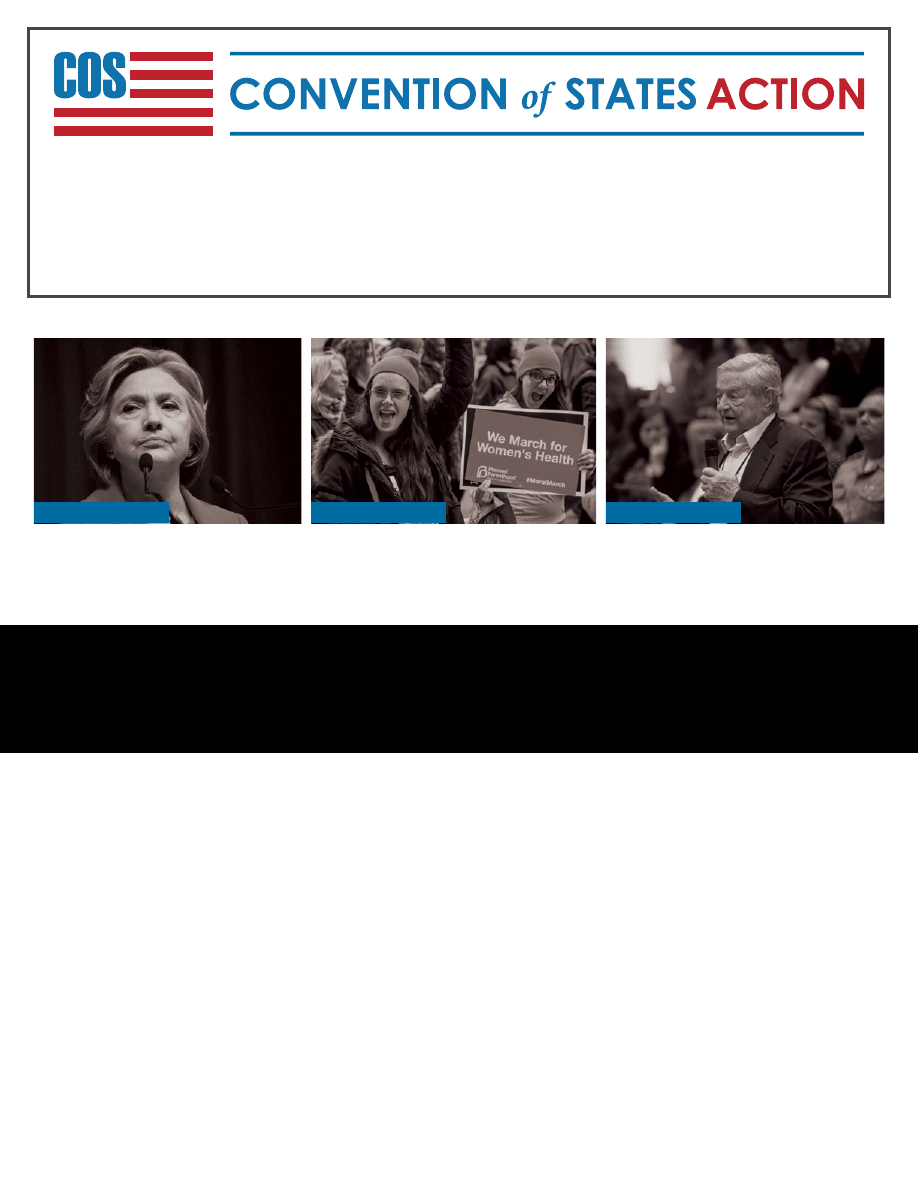
151
146
Harvard Journal of Law & Public Policy
[Vol. 40
power is usurpation. Time does not alter the nature and
quality of either.
505
The parallel fails. First, the Constitution was lawfully adopt-
ed. Second, the Constitution was approved by the direct vote of
the people before anyone was obligated by it. Nothing in this
history provides a parallel to establish an aura of legal or moral
legitimacy for judges who wish to exercise the self-created pre-
rogative to regularly rewrite the Constitution starting the first
Monday of every October.
IV.
C
ONCLUSION
When we raise our hands to swear allegiance to the Constitu-
tion and promise to defend it against all enemies foreign or
domestic, we can do so with a clean conscience. The Constitu-
tional Convention was called by the states. The delegates
obeyed the instructions from their respective legislatures as to
the scope of their authority. The new method for ratification
was a separate act of the Constitutional Convention that was
approved by a unanimous Congress and all thirteen legisla-
tures. The consent of the governed was obtained by having
special elections for delegates to every state ratifying conven-
tion. No state was bound to obey the Constitution until its peo-
ple gave their consent. Moral legitimacy and legal propriety
were in competition at times. But in the end, the Framers found
a way to satisfy both interests.
The Constitution of the United States was validly and legally
adopted.
505. T
HOMAS
P
AINE
,
T
HE
R
IGHTS OF
M
AN
, reprinted in 2 T
HE
W
RITINGS OF
T
HOMAS
P
AINE
, at 265, 428 (Moncure Daniel Conway ed., 1894).
In mid-April, on Good Friday, the George Soros funded left-wing policy group Common Cause declared war on COS, announcing
the formation of the largest radical left alliance in US history.
Almost every radical, liberal, progressive, Marxist group in America signed onto a coalition to oppose the use of
Article V and the Convention of States movement as provided in our Constitution. In doing so, they accomplished something
that even Hillary Clinton and Bernie Sanders couldn’t: they unified the radical left with one voice.
Access to Independence, Inc.
(Madison, WI)
ACE-AFSCME Local 2250
ACLU of Colorado
African American Health Alliance
African American Ministers In
Action
AFSCME 2960
AFSCME 4041
AFSCME Council 3
AFSCME Council 32
AFSCME Council 67
AFSCME Iowa Council 61
AFSCME Retirees
AFSCME Retirees Chapter 32
AFSCME Retirees Chapter 97
Alaska AFL-CIO
Alliance for Justice
America Votes Colorado
American Federation of Labor
and Congress of Industrial
Organizations (AFL–CIO)
American Federation of State,
County and Municipal Employees
American-Arab Anti-Discrimination
Committee
Americans for Democratic Action
(ADA)
Asian and Pacific Islander American
Vote
Baltimore Neighborhoods, Inc.
Bend the Arc Jewish Action
Benedictine Sisters of Baltimore
Better Idaho
Bhutanese Community Association
of Pittsburgh
Brennan Center for Justice
California Common Cause
Campaign Legal Center
Center for American Progress
Center for Community Change
Center for Law and Social Policy
(CLASP)
Center for Media and Democracy
Center for Medicare Advocacy
Center for Popular Democracy
Center on Budget and Policy
Priorities
Children’s Defense Fund
Citizen Action of Wisconsin
Citizens for Responsibility and
Ethics in Washington (CREW)
City of Chino Housing Division
Clean Elections Texas
Cleveland Nonviolence Network
CNY Fair Housing, Inc
Coalition on Human Needs
Colorado AFL-CIO
Colorado Common Cause
Colorado Ethics Watch
Colorado Fiscal Institute
Colorado Sierra Club
Colorado WINS
Common Cause
Common Cause Connecticut
Common Cause Delaware
Common Cause Florida
Common Cause Georgia
Common Cause Hawaii
Common Cause Illinois
Common Cause Indiana
Common Cause Kentucky
Common Cause Maryland
Common Cause Michigan
Common Cause Minnesota
Common Cause Nebraska
What you see below is taken directly from the press release
Issued on Good Friday, April 14, 2017, by Common Cause:
“The undersigned organizations strongly urge state legislatures to oppose efforts to pass a resolution to call for a
constitutional convention. We also strongly urge state legislatures to rescind any application for an Article V constitutional
convention in order to protect all Americans’ constitutional rights and privileges from being put at
risk and up for grabs.” ~ Common Cause
HILLARY CLINTON
PLANNED PARENTHOOD
GEORGE SOROS

152
Common Cause New Mexico
Common Cause New York
Common Cause North Carolina
Common Cause Ohio
Common Cause Oregon
Disability Rights Oregon
Common Cause Pennsylvania
Common Cause Rhode Island
Common Cause Texas
Common Cause Wisconsin
Communications
Workers of America (CWA)
Community Advocates
Public Policy Institute
Community at Holy Family Manor
(Pittsburgh, PA)
Congregation of the Humility of
Mary
Connecticut Fair Housing Center,
Inc.
Conscious Talk Radio
Courage Campaign
Culinary Union
CWA Local 1081
Daily Kos
Democracy 21
Disability Rights Maine
Disability Rights Maryland
Disability Rights North Carolina
Disabled in Action of
Greater Syracuse Inc.
Dominicans of Sinsinawa -
Leadership Council
Downstreet Housing & Community
Development
Dream Defenders
Earthjustice
Eclectablog
Economic Policy Institute
EMILY’s List
End Domestic Abuse Wisconsin
Equality Ohio
Every Voice
Fair Elections Legal Network
Fair Housing Advocates of Northern
California
Fair Housing Center of Central
Indiana
Fair Housing Center of Northern
Alabama
Fair Housing Center of West
Michigan
Faith in Florida
Faith in Public Life
Family Values at Work
Florida Consumer Action Network
Food Research & Action Center
(FRAC)
Franciscan Action Network
Fuse Washington
Grandparents United for Madison
Public Schools
Greater New Orleans Fair Housing
Action Center
Greenpeace USA
Harlingen Community Development
Corporation
Holy Family Home and Shelter, Inc
Idaho AFL-CIO
Independence First
Independent Living Resources
(Durham, NC)
International Association of Fire
Fighters
Iowa AFL-CIO
Jobs With Justice
Just Harvest (Pittsburgh, PA)
Kansas AFL-CIO
Kentucky AFL-CIO
League of Women Voters of
Colorado
League of Women Voters of
Minnesota
League of Women Voters of New
Mexico
League of Women Voters of the
United States
League of Women Voters of
Wisconsin
Long Island Housing Services, Inc.
Madison-area Urban Ministry
Main Street Alliance
Maine AFL-CIO
Maryland Center on Economic
Policy
Massachusetts AFL-CIO
Metropolitan Milwaukee Fair
Housing Council
Mi Familia Vota
Midstate Independent Living
Consultants
Minnesota AFL-CIO
Minnesota Citizens for Clean
Elections
Mississippi AFL-CIO
Monarch Housing Associates
Montana AFL-CIO
NAACP
Nashville CARES
National Asian Pacific American
Families Against Substance Abuse
National Association of Social
Workers
National Association of Social
Workers, Wisconsin Chapter
National Council of Asian Pacific
Americans (NCAPA)
National Council of Jewish Women
National Council of La Raza Action
Fund
National Disability Institute
National Disability Rights Network
National Education Association
(NEA)
National Employment Law Project
(NELP)
National Fair Housing Alliance
National Korean American Service
& Education Consortium
National Partnership for Women &
Families
National WIC Association
National Women’s Law Center
Nebraskans for Civic Reform
New Era Colorado
New Hampshire AFL-CIO
New Jersey Association of
Mental Health and Addiction
New Mexico Hospital Workers Union
(1199NM)
North Dakota AFL-CIO
Oak Park River Forest Food Pantry
Ohio Voice
Oklahoma AFL-CIO
OMNI Center for Peace, Justice &
Ecology
One Wisconsin Now
Options for Independent Living Inc.
(Green Bay, WI)
P.S., A Partnership
People Demanding Action
People For the American Way
Planned Parenthood of Southern
New England
Progress Colorado
Progress Florida
Progress Michigan
Progress Now
Progress Ohio
Project IRENE
Public Justice Center
Schenectady Inner City Ministry
School Sisters of Saint Francis
(Milwaukee)
SEIU Colorado
Service Employees International
Union (SEIU)
Sierra Club
Sisters of Charity of Nazareth
Congregational Leadership
Social Security Works
Solidarity Committee of the Capital
District
South Carolina AFL-CIO
South Dakota AFL-CIO
Southwest Fair Housing Council
State Innovation Exchange
Survival Coalition of Disability
Organization of Wisconsin
Tabitha’s Way
The Arc of the United States
The Arc Wisconsin
The Forum for Youth Investment
The Public Interest
The Voting Rights Institute
The Wisconsin Democracy
Campaign
The Xaverian Brothers
Toledo Area Jobs with Justice
Toledo Fair Housing Center
UNITE HERE
United Food and Commercial
Workers (UFCW)
Virginia AFL-CIO
Virginia Civic Engagement Table
Vision for Children at Risk
Voice for Adoption
Vote Vets Action Fund
Washington AFL-CIO
Washington Community Action
Network
West Virginia Citizen Action Group
Wisconsin AFL-CIO
Wisconsin Aging Advocacy Network
Wisconsin Coalition of Independent
Living Centers, Wisconsin
Community Action Program
Association (WISCAP)
Wisconsin Council on Children and
Families
Wisconsin Democracy Campaign
Wisconsin Faith Voices for Justice
Wisconsin Voices
Women’s Voices Women Vote Action
Fund Working America
Wyoming AFL-CIO
T
he Article V mechanism is safe, and it is the only
constitutionally eff ective means available to do what
is so essential for our nation.
The Constitution’s Framers foresaw a day when the federal
government would exceed and abuse its enumerated
powers, thus placing our liberty at risk. George Mason was
instrumental in fashioning a mechanism by which “we the
people” could defend our freedom—the ultimate check on
federal power contained in Article V of the Constitution.
Article V provides the states with the opportunity to
propose constitutional amendments through a process
controlled by the states from beginning to end on all
substantive matters.
A convention to propose amendments is convened when
34 state legislatures pass resolutions (applications) on an
agreed topic or set of topics. The Convention is limited to
considering amendments on these specifi ed topics.
While some have expressed fears that an Article V
convention might be misused or improperly controlled by
Congress, it is our considered judgment that the checks
Signed,
The
JEFFERSON
STATEMENT
Original signers of the Jeff erson Statement
Randy E. Barnett
Charles J. Cooper
John C. Eastman
Michael P. Farris
Robert P. George
C. Boyden Gray
Mark Levin
Nelson Lund
Andrew McCarthy
Mark Meckler
Mat Staver
When the nation’s fi nest legal minds gathered at the Jeff erson Hotel in Washington, D.C., they set out to
consider arguments for and against the use of Article V to restrain federal power. But like the Founding
Fathers in 1787, they soon realized that they agreed unanimously that the Article V option is safe, eff ective,
and necessary.
These experts, who subsequently signed the Jeff erson Statement reproduced below, rejected the argument
that an Article V convention is likely to be misused or improperly controlled by Congress. They shared the
conviction that Article V provides the only constitutionally eff ective means to restore our federal system,
and they formed the core of our Legal Board of Reference, whose names you can fi nd on the opposite side
of this document.
MARK LEVIN
MARK MECKLER
MICHAEL FARRIS
and balances in the Constitution are more than sufficient
to ensure the integrity of the process.
The Article V mechanism is safe, and it is the only
constitutionally eff ective means available to do what is so
essential for our nation—restoring robust federalism with
genuine checks on the power of the federal government.
We share the Founders’ conviction that proper decision-
making structures are essential to preserve liberty. We
believe that the problems facing our nation require several
structural limitations on the exercise of federal power. While
fi scal restraints are essential, we believe the most eff ective
course is to pursue reasonable limitations, fully in line with
the vision of our Founders, on the federal government.
Accordingly, I endorse the Convention of States Project,
which calls for an Article V convention for “the sole purpose
of proposing amendments that impose fi scal restraints on
the federal government, limit the power and jurisdiction of
the federal government, and limit the terms of offi ce for its
offi cials and for members of Congress.” I hereby agree to
serve on the Legal Board of Reference for the Convention
of States Project.

153
Common Cause New Mexico
Common Cause New York
Common Cause North Carolina
Common Cause Ohio
Common Cause Oregon
Disability Rights Oregon
Common Cause Pennsylvania
Common Cause Rhode Island
Common Cause Texas
Common Cause Wisconsin
Communications
Workers of America (CWA)
Community Advocates
Public Policy Institute
Community at Holy Family Manor
(Pittsburgh, PA)
Congregation of the Humility of
Mary
Connecticut Fair Housing Center,
Inc.
Conscious Talk Radio
Courage Campaign
Culinary Union
CWA Local 1081
Daily Kos
Democracy 21
Disability Rights Maine
Disability Rights Maryland
Disability Rights North Carolina
Disabled in Action of
Greater Syracuse Inc.
Dominicans of Sinsinawa -
Leadership Council
Downstreet Housing & Community
Development
Dream Defenders
Earthjustice
Eclectablog
Economic Policy Institute
EMILY’s List
End Domestic Abuse Wisconsin
Equality Ohio
Every Voice
Fair Elections Legal Network
Fair Housing Advocates of Northern
California
Fair Housing Center of Central
Indiana
Fair Housing Center of Northern
Alabama
Fair Housing Center of West
Michigan
Faith in Florida
Faith in Public Life
Family Values at Work
Florida Consumer Action Network
Food Research & Action Center
(FRAC)
Franciscan Action Network
Fuse Washington
Grandparents United for Madison
Public Schools
Greater New Orleans Fair Housing
Action Center
Greenpeace USA
Harlingen Community Development
Corporation
Holy Family Home and Shelter, Inc
Idaho AFL-CIO
Independence First
Independent Living Resources
(Durham, NC)
International Association of Fire
Fighters
Iowa AFL-CIO
Jobs With Justice
Just Harvest (Pittsburgh, PA)
Kansas AFL-CIO
Kentucky AFL-CIO
League of Women Voters of
Colorado
League of Women Voters of
Minnesota
League of Women Voters of New
Mexico
League of Women Voters of the
United States
League of Women Voters of
Wisconsin
Long Island Housing Services, Inc.
Madison-area Urban Ministry
Main Street Alliance
Maine AFL-CIO
Maryland Center on Economic
Policy
Massachusetts AFL-CIO
Metropolitan Milwaukee Fair
Housing Council
Mi Familia Vota
Midstate Independent Living
Consultants
Minnesota AFL-CIO
Minnesota Citizens for Clean
Elections
Mississippi AFL-CIO
Monarch Housing Associates
Montana AFL-CIO
NAACP
Nashville CARES
National Asian Pacific American
Families Against Substance Abuse
National Association of Social
Workers
National Association of Social
Workers, Wisconsin Chapter
National Council of Asian Pacific
Americans (NCAPA)
National Council of Jewish Women
National Council of La Raza Action
Fund
National Disability Institute
National Disability Rights Network
National Education Association
(NEA)
National Employment Law Project
(NELP)
National Fair Housing Alliance
National Korean American Service
& Education Consortium
National Partnership for Women &
Families
National WIC Association
National Women’s Law Center
Nebraskans for Civic Reform
New Era Colorado
New Hampshire AFL-CIO
New Jersey Association of
Mental Health and Addiction
New Mexico Hospital Workers Union
(1199NM)
North Dakota AFL-CIO
Oak Park River Forest Food Pantry
Ohio Voice
Oklahoma AFL-CIO
OMNI Center for Peace, Justice &
Ecology
One Wisconsin Now
Options for Independent Living Inc.
(Green Bay, WI)
P.S., A Partnership
People Demanding Action
People For the American Way
Planned Parenthood of Southern
New England
Progress Colorado
Progress Florida
Progress Michigan
Progress Now
Progress Ohio
Project IRENE
Public Justice Center
Schenectady Inner City Ministry
School Sisters of Saint Francis
(Milwaukee)
SEIU Colorado
Service Employees International
Union (SEIU)
Sierra Club
Sisters of Charity of Nazareth
Congregational Leadership
Social Security Works
Solidarity Committee of the Capital
District
South Carolina AFL-CIO
South Dakota AFL-CIO
Southwest Fair Housing Council
State Innovation Exchange
Survival Coalition of Disability
Organization of Wisconsin
Tabitha’s Way
The Arc of the United States
The Arc Wisconsin
The Forum for Youth Investment
The Public Interest
The Voting Rights Institute
The Wisconsin Democracy
Campaign
The Xaverian Brothers
Toledo Area Jobs with Justice
Toledo Fair Housing Center
UNITE HERE
United Food and Commercial
Workers (UFCW)
Virginia AFL-CIO
Virginia Civic Engagement Table
Vision for Children at Risk
Voice for Adoption
Vote Vets Action Fund
Washington AFL-CIO
Washington Community Action
Network
West Virginia Citizen Action Group
Wisconsin AFL-CIO
Wisconsin Aging Advocacy Network
Wisconsin Coalition of Independent
Living Centers, Wisconsin
Community Action Program
Association (WISCAP)
Wisconsin Council on Children and
Families
Wisconsin Democracy Campaign
Wisconsin Faith Voices for Justice
Wisconsin Voices
Women’s Voices Women Vote Action
Fund Working America
Wyoming AFL-CIO
T
he Article V mechanism is safe, and it is the only
constitutionally eff ective means available to do what
is so essential for our nation.
The Constitution’s Framers foresaw a day when the federal
government would exceed and abuse its enumerated
powers, thus placing our liberty at risk. George Mason was
instrumental in fashioning a mechanism by which “we the
people” could defend our freedom—the ultimate check on
federal power contained in Article V of the Constitution.
Article V provides the states with the opportunity to
propose constitutional amendments through a process
controlled by the states from beginning to end on all
substantive matters.
A convention to propose amendments is convened when
34 state legislatures pass resolutions (applications) on an
agreed topic or set of topics. The Convention is limited to
considering amendments on these specifi ed topics.
While some have expressed fears that an Article V
convention might be misused or improperly controlled by
Congress, it is our considered judgment that the checks
Signed,
The
JEFFERSON
STATEMENT
Original signers of the Jeff erson Statement
Randy E. Barnett
Charles J. Cooper
John C. Eastman
Michael P. Farris
Robert P. George
C. Boyden Gray
Mark Levin
Nelson Lund
Andrew McCarthy
Mark Meckler
Mat Staver
When the nation’s fi nest legal minds gathered at the Jeff erson Hotel in Washington, D.C., they set out to
consider arguments for and against the use of Article V to restrain federal power. But like the Founding
Fathers in 1787, they soon realized that they agreed unanimously that the Article V option is safe, eff ective,
and necessary.
These experts, who subsequently signed the Jeff erson Statement reproduced below, rejected the argument
that an Article V convention is likely to be misused or improperly controlled by Congress. They shared the
conviction that Article V provides the only constitutionally eff ective means to restore our federal system,
and they formed the core of our Legal Board of Reference, whose names you can fi nd on the opposite side
of this document.
MARK LEVIN
MARK MECKLER
MICHAEL FARRIS
and balances in the Constitution are more than sufficient
to ensure the integrity of the process.
The Article V mechanism is safe, and it is the only
constitutionally eff ective means available to do what is so
essential for our nation—restoring robust federalism with
genuine checks on the power of the federal government.
We share the Founders’ conviction that proper decision-
making structures are essential to preserve liberty. We
believe that the problems facing our nation require several
structural limitations on the exercise of federal power. While
fi scal restraints are essential, we believe the most eff ective
course is to pursue reasonable limitations, fully in line with
the vision of our Founders, on the federal government.
Accordingly, I endorse the Convention of States Project,
which calls for an Article V convention for “the sole purpose
of proposing amendments that impose fi scal restraints on
the federal government, limit the power and jurisdiction of
the federal government, and limit the terms of offi ce for its
offi cials and for members of Congress.” I hereby agree to
serve on the Legal Board of Reference for the Convention
of States Project.
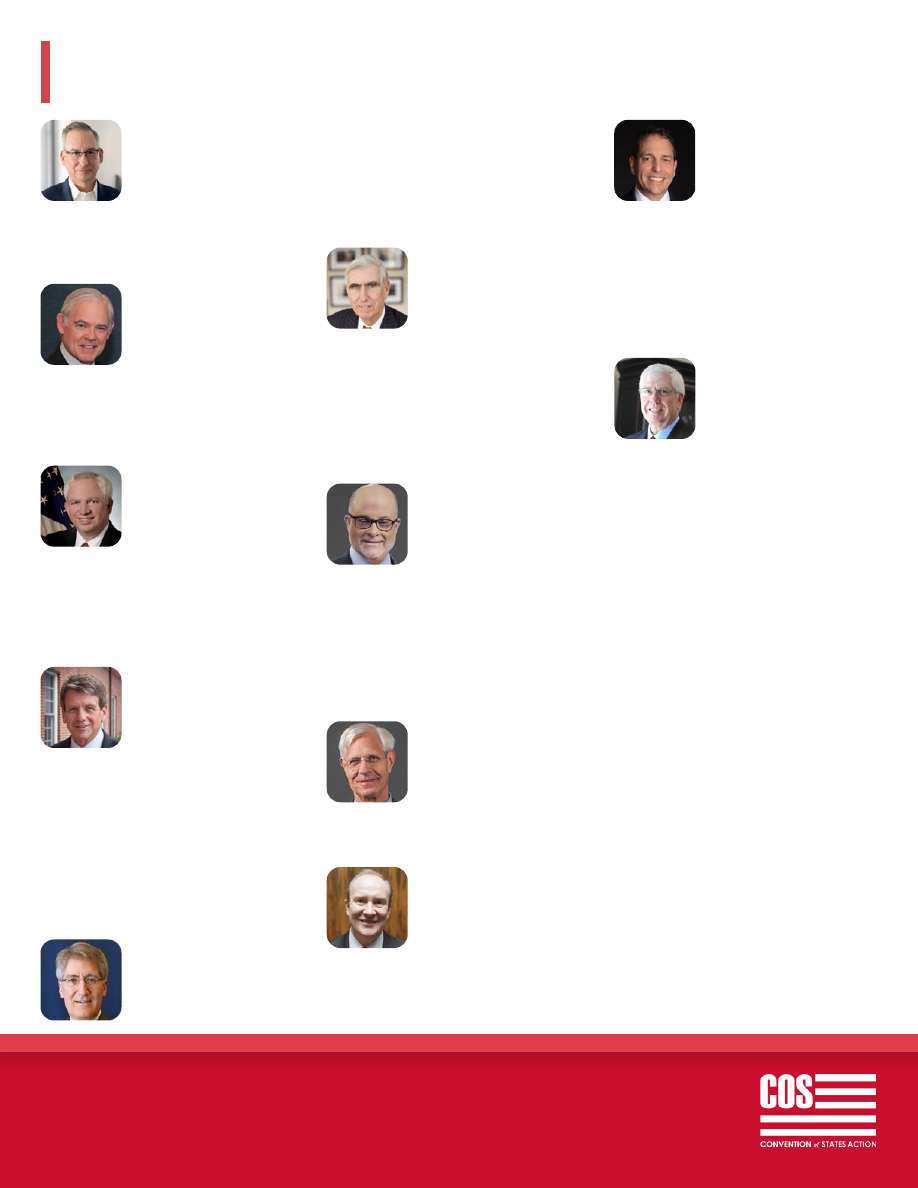
154
Randy E. Barnett
is a
graduate of Harvard Law
School and a professor at
the Georgetown University
Law Center. He represented
the National Federation of Independent
Business in its constitutional challenge to the
Aff ordable Care Act.
Charles J. Cooper
is a
founding member and
chairman of Cooper & Kirk,
PLLC. A member of the
Reagan Administration,
Mr. Cooper has argued before the Supreme
Court, and he spent much of his career
defending constitutional rights as a top lawyer
for the National Rifl e Association.
John C. Eastman
is the
Founding Director of the
Center for Constitutional
Jurisprudence, a public
interest law firm affiliated
with the Claremont Institute. Prior to joining
the Fowler School of Law faculty, he served
as a law clerk with Justice Clarence Thomas at
the Supreme Court of the United States and
served in the Reagan administration.
Michael P. Farris
is the co-
founder of the Convention
of States Project, the
Chancellor of Patrick Henry
College, and Chairman of
the Home School Legal Defense Association.
During his career as a constitutional appellate
litigator, he has served as lead counsel in
the United States Supreme Court, eight
federal circuit courts, and the appellate
courts of thirteen states. Mr. Farris is widely
respected for his leadership in the defense of
homeschooling, religious freedom, and the
preservation of American sovereignty.
Robert P. George
is one
of the nation’s leading
conservative legal scholars
and is the founding director
of the James Madison Program in American
Ideals and Institutions. He is chairman of the
United States Commission on International
Religious Freedom (USCIRF) and has served
as a presidential appointee to the United
States Commission on Civil Rights.
C. Boyden Gray
is the
founding partner of Boyden
Gray & Associates, in
Washington, D.C. Prior
to founding his law firm,
Ambassador Gray served as Legal Counsel
to Vice President Bush (1981–1989), as
White House Counsel in the administration
of President George H.W. Bush (1989–1993),
and as counsel to the Presidential Task Force
on Regulatory Relief during the Reagan
Administration.
Mark Levin
is one of
America’s preeminent
constitutional lawyers and
the author of several New
York Times bestselling books
including Men in Black (2007), Liberty and
Tyranny (2010), Ameritopia (2012) and The
Liberty Amendments (2013). Mr. Levin has
served as a top advisor to several members
of President Ronald Reagan’s Cabinet—
including as Chief of Staff to the Attorney
General of the United States, Edwin Meese.
Nelson Lund
is University
Professor at George Mason
University School of Law.
After clerking for Justice
Sandra Day O’Connor,
he served in the White House as Associate
Counsel to President George H.W. Bush.
Andrew McCarthy
is a
bestselling author, a Senior
Fellow at National Review
Institute, and a contributing
editor at National Review.
Mr. McCarthy is a former Chief Assistant
U.S. Attorney in New York.
[email protected]
M a r k M e c k l e r
i s
President of Convention
of States Foundation, the
parent organization of
the Convention of States
Project. Mr. Meckler is one of the nation’s
most eff ective grassroots activists. After he
co-founded and served as the National
Coordinator of the Tea Party Patriots, he
founded Citizens for Self-Governance in 2012
to bring the concept of “self governance”
back to American government.
Mat Staver,
B.A. M.A., J.D.,
B.C.S.
, serves as Senior Pastor,
Founder and Chairman of
Liberty Counsel; Chairman
of Liberty Counsel Action,
Faith and Liberty, National Pro-life Center,
Freedom Federation, Salt & Light Council,
and National House of Hope; Founder and
Chairman of Liberty Relief International; Vice
President and Chief Counsel of the National
Hispanic Christian Leadership Conference
(which includes over 42,000 Evangelical
Hispanic churches); Trustee, Timothy Plan, a
family of mutual funds traded in New York
and Tel Aviv; and former dean of Liberty
University School of Law. Mat has the highest
AV rating for attorneys and is board certifi ed
in Appellate Practice by the Florida Bar. He
has argued before the U.S. Supreme Court.
He has published many scholarly and popular
articles, brochures, numerous booklets and
books, including Why Israel Matters, Covenant
Journal, and Eternal Vigilance. He has produced
the “Why Israel Matters” original TV, as well
as produces and hosts Faith & Freedom, an
11-minute daily radio program, Freedom’s
Call, a 60-second daily radio program, and
Freedom Alive, a 30-minute weekly TV
program. He is married to Anita, who is
president of Liberty Counsel. Mat and Anita
have one daughter, three grandchildren, and
two great grandchildren.
“The Article V mechanism is safe, and it is the only constitutionally effective
means available to do what is so essential for our nation.”
Support the only solution that is as big as the problem.
Sign the petition at ConventionofStates.com.
www.conventionofstates.com

155
Randy E. Barnett
is a
graduate of Harvard Law
School and a professor at
the Georgetown University
Law Center. He represented
the National Federation of Independent
Business in its constitutional challenge to the
Aff ordable Care Act.
Charles J. Cooper
is a
founding member and
chairman of Cooper & Kirk,
PLLC. A member of the
Reagan Administration,
Mr. Cooper has argued before the Supreme
Court, and he spent much of his career
defending constitutional rights as a top lawyer
for the National Rifl e Association.
John C. Eastman
is the
Founding Director of the
Center for Constitutional
Jurisprudence, a public
interest law firm affiliated
with the Claremont Institute. Prior to joining
the Fowler School of Law faculty, he served
as a law clerk with Justice Clarence Thomas at
the Supreme Court of the United States and
served in the Reagan administration.
Michael P. Farris
is the co-
founder of the Convention
of States Project, the
Chancellor of Patrick Henry
College, and Chairman of
the Home School Legal Defense Association.
During his career as a constitutional appellate
litigator, he has served as lead counsel in
the United States Supreme Court, eight
federal circuit courts, and the appellate
courts of thirteen states. Mr. Farris is widely
respected for his leadership in the defense of
homeschooling, religious freedom, and the
preservation of American sovereignty.
Robert P. George
is one
of the nation’s leading
conservative legal scholars
and is the founding director
of the James Madison Program in American
Ideals and Institutions. He is chairman of the
United States Commission on International
Religious Freedom (USCIRF) and has served
as a presidential appointee to the United
States Commission on Civil Rights.
C. Boyden Gray
is the
founding partner of Boyden
Gray & Associates, in
Washington, D.C. Prior
to founding his law firm,
Ambassador Gray served as Legal Counsel
to Vice President Bush (1981–1989), as
White House Counsel in the administration
of President George H.W. Bush (1989–1993),
and as counsel to the Presidential Task Force
on Regulatory Relief during the Reagan
Administration.
Mark Levin
is one of
America’s preeminent
constitutional lawyers and
the author of several New
York Times bestselling books
including Men in Black (2007), Liberty and
Tyranny (2010), Ameritopia (2012) and The
Liberty Amendments (2013). Mr. Levin has
served as a top advisor to several members
of President Ronald Reagan’s Cabinet—
including as Chief of Staff to the Attorney
General of the United States, Edwin Meese.
Nelson Lund
is University
Professor at George Mason
University School of Law.
After clerking for Justice
Sandra Day O’Connor,
he served in the White House as Associate
Counsel to President George H.W. Bush.
Andrew McCarthy
is a
bestselling author, a Senior
Fellow at National Review
Institute, and a contributing
editor at National Review.
Mr. McCarthy is a former Chief Assistant
U.S. Attorney in New York.
[email protected]
M a r k M e c k l e r
i s
President of Convention
of States Foundation, the
parent organization of
the Convention of States
Project. Mr. Meckler is one of the nation’s
most eff ective grassroots activists. After he
co-founded and served as the National
Coordinator of the Tea Party Patriots, he
founded Citizens for Self-Governance in 2012
to bring the concept of “self governance”
back to American government.
Mat Staver,
B.A. M.A., J.D.,
B.C.S.
, serves as Senior Pastor,
Founder and Chairman of
Liberty Counsel; Chairman
of Liberty Counsel Action,
Faith and Liberty, National Pro-life Center,
Freedom Federation, Salt & Light Council,
and National House of Hope; Founder and
Chairman of Liberty Relief International; Vice
President and Chief Counsel of the National
Hispanic Christian Leadership Conference
(which includes over 42,000 Evangelical
Hispanic churches); Trustee, Timothy Plan, a
family of mutual funds traded in New York
and Tel Aviv; and former dean of Liberty
University School of Law. Mat has the highest
AV rating for attorneys and is board certifi ed
in Appellate Practice by the Florida Bar. He
has argued before the U.S. Supreme Court.
He has published many scholarly and popular
articles, brochures, numerous booklets and
books, including Why Israel Matters, Covenant
Journal, and Eternal Vigilance. He has produced
the “Why Israel Matters” original TV, as well
as produces and hosts Faith & Freedom, an
11-minute daily radio program, Freedom’s
Call, a 60-second daily radio program, and
Freedom Alive, a 30-minute weekly TV
program. He is married to Anita, who is
president of Liberty Counsel. Mat and Anita
have one daughter, three grandchildren, and
two great grandchildren.
“The Article V mechanism is safe, and it is the only constitutionally effective
means available to do what is so essential for our nation.”
Support the only solution that is as big as the problem.
Sign the petition at ConventionofStates.com.
www.conventionofstates.com
This page is intentionally left blank
 |
—-
| Page Metadata ||
|Login Required to view? |No |
|Created: |2017-07-06 11:08 GMT |
|Updated: |2025-10-24 20:12 GMT |
|Published: |2017-07-17 12:00 GMT |
|Converted: |2025-11-11 12:07 GMT |
|Change Author: |Convention Of States Project|
|Credit Author: | |
|
—-
| Page Metadata ||
|Login Required to view? |No |
|Created: |2017-07-06 11:08 GMT |
|Updated: |2025-10-24 20:12 GMT |
|Published: |2017-07-17 12:00 GMT |
|Converted: |2025-11-11 12:07 GMT |
|Change Author: |Convention Of States Project|
|Credit Author: | |